

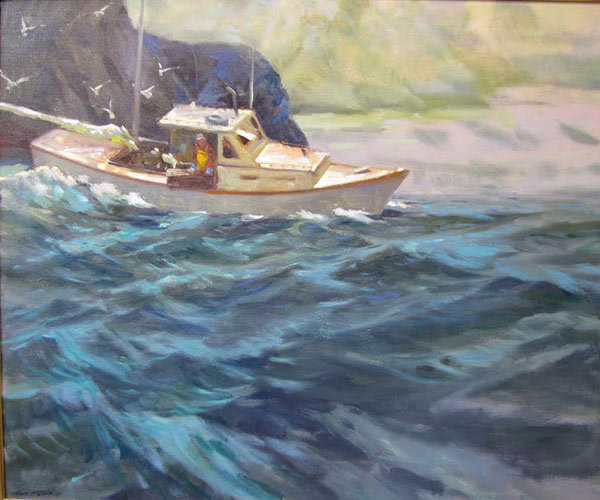
The Rockport Art Association recently opened a dazzling exhibition highlighting the life and career of Don Stone, which is on view through the end of December.
Via the Rockport Art Association, “The Rockport Art Association will open a special exhibition entitled “Don Stone, N.A. Retrospective” at its historic gallery complex in Rockport, Massachusetts on November 21. “Don Stone, N.A. Retrospective” is a retrospect exhibition tracing the prolific career of internationally known modern impressionist painter Don Stone (1929-2015). With over 100 artworks on loan from the Stone family as well as area collectors, this exhibition will showcase Stone’s career that spanned over six decades.”
To learn more, visit Rockport Art Association.
December 31: Don Stone Retrospective Closes
December 17: Shared Heritage Lecture & Exhibition
In the wake of the destruction of irreplaceable cultural monuments by the Islamic State in Iraq and Syria (ISIS), there are many who fight – in a variety of ways – to protect Humanity’s heritage.
The devastating effects of Islamic extremism in the Middle East have touched almost every part of the globe. Most important to remember are the innocent lives lost and families affected by continued senseless attacks as well as the men and women who have paid the ultimate price to protect their countries.
In addition to the destruction of human life has also come the bombing, bulldozing, and demolition of irreplaceable cultural artifacts and sites that have formed the core of what we know about the birth of civilization in Mesopotamia.
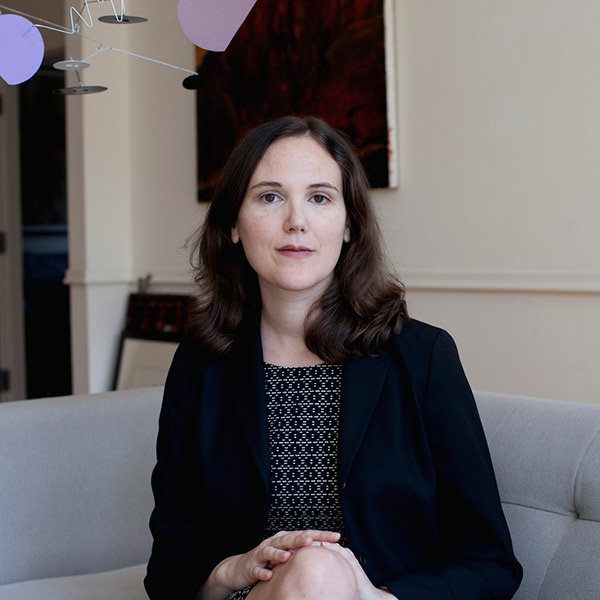
“ ‘The Missing: Rebuilding the Past’ is the first exhibition to showcase the efforts of artists and scholars to resist the destruction of the past through creative and innovative reactions, protests, and reconstructions. The curator, Professor Erin Thompson, will talk about its works, in a variety of media – photography, drawing, video, 3D printing – which explore the destruction of art at many historical moments, from ancient Greece to World War II to the present. The artists and scholars of “The Missing” show that there are many ways, from the creative to the technical, in which they and we can help fight ISIS’ message by making the destroyed past live again. Erin Thompson is America’s only full-time professor of art crime. She studies the damage done to humanity’s shared heritage through looting, theft, and the deliberate destruction of art. Currently, she is researching the ways in which terrorist groups sell and destroy antiquities in order to support their genocidal campaigns. She has discussed art crime topics in The New York Times and on CNN, NPR, Al Jazeera America, and the Freakonomics podcast. Her book, Possession: The Curious History of Private Collectors, will be published by Yale University Press next year.”
Dr. Thompson’s lecture will take place December 17 at the National Arts Club in New York City.
To learn more, visit the National Arts Club.
Featured Artwork: Richard Schmid
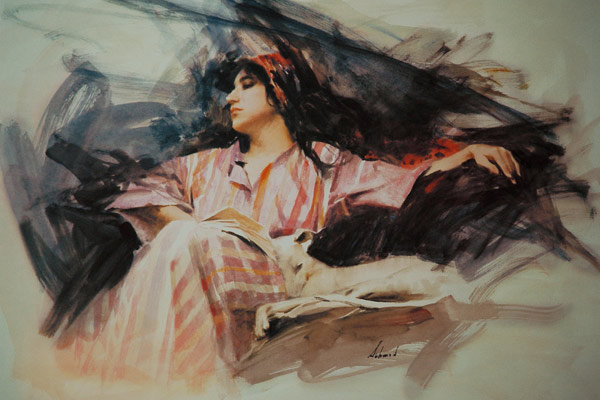
Richard Schmid
“Robin & Whippet”
Ltd Signed Lithograph
17 x 21 in.
http://www.richardschmid.com/product-p/strsl036.htm
For Info Contact:
Molly Schmid
[email protected]
850-728-7959
About the Artist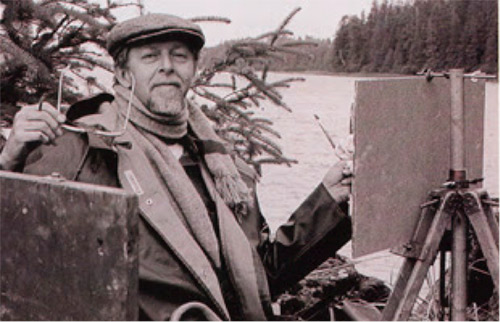
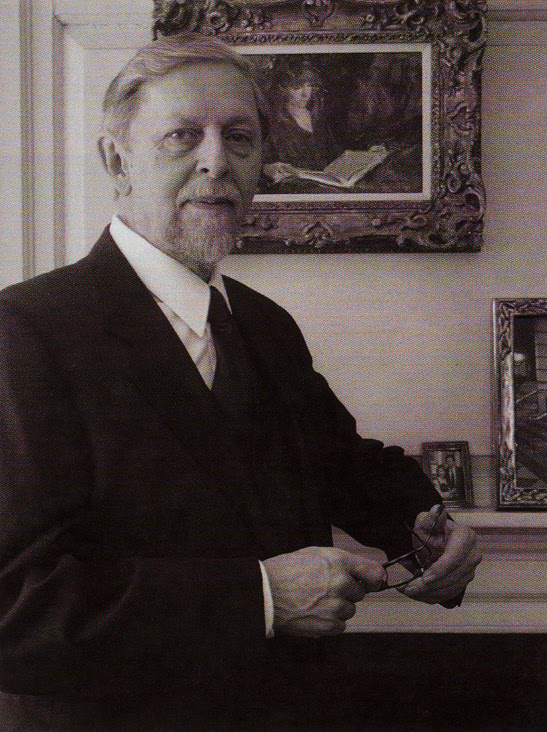
Richard Schmid was born in Chicago, Illinois in 1934. His earliest artistic influence came from his maternal grandfather, Julian Oates, an architectural sculptor. Richard’s initial training in landscape painting began at the age of twelve with the Chicago painter Gianni Cilfone. Subsequent studies in anatomy and figure drawing allowed his entrance at eighteen into the American Academy of Art in Chicago where he continued into the full range of classical techniques under William H. Mosby.
William Mosby, a graduate of the Belgian Royal Academy in Brussels and the Superior Institute in Antwerp, was a technical expert on European and American realism. Studies with him involved working exclusively from life, at first using the conceptual and technical methods of the Flemish, Dutch, and Spanish masters, and eventually all of the late 19th century European and American painters.
Throughout his career, which saw fifty one-man shows, Richard Schmid has promoted art education through his books, articles, workshops, seminars, and television presentations. He travels widely for his subjects, and currently lives in New Hampshire with his wife, the painter Nancy Guzik. Richard holds a Doctorate in Fine Art and is a recipient of The John Singer Sargent Medal for Lifetime Achievement.
Since the publication of his landmark book on landscape painting in 2009, Richard has been involved in two major projects. The first, in 2011, was a very large painting of Abbotsford House, the Manor home of Sir Walter Scott in Scotland, which won a viewing and praise from HRH Queen Elizabeth during grand re-openning ceremonies of the house and visitors center.
The second project, begun in 2011, was the new expanded edition of Alla Prima, ALLA PRIMA II, completed in 2013, and now in its second printing. Additionally, exhibitions of Richard’s art were mounted at the National Academy of Science on Cape Cod, and Wellesley College in Boston.
Throughout his distinguished career as a painter, author, and teacher, Richard Schmid has been a candid spokesman for what is known as the Grand Manner—a certain mingling of virtuosity and unrestrained joy in art. Richard continues to paint, write and enjoy life with his wife, the artist Nancy Guzik, in the bucolic setting of their New Hampshire home.
Richard Schmid’s work has been represented in the following:
The Smithsonian Institution
The National Academy of Sciences
The Pennsylvania Academy of Fine Arts The Art Institute of Chicago
The Harvard Club
The Connecticut Academy of Fine Arts The National Academy of Design
The American Watercolor Society
The Thomas Gilcrease Museum
The Frye Museum
The Allied Artists of America
The Colorado Historical Society
The Butler Institute of American Art The Holter Museum
The St. Louis Artist’s Guild
The Colorado Springs Fine Arts Center
The Salmagundi Club
The Tucson Museum of Art
The Albuquerque Museum of Art
The Loveland Museum
The Beijing Exhibition Center, China
Fields of Dream
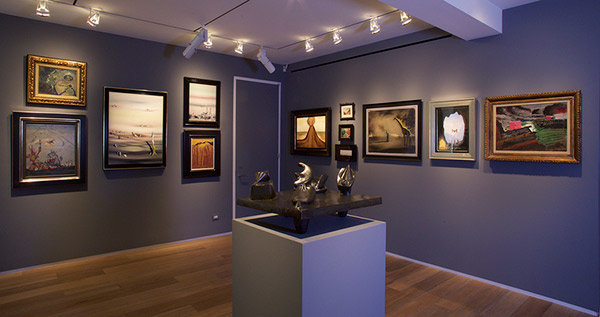
Caught between fantasy and reality, the birth of surrealism in art was a profound moment of personal expression and psychological investigation. Just a few weeks remain before the doors close on a compelling landscape exhibition in New York City.
Melting clocks, irregular forms, mysterious spaces, and optical oddities are all commonplace and, perhaps, normal for the surrealist artist. Although the enigmatic Salvador Dalí may be the first name called to mind when Surrealism is mentioned, a wide variety of artists experimented with the metaphysical style as early as the 18th century. For the surrealist, the choice of subject was, as one would expect, nearly infinite in possibility, but “Fields of Dream” at Di Donna Gallery in New York City is taking a look at the style’s exploration of landscape through the eyes of 31 masters.
From the gallery’s website: “Encyclopedic in scope, the exhibition opens chronologically with a 17th century anthropomorphic landscape after Matthäus Merian the Elder, and unravels into the fertile territory of how the Surrealists expanded upon the genre of landscape. Similarly, Salvador Dalí’s Mysterious Mouth Appearing in the Back of my Nurse, 1941, presents figures in a landscape oddly composing a female head. Greek-born Italian artist Giorgio de Chirico’s Méditation matinale, painted in Paris in 1911-12, is a melancholic cityscape whose vantage point looks out onto the sea, echoing with mysterious nods to antiquity. His metaphysical works became exemplary for the Surrealist movement, rekindling an interest in deep pictorial space. In his Thébes,1928, a classical Greek temple and ruins sit upon a rocky landscape, uncannily staged in a domestic interior replete with wood parquetry.”
Over six dozen artworks loaned from several public and private collections will feature in the show, which surely gives an in-depth look into one of the most controversial and creative styles ever created. The exhibition will include works by Hans Bellmer, Victor Brauner, André Breton, Alexander Calder, Leonora Carrington, Federico Castellón, Giorgio de Chirico, Salvador Dalí, Adrien Dax, Paul Delvaux, Oscar Domínguez, Enrico Donati, Paul Eluard, Jimmy Ernst, Max Ernst, Leonor Fini, Arshile Gorky, Marcel Jean, Jacqueline Lamba, René Magritte, Man Ray, Matta, Joan Miró, Gordon Onslow Ford, Wolfgang Paalen, Pablo Picasso, Kay Sage, Kurt Seligmann, Yves Tanguy, Dorothea Tanning, and Antoni Tàpies.
“Fields of Dream: The Surrealist Landscape” will be on view through December 18.
To learn more, visit Di Donna Gallery.
This article was featured in Fine Art Today, a weekly e-newsletter from Fine Art Connoisseur magazine. To start receiving Fine Art Today for free, click here.
NADA and Art Basel 2015 in Miami Beach
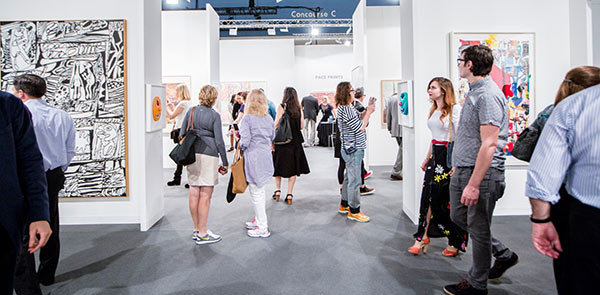
The New Art Dealers Alliance and Art Basel are set for a major string of exhibitions and events in sunny Miami Beach, Florida. Find out who’s exhibiting, must-attend events, and more!
Since 2001, one of North America’s preeminent international art fairs has called Miami Beach home, featuring over 250 fine art galleries from over 31 countries. From December 3-6, the city will be bustling with eager art lovers, collectors, and casual viewers alike as they browse a host of events and “satellite fairs” that have been spawned in the wake of Art Basel Miami’s success: including NADA, the New Art Dealers Alliance, which will showcase some 150 exhibitors and projects from 15 countries.
Organizers of the fair created this trailer for the 2015 Flim events:
A full events calendar can be found here: 2015 Events Calendar
Curious to find out who’s exhibiting? A full list can be found here: 2015 List of Exhibitors
To learn more, visit Art Basel.
This article was featured in Fine Art Today, a weekly e-newsletter from Fine Art Connoisseur magazine. To start receiving Fine Art Today for free, click here.
Essential Moments
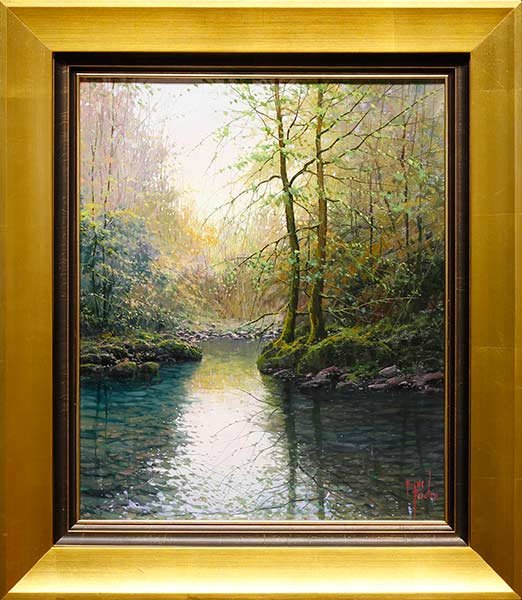
Every day is the first day in the studio of Spaniard Miguel Peidro, whose humbling process and inspiration result in magnetic natural beauty.
Viewing the paintings of Spanish artist Miguel Peidro is almost like travelling back in time to the moment one falls in love with art for the first time. Simple in subject and nearly photographic in their naturalism, works such as “Les Baronnies, French Pyrenees” leave audiences in sheer awe of what the human hand can achieve in paint. Working out of his studio in Spain, Peidro’s creative process is as humble as they come and touches on the core of what many artists seek to achieve in their pictures. “My creative process has to do with my love of nature,” he says. “I paint what moves me, what gives me sensations. My intent in my paintings is to convey emotions, nostalgias, yearnings; I want it to be that, when a viewer observes my work, he or she remembers pleasant moments. My paintings are not made for thinking, they’re made for feeling!”
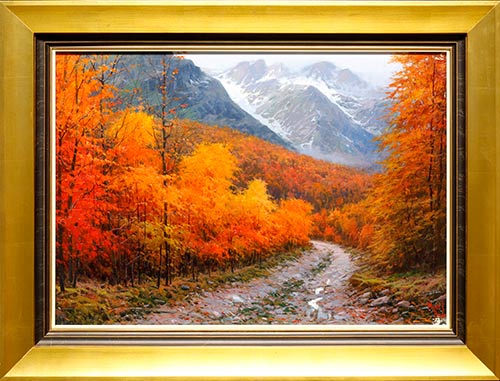
Miguel Peidro, “Autumn in the Pyrenees,” oil on canvas, (c) Miguel Peidro, 2015
From his earliest memories, Peidro recalls always having crayons in his hands but never predicted his journey would lead him to become a successful painter. Be that as it may, the man couldn’t be happier with his current state. He suggests, “My goals in art have largely been met. I’m happy. Every day I go to my studio as if it was the first day, I do my job and I’m lucky to be able to look at what I like.” These sentiments translate well into his pictures; they each have a positive energy that is infectious and captivating. Continuing, he writes, “The struggle of the artist is to convey what he or she feels, this is the language of expression, and to get you to feel happy.”
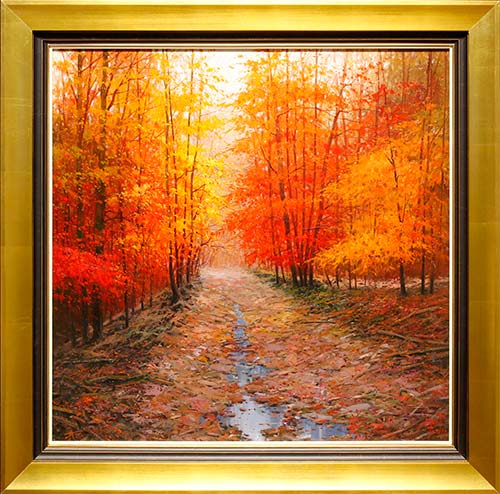
Miguel Peidro, “Peaks of Europe,” oil on canvas, (c) Miguel Peidro, 2015
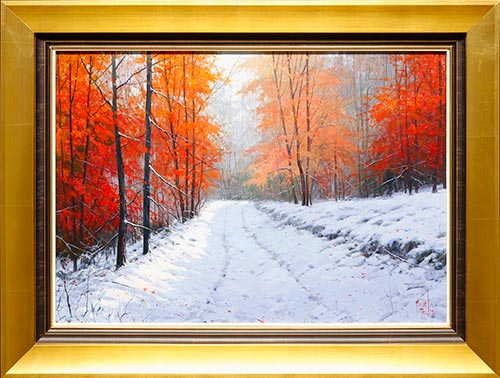
Miguel Peidro, “Snow in Autumn,” oil on canvas, (c) Miguel Peidro, 2015
A host of enjoyable feelings surface in “The Catalan Pyrenees in Autumn,” which bursts with color and natural beauty. The viewers find themselves along a well-trodden stone road deep within the Pyrenees Range at the height of fall. A rich saturated orange and red from the leaves of maple trees give the painting distinction, even when viewed at great distance. The road projects into the distance, curving out of sight towards the right edge of the canvas. A thick fog rolls through the peaks of distant mountains. The eye’s journey through the composition is splendid, giving one the sense of the deep recessive space and eager to experience what lies further down the path.
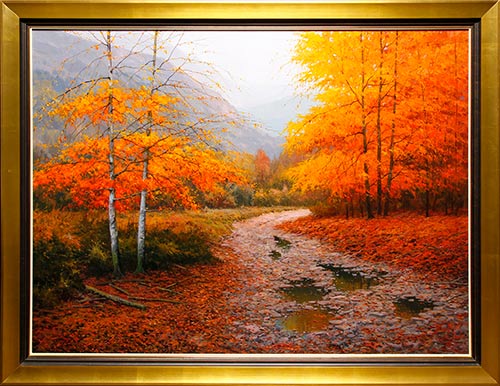
Miguel Peidro, “The Catalan Pyrenees in Autumn,” oil on canvas, (c) Miguel Peidro, 2015
Peidro has appeared to master his technique, and feelings, which will only continue to carry the artist to higher recognition. He recalls just five years ago only exhibiting in galleries in Spain, which has since grown to include the United States, Russia, England, and Japan today. Recently, Peidro’s work received wide acclaim at the International Art Fair and the Art Revolution Taipei in Taiwan, both of which the artist plans to enter in 2016.
Miguel Peidro is represented by the following galleries:
R Alexander Fine Art – Atlanta, GA http://www.ralexanderfineart.
Thornwood Gallery – Houston, TX http://www.thornwoodgallery.
Key West Gallery – Key West, FL http://keywestartgalleries.com
Greenberg Fine Art – Santa Fe, NM http://greenbergfineart.com
Gallery Elite – Carmel, CA http://www.galleryelite.net
Sheldon Fine Art – Newport, RI http://www.sheldonfineart.com/
This article was featured in Fine Art Today, a weekly e-newsletter from Fine Art Connoisseur magazine. To start receiving Fine Art Today for free, click here.
Emotion in Motion
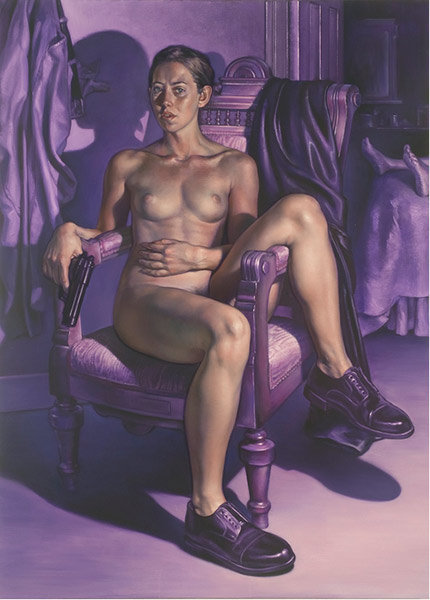
In a highly anticipated solo exhibition, Geoffrey Laurence seeks to use paint as a vehicle for communicating the human experience through emotional narratives.
Geoffrey Laurence has had a long, diversified career, one in which the artist has designed interiors, photographed for newspapers, made graphic designs for large companies, and recently, as an independent painter. Laurence has a specific message and method to his works, each of which come to the fore during an upcoming solo exhibition at Lacuna Gallery in Santa Fe, New Mexico. Opening December 4, Laurence will showcase several of his latest oils that endeavor to challenge contemporary realism as simply “the mechanical reproduction of light particles bouncing off surfaces,” as the gallery writes. Rather, Laurence’s primary motive in painting is to convey human experience through naturalistic works that are also imbued with high emotional and expressive technique and narrative.
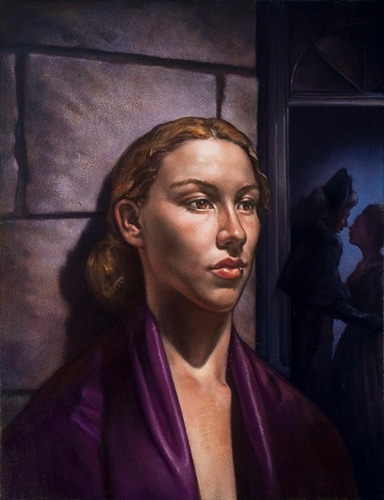
Geoffrey Laurence, “Romance,” oil, 26 x 20 in. (c) Lacuna Gallery, 2015
Lacuna states, “Geoffrey does not consider himself a naturalistic realist, nor does he currently have any interest in creating an entertaining magic trick of illusionist experience for the viewer. Rather, he believes that the easy descent into nostalgia for past art forms — which much ‘realism’ today provides — does not satisfy viewers’ needs from contemporary painting. His concern is more with the difficulty of creating emotional responses through his work and with the painting process, of moving and experiencing paint in different ways with a brush, and of engaging the viewer in an emotional narrative.”

Geoffrey Laurence, “Buy, Hold, Sell,” oil, (c) Lacuna Gallery, 2015
Indeed, emotional narrative without a doubt surfaces in the hypnotic “The Old Man’s Shoes.” Amidst a strictly purple interior, a fleshy female nude sits in an armchair. Only wearing a pair of black leather dress shoes –- unquestionably masculine in style –- the subject turns in the chair towards the viewer, draping her left leg over the arm. She gracefully touches her abdomen while pensively gazing out of the frame and towards the viewer’s right. Just beyond a doorway along the right edge of the piece, a pair of projecting feet intrudes horizontally into the frame, presumably belonging to a male partner. “His desire is to make communication of human experience through his art possible,” the gallery continues, “and therefore relies on a ‘realistic’ language rather than ‘realism’ per se, which focuses primarily on subliminal emotional effect at the same time as visual effect.”
“Emotion in Motion: Geoffrey Laurence” opens on December 4 and will hang through December 31.
To learn more, visit Lacuna Gallery.
This article was featured in Fine Art Today, a weekly e-newsletter from Fine Art Connoisseur magazine. To start receiving Fine Art Today for free, click here.
Holidays Heating Up at James Yarosh
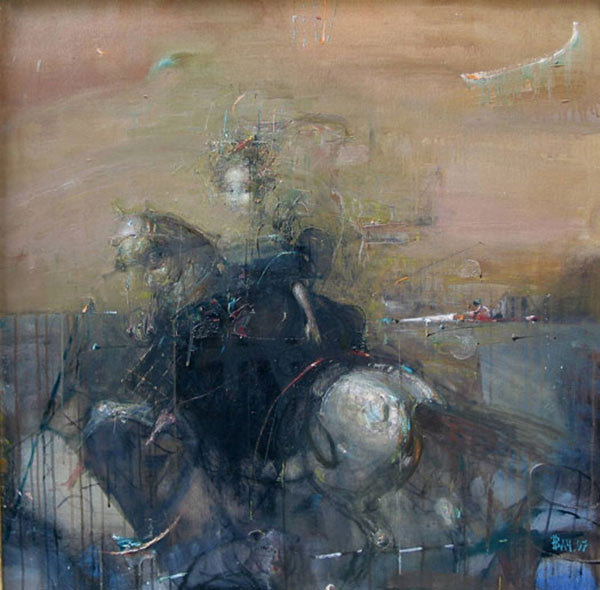
Thanksgiving was so…yesterday, and the holiday slate of fine art events and exhibitions can really begin to roast, especially in the coming weeks at James Yarosh Associates Fine Art Gallery, New Jersey.
James Yarosh Associates Fine Art Gallery in Holmdel Village, New Jersey, is poised to open the doors on its new “Holiday Show” exhibition, which will feature a lovely collection of Russian Realism and a highly anticipated visit and demonstration from Ukrainian artist Vachagan Narazyan.
The gallery suggested that, “James Yarosh Associates Gallery is known by collectors and the interior design trade as a ‘painter’s gallery,’ exhibiting fine art paintings created for art’s sake, and its critically acclaimed collections of Russian Realism art, which is considered the most important Realism movement of the 20th century. The ‘Holiday Show’ highlights a collection of works by three revered Soviet-era artists: Alexander Danilichev, Nikolai Fedosov, and Nikolai Sergeyev. Yarosh describes the featured paintings as works that ‘find the beauty and poetry in the life around us.’ The collection showcases landscape and pastoral scenes by these learned artists, painting in their free time, that capture their loving depictions of their subjects with masterful simplicity.”
Opening with extended hours on December 5 and 6, the “Holiday Show” will be on view through January 3. Just as exciting is the enticing demonstration from Narazyan, who is making his first visit to the gallery in over 10 years. On December 12 and 13, Narazyan will execute a painting at the gallery and will be available to answer questions. Yarosh writes, “Watching the artist develop a painting will give insight into his craft. Narazyan is unique in that he has honed his skill through academic training in the arts, but that ability is equally matched with his imagination, from which he creates a world of paintings that are very much his own vision.”
To learn more, visit James Yarosh Associates Fine Art Gallery.
This article was featured in Fine Art Today, a weekly e-newsletter from Fine Art Connoisseur magazine. To start receiving Fine Art Today for free, click here.
Featured Lot: Boris Dmitrievich Grigoriev, “Ramayana”
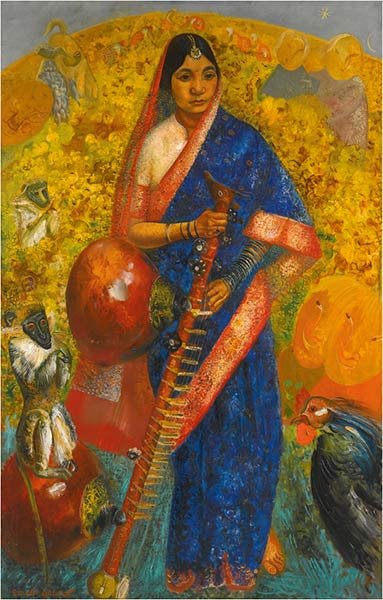
In this ongoing series for Fine Art Today, we take a longer look at the history and features of a soon-to-be-available artwork of note. This week: Boris Dmitrievich Grigoriev, “Ramayana.”
Hailing from Russia during the late 19th and early 20th centuries was the little known, but highly respected, Boris Dmitrievich Grigoriev (1886-1939). Born in Rybinsk, Grigoriev began his artistic career early in 1903 at the Stroganov Art School, where he quickly excelled and developed a taste for representing the Russian countryside and village life, subjects familiar to the budding painter.
After training for four years at Stroganov, Grigoriev continued his education at the prestigious Imperial Academy of Arts in Saint Petersburg under notables such as Dmitry Kardovsky and began exhibiting his works in 1909. Over his career, Grigoriev executed several series of paintings and graphic works, each of which displays the artist’s mastery of color in addition to the variety of modern styles that would influence his aesthetic. From 1916 to 1918, he created a series of works titled Russia, where he sought to illuminate the strength of Russian peasantry in the face of poverty. Influential critic Alexandre Benois reviewed the series with acclaim, noting that Grigoriev had captured the soul of Russia during the years leading to the country’s great revolution.
Grigoriev’s work is highly coveted among collectors today and his work frequently demands six-figure numbers. Perhaps due to his friendship with Nikolai Roerich –- who studied extensively the cultures of the East, specifically India –- Grigoriev executed the eclectic “Ramayana” in 1931, a truly extraordinary painting and one of the artist’s most unusual in his oeuvre. Based on the ancient Indian epic Ramayana, the image depicts the mythological heroine Sita in full length and traditional dress. Sita’s brilliant blue dress contrasts sharply with the luminous orange sphere of fields. From this sphere, faces of Soviet boys peek out while a monkey gestures. In Sita’s hands is an elegant veena, a type of classical Indian stringed instrument. As the divine companion of the epic’s main character Rama, Sita represents the ideal of female purity.
Dedicated to the monumental Mahatma Gandhi, who was named Time magazine’s “Man of the Year” in 1930, the piece is truly one of a kind and sure to draw spirited bidding. “Ramayana” features within Sotheby’s December 1 Russian Pictures sale, with auction estimates between $918,720 and $1,224,960 -– prices worthy of the painting’s allure.
To view the full catalogue, visit Sotheby’s.
This article was featured in Fine Art Today, a weekly e-newsletter from Fine Art Connoisseur magazine. To start receiving Fine Art Today for free, click here.
Heading to Court?
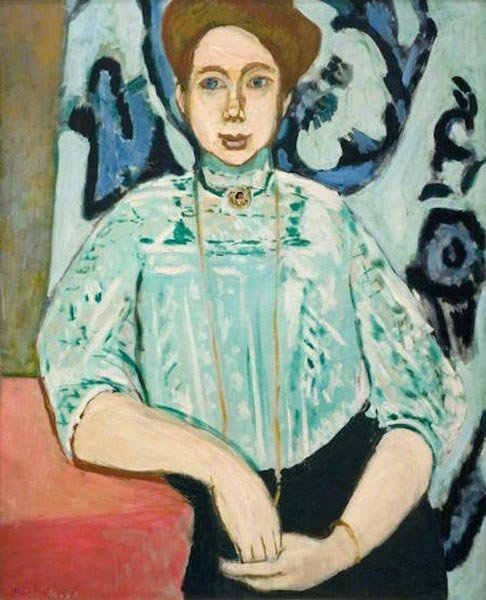
The National Gallery, London, might find itself at the center of a lawsuit after it rejected one family’s claim to a “stolen” Henri Matisse portrait of Greta Moll.
Since the end of World War II, the restitution of stolen and looted artworks has been a grueling process that continues to this day. The descendants of Greta Moll, who was the subject of a 1908 portrait by Henri Matisse, are disputing the current ownership of the painting, currently held by the National Gallery, London. The family has argued the portrait was misappropriated in the years following 1947.
The family suggests that Greta and Oskar Moll left Berlin after the war with Wales as their destination. As their only financial asset, Greta sought to ensure the safety of the portrait and avoid an export ban by entrusting it to Gertrud Djamarani, who in turn left it as collateral to dealer Heidi Vollmöller. The work resurfaced in 1979 after the National Gallery acquired it at auction, apparently suggesting that Vollmöller had sold the work years earlier.
With this information in hand, the family formally filed a petition with the museum for the portrait’s return, which was recently denied. Heirs to the Moll family have threatened to file a lawsuit if the painting is not returned. It seems litigation might be unavoidable.
To learn more, visit ArtNet.
This article was featured in Fine Art Today, a weekly e-newsletter from Fine Art Connoisseur magazine. To start receiving Fine Art Today for free, click here.