

Meet Liu Yiqian, a former taxi driver turned billionaire who bought Amedeo Modigliani’s “Nu Couché” for $170.4 million.
It’s a story that Hollywood’s best writers couldn’t pen: a rags-to-riches tale involving a Chinese taxi driver-turned-stock billionaire that has the entire art world buzzing. As a teenager growing up in Shanghai during the Cultural Revolution, Mr. Liu Yiqian sold handbags and drove taxis for a meager living. As reported by the New York Times, Yiqian dropped out of middle school and “rode the wave of China’s economic opening and reform, making a fortune through stock trading in real estate and pharmaceuticals in the 1980s and 1990s.”
On Monday, November 9, Liu Yiqian launched himself into the record books after he purchased Amedeo Modigliani’s “Nu Couché” for a mind-blowing $170,405,000 — the second-highest price ever paid for a work of art. The piece becomes an integral part of Yiqian’s art collection, which is housed and displayed within two private museums owned by him and his wife, Wang Wei.
“We are planning to exhibit it for the museum’s fifth anniversary,” Yiqian said. “It will be an opportunity for Chinese art lovers to see good artworks without having to leave the country, which is one of the main reasons why we founded the museums.”
More information about Christie’s sale was published in last week’s Fine Art Today newsletter, which can be found here.
To learn more, visit the New York Times.
This article was featured in Fine Art Today, a weekly e-newsletter from Fine Art Connoisseur magazine. To start receiving Fine Art Today for free, click here.
Who Bought Modigliani’s “Nu Couche”?

Ransom
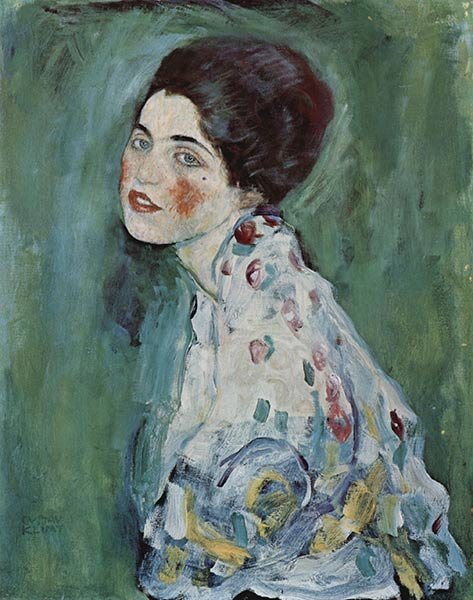
For 18 years, the art world has sorely missed a beautiful portrait by the modern artist Gustav Klimt (1862-1918) that was stolen from the Galleria d’Arte Moderna Piacenza. The chances for the work’s return seemed bleak, until a few weeks ago.
Known for his breathtakingly beautiful paintings of provocative females amidst a cacophony of colorful patterning and gold leaf, Gustav Klimt occupies a position as one of the most influential and well-known artists of the Vienna Secession — and indeed modern art. Unfortunately, as a result of the iconoclastic visions of Adolf Hitler during World War II, in addition to bombings and accidental fires, several of Klimt’s works have been destroyed, making his original works incredibly rare and significant.
In February of 1997, the stunning “Portrait of a Lady,” circa 1916, disappeared from the Galleria d’Arte Moderna Piacenza in Italy. The work displays Klimt’s characteristic expressiveness and exquisite coloring and patterning. The female subject, shown in half-length, sits in profile but turns her face toward the viewer. At first glance her gaze appears to meet ours, but closer consideration suggests she may be peering just beyond the viewer’s position. The subject’s dark maroon and black hair contrasts sharply with her milky-white skin, which blushes with intensity around the cheeks. The sitter’s dress is barely representational, but Klimt has provided just enough for legibility. The garment recalls a Japanese kimono, which would come as no surprise, given Klimt’s profound love for Japanese art and culture. The refinement of the subject’s face also demands lengthy consideration as it diverges from the fluid, expressive, and loose brushwork of the green background and textured kimono.
With fingers crossed, this lovely painting has a chance of being returned, for a price, of course. According to Der Standard in Austria, an unknown Italian man identifying himself as a retired art thief has offered to return the work unharmed if his ransom of $163,000 is met. Although authorities have refused to pay the sum, several art institutions have proclaimed their willingness to gather the funds.
To learn more, visit ArtNet.
This article was featured in Fine Art Today, a weekly e-newsletter from Fine Art Connoisseur magazine. To start receiving Fine Art Today for free, click here.
Boasting Bosch
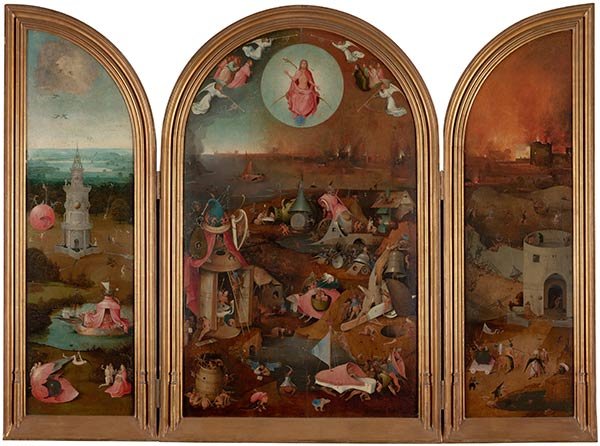
Quirky, odd, unusual, and sinful are words that have all been used to describe the captivating paintings by Dutch artist Hieronymus Bosch (1450-1516). His works are often crowded with fantastical beasts and imaginary spaces, and part of the artist’s allure lies in the relative mystery surrounding his artistic aesthetic and small oeuvre. Only 25 paintings by Bosch survive today, making the chance to view even one an exciting proposition. How about 20?
Eight years in the making, a monumental exhibition of 20 of the 25 surviving Hieronymus Bosch paintings will open on February 13 at the Noordbrabants Museum in the Netherlands. The exhibition, “Bosch: Visions of Genius,” will be met with great excitement and anticipation because never before have so many works by Bosch been brought together. Twelve of the panels on view have undergone extensive restoration following the study of the Bosch Research and Conservation Project, including a new panel recently attributed to the Dutch master. Equally exciting is the inclusion of around 19 drawings by Bosch. All told, the exhibition will feature some 70 works that illustrate the breadth of Bosch’s scope and career.
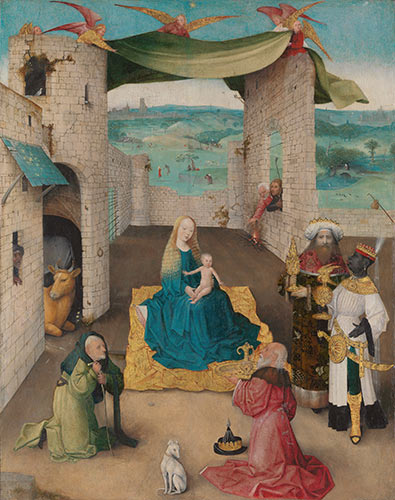
Hieronymus Bosch, “Adoration of the Magi,” ca. 1470-1480, Metropolitan Museum of Art,
(c) Rik Klein Gotnik for the Bosch Research and Conservation Project 2015
Museum director Charles de Mooij suggested, “Hieronymus Bosch is the most important and most original medieval artist our country has ever produced. It is a long-cherished ambition to get the vast majority of his works back to his hometown in 2016. And a great opportunity for a new generation to get acquainted with his work, which is unique in every respect.” Via the museum’s press release, the basis of the exhibition “got underway back in 2007. The foundations for the exceptional works being loaned out for the exhibition were laid by the Bosch Research and Conservation Project (BRCP), an ambitious large-scale international art history study conducted together with the Hieronymus Bosch 500 Foundation and Radboud University of Nijmegen. A team of international experts headed by Jos Koldeweij and Matthijs Ilsink spent six years intensively and systematically studying and documenting virtually the entire oeuvre of the master Bosch worldwide using state-of-the-art technology. The results of this scientific research are being published in a two-volume Hieronymus Bosch monograph comprising a catalogue of his works and technical studies, approximately 1,000 pages in all.”
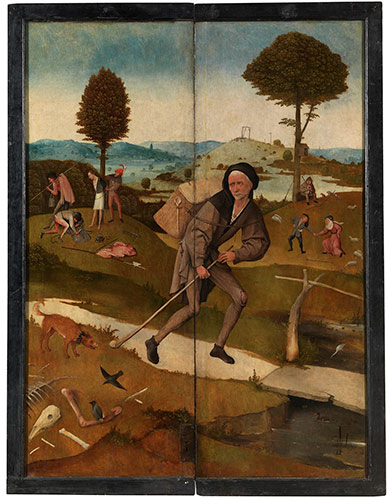
Hieronymus Bosch, “The Hay Wain,” ca. 1510-1516, Museo del Prado,
(c) Rik Klein Gotnik for the Bosch Research and Conservation Project 2015
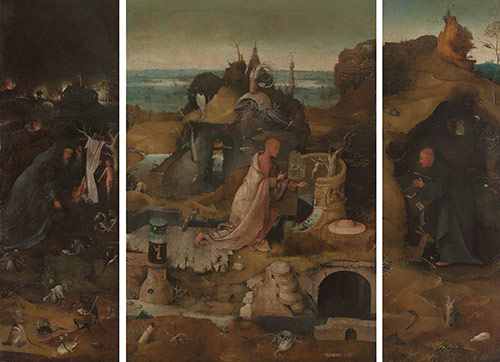
Hieronymus Bosch, “Triptych of the Hermit Saints,” ca. 1495-1505, Gallerie dell’Accademia,
(c) Rik Klein Gotnik for the Bosch Research and Conservation Project 2015
In the end, the exhibition is sure to be a memorable experience for visitors while also marking a historical moment for both Bosch and the Netherlands.
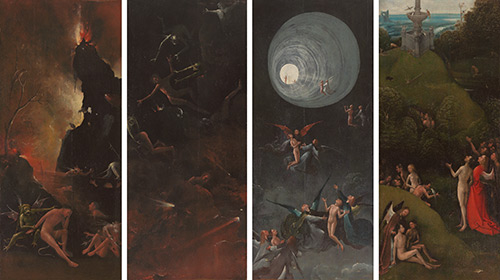
Hieronymus Bosch, “Visions of the Hereafter,” ca. 1505-1515, Museo di Palazzo Grimani,
(c) Rik Klein Gotnik for the Bosch Research and Conservation Project 2015
“Bosch: Visions of Genius” opens on February 13 and will be on view through May 8.
To learn more, visit the Noordbrabants Museum.
This article was featured in Fine Art Today, a weekly e-newsletter from Fine Art Connoisseur magazine. To start receiving Fine Art Today for free, click here.
Honoring Our Veterans

Although Veterans Day has passed, there are always ways in which our appreciation for veterans’ sacrifice can be shown. The Norman Rockwell Museum has recently mounted a tear-jerking exhibition in honor of those who serve.
“Love a Vet: Honoring Our Veterans” is much more than an art exhibition at the fabulous Norman Rockwell Museum in Stockbridge, Massachusetts; it is a chance to reflect on the sacrifices made by our nation’s military through the eyes of the artist as each comments on the difficulties, struggles, and emotional trauma faced by our veterans upon re-entry into civilian life.
Opening on November 7, “Love a Vet” features paintings, drawings, and prints by a number of established contemporary illustrators, many of whom are veterans themselves. Award-winning graphic designer Ella Rue, whose son is a veteran, organized the exhibition. The impetus for the show began with Rue’s nonprofit “52 Reasons to Love a Vet,” which helps veterans advance their education and assists with medical resources. In addition, Rue invited some of her fellow artists to donate original works to be reproduced and sold in the form of playing cards to help fund operations.
In conjunction with the museum, the exhibition is supported by Berkshire Bank, whose CEO, Mike Daly, said, “We are proud to be able to sponsor this important exhibition and provide veterans with free admission at Norman Rockwell Museum. This is only the beginning of what I think we can do to say thank you to these brave men and women.” These sentiments were echoed by the museum’s chief curator, Stephanie Plunkett, who stated, “We are pleased to present the art of so many of America’s most accomplished illustrators. This exhibition highlights the power of visual imagery to inspire new consideration of an important social concern — the health and immense sacrifice of America’s veterans.”
“Love a Vet: Honoring Our Veterans” opened on November 7 and will be on view through January 5.
To learn more, visit the Norman Rockwell Museum.
This article was featured in Fine Art Today, a weekly e-newsletter from Fine Art Connoisseur magazine. To start receiving Fine Art Today for free, click here.
Faith After the Pharaohs
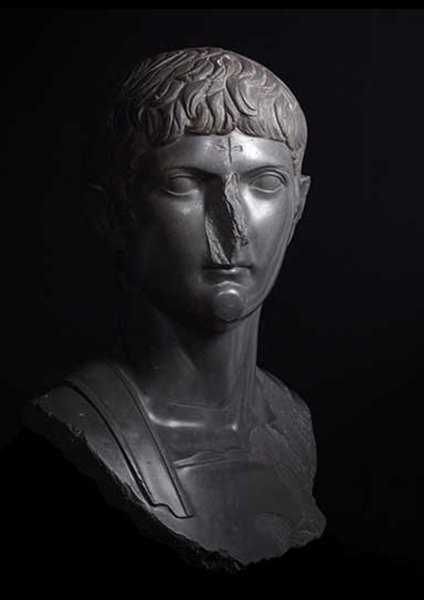
Part of the lasting legacy of the Hellenistic period (circa 323–31 BCE) was the birth of the cosmopolitan. or “world citizen.” Alexander the Great’s unification of the Mediterranean world initiated a culturally diverse period of intermittent tension and peaceful coexistence among Romans, Greeks, Egyptians, Persians, and more.
After 30 BCE, the Roman Empire ascended and expanded her borders, incorporating a nearly infinite range of cultures, peoples, and religions. On view now at the British Museum, London is an amazing exhibition that details the evolution of Egyptian art after the death of Cleopatra and Mark Antony in 30 BCE until 1171 CE, when the Islamic Fatimid dynasty collapsed. “Egypt: Faith After the Pharaohs” spans over 12 centuries and highlights the ways that Jews, Christians, and Muslims transformed the Nile region. As the museum states, “It is a story charting the change from a world of many gods to the worship of one God. The state’s use of religion to assert power is shown by fabulous sculptures that mix ancient Egyptian and Roman imperial iconography, and letters on papyrus concerning the treatment of Jews and early Christians. Gravestones and architectural elements demonstrate the reuse and reworking of sacred spaces — temple complexes were reused as churches and, later, mosques.
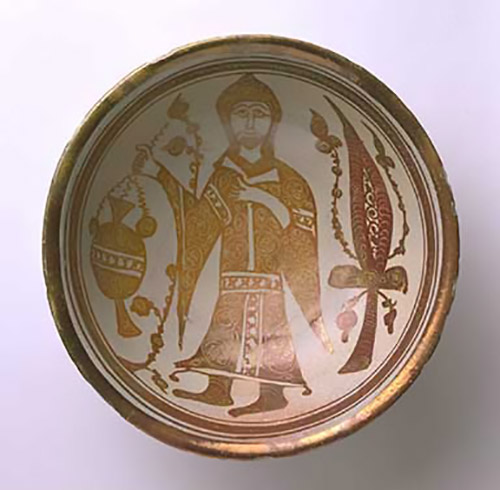
Bowl with the image of a priest, ca. 1050-1100 CE, ceramic, (c) Victoria & Albert Museum 2015
“The changes in people’s private lives are shown through everyday objects — delicate fragments of papyrus preserve some of the earliest surviving Jewish scriptures and lost Christian gospels. Colorful garments and accessories show what people wore, and soft-furnishings show how they dressed their homes.
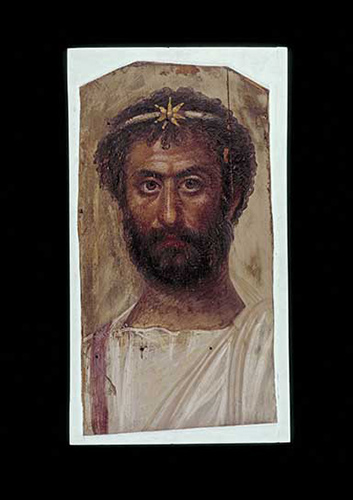
Portrait of a Priest of Serapis, ca. 140-160 CE, encaustic on wood, (c) The British Museum 2015
“Together, the objects in the exhibition show how the shift from the traditional worship of many gods to monotheism — the belief in one God — affected every part of life. Egypt’s journey from Roman to Islamic control reflects the wider transformation from the ancient to medieval world, a transition that has shaped the world we live in today.”
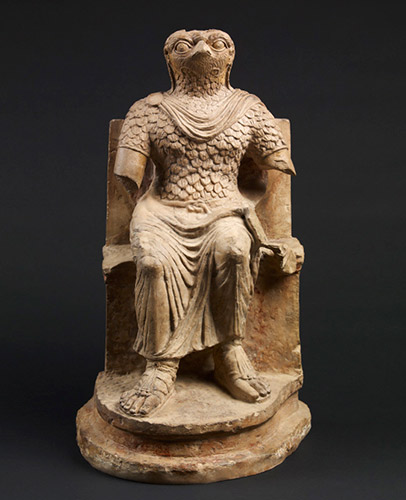
The Egyptian god Horus in Roman military costume, 1st-2nd century CE, limestone, (c) The British Museum 2015
“Egypt: Faith After the Pharaohs” opened on October 29 and will be on view through February 7.
To learn more, visit the British Museum.
This article was featured in Fine Art Today, a weekly e-newsletter from Fine Art Connoisseur magazine. To start receiving Fine Art Today for free, click here.
Rodin Reopened
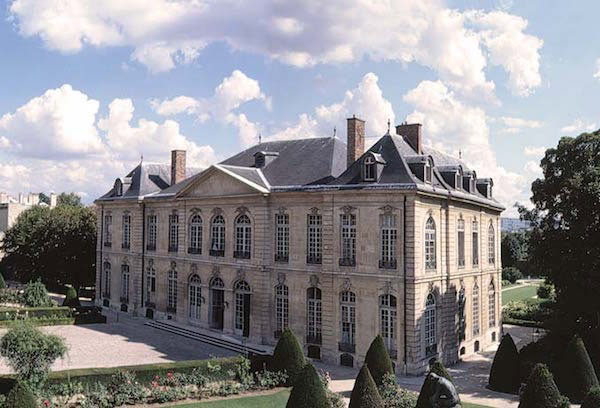
After over $17 million in renovation and restoration, the lovely Rodin Museum in Paris reopened its doors on November 12, the master sculptor’s 175th birthday.
Known best for such seminal sculptures as “The Thinker” and “The Kiss,” Auguste Rodin is often credited with having launched sculpture into the modern era during the late 19th and early 20th centuries. Today, many of the master’s works are housed in an exceptional 18th-century Parisian mansion, one that Rodin used as his studio until his death in 1917. Along with his entire estate, Rodin bequeathed the mansion to the French state, which in 1919 converted it into a museum.
Unfortunately, the structure was in a state of extreme disrepair even when Rodin walked the grand staircase himself, and that remained the case until 2012, when the museum shut its doors for renovation. After three years and $17.4 million, the museum opened again to the public on November 12, on what would have been the sculptor’s 175th birthday. In celebration of the reopening, the museum has also put on display several recently restored and previously unseen sculptures by Rodin. Selections from Rodin’s personal collection of Greek and Roman sculpture will be on view as well.
To learn more, visit ArtNet.
This article was featured in Fine Art Today, a weekly e-newsletter from Fine Art Connoisseur magazine. To start receiving Fine Art Today for free, click here.
Poems in Paint and More
The connections among American poetry and painting, sculpture, and decorative arts form the center of an outstanding exhibition at the Wadsworth Atheneum Museum of Art.
A creative exhibition is underway in Hartford, Connecticut, at the Wadsworth Atheneum Museum of Art. “Sound & Sense: Poetic Musings in American Art” is an eclectic exhibition that will pair a variety of gorgeous objects with verses by celebrated poets. In addition, drawing from the museum’s own permanent collection, artworks that incorporate poetic inscriptions in their compositions or “have direct relationships to America’s rich poetic traditions,” as the museum states, will be included.
Highlights of the show include works from Albert Bierstadt, Rockwell Kent, Georgia O’Keeffe, Daniel Chester French, and Isamu Noguchi. Poetic verses from the works of — among others — Herman Melville, Lydia Sigourney, Walt Whitman, and Robert Frost accompany the art.
A particular masterpiece of the exhibition is Thomas Dewing’s “The Days,” circa 1884-1886. The lovely horizontal format of the canvas presents six figures — one male and five females — among a background of rich green foliage and a tree. Each of the female figures hold objects of significance, likely alluding to their identities. Dewing’s soft touch and nearly incandescent tonality have the appearance of Pre-Raphaelite paintings.
“Sound & Sense: Poetic Musings in American Art” opened on November 14 and will run through April 17.
To learn more, visit The Wadsworth Atheneum Museum of Art.
This article was featured in Fine Art Today, a weekly e-newsletter from Fine Art Connoisseur magazine. To start receiving Fine Art Today for free, click here.
Seeing Nature

The Portland Museum of Art recently mounted a major exhibition featuring 39 carefully selected masterpieces drawn from Microsoft co-founder Paul G. Allen’s family collection.
Although best known for his philanthropy and co-development of tech giant Microsoft, Paul G. Allen has also been diligently amassing an impressive art collection, selections from which are now on view at the Portland Art Museum. “Seeing Nature: Landscape Masterworks from the Paul G. Allen Family Collection” will feature 39 paintings spanning nearly 400 years. Moreover, the styles of the works are diverse, offering art lovers the chance to view the full spectrum of landscape’s capabilities.
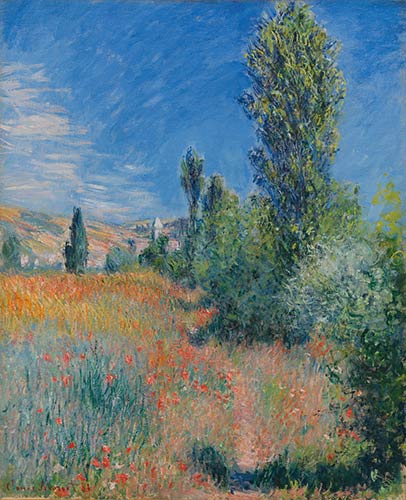
Claude Monet, “En Paysage dans lile Saint-Martin,” 1881, oil on canvas, 28 13/16 x 23 5/8 in.
(c) Paul G. Allen Family Collection 2015
Some of the blockbuster names include Canaletto, Joseph Mallord William Turner, Gustav Klimt, David Hockney, Georgia O’Keeffe, and Edward Hopper. Museum director Brian Ferriso remarked, “‘Seeing Nature’ offers an extraordinary opportunity to perceive the world through the gaze of some of the most important artists in history. These masterpieces have never before been on display together. Paul Allen is one of the Northwest’s most significant art collectors and philanthropists, and his willingness to share his landscape masterpieces with our visitors offers an unprecedented chance to be inspired by works of art.”
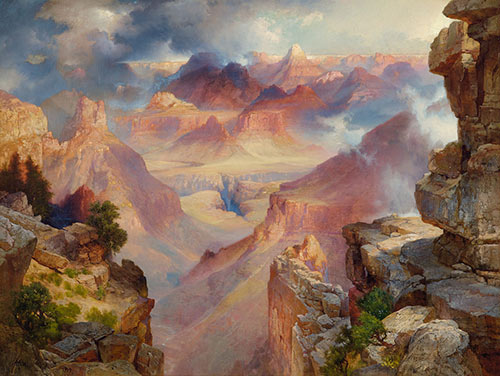
Thomas Moran, “Grand Canyon of Arizona at Sunset,” 1909, oil on canvas, 30 x 40 in.
(c) Paul G. Allen Family Collection 2015
Equally exciting is the exhibition’s availability, as it will travel across the country to several esteemed locations over the next two years. After its run at the Portland Art Museum, the collection will move to the Philips Collection in Washington, D.C., the Minneapolis Institute of Arts, and the New Orleans Museum of Art, and will finally close at the Seattle Art Museum in early 2017.
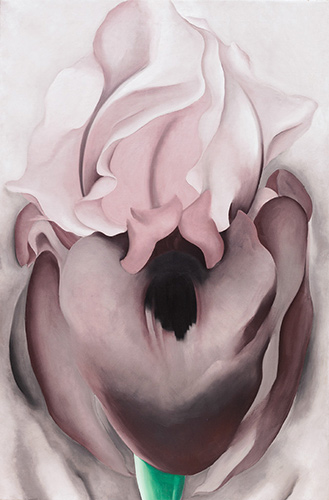
Georgia O’Keeffe, “Black Iris VI,” 1936, oil on canvas, 36 x 24 in. (c) Paul G. Allen Family Collection 2015
“Seeing Nature: Landscape Masterworks from the Paul G. Allen Family Collection” opened on October 10 and will be on view in Portland through January 10.
To learn more, visit the Portland Art Museum.
This article was featured in Fine Art Today, a weekly e-newsletter from Fine Art Connoisseur magazine. To start receiving Fine Art Today for free, click here.
Featured Artwork: D.K. Richardson
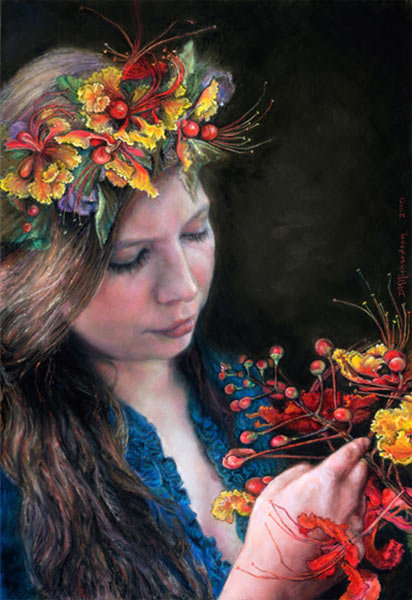
“Blossoms for the Bride”
Pastel on Panel
16 x 11 in.
Framed: H 23.5” x W 18.5”
$22,000
www.dkrichardson-artist.com
[email protected]
Description: Summer In my garden brings the most delightful experiences and Pride of Barbados is one the most spectacular flowering plants that can be viewed from my solarium. Its flowers are vibrant yellow, orange, and fiery red. I knew there must be an enchanting way to combine this most spectacular flora and my beloved niece and model, Shasta Chez’, who had just recently renewed her vows. These two exquisite subjects intertwined into the painting, “Blossoms for the Bride”.
About the Artist:
Influenced by Masters of their craft: Da Vinci, Moroni, Rembrandt, Vermeer, and Rubens; D.K. Richardson endeavors to breathe a feeling of “Life” into her subjects regardless of the medium. She is known for her unique and detailed pastel work. Strong composition, color, and expression hold viewers fascinated with the painting’s life-like appearance.
Recent Achievements:
IN3 Group Exhibition, Jadite Gallery, New York, NY which opened September 16. Paintings exhibited were “A Quiet Moment”, “Adoration”, and “Blossoms for the Bride”. “The Shaman”, a pastel painting, recently exhibited in Madrid, Spain. “The Babylonian Woman”, worked with a verdaccio oil underpainting and glazing technique, has exhibited in Texas, Sweden, Lithuania, Romania, Italy, Spain, and France. “Once a Queen – Twice Exiled”, verdaccio underpainting with color glazes exhibits in Paris in March of 2015. Finalist in the 2013/2014, 2012/2013, and 2011/2012 ARC International Salons; Richardson has been honored with two Best of Show winners in the Austin Pastel Society competitions; Certificate of Excellence 2013 Portrait Society of America International Portrait Competition.
Richardson is an active member of the Portrait Society of America, and IN3 International Artists Incentive. Native to Texas, she resides in Austin.
D.K. Richardson | 830-928-3393 | [email protected] | www.dkrichardson-artist.com
January 10: Miro
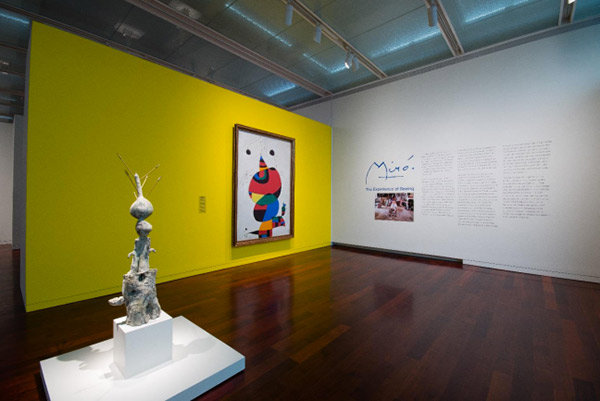
The McNay Art Museum in San Antonio, Texas, will present a rare glimpse at the later works of Spanish-born artist Joan Mirό (1893-1983), one of the greatest innovators of 20th-century art in Europe.
“Miró: The Experience of Seeing” opened on September 30, 2015 and runs through Jan. 10, 2016. The McNay is the only southwest venue and final stop of the exhibition’s U.S. tour.
To learn more, visit the McNay Art Museum.