

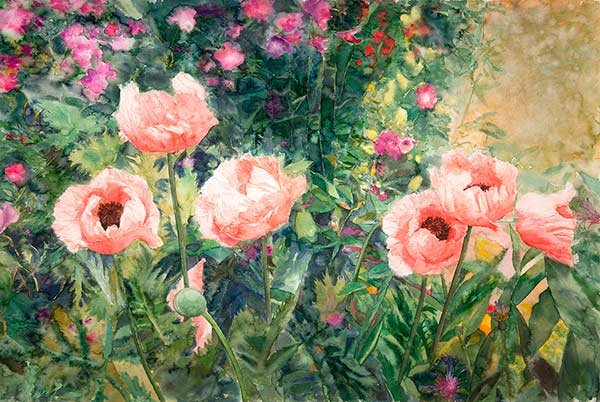
The Woodmere Art Museum in Philadelphia is currently celebrating one of city’s most revered realist painters and watercolor innovators, Eileen Goodman, in a solo exhibition.
Exceptional tonal ranges, saturated hues, and vivid textures are all characteristics of the coveted watercolors by artist Eileen Goodman, who forms the focus of an outstanding exhibition at the Woodmere Art Museum in Philadelphia. Via the exhibition website, “The show will include work spanning five decades of the artist’s career, from her early figurative drawings, prints, and oils to her recent monumental watercolors. The range of works on view will demonstrate how her mastery of watercolor was shaped by both her formal artistic training and her independent experimentation in various media.”
In conjunction with the exhibition, the museum has organized a number of related events, including a constructive feedback/workshop with the artist herself on November 21. As the museum describes it: “Look at your watercolor paintings with artist Eileen Goodman and discover new possibilities. Begin in the studio, then visit Woodmere’s galleries to see the unique qualities of watercolor in Goodman’s art.” Assistant curator Rachel McCay will lead a gallery talk on November 14 while Goodman herself will lead a tour on January 9.
“The Weight of Watercolor: The Art of Eileen Goodman” opens on November 14 and will be on view through March 13.
To learn more, visit the Woodmere Art Museum.
This article was featured in Fine Art Today, a weekly e-newsletter from Fine Art Connoisseur magazine. To start receiving Fine Art Today for free, click here.
Watercolor’s Weight
Picturing the Americas
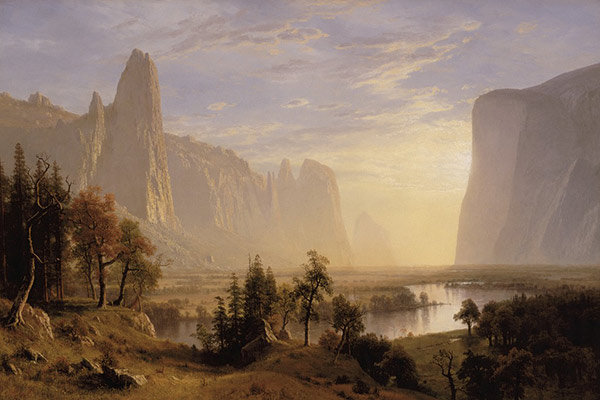
Featuring over 100 oil paintings, watercolors, prints, and photographs, the Crystal Bridges Museum of American Art recently mounted an exhibition chronicling how pictorial representations of the American landscape helped forge visions of the whole hemisphere.
Some of the biggest names in American landscape painting — including Albert Bierstadt, Frederic E. Church, Thomas Cole, Martin Johnson Heade, and Georgia O’Keeffe — highlight a lovely exhibition in Arkansas at the Crystal Bridges Museum of American Art. An added bonus is the inclusion of outstanding works from South American painters as well, such as Jose Maria Velasco and Juan Manuel Blanes, among others.
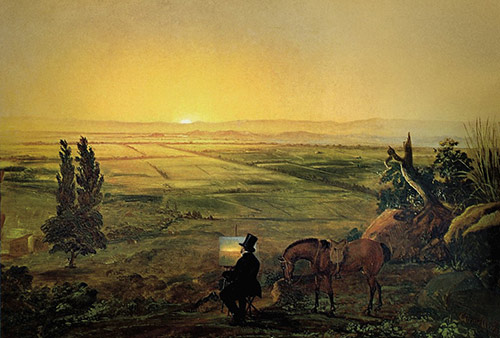
Alejandro Ciccarelli, “View of Santiago from Peñalolén,” 1853, oil on canvas, 85 x 125 cm.
(c) Pinacoteca Banco Santander 2015

William G.R. Hind, “Drawing Map on Birch-Bark,” 1861, oil on board, 30 x 42.3 cm. (c) Toronto Public Library 2015
“Picturing the Americas: Landscape Painting from Tierra del Fuego to the Arctic” is “the first exhibition to examine landscape painting from the early 19th century to the early 20th century in an inclusive, pan-American context,” states the museum. “Thematically organized, the exhibition places special emphasis on the areas where landscape painting expressions were most vital.” The themes include “Land Icon Nation,” “Field to Studio,” “Land Encounter Territory,” “Land as a Resource,” “Land Transformed,” and “Icon Nation Self.”
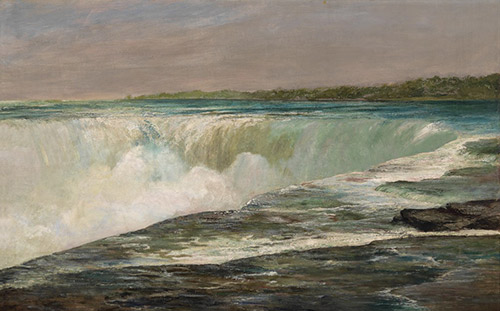
William Morris Hunt, “Horseshoe Falls Niagara Falls,” 1878, oil on canvas, (c) Williams College Museum of Art 2015
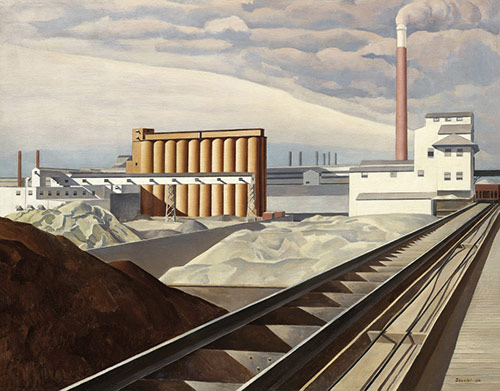
Charles Sheeler, “Classic Landscape,” 1931, oil on canvas, (c) National Gallery of Art, Washington 2015
“Picturing the Americas” opened on November 7 and will be on view through January 18.
To learn more, visit the Crystal Bridges Museum of American Art.
This article was featured in Fine Art Today, a weekly e-newsletter from Fine Art Connoisseur magazine. To start receiving Fine Art Today for free, click here.
Blue
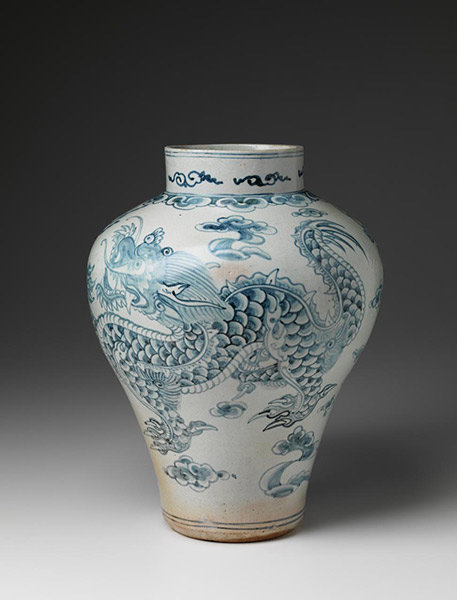
For thousands of years, blue pigments have traditionally been reserved for objects of extreme wealth and veneration. Produced largely from cobalt, lapis lazuli, or indigo, blue pigment was expensive and hard to find. A creative exhibition in Australia is spotlighting the fascinating metamorphosis of pattern, form, and motif stemming from the global trade of Asian ceramics, textiles, prints, and paintings — which extensively used a blue and white palette.
On view now at the National Gallery of Victoria in Melbourne, Australia, “Blue: Alchemy of a Colour” is a fascinating and creative exhibition exploring one of the most sought-after and coveted pigments in history: blue. During the 17th and 18th centuries, Persian, Chinese, Japanese, and Vietnamese artisans popularized a type of stoneware characterized by the use of beautiful cobalt-blue glazes on porcelain, a style of ceramics that can still be found today in countless homes across the world. Also exported from Asia were lavish indigo-dyed textiles with elaborate wood-block-printed designs that would eventually inspire some of history’s greatest modern artists, including Claude Monet and Gustav Klimt.
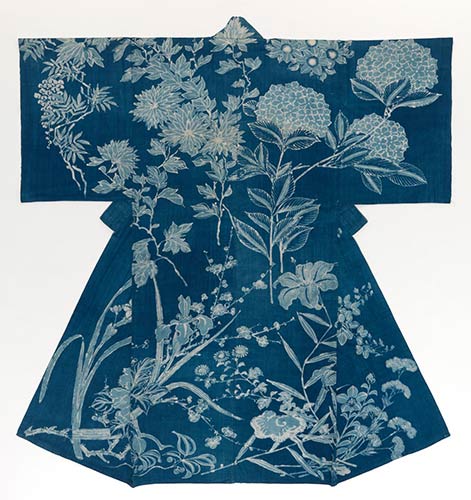
Japanese, “Summer kimono,” Yukata Meiji period 1868-1912, cotton, 145.3 x 133.3 cm.
(c) National Gallery of Victoria 2015
Selected works from the National Gallery of Victoria as well as important loans from across the globe will feature in “Blue,” which will also trace the pigment’s history and trade. A particularly stunning example from the show is a Korean “Dragon Jar” produced in the 18th century. The bulbous jar has a gorgeous and full shoulder that leads to a small base, which is proportionally sized to the piece’s neck and rim. Twisting and turning as it wraps around the entire vessel is an outstanding dragon — a traditional motif found in many Asian artworks. Filling the negative spaces are stylized arrangements of cloud-like forms and decorative lines the organize the surface and distinguish the foot from the body, body from neck, and neck from rim.
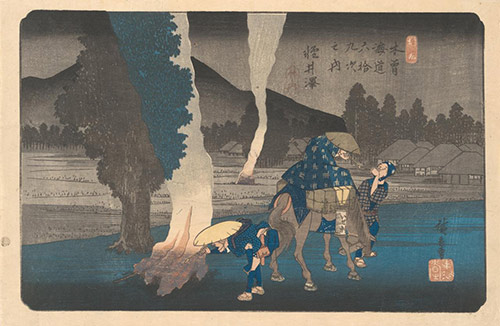
Utagawa Hiroshige, “Karuizawa,” ca. 1830, color woodblock print, 25.6 x 38.2 cm. (c) National Gallery of Victoria 2015
“Blue: Alchemy of a Colour” opening on November 6 and will be on view through March 16.
To learn more, visit the National Gallery of Victoria.
This article was featured in Fine Art Today, a weekly e-newsletter from Fine Art Connoisseur magazine. To start receiving Fine Art Today for free, click here.
Delacroix and the Rise of Modern Art
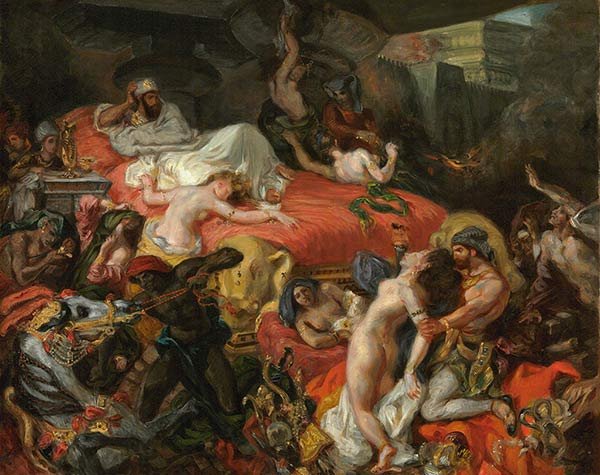
While historians and scholars alike maintain that modernism began in France in 1863, a current exhibition in Minneapolis seeks to highlight the movement’s roots within French Romanticism, specifically the works and career of Eugéne Delacroix.
“The principal characteristics invariably associated with Modernism — the artist’s self-conscious rejection of conventional or academic methods of representation in search of more vital forms of personal expression, and the exploration of the aesthetic autonomy of the means of representation, regardless of the subject represented — were in evidence long before the Salon des Refusés in 1863,” writes the Minneapolis Institute of Arts, which opened an exhibition on October 18.
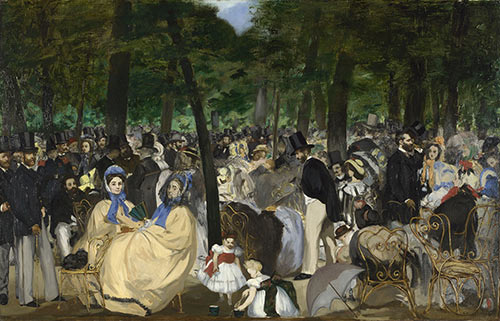
Edouard Manet, “Music in the Tuileries Gardens,” 1862, oil on canvas, 30 x 47 in. (c) National Gallery, London 2015
“Delacroix’s Influence: The Rise of Modern Art from Cézanne to van Gogh” seeks to call attention to Modernism’s roots in French Romanticism, suggesting that artists at the turn of the 19th century were just as concerned with representing — and responding to — ever-changing social, economic, and cultural conventions as the Expressionists and Impressionists were.
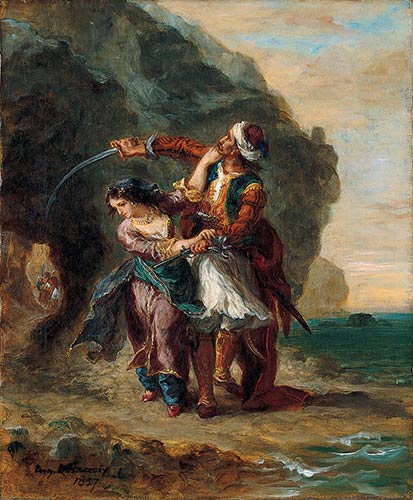
Eugene Delacroix, “Bride of Abydos,” 1857, oil on canvas, 19 x 15 in. (c) Kimbell Art Museum 2015
Continuing, the museum writes, “Without attaching the tag of ‘first modern’ to any particular artist’s or school’s legacy, this exhibition examines the radical role as mentor and archetype that Eugéne Delacroix and his art played during his lifetime and subsequent decades. As the bridge between Anglo-French Romanticism of the 1820s and the ‘New Painting’ that came to be called Impressionism in 1874, Delacroix’s influence reveals a progression by which, one after another, succeeding generations of avant-garde artists, however divergent their own artistic programs, engaged anew every aspect of his protean achievement.”
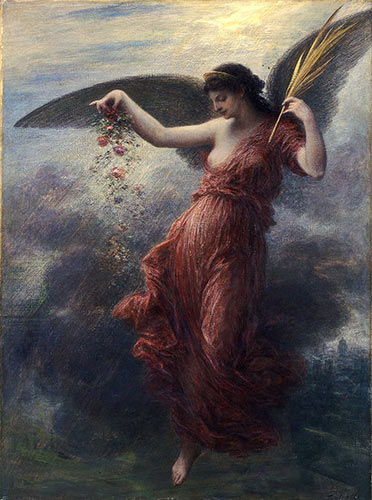
Henri Fantin Latour, “Immortality,” 1889, oil on canvas, 46 x 35 in. (c) National Museum Wales 2015
“Delacroix’s Influence: The Rise of Modern Art from Cézanne to van Gogh” opened on October 18 and will be on view through January 10.
To learn more, visit the Minneapolis Institute of Arts.
This article was featured in Fine Art Today, a weekly e-newsletter from Fine Art Connoisseur magazine. To start receiving Fine Art Today for free, click here.
Christie’s Earns Half-Billion in Recent New York Sale
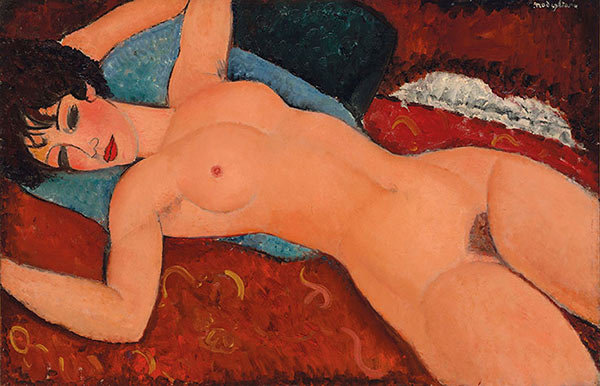
The art world is buzzing about Christie’s recent “Artist’s Muse” auction, which offered 34 masterpieces and realized nearly $500 million in sales.
Five world auction records were broken and checkbooks were steaming after Christie’s “Artist’s Muse” auction on November 9. With sales totaling $491,252,000, 12 of the 34 modern masterpieces hammered for more than $10 million.
Leading the way in sales and the night in general was Amedeo Modigliani’s “Nu couché (Reclining Nude)” of 1917-1918. The erotic painting was the source of quite a stir and controversy when it was first exhibited during Modigliani’s one and only show at the Galerie Berthe Weill in Paris. Outraged at the nudity and the overt sexuality of the painting, police demanded the immediate closure of the exhibition. “The painting is one of a series of great female nudes made for Léopold Zborowski,” Christie’s reports.
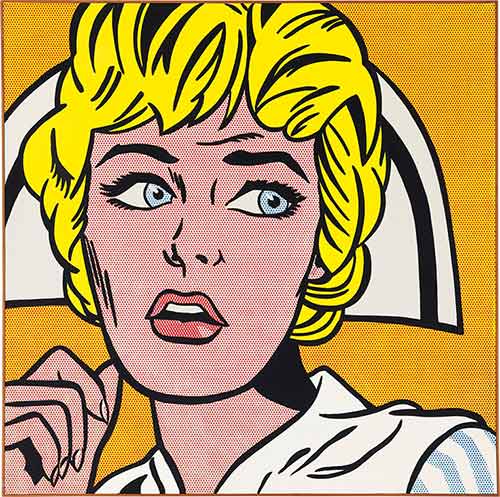
Roy Lichtenstein, “Nurse,” 1964, oil and magna on canvas, (c) Christie’s, New York 2015
The price? Hammering for a whopping $170,405,000, “Nu couché” eclipsed Modigliani’s previous auction records by nearly $100 million. Furthermore, the price was the second highest ever paid for a work of art. Picasso’s “Les Femmes d’Alger (Version ‘O’),” was sold in May 2015 for $179,364,992 and currently holds the record.
As Lot 8A, Modigliani’s bank-buster price characterized and foreshadowed what was to come. Roy Lichtenstein’s “Nurse” of 1964 realized $95,365,000; Gustave Courbet’s “Femme nue couchée” sold for $15,285,000; Baltus’s “Lady Abdy” sold for $9,909,000; and Paul Gauguin’s “Thérése” of 1902 realized $30,965,000.
To learn more, visit Christie’s.
This article was featured in Fine Art Today, a weekly e-newsletter from Fine Art Connoisseur magazine. To start receiving Fine Art Today for free, click here.
Following Hercules

A current exhibition at the Fitzwilliam Museum in Cambridge seeks to explore the ways in which classical and contemporary images of the Greek hero Hercules have defined western art.
The Nemean Lion, the Erymanthean Boar, the Augean Stables, and the Apples of Hesperides are only a few of the 12 “heroic labors” mythically endured by Hercules. Images of Hercules, half man and half god, abounded in ancient Greece, his immaculate form and character providing an ideal model for Hellenic ideologies of perfection. On view now at the famed Fitzwilliam Museum on the campus of Cambridge University, “Following Hercules: The Story of Classical Art” aims to do just that: tell the story of classical art and “how Greece and Rome’s gods and heroes came to inhabit post-antique painting and sculpture.”
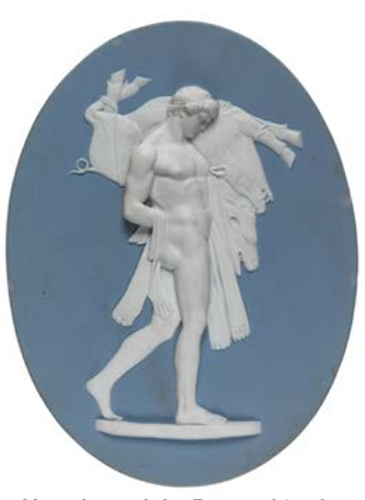
“Hercules and the Erymanthian Boar,” ca. 1790, jasperware plaque, 212 mm. (c) Fitzwilliam Museum 2015
The museum continues, “Hercules is brought to life by each of the 40 objects on display, from exquisite gems and coins, Renaissance drawings and bronzes, to 18th-century paintings, and Matthew Darbyshire’s giant polystyrene statue. Their interaction reveals how classical art was born, and gives classical art ongoing relevance.”

Matthew Darbyshire, “Hercules (detail),” 2014, polystyrene, 315 cm. (c) Robert Tucker and Jonathan Wilmot,
Restoration House 2015
“Following Hercules: The Story of Classical Art” opened on September 25 and will run through December 6.
To learn more, visit the Fitzwilliam Museum.
This article was featured in Fine Art Today, a weekly e-newsletter from Fine Art Connoisseur magazine. To start receiving Fine Art Today for free, click here.
A Bridge to Modernity
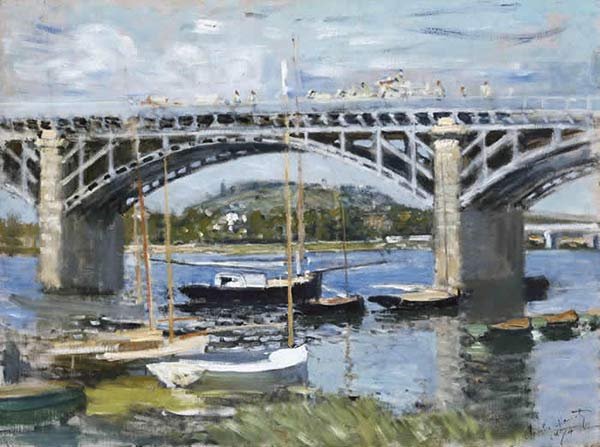
Twelve seminal works from the master of Impressionism have just landed at the National Gallery of Canada.
Although the works by Claude Monet (1840-1926) display a diverse range of subjects, his views of bridges earn the spotlight in a current exhibition at the National Gallery of Canada in Ottawa, Ontario. “Monet: A Bridge to Modernity” explores a tantalizing period in the artist’s career, between 1872 and 1875 in the aftermath of the Franco-Prussian War. Monet spent these three years in Argenteuil, a small town on the outskirts of Paris, where he meticulously captured the local bridges.
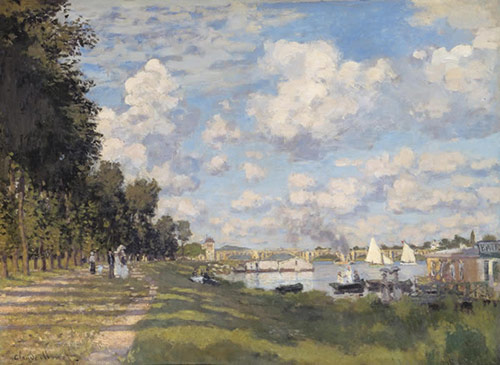
Claude Monet, “The Port at Argenteuil,” ca. 1872, oil on canvas, 60 x 80.5 cm. (c) Musée d’Orsay, Paris 2015
“Monet emerges as a methodical artist who used the local bridges to work out his aesthetic concerns,” the gallery says. “What resulted were compositions of startling modernity that cemented Monet’s status as one of the leaders of the avant-garde.” Twelve paintings by Monet will feature in the exhibition, along with photographs, illustrations, guidebooks, Japanese prints, and postcards. The exhibition is the first monographic of Monet’s work in Canada in nearly 20 years.
“Monet: A Bridge to Modernity” opened on October 29 and will be on view through February 15.
To learn more, visit the National Gallery of Canada.
This article was featured in Fine Art Today, a weekly e-newsletter from Fine Art Connoisseur magazine. To start receiving Fine Art Today for free, click here.
Featured Lot: Frank Tenney Johnson, “In Old Wyoming aka On the Alert”
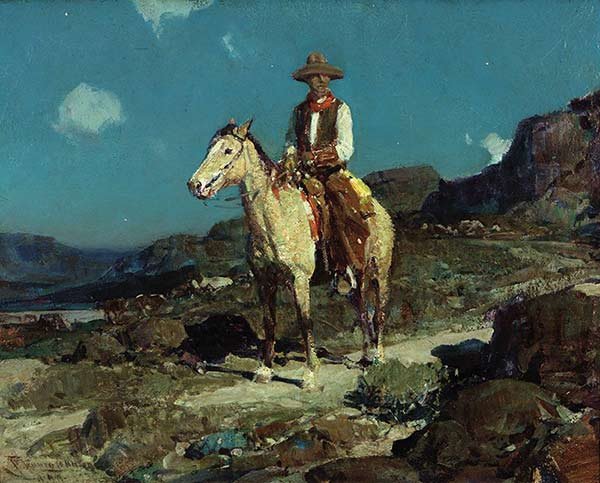
In this ongoing series for Fine Art Today, we take a longer look at the history and features of a soon-to-be-available artwork of note. This week: Frank Tenney Johnson, “In Old Wyoming aka On the Alert.”
Born in 1874, artist Frank Tenney Johnson (1874-1939) is perhaps best known for developing a style of painting Native Americans and cowboys called “The Johnson Moonlight Technique.” Raised in western Iowa, Johnson witnessed first-hand the streams of wagons, cattle, and horses heading west during the late 19th century, subjects that became the hallmark of his paintings. Working predominantly as an illustrator, Johnson worked for Field and Stream magazine after 1904 traveling west to illustrate the lives of cattlemen in New Mexico and Colorado.
Johnson’s work did not achieve notoriety until about 1920, when he became more involved with both the New York and California art scenes. The National Wildlife Museum reports, “Johnson was most influenced by his early instructors, John H. Twachtman, William Merritt Chase, and Robert Henri, who were all known for their excellent draftsmanship, painterly brushwork, and a fascination for outdoor light. He appropriated elements from the Munich style and American and French Impressionism, but incorporated those features to form his own romantic realistic style. Often he is associated with Frederic Remington and Charles Russell because of their concentration on the trail and the range. However, Johnson is best known for his nocturnal scenes in which he concentrated on the effects of moonlight on form and color.”
Heading to auction on November 15 via Altermann Galleries & Auctioneers is a stunning example of Johnson’s famed moonlight style. “In Old Wyoming aka On the Alert” displays an attentive cowboy on horseback during the dead of night. The piece has a beautiful glow that captures masterfully how the moonlight can turn night into day. Also immediately noticeable is the expressive touch of Johnson’s brush, recalling C. M. Russell. A sharp diagonal composition adds a sense of tension and movement to an otherwise still piece. As intriguing is the rider’s horse, who also seems keenly aware of his — or her — surroundings.
Auction estimates are between $150,000 and $200,000.
To view the full catalogue, visit Altermann Galleries & Auctioneers.
This article was featured in Fine Art Today, a weekly e-newsletter from Fine Art Connoisseur magazine. To start receiving Fine Art Today for free, click here.
Six Honored at Art Ball, Including Our Own Publisher Eric Rhoads
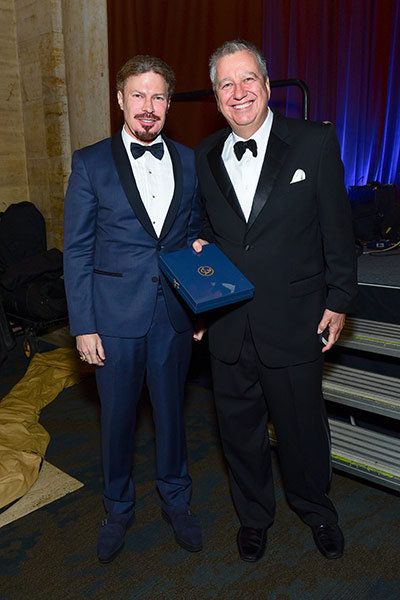
More than 300 people donned black tie, white tie, or historical costumes to attend the Florence Academy of Art Beaux Arts Ball, held at the lush venue Cipriani 25 Broadway in New York City on Friday. The event celebrated six figures in the representational art scene — three noted artists and three key patrons, one of whom was B. Eric Rhoads, the publisher of Fine Art Connoisseur.
“I’m honored to not only receive this patron’s award, but to be in the company of such greats, who have done so much to further the cause of representational art,” says Rhoads.
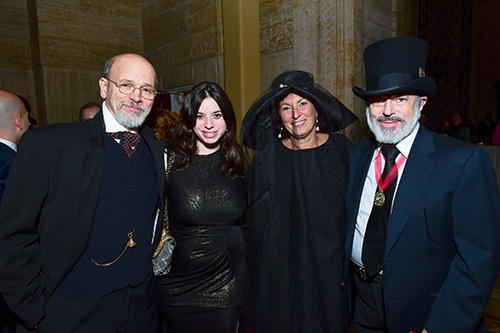
Daniel Graves, Kara Ross, Anki Graves, Fred Ross (c) Sean Zanni/PMC
Rhoads was honored alongside Christopher “Kip” Forbes and Judith Kudlow. The artists honored were Jacob Collins, Daniel Graves, and Stone Roberts.
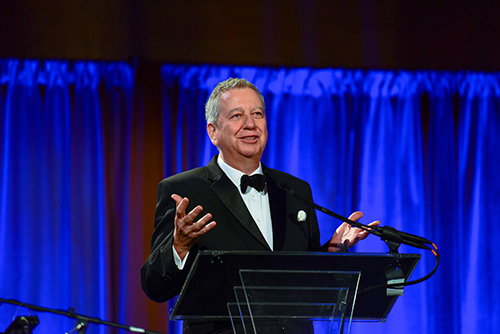
Rhoads giving his acceptance speech
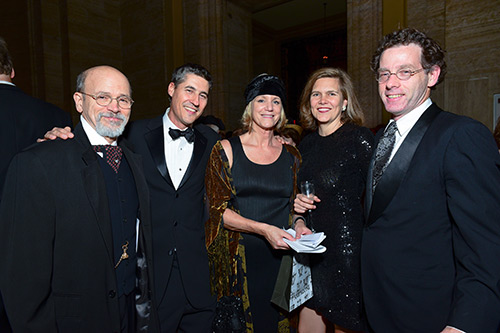
Daniel Graves, Edward Minoff, Susan Tintori, Justine Kalb, Jacob Collins (c) Sean Zanni/PMC
The evening began with an art exhibition and cocktails, then proceeded into dinner and then the presentation of the honors and speeches by the honorees. The night ended with dancing and a costume parade.
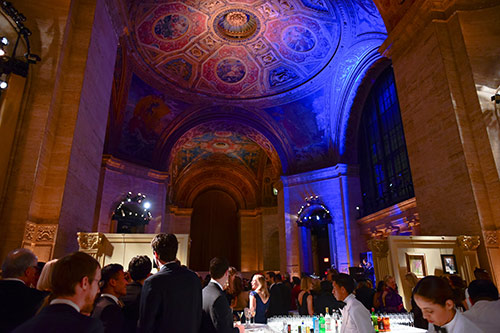
Cipriani 25 Broadway, the venue for the Beaux Arts Ball (c) Sean Zanni/PMC
The Florence Academy of Art is a school in Italy (with branches in New York and Spain) that emphasizes traditional realism based on close observation of the material world. The emphasis is on technical skill and the working processes of the Old Masters.
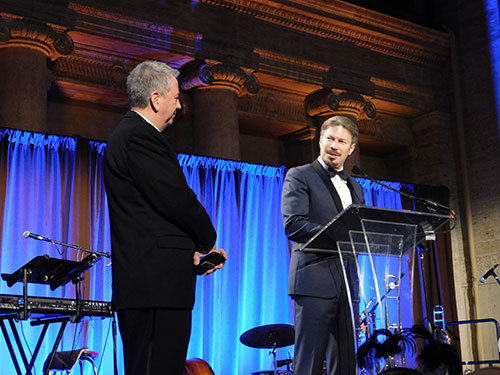
Michel Whitmer introduces B. Eric Rhoads. Photo by Vanessa Rothe
This article was featured in Fine Art Today, a weekly e-newsletter from Fine Art Connoisseur magazine. To start receiving Fine Art Today for free, click here.
Fine Art Cruise
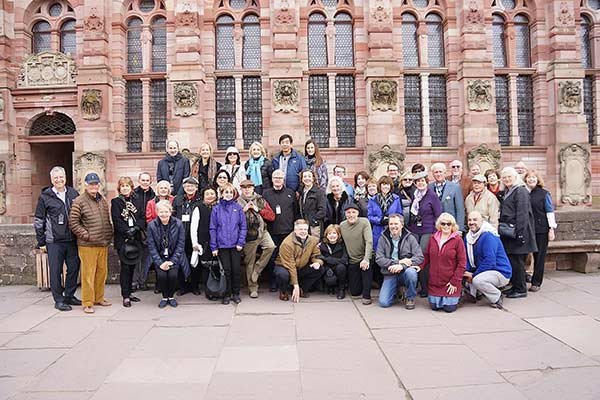
Forty-five art lovers are unpacking their suitcases across North America this week, having recently returned from Fine Art Connoisseur’s sixth annual Fine Art Cruise.
This successful adventure began with a five-night stay at the Grand Hotel de l’Europe in Amsterdam, where FAC Publisher Eric Rhoads and Editor-in-Chief Peter Trippi led guests on a four-day tour through such major sites as the Rijksmuseum, Rembrandthuis, and Van Gogh Museum, plus out-of-town excursions to the Kroller-Muller Museum at Otterlo and the Maurithuis in The Hague.
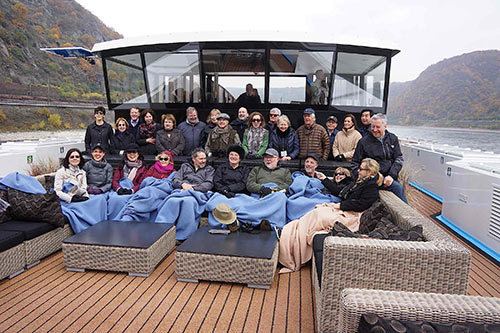
A cool day cruising the Rhine
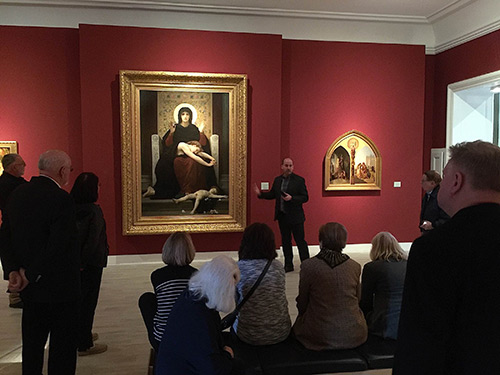
Peter Trippi lecturing about Boughereau in Strausburg
The group decamped on October 26 to AMA Waterways’ luxurious new ship the AmaCerto, where they spent seven days and nights sailing down the Rhine River through the Netherlands, Germany, and Switzerland. On-land visit highlights included the Rothschild family’s enormous Kasteel de Haar, the Wallraf-Richartz Museum in Köln (as well as that city’s magnificent Gothic cathedral), the famously beautiful cities of Wiesbaden and Heidelberg, Strasbourg’s elegant Palais Rohan, and generous helpings of Black Forest cake in the picturesque city of Freiburg.
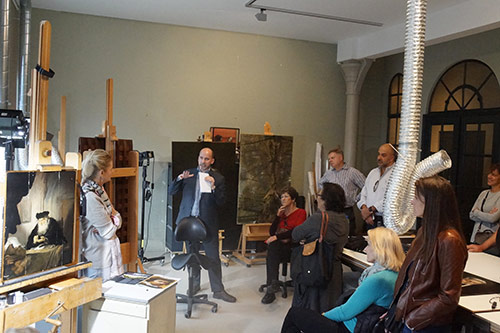
A visit to the restoration studio of Lara van Wassenaer in Amsterdam
Surely the most thrilling day was the one spent sailing through the famously beautiful Rhine Gorge, lined with castles and with vineyards that plunge down the slate hillsides to the water’s edge. Peter Trippi delivered three contextual lectures aboard AmaCerto, and a festive Halloween party — complete with inventive art-inspired costumes — closed out the week in style.
A full article about the cruise will appear in the February 2016 issue of Fine Art Connoisseur.
This article was featured in Fine Art Today, a weekly e-newsletter from Fine Art Connoisseur magazine. To start receiving Fine Art Today for free, click here.