

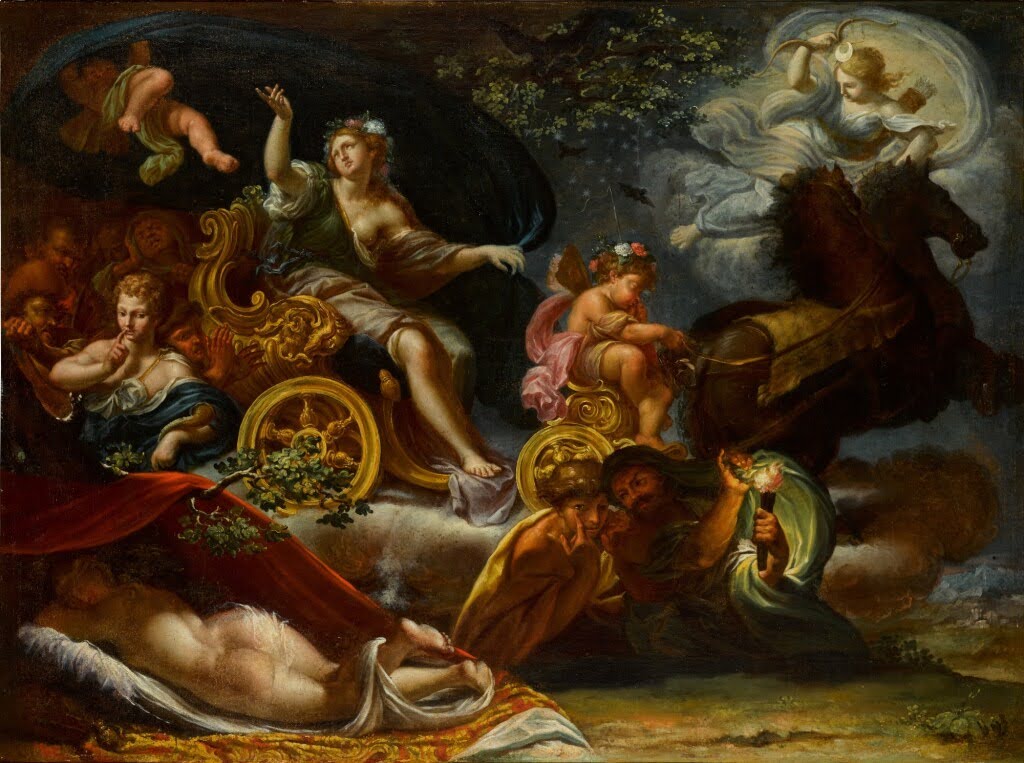
Christopher Bishop Fine Art has announced the first-ever exhibition of “The Triumph of Night” (ca. 1765), a newly rediscovered masterwork by Neapolitan painter Fedele Fischetti (1732–1792).
On view through December 12, 2025, via the exhibition “Alchemy and the Painter,” this singular painting offers a rare visual record of hidden Enlightenment-era Naples, where alchemy, Masonic philosophy, and artistic experimentation intertwined.
More from the gallery:
Discovered by Bishop at auction and hidden from scholarship until now, “The Triumph of Night” sheds new light on occultism and progressive thought, revealing the complex interplay of secrecy, ritual, and knowledge that defined Enlightenment Naples.
Research suggests that the work was commissioned by Raimondo di Sangro (1710-1771), a practicing alchemist and Prince of Sansevero—Naples’s most extravagant patron. A philosopher, Freemason, and necromancer later excommunicated by the church, di Sangro cultivated an intellectual circle for which alchemy represented the synthesis of all knowledge, a spiritual initiation, and a quest for immortality.
The painting is at once a Baroque spectacle and an Enlightenment puzzle. “The Triumph of Night dazzles” with silks, golds, and silvery light, staging a scene of near-chaos that resolves into a sophisticated allegory of alchemy. Embodying painting as science, a transformative process with the power to create new realities, Fischetti maps a path from ignorance to illumination through iconography drawn from Egyptian, Greek, Roman, Hebrew and Christian traditions.
Within this context, Fischetti’s painting emerges as both talisman and ritual object: a visual map of secrecy, heresy, and transformation, offering a rare confirmation of these rites whose material traces have largely vanished.
Accompanying the painting will be a selection of objects and ephemera—including a Roman gnostic gem, a Victorian Masonic gold orb pendant, and an Egyptian gold amulet of the eye of Horus (Wedjat), among others—that deepen its symbolic web, pointing toward a worldview rooted in the conviction that the more ancient the source, the closer to truth. For contemporary viewers, “The Triumph of Night” resonates an alternative creation myth: the dark forces of night giving birth to a golden promise of renewal.
“Alchemy and the Painter” will be accompanied by a fully illustrated catalogue with an essay by Christopher Bishop. The gallery will also host an academic talk on the presentation in November.
About Fedele Fischetti
Fedele Fischetti (Italian, 1732 – 1792), one of the most important painters working in eighteenth-century Naples, was celebrated for his sophisticated frescoes that merged classical themes with Baroque illusionism and wit.
A master of both sacred and secular fresco cycles, Fischetti brought together the grandeur of late Baroque illusionism with the emerging clarity of Neoclassicism. He quickly rose to prominence with his refined decorative schemes for churches and palaces. His early works—such as “The Fall of Simon Magus” and “Presentation at the Temple” (ca. 1759–60) in Naples’ Basilica dello Spirito Santo—already displayed a refined classicist orientation inspired by Pompeo Batoni (Italian, 1708 – 1787).
The artist played a central role in shaping the city’s Neoclassical aesthetic working for Naples’ most elite patrons, including the Bourbon court of Ferdinand IV. Between 1778 and 1781, Fischetti painted a celebrated cycle of frescoes—The Four Seasons and The Golden Age—for the Royal Palace of Caserta, marking his peak as a court decorator.
Over the course of his career, Fischetti was increasingly interested in the most recondite and complex of allegories, drawing on the contemporary advances in archeology to depict the most gilded, most fantastical visions of antiquity. Though often overlooked in favor of his contemporaries in Rome, Florence, Bologna, and Venice, the works of Fischetti are a vivid efflorescence of Naples’ decadent yet intellectually serious late Baroque culture.
For more details about this unveiling and exhibition, please visit the website of Christopher Bishop Fine Art: www.christopherbishopfineart.com.



, a newly rediscovered ...)