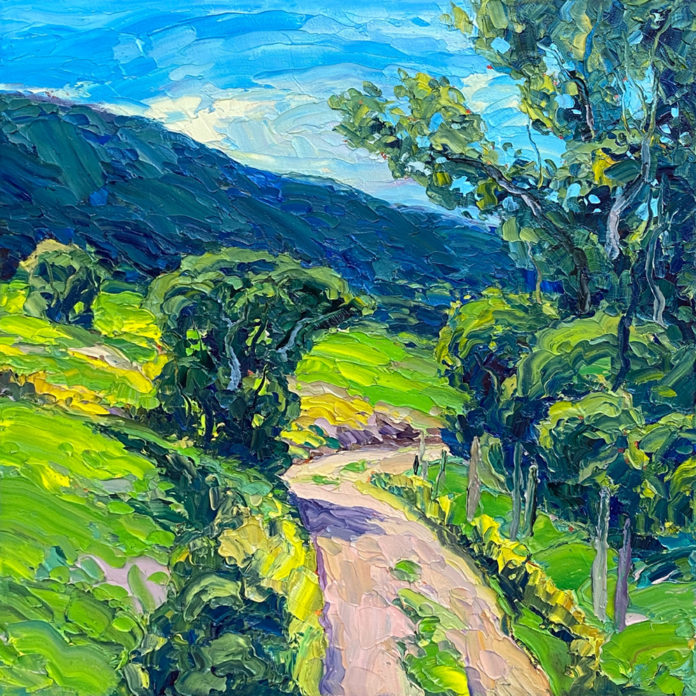
Rhythm of Spring
20 x 20 in.
Oil on canvas
$2,700
Available through Manitou Galleries, Santa Fe, New Mexico
Brad Teare painted the plein air reference for this painting while traveling The Palouse in eastern Washington. The memory of whispering wind, the trill of insects and birds, and the warmth of the summer sun all merge into the final painting.
Teare typically paints a small plein air sketch, then a larger studio study, culminating in a larger piece, perhaps 36″ to 48″ square. All three phases stand alone and are integral steps in his creative process.
BRAD TEARE – THE POETRY OF THICK PAINT
During Teare’s artistic education, he was inspired by Rockwell Kent, Birger Sandzén, William Wendt, and LeConte Stuart.
After art school, Teare worked in New York as an illustrator for The New York Times and Random House, illustrating projects for authors such as James Michener and Alice Walker. A Van Gogh exhibit at the Metropolitan reinforced his love of texture. Intrigued, and after a decade of textural exploration, he now paints entirely with palette knives in thick, multi-hued strokes.
Teare lives in Providence, a small town in the mountains of Utah. His studio, situated between Yellowstone and Arches National Parks, provides a lifetime of spectacular scenery.
Teare has shown at The Forbes Galleries and The Salmagundi Club, both in New York City. He has attended residencies and festivals such as the Forbes/Trinchera Ranch Residency in Colorado, the Maynard Dixon Residency in Mount Carmel, Utah, the LA Art Show, and the Door County Plein Air Festival in Door County, Wisconsin.
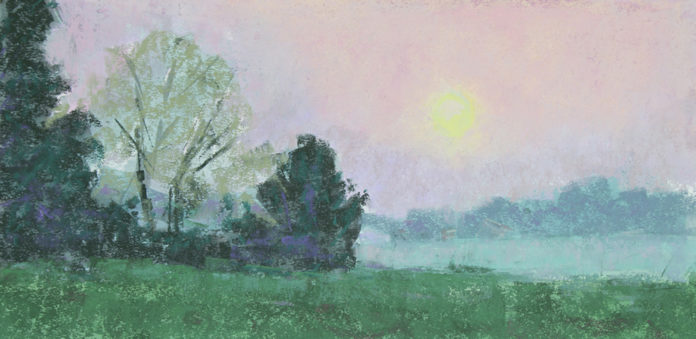
Hazy Humid Morning
6 x 12 in.
Pastel over watercolor on Lenox 100 paper
Visit www.carolstrockwasson.com for more
Carol Strock Wasson a signature member of American Women Artists, Pastel Society of America, a Master member of Chicago Pastel Painters and most recently achieved Master Circle Status with International Association of Pastel Societies (2019).
She is focused on painting with spontaneity and freshness. Her dedication is evident in awards and entry into prestigious shows across the country. She received the Maggie Price Award at International Associations of Pastel Societies in 2017. Other shows include American Women Artists, Indiana Heritage Arts, Arts for Parks, Pastel Society of America, Chicago Pastel Society.
Carol is a featured artist in three publications, Painting Indiana II, Painting Indiana III and Historic Indiana en Plein Air. She is a supporting member of numerous organizations locally and nationally.
Recently Carol has opened her own workshop and gallery space at StrockWasson Studio at 317 N Columbia, Union City, Indiana. Her commitment is to teach the importance and awareness of pastel in art at all levels of development.
Memberships
Indiana Artists Club
American Women Artists, Signature Member
Indiana Plein-Air Painters Association
Hoosier Salon
Pastel Society of America, Signature Member
American Impressionists Society
Chicago Pastel Painters, Master Pastelist
Pastel Society of North Carolina
Pastel Society of Cape Cod
Museums
Richmond Art Museum, Richmond Indiana
Indiana Heritage Arts, Nashville Indiana
Indiana State Museum, Indianapolis Indiana
Art Museum of Greater Lafayette, Lafayette, Indiana
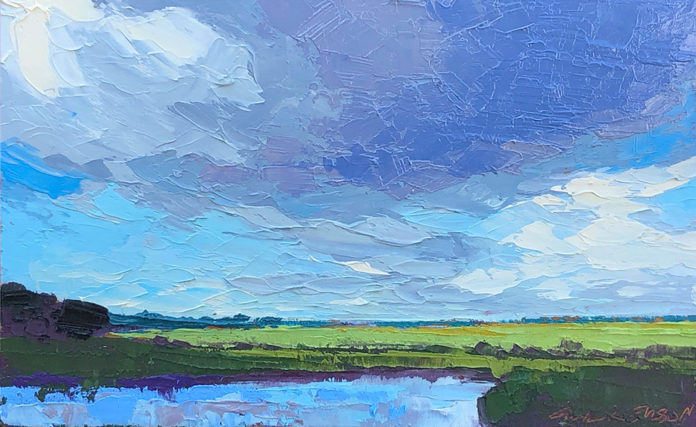
Using the changing color and light of an impression, the artistry of Mary Bentz Gilkerson’s paintings connects people to the experience of place.
“Almost daily for the last ten years I’ve made a small painting inspired by the landscapes I travel through, mainly near the roads and highways around Columbia, South Carolina, especially Lower Richland, and the marshes can creeks of Edisto Island and Savannah, Georgia” says Gilkerson.
Mary is drawn to the ordinary spaces we move through, especially ones that are within view from the road.
“In a roadside view I find a strange intersection of nature and culture. We move so fast that we don’t take time to observe the world around us in the way that people did before modern transportation and technology came along. In my work, I seek to focus on the shifting patterns of light and color that tell us what time of day and season it is, to note the small and subtle, as well as the large and grand.”
Gilkerson holds an MFA in drawing and painting from the University of South Carolina. A native South Carolinian, she lives and works in her Columbia studio after retiring as a professor of art at Columbia College. She has received grants from the South Carolina Arts Commission and the Cultural Council of Richland and Lexington Counties in addition to having been selected as a Southern Arts Federation Fellowship Finalist. Her work is in the permanent collections of McKissick Museum, Palmetto Health, Morris Communications Company, and Seibels Bruce Group, among others.
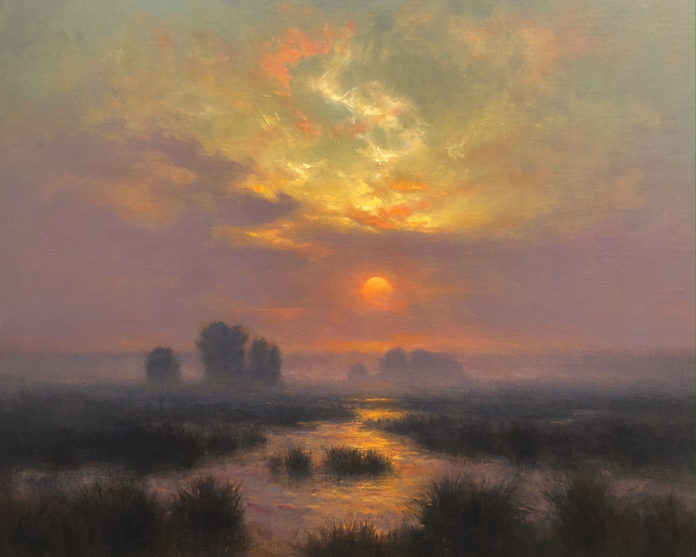
Evening Eminence explores the transition from day to night, with the regal presence of the setting sun inspiring the painting’s title. The low-lying marsh adds to the calm nature of the scene, the water echoing the warmth above.
Low horizons and plentiful skies are second nature to this artist originally from central Illinois. Frequent drives on the interstate offered ever-changing cloud compositions in varying color combinations. He recalls once seeing a glorious sunset to his left as a full moon rose serenely on his right. It was all he could do to keep from running off the road, though he thought it might be a fittingly sublime way to go.
As deeply inspired by art history as by nature, he has a love of Turner’s dramatic skies, Corot’s subtle poetry, and Inness’s transcendent spiritualism. The current painting seems to embody all three.
With well over a hundred awards to his name, the artist recently has won an Award of Excellence at the 2021 Oil Painters of America Salon Show for his painting Night Journey. Again presenting an hour of change, the painting features an opalescent moon. The juror lauded the piece for its masterful sense of mystery.
Gerard Erley’s work is represented by Berkley Gallery in Warrenton, Virginia and by City Art in Columbia, South Carolina.
The artist’s artwork and related information can be viewed at www.gerarderley.com.
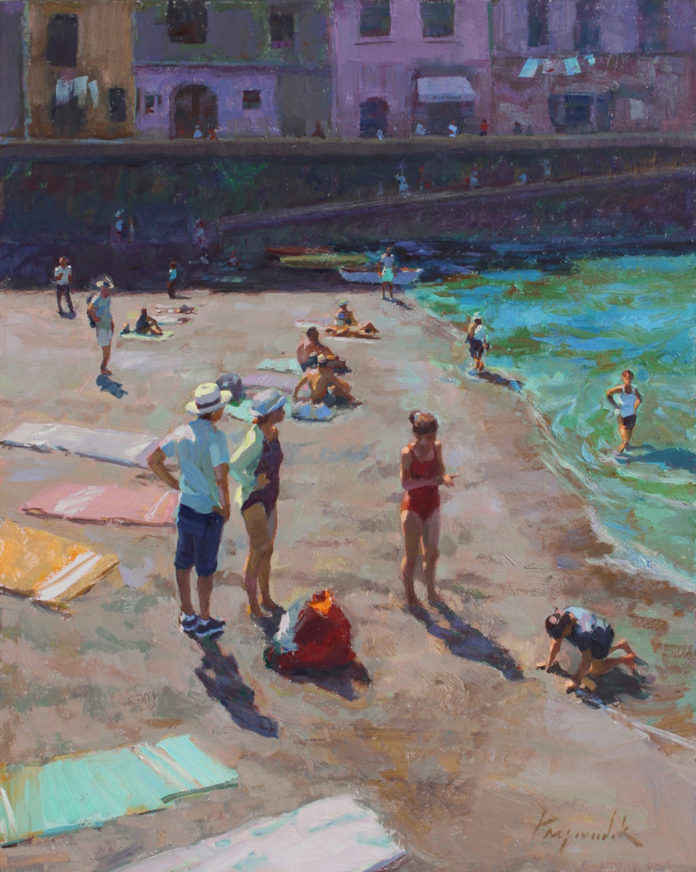
Camille Przewodek: “This painting is one of a series of studio paintings I have completed as a result of my trip to Italy in 2019. This painting “Vernazza Beach” was exhibited in the 2020 OPA National Juried Exhibition. I used reference photos I took on my trip along with a number of color studies done on location. As I have more than 35 years of experience painting on location, I feel I am able to effectively paint from photo reference. Also, in the studio, I can redesign and change the photo to suit my composition. For example, I used the beach towels to lead you into the painting and rearranged all the figures.”
In addition to her training at Wayne State University in Detroit and the Academy of Art College in San Francisco, Camille Przewodek studied color with impressionist master, Henry Hensche, at the Cape School of Art in Provincetown, MA. Today, Przewodek carries on Hensche’s tradition by teaching his color approach to others in workshops. The lineage of her instruction goes back through Hensche to his teacher Charles Webster Hawthorne, who had studied with William Merritt Chase. As with the French impressionists, American impressionism focused on painting outdoors and observing light and atmosphere on color. Unlike French impressionism, however, American impressionists tended to pay greater attention to the solidity of form. This was part of Hensche’s training: rather than drawing objects, then “coloring them in,” Przewodek learned to see and express the myriad subtleties of color relationships that create form.
Przewodek’s style, which quickly became distinctive for its rich saturated color and luscious oil paint, caught the attention of numerous clients during the decade when she worked as a commercial illustrator. “I was one of the few illustrators who didn’t look like an illustrator. I painted the way I liked to paint,” she says. When she landed accounts such as Alfa Romeo and Chateau St. Jean, Przewodek knew it was her commitment to capturing changing light that made the difference.
Przewodek believes that just about any scene is beautiful, if you are willing to seek out the beauty in it. “I paint light, that’s what I do. When people say they like a painting that has bright colors in it, they obviously like sunny days. For others the appeal is found in the cooler colors of gray days. The abstract relationships of the big structures and the masses of color are where I begin. How does the sky relate to a hill and to the foreground? I see the relationships and proportions of color in my mind, and then I go for it!”
Camille is an acknowledged authority on color who regularly serves as an entry and awards judge for various painting competitions and events. She is also a much sought-after instructor who annually teaches painting workshops across the country, and offers regular weekly classes close to home at her studio in Northern California.
She has been an invited instructor, lecturer, and panelist on the Hensche-Hawthorne approach to seeing and painting color at American Artist Magazine’s Weekend with the Masters as well a regularly featured, on-stage demonstrator at PleinAir Magazine’s Annual Plein Air Convention.
Camille is a Master Signature Member of the American Impressionist Society, American Women Artists, and Oil Painters of America, and she is currently represented by the Huse/Skelly Gallery on Balboa Island, California.
In the Artist’s Words:
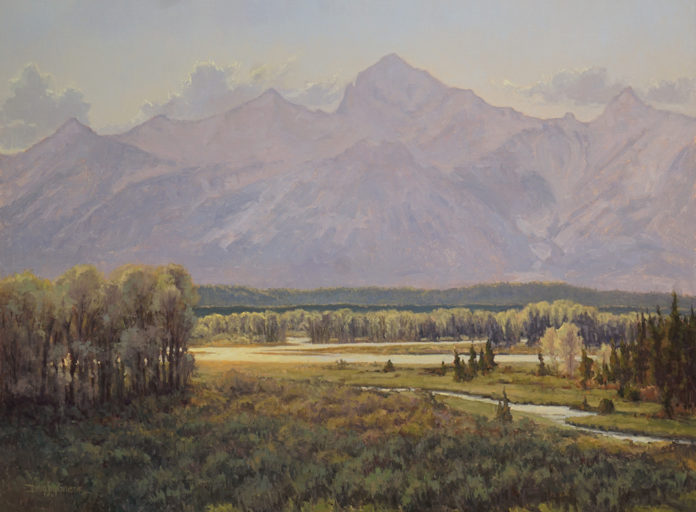
“This painting was inspired by several trips to Grand Teton National Park and was painted from both plein air studies and reference photos I took there. The majesty of these mountains reminded me of a grand cathedral. The ethereal light that bathed the mountains and the bright light reflecting on the river on this particular day made me feel like I was standing in heaven. The rhythm of the trees was like a visual hymn. It was a very spiritual experience and is what I hoped to portray in the painting.”
About the Artist:
Nebraska artist, Debra Joy Groesser, is best known for her impressionistic landscape paintings, particularly her plein air work. “Painting is such a spiritual experience for me. Nothing inspires me more than being out on location, capturing the subtle nuances of color, light and atmosphere that can only be achieved by painting from nature.”
Debra is CEO/President of the American Impressionist Society (AIS), a Master Signature Member of Plein Air Artists Colorado, Signature Member of AIS, Laguna Plein Air Painters Association and American Plains Artists, and an elected member of Rocky Mountain Plein Air Painters and the Salmagundi Club. Debra owns her own gallery in her hometown of Ralston, Nebraska, where she is also the “First Lady” (her husband Don serves as Mayor for the city – 25 years and counting!).
Debra has participated in countless juried and invitational exhibitions and has won many awards for her work. She has served on the faculty of the Plein Air Convention and Plein Air Live. Upcoming exhibitions she will be participating in include the American Impressionist Society National Juried Exhibition at Gallery 1516 in Omaha NE, September 10–December 12, 2021, and her solo exhibition, “Yes This is Nebraska” at the Bone Creek Museum of Agrarian Art in David City, NE, November 18, 2021–March 13, 2022. Debra has been featured in several national art publications. She is represented by Illume Gallery of Fine Art, St. George UT; Montgomery-Lee Fine Art, Park City UT; Mary Williams Fine Arts, Boulder CO; Southwind Gallery, Topeka KS, and Debra Joy Groesser Fine Art, Ralston NE.
For more information about Debra, her work, and to sign up for her monthly email newsletter, please visit her website, www.debrajoygroesser.com You can also follow Debra on Facebook (Debra Joy Groesser Fine Art) and Instagram (@debrajoygroesser).
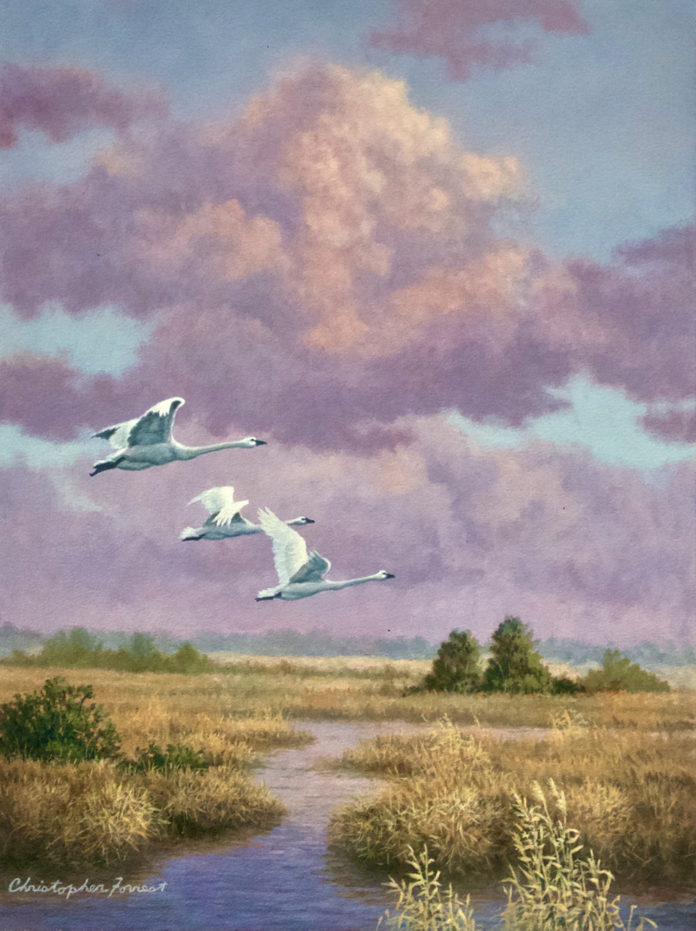
Low Country Swans
By Chris Forrest
16 x 12 in.
Oil on Raymar panel
$1,250
Available at Xanadu Gallery
The painting Low Country Swans features a challenging dramatic sky, the local marsh, and a favorite winter bird, the Tundra Swan. Living on a coastal island, Chris is both challenged and thrilled for the opportunity to depict the coastal sea and low country along with the local wildlife.
Chris was always going to attend art school, but studied engineering instead. He was commissioned in the Army and served 10 years with tours in Vietnam & Germany, command & operations assignments, and ranger & airborne schools/training. He then worked 10 years as a fulltime wildlife printmaker and painter followed by 30 years in business. Returning to art full time in 2019, he is totally enjoying the challenge of painting again.
His work has been featured in Southwest Art, Wildlife Art, Prints, and North Light magazines along with multiple editions of Who’s Who in American Art. He is a signature member of the Society of Animal Artists, and is a member of the American Society of Marine Artists, International Guild of Realism, and associate member of NOAPS & OPA. His work can currently be seen at the Copley Society National Land-Sea Show, OPA Salon Show, and NOAPS associate online, and was in this year’s NOAPS Best of America-Small Works.
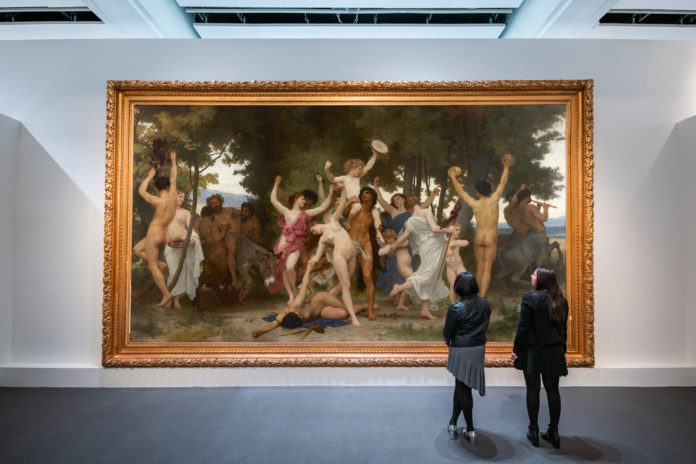
William-Adolphe Bouguereau, "The Youth of Bacchus," 1884, oil on canvas, 130 1/8 x 240 1/8 in.
Collecting Bouguereau Paintings > Though he was never robustly championed by the critics, this French academician successfully applied his formidable skill to satisfy a hungry American market.
The exhibition “Bouguereau & America” (2019-2020 at the Milwaukee Art Museum; the Memphis Brooks Museum of Art; and the San Diego Museum of Art) gathered more than 40 canvases painted by William-Adolphe Bouguereau (1825–1905).
Bouguereau and His American Collectors
BY THOMAS CONNORS
“Asset class” may be a relatively new descriptor for art, but amassing works of aesthetic distinction to signify one’s own status actually dates back to antiquity. In the United States, this strategy manifested in earnest for the first time with the great industrialists and bankers of the Gilded Age, but Henry Clay Frick and J.P. Morgan were not the only captains of industry adding skylit “picture galleries” to their grand homes.
People of lesser fortune and fame swiftly followed suit. Although their collections were generally not of the same caliber and did not play as significant a role in shaping our country’s greatest museums, these people and their acquisitions nonetheless influenced American cultural history and also the formation of many artists’ reputations.
Though he was never robustly championed by the critics, this French academician successfully applied his formidable skill to satisfy the hungry American market.
ACCOMMODATING HIS CLIENTELE
Born in the seaport of La Rochelle, Bouguereau arrived in Paris at age 20 to study with the neoclassicist painter François-Édouard Picot. After two years at the École des Beaux-Arts and two failed attempts, he won the Prix de Rome in 1850, which offered him the opportunity to experience masterworks of the Italian Renaissance and classical antiquity firsthand. Having demonstrated a high level of technical mastery and a thorough respect for pictorial conventions, Bouguereau was soon launched on a respectable career.
In 1856 he received a portrait commission from Emperor Napoleon III, and 20 years later was elected to the academy. Between these milestones, and until his death in 1905, Bouguereau remained true to the training of his youth, deftly handling his brush to produce client-pleasing images: mythical scenes, allegorical nudes, and charming waifs.
The writer Émile Zola — best remembered as the champion of Édouard Manet and the Impressionists — dismissed Bouguereau’s efforts as pretty pictures for the nouveaux riches, populated with “peasants who are clean and rosy… young girls chaste and modest… goddesses delicately suggestive.” However, as the scholar Abigail Solomon-Godeau suggests in the exhibition catalogue, although Bouguereau’s style and subject matter were retrograde when contrasted with those of the avant-garde, his work was, in fact, a business-like response to changing times.
No longer able to depend on the state and church as patrons, academic artists learned to behave like capitalists. In 1863, when Manet’s “Le déjeuner sur l’herbe (The Luncheon on the Grass)” sensationally pointed the way toward a new kind of art, Bouguereau’s far-from-progressive Faun and Bacchante was a reasonable accommodation of the conservatism that currently ruled the marketplace.
American collectors — not yet seduced by emergent French modernism — proved to be the artist’s most ardent supporters. “Bouguereau & America” explored the course of Gilded Age collecting and the ways in which Americans’ reverence for the French Academy shaped not only the personal taste of affluent individuals but also, in time, influenced our country’s institutional acquisitions.
Tanya Paul, the Isabel and Alfred Bader Curator of European Art at the Milwaukee Art Museum, co-organized the exhibition. She notes, “When you look through Edward Strahan’s well illustrated volume of 1880, The Art Treasures of America, most of the artists listed in it — such as the painters of the Düsseldorf school — have fallen off our art-historical map completely. Bouguereau is one of the few who has remained, who has stayed a central part of our consciousness in terms of that period.”
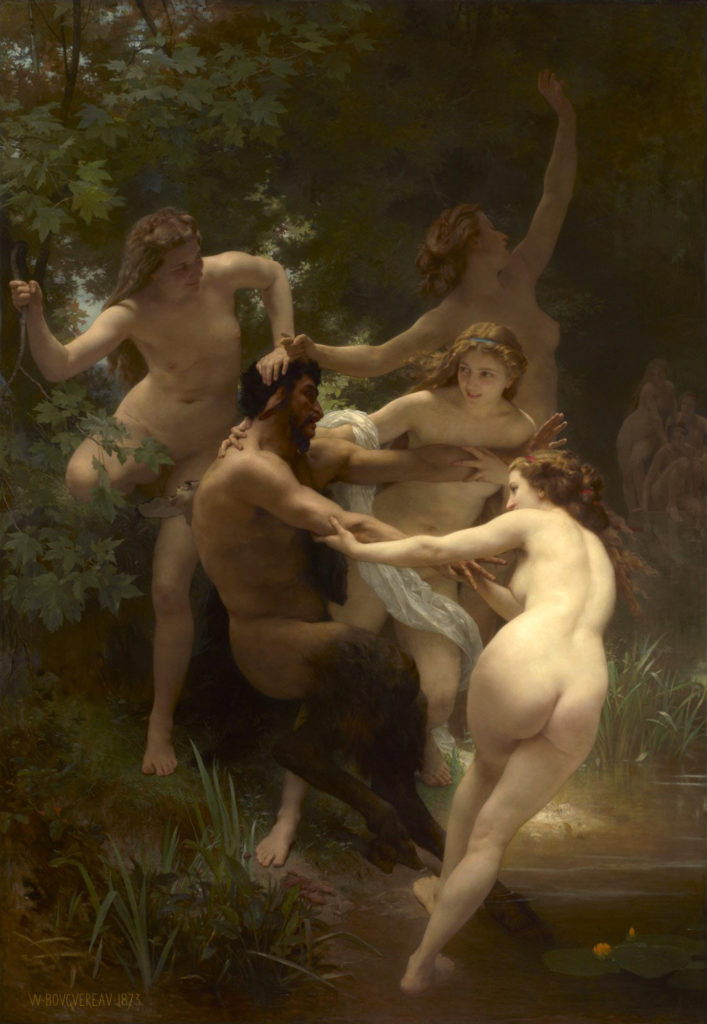
Aided by the acumen of the Parisian dealers Paul Durand-Ruel and Adolphe Goupil (and by what was originally Goupil’s satellite in New York, M. Knoedler & Co.), Bouguereau’s art found its way into the mansions of America’s growing elite. “Diamond Jim” Brady and William Randolph Hearst were just two of the marquee names to own his canvases. But one of the first to buy a Bouguereau was the New York City hardware store magnate John Wolfe, who purchased “Nymphs and Satyr” (1873) directly from the artist in 1882.
Later owned by the hotelier (and convicted murderer) Edward S. Stokes, who displayed it in the bar of New York’s Hoffman House, this painting was ultimately acquired in 1942 by the Singer sewing machine heir, Robert Sterling Clark, and has long adorned the museum he and his wife created in Williamstown, Massachusetts.
William-Adolphe Bouguereau, “Nymphs and Satyr,” 1873, oil on canvas, 102 1/2 x 72 in., Clark Art Institute, Williamstown, Massachusetts, acquired by Sterling and Francine Clark, 1942, 1955.658
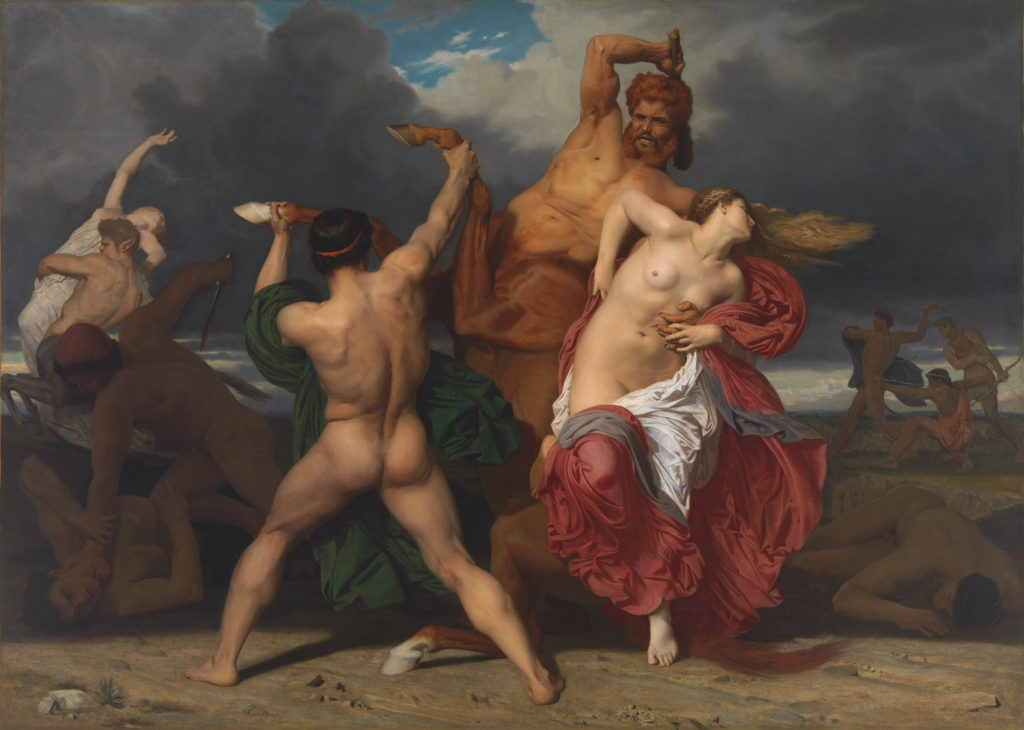
Although hewing close to academic ideals when it comes to subject matter, “Nymphs and Satyr” is certainly an easier picture to absorb (thanks in part to its lusciously rendered flesh) than a much earlier Bouguereau scene, “Battle of the Centaurs and the Lapithae” (1852), now at the Virginia Museum of Fine Arts. Perhaps it is no wonder that, when he began creating work for the American market, Bouguereau muted his classical allusions and narratives, instead making beguiling verisimilitude the primary attraction.
William-Adolphe Bouguereau, “Battle of the Centaurs and the Lapithae,” 1852, oil on canvas, 49 x 68 5/8 in., Virginia Museum of Fine Arts, Richmond, Arthur and Margaret Glasgow Fund, 2008.100; photo: Travis Fullerton
“When he met Durand-Ruel, he started to understand what he needed to do to sell,” Paul suggests. “He needed to take his skills as an academically trained artist and translate them into paintings that would be more accessible. This meant a reduction of complexity in terms of subject matter, but not in terms of composition.”
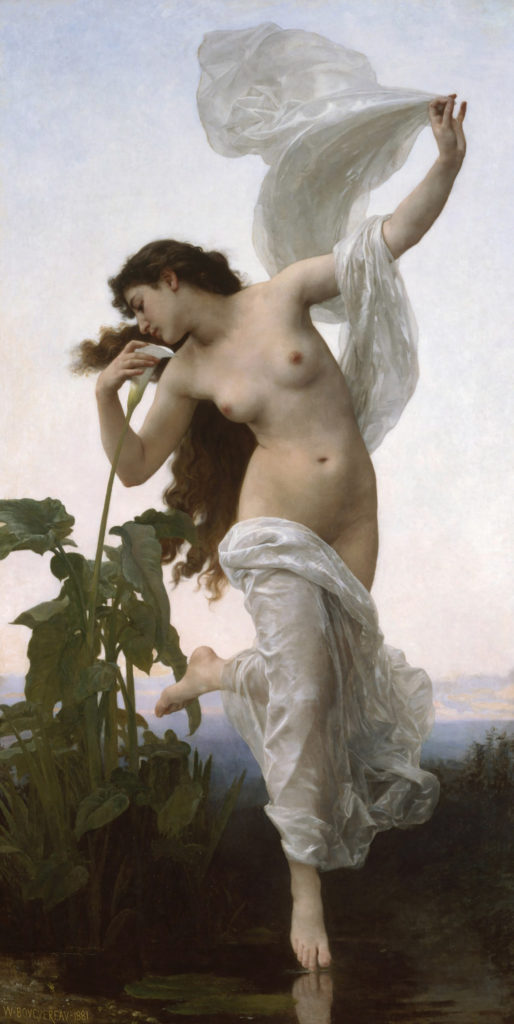
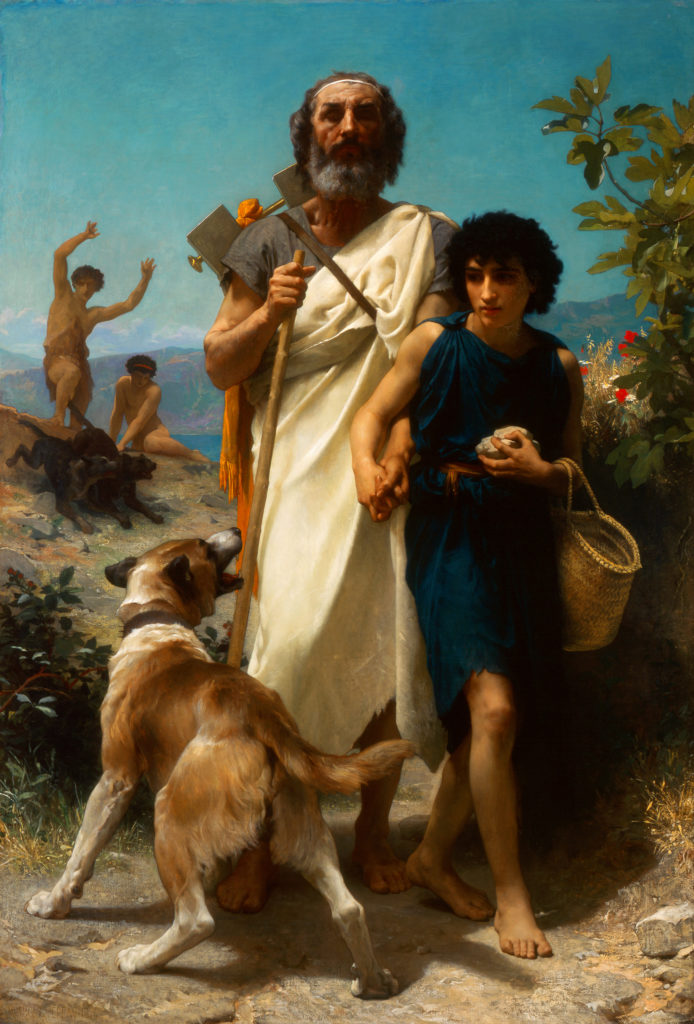
While Bouguereau eventually courted American collectors with images of mournful urchins with outstretched hands, loving mothers, and chaste nudes such as “Dawn” (1881), his more recognizably classical scenes did not go unappreciated here. “Homer and His Guide” (1874) was acquired soon after its completion by the New York department store entrepreneur Alexander Turney Stewart, whose collection included two other works by Bouguereau, as well as pieces by his compatriots Ernest Meissonier and Rosa Bonheur. Orestes Pursued by the Furies (1862) entered the collection of the Philadelphia inventor and philanthropist Joseph Harrison, Jr.
William-Adolphe Bouguereau, “Dawn,” 1881, oil on canvas, 84 5/8 x 42 1/8 in., Birmingham Museum of Art, Alabama, bequest of Nelle H. Stringfellow, 2005.111
As he had in France, Bouguereau took his share of lambasting in the U.S. The artist Winslow Homer asserted he would not cross the street to see a Bouguereau, calling his works “waxy and artificial.” After disparaging the artist’s renditions of the “picturesque poor,” the author and critic Clarence Chatham opined, “In an orderly society regulated by wholesome rules dictated by conventional propriety, such a painter is sure of his reward.”
IN AND OUT OF FASHION
“Bouguereau & America” was co-organized by Stanton Thomas, formerly the curator of European and Decorative Arts at the Memphis Brooks, and now curator of collections and exhibitions at the Museum of Fine Arts in St. Petersburg, Florida. He notes, “It’s hard not to think of the French critic Théophile Gautier’s comment in 1868, ‘Nous ne voulons pas de la peinture léchée’ (We do not want painting licked).” But it was exactly the slickness of Bouguereau’s canvases that American collectors found so appealing.
“Their surface perfection connoted value and quality,” Thomas explains. “It seems pretty clear that the robber-barons and merchant princes were consciously buying works that were so perfect as to be uncontroversial. And it was not just his technique, but also the harmonious, Raphael-like sweetness that melted so nicely on American palates.”
A Bouguereau first entered an American museum collection in 1878, when the widow of Joseph Harrison, Jr., gifted Orestes Pursued by the Furies to the Pennsylvania Academy of the Fine Arts. Not long after, similar bequests were conveyed to the Cincinnati Art Museum and New York City’s Metropolitan Museum of Art.
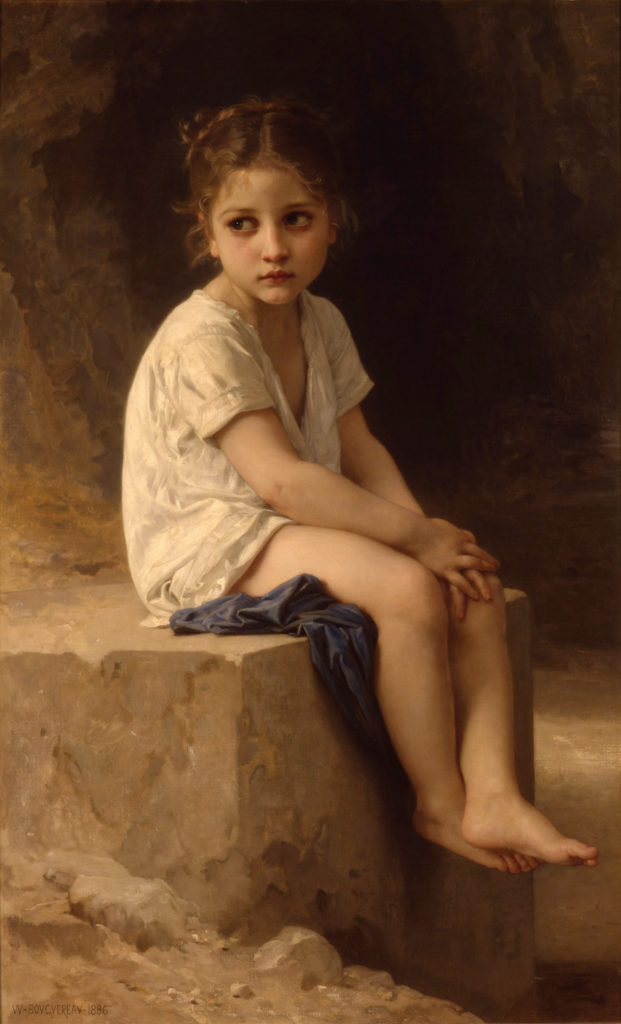
William-Adolphe Bouguereau, “At the Foot of the Cliff,” 1886, oil on canvas, 43 1/2 x 26 1/4 in., Memphis Brooks Museum of Art, Tennessee, bequest of Morrie A. Moss, 93.4
Over the years, Bouguereau paintings found their way into a number of smaller institutions, as well as the Art Institute of Chicago and later the J. Paul Getty Museum. While some of these were purchases, most were gifts or bequests, which makes us wonder if curators were biased against Bouguereau.
“Many of those works came into museum collections after the death of the artist and after his critical collapse, so yes, it is fair to say there was a lot of institutional indifference to his work,” says Thomas. “Perhaps even more telling is the way that Bouguereau paintings— almost inevitably seen as kitsch and saccharine — often languished in storage for decades before ever being shown in the museums’ galleries. I am always impressed by the vision of the very few collectors of the mid-20th century who astutely acquired this artist against prevailing market trends and art-historical bias, including Clark, Chrysler, and Getty.”
By the late 1880s, Bouguereau’s art began to lose its value, if not its appeal. As Tanya Paul notes in her catalogue essay, Return from the Harvest (1878) — originally valued at $45,000 — sold at auction for $8,000 in 1887 and fetched only $2,200 in 1929, when it was purchased by the vaudeville impresario Edward Franklin Albee. In the 1970s, a Bouguereau could be had for $10,000, but since the 1990s, his work has appreciated. In June 2010, “Pietà” (inspired by Michelangelo’s famous treatment) led the Old Masters & 19th-Century sale at Christie’s New York, selling for $2,770,500.
Of course, auction prices are only part of the story. Seeing his works, it is difficult not to be wowed by his vivacity, and by his profoundly skilled deployment of paint. In “Homer and His Guide,” one wonders how the light from above not only models the figures, but also makes their flesh glow. We apprehend the utterly recognizable parental expression in “Young Mother Gazing at Her Child,” and amid all the violence of “Battle of the Centaurs and the Lapithae,” we admire the delicately interlaced fingers of Eurytus and Hippodamia.
William-Adolphe Bouguereau, “Homer and His Guide,” 1874, oil on canvas, 82 1/4 x 56 1/4 in., Milwaukee Art Museum, Layton Art Collection, Inc., gift of Frederick Layton L1888.5; photo: Larry Sanders
“I used to work at the Philbrook Museum of Art in Tulsa, where we had a Bouguereau picture depicting a shepherdess,” Paul recalls. “It was not the most amazing example of his art, but a strong one, and I could not take that painting off public view. In fact, I couldn’t even move it to a different wall because visitors were so in love with it.”
Having said that, Bouguereau remains a bit “rich” for some museum-goers — somewhat like having too much dessert. Or perhaps too “popular.” But this artist knew what he was doing and he made no apologies. “What can you do, one has to change with the taste of the public,” Bouguereau told a journalist in 1891. “I know that this style is the object of a lot of criticism… In painting I am an idealist, I only see beauty in art, and for me, art is beauty.”
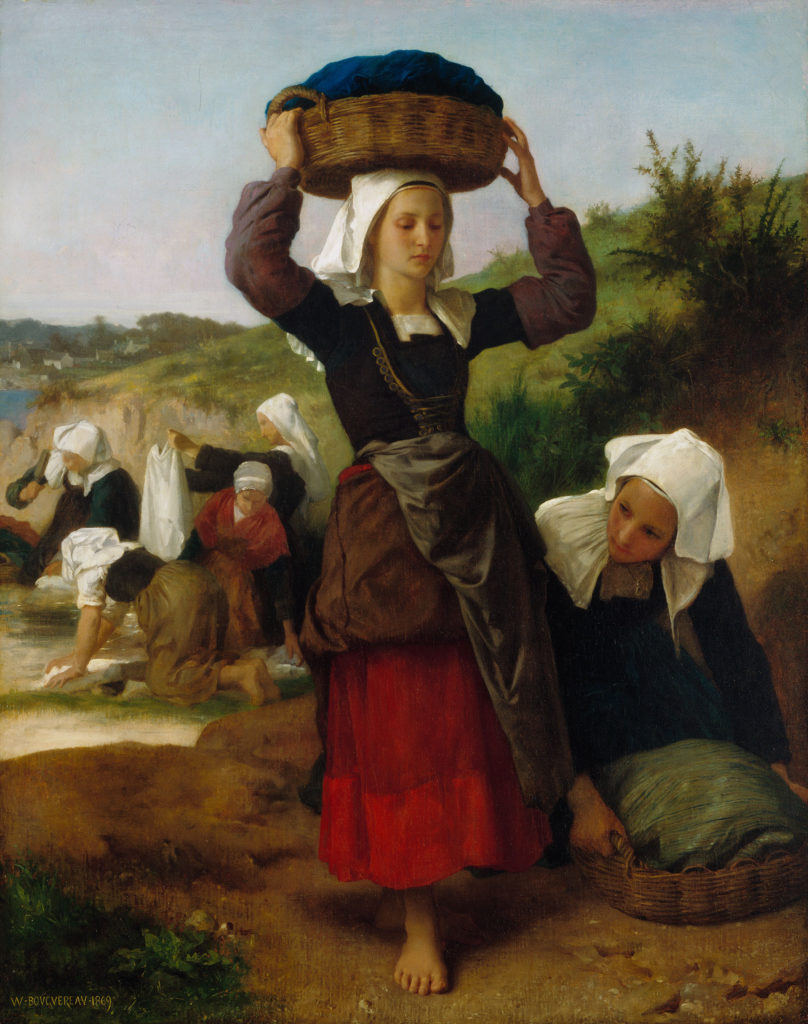
William-Adolphe Bouguereau, “Washerwomen of Fouesnant,” 1869, oil on canvas, 30 x 23 5/8 in., Memorial Art Gallery of the University of Rochester, Bertha Buswell Bequest, 55.61
THOMAS CONNORS is a Chicago-based arts journalist. He wrote about the artist Ned Mueller in the August 2018 issue of Fine Art Connoisseur.
> Visit EricRhoads.com to learn about more opportunities for artists and art collectors, including retreats, international art trips, art conventions, and more.
> Sign up to receive Fine Art Today, our free weekly e-newsletter
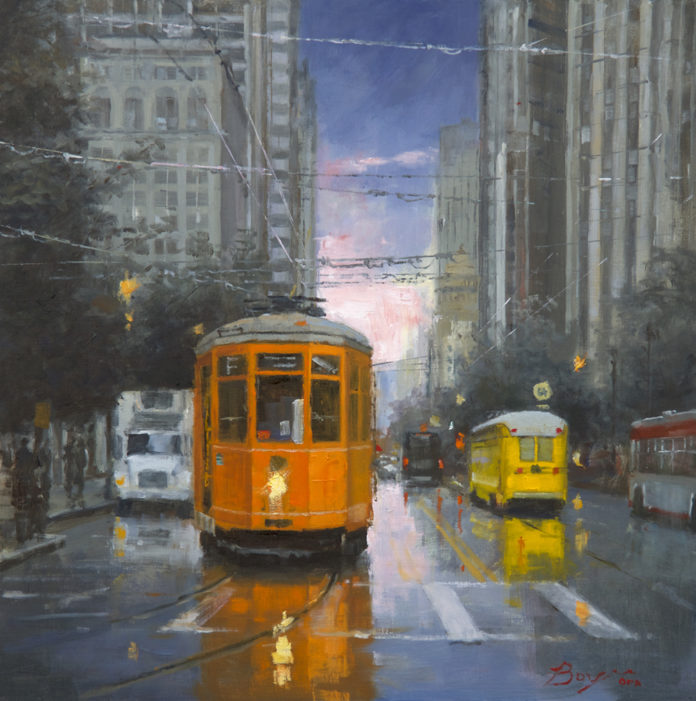
Richard Boyer: “I found it fascinating that San Francisco went around the country and bought up old trolleys to renovate for their mass transit system. So, each one is marked from the city it originated in. For paintings, it’s a great subject matter with the variety of different colors.”
Boyer began painting at an early age, first showing his work while still attending high school in Williamsville, New York. He graduated from the University of Utah in 1981 after five years of study under the portrait and figurative painting “Alvin Gittins.” Gittins’ ability to render the figure so expertly intrigues and influences him to this day.
In 1981, Boyer moved to Germany to study languages at the Universität Kiel. With Kiel as a home base, he utilized the opportunity to travel and paint throughout Europe, Africa and the Middle East. Richard met his Swedish wife, Karin, while studying at the University of Berlin. Since 1988, they have resided in Salt Lake City, Utah, where their three children were born. However, they continue to spend their summers with their extended family in Sweden.
During the recession, several of Boyer’s galleries suggested that he paint cities — maybe closer to home. So, with that he traveled to Portland where it rained for three days. Experiencing all the colors and reflections in the wet streets exploded into a new direction of painting cityscapes in a larger format. The galleries loved the new direction and there has been no looking back.
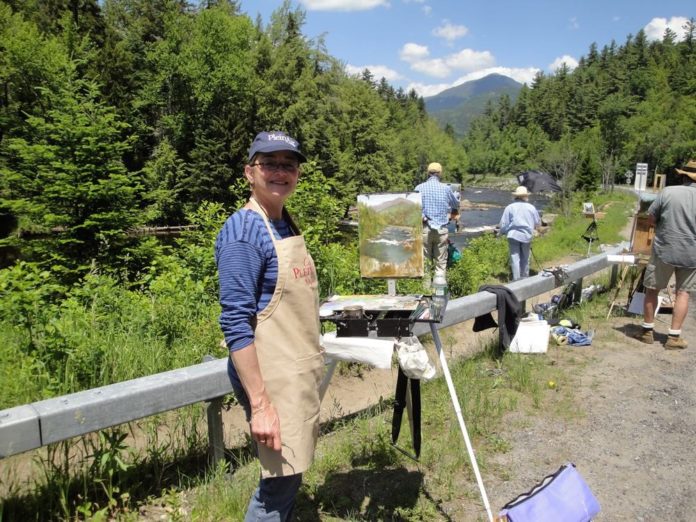
Aida Garrity painting during the second annual Adirondacks Publisher’s Invitational in June 2013.
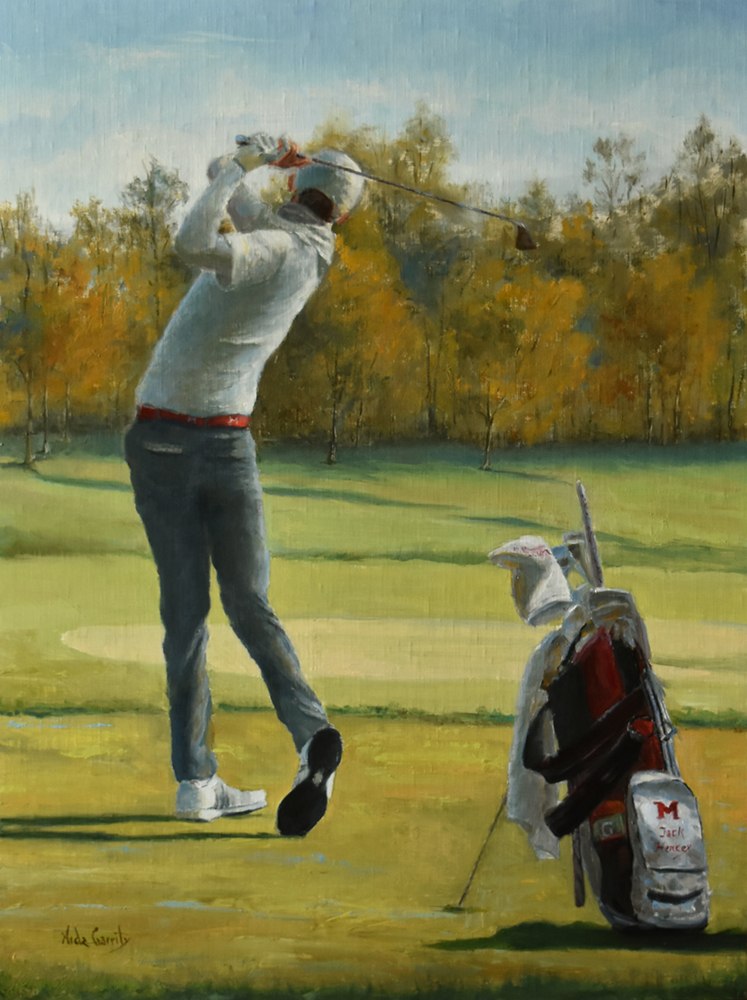
Aida Garrity, “Jack,” 24 x 18 in., oil, 2021
How did you get started and then develop your career?
Aida Garrity: I discovered my passion for painting at age five through children’s art classes at the Museo de Bellas Artes in Caracas, Venezuela. I earned a Bachelor of Science in Metallurgical Engineering from the Imperial College, London and worked for over 30 years in engineering. I returned to my artwork in 2006 when I decided to obtained an MFA from San Francisco Academy of Art University and graduated in 2010.
Over the years, I have taken workshops with artists I admired and attended several conventions, participated in painting trips with plein air organizations and friend artists. I have to admit that what really helped me grow the most as an artist has been to paint from life and on location. The experience has provided me the gift of learning how to look at my subject and how to create the freshness that is needed in the final piece of art.
How do you describe success?
For me success has come in different ways. I feel that I have been successful on working hard to improve my art over the years. This has been validated by the acceptance of my art into national shows and by my collectors’ acquisition of my paintings for them to enjoy in their homes with family and friends. It gives me a great joy to see their faces of joy and admiration when they receive the paintings.
How do you find inspiration?
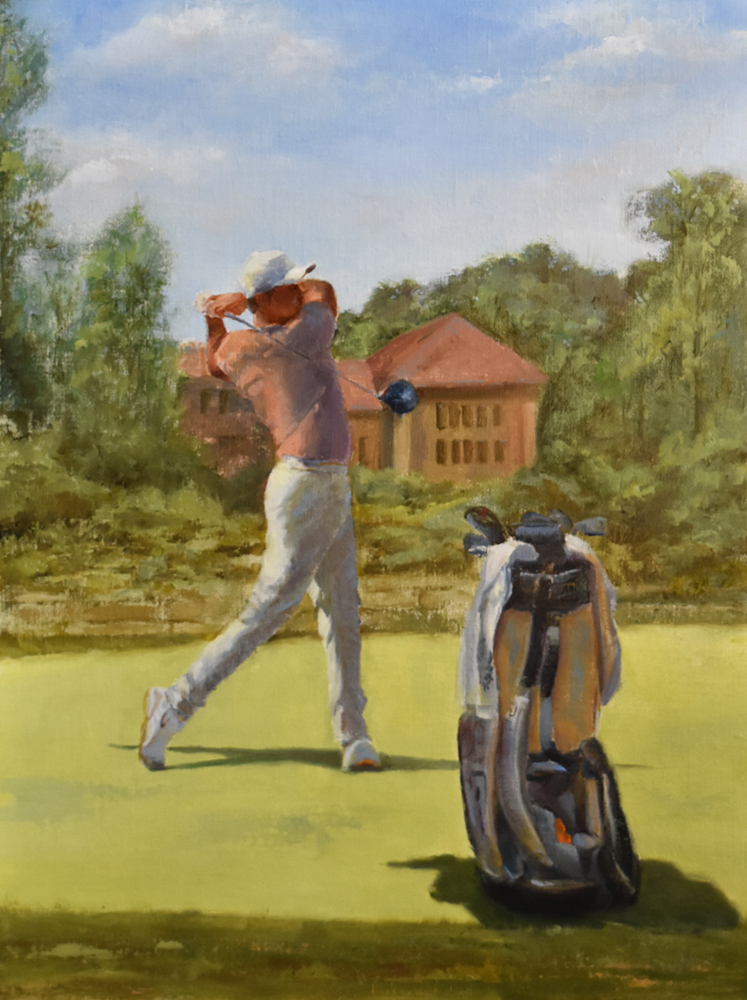
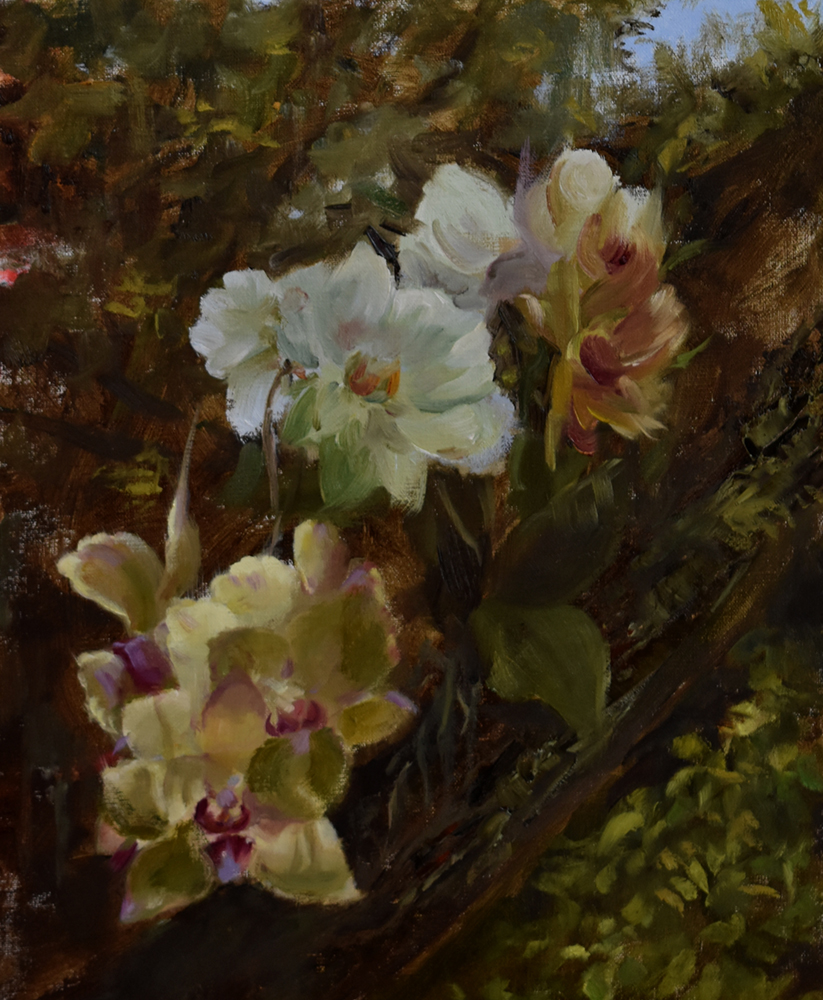
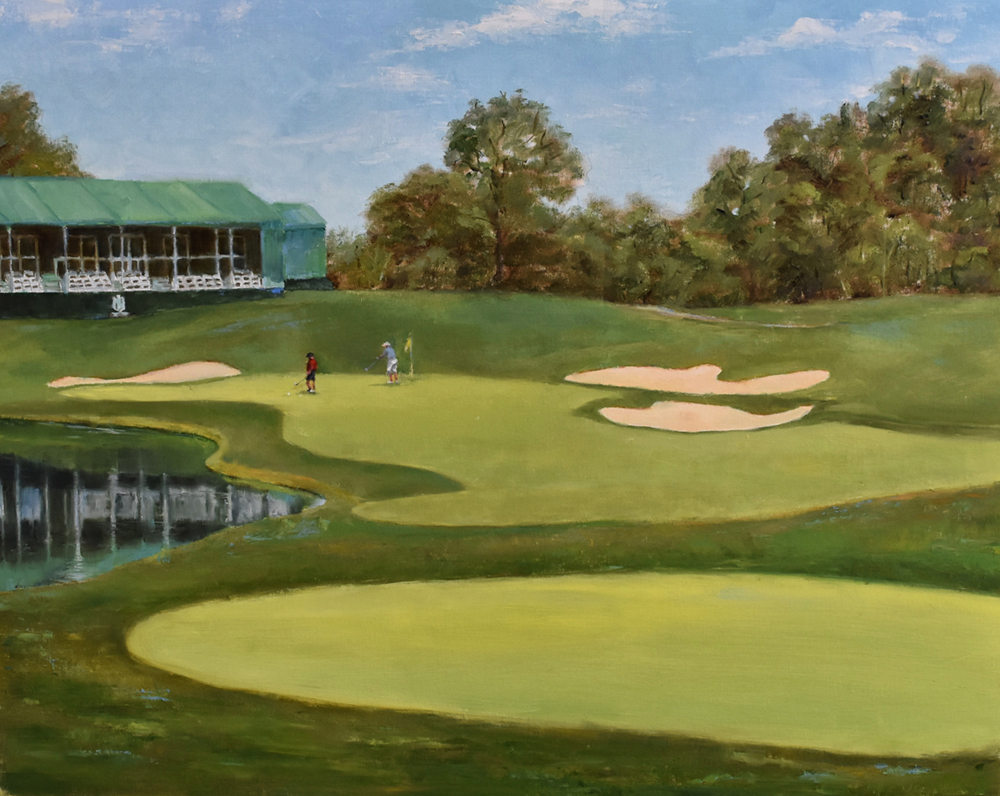
I find my inspiration in the wonders of life and beauty, capturing individual personalities, moods and emotions. For example, in these paintings of golf-inspired landscapes and scenes from my residences in Ohio and Florida, I undertook the challenge of crafting a composition that evokes emotion and transmits a story to the viewer. I also cultivate my creativity by painting plein air with friends in different areas of the country and by travelling internationally with different groups of artists.
What is the best thing about being an artist?
The best thing about being an artist is to be able to see in detail the beauty of the world around us. We are very fortunate to be able to elevate our souls to that level of sensitivity that is so difficult to explain in simple words.
Robert Henri describes it as follows: “When the artist is alive in any person, whatever his kind of work may be, he becomes an inventive, searching, daring, self-expressing creature. He becomes interesting to other people. He disturbs, upsets, enlightens, and he opens ways for a better understanding. Where those who are not artists are trying to close the book, he opens it, shows there are still more pages possible.”
Who do you collect?
My goal is to collect work from the artists that I most admire. My current collection consists of paintings by Judith Carducci, Daniel Gerhartz, Daniel Keys, Scott Burdick, Susan Lyon, Michael Shane Neal, Casey Baugh, Don Demers, Kim Moore, Jeanne McKinney, and Christopher Leeper.
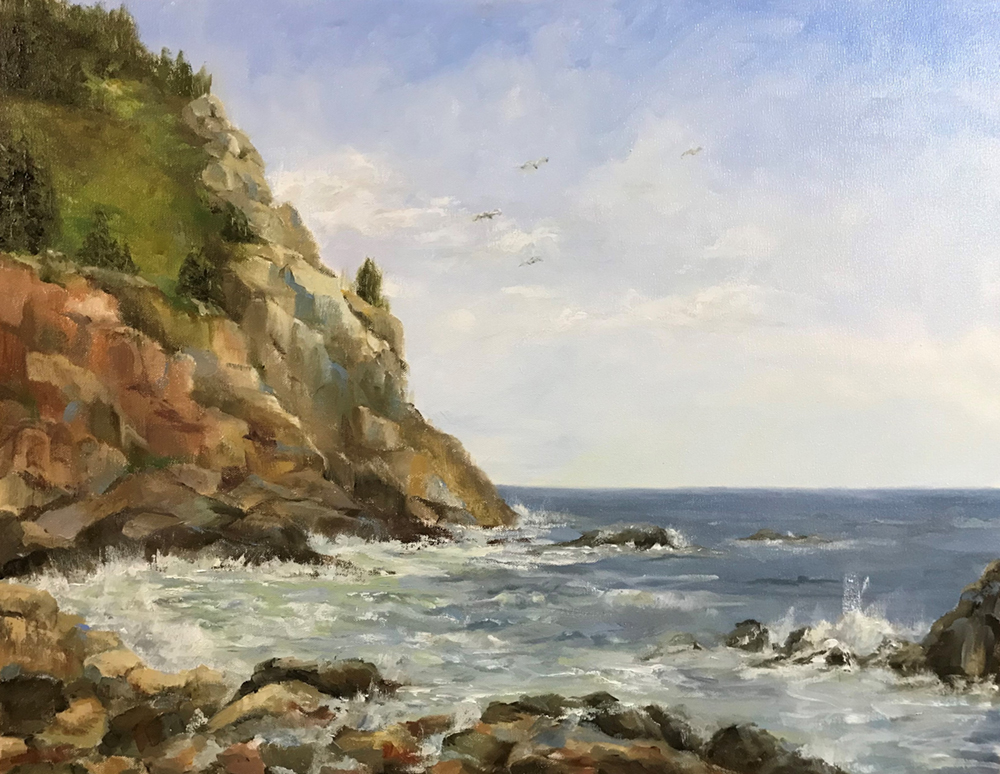
Aida Garrity, “Tee Off at the Memorial Tournament,” 18 x 24 in., oil, 2020Aida Garrity, “Backlit Flowers,” 14 x 11 in., oil, 2021Aida Garrity, “White Head,” 22 x 24 in., oil, 2019Aida Garrity, “Golf Tournament Practice,” 24 x 30 in., oil, 2021
Fill your mind with useful art stories, the latest trends, upcoming art shows, top artists, and more. Subscribe to Fine Art Today, from the publishers of Fine Art Connoisseur magazine.