Cavalier Gallery will soon present an exhibition of recent paintings by David Peikon, ranging from cityscapes to landscapes and botanicals. He has titled it “Stories” because each work is coupled with a brief narrative about how it came to exist.
Peikon notes, “Since I can’t always be at the gallery to offer first-person accounts, and since the gallery staff can’t possibly know all the details, I hope this will make the experience more rewarding for visitors, helping them engage more completely, and connect emotionally, with the paintings.”
Lon Brauer, “September of 64,” 2019, oil on panel, 24 x 20 in. Available through the artist
Fontbonne University Gallery of Fine Art in St. Louis will be exhibiting a potpourri of recent oil paintings by alum Lon Brauer (lonbrauer.com). All figurative in nature, each work explores a specific narrative and carries a dubious story within.
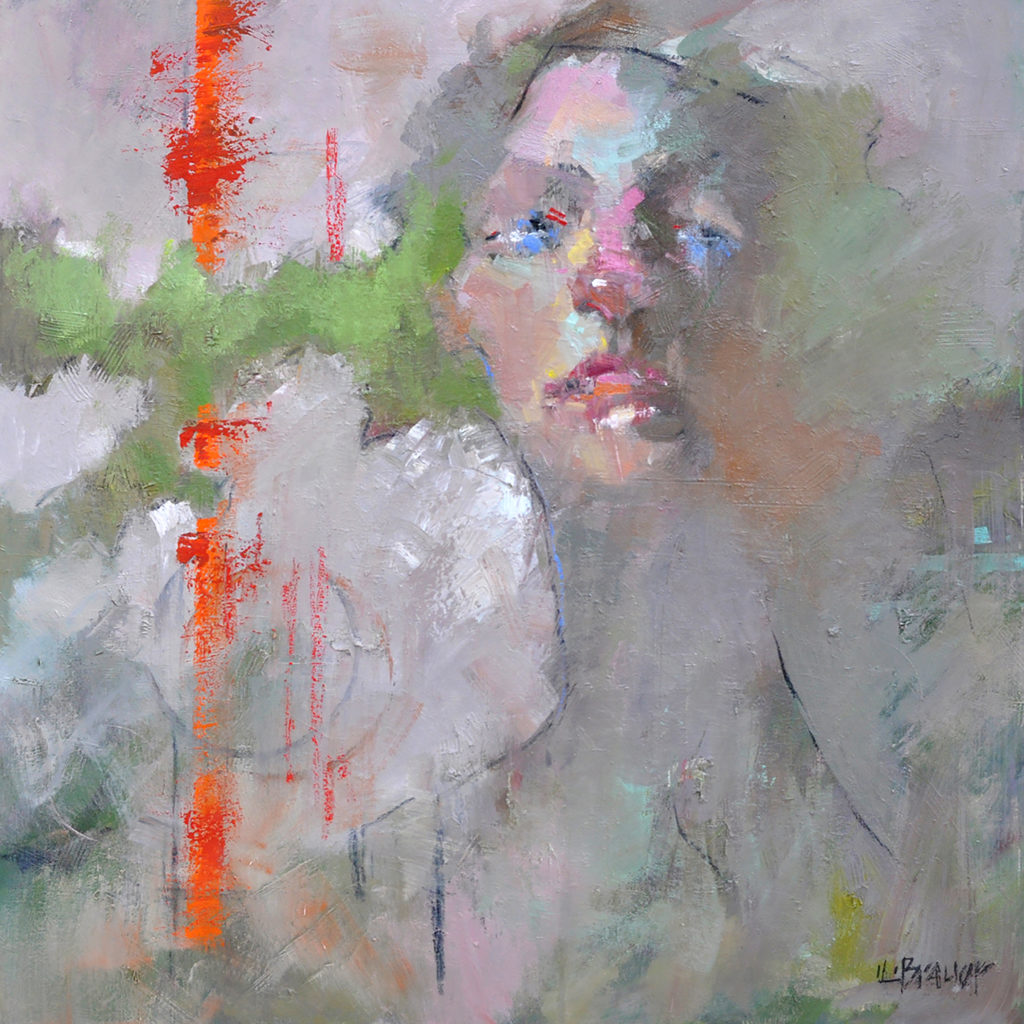
Lon Brauer, “Reflection,” 2019, oil on panel, 20 x 16 in. Available through the artist
Lon Brauer is an American artist known for his work in figure and plein air landscape. Born in 1955 and coming of age in the seventies, he has roots in the abstract expressionist movement. His work is a mix of the abstract and representational, bringing an impressionistic use of paint and materials to create images that challenge the viewer with new perspectives.
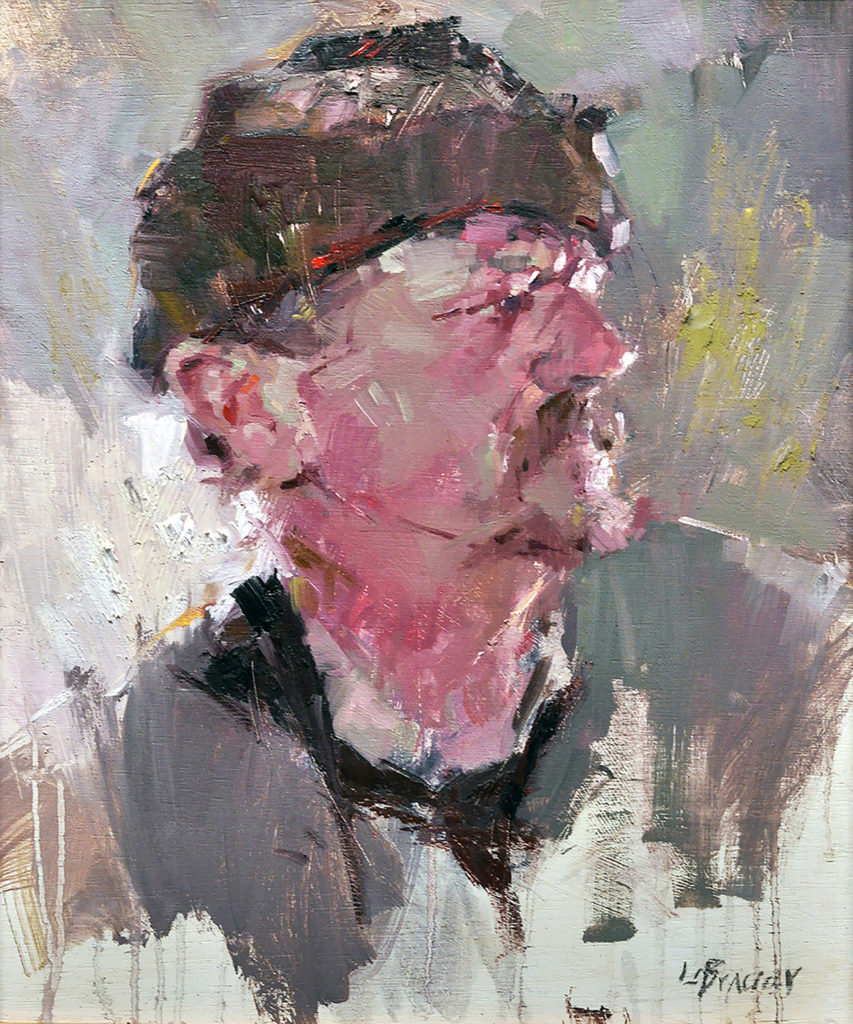
Lon Brauer, “Man in Plaid,” 2019, oil on panel, 30 x 24 in. Available through the artist
Brauer’s work will be coupled with the organic sculpture of Ryan Bradley. The exhibition will be on view January 17–February 14, 2020.
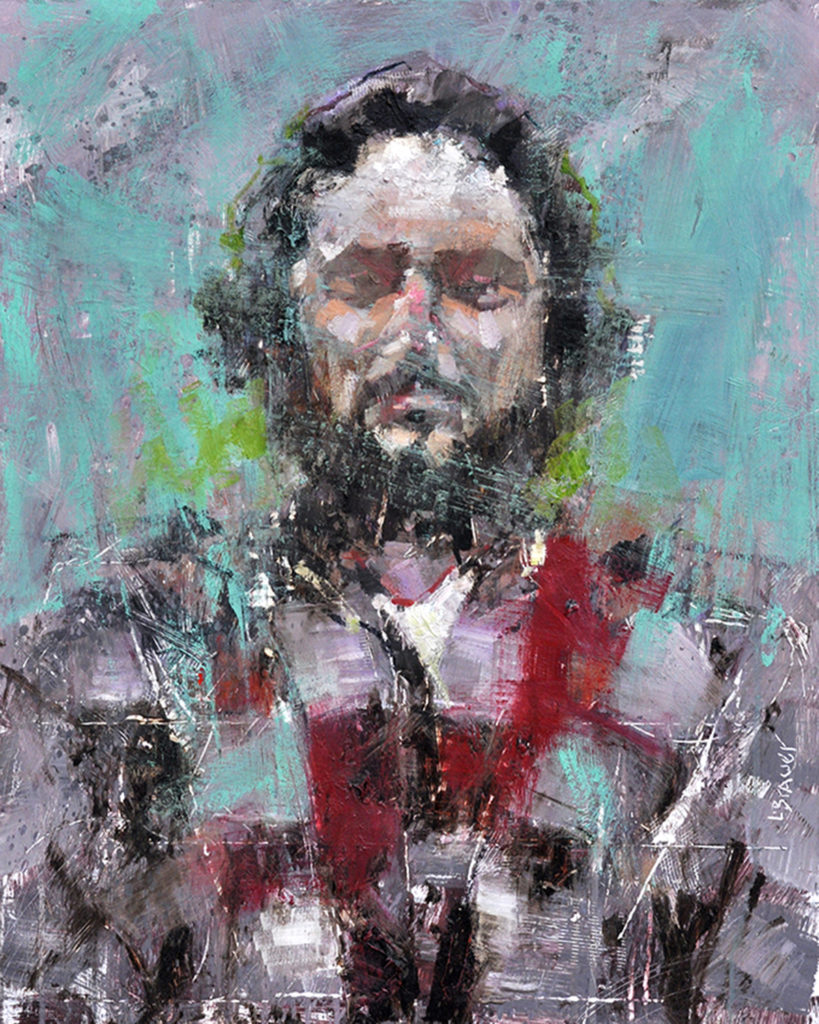
Lon Brauer, “Tribulation,” 2019, oil on canvas, 30 x 30 in.
Lon Bauer on Self-Portraits:
A self-portrait . . . or more. The everyman.
We see a painting on the wall and perceive it as a picture. Indeed, it is a picture no matter what the subject, but what can set one painting apart from the other is the way in which the materials are manipulated to make that picture. A painted image is an abstraction. It is a series of shapes and patterns that relate to what we think we know about the world around us.
All paintings have a narrative. That narrative can be the image or it can be the materials. Or it can be both. Representational art requires a firm structural foundation in drawing. There is no way around that. There needs to be believability in the image, and that comes from some sort of grounding. Once that is established, the artist can hang paint all day long — in a myriad of ways and a plethora of materials — to describe the vision with innovation.
My goal is to see how far I can stretch within the confines of realism.
So is this a self-portrait? Perhaps, but not merely in imagery. The means and method to making this speaks to an aggressive rawness of hand and mind.
The common man in all of us.
Lon Brauer, “Longshoreman,” 2019, oil on panel, 24 x 18 in. Available through the artist
Contemporary California Sculpture: Modern Works from NSS
Sparks Gallery has announced that it is hosting another collaboration with the National Sculpture Society (NSS). This year they will be featuring Contemporary California Sculpture in a smaller scale than previous years. Sculptor members of NSS residing in California (Southern CA and Greater San Francisco area) were selected by Sparks Gallery owner and chief curator Sonya Sparks.
More from the San Diego gallery:
Although differing in subject matter and material, all of the exhibited artists are creating three-dimensional representational works with a contemporary twist.
Contemporary California Sculpture: Modern Works from NSSImages courtesy Sparks Gallery
Exhibiting Artists:
Judy Salinsky
Jacquelyn Giuffre
Catherine L. Bohrman
Deanna Rae Cummins-Montero
Kristine Taylor
Linda Serrao
Tony Gangitano
Susan Erikson Hawkins
Rosie Irwin Price
Mark Edward Adams
Cynthia Siegel
Ann Geiler
Ruth Green
Maidy Morhous
Mary Buckman
Oceana Rain Stuart
Peter Dingli
Richard MacDonald
Manuelita Brown
Adam Matano
Exhibition Dates: January 11, 2020, through March 29, 2020
Opening Reception: January 11, 2020, 6 p.m. to 9 p.m.
About Sparks Gallery:
Located in the Gaslamp Quarter of downtown San Diego, the Sparks Gallery (Est 2013) is housed in the historic Sterling Hardware Building between Island and Market on Sixth Avenue. Sparks Gallery represents contemporary artwork by artists living in San Diego and Southern California. The Gallery serves as a premier San Diego event venue offering art exhibitions, art workshops, seminars, and private events. Read more at sparksgallery.com.
Arcadia Contemporary (Pasadena, CA) recently announced its next exhibition, “Portraiture 2020,” on view January 11–26, 2020.
From the gallery:
The exhibition features paintings by five artists from around the world who all create portraiture, but each approach is radically different. From the timeless and elegant works by Will St. John to the dynamic and electric images by Loribelle Spirovski, these five painters show that while the subject matter may be similar, it is the artists’ unique and individual styles that have set them apart and have established each of them in the contemporary fine art world.
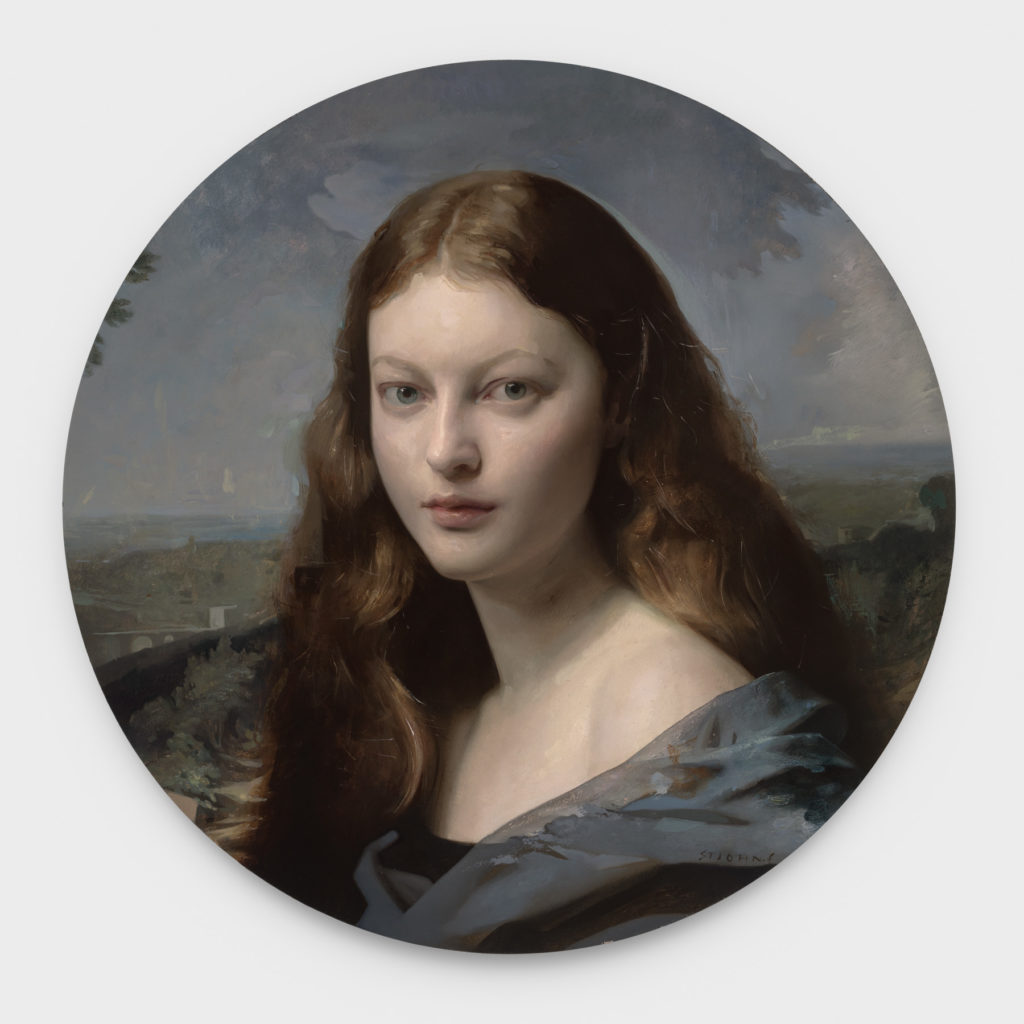
Will St. John, “Laura Sims in Landscape”
The artists participating in this exhibition are:
MARY JANE ANSELL (WALES)
BEN ASHTON (ENGLAND)
LO CHAN PENG (TAIWAN)
LORIBELLE SPIROVSKI (AUSTRALIA)
WILL ST. JOHN (U.S.)
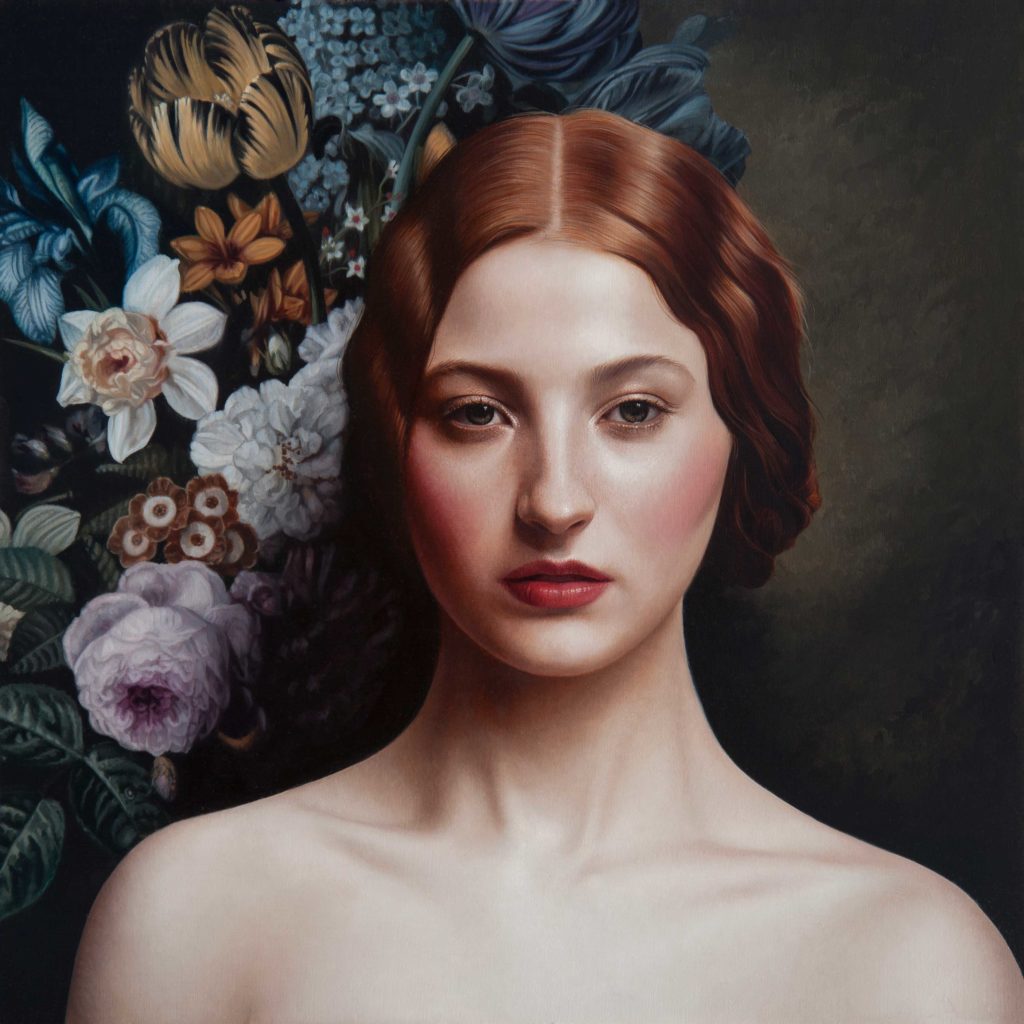
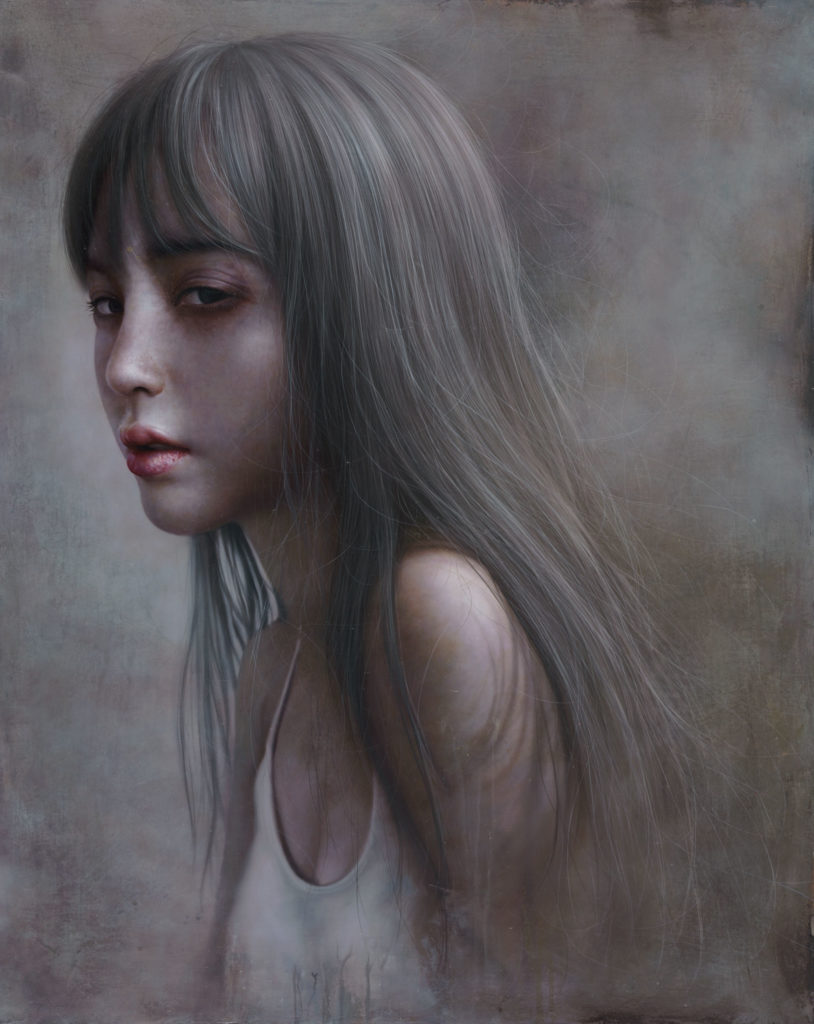
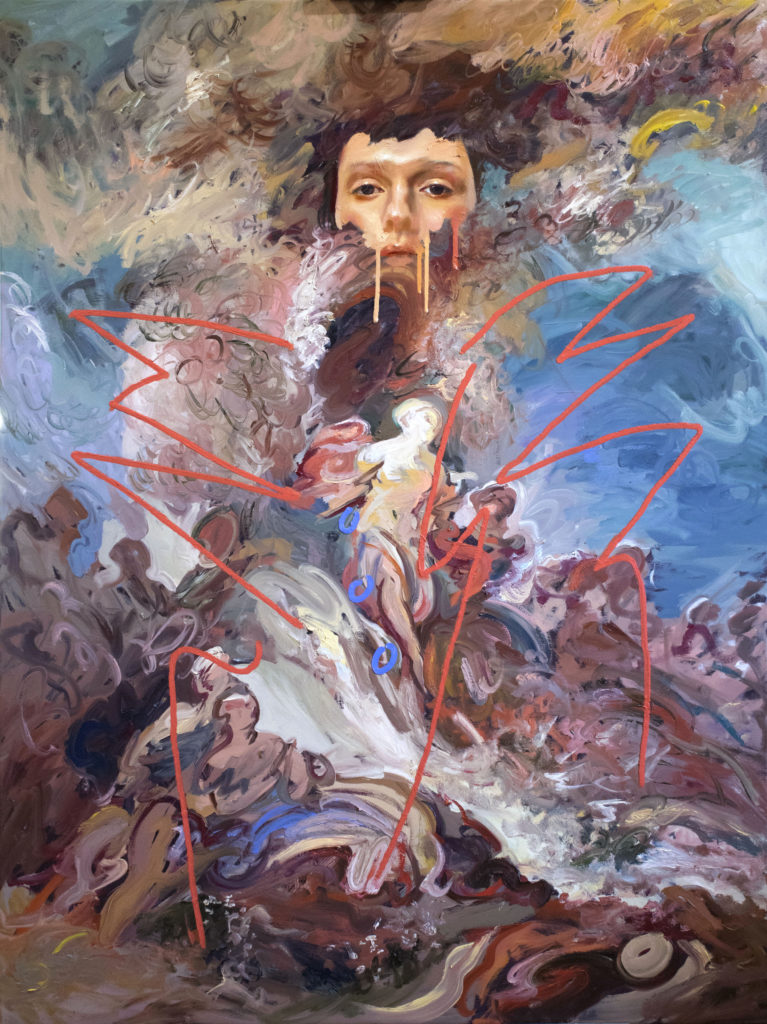
Mary Jane Ansell, “Lamina,” 12 x 12Lo Chan Peng, “The Fog,” oil on linen, 35 x 27Loribelle Spirovski, “Donna Cattiva,” 48 x 36
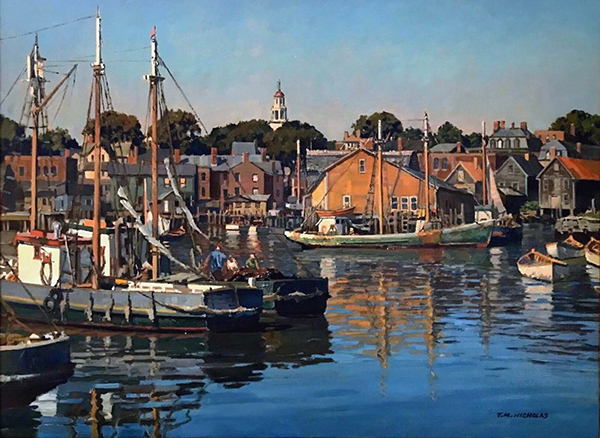
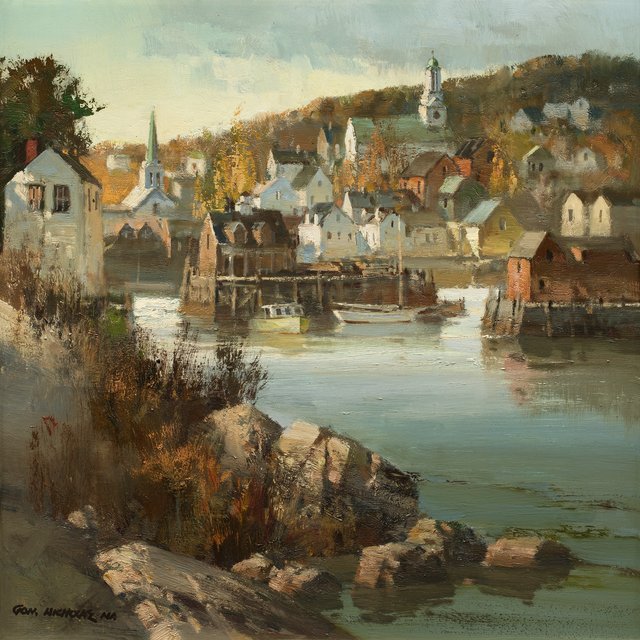
T. M. Nicholas, “Old Harbor, Gloucester,” oil on canvas, 30 x 40 in. Private Collection
Exploring 40 years of the artistic collaboration between Rockport father and son Tom and T. M. Nicholas will be the focus of the Cape Ann Museum’s upcoming exhibition, “Tom and T. M. Nicholas: A Father and Son’s Journey in Paint.” The Nicholas works, created in the well-known style of the Cape Ann School of Painting and curated from numerous private collections, will be on view January 11, 2020, through April 12, 2020.
Tom Nicholas, “Late Autumn, Rockport Harbor,” oil on canvas, 16 x 16 in. Private Collection
More from the museum:
Born and raised in Connecticut, Tom Nicholas studied with Ernst Lohrmann, H. Fisk, and the School of Visual Arts in New York. He has lived and worked in Rockport since the early 1960s, running a gallery on Main Street with his wife, Gloria. His work in oil, watercolor, and gouache has received numerous awards and recognitions from the Allied Artists of America, the Salmagundi Club, the American Watercolor Society, and the National Academy of Design. He was elected an Academician of the National Academy of Design and a Dolphin Fellow of the American Watercolor Society.
T. M. Nicholas, a student of the Montserrat College of Art, studied with his father as well as with the respected Rockport painter John Terelak. Working out of a studio in Essex, Massachusetts, T. M., like his father, exhibits widely, has paintings in museum collections, and has won many awards.
As part of the exhibition’s related programming, T. M. Nicholas and art historian Judith Curtis will give separate gallery talks. Curtis is a freelance writer specializing in art-related themes and is a past curator of the Rockport Art Association and Museum’s Permanent Collection. She lives on Cape Ann and is a regular contributor to the American Art Review. She has also written several books, including Anthony Thieme; The Life and Art of Paul Strisik, N.A.; W. Lester Stevens, N.A. (1888–1969); Harry A. Vincent and His Contemporaries; Rocky Neck Art Colony (1850–1950); A. T. Hibbard, American Master, and two Charles Movalli exhibition catalogues. More recently, she curated — and wrote the catalogue for — “Polly Thayer Starr and the Alchemy of Painting.” She was also co-curator of “Strokes of Genius: Women Artists of New England,” for which she wrote the catalogue.
As part of the Nicholas exhibition, related programming events include:
Opening Reception
Saturday, January 11, 3:00 to 5:00 p.m.
Lecture by T. M. Nicholas & Stapleton Kearns about The Cape Ann School of Painting
Saturday, February 15, 3:00 p.m.
Gallery Talk by Judith Curtis
Saturday, March 14, 9:30 a.m.
Gallery Talk by T. M. Nicholas
Saturday, April 4, 9:30 a.m.
“Tom and T. M. Nicholas: A Father and Son’s Journey in Paint” is on view at Cape Ann Museum (Gloucester, MA) January 11 through April 12, 2020.
The newest body of work by this Colorado/Pennsylvania figurative artist explores the four elements: earth, fire, water, and air.
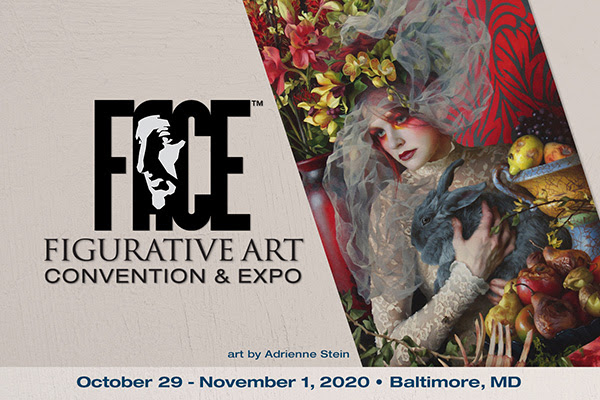
Adrienne Stein, “Nefertiti,” oil on linen, 8 x 8 in., $1,500
Adrianne Stein is an award-winning painter, and Gallery 1261 is thrilled to exhibit her very first solo show. The title of the exhibit is derived from the Renaissance concept of the four elements being embodied in mythic beings known as Elementals. The paintings in this show depict figures that correspond with the elements of earth, fire, water, and air. Adrianne shares, “The color and emotional tenor of each painting is distinct, and I wanted to have the experience of traveling into a new unique world with each painting.”
Stein’s work reanimates historical painting genres, forming a bridge to the present with fresh insight and imagery. The worlds she paints are inhabited by figures, folklore, archetypes, and natural elements that are fueled by a sense of personal as well as universal myth. Close friends and family members are reinterpreted in lush and magical environments that form the nexus between reality and fantasy, expressed through an unconscious world of symbolic imagery.
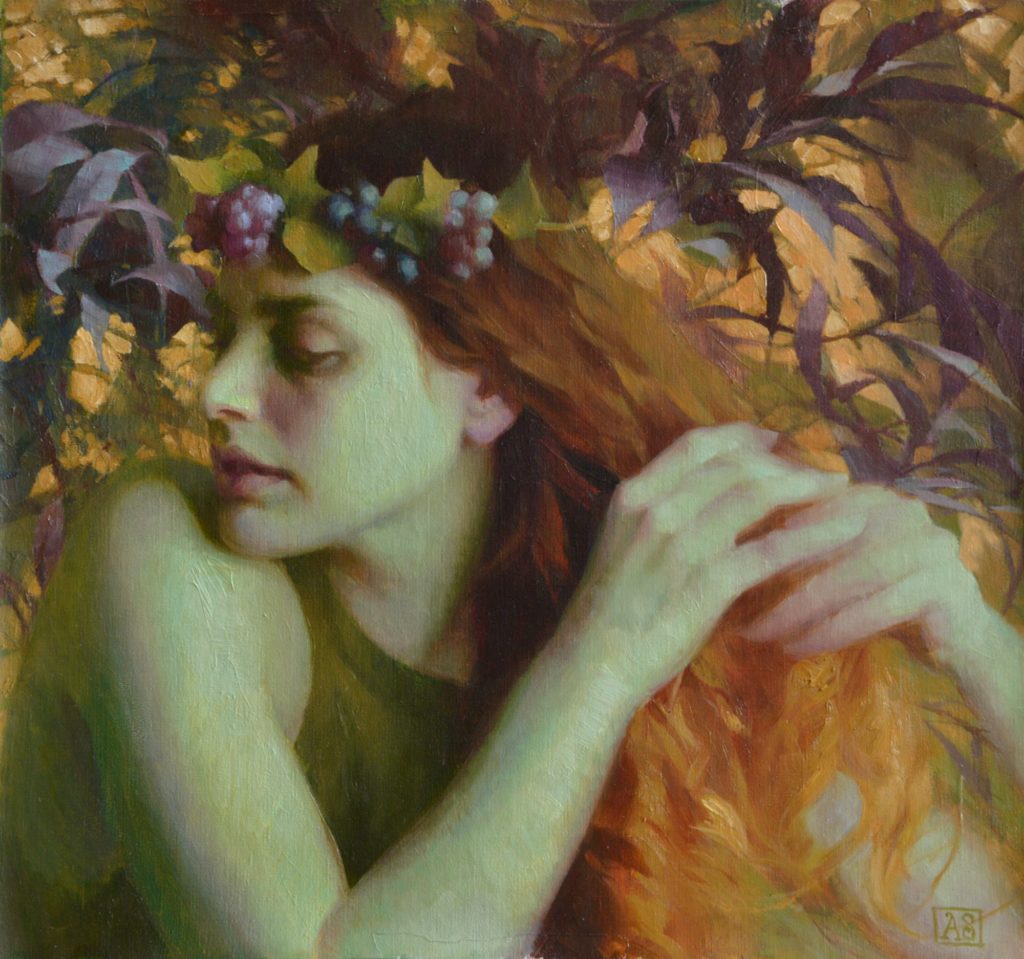
Adrienne Stein, “Bacchante II,” 2019, oil on linen, 18 x 19 in., $4,800
“I do focus on a specific aesthetic,” says Stein, “and I’ve always been really drawn to 19th-century Victorian painting and the Pre-Raphaelites. There’s a storytelling element in their work that draws me in . . . and looking at their work, it’s so rich with detail. A lot of my recent works are really inspired by that tradition of painting.”
The works in this exhibition will be mostly small, ranging from 5 x 7 to 12 x 16 inches—each is a meditation on color and nature.
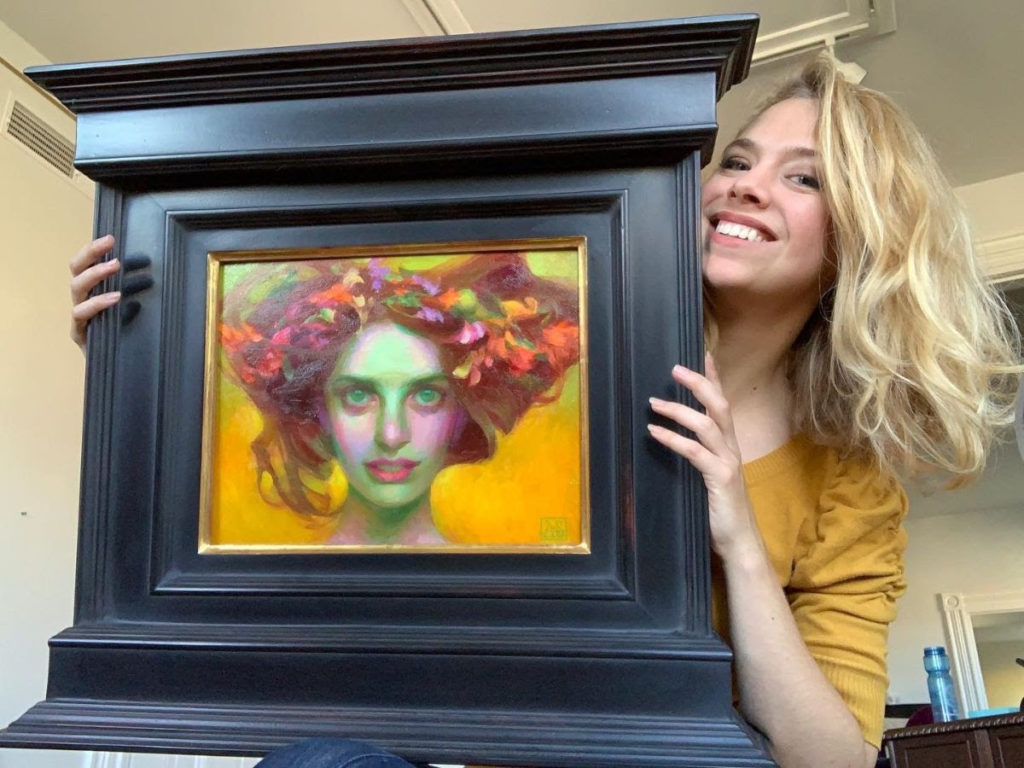
Adrienne Stein with “Enchantress,” oil, 11 x 14 in.
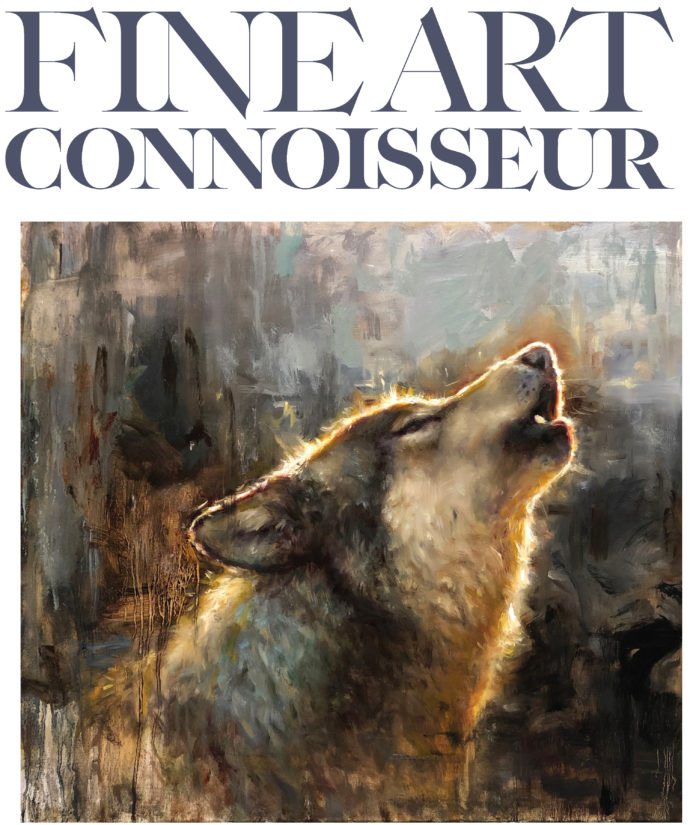
On the cover: Virginie Baude (b. 1978), “Wolf Spirit” (detail), 2019, oil on canvas, 24 x 36 in. (overall), available at the Southeastern Wildlife Exposition, Charleston (February 14–16).
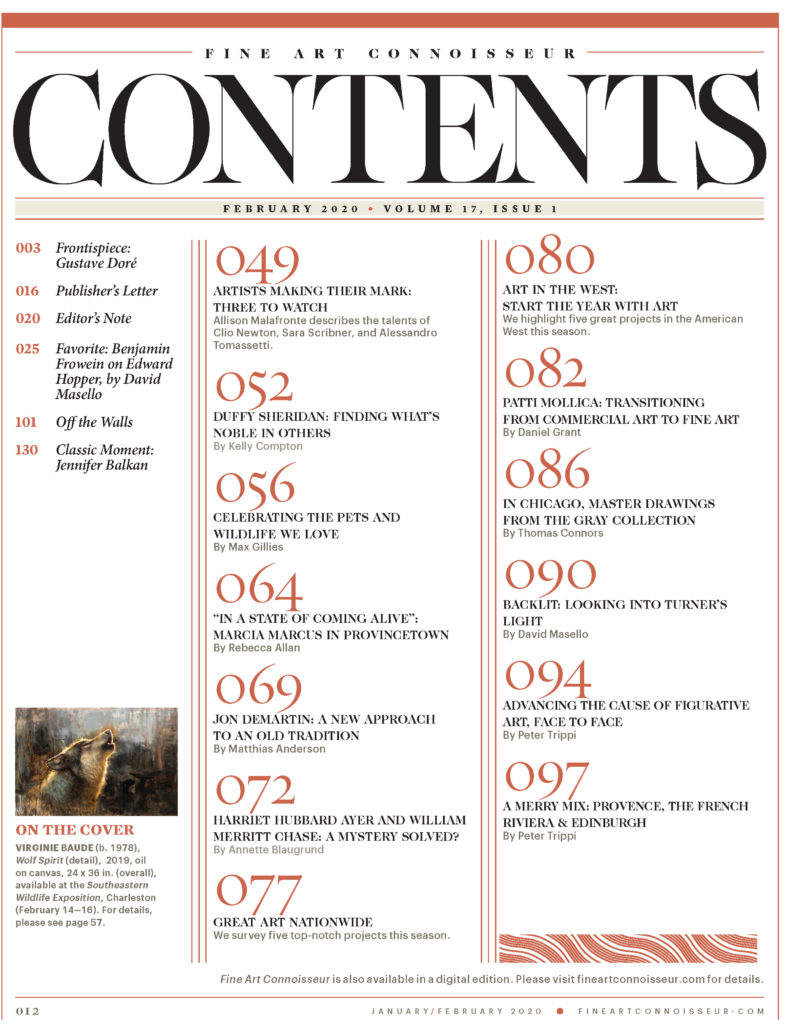
From the Fine Art Connoisseur January/February 2020 Editor’s Note:
Here We Go Again
It’s the New Year, but everyone is still talking about the banana that fetched $120,000 last year. If you haven’t heard about it, you are lucky, and I hesitate to relieve your bewilderment. Every December the cutting-edge art world gathers in Miami for the constellation of fairs surrounding Art Basel Miami Beach. Billions of dollars’ worth of art is traded, most of it more conceptual, minimalist, or experiential than what you see here in Fine Art Connoisseur. If you haven’t visited Miami during the first week of December, it’s well worth going, once, to get a sense of how closely cutting-edge art resembles show business these days.
Perhaps Miami Basel’s greatest triumph ever came last month when Galerie Perrotin — a leading international dealer — exhibited a real banana attached to its wall with duct tape. This “sculpture” came in an “edition” of three, and all three sold promptly for $120,000 each. The “creator” is Maurizio Cattelan (b. 1960), the dashing Italian provocateur whose previous “outrage” was the 18-carat gold toilet premiered at the Guggenheim three years ago and stolen from an exhibition at Blenheim Palace last year.
Cattelan is a hugely successful conceptualist more interested in ideas than craftmanship, and he is also a publicist’s dream because his ideas are far more exciting to read about than to see; this knack for getting noticed sells newspapers, and draws “collectors” like moths to the flame. To make the Miami situation even more memorable, a Georgian-born performance artist (David Datuna) walked into Perrotin’s stand, calmly removed the banana from the wall, then ate it as “astonished” onlookers filmed him.
No harm done, of course. As with most conceptual artworks, the new owners were expecting to replace their bananas with fresh ones whenever they wanted to admire their new acquisitions.
In fact, most “collectors” at this level are more interested in the limited edition’s certificate of authenticity issued by the artist, which gets parked in a bank vault and sold to someone else eventually. In this world, it’s about the idea, not the object.
I believe in capitalism, so I have no particular objection to this nonsense. If people want to spend money on a clever prank whose notoriety will be superseded by next January, that’s their right. But I am worried — yet again — about what message this sort of thing sends to sensible people who occasionally think that art might just be something they would enjoy buying. Note: I felt the same way about the heavily restored Leonardo painting of Christ that sold for the ludicrous sum of $450 million at Christie’s two years ago, so this is not about my hating Maurizio Cattelan or bananas.
Bottom line: a succès de scandale like the banana essentially tells “regular” people — folks who can actually afford to buy good, appropriately priced art — that any art worth having is admirable only for its financial value, cleverness, or rarity. That perception is not helpful for most working artists, for dealers, for auctioneers, or even for museums, which feel increasingly pressured to exhibit sensational artworks in order to sell tickets.
What to do about it? Take it all in stride, chuckle at the joke, then reassure the “regular” art lovers we know that they can still get in the art game — a less noticed corner of the field, to be sure, but one that is more emotionally, intellectually, and even spiritually rewarding than the nonsense making headlines last month.
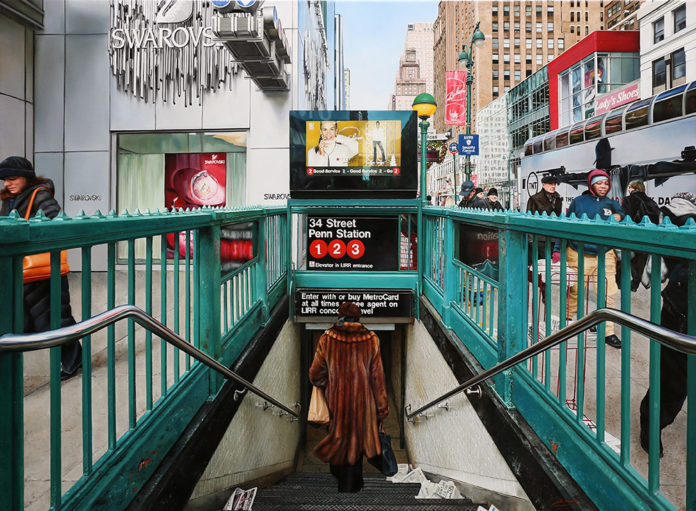
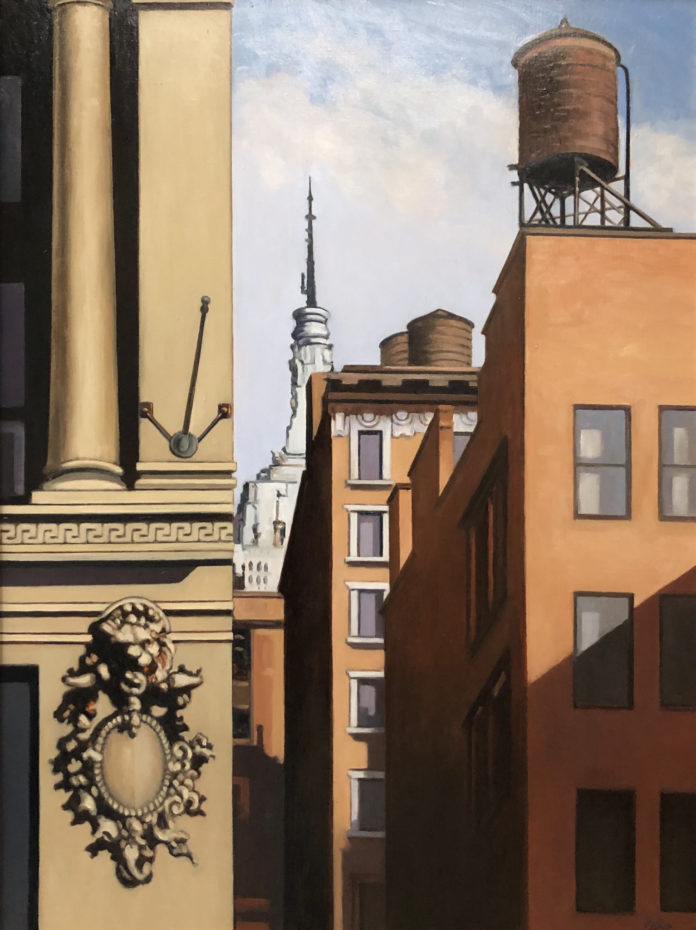
Jesus Navarro New York Metro, 2019
Oil on Canvas
24 x 31 in.
Available Lotton Gallery
Jesus Navarro was born in Jerez, located in southern Spain in 1952. By the age of twelve, his artistic talents led him to the local school of arts and crafts (Escuela de Artes y Oficios de Jerez) where he studied painting and sculpture. Concurrently, he also apprenticed with a locally renowned painter, Ramirez Toro. Toro extensively educated Navarro in the complex and intricate techniques of classical painting.
In 1971, Navarro moved to Barcelona where he began a phase of self-teachings, focusing on combining classical techniques along with his newly discovered interests in detailed formation of compositions. Three short years later, Navarro’s first exhibition was held in Zamora, Spain at the bank Caja de Ahorros. At the age of 25, Navarro partnered with other painters along with the City Hall of Barcelona to create the Escuela de Arte Tres en Raya where he was the director.
Throughout the eighties, Navarro exhibited his works in several exhibitions at galleries in Barcelona and his hometown. The most prominent exhibitions of this were shown at Galería de Arte del Corte – Ingles (Barcelona), Galería Canuda (Barcelona), and Galería de Arte Manuel Daza a (Jerez). He began traveling simultaneously to Mexico and Venezuela where he found inspiration for his work.
In 1996, Navarro’s work was part of a collective exhibition at the Museum of Contemporary Art in Miami, Florida. The museum acquired a piece from this exhibition for their permanent collection.
Navarro’s work is now in high demand, as he tirelessly exhibits not only in Spanish cities such as Madrid, Torredembarra, Barcelona, and Majorca, Valencia and in Scotland, China and the United States. The art of Navarro is found in private collections in Europe, Asia, North and South America.
Lotton Gallery
900 N Michigan Ave, Level 6
Chicago, IL 60611
T: 312-664-6203
Web: www.lotttongallery.com
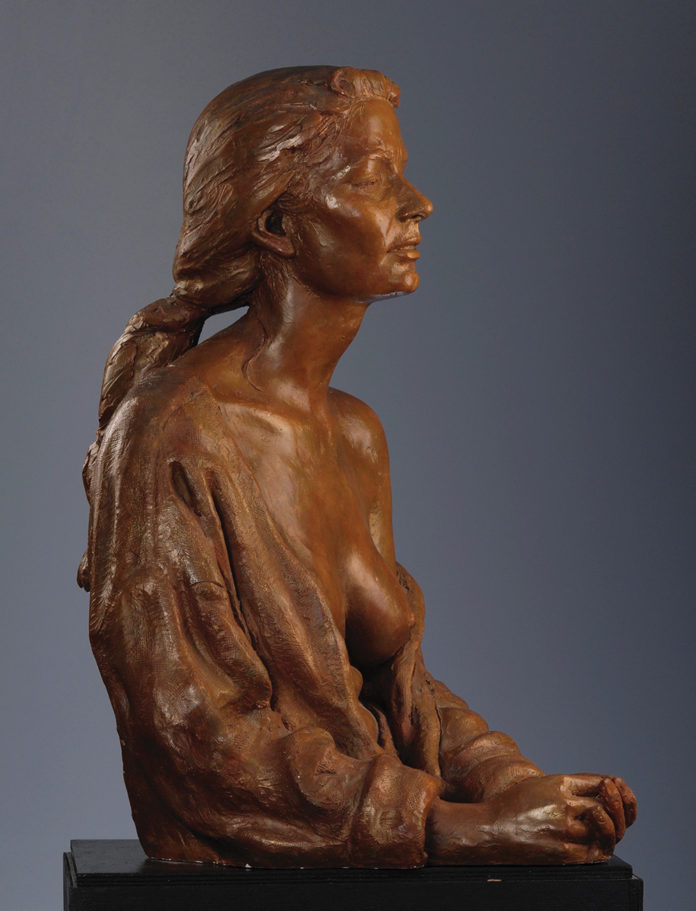
Jess
by Alan LeQuire
Life-size half figure, Bronze, Edition of 12
Alan LeQuire: Miniature to Monumental
Alan LeQuire is one of the nation’s premiere sculptors. His works adorn the walls of institutions like Vanderbilt University and the Country Music Hall of Fame, as well as private collections around the world. His monumental works, Musica, the largest bronze figure group in the United States, and Athena Parthenos, the largest indoor statue in the western world, enrich the visual landscape of Nashville.
Author, Madison Bell describes LeQuire as a “strikingly accurate and extremely popular portrait artist. His portrait heads combine the energy, expressiveness and apparent mobility of a quick sketch with the permanence of bronze.”
Included in the many portraits to date are busts of the British Poet, Donald Davie, Chancellor Harvey Branscomb of Vanderbilt University, and Chancellor Ike Robinson of the University of Oklahoma. Other busts and life-size portraits have been commissioned by and are on display at Vanderbilt Medical Center and Belmont University.
A larger-than-life standing figure portrait of Dr. Thomas Frist, Sr. with two small children can be found at Skyline Medical Center in Nashville as well as Bayonet Point Medical Center in Naples, Florida. Life-size standing portraits have also been done of Sam Davis at Montgomery Bell Academy and Jack Daniel at the Jack Daniel Distillery in Lynchburg, TN.
Of special interest in 2020 are LeQuire’s five public monuments commemorating woman suffrage, each with larger-than-life portraits of heroes and heroines like Anne Dallas Dudley, Carrie Chapman Catt, Harry T. Burn and his mother “Febb”, and Ida B. Wells to name a few. On the road in 2020 are LeQuire’s colossal portrait heads of cultural icons Bessie Smith, Leadbelly, Paul Robeson, Billie Holiday, Marian Anderson, and Woody Guthrie. These Cultural Heroes will be on exhibit at The Music Hall & Folk Americana Roots Hall of Fame, Boston, MA through December.
As a contemporary sculptor, LeQuire relishes the process of portraiture — experimenting with various ways of handling the material (clay), always with the intent in mind to make the material and its treatment at least as important as the subject matter. He prefers to sculpt real people in realistic circumstances opposed to the classical sculptors of Greece who idealized the figure, believing that the human figure is the single artistic subject to which all viewers inevitably respond.
Monumental, miniature, or life-size, LeQuire’s sculptures manage to achieve a living quality, which contributes to a long-standing career of public commissions and a consistent demand for private collections.
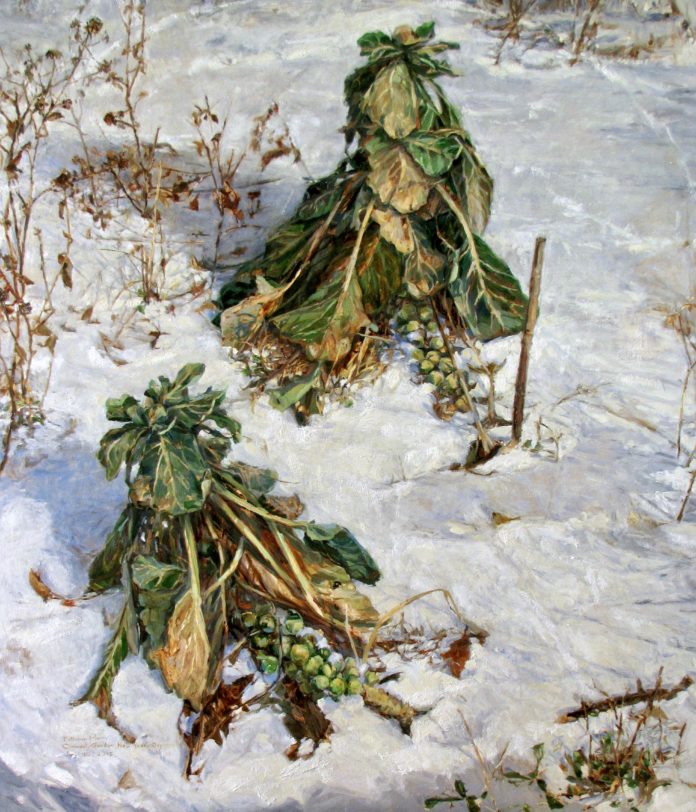
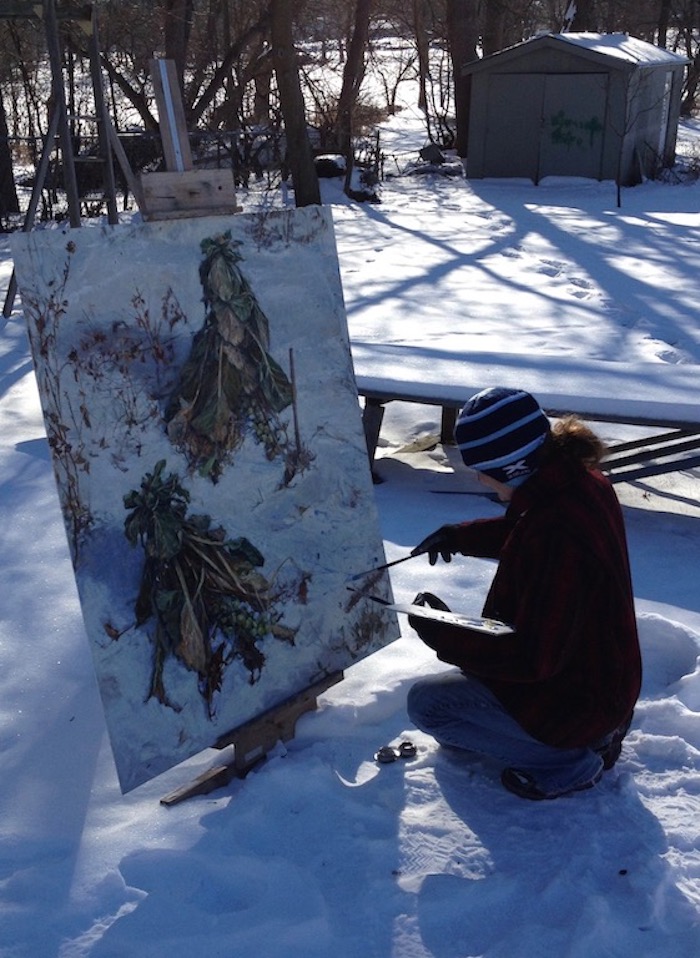
Bethann Moran-Handzlik, “Community Garden New Year’s Day,” direct observation, oil on panel, 42 x 48 in.
“Community Garden New Year’s Day” by Bethann Moran-Handzlik was the First Overall Winner in the bi-monthly Plein Air Salon (June/July 2019). Here, the artist tells about how the oil painting came to be.
Community Garden New Year’s Day: An Oil Painting
BY BETHANN MORAN-HANDZLIK
Each year I anticipate my first painting of the New Year. January plein air work in the Midwest has its challenges, but I love the cool blue shadows and muffling effect of the snow. As the New Year approaches, I like to know what my subject will be so I can get right to it on New Year’s Day. Sometimes it is a small painting that I will complete in a couple of hours; other years I am so busy I cannot paint on New Year’s Day.
A couple of years ago I knew I had some time on my hands so I set out looking for my subject. I drove around our small town; it was getting dark and I was feeling like nothing was going to work. I parked in front of the Community Garden to think. I thought about the poem “Winter Garden” by Pablo Neruda, and I knew my subject was close. I got out of the car, and as I walked the garden paths of snow-buried plots, I came across several stands of Brussels sprouts.
I looked more carefully, and there was a profusion of sprouts left on the frozen plants! The subject became clear — it was a symbol that on New Year’s Eve everyone in our small town was fed: there was an abundance! These strange and beautiful plants half-buried in the snow were the subject I would start my new year with.
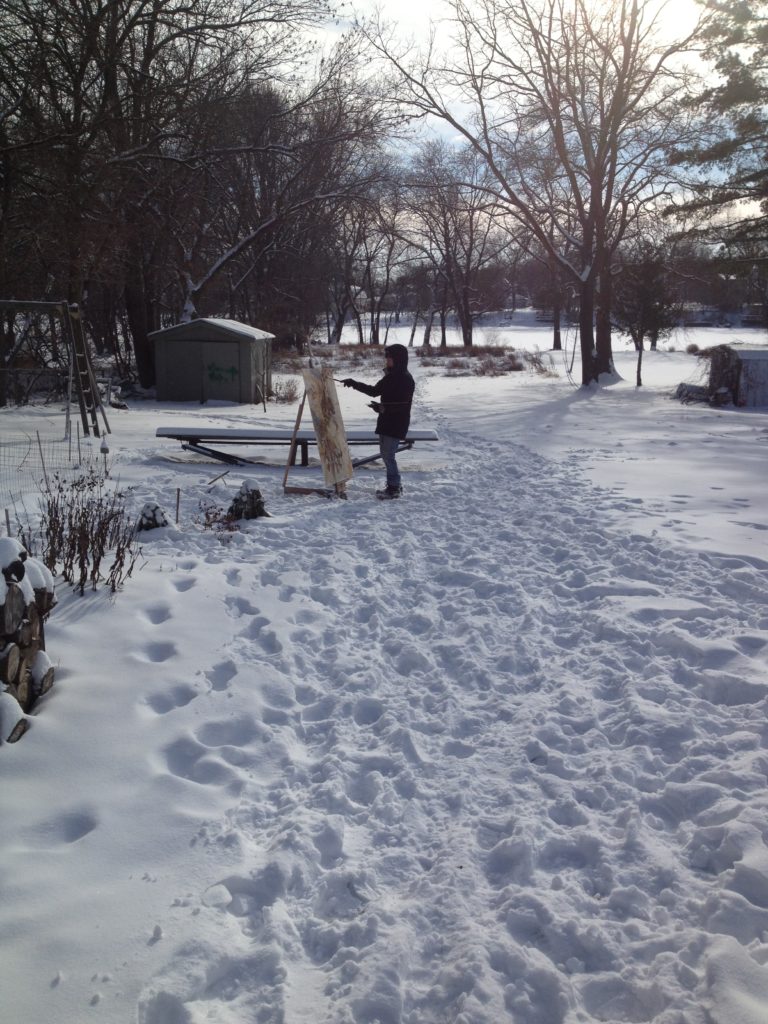
I riffled through my prepared panels and found a perfect 42 x 48. New Year’s Day it was quite cold, but I went out and got my start. As I began painting, I realized the temperature was plummeting; there is no shelter at the community garden. I had a great start, though, and so I went home anticipating coming back the next day.
Upon waking, the temperatures were much colder and the 10-day forecast was grim. I whined to my husband, “I have such a good start but I think I might have to give up on the Brussels sprouts.” Not putting his mandolin aside, he said “Yeah, I guess so.” A moment later he sensed my deep disappointment and said, “Let’s go take a look.”
We drove over to the garden, and he came up with the brilliant idea to go home and get some shovels. We dug up the plants, put them in the van. The warm air animated the decay, and my husband proclaimed the plants “a barn of gassy cows.” The odor was potent.
You can see I have worn a path from the house to the painting: “Community Garden New Year’s Day” in progress
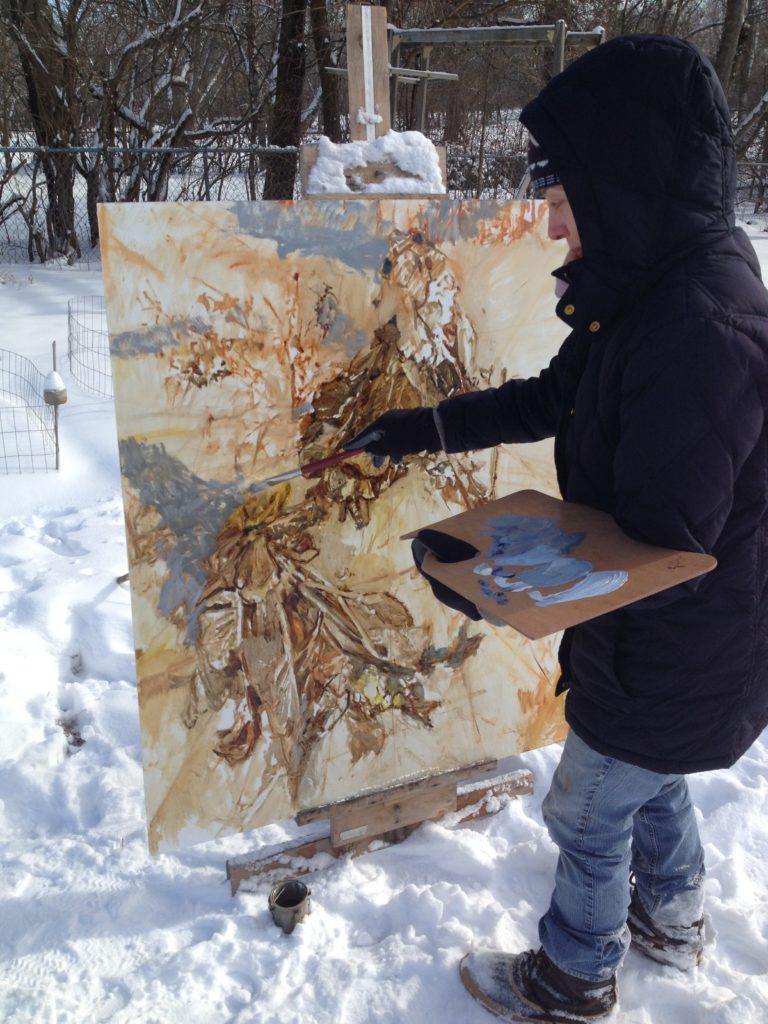
We got home and stepped them into our own garden and for the next week and a half I painted running in and out of the house to keep warm. On very cold days I taped my brushes to my glove so I could curl my fingers inside and when my paint got too stiff, I had a second warm palette waiting inside so I could go right back out.
I taped my brush to my hand so I could curl my fingers inside.I brought out limited amounts of paint. I started the underpainting with Williamsburg Italian Pink. Here you can see I am establishing mid-tone greys. When my paint grew too stiff, I had a second warm palette in the house that I could just run in and trade.
The scale of the painting evokes verisimilitude; the audience stands in the snow looking down, seeing the plants at life scale. Like the shifted perspective in Antonio Lopez Garcia’s “Sink and Mirror,” this painting draws the viewer to look down and then out at the ever-upright plants. I have been exploring this type of perception for several years and I find it so intimate. It induces a direct relationship with the subject that is markedly different from my vista plein air work. Each type of space occupies a specific emotional and intellectual state of experience.
I have been thinking a great deal about painting as a prosthetic of vision — not sight, but vision. Vision is filled with the optical / perceptual, but it is also anticipatory and relies on past experience. Painting is a prosthetic of vision because it enables both the artist and the audience to “see” the subject. One of the greatest compliments I receive from people is “I never really saw it like that before” or “ I didn’t think Brussels sprouts could be so moving.” The painting becomes a prosthetic of vision which at once carries the image and all the intended and unintended reverie.
Painting for me is a relationship with the subject. My paintings are slow — filled with wind, changing light, fluctuating temperatures, and animal sounds. While in the field, much concentration is needed. The work is at times arduous, at other times like a meditation.
I have been painting nearly all my life, but this was the first time I entered the Plein Air Salon, and I am grateful to Plein Air Magazine and Michele Marceau Ward, who selected my work for the bi-monthly award. “Community Garden New Year’s Day” is available. As for my painting this New Year’s Day, I know what my subject will be and I can hardly wait to get out there to paint. Happy New Year!
Painting “The Peace of Wild Things”
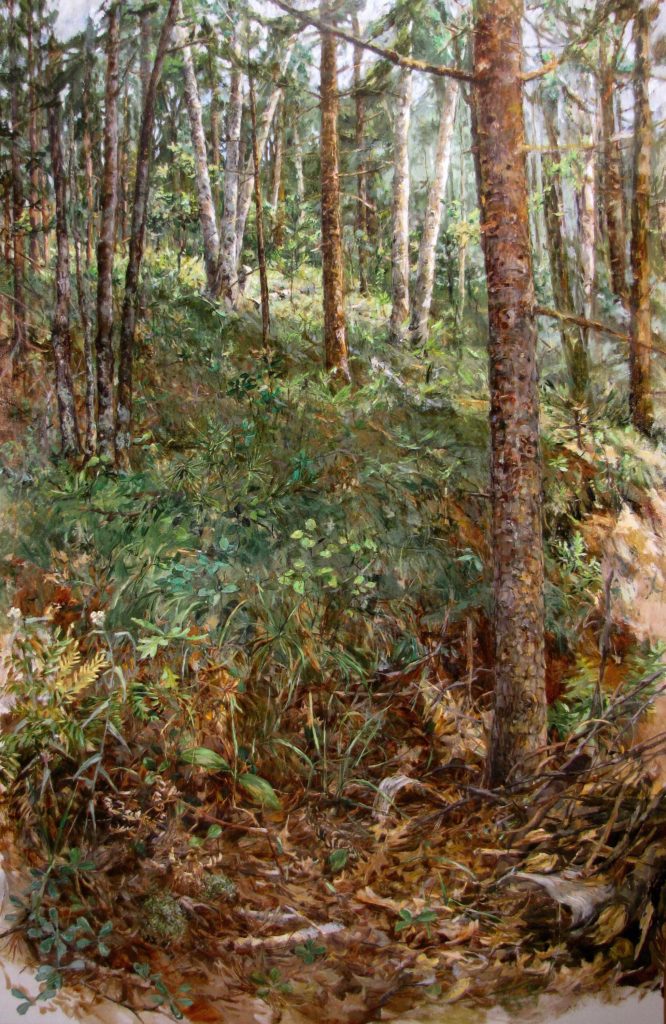
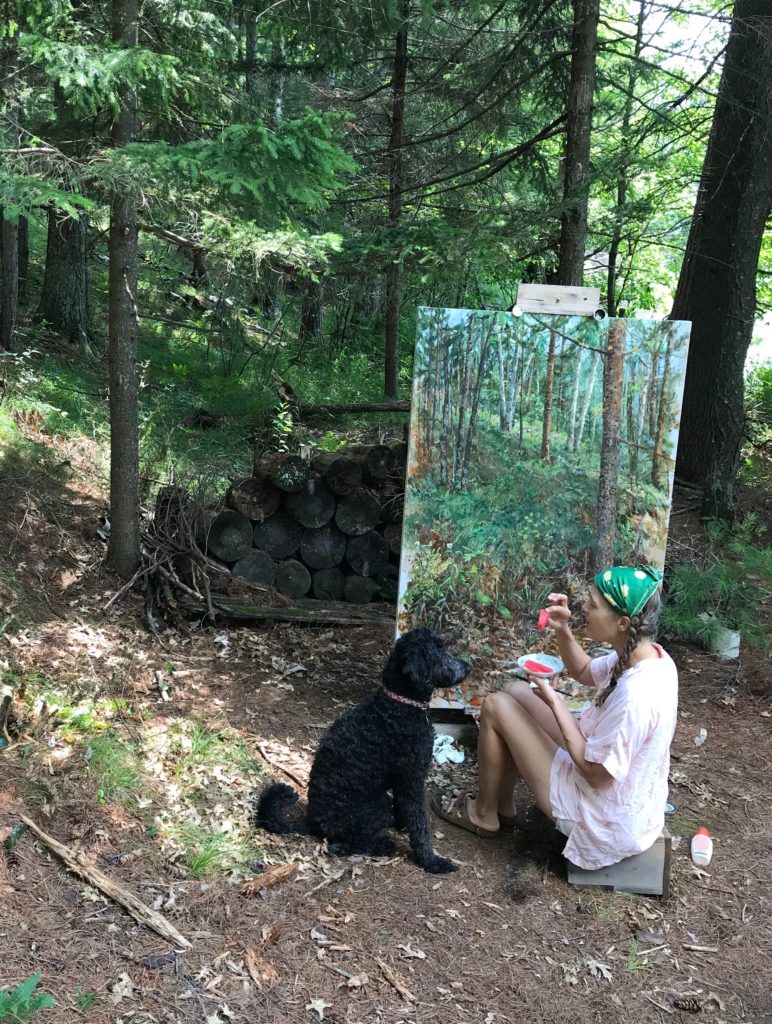
“The Peace of Wild Things,” oil on linen, 40 x 60 in. direct observation, Florence County, WITaking a watermelon break with our family dog, Windzy. At this point I have been working on the painting for nearly three weeks. The painting is titled after the Wendell Berry poem by the same title. (For more in-progress images, visit my blog: bethannmoranpainting.blogspot.com.)
Painting “Shared Solitude”
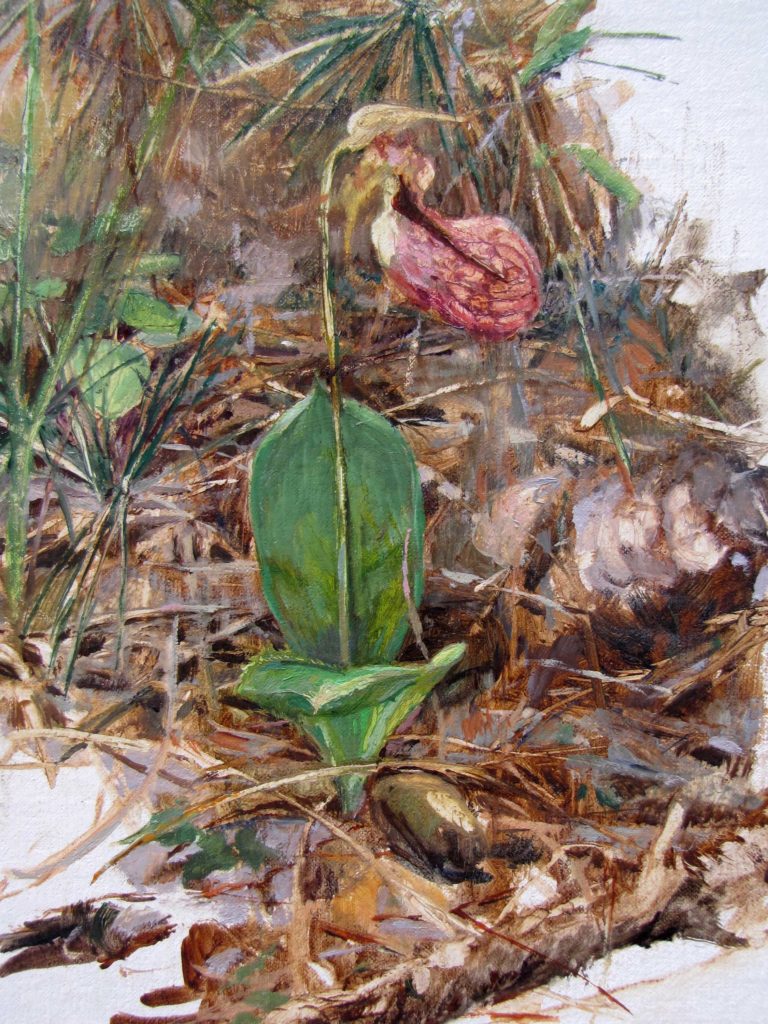
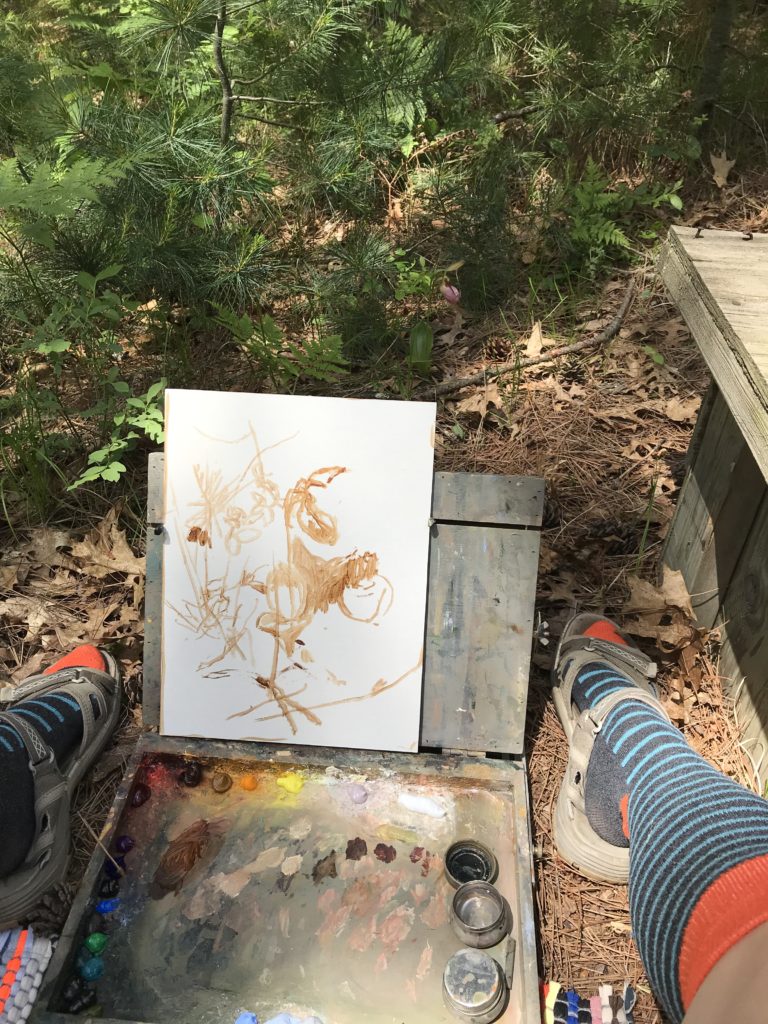
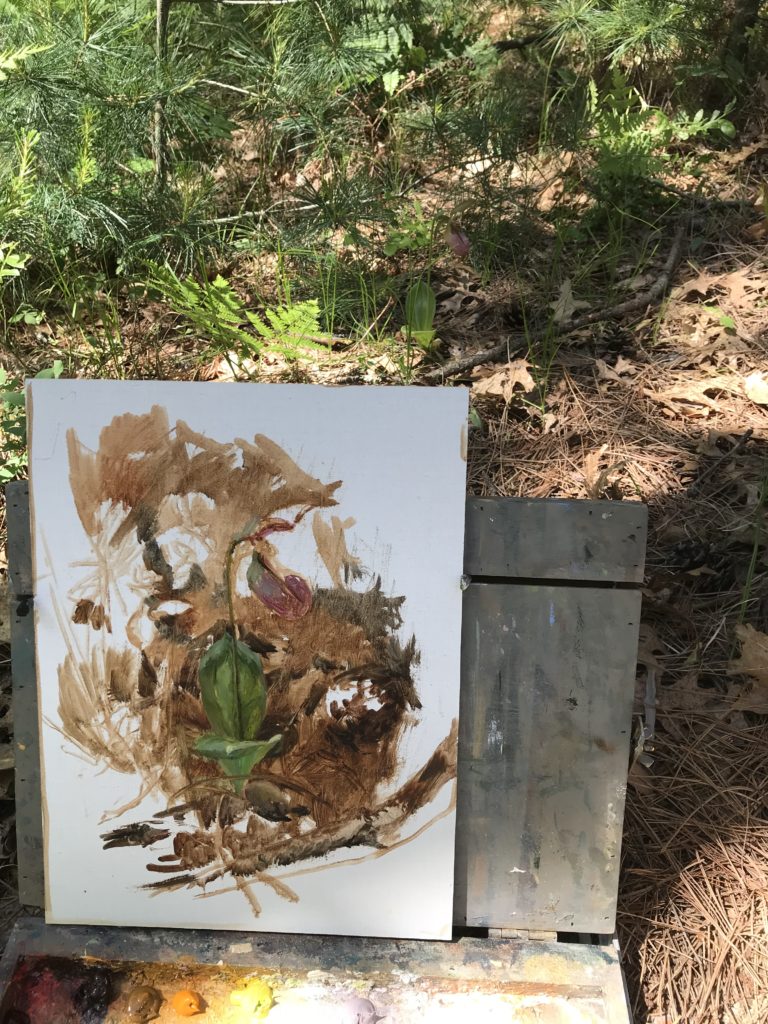
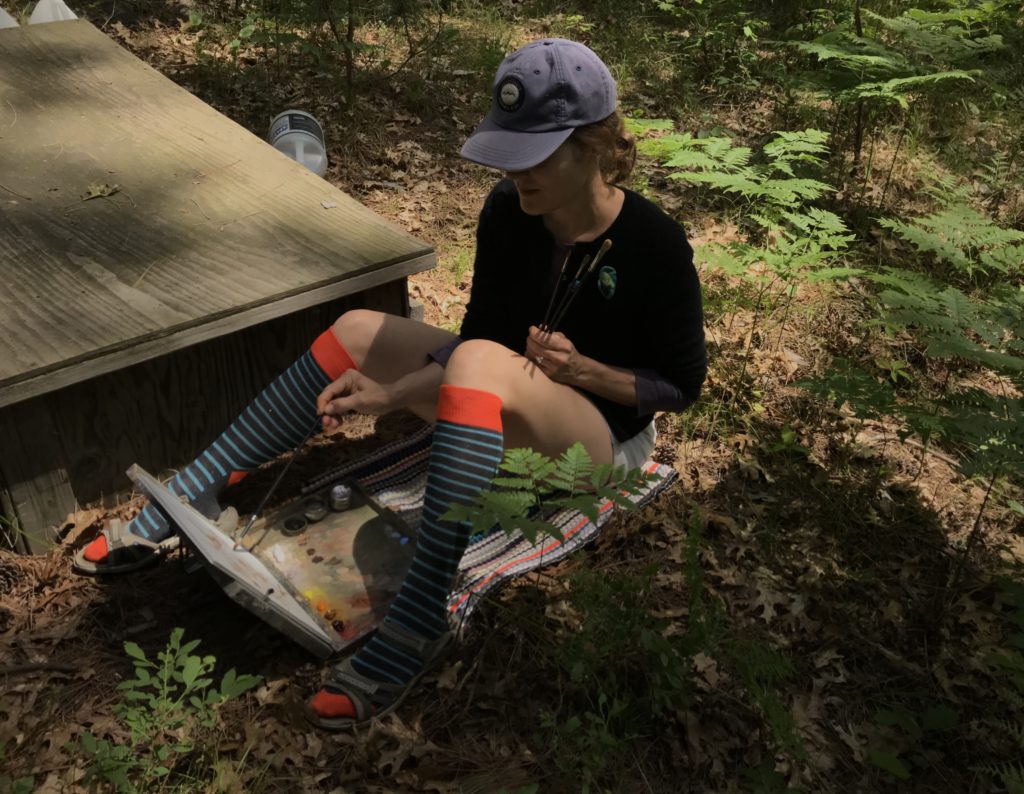
Bethann Moran-Handzlik, “Shared Solitude,” in progress, oil on linen, 9 x 12 in., direct observation, Lady’s Slipper/Moccasin Flower, Florence County, WII like to be “in” my subject. Here I am sitting low on the ground to look “face to face” with this blossom.I started the painting with Williamsburg Italian Pink. The flower is just above on the right side of my box.
Painting “White Boat House 3”
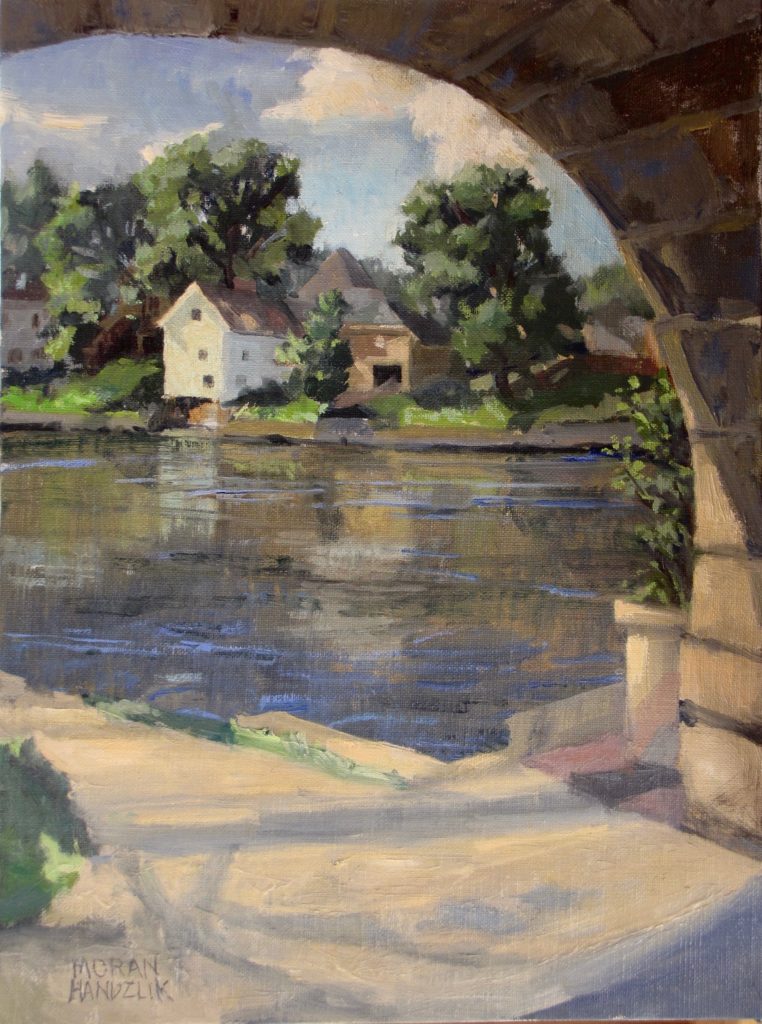
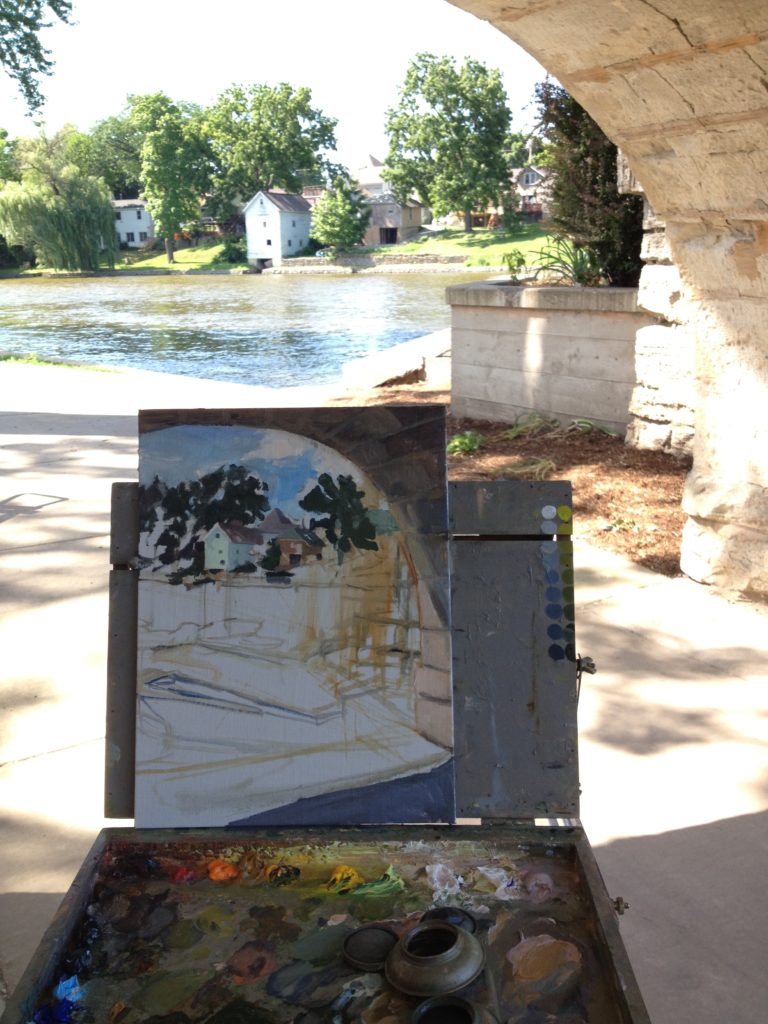
Bethann Moran-Handzlik, “White Boat House 3,” oil on linen, 9 x 12 in. This is the third painting I have made of the white boat house on the river. I love the reflection in the water.In progress “White Boat House 3,” oil on linen 9 x 12 in.
Painting “Weston’s Orchard”
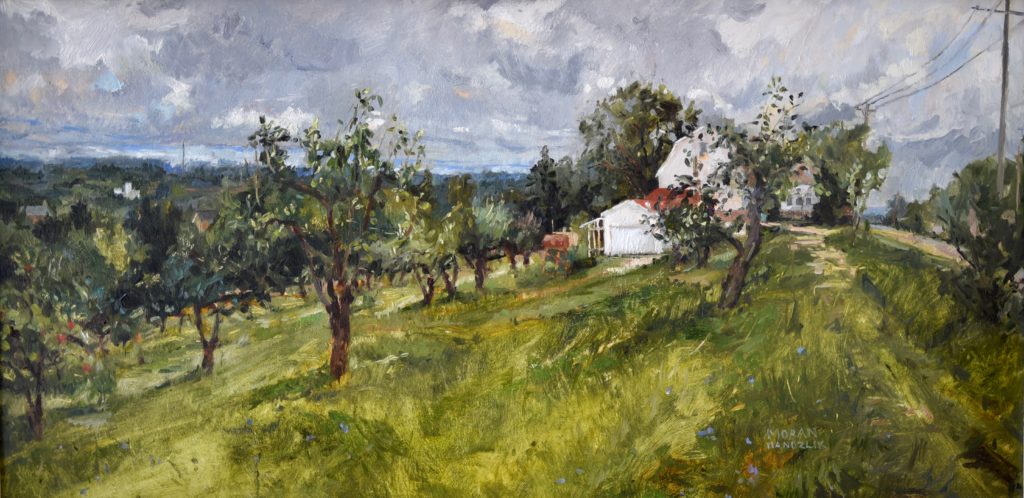
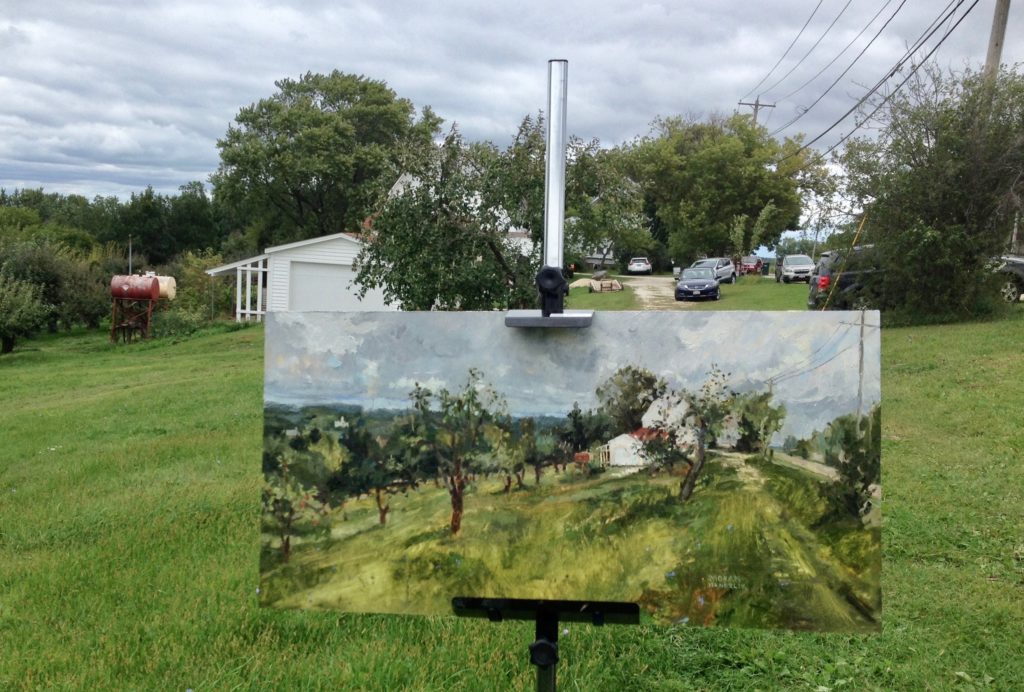
Bethann Moran-Handzlik, “Weston’s Orchard,” oil on panel, 12 x 24 in.I ate an apple while I was painting and felt in harmony with the landscape, even though the wind blew my easel over and I was pummeled with rain.
More from Bethann Moran-Handzlik
Painting is mesmerizing. The complexity of tracking the edge of a leaf or plowed field in changing light into daubs of color is endlessly engrossing. I become transfixed by the subject and the technique and my mind wanders. My mind wanders toward teaching, which I feel so fortunate to do. It wanders toward my aspirations for my family and for the world. My mind is drawn into the intricacy and perfect rhythm of nature, the beauty of it all. And then language leaves me altogether and the work is beyond words. The paintings are done with care. I sit and look a long time, each element accounted for so that as the painting comes inside, the viewer can first take in the broad theme but then be drawn repeatedly into a satisfying contemplation of everything that is on their mind and in their heart, and they can leave the painting feeling refreshed.
I have been fortunate to be able to teach and paint for many years now. I was awarded a Hudson River Fellowship in 2014 and a La Napoule Artist Residency in France in 2016. I have painted during our family’s travels to Scotland, and I had the privilege to copy master works at the National Gallery, Scotland, and the National Gallery, London, among others. Painting at the Aldo Leopold Foundation Center, Baraboo, WI, is one of many plein air adventures I enjoy. I teach at the University of Wisconsin Whitewater and will teach a workshop this summer at the Peninsula School of Art, August 19–22, 2020.
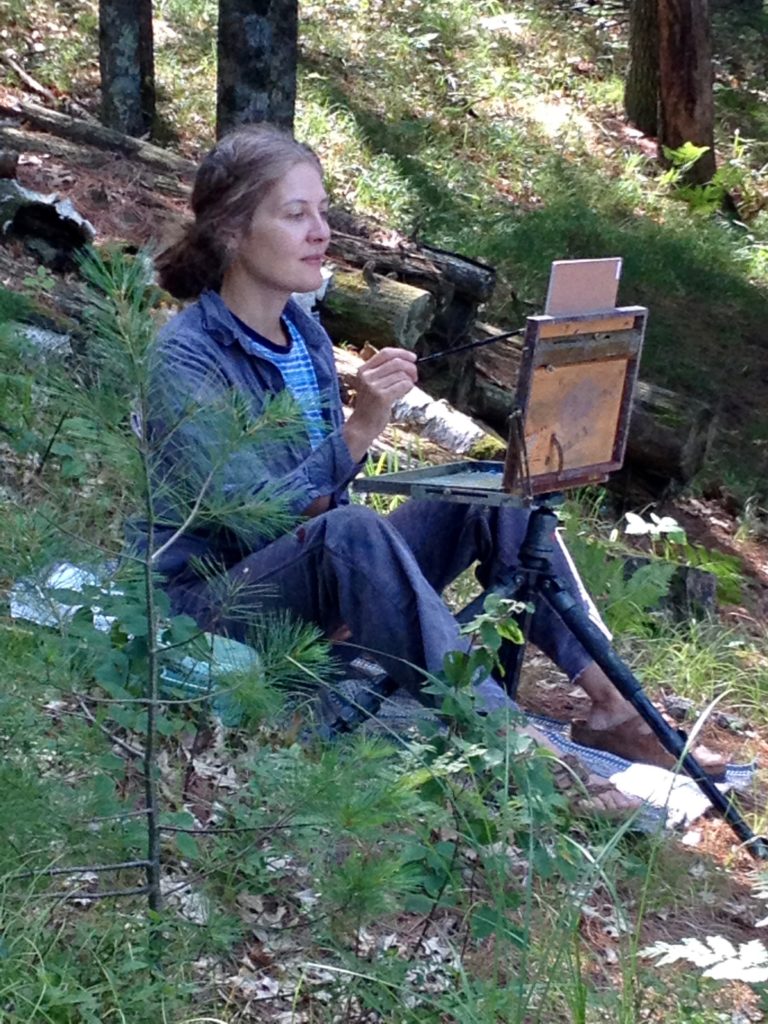
Bethann Moran-Handzlik painting in Florence County, Wisconsin
ART COMPETITION CALL FOR ENTRIES: Did you know? The Plein Air Salon accepts both plein air and studio works! Categories include best Acrylic, Oil, Pastel, Watercolor/Gouache, Floral, Landscape, Nocturne/Sunrise/Sunset, Figure/Portrait, Outdoor Still Life, Water, Animals/Birds, Western, Plein Air only, Buildings, and Vehicles. The next deadline to submit art is coming soon. You could win up to $15,000!
Fill your mind with useful art stories, the latest trends, upcoming art shows, top artists, and more. Subscribe to Fine Art Today, from the publishers of Fine Art Connoisseur magazine.



 Download the January/February 2020 issue here