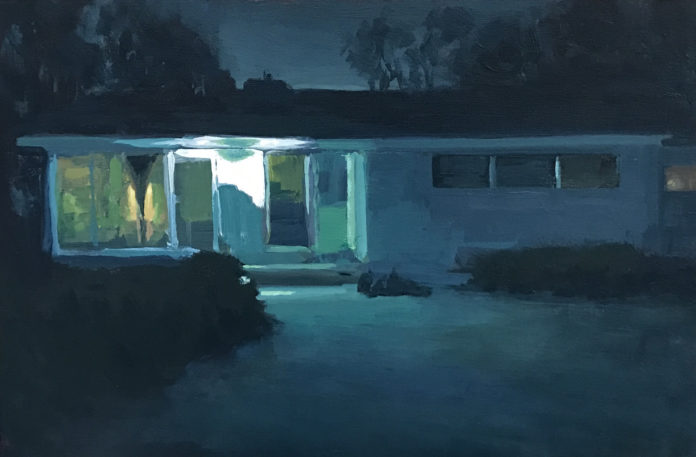
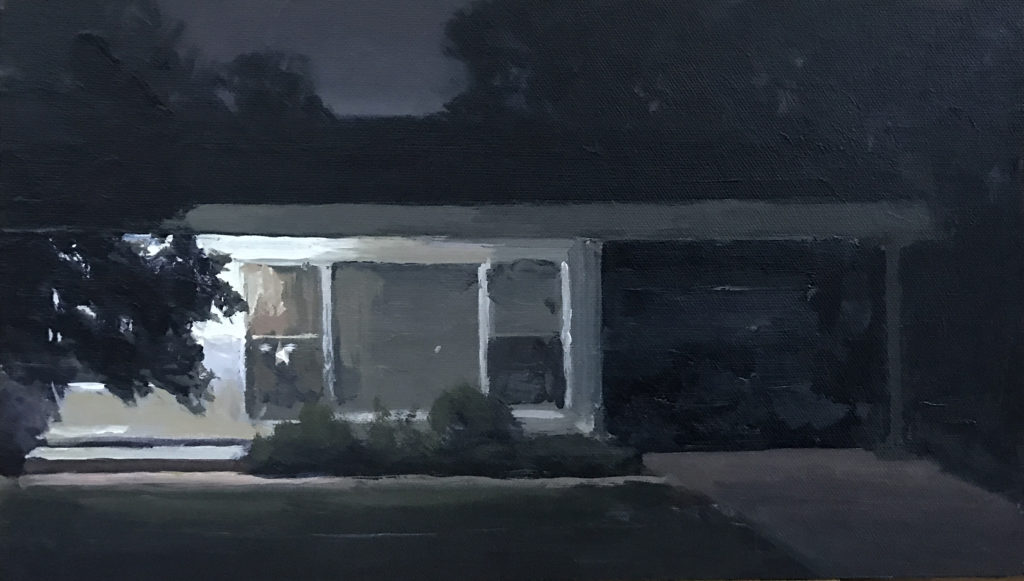
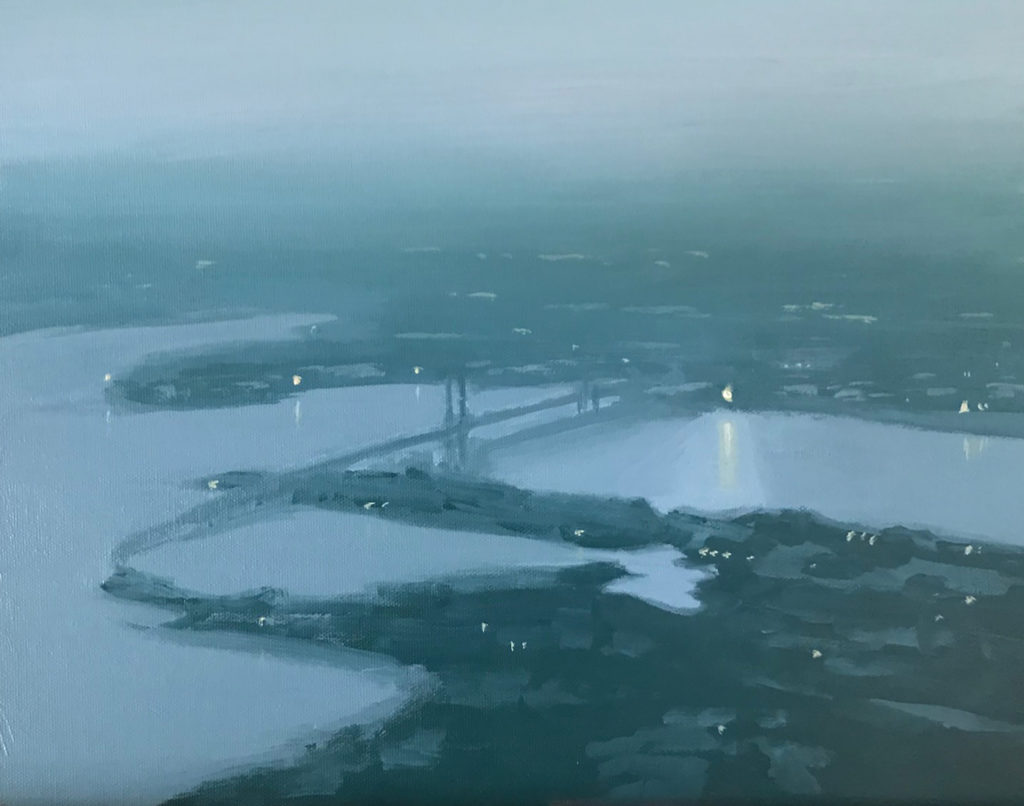
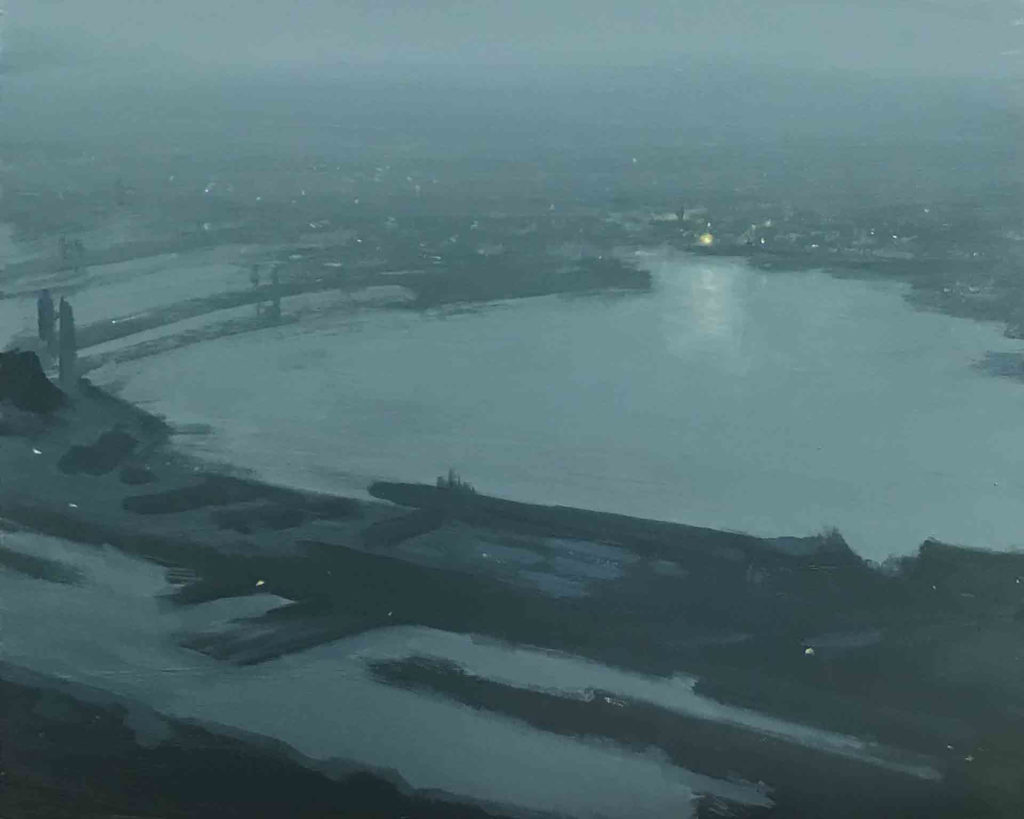
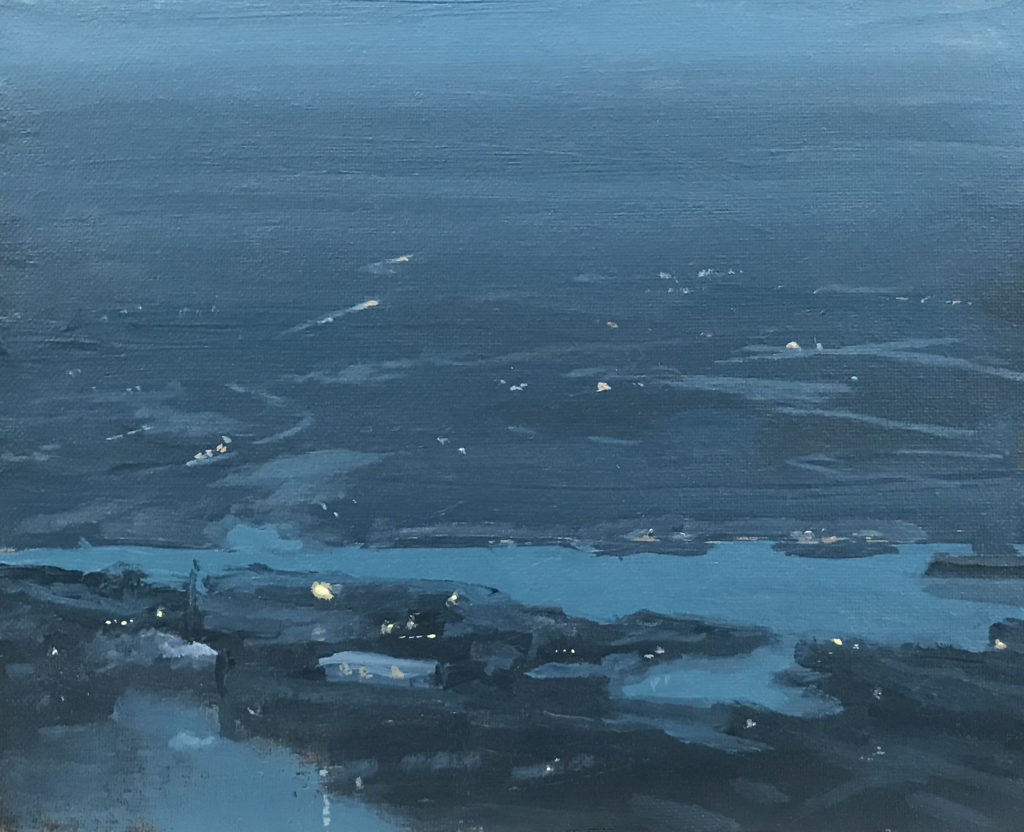
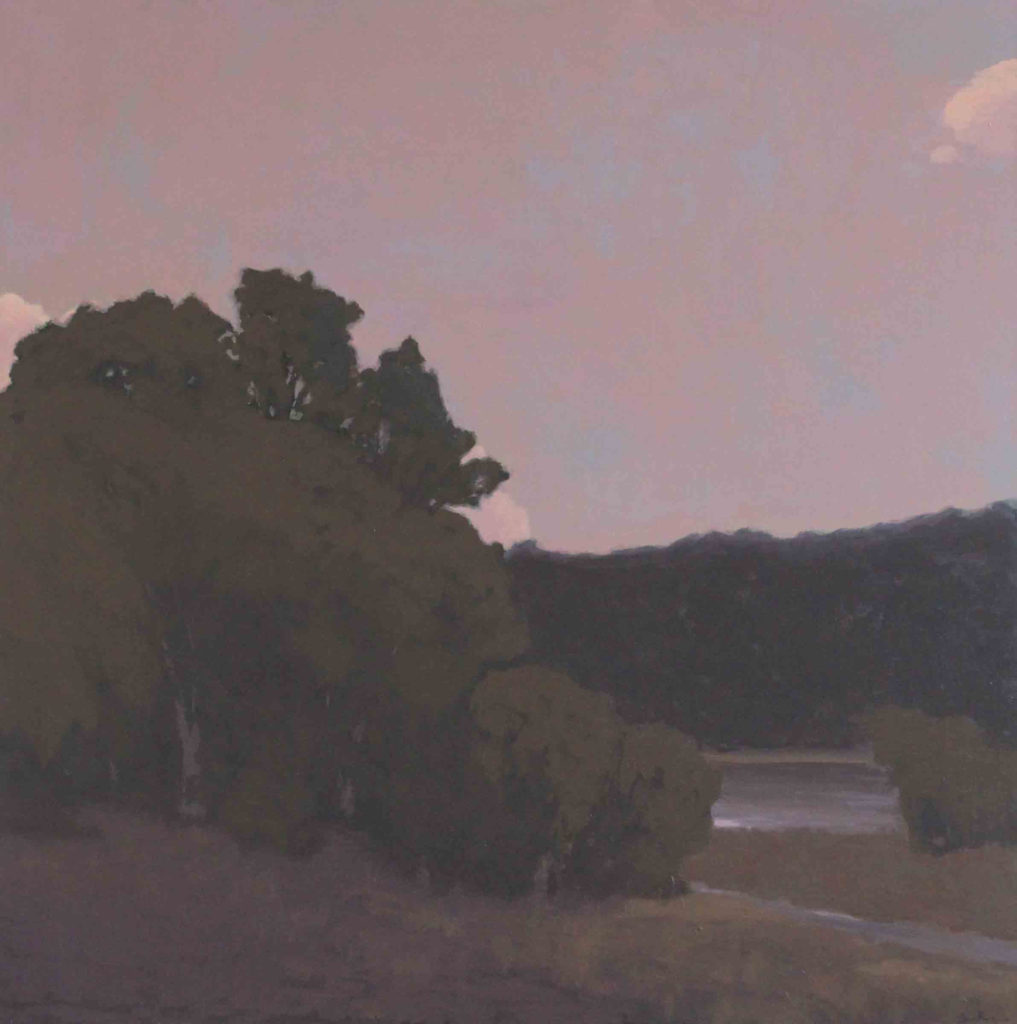
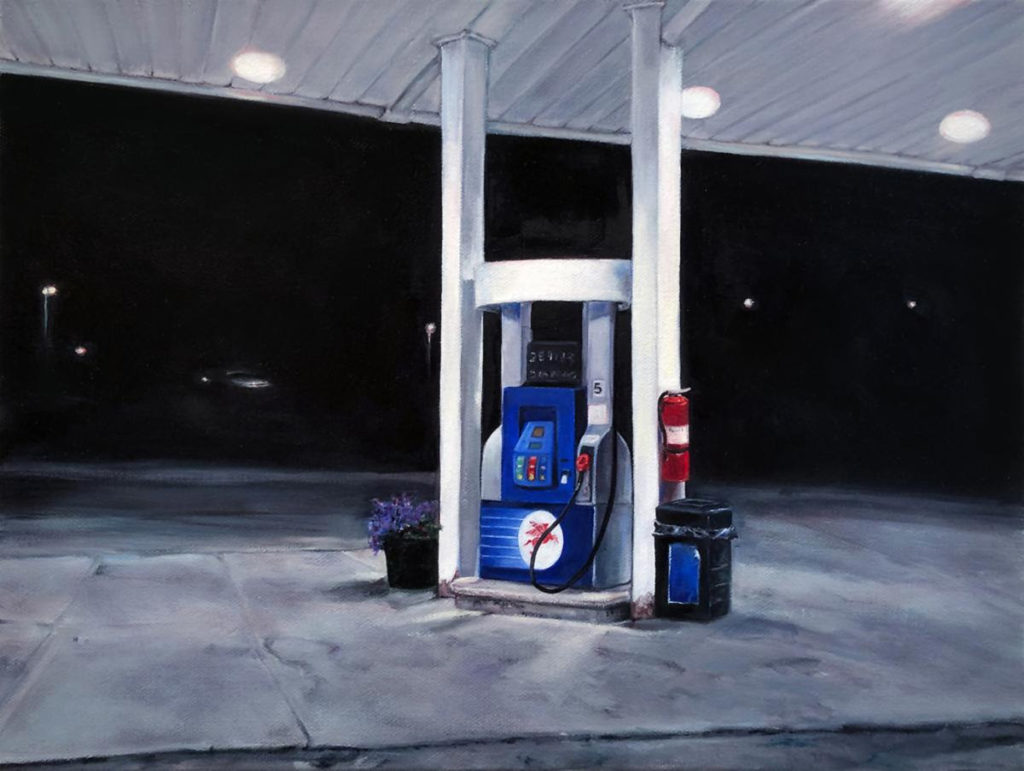
Brian Sindler’s most recent momentum centers on nocturne paintings, which will be exhibited at Primitive in Chicago through February 14, 2020.
Brian Sindler, “Midway Rd Nocturne 1”
More from the gallery:
Although well known as a landscape and plein air painter, Brian Sindler shows far greater depth and complexity than any one single style or label. His paintings stretch across the borders of landscape painting, conceptual art, realism, and even surrealism.
Brian Sindler, “Early Morning NY”
Sindler’s nocturne paintings display his masterful use of light – or absence thereof. They illustrate the borders of darkness found at dusk and dawn in stunning aerial views, veils of light shrouding non-traditional tree lines, and the mystery of night as it appears in middle-class suburbs. Collectively, they create a world filled with mood, wonder, and anticipation, bringing to life moments that are ephemeral and compelling.
Brian Sindler, “Nocturne – Grenwald”
Brian Sindler, “Amsterdam Evening”Brian Sindler, “Forest Way”
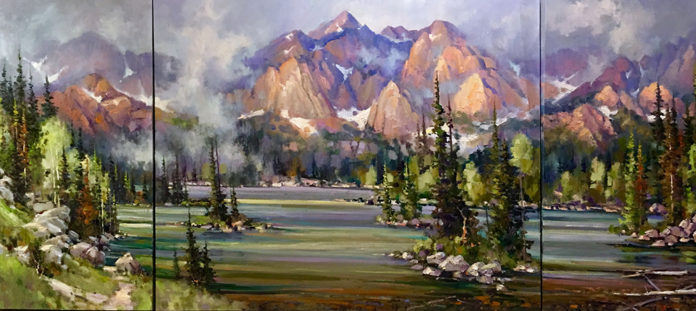
After the Rain in the Wind River Mountains
Kirk Randle
50 x 110 in.
oil on canvas
$35,000
A native of Utah, Kirk’s works depict a sense of place. He is known for painting sweeping landscapes and vivid skies, showcasing the intense beauty and reflective light of the West. His artistic career spans decades, including 30 years as a participant in the Celebration of Fine Art. Come watch him and 100 other artists create at the Celebration of Fine Art, where art lovers and artists connect, in Scottsdale, Arizona; January 18-March 29, 2020. Contact us at 480.443.7695 or [email protected].
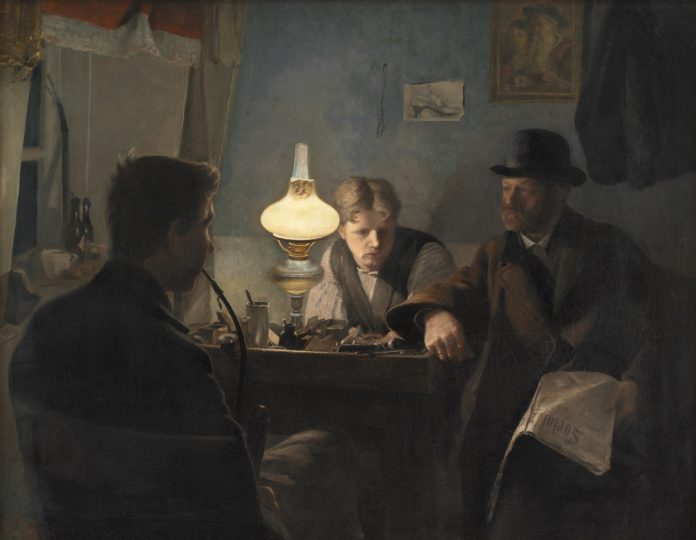
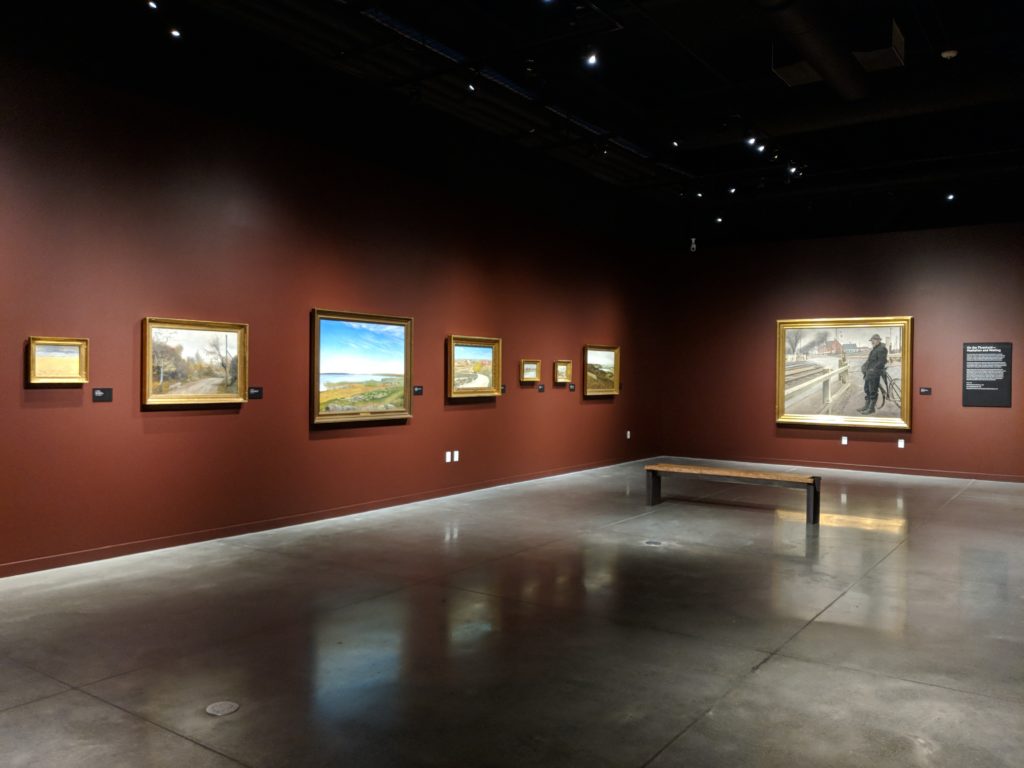
The National Nordic Museum (Washington) is presenting the first exhibition outside the Nordic countries focused on Laurits Andersen (L.A.) Ring (1854–1933), a Danish painter once famous for his realist and symbolist images.
All 25 paintings have been loaned by the National Gallery of Denmark. This project is titled “On the Edge of the World” because Ring’s figures often occupy transitory zones — such as a window or railway crossing — that might represent the threshold between life and death. It will move on to the Bruce Museum in Greenwich, Connecticut (February 1–May 24, 2020).
Courtesy the National Nordic Museum
More from the museum:
L.A. Ring has been a key figure in the international breakthrough of Nordic art. His works are represented in major shows dedicated to art from around 1900, but despite his importance this will be the first exhibition devoted solely to Ring’s art shown outside the Nordic countries. It’s a rare opportunity to meet a highly gifted Nordic artist with a view on nature and modern life that corresponds with American Naturalism and Impressionism.
Courtesy of SMK—The National Gallery of Denmark
Ring’s paintings testify to the radical artistic and cultural shifts that took place in the decades around 1900, more so than the works of many other artists from the period. Meeting the modern world head-on, Ring is the one Danish artist to best describe the great changes in the world of art and in society taking place in the decades around the year 1900. The upheaval can be seen everywhere, often as a restless search for something different and perhaps more meaningful.
Courtesy of SMK—The National Gallery of Denmark
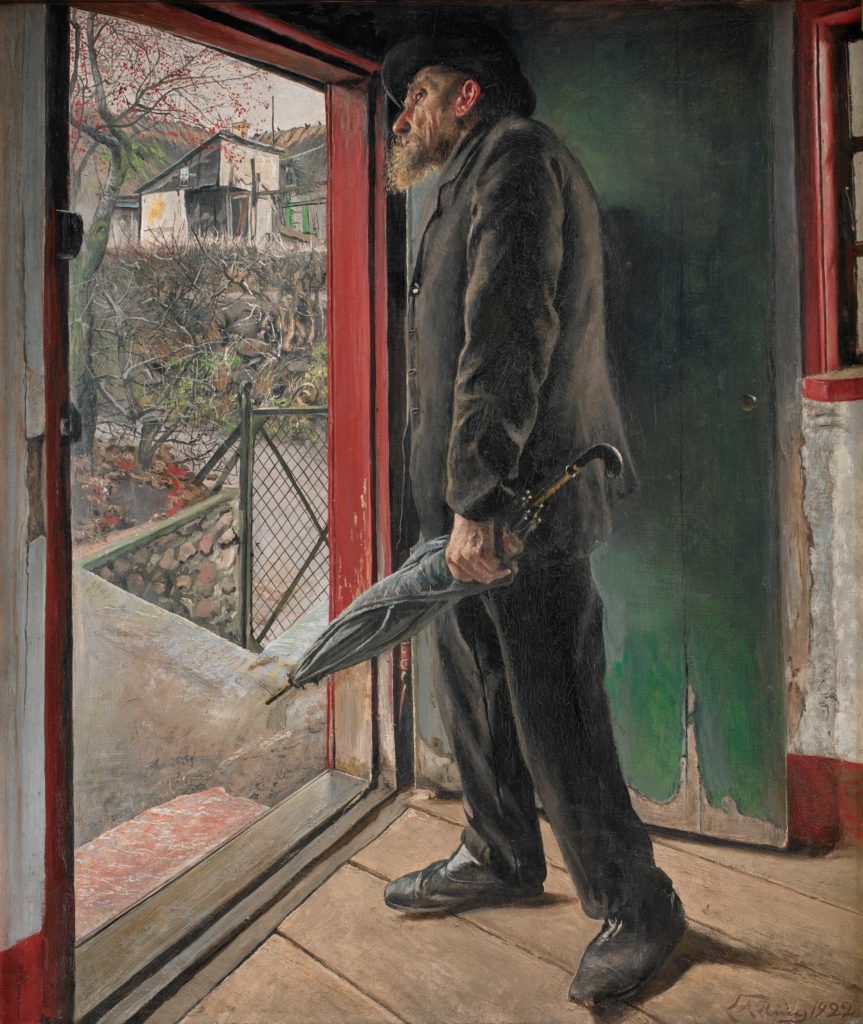
In Ring’s works, man often occupies a transitory zone—a threshold—whether at a garden gate, a window, a railway crossing, or on a road. It may be a young girl who is entering adulthood, or an old one who is close to death. Painted on the threshold of modern life, Ring’s works contain “the new” as concrete objects, as motifs, but they also reflect “the modern” as a state of mind. Eminently relatable, his art has a universally human quality. Showing everyday life around 1900, it resonates with American history as it also tells the story of many European emigrants who settled in the U.S. around 1900.
Laurits Andersen Ring (1854–1933), “Has It Stopped Raining?” 1922, oil on canvas, 25 3/8 x 21 7/8 in., Statens Museum for Kunst, Copenhagen
“In American immigrant culture, one finds a relationship with nature and place that is so pronounced and significant in L.A. Ring’s paintings. Feeling a lifelong connection with a personal, primordial, yet abandoned ur-landscape is also, and for good reason, a recurring theme among several American artists during the first half of the 20th century. With its depictions of vast landscapes and modern urban life in an America undergoing major transformations, American realism and naturalism has strong parallels to Ring’s production,” explains Peter Nørgaard Larsen, Senior Researcher and Chief Curator at SMK, the National Gallery of Denmark.
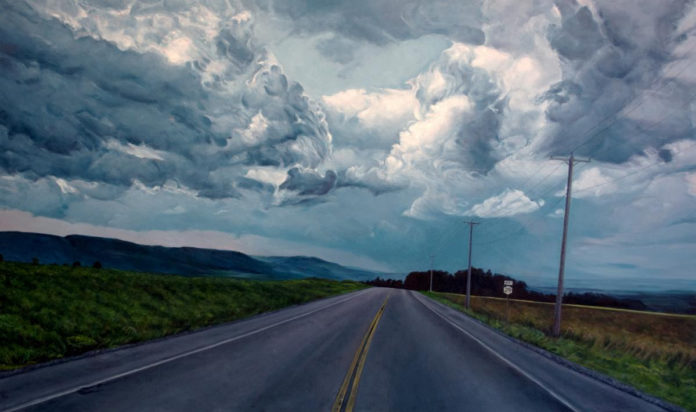
Edie Nadelhaft, “NY Route 29,” 2019, oil on canvas, 36 x 60 in / 91 x 152 cm
“Evening in America” is Edie Nadelhaft’s second solo show with Lyons Wier Gallery (NY). This new group of road-trip paintings picks up where her last series, “Big Country” (2017), left off. “Evening in America” focuses on the visual nuances and psychological ambiguity of twilight.
Nadelhaft states, “There is a dreamy, magical, and oft-times haunted quality to this work that showcases otherwise unremarkable, pedestrian, and distinctly American settings.”
More from the gallery:
Nadelhaft draws inspiration from artists, writers, and filmmakers whose work explores the subtler (and often stranger) corners of the American experience, including David Lynch, Diane Arbus, Donna Tartt, and Walker Evans, whose 1974 comment about his own process sums it up nicely: “I lean toward the enchantment, the visual power of the aesthetically rejected subject.”
An avid motorcyclist, Nadelhaft takes annual weeks-long tours of the country’s lesser-known and less spectacular outposts, collecting sketches, photos, and memories that form the basis for her paintings of settings that hover between the built world and the natural landscape. No people are pictured, but each composition preserves some residue of the human presence: clouds gather over a neglected highway in northern Michigan; a signpost flashes by in a mysterious sequence of three small paintings depicting what might quite possibly be the literal end of the earth; the artist’s home base of New York City makes a cameo appearance in a triptych painting of a shuttered Luna Park shown at that magical impasse between day and night when the first few stars appear in the still-blue sky.
Motorcycle aesthetics feature prominently in the works, many of which are composed as rider’s-eye-view 3D constructions that incorporate actual motorcycle parts. These structures are pared down to the elegant and highly personal stylings of motorcycle culture, combining handlebars and mirror housings with custom handgrips and hardware to create sculptural objects that reference the inherent beauty of these machines.
Edie Nadelhaft, “After Robert Olsen,” 2019, oil on canvas, 16 x 23 in / 41 x 58 cm
The exhibition also includes a number of traditionally stretched canvases ranging in size from 12 x 16 inches to 36 x 60 inches. Rendered in a manner best described as perceptual realism, these paintings take the viewer into the scene, showing just as much — or as little — sharp detail as a human eye can process in person. The point of view and style of painting takes into account the fleeting nature of impressions, especially those formed while driving in low light on unfamiliar roads.
Nadelhaft states, “The exhibition title, ‘Evening in America,’ is both a literal description of the paintings on view, which are all set in late afternoon or early evening, as well as a questioning of the state of the nation. The words reference Ronald Reagan’s re-election campaign ad that featured imagery of Americans starting their day in a bright sunny world, and the opening line, ‘It’s morning again in America.’ We now seem to be driving on an unfamiliar road in low light. And evening is ambiguous, a potentially dangerous time in-between, especially for driving. Light is greatly diminished, but it is not quite dark enough to reap the full benefit of headlights.
Buildings, trees, and power lines appear and disappear in a murky, shimmering haze; nighttime is fluid, rife with intrigue, and for some, even dread. But the dark can also provide a portal to the imagination, opening up new possibilities and potential.” And for this artist, it brings an overwhelming sense of wonder and relief. Daylight can be so demanding! The night — especially traveling at night — offers protection, a respite, like a spell that conjures a brief suspension of responsibility and time as one hurtles through space fully enveloped in the totality of that experience.
Edie Nadelhaft studied painting and art history at the School of the Museum of Fine Arts, Boston, MA, SUNY at Purchase, NY, and received a BFA with honors from Massachusetts College of Art & Design, Boston, MA. Her work has been exhibited at art fairs, museums, and galleries throughout the US, and internationally in Taiwan, Shanghai, and Basel, Switzerland. Nadelhaft’s work is in the permanent collections of the Ford Foundation (New York, NY), the University of New Mexico Health Sciences Center (Albuquerque, NM), and Falconworks Theatre for Social Change (Red Hook, NY), and has been written about in the Detroit News, the American Scholar, Domino Magazine, Juxtapoz, the Washington Post, the New York Times, and Wall Street International.
In December 2019, Nadelhaft will be the subject of the Virtual Memories Show podcast. Awards and residencies include the Artist in Residence at Platte Clove (Elka Park, NY), Artist in Residence at the Visible Vault, Yellowstone Art Museum (Billings, MT), Fine Arts Painting Department Merit Award, Massachusetts College of Art (Boston, MA), and the Combined Jewish Philanthropies Academic Scholarship (Boston, MA). Edie Nadelhaft has lived and worked in Lower Manhattan since 1998 and has been represented by Lyons Wier Gallery since 2013.
The Brenau University Downtown Center (Georgia) is currently playing host to an ongoing special exhibition of works titled “Charles Webster Hawthorne: Paintings from the Collection of Doug and Kay Ivester.”
More from the gallery:
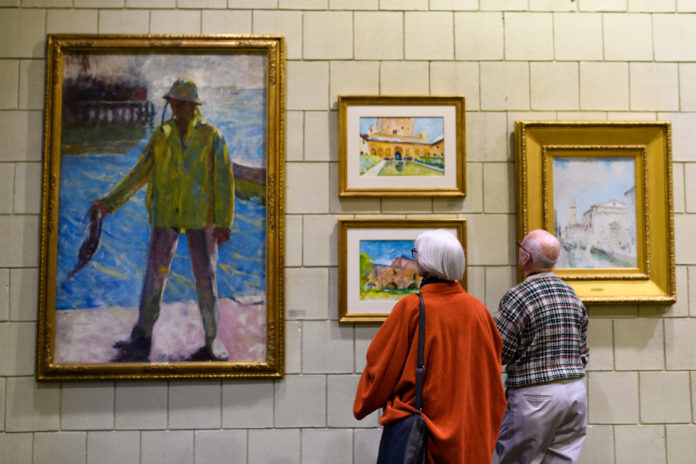
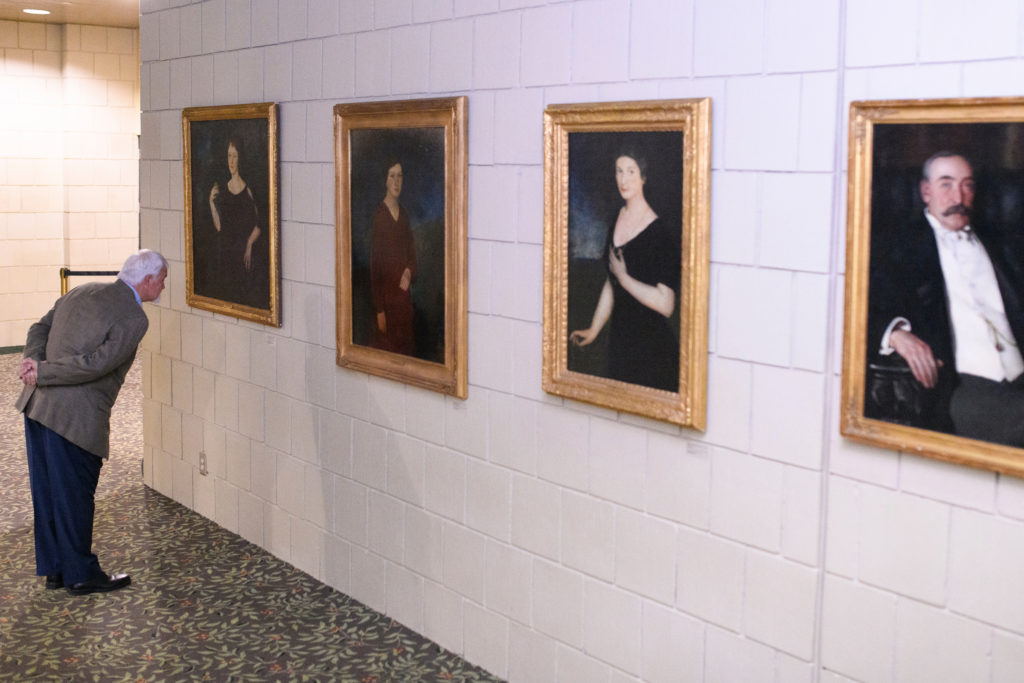
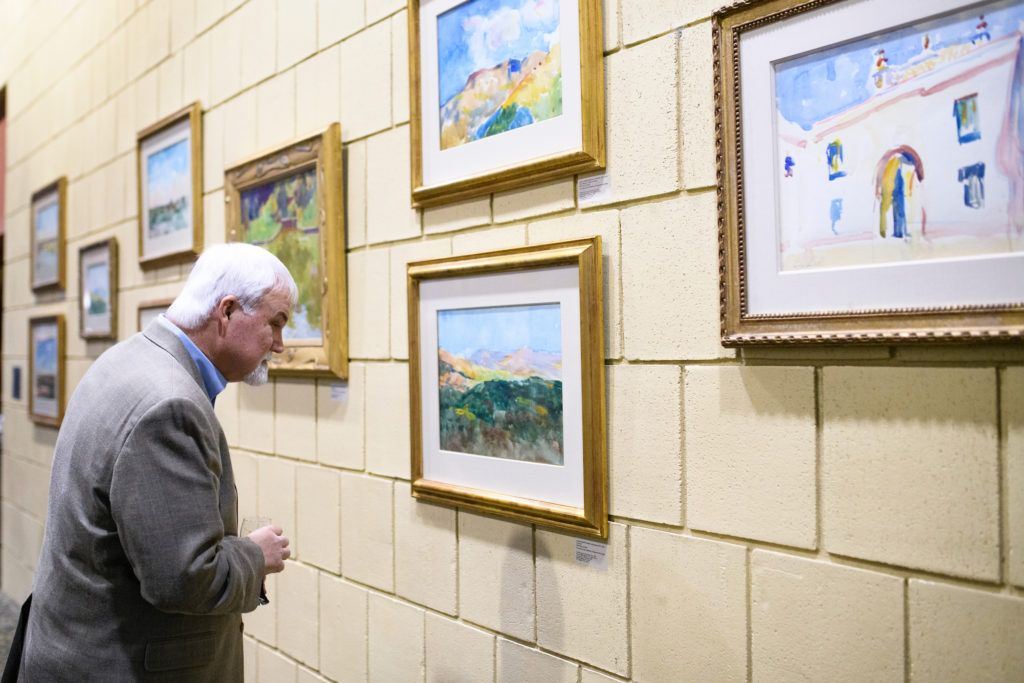
The towering walls of the Theatre on the Square’s lobby now display 30 oil paintings and watercolors on loan from Doug and Kay Ivester by Charles Webster Hawthorne (1872–1930), an American artist renowned for his portraits and genre paintings who was instrumental in the founding of the Cape Cod School of Art in 1899.
“Hawthorne was a pupil of and assistant to American Impressionist painter William Merritt Chase,” said Nichole Rawlings, Brenau Galleries director. “Coincidentally, the very first piece donated to the Brenau Collection when it began in the 1980s was a painting by Chase given by Mr. and Mrs. Fred Bentley Sr. Brenau is grateful to the Ivesters for allowing works by these old friends and colleagues to be together again on our campus.”
The Downtown Center might be home to the university’s high-demand Department of Physical Therapy in the Ivester College of Health Sciences, but it is no stranger to esteemed works of art as it houses the Manhattan Gallery — one of the university’s four Gainesville galleries — which features an ongoing exhibition of Brenau University Permanent Collection artwork by artists who have some connection to the New York art world. The space is anchored by over 100 works from the collection of Dorothy and Herbert Vogel, who were very well-known in the New York art scene, and features a number of photographs and prints by artist Andy Warhol (1928–1987), which were given to Brenau by the Andy Warhol Foundation.
Rawlings said the new selection of paintings on display highlights works representative of Hawthorne’s subject matter and style featuring famous faces, serene landscapes, and architectural beauty.
“Hawthorne was involved in his era’s most advanced color theory practice, and these pieces demonstrate that through their shapes and layers of applied color,” she said. “Hawthorne is quoted saying, ‘Forget what object is before you — think, here is an oblong of pink, a little square of blue, a streak of yellow. Paint it just as it looks to you, the exact color and shape, until it gives you an impression of the scene before you.’”
The installation of “Charles Webster Hawthorne: Paintings from the Collection of Doug and Kay Ivester” in the theatre lobby makes these works easily viewable for downtown Gainesville visitors during business hours.
Rawlings said the Brenau University Permanent Art Collection is a resource for the Brenau community and beyond.
“We encourage visitors from the wider Gainesville and North Georgia communities, and we strive to provide free and educational cultural opportunities,” she said. “Our gallery spaces, including the Brenau University Downtown Center, are always open to the public during business hours and are free to visit. Galleries staff or trained docents can provide additional tours and information upon request to community groups at no cost.”
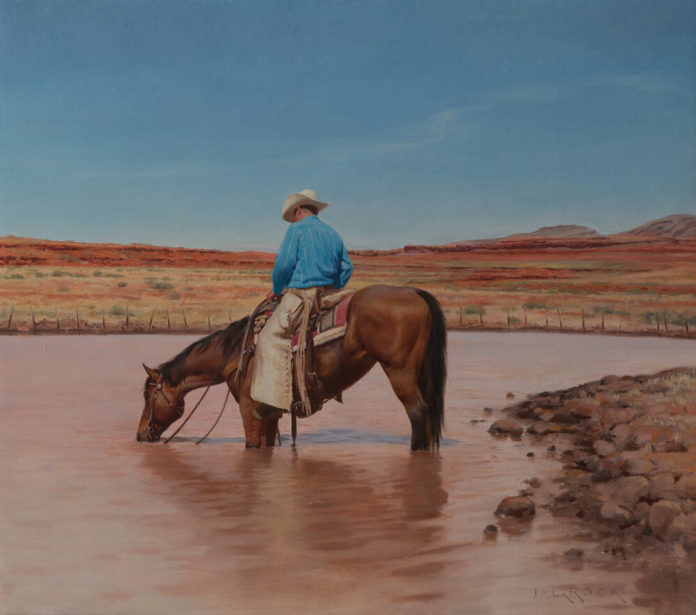
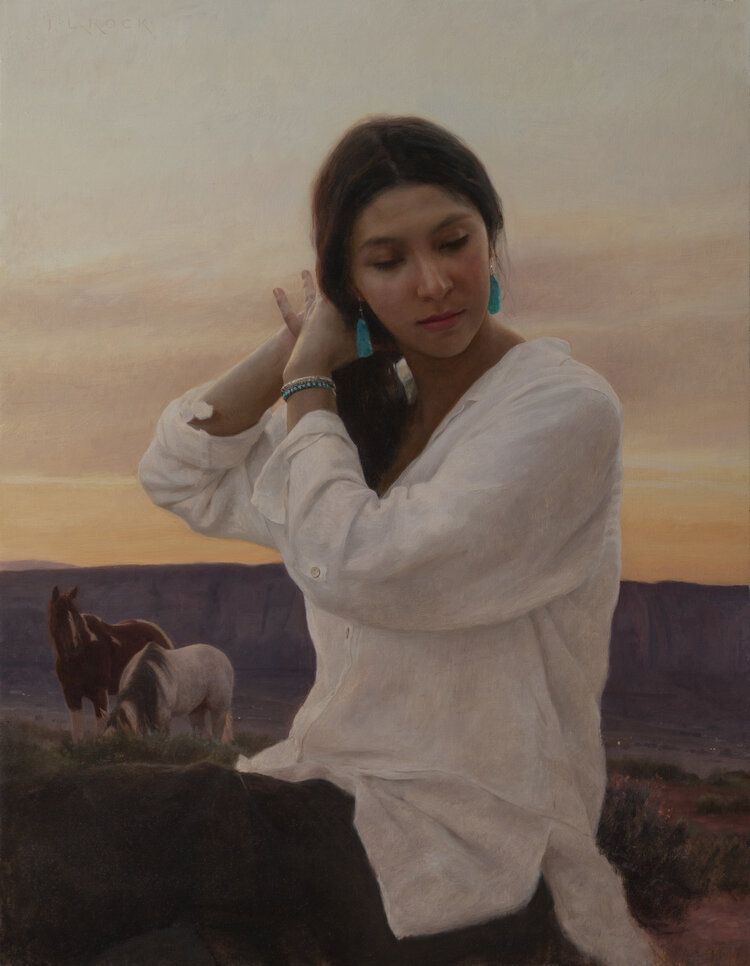
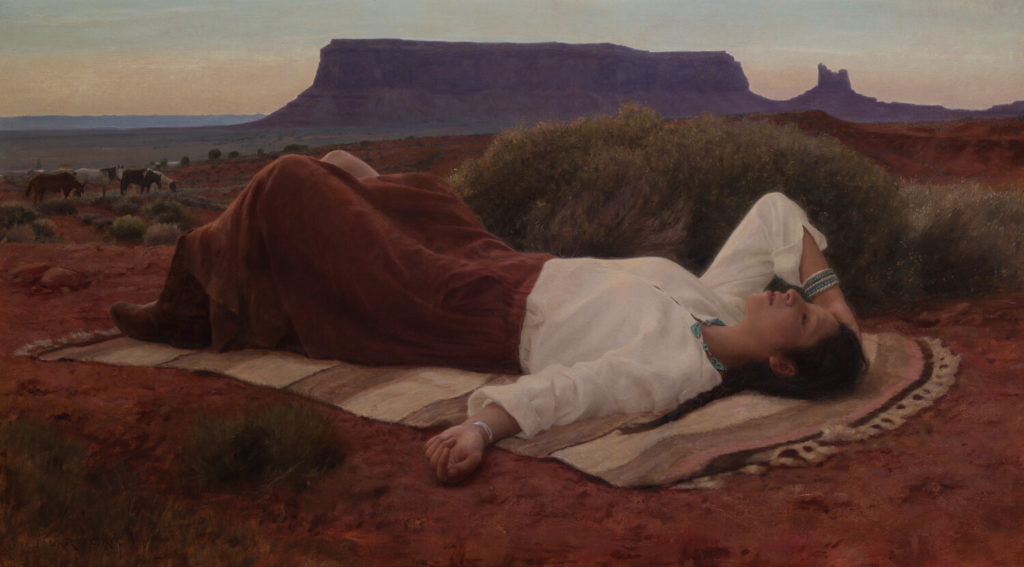
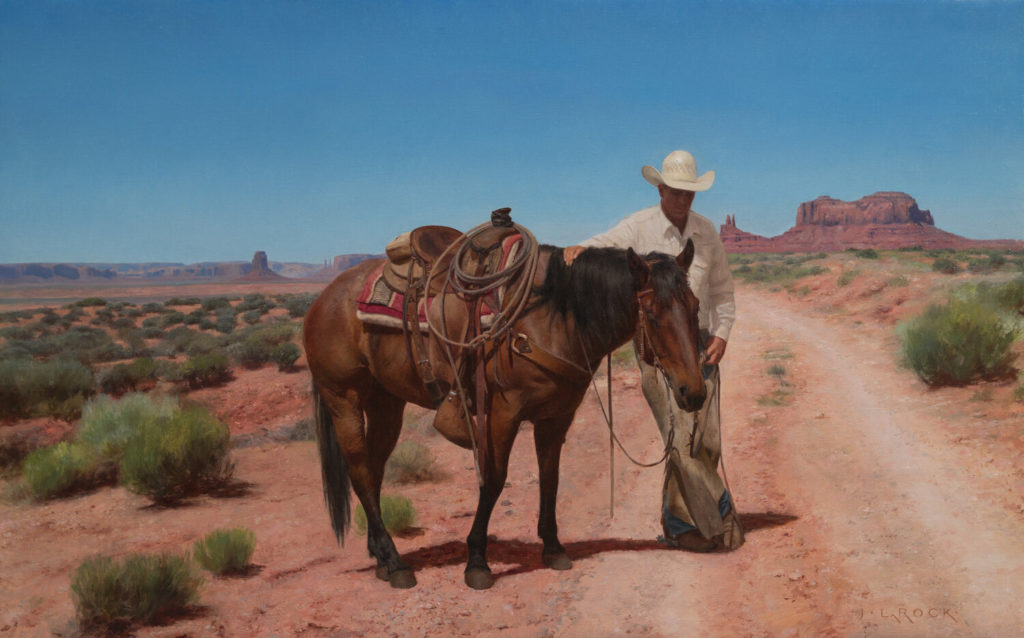
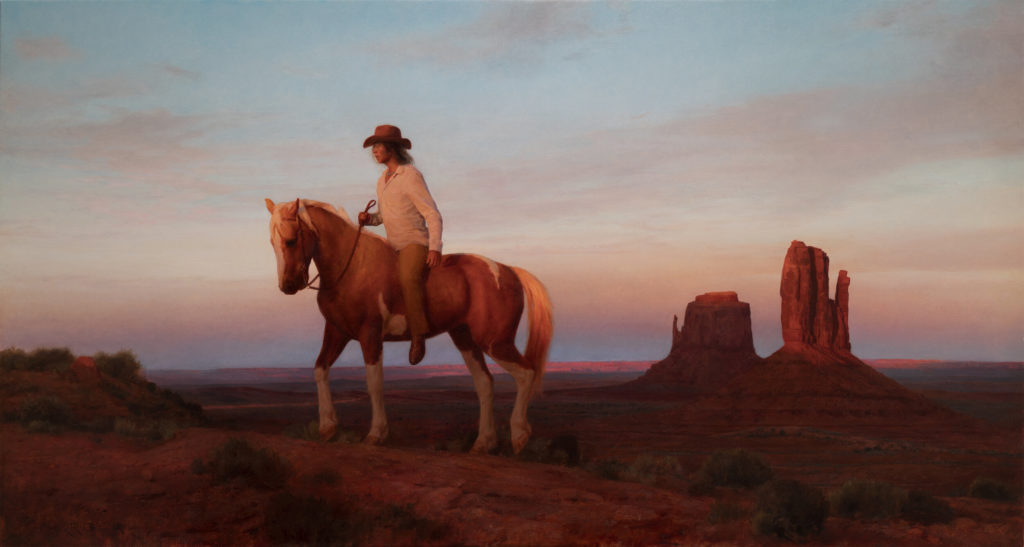
View “Joshua LaRock: A Showcase of New Works” at Maxwell Alexander Gallery (Los Angeles). An opening reception will be held December 14.
Joshua LaRock, “Braids,” oil 27 x 21 in.
From the gallery:
Joshua LaRock, a Texas native, is a classically trained artist with deep roots in figurative painting. Influences of old masters such as Bouguereau mixed with the beauty of the Southwest create a truly unique perspective of the West.
Joshua LaRock, “Desert Repose,” oil, 21 x 38 in.
“I am extremely excited to present my debut series of paintings inspired by the American Southwest,” says LaRock. “Since moving back to Texas, I have become increasingly motivated by the great beauty and many possibilities that the West offers me as an artist. This has been a pleasant rediscovery of my roots, and I feel like I have only just begun to explore the richly varied landscape and diverse humanity of the region where I grew up.”
Joshua LaRock, “On the Road,” oil, 17 x 27 in. (sold)Joshua LaRock, “Rising Shadows,” oil, 29 x 54 in.
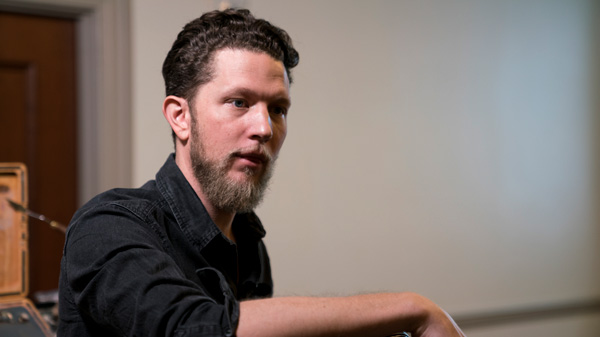
Last month at the 3rd Annual Figurative Art Convention & Expo (FACE), Joshua LaRock led a demo on “Painting Distinctive Portraits,” including helpful slides with illustrations showing examples of the “points” in a face, the tilts, shapes, and measurements one can use. He also explained how to adjust your model back into position after a break by comparing the cast shadows on his or her face versus the cast shadows on your painting. Learn more about FACE20, to be held in Baltimore, Maryland, here.
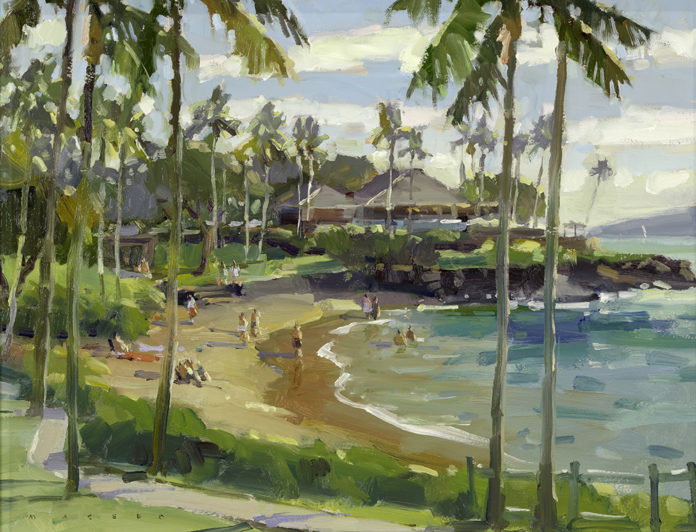
Best Day Ever, Kapalua Bay
By Ronaldo Macedo
12 x 16 in.
Oil on canvas
2019 Maui Plein Air Painting Invitational
Montage Kapalua Bay Afternoon Paint-Out
Where the earth meets the ocean, you will find Maui plein air artist, Ronaldo Macedo, creating breathtaking oil paintings on canvas. He connects complex elements to create a feeling of serenity and strength. It is the confidence of life outdoors — surfing, boating and painting award-winning fine art.
Ronaldo says seascapes, boats and mountains were his earliest memories growing up in Rio de Janeiro, where his parents encouraged his artistic talents. When the family moved to California, “I learned there were many careers in art, so I studied illustration in college. Summers I worked as an international river guide in stunning landscapes all over the world — Norway, Chile, Turkey, Costa Rica and the Grand Canyon,” says Macedo. Passions for the outdoors and art bloomed as plein air painting in 1989 when Ronaldo moved to Maui.
Referring to his painting Best Day Ever, Kapalua Bay, Ronaldo states, “This is my favorite spot on the Kapalua Bay. It has all the elements, shapes and angles that I love to paint — vertical palms intersect the horizontal planes, architecture, rocks and Lanaʻi Island in the distance. A beach walk and hedges wind along the left side to a tunnel, and long shadows spill up the beach. I feel like the auto mechanic building his dream automobile who opens his garage to find every essential part and every accessory on his wish list!”
Ronaldo Macedo was a co-founder of the Maui Plein Air Painting Invitational, now in its 15th year. “Our goal was to bridge mainland and Hawaii painters, to raise the caliber of Maui art. It’s pretty amazing to see how we’ve grown and enjoy the close relationships artists have forged with the Maui families who have hosted them through the years. The benefits have gone way beyond the event,” says Ronaldo.
Ronaldo Macedo sells his originals and prints exclusively at Lahaina Galleries in Maui and California. He is a “collectors’ favorite” at the Maui Plein Air Painting Invitational to be held February 15–23, 2020.
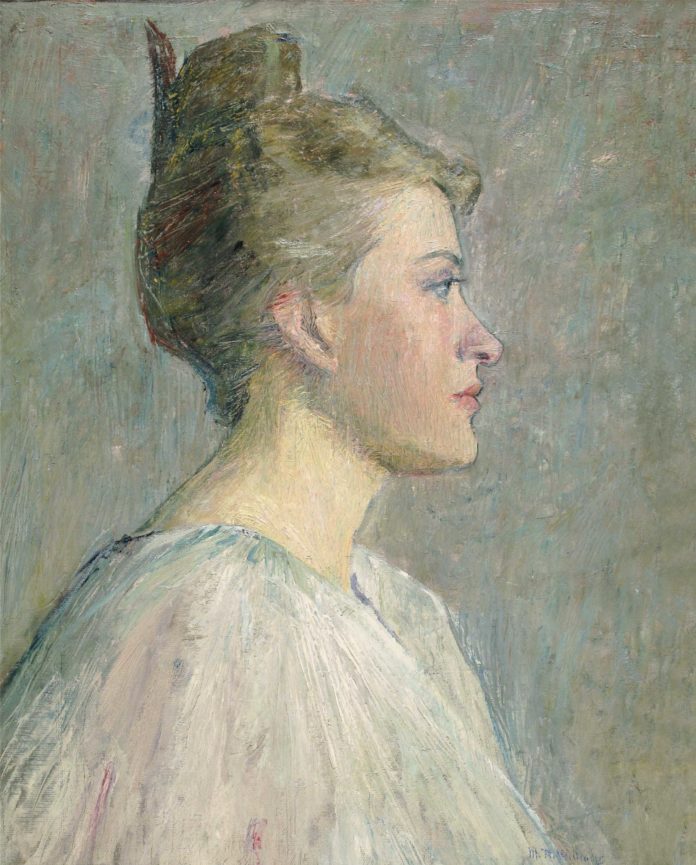
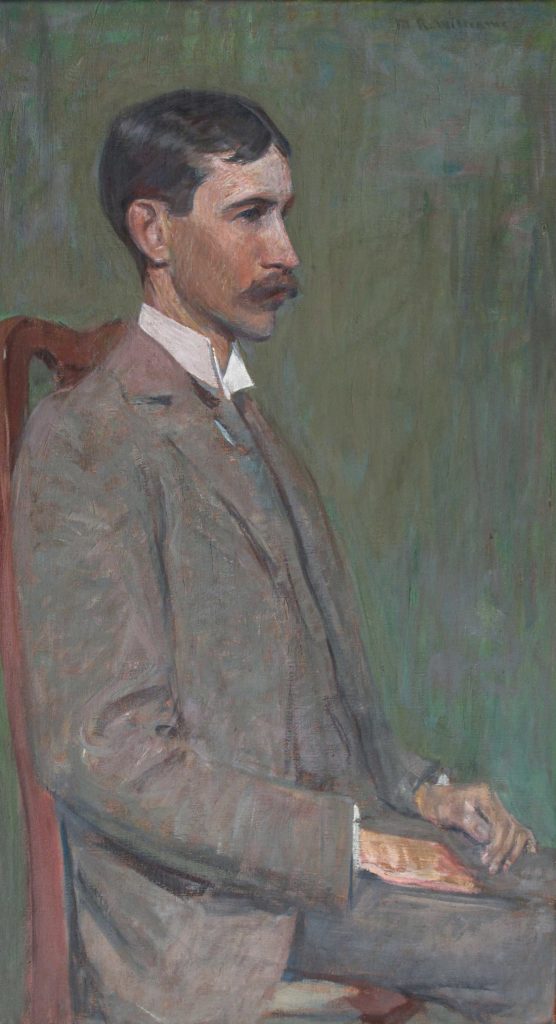
Mary Rogers Williams, “A Profile,” c. 1895, oil on canvas, 21 x 16 in. Shown at the New York Water Color Club and the Pennsylvania Academy of the Fine Arts in 1895. WFC (photo: Ted Hendrickson).
“Forever Seeing New Beauties: The Forgotten Impressionist Mary Rogers Williams, 1857–1907” is a new book by Eve M. Kahn, published by Wesleyan University Press (available here). Enjoy this excerpt and learn more about Mary Rogers Williams, “the Mary Cassatt you’ve never heard of.”
Excerpt from “Forever Seeing New Beauties: Why She Matters”
Mary Rogers Williams (1857–1907) is the only nineteenth-century woman artist for whom it is possible to relate in detail where she traveled, from the Arctic Circle to Roman ruins south of Naples, along with her evocative comments on what she ate, what political scandal was splashed across the newspapers, which street urchins tugged at her heart, what plants were clinging to nearby rock formations, what smells were wafting through the streets, how much she paid for tram rides, which hotel guests fascinated or bored her, what she thought of better-known painters and men’s treatment of women on the road, which museum shows and church restorations she loved and hated, what she was wearing, and how much she missed home—while she was sketching fjords, medieval doorways, harbors, chateau spires, and parched hillsides.
Mary Rogers Williams, “Portrait of Henry C. White,” c. 1896, oil on canvas, 36 x 20 in. WFC (photo: Ted Hendrickson).
She is also surely the only nineteenth-century woman artist who fell into deep obscurity, while thousands of pages of her letters and mounds of other family paperwork plus virtually all her paintings were slumbering together in storage. The quantity of documentation, even about the ordinary, is part of what makes her story extraordinary.
Mary has been called “the Mary Cassatt you’ve never heard of.” The two Marys, both Impressionists, did share a love for painting women and for bohemian living in Paris. But while Mary Cassatt enjoyed inherited money and patrons’ support and socialized with Degas’s circle, Mary Williams was a baker’s daughter who had little uninterrupted time for art. Mary Williams taught at Smith College for nearly twenty years to help pay her family’s bills.
But please do not feel sorry for her, or think of her as a martyr. Mary, above all, had fun, within the limitations of her budget and her era’s misogyny.
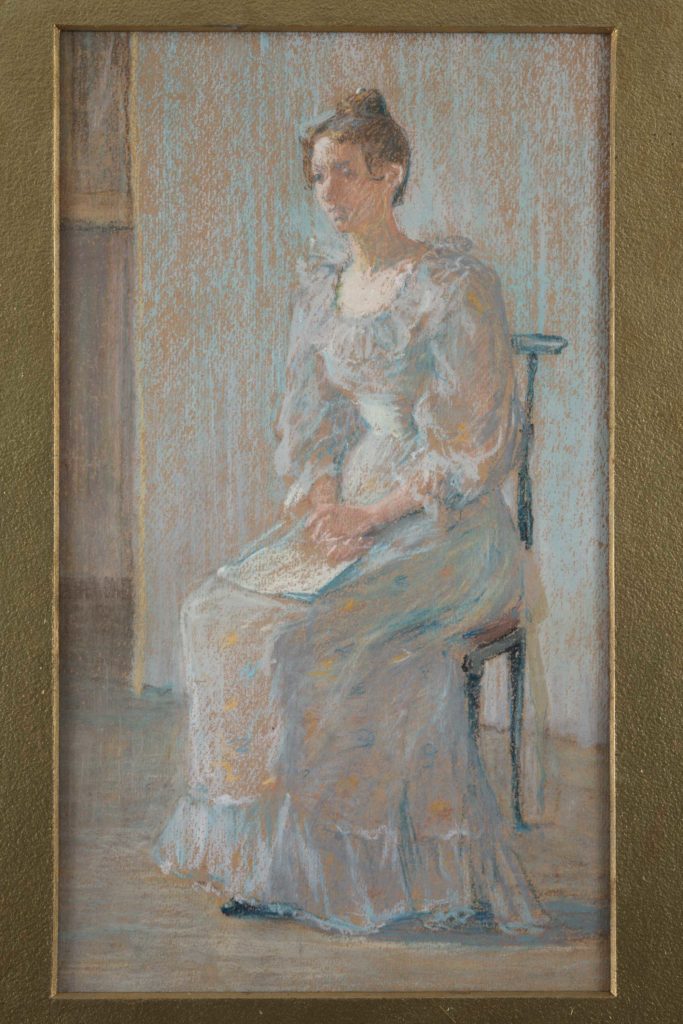
Mary Rogers Williams, “Friendly Sitting,” undated (pre-1894), pastel, 17½ x 10 in. Private Collection (photo: Karen Philippi).
Her writings record not only her travels but also the travails of teaching female pupils and competing with men for space on gallery walls. Her story affords a rare woman’s perspective on nineteenth-century cosmopolitan life: Why were women not allowed to linger on ocean liner decks at night? Why did Italian waiters urge her to get married already? Why did Dwight Tryon, her Smith department head, believe that women could be taught so little about art? Why did he get the credit for what students achieved, although he spent only a few mornings each semester on campus?
About 100 of Mary’s oil paintings, pastels, and watercolors and 160 sketches survive, many of them long kept in the Whites’ boathouse. She exhibited in Paris, New York, Philadelphia, Indianapolis, Hartford, Boston, and Springfield and Northampton, Massachusetts, and she was lauded in publications including the New York Times. Henry White compared her to “those New England women of artistic temperament of whom Emily Dickinson, the poet, was an example.” But while Emily Dickinson scribbled in her upstairs bedroom, for Mary there was almost no such thing as too much time on the road. In her travels, Mary would try almost anything, including escargots, subways, wood carving, bookbinding, and sneaking out at night to see comets.
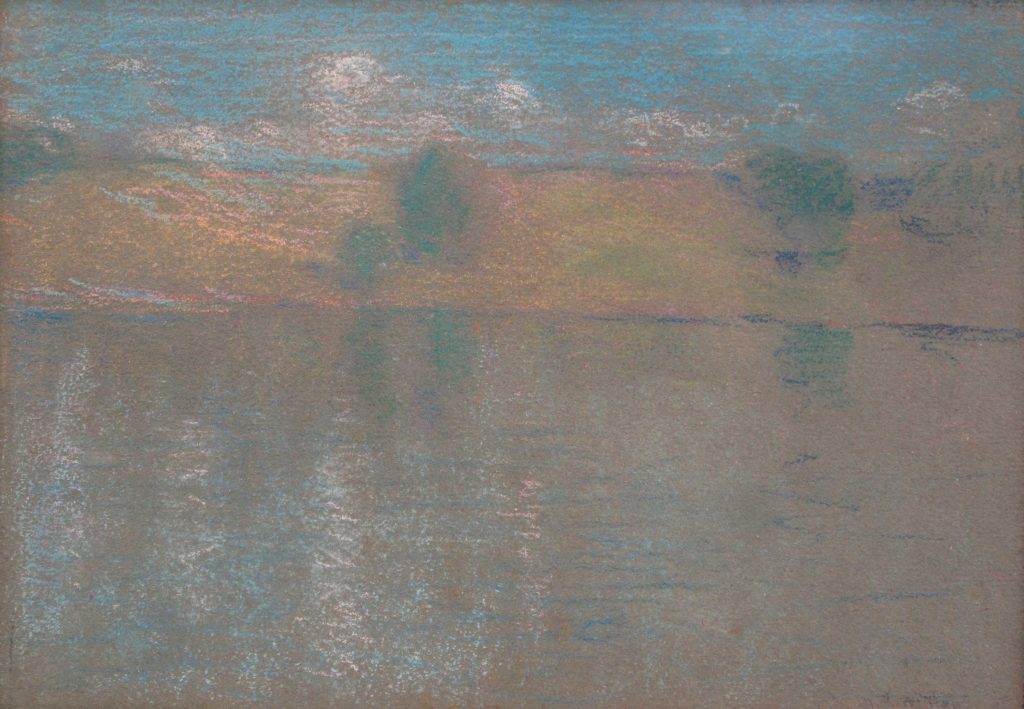
Mary Rogers Williams, “Job’s Pond, Connecticut,” undated (pre-1895), pastel, 9 x 12 in. WFC (photo: Ted Hendrickson)
At Smith, along with teaching art and the history of art and sculpture, Mary hung exhibitions of student pieces and borrowed artworks, organized faculty parties, tried to flatter donors, handled her own housework and cooking, painted landscapes as well as portraits of Smith students and staff, and submitted and shipped her paintings and pastels for American exhibitions. She published a few writings about art, and she occasionally sold a work. On vacations with her family, she took charge of feeding everyone, and while living in Europe, she cooked, stoked heating stoves, painted and papered walls, waxed her floors daily, and made and repaired her own clothes. A single male artist of her time, even under similar financial constraints, would not have been expected to handle many of the chores that fell to her.
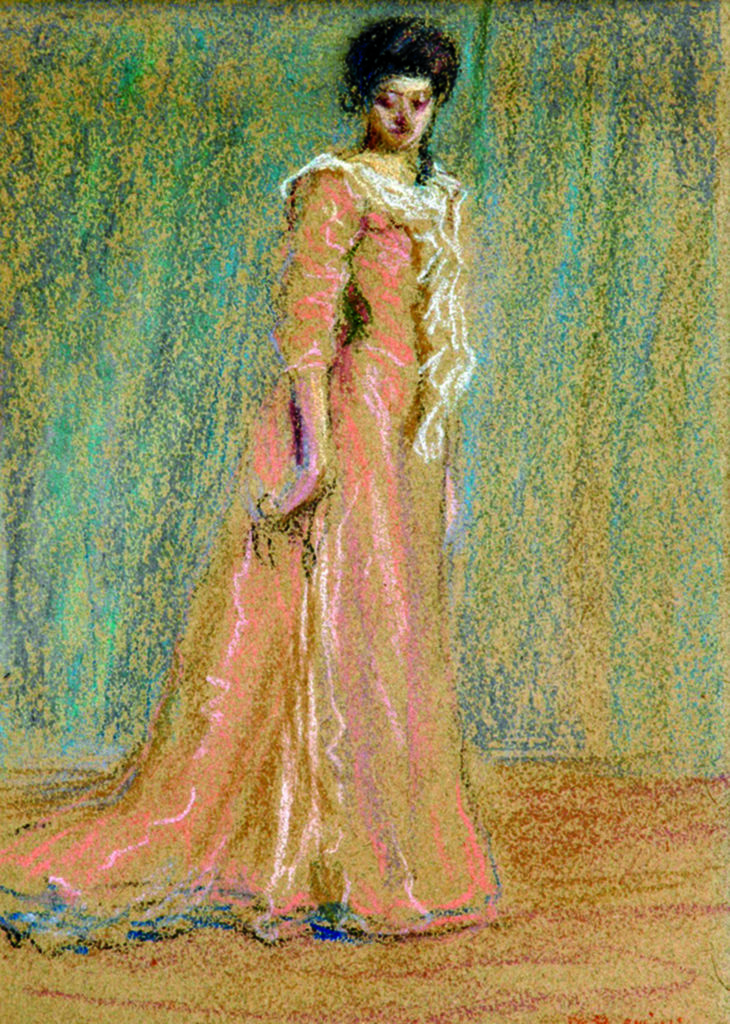
Mary Rogers Williams, “The Pink Gown (also called Woman in Pink),” c. 1895, pastel, 12 x 8 in. Shown at the New York Water Color Club and the Pennsylvania Academy of the Fine Arts in 1895. Private collection (photo: Stair Galleries, Hudson, NY).
She knew celebrated artists, including James McNeill Whistler, Albert Pinkham Ryder, William Merritt Chase, and Childe Hassam. She liked Ryder, despite his absentmindedness and chaotic home, and she did not mind Chase, who had critiqued her early on for “too much timidity!” But she found Hassam’s work repetitive, and as for Whistler, she concluded after a few classes at his Paris school that he was a pompous fop surrounded by fawners. She dropped out of the school—and in general, she was anything but a joiner.
In artistic style, she has been classified recently as a Tonalist and an Impressionist. From the 1880s to the 1910s, Tonalist painters used a limited and largely somber palette to evoke the moods of landscapes rather than fine details. The Impressionists, who emerged in the 1860s in France, likewise set out to break away from realism, but they favored brighter hues and broader subject matter—from factories to brothels— than did the Tonalists. Neither category, as we now conceive them, existed in Mary’s lifetime. And while she knew Tonalists and Impressionists who congregated at Florence Griswold’s boardinghouse in Old Lyme, she scarcely socialized with them. She lived in Paris for years (1898–1899 and 1906–1907), but she befriended no Parisian art world celebrities—she does not seem to have met, for instance, Mary Cassatt.
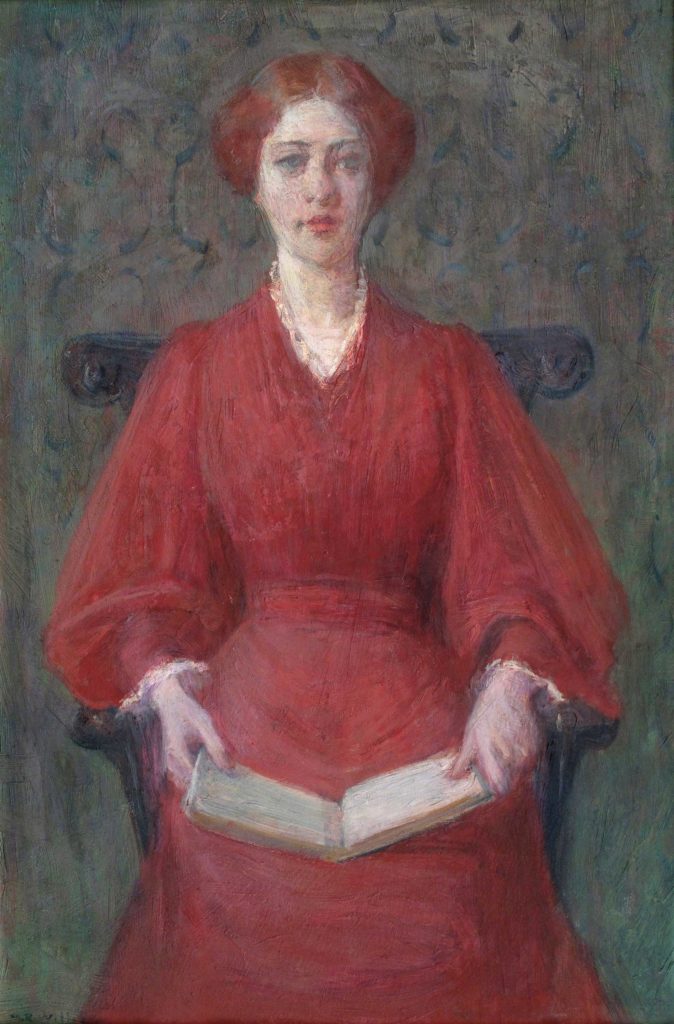
Mary Rogers Williams, “A Girl in Red,” undated (pre-1901), oil on panel, 21 x 14 in. A work of that title was shown in Mary’s posthumous exhibitions. WFC (photo: Ted Hendrickson).
Mary simply described herself as “forever seeing new beauties.” She did not analyze her brushstrokes, which at times gave only suggestions of buildings, foliage, land contours, and faces. In 1894, in her only published interview, “when asked what style she proposed to adopt, she replied: ‘If I cannot have a style of my own, I trust I may be spared an adopted one.’”
Little trace of her remains in the archives of more famous people; if anything had been filed there, historians might have rediscovered her before I stumbled upon her in 2012. She died unexpectedly; she had no time to organize her papers and place artworks in private and institutional collections. Henry and her unworldly sisters tried futilely to perpetuate her legacy.
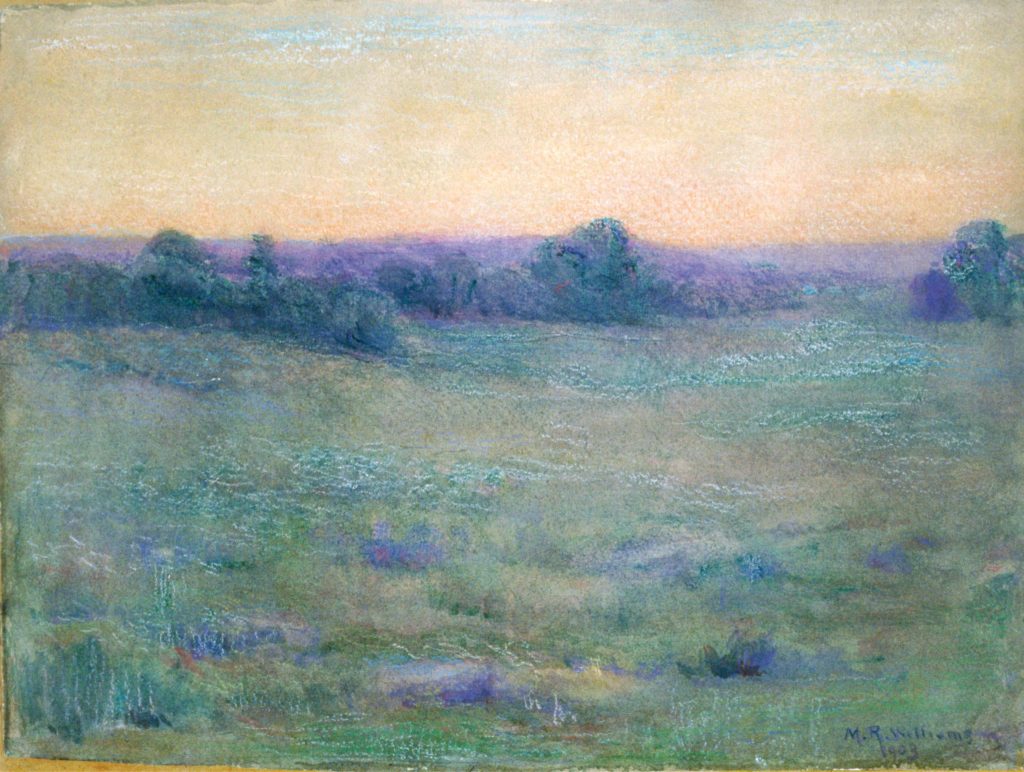
Mary Rogers Williams, “Green Landscape—Hills in the Distance” (probably Connecticut River Valley), 1903, pastel, 12½ x 22 in. Smith College Museum of Art, Northampton, Massachusetts. Fifth of the sisters of Mary Rogers Williams, sc 1911:3–2
Imagine what she could have accomplished if she had been longer lived, or rich, or a married man—if she had been allowed to concentrate year-round in her own studio, with servants or a spouse or lover or dutiful child to help, if anyone had promoted her in her lifetime or concentrated after her death on sharing her work widely with dealers, scholars, and collectors.
Mary, however, would likely scoff at any suggestion that she would have been better off privileged. She disliked wealthy people. Her letters are full of anecdotes about boring namedroppers, Americans who learned nothing while traveling and mangled foreign languages, and artists who repeated themselves or copied Old Masters. And she doubted her own talents for painting, teaching, and writing. “I know I was not built for an imparter of information,” she told Henry. In 1908, the Springfield Republican eulogized her: “She had an almost pathetic tendency to think less of her work than it deserved.”
One professional feat she apparently never attempted or even wanted to, unlike so many of her colleagues, particularly men, was painting a self-portrait.
When Mary was told that people loved her letters, and were delightedly passing them around, she was surprised that she had not bored anyone, or so she said. She must have suspected that her words sent across the Atlantic were powerful, as she sat in the glow of oil lamps or candlelight scribbling descriptions of radishes and cauliflowers striped and stacked on a French produce truck, mauve clouds during an Arctic Circle eclipse, and tasseled uniforms on British palace guards. Mailing the letters home to her sisters from Europe, she told them, gave her “one moment when I feel sure that I’ve done just the right thing.”
About the Author
EVE M. KAHN is an independent scholar specializing in art and architectural history, design, and preservation, and was weekly Antiques columnist at the New York Times, 2008–2016. She contributes regularly to the Times, The Magazine Antiques, Apollo, and Atlas Obscura.
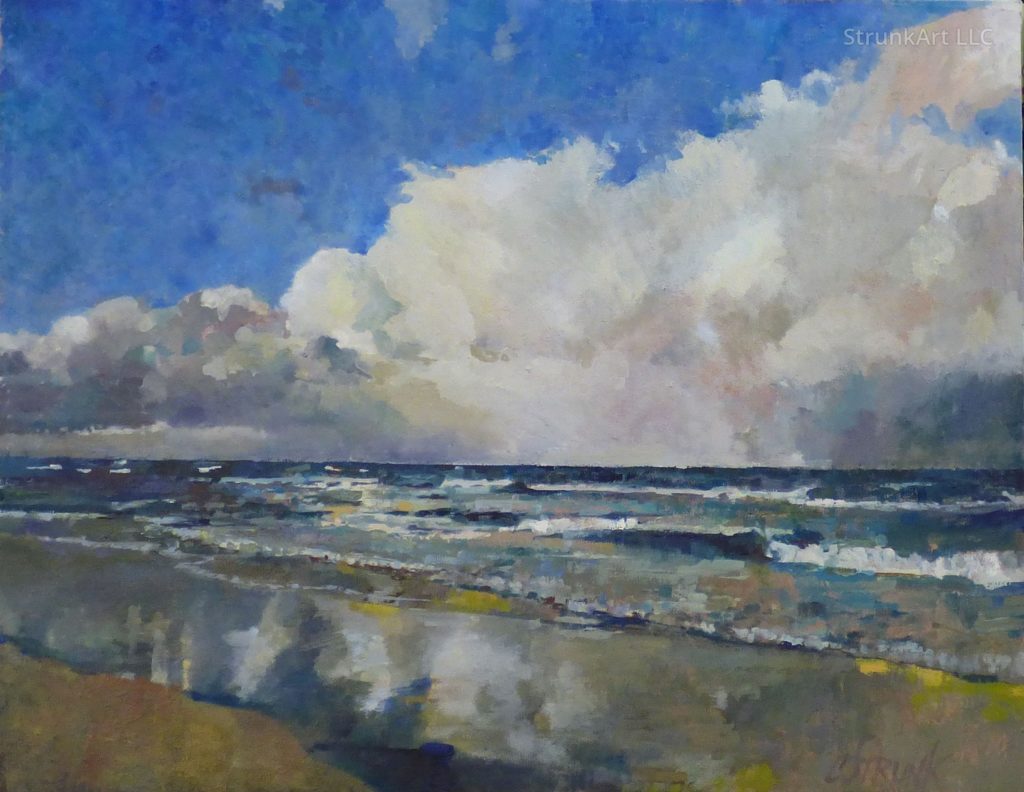
Chris Strunk, “Approaching Storm,” 2014, oil on canvas, (c) Chris Strunk 2015
Take a journey with Fine Art Today into the oil paintings of “secret places” painted by artist Chris Strunk.
Like many artists, whether historical or contemporary, painter Chris Strunk is often struck by particular locations and scenes he happens upon during his day-to-day experiences. Strunk is constantly snapping photos, using the technology as a way to sketch and quickly capture a variety of views that speak to him. However, rather than copying the photos, Strunk uses his mechanical images to create something organic, arranging sets of photos as a reference before considering his composition of his oil paintings.
Chris Strunk, “Approaching Storm,” 2014, oil on canvas, (c) Chris Strunk 2015
Once he begins, he will work, then step away, never resuming work without clarity and intention. “I have learned to feel my way through paintings in this way,” the artist states. “Waiting for clarity is not necessarily thinking — clarity happens for everyone if they can train themselves to wait. Eventually the subject and the work on the canvas become so compelling that I couldn’t stop even if I tried.”
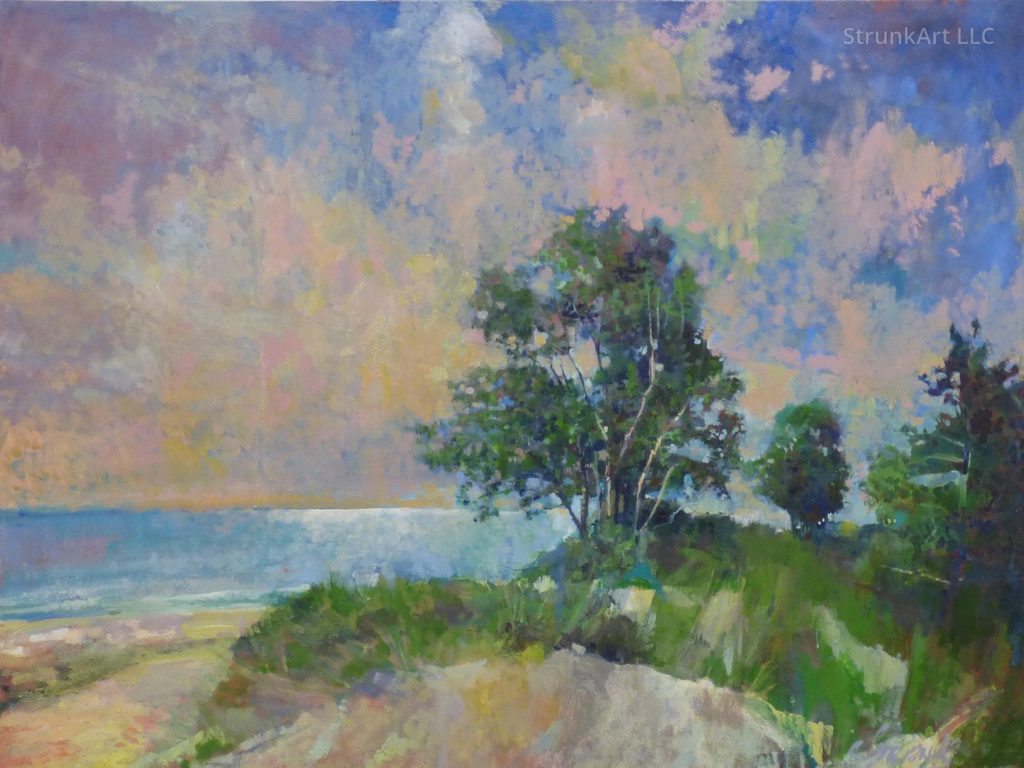
Chris Strunk, “Saugatuck Evening,” 2015, oil on canvas, 39 x 52 in. (c) Chris Strunk 2015
Strunk also draws visual inspiration from his robust book collection. The artist states, “I keep my art library handy and am routinely looking at the work of artists that inspire me. There are always books on the studio floor to be perused during painting sessions. Some of the books are a constant source. For example, at the moment there are monographs on Edward Hopper, George Bellows, and Ivan Shishkin. There is also a history of Italian 19th-century painting and a history of American tonalism, one of my favorites.”
Chris Strunk, “Cosby, TN in Winter,” 2014, oil on canvas, 36 x 60 in. (c) Chris Strunk 2015
The artist writes, “Everyone has secret places where they can go and be whole. My paintings are often of these locations.” For several years, Strunk has been exploring — both physically and artistically — the dunes on Lake Michigan, near his home in Holland, Michigan. His secret places involve wandering off the beaten trail, exploring locations on his own. “On the easel right now is a view through the trees on top of one of the biggest dunes,” says Strunk. “The woods up there have a different magic. At one of the higher points is a secret place where one can see Lake Michigan in the distance; it’s an epic view. For me, the walks have become part of the process and I take my time in reverence.”
Chris Strunk, “Cardiff by the Sea,” 2013, oil on canvas, 40 x 27 in. (c) Chris Strunk 2015
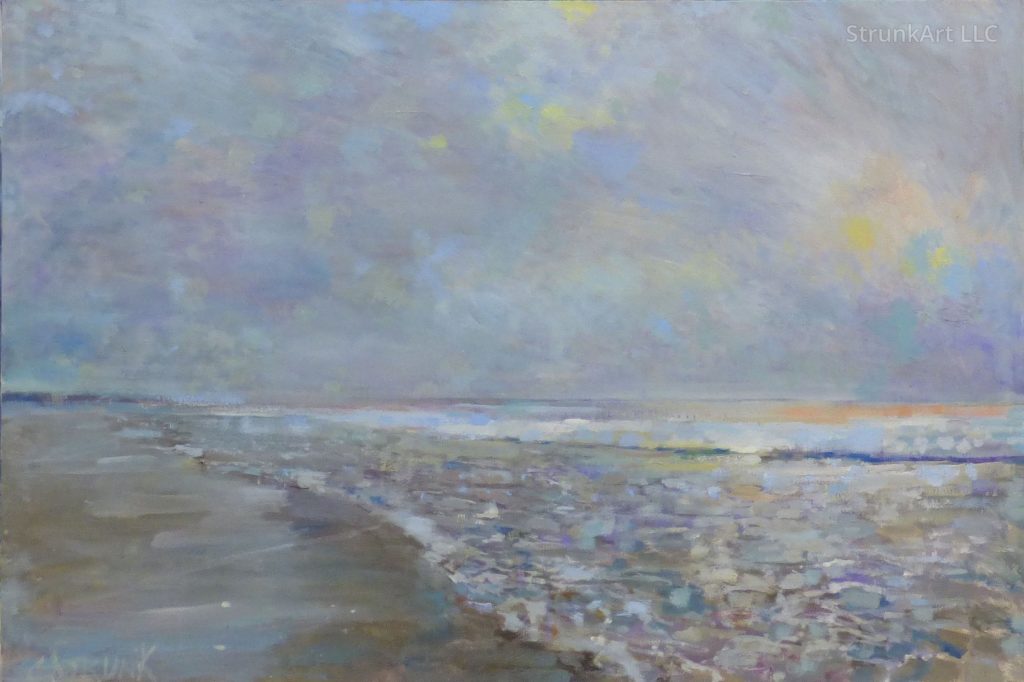
Stylistically, Strunk’s work is a melding of representation and abstraction. Within the artist’s oeuvre one will find works in both categories, but his landscapes have a special, almost impressionistic allure. “The Approaching Storm” from 2014 is especially beautiful. Standing along the shores of Lake Michigan, the viewer gazes across rumbling surf as dramatic, imposing clouds appear to be closing in from the horizon. Strunk’s application of oil lends itself to the scene, which we can imagine is in constant flux and movement. Further, the palette displays a rich arrangement of blues, yellows, whites, greens, and, perhaps, hints of orange.
The viewer is left longing to find Strunk’s secret place in “Saugatuck Evening.” From an elevated vantage point, the viewer looks out over the fading sunset across Lake Michigan. A beautiful array of patterned dabbles of pink, purple, and orange fragment a blue sky. In the foreground, a few trees and grasses balance the palette and contrast against the sky.
This article was featured in Fine Art Today, a weekly e-newsletter from Fine Art Connoisseur magazine. To start receiving Fine Art Today for free, click here.
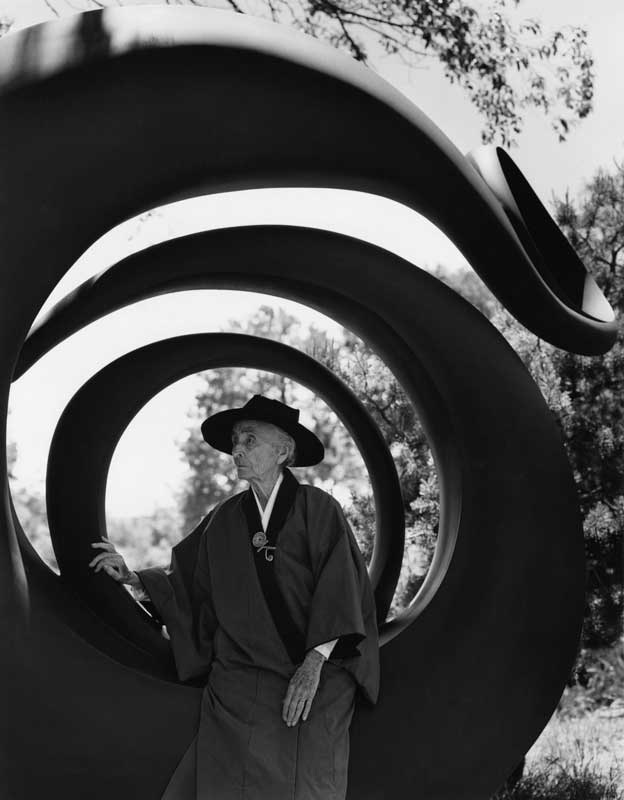
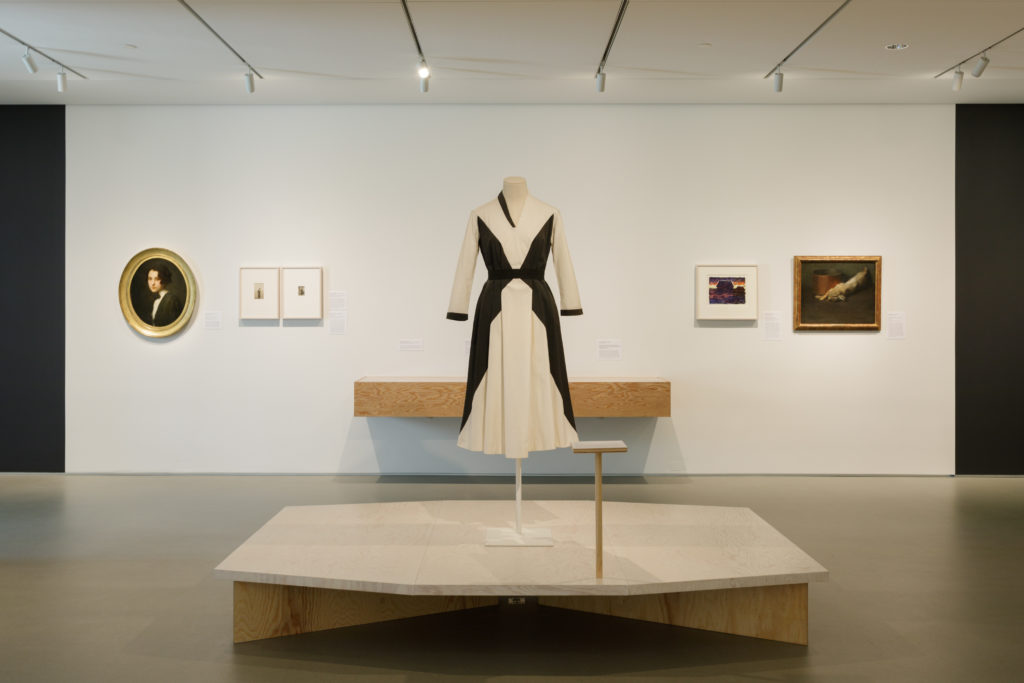
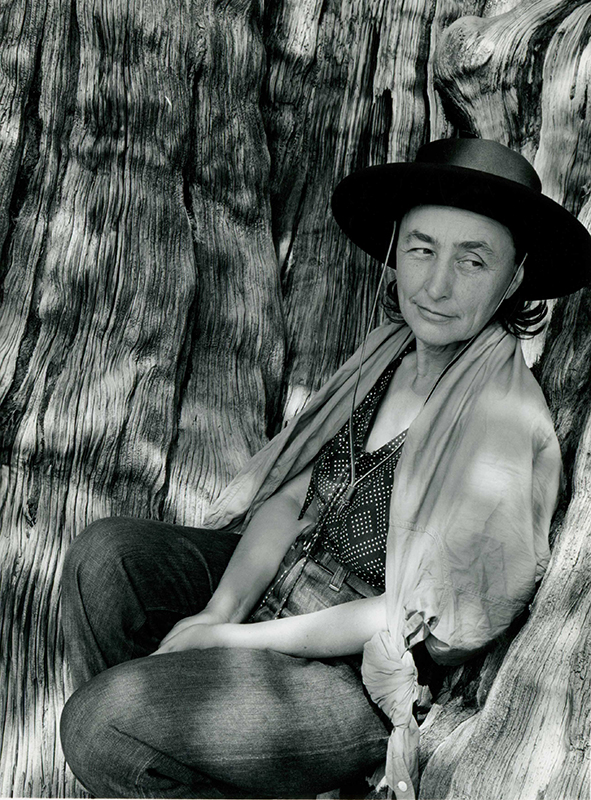
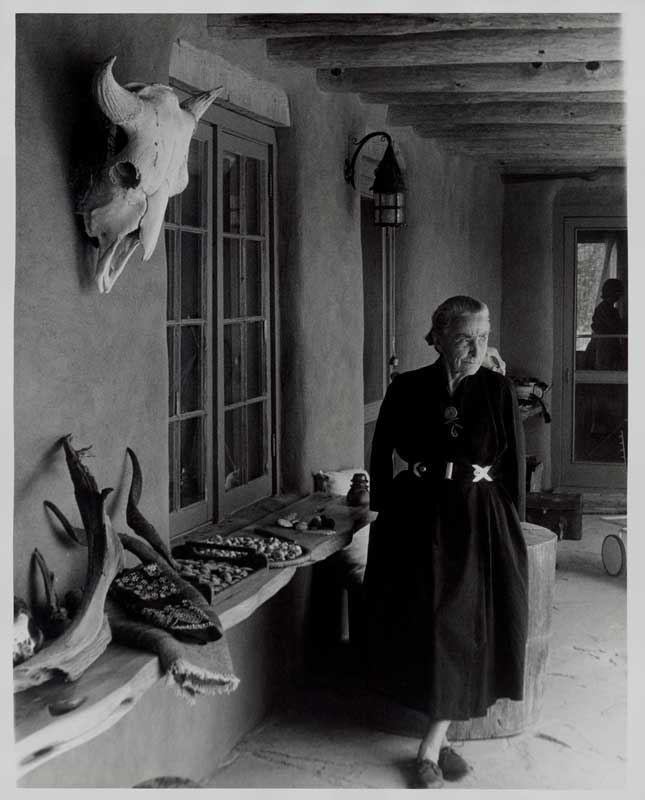
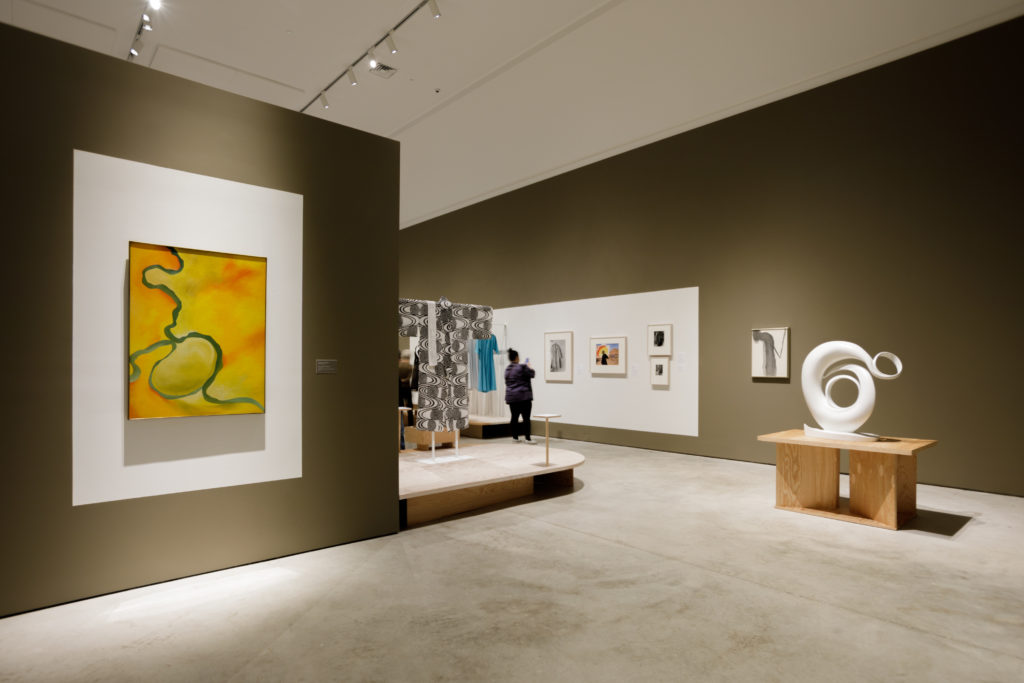
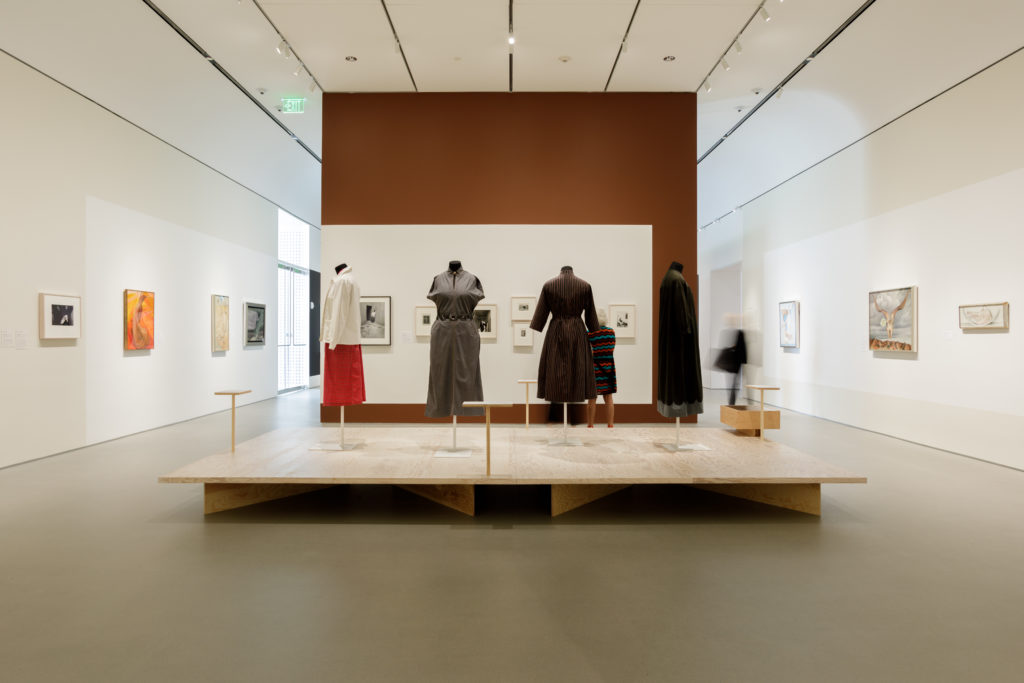
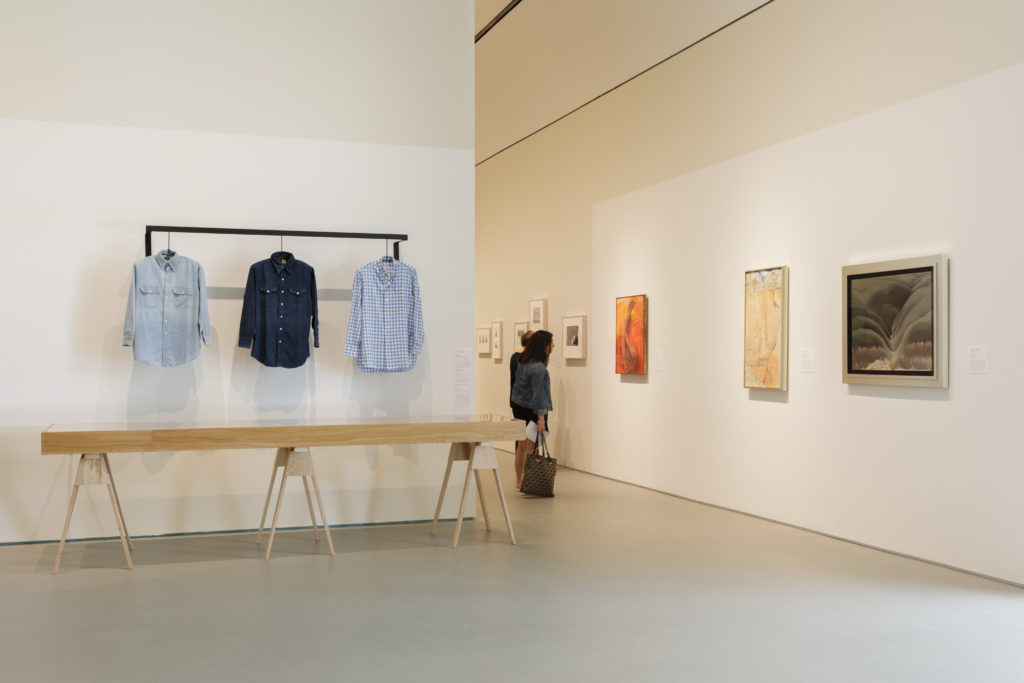
In West Palm Beach, Florida, the Norton Museum of Art is currently showing “Georgia O’Keeffe: Living Modern,” through February 2, 2020. First organized by the Brooklyn Museum in 2017, and as part of a major national tour, the exhibition takes a new look at how the renowned modernist artist created her public image through what she wore and how she allowed herself to be photographed.
“Georgia O’Keeffe: Living Modern” is organized by the Brooklyn Museum and curated by Wanda M. Corn, Robert and Ruth Halperin Professor Emerita in Art History, Stanford University and made possible by the National Endowment of the Arts. Gallery photos by Jacek Gancarz
The focus on O’Keeffe’s wardrobe shown alongside key paintings and photographs confirms and explores the artist’s determination to be in charge of how the world understood her identity and artistic values. In addition to selected paintings and items of clothing, the exhibition presents photographs of O’Keeffe and her homes by Alfred Stieglitz, Ansel Adams, Annie Leibovitz, Philippe Halsman, Yousuf Karsh, Cecil Beaton, Andy Warhol, Bruce Weber, Todd Webb, and others.
The show demonstrates how O’Keeffe, early on, fashioned a signature style of dress, which evolved during her years in New York when a black-and-white palette dominated much of her art and wardrobe, and then during her time in New Mexico, where her art and clothing changed in response to the colors of the Southwestern landscape.
The exhibition includes nearly 200 objects on loan from the Georgia O’Keeffe Museum in Santa Fe, the Brooklyn Museum, the Cleveland Museum of Art, the National Gallery of Art in Washington, DC, and other lenders. In addition to selected paintings – including one from the Norton’s collection — and clothing, there are striking photographs of O’Keeffe taken by Alfred Stieglitz, Ansel Adams, Philippe Halsman, Cecil Beaton, Andy Warhol, Bruce Weber, and other renowned artists. These pictures helped solidify O’Keeffe’s status as a pioneer of modernism and a contemporary style icon.
“Georgia O’Keeffe: Living Modern” is organized by the Brooklyn Museum, with guest curator Wanda M. Corn, Robert and Ruth Halperin Professor Emerita in Art History, Stanford University, and coordinated at the Norton Museum of Art by Ellen E. Roberts, Harold and Anne Berkley Smith Curator of American Art.
Fill your mind with useful art stories, the latest trends, upcoming art shows, top artists, and more. Subscribe to Fine Art Today, from the publishers of Fine Art Connoisseur magazine.




 The Downtown Center might be home to the university’s high-demand Department of Physical Therapy in the Ivester College of Health Sciences, but it is no stranger to esteemed works of art as it houses the Manhattan Gallery — one of the university’s four Gainesville galleries — which features an ongoing exhibition of Brenau University Permanent Collection artwork by artists who have some connection to the New York art world. The space is anchored by over 100 works from the collection of Dorothy and Herbert Vogel, who were very well-known in the New York art scene, and features a number of photographs and prints by artist Andy Warhol (1928–1987), which were given to Brenau by the Andy Warhol Foundation.
 “Hawthorne was involved in his era’s most advanced color theory practice, and these pieces demonstrate that through their shapes and layers of applied color,” she said. “Hawthorne is quoted saying, ‘Forget what object is before you — think, here is an oblong of pink, a little square of blue, a streak of yellow. Paint it just as it looks to you, the exact color and shape, until it gives you an impression of the scene before you.’”