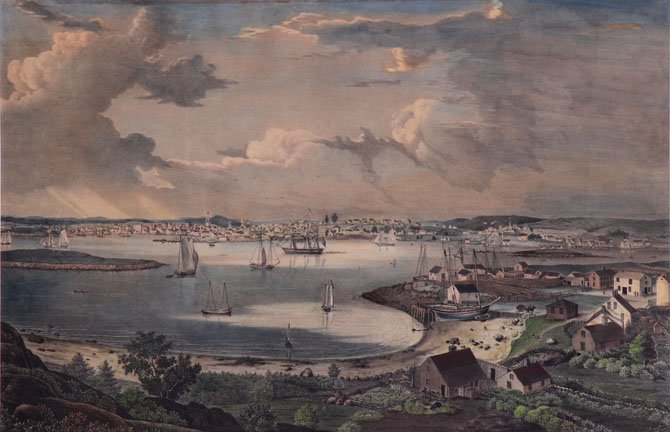
Fitz Henry Lane, “View of the Town of Gloucester, Mass.,” 1836, colored lithograph on paper, Pendleton’s Lithography, Boston
The Cape Ann Museum in Gloucester, Massachusetts, is proudly presenting an important selection of lithographs by one of America’s most important artists of the mid-19th century. Who was he?
“Drawn from Nature & on Stone” is a significant exhibition at the Cape Ann Museum featuring important works by Fitz Henry Lane, a Gloucester native. On view through March 4, the exhibition has been organized in conjunction with the museum’s release of the artist’s catalogue raisonné. According to the museum, “Lane was born in Gloucester, trained in lithography in Boston and, during the same time, exposed to the art world. By the late 1840s, Lane was rapidly establishing himself as a well-known and sought-after painter. During the 1850s and into the 1860s, working from a studio overlooking Gloucester Harbor, Lane created an unknown number of canvases documenting and celebrating in amazing detail and beauty the world around him. His work included views not only of Gloucester and surrounding communities but also of Boston Harbor, coastal Maine, New York Harbor, and other locales.
“Today, the Cape Ann Museum, located just a few blocks away from Lane’s studio, proudly displays the world’s single largest collection of oil paintings by this esteemed American artist. While his canvases, exhibited in museums around the world, remain the work Lane is best known for, his life-long fascination with the art of lithography remains an important and central part of his career.
“With the exhibition ‘Drawn from Nature & on Stone,’ the Museum will investigate Lane’s lithographs, exploring the intersection of his work in oil and in print and his success at creating illustrations for sheet music, business cards and stationery, advertising materials and book illustrations. The exhibition will highlight a series of views Lane created of towns and cities throughout the region including Gloucester; Boston; Norwich, Connecticut; Castine, Maine; and Baltimore. In total, Lane is thought to have had a hand in the production of approximately 65 lithographs.
“‘Drawn from Nature & on Stone’ will feature lithographs from the Cape Ann Museum’s own holdings and from collections throughout the region including the American Antiquarian Society, the Boston Athenaeum, The New York Public Library and the Library of Congress. The exhibition will offer scholars and lay people alike the opportunity to explore the intersection of Lane’s work as a printmaker and a painter, to learn more about the art of lithography, and to consider the enduring effects image production has had on American culture since the early 19th century.”
This article was featured in Fine Art Today, a weekly e-newsletter from Fine Art Connoisseur magazine. To start receiving Fine Art Today for free, click here.
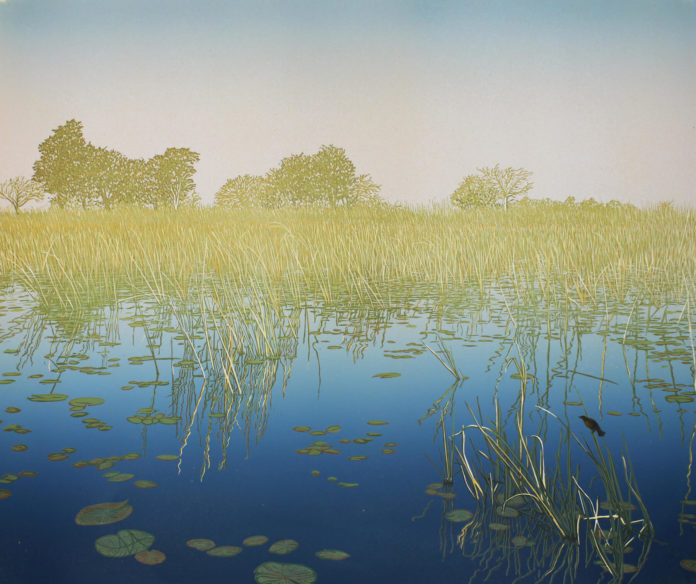
Mike Anderson, “Red-winged Blackbird,” 2012, woodcut on rives paper
Avian marvels in a wide variety of styles and mediums are currently being showcased at the Leigh Yawkey Woodson Art Museum in Wisconsin. Who’s included?
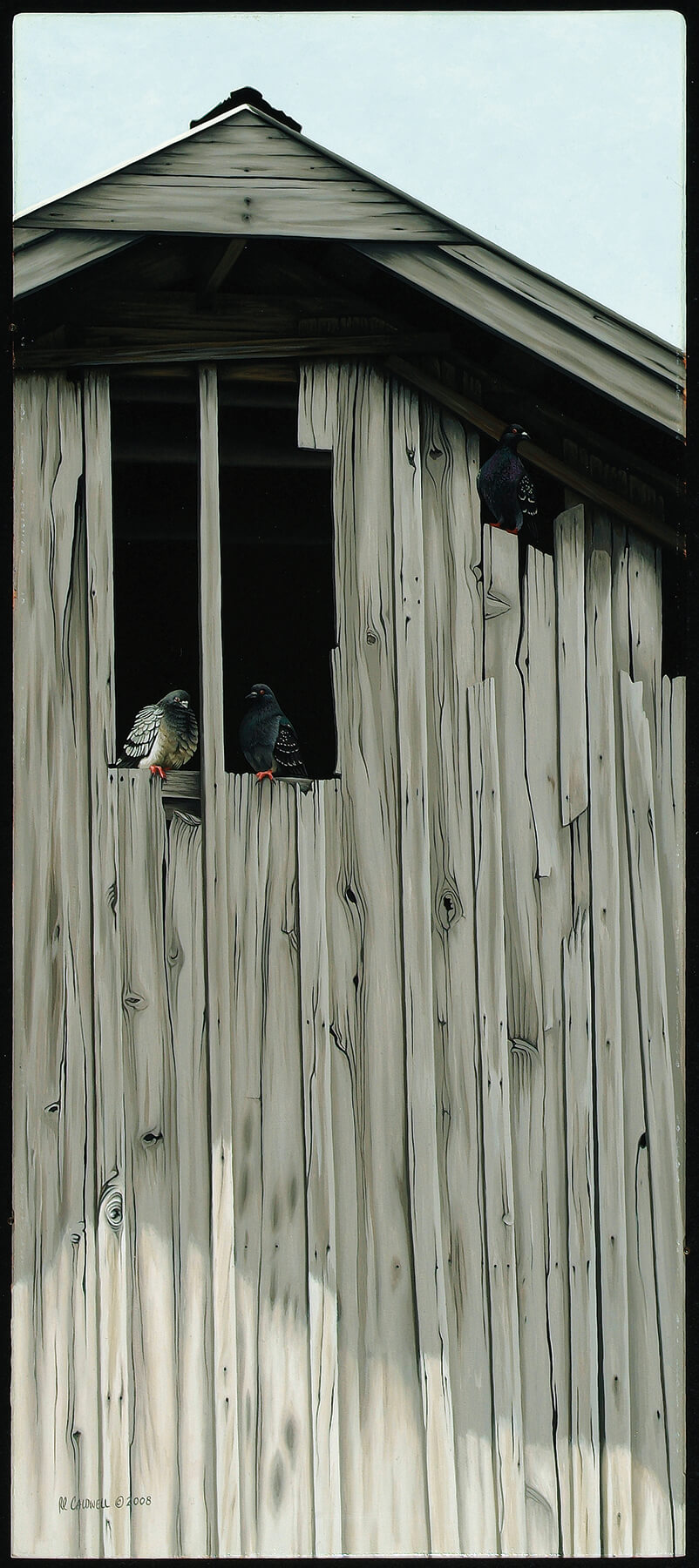
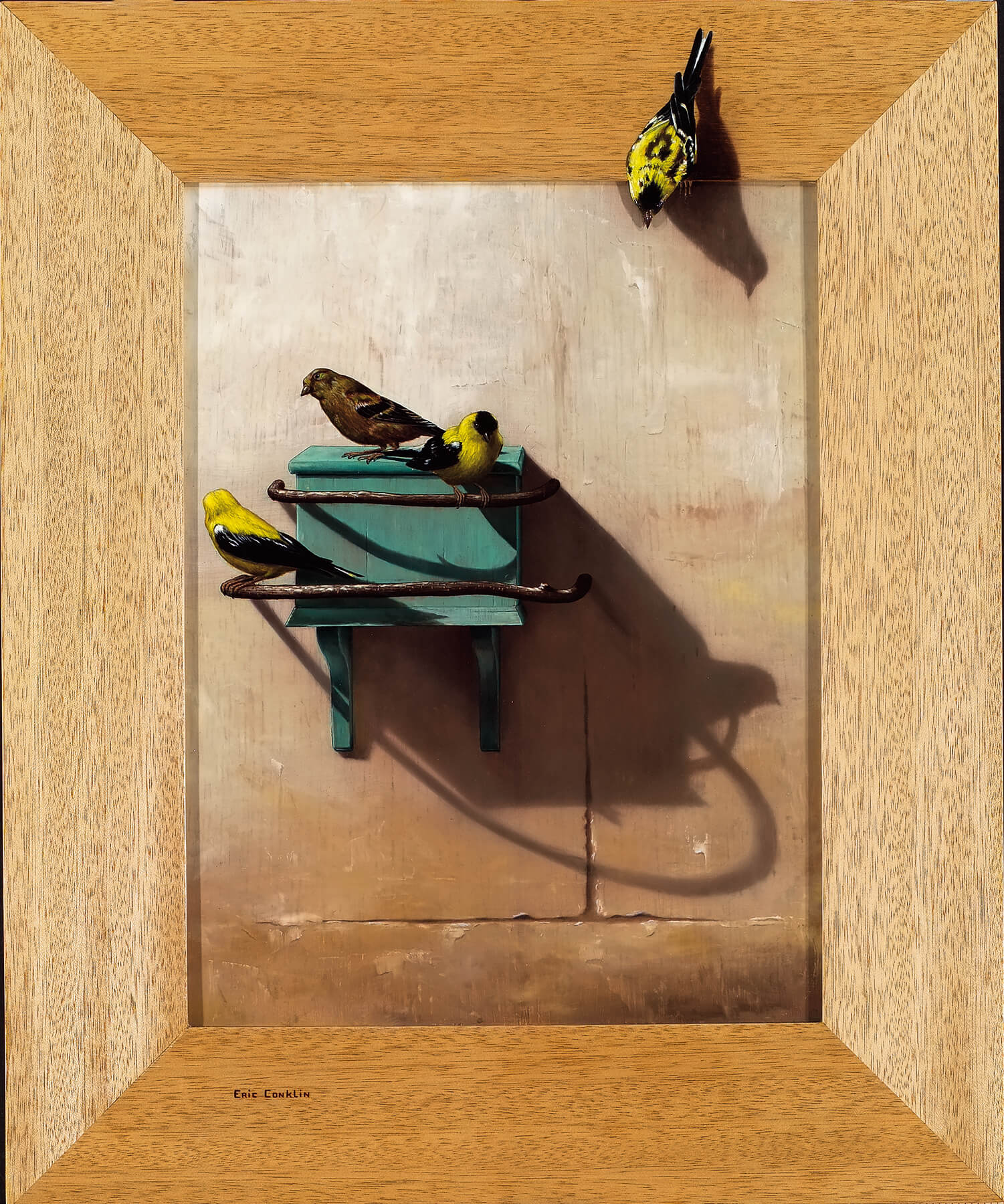
“Passionate Pursuits: Birds in Our Landscapes” is an ongoing exhibition of avian art at the Leigh Yawkey Woodson Art Museum in Wausau, Wisconsin. On view through February 18, 2018, the exhibition presents a range of both historical and contemporary works in a variety of media —celebrating one of the most inspirational subjects in art.
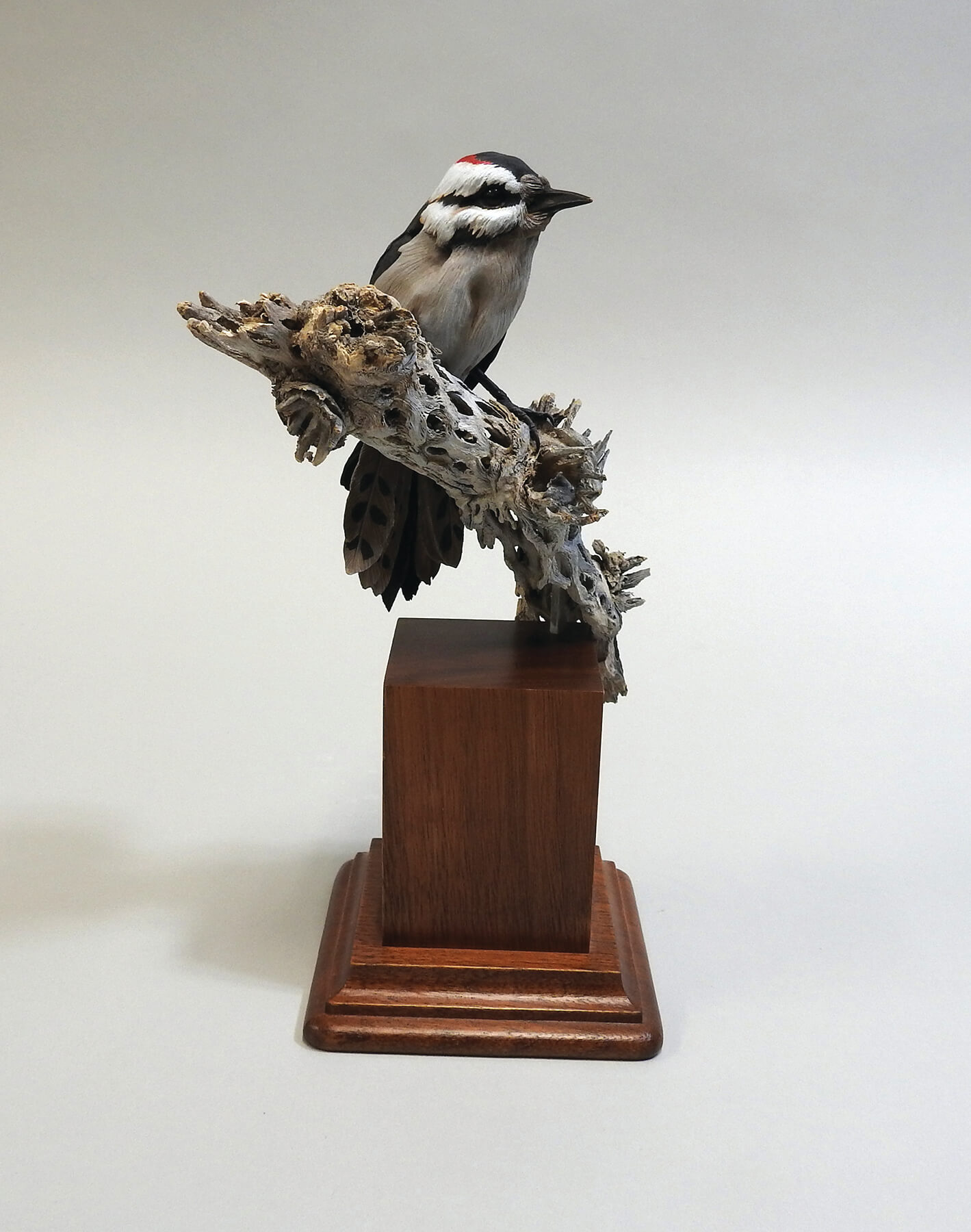
Robert Caldwell, “Sewanne Barn,” 2008, oil on hardboardEric Conklin, “The Brood,” 2004, oil on oak panelJohn Mullican, “Downy Woodpecker,” paint on tupeloRoger Tory Peterson, “Baltimore Oriole and Young,” 1950, watercolor on illustration board
“Avian marvels that live in and pass through Midwest cities, rural landscapes, and our backyard feeders connect us with nature,” the museum writes. “They are alluring to watch, sing melodiously, and balance our ecosystem. Whether perched atop a tree, taking a turn at the nest, or foraging for food, birds provide unlimited inspiration for creative artistry.”
This article was featured in Fine Art Today, a weekly e-newsletter from Fine Art Connoisseur magazine. To start receiving Fine Art Today for free, click here.
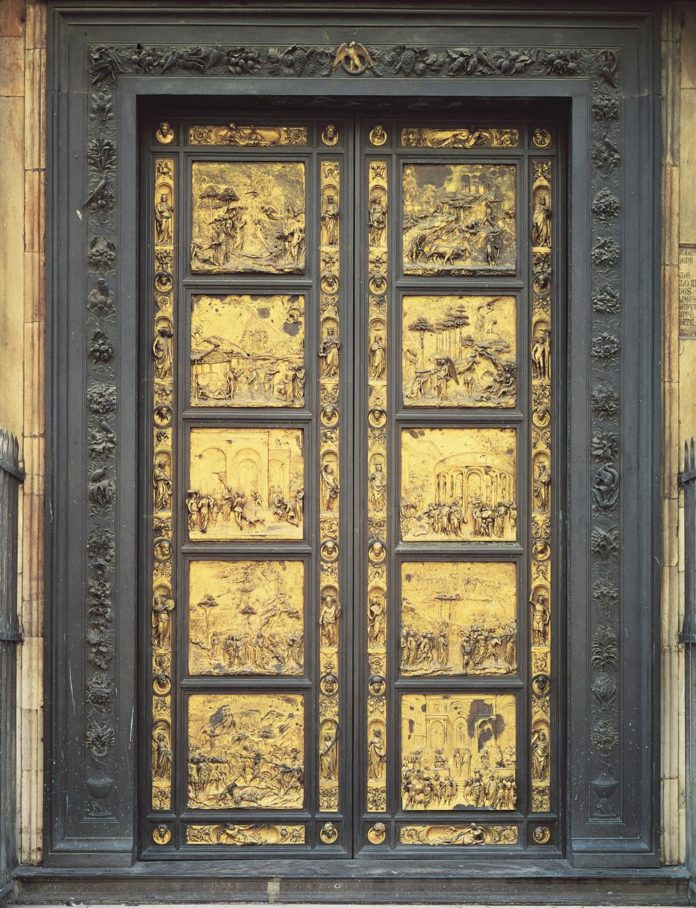
Lorenzo Ghiberti, “Gates of Paradise,” circa 1452, gilded bronze, 17 feet, Florence baptistery
Originally created for the east façade of the Baptistery in Florence, Italy, “The Gates of Paradise” by Lorenzo Ghiberti — a monumental pair of 17-foot gilded bronze doors — are considered a defining moment of the Italian Renaissance. How have they landed in Missouri?
A team of engineers and workers triumphed over multiple challenges recently when they successfully installed casts of the original “Gates of Paradise” doors in the Bloch Lobby at the Nelson-Atkins Museum of Art in Kansas City, Missouri. The 15th-century doors are massive, at 17 feet tall and weighing in excess of 4 1/2 tons.
Via the museum, “The doors require a location that allows for anchoring and framing against a strong wall, and the top of the ramp in Bloch Lobby offered just such a majestic location. The original ‘Gates of Paradise’were set within the east portal of the Baptistery in Florence, and they functioned as a space of transition through which the baptized passed on their way to the Cathedral, which signified the Heavenly Kingdom to believers.”
“‘Bloch Lobby is the entry point for the museum, and “The Gates of Paradise” will signal that as visitors enter the modern and ethereal Bloch Building, they will encounter not only contemporary work, but also art from all over the world and across many time periods,’ said Julián Zugazagoitia, Menefee D. and Mary Louise Blackwell CEO & Director of the Nelson-Atkins.
“Ghiberti was commissioned in 1425 to create the doors, and he and his workshop toiled for 27 years (1425-1452) to create striking, sculptural panels depicting scenes from the Old Testament. The panels are surrounded by intricate framework, foliage, fruit, and busts. For centuries, the doors have been considered one of the masterpieces of Western art and the beginning of the Renaissance.
“‘The original doors represented a transition to the Italian Renaissance, which was so fundamentally transformative that its influence left no Western culture untouched,’ Zugazagoitia said.
“‘The contemporary cast of Ghiberti’s ‘Gates of Paradise’fits within a long trajectory and tradition of copying great works of art from the past, extending to Antiquity. Romans filled their homes and their bathhouses with copies of Greek sculptures. Renaissance collectors including Cosimo I de Medici, and Antoine Perrenot de Granvelle, whose portrait by Titian hangs in the Nelson-Atkins, commissioned bronze copies of sculptures for their private collections. The practice continued in the 18th century among English collectors including the Duke of Hamilton, the Duke and Duchess of Lauderdale, and the Duke of Northumberland, all of whom commissioned marble replicas of the most important Italian works they saw during their travels on the Grand Tour.
“In the 19th and early 20th centuries, museums throughout Europe and America, including the Victoria and Albert Museum in London, and The Metropolitan Museum of Art in New York, assembled vast collections of plaster casts of Classical and Renaissance sculptures created from molds taken directly from the originals to educate and as a way to disseminate knowledge. William Rockhill Nelson participated in this trend from the early 20th century and acquired a small collection of sculpture casts, which he displayed in a gallery on the second floor of the Kansas City Public Library. Such plaster casts provided museum visitors — many of whom found travel to Europe difficult —the only opportunity to experience the extraordinary power of great masterpieces of Western Art. Mr. Nelson also commissioned copies of paintings by the ‘European Old Masters,’ works that he felt ‘have stood the test of time and are acclaimed as the foremost achievements.’
“The contemporary bronze casts of Ghiberti’s ‘Gates of Paradise’at the Nelson-Atkins offers visitors another opportunity to see a monumentally important work of art in its original scale and materiality. It is one of two authorized casts made in 1990 from molds taken by Bruno Bearzi in the late 1940s, directly from Ghiberti’s original. The casting process was organized to preserve the original and was fully monitored by the Ufficio Tecnico dell’Opera di Santa Maria del Fiore and carried out by the Fonderia Marinelli of Florence. The ‘sister’ cast on view at the museum is the one in the east portal of the Florence Baptistery, replacing Ghiberti’s original doors, which are now on display inside the Museo dell’Opera del Duomo.
“Between 2013 and 2016, the new casts of ‘Gates of Paradise’traveled in an exhibition tour that included Mumbai, India and Seoul, South Korea. On returning to Florence, they were purchased by the DeBruces as a promised gift for the Nelson-Atkins. The massive gates were crated, sent on a ship across the ocean, and transported to Kansas City, arriving in February of this year.”
This article was featured in Fine Art Today, a weekly e-newsletter from Fine Art Connoisseur magazine. To start receiving Fine Art Today for free, click here.
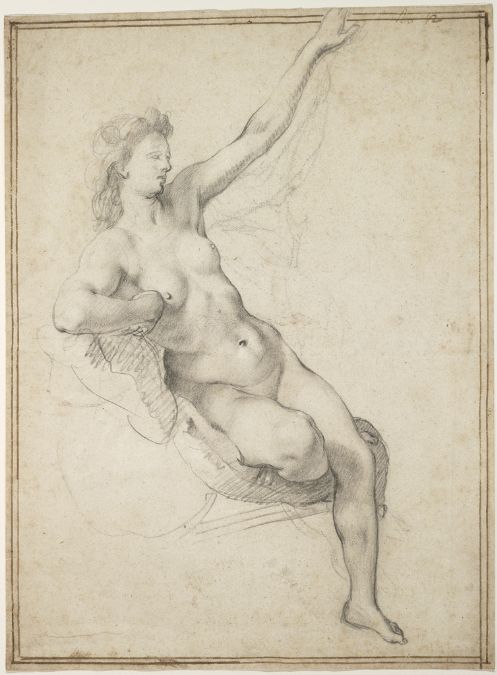
Hendrick Goltzius, “Seated Female Nude,” circa 1594, black chalk and brown ink, 15 5/16 x 11 3/8 inches
The Harvard Art Museums recently announced they will receive a spectacular gift of 330 master drawings. The gift was made public by George S. Abrams, the esteemed Boston-based collector, at a dinner held on November 3 in his honor. Details of the acquisition here!
Administrators of the Harvard Art Museums are jumping with joy this week as George S. Abrams announced his intentions to gift the institution a premier collection of 330 master drawings from the Dutch Golden Age, including works by Rembrandt and his pupils.
“The gift further establishes the museums as the major site for the appreciation, research, and study of works on paper from the Dutch Golden Age in North America,” the museums write. “This newest promised gift from the Abrams family brings tremendous depth and breadth to the museums’ holdings; the works represent over 125 artists and include extremely fine examples by major masters such as Rembrandt, Jacques de Gheyn II, Hendrick Goltzius, and Adriaen van Ostade, as well as a remarkable range of drawings by lesser-known masters who worked in a wide range of subjects and media. Impressive drawings by artists Nicolaes Berchem, Jacob Marrel, and Cornelis Visscher will help fill gaps in the museums’ collections. Taken as a whole, the Abrams Collection at the Harvard Art Museums reveals the critical role of drawing in the art world of the Dutch Golden Age.
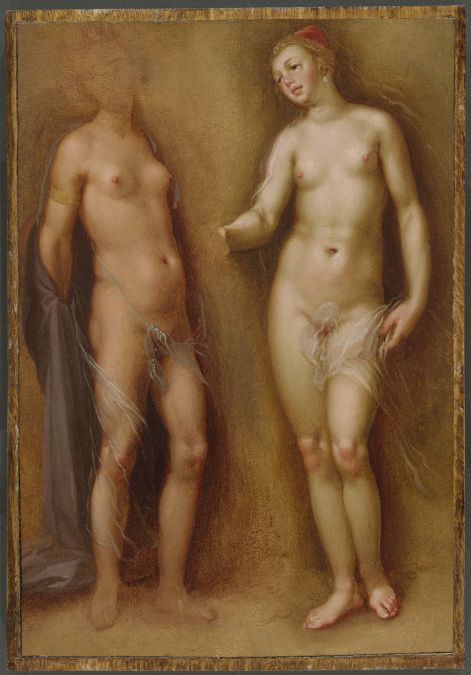
Cornelis van Haarlem, “Two Female Nudes,” circa 1608, oil on paper, varnished and mounted, 14 5/16 x 9 3/4 inches
“‘George has generously supported the Harvard Art Museums over many decades and in countless ways; we are incredibly thankful for the role that he and Maida have played in galvanizing the study of drawings at Harvard and particularly for their commitment to telling the rich story of draftsmanship from the Low Countries,’ said Martha Tedeschi, the Elizabeth and John Moors Cabot Director of the Harvard Art Museums. ‘The latest gift from the Abrams family is truly transformative for our museums — indeed, for the entire Boston area, especially as the city strives to become a major destination for the study and presentation of Dutch, Flemish, and Netherlandish art. Together with the newly founded Center for Netherlandish Art at the Museum of Fine Arts, we now can pursue institutional collaborations that will serve visitors and scholars from around the world.’
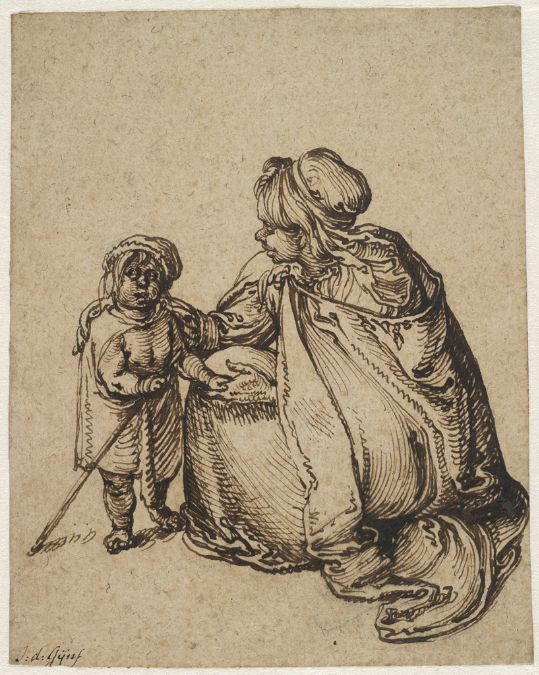
Jacques de Gheyn II, “A Roma Woman with a Child,” circa 1604, brown ink and black chalk
“Mr. Abrams and his late wife Maida made earlier gifts that brought more than 140 drawings to the Harvard Art Museums over the course of several decades. With their collective gifts, the museums now have the most comprehensive holding of 17th-century Dutch drawings outside Europe.
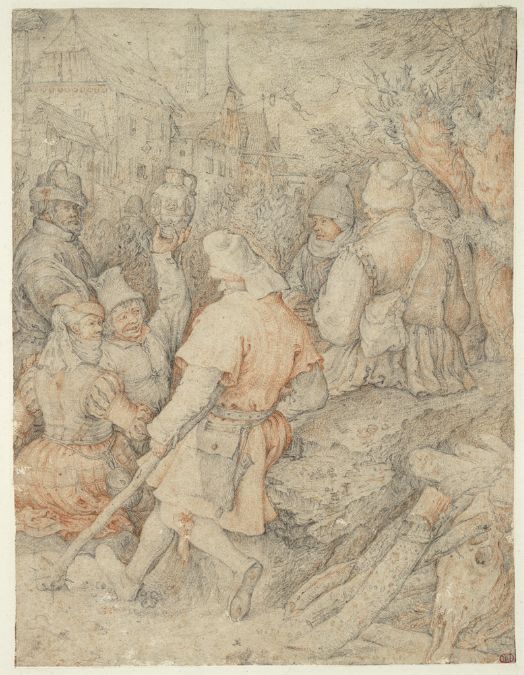
Roelant Savery, “Six Peasants Merrymaking,” circa 1608, black and red chalk on paper, 10 5/8 x 8 1/8 inches
“‘When the collection grows in quality and quantity in such a major way, suddenly there are stories you can tell with greater force and depth, with fewer gaps in the narrative,’ said Edouard Kopp, the Maida and George Abrams Curator of Drawings at the Harvard Art Museums. ‘Since its creation, the Fogg Museum has been a key U.S. institution for the study and appreciation of drawings, and this gift will enable us to be an even more vibrant center, particularly for Dutch drawings.’”
This article was featured in Fine Art Today, a weekly e-newsletter from Fine Art Connoisseur magazine. To start receiving Fine Art Today for free, click here.
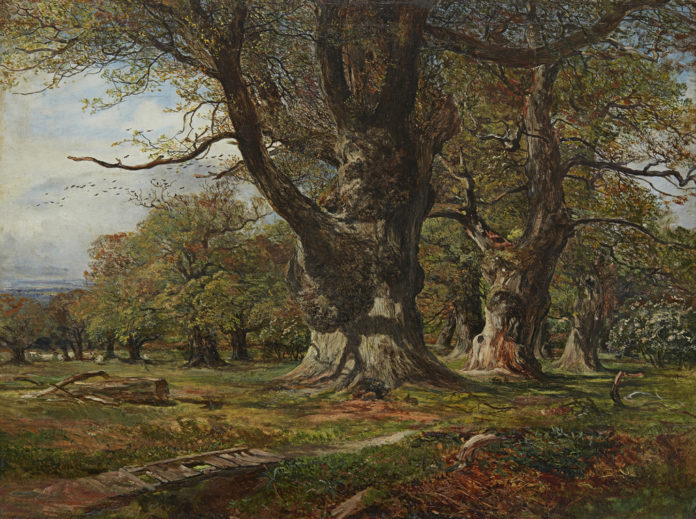
James Docharty, “Sheep in an Oak Woodland,” oil on canvas, 18 x 24 inches
In this ongoing series for Fine Art Today, we take a longer look at the history and features of a soon-to-be-available artwork of note. This week we highlight a robust upcoming sale at Freeman’s.
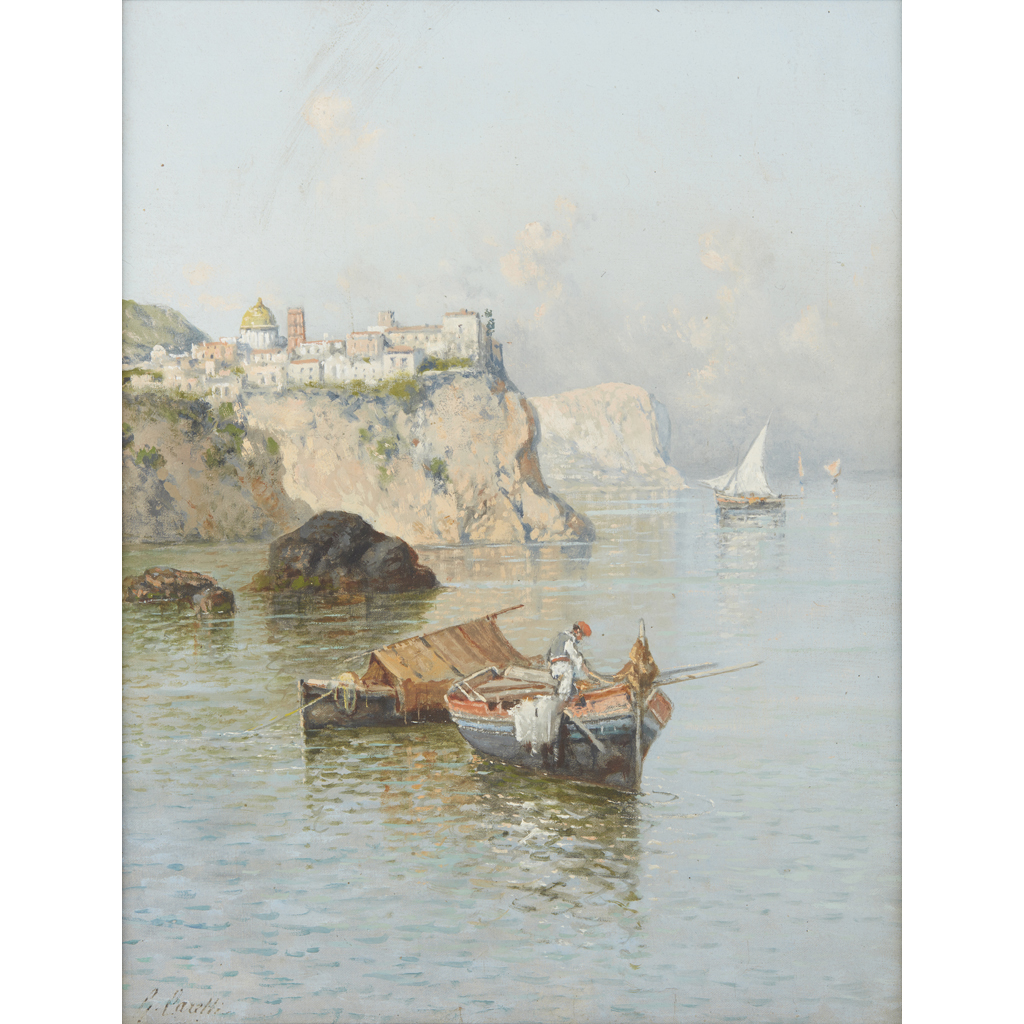
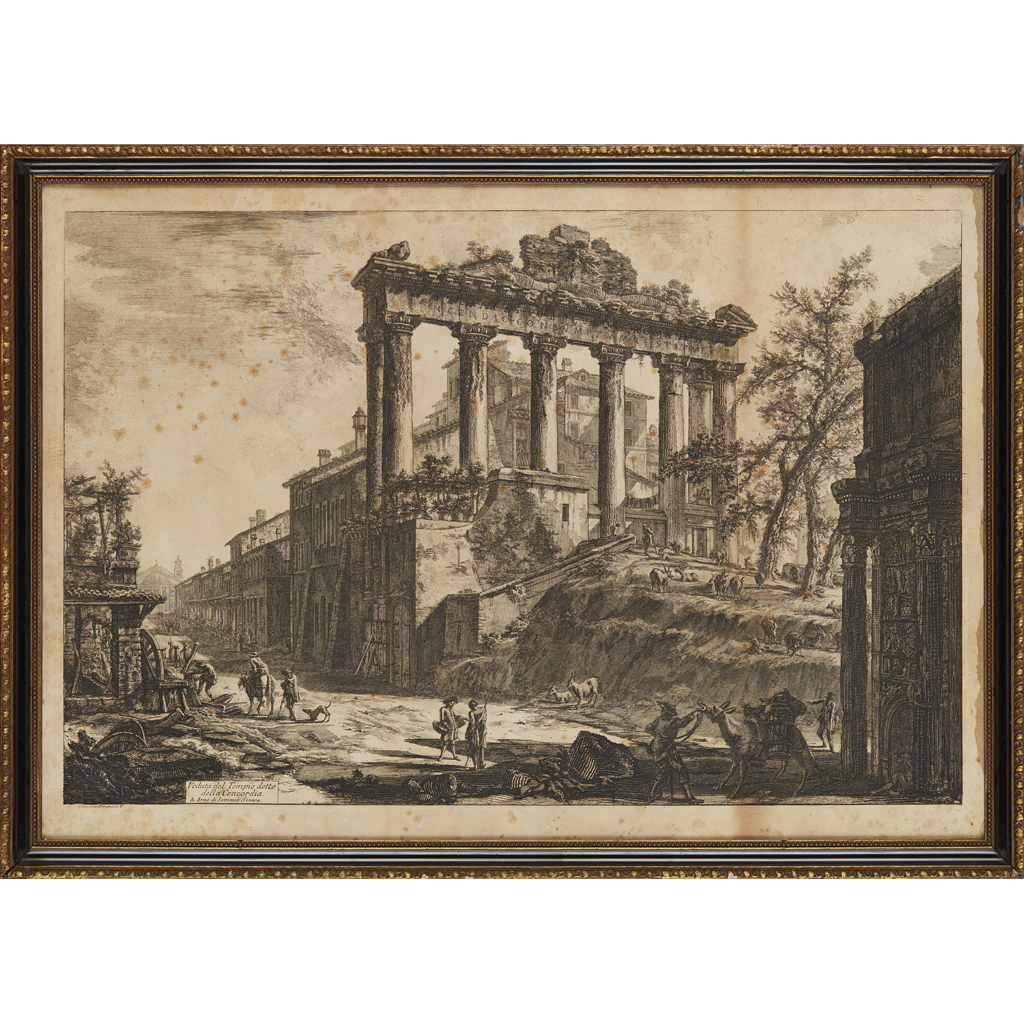
Five centuries of Old Master paintings, prints, and sculpture head to the auction block via Freeman’s on November 22 in Edinburgh, Scotland. The auction opens at 11 a.m., and nearly 100 lots are available, among them works by such luminaries as Giovanni Battista Piranesi, Jan van Goyen, Edwin Cooper, Sir Thomas Lawrence, Sir John Everett Millais, Sir Edwin Landseer, Sir Alfred Munnings, and Cecil Kennedy.
Giuseppe Carelli, “Fisherman off the Coast,” oil on canvas, 15 1/4 x 11 1/4 inchesGiovanni Battista Piranesi, “Veduti del Tempio detto della Concordia,” etching, 20 1/4 x 29 inches
This article was featured in Fine Art Today, a weekly e-newsletter from Fine Art Connoisseur magazine. To start receiving Fine Art Today for free, click here.
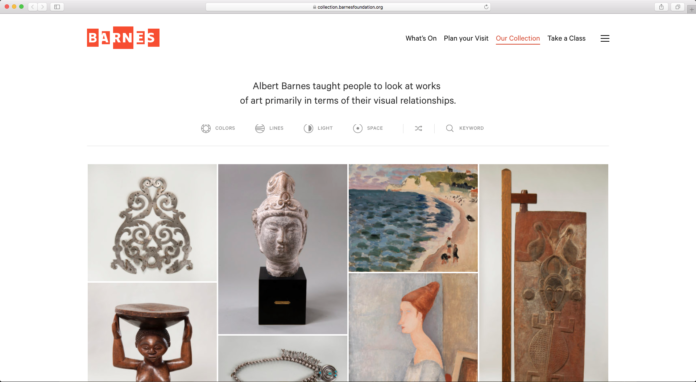
Screenshot of the new website via the Barnes Foundation
In celebration of its fifth anniversary in the heart of Philadelphia, the Barnes Foundation has made fine art enthusiasts very happy by boosting the collection’s accessibility. What’s the news?
The Barnes Foundation recently launched a new website that allows audiences to search thousands of works from its permanent collection based on a number of personalized criteria. In celebration of the foundation’s fifth anniversary in Philadelphia, Pennsylvania, users will be able to download high-resolution images of over 1,400 works that are now in the public domain.
Led by Shelley Bernstein, Barnes Foundation deputy director for audience engagement & chief experience officer, and funded by a grant from the John S. and James L. Knight Foundation, the new online tool is the first in the museum field to search holdings with a deep focus on visual properties such as light, line, color, and space, rather than requiring users to be familiar with artist names or art historical movements.
According to the press release, “This project extends into the digital realm the same pioneering approach Dr. Albert C. Barnes used to display his collection in ensembles — combining masterpieces by artists such as Cézanne, Renoir, Matisse, and Van Gogh with ancient, medieval, Renaissance, and non-Western art as well as metalwork, furniture, and decorative art.”
This article was featured in Fine Art Today, a weekly e-newsletter from Fine Art Connoisseur magazine. To start receiving Fine Art Today for free, click here.
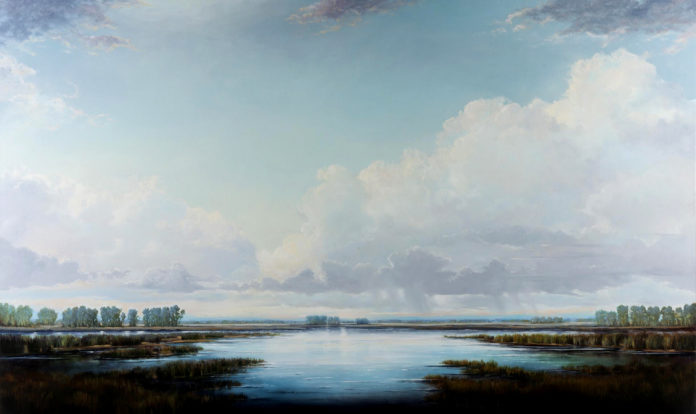
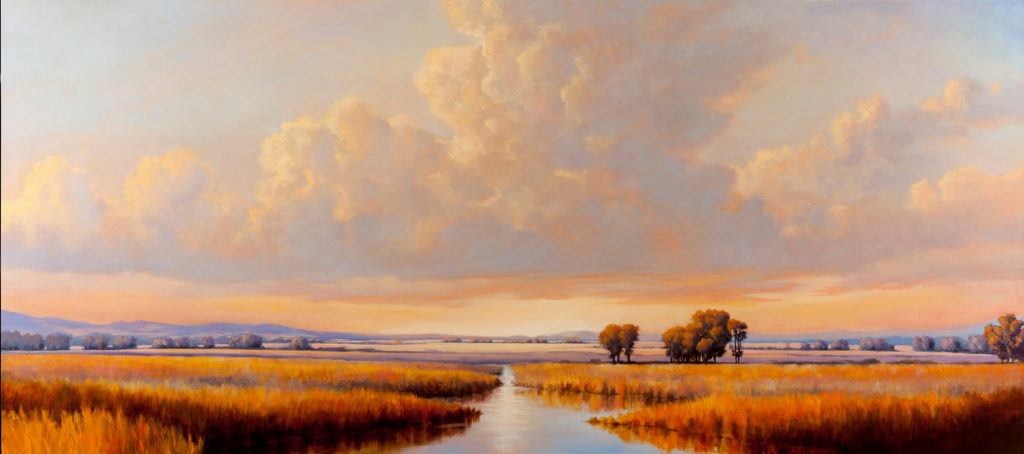
Victoria Adams, "Blue Venture," oil on linen, 36 x 60 in.
Fine Art Today had a compelling conversation with an amazing landscape painter, who gave us detailed insight into her creative goals and processes that deserve quotation in full. You’re invited to bask in her tranquil illumination. Do you know her yet?
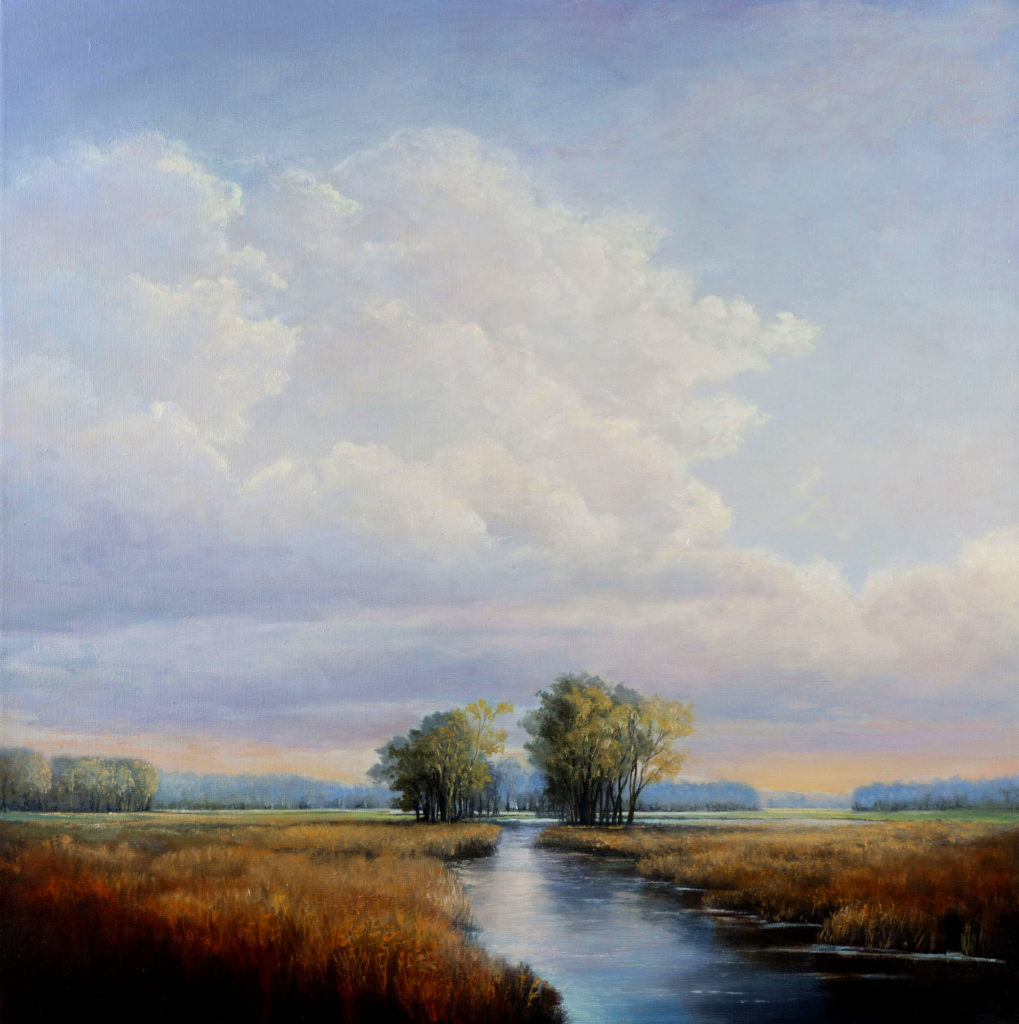
Victoria Adams, “Lowlands #120,” 2019, oil on linen, 24 x 24 in.
Fine Art Today: Tell me a little about your creative process. Once inspiration hits, how do you approach the panel/canvas? In other words, do you always start a piece the same way even if the sources of inspiration are different? How do you know when a painting is completed; is it that sense of personal fulfillment, or that a particular experience/idea is re-achieved?
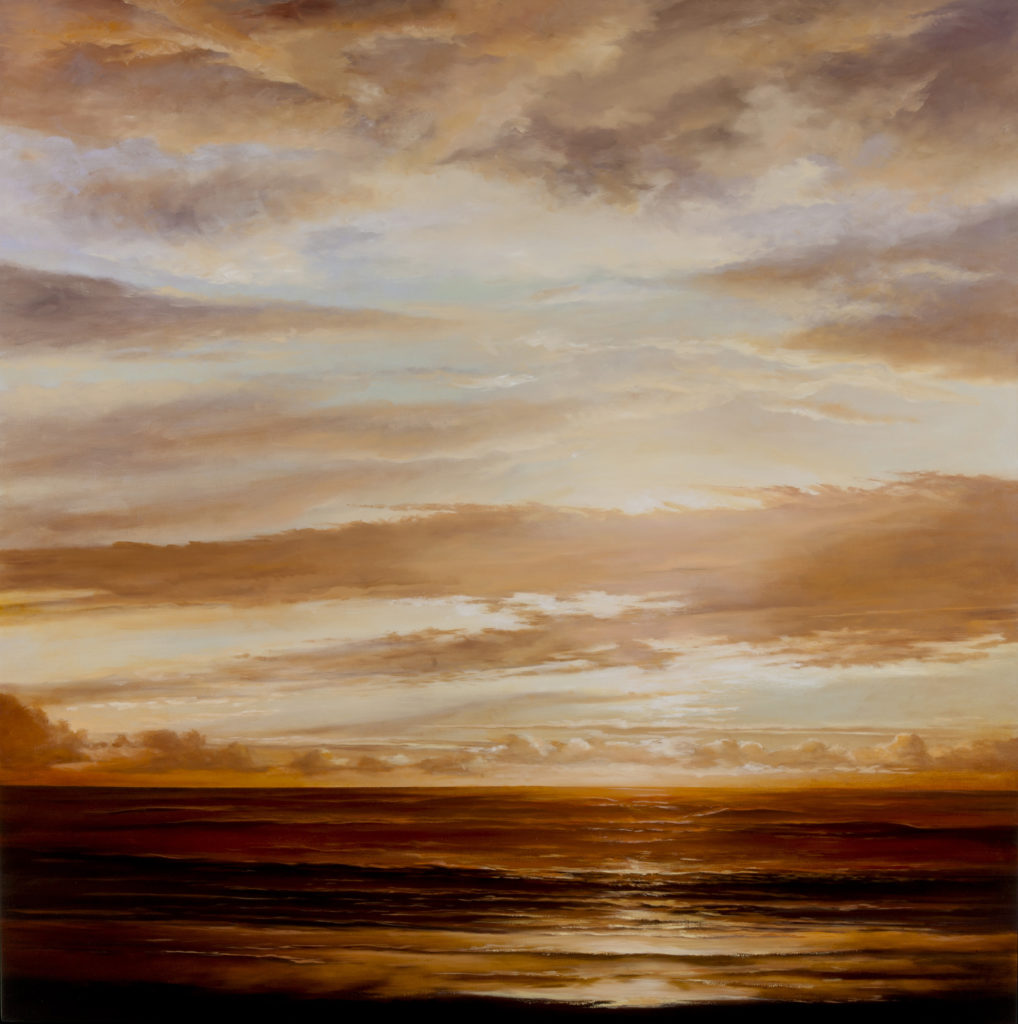
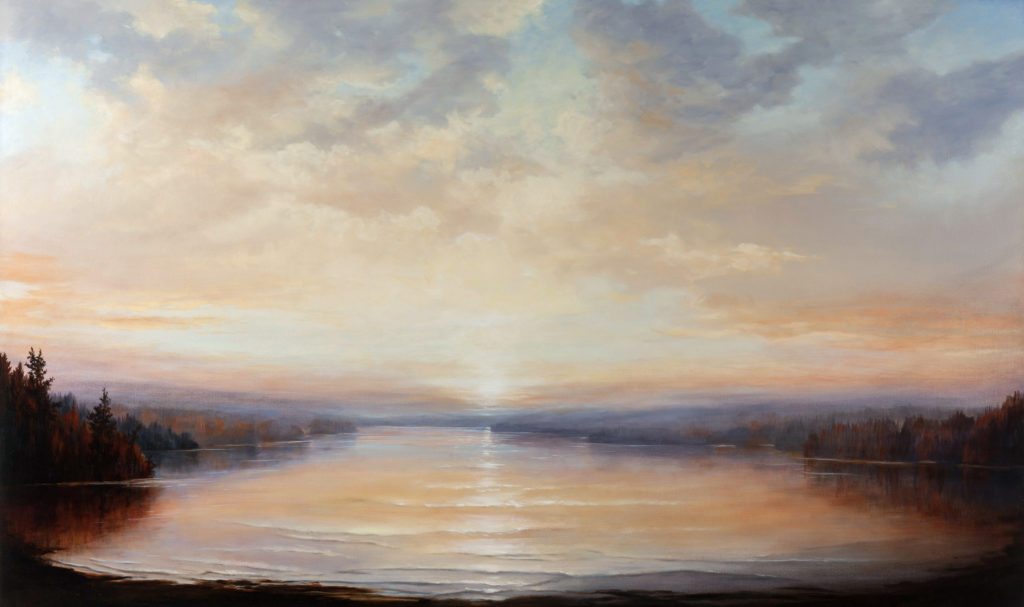
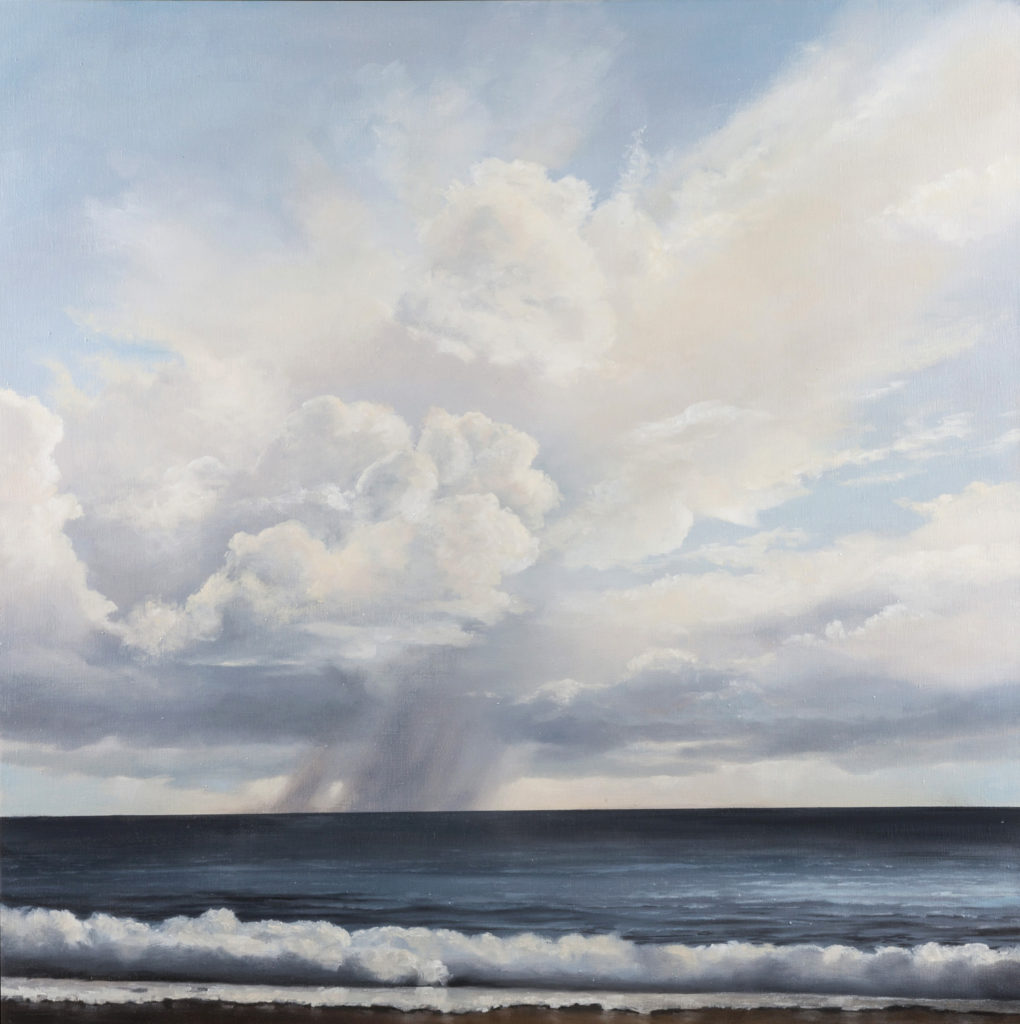
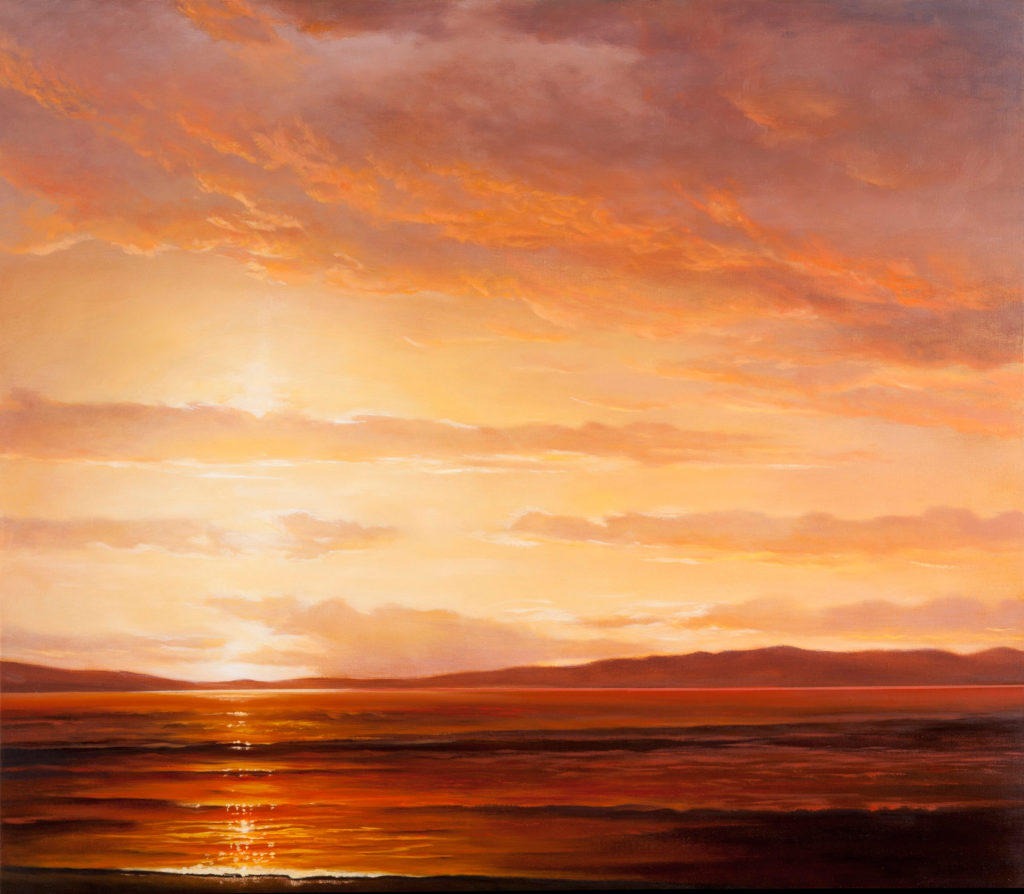
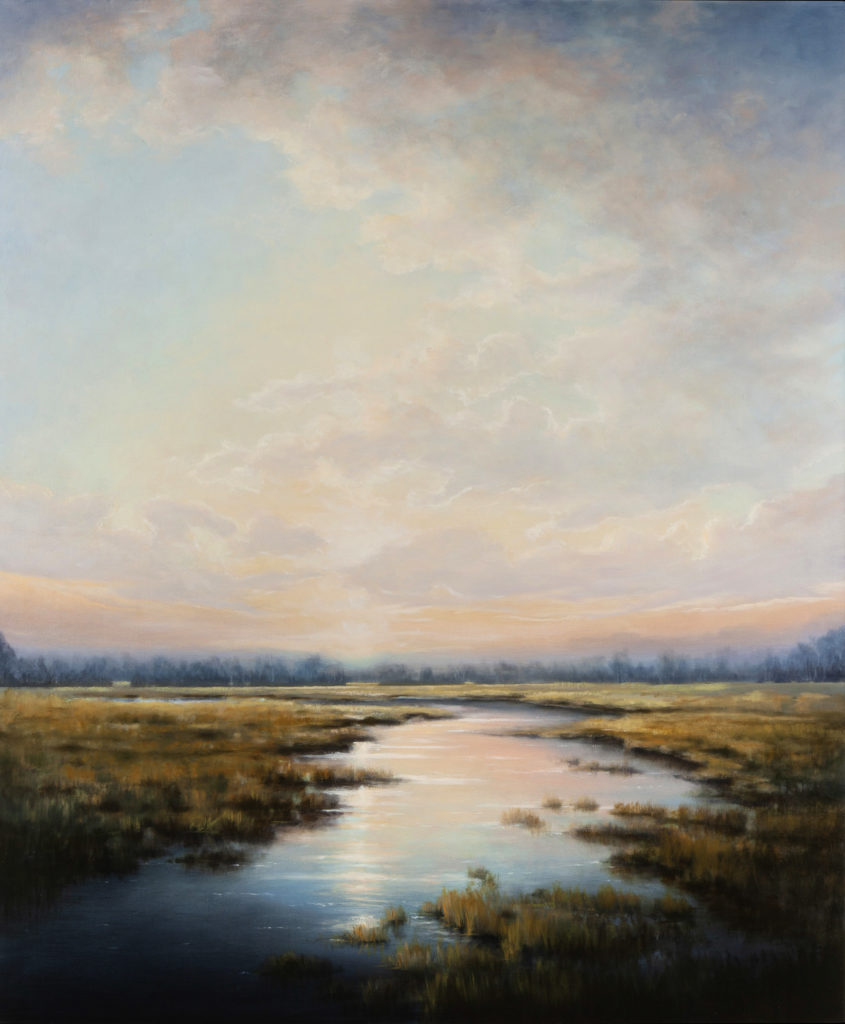
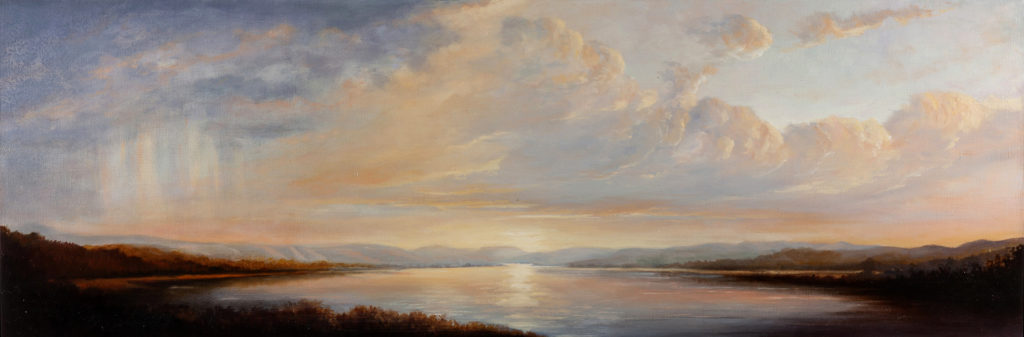
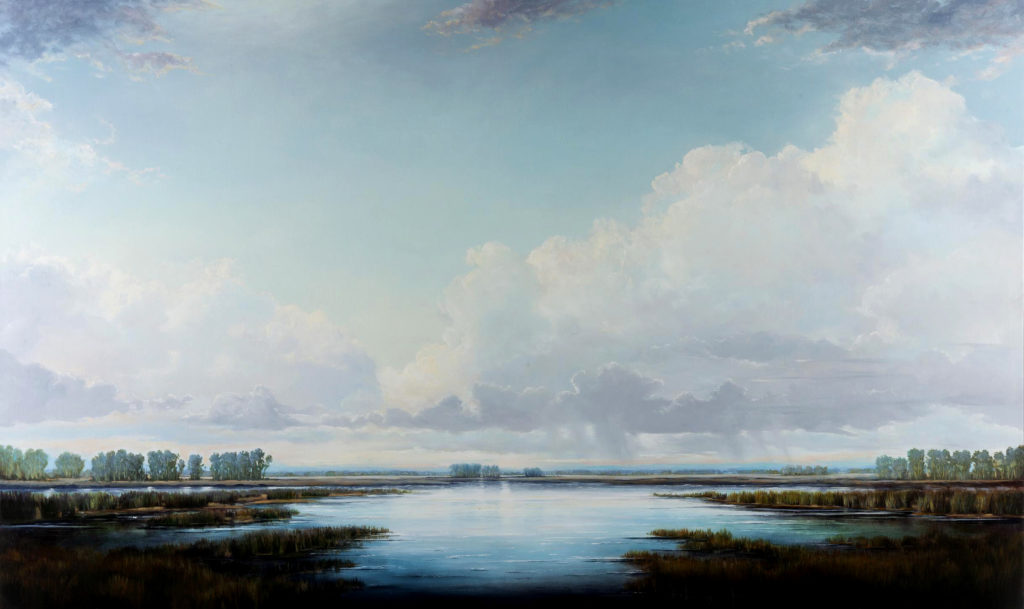
Victoria Adams: All of my paintings include large areas of stormy sky above either a landscape or a waterscape. The scenes are fictional, generated entirely from my imagination or constructed from the memory of an actual scene and its details. Or sometimes a scene emerges from a combination of these techniques. My canvases are completed wholly in my studio, but they do include many details from the real world. During the process of painting, I usually rely on segments of multiple photographs that I take during walks or trips. I render fragments and details from these photos of skies, water, land features, trees, etc. in each painting in order to give my imagined or remembered scenes a greater illusion of representational truth.
My works range in size from very small miniatures to very large pieces. Since I want to emphasize the horizontal nature of my subject matter, I frequently use canvases that are rectangular or elongated rectangles. Squares also are a favorite, and I strive to create as much horizontality in those as possible. I normally begin a painting by setting the horizon line at some level in the lower third of the composition, depending on the overall height of the canvas. A horizon height of anywhere from one-third to one-seventh allows the “sky” area above to dominate. The lower the horizon line sits, the more opportunity I have to use the perspective of clouds in the sky to create a deep illusion of space.
The idea for a painting typically begins with some type of sunset or storm scene that has caught my interest, and based on that I decide on a general color key, warm or cool, that seems appropriate to use with that particular type of sky. The sky and the general look of the composition may also be informed by a previous painting I’ve made, and that I want to explore further, but in a differently proportioned canvas. I also make an initial decision about where the light source in the sky is coming from — is it to the left or right? Will the clouds be lit from above or below? Where along the horizon does the light either land or emanate from?
I spend time painting in my studio on a regular daily schedule — I tend not to wait for inspiration. I instead rely on the act of painting to get me excited. I love witnessing how any one painting is developing, and I have an attitude of open curiosity as it develops. Each painting becomes all-engrossing, and that keeps me interested and present. I tend to work on only one painting at a time. Miniature paintings or large paintings seem to require the same intense process. I typically work from the top down on the sky area first, completing it almost entirely before then moving on to the area below the horizon. I work directly with a little Liquin or Galkyd using smooth brushes and feathering as I go. I consult various photos I have printed out in the studio to render details that approximate a real sky.
Using weather websites, I also instruct myself on the names and visual characteristics of types of clouds I’m painting. I may rework portions of the sky several times before I get the effect of luminosity I’m after. I then move on to the area below the horizon, using the logic of the sky I’ve almost completed to design the rest of the composition. The nearly finished sky provides numerous clues about how to develop the area below the horizon — the direction of the light source will remain the same, for instance. And the position of the mass of clouds will need to be balanced by the land or water below. I make use of all the typical tools of linear and aerial perspective to create the final composition, making corrections in the sky also if necessary.
I create receding space, always emphasizing subtle horizontal alignments. Numerous photos provide detailed references in rendering groups of trees, shoreline configurations, distant horizon lines, wave patterns, etc. — all with the intention of making the composition I’m working on have the look of someplace that could actually exist. I eventually end up with a composition that I rework all over until I’m satisfied that it is unified and that nothing else needs to be “fixed.” It’s at that point that I feel the painting is finished.
Victoria Adams, “Undulant Sea,” 2015, oil on linen, 48 x 48 in. (c) Victoria Adams, 2016
Fine Art Today: Forgive me for projecting, but I get a strong evocation of Albert Bierstadt, Thomas Cole, and other Hudson River School artists in the brilliant illumination and deep space within your work. Are you particularly moved by these artists, and do you see yourself working in this tradition? If so, why? If not, then who?
Victoria Adams: I have certainly been strongly influenced by the American Luminists and the Hudson River School artists. The skies of Church, the panoramas of Bierstadt, the dreamy shorelines of Heade and Gifford are always guiding me. The way I paint light, for instance — with subtle value gradations of translucent color — is a hallmark of Luminist influence. But I’ve also learned from so many earlier European landscape artists: Rembrandt, Rubens, van Goyen in the Dutch tradition; and the 19th century, Constable, Turner as well as painters of the French Barbizon School. I keep a large library handy to refresh my memory. Among contemporary painters, I’m also drawn to Gerhard Richter’s landscapes. I’m constantly discovering new names all the time. It may surprise people who like my work to know that I keep coming back to Peter Paul Rubens. He’s most known as a painter of figures, but he also was fascinated by landscape, and did a number of private paintings that he gave to friends of the countryside near his home outside Amsterdam. These images feature the kind of ideal poetic landscape of broad views with bold skies that interests me.
Victoria Adams, “Duration,” 2016, oil on linen, 36 x 60 in. (c) Victoria Adams, 2016
Fine Art Today: What would you consider your primary goals to be in art? What do you hope your viewers take away from your paintings?
Victoria Adams: My painted scenes are less about reproducing the look of an actual real place than about constructing an image of an ideal place, but one that has believable space, light, and atmosphere. I have often been told by collectors that the places I depict look like places viewers feel they could step into or wish they could go to. The images remind them of places they half-remember or feel they have dreamt about.
This feedback is in line with my intent — my work isn’t about depicting any one particular place, although I thoroughly enjoy painters’ work that achieves that goal. I feel my work is conceptual rather than strictly realist. In each painting I strive to evoke a moment of envelopment in — and an enchantment with — a wide uninterrupted expanse of the natural world. None of my works include people, buildings, roads, or other signals of human presence. I want the image I’m presenting to be solely about the natural world rather than a backdrop to some imagined narrative about the characters in it. The places I paint are outside of any identifiable time period — instead, they are about timelessness.
Emphasizing horizontal elements promotes a feeling of quiet and stillness. The qualities of timelessness and stillness are what make these images less about the real and more about the ideal, more poetic than strictly accurate. I’m very interested in the emotional and psychological effects that standing in an actual landscape or viewing a painted landscape can have.
Victoria Adams, “Towards the Blue,” oil on linen, 36 x 36 in. (c) Victoria Adams, 2016
Fine Art Today: Tell me about your surfaces. It can be hard to tell from photos, but it appears as though you have a nice traditional finish. How important are these — and other — surfaces to your art?
Victoria Adams: My surfaces are intentionally quite smooth. I want the emphasis to be on the image, so I stay away from leaving lots of brushstrokes, since those would be a reminder of my presence. The illumination on the clouds is more believable, for instance, if the gradations of value are very subtle.
Victoria Adams, “Far Shore,” 2016, oil on linen, 33 x 38 in. (c) Victoria Adams, 2016
Fine Art Today: What has your journey to becoming a successful artist been like? Were you always interested in art?
Victoria Adams: During childhood I was drawn to making things, and painting and drawing. However, I took my first art courses in my mid-20s, just as a fun thing to do, but I eventually became enthralled. My first works were abstract, with lots of straight lines and layered planes. After a few years, my abstract work morphed into representational painted landscapes with softer edges and deeper space.
Victoria Adams, “Remembering,” oil on linen, 24 x 54 in. (c) Victoria Adams, 2016
Fine Art Today: Finally, where are Victoria and her art in a year, or even five years? How do you see your career and artwork evolving in the near and distant future, and what are some things you seek to achieve?
Victoria Adams: I will probably always be drawn to painting landscape, since I love being in actual landscape so much and since I never run out of new ideas for paintings. I tend to stay with a type of painting for a long while, and I get more satisfaction out of going deep while I explore the same aesthetic and conceptual territory than I would if I were switching to another genre. I’m always striving to do what I do already, but do it better.
Victoria Adams, “Drift,” 2018, oil on linen, 40 x 34 in.Victoria Adams, “Lost River Plain,” 2019, oil on linen, 12 x 36 in.Victoria Adams, “Blue Venture,” oil on linen, 36 x 60 in.
—-
Adams’ work has been shown extensively throughout the U.S. and is included in numerous private and public collections. Adams’s work is also represented by Gail Severn Gallery, Ketchum, ID; Woodside/Braseth, Seattle, WA; Somerville Manning Gallery, Greenville DE; and Zolla/Lieberman Gallery, Chicago IL. Interested viewers may see more of her work at her website: www.victoriaadamsart.com
This article was originally written by Andrew Webster and featured in Fine Art Today.
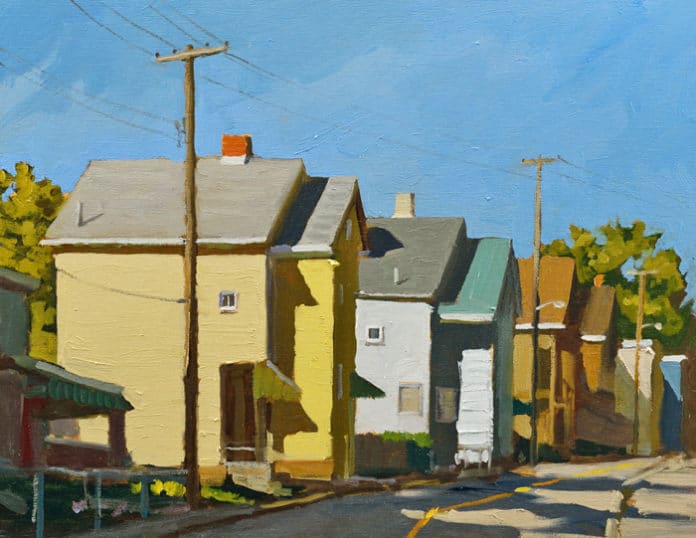
Ron Donoughe has been painting the western Pennsylvania landscape for 30 years. He explores its rural and urban settings on a daily basis as he works in plein air throughout the seasons.
As curator V. Scott Diamond has noted, “Ron Donoughe has spent many years recording the often unassuming and occasionally magnificent landscape of the Allegheny Mountain region. Approaching this landscape with the eyes of one who knows it like a brother, Donoughe renders it ineffably compelling.”
For an installation project Donoughe may take a year or more to complete 60-100 plein air paintings. In these exhibits the small paintings interact with each other, giving a textural overview of a particular time and place. Donoughe believes such in-depth projects allow for a more thoughtful understanding of his subject. It is a contemporary take on a traditional approach to painting.
“The affection of his gaze catches our attention, and through his brush, even the most mundane subjects become eminently worthy. This is the power of a great artist, and it is one that Donoughe clearly knows how to wield.”
“Ron Donoughe is one of those American artists intimately linked with the region where he lives,” noted writer Max Gillies, comparing Donoughe’s tie to that of others like Andrew Wyeth (the Brandywine Valley and Cushing, Maine), Winslow Homer (the Bahamas and coastal Maine) and Edward Hopper (New York City and Cape Cod).
Donoughe has completed murals for the Cambria County courthouse, has been a featured artist in the Pennsylvania governor’s residence, and recently his collection of 90 Pittsburgh Neighborhoods was acquired by the Heinz History Center in Pittsburgh, an affiliate of the Smithsonian Institution.
His interest in plein air painting led to the formation of the Plein Air Painters of Western Pennsylvania. And his work can be found in many corporate, private, and public collections including The Westmoreland Museum of American Art, The Southern Alleghenies Museum of Art, The University Museum at Indiana University of Pennsylvania, and the Pennsylvania Convention Center.
A ‘Today’s Masters’ section featured article titled, “Looking Local: Ron Donoughe’s Painting of Western Pennsylvania” recently appeared in the October issue of Fine Art Connoisseur magazine.
Ron Donoughe has also published three books about his work. For information, please contact the artist at [email protected]. View more of Ron’s work at http://donoughe.com/.
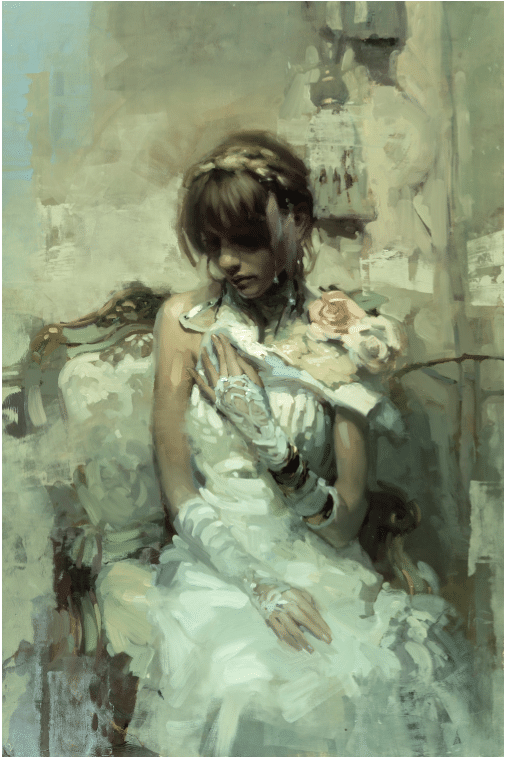
Jeremy Mann, “Portrait of Jillian,” oil on panel, 24 x 36 inches
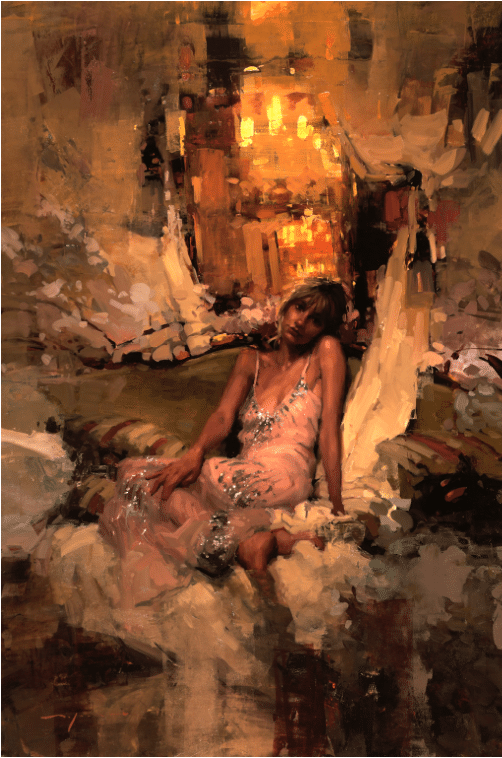
Principle Gallery in Alexandria, Virginia, is the latest gallery to display the works of renowned painter Jeremy Mann. Featuring works that explore the artist’s experiments, process, and emotions, this isn’t a solo show to miss.
Principle Gallery is overjoyed to be presenting the latest body of work from the mind of Jeremy Mann. On view from November 17, the solo show is once again a fascinating representation of Mann’s self-reflection as one of the nation’s top artists.
Jeremy Mann, “Chandelier Dress at Night,” oil on panel, 26 x 39 inches
An excerpt from Fine Art Connoisseur magazine’s profile on Mann:
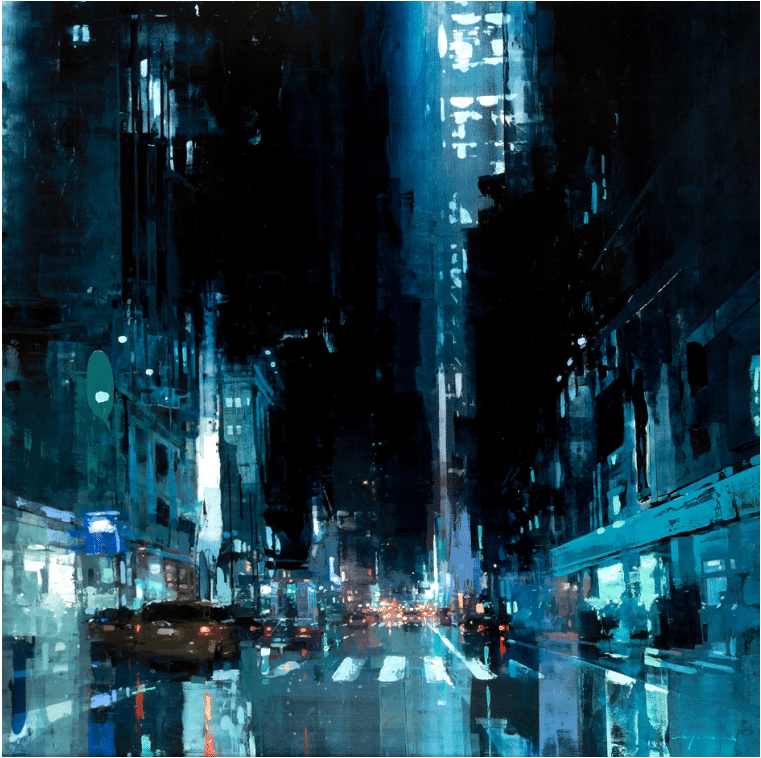
Dramatically and skillfully rendered, the cityscapes and figurative works of Jeremy Mann give visual form to the emotive essence of modern life. Jeremy Mann’s paintings capture the tenor of these moments that characterize life in the city. Whether depicting the distinctive hills and winding roads of San Francisco, or the bustle of the city that never sleeps, Mann paints the heart of his setting.
Jeremy Mann, “NYC 18,” oil on panel, 48 x 48 inches
Confident, gestural strokes and brilliant highlights define his style. Any detail of one of his cityscapes would almost certainly look abstract. But as the eye moves away from the canvas, dots of red emerge into rows of brake lights and slashes of blue signal the glow of neon street signs. Mann works to manipulate paint in a variety of techniques, sometimes staining the surface of the canvas, using solvents to thin and remove paint, or exploiting the gritty quality of an ink brayer. The result is a personalized, expressive style.
Interestingly, Mann’s cityscapes are almost completely devoid of figures. His figurative works form a separate part of his artistic output and are just as masterfully executed. These interior scenes of women picture loneliness and ennui, self-reflection and melancholy, all expressed in a deeply sensuous visual language.
Though his work divides easily into these categories, a common theme underlies both. The modern city – dark, sexy, stimulating, seductive – is Mann’s true subject.
This article was featured in Fine Art Today, a weekly e-newsletter from Fine Art Connoisseur magazine. To start receiving Fine Art Today for free, click here.
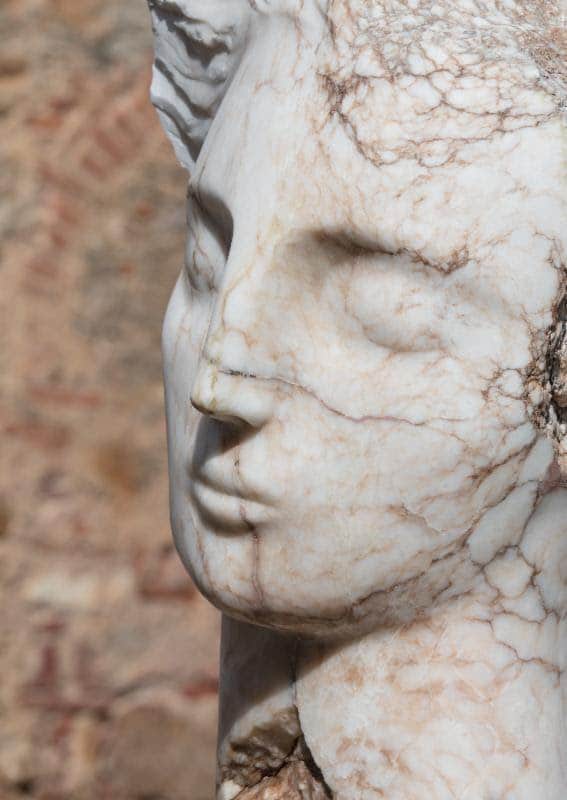
Bowman Sculpture is delighted to present a solo exhibition of new works by Emily Young, widely regarded as Britain’s greatest contemporary stone sculptor. The exhibition will include a new series of heads, discs, and torsos carved from stone and rarely seen bronze works.
On view November 17 through January 11, 2018 at Bowman Sculpture will be the incredible sculptures by Emily Young. “Young is recognized for her sculptures and public artworks that investigate the relationships between the ancient world and our own; humankind and the natural world; and an artwork and its origins,” the gallery writes. “She continues to explore a connection between time, land, and cultures through her deeply personal approach to sculpture. Her work is a direct manifestation of the human consciousness, allowing her to carve, for example, a human face directly onto a piece of stone which in turn marks her relationship to nature. Through a profound engagement with each individual stone’s geological history and its geographical source, Young forms a personal dialogue with the past and the future.
“Young’s studio in Tuscany is situated in a 17th-century monastery located between the Ligurian Sea and Mount Amiata, a mountainous volcanic area inland, the area is rich in natural, cultural, and historic significance. She sources her materials locally in Italy and across the world. Young demonstrates the extraordinary qualities of stone, allowing the material to convey profound messages about life, time, and the universe.
“For this exhibition, the artist has carved works from stones ranging from Indian Forest Green marble, white onyx, Rouge de Vitrolles, Quartzite and Dolomitic limestone, among others. A rich variety of attributes characterize each type of stone and therefore each work. Agate, for example, is characterized by its fineness of grain and brightness of color whereas Kilkenny marble is a fine-grained Carboniferous limestone that contains fossils thus revealing the preserved traces of animals, plants, and other organisms from the distant past.
“The artist’s approach is to ‘work with the stone,’ allowing the material to reveal its inherent beauty. Young arrives at the finished work through a process of carving that guides the artist according to the unique character and traits of the material.”
The artist added, “The grace, power, and pleasure that the natural world can show us is what drives the making of these pieces. The human form, the most complex of all life forms on earth, is carved out of stone, out of the same minerals, elements, atoms, and molecules that have always made up our physical universe.”
She continues, “Throughout my working life as an artist, the connections, or lack of them, between humankind and the astonishingly rare and precious natural world has been the predominant story. Really, it’s the only story now, the biggest story of all time for humanity.”
This article was featured in Fine Art Today, a weekly e-newsletter from Fine Art Connoisseur magazine. To start receiving Fine Art Today for free, click here.
Fill your mind with useful art stories, the latest trends, upcoming art shows, top artists, and more. Subscribe to Fine Art Today, from the publishers of Fine Art Connoisseur magazine.