

Home Blog Page 359

Are You a Casualty of Modernity?

0
Kent Monkman, “Our Lady of Sorrows,” 2017, acrylic on canvas, 72 x 48 in. © Peters Projects

Reinterpreting the 19th-century works of Alfred Jacob Miller, Kent Monkman creates a fascinating dialogue surrounding mythology, indigenous peoples, and tradition this month through his newest acrylics in New York City. Who’s hosting, and for how long?

Peters Projects, in collaboration with GP Contemporary & Gerald Peters Gallery in New York City, is excited to provide Cree artist Kent Monkman with a platform to discuss a range of engaging topics during “Casualties of Modernity.”

Kent Monkman, “The Deposition,” 2014, acrylic on canvas, 84 x 126 in. © Peters Projects

On view through March 27, Monkman’s sharply rendered and saturated paintings “appropriate Nineteenth century western artist Alfred Jacob Miller,” the gallery reports. Discussing his intentions with the solo show, Monkman suggests, “Drawing upon mythological sources, both European and Native American, my series of paintings will feature dynamic scenes of indigenous peoples, mountain men, and trappers in various scenes of revelry and interaction. I will include animals in the scenes as they are central to mythologies — from Greek myths to indigenous legends — that express the most profound aspects of human existence and shape our understanding of nature and the cosmos.”

Kent Monkman, “Love,” 2014, acrylic on canvas, 72 x 48 in. © Peters Projects

The gallery adds, “Kent Monkman’s New Work focuses on his thematic approach to fine art history that excludes Indigeneity. Monkman is responding to two common problems faced by Northern Native artists and theorists, preserving tradition and retrieving that which has been silenced, as if one could reclaim a speaking position from the past, a space in time prior to and beyond the colonial order. Monkman does not attempt to resurrect the past as it was, but rather implies that knowledge of the past can inform the present and future.”

To learn more, visit Peters Projects.

This article was featured in Fine Art Today, a weekly e-newsletter from Fine Art Connoisseur magazine. To start receiving Fine Art Today for free, click here.
Winter 2.0? Nonsense!

0
James Winn, “Azaleas,” acrylic on panel, 24 x 72 in. © Tory Folliard Gallery

Although parts of the United States are digging themselves out from under piles of ice and snow — especially the Northeast — artists and galleries are still fighting for spring! There’s something beautiful blooming in Milwaukee…

Tory Folliard Gallery in Milwaukee, Wisconsin, is poised to open a brilliant and radiant display of new paintings by artist James Winn. It opens on March 18 and continues through April 15; the gallery will showcase a number of Winn’s beautiful floral compositions sure to warm one’s soul.

James Winn, “Iris,” acrylic on paper, 6 x 6 in. (each) © Tory Folliard Gallery

A reception for the show, along with an artist talk, will be hosted from 1-4 p.m. on March 18 at the venue. As reported by the gallery, “Azaleas, irises, lilies and other flowering foliage once again capture the eye of Illinois artist James Winn. Unlike his landscape paintings with endless skies, Winn is shifting his perspective and bringing the viewer eye-to-eye with portraits of individual blooms and luminously lit flowers set against dark backgrounds. By manipulating light and color, these highly detailed paintings present a sense of Presence that one can experience when alone and attentive in nature.”

To learn more, visit Tory Folliard Gallery.

This article was featured in Fine Art Today, a weekly e-newsletter from Fine Art Connoisseur magazine. To start receiving Fine Art Today for free, click here.
Creating Iconographic Drifts and Distant Memories in California

0
Lauren Szabo, “Fragment 2,” 2016, oil on canvas, 36 x 36 in. © 111 Minna Gallery

Coupled with what the gallery calls “proximity-based technology” along with compelling talent, these two accomplished female painters have taken over and beautified the walls of this San Francisco venue. Deepen your gallery experience here.

Representational painters Elisa Remender and Lauren Szabo have embarked on two co-exhibitions at San Francisco’s 111 Minna Gallery through April 1. Along with their memorable works, the gallery has added what it’s calling “proximity-based technology” in hopes of deepening visitors’ gallery experiences.

Collected by some of Hollywood’s most famous stars, the acrylic works of Elise Remender give a fresh take on the classic pinup model. Titled “Distant Memories,” Remender’s exhibition features some 12 new works highlighting the artist’s deep appreciation for and interest in vintage fashion, Art Deco, and underground pop culture of the 1950s. “Additionally, the vivid colors of the era including pictures of the ocean and bright blue pools have inspired her bathing beauty series,” the gallery adds.

Elise Remender, “Perfect Day,” 2016, acrylic, © 111 Minna Gallery

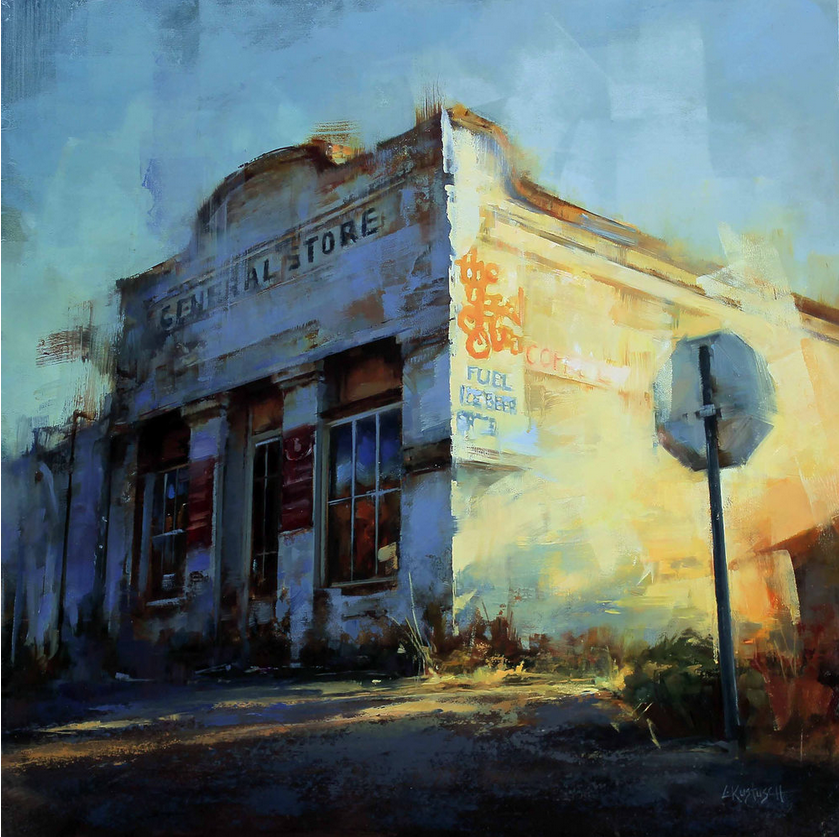
In conjunction with Remender’s show is “Iconographic Drift” — a showcase of tightly rendered cityscapes and signs by the skilled Lauren Szabo. Via the gallery, “Szabo is an Oakland-based artist that has been working with the medium of oil paint for over 20 years. Her recent paintings are composed of man-made objects in the process of being reclaimed by nature. Her subjects are always in an un-restored state, and include paper billboards, neon signs, and incandescent bulb signs. These advertisements have been decayed by the elements. Once containing messages of perfectionism, a dilapidated advertisement is now itself flawed in societal terms. Advertisements nearly always promise a perfect, static, and ultimately false outcome, but by depicting such signs in a state of decay, she reveals the true, aging reality of all objects (and beings) — flawed but arguably more beautiful. These signs are becoming more rare as we continue to move forward in the digital age. She wishes to elevate these overlooked locations and cultural relics into icons with the intention of stimulating dialogue about our societal priorities.”

To learn more about these exhibitions, visit 111 Minna Gallery.

This article was featured in Fine Art Today, a weekly e-newsletter from Fine Art Connoisseur magazine. To start receiving Fine Art Today for free, click here.
Raleigh Receives the “Glory of Venice”

0
Vittore Carpaccio, “Annunciation,” 1504, oil on canvas, 50 x 54 3/4 in. (c) Galleria Giorgio Franchetti alla Ca’d’Oro, Venice 2017

A current exhibition on view through June 18 is a once-in-a-lifetime opportunity to see for yourself how and why this Renaissance city was renowned for its seductive colors — both in reality and through the monumental artists who called it their home. Can you name it?

The North Carolina Museum of Art (NCMA) recently opened a captivating exhibition that could prove to be a once-in-a-lifetime opportunity for the state’s residents. “Glory of Venice: Renaissance Paintings 1470-1520” is a showcase of approximately 50 stunning Renaissance paintings, including major altarpieces, private secular and devotional paintings, and portraits.

Titian, “Madonna and Child with Saints Catherine of Alexandria and Dominic, and a Donor,” circa 1513, oil on canvas, 54 x 72 1/2 in. (c) Fondazione Magnani Rocca 2017

It’s not surprising that Venice, Italy, is renowned for much more than its unique geographic location, food, and iconic gondolas. Indeed, for centuries scholars, aristocrats, royalty, and — of course — artists have all become enamored with the jewel-like colors that dance off the city’s canals and pastel-colored buildings. Nearly all the artists who called “The Floating City” home are noted for their use and mastery of color, especially with regard to Renaissance masters, including the Bellini family, the Bassano family, Giorgione, and Titian — to name just a few.

Giovanni Bellini, “Annunciation,” circa 1500, oil on canvas, 88 x 42 in. (c) Gallerie dell’Accademia, Venice 2017

Via the museum, “Twenty unparalleled loans from Venice’s Gallerie dell’Accademia, which houses the finest collection of Venetian Renaissance art in the world, form the core of the exhibition. They are joined by masterpieces from other institutions in Italy and the United States, including the NCMA.”

“Glory of Venice” opened on March 4 and continues through June 18. To learn more, visit the North Carolina Museum of Art.

This article was featured in Fine Art Today, a weekly e-newsletter from Fine Art Connoisseur magazine. To start receiving Fine Art Today for free, click here.

A Permanent Home for This Important Painter

0
Frank Mason, “Self Portrait with Beret,” 1972, oil on panel, 20 x 16 in. © Frank Mason

It’s been a long time coming, but that doesn’t take away from the celebration and excitement emanating from Point Park University in Pittsburgh, Pennsylvania. What’s the story you need to hear?

Iconic artist Frank Mason has been a longtime member and supporter of Artists Fellowship, Inc., receiving the Benjamin West Clinedinst Memorial Medal in 2002. The Fellowship recently announced news that the Lawrence Hall Gallery at Point Park University in Pittsburgh will now house a permanent exhibition of Mason’s works.

“Recently part of that collection travelled and was shown at Indiana (PA) University,” the Fellowship reports. “The Cleveland-born master was associated with the Art Students League as a teacher for many years and ArtWatch International, which he co-founded. So many artists do not have that singular institution to carry their banner. In this instance, high marks go to Frank’s widow, Anne, and Jack Tomayko, a longtime collector and Trustee at Point Park, for making it happen.” The exhibition will feature 16 oil paintings ranging from portraits and figure studies to landscapes and seascapes.

To learn more, visit Frank Mason.

This article was featured in Fine Art Today, a weekly e-newsletter from Fine Art Connoisseur magazine. To start receiving Fine Art Today for free, click here.
A Life Outdoors, in Your Home

0
Jay Moore, “Sunrise on St. Mary’s Lake,” oil on linen, 30 x 40 in. © Trailside Galleries

Trailside Galleries is proud to showcase recent works by landscape painter Jay Moore. Having been raised in Colorado and spent most of his life outdoors, Moore has a beautiful, finely tuned picture ready for your mantel.

On view through April 7 at Trailside Galleries’ Scottsdale, Arizona, location is a luminous display of landscape beauty from Colorado artist Jay Moore. “Moore is a modern-day naturalist,” the gallery suggested, “more at home amongst the elements, observing the natural world. The artist’s years spent exploring the Colorado highlands has given him a keen eye for the subtleties of the great outdoors. He can look at a patch of snow on the ground and tell you what month it is. He can even tell, often to the minute, when rain will fall by looking at the cloud patterns in the sky.”

Jay Moore, “Sunset in Laguna,” oil on linen, 30 x 40 in. © Trailside Galleries
Jay Moore, “A Glance at Autumn,” oil on linen, 24 x 18 in. © Trailside Galleries

All of Moore’s attention to detail surfaces with brilliance in his landscapes, which are tightly rendered and could easily fool the eye. “As an artist,” Moore asserts, “a painting is like a conversation: I hear what the terrain says to me and respond on the canvas. I am very excited about the show because it will include paintings from my usual haunts in Colorado as well as explorations in the past year to Glacier National Park, the California coast, and Hawaii. I am broadening out and finding whole new subject matter that is very inspiring. I have been easel painting for over 20 years, but am as excited as ever.”

To learn more, visit Trailside Galleries.

This article was featured in Fine Art Today, a weekly e-newsletter from Fine Art Connoisseur magazine. To start receiving Fine Art Today for free, click here.
Fine Art Connoisseur January-February 2018

0

Download the January/February 2018 issue of Fine Art Connoisseur here to read the issue now.

Feature articles of the January/February 2018 issue include:

Artists Making Their Mark: Three to Watch
Allison Malafronte describes the talents of Michael Aaron Hall, Barbara Jaenicke, and Mary Pettis.

Capturing the Spirit of Music and Dance
by Kelly Compton

A Soldier’s Journey: Sabin Howard’s World War I Memorial Monument
by Donald Kuspit
(preview the excerpt “A Soldier’s Journey: The Weight of Sacrifice Portrayed in Bronze Relief”)

George “Frolic” Weymouth: Brandywine River Valley Artist
by Annette Blaugrund

Sporting and Wildlife Art in South Georgia
by Peter Trippi
(preview the excerpt about Pebble Hill Plantation)

Western Tradition
by David Masello

The Russian Art Trip: Best Ever?
by Peter Trippi

Advancing the Cause of Figurative Art, Face to Face
by Peter Trippi

Great Art Nationwide
We survey 12 top-notch projects this season.

Chauncey Stillman, Wethersfield, and a Very Personal Legacy
by Genevieve Fox

Art for the Other 99 Percent
by Leslie Lobell and Eric Timsak

On the cover: Anna Rose Bain (b. 1985), “Vintage Tutu,” (detail), 2017, oil on linen, 50 x 36 in., Saks Galleries, Denver

Subscribe to Fine Art Connoisseur (click here) today so you never miss an issue.

Featured Artwork: Cecil Byrne Gallery presents JEANNE ROSIER-SMITH

0
“Daybreak” by Cecil Byrne

“Daybreak”

pastel on paper

40 x 20 in. (framed dimensions)


About the artist:

Award-winning artist Jeanne Rosier Smith studied art at Georgetown University and at the New Jersey Center for Visual Art and the DuCret School of Art in New Jersey. After earning her Ph.D. and spending ten years teaching college English, she began painting professionally when her youngest child started school in 2004.

Smith fell in love with pastels fifteen years ago, at first touch. Their velvety richness and direct touch makes them her medium of choice. She is known for her active, dramatic wave paintings, her opulent still lifes, and her expressive portraits. Her year spent in Nice, France, in a dorm room with a sea view began a lifelong love of the water—one she is currently exploring in her wave series. She returns to coastal South Carolina, as well as the cape and islands of the Massachusetts coast year round, and she’s fascinated with the challenge and potential of painting crashing water with dry pastel.

Smith is a signature member of the Pastel Society of America, the Connecticut Pastel Society and the Pastel Painters Society of Cape Cod, and a juried artist member of the Copley Society, the Salmagundi Club and Academic Artists.  She has exhibited at the Massachusetts State House, the Boston Artists Guild, and nationally at the Pastel Society of America, the Catherine Lorillard Wolfe Arts Club and American Artist Professional League shows, among others.

She has won numerous awards, including First Place in the 2017 Pastel Journal 100, the IAPS Prix de Pastel in 2012, the Grand Prize in International Artist Magazine’s 2012 Seascapes Competition, and the Art Spirit Foundation Gold Medal Award for Excellence in Pastel from American Artists Professional League. Her work has been featured in International Artist Magazine, American Art Collector, and The Pastel Journal. Her paintings are in collections across the US, to Monte Carlo, to New Zealand.

Jeanne Rosier Smith is represented by Cecil Byrne Gallery in Charleston, South Carolina.

View more of Jeanne’s work at http://cecilbyrnegallery.com/collections/paintings-by-jeanne-rosier-smith.

View more from Cecil Byrne Gallery at http://cecilbyrnegallery.com.


The Golden Twenties

0
Joseph Kleitsch, “Problematicus,” 1918, oil on canvas, 60 x 55 in. © Collection of Robert and Susan Ehrlich 2017

A California institution is proud to have recently opened a major exhibition that delves into the life and career of an Impressionist widely recognized as one of the state’s most influential. Although he fell into obscurity after his untimely death, the script has flipped with “The Golden Twenties.”

Born in Hungary in 1882, Joseph Kleitsch (1882-1931) immigrated to the United States in 1902, eventually taking up residence in such vibrant cities as Cincinnati, Denver, and Chicago. However, it was Kleitsch’s migration to the West Coast, particularly Laguna Beach, that proved to be the most important move, as he eventually became one of California’s most influential and important impressionists.

Although his death in 1931 lead to the artist’s relative obscurity, the Pasadena Museum of California Art (PMCA) — along with scholar and author Patricia Trenton, PhD — are quickly changing the narrative with a brilliant exhibition on view this year.

Opened on March 5 and continuing through August 6, “The Golden Twenties: Portraits and Figure Paintings by Joseph Kleitsch” is not only the first museum exhibition to focus on Kleitsch, but also one that “characterizes Southern California during this tumultuous decade through depictions of the people who helped shape it,” the museum writes.

“Noting the mild climate of Laguna Beach and perhaps the success Edgar Payne, his friend and fellow Chicago artist, found there, Kleitsch moved to the artist’s haven in 1920. He quickly became a leading member of the art colony. He was involved with the Laguna Beach Art Association and was an in-house portraitist for the esteemed Stendahl Gallery, then located in the elegant Ambassador Hotel. The artist also pursued his newfound interest in landscape painting, becoming an important part of the California Impressionism movement.

“Kleitsch’s career is often mistakenly divided into two parts: his early portraits painted in Hungary and Chicago and his impressionistic and increasingly abstract landscapes painted in California during his later years. However, Kleitsch continued to paint portraits and figurative works in California and was considered Laguna Beach’s premier portrait painter until his untimely death in 1931.

“In his relatively short career, Joseph Kleitsch’s innate sensitivity propelled him to uncover the depth of his subjects. With a jewel-toned palette and pattern influenced by his native Hungary and a golden, impressionistic palette developed after his arrival in California, the artist’s figure paintings and portraits of friends, dignified businessmen, and glamorous movie stars convey the character of each sitter and recount the personal stories of California in the twenties. This selection of 42 of Kleitsch’s bold and diverse paintings represents a significant artistic legacy, which has been assembled, for the first time, in this focused and intimate study.”

To learn more, visit the Pasadena Museum of California Art.

This article was featured in Fine Art Today, a weekly e-newsletter from Fine Art Connoisseur magazine. To start receiving Fine Art Today for free, click here.
Blurred Lines

0
Carol Hagan, “Trifecta,” oil and cold wax on glass, 27 x 42 x 3/4 in. © Carol Hagan 2017

An early goal for historical artists was to begin breaking down the artificial barrier (or picture plane) between the created world and the viewer’s world, using inventive new strategies. This member of the Russell Skull Society has taken this idea to gorgeous new heights.

Using glass as her support along with colorful oils and cold wax, artist Carol Hagan is giving collectors and connoisseurs something fresh to look at with a stunning new series she calls “Glass Horses.” A self-taught artist, Hagan considers herself a contemporary expressionist and colorist, two elements that are highlighted beautifully in this new series of paintings.

Carol Hagan, “She Was Fond of Wandering, But Was Always Back by Supper,” oil and cold wax on glass, 22 x 24 x 3/4 in. © Carol Hagan 2017

As her works suggest, Hagan has an affinity for horses as her subjects, and she captures their majestic beauty with simple, expressive, but very deliberate and descriptive stokes of the brush. While their bold forms are clearly recognizable, closer inspection of the details reveals Hagan’s skill and understanding of color relationships. In fact, to ignore the form of the horses is an exercise that only reveals stunning abstract expressionist qualities.

Of her subjects, Hagan says, “Horses are old souls. The quiet exchange of positive energy and communication that takes place just from standing next to a horse, or within a group of horses, is simply extraordinary. They hold within them a silent calm, yet a powerful sense of acceptance, grace, wisdom, and strength.”

Carol Hagan, “Spotted Rump,” oil and cold wax on glass, 27 x 40 x 3/4 in. © Carol Hagan 2017

The effect of Hagan’s glass painting is also extraordinary, as her equine subjects truly appear to occupy the viewer’s space. It’s hard to find adequate ways to describe the spatial relationship between the viewer and artwork because it’s not quite something one typically encounters. Be that as it may, there’s little doubt that the technique works, leaving one wondering if other artists may one day try it for themselves.

Discussing this new series, Hagan writes “The ‘Glass Horses’ series is inspired by my desire to incorporate both light, and spatial elements, in my work. Painting on sheets of thick glass allows me the opportunity to explore the dimension of light, and the free-standing works can be viewed from both sides. Shadows are cast from the horses themselves, through their positive and negative spaces. These works possess a three-dimensional presence, depending on how each piece is lit for display.

“A complete work incorporates two sheets of glass, with painting on both sheets working together to create a single image. I use oils and cold wax together, creating transparent washes and glazes, opaque strokes, and richly textured areas. These all interact with the element of light, and bring its ever-changing qualities into play. I chose to have my glass sheets finished with flat polished edges, as this allows for yet another aspect of light prisms to reflect from the painted images, and enhances the interesting shadows that they create.”

Carol Hagan, “Peach-Faced Love Birds,” oil and cold wax on glass, 38 x 36 x 3/4 in. © Carol Hagan 2017

Collectors will soon have a chance to view these — and other gorgeous, more traditional, paintings — during the C.M. Russell Museum’s exhibition and sale, slated to open next week (March 16-18 in Great Falls, Montana). More specifically, Hagan is one of only two female artists in the Russell Skull Society of Artists. Hagan, along with her fellow members, will be showcasing works all week at the Mansfield Convention Center.

If you would like to learn more, visit Carol Hagan. More information about the Russell Skull Society of Artists can be found here.

This article was featured in Fine Art Today, a weekly e-newsletter from Fine Art Connoisseur magazine. To start receiving Fine Art Today for free, click here.
WEEKLY NEWS FROM THE ART WORLD

Fill your mind with useful art stories, the latest trends, upcoming art shows, top artists, and more. Subscribe to Fine Art Today, from the publishers of Fine Art Connoisseur magazine.

  • This field is for validation purposes and should be left unchanged.