
Home Blog Page 360

Ivy League Brilliance

0
Johan Joseph Zoffany, “Queen Charlotte,” 1771, oil on canvas, © Royal Collection Trust

Although “Ivy League” is a term most closely associated with academic excellence, selectivity in admissions, and social elitism, it can also be used to describe an outstanding exhibition of nearly 300 objects from Enlightenment Europe on view now at Yale University.

Caroline of Ansbach, Augusta of Saxe-Gotha, and Charlotte of Mecklenberg-Strelitz — three German princesses who married into the British royal family in the 18th century — are the focus of a stunning exhibition of nearly 300 artworks at the Yale Center for British Art in New Haven. Opened on February 2, “Enlightened Princesses” explores the lasting legacies of these important women and how each shaped courtly life. “They encouraged the greatest philosophers, scientists, artists, and architects of the day,” the center notes, “and they brought art, music, dance, enlightened conversation, and experimentation into the palaces and royal gardens, and supported industry, trade, and imperial ambition.”

Joseph Highmore, “Queen Caroline of Ansbach,” circa 1735, oil on canvas, Royal Collection Trust

On view through April 30, the exhibition includes important artworks and manufacture, which either belonged to the women themselves or their families, or was commissioned by them. Among the highlights are works by Hans Holbein, William Kent, Allan Ramsay, Sir Joshua Reynolds, George Stubbs, Thomas Gainsborough, and Johan Zoffany.

Continuing, the center writes, “[the exhibition] focuses on five themes, explaining the princesses’ activities and interlocking contributions over the course of their lifetimes. Firstly, ‘Cultures of Learning: Powerful Conversations’ examines how Caroline, Augusta, and Charlotte built pivotal relationships with leading cultural and intellectual figures of their age, and the far-reaching consequences of those exchanges. This leads into a consideration of ‘The Court as a Stage,’ not only in the literal sense for the performance of music, dance, and theater but also as a political and cultural arena in which the princesses had to navigate the inherently political nature of public and private life.

Allan Ramsay, “Augusta, Dowager Princess of Wales,” 1769, oil on canvas, © Collection of H.R.H. Hereditary Prince Ernst August of Hanover

“‘Royal Women: Mothers of the Nation’ considers the princesses’ engagement with evolving contemporary philosophies about childhood, both as active contributors to the educational programs devised for their own children and in their public roles as encouragers and protectors committed to the development of wide-reaching philanthropic projects. Next, ‘To Promote and Protect: The Princesses and the Wider World’ shows how the princesses supported enterprising industrialists and furnished their own homes and developed their gardens, so as to champion national manufacturers and the produce of empire. Finally, a concluding section on ‘Political Gardening’ shows how Caroline, Augusta, and Charlotte explored contemporary garden philosophies and exercised their architectural ambitions for both personal and political ends, all the while reacting to a volatile commercial environment as well as a changing perception of the bonds between the dynasty, nationhood, and empire.”

To learn more, visit the Yale Center for British Art.

This article was featured in Fine Art Today, a weekly e-newsletter from Fine Art Connoisseur magazine. To start receiving Fine Art Today for free, click here.
Reader’s Choice: Pure Joy and Character

0
Mary Pettis, “Russian Fisherwoman,” 2009, oil on canvas, 24 x 30 in. © Mary Pettis 2017

In this ongoing series, Fine Art Today delves into the world of portraiture, highlighting historical and contemporary examples of superb quality and skill. This week we detail a visage that will undoubtedly leave you smiling.

If everyone could be as happy as Mary Pettis’ “Russian Fisherwoman” all the time, the world would be a much better place. With Pettis’ careful yet expressive touch, this week’s feature portrait radiates pure joy and character. Tightly cropped and captured in full length, a hearty and hefty woman sits on a bench in front of her merchandise while enjoying a cigarette. As she casually leans toward the viewer, Pettis has captured her visage in a snapshot instant. Warmth and happiness emanate from her face, her eyes piercing and her cheeks flushed. I like to believe she’s been caught in the midst of retelling a fantastic story or local joke, a welcoming proposition that gives the piece intimacy and familiarity.

It was 2009, and Pettis — along with a group of several other artists — was traveling through rural Russia. Although it was bitter cold and deep within the Siberian winter, routine continued with fervor in a small fish market. “I first saw her from the window of our bus traveling along the outskirts of a little Russian village,” Pettis recalls. “We hadn’t planning on stopping at the makeshift fish market, but several of us called out at once, ‘Stop the bus!’” There must have been something special about the market that spoke to this group of creatives, perhaps a strong sense of local, untouched culture, the Siberian natives, or perhaps the flashes and ribbons of color in an otherwise bleak season.

Pettis says, “I was struck immediately by her large, homespun happy aura (I’m thinking that a good day fishing may be akin to a good day painting!). I loved the raw contrasts — the incongruities: the bright red shirt under camouflage, her unabashed joy amid the February bleakness. I felt her powerful presence would be best expressed with a close, pyramidal composition, heavy textures, and lively, unedited alla prima brushwork. To this day, I can’t help but smile when I look at this painting of her.”

Indeed, Pettis achieved her goal with such success that reactions from viewers are largely the same. It’s hard not to feel the subject’s sense of satisfaction, joy, leisure, character, and warmth — perhaps the ultimate indicator of a superb portrait.

To learn more, visit Mary Pettis.

This article was featured in Fine Art Today, a weekly e-newsletter from Fine Art Connoisseur magazine. To start receiving Fine Art Today for free, click here.
Reality or Illusion? You Decide.

0
M.C. Escher, “Drawing Hands,” 1948, lithograph, 11 x 13 in. © Collection of Herakleidon Museum, Athens 2017

A great Midwest museum is offering a rare glimpse into the life and career of one of the 20th century’s most acclaimed graphic artists and masters of illusion.

Known for his imaginative tessellations of bids, frogs, and lizards, and his impossible never-ending staircases and waterfalls, Dutch artist M.C. Escher (1898-1972) created some of the most popular images in modern art. The fascinating worlds Escher created in his drawings, lithographs, and woodcuts have proven to be timeless, appearing on the covers of albums and on the walls of countless teenagers’ bedrooms and college dormitories.

M.C. Escher, “Day and Night,” 1938, woodcut, 15 7/16 x 26 5/8 in. © Collection of Herakleidon Museum, Athens 2017

March 4 marked the opening of “M.C. Escher: Reality and Illusion” at the Leigh Yawkey Woodson Art Museum in Wausau, Wisconsin. On view through May 28, the exhibition includes some 120 woodcuts, lithographs, mezzotints, and drawings that “delve deeper into both the literal and impossible worlds Escher created over a career spanning five decades,” the museum writes. “Drawn from a large private collection, ‘Reality and Illusion’ includes early figure drawings, lesser-known book illustrations, detailed Italian landscapes, the tessellations for which he became famous, and examples of his signature architectural fantasies in which stairways seem to go both up and down.”

To learn more, visit the Leigh Yawkey Woodson Art Museum.

This article was featured in Fine Art Today, a weekly e-newsletter from Fine Art Connoisseur magazine. To start receiving Fine Art Today for free, click here.
The Clark Looks North and South

0
Giovanni Antonio Boltraffio, “Head of a Woman,” circa 1495, metalpoint heightened with white, © The Clark Art Institute 2017

The 16th and 17th centuries were important periods of artistic exchange in Europe, especially with regard to prints and drawings. A captivating exhibition opened last week on the East Coast that delves into these mediums, from the Netherlands to Naples. Learn more here!

The Clark Art Institute’s world-class permanent collection of prints and drawings from the 16th and 17th centuries are currently on radiant display during “Looking North and South: European Prints and Drawings 1500-1650.” Opened on March 5 and continuing through May 29, the exhibition investigates the ways in which both Northern and Southern European artists engaged in artistic exchange through prints, drawings, and books.

Albrecht Dürer, “Adam and Eve,” 1504, engraving, © The Clark Art Institute 2017

Drawn exclusively from the institute’s permanent collection, “[the exhibition] considers how artists responded to the work of their contemporaries in different regions of early modern Europe, revealing intersections and divergences in artistic production and the important role played by works on paper — portable and more affordable than painting — in shaping the exchange of ideas,” according to the Clark.

Peter Paul Rubens, “Hercules Strangling the Nemean Lion,” circa 1620, color chalks, ink and gouache, © The Clark Art Institute 2017

Among the artists represented in the show are Albrecht Dürer, Giovanni Antonio Boltraffio, Jacopo Palma il Giovane, Antonio del Pollaiuolo, Maarten de Vos, Giorgio Vasari, Rembrandt van Rijn, and Peter Paul Rubens. The Clark Art Institute is located in Williamstown, Massachusetts.

To learn more, visit The Clark Art Institute.

This article was featured in Fine Art Today, a weekly e-newsletter from Fine Art Connoisseur magazine. To start receiving Fine Art Today for free, click here.
Loving Lipking

0
Jeremy Lipking, “Silver Ripples,” oil on canvas, 12 x 6 in. © Image Courtesy Arcadia Contemporary

Originally published March, 2017

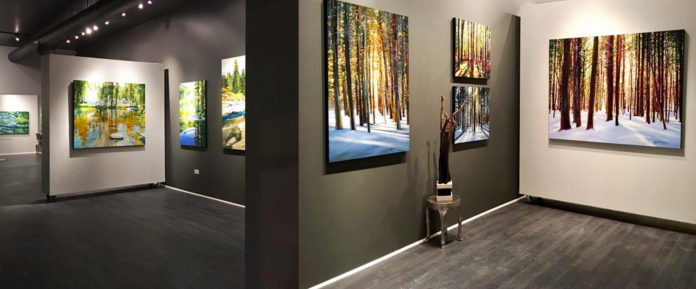
Any fine art event with the name Jeremy Lipking in it is one worth noting, especially when it’s a solo exhibition. This one features 20 stunning new paintings at Culver City, California’s Arcadia Contemporary gallery.

Jeremy Lipking, “Matilija Poppies,” oil on canvas, 18 x 36 in. © Image Courtesy Arcadia Contemporary

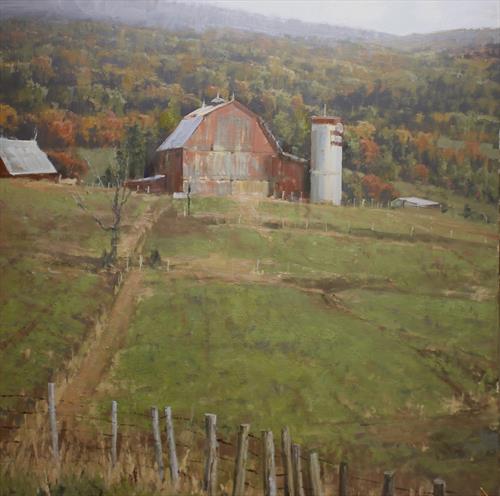
It opens this weekend, on March 11, and one can expect major crowds of fine art enthusiasts and collectors to converge on Arcadia Contemporary. Indeed, for years Lipking has amassed quite a following for his painterly works featuring figures in natural environments. “From twilight skies cloaking nude bodies to forests that embrace wandering figures, Lipking’s works contain a sense of mystery and majesty,” the gallery reports. “In just a few short years, the artist’s meteoric rise to the top of the representational art world has been accompanied by numerous awards and merits.

Jeremy Lipking, “Aspen Nocturne,” oil on panel, 8 x 6 in. © Image Courtesy Arcadia Contemporary

“A resident of Calabasas, CA, Lipking relies on locations in California, such as the Pacific Coast, Malibu Canyon, and the Eastern Sierra Mountains, for inspiration. To create his works, Lipking paints on location with a live model or, if conditions are prohibitive, takes photographs as reference. He prefers to work outdoors, laying out as many pieces as possible in one sitting. The ideal method, he says, is to make a quick painting from life, photograph his model, and take the material back to his studio for completion.

Jeremy Lipking, “Above Timberline,” oil on canvas, 36 x 18 in. © Image Courtesy Arcadia Contemporary

“Arcadia Contemporary is pleased to host the artist’s fifth exhibition with the gallery. Since relocating from NYC to Los Angeles in 2016, the gallery has made a strong impact on the Los Angeles art scene as one of the few galleries exclusively featuring skilled, representational painting.”

This article was featured in Fine Art Today, a weekly e-newsletter from Fine Art Connoisseur magazine. To start receiving Fine Art Today for free, click here.
A Well-Deserved Honor

0
Leah Lopez, “Two Golden Apples,” oil on panel, © Leah Lopez 2017

Each year on March 8 the world celebrates important women who have shaped history during International Women’s Day. In conjunction with the event, this great gallery has launched an Art Fair that includes creative talent you don’t want to miss. What’s the buzz?

Located in New York City, One Art Space is quickly rising in the gallery world as a go-to destination for premier artistic talent. That trend continues this month during the gallery’s “International Women’s Day Art Fair.” Although the gallery hosted a beautiful event last night, there remains ample opportunity to both view the art and mingle with the artists.

Leah Lopez, “Clay Vase and Lemons,” oil on panel, © Leah Lopez 2017

One Art Space will also host a closing event on March 16, which coincides with Tribeca Art Night (TAN). Artists included in the exhibition are Leah Lopez, Sarah Sager, Caroline Absher, Shenna Vaughn, Maria Owen, Nancy Pantirer, Peach Jin Tao, Annelise Capossela, Rosangela Bombieri, Allison Kroll, Lulu Dong, Ceceilia Ruiz, Silvia Aviles, Ayako Bando, Nina Kovalenko, Keli Lucas, CJ Collins, and Nana An. The exhibition was curated by Frank Giella.

Discussing the event and its inspiration, the gallery writes, “International Women’s Day first began in New York City in 1911 and has historically been utilized to call attention to the many hardships and oppressions faced by women throughout the world. The Suffragettes founded International Women’s Day to unite and empower women in their fight for equality and to this day, it continues to inspire individuals to persevere in the face of adversity, celebrate powerful women, and organize direct action to further our progress as a society towards the abolishment of gender inequality.

Allison Kroll, “Intertwined,” 2016, oil on canvas, 40 x 30 in. © Allison Kroll 2017

“We support the modern-day Suffragettes of the International Women’s Day Campaign in promoting this holiday and their ten core values of justice, dignity, hope, equality, collaboration, tenacity, appreciation, respect, empathy, and forgiveness.

“This year, we celebrate by presenting an exhibition in honor of the monumental achievements of women throughout history. The International Women’s Day Art Fair features a diverse, international collection of talented, female-identifying artists of varying ages.”

To learn more, visit One Art Space.

This article was featured in Fine Art Today, a weekly e-newsletter from Fine Art Connoisseur magazine. To start receiving Fine Art Today for free, click here.
Fine Art Opportunity Coming to Facebook Live

0
Image courtesy Studio Incamminati 2017

Studio Incamminati — a premier school for contemporary realist art — is coming to Facebook Live later this month for a can’t-miss opportunity. What is it and when?

Located in Philadelphia, Pennsylvania, Studio Incamminati is one of the most respected schools for contemporary realist art in the country. Using Facebook Live, the school is now becoming more accessible!

On Saturday, March 25, from 12:30-4:30 p.m. ET, Studio Incamminati will broadcast a LIVE demo featuring three incredible artists. Titled “The Dream Stream: Three Artists, Three Perspectives,” the demo will feature Lea Colie Wight, Darren Kingsley, and Kerry Dunn as they perform a live-model painting demo.

As part of the event, moderators Dan Thompson and Natalie Italiano (also instructors at the school) will be on hand to answer questions from Facebook viewers. The demonstration has also engaged an experienced tech crew for a multi-camera operation, giving viewers every angle of the action!

Mark your calendars and turn your home into Studio Incamminati for an afternoon!

This article was featured in Fine Art Today, a weekly e-newsletter from Fine Art Connoisseur magazine. To start receiving Fine Art Today for free, click here.
The Phoenix Has Risen!

0

Fine Art Connoisseur is overjoyed to report the grand opening of RJD Gallery’s new exhibition space in Bridgehampton, New York. Although a devastating fire in December 2016 took them out for a few months, the gallery has risen like the legendary phoenix! Check out its stunning new space here!

Many of our readers already know about the terrible fire on December 16, 2016 in Sag Harbor, New York, that destroyed RJD Gallery — one of the premier contemporary art galleries in the country.

D_GJM5502 D_GJM5511March 2017 marks a major point of celebration as the gallery has just opened a gorgeous new exhibition space in Bridgehampton, New York, at 2385 Montauk Highway between Bobby Vans and the Candy Kitchen. The new gallery boasts nearly twice the space and is already populated with new works by RJD’s accomplished roster of artists.

D_GJM5515 D_GJM5521 D_GJM5537As Fine Art Today suggested just a few weeks ago, “In Greek mythology, a phoenix is a long-lived bird that is regenerated or reborn. Associated with the sun, the phoenix rises and obtains new life from the ashes of its predecessor. In historical records, the phoenix symbolizes renewal and resurrection, emerging from its death stronger than before.

D_GJM5559 D_GJM5563 D_GJM5569“The flaming bird of Greek mythology is a perfect metaphor for RJD Gallery: It is sometimes through the most challenging of times that one can emerge stronger and more determined than ever.”

D_GJM5573 D_GJM5577 D_GJM5582 D004Please join us in celebration and a round of applause for RJD Gallery!

The new space is currently open and will host its first reception on March 25. To learn more, visit RJD Gallery.

This article was featured in Fine Art Today, a weekly e-newsletter from Fine Art Connoisseur magazine. To start receiving Fine Art Today for free, click here.

Portrait of the Week: How Does He Do It?

0
David Jon Kassan, “Sam Goldofsky, Survivor of Auschwitz,” 2015, oil on panel, 45 x 35 in. © David Jon Kassan 2017

In this ongoing series, Fine Art Today delves into the world of portraiture, highlighting historical and contemporary examples of superb quality and skill. This week we consider the work of a contemporary master with mesmerizing talent and insight.

It’s hard to find the right words to describe the arresting portraits of contemporary master David Jon Kassan, which says a lot, given the fact that I write about art for a living. This week’s feature portrait — a three-quarter view of Auschwitz survivor Sam Goldofsky — gives realism new meaning and commands viewers’ attention even at first glance.

Set against a cool-toned background, Sam Goldofsky stands with disheveled gray hair and a pensive, perhaps distressed, expression on his face as he glances out of the frame. With arms crossed, Goldofsky wears a white undershirt, gray pants, and a black belt. The portrait radiates seriousness and a nearly tangible intensity. With his left arm crossed over his right, Goldofsky prominently displays a tattoo on his forearm, in a cold — perhaps protective — gesture. During the Holocaust, concentration camp prisoners received tattooed serial numbers at only one location: Auschwitz. The tattoo’s direct and clear display explains the subject’s demeanor, as he seems to be recalling horrific memories of his time at the camp.

Kassan has masterfully captured every detail of Goldofsky’s visage. His face, arms, hands, and skin bear the signs of a man who has witnessed and experienced the worst of human behavior. Although his pursed lips and heavy eyes tell a terrible tale, there is something magnificently beautiful about the portrait as well, something only art can do: turn the repellent past into something gorgeous, without diminishing our need to remember the transgressions of history.

“Sam Goldofsky” is part of a much larger idea called The Edut Project, an initiative that creatively showcases the life journeys of Holocaust survivors in order to protect, promote, and defend human rights today. Goldofsky’s portrait is one of several portraits by Kassan in the project, each as moving and beautiful as the last. Via the project’s webpage, “The combination of life-sized, realistic portrait paintings with filmed Survivors’ testimony, gives the viewer a live emersive experience putting a unique and personal face to the Shoah. These stories are about more than the atrocities, they are about a lifetime of strength and perseverance.”

To learn more, visit David Jon Kassan.

This article was featured in Fine Art Today, a weekly e-newsletter from Fine Art Connoisseur magazine. To start receiving Fine Art Today for free, click here.
Featured Lot: Daniel Ridgway Knight, “The Sewing Circle”

0
Daniel Ridgway Knight, “The Sewing Circle,” oil on canvas, 36 x 47 in. (c) A.B. Levy’s 2017

In this ongoing series for Fine Art Today, we take a longer look at the history and features of a soon-to-be-available artwork of note. This week: Daniel Ridgway Knight, “The Sewing Circle.”

The paintings of Daniel Ridgway Knight (1839-1924) often represent the best elements — and subjects — of 19th-century painting, including history, genre, landscape, portrait, and floral themes. Born into a strict Quaker home in Philadelphia, Knight rejected his family’s grooved path toward working in a local hardware store. Rather, Knight forged his own path into the arts, studying at the Pennsylvania Academy of Fine Arts before traveling to Paris to enroll at the Atelier Gleyre.

Among Knight’s fellow students were Mary Cassatt, Thomas Eakins, William Sartain, and Everett Shinn. By the mid-1870s, Knight had established himself as a preeminent painter of peasant life. His preferred subjects included women in fields gathering flowers. Knight’s style was immediately revered by his contemporaries and collectors for its extreme tightness, detail, and clarity.

Heading to auction on March 16 via Palm Beach, Florida’s A.B. Levy’s is a gorgeous original by Knight, complete with his canonical subject and recognizable style. In the work titled “The Sewing Circle,” the viewer has stumbled upon a group of women casually sitting and conversing as they sew. Just to the group’s left is an overgrown water well, with houses beyond. The women occupy a beautiful field, with ribbons of wildflowers adding flashes of color in the sea of green. Auction estimates are between $200,000 and $300,000.

To learn more, visit Live Auctioneers.

This article was featured in Fine Art Today, a weekly e-newsletter from Fine Art Connoisseur magazine. To start receiving Fine Art Today for free, click here.

WEEKLY NEWS FROM THE ART WORLD

Fill your mind with useful art stories, the latest trends, upcoming art shows, top artists, and more. Subscribe to Fine Art Today, from the publishers of Fine Art Connoisseur magazine.

  • This field is for validation purposes and should be left unchanged.