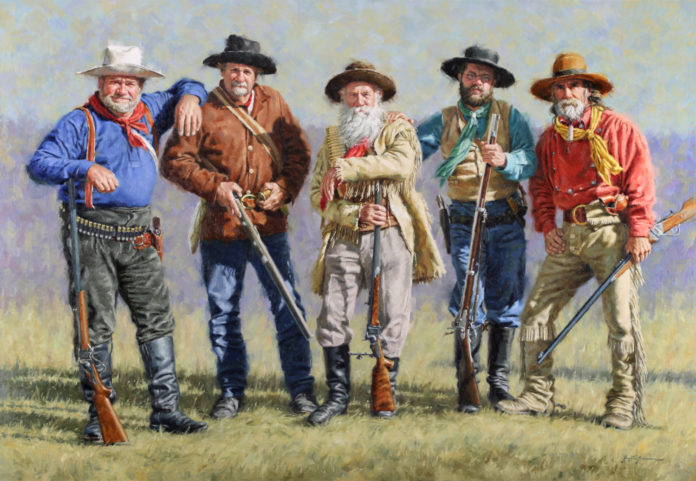
Max Ginsburg, “Unemployed on Line,” 2013, oil on canvas, 40 x 80 in. (c) Max Ginsburg 2017
The Florence Academy in New Jersey is currently hosting a great solo exhibition of realist works by this famed painter.
“Realism and Reality” — on view from January 16 through January 29 — is a compelling solo exhibition of major paintings by Max Ginsburg at the Florence Academy of Art’s New Jersey location.
Max Ginsburg, “Peace-March,” 2007, oil on canvas, 48 x 70 in. (c) Max Ginsburg 2017
The exhibition will include studies, illustrations, and major paintings by Ginsburg. On January 21, Ginsburg will host a painting-from-life demonstration, with a reception and artist talk, from 4-8 P.M.
Max Ginsburg, “Unemployed on Line,” 2013, oil on canvas, 40 x 80 in. (c) Max Ginsburg 2017
This article was featured in Fine Art Today, a weekly e-newsletter from Fine Art Connoisseur magazine. To start receiving Fine Art Today for free, click here.
Jane Jones, “Tenacity,” oil on canvas, 18 x 17 in. (c) Bonner David Galleries 2017
Stunning still life paintings by this amazing female artist will embellish the walls of Bonner David Galleries in Scottsdale, Arizona, beginning today through February 1. Who is the creator of these glorious survivors?
Featuring a stunning array of floral still life paintings at Bonner David Galleries is accomplished artist Jane Jones. On view from January 19 through February 1, “Glorious Survivors” showcases Jones’ tightly rendered floral still life paintings along with other natural and manmade objects. “Every canvas tells a story,” Jones says, “and each flower represents survival, not only as a plant, but for what that strength portrays about the human condition.”
Jane Jones, “Beautiful Soul,” oil on canvas, 34 x 19 in. (c) Bonner David Galleries 2017Jane Jones, “Survivors,” oil on canvas, 68 x 43 in. (c) Bonner David Galleries 2017Jane Jones, “Tenacity,” oil on canvas, 18 x 17 in. (c) Bonner David Galleries 2017
A special artist reception will be held this evening from 6-9 P.M. at the gallery.
This article was featured in Fine Art Today, a weekly e-newsletter from Fine Art Connoisseur magazine. To start receiving Fine Art Today for free, click here.
George Bernard O’Neill, “The Father of the Regiment,” 1877, oil on canvas, 36 x 28-1/4 in. (c) Freeman’s 2017
Doesn’t Victorian painting have such a high degree of charm and sentiment? Indeed, during the reign of Queen Victoria (1837-1901), British painting was characterized by many different styles of painting, many of which are currently enjoying renewed appreciation, says this accomplished expert.
In anticipation of Freeman’s January 23 European Art & Old Masters sale, department head David Weiss took the opportunity to muse on the renewed appreciation for the diverse works of the Victorian period in Britain, which included the Pre-Raphaelite, Classical Revivalist, and Aesthetic movements.
“Buoyed in part by a number of significant British and American museum exhibitions,” writes Weiss, “major Victorian Art auctions in the 2000s and an acknowledgment of its being undervalued as a collecting category, British narrative painting and its aims of representing the real, rather than the idealized world is experiencing a small comeback in the market — particularly for its top practitioners.
“Words that spring to mind when collectors think of traditional British Victorian pictures often include: sweet, lyrical, tender, charming and fanciful…with an added dose of moral overtone for good measure. In stark contrast to the cerebral, movement-oriented nature of non-representational contemporary art, much of Victorian painting is generally easy to read, easy to understand and very digestible; qualities that have made it too dismissible for the art cognoscenti.
“Still, finely painted examples are noteworthy, and Freeman’s auction of European Art & Old Masters on January 23 features a variety of 19th century genre paintings, including a number of British oils that tell a story; or at the very least, encourage the viewer to enter the picture space and witness the goings on amongst the figures depicted. Despite being dismissed by critics for sentimentality, the charm and bright storytelling of the Victorian painting is undeniable.
“Warmth and good spirits are fully on display in George Sheridan Knowles’s painting ‘A Love Song’ (Romance), while Charles Hunt’s ‘All the Fun of the Fair’ is a visual potpourri of dozens of Victorian figures engaged in all manner of activity on a sunny English day. The flower gathering women in Henry John Yeend King’s ‘Gathering Flowers’ maintain an almost distant, far away gaze, absorbed in thought, and in stark contrast to the sheer joy and affection conveyed between a grandfather — a retired military man — and his doting grandchildren, in the entendre-rich ‘The Father of the Regiment’ by George Bernard O’Neill.”
This article was featured in Fine Art Today, a weekly e-newsletter from Fine Art Connoisseur magazine. To start receiving Fine Art Today for free, click here.
Sherrie York, “Shadowplay,” reduction linocut, 18 x 18 in. (c) Ann Korologos Gallery 2017
Ann Korologos Gallery in Basalt, Colorado, is pleased to be presenting the works of 12 acclaimed artists during a blockbuster group exhibition. Who can you expect to see, and for how long? Find out here!
On view through February 7 at Ann Korologos Gallery, “Awards & Accolades” is a fantastic group exhibition featuring 12 of the nation’s most acclaimed Western artists. Although the gallery regularly has a roster of 32 award-winning artists, many of them natives of Colorado, “Awards & Accolades” celebrates a dozen of these creators and many of their recent honors.
Amy Laugesen, “Rustic Mare,” ceramic and steel, 24 x 25 x 11 in. (c) Ann Korologos Gallery 2017
According to the gallery, “among them are ten artists whose works will be on view in the January 2017 Coors Western Art Exhibit & Sale in Denver, including Dinah K. Worman, selected by Coors exhibition organizers as ‘Featured Artist.’”
Sherrie York, “Shadowplay,” reduction linocut, 18 x 18 in. (c) Ann Korologos Gallery 2017
The gallery continues, “Gallery artists Terry Gardner, Amy Laugesen, Leon Loughridge, Dean Mitchell, Joel Ostlind and Dan Young will be showing a diverse array of paintings, ceramic sculpture, wood block prints, watercolors and copperplate etchings. Additionally, three Ann Korologos Gallery artists have been invited to exhibit at the National Western Club, also a part of the popular Coors event: painter Andy Taylor and printmakers Paula Kraemer and Sherrie York. Many of these artists have also distinguished themselves by winning other awards in 2016.
Dan Young, “Evening Color,” oil on panel, 24 x 30 in. (c) Ann Korologos Gallery 2017
“The work of Mancos, CO sculptor and painter Veryl Goodnight, inducted into the Cowgirl Hall of Fame in 2016, will also be on view. Veryl’s lively bronzes and oils depict regional wildlife, and more recently, dog sledding.
“Rounding out the Gallery’s presentation will be paintings by Peter Campbell of Durango, CO, who won “Best in Show” in the 2015 and 2016 Aspen Plein Air Festival.”
This article was featured in Fine Art Today, a weekly e-newsletter from Fine Art Connoisseur magazine. To start receiving Fine Art Today for free, click here.
Charles Thwaites, “Abstraction-Orchard,” encaustic on paper, (c) Museum of Wisconsin Art 2017
This 20th-century painter excelled at both realism and abstraction, but he’s relatively unknown. The Museum of Wisconsin Art is seeking to change the narrative during this compelling exhibition through March.
The name Charles Thwaites may or may not be familiar, but what is certain is the beauty of his work. Opening January 28 at the Museum of Wisconsin Art in West Bend, Wisconsin, “Charles Thwaites: An American Journey” is a stunning retrospective that “seeks to introduce a new audience to a rare twentieth-century artist who excelled at both realism and abstraction” the museum writes.
“In the 1930s and 1940s, Thwaites was one of the most recognized artists in America with his paintings exhibited in many of the most prestigious galleries and museums. He was the go-to artist in Wisconsin for official portraits and executed four post office murals under the auspices of the WPA in the 1930s.
“In 1954, Thwaites and his wife Antoinette moved permanently to New Mexico, where his realist style slowly transitioned to abstraction and Thwaites became a member of the ‘Taos Moderns’ group. During the 1960s and 1970s, he concentrated on purely abstract work such as the stark black-and-white geometric series that was inspired by natural elements.
“When he died in 2002, Thwaites’ name had faded from the Southwestern art scene, as it had in Wisconsin when he moved away. Now the Museum of Wisconsin Art has the opportunity to restore Thwaites to his rightful place in twentieth-century American art.”
“Charles Thwaites: An American Journey” will be on view through March 12. To learn more visit The Museum of Wisconsin Art.
This article was featured in Fine Art Today, a weekly e-newsletter from Fine Art Connoisseur magazine. To start receiving Fine Art Today for free, click here.
Gallery owner Richard J. Demato, Photo (c) RJD Gallery 2017
Last week Fine Art Today had the pleasure of reporting on the remarkable progress of rebuilding RJD Gallery in New York after a devastating December 2016 fire. The gallery recently announced this!
RJD Gallery is proud to host the 8th annual Hampton’s Juried Art Show this spring and has just sent out its open call to artists. In addition to being a fantastic opportunity to exhibit one’s work at a premier contemporary gallery — not to mention its new space — the show will be raising funds and awareness to benefit The Retreat, a not-for-profit organization on Eastern Long Island that provides support and educational programs related to domestic violence and sexual assault.
The open call for the show invites artists to submit a minimum of two artworks, with a maximum of five. Opening night for the exhibition will be April 22, 2017. One hundred percent of the $50 submission fee will be donated to The Retreat. The deadline for submissions is March 17, 2017.
This article was featured in Fine Art Today, a weekly e-newsletter from Fine Art Connoisseur magazine. To start receiving Fine Art Today for free, click here.
John Bacon the Elder, “Bacchanalian Scenes,” circa 1770, terracotta, (c) Tomasso Brothers Fine Art 2017
These brothers have established a worldwide reputation for finding, exhibiting, and selling some of the highest-quality and rarest sculptures from the Renaissance through Neoclassical periods. This is worth a trip to the Upper East Side.
Tomasso Brothers Fine Art is returning to Manhattan in late January at Carlton Hobbs LLC. It shouldn’t come as a surprise that what they have to offer is truly magnificent, as the Tomasso brothers have long been recognized as among the best dealers and collectors of rare Renaissance and Neoclassical sculpture.
From January 19 to January 28, a number of outstanding works in terracotta, bronze, and marble will grace the spaces of Carlton Hobbs LLC. Among the highlights are a pair of exquisite terracotta relief panels depicting Bacchanalian scenes from Pompeii, created by the great English sculptor John Bacon the Elder, circa 1770. Also turning heads are a rare bronze mythological group by Massimiliano Soldani-Benzi, a newly discovered portrait bust by the Roman Neoclassical sculptor Domenico Cardelli, and a superb bronze by Gian Francesco Susini titled “The Borghese Satyr.”
John Bacon the Elder, “Bacchanalian Scenes,” circa 1770, terracotta, (c) Tomasso Brothers Fine Art 2017
Discussing the two terracotta reliefs, the brothers say, “A series of frescoes were uncovered at the so-called Villa of Cicero at Pompeii in January 1749 illustrating, amongst other subjects, the revelries of Centaurs and Bacchantes, followers of the god Bacchus. Josiah Wedgwood (1730-1795) had access to the Pompeiian models through the Marquess of Lansdowne (1737-1805). It would seem Wedgwood had the present terracotta roundels faithfully produced after the ancient prototypes around 1770 by John Bacon the Elder, one of the most prominent English sculptors of the period, who collaborated on a number of other occasions with Wedgwood.
“Highly finished, the roundels are the models from which Wedgwood’s white stoneware and black basalt versions of the Centaur reliefs were derived. They display a confident handling of anatomies and a sense of movement that fully does justice to the lithe dynamism of the original Pompeiian frescoes. The roundels constitute a rare and beautiful example of the early resonance of Pompeii’s influence. Formerly in the collection of Dr. Terry Friedman (b. Terence Friedman in Detroit, Michigan), a leading art historian and authority on 18th century architecture, keeper of decorative arts at Temple Newsam historic house (1969-1993) and later principal keeper at Leeds City Art Gallery.”
This article was featured in Fine Art Today, a weekly e-newsletter from Fine Art Connoisseur magazine. To start receiving Fine Art Today for free, click here.
William-Adolphe Bouguereau, “Bacchante Teasing a Goat,” oil on canvas, (c) Art Master Collection 2017
In this ongoing series for Fine Art Today, we take a longer look at the history and features of a soon-to-be-available artwork of note. This week’s lot was painted by arguably the greatest figure painter of all time.
Until recently, the name William-Adolphe Bouguereau (1825-1905) had long been forgotten and disregarded in the annals of history. A subject of vexed opinion and debate, Bouguereau suffered a fate similar to Rembrandt’s during the hundred years following his death in 1905, “ridiculed and banished from museums and official art circles,” as biographers Damien Bartoli and Frederick Ross express it. Bouguereau’s masterful paintings could be had for an average of $500 to $1,500 in 1960 — undoubtedly a consequence of the rapidly shifting views and definitions of art during the 20th century.
As one of history’s greatest painters of the figure, it seems opinions — and the market — for Bouguereau’s gorgeous pictures were bound to shift, and indeed, 1960 appears to have been rock bottom. Since the “swinging ’60s,” the value of Bouguereau’s paintings has exploded, doubling on average every four years. In fact, Bartoli and Ross document that in 1979 alone, prices for Bouguereau’s work quadrupled. By 2000, Bouguereau’s canvases were regularly commanding seven figures, and the desire for his works has only continued to increase.
As one of France’s preeminent academic and traditionalist painters, Bouguereau executed some 822 known paintings during his storied career, often portraying quintessential classical and mythological subjects. He frequently depicted the figure, and his ability to render the human form is unparalleled; his knowledge of anatomy and physiology surfaces with remarkable clarity, craftsmanship, and skill.
Bartoli and Ross write, “Bouguereau caught the very souls and spirits of his subjects much like Rembrandt. Rembrandt is said to have captured the soul of age. Bouguereau captured the soul of youth. Considering his consummate level of skill and craft, and the fact that the great preponderance of his works are life-size, it is one of the largest bodies of work ever produced by any artist. Add to that the fact that fully half of these paintings are great masterpieces, and we have the picture of an artist who belongs like Michelangelo, Rembrandt, and Caravaggio, in the top ranks of only a handful of masters in the entire history of western art.”
With a relatively modest starting bid of $300,000, the outstanding “Bacchante Teasing a Goat” heads to auction via the Art Master Collection in Miami, Florida. Brilliantly restored and in excellent condition, the picture’s colors seem as vibrant as the day Bouguereau applied them to the canvas. The viewer happens upon a playful, nude priestess and follower of the mythological god Bacchus as she reclines leisurely amongst forest foliage. She casually leans back, resting her weight upon her left arm as her right rises to block the powerful charge of a goat. As expected, the rendering of the subjects is absolutely stunning, especially with regard to the figure herself. The piece is charged with playful — perhaps erotic — energy and connotations, either being appropriate for the subject’s allegiance to Bacchus, the Greek god of wine, poetry, youth, and sexual excess. Auction estimates are as high as $500,000.
This article was featured in Fine Art Today, a weekly e-newsletter from Fine Art Connoisseur magazine. To start receiving Fine Art Today for free, click here.
Mark Beale grew up exploring the creeks and rivers of Tidewater, Virginia. Forty years of boating, and later intensive study and practice, has formed the basis of his art career.
“The water gets in your blood,” he says. “I didn’t know it at the time, but early on I was falling in love with the coastal landscape”.
At the age of 14, he began attending workshops conducted by Barclay Sheaks and later studied with Theodore Turner at the University of Virginia.
From Sheaks, Beale learned patience in developing his artwork and the importance of “lying in the marsh,” rather than just looking at it. To Beale this came to mean immersing oneself in the sights, sounds, feel and smell of the marsh, to become absorbed by it and literally become part of it.
After seeing the Tonalist paintings of George Inness and Jean-Baptiste-Camille Corot, Beale had an unwavering desire to pursue the Tonalism style. He first went to the Met to see the Inness works, exploring even work in the process of restoration in the backrooms of the museum. Beale then contacted the Spanierman Gallery in New York City and was allowed to hold and study under magnification many of Inness’ private works in the gallery’s collection. Later being invited to exhibit at New York City’s Salmagundi Club became one of the first pinnacles of his career. “Having my work hanging next to a glass case with Inness’ palette in it was nothing short of surreal” he says.
For the past 25 years, Beale has lived in Charleston, South Carolina with his wife Terri. His painting style continues to draw from the 19th-century Tonalist and Impressionist Schools and from his formative experiences boating, fishing, and painting on-location.
Beale’s work has been selected for numerous juried exhibitions and earned many awards, including awards from the National Parks Foundation. In 2012, two of his landscape works were chosen for the National Parks two-year traveling exhibit. At each venue on the tour, his painting “Wadmalaw River Moonrise” was the painting displayed at the exhibition entry. In 2013, he won first prize at Magnolia Garden’s national landscape competition and his work “Creekside Dusk,” which was purchased for the Magnolia Plantation permanent collection in Charleston.
Notable exhibition credits include The Gibbes Museum of Art in Charleston, South Carolina, The Coutts Museum of Art in Eldorado, Kansas, The Wildlife Experience Museum in Denver, Colorado, and the historic Salmagundi Club in New York City. His paintings are in public and private collections around the world. Beale work has also been featured in many publications including Fine Art Connoisseur and American Art Collector and he is listed in Who’s Who in American Art.
Beale is a member of the American Society of Marine Artists, the American Impressionist Society and Oil Painters of America and he has served on the Board of Directors of the Charleston Artist Guild, which conducts charitable workshops for school children and patients with Alzheimer’s disease.
“My goal is to express an emotion with each painting, a sense of atmosphere and mood. I want the viewer to feel an enveloping air and be drawn into the painting. Ultimately I would like my work to remind others of the feelings that God’s creation inspires in us.”
Beale is represented by Reinert Fine Art in Charleston, South Carolina and Blowing Rock, North Carolina. His portfolio can be viewed at bealefineart.com.
Mary Derrick, “Drifting,” 2016, oil on canvas, 18 x 24 in. (c) Mary Derrick 2017
You’ve spoken! In this occasional series, we highlight one of the most popular articles among Fine Art Today readers. In case you missed this incredible story, here’s another look at this landscape painter with a potent message.
Landscape painter Mary Derrick is an outstanding example to show it’s never too late to begin one’s love affair with art. More importantly, however, was the moment it happened, which has kept memories of the person who led her to it fresh.
Canadian painter Mary Derrick has always been artistically inclined, working in creative — albeit stressful — roles that have allowed that to surface with regularity. However, as Derrick admits, her career until recently limited the amount of time she could dedicate to her own painting and creative endeavors. “To be honest, while I had always loved art, I worked in high-stress — but thankfully creative — roles, so I have never had a lot of time to give to my art, but I have been focusing on it since 2012 and started exhibiting in 2014,” she says. “I now devote myself exclusively to it.”
Mary Derrick, “Drifting,” 2016, oil on canvas, 18 x 24 in. (c) Mary Derrick 2017
We’re all better for it as well because Derrick indeed has a lovely knack for landscape and, in particular, atmospheric light and moody space. How Derrick ultimately turned to painting more seriously is a valuable lesson to all creatively inclined individuals: It’s never too late to begin your journey. Derrick recounts this pivotal moment, which itself is a beautiful tale of companionship: “In truth, how I started painting was through my mother-in-law, who was a wonderful watercolorist. In her final days, I went to spend some time with her, and knowing that painting was her passion, I asked her to give me some lessons. Of course she obliged and since that moment my love affair with painting was ignited.”
One can only imagine the delight her mother-in-law had in passing along her vast knowledge — opening the door to another artist as her own was closing. Indeed, there can be little doubt that whenever Derrick picks up her brush and dabs it into aquamarine or vermillion red, the fond memories of her mentor are as fresh and lovely as ever.
Mary Derrick, “Daydreaming,” 2016, oil on canvas, 48 x 60 in. (c) Mary Derrick 2017
Perhaps this is part of the reason Derrick’s pictures have such a calming and nostalgic spirit to them; perhaps we’re projecting, but regardless, there is a moving softness and atmospheric quality to her work that deserves attention. This could also be a result of the painter’s creative process, which is almost entirely intuitive. Derrick suggests, “I very rarely use pictures as sources for inspiration, but instead paint from my head. I find this process freeing — about 90 percent of the work happens all at once. Over the next few days I spend some time considering the work intermittently before adding some final touches.”
Although the final works are beautiful representations, the emotions they evoke in viewers seem to dominate. “While my paintings use representations of nature, they have little to do with nature and everything to do with emotion,” the artist says. “To feel free to express the myriad of emotions we face and to let them take shape, sometimes calm and peaceful and even serene, sometimes filled with awe and reverence, and then other times with confusion, angst, or rage.”
Mary Derrick, “Water’s Edge,” 2016, oil on canvas, 30 x 48 in. (c) Mary Derrick 2017
Since beginning to exhibit in 2014, Derrick has found herself predominantly in group shows, with a few solo events in her native Canada. However, the artist seeks to explore options in the United States. In June 2017, Derrick will mount a solo exhibition — though details are forthcoming. Stay tuned!
This article was featured in Fine Art Today, a weekly e-newsletter from Fine Art Connoisseur magazine. To start receiving Fine Art Today for free, click here.
Fill your mind with useful art stories, the latest trends, upcoming art shows, top artists, and more. Subscribe to Fine Art Today, from the publishers of Fine Art Connoisseur magazine.