

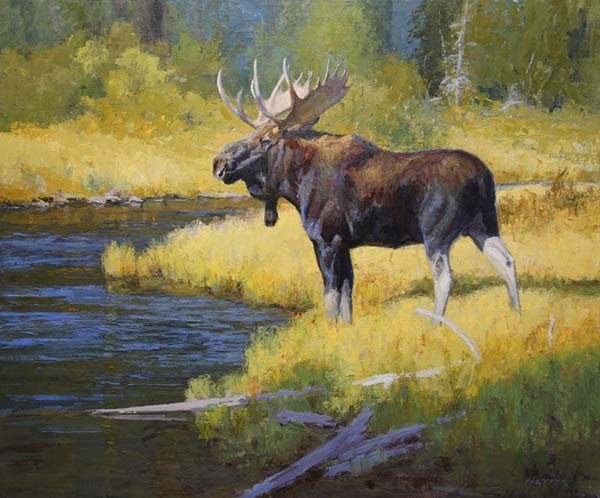
He’s one of the foremost wildlife painters working today. His paintings are rich in color and expressive in touch. This artist’s endless fascination with Western landscapes and wildlife is highlighted with intense power and beauty in a solo exhibition.
Growing up in West Texas, William Alther developed a passionate interest in art and the natural world at a very early age. Eventually this fascination led Alther to a career in zoology and wildlife biology at the Denver Museum of Nature & Science for nearly 13 years. Luckily for us, Alther began focusing on his art full-time after 2004 and has quickly risen in the ranks as one of the nation’s top wildlife painters.
His works will undoubtedly feel right at home on the walls of Legacy Gallery in Jackson, Wyoming, next month as Alther and his art are the subjects of a compelling solo exhibition. Featuring the artist’s newest works, the show will be yet another display of Alther’s command of wildlife and natural beauty in brush and paint. The exhibition will open on July 1 and run through July 10, with an artist reception on July 7.
To learn more, visit Legacy Gallery.
This article was featured in Fine Art Today, a weekly e-newsletter from Fine Art Connoisseur magazine. To start receiving Fine Art Today for free, click here.
Unlike Any Other at Legacy
Where to Find Leading Landscapes
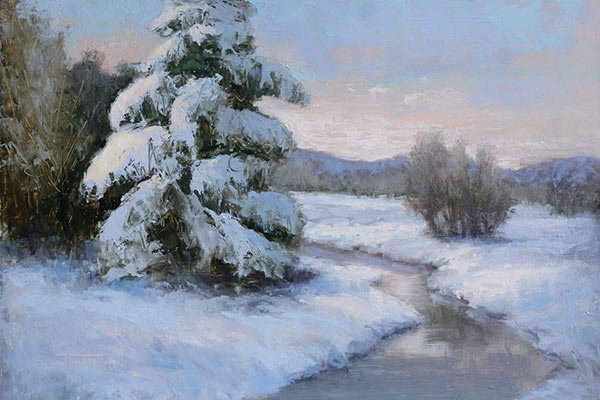
Save the date for June 10 at Abend Gallery in Denver, Colorado, as the nationally known gallery is poised to host a major group exhibition of stellar landscape painting.
Alex Beck, Sherrie York, Zhaoming Wu, and Jane Hunt are only a few of the names in an impressive lineup of artists participating in Abend Gallery’s “Landscape” exhibition. Opening June 10 and on view through July 23, the exhibition will be one of the greatest displays of variety in landscape painting in the country. In fact, the exhibition is expected to be so large that the gallery is planning two opening receptions, one on June 10 and another June 23. With works ranging from tight realism to loosened abstraction and expressionism, there will surely be something for every connoisseur to enjoy.
Also currently on view at Abend Gallery is an equally outstanding exhibition of figurative painting, which features works by — among many others — Teresa Elliott, Emilio Villaba, and Mary Chiaramonte.
To learn more about both shows, visit Abend Gallery.
This article was featured in Fine Art Today, a weekly e-newsletter from Fine Art Connoisseur magazine. To start receiving Fine Art Today for free, click here.
How to Earn $142K in Art Sales
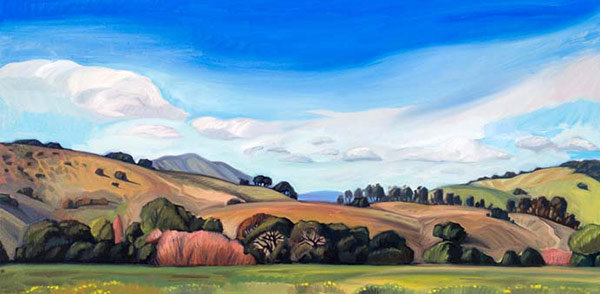
An outstanding organization that seeks to preserve the agricultural lands surrounding San Francisco, the Marin Agricultural Land Trust — or MALT — hosts a landscape art show and sale each year to raise funds for its mission. Its most recent event broke records.
Featuring nearly 40 acclaimed Marin and Santa Barbara Oak Group artists, the Marin Agricultural Land Trust (MALT) recently hosted its annual “Ranches & Rolling Hills Landscape Art Show and Sale,” which realized over $142,000 in sales — smashing previous records. Even more impressive was the fact that this total was achieved through the sale of only 110 paintings — a testament to both the skills of the artists and the support for MALT’s mission. Among the participating artists were Meredith Brooks Abbott, Susan Hall, David Perkins, Richard Schloss, Leslie Allen, Ward Walkup, Jon Francis, Jeanette Le Grue, and Dana Hooper.
Plans are already in progress for the organization’s 20th-anniversary celebration, scheduled for May 2017. To learn more, visit The Marin Agricultural Land Trust.
This article was featured in Fine Art Today, a weekly e-newsletter from Fine Art Connoisseur magazine. To start receiving Fine Art Today for free, click here.
With High Standards Comes High Art
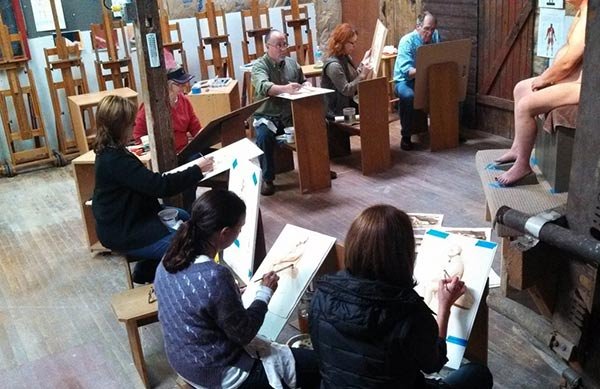
It’s the only atelier in Wisconsin to earn the prestigious stamp of approval from the Art Renewal Center. Collectors and lovers of traditional fine art should take note of this outstanding faculty/student exhibition.
The Academy of Fine Art, Wisconsin’s only ARC-Approved Atelier, will mount its annual faculty and student exhibition at Green Bay’s The Art Garage on June 2. The exhibition will feature an extraordinary range of paintings, drawings, and sculptures from the school’s artists and professors, including Lori Beringer, Marcia Brice, David Carpenter, Ken DeWaard, Jeff Hargreaves, Patrick Burke, and Mark Zelten.
To learn more, visit The Academy of Fine Art.
This article was featured in Fine Art Today, a weekly e-newsletter from Fine Art Connoisseur magazine. To start receiving Fine Art Today for free, click here.
How Tennessee Celebrates Women’s Suffrage

The establishment of a woman’s right to vote was finally realized in 1920, when Tennessee passed the 36th vote needed to ratify the 19th Amendment. Today, despite the countless important accomplishments women have made in our country, as little as 8 percent of public monuments celebrate their achievements.
The state of Tennessee and sculptor Alan LeQuire are overjoyed to be unveiling a new public monument celebrating the Women’s Suffrage movement. The sculpture will feature five figures and will be located at Centennial Park in Nashville, Tennessee. Via the press release for the monument, “Select works will be on exhibit through August at LeQuire Gallery to celebrate Alan’s broad career and his newest Public Commission. The exhibit will include clay and bronze figures, miniature to monumental, as well as some of Alan’s drawings and watercolors, and of course, his portraiture. One or two of the clay figures from the Suffragist Monument may be in the room too, providing a sneak peek of the August 26th unveiling.”
To learn more, visit LeQuire Gallery.
This article was featured in Fine Art Today, a weekly e-newsletter from Fine Art Connoisseur magazine. To start receiving Fine Art Today for free, click here.
Featured Lot: Francesco Righetti, “Apollo & Daphne”
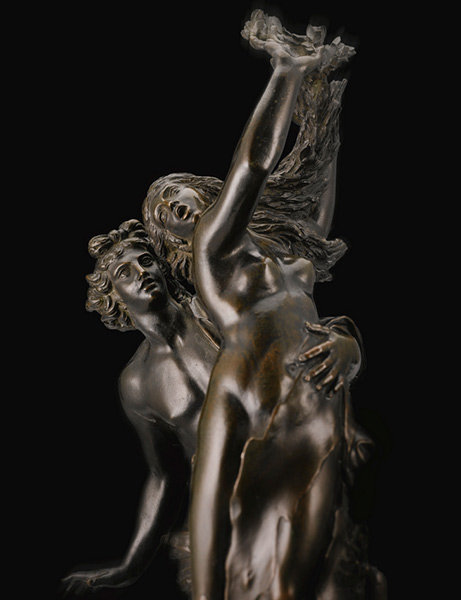
In this ongoing series for Fine Art Today, we take a longer look at the history and features of a soon-to-be-available artwork of note. This week: Francesco Righetti, “Apollo & Daphne.”
During the 17th and 18th centuries, it was fashionable for the wealthy to amass collections of exotic goods, cutting-edge technologies, scientific oddities, and exquisite art as part of their Wunderkammers or “Cabinet of Curiosities” collections. These encyclopedic collections were evidence of the owner’s expertise, intelligence, and control over the natural and man-made worlds.
An outstanding selection of artworks from a Milanese cabinet collection will be available on June 13 via Sotheby’s in Milan, Italy. Among the highlights of the auction is Francesco Righetti’s gorgeous reproduction of Gian Lorenzo Bernini’s masterwork “Apollo & Daphne” in the Borghese Collection in Rome. Although the sculptor, founder, and silversmith would receive numerous commissions from popes and monarchs during his career, it is indeed the artist’s small-scale reproductions — such as his version of “Apollo & Daphne” — for which Righetti is best remembered.
Scholar James Harper writes, “Righetti trained in the workshop of the leading Roman sculptor-silversmith of the day, Luigi Valadier, and emerged from his training as a versatile artist-craftsman in his own right. Righetti’s first major independent commission came in 1781, from the English banker Henry Hope. Hope requested twelve full-sized lead replicas of famous sculptures, which were to be painted white to simulate marble.”
The sculpture displays the dramatic mythological moment when the Olympian god Apollo attempts to capture the nymph Daphne. Overcome with hatred for the god, Daphne tries to flee. As she pleads to her father, Peneus, for help, he obliges by transforming Daphne into a tree. Bernini’s baroque masterpiece captures Daphne mid-transformation, her feet beginning to root themselves into the ground, tree bark flowing into her torso, and her fingers growing leaves. The sculpture displays a dynamic diagonal composition, heightening its dramatic impact and sense of movement. Auction estimates are between $34,000 and $56,000.
To view the full catalogue, visit Sotheby’s.
This article was featured in Fine Art Today, a weekly e-newsletter from Fine Art Connoisseur magazine. To start receiving Fine Art Today for free, click here.
Making Melancholy More
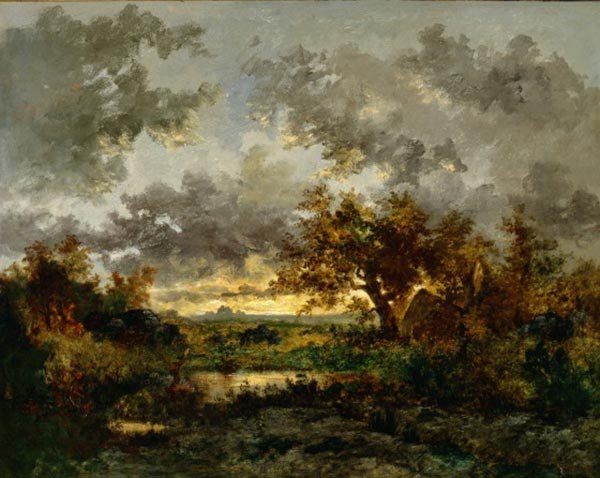
He was one of the most exciting, experimental, and affecting artists of his day, but his reputation was quickly eclipsed by the triumph of Impressionism. Over 75 gorgeous works from this French painter are on view at the Getty.
Although his paintings are often categorized as “grave” or “melancholic” in nature, Théodore Rousseau was a supremely gifted artist who was a giant among French landscape painters during the second half of the 19th century. Though he was once avidly collected for monumental prices across Europe and the United States, Rousseau’s immediate legacy fell prey to the growing taste for Impressionism in France after his death in 1867.
On view June 21 through September 11 at the Getty Museum in Los Angeles, “Unruly Nature: The Landscapes of Théodore Rousseau” will bring together some seventy-five paintings by the artist. On loan from several international galleries and private collections, “the exhibition explores the astonishing technical and stylistic variety of Rousseau’s work, revealing him to be one of the most exciting, experimental, and affecting artists of his day,” the museum reports.
The works included will feature great variety, as the artist was notorious for leaving many of his works “incomplete.” However, the term is relative because Rousseau had a reputation for spending exorbitant amounts of time developing his subjects. He left many of his works with areas fully complete while others may be underdeveloped. Although frustrating for his contemporaries and modern collectors, the state of his canvases nonetheless offers viewers insight into the artist’s unique working methods and techniques.
To learn more, visit the Getty.
This article was featured in Fine Art Today, a weekly e-newsletter from Fine Art Connoisseur magazine. To start receiving Fine Art Today for free, click here.
You’ll See Them in Hudson River Heaven
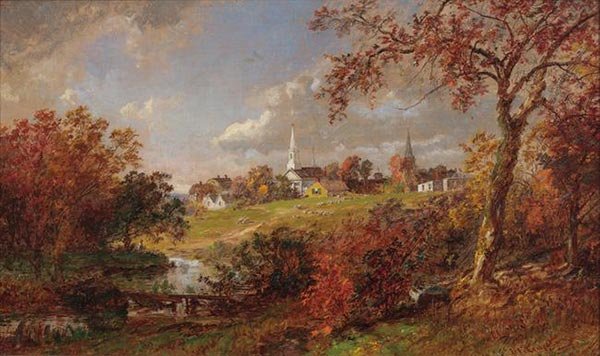
There can be little doubt that, when one sees or hears the names Cole, Heade, Bierstadt, Kensett, or Cropsey, interest is piqued.
Although the seminal artists of the Hudson River School were working well over a century ago, there still remains ample opportunity to spotlight how innovative each of them were and how their lessons continue to influence art today. On view now through June 25 at Driscoll Babcock Galleries in New York City, “The Shock of the Old: Epic Visions in 19th Century American Art” is an exciting exhibition that seeks to celebrate some of our greatest painters.
“The Hudson River School was America’s first native school of painters,” writes the gallery, “and their imagery of the unfettered American landscape probed deeply into the psychological, political and sociological manifestations of the new nation and produced some of the greatest painters of the nineteenth century.
“Today, nineteenth century American paintings are being recognized as never before with the recent renovation and reinstallation of new American galleries at major museums throughout the country, including the Metropolitan Museum of Art, the Museum of Fine Arts in Boston, the Nelson-Atkins in Kansas City, [and] the Art Institute of Chicago and the formation of major new collections including the Crystal Bridges Museum of American Art in Bentonville, Arkansas and The Minnesota Marine Art Museum in Winona. ‘The Shock of the Old’ refreshes consideration of the ‘Old,’ in the context of new perspectives and new audiences.”
To learn more, visit Driscoll Babcock Galleries.
This article was featured in Fine Art Today, a weekly e-newsletter from Fine Art Connoisseur magazine. To start receiving Fine Art Today for free, click here.
Painting With Light

Concurrent with the development and rise of the Pre-Raphaelite Brotherhood and British Impressionism in England during the late 19th century was the development of photography. How one influenced the other is a story worth telling.
On view now through September 25 at the Tate Britain, “Painting with Light” is an innovative exhibition that seeks to explore the ties between early photography and several concurrent artistic movements in Britain, including the Pre-Raphaelites, Aesthetic Movement, and British Impressionism.
Covering a time period of about 75 years — from the Victorian and Edwardian ages — “the exhibition opens with the experimental beginnings of photography in dialogue with painters such as J.M.W. Turner and concludes with its flowering as an independent international art form,” the museum suggests. “Stunning works by John Everett Millais, Dante Gabriel Rossetti, J.A.M. Whistler, John Singer Sargent and others will for the first time be shown alongside ravishing photographs by pivotal early photographers such as Julia Margaret Cameron, which they inspired and which inspired them.”
To learn more, visit the Tate Britain.
This article was featured in Fine Art Today, a weekly e-newsletter from Fine Art Connoisseur magazine. To start receiving Fine Art Today for free, click here.
Caravaggio, Enough Said?
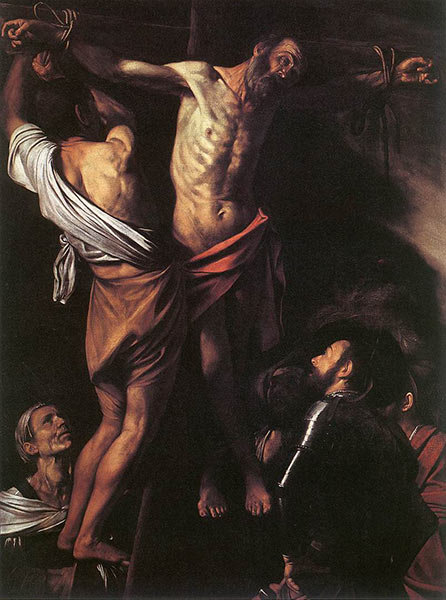
Murderer, defector, villain, painter. Caravaggio is indeed one of the most fascinating characters in the history of art. Very few of the artist’s works survive, which means any opportunity to see even one is an opportunity worth taking.
It’s been two years since the public last laid eyes on the magnificent “Crucifixion of Saint Andrew” by Baroque master Michelangelo Merisi da Caravaggio. Since 2014, the Cleveland Museum of Art has been painstakingly conserving the priceless painting, predominantly focusing on cleaning the work from edge to edge. Via the museum webpage, “This is the first time the painting has been conserved since coming to the museum in 1976. In 2014, extensive treatment began on the work, whose original paint layer was obscured by clouded, cracked varnish and retouching. The cleaning of the painting was the subject of a Conservation in Focus exhibition during the summer of 2014, when a sophisticated paintings conservation lab was constructed in the museum’s Julia and Larry Pollack Focus Gallery, where visitors were able to watch the museum’s Conservator of Paintings Dean Yoder and ask questions. ‘The Crucifixion of Saint Andrew’ returns on view May 17, 2016, in the Reid Gallery (gallery 217) in time for the museum’s centennial summer celebrations. Visitors will be able to fully appreciate the newly conserved Baroque masterpiece, the largest painting by Caravaggio in America.”
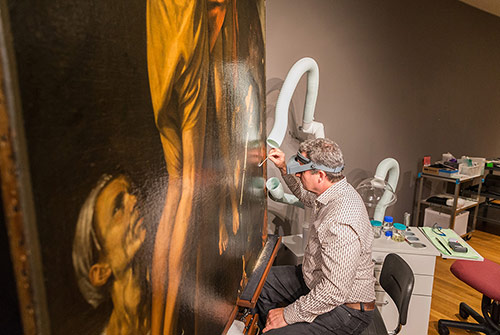
A conservator works on the masterpiece. (c) Image by David Brichford
The museum continues, “The painting depicts the martyrdom of Saint Andrew, who was sentenced to death for his missionary activity in Greece. While bound to the cross, he preached for two days to an increasingly sympathetic crowd. Finally pressured to release Andrew, his executioners were paralyzed while trying to untie him. Caravaggio portrays the moment when Andrew’s desire to be martyred has been fulfilled. In an unusual interpretation of the subject, Caravaggio presented the event as intimate and private rather than as a gruesome public spectacle.”
To learn more, visit the Cleveland Museum of Art.
This article was featured in Fine Art Today, a weekly e-newsletter from Fine Art Connoisseur magazine. To start receiving Fine Art Today for free, click here.