Home Blog Page 427

Beauty and Rebellion

0

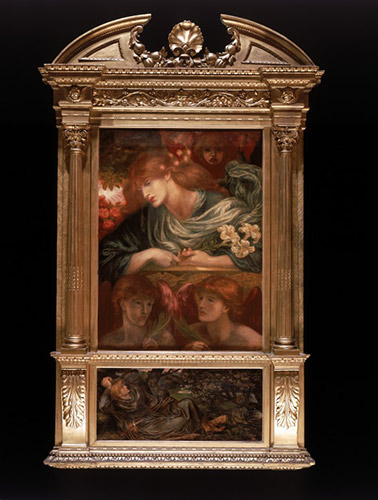
Artists of the Pre-Raphaelite movement during the 19th century were without a doubt rebellious, and produced many outstandingly beautiful works. More than 120 paintings from the group are now the subject of an exhibition in Liverpool, England, that explores the city’s role in the movement and its position as the “Victorian art capital of the north.”
 
Coining the term “Sir Sloshua” in mockery of painter and founder of the English Royal Academy of Arts Sir Joshua Reynolds, the Pre-Raphaelite Brotherhood was an artistic rebellion. Rejecting what they viewed as the corrupting and mechanistic approach of the Italian Mannerists, Pre-Raphaelite founders William Holman Hunt, John Everett Millais, and Dante Gabriel Rossetti endeavored to reform art and return to the verisimilitude, intense hues, and complex compositional strategies of the Quattrocento.


Dante Gabriel Rossetti, “The Blessed Damozel,” ca. 1875-1879, oil on canvas, 111 x 82.5 cm. (top), 36.5 x 82.5 cm. (bottom)
(c) Walker Art Gallery 2016

 
Open now at the Walker Art Gallery in Liverpool, England, “Pre-Raphaelites: Beauty and Rebellion” features more than 120 paintings from the movement’s founders — and many more by its greatest champions. Guest curator Christopher Newall said, “This exhibition will explore different aspects of patronage, art politics, and the careers of the artists who lived in Liverpool in a way that no exhibition has previously done.” What is more, the exhibition focuses on the significance of Liverpool, particularly the Liverpool Academy, in enabling the movement to flourish.
 
The gallery continues, “The exhibition will examine the relationship between artists like Ford Madox Brown and Dante Gabriel Rossetti with their Liverpool contemporaries, collectors, and the institutions that welcomed them.” “Pre-Raphaelites: Beauty and Rebellion” opened on February 12 and will remain on view through June 5.
 
To learn more, visit the Walker Art Gallery.
 
This article was featured in Fine Art Today, a weekly e-newsletter from Fine Art Connoisseur magazine. To start receiving Fine Art Today for free, click here.
 

The Figure Examined

0

Featuring some of the biggest blockbuster names in the history of art, the Tampa Museum of Art has opened an exhibition that showcases one of the most universal subjects in art: the human figure.
 
Cassatt, Degas, Giacometti, Matisse, Picasso, and Rodin are but a few of the major names featured in “Public and Private — The Figure Examined,” an irresistible exhibition at the Tampa Museum of Art that — as its title suggests — delves into each artist’s creative interpretation of the figure.
 
The works all come from the esteemed Kasser Mochary Art Foundation, a gorgeous family collection founded in 1968 by Alexander and Elisabeth Kasser. Of the exhibition, the museum writes, “Juxtaposing their diverse approaches to a common subject reveals radical stylistic changes, as well as a broad spectrum of political, philosophical, and aesthetic meanings associated with the human form.”
 
“Public and Private — The Figure Examined” opened on February 12 and will be on view through May 30. To learn more, visit the Tampa Museum of Art.
 
This article was featured in Fine Art Today, a weekly e-newsletter from Fine Art Connoisseur magazine. To start receiving Fine Art Today for free, click here.
 

Dawn’s Early Light

0

Individuals of the Jewish faith have fully integrated themselves into American public and popular culture. However, this wasn’t always the case, and the Princeton University Art Museum has recently mounted a show that delves into creative products of Jews in America during “the crucible years after the birth of the United States.”
 
During a period when personal liberties and freedoms are at an all-time high, it’s hard to imagine that at the birth of the United States, people of the Jewish faith were not accustomed to speaking for and about themselves in the public arena. An exciting exhibition has recently opened at the Princeton University Art Museum that features an eclectic range of objects produced by Jews during the late 18th and 19th centuries.
 
“By Dawn’s Early Light: Jewish Contributions to American Culture from the Nation’s Founding to the Civil War” will showcase “more than 160 books, maps, manuscripts, prints, and paintings, including some of the earliest novels, plays, scientific treatises, and religious works by Jews in the United States,” the museum writes.
 
“By Dawn’s Early Light” tells the fascinating tale of how Jewish culture evolved and assimilated into the budding American culture during these formative years. The museum suggests, “As the United States started its grand experiment with liberty, and began to invent a culture of its own, Jews, too, began a grand experiment of living as equals. In a society that promised exceptional freedom, this was both liberating and confounding. As individuals, they were free to participate as full citizens in the hurly-burly of the new nation’s political and social life. But as members of a group that sought to remain distinctive, freedom was daunting. In response to the challenges of liberty, Jews adopted and adapted American and Jewish artistic idioms to express themselves in new ways as Americans and as Jews. In the process, they invented American Jewish culture, and contributed to the flowering of American culture during the earliest days of the Republic.”
 
“By Dawn’s Early Light: Jewish Contributions to American Culture from the Nation’s Founding to the Civil War” opened on February 13 and will hang through June 12. To learn more, visit the Princeton University Art Museum.
 
This article was featured in Fine Art Today, a weekly e-newsletter from Fine Art Connoisseur magazine. To start receiving Fine Art Today for free, click here.
 

Picturing Prestige

0

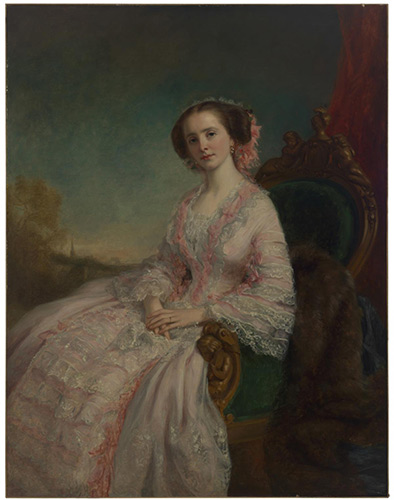
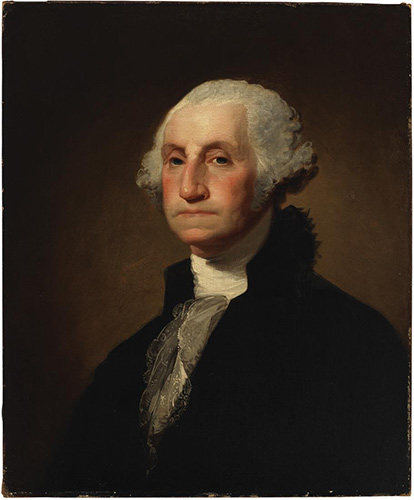
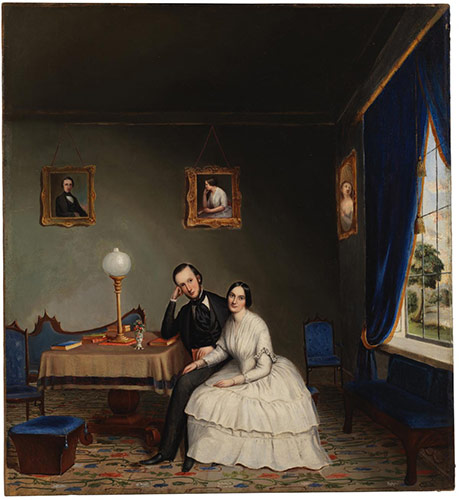
No matter the time or place, one always finds examples of individuals — and families — employing the artist to carefully craft their public images. On view now at the City Museum of New York is an exhibition that explores how 18th- and 19th- century New Yorkers used portraiture as indicators of prestige.
 
Whether it was an important marriage, an inheritance, a promotion, or simply a fashionable practice among well-to-do New Yorkers, portraiture has always provided a stage upon which to celebrate moments of significance. The outstanding City Museum of New York is showcasing a number of prudently manufactured portraits from the 18th and 19th centuries. “Picturing Prestige: New York Portraits, 1700-1860” is largely drawn from the institution’s permanent collection and gives New Yorkers a chance to learn more about their city’s historical denizens.


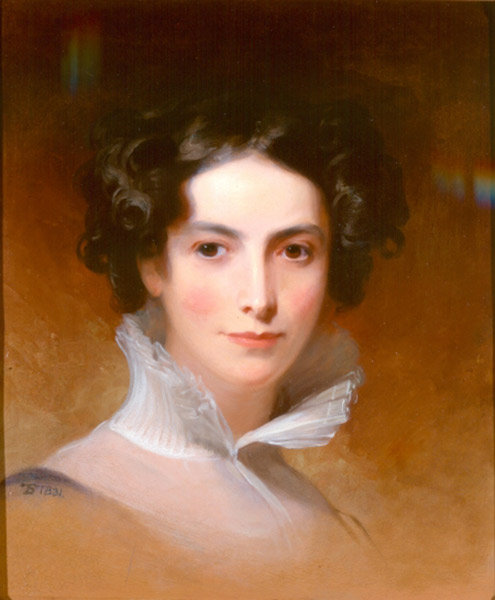
George Peter Alexander Healy, “Caroline Slidell Perry Belmont,” ca. 1855, (c) City Museum of New York 2016


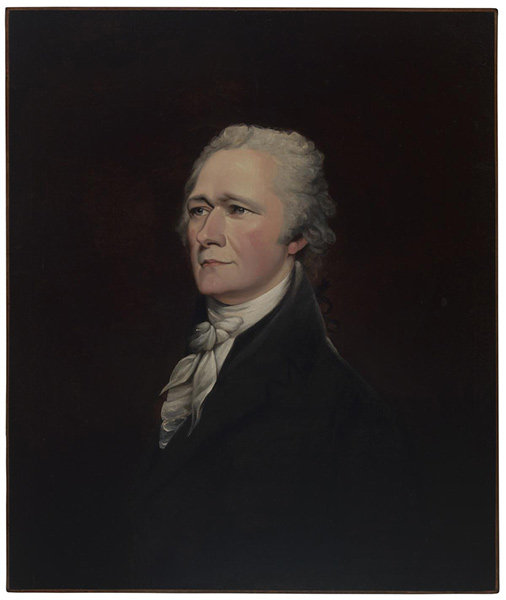
Gilbert Stuart, “George Washington,” 1796, (c) City Museum of New York 2016

 
Much of the work included in the exhibition is by “many of the leading American painters of their day and captures the aspirations of the rising, upstart merchant city as it became the most populous and the most important port in the young country,” the museum suggests. “In addition, the exhibition chronicles the changing nature of portraiture and artistic patronage, and ties together the lives of a group of leading citizens who enjoyed financial and social benefits that were beyond the reach of most New Yorkers.”


Nicholas Biddle Kittell, “Mr. & Mrs. Charles Henry Augustus Carter,” ca. 1845, (c) City Museum of New York 2016

 
“Picturing Prestige: New York Portraits, 1700-1860” opened on February 5 and will hang through November 18. To learn more, visit the City Museum of New York.
 
This article was featured in Fine Art Today, a weekly e-newsletter from Fine Art Connoisseur magazine. To start receiving Fine Art Today for free, click here.

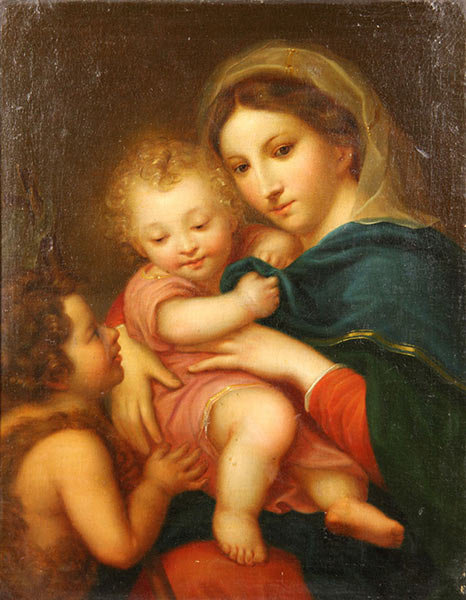
Featured Lot: Anton Raphael Mengs, “Madonna and Child”

0

In this ongoing series for Fine Art Today, we take a longer look at the history and features of a soon-to-be-available artwork of note. This week: Anton Raphael Mengs, “Madonna and Child.”
 
Anton Raphael Mengs’ (1728-1779) was the son of an established painter, and his life revolved in and around the art world from birth to death. Born in Bohemia, Mengs would spend much of career in Rome, Madrid, and Saxony painting for — among others — the Duke of Northumberland and Charles III of Spain. By 26, Mengs had established himself as a master painter in Rome and earned distinction as director of the Vatican school of painting.
 
In addition to his exquisite pictures, Mengs is perhaps best known as a champion of classical antiquity. The painter’s close relationship with Johann Winckelmann helped to reestablish Neoclassicism in painting. Mengs would produce some of his best works for Charles III of Spain, including the outstanding ceiling of the banquet hall in the Royal Palace of Madrid. Mengs also executed a magnificent copy of Raphael’s “The School of Athens” on canvas for the Duke of Northumberland.
 
Mengs’ paintings are notable for their attention to detail and a grandeur that recalls the Roman Baroque style. Indeed, some scholars see Mengs as one of the last great Baroque painter, while others declare him the first great Neoclassicist — a title the artist would undoubtedly have enjoyed.
 
Heading to the auction block via Kaminski Auctions in Beverly, Massachusetts, is a gorgeous “Madonna and Child.” The work embodies all things classical and vividly displays Mengs’ meticulous detail. A warm luminance radiates from the figures within the tender scene. Kaminski Auctions will feature the painting on February 21 during its “Unreserved Estate Auction.”
 
To view the full catalogue, visit Kaminski Auctions.
 
This article was featured in Fine Art Today, a weekly e-newsletter from Fine Art Connoisseur magazine. To start receiving Fine Art Today for free, click here.
 

The ‘Realism’ in Surrealism

0

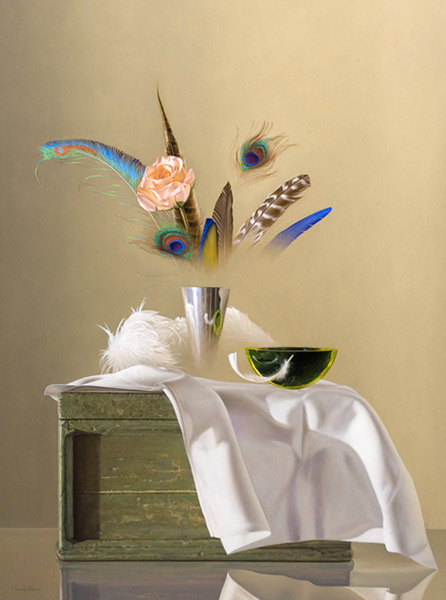
There seem to always be undertones of realism within the genre of surrealism, hence the name, and the popularity among artists and connoisseurs. Fine Art Today recently caught up with the accomplished and talented painter Jeremiah Stermer, who offered fascinating insights into his creative process and how he puts the “realism” in surrealism.
 
Artists are members of a select category of individuals who possess the ability to create what they see in the mind’s eye. For painter Jeremiah Stermer, his surrealist visions are often translated in the form of exquisitely rendered and veristic still life paintings. He works in one of two ways: Stermer’s creative process involves harnessing an idea and working it into a painting. His other method includes setting up still life compositions and developing them.


Jeremiah Stermer, “Artist’s Palette with Invisible Pear,” 2014, oil on linen, 7 7/8 x 10 3/4 in.
(c) Jeremiah Stermer 2016

 
Stermer writes, “When I lay in the background work, I am setting the stage for the final moments; like when I paint the final highlight on the edge of a thin wine glass. My version of representational oil painting is a culmination of discoveries. I like to work the thin delicate layers of paint and have them hover in micro-thin layers, playing off the neutral tinted ground – the surface of the painting support.”


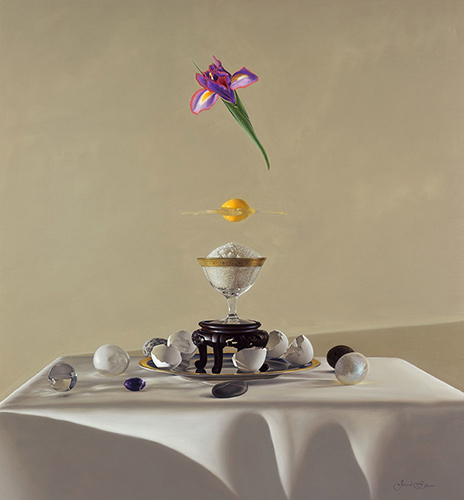
Jeremiah Stermer, “Birth of Vision,” 2005, oil on panel, 26 x 24 in. (c) Jeremiah Stermer 2016


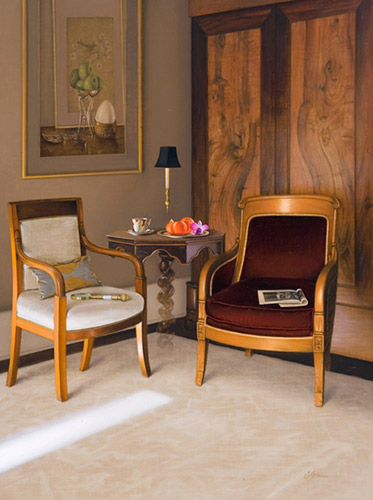
Jeremiah Stermer, “Interior 2 Chairs,” 2013, oil on linen, 13 1/2 x 10 1/4 in. (c) Jeremiah Stermer 2016

 
For Stermer, realism is employed as a means to bring to life scenes from his imagination, “half-sleep hallucinations, insight-visions, or just simply asking myself ‘wouldn’t this be fabulous if a vase and bouquet of flowers were hovering out before me in mid air?’” he says. “I use realism so my paintings make these scenes — imagined or set up — legible and tangible so that it isn’t so much about how it was painted, but how the whole scene affects you. As a realist/surrealist, I’ll paint an abstract idea clearly and solidly, and not for technical acclaim, but for the idea to have unquestionable clarity as to exactly what I mean it to look like and, hopefully, feel like.” Indeed, mood and feeling are Stermer’s ultimate artistic goals.


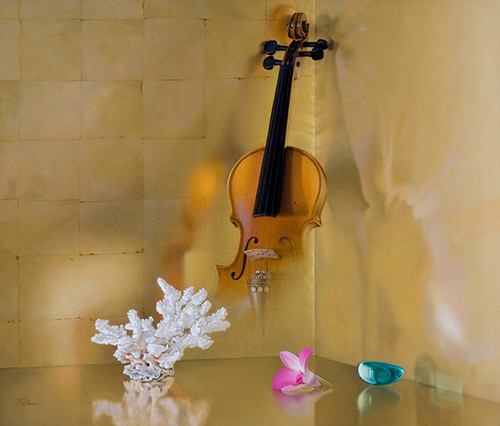
Jeremiah Stermer, “Invisible Violin,” 2014, oil on panel, 12 x 14 in. (c) Jeremiah Stermer 2016


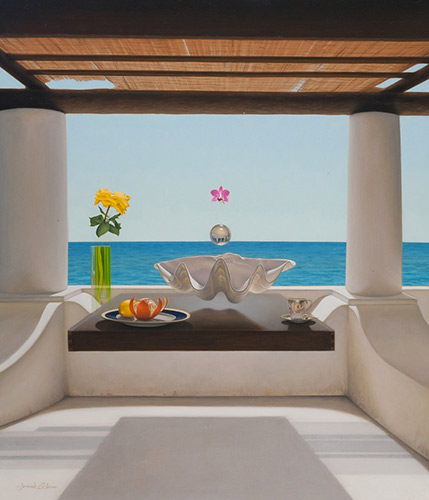
Jeremiah Stermer, “Ocean View,” 2015, oil on linen, 15 x 13 in. (c) Jeremiah Stermer 2016

 
Stermer’s use of natural lighting — of particular times and seasons — is vital toward achieving his desired mood. He writes, “My favorite lighting is bright sunny light; a certain time of year — Spring, early Summer, or September — or a certain time of day before sunset while the colors are still white and gold. I’m sure this comes from my childhood summers on the Chesapeake Bay when I spent summers with my grandparents at their shore home. The scenes in and around the house had a special light which would bounce up off the water and shimmer and dance on everything, lambently. The mood from that light is at the heartbeat of my paintings.”


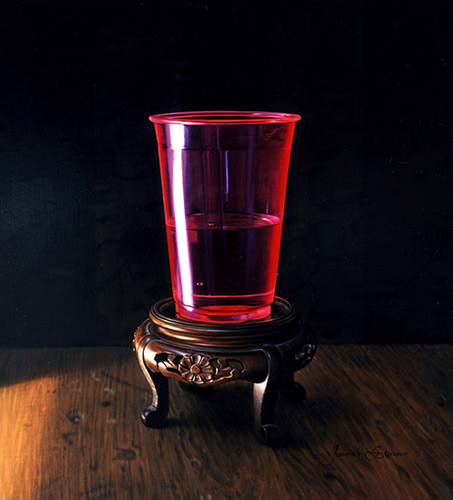
Jeremiah Stermer, “Pink Plastic Cup on Oriental Base,” 2005, oil on panel, 11 x 10 in. (c) Jeremiah Stermer 2016


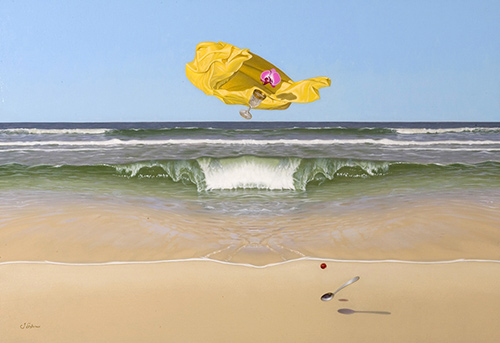
Jeremiah Stermer, “Yellow Scarf Hover over Ocean,” 2014, oil on linen, 11 x 16 in. (c) Jeremiah Stermer 2016

 
Also formative to Stermer’s approach was a near-death out-of-body experience the artist had when he was 30 years old. “I touched bliss-nirvana,” Stermer says. “It has had a wonderful effect on every aspect of my life, and certainly the passion I have toward everything I paint. I realized that having this inspired look and feel in my paintings is what I aspired to and, apparently, had always aspired to. I do everything I can, as often as possible, to promote my inner tranquility so that I may go easily into a trance-like state when I paint. Everything works best for me and the painting this way. It also makes the experience calm and enjoyable.”


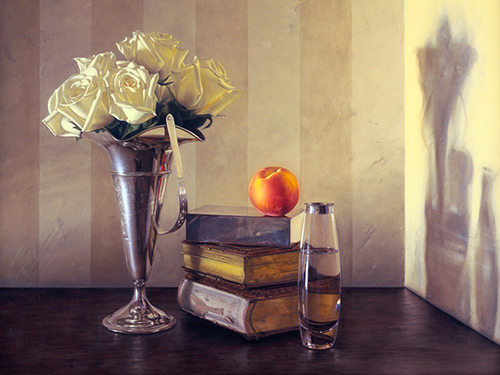
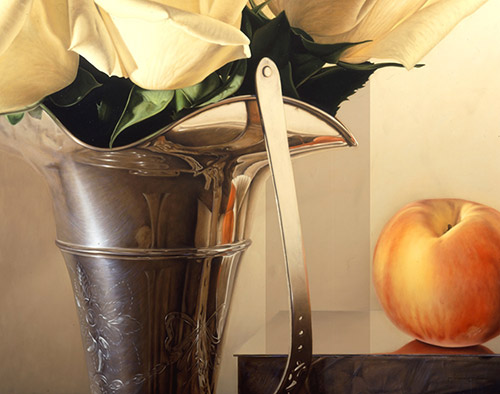
Jeremiah Stermer, “White Roses, Peach & Old Books,” 2003, oil on panel, 20 x 33 1/2 in. (c) Jeremiah Stermer 2016


Jeremiah Stermer, “White Roses, Peach & Old Books (detail),” 2003, oil on panel, 20 x 33 1/2 in.
(c) Jeremiah Stermer 2016

 
Through his delicate touch and keen observational skill, audiences can easily share in Stermer’s surrealist dreams and visions — and many like what they’ve seen. Now, at 69, Stermer has been painting for 58 years and his abilities are only improving. “As I grow over the years and my awareness matures, I see things differently and better, many of which I want to portray in paint. I assumed that as I got older my hand would diminish in ability. It has done the opposite. I see my hands painting at a level I never would have guessed I would have achieved.”
 
To learn more, visit Jeremiah Stermer.

You can also visit http://jeremiahstermerart.blogspot.com/ or the Art Renewal Center.
 
This article was featured in Fine Art Today, a weekly e-newsletter from Fine Art Connoisseur magazine. To start receiving Fine Art Today for free, click here.
 

Featured Artwork: Mark Goodson

0

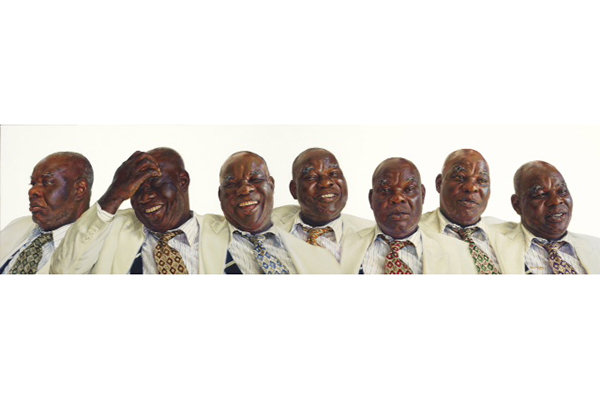
“Expressions of Quilly”
Oil on Canvas
18 x 72 in.
$19,450

www.celebrateart.com
www.markbgoodsonfineart.com
 
About the Artist:
Mark Goodson began his painting career at the age of 57. Creative since childhood, his first career was as a sign-maker – before the age of automation. Calligraphy and hand lettering provided an early passion for brush strokes.  Mark would practice for hours, turning newsprint sideways as a template for perfect spacing. His business blossomed, but signs became sterile as technology permeated the industry. He missed the human touch and yearned for the satisfaction of creation. “I came to the conclusion that I only get to be mortal once.”
 
Mark sold his sign shop and returned to school for an art degree. Convinced he would not be able to paint with oil, his biggest lesson is that the crippling force of fear can become a source of stimulating thrill when ability is buttressed by effort and experience.
 
This painting, “Expressions of Quilly” is a multiple portrait that allows the viewer greater insights into the personality of a fine subject.  Quilly is a good, kind man; devoted to his beliefs.  Though serious and determined he is quick to smile and find joy in his life.  There seems to be a harmonious flow from one image to the next, like music from one note to another.  The various expressions provide each viewer the opportunity to find the Quilly they relate to best. The uniquely delightful nature of the painting is enhanced by the different colored neckties.
 
Mark paints from life and uses photography as a convenient reference. He strives to create believable atmosphere in which “you can believe there is air moving around the elements in the painting.” He feels that painting from life builds a skill that one cannot capture from photo references. Mark’s work captures his subject’s likeness beautifully, but the magic is in the shadows of his work.

Mark believes that within all art there is drama. He alludes to live theater; in which a partially lit stage creates the question of what is in the shadows. He captures that mystery on canvas; creating interesting shadows that add strength to the image.
 
Mark exhibits his work at the annual Celebration of Fine Art in Scottsdale, AZ, which draws visitors and collectors from around the globe.
 
The Celebration of Fine Art is a unique art experience which gives visitors the opportunity to watch 100 artists in their working studios January 16 – March 27, 2016 in Scottsdale, AZ. Open daily from 10 am – 6 pm. Visitors will enjoy strolling through the 100 artist studios under the 40,000 square foot exhibit tent.  Artists are on-site creating, allowing for the visitor to watch them at work, discover what inspires them and the techniques used to create the works of art.  Come to Scottsdale to see more of Mark’s works in person and discover the stories behind each unique work of art.

www.celebrateart.com
www.markbgoodsonfineart.com
 

Living Poetic Beauty

0

Some scholars have argued that all artistic expression is simply humanity’s attempt to understand the divine: that sense of connectedness with something bigger that’s nearly impossible to articulate with words. After a severe tremor forced her to abandon the brush 25 years ago, artist Mary Jane Q Cross now uses her fingers to fulfill her life’s desire to paint and become closer to God.
 
Whether one identifies with religion or not, it’s impossible to deny that the paintings by Mary Jane Q Cross (b. 1951) capture a powerful spirit that is absolutely hypnotic. “I look for subjects that are going to carry me through weeks of painting,” Cross says. “It has to be captivating, with nobility and underlying narrative beauty.” Frequently choosing female subjects arrested in thought or prayer, Cross’s paintings evoke a quiet stillness and peace that encourages viewers to sense both divine and visual spirituality. Cross suggests, “My viewers uncover, discover, and find it in my paintings. Whether they are spiritual or secular, the impact is the same.”
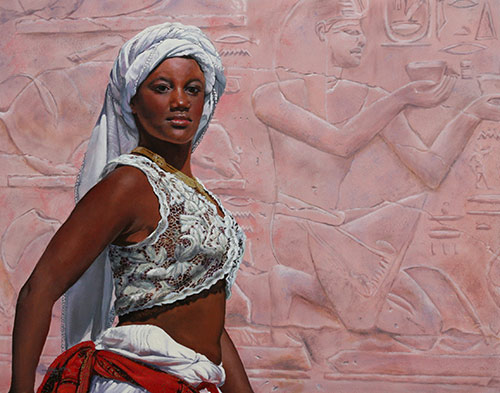


Mary Jane Q Cross, “Study for the Queen of Sheba, I Serve the God of Solomon,” oil on panel, 22 x 28 in.
(c) Mary Jane Q Cross 2016

 
Cross’ work also has a special touch, literally. About 25 years ago, the artist began to suffer from a severe tremor, which forced her to abandon the brush. Since then, Cross employs her fingers to impart paint onto the canvas. The tranquility of her subjects seems to echo the artist’s inner peace and faith. “Knowing exactly where to place paint has been vital,” she says. “I cannot ‘load a brush’ nor move it around much once it’s applied. The right amount of paint for the strokes, color, and value is deliberate. If a situation forces you to abandon your tools, find a way to fall on your knees and ask how to continue. Life is not so much a snapshot as it is a video. It took 5 1/2 years to relearn my craft as a ‘living/dead’ artist. There was always a sense of how to reinvent and how to get the work done. Spiritually and physically, there was an answer. Finding the right path to accomplish this was more of a larger-than-life movie than a video.”
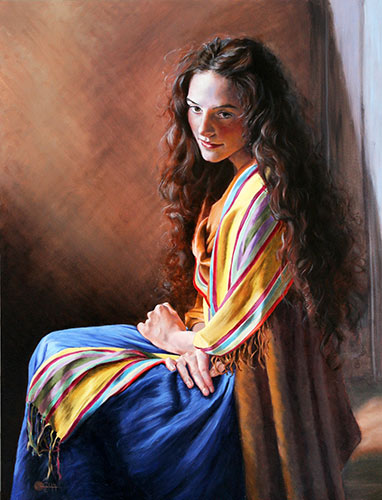


Mary Jane Q Cross, “Grace Wrapper in this Life of Many Colors,” oil on panel, 30 x 26 in. (c) Mary Jane Q Cross 2016

 
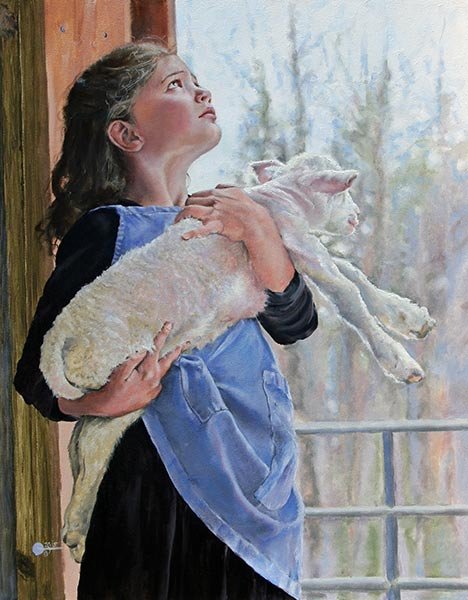
Recalling the realization and process behind her tremendous “I Have the Perfect Lamb, Lord,” Cross explains, “Usually there is something pivotal that sets off actual inspiration, and in this case, I had a local farmer unexpectedly call and say, ‘MJ, lambs have been born, you only have a few days before they’re too feisty for an 8-year-old.’ I jumped and began to assemble costumes and props and think of ways to keep my model warm! On a personal note, my close friend’s husband was losing a battle for his life. The emotional response to my friend’s impending loss was painted with every fingerprint I pressed, every prayer we prayed, and every tear spent. He passed while I was working on this piece. My response to nearly all things is to pray and paint. The quiet seriousness of those days is tender in this earnest, narrative work.”
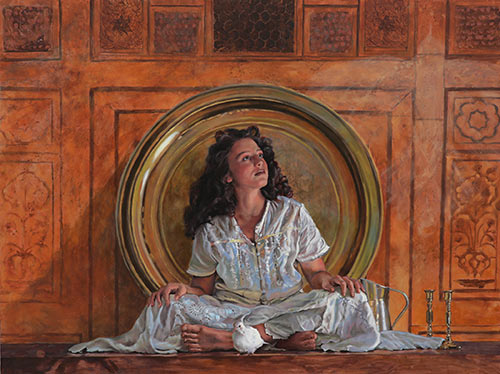


Mary Jane Q Cross, “The Contemplative,” oil on panel, 30 x 40 in. (c) Mary Jane Q Cross 2016
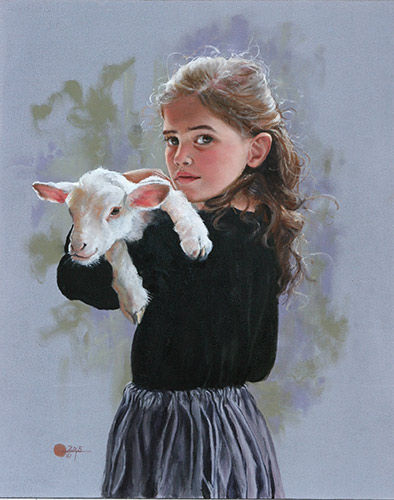

Mary Jane Q Cross, “The Meek Shall Inherit the Earth,” oil on panel, 20 x 16 in. (c) Mary Jane Q Cross 2016

 
In addition to her visual endeavors, Cross is also a published poet.  Her book, Poems of a Painter, Paintings of a Prayer”, is now in its third printing.  The next edition will include 40 additional poems along with paintings that have accompanying essays. 
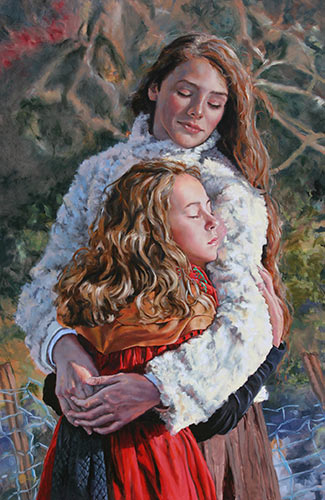


Mary Jane Q Cross, “Tender Hands in Trying Times,” oil on panel, 40 x 26 in. (c) Mary Jane Q Cross 2016

 
At 64, Cross understands that her time to paint won’t last forever. “I’ve always said — and believed — that I would need three lifetimes to paint half of the paintings I envision. Choosing paintings that are worthy to be painted is a new and softly nagging consideration,” the artist says. “Speaking engagements are ever increasing, and making time for those has been a strong way to give back to the industry. Also, national and international competitions still hold great joy for me and allow me to work with larger formats that galleries are not always comfortable with. My personal and direct contact with viewers has been very successful, and it’s always about relationships.”
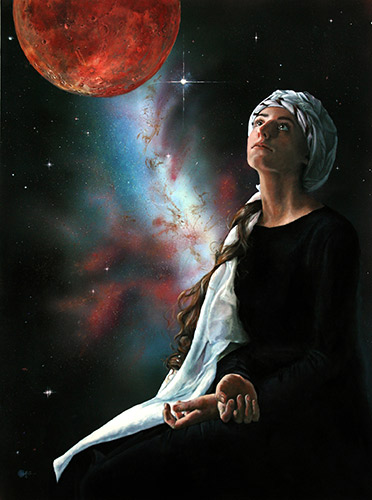


Mary Jane Q Cross, “Blood Moon Rising,” oil on panel, 40 x 30 in. (c) Mary Jane Q Cross 2016

 
To learn more, visit Mary Jane Q Cross.
 
This article was featured in Fine Art Today, a weekly e-newsletter from Fine Art Connoisseur magazine. To start receiving Fine Art Today for free, click here.

Featured Lot: John Emms, “Hounds and a Terrier in a Kennel”

0

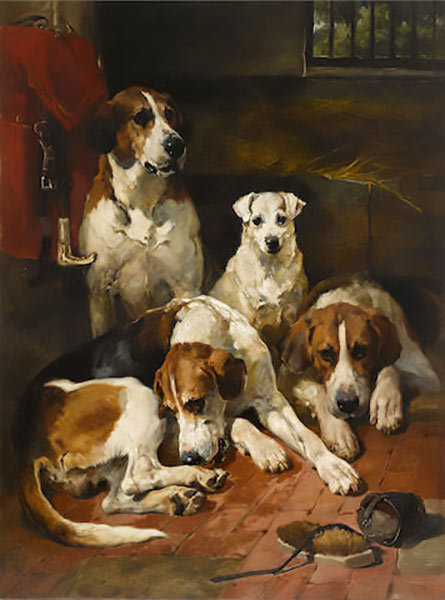
In this ongoing series for Fine Art Today, we take a longer look at the history and features of a soon-to-be-available artwork of note. This week: John Emms, “Hounds and a Terrier in a Kennel.”
 
Dogs won’t be just man’s best friend, but the art collector’s as well on February 17 at Bonham’s in New York City. With estimates starting at $150,000, John Emms’ (1841-1912) “Hounds and a Terrier in a Kennel” will be one of the evening’s highlight lots.
 
Born in Norfolk in 1841, Emms made a successful career painting animals, particularly horses and dogs. An avid hunter, Emms undoubtedly had an close familiarity with his canine partners, and his bond with the animals surfaces in the individualistic and delicate treatment of his subjects. Bonhams writes, “What we know of Emms is almost as interesting as the painting itself. Born on April 21st 1841 at Blofield, Norfolk, he was the son of Henry William Emms, an amateur artist. Emms had two brothers and a sister, the eldest of which married the brother of Sir William Richmond P.R.A. Like all aspiring artists, Emms travelled to London where he became an assistant to Frederic Lord Leighton P.R.A. It was through Leighton that Emms first visited Lyndhurst when he assisted the former to paint a fresco in Lyndhurst Parish Church. He then made his debut at the Royal Academy in 1866 and proceeded to exhibit elsewhere at the British Institution, Royal Society of British Artists and the New Watercolour Society.”
 
Emms’ “Hounds and a Terrier in a Kennel” is perhaps one of the artist’s favorite — and most celebrated — subjects. Within a warm, tightly cropped space, four dogs patiently await their master’s orders. A bright glow emanates from the subjects and each has a lovely degree of individuality and character. Three of the dogs engage the viewer with relaxed gazes as the largest dog — sitting toward the upper left of the canvas — seems attentive and eager as it gazes out of the picture frame.
 
“Hounds and a Terrier in a Kennel” will feature during Bonham’s February 17 “Dogs in Show and Field” auction at 10 AM Eastern. To view the full catalogue, visit Bonhams.
 
This article was featured in Fine Art Today, a weekly e-newsletter from Fine Art Connoisseur magazine. To start receiving Fine Art Today for free, click here.

 

The Tasteful Eye

0

Over the past 20 years, the Sterling & Francine Clark Art Institute in Massachusetts has been amassing a robust collection of world-class painting, sculpture, decorative arts, drawings, prints, and more. A current exhibition celebrates this period of tasteful selection.
 
With nearly 10,000 objects to account for, the Williamstown, Massachusetts, museum referred to as The Clark boasts a powerful collection — a quarter of which was acquired in the past 20 years. The Clark suggests, “The Institute acquires works of art through purchase and by gift and adheres to the standard of excellence that is a legacy of its founders, Sterling and Francine Clark. This exhibition features highlights of acquisitions made between 1995 and the present and tells stories of how and why these objects have become part of the Clark’s collection. The works in the exhibition, housed in the Clark Center galleries—together with additional acquisitions from this time period on display in the Museum Building—tell a story of how a strong collection has become even stronger through the actions of the institute and its generous donors.”
 
“An Eye for Excellence: Twenty Years of Collecting” will be on view through April 10. To learn more, visit The Clark.
 
This article was featured in Fine Art Today, a weekly e-newsletter from Fine Art Connoisseur magazine. To start receiving Fine Art Today for free, click here.
 

WEEKLY NEWS FROM THE ART WORLD

Fill your mind with useful art stories, the latest trends, upcoming art shows, top artists, and more. Subscribe to Fine Art Today, from the publishers of Fine Art Connoisseur magazine.

  • This field is for validation purposes and should be left unchanged.