

Home Blog Page 444

A Place in the Sun

0

Two painters, driven by their friendship and mutual passion for art, would help define American art in the 20th century. Both finding their homes in Taos, New Mexico, the story of Walter Ufer and E. Martin Hennings takes center stage at the Denver Art Museum.
 
The tale behind two founding fathers of American Western painting, Walter Ufer and E. Martin Hennings, forms the center of an amazing exhibition at the Denver Art Museum. “A Place in the Sun” will open December 13 and chronologically explore the artists’ lives, artistic evolution, and lifelong friendship. Both artists established deep connections with New Mexico’s rich Native American and Hispanic cultures, which surfaced with frequency in their choice of subject matter. “Even though the artists painted similar subjects,” the museum writes, “their artistic styles truly differentiate their work. Ufer painted alla prima, in which layers of wet paint are applied to previous layers of wet paint. Hennings adopted the German style of art nouveau called jugendstil, which is inspired by curved lines and the natural forms in flowers, plants, and trees.”


Walter Ufer, “Going East,” 1917, oil on canvas, 51 x 51 in.
(c) Philbrook Museum of Art & Fred Jones Jr. Museum of Art, 2015

 
As the first major exhibition of the two artists, the show is a must-see and sure to delight, especially Hennings’ “A Friendly Encounter,” circa 1922. Not only will the brilliant yellows found within the birch tree leaves impress the viewer, but at 40 x 50 inches, the size will, too. Located in the foreground and at the bottom right of the canvas, two Native American subjects converse while sitting on their horses. Just beyond the tree line, another figure on horseback trots through the shadow. Hennings’ jugendstil style really comes to the fore in “A Friendly Encounter,” as hardly a straight line exists in the piece. Despite the rather static subject, the painting ebbs and flows with movement, the eye excited by the plethora of organic, wavy lines.
 
“Going East” by Ufer is equally as stunning, but also displays the artist’s penchant for loose, expressive brushwork resulting from his alla prima technique. The main subject of the work, a female in the left foreground, displays a dazzling bright-blue cape that gracefully drapes over her head and shoulders. Closer inspection of the garment reveals an intricate –- almost impressionistic –- play between strokes of blue and green. This type of brushwork is repeated through the work, most notably in the blue sky and puffed clouds.
 
“A Place in the Sun: The Southwest Paintings of Walter Ufer & E. Martin Hennings” will be on view through April 24.
 
To learn more, visit the Denver Art Museum.

This article was featured in Fine Art Today, a weekly e-newsletter from Fine Art Connoisseur magazine. To start receiving Fine Art Today for freeclick here.
 

All Quiet in the Louvre

0

Nearly two weeks after the deadly terrorist attacks that killed 129 people in Paris, the city’s greatest monuments, and museums, remain eerily empty.
 
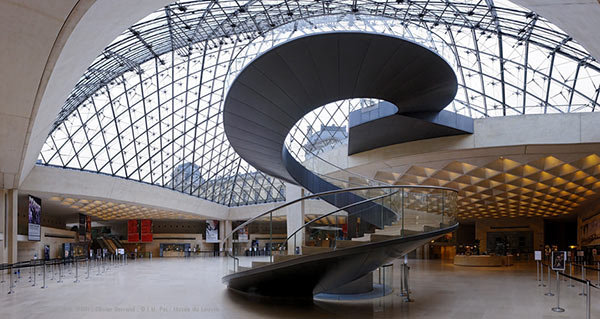
Anyone who’s ever laid eyes on Leonardo da Vinci’s famed “Mona Lisa” at the Louvre Museum, Paris, has likely viewed it from a distance or fought their way through hundreds of visitors to get within 10 feet of the masterpiece. Two weeks after the deadly attacks, in which terrorists gunned down hundreds of innocent people, the scene within the world-famous museum is quite different: it’s virtually empty. Perhaps stemming from fear of additional attacks, many tourists and locals alike appear to be avoiding potential targets, and the Louvre Museum is no exception. Rather than the typical stampede of eager art lovers seeking to get a glimpse, visitors to the museum today will have virtually unabated access to the entire complex’s robust collections.
 
As the city, and the world, continues to recover from the violence, the halls of the Louvre will eventually bustle once more, but it is undeniable that the most recent attacks have had a profound impact on Parisian society, politics, and culture.

This article was featured in Fine Art Today, a weekly e-newsletter from Fine Art Connoisseur magazine. To start receiving Fine Art Today for freeclick here.
 

Addison Art Celebrates 20 Years

0

Addison Art Gallery has much to be thankful for, including a robust stable of talented artists, a host of outstanding exhibitions, and two decades of “beauty, friends, and fun.”
 
Located in the heart of Orleans, Massachusetts, Addison Art Gallery has been one of Cape Cod’s most active fine art institutions. On November 28, the gallery will host a celebration in light of 20 years of operation. Featuring live music from The Dan Sullivan Trio, a host of artists and friends, and, of course, magnetic art, the celebration is sure to be one to remember. As a gesture of good fortune and gratitude to the self-sustaining Orleans community, the gallery has offered to donate a portion of all sales between November 27 and November 29 to Lower Cape Outreach, which “provides emergency food, clothing and financial support” to the region, as the gallery states.
 
To learn more, visit Addison Art Gallery.

This article was featured in Fine Art Today, a weekly e-newsletter from Fine Art Connoisseur magazine. To start receiving Fine Art Today for freeclick here.

A Moment Held in Time

0

Born with a love for nature and art, painter Jhenna Quinn-Lewis has established herself as one of the country’s preeminent contemporary painters through her skillfully executed still-life and feathered subjects. Where can you catch her most recent works?
 
In a similar way to mathematics, art is a language that can be understood universally. The aesthetic sense –- the ability to appreciate ordered form and beauty –- is a hard-wired facility each of us possesses. There is something elemental or fundamental about art in the way it can investigate our understanding of nature and the mystery of life. These are precisely the key motivations for painter Jhenna Quinn-Lewis, who has always felt the need to express, explore, and create on canvas.


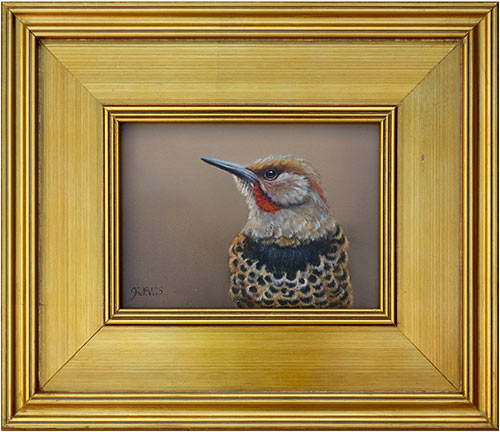
Jhenna Quinn-Lewis, “Flicker,” oil, 5 x 7 in. (c) Meyer Gallery, 2015

 
Opening on December 18 at the outstanding Meyer Gallery in Santa Fe, New Mexico, is a solo exhibition of Quinn-Lewis’ recent works, and they’re sure to delight. Featuring 41 paintings, the exhibition will undoubtedly showcase Quinn-Lewis’ penchant for still life and birds, each of which are executed with care and keen observational skill.


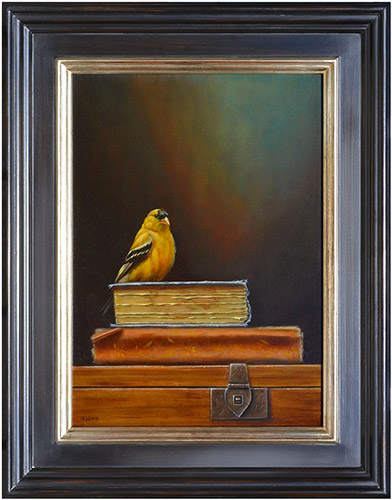
Jhenna Quinn-Lewis, “Book Critic,” oil, 16 x 12 in. (c) Meyer Gallery, 2015

 
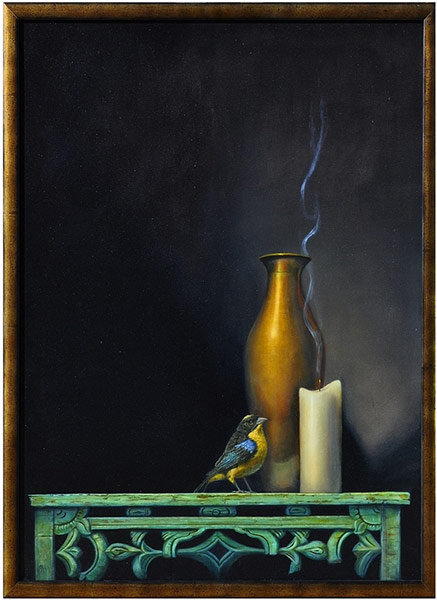
Several examples, such as “As the Evening Passes,” combine both birds and still life in unique and creative ways. Set against a dark unpopulated background, a gorgeous black, blue, and yellow bird stands on an ornately carved green tabletop. At near center, the feathery subject is accompanied by a copper vase and extinguished candle. Although interpretations are subjective, the extinguished candle –- its wick still glowing and emitting wisps of silky smoke –- often symbolize the passing of time, death, corruption, or the loss of virginity. Be that as it may, feathers and, more importantly, birds, could connote resurrection, hope, and faith. If granted, the piece would be a beautiful juxtaposition of triumph over death or hope over despair. Other works, such as “Flicker,” are small portraits of birds majestically presenting their beauty in profile. The subject here displays brilliant red highlights beneath the beak, with a black chest and spotted torso.
 
“Jhenna Quinn-Lewis: New Works” will hang through December 31.
 
To learn more, visit Meyer Gallery.

This article was featured in Fine Art Today, a weekly e-newsletter from Fine Art Connoisseur magazine. To start receiving Fine Art Today for freeclick here.

A Secessionist’s Muse

0

Where did our modern notions of sexual identity originate? How was the traditional relationship between the sexes challenged during the early 20th century? These questions and more are the foundations of a stunning exhibition at the Belvedere in Vienna.
 
Gustav Klimt, Egon Schiele, and Oskar Kokoschka were undoubtedly three of the most outstanding painters of Viennese Modernism during the late 19th and early 20th centuries. In their own unique styles, each artist was, and is, known for their artistic research into the “woman question,” producing provocative works that commented on sexual liberation and sought to escape moralist taboos. On view now at the gorgeous Belvedere in Vienna, Austria, “The Women of Klimt, Schiele and Kokoschka” presents a tantalizing view of how each artist individually navigated the “woman question” through a world-class collection of masterpieces. The museum also “provides insights into the relationship between the sexes in the early 20th century, elaborating on the origins of modern sexual identity.” 
 
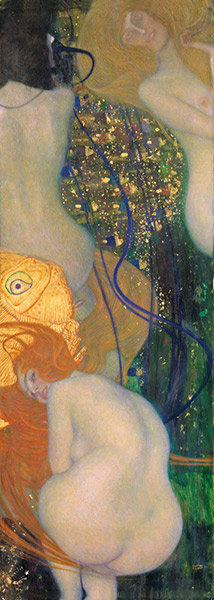
Klimt’s “Goldfish” of 1901-1902 is a highlight of the show and a sight to behold. In a strong, slender vertical format, the viewer finds three nude female subjects among a gorgeous arrangement of abstract, organic lines, colored patterning, and gold leafing. The main subject, located at the bottom, faces away from the viewer but turns to look over her shoulder at the viewer with an inviting gaze. Her brilliant orange hair instantly becomes part of a yellow form –- reminiscent of a goldfish. Moving up the picture, the second female subject again faces away from the viewer, her profiled face barely visible. Finally, the third figure occupies the upper-right corner, facing the viewer and peering outside towards our position. The expression, range of patterning, and color are truly revolutionary and absolutely unique.
 
“The Women of Klimt, Schiele and Kokoschka” opened on October 22 and will be on view through February 28.
 
To learn more, visit the Belvedere.

This article was featured in Fine Art Today, a weekly e-newsletter from Fine Art Connoisseur magazine. To start receiving Fine Art Today for freeclick here.

The Golden Age of Vermeer

0

The Royal Collection is regarded as one of the finest gatherings of art in the world. Although known for its range and diversity, the collection is particularly strong in painting from the Dutch Golden Age (spanning roughly the 17th century), 27 of which are on view now at the Queen’s Gallery.
 
Skilled in capturing the subtle effects of light in paint and nearly perfect naturalists, painters of the Dutch Golden Age were masters of everyday –- perhaps ordinary –- subjects. In a striking break from the traditional, highly religious content of artworks in southern Europe, Dutch painters, and their patrons, preferred to celebrate their simple, prosperous way of life through exquisite still life, landscape, portraiture, and genre works.


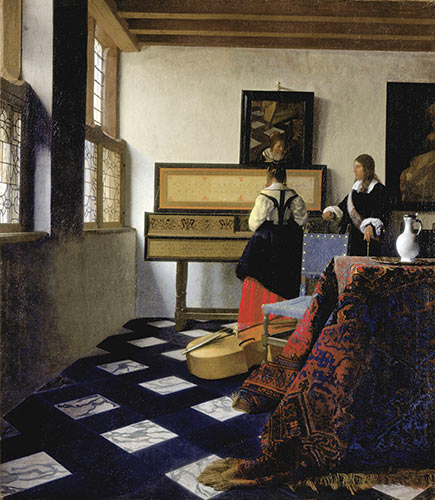
Johannes Vermeer, “The Music Lesson,” ca. 1662-1665, oil on canvas, 74 x 64.6 cm. (c) The Royal Collection Trust,
Her Majesty Queen Elizabeth II, 2015

 
Boasting one of the most extensive collections of Dutch Golden Age painting, the curators of The Royal Collection often loan these precious works to museums all over the globe, as almost every culture has found much to appreciate through the ordinary subjects and exquisite detailing. Be that as it may, 27 masterpieces from the collection have been carefully selected for “Masters of the Everyday: Dutch Artists in the Age of Vermeer,” which debuted at The Queen’s Gallery at Buckingham Palace earlier this month.
 
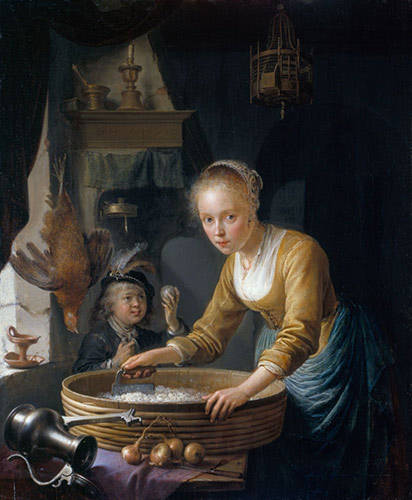
As expected, the exhibition features the biggest names from the period, including Gerrit Dou, Gabriel Metsu, Jan Steen, Pieter de Hooch, and, of course, Johannes Vermeer. From the exhibition website: “While the subject-matter may be ordinary –- the preparation of food, eating and drinking, the enjoyment of music or a family game -– the painting is rich and jewel-like, with equal attention paid to a discarded pipe as to a fine silk drape. The meticulously documented details often allude to a work’s deeper meaning, or to moral messages that would have been familiar to the contemporary viewer.”


Gerrit Dou, “A Girl Chopping Onions,” 1646, oil on panel, 21 x 16.8 cm. (c) The Royal Collection Trust,
Her Majesty Queen Elizabeth II, 2015

 
Paintings by Vermeer are, without a doubt, highlights of any exhibition in which they’re included, and it is no different here. Although it would be hard to distinguish a hierarchy of Vermeer’s surviving 34 works, “The Music Lesson” of 1662-1665 is arguably one of his best. Characteristic of the painter’s work, we find two subjects –- a male teacher and female student –- within a well-lit interior. No detail has been omitted, from the individual strands and knots of the rug in the foreground, to the marbling in the quintessential checkered floor, to the intricate inlay on the girl’s virginal. So accurate and detailed is the painting that it could be read as more photographic than painterly. Regardless, the work stands as one of the finest examples to have survived from the Golden Age.


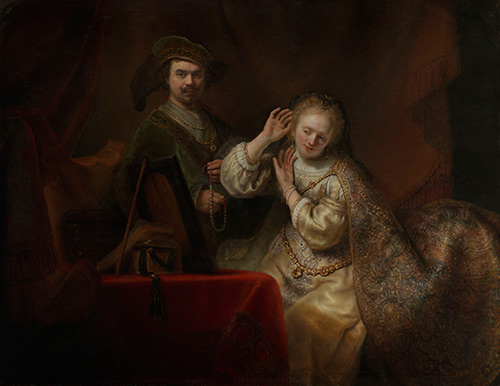
Attrib. Ferdinand Bol, “Rembrandt and Saskia,” ca. 1638, oil on canvas, 154 x 200 cm. (c) The Royal Collection Trust,
Her Majesty Queen Elizabeth II, 2015

 
“Masters of the Everyday: Dutch Artists in the Age of Vermeer” opened on November 13 and will hang until February 14. In September 2016, the exhibition will travel to the Mauritshuis, the Hague.
 
To learn more, visit The Royal Collection Trust.
 
This article was featured in Fine Art Today, a weekly e-newsletter from Fine Art Connoisseur magazine. To start receiving Fine Art Today for freeclick here.
 

An Enemy of Progress

0

As the world progresses relentlessly into the future, constantly striving for the bigger and better, Conor Walton uses paint to remind us all of the fragility of our world.
 
On display through December 7 at the outstanding CK Contemporary is a fascinating solo exhibition of paintings by Conor Walton, a man whose artistic mission is to cultivate a broader perspective among his viewership. A self-described “enemy of progress” — alluded to in the title of the show — Walton views culture as simply a “façade,” a modern ruse that distracts the masses from the larger, more natural forces that may ultimately shape our destiny.
 
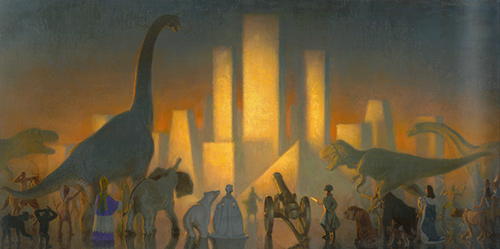
Relying on nature for his representational works, Walton’s concept eagerly comes to the fore in the aptly titled “The Enemies of Progress,” which displays a diverse arrangement of extinct species, old gods, and more. The gallery writes, “The assembled figures stand for all those whose beliefs, values, and ways of life are threatened with obsolescence; those whose very existence is undermined by the ‘March of Progress.’ They are preparing to attack a gleaming but generic cluster of architectural forms, a blank, featureless utopia that resembles a modern city skyline. ‘The Enemies of Progress’ is a principled, courageous, and darkly comical painting. As in all of Walton’s work, the strain of humor is extremely pointed: it is a serious humor infused with tragedy.”


Conor Walton, “The Enemies of Progress,” oil on linen, 24 x 48 in. (c) CK Contemporary 2015

 
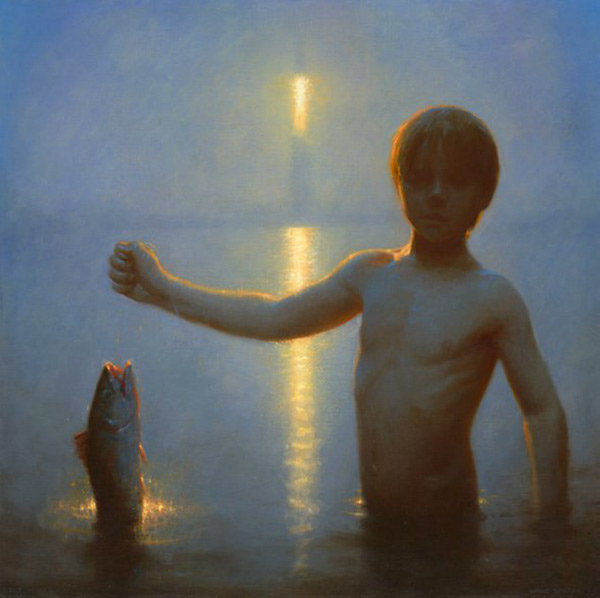
However relevant Walton’s concept may be, the messages are communicated with extreme beauty. “Phaethon” is a gorgeous painting displaying an adolescent boy waist-deep in water. The subject holds his left arm out, displaying for the viewer a fish attached to a line. Along the horizon, a large architectural form rises from the haze, its peak brightly illuminated. The naturalism and luminance are absolutely stunning.
 
Whether through the works’ profound beauty, weighty message, or both, the exhibition is sure to delight viewers over the next few weeks. “The Enemies of Progress” will be on view at CK Contemporary in San Francisco, California, through December 7.
 
To learn more, visit CK Contemporary.
 
This article was featured in Fine Art Today, a weekly e-newsletter from Fine Art Connoisseur magazine. To start receiving Fine Art Today for free, click here.
 

Pure Presence

0

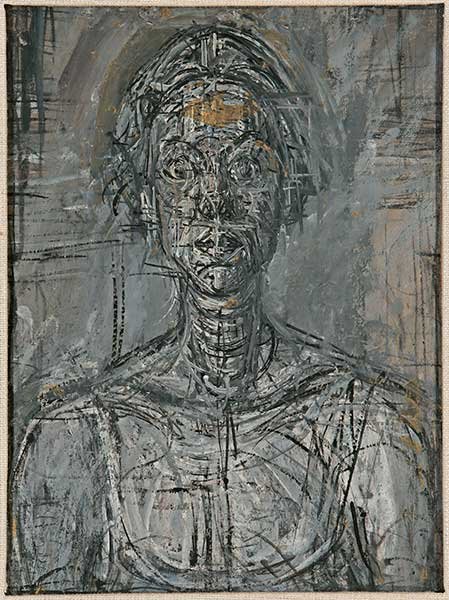
The National Portrait Gallery in London is overjoyed to be presenting a major exhibition surrounding the life and career of Alberto Giacometti, an artist recognized for his fascination with the artistic complexities of evoking a human presence.
 
October 15 marked the opening of a widely anticipated exhibition of Alberto Giacometti (1901-1966) at the National Portrait Gallery in London. The exhibition surrounds the life and career of one of the giants of Modernism. Indeed, the stature of Giacometti and the influence he exercised on artists of the 20th century may be compared only to Picasso, Chagall, and Matisse. To be sure, the sculptures by Giacometti define well the time in which they were created, which included World War I, World War II, and the Great Depression.
 
“Giacometti: Pure Presence” is not just an exhibition that presents the familiar narrative of the artist’s life and art, such as his time in Paris and his work with Surrealism and Existentialism. Rather, as stated by Paul Moorhouse, curator of the exhibition, “What our exhibition does is to propose an alternative reading of Giacometti’s work. What it shows is that, effectively, he had a double life. Throughout his career from 1914 to 1966, Giacometti had an unbroken involvement with portraiture, which is the subject of our exhibition. We follow Giacometti’s involvement with portraits throughout his life alongside his more familiar work. Our message is that Giacometti is not only one of the greatest artists of the 20th century, he is also one of the leading portraitists.”
 
Diving a bit deeper, the exhibition presents a unique vision of Giacometti’s portraiture, work that defied conventional attitudes and definitions of the genre. For Giacometti, portraiture was “about looking”; as Moorhouse suggests, “It’s about testing his response to a human presence in the studio and unraveling our relationship with the world.” The show will feature over 60 paintings, sculptures, and drawings from international public and private collections.
 
“Giacometti: Pure Presence” opened on October 15 and will be on view through January 10.
 
To learn more, visit the National Portrait Gallery.
 
This article was featured in Fine Art Today, a weekly e-newsletter from Fine Art Connoisseur magazine. To start receiving Fine Art Today for free, click here.
 

Featured Lot: Rene Lalique, “Vitesse Mascot”

0

In this ongoing series for Fine Art Today, we take a longer look at the history and features of a soon-to-be-available artwork of note. This week René Lalique, “Vitesse Mascot.”
 
A giant among giants, René Lalique (1860-1945) is remembered well for his gorgeous art nouveau-styled jewelry and glass. Indeed, by 1900, at the age of 40, Lalique was the most celebrated jeweler in the world. However, Lalique shifted his career around this time to focus more on glass, both in jewelry and as autonomous works of art.
 
After the death of his father in 1876, the 16-year-old Lalique became apprenticed under the acclaimed jeweler Louis Aucoc in Paris, a move that would launch one of Lalique’s many successful careers.
 
Lalique also participated at the World’s Fair in St. Louis in 1904, which would help promote his work in the Americas. As mentioned above, this was also when Lalique began experimenting more with glass. All told, Lalique created an astounding variety of glass models, over 1,500 in total. Among his most notable forms were car mascots, vases, stemware, plates, bowls, mirrors, and lamps, to name just a few.
 
One of the more popular forms was Lalique’s figurative sculptures, especially those that display his characteristic opalescent coloring, later known as “Lalique glass.” Although hundreds, if not thousands, were produced during his storied career, each figure commands a hefty price when they head to auction. Along with an impressive selection of Tiffany & Co. lamps, many outstanding glass works by Lalique feature during Heritage Auctioneers’ November 23 “Tiffany, Lalique & Art Glass Signature Auction” in Dallas, Texas.
 
The example detailed here, “Vitesse Mascot” (1929), is superb. The nude female figure is shown kneeling in an expressive, dramatic pose. Her arms reach above her head and grip her flowing hair. The pose recalls the famed Laocoön, popularized by many artists after its discovery in Rome in the 16th century. The colors of the sculpture are magnificent as well, displaying a cool opalescent blue with hints of purple and white. Heritage reports, “The pinnacle of Lalique’s career as a master glass craftsman is considered to be the 1925 Exposition Internationale des Arts Décoratifs et Industriels Moderns in Paris, which defined the Art Deco style. Highlights of this style included bold colors, images of nature and romanticized human figures. In addition to having his own pavilion at the Exposition, Lalique installed a 40-foot glass fountain that was seen by most of the 16 million visitors who attended the 1925 event. Lalique’s works are on display in approximately three dozen international museums, including the Corning Museum of Glass in Corning, New York, which possesses the largest publicly displayed collection of Lalique glass in the world. The Musee Lalique in Wingen-sur-Moder, France, is the main museum dedicated to Lalique in his homeland and contains 1,500 pieces. This village was the site of Lalique’s glass factory.”
 
Auction estimates are between $30,000 and $50,000.
 
To view the full catalogue, visit Heritage Auctions.
 
This article was featured in Fine Art Today, a weekly e-newsletter from Fine Art Connoisseur magazine. To start receiving Fine Art Today for free, click here.
 

The Original “Selfie”

0

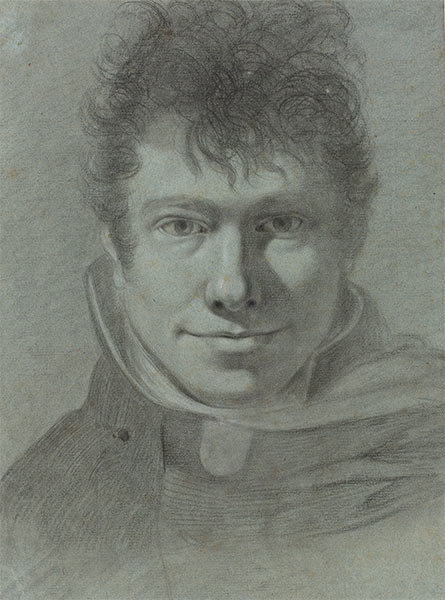
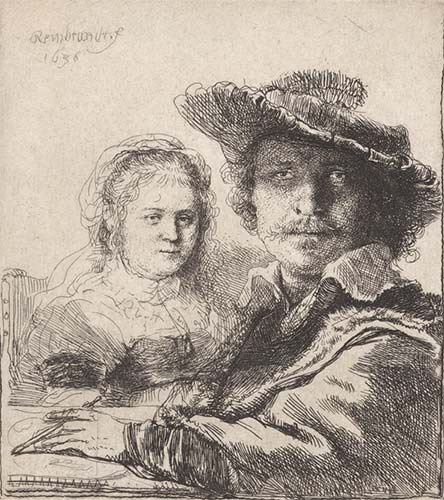
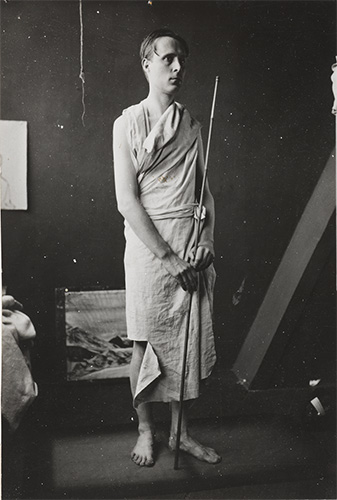
The Rijksmuseum in Amsterdam is taking a fresh, traditional look at the “selfie,” exhibiting approximately 90 drawings, prints, and photographs spanning a period from the 17th century to the 20th century.
 
It has become such a commonplace word: the “selfie,” a slang term coined to describe images, taken on cellphones and cameras, that show the faces and extended arms (or sticks) of individuals. In many cases, the dreaded selfie has usurped — if not replaced entirely — self-portraiture as quickly as the push of a button.


Rembrandt van Rijn, “Self-Portrait with Saskia,” ca. 1636, (c) Rijksmuseum 2015

 
Like a breath of fresh air, the Rijksmuseum, Amsterdam, is bringing new meaning to the term by exploring the “selfie” on paper. At its core, the exhibition focuses on self-portraits, from the Dutch master himself, Rembrandt van Rijn, through the 20th century with works from Carel Willink. Other artists include Oskar Kokoschka, Moses ter Borch, Leendert van der Cooghen, and Jan Toorop.
 
The museum reports, “There is one model who is always available, never complains of aching feet, doesn’t harp on about more pay and is prepared to adopt every conceivable pose and facial expression — the artist themselves.” Indeed, no matter what culture or time in history, artists have always been fascinated with producing self-images. One could even suggest that the stenciled hands painted on the walls of Paleolithic caves some 40,000 years ago were proclamations of humanity or “the self.” As such, any exhibition detailing self-portraiture will invariably have a number of outstanding works from which to curate, and the Rijksmuseum was no different.


Carel Willink, “Self-Portrait,” 1938, (c) Rijksmuseum 2015

 
However, rather than simply focusing on self-portraiture proper, the museum has added another element to the equation, highlighting specifically works executed on paper. The prints, drawings, and etchings in the show are more intimate, perhaps experimental. Regardless, visitors will undoubtedly leave with the feeling that they’ve just met the makers.
 
“Selfies on Paper: Self-portraits from Rembrandt to Willink” opened on November 5.
 
To learn more, visit the Rijksmuseum.
 
This article was featured in Fine Art Today, a weekly e-newsletter from Fine Art Connoisseur magazine. To start receiving Fine Art Today for free, click here.
 

WEEKLY NEWS FROM THE ART WORLD

Fill your mind with useful art stories, the latest trends, upcoming art shows, top artists, and more. Subscribe to Fine Art Today, from the publishers of Fine Art Connoisseur magazine.

  • This field is for validation purposes and should be left unchanged.