
Home Blog Page 459

Close Encounters

0

A four-year collaboration between several major museums culminates in Atlanta with a gorgeous exhibition of American still life painting from the late 18th and early 19th centuries.
 
Since 2011, the High Museum, Atlanta, the Louvre Museum, Paris, and the Crystal Bridges Museum, Arkansas, have collaborated on a series of exhibitions exploring the history of American art, culminating with a display of exquisite still life paintings in Atlanta.  “The Simple Pleasures of Still Life” follows previous installations detailing the stories behind important themes in American art, including landscape, genre, and portraiture. 


William Michael Harnett, “Still Life with Bust of Dante,” ca. 1883, oil on panel, (c) High Museum of Art 2015

 
The current exhibition illuminates how American painters of the late 18th and early 19th centuries adapted European still life traditions to American aesthetic and taste.  Bringing together some of the biggest names of American still life, including Raphelle Peale, Martin Johnson Heade, Joseph Biays Ord, and William Sidney Mount.
 
A highlight of the show is Ord’s “Still Life with Shells,” circa 1840.  Beautifully illuminated are a diverse arrangement of sea shells along a tightly-cropped shore.  Ord’s attention to detail and ability to decipher different textures is magnetic, especially the iridescence of the central and smaller shells in the foreground and center.  Also noteworthy is William Michael Harnett’s “Still Life with Bust of Dante,” circa 1883.  Perhaps more closely aligned with his European predecessors, Harnett displays a variety of books, papers, musical instruments, and more in his composition.  A tapestry hangs over the edge with what could be described as a Native American design. 
 
“American Encounters: The Simple Pleasures of Still Life” opens on September 26 and will hang through January 31.
 
To learn more, visit the High Museum of Art.
 
This article was featured in Fine Art Today, a weekly e-newsletter from Fine Art Connoisseur magazine. To start receiving Fine Art Today for free, click here.
Twisted Solidity

0

Michael Boroniec defies convention – and physics – with his altered ceramic vessels in a current solo exhibition.
 
The transformation of clay from a soft, malleable material into a hardened, seemingly indestructible form is one of the many elements that draw artists to the medium.  From a weakened state out of the earth, artworks in clay go through an extended process of drying, its properties and capabilities evolving over time as the moisture content continues to diminish.  The range of possibility with clay seems infinite, ranging from the simple traditional forms of pottery, to complex and conceptual sculptures.  Finding himself somewhere in the middle is artist Michael Boroniec, who bridges the gap between pottery and sculpture, functional and not.
 
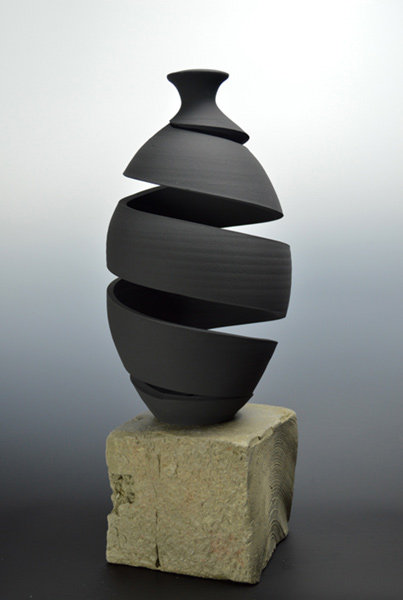
Without cutting into his work, Boroniec’s vases could be magnetically beautiful in their elegant simplicity and traditional fullness.  However, the artist defies this tradition by altering the vessel, cutting a large gap into the work in a spiral from bottom to top.  The resulting effect gives the pot a ribbon appearance and echoes its construction on the potter’s wheel.  Even those with experienced knowledge of the ceramic process are left confused as to how Boroniec achieves his effect, considering the sagging and warping often experienced during even the lowest of firing temperatures. 
 
Regardless, the works undoubtedly illustrate both Boroniec’s acute aesthetic as well as his extremely high level of technical expertise.  “BerkshireNow: Michael Boroniec” opened on September 4 at the Berkshire Museum in Pittsfield, Massachusetts and will be on view through November 22.
 
To learn more, visit the Berkshire Museum.
 
This article was featured in Fine Art Today, a weekly e-newsletter from Fine Art Connoisseur magazine. To start receiving Fine Art Today for free, click here.
Victory Gets a New Look

0

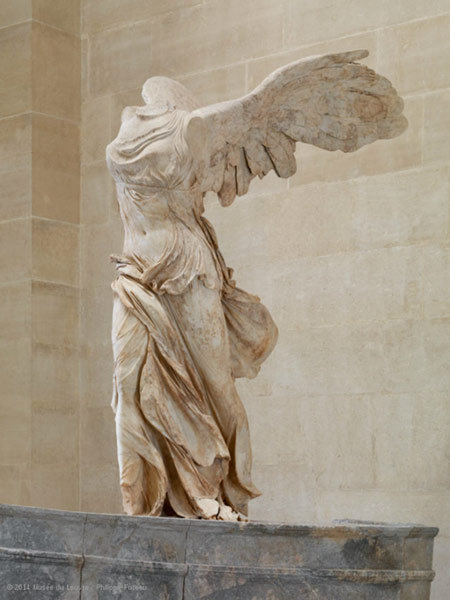
One of the most iconic and famous sculptures in history is highlighted during an exhibition that explores its journey from the Greek island of Samothrace to its permanent location in the Louvre, Paris.
 
While it seems impossible to label anything other than Da Vinci’s “Mona Lisa” as the most famous artwork in the Louvre Museum, Paris, perhaps Lisa’s sculptural counterpart is the renowned “Nike of Samothrace” – or more commonly known as “Winged Victory.”  Since the sculpture’s discovery in 1863 by Charles Champoiseau, it has captivated millions of Louvre patrons while undergoing numerous conservation projects, the latest coming in 2014.  The most recent attempts to preserve and clean the statue have revealed a stunning level of color in the sculpture’s marble, which could offer scholars new insight into the way the statue was conceived and presented. 
 
“The Winged Victory of Samothrace: Rediscovering a Masterpiece” will begin with a journey to the sculpture’s home – the Greek island of Samothrace.  More specifically, the sculpture was discovered within a sanctuary dedicated to great Olympic Gods.  The Louvre reports, “From 1863 to the present, successive excavations by French, Austrian, and American teams – some of whose discoveries are highlighted here – have dotted the long path of experts’ attempts to understand the complexity of the creative process behind the artwork.  Old photographs and plaster casts document the main stages of the statue’s conservation and display in the Louvre in 1866, 1883, and 1934.”
 
“The Winged Victory of Samothrace: Rediscovering a Masterpiece” opened on March 5 and will be on view through November 9.
 
To learn more, visit the Louvre Museum.  
 
This article was featured in Fine Art Today, a weekly e-newsletter from Fine Art Connoisseur magazine. To start receiving Fine Art Today for free, click here.
Awards at Buffalo Bill

0

Organizers of the renowned Buffalo Bill Art Show & Sale have just announced their major award winners from August 2015.  Who were they?
 
Over 108 of the nation’s leading Western painters and sculptors descended on Cody, Wyoming August 26th for the 34th annual Buffalo Bill Art Show & Sale which saw $30,000 in prize money awarded to two artists.
 
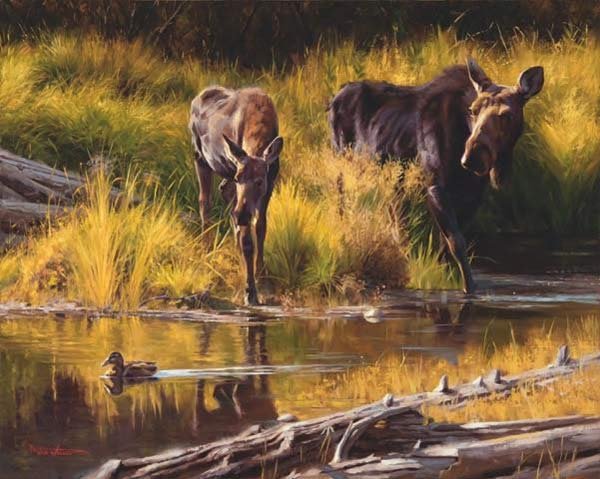
Painter Dustin van Wechel was honored with the Premier Platinum Award, a distinction that earned him $20,000.  His painting “Right of Way” instantly captivated the competition’s judges, who were struck by Van Wechel’s masterful rendering of reflection in the water’s surface.  Equally as remarkable are the two Moose – a calf and cow – who patiently wait and stare as a duck moseys along the stream.  Their anatomy is well observed and convincing.  If that wasn’t enough, the strong yellow hues of the tall grasses capture the viewer as well with hints of green and orange scattered about.


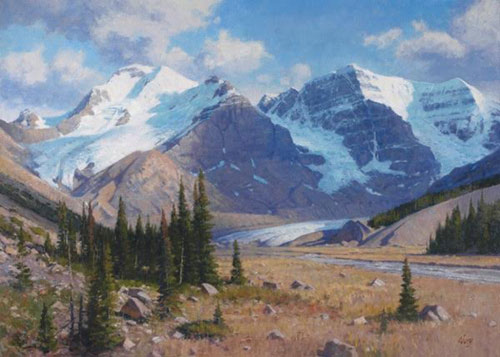
Ralph Odberg, “Shadows of their Former Selves,” – Awarded the Wells Fargo Gold Award

 
The Wells Fargo Gold Award was taken by Ralph Odberg, which left him with a satisfying $10,000 prize.  His picture “Shadows of their Former Selves” is a beautifully arranged and scenic panorama of Jasper National Park, Canada.  The piece is special in its quiet tone despite its rather monumental subject.  Organizers suggested that, “the various dimensions – foreground, middle ground and background – complement each other and move the eye in a circular motion across the canvas.  The shadows cast an imposing shape on the mountains, adding power to the expertly pigmented landscape.”


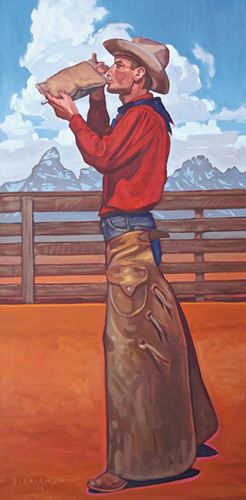
Dennis Ziemienski, “Tall Drink of Water,” – Awarded the William E. Weiss Purchase Award

 
In addition to the cash prizes, Dennis Ziemienski was honored with the William E. Weiss Purchase Award, which will be added to the permanent collection of the Buffalo Bill Center.  Chosen by the institution’s staff, “Tall Drink of Water” is both imposing with its proportions as well as its bold, illustrative style.  Characterized by simple forms, solid colors, and clean lines, a sharp-dressed cowboy sips his canteen between his drags of a cigarette.  The piece is divided, compositionally, in half, with the warm oranges and reds of the Wyoming sands balancing the cool blues and whites of the sky, clouds, and mountains above the horizon. 
 
To learn more, visit the Buffalo Bill Art Show & Sale.
 
This article was featured in Fine Art Today, a weekly e-newsletter from Fine Art Connoisseur magazine. To start receiving Fine Art Today for free, click here.
“Nomads, Players, and Saints”

0

Husbands and wives often rely on each other for strength, emotional support, and healthy criticisms.  However, when both are artists, a new dimension of creative energy enters the relationship – and often with outstanding results.  One Canadian couple is continuing to ascend with a tantalizing exhibition.
 
On their own, artists France Jodoin and Kevin Sonmor could be mounting successful fine art careers; together they might be unstoppable.  Beginning September 24 and running through October 24 is a joint exhibition of the husband-wife tandem at Pryor Fine Art in Atlanta, Georgia.  Both are immensely talented and appear to challenge and build upon one another in creative ways that have left many impressed. 


France Jodoin, “A Sky Blue As Forget Me Nots,” oil on linen, 60 x 60 in. (c) Pryor Fine Art 2015


France Jodoin, “Hope is This Thing With Feathers,” oil on linen, 60 x 48 in. (c) Pryor Fine Art 2015

 
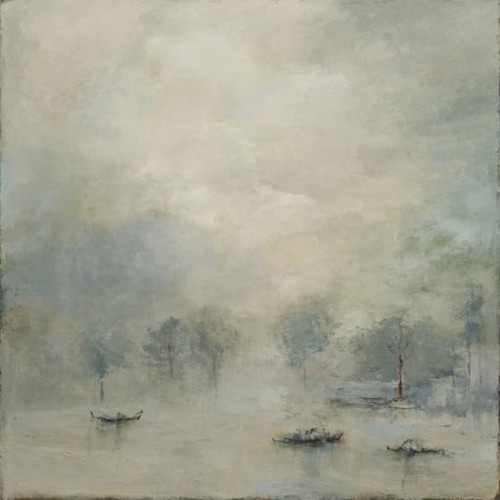
Jodoin works intuitively and instinctually, approaching her canvases without preconceived ideas or expectations.  While displaying some representational forms and objects, many of Jodoin’s work have a hazy, atmospheric aura.  “My works are not intended as historical depictions,” she asserts, “rather they delve into history as a perspective to create mise-en-scene intended for the contemporary viewer in which a sense of time spent waiting or watching is unambiguous, but few details are given to attach particular cause to what is begin watching, or waited upon.”


France Jodoin, “Just a Little White Lie,” oil on linen, 40 x 40 in. (c) Pryor Fine Art 2015

 
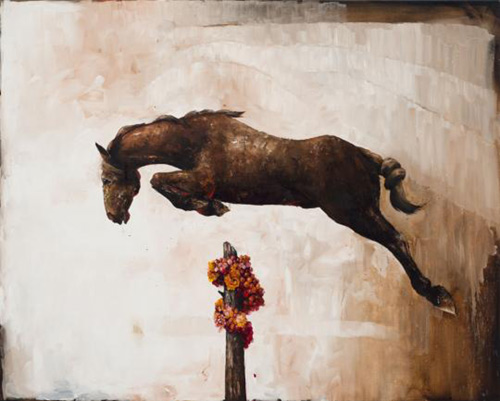
Sonmor has a different approach, but his aesthetic blends beautifully with Jodoin’s.  For Sonmor, he often finds himself fascinated with equestrian paintings, which derive from his love of Gericault, Stubbs, and Muybridge.  The gallery reports that, “In his new body of work, The Utilitarians, Sonmor muses on the conventions of historical subjects including equestrian, marine, romantic landscapes, and the vanitas still lifes. Sonmor uses these familiar historical practices, though slight shifting many of their known properties as advertisements for institutional or private power.  The resulting paintings celebrate these historical subjects in today’s culture which questioning their utilitarian value in an image-saturated world.”


Kevin Sonmor, “The Beautiful Empty,” oil on linen, 24 x 24 in. (c) Pryor Fine Art 2015


Kevin Sonmor, “The Baptist Study,” oil on linen, 48 x 60 in. (c) Pryor Fine Art 2015
 

“Jodoin & Sonmor: Nomads, Players and Saints” opens on September 24 and will be on view through October 24.  An opening reception is scheduled for September 24 from 6-8 PM.
 
To learn more, visit Pryor Fine Art.
 
This article was featured in Fine Art Today, a weekly e-newsletter from Fine Art Connoisseur magazine. To start receiving Fine Art Today for free, click here.
Music Finds its Voice

0

The parallels between visual and audible art is a well-documented – and often explored – relationship.  From representations of musicians and muses to exquisite instruments, one exhibition is illuminating the art of music.
 
Whether it be Classical, traditional, abstract, or avant-garde the full spectrum of various styles and art forms are on full display at the San Diego Museum of Art.  “The Art of Music” will present all types of people and tastes with something to enjoy beginning September 26.  The exhibition offers a diverse exploration of the relationship between art and music from various cultures and times across the globe.  The museum writes, “Throughout history and around the globe, music has been a source of inspiration for visual art in a wide variety of ways. “The Art of Music” highlights the complex relationships between these prominent and intertwining branches of creative expression, combining works from the Museum’s permanent collection with loans from major museum and private collections.”


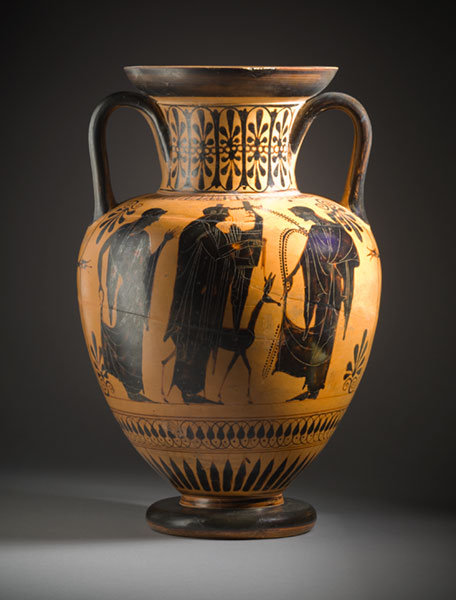
“Lyre Guitar,” early 19th century, (c) The Metropolitan Museum of Art


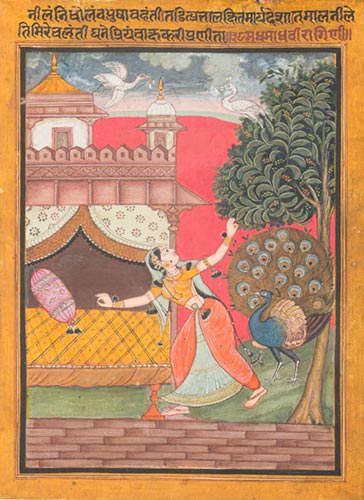
Shiv Chand, “Madhumadhavi Ragini of Bhairav,” ca. 1610, watercolor, (c) San Diego Museum of Art 2015


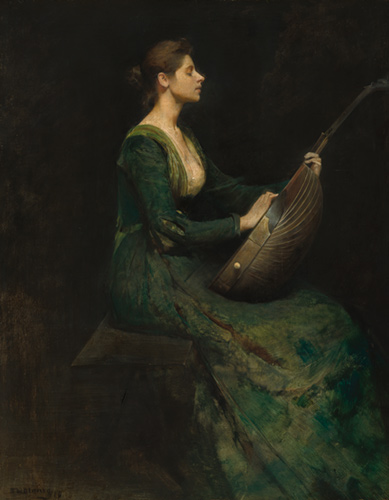
Thomas Wilmer Dewing, “Lady with Lute,” 1886, oil on wood, (c) National Gallery of Art 2015

 
All told, the exhibition will feature nearly 200 objects ranging from instruments, sculptures, paintings, installation, video, and sound art.  Continuing, the museum reports, “Spanning media, time, and culture, “The Art of Music” is focused around three central themes. The first examines the motif of the musician and the symbolic nature of this figure in works as diverse as Greek terracotta figures, Chinese metalwork, and Western portraits of celebrated musicians. The second section considers the social function of music and its public and private rituals. The third and final section explores representations of the sounds, emotions, and sights of music, from Indian Ragamala paintings to modern and contemporary interpretations of the colors and forms evoked by music.”
 
“The Art of Music” opens on September 26 and will be on view through February 7.
 
To learn more, visit The San Diego Museum of Art.
 
This article was featured in Fine Art Today, a weekly e-newsletter from Fine Art Connoisseur magazine. To start receiving Fine Art Today for free, click here.
High School with High Art

0

High Schools are typically judged by their graduation rates and standardized test scores.  However, one California High School boasts an impressive fine art collection, selections of which are on view now.
 
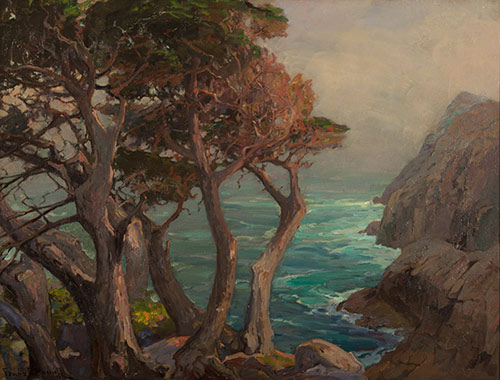
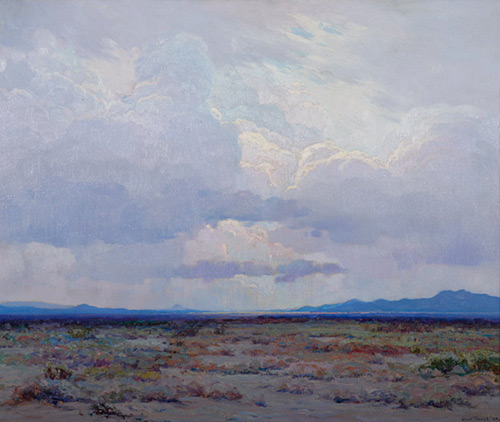
Nestled only a stones throw from the Pacific Ocean is the small subdivision of Gardena, California just south of downtown Los Angeles.  Between the years 1919 and 1956, Gardena High School established a remarkable tradition that continues to captivate and entertain even to this day.  For each of those years, the High School administration allowed the seniors to collaborate and select artworks by contemporary artists.  After careful consideration, the seniors would choose a work to be purchased and given to the school upon graduation.  The tradition, which seems nearly unthinkable today, enabled the school to amass an impressive collection of museum-worthy paintings, many of which are now on view at The Autry National Center in Los Angeles.


Franz Bischoff, “A Cool Drifting Fog,” 1924, oil on canvas, (c) Gardena High School Collection 2015

 
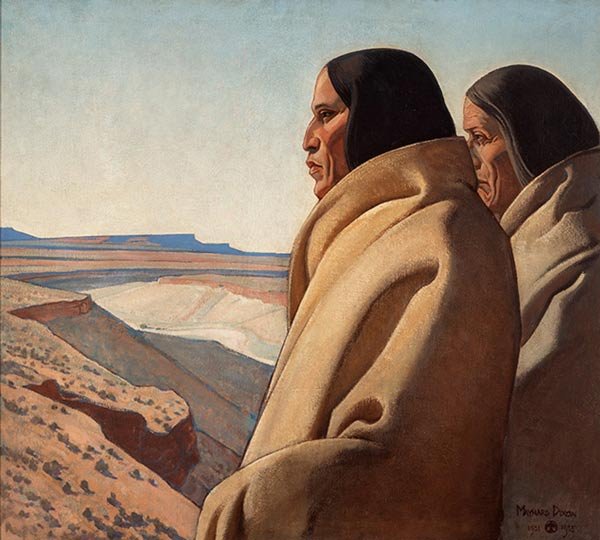
Featuring nine paintings from the collection, the exhibition is frustratingly small but packs an impressive punch considering the works included are by some of California’s most celebrated artists of the early twentieth century.  One such masterpiece is by the famed painter Maynard Dixon (1875-1946).  “Men of the Red Earth,” circa 1931-32, was purchased by the Summer class of 1944.  The image displays a pair of statuesque Native Americans in profile, stoically peering out of the picture.  Illustrative in style, the painting boasts solid shapes and forms with masterful use of pastel colors and atmospheric space. 


John Frost, “Desert Twilight,” 1924, oil on canvas, (c) Gardena High School Collection 2015

 
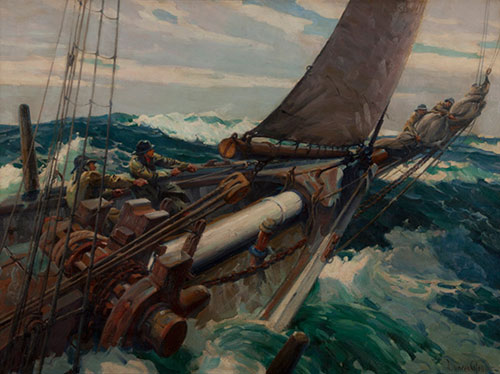
Another stunning piece from the exhibit is Joe Duncan Gleason’s (1881-1959) “Head Winds (Storm at Sea).”  In a powerful diagonal composition that stretches from lower left to upper right, a group of sailors struggle to control their vessel as it thrashes and bobs over stormy waves. 


Joe Duncan Gleason, “Head Winds (Storm at Sea),” oil on canvas, (c) Gardena High School Collection 2015

 
Those who wish to view the show have plenty of time to plan.  “California Impressionism: The Gardena High School Collection” opened on September 12 and will be on view through October 2016. 
 
To learn more, visit The Autry National Center.
 
This article was featured in Fine Art Today, a weekly e-newsletter from Fine Art Connoisseur magazine. To start receiving Fine Art Today for free, click here.
Acute Observations

0

Known for his stunning portraits and skillful use of light, painter Casey Childs asserts the modern relevancy of tradition during a solo exhibition.
 
It was only four years ago that artist Casey Childs received First Honors in the Portrait Society of America’s 2011 International Portrait Competition.  His profound talent has not gone unnoticed since and his recent works feature in a current solo exhibition at Principle Gallery in Alexandria, Virginia.  “My work as a whole encompasses an exploration of the human experience,” Childs statement explains, “My interest in the people around me comes from the idea that we look at people every day, but we never really stop to SEE them.” 


Casey Childs, “Sydney,” oil on panel, 18 x 12 in. (c) Principle Gallery 2015

 
There is an undeniable personality to his sitter in “Waiting,” a beautiful – and large – oil on panel.  In full view and in center left is a well-covered female sitter, her large coat and scarf signaling the chill that surrounds her.  Although the composition is dominated by cool hues, our eyes find points of warmth in the fiery-red of her boots, scarf, and car break-lights in the background.  The scene is simple and casual, encouraging the viewer to consider the individuals they pass on occasion.


Casey Childs, “Nocturne on the Reservoir,” oil on linen, 48 x 24 in. (c) Principle Gallery 2015

 
“Sydney” also oozes expressive character.  Commanding with its powerful red background, a female subject dressed in a stylish black dress reclines on a minimally executed chair.  Despite the rather quick and fluid brushstrokes, the subject’s visage is remarkable, fresh, and lively.  Also noteworthy are the strange vertical accents or distortions that dance across the panel. 


Casey Childs, “Light and Solitude,” oil on panel, 17 x 12 in. (c) Principle Gallery 2015

 
“Casey Childs: Observations” opens on September 25 with a reception from 6:30 – 9 P.M.
 
To learn more, visit Principle Gallery.
 
This article was featured in Fine Art Today, a weekly e-newsletter from Fine Art Connoisseur magazine. To start receiving Fine Art Today for free, click here.
It All Begins with Shapes

0

One of America’s accomplished realist painters reminds us all that successful paintings begin with the simplest of forms: shapes.
 
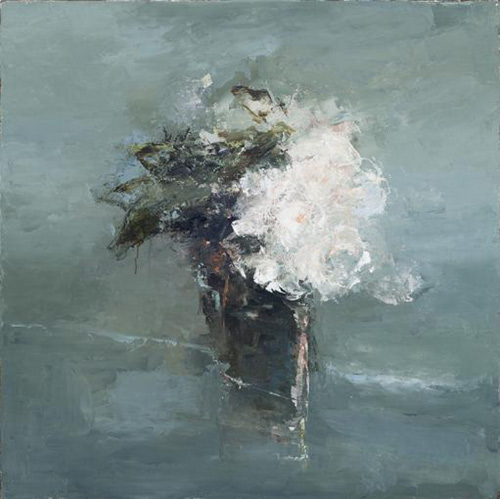
“It all begins with shapes,” says artist Louis Escobedo, “To me a successful painting is all about shapes and harmony.”  These simple elements of art are undeniably an integral part of Escobedo’s process, a method which is highlighted during his solo exhibition at 717 Gallery in Easton, Maryland.  For the artist, a painting begins with the contours of simple, broad shapes imparted onto the blank canvas.  Only after these large, roughed areas are defined does Escobedo add color and details, blending the edges of those shapes into finished paintings.  He suggests, “I prefer to reach for scenes that convey a sense of synchronization.  I strive to make paintings that excel with dramatic lighting and tremendous depth, looking beyond the physical makeup of the subject.” 


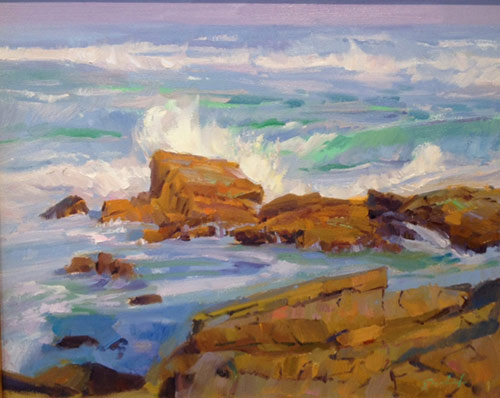
Louis Escobedo, “San Diego Shore,” oil, 16 x 20 in. (c) 717 Gallery 2015
 

“San Diego Shore” is a representational example of Escobedo’s aesthetic vision.  Broad areas of illuminated rock projects define the foreground and middle-ground of the painting.  A rhythmic play of blues, pinks and greens compose a thrashing and violent surf, which separates the two rocky forms.  There is a quite simplicity to both the scene and the details, but Escobedo has successfully achieved a depth and viewer participation that is truly gripping.  “A highly detailed painting that lacks feeling can leave me cold,” he confesses, “I’d rather finish the painting at the earliest point, as soon as the essence becomes evident – at the exact place where a shape becomes an object.” 


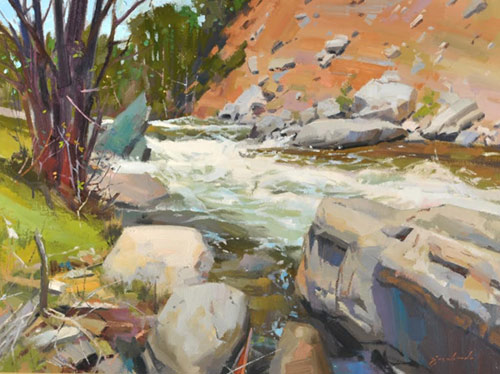
Louis Escobedo, “The Canyon,” oil, 18 x 24 in. (c) 717 Gallery 2015

 
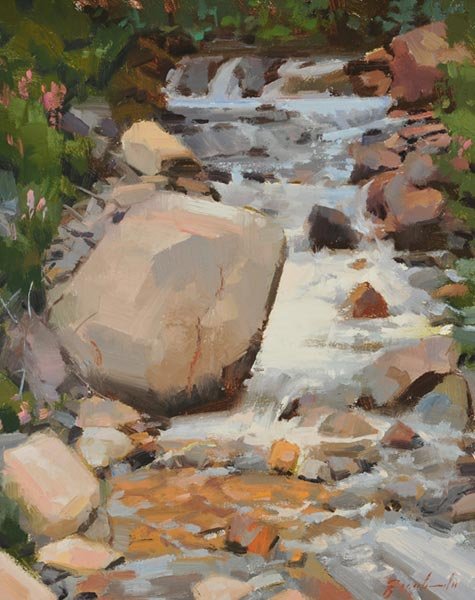
“Hidden Stream” illustrates this philosophy well.  Scattered about the entire work is an arrangement of river stones of all types of size and variation.  Using only broad, simple strokes, the stones have little detail beyond their initial shapes.  The same could be said for the foliage and stream as it cascades down a slope towards the viewer.  Despite its minimalism, the shapes and overall integrity of the scene remains intact with all its subjective narrative and emotion accompanied with it. 
 
“Shapes and Harmony” opened on September 4 and will hang through October 31.
 
To learn more, visit 717 Gallery.
 
This article was featured in Fine Art Today, a weekly e-newsletter from Fine Art Connoisseur magazine. To start receiving Fine Art Today for free, click here.
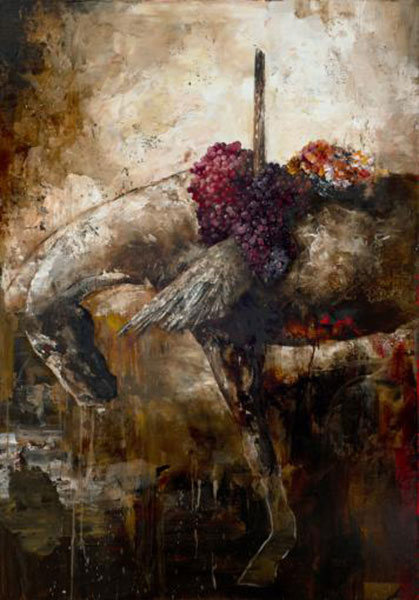
Bones with Flesh

0

The figure receives bold serenity, self-consciousness, sensuality and more during Kent Williams’s upcoming solo exhibition.
 
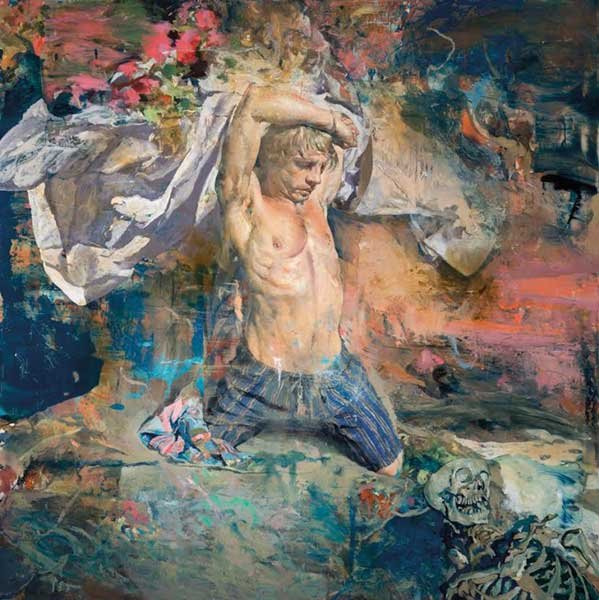
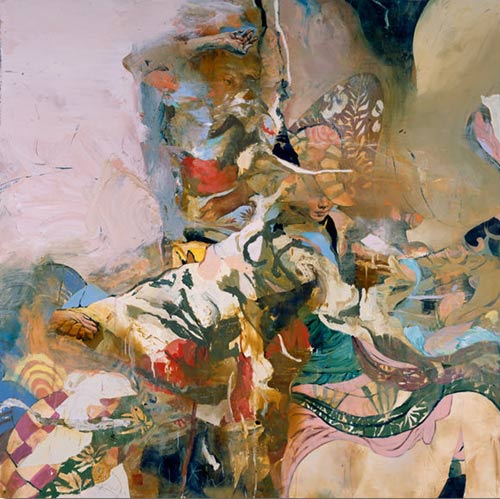
Employing a sophisticated range of both detailed and expressive brushwork, painter Kent Williams will continue to enthrall his growing following on September 25, when his 3rd solo exhibition opens at EVOKE Contemporary in Santa Fe, New Mexico.  Everything Williams’s admirers have come to expect will feature in this show, including figures with strong gestures rendered in acute detail along with abstract and dynamic brushwork that is a powerful aesthetic dichotomy.  “Romantique” is one such example from the show.  At center one finds a topless male figure on his knees, his arms stretched as they reach above his head.  Upon first glance, the figure’s spatial context seems completely abstracted, imaged with strong planes of color applied with brush and knife.  However, extended consideration reveals integrated representational forms.  Behind the figure and fluttering like a cape is a cloth-like form that displays a sharpness of line and shadow that contrasts from the color quilting of color beyond.  Further, the bottom right of the canvas reveals an eerie subject: a human skeleton.  This intense picture seems to reveal a narrative, the details of which are determined by the viewers themselves.


Kent Williams, “Osseous Matter,” oil on linen, 28 x 24 in. (c) EVOKE Contemporary 2015


Kent Williams, “Tomorrow,” oil on linen, 48 x 48 in. (c) EVOKE Contemporary 2015

 
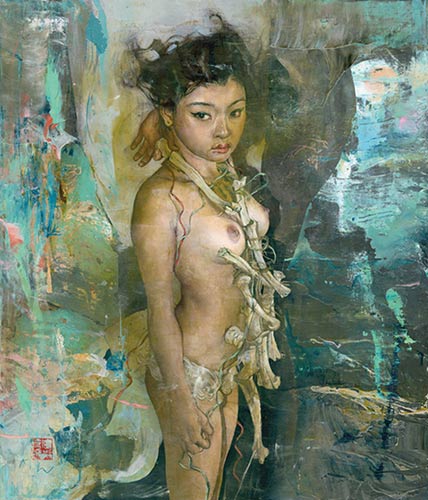
The skeletal themes of death appear to continue in “Osseous Matter,” a painting whose title alone begs contemplation.  In three-quarter view and standing at center, a nude female figure adorns a large necklace made from human bones.  Similar to “Romantique,” the figure stands in a swarm of active, abstracted color.  In addition to juxtaposing naturalism with abstraction, there is a further play between the figure’s stillness and the active movement of the background.  Abstraction appears to become the primary focus in “Tomorrow,” with only miniscule areas given to figurative representation.


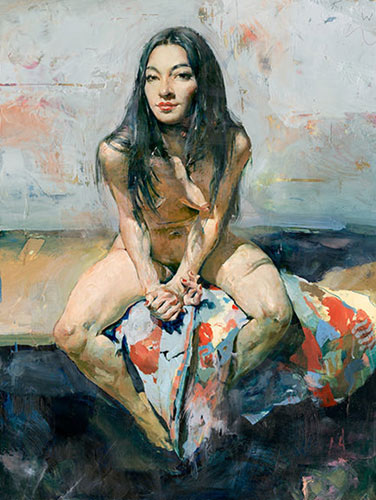
Kent Williams, “Cool with Red,” oil on clayboard, 24 x 18 in. (c) EVOKE Contemporary 2015

 
“Kent Williams: Bones with Flesh” opens on September 25 with a reception from 5 to 7 PM.  The exhibition will be on view through October 28.
 
To learn more, visit EVOKE Contemporary.  
 
This article was featured in Fine Art Today, a weekly e-newsletter from Fine Art Connoisseur magazine. To start receiving Fine Art Today for free, click here.
WEEKLY NEWS FROM THE ART WORLD

Fill your mind with useful art stories, the latest trends, upcoming art shows, top artists, and more. Subscribe to Fine Art Today, from the publishers of Fine Art Connoisseur magazine.

  • This field is for validation purposes and should be left unchanged.