

A large number of original masterpieces by contemporary masters will feature in an upcoming auction via Invaluable.com. Among the notables include Antonio and Ignacio Ramirez.
To view the full catalogue, visit Invaluable.
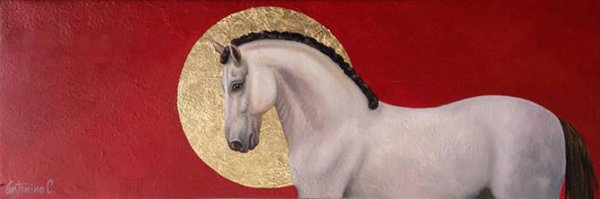
A large number of original masterpieces by contemporary masters will feature in an upcoming auction via Invaluable.com. Among the notables include Antonio and Ignacio Ramirez.
To view the full catalogue, visit Invaluable.
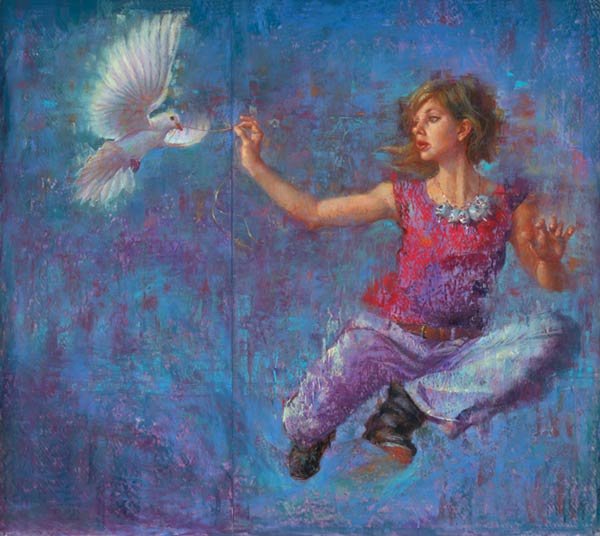
Janet A. Cook
“Liz and the Thread of Flight”
Pastel and Mixed Media
40 x 43 in.
[email protected]
www.janetacook.com
Artist’s Statement:
The common thread through out my work is my fascination with the figure; it’s timeless, beautiful and powerful. Additional inspiration comes from a variety of sources ranging from the old masters to modern advertising, graffiti and body art. My goal is to combine these elements, along with my imagination, into a cohesive, strong statement that intrigues and engages the viewer.
Janet A. Cook will be exhibiting in the “Five-Year Anniversary Exhibition of Figurative Art” during September 2015 at Dacia Galley, New York City, and is slated to have her third solo show at the gallery in 2016.
Cook has also exhibited at galleries and institutions through out New York, New Jersey and Connecticut. In 2013 she participated in the “Fountain Art Fair” at the Armory, NY and has shown in France, Germany, and Romania as part of Dacia’s “Universal Art Project.” Museum shows include an invitational at the Trenton City Museum, NJ, Mattatuck Museum, CT, National Academy Museum, NY, Hudson River Museum, NY, and the Maritiem Muzeeum of Vlissingen, Netherlands.
Over the years she has received many awards for excellence, including a Gold and Silver medal from the Allied Artists of America and The Salmagundi Art Club; A Master Circle Medal award from The International Association of Pastel Societies, Best in Show from the Catherine Lorillard Wolfe Art Club and honorable mention from the Portrait Society of America. Cook is also an elected member of the Salmagundi Club, where she serves on the Art Committee, the Pastel Society of America, the Catherine Lorillard Wolfe Art Club, the Allied Artists of America, and the American Artist’s Professional League.
In 2007 Cook’s work was featured on NBC’s ‘Dateline’, the ‘Da Vinci Code’ and has been reviewed and noted in the Times of Trenton, NJ, In 2014 TheGreatNude.tv made a video of her solo show at Dacia Gallery, and her portrait painting of “Winky’ was chosen for the front cover of the Art Students League Lines Magazine where she is an alumni. Her work has also been featured in The Pastel Journal, and the American Artist Magazine.
She teaches at the Pastel Society of America and runs workshops in New York and France. She has also lectured and demoed in the US and Italy and been honored to participate in both the judging and jurying of many shows. Her work is in many private collections in the US, UK, Panama, Israel and the permanent collection of the Trenton City Museum, NJ.
Originally from the UK, Cook studied at the National Academy School of Art and the Art Students League in New York City, and holds a BA in Art History with honors from De Montfort University, England, UK.
[email protected]
www.janetacook.com
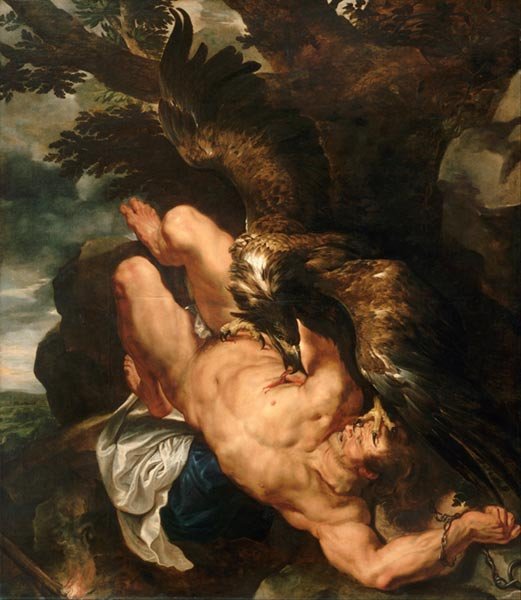
Pain, torment, creative struggle, and astounding beauty are only a few words that could describe an upcoming exhibition in Philadelphia.
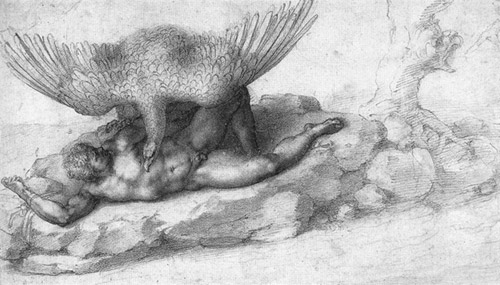
“Prometheus Bound” is one of the many masterpieces produced by the legendary Peter Paul Rubens (1577–1640). A twisting, contorted, and nude Prometheus is shown struggling in the grips of a massive eagle, which devours the titan’s liver. The subject is from an ancient Greek myth in which Prometheus is eternally punished, chained to a rock by Zeus for stealing fire and gifting it to humans. Rubens has represented the scene in violent detail, the strong diagonal composition from upper left to lower right creating chaos, movement, and tension. Every element that made Rubens one of the most sought artists of his day can be found within this picture, which he himself considered one of his most important works. The muscular body of Prometheus is exquisitely rendered, every tensed muscle indicated with stunning clarity.
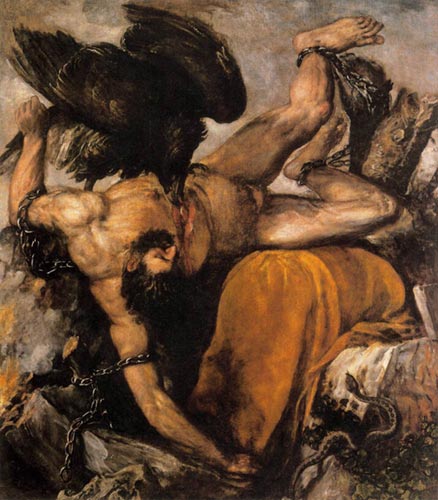
The painting will feature as the centerpiece of an upcoming exhibition at the Philadelphia Museum of Art, which explores how “Prometheus Bound” was inspired by paintings, drawings, and prints. Of particular note is the inclusion of works by both Michelangelo and Titian. The museum reports that, “Despite the significance of Rubens’s masterpiece, no exhibition has ever been devoted to it. “The Wrath of the Gods” shows how the artist’s talent for creating images bursting with physicality, movement, and color was profoundly shaped by the work of Italian Renaissance greats Michelangelo and Titian as well as antique sculpture, especially the Vatican’s famed “Laocoön.”
A cast of the Hellenistic sculpture will be on view as well, one of the great sculptures from antiquity to have ever survived. The sculpture proved to be a major source of inspiration for artists after its discovering in the mid 16th-century. Laocoön twists his body with a pained expression as he attempts to rip the giant serpents from himself and his two sons.
The exhibition will undoubtedly be an incredible experience for both the casual and experienced.
“The Wrath of the Gods” opens on September 12 and will be on view through December 6.
To learn more, visit the Philadelphia Museum of Art.
This article was featured in Fine Art Today, a weekly e-newsletter from Fine Art Connoisseur magazine. To start receiving Fine Art Today for free, click here.
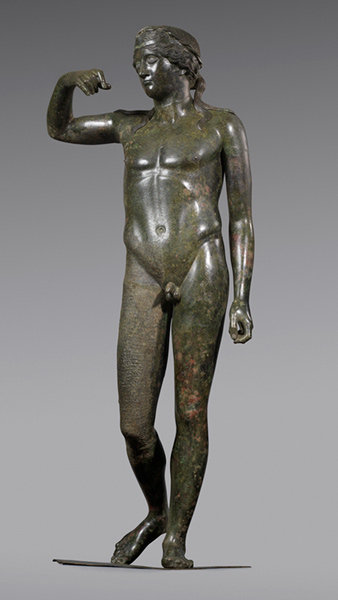
The Art Institute, Chicago’s Department of Ancient and Byzantine Art and the Department of Prints and Drawings have collaborated to explore the ways in which Renaissance images of the Greek god Dionysos were inspired by and responses to Classical antiquity.
“Dionysos Unmasked: Ancient Sculpture and Early Prints” is an innovative exhibition at The Art Institute, Chicago, that juxtaposes ancient sculptures of the god with Renaissance prints of the same subject. The show will undoubtedly be a fascinating lesson on how 14th- and 15th-century artists looked to the ancient past for standards of beauty and artistic perfection. Nearly 100 objects, both from the museum’s permanent collection and recent loans, will be displayed.
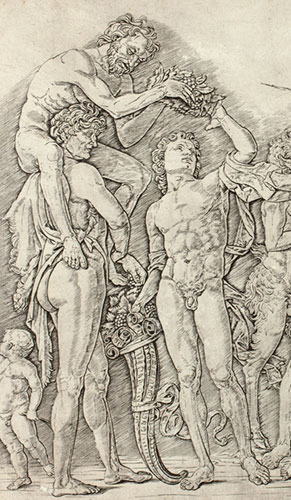
Dionysos, as the god of wine, poetry, youth, and sexual excess, has occupied a special place in the minds of artists for millennia. Known to the Romans as Bacchus, the god is said to have pranced and gallivanted with an entourage of satyrs and the woodland god Pan, as well as female followers. The museum reports, “All these devotees represented the untamed and hedonistic desires of humanity, which were unleashed by the intoxicating elixir of wine. During the Renaissance and Baroque periods, the time of early printmaking, interest in antiquity — especially Dionysos — flourished. Ancient sculptures depicting the god and his raucous retinue inspired artists to find new ways to transform age-old Dionysian subjects into prints and drawings that would appeal to their own contemporary audiences.”
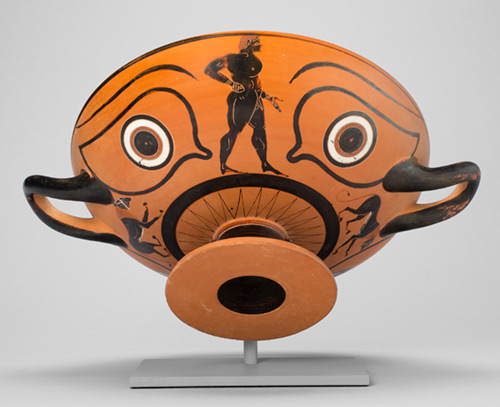
Along with sculptures, drawings, and prints, the exhibition includes Greek pottery, particularly forms used in drinking festivals. All told, the range of works spans nearly 1,500 years and is sure to delight visitors.
“Dionysos Unmasked: Ancient Sculpture and Early Prints” is on view through February 15.
To learn more, visit The Art Institute.
This article was featured in Fine Art Today, a weekly e-newsletter from Fine Art Connoisseur magazine. To start receiving Fine Art Today for free, click here.

Few need a new reason to motivate them to view a Van Gogh painting in person. But just in case: This one is a masterpiece.
Individuals within a day’s drive of Minneapolis should not hesitate to book their next visit to the Minneapolis Institute of Arts, as a masterpiece by Vincent van Gogh is on view from the Van Gogh Museum in Amsterdam — and admission to see it is free. While every painting by the expressionist can be considered great, there is a hierarchy, and “Irises” is near the top. The painting, dated to 1890, is one of the artist’s mature paintings, displaying the full range of Van Gogh’s transcendent touch. A brilliant yellow background commands the attention immediately. And then, leaping from the surface, is a bouquet of breathtaking blue irises.
To view a van Gogh in person is an entirely different experience than seeing it reproduced in books or on screen. The life and energy radiating from “Irises” leave no doubt in viewers as to why van Gogh has earned such renown and fame. This vibrancy is communicated through both the magnetic primaries and the complimentary colors, along with the rich tactile texture made famous by the artist. Indeed, there is enough visual interest infused into this, and all of van Gogh’s work, to keep an enthusiast occupied for some time.
“Irises” will be on view through October 4.
To learn more, visit the Minneapolis Institute of Arts.
This article was featured in Fine Art Today, a weekly e-newsletter from Fine Art Connoisseur magazine. To start receiving Fine Art Today for free, click here.
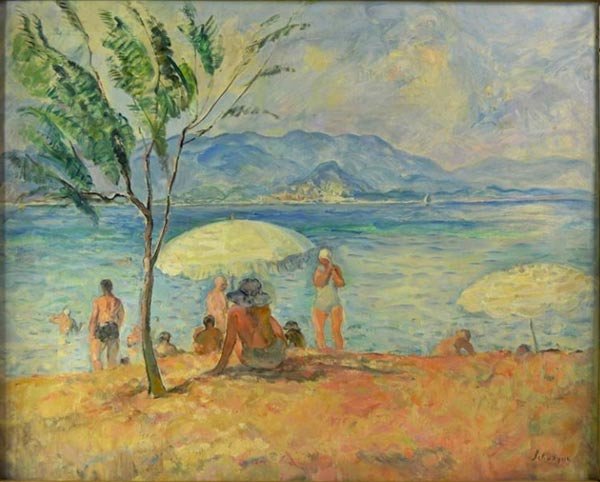
In this ongoing series for Fine Art Today, we take a longer look at the history and features of a soon-to-be-available artwork of note. This week: Henri Lebasque, “Baigneuses (Bathers).”
Henri Lebasque (1865–1937) is a name recognized by few. However, critics celebrated the post-impressionist — born in Champigné, France, in 1865 — during his lifetime for the stunning color palette of his works, the joy in their forms, and their leisurely themes. In 1885, the 20-year-old Lebasque traveled to Paris to study at the prestigious École des Beaux-Arts, where he frequently took part in the Paris Salons and exhibitions shown annually for the art society. By 1903, he had met Henri Matisse, and together the two founded the Salon d’Automne, which exhibited works by the famed “Les Fauves,” among others. By 1924, Lebasque settled in Le Cannet, and he passed away in 1937.
Lebasque’s paintings can be found all across the world and in important private and public collections. Spirited bidding is expected at Rosebery’s, London when one of Lebasque’s oils, titled “The Bathers,” becomes available on September 8. The painting displays a common theme for the artist, who delighted in the casual. Using a gorgeous feathery stroke so characteristic of the age, Lebasque shows us a group of figures, most with their backs toward the viewer. While the foreground is empty, the middle of the image displays a lone female, taking advantage of what little shade nature has to offer. Her shaded form is the only dark reprieve for our eyes in an otherwise shining bright picture. The strong warm hues of the sandy beach are balanced with the cool greens and blues of the water, sky, and mountains in the distance.
“The Bathers” will be featured September 8 during Rosebery’s “Fine Art Auction featuring Decorative Arts and Modern Design” beginning at 10 a.m.
To view the full catalogue, visit Rosebery’s.
This article was featured in Fine Art Today, a weekly e-newsletter from Fine Art Connoisseur magazine. To start receiving Fine Art Today for free, click here.
Landscape comes alive during an upcoming solo exhibition of Douglas Fryer’s latest oils.
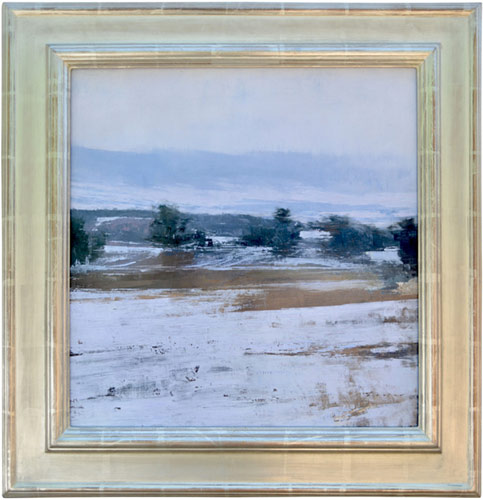
“Art happens in the heart and in the mind and in the soul, not just the hand,” observes Douglas Fryer, and it is a philosophy that surfaces with stunning results in the artist’s landscapes. Filled with predominantly soft, graceful strokes, Fryer’s paintings have an atmospheric essence that filters into the viewer’s space, encapsulating that viewer in a fury of emotional experience.
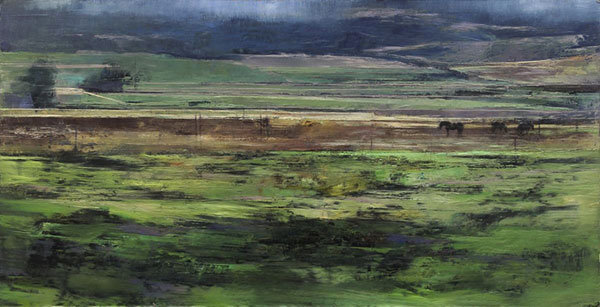
Strong, horizontal strokes give “Night’s Rain Passing” a linear quality that creates dramatic movement from one side to the other. While it is largely abstracted, representational forms emerge from the planes of color, including a small group of horses to the right and perhaps a barn or two in the upper left.
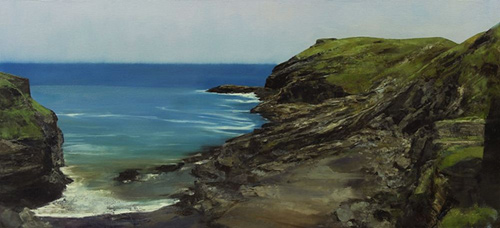
“Tintagel” is a superb example as well, its rocky forms defined with a sharpness and clarity that seems very distant from “Night’s Rain Passing.” A small cove, represented softly but activated by swaths of white, is surrounded by the grass-covered, imposing cliffs of a rocky shore. These, along with 12 other paintings of varying size, will feature in an upcoming solo exhibition at Meyer Galleries in Santa Fe, New Mexico.
For those who seek to pick up one of their own, time is of the essence. “Douglas Fryer” opens on September 11 and will hang through September 18: one week.
To learn more, visit Meyer Galleries.
This article was featured in Fine Art Today, a weekly e-newsletter from Fine Art Connoisseur magazine. To start receiving Fine Art Today for free, click here.
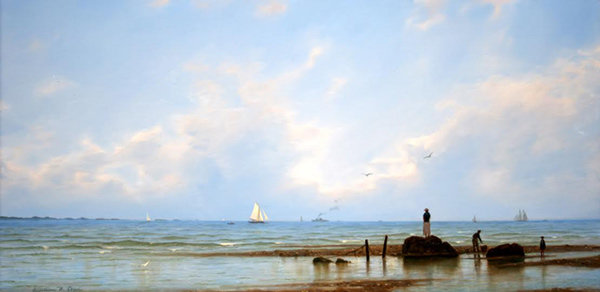
While his maritime subjects are inspired by his childhood experiences exploring the islands about Lewis Bay, admirers and collectors have come to covet William Davis’s mastery of luminosity and light.
It is hard to believe that William R. Davis is a self-taught painter. His pictures breathe with life, character, and light that seem possible only for a well-trained painter. That’s what 38 years of full-time trial and error can accomplish, and Davis is still excelling in ways that continue to captivate.
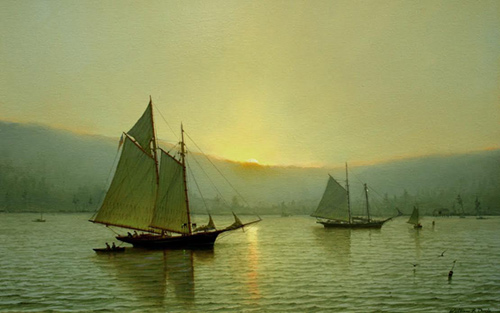
Davis is among the world’s most renowned maritime painters, and, like so many before him, his journey to become an artist began early in life. “The inspiration certainly comes from my childhood,” says Davis. “I filled my days playing along the shores of Hyannis Port, Massachusetts, a wonderful place to grow up. By 10 years old, I was sailing single-handed small catboats, exploring every small island and cove in and about Lewis Bay.” The young Davis developed an acute and discerning eye for light as it cascades across the waters, a realist observation that surfaces in all his work. “Sailing also gave me the self-confidence and patience in developing my skills,” he notes.
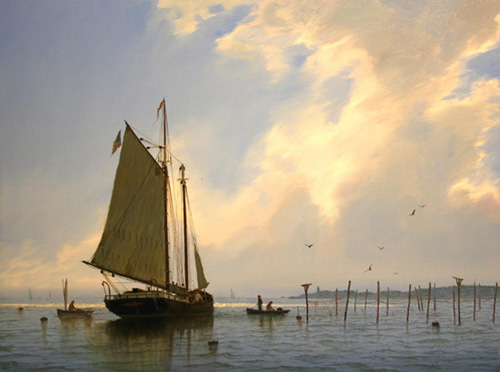
Davis’s process often begins with painting the scene’s sky from top to bottom, which allows the artist to match the water’s reflective colors exactly. Broad and simplified details above the horizon are imaged and blended in the wet paint before the piece is allowed to dry. Details slowly begin to emerge after this point, when Davis begins to outline his wooden boats and other elements in the landscape. The final process involves adding details in the water and boats and highlighting points of highest luminosity.
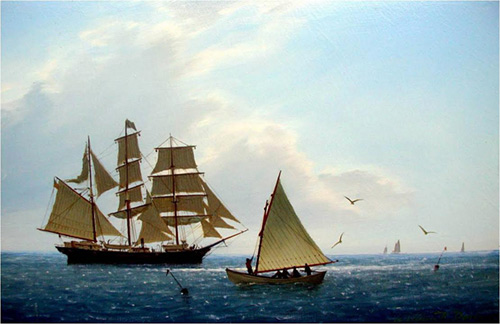
Particularly lovely about Davis’s paintings is their nostalgic allure, with most pictures depicting the traditional wooden sailboats that are nearly impossible to find since the introduction of fiberglass. This is an important element for Davis, who, along with his collectors and admirers, longs to see harbors populated with the elegant and character-filled vessels. Inspired by artists of the Hudson River School in addition to such masters as Edward Moran, Antonio Jacobsen, and Fitz Henry Lane, Davis’s paintings have a level of detail, quietness, and glow that is timeless. Indeed, it is the inner glow and radiance of his paintings that has harnessed the most attention.
“My customers have always expressed their enjoyment at having my works hanging in their homes,” says the artist. “Even many years later, I’m approached by people who want to tell me how the light changes on their painting several times a day. What I take away from this is a satisfaction from producing something that people love and want to live with.”
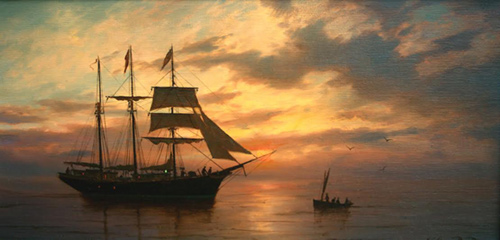
Who wouldn’t want “Weir Fishermen off West Dennis Beach” adorning their home? Albeit small, the painting packs a significant impact. Calmly resting in center left is a beautiful vessel, its sails extended as they are silhouetted against the waning light of the sky. “Distant Ships” is another outstanding picture, itself having an old-time tone as the boats glide across the horizon. “Safe Anchor, Southwest Harbor” has a greenish glow to its light, in some ways giving the piece an aged appearance.

The future is exciting for Davis, who seeks to expand the scale of his paintings, which have remained relatively small throughout his career. “The most important effort has been increasing the size of my paintings and maintaining the same luminosity and color on a grand scale,” he says. One can only imagine, if he is successful, the wonders in store.
To learn more, visit William Davis.
This article was featured in Fine Art Today, a weekly e-newsletter from Fine Art Connoisseur magazine. To start receiving Fine Art Today for free, click here.

As we mark the 10th anniversary of Hurricane Katrina, many still are — and will forever be — scarred by the unimaginable destruction witnessed in the Southern United States. Time and again, however, Americans emerge stronger than ever, turning tragedy into triumph and ugliness into art.
In August of 2005, most Americans watched on their televisions as the Gulf Coast — and especially the city of New Orleans — was rocked by the costliest and nearly the deadliest natural disaster in U.S. history. A category 5 hurricane, Katrina had wind speeds as high as 174 MPH and killed nearly 2,000 people. The images transmitted through our screens were stunning in their truthfulness to the destruction of the storm and the dire situation in which many residents found themselves.
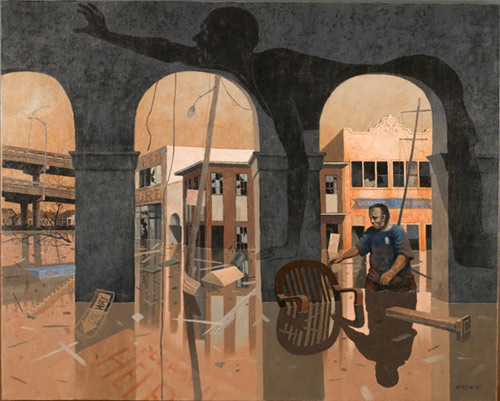
The physical, mental, and visual experience of the storm was very different for those who found themselves in its path and struggling to survive in its wake. Following the storm, as communities began to rebuild, many were already beginning to reflect on the events, and it seems only natural that artists of the region would express their experiences in new and unique ways. One of those artists was Rolland Golden, and for about two years following Katrina, he recorded his observations and feelings in 32 major works, 14 of which are now on view at The Historic New Orleans Collection.
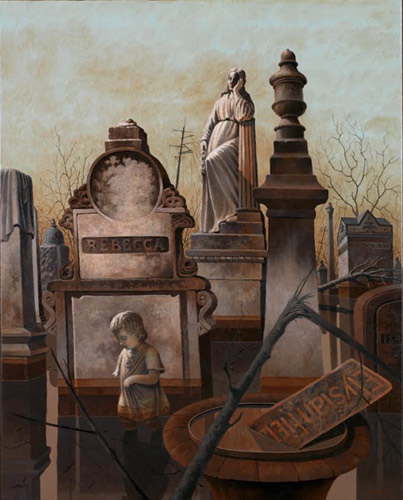
“Desperation” is one such picture, and it is gripping in its raw emotional content. At center right in the foreground, we find an elderly figure wearing a horrified expression. Surrounding the figure are a number of destroyed homes, their siding and wood panels scattered across the ground. Although the destruction is magnetic, it is the figure with whom we identify and on whom we concentrate. There is a pain and sorrow emanating from her that is absolutely moving, and the brilliant red hue of her garment leaps from the surface, pushing the figure uncomfortably close to the viewer. Golden doesn’t want us to shy away, but to confront and bring to the fore the experiences of Gulf Coast residents.
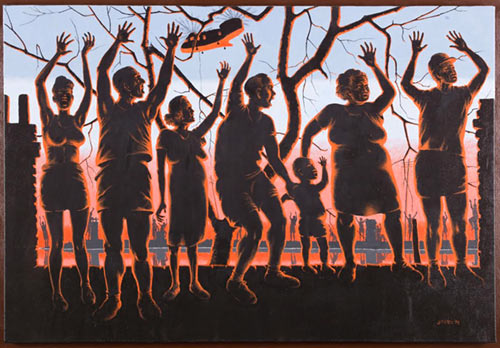
The situation is perhaps more ominous in “Throw Me a Line, Mister,” which displays a family of African Americans stranded on a rooftop. With minimal details, the figures are silhouetted, highlighted with a fiery red-orange that has a hellish tone. Within the gaps between their bodies, we find other desperate individuals, everyone holding their arms high in hopes of rescue.
“Rolland Golden’s Hurricane Katrina Series: A Selection” opened on July 29 and will be available through January 16.
To learn more, visit The Historic New Orleans Collection.
This article was featured in Fine Art Today, a weekly e-newsletter from Fine Art Connoisseur magazine. To start receiving Fine Art Today for free, click here.

The death of an individual can sometimes lead to disagreements among those who feel entitled — by blood or law — to acquire their possessions. This was recently demonstrated in the case of the late heiress Huguette Clark.
Huguette Marcelle Clark (1906-2011) was considered a great philanthropist, donating much of her inherited fortune to various charities. However, the late heiress was also labeled a recluse, living in a hospital for more than 20 years while her mansions remained empty. That hospital, Mount Sinai Beth Israel in New York City, recently found itself in a legal battle with Clark’s distant relatives over donations she made to the institution more than 15 years ago.
Among the items donated to the hospital was a beautiful painting by Édouard Manet, “Peonies in a Bottle” (1864), worth an estimated $3.5 million. In addition to the painting, Clark donated cash gifts totaling nearly $1 million to the institution over several years.
Relatives argued that museum staff and administrators frequently approached Clark for donations during her tenure with the hospital, taking advantage of her old age and manipulating her into giving away her prized possessions.
Last month, Manhattan Judge Nora S. Anderson ruled in favor of the hospital, deeming that the statute of limitations had long passed, since it was in October of 2002 that Clark made her last donation. However, relatives are still able to pursue separate lawsuits against doctors and nurses who cared for Clark.
To learn more, visit here.
This article was featured in Fine Art Today, a weekly e-newsletter from Fine Art Connoisseur magazine. To start receiving Fine Art Today for free, click here.