

After 24 long years, a stunning Rodin original was returned to its rightful owner.
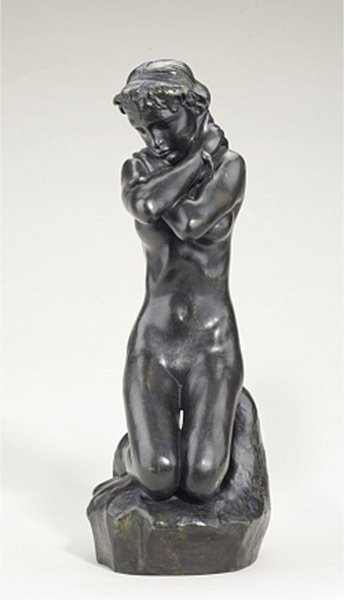
Dating to 1886, “Young Girl with Serpent” is a prime example of Auguste Rodin’s genius. The figure sits on her knees, with a pensive expression and her arms wrapped around her shoulders. The mastery of modeling and acute observation of anatomy are breathtaking in their accuracy. In 1991, the sculpture — along with an estimated $1 million in other artworks — was stolen from a Beverly Hills mansion after a Swiss housekeeper sold duplicates of his employers’ house keys to a criminal gang for $5,000.
The housekeeper was quickly caught, but the sculpture’s whereabouts remained a mystery until this year. After nearly 24 years, the sculpture surfaced by consignment at Christie’s, London, in 2011. After four years of negotiation, the sculpture was returned unconditionally to the original owner, who is now in her 80s. The sculpture is estimated to be worth around $100,000. Other works stolen from the mansion, including a Rodin sketch of “The Kiss” and another sculpture, “The Eternal Spring,” are still missing.
To learn more, visit The Art Newspaper.
This article was featured in Fine Art Today, a weekly e-newsletter from Fine Art Connoisseur magazine. To start receiving Fine Art Today for free, click here
Rodin Returned
All in One
The oldest fine art gallery in Colorado is showcasing nearly 40 artists in its current “Summer Exhibition.”
For collectors and art admirers who love an exhibition that offers an eclectic variety of style, medium, and aesthetic, Saks Gallery in Denver, Colorado, is the place to be. Sara Noel will feature the most abstract of work; her large brushstrokes, blending of blues, oranges, and reds, and rhythmic surface make “Right Brain Peonies” pulsate with expressive energy. This abstract work features along with G. Russell Case, who “offers us the plain and simple truth of the west, warm tones, high canyon walls, jagged mountain ranges inhabited by a lonesome cowboy or a Navajo family traversing the harsh yet beautiful high desert landscape.”
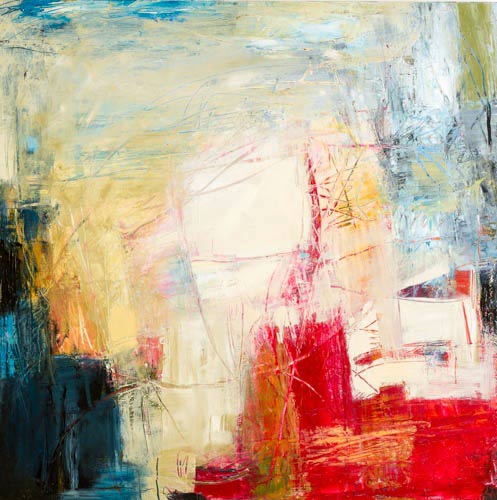
Sara Noel, “Right Brain Peonies,” Mixed media on canvas, 40 x 40 in. Saks Gallery
The sculptures of Wayne Salge will be on display as well. Salge’s “Lookout” is a piercing image of a perched owl — its features sharpened and boiled down to simple planes, geometric shapes, and patterns.
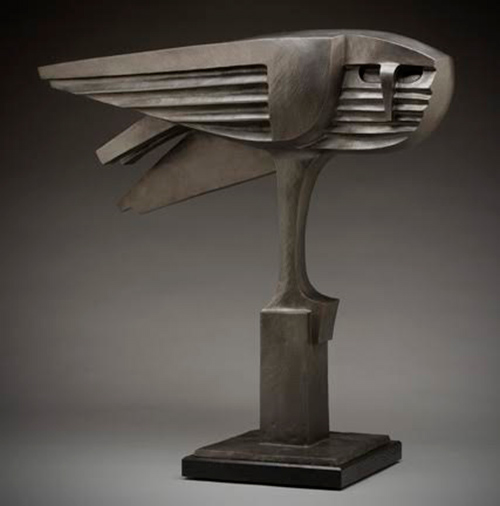
Wayne Salge, “Lookout,” bronze edition of 6, 33 x 37 x 14 in. Saks Gallery
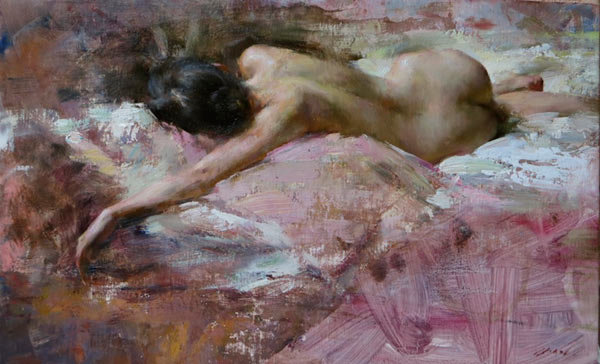
The stunning figurative paintings by Mary Qian are absolutely magnetic. Featured is “Pink,” which displays a reclining female nude facing away. She rests in a sea of pinks, whites, browns, and oranges that have been quickly and expressively laid on the canvas. The accurately rendered figure appears to float effortlessly, and her soft, more purposeful treatment contrasts sharply with the abstract space that surrounds her.
“The Summertime Exhibition” opened on June 11 and will be on view through August 22.
To learn more, visit Saks Gallery.
This article was featured in Fine Art Today, a weekly e-newsletter from Fine Art Connoisseur magazine. To start receiving Fine Art Today for free, click here.
Featured Artwork: William Trost Richards, “Western Shore of Ion”
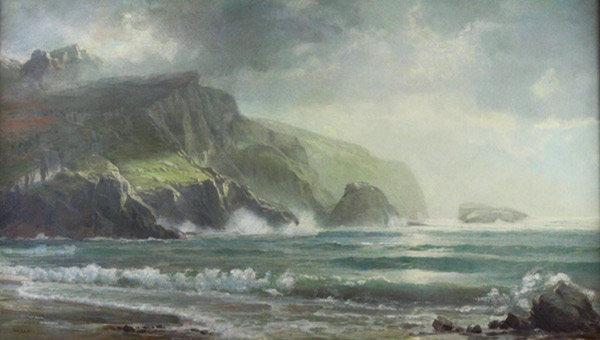
In this ongoing series for Fine Art Today, we take a longer look at the history and features of a soon-to-be-available artwork of note. This week: William Trost Richards, “Western Shore of Ion.”
An important American landscape artist often connected with the Hudson River School and the American Pre-Raphaelite movement, William Trost Richards (1833–1905) produced innumerable acclaimed watercolors and paintings of marine, White Mountain, and Hudson Valley subjects. Born in Philadelphia, Richards studied alongside German artist Paul Weber (1823–1916) and worked as an illustrator for a metalwork company. In 1854, Richards met many of the renowned painters of the Hudson River School, which would help shape his artistic vision. But in lieu of the romanticized and stylized approach to landscape by the Hudson River School, Richards preferred extreme naturalism and factual renderings, making many of his works appear photographic.
Today, Richards’s works are featured in many important museums, including the National Gallery, the Smithsonian American Art Museum; the Wadsworth Atheneum; the Philadelphia Museum of Art; the Yale University Art Gallery; the High Museum of Art; the Museum of Fine Arts, Boston; the Fogg Art Museum; and the Brooklyn Museum of Art.
Featuring in Louis J. Dianni’s 2015 auction in Garrison, New York, is Richards’s “Western Shore of Ion,” a stunningly beautiful and quintessential seascape produced in 1890, toward the end of the artist’s career. Richards’s faithfulness to nature has indeed come through in this piece, and one feels as though one could step into the picture. Focusing on a large rocky outcrop, waves crash and spew mist into the air in the center of the composition. There is a lovely pairing of the blue-green of the ocean with the light green of the rocky shore. Flashes of red are barely visible toward the upper left edge of the painting, but are intensified by the dominant blues and greens.
“Western Shore of Ion” features in Louis J. Dianni’s auction on August 8-9 in Garrison, New York.
To view the full catalogue, visit Lous J. Dianni.
This article was featured in Fine Art Today, a weekly e-newsletter from Fine Art Connoisseur magazine. To start receiving Fine Art Today for free, click here.
Reviving Rossiter
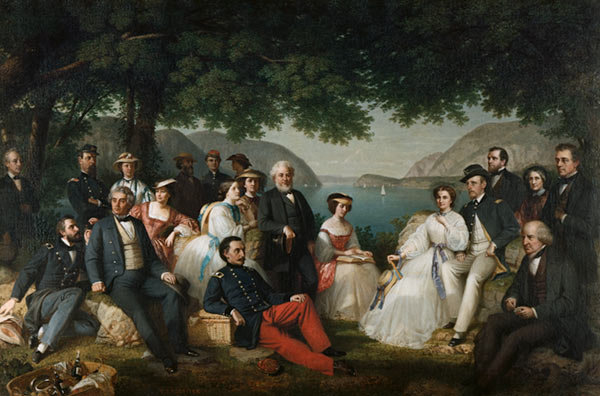
Although 19th-century painter Thomas Prichard Rossiter did not enjoy a great amount of professional success during his lifetime, the Boscobel House in Garrison, New York, is honoring the man with his first retrospective.
While Thomas Prichard Rossiter occasionally rubbed shoulders with the likes of John Frederick Kensett, Thomas Cole, and Asher B. Durand of the Hudson River School, he was not able to harness the same degree of notoriety or success as his peers. Some have suggested that the artist’s desire to paint subjects other than landscape — such as history — may have contributed to his “unfashionable” status in the mid-19th century. Even so, the painter was a prodigy and his skill undeniable.
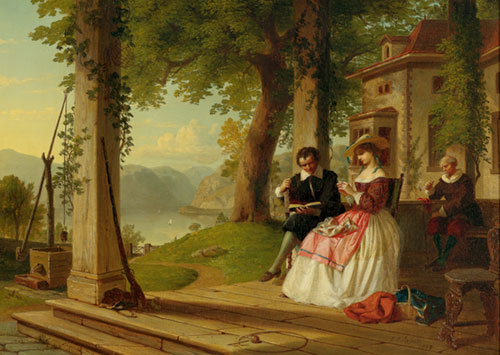
Thomas Prichard Rossiter, “The Old Porch (Washington Irving Reading Knickerbocker’s Tales of NY to his Wife [sic] on the Porch of Sunnyside),” 1858, oil on canvas, Private collection, Courtesy of Boscobel House and Gardens.
“A Picnic on the Hudson,” of 1863, is a virtuoso display of the artist’s ability. A large group of well-to-do friends and acquaintances of the painter sit and recline leisurely on a beautiful day along the Hudson River. Rossiter has skillfully rendered each individual with care, noting the details in their clothing, posture, and position within the composition. At distance, we see the magnificent Hudson River, with sailboats gliding gently across the horizon. “Rossiter’s paintings captured some of the most famous 19th-century residents and landmarks of the Hudson Valley,” says Boscobel House curator Jennifer Carlquist.
The exhibition will feature approximately 25 paintings and works on paper from public and private collections, displaying Rossiter’s portraits, still lifes, landscapes, genre scenes, and history paintings. For an added experience, visitors can tour the painter’s original house, located just north of the Boscobel House and Gardens.
“Every Kind of Painter: Thomas Prichard Rossiter” opened on August 2 and will be on view through November 29.
To learn more, visit the Boscobel House and Gardens.
This article was featured in Fine Art Today, a weekly e-newsletter from Fine Art Connoisseur magazine. To start receiving Fine Art Today for free, click here.
The Little and the Big
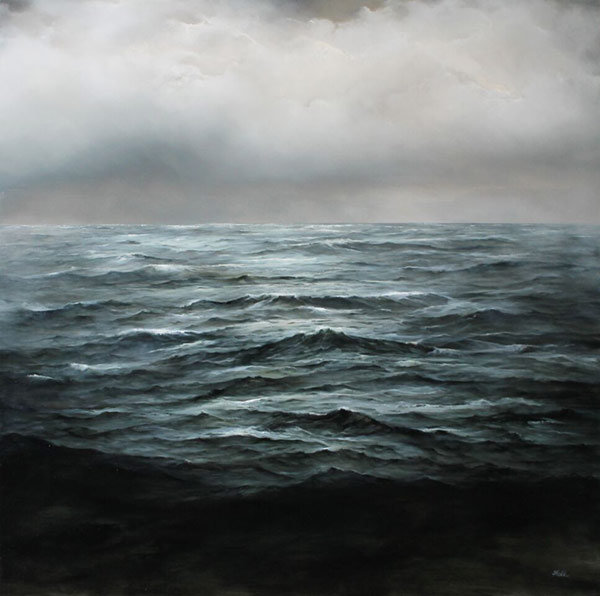
We all have the ability to appreciate artworks for a number of reasons, including the scale of the product and the skill required in its fabrication. More often, we are taken by the monumentality and imposing presence of large paintings or sculptures. Even so, we can be equally mesmerized by the miniature, and awed at the dexterity required of the artist’s hand.
Robert Lange Studios has gone out on a limb with an intriguing new exhibition, “Little Big,” and it worked. The exhibition will feature the paintings of Adam Hall, who works in large scale, juxtaposed next to Megan Aline, who paints in miniature. Making the show even more compelling is the fact that both Aline and Hall draw largely from childhood experiences for inspiration, giving the paintings similar tones, moods, and feelings of nostalgia, despite their differences in size. Alongside one another, the paintings display a range of artistic abilities and serve as evidence that whether their works are large or small, proficient artists can always transport viewers into their creative world.
Megan Aline, “Find Stillness,” acrylic on canvas, 4 x 4 in. Robert Lange Studios
“I’ll Follow You” is a particularly beautiful painting by Hall. The simplicity of this seascape, with no discernible focus, invites a plethora of subjective interpretations. At 36 inches on each side, the size of the painting is anchoring and intimidating. Further, Hall’s use of high contrast and a diverse variety of blues, whites, blacks, and greens captivate the viewer.
It would take 81 of Aline’s paintings to fill the same space as Hall’s “I’ll Follow You,” but their impact is just as large. Working on 4 by 4-inch canvases, Aline only recently discovered her affinity for the small scale. “I love small brushes,” writes Aline. “I enjoy the act of moving a brush from one side of a canvas all the way to the other with one motion. Not only do I love the act of making a small piece, but there’s something very satisfying about being able to create works without the pressure of time.”
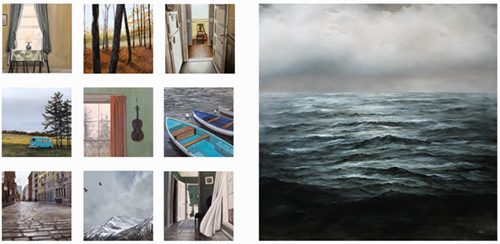
Michael Hall & Megan Aline, a conception of how the works will be displayed, Robert Lange Studios
Considering Aline’s “Find Stillness,” the artist’s amazing dexterity comes to the fore. Recalling the domestic scenes of the Dutch Golden Age, a beautiful arrangement of books, weights, a teapot, and an orchid rests on a wooden table next to a brightly illuminated window to the left. There is a calm and quietness in the piece, as each object seems to rest in its perfect place.
“Little Big” opens at Robert Lange Studios tomorrow, August 7, and will hang through August 28.
To learn more, visit Robert Lange Studios.
This article was featured in Fine Art Today, a weekly e-newsletter from Fine Art Connoisseur magazine. To start receiving Fine Art Today for free, click here.
Shaping the Figure
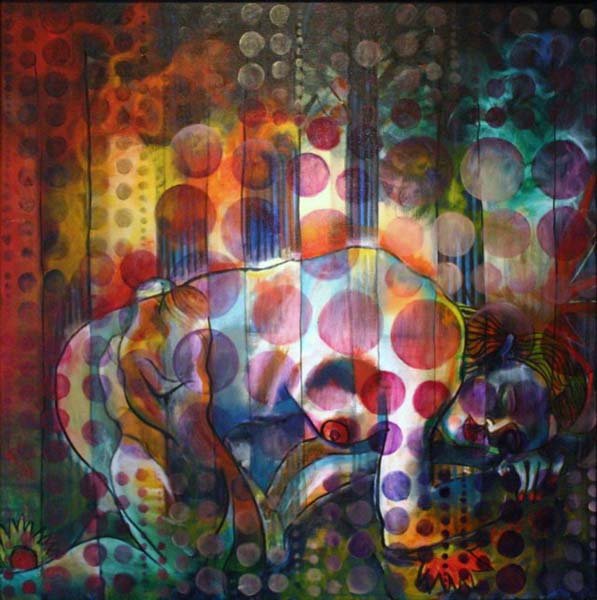
Gideon Cohn abstracts and reimagines the figure through color, shapes, and patterning in an eclectic exhibition.
One could easily pick out a number of different artistic styles in the work of Gideon Cohn, who may leave viewers both puzzled and inspired in his latest solo exhibition at Dacia Gallery, New York. “The Kiss (Woods & Sea)” could recall artists of the 1960s and 1970s, but one could also find cubism in other works, such as “Checkered Woman.”
Despite the broad range of influences, the figure remains a dominant subject for Cohn. He suggests, “Its ever-changing shapes, colors, and line have been a stimulus in my exploration process for 35 years. Figurative drawing and painting became my conduit to the beauty of sensuality, flow of spirit, and the ties to earth.”
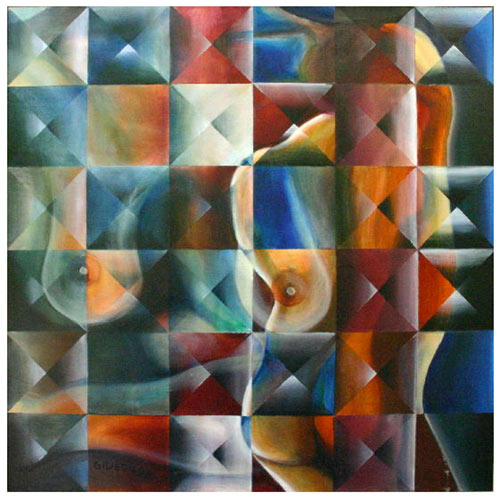
Gideon Cohn, “Checkered Woman,” oil on canvas, Dacia Gallery
There is a captivating dichotomy between the organic lines of the figure and the overlying order of geometric patterning in much of Cohn’s work in this exhibition. The lack of spatial context or a clear narrative also injects a surrealist tone into the paintings that is mystifying.
“Visum Opticum: Gideon Cohn” opened on August 1 and will hang until August 27.
To learn more, visit Dacia Gallery.
This article was featured in Fine Art Today, a weekly e-newsletter from Fine Art Connoisseur magazine. To start receiving Fine Art Today for free, click here.
Shaping the Figure
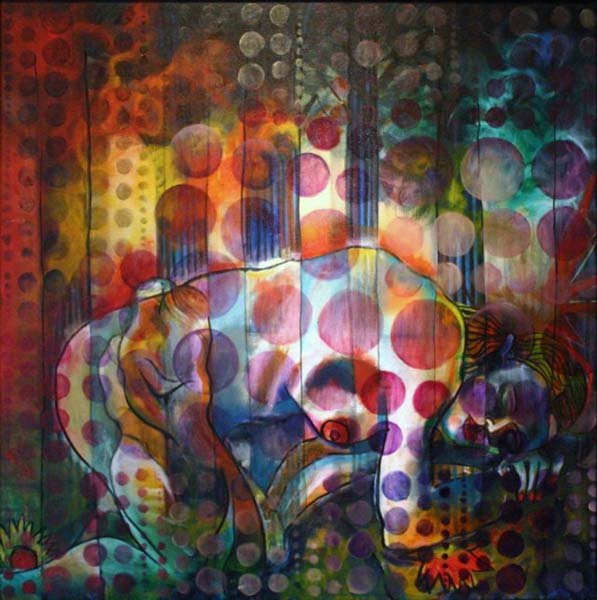
Gideon Chon abstracts and reimagines the figure through color, shapes, and patterning in an eclectic exhibition.
One could easily pick out a number of different artistic styles in the work of Gideon Chon, who may leave viewers both puzzled and inspired in his latest solo exhibition at Dacia Gallery, New York. “The Kiss (Woods & Sea)” could recall artists of the 1960s and 1970s, but one could also find cubism in other works, such as “Checkered Woman.”
Despite the broad range of influences, the figure remains a dominant subject for Chon. He suggests, “Its ever-changing shapes, colors, and line have been a stimulus in my exploration process for 35 years. Figurative drawing and painting became my conduit to the beauty of sensuality, flow of spirit, and the ties to earth.”
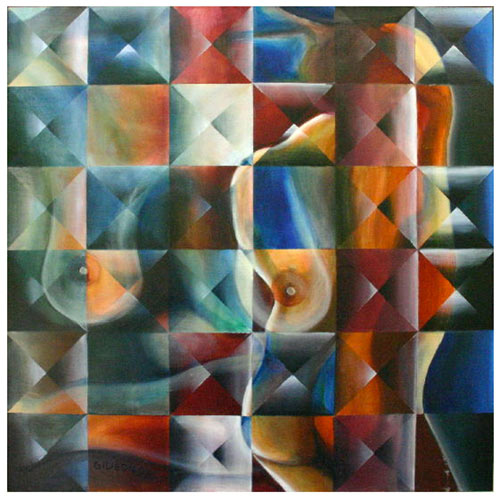
Gideon Cohn, “Checkered Woman,” oil on canvas, Dacia Gallery
There is a captivating dichotomy between the organic lines of the figure and the overlying order of geometric patterning in much of Chon’s work in this exhibition. The lack of spatial context or a clear narrative also injects a surrealist tone into the paintings that is mystifying.
“Visum Opticum: Gideon Chon” opened on August 1 and will hang until August 27.
To learn more, visit Dacia Gallery.
This article was featured in Fine Art Today, a weekly e-newsletter from Fine Art Connoisseur magazine. To start receiving Fine Art Today for free, click here.
Natural Forms
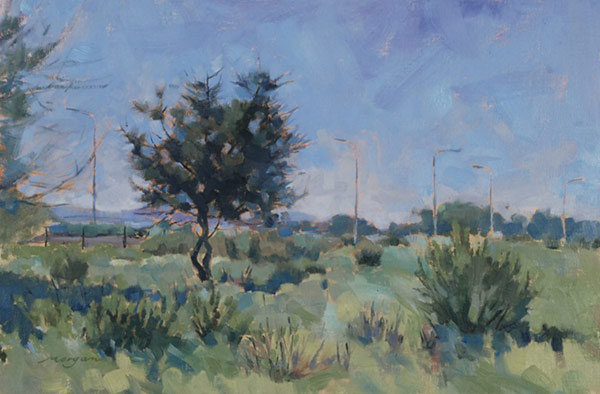
Plein air painter Jamie Morgan takes viewers “Into the Wild” as his appreciation for the vitality of nature shines through at the Arte Verissima Gallery & Studio.
Nature always finds a way to persist and adapt to a variety of disasters and alterations, including those of human beings. Although towns and cities continue to expand, we are often — and need to be — reminded of the vitality of nature and the energy it emanates. Painter Jamie Morgan has always possessed an admiration for nature’s ability to persist, and these ideas come to the fore within “Into the Wild,” a solo exhibition of the artist’s latest work at Arte Verissima Gallery & Studio in Oakland, California.
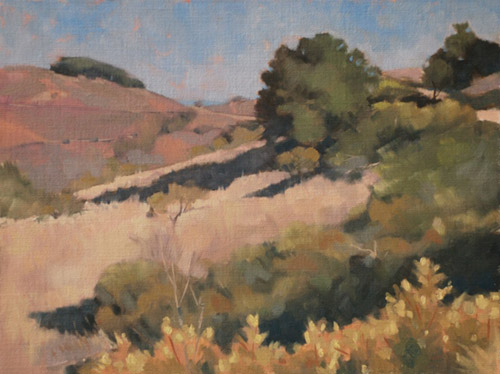
Jamie Morgan, “Sibley I,” oil on linen, 12 x 16 in. Jamie Morgan 2015
Lessons in color, form, and meaning gathered from experiences outdoors are highlighted in works such as “Marina Oak.” At center one finds a dark tree in shade — a natural focal point with sharp contrasts to the sky. A broad range of green and blue hues are playfully layered and patterned below to image the shrubs and grasses. Morgan’s expressive and loose brushwork vibrates the surface, giving it movement and life. One is reminded of the subtle presence of humans through the fence posts toward the left edge of the picture as well as the street lamps that stand along the horizon.
“Into the Wild” opens tomorrow, August 7, and will be on view through September 13.
To learn more, visit the Arte Verissima Gallery & Studio.
This article was featured in Fine Art Today, a weekly e-newsletter from Fine Art Connoisseur magazine. To start receiving Fine Art Today for free, click here.
The French Connection
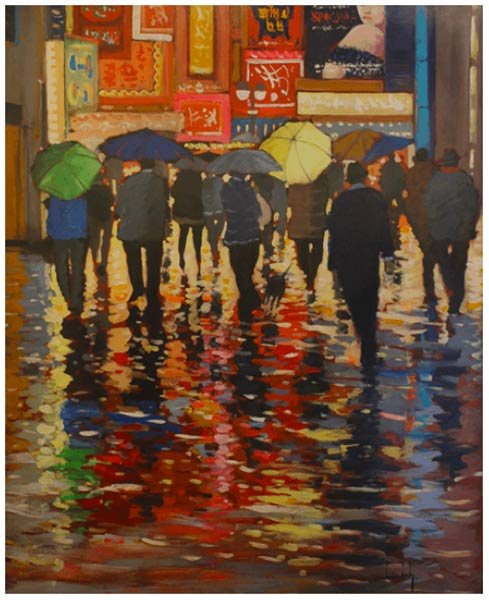
Born on the Atlantic coast of France, painter Olivier Suire Verley has traveled across the world to capture the charm of different places and peoples. Verley is an exceptional colorist, and his latest paintings, in a current solo exhibition across the United States, are sure to deepen one’s mood.
Whether he’s painting the beaches of Morocco, the streets of Paris, or the harbors of his hometown of La Rochelle, France, Olivier Suire Verley has little trouble capturing the essence of his subjects. Born into an artistic family — Verley’s grandfather was a renowned painter — Verley seemed destined to develop and impart his reflections of life onto the world from the beginning. Today, his paintings engage viewers immediately with their quilting and layering of highly saturated color. Once there, one is continually entertained by Verley’s play of abstraction, where well-defined figures and objects seem to flatten before lifting again in relation to their surroundings.
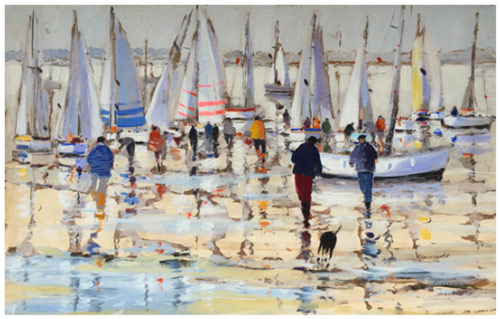
Olivier Suire Verley, “Before the Regatta,” oil and acrylic, 28.75 x 45.5 in. Addison Art Gallery
“A Night in Japan” is an excellent example of Verley’s mastery of color and his ability to capture the impression of a rainy night in the heart of a bustling city. Dabbles of color in a rainbow spectrum compose nearly half of the canvas from the bottom, creating an abstract pattern that makes the wetness of the street seem tangible. This undefined area flows beautifully into the sharp forms of bodies and neon advertisements. As in most of his work, Verley does not include faces or physical details to distinguish individuals, but his subtle attention to clothing, accessories, and color imbues each figure with character. Further, Verley has created a convincing sense of space and three-dimensionality, which is strengthened by the flattened, abstract arrangement of color at the bottom juxtaposed against the sharp geometric forms of the signs at the top.
“Olivier Suire Verley: One Man Show” opens at the Addison Art Gallery in Orleans, Massachusetts, on August 8.
To learn more, visit Addison Art Gallery.
This article was featured in Fine Art Today, a weekly e-newsletter from Fine Art Connoisseur magazine. To start receiving Fine Art Today for free, click here.
Time Stands Still
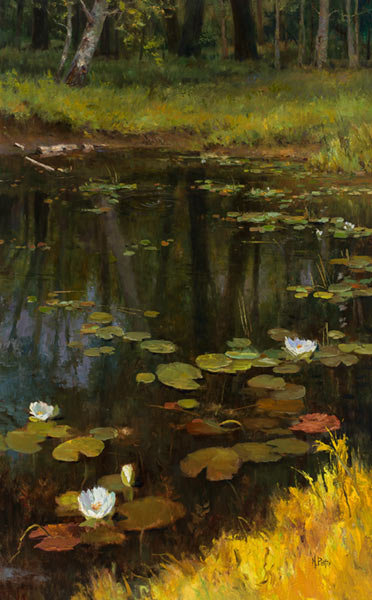
The Saint Croix National Scenic Riverway is well known for its beautiful vistas, gentle cascading falls, and lush green landscapes over a stretch of 255 miles between Minnesota and Wisconsin. Mary Pettis has called a small town on the Saint Croix River home for many years, and her latest paintings are on view soon.
With just one stoplight, Taylors Falls, Minnesota, is the type of small, quiet town perfect for a plein air painter to flourish, especially when that town is nestled right along a beautiful river. Mary Pettis has an established reputation built on her stunning representations of the Saint Croix River region as well as other parts of the country, and her latest oils are on view beginning tomorrow, August 7, at the Jaques Art Center in Aitkin, Minnesota.
Drawing heavily from her classical training and Russian influence, Pettis’s paintings have a stillness that captures well those moments when we stumble upon a pristine and untouched space in nature. “Time Stands Still” is a beautiful example of this character. In the piece, we find a reflective pool or pond adorned with floating lily pads and driftwood. The brilliant white of the lilies contrasts sharply with the dark waters and gives the eye points of detailed focus. The bottom right corner of the linen is given over to a swath of yellow and orange grasses, helping viewers solidify their footing within the scene and observed space. Although tightly cropped and focused toward the ground and water, the reflections in the water allow the viewer to pick out hints of the sky, which opens the scene and provides comfort.
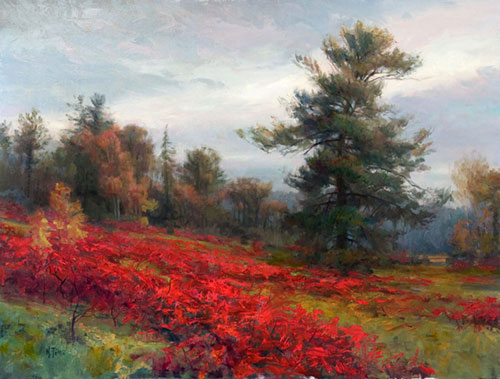
Mary Pettis, “Autumn Poetry,” oil on linen, 30 x 40 in. Mary Pettis 2015
“Autumn Poetry” is another breathtaking painting, capturing the viewer immediately with large areas of vibrant — almost neon — reds as they sweep diagonally across the linen. There is a sharpness and violence to the application of the red that is balanced by a much softer touch to the trees and sky in the distance. The exhibition should leave audiences pleased, if not booking their next trip to the Saint Croix National Scenic Riverway.
Mary Pettis’s “Solo Exhibition” opens on August 7 and will run through September 19.
To learn more, visit Mary Pettis’s website.
This article was featured in Fine Art Today, a weekly e-newsletter from Fine Art Connoisseur magazine. To start receiving Fine Art Today for free, click here.