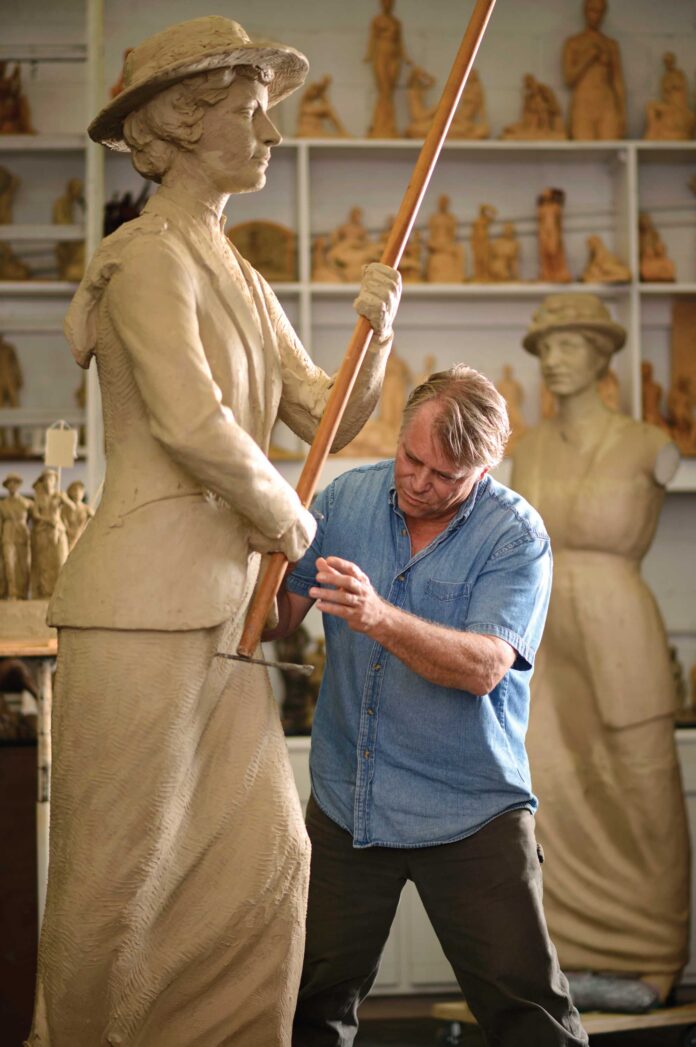
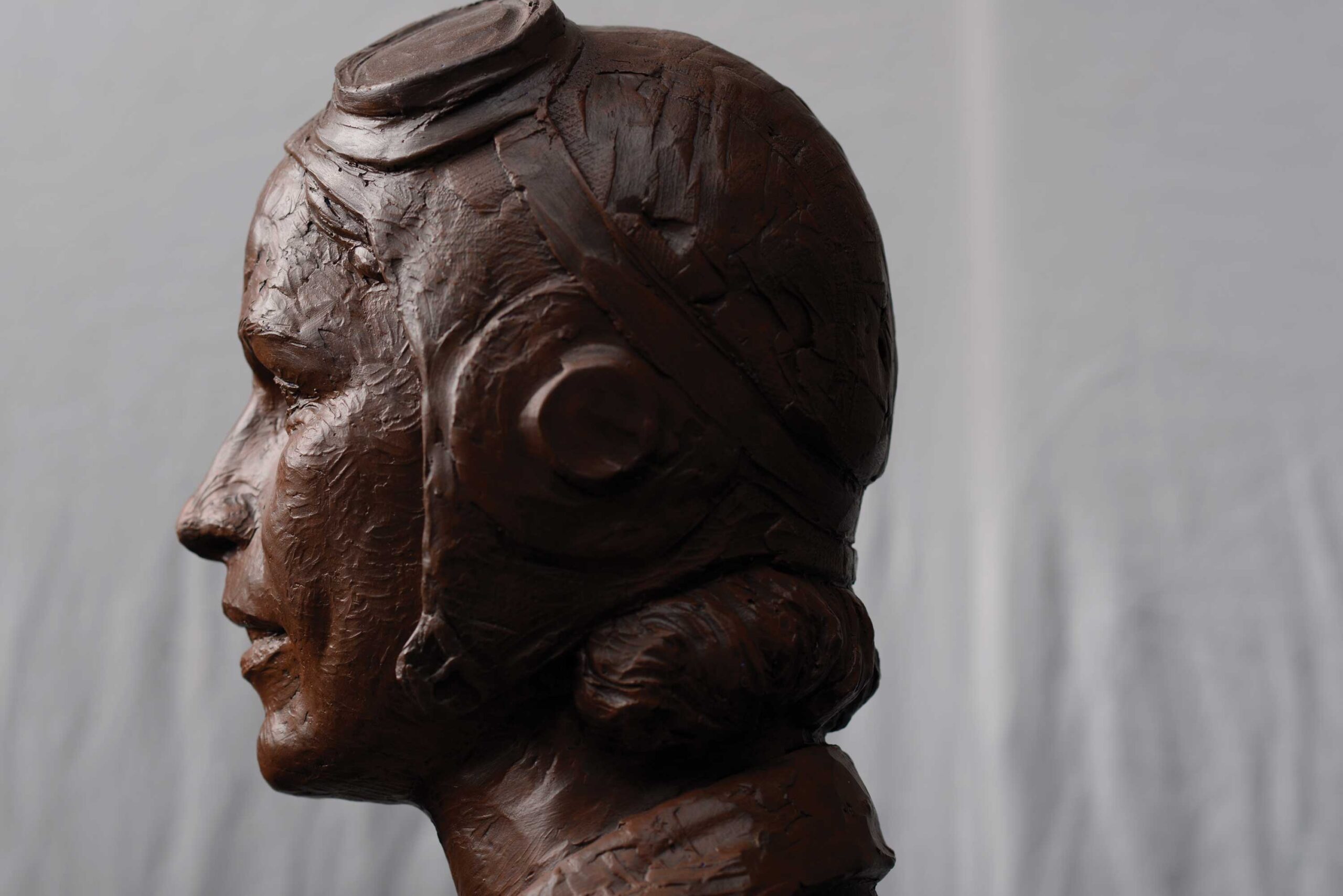
Alan LeQuire working in clay on his portrait of Anne Dallas Dudley for the Tennessee Woman Suffrage Monument, Nashville
Figurative Art Sculptures of Women by Alan LeQuire
An Unusual Path
Growing up in a rural area outside Nashville, Alan LeQuire (b. 1955) began crafting objects in copper and tin when he was just 11. His initial influence was primarily the “conscious primitivism” pursued by the earlier Tennessee sculptors William Edmondson (1874–1951), Puryear Mims (1906–1975), and Olen Bryant (1927–2017), all of whom used found materials and stone.
After earning an undergraduate degree at Nashville’s Vanderbilt University, LeQuire undertook a one-year apprenticeship under Milton Hebald (1917–2015), an American sculptor living in the Roman Campagna. There the young man learned about bronze casting and began to emulate the Italian master Giacomo Manzù (1908–1991) in always starting his modeling process with wet clay. Returning to the U.S., LeQuire studied figurative sculpture with Peter Agostini in the M.F.A. program of the University of North Carolina at Greensboro.
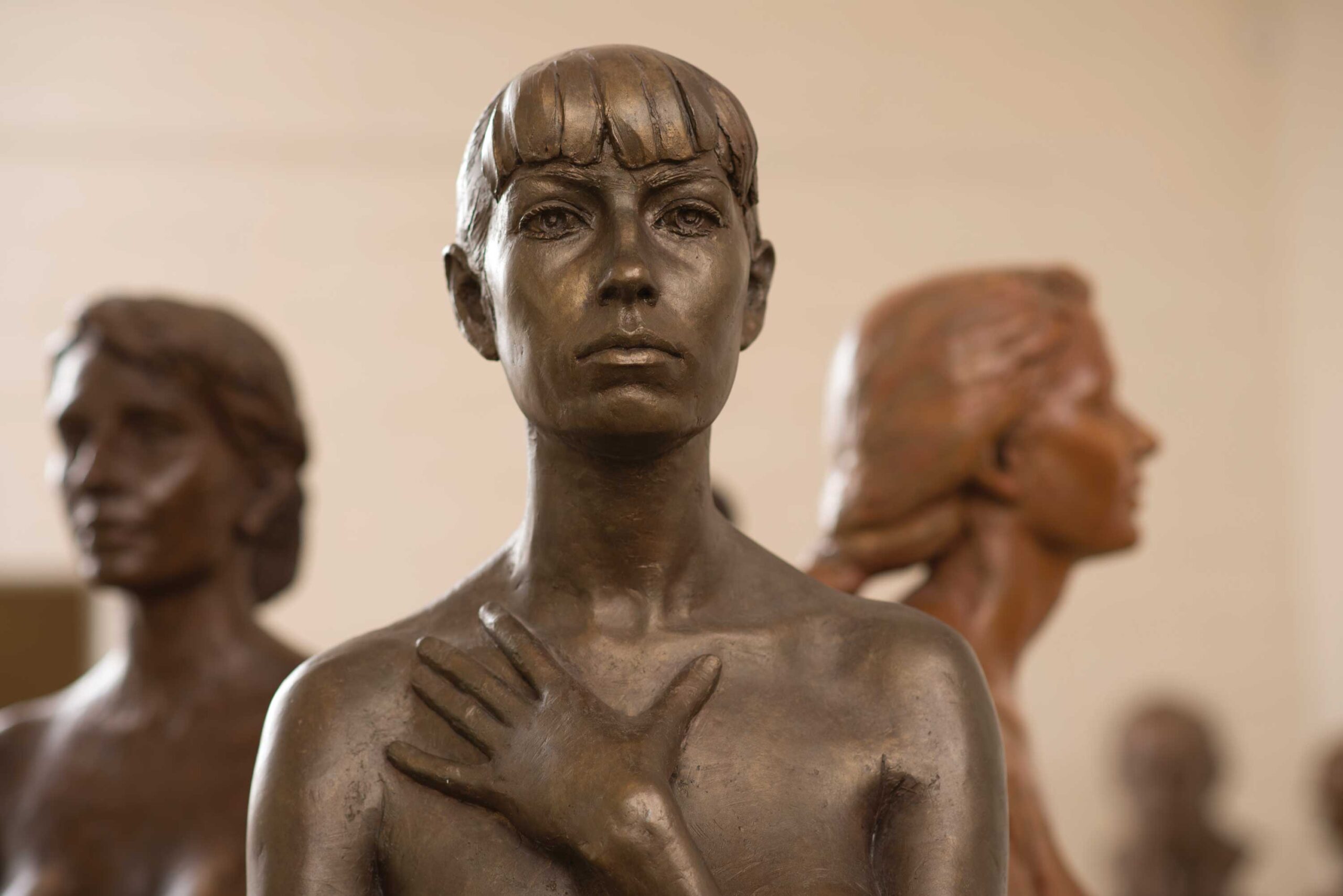
Alan LeQuire, Mimi, Bridgett, Jess, c. 2001–03, painted plaster, life-size busts, available in bronze (edition of 6)
Fresh out of graduate school, he was commissioned to create Athena Parthenos, which, at 42 feet high, remains the largest indoor sculpture in the Western world. Nashville was already renowned for the full-scale replica of the Parthenon it erected in 1897 to mark the centenary of Tennessee’s becoming a U.S. state. Yet Nashvillians had long dreamed of completing it with a replica of the female goddess who once dominated the original temple in Athens. It took young LeQuire eight years to fulfill that dream in 1990. Today he notes, “She is an idealized figure, of course, and I was attempting to mimic the style of Phidias, but I see the Athena statue as part of the same objective I have had all along — to honor women.”
Though he sculpts on a small scale, too, monumentality has always mattered to LeQuire. Viewers marvel at the four-times-life-size portraits from his ongoing Cultural Heroes series. Among them are his depictions of the blues icons Bessie Smith and Billie Holiday, both of whom championed African Americans’ civil rights despite the risks such views posed to their musical careers.
Highlighting those who have dared to make a difference matters to LeQuire. He recalls, “Noticing how few portraits of women existed in public spaces [only 8 percent of America’s public sculptures honor real women], I wanted to bridge that gap. I have had some wonderful clients who felt the same way. One of my first commissions was a life-size portrait of Margaret Branscomb for Vanderbilt University.” This depiction of the energetic wife of Harvie Branscomb, the university’s chancellor from 1946 to 1963, led LeQuire to create more public monuments.
As of 2020, five of those projects commemorate the triumph of woman suffrage in his native state. Non-Tennesseans may not realize that — just over 100 years ago — it was the Volunteer State that cast the vote needed to ratify the 19th Amendment to the U.S. Constitution, thus granting American women the right to vote.
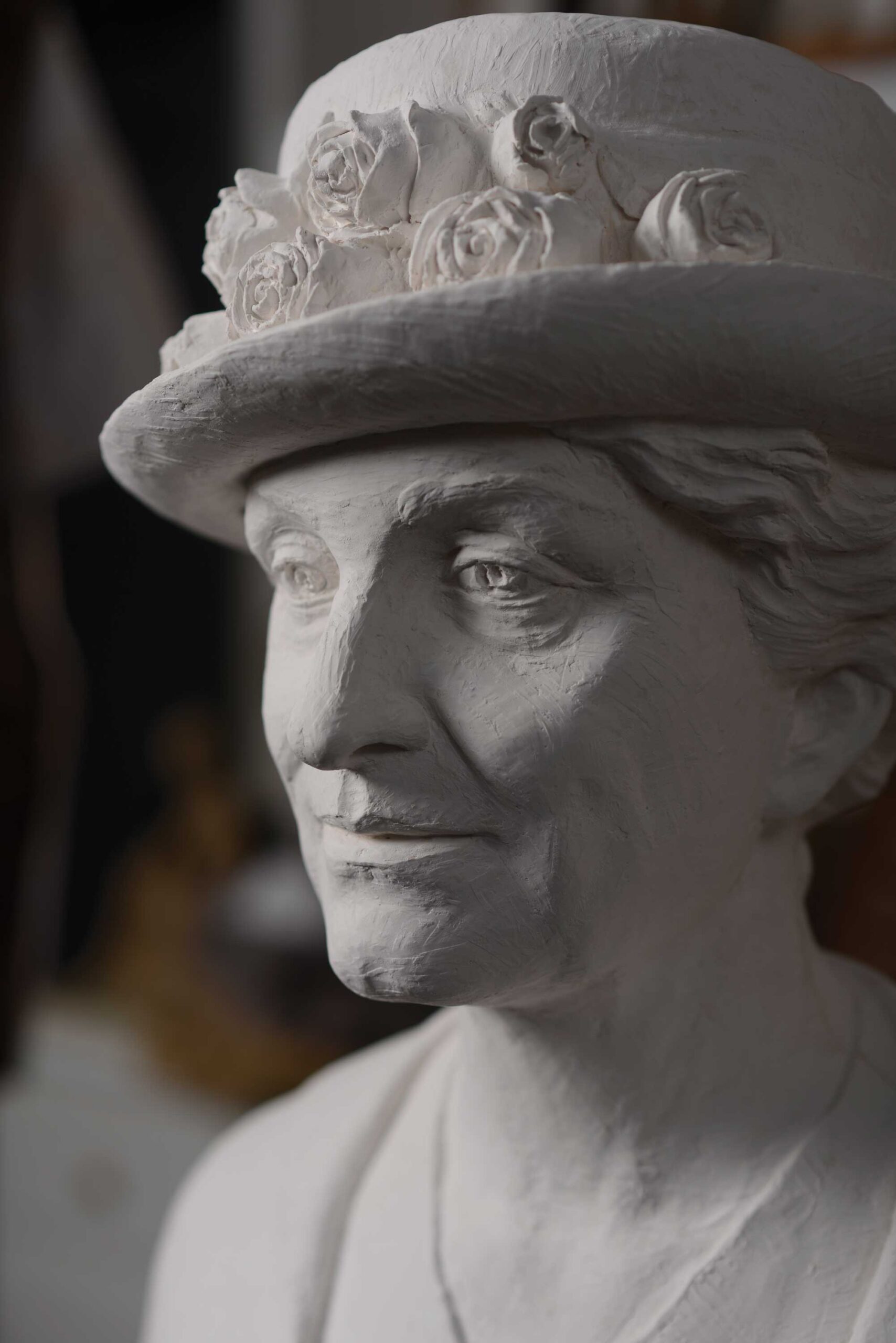
Alan LeQuire, “Carrie Chapman Catt,” 2016, plaster, life-size bust, available in bronze (edition of 12)
LeQuire notes, “In 2016 we unveiled my Tennessee Woman Suffrage Monument in Nashville, which has heroic-scale portraits of five women involved in the ratification: Carrie Chapman Catt, Anne Dallas Dudley, Abby Crawford Milton, J. Frankie Pierce, and Sue Shelton White. It seemed appropriate to place these real women on the same grounds in Centennial Park with the Parthenon and Athena. They are a reminder of the importance of real women taking real political action, and for me a continuation of the goal of honoring all women.”
Also in 2020, LeQuire participated in the unveiling of Memphis’s Equality Trailblazers Monument, which includes his busts of six leaders. One of them is the late Rep. Lois DeBerry, the second African American woman to serve in the Tennessee legislature and the first to serve as Speaker Pro Tem.
Smaller, Too
“Over the years,” LeQuire observes, “I have continued to study the female figure working from models and teaching anatomy. These small figures are miniature portraits — some more realistic than others. I am ready to enlarge these works to life-size or greater. I want to sculpt the figure with drapery and expand my subject matter to create more narrative interest. I have been combining multiple figures and animals in pursuit of a pastoral ideal that has been with me from the beginning. I think it is more relevant today than ever, and I want to celebrate our unique place and time with sculpture that is full of life and energy.”
There is evidence of LeQuire’s efforts in this direction, specifically with three new series: Caryatides, Women in Drapery, and Women with Animals.
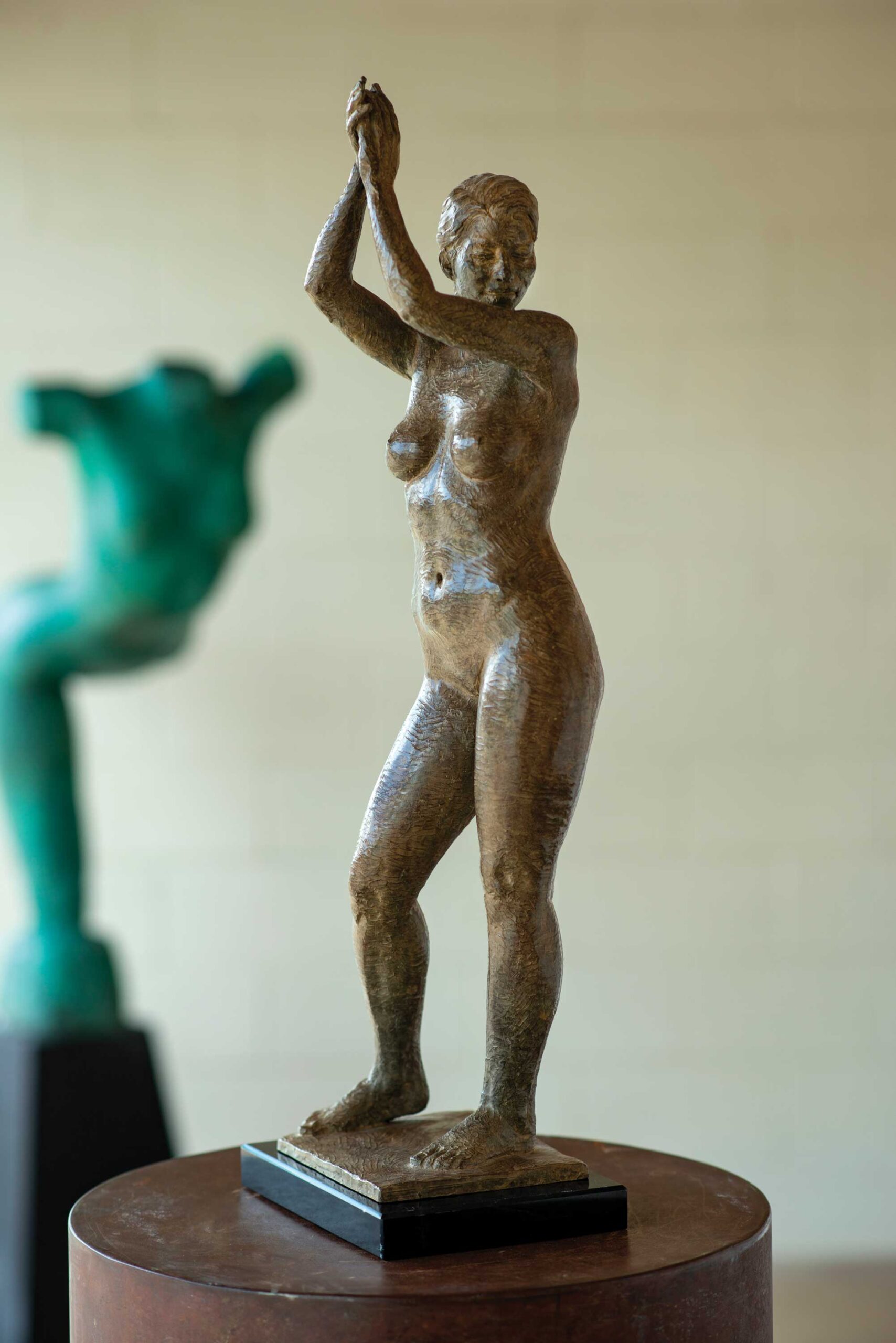
Alan LeQuire, “Emma Caryatide,” 2015, bronze (edition of 12), 25 x 6 1/2 x 5 in.; in the background at left is “Flying Torso,” life-size, available in bronze (edition of 6)
Though their beauty verges on the timeless, most of these figures bear the names of their actual models, such as Jessica or Katie — to remind us they are just as real as Carrie Catt or Cornelia Fort.
Alan LeQuire, “Cornelia Fort,” 2012, painted plaster, life-size, available in bronze (edition of 12)
Covering 5,000 square feet, LeQuire Gallery serves several purposes. Foremost is its role as LeQuire’s studio, where he sculpts and has taught traditional methods in drawing, painting, and sculpting since 1984.
As part of our effort to continue to help artists and art galleries thrive, we’re proud to bring you this week’s “Virtual Gallery Walk.” Browse the artwork below and click the image itself to learn more about it, including how to contact the gallery.
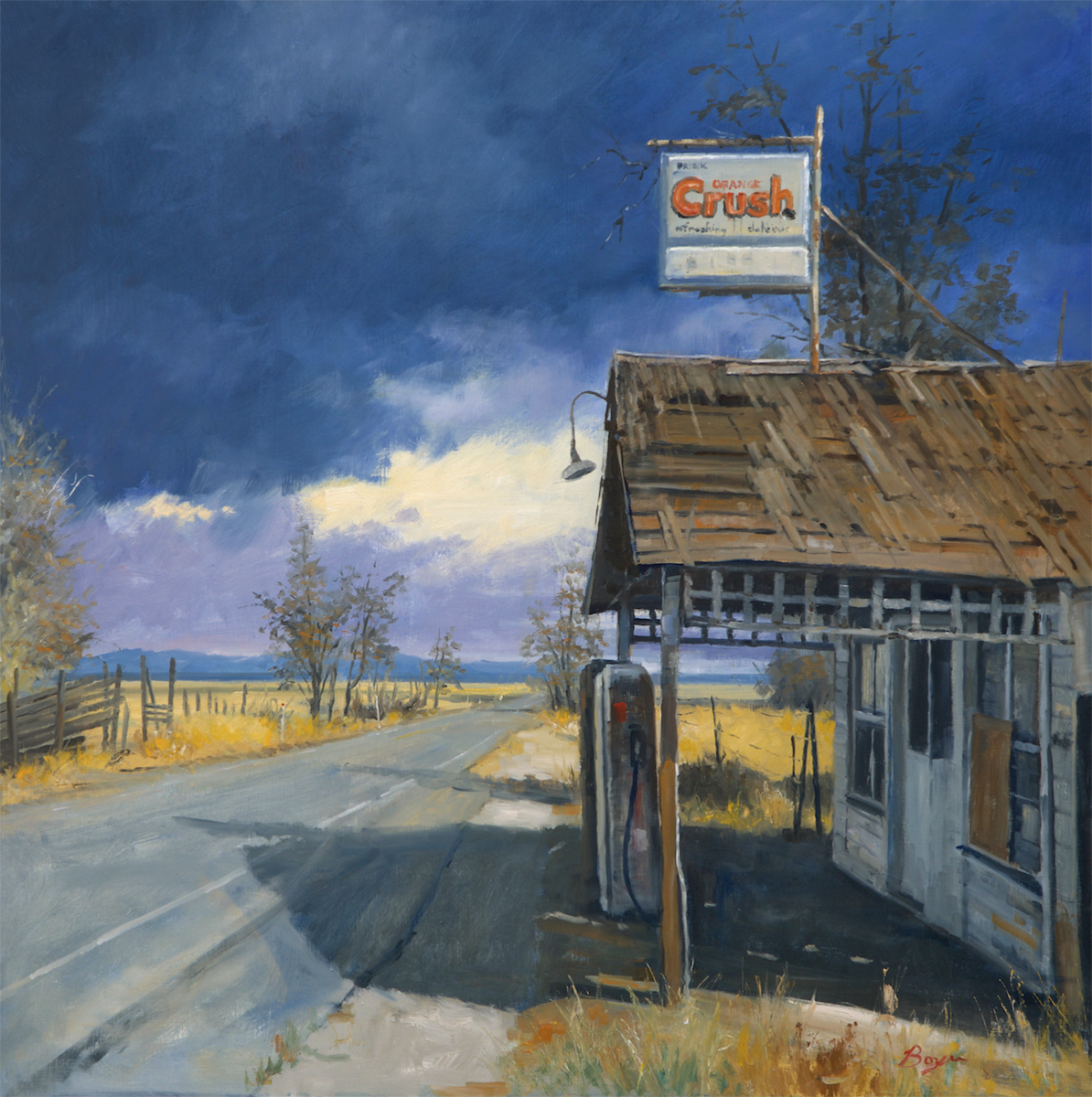
Orange Crush, Richard Boyer, Oil on board, 30 x 30 in; Private Collection
***
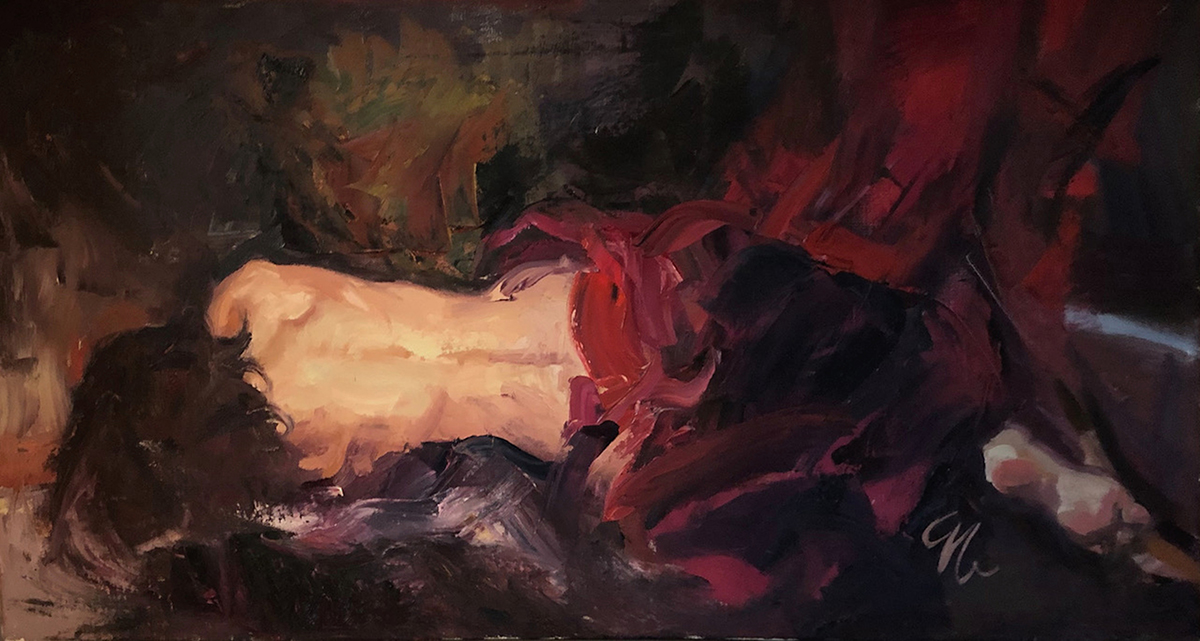
Symphony in Red Encore, oil on canvas panel, 15 x 30 in; C.M Cooper
***
Adam and Eve, Glenn Marlowe, Aqua Resin, 140 x 79 x 52 in; Glenn Marlowe
Want to see your gallery featured in an upcoming Virtual Gallery Walk? Contact us at [email protected] to advertise today. Don’t delay, as spaces are first come, first served, and availability is limited.
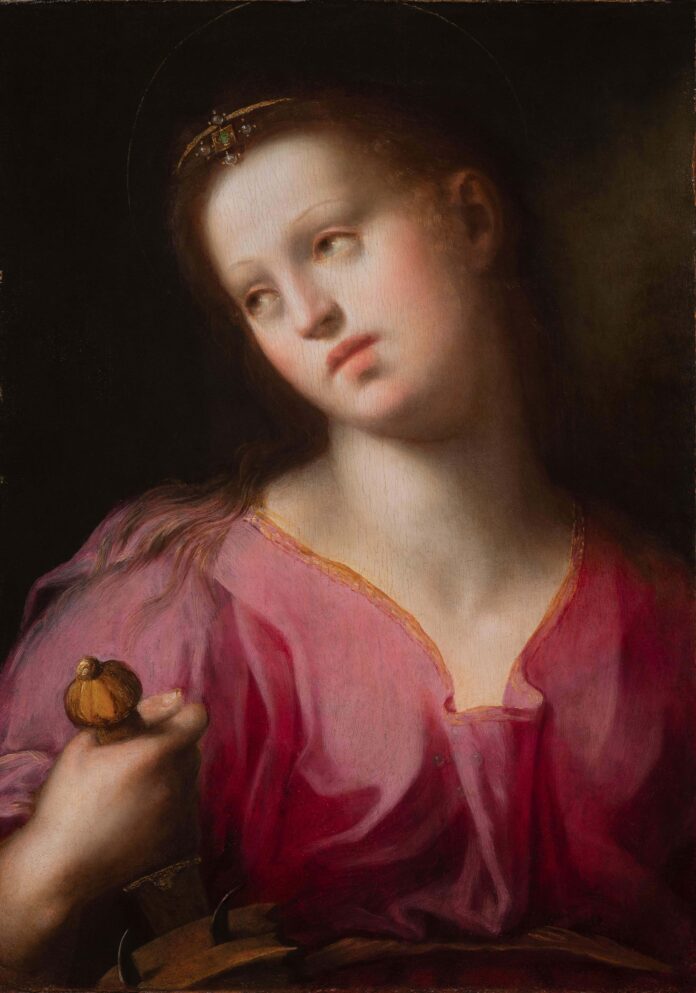
Domenico Puligo (1492-1527), "Saint Catherine of Alexandria," c. 1522-1527, Oil on panel, Moretti Fine Art
London Art Week Summer 2023 opens Friday, June 30 and runs through July 7.
From the organizers:
Expert dealers offering museum-quality examples of decorative arts, paintings, sculpture, and works on paper of all periods from antiquity to contemporary, as well as – for the first time this year – rare books, maps and manuscripts.
Important and broad-ranging gallery exhibitions are staged across central London, in particular in St. James’s, Mayfair, Pimlico, Kensington and Chelsea. LAW encompasses the Classic and Old Master live viewings and auctions at Bonhams, Christie’s and Sotheby’s, and once again collaborates with Cromwell Place, the arts hub opposite the Victoria & Albert Museum. Here, several major exhibitions are being staged by participants alongside a LAW Showcase in the famous Lavery Studio.
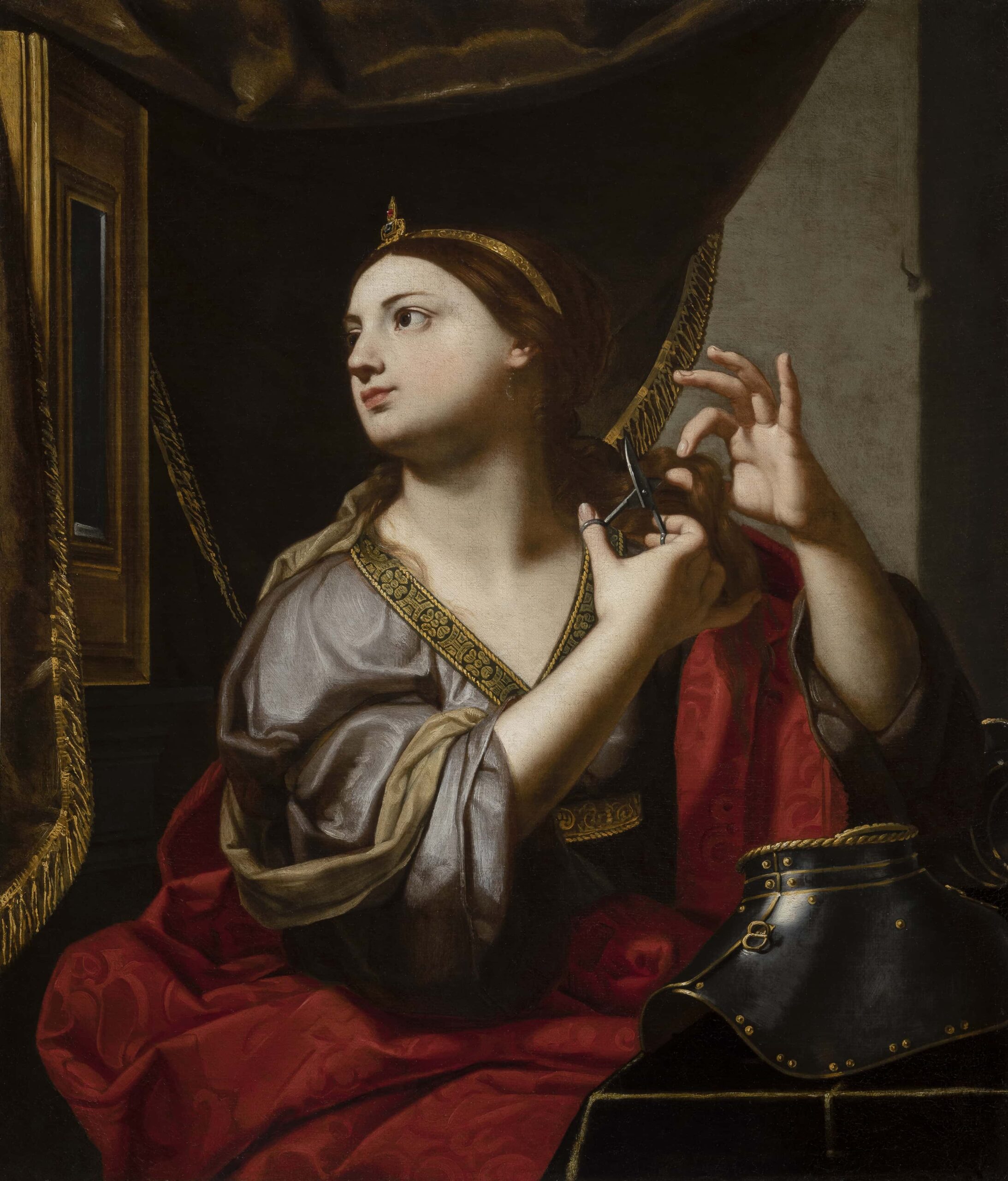
Michele Desubleo (1602-1676), “Berenice,” Maubeuge, Parma, 1660 c., Oil on canvas, 99.5 × 84.5 cm. (39 ⅓ × 33 ¼ in.), Maurizio Nobile Fine Art
Preview London Art Week here:
Portraits
Moretti Fine Art will be staging an exhibition of “The Stories behind the Sitters: Portraits spanning Five Centuries.” One of the highlights is a beautiful portrait of Anne, Viscountess Pollington, later the Countess of Mexborough with her son, by Sir Thomas Lawrence (1769-1830).
The Weiss Gallery; Robert Peake is today one of the best known of the artists working in England during the reigns of Elizabeth I and James I. The present portrait was first identified as a work by Robert Peake by Sir Roy Strong in his seminal book on early English portrait paintings, “The English Icon,” which was published in 1969.
Such was the artist’s standing, the patron of the present work, almost certainly the boy’s father, must have held a significant position within the court. Indeed, for much of the last century, the sitter was thought to have been Henry Frederick Stuart (1594-1612), the Prince of Wales.
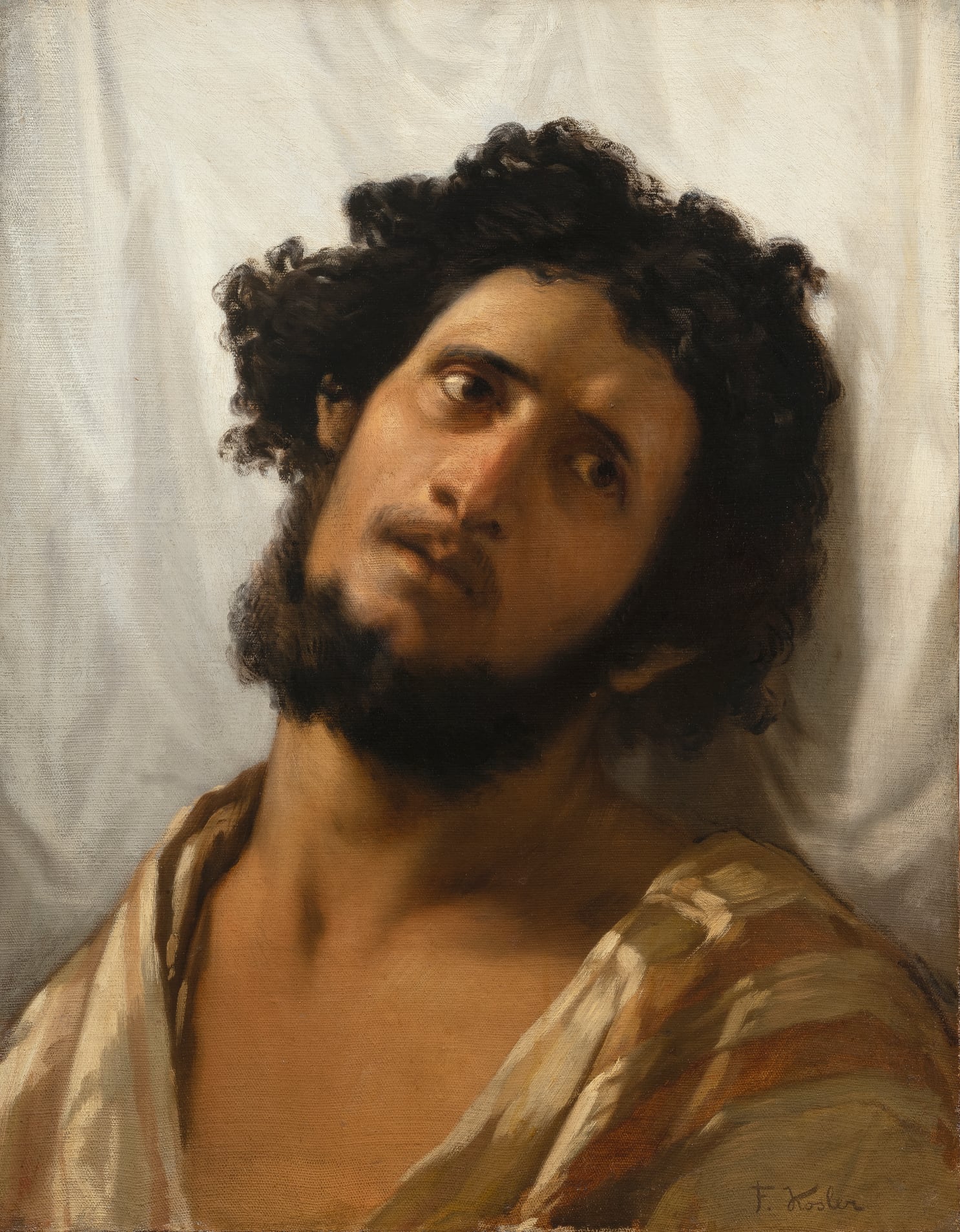
Franz Xavier Kosler (1864-1905), “Portrait of a man as Giacomo Orlandi di Subiaco,” Vienna, Syracuse, c. 1885-95, Oil on canvas, laid on panel, 61 × 49 cm. (24 × 19 ¼ in.), signed ‘F. Kosler’ lower right
Old Masters
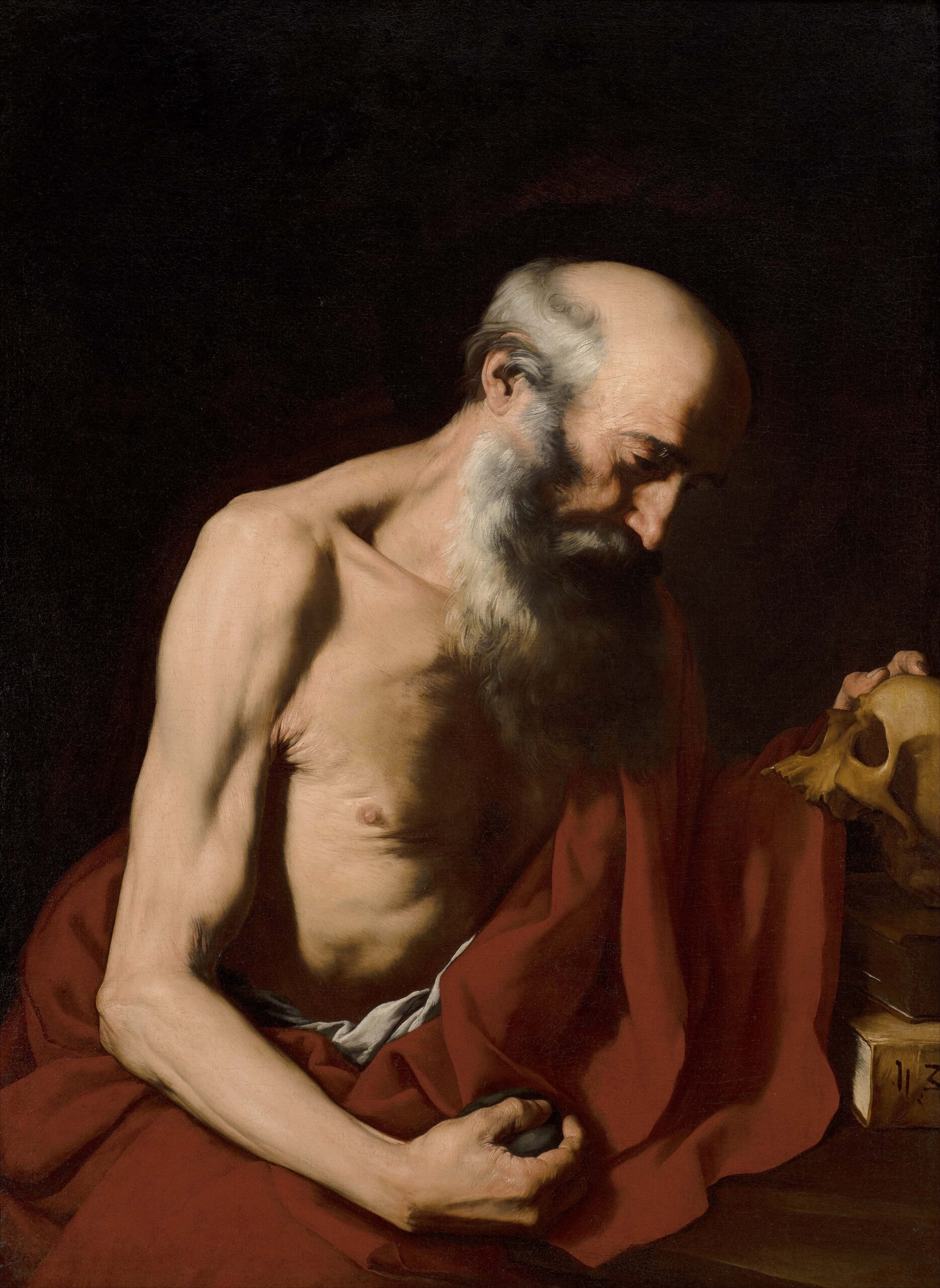
Colnaghi will exhibit The Penitent St Jerome by Jusepe de Ribera. Recent conservation has confirmed that this intense, contemplative image was painted in the mid to late 1620s, before Ribera turned away from the strong naturalism of his earlier years for
Neo-Venetian colouring.
Benappi’s highlight is a beautiful painting of Saint Catherine of Alexandria, which is without doubt by Domenico Puligo, an early Florentine painter and contemporary of Pontormo and Rosso. Giorgio Vasari praised Puligo as the best student of Ridolfo del Ghirlandaio, saying that, compared to all the others, he was “excellent at drawing and more vague and graceful with colour.”
Jusepe de Ribera, called Lo Spagnoletto (1591-1652), “The Penitent St Jerome,” 1620s, Oil on canvas, Colnaghi
Landscapes
Guy Peppiatt Fine Art stages an exhibition of British Drawings and Watercolours from the 18th and 19th Century. Among the highlights are works by Thomas Girtin, John Ruskin, and John Frederick Lewis. This watercolour by Girtin formed one of a group of four works depicting the Chalfont estate, commissioned by its owner Thomas Hibbert (1744-1819), a wealthy Jamaican merchant, who bought the estate in 1791. The watercolour demonstrates Girtin’s extraordinary mastery of both watercolour and bodycolour highlights.
Nonesuch Gallery are pleased to present their second catalogue and first LAW exhibition on the theme of ‘Travel’, with a focus on works on paper, dating from c.1600-1900. Many of the subjects in the catalogue are Italian, by artists from throughout Europe, but also from across the Atlantic.
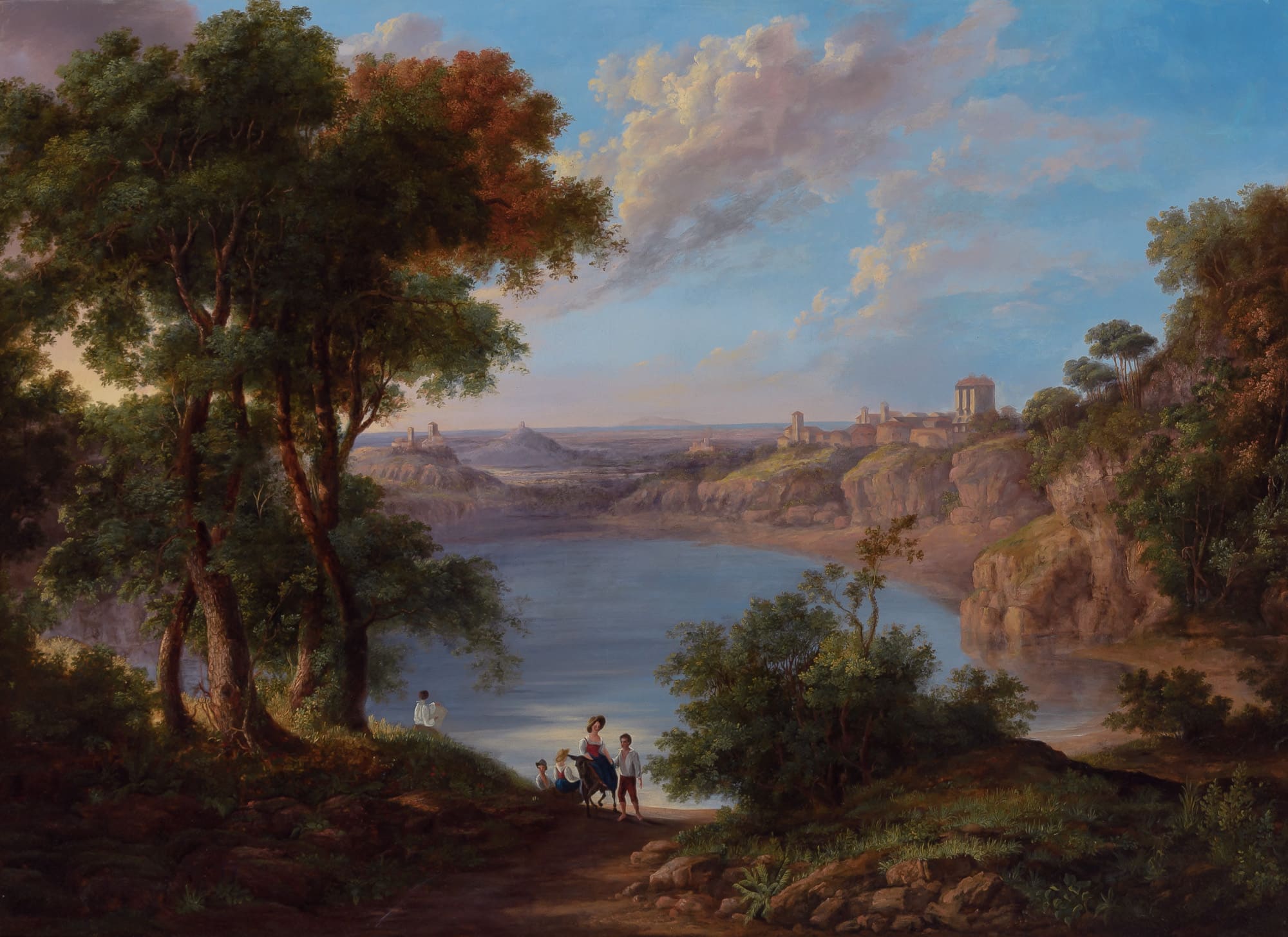
Nicolas-Didier Boguet (1755-1839), “A View Over Lake Nemi From The North,” c.1783-1830, Oil on canvas, Nonesuch Gallery
Harry Van der Hoorn and Thomas Woodham-Smith announced the new fair at Royal Hospital Chelsea, June 2023, will henceforth be called The Treasure House Fair. “Our choice of title reflects the wide range of disciplines and masterpieces in the fair, each piece a treasure in its own right. From my perspective, and I speak as a Dutchman, treasure is a word that is understood throughout the world. The word ‘House’ is a mark of respect to The Grosvenor House Fair, a fair that has inspired so many of us over the years.” — Harry Van der Hoorn.
Exhibitors in the first edition of The Treasure House Fair 2023 included UK, European and international dealers, each of them at the top of their field, such as Ronald Phillips, Adrian Sassoon, Michele Beiny, Richard Green, Osborne Samuel, Galerie Gmurzynska, Tomasso, Peter Harrington, Shapero Rare Books, Howard Walwyn, Carter Marsh, Wartski and SJ Phillips.
The Fair will take place again next June. For more information, visit treasurehousefair.com.
The stand of Richard Green Gallery, photo: Mathew Quake
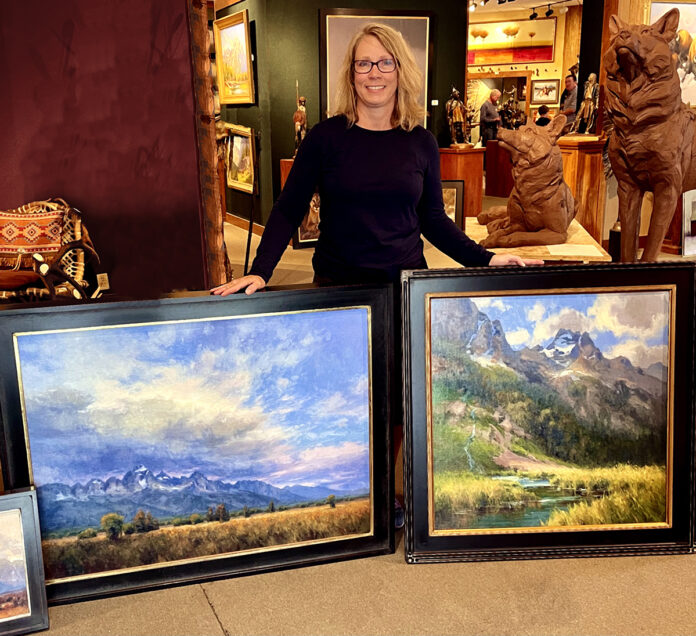
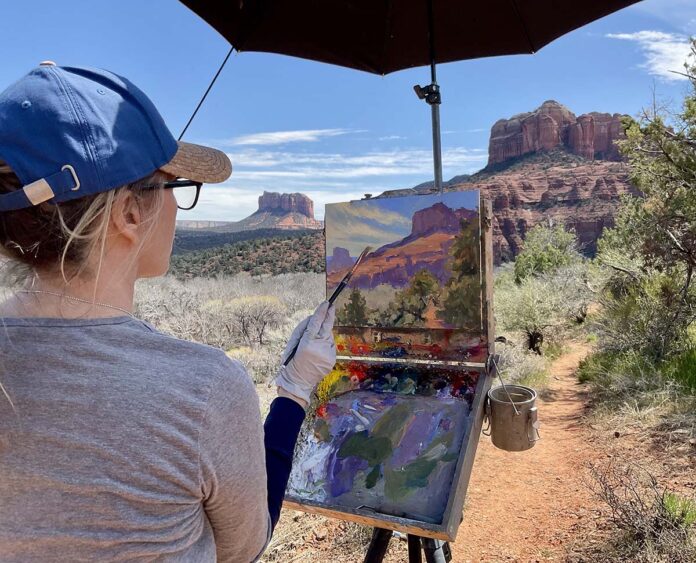
Kim Casebeer with her winning wet paint competition painting at the American Impressionist Society show
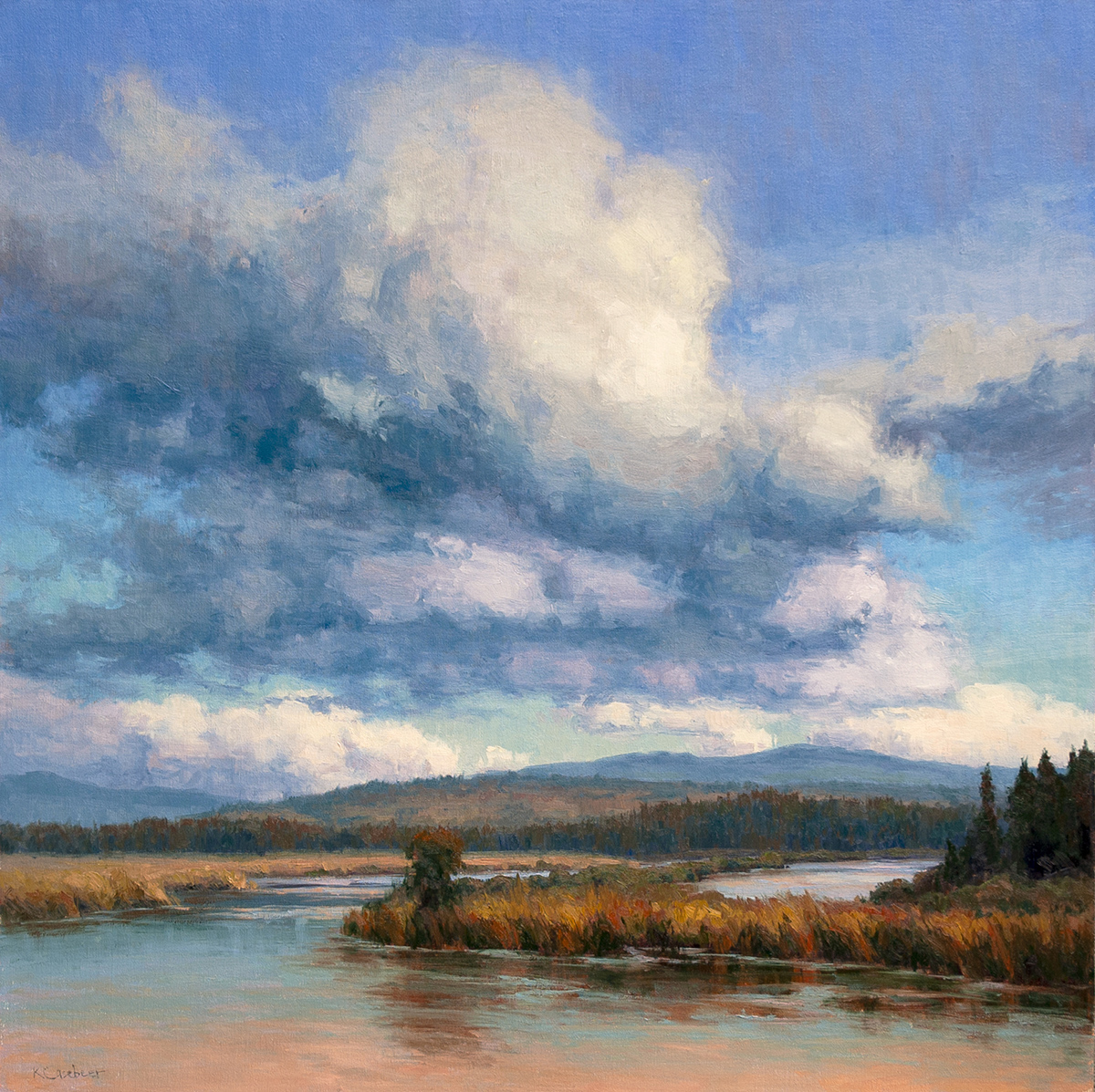
Kim Casebeer: I find inspiration in nature in a variety of ways. It can be in the places I go near where I live, or in the places that I visit. Revisiting places near where I live, such as in “Evening at the Pond,” may seem mundane, but going back to the same places over and over again allows me to more deeply study a location. It’s when I get to know a place that I can bring more of my feelings for it into the painting, which is really at the heart of why I paint. That is why these simple places can be so wonderful to paint.
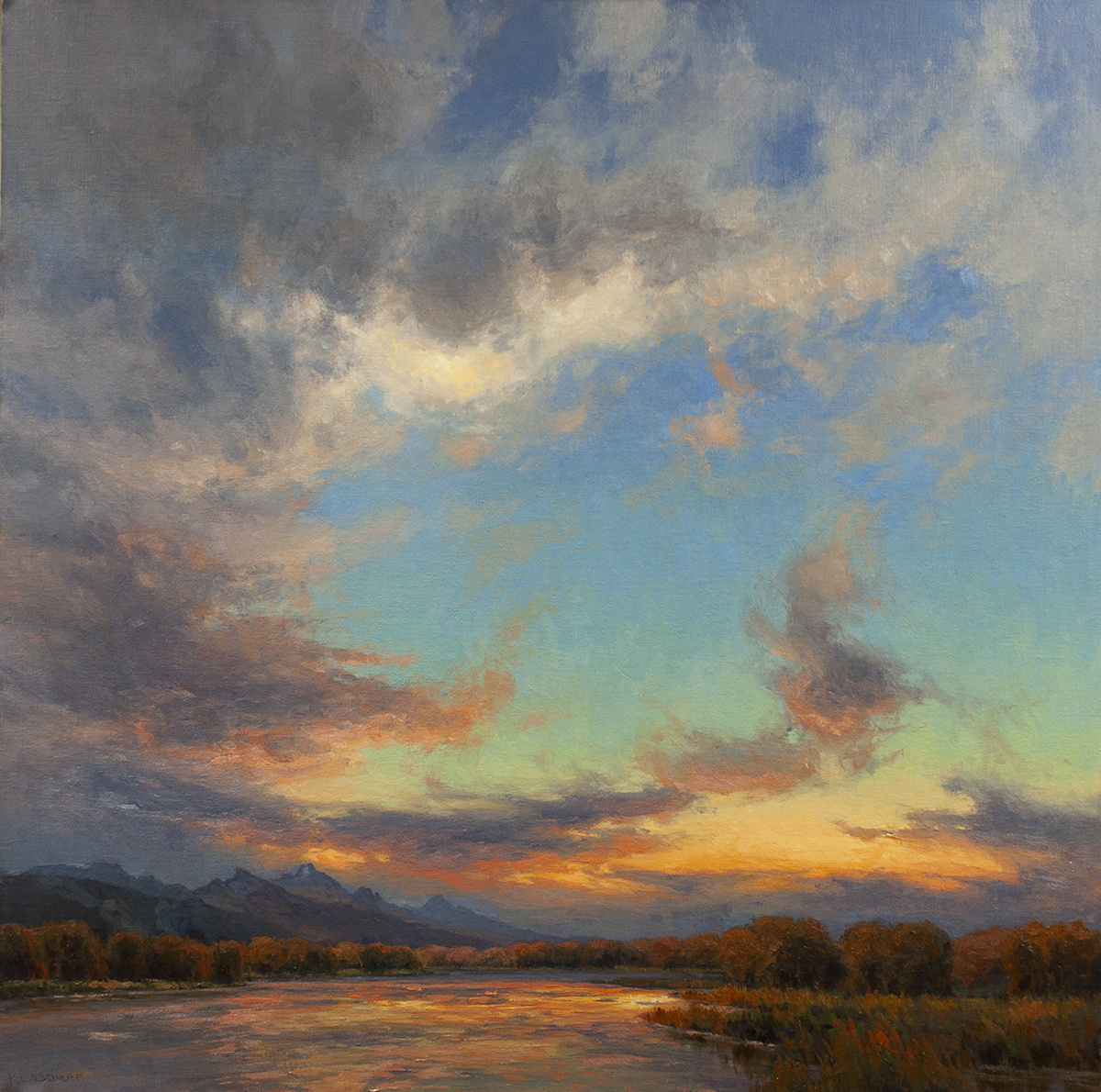
Having the opportunity to visit other locations such as the Grand Teton National Park, which inspired “Last Moments of the Day,” is also very inspiring. I plein air paint a lot when I’m visiting a location. Bringing these plein airs home gives me valuable insight when working on larger pieces. The light, shadows, wind, rain, sun, and how I felt – these are all important notes to capture and bring back to the studio. No matter if I’m painting in my backyard, or across the country, I want to elicit an emotional response from the viewer.
Kim Casebeer, “Evening at the Pond,” oil on linen, 26 x 40 in. 2022. Available through Reuben Saunders Gallery, Wichita, KSKim Casebeer, “Last Moments of the Day,” oil on linen, 24 x 36 in., 2021. Available through Mountain Trails Gallery, Jackson, WY
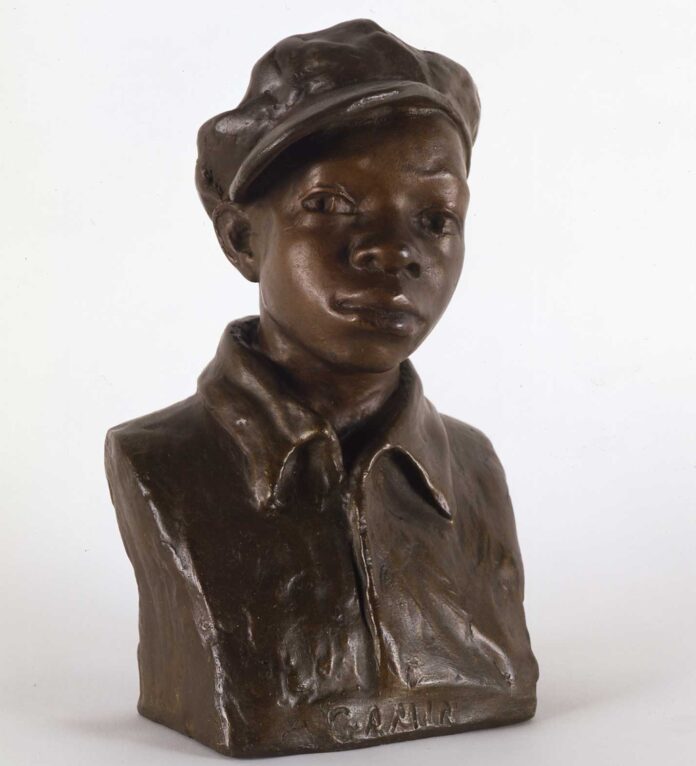
Augusta Savage, "Gamin," c. 1930, painted plaster, 9 1/4 x 6 x 4 in., Cummer Museum of Art & Gardens, Jacksonville, purchased with funds from the Morton R. Hirschberg Bequest, AP.2013.1.1
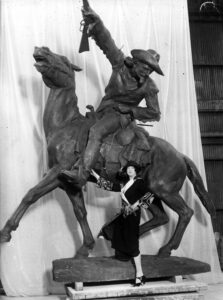
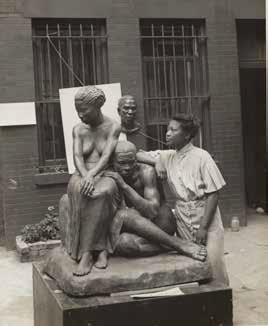
At first glance, Gertrude Vanderbilt Whitney (1875–1942) and Augusta Savage (1892–1962) are the oddest of couples, the strangest of bedfellows. The disparity holds true as one learns more about these female American sculptors who lived worlds apart (both socially and economically) and whose works, purely by chance, have crisscrossed the eastern half of the U.S. in museum retrospectives dedicated to each of them. Yet the biographies of this pair — one an heiress-patron who became an artist herself, the other an artist-prodigy who became an influential member of the Harlem Renaissance — have several crucial elements in common.
Gertrude Vanderbilt Whitney in her studio with Buffalo Bill — The Scout, c. 1924, Buffalo Bill Center of the West, Cody, Wyoming, MS6 William F. Cody Collection, P.69.0517
To be sure, each lived and worked in New York City in the early to middle years of the 20th century, embracing various degrees of realism and helping other artists realize their potential. But what makes a truly meaningful pairing of them possible is that each, because of who she was, had difficulty being taken seriously as an artist in the first place. Indeed, each emerged from cultural milieus whose denizens were not expected to become artists at all, and often were roundly discouraged from doing so.
Savage’s father, in the artist’s own words, “licked [her] four or five times a week, and almost whipped all the art out of [her]” when, as a child, she fashioned farm-animal figures out of her Florida hometown’s red clay. This Methodist minister, who also made his living as a carpenter, fisherman, and farmer, preached that the Bible forbade “graven images.” Besides, the Savage family was poor; their children were expected to aspire to simple wage-earning work. Yet those pressures paled in comparison to the indignities of racial discrimination that Savage faced as she sought to realize her dream of an artistic career — and not just in the South.
Augusta Savage with her sculpture “Realization” in 1938, photograph taken by Andrew Herman, Federal Art Project, Works Progress Administration, gelatin silver print, 10 x 8 in., Schomburg Center for Research in Black Culture, New York Public Library, 86-0036
As for Whitney, even today it is easy to think condescendingly of her as a dilettante when we learn she took up a chisel to “express” herself. Because she famously founded Manhattan’s Whitney Museum of American Art, some might wonder if supporting other artists with “real” talent should have been enough for a rich lady like her. What’s more, sculpture was once strenuously defended as a male-only domain. Both Whitney and Savage would have been held back for that reason alone. As it turned out, each rebelled successfully against potentially soul-stifling stereotypes.
And yet, from the mid-1940s — following Whitney’s death and Savage’s retreat to obscurity in rural New York State, to say nothing of realism’s descent into critical disfavor — the artistic endeavors of both women were essentially forgotten. Only now are they being rediscovered and reassessed by both academics and institutions. In addition, Savage is now fetching big prices at auction as museum curators and private collectors realize that a truly American art collection cannot be considered complete or significant unless it includes works by African Americans.
The above is an excerpt from a Fine Art Connoisseur article by Jeanne Schinto
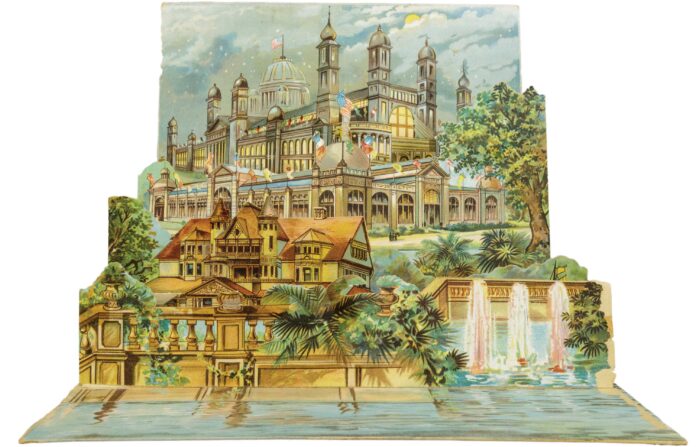
Printed in Germany, this chromolithographed viewbook offers a three-dimensional panorama of the 1893 World’s Columbian Exposition in Chicago.
Newberry Library, Chicago newberry.org
through July 15, 2023
Pop-up books go back centuries. Since at least the 1100s, readers have been lifting flaps, spinning dials, and opening elaborate three-dimensional spreads in the pages of books. The earliest interactive texts were intended for scholars. Over time, pop-up books found new audiences and grew in popularity, engaging a wide range of users from emperors to mathematicians to children.
Featuring books, maps, and ephemera from the Newberry collection, “Pop-Up Books through the Ages” traces the extensive history of hands-on reading. Tactile, interactive components can be found in everything from a 1489 astronomical calendar and a 1775 battle map to a 1932 edition of Pinocchio. Viewing these different items in one place, visitors will see how the art, science, and business of pop-up books evolved over hundreds of years.
In addition to exploring the past, the exhibition highlights the present and future of pop-up books, including the work of contemporary book and paper artists who are pushing the form in new directions. Two of these artists, Hannah Batsel and Shawn Sheehy, have even designed a pop-up version of the Newberry that you can take home and construct yourself.
The pop-up Newberry kits are meant as a take-away for visitors to the show. If you cannot make it to the library and would like to be notified of any available kits after the exhibition closes on July 15, please send us an email and we will notify you by August 1 if kits are available.
“Pop-Up Books through the Ages” is generously supported by The National Endowment for the Arts, The Gladys Krieble Delmas Foundation, Professor James H. Marrow and Dr. Emily Rose, Alan Templeton, Diane and Richard Weinberg, and The Movable Book Society.
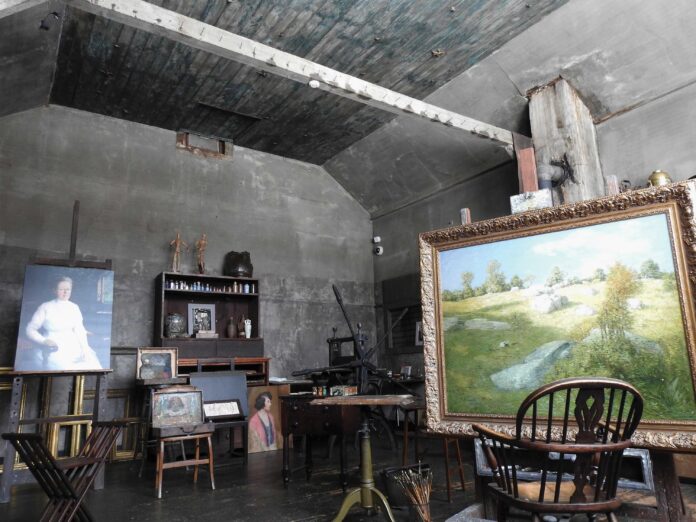
Interior of J. Alden Weir’s studio at Weir Farm National Historic Site; photo: Xiomáro, courtesy National Park Service, Weir Farm National Historic Site, Wilton, Connecticut
Where Creativity Happens: Follow us inside the homes and art studios of these remarkable makers.
Where Creativity Happens: The Lure of Artists’ Homes and Art Studios
By Valerie A. Balint
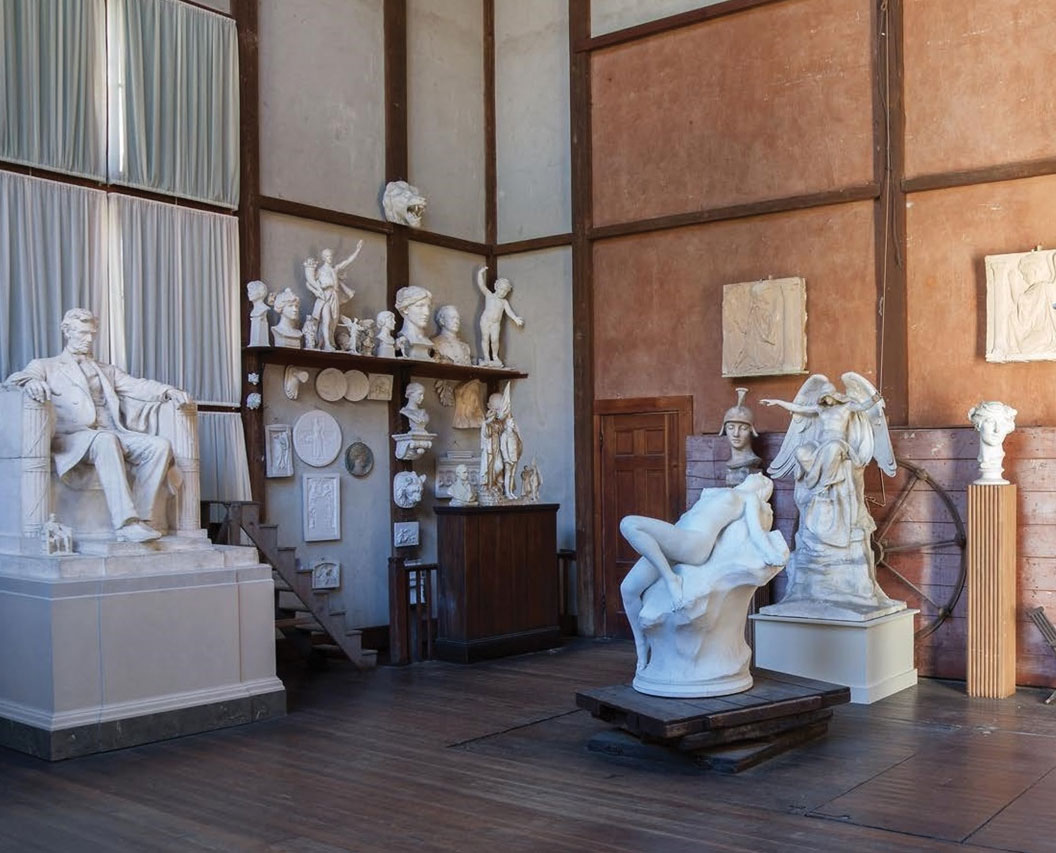
Daniel Chester French’s Abraham Lincoln in the Lincoln Memorial (1914–22, Washington, D.C), Frederic Edwin Church’s Niagara (1857, National Gallery of Art), and Grant Wood’s American Gothic (1930, Art Institute of Chicago): these three icons of American art each transcend their physicality.
Interior of Daniel Chester French’s studio at Chesterwood, with his Andromeda and the seated Abraham Lincoln; photo: Don Freeman, 2017, courtesy Chesterwood Historic Site, National Trust for Historic Preservation, Stockbridge, Massachusetts
The Lincoln Memorial has become synonymous with fundamental ideals of democracy, social justice, and the right to assemble freely in protest or celebration. It has become a place of pilgrimage for millions and is perhaps the most famous American artwork of all. Niagara signifies Americans’ ties to our grand landscape as linked to national identity, and to our National Parks system, which is exceptional in the world. Church’s painting has come to represent the exact vantage point we conjure up when picturing the falls and has been reimagined endlessly, even by contemporary artists such as Annie Leibowitz. Wood’s enigmatic commentary on rural life is likely one of the world’s most widely reproduced and re-appropriated images, transformed onto T-shirts, beach towels, and “paper doll” magnets. These masterworks are foundations of America’s cultural vocabulary.
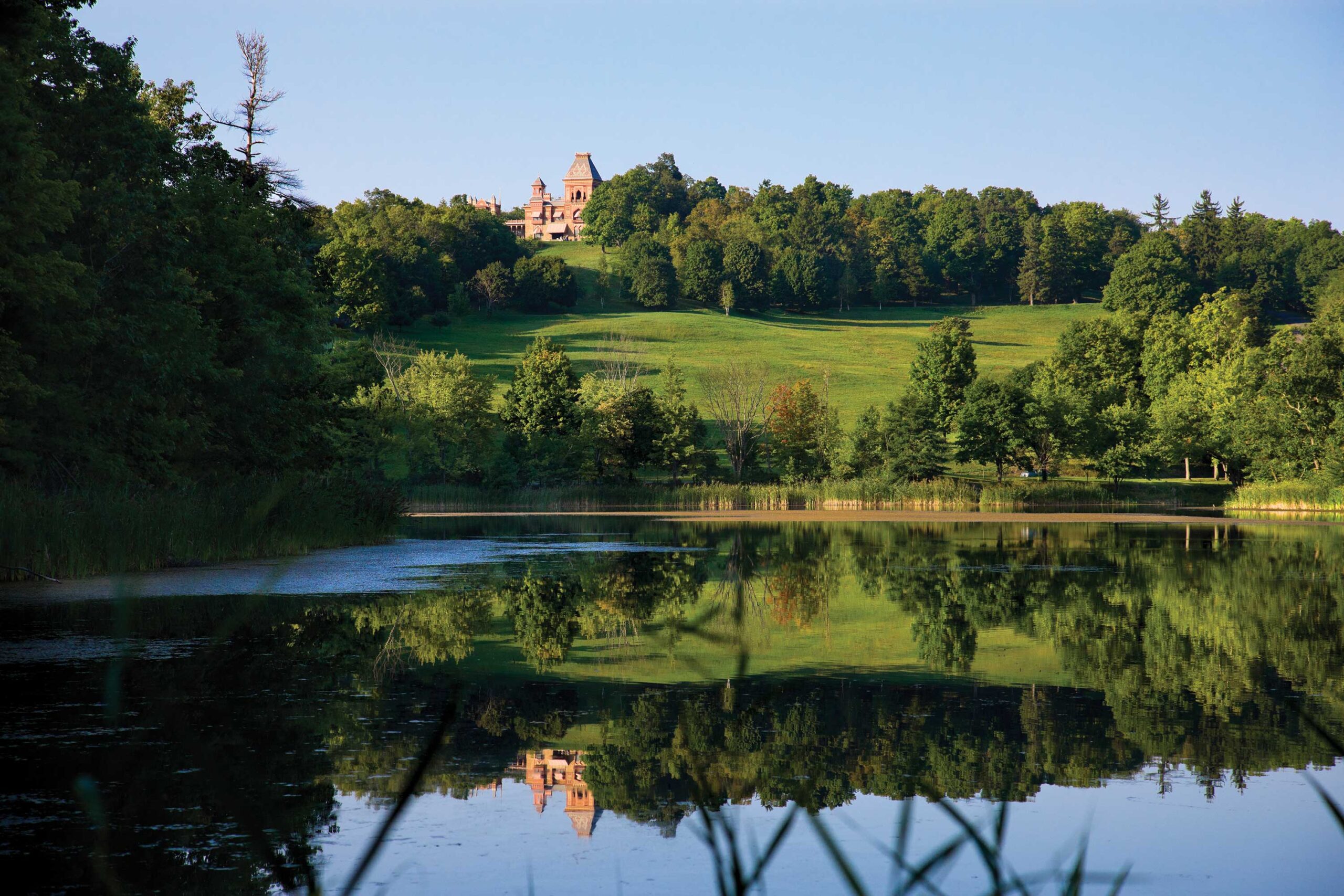
But it is easy to forget that these objects were made by specific people in specific places, created through rigorous physical work and mental engagement by makers who lived in places that both inspired and were transformed by them. Preserved artists’ homes and studios — French’s bucolic Chesterwood (Stockbridge, Massachusetts), Church’s majestic Olana (Hudson, New York), and Wood’s ingeniously compact home and studio space (Cedar Rapids, Iowa) — offer novices, devotees, and connoisseurs alike an opportunity to immerse themselves in the locus of an artist’s creative process, complex personal narrative, and — in many instances — artistic experimentation. This promise of the experiential represents the core ethos of the Historic Artists’ Homes and Studios network, a program of the National Trust for Historic Preservation.
A NATIONWIDE PARTNERSHIP
Historic Artists’ Homes and Studios (HAHS) is a professional network comprising 44 (and still growing) preserved artists’ homes and studios throughout America, all now open as public sites. The National Trust for Historic Preservation created the program in 1999, with lead support from the Henry Luce Foundation, to support places that tell the rich stories of our nation’s art history. Collectively, these member sites represent the legacy of more than 300 visual artists across 21 states and three centuries. Together, they engage more than 1 million visitors annually in meaningful experiences that link creativity to place.
The network represents the only program in the nation dedicated to providing professional support to this unique category of preserved sites, serving as a model for similar consortiums overseas. It is the leading voice promoting public awareness of the important role that artists’ residences and workplaces have played in the development of our nation’s art.
Member sites reflect the breadth and depth of art history in the U.S. and include places dedicated to iconic painters and sculptors such as Thomas Cole, Edward Hopper, and Augustus Saint-Gaudens, as well as those celebrating decorative arts practitioners such as furniture maker Sam Maloof (Alta Loma, California) and photographers like Alice Austen (Staten Island, New York). In addition, there are several important artists’ colonies, including the impressionist enclave at the Florence Griswold home (Old Lyme, Connecticut), that served as creative hubs during their heydays.
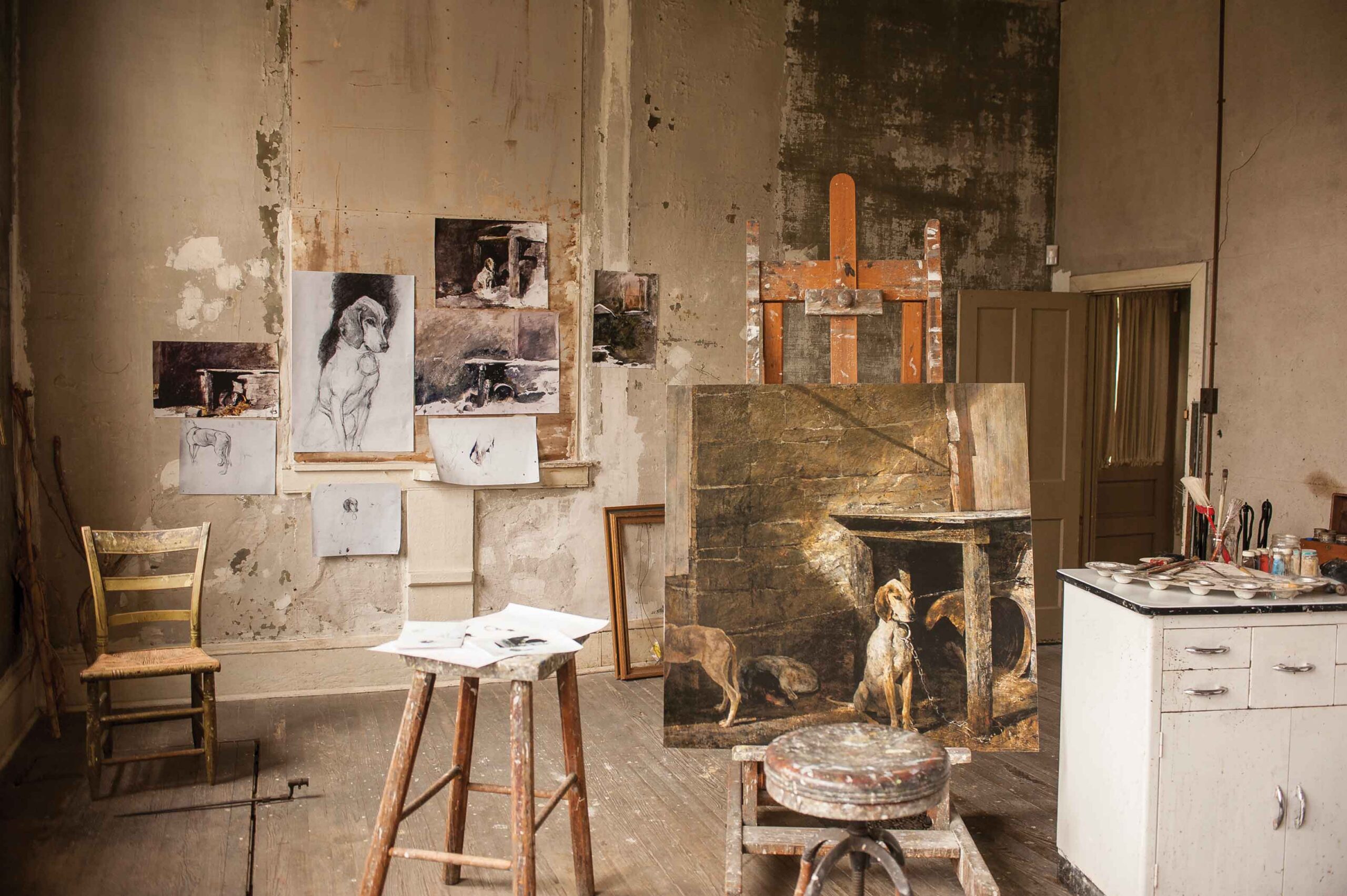
These preserved sites include artists both well-known and less familiar. Andrew Wyeth, the central figure among three generations of artists, was fueled by the environment of his boyhood in Chadds Ford, Pennsylvania, and by the nearby Kuerner Farm to create enduring images in a converted schoolhouse. To visit is to understand better both his works and the complex and deeply introspective person who remained inspired by, and close to, his childhood home.
Interior of Andrew Wyeth’s studio with reproduction of Raccoon (1958) on easel and reproduction drawings taped to wall; photo: Carlos Alejandro, courtesy Brandywine River Museum of Art, Pennsylvania
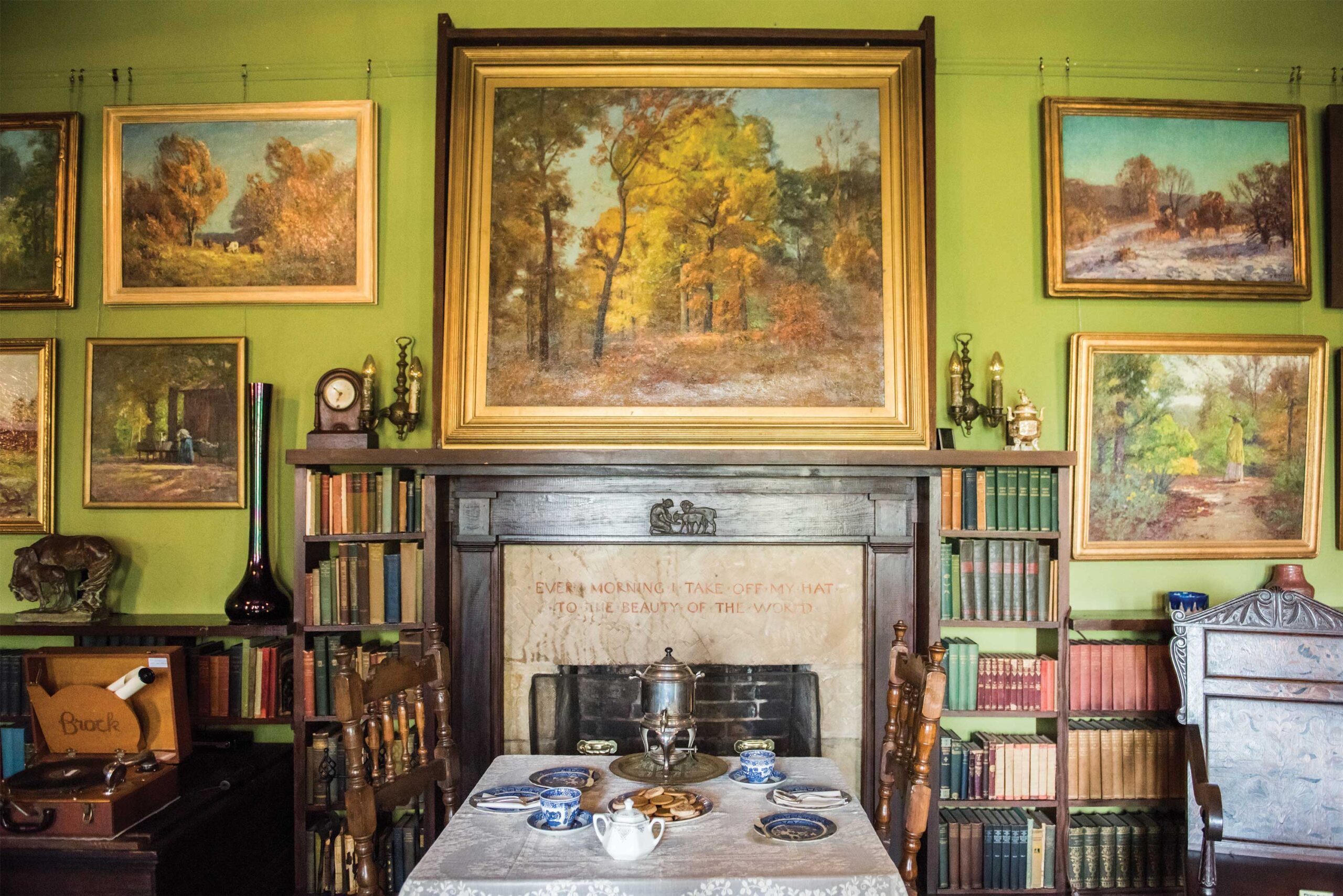
By contrast, Theodore C. Steele, American impressionist and member of the Hoosier Group, moved to rural Indiana and transformed his landscape, which then became a favored subject. The walls and mantels of the house he designed and helped build are adorned with quotations that convey his personal credo as well as a painterly ethos, including: “Every morning I take my hat off to the beauty of the world.”
Parlor interior at Theodore C. Steele’s “House of the Singing Winds,” featuring works by Steele and inscribed fireplace mantel, Collection Indiana State Museums & Historic Sites System; photo: T.C. Steele State Historic Site, Nashville, Indiana
No less personal is the Arts and Crafts home that painter Grace Hudson designed in Ukiah, California, with her ethnographer husband, set in a region inhabited by the indigenous Pomo peoples. The couple lived among the tribes and documented their disappearing culture — albeit through decidedly Western eyes. Less known today, Hudson and her imagery were incredibly popular in her time and now warrant rediscovery.
IN THE INNER SANCTUM
Stepping into an artist’s studio invites alchemy; secrets are revealed that cannot manifest on a museum or gallery wall. The enticing rows of patina compounds in jars, wire armatures, and chiseling tools found in sculptor Ann Norton’s Florida studio — or the small modeled maquettes Thomas Hart Benton used in his St. Louis studio to compose figurative arrangements for his monumental painted mural cycles — make clearer the complex processes involved in making art.
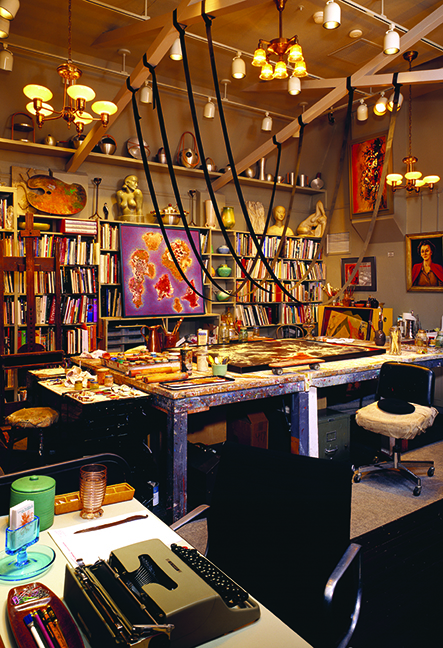
Some studios are replete with props and costumes, such as the authentic indigenous artifacts that appear in works by the Montana painter Charles M. Russell and Taos artists Henry Sharp and E.I. Couse. Other artists outfitted studios with devices of their own design to aid in their efforts. Daniel Chester French created a section of rail track that extends beyond his studio doors, enabling him to move large-scale works in progress outside to contemplate changes in natural light and perspective. Denver-based artist and educator Vance Kirkland rigged a series of straps from the ceiling so he might paint suspended over the large canvas on his worktable.
Vance Kirkland’s studio workroom, where he suspended himself above his paintings in straps to work on large paintings; photo: Ron Ruscio, courtesy Kirkland Museum of Fine & Decorative Art, Denver
Perhaps nowhere is process felt more acutely than in the studio Jackson Pollock (and later Lee Krasner) used at their home in East Hampton, Long Island. The impossibly dense paint-splattered floor (left by Pollock) coupled with painted remnants of gestural arcs on the walls (left by Krasner) immerse visitors in their respective processes.
Similarly, the roaring surf that ceaselessly pounds against the rocks outside Winslow Homer’s Maine studio places visitors directly within one of his masterful coastal landscapes.
BEYOND THE STUDIO WALLS
These sites have become places to learn about artists and their art, but they also invite other types of inquiry. In these personal spaces, unfettered by clients or critics, artists were free to experiment and expand beyond established boundaries. Often they responded to the tension between inspirations drawn from their locales and the impulse to shape those same locales to represent their own aesthetic sensibilities. Many sought (and achieved) the integration of the natural, the built, and the collected. The result? Tangible autobiographies of sorts that evolved — sometimes over decades, beyond the timeframe of any singular work’s production or a career-defining moment. In their homes and studios, painters, sculptors, and decorative artists could redefine themselves as architects, landscape architects, interior designers, and even curators. Grant Wood outfitted his space with metalwork fixtures he handcrafted. Chicago Imagist Roger Brown adapted a commercial building to serve as home and studio, but also to be what he deemed “a museum” to house his vast collections.
Visitors can discover new facets of an artist they thought they knew, as well as re-manifestations of the familiar, perhaps revealed in a different guise. Seemingly disparate environments like Church’s Olana and Russel Wright’s Manitoga are two examples where such synergies can be found. Both represent examples of holistic environments conceived to encompass multidisciplinary forms of expression. Church’s Persian-fantasy home, an amalgam of inspirations from his sojourn to the Middle East and his imagination, sits within the landscape he spent 40 years perfecting, one worthy of any Hudson River School composition. Church reveled in color, grand proportion in relationship to intricate detail, panoramic composition, and theatricality in both life and art. His decades-long effort is now recognized as a work of art itself.
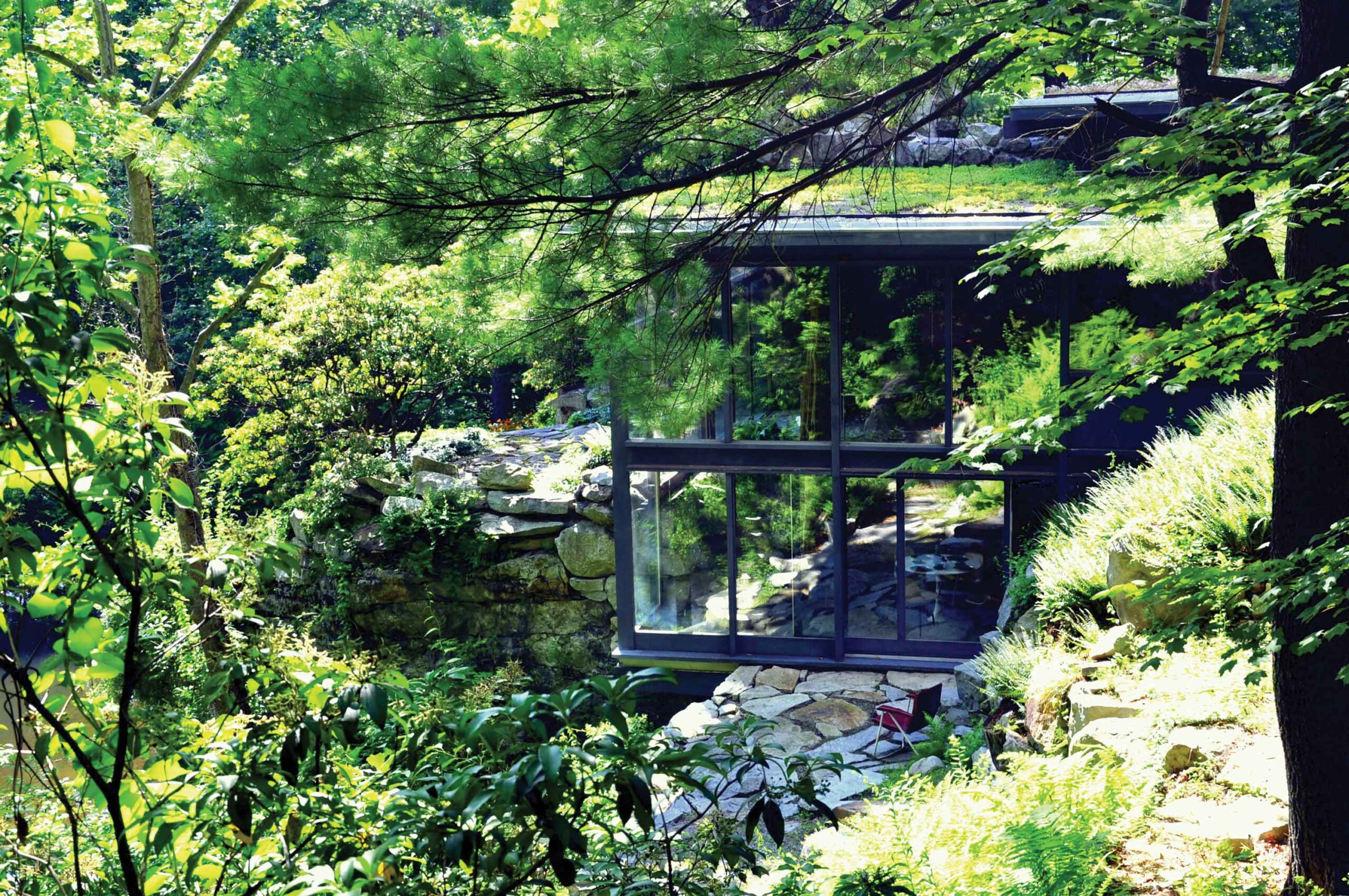
Dragon Rock, Russel Wright’s home overlooking the Quarry Pond at Manitoga; photo: Vivian Linares, courtesy Manitoga/Russel Wright Design Center, Garrison, New York
Similarly, industrial designer Russel Wright’s modernist integration with nature at Manitoga (Garrison, New York) is a totality of art and design. In a home built on a former industrial site, Wright changed the tableware and other fittings with the seasons and was able to enact the principles outlined in his 1950 publication Guide to Easier Living. His experimentations with natural elements — like a pressed butterfly screen, stone doorknobs, and birch bark-wrapped doorways — under-score that any of these beautifully executed designs could be extracted and hold pride of place under a museum vitrine, but are best understood in their original context.
Numerous sites reflect similar impulses by their artist owners, including those who transformed existing buildings. Donald Judd’s live-work environment at 101 Spring Street in New York City’s SoHo neighborhood, an erstwhile sewing factory, became an informal teaching salon and an installation of contemporary works by himself and colleagues, a concept he pursued further in Marfa, Texas. Georgia O’Keeffe’s adobe compound in Abiquiú, New Mexico, which she completely transformed to satisfy her minimalist preferences, inspired many of her works.
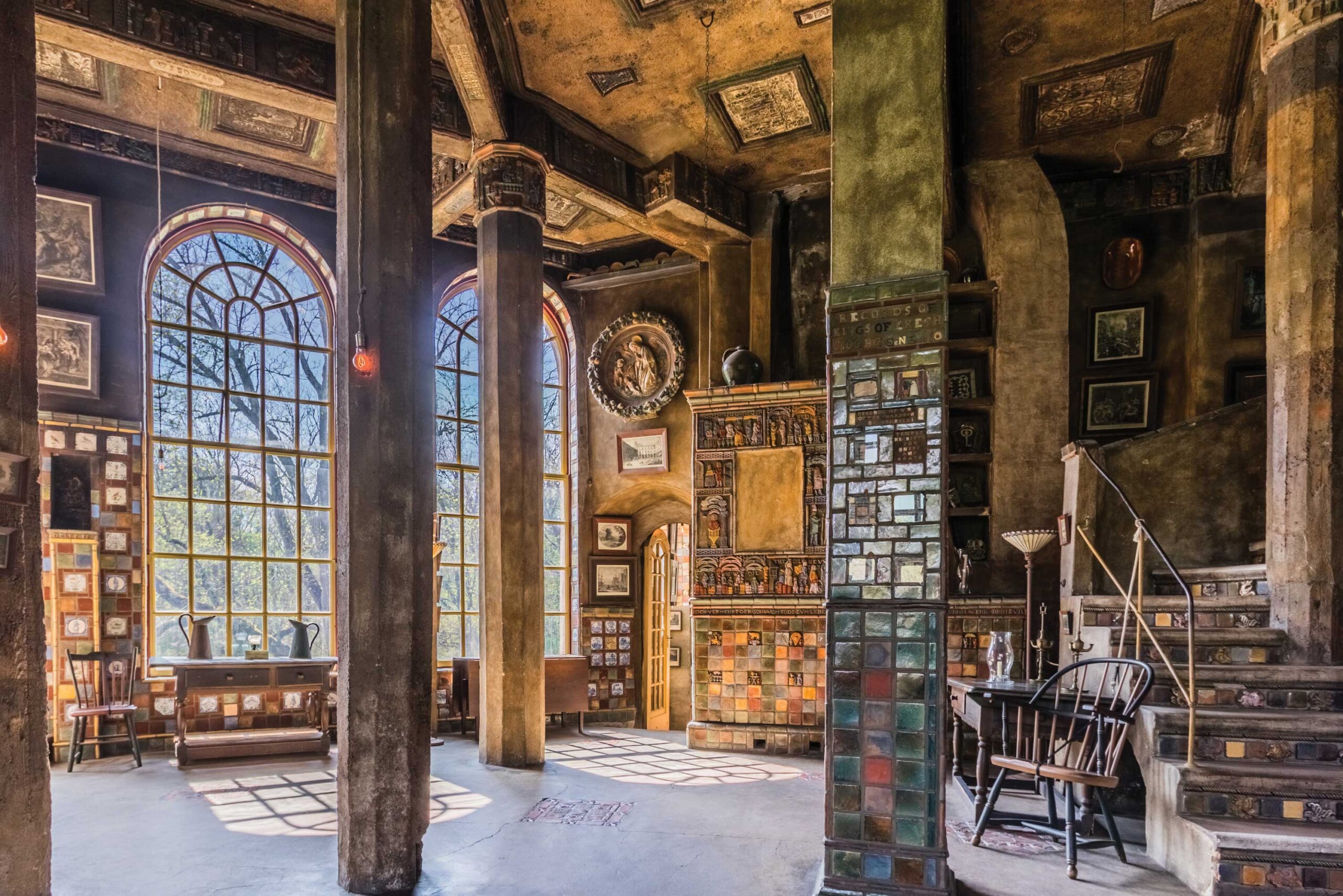
Still other artists chose to move beyond traditional concepts of studio and display altogether, such as Fonthill, the fantastical creation of tile maker Henry Chapman Mercer, in Doyles-town, Pennsylvania. Mercer invented a method of building with concrete, eschewing the conventional construction norms of his day, while also including exacting, but reimagined, architectural elements that he encountered on his European travels. The resulting tableau presents a dizzying display of his signature tiles, encyclopedic ceramics, and book collections, which all have become part of the larger installation.
The saloon at Henry Chapman Mercer’s Fonthill Castle, Doylestown, Pennsylvania, photo: Kevin Crawford, courtesy Mercer Museum and Fonthill Castle of the Bucks County Historical Society
A more recent example of this experimental relationship between working and living spaces is conceptual artist David Ireland’s architectural sculpture: his Victorian home in San Francisco’s Mission District shatters previous conceptions of how art and life can continuously interact in the same space and strict classifications of painting, sculpture, and performance. Ireland, who died only 11 years ago, famously asserted, “You can’t make art by making art.” Instead, he made art a part of daily living, transforming his traditional home into a holistic installation that he worked for years to create, in part by covering his walls with layer upon layer of polyurethane that now glows like amber. The house, restored and then opened to the public in 2018, illustrates our increasing desire to engage with artist spaces.
These examples represent only a fraction of the innovative spaces that await visitors to the Historic Artists’ Homes and Studios.
VESSELS OF ART AND COLLECTING
Many of these diverse sites are exquisite examples of design and decoration, reinforcing artists’ abilities to compose, combine color, and harmonize. During this unprecedented time, as many of us work from home (as artists often do) and commune more deeply with our personal spaces, the implications of wall color choice and the objects we surround ourselves with become more pronounced. All aesthetic choices, conscious or unconscious, say something about who we are. So, too, for artists, who often hang their walls or grace their landscapes with artworks of their own design. Many sites boast large collections or works by the artists who lived there, giving visitors unparalleled opportunities to explore their oeuvre.
Still other sites incorporate works created in situ, such as the abstract frescos George L. K. Morris and Suzy Frelinghuysen installed throughout their modernist home in Massachusetts, or the epic mural cycle that self-taught African American artist Clementine Hunter created in a former slave building at Melrose Plantation in rural Louisiana, where she lived and worked most of her life. Other artists surrounded themselves with artworks by friends or colleagues or artists from long ago who inspired their own creativity. Sculptor Chaim Gross’s Green-wich Village home and studio is replete with works by his contemporaries, many of whom were friends. Painter Gari Melchers, who lived and taught in Europe for many years, brought back Dutch masterworks to display in his Virginia home.
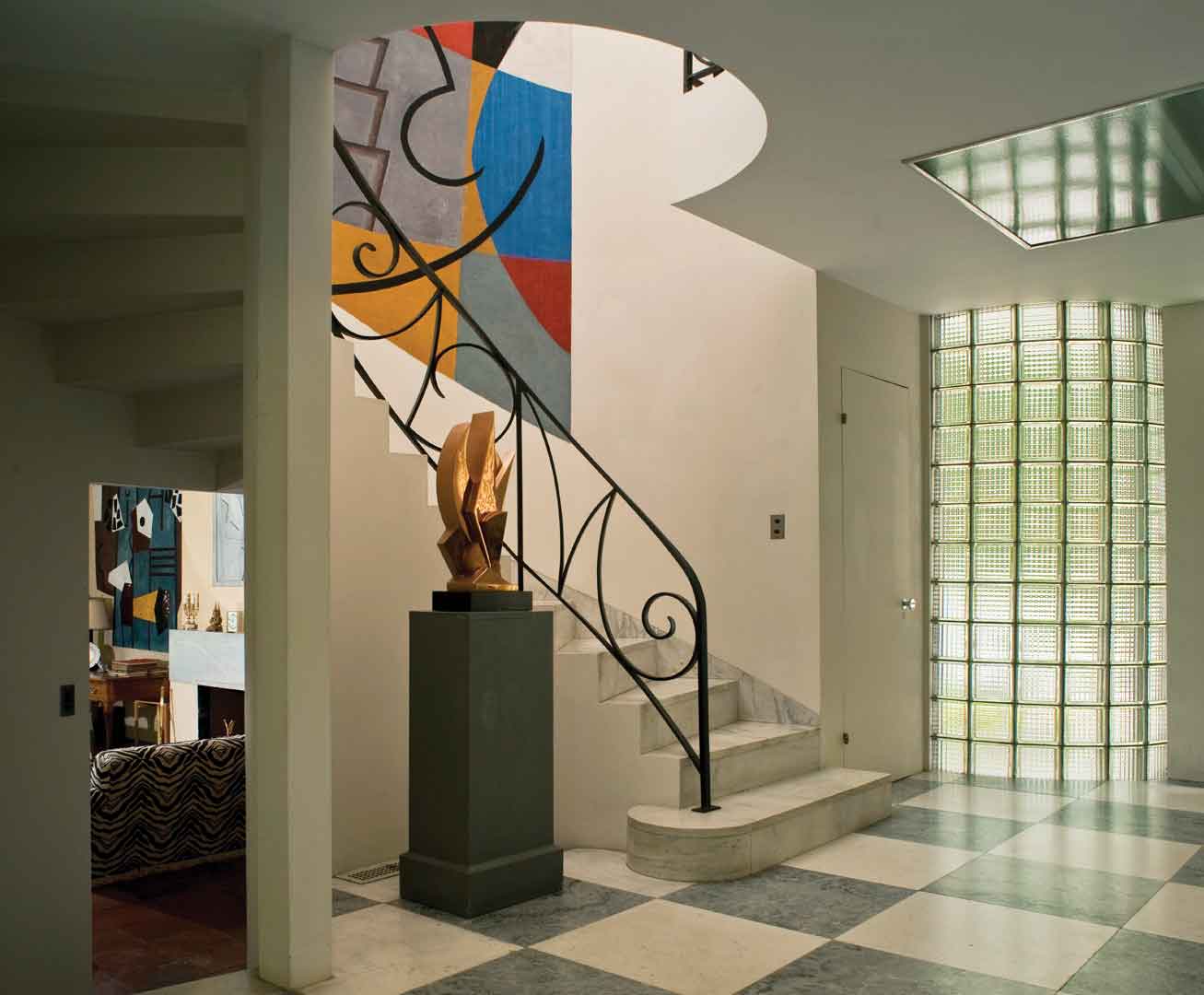
Foyer, with a glimpse into the living room, at the home of abstract painters Suzy Frelinghuysen and George L.K. Morris, featuring works by Morris (foyer fresco and sculpture; living room frescos and bas-relief); photo: Geoffrey Gross, courtesy Frelinghuysen Morris House & Studio, Lenox, Massachusetts
Many artists were also astute collectors and curators, adorning their spaces with personal touchstones or objects of inspiration as diverse as African masks, Pre-Columbian artifacts, local seashells, and Americana kitsch. These choices, which are part of the deeply personal narratives and impulses of the artists, cannot be seen elsewhere. They are among the most unique treasures the sites have to offer art and object lovers, and they present opportunities for all of us to tap into that creativity to find new ways of living artful lives.
About the Author
VALERIE A. BALINT is the program manager for Historic Artists’ Homes and Studios (HAHS), based at Chesterwood in Stockbridge, Massachusetts. Prior to joining HAHS in 2017, she served for 17 years on the curatorial staff at Frederic Church’s Olana, and previously at Chesterwood and the Frelinghuysen Morris House & Studio (all are HAHS sites). She wishes to thank staff members from all of the sites who provided images for this article, and also her colleague Alexandra T. Anderson for her thoughtful review of it.
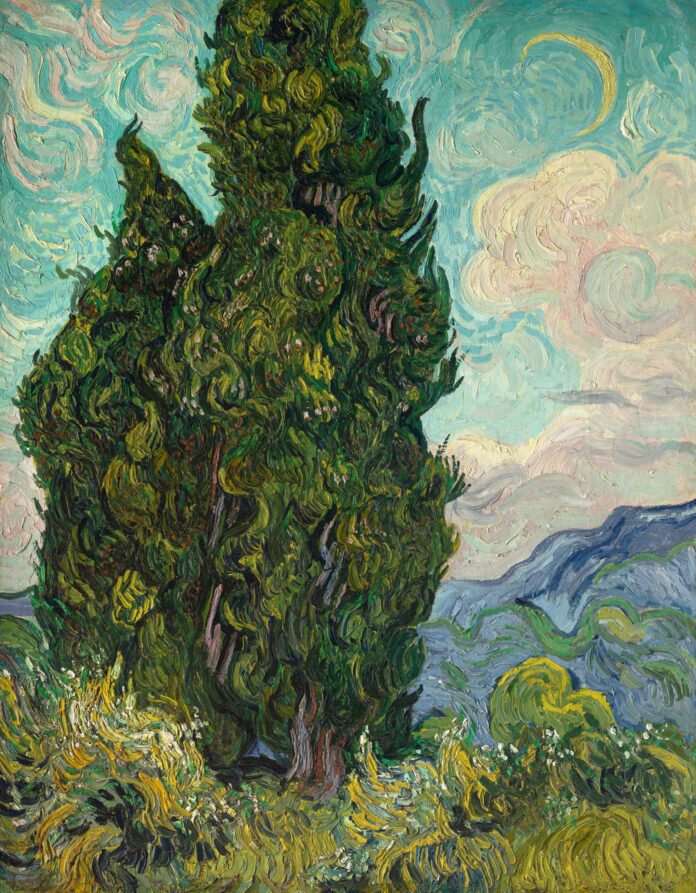
Vincent van Gogh, "Cypresses," June 1889, Oil on canvas, 36 3/4 x 29 1/8 in. (93.4 x 74 cm), The Metropolitan Museum of Art, New York, Rogers Fund, 1949 (49.30)
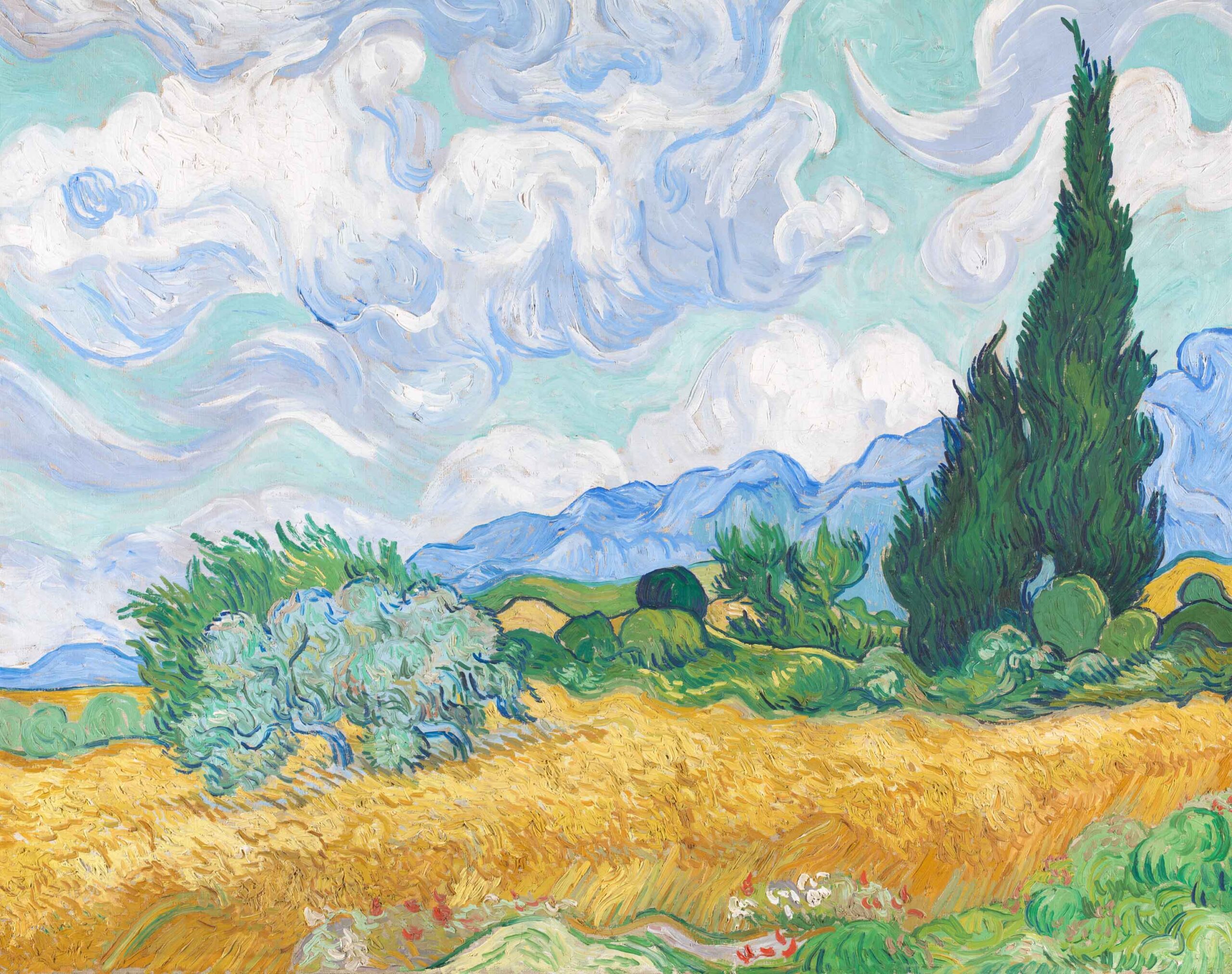
The Metropolitan Museum of Art is presenting a groundbreaking exhibition of some 40 works by Vincent van Gogh (1853–1890) through August 27, 2023. “Van Gogh’s Cypresses” will be the first show to focus on the unique vision the artist brought to bear on the towering trees—among the most famous in the history of art—affording an unprecedented perspective on a motif virtually synonymous with his fiercely original power of expression.
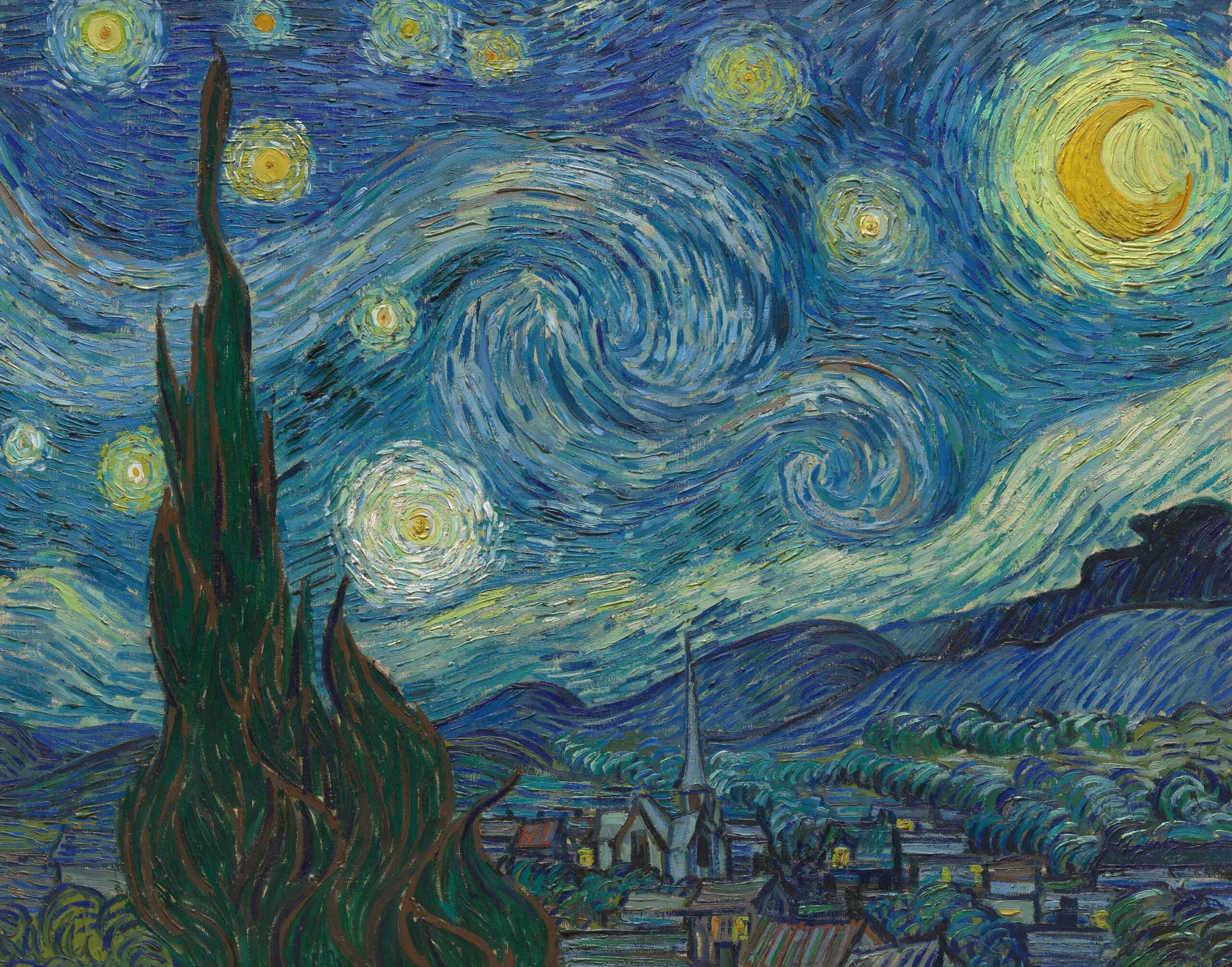
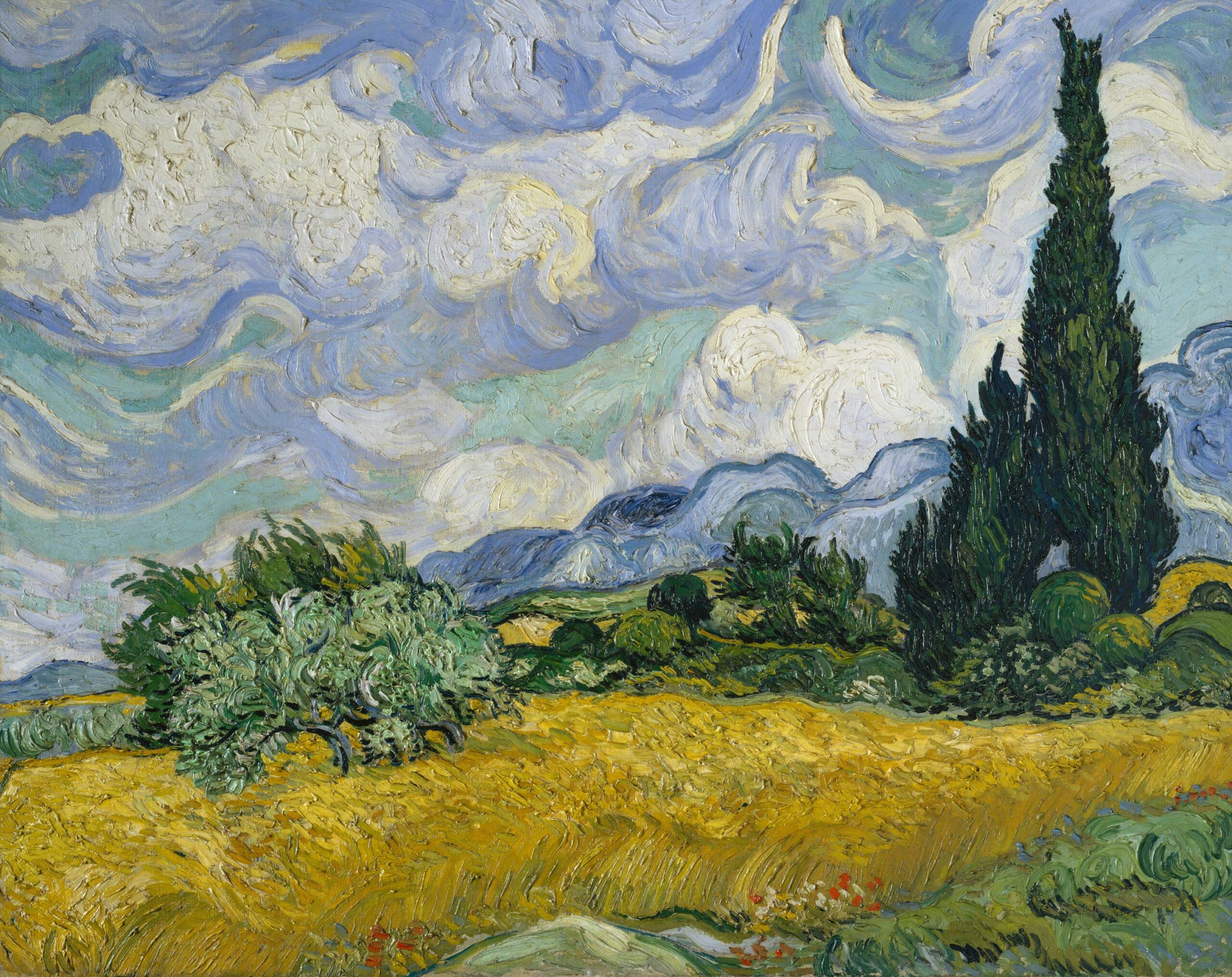
A stunning range of works will illuminate the extent of Van Gogh’s fascination with the region’s flamelike evergreens as they successively sparked, fueled, and stoked his imagination over the course of two years in the South of France: from his initial sightings of the “tall and dark” trees in Arles to realizing their full evocative potential (“as I see them”) at the asylum in Saint-Rémy.
Iconic paintings such as “Wheat Field with Cypresses” and “The Starry Night” will take their place as the centerpiece of this historic exhibition, which will only be presented at The Met.
“The show is a dream come true,” said Max Hollein, Marina Kellen French Director of The Met. “Marking the 170th-anniversary year of Van Gogh’s birth, this highly focused survey unpacks his distinctive vision of the commanding cypress trees. A once-in-a-lifetime gathering of works presents both an overview and an intimate glimpse of his creative process, challenging prevailing notions with fresh insights.”
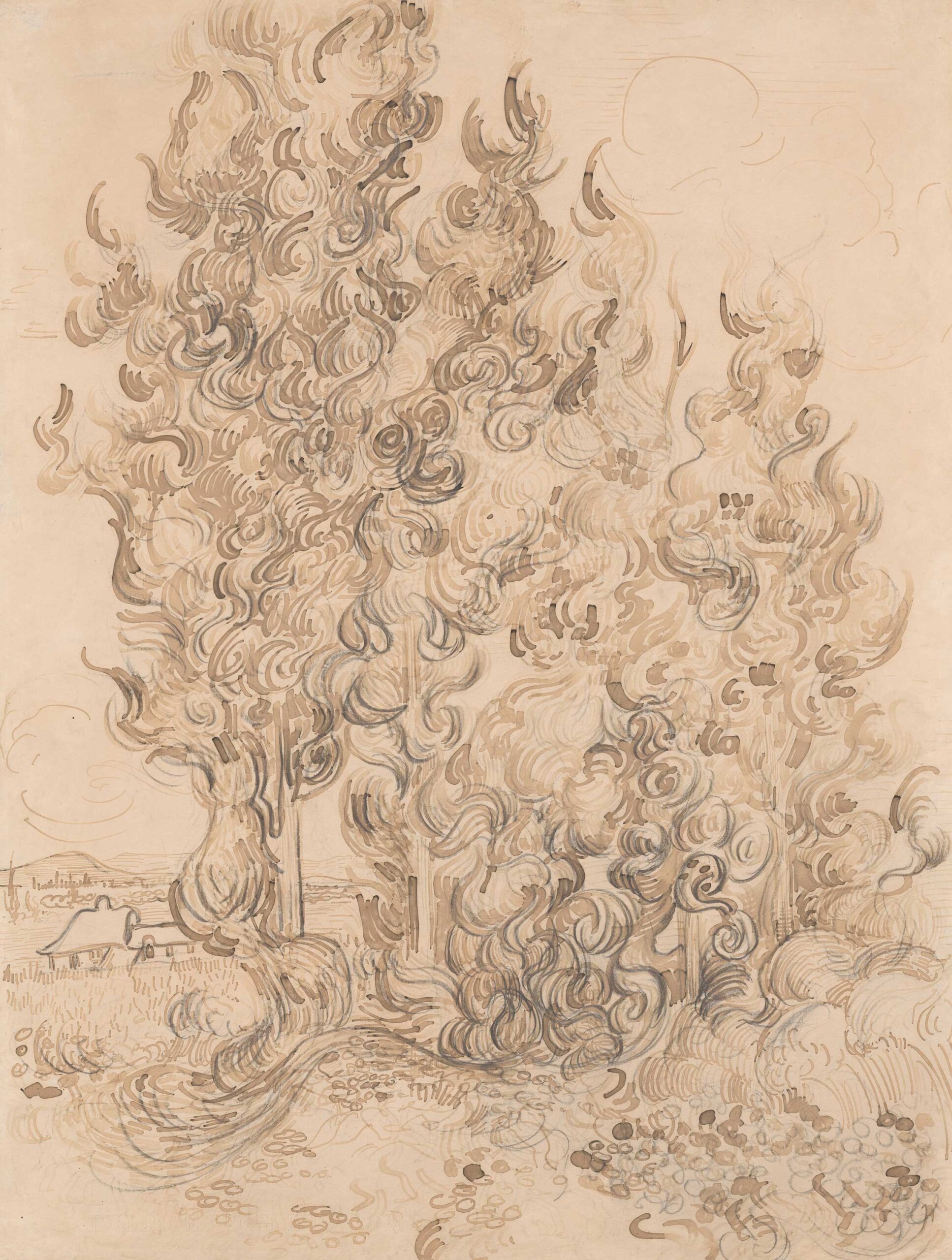
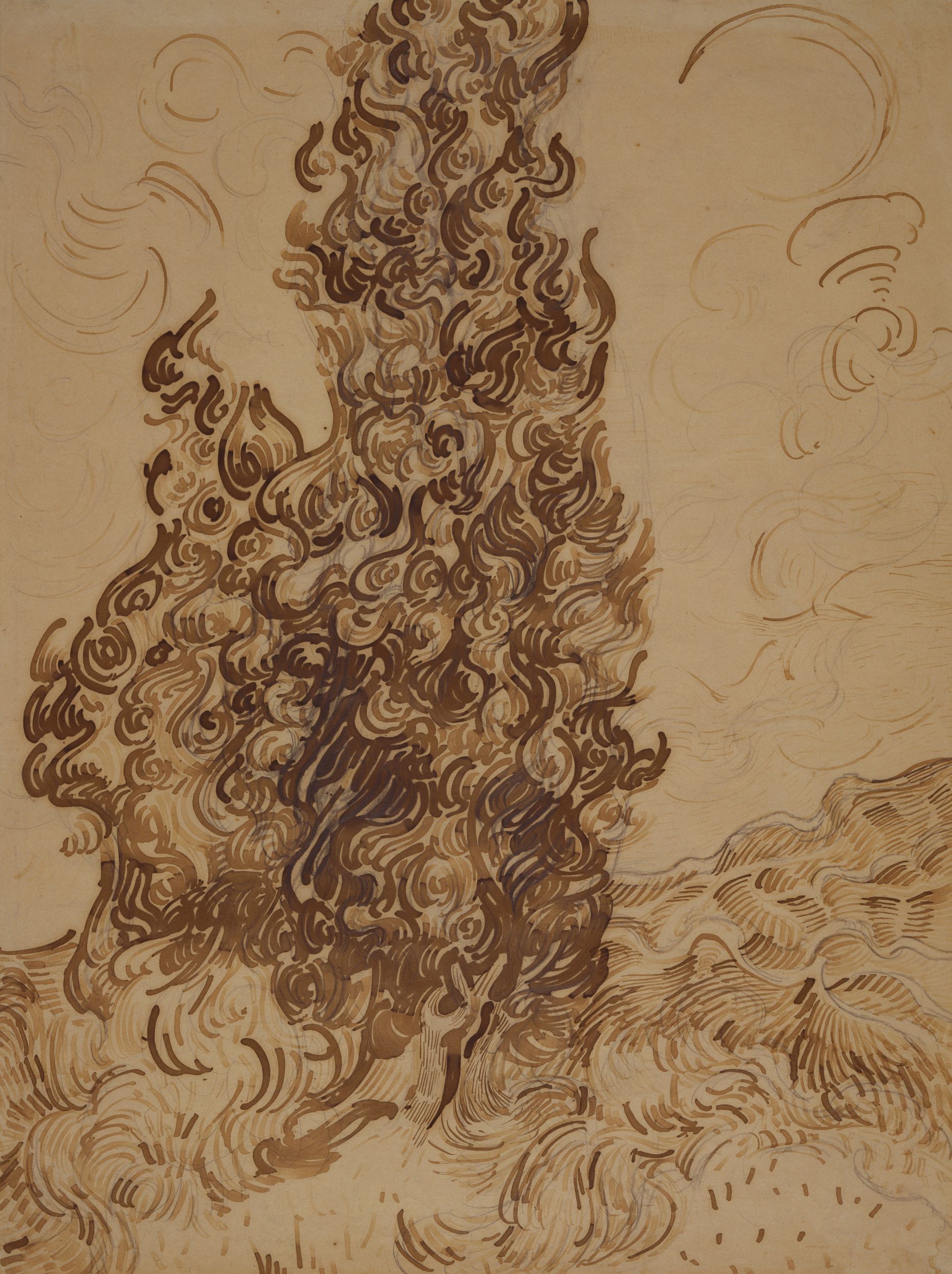
Vincent van Gogh, “Cypresses,” June 1889, Pen and reed pen and inks and graphite on wove paper, 24 5/8 x 18 1/4 in. (62.5 x 46.4 cm), The Art Institute of Chicago, Gift of Robert Allerton (1927.543) Photo: The Art Institute of Chicago / Art Resource, NYVincent van Gogh, “Cypresses,” June 1889, Brown ink and graphite on wove Latune et Cie Balcons paper 24 3/8 x 18 5/8 in. (61.9 x 47.3 cm), Brooklyn Museum, Frank L. Babbott Fund and A. Augustus Healy Fund (38.123), Photo: Courtesy Brooklyn Museum
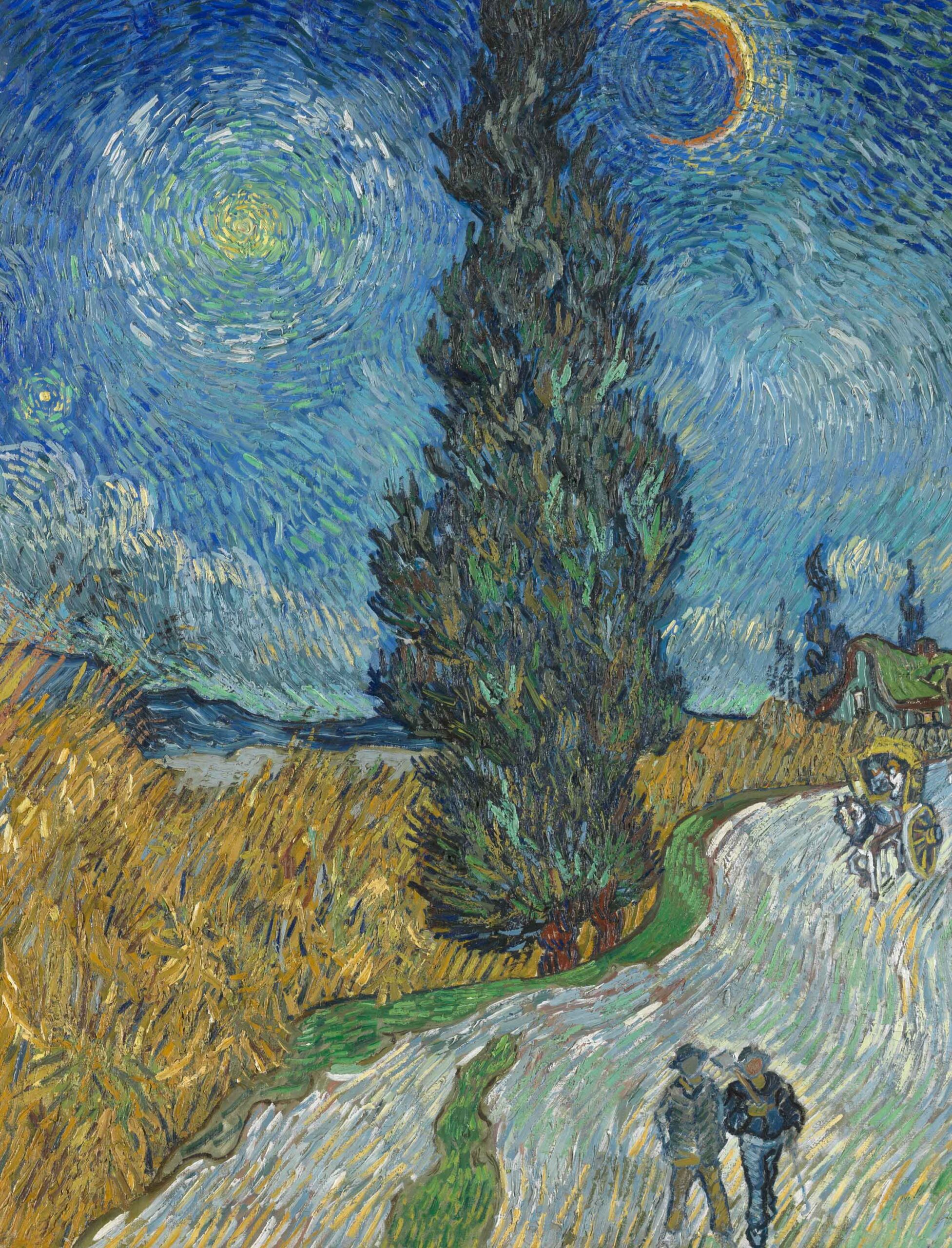
Juxtaposing landmark paintings with precious drawings and illustrated letters—many rarely, if ever, lent or exhibited together—this tightly conceived thematic exhibition will offer an extraordinary opportunity to appreciate anew some of Van Gogh’s most celebrated works in a context that will reveal the backstory of their invention for the first time.
Vincent van Gogh, “Country Road in Provence by Night,” May 1890, Oil on canvas, 35 11/16 x 28 3/8 in. (90.6 x 72 cm), Kröller-Müller Museum, Otterlo, The Netherlands Photo: Collection Kröller-Müller Museum, Otterlo, the Netherlands, photo by Rik Klein Gotink
As part of our effort to continue to help artists and art galleries thrive, we’re proud to bring you this week’s “Virtual Gallery Walk.” Browse the artwork below and click the image itself to learn more about it, including how to contact the gallery.
Sunset, Window View, Lee McVey, pastel, 12 x 16 in; Lee McVey
Want to see your gallery featured in an upcoming Virtual Gallery Walk? Contact us at [email protected] to advertise today. Don’t delay, as spaces are first come, first served, and availability is limited.
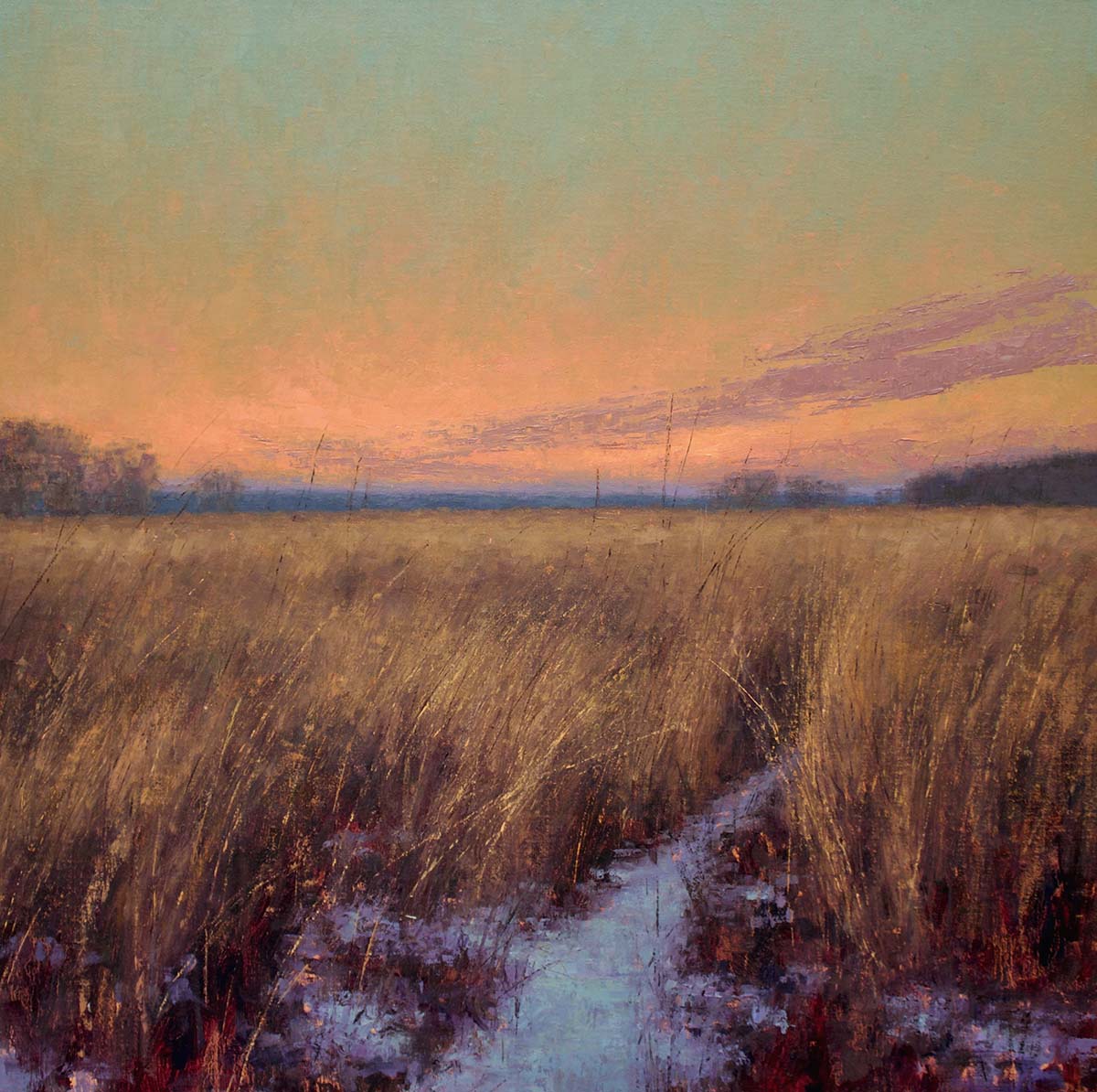
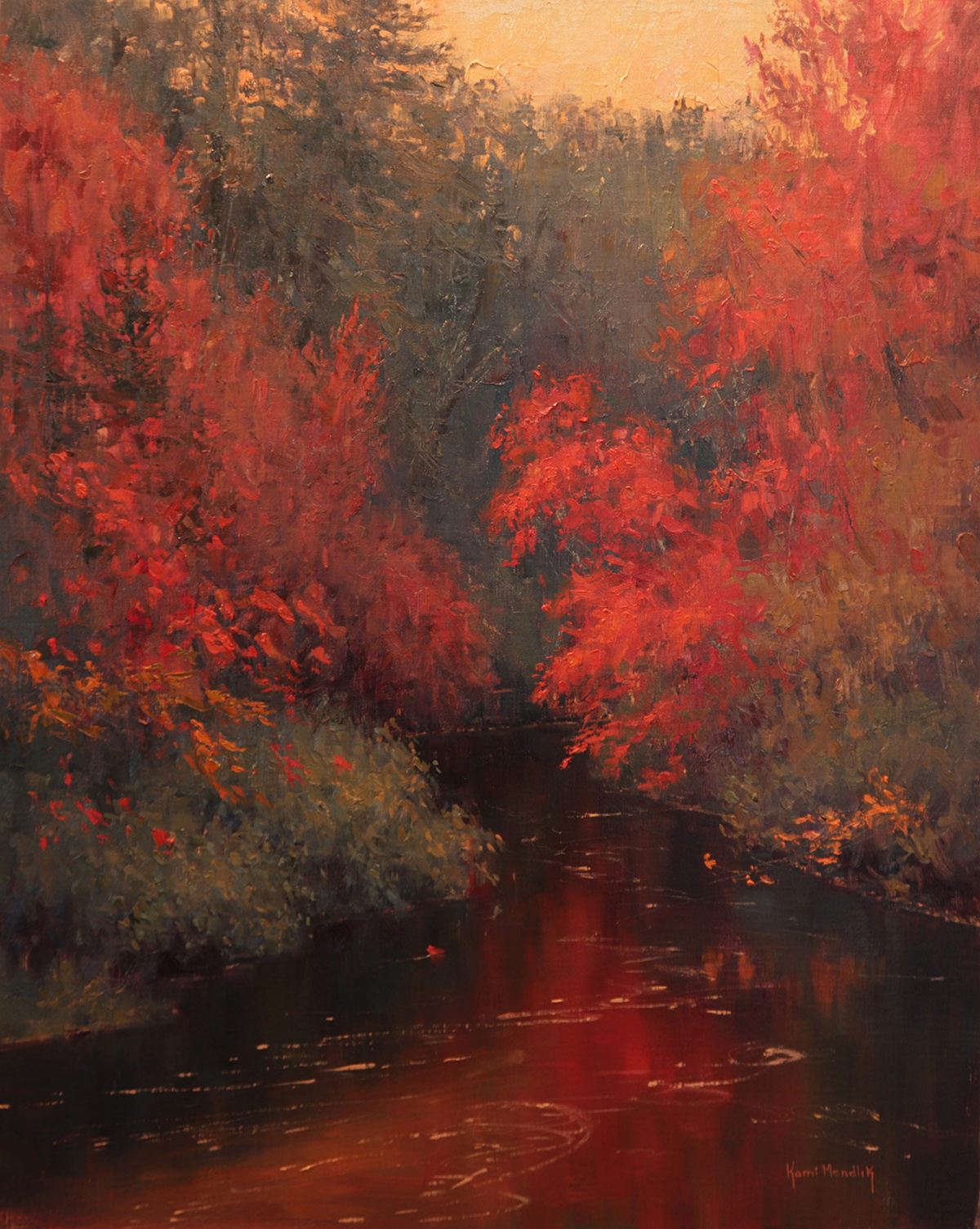
How did you develop your unique style? Kami Mendlik: I believe that our style is something we are born with and comes to the surface once we’ve done the hard work of learning how to use tools, (the fundamentals) inside and out until they become second nature. It is then, what some may call “style” can truly, authentically come through in our work as our deepest form of expression. I believe this is what sets ones work apart.
How do you find inspiration? Kami Mendlik: I find my inspiration by showing up. I am not inspired to paint, painting inspires me! I begin most days with a long walk before going out to paint or heading up to the studio. Simply the act of moving is what does it for me. The second I start to study how one color relates to another, my juices are flowing. To me, that is inspiration!
Kami Mendlik, “Into The Silver Lining Again,” oil on linen, 30 x 30 in., 2022. I love painting the quiet moments that flee all too quickly, and trying to capture those moments with paint is my deepest desireKami Mendlik, “Take Me to the River,” oil on linen, 30 x 24 in., 2022. This piece is the result of studying the milky light created from the wildfires out west
Fill your mind with useful art stories, the latest trends, upcoming art shows, top artists, and more. Subscribe to Fine Art Today, from the publishers of Fine Art Connoisseur magazine.