


Fine Art Collection Profile >
Carl B. Bedell is an attorney based in central Virginia. He traces his first meaningful encounters with art back to when his family was stationed in Germany with the U.S. Army. “My parents took my brothers and me to incredible museums throughout Europe,” he recalls, and later he revisited them as a U.S. Army officer himself, while living in the Dutch city of Maastricht, renowned for its annual art fair.
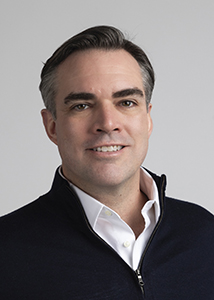
When he resided in Washington, D.C., Bedell became active with groups of young professionals supporting such local museums as the Corcoran Gallery, Phillips Collection, and Smithsonian Institution. After joining the Arlington County (Virginia) Commission for the Arts, he rose to chair its public art committee. (He maintains a second home in Arlington today.)
These volunteer activities brought Bedell into regular contact with talented artists, and so he began collecting in earnest. Today his paintings and sculptures include works by Guy Bell, Tim Conlon, Max Ferguson, Kit King, Roberto Lugo, Sebastian Martorana, Matt Moulthrop, Peter Olson, Andy Paiko, Mario Andres Robinson, Remington Robinson, Martin Swift, Tigran Tsitoghdzyan, Adam Vinson, and Helen Zughaib, and he owns photographs by Binh Dahn, Tim Hyde, Esko Männikkö, Jamie Johnson, and E. Brady Robinson.
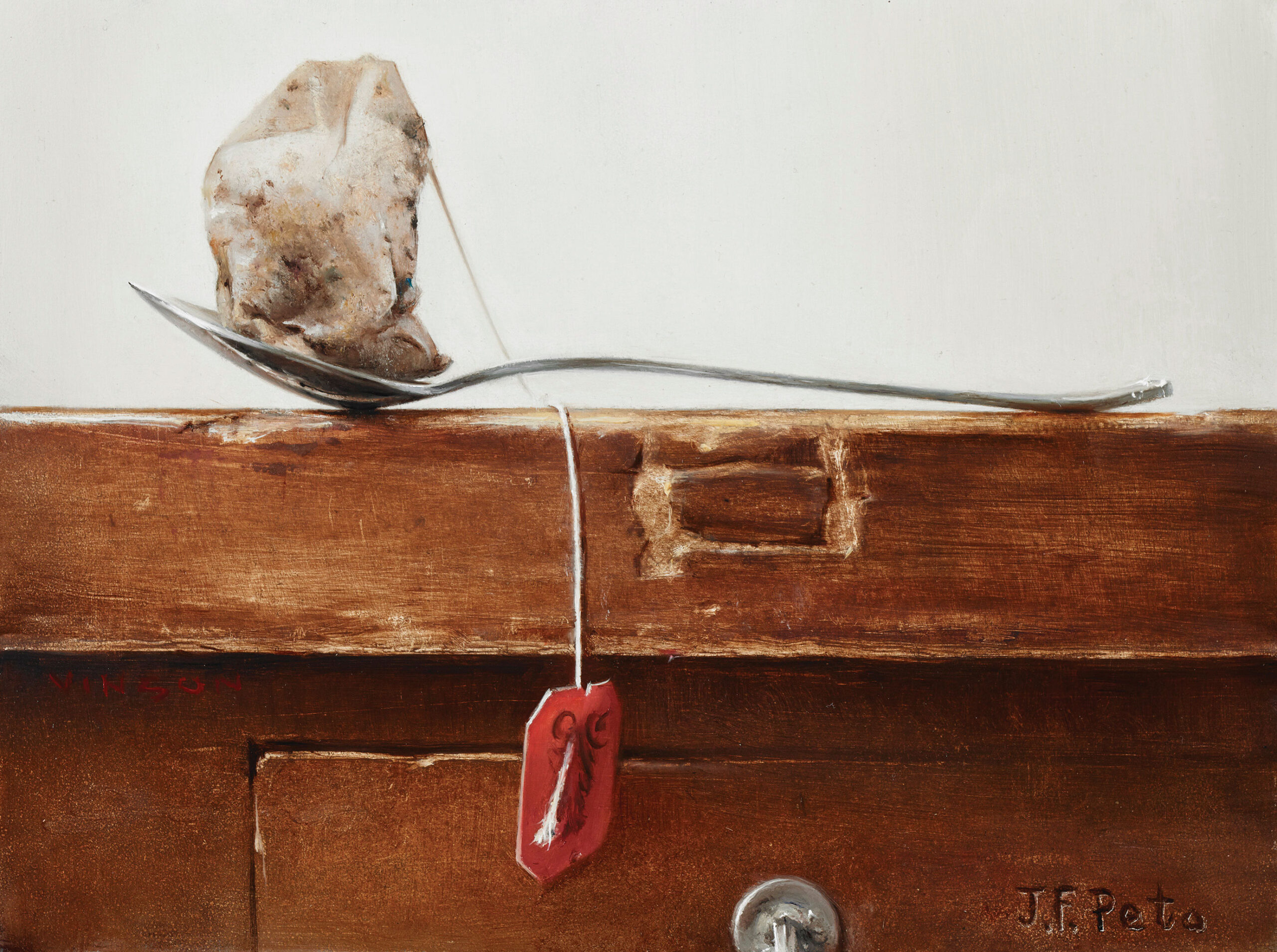
The collection’s throughline, he explains, is technical virtuosity, certainly evident in Bedell’s first acquisition, made just over a decade ago. Though he had admired Adam Vinson’s paintings as early as 2008, Bedell fell for “Card Sharks” after it won the People’s Choice Award at a 2014 gallery show in Sarasota. He bought it and now owns five more Vinsons, his favorite of which is “Steeped in Irony,” illustrated here. Vinson had exhibited this still life in an alumni show at the Pennsylvania Academy of the Fine Arts; he made it in homage to another Academy graduate, the trompe l’oeil master John F. Peto (1854–1907), many of whose scenes were unscrupulously resigned by another artist after his death. In tribute, Vinson added Peto’s “signature” alongside his own.
Bedell is deeply interested in artists’ processes and often asks them for preparatory pieces related to his acquisitions. Vinson gave him the vintage photograph that appears in “Card Sharks,” plus two props depicted in another scene. On the back of his painting “Popcorn (Study),” Max Ferguson added song lyrics, quotations, and even a photograph of his son. Touchingly, Bedell has also assembled a collection of exhausted brushes: “I offer the artists gift certificates for new brushes in exchange for ones they can no longer use.”
Bedell recalls a watershed moment a few years ago: “I was set to bid on a 19th-century trompe l’oeil painting at auction, but this happened to coincide with final preparations to host another of my week-long retreats for 5–10 artists at my family’s river house in Arkansas’s Ozark mountains. Instead of bidding, I decided I would rather collect works by living artists, with whom I could build relationships and develop a deeper understanding of the art that I have the privilege to live with.” The retreats in Arkansas don’t involve artmaking as much as inspiration: all Bedell asks is that each artist give a talk about their work; some, he notes, “haven’t enjoyed such stimulating dialogues since they finished their formal education.”
Separately, Bedell offers the artists career advice and introduces them to other collectors. The latter is especially easy when he deinstalls his own collection at home and invites a favored artist to mount an impromptu selling show.
As for buying art, Bedell says, “My friendships with artists and other collectors are the primary source for identifying new artists.” Of course he also follows galleries, museums, magazines, and social media (“I went through a phase of only collecting artists I found on Instagram”), and he scouts talent while exploring the big fairs in Miami and New York. “When I travel,” he adds, “I try to identify artists in those places and schedule studio visits.”
The result of all this activity is a web of connections that give Bedell joy: “For any work, I can tell you a story of how I met that artist and how our relationship developed.” He cites the Armenian-born, New York-based artist Tigran Tsitoghdzyan, from whom he acquired a large, untitled painting in 2023: “Facebook had recommended his art, so I began following him. Soon I visited his studio and found we have much in common. I helped him prepare his application for U.S. citizenship, and it was incredible to be with him at his naturalization ceremony.”

It was Tsitoghdzyan who introduced Bedell to the work of Kit King at a moment when “I was trying to push what I was comfortable with, to collect art that not only displayed incredible technical ability, but also said and meant something. I was blown away by the photorealism of Kit’s large self-portrait, “The Tangible Manifestation of Change” [illustrated above], and also by the novelty of her having cut the image into strips and reassembled them.” He points with pride to King’s own statement about this powerful image: “Painted and sliced up as though it has gone through a shredder, this piece serves as a visual commentary of living in a disposable society, and the consequence in how this destructive behavior is now entering and affecting the relationships we form, and in turn how this begins to shape our own identities.” Bedell continues, “If a viewer can ask ‘Why would King cut it up?’ then perhaps that leads to deeper introspection to, as she does, question why it’s acceptable to tear one another down in real life.”
Bedell also feels strongly about Sebastian Martorana’s marble sculpture “Glove: Engineer.” After admiring the artist’s work at the Smithsonian’s Renwick Gallery, Bedell visited his studio and was impressed by the sculpture of a glove already sold. “Sebastian told me about the glove series he wanted to make, so I promptly commissioned the second one. I love how he took a classical subject [the hand] and added a modern twist by showing it encased in a heavy-duty work glove. And because I am so fascinated by process, I also obtained Sebastian’s study [drawn with grease pen on cardboard] plus the actual glove he studied, coated with marble dust!”
Like many collectors, Bedell worries a bit as a new artwork arrives, as this often means having to put something into storage. But he enjoys rotating the collection: “It allows for new perspectives: the light changes, and the relationship to artworks nearby might help me appreciate some aspect I hadn’t noticed before.” Clearly this is a collection that keeps giving, long after the initial thrill of acquisition.
View more artist and fine art collection profiles here at FineArtConnoisseur.com.