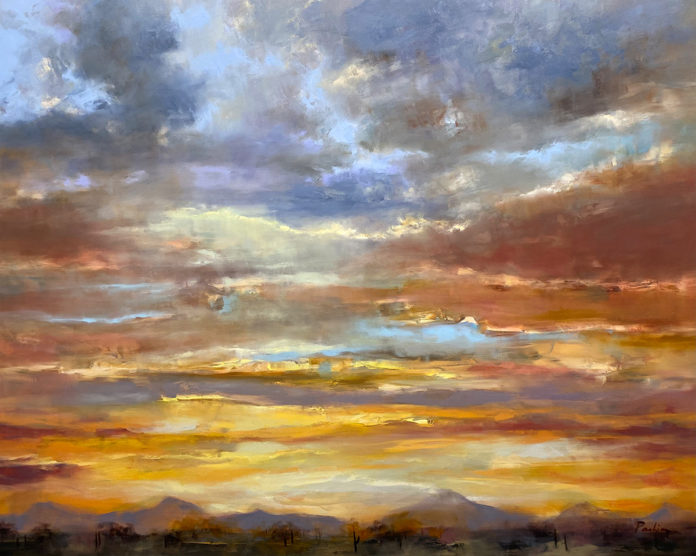
Joshua Cunningham (b. 1974), "So Begins the Green," 2020, oil on linen, 14 x 18 in.
Joshua Cunningham: Further In
Groveland Gallery
Minneapolis, Minnesota grovelandgallery.com
Through January 15, 2022
In Minneapolis, Groveland Gallery is set to host its fourth solo show dedicated to Joshua Cunningham, who lives just across the Mississippi River in St. Paul. On view will be paintings spanning two decades, including ones he self-deprecatingly admits were “started long before I knew how to finish them,” others “created over half a dozen visits to the same place at the same hour,” and still more that “came off the brush fully formed.”
Cunningham notes that his increased teaching load during the pandemic only “deepened my gratitude for the sacrifices and energy that my mentors put into my training, their mentors into them, and so it goes back for generations.” He adds that the newer paintings in the Groveland exhibition are “born of moving further into a deepening gratitude for all those artists who’ve come before.”
Of his verdant landscape painting illustrated here, Cunningham recalls, “There was something about how the undulating rhythms all roll toward the well-worn middle ground that creates a connectedness between the right and left of the canvas. No matter how far our attention strays, there is always a way back to common ground.”
> Visit EricRhoads.com to learn about more opportunities for artists and art collectors, including retreats, international art trips, art conventions, and more.
> Sign up to receive Fine Art Today, our free weekly e-newsletter
David Poxon was born in the Industrial heartland of England, but now makes his home in the rural countryside of Shropshire, U.K. He is an elected member of the prestigious Royal Institute of Painters in Watercolours and is also a signature member of the National Watercolor Society of America.
David Poxon is on the faculty of the 2022 Watercolor Live virtual art conference, January 27-29, with a Beginner’s Day on January 26. Register early at WatercolorLive.com!
A recurring theme in David’s work is the reclamation by nature of that which man has created and abandoned, finding renewed life between object and environment.
His medium of preference is watercolour, and he says he is “a purist in the sense that mainly transparent pigment is used, and white paint avoided.”
Here’s more about his watercolour techniques and inspiration.
David Poxon, “Killing Time,” watercolour This painting won the Shanghai Biennial and got me my first big breaks in China. The clock was attached to an old Cricket Pavilion and had long stopped working. To be true to the subject I waited for the correct time before quickly drawing and photographing it in order that the cast shadows from the clock hands would be an accurate reflection of the minutes past the hour. So hence the title, “Killing Time,” waiting for inspiration.
Stimulating Watercolors
BY DAVID POXON
I aim to record what is seen and felt in a subject as accurately and realistically as possible, believing that any finished painting should attempt to transcend a mere visual experience and reach out to the viewer in a stimulating, emotional, and engaging way.
Totally fascinated with the technical challenges that pure watercolour painting presents, my working method requires patience and preparation. Thinking about the subject whilst exploring its ‘construction’ through drawing, and refining and rehearsing passages that stretch my abilities as a painter, provides my constant motivation. This reverential approach is very much born out of the respect I feel for the subjects that call me.
David Poxon, “Harvest Days,” watercolour, 27 x 19 I wanted to capture the atmosphere of the late summer Barley harvest. Where I live in rural Shropshire, England I am surrounded by beautiful countryside and the machines that maintain it. These tractors are modern day workhorses and each has its own characteristics. As a young boy my Father would take me to collect loads of potatoes in his old truck. The treat of the day was to have a ride on the farmer’s tractor. Tractors were the first things I learned to draw and paint.
The Subject Hunt
Subject hunting trips are usually frantic and fast-paced expeditions. I go armed with a small pad, drawing kit, camera, and tape measure to record size and scale. When the light is right – that which gives strong cast shadows and emphasises tonal definition – I am ready to go exploring at a moment’s notice. Being aware of potential subjects is very much a state of mind; inspiration can strike in the unlikeliest places and it’s important to have my “artist radar” on maximum alert.
David Poxon, “In a Farmyard,” watercolour, 20 x 18 This is an old lister engine the farmer had used to power his milking parlour; it had a wonderful array of subtle blue to green and that glorious amber rust and soft shadow plays. I was so excited by this subject; it took me a month to paint!
Painterly Possibilities
I never rearrange a possible subject, as this can give an almost artificial atmosphere to the work. Rather, I change my position within the subject area until a sense of the painterly possibilities emerges. I move rapidly from one scenario to another, stopping to make quick drawing notes, taking photos for fine detail, and measuring where necessary.
Occasionally a more formal on-the-spot drawing is called for. Frottage is a useful technique to have in my armoury to instantly create an impression of texture, shape, and tonal extremes. An instant record of any object can be captured in a few moments with the aid of copy paper and a soft pencil.
David Poxon, “Men Worked Here,” watercolour, 18 x 27 This subject and its format is typical of the compositional choices I make. A discarded factory and this painting is my take on a typical post-industrial scene. My early years were spent surrounded by Industry and factories which were my playground while growing up. Now long gone, this post-Industrial age gives us as painters some wondrous subjects.
It is only later when back in my studio that the day’s collection can be fully examined. As my painting method means that days or weeks are spent on a work it’s necessary to gauge whether my enthusiasm for what at first seemed like a good capture will sustain.
Some projects are far more complicated than others, and this is where accurate drawing and preparation are vital. There can be no obvious drawing errors when attempting to record the parts of engines or tractors, as it’s inevitable that an expert will be in the gallery and spot any embarrassing mistakes. Taking time to get the drawing right will avoid a world of pain later! These machines and scenarios have characters of their own, and I treat them as portraits in respect to their features.
The next step is to produce an accurate line drawing. I always work on stretched heavy watercolour paper held down onto marine plywood boards. Having a stock of these of various sizes always available means that my options are never restricted.
My final line drawing for transfer to the watercolour paper will be kept to an absolute minimum in terms of detail. The aim is to provide a simple skeleton shape. I regard this very much as scaffolding in the sense that when the painting is begun my process will rebuild the subject on the paper.
The next step is protecting areas to be kept white. I use anything that comes to hand to do this: scraps of paper, objects, masking fluid. It’s better to protect more whites than I may need, after all there are very few actual real whites in nature, and I can blend them away later in the painting if they are unnecessary. At this stage the ‘work’ does not look anything like it might end up; holding onto that final vision in the mind is vital!
The first washes tend to be splashy affairs with mixes about the consistency of milk. I try to get 7 or 8 layers of wash down, wet-on-dry, to get the paint body onto the paper. These are exploratory in the sense that a finished work may have more than 20 transparent wash layers.
The drawing may become lost amid the seeming chaos of these first applications; finding the scaffolding drawing sometimes requires the tenacity of an archaeologist. Knowing where I want the painting to go only comes through experience with this type of method.
My board is kept flat to maximise any granulation effects, but rocking it occasionally encourages runs and blending. Texture is important to me, so I will take any benefits the pigments throw my way. Balancing the medium’s natural tendencies while finding colour ways and exploiting light effects, counterchanged with complimentary darker passages, is an exciting juggling skill.
A Word of Advice
Watercolour has a reputation for being the most difficult medium to master, often seemingly to have a will of its own. With experience you can limit the chances of the paint running away from your subject and wield a certain amount of control by stepping down through the tonal register with multi layers of wash, working light to dark, and slowly steering the painting towards the vision that first inspired you.
This patient approach can be very rewarding, after all, life teaches us that you only get out of something what you put in.
David Poxon, “Another World,” watercolor, 12 x 17 I love to get close to my subjects and explore all the frail surfaces slowly transitioning. Watercolour is the perfect medium for capturing this natural process of reclamation. By overlaying multiple washes of transparent colour you can step down in value, but with very careful application maintain the glow from the paper that gives watercolour its unique characteristics.
For my upcoming Watercolor Live demo, I have chosen a seemingly simple subject that encompasses the elements which constantly appear in my work: texture and multi-layering for extreme value: an ancient building in Rome I came across on my travels.
We will ‘zoom’ in on the aspects that give me the greatest painting pleasure – all those textural details and rich colours!
My works can often take days or weeks to complete. Given the obvious and necessary time limit for my Watercolor Live demo, I have devised a way that can give a snapshot into my process for viewers in an easy to understand and follow system. I hope Watercolor Live fans will enjoy a small glimpse into my world and techniques. Enjoy.
David Poxon, “Wired,” watercolour, 18 x 26 The solitude and silence in this abandoned workplace had an almost intangible presence. Its walls seemed to be imbued with the energy of the workforce long since gone. The crumbling textures, peeling paintwork, strong cast shadows, and delicate trail of old cables gave me all the painterly challenges I look for in a subject.
As part of our effort to continue to help artists and art galleries thrive, we’re proud to bring you this week’s “Virtual Gallery Walk.” Browse the artwork below and click the image itself to learn more about it, including how to contact the gallery.
Blue & Brown (Louis Vuitton) by Ray Kleinlein, Oil, 38 x 34 in.; Anderson Fine Art Gallery
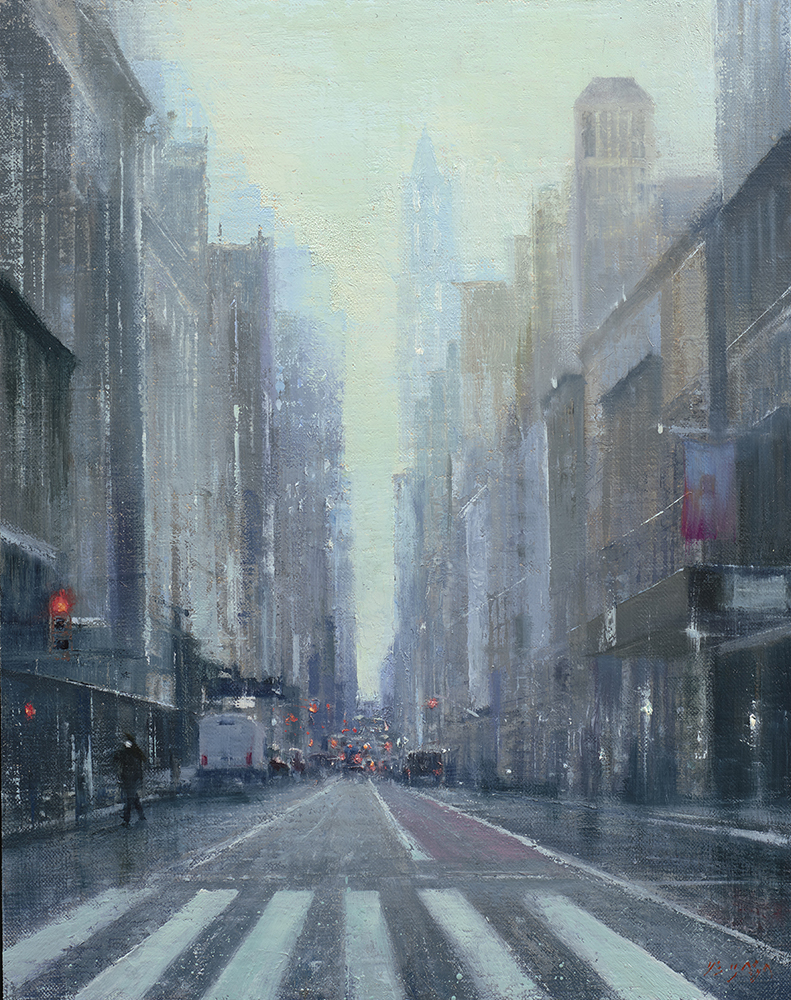
Soho Evening Rain by D.Eleinne Basa, Oil on canvas, 20 x 16 in., Signed; Rehs Contemporary
Surf at Low Tide by Edward Henry Potthast (1857 – 1927), Oil on canvas, 24 x 30 in., Signed; titled and addressed on a label on the reverse; Rehs Galleries, Inc.
Want to see your gallery featured in an upcoming Virtual Gallery Walk? Contact us at [email protected] to advertise today. Don’t delay, as spaces are first come, first served, and availability is limited.
Last Rays
18 x 24 in.
Pastel on prepared board
$1,750 (plus tax and shipping as applicable)
Available through Castle Gallery, 1202 West Wayne Street, Fort Wayne, Indiana
Jill Stefani Wagner PSA-MP IAPS/MC
“Last Rays was inspired by lovely late afternoon light peaking through snowy trees in February. As a Michigan artist, I have learned to appreciate the snowy months in the Midwest almost as much as I love the beautiful spring, summer and fall days. Each season has its own unique beauty. Sunny winter scenes really sparkle with warm light and cool blue shadows. In this piece I focused on that complimentary duality and accentuated the texture by using a thick pastel ground under painting.
“Whether painting landscapes, interiors or figures, my primary focus is always the light and how it affects the subject I’m trying to capture. Working in pastel and oil I approach my paintings as a sculptor would, carving out nuances of highlight and shadow.
“An avid plein air artist, I’m inspired by the American landscape and that of my beloved Italy. I find my greatest joy painting on location, taking in the atmosphere, temperature, sounds and smells, as well as the view. I participate in national plein air festivals, traveling throughout the country to capture the uniqueness of each venue. During the cold Michigan winters, I work in my studio creating larger pieces…but always, always chasing the light.”
Jill Stefani Wagner’s artwork has been exhibited in solo and group exhibitions throughout the country and is included in many corporate and private collections. Her paintings have been juried into prestigious national and international oil and pastel exhibits and have been honored with multiple awards.
One of Jill’s paintings graced the cover of PleinAir Magazine, and her work is often featured in their pages. Fine Art Connoisseur Magazine has frequently highlighted her paintings as has Pastel Journal and the French magazine, Practicum des Arts. Wagner has been invited Pastel Faculty at PleinAir Magazine’s Plein Air Convention for four years and enjoys teaching workshops and mentoring other artists.
Wagner is a designated Master Paste list in the Pastel Society of America and Master Circle in the International Association of Pastel Societies, and belongs to American Impressionist Society, Oil Painters of America, Great Lakes Pastel Society and Degas Pastel Society.
Jill Stefani Wagner graduated with a B.F.A. in painting from University of Michigan School of Art. She owned an award-winning advertising firm in Ann Arbor, Michigan, before “seeing the light” and becoming a full-time artist.
Journey
By David Marty
24 x 36 in.
Oil on canvas
$3,450 framed
Available through Cole Gallery in Edmonds, Washington
This painting leads you into a journey along country back roads. Enter in and see what you can discover. “Fall is my favorite time of year, and I love to take off and explore and see the spectacular colors and changing foliage. For a plein air painter it is a prime opportunity to be out there painting with almost overwhelming inspiration!”
David Marty is known for his impressionistic landscapes which portray a sense of peacefulness. Initially David’s professional career took him in the direction of graphic design and illustration, but he is now following his passion and painting full time. His paintings have been juried into Oil Painters of America, American Impressionist Society and C.M. Russell exhibits.
“I love to be outside painting plein air. Nothing can compare to the joy of being surrounded by nature and experience its beauty first hand. My passion is to capture the emotion I feel towards a scene or moment in time and share those feelings with others.” Recently David has been invited to participate in several plein air shows, including the prestigious Laguna Beach Invitational. This summer he received the Curator’s Choice Award for his body of work at Plein Air Glacier.
David and his wife reside in Edmonds, have five children, and three grandchildren.
Upcoming Shows
LPAPA Squared, LPAPA Gallery • Laguna Beach, CA • December 2 – January 3, 2022
6” Squared, Randy Higbee Gallery • Costa Mesa, CA • December 4 – January 3, 2022
Best of the West • Great Falls, MT • March 17-20, 2022
Featured Artist, Scott Milo Gallery • Anacortes, WA • May 5 – June 4, 2022
Carmel Plein Air Art Festival • Carmel, CA • May 13-15, 2022
Visit davidmarty.com for more work by David Marty or to sign up for his e-newsletter.
ALAN FETTERMAN FINE ARTS GALLERY, located at 181 East Court Street, Doylestown, PA 18901.
“Bucks County has been my homeland for a lifetime” says, Alan Fetterman, the 63-year-old Bucks County artist.
Recognized as one the most prominent regional artists of our time, Alan Fetterman, has already left a deep creative indelible imprint on the art scene, not to mention his long legacy as a community volunteer and founding member of non-profits boards, organizations, and commissions. “Giving is a profound and wonderful action, and this community of people and leaders set a bright and mighty example. It’s an honor to be a part,” says Fetterman.
For 30 years Fetterman has survived exclusively as an artist creating about our county’s landscapes, faces, and places. “I am insatiable and completely endearing to this land and community we call home. Its wellspring waters and bright bucolic landscape is certainly worthy of reflection,” Says Fetterman. Fetterman’s artwork can be found in public and private locations all throughout the region. One public example is two huge paintings held in collection at the Doylestown Hospital in the main lobby. One of those large paintings “Doylestown at the Turn” he created from the rotunda rooftop of the courthouse in 1999. “It was pre-911 so getting on top of a pubic building with a 5-foot by 6-foot canvas was less difficult than it would be today; although permission was needed by the county commissioners, and security guards were always near just the same,” said Fetterman.
In his lifetime Fetterman has created approximately 1,200 paintings and 25 sculptures…nearly all of them are held in collections. Priced from $1,000 for a small painting to his largest to date at 8 feet x 9 feet that sold through a gallery for $50,000. Collectors say he paints from the eyes of a bright heart and kind spirit with a magical touch of goodness held inside each painting. For the last few years his paintings have included the word “Love” written within the paint. “I believe we all can agree that Love is the best of all offerings,” Fetterman notes.
Art and lifetime awards reflect Fettreman’s success. The Central Bucks Chamber lifetime achievement award, The Bucks County Community College President’s award, The Rotarian four-way test honoree, and being an honored Kay scholar at the University of Pennsylvania to name a few. He also spent seven weeks in Brazil as an Ambassador of goodwill with Rotary International, and a dozen other medals and awards. “With all of the fine honors at hand, I am most honored and grateful each and every time one purchases my art and brings it into their home. It’s a powerful honor to have one’s art in another’s home,” says Fetterman.
Alan Fetterman’s gallery is now in the heart of Doylestown located at Freeman’s Hall, 181 East Court Street, which sits on possibly the highest elevation ground in Doylestown. “After having a studio on the river bank in Point Pleasant for 10 years and in a Gristmill in New Britain along side a heavy flowing creek for 10 years, respectively, it’s now the perfect place to stay high and dry and hang my paintings and my hat,” says Fetterman. This artist is no stranger to adversity. The artist paid a heavy toll by the three consecutive floods of 2004 thru 2006 that flooded his home and studio in Point Pleasant, PA. “It’s mostly magnificent living near water, but it can surely be treacherous just the same. Surviving exclusively as a Fine Art artist is far from an easy task. Add consecutive floods to the mix and the challenges mount X- fold. Of course, a committed artist puts everything on the line each day and year in order to survive. Bobbing and weaving is a part of the passage. Dedication and commitment to one’s vision and scope remains paramount. And the riverboat gambler’s hat on my head is the perfect metaphor for surviving in ever rolling waters,” said Fetterman.
As Bucks County’s first “Artist in Residence” with a legacy of 49 one-person shows in galleries all throughout the United States, Fetterman produces work sought and collected for not only continuing the Pennsylvania Impressionist tradition, but for creating his own vibrant energetic contemporary legacy of color and composition. He’s traveled extensively throughout the Americas and abroad, living and learning cultural values and old-world aesthetics that has rendered a large creative lexicon with sculpture, poetry, prose, and music. Prior to the Covid outbreak Fetterman was in a recording studio creating original music he calls “Bucks County Rock.” My hopes are to return and complete my music once time and place allows,” he notes.
Fetterman was awarded the Philadelphia Sketch Club medal of Honor by the nation’s oldest art club in America, and has a degree in philosophy from the University of Pennsylvania, and a degree from Bucks County Community College in American Studies. He’s been featured and showcased in over 100 art venues and galleries in places diverse as Carmel, California, Twilight Park, Hudson River Valley, New York, Curitiba, Brazil, and Vero Beach, Florida. He’s a past member of New York City’s Salmagundi Club and his work and life have been profiled in dozens of magazines, columns, and books, including features in “A Bucks County State of a Mind,” “The Embraceable You,” and “Illuminate” by art historian Cathy Viksjo.
Alan Fetterman lives in Buckingham with his wife Sherrie. They have raised four children; Windsor, Brandy, Tia, and Jackson, along with nearly a dozen fine dogs…
Winter at the Canyon
By Robert Goldman
36 x 36 in.
Oil
The 13th annual Grand Canyon Celebration of Art recognized the achievements of 25 artists who have successfully interpreted the canyon, both in plein air and studio work.
The artists painted at the South Rim of the Grand Canyon National Park for a week in September, capturing on canvas the vastness, the ever-changing light and the many moods of the canyon.
Arizona artist Robert Goldman is one of the participating artists. A professional artist for 50 years, Goldman attended the Art Center College of Design in Pasadena and has studied with numerous artists including Wolf Kahn, John Asaro, Wayne Theibaud, Ray Roberts, Matt Smith and Ned Jacob.
Goldman was awarded PleinAir Magazine’s Best of Show for the body of plein air work he completed during the 2019 Grand Canyon Celebration of Art.
In addition to the plein air work the Celebration of Art artists do during the event, they also submit a studio painting for the event catalog. Of his studio painting “Winter at the Canyon,” Goldman says:
“In this painting, the lone figure is immersed in the grandeur and enormity of the Grand Canyon under a blanket of snow. The snow brings forth unique aspects of design and simplicity in relation to the varied elements of the landscape.”
Hot August Morning
By Ray Hassard
Pastel on panel
6 x 18 in.
$850.00
On view at Cincinnati Art Galleries in the show “Our Town”
August in Cincinnati is known not only for the heat but also for the humidity. Sure, it’s not as brutal as, say, Central American jungle humidity, or even Maryland’s Eastern Shore, but it often gets pretty oppressive. So, hoping at least to find a bit of breeze to paint with, my friends Mike and Marilee and I headed down to the river one hot morning to paint. We scrambled down an overgrown bank near a boat launch ramp and set up our easels. The location was what we expected — buggy and smelly — but there was a breeze and it actually seemed to be getting stronger.
After a few hours, each of us intent on our paintings, we were all startled to hear a loud clap of thunder behind us. Turning quickly, we saw an ominous black sky approaching rapidly. With just enough time to pack and run up the pack, we got back to our cars just as a downpour came crashing out of the sky. Who says plein air painting is not an extreme sport?!
Most of this painting was in fact done plein air, but that hurried departure meant some finishing in the studio later on. I have found that having worked en plein air frequently has helped develop my visual memory. Though I had not taken any photos of the scene, I was able to finish it from the image in my mind.
I have been painting plein air for over 20 years, at home and around the world. Three painting trips to India were a high point of my life as an artist. Painting in the streets there is truly extreme, with animals, crowds of curious people, unruly traffic and much more to contend with, but worth any difficulties encountered. A month as artist in residence in Dinan, France was another wonderful experience that I am thankful to have had. In that case, painting on the banks of the river Rance reminded me of the Ohio which I see from my window every day.
In the last 10 years I have been a competitor in many plein air competitions around the country including Plein Air Maui, Easton Maryland, San Angelo Texas, and New Iberia, Louisiana. Of course, Covid intervened in all that traveling, but there’s just as much to paint in Cincinnati!
I am represented by Cincinnati Art Galleries, 225 E 6th Street, Cincinnati, Ohio 45202, (513) 381 2128. The current show spotlights art of the Cincinnati area and runs through the end of November.
Oxford Gallery, 267 Oxford St # 1, Rochester, NY 14607. The current show is a group show on the theme “In a Different Light” and includes 2 paintings of mine based on overnight motel stays on my travels.
Castle Gallery; 1202 West Wayne St, Fort Wayne, IN 46802, has been carrying my work since August this year.
Big Pink Roses
48 x 48 in.
Acrylic on canvas
$3,200
Available through the artist at Beth Clary Fine Art Gallery: 317-439-7143
“In the little historic neighborhood where my gallery is located, is a family florist. These big pink roses are my favorite flower they sell. I buy a bunch every Friday. This bouquet was one of those purchases. They are enormous, and the smell is amazing! They make me happy. I hope they make you happy as well!”
Beth Clary Schwier is an award-winning Indiana artist. Originally from Peru, Indiana. A former actress and model, Beth began painting while raising her six children and then began studying with renowned Indiana impressionist artist C.W. Mundy. She loves experimenting with abstract impressionism and abstract realism.
Although she is known for her amazing floral pieces, Beth likes to paint unusual subjects from everyday life that evoke nostalgia and fond memories. Beth and her art are featured on Seasons 2 thru 6 of HGTV’s National Hit Show Good Bones, filmed in Indianapolis. She was also a featured artist at the 2017 Smithsonian Folklife Festival on the mall in Washington DC, depicting the American Circus.
She now has her own gallery near downtown Indianapolis. Beth Clary Fine Art is located at 5636 East Washington St, Indianapolis, IN 46219. Her website is www.bethclaryschwier.com.
The Man Who Herded the Hairy Cow
24 x 36 in.
Oil on linen
$14,500
Available through the artist
Jove Wang believes in exploring new ideas with every painting, but he also learns by diligently studying the old Masters. He does not confine himself in just one painting category having explored portraits, figures, still life, landscape, and large scale works up to 58” x 72” in size. He has been teaching oil painting for over 20 years out of his California studios and takes pleasure in sharing his artistic techniques and ideas without reservation.
Jove was honored most recently in 2021 with Best of Show and Artists’ Choice Award at the American Impressionist Society’s 22nd Annual National Juried Exhibition. Immediately following, he won Best of Show at the AIS All Member Online Exhibition. He is so appreciative to both judges for their recognition of his artistic achievements.
Other Recognition:
2009 Guy Rose Award, California Art Club
2000 Best of Show and Artists’ Choice Award, Carmel Plein Air Painting Festival
1999 Best of Show, Oil Painters America
1997 Gold Medal Award, California Gold Meadow Exhibition, California Art Club
He has also won awards outside of the United States and has works in many museums and private collections around the world.
Fill your mind with useful art stories, the latest trends, upcoming art shows, top artists, and more. Subscribe to Fine Art Today, from the publishers of Fine Art Connoisseur magazine.