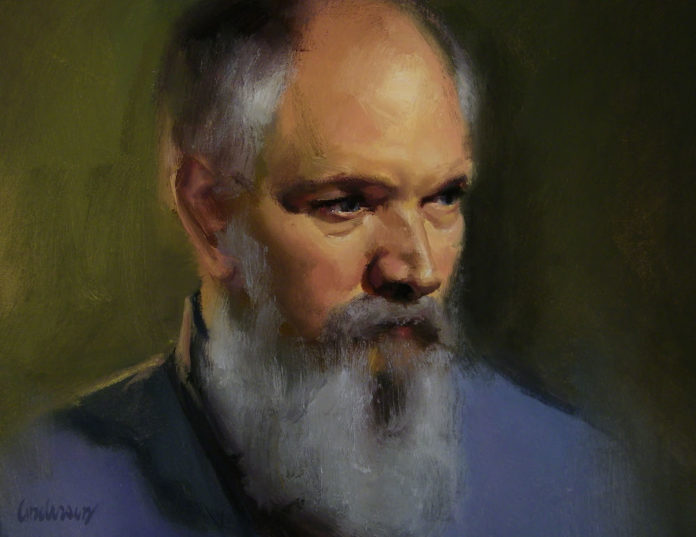
Erich by Kurt Anderson
Oil on Canvas
$2,800
Featured in the Oil Painters of America National Exhibition, August 17 – September 19, 2020
RS Hanna Gallery, Fredericksburg, Texas
“This portrait of my friend Erich Erving was painted in my studio over two sessions, each about 4-5 hours. He has posed for group sessions, but I was alone when I painted this portrait, so I was able to take my time in lighting and arranging the composition. That made a huge difference and allowed me to really think through those subtle elements of gesture and expression that spoke to this individual’s personality.
“As with all my paintings, I love to work directly from life. Something happens when responding directly to the physical world. I think it is partly due to the loss of perfect control, and the need to continually make choices about exactly what ever-changing nuance of what you are seeing that you want to include.”
This painting is currently hanging at RS Hanna Gallery in Fredericksburg, Texas, as part of the Oil Painters of America National Exhibition. Anderson is just coming off a term as president of the OPA where he has won top honors and served on the board of directors since 2010.
Anderson is an oil painter who works in many genres – floral, landscape, figurative and portrait. He is represented in many major collections and galleries. His 20-foot mural Prairie Sky is on permanent display at the library of Iowa State University. Anderson’s official portrait commissions range from the Chief Justice of the Minnesota Supreme Court to the president of Iowa State University.
Anderson is the author or contributing author of eight books on painting, including his most recent book Expression by Design – The Art of Kurt Anderson available through his website.
Gallery Representation
Reinert Fine Art, Charleston, South Carolina
Illume Gallery of Fine Art, St. George, Utah
Cutter & Cutter Fine Art, St. Augustine, Florida
Beverly McNeil Gallery, Birmingham, Alabama
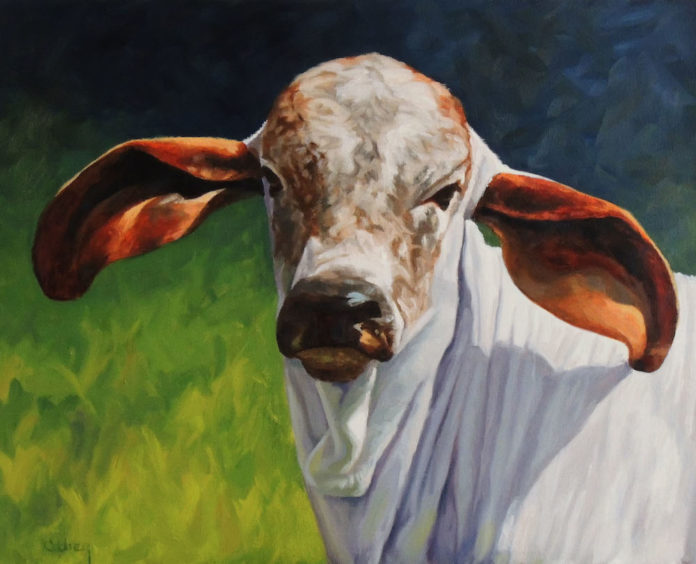
Little King by Addren Doss
Oil on linen panel
16 x 20 in.
$1800
Addren Doss is known for oil and pastel paintings of animals and landscapes which are filled with strong light and color. Her ongoing series, Bodacious Bovines, is a good example of this. When deciding on which bovine to paint she looks for attitude and treats these paintings as portraits with many of her subjects looking you straight in the eye. She is drawn to patterns of strong light and shadow, and color that glows in late afternoon light. Many of her favorite subjects have been painted in both oil and pastel as she explores how one medium affects the other. She usually meets her subjects while on plein air painting trips around the country.
Addren is a Master Member of Women Artists of the West, Founding Member of the Piedmont Outdoor Painting Society, and Member of the Pastel Society of North Carolina. Her work has been exhibited in venues across the country and can be found in public and private collections in this country and the United Kingdom. She is represented by O’Brien Gallery in Greensboro, North Carolina.
Carrie Wild, Amy Ringholz and Caleb Meyer will return to the 2020 Jackson Hole Fall Arts Festival QuickDraw with new option for livestreaming and purchasing art through an online auction. Image credit: Jackson Hole Fall Arts Festival
The 36th Annual Jackson Hole Fall Arts Festival in Jackson, Wyoming has recently announced its plans to hold both in-person and online activities for artists and collectors, September 9-20, 2020.
From the organizers:
In addition to being able to watch top artists create a masterpiece in 90 minutes or less in downtown Jackson, the Jackson Hole Fall Arts Festival is bringing the fan favorite QuickDraw into homes nationwide on September 19 with a new livestream feature for the event and the auction that follows. Popular artists returning to QuickDraw this year include elite painters Amy Ringholz, Carrie Wild, Kathryn Mapes Turner, and sculptors Bryce Pettit, Rip & Alison Caswell, and more. As always, spectators can see artists in action in Jackson (at limited capacity this year).
Once completed, QuickDraw pieces go immediately to a live auction that will have an electronic bidding option for the first time in the festival’s history. A limited and social-distanced in-person audience will bid live from the floor of the auction, competing against online bidders on BidSquare in real time. The one-of-a-kind artwork, often accompanied by special stories from the artists, ranges from oil and watercolor paintings to sketches to sculptures, all inspired by Jackson Hole’s spectacular natural surroundings and unique wildlife, with pieces typically selling anywhere from $1,500 – $15,000. The auction will begin promptly at 10:30 a.m. MST, with virtual as well as in-person attendees able to watch and bid on desired pieces. It’s highly recommended for those interested in participating online to register in advance on BidSquare to be ready to bid on auction day.
Sculptor Bryce Petit. Image credit: Jackson Hole Fall Arts Festival
“We are thrilled at the opportunity for a virtual QuickDraw Auction, allowing people to participate in this iconic event from the safety and comfort of their own homes if they prefer,” says Britney Magleby, Special Events Manager at the Jackson Hole Chamber. “In my opinion, Jackson has always been a must-know destination for arts and culture. I think even more people will see that after this year’s festival.”
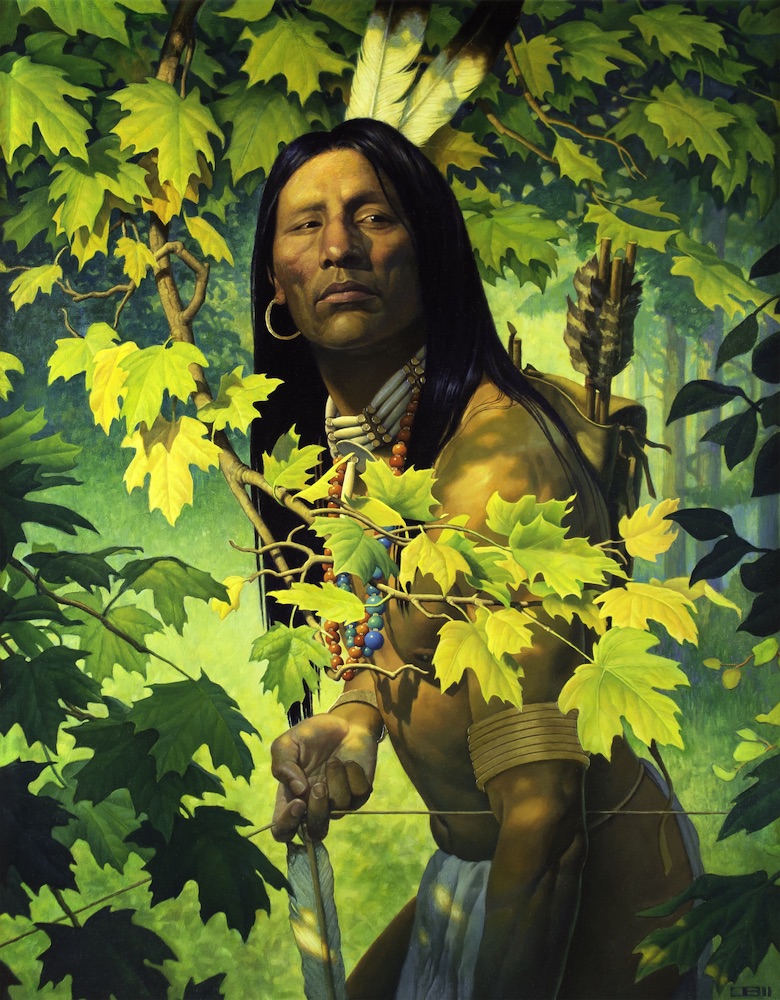
Also up for auction after QuickDraw will be the stunning 2020 featured artwork, “Hunter’s Watch,” by renowned artist Thomas Blackshear. Past years’ featured art has sold for as much as $65,000. Blackshear’s vibrant painting also graces 2020 festival posters, so everyone can bring the award-winning artist’s painting home, with posters available for purchase here.
“Hunter’s Watch” by Thomas Blackshear, Oil on Canvas with Gold Leaf, 30 x 38 in.; Trailside Galleries during Jackson Hole Fall Arts Festival
The National Museum of Wildlife Art’s annual “Western Visions,” a signature event of the Jackson Hole Fall Arts Festival, this year includes the in-person “Western Visions Jewelry Show” on September 9. The museum is also offering an online artists’ panel, “The Jackson Hole Five: Important Painters from the West,” on September 17, featuring a discussion with five of the most influential painters in Jackson Hole: Amy Lay, Amy Ringholz, Kathryn Mapes Turner, September Vhay and Kathy Wipfler. Additional Western Visions opportunities will continue to be made available leading up to the event; check wildlifeart.org/western-visions for details.
Every year, Jackson Hole Fall Arts Festival attendees enjoy browsing and shopping in person at the September 13 Takin’ It To The Streets outdoor art fair. The 2020 fair features over 50 local artists selling an array of mediums on the beautiful and spacious lawn of the Center for the Arts.
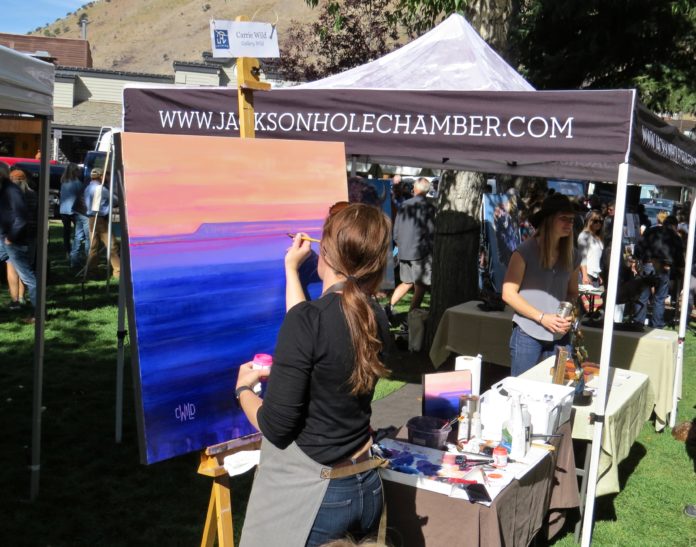
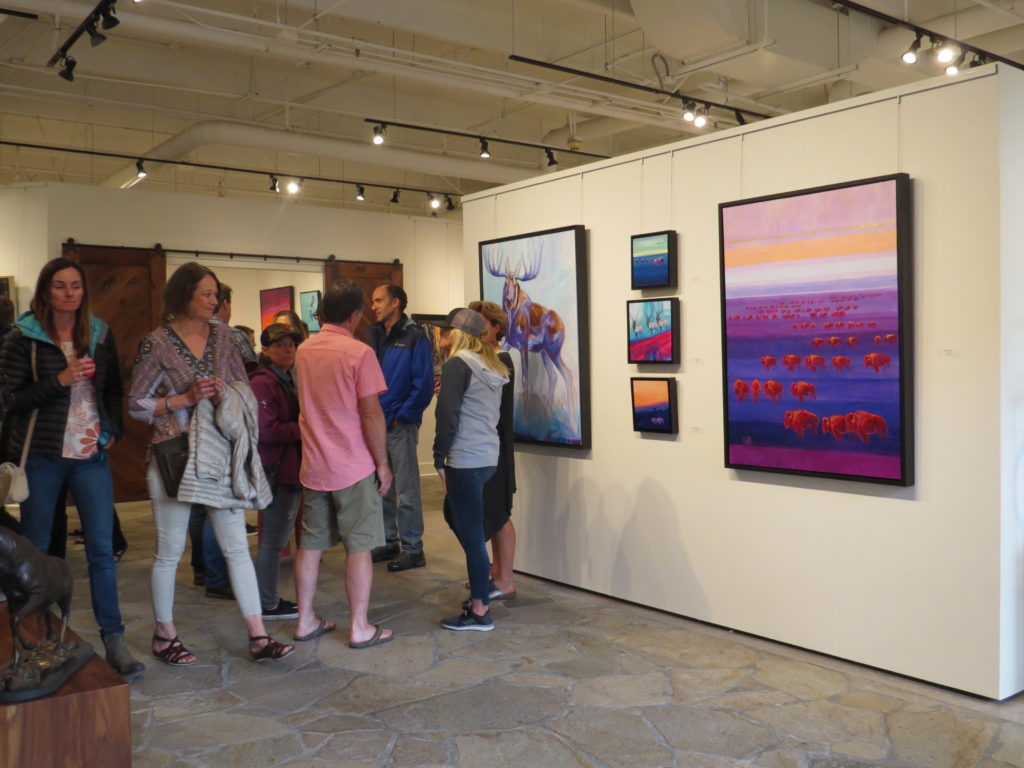
Gallery Wild during last year’s Fall Arts Festival. Image credit: Jackson Hole Fall Arts Festival
Widely regarded as a top destination for Western and Wildlife Art, Jackson features more than 30 fine art galleries, museums, and centers. During the Fall Arts Festival, galleries display their “best of the best,” with exhibitions of work from internationally recognized artists. While the traditional Palates & Palettes is on pause for 2020, several of the galleries will carry on the gallery walk legacy with local events: Gallery Wild will host artists receptions and events at their downtown gallery space on September 11, 18 and 19. Meanwhile new Town Square gallery New West Fine Art will offer an Evening Reception & Artist Talk from Connor Liljestrom related to his exhibition “Last of the Old West” on September 11 – accompanied by a performance from Contemporary Dance Wyoming.
Adding to the lineup of excellent online opportunities this year, the Western Design Conference Exhibit + Sale, also a signature event of the festival, will go entirely virtual this year with a new interactive digital version of its Sourcebook that will be released on September 10, 2020, on westerndesignconference.com, allowing collectors, design aficionados and anyone who appreciates the finest in American contemporary craft to source, through September 2021. And in addition to this year’s WDC artisans, the special online Sourcebook will include access to top designers from throughout the event’s past 28 years.
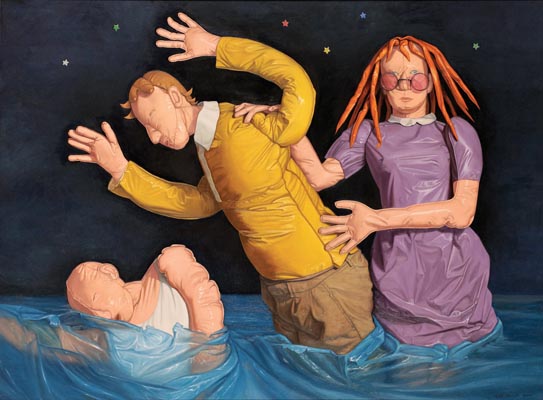
Vera Barnett, "Classical Plastique: Rose-Colored Glasses," 2009, oil on linen
Valley House Gallery and Sculpture Garden (Dallas, Texas) has recently announced the exhibition “On Being Human.”
“These last months have reminded us of the importance of our basic humanity and the inherent value of others,” says the gallery. “After isolating, we felt a need to be surrounded by people—hence this invitational exhibition about people seen through the artist’s eye.”
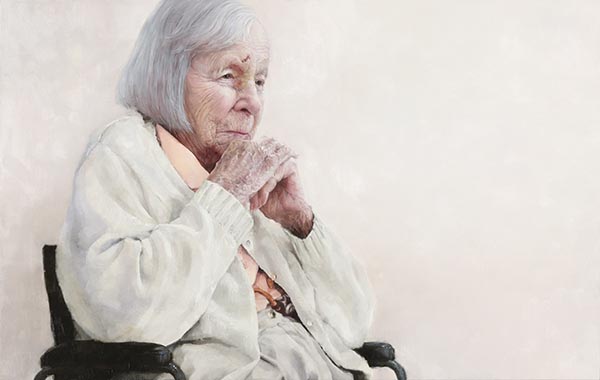
Amy Werntz, “Marjorie,” 2018, oil on birch panel
In addition to Valley House artists, the following figurative artists are also participating:
Deborah Ballard – Vera Barnett – Lu Ann Barrow – Peter Bonner – Curt Brill – Lloyd Brown – Sean Cairns – Jeanne Campbell – Lindy Chambers – John Cobb – Brian Cobble – Robert D. Cocke – Carol A. Cook – Laurie Hickman Cox – Lee Baxter Davis – Laurence Edwards – David Everett – Barnaby Fitzgerald – Scott Gentling – Miles Cleveland Goodwin – Ira Greenberg – Otis Huband – Sedrick Huckaby – Anita Huffington – Kathryn Keller – Sirena LaBurn – Emily LaCour – Rudolf Sotelo Lailson – Jungeun Lee – Laurie Lipton – Jun-Cheng Liu – William B. Montgomery – Philip Morsberger – Fred Nagler – Trish Nickell – Gail Norfleet – Michael O’Keefe – Luke Sides – Hadar Sobol – Ellen Soderquist – Bob Stuth-Wade – James Surls – Chaco Terada – Valton Tyler – Mary Vernon – Donald S. Vogel – Amy Werntz – Jim Woodson – Miguel Zapata
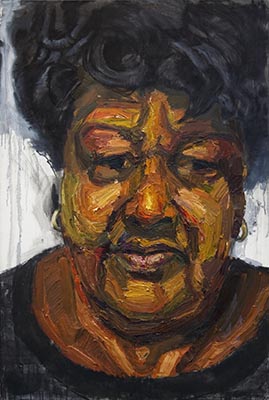
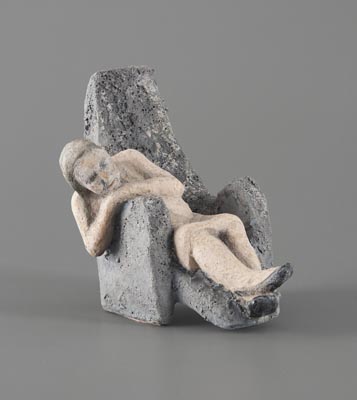
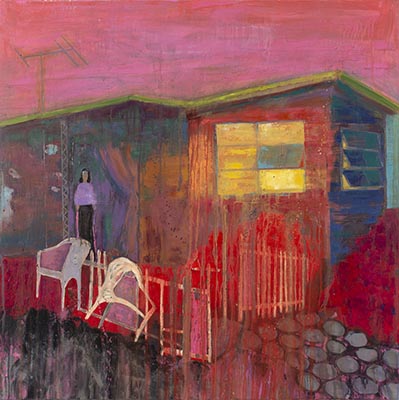
Sedrick Huckaby, “Mary, Mary-Lu, Missionary Parker,” 2013, oil and charcoal on canvas on panelCarol A. Cook, “The Grey Chair,” 2016, raku clay and low-fire texture glazesLindy Chambers, “Home Alone,” 2020, oil and acrylic on canvas
“On Being Human” will be on view through October 31, 2020. Masks are required, and the gallery will observe all guidelines issued by the State of Texas and City of Dallas. Learn more at valleyhouse.com.
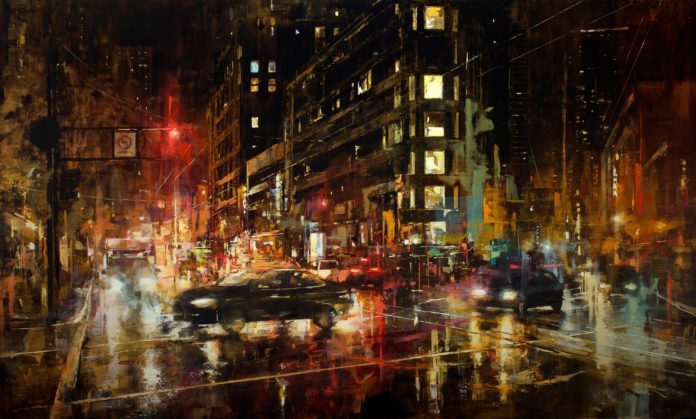
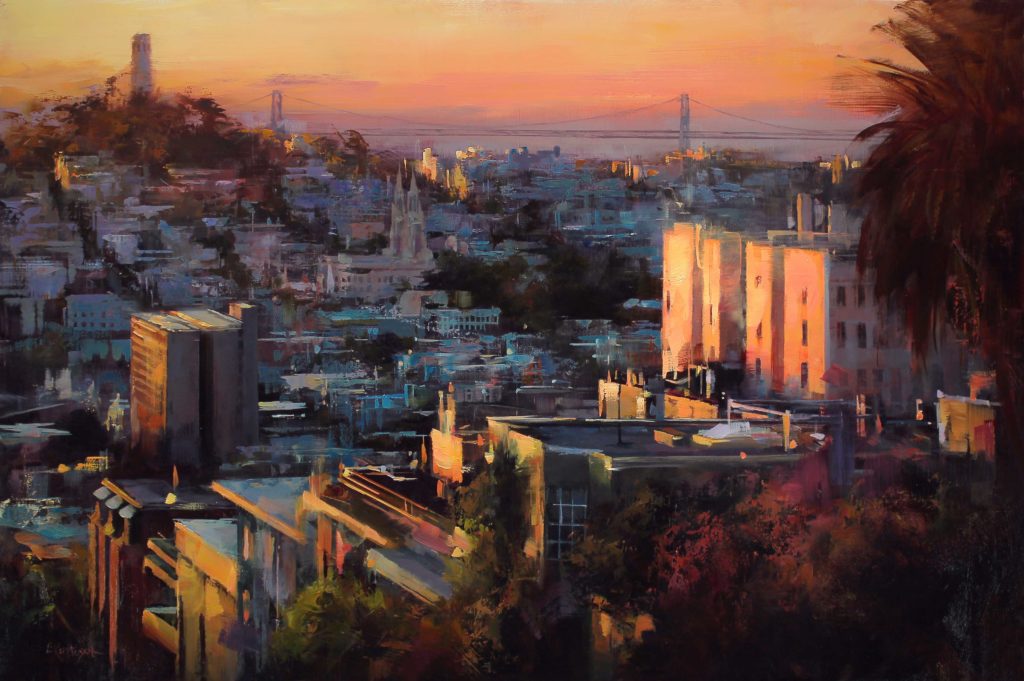
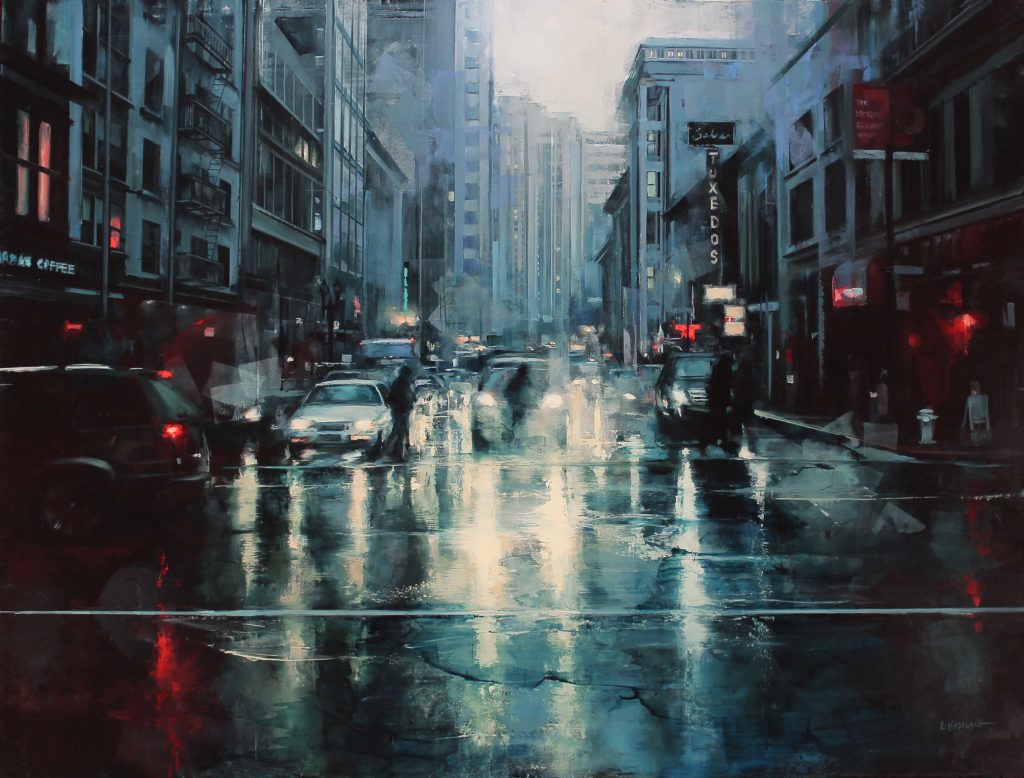
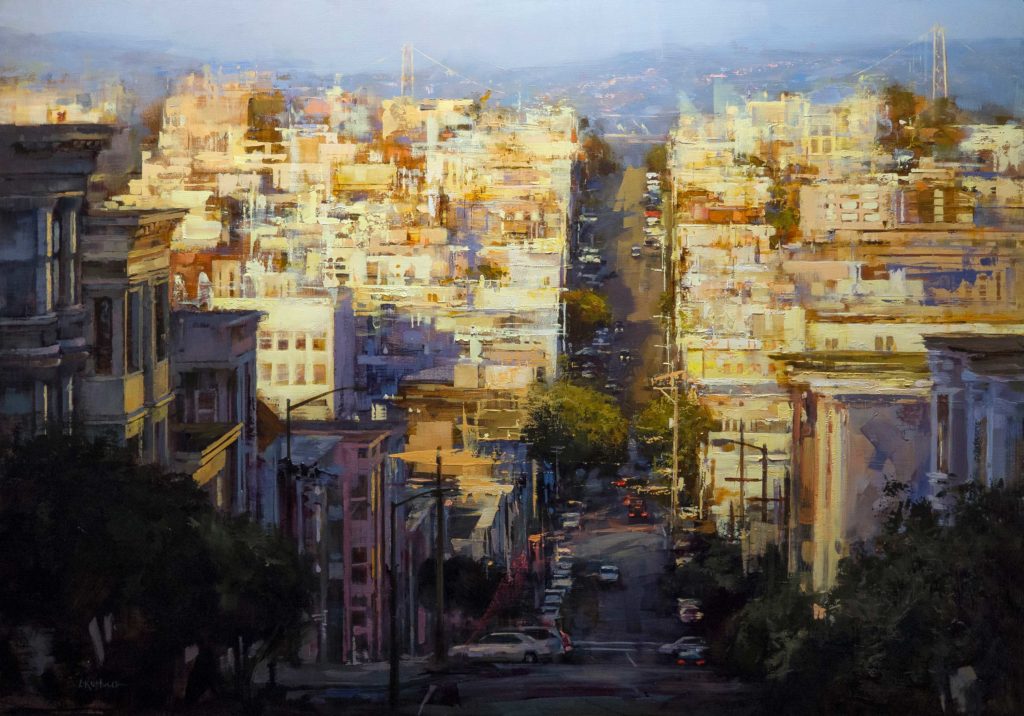
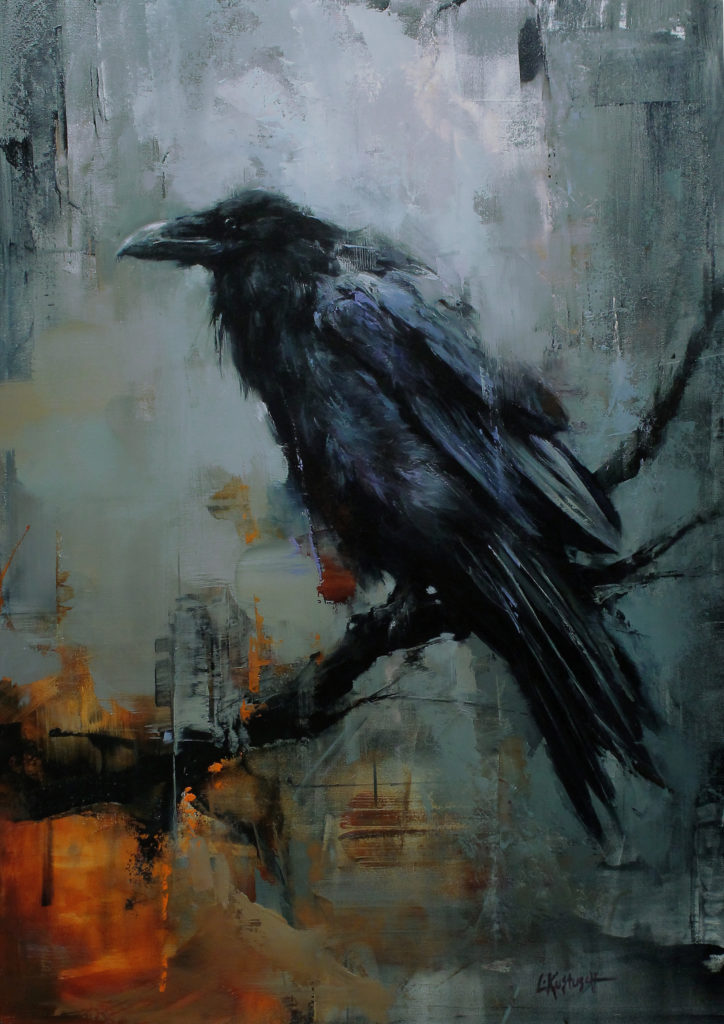
Lindsey Kustusch, "Luminance," 36 x 60, oil on panel, 2018
Influenced by the bustle of city life, Lindsey Kustusch paints “the abstraction of how we remember our days.” Go behind the scenes of her contemporary oil paintings here.
I am fascinated by the power of art and its ability to alter the way we see our surroundings…how everyday things can gain exquisite beauty simply because we’ve experienced it through someone else’s eyes.
That is the magic behind the paint brush. It grants us freedom to change how we see the world. It challenges the significant versus the insignificant and all of the shadowy spaces in between. It’s a memory exposed, and a loss for words defined. As the artist and the onlooker, art offers us a chance to see the things we miss.
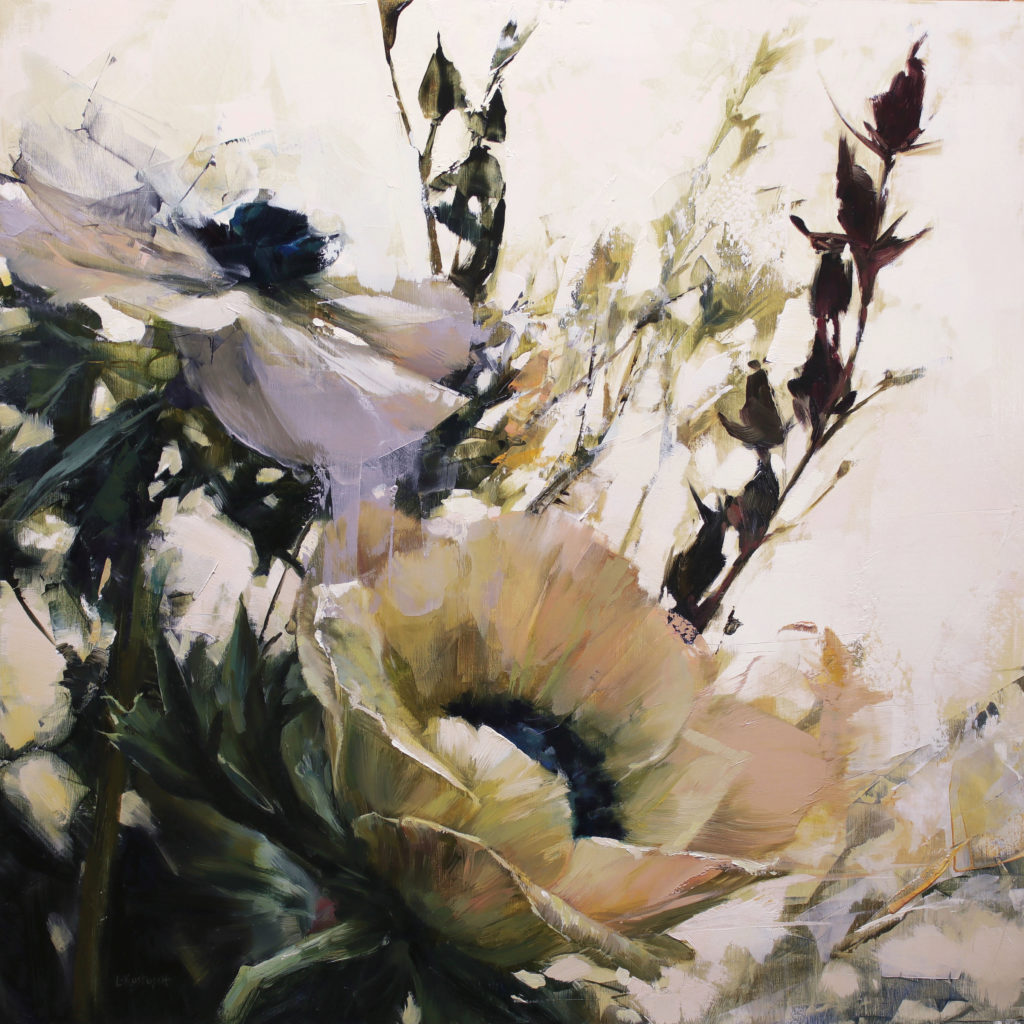
Lindsey Kustusch, “Ivory Blooms,” 22 x 22, oil on panel, 2019
Since I was a child, my love for art has always held equal importance to my deep connection with animals. I spent several years at art school before leaving to work for rescue organizations, edging towards a career in animal science. As rewarding as this truly was, there was something always holding me back from taking it further: the joy and wonder that comes from creating something from nothing. It was years before I picked up the paint brush again and saw oil painting for the limitless instrument that it truly is. It took following my heart and abandoning the path I was on, only to follow my heart right back to where it all began, but this time with focus and intent.
This led to hours upon hours of experimentation and “trial and error” in the studio that eventually led to a layered approach to building a painting. Making heavy use of palette knives, battered brushes, and hardware store finds, I began painting my everyday experiences in my new home in San Francisco: the impeccable beauty and the unkempt grit, the quiet and the chaotic, the nooks and crannies of my everyday commute, and the people and animals that interlaced the domestic city streets with the wild and untamed landscape of the country.
Having lived most of my life in a bustling, urban environment, my work has always been heavily influenced by city life as a whole. Every day I bring something unexpected back to the studio, fueling the exploration of new ideas, tools, and techniques, one being the abstraction of how we remember our days. Maybe it’s just the lights of the storefront at night that stand out, or the fog wrapping itself around the skyscrapers at dusk, or the sunset illuminating the hillside dappled with houses on the walk home.
We have an emotional filter on all of our memories, so by tapping into how that could be illustrated in a two-dimensional sense is the closest I can come to painting something that “feels” real. Leaving the peripheral details ambiguous forces our imagination to fill in the rest, which for me creates a deeper connection and emotional core to a work of art.
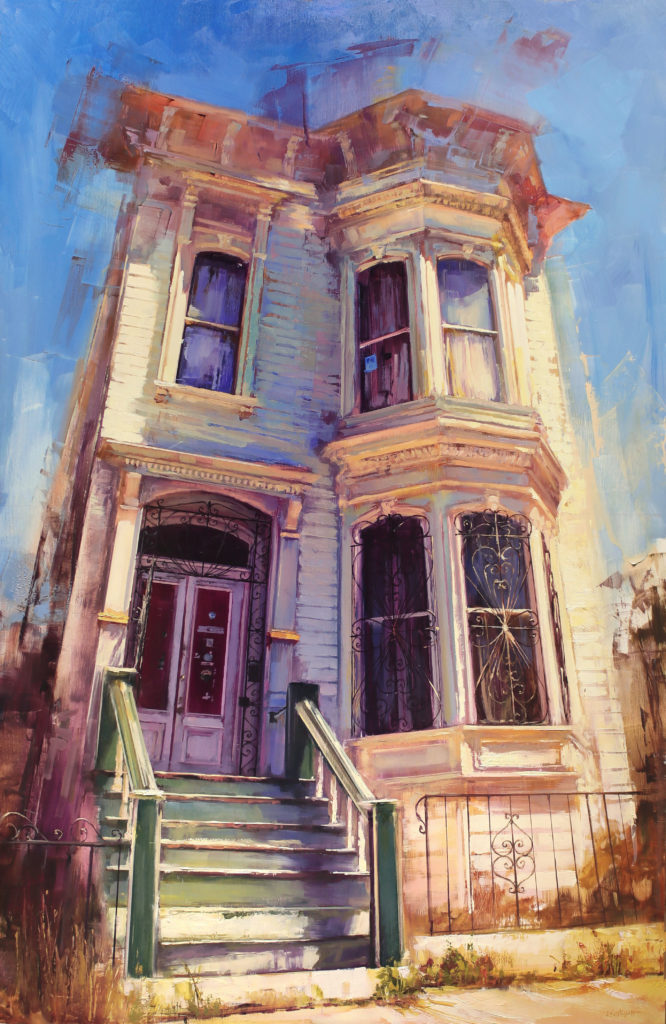
Lindsey Kustusch, “Mission Antique,” 40 x 26, oil on panel, 2019
I also love the mystery of painting in layers and not knowing how each mark was made. It’s a puzzle within the riddle of the painting itself, the bits and pieces where the paint looks like it weathered the same storm as the subject. Most of all, I love the challenge of it. How do I recreate these moments in a truly “realistic” sense? What will make this real to me? That’s when the fun begins.
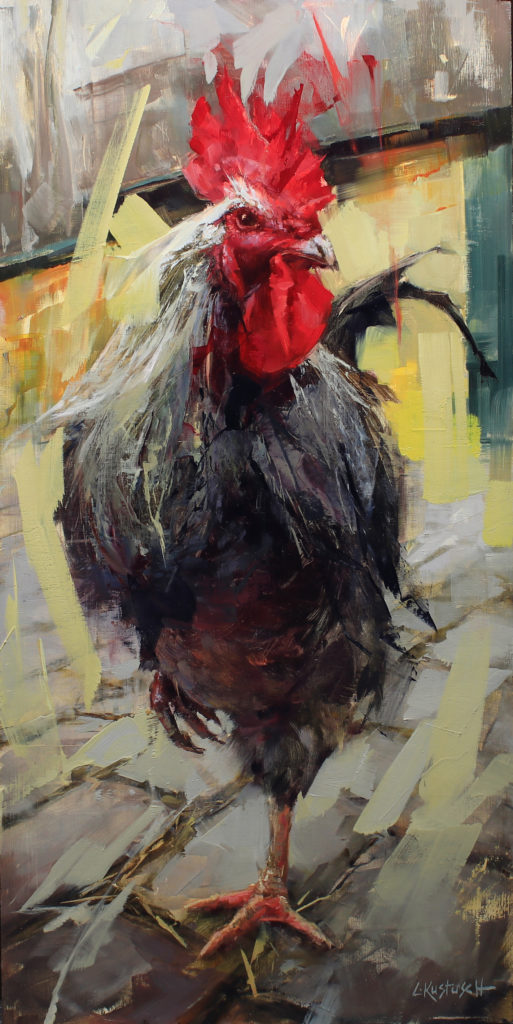
Lindsey Kustusch, “King of the Farm,” 20 x 10, oil on panel, 2020
I typically start each studio painting the same way. I take a photo of the scene or subject and attempt to recreate the memory by adjusting my photo, giving it a clearer direction on where the painting can go. It’s a quick and easy way not to waste paint but still find the voice and “focal point” of the piece. For me this step has become the most critical. It’s when I decide what should be described with accurate detail or determine if it’s the lack of detail that will highlight its significance.
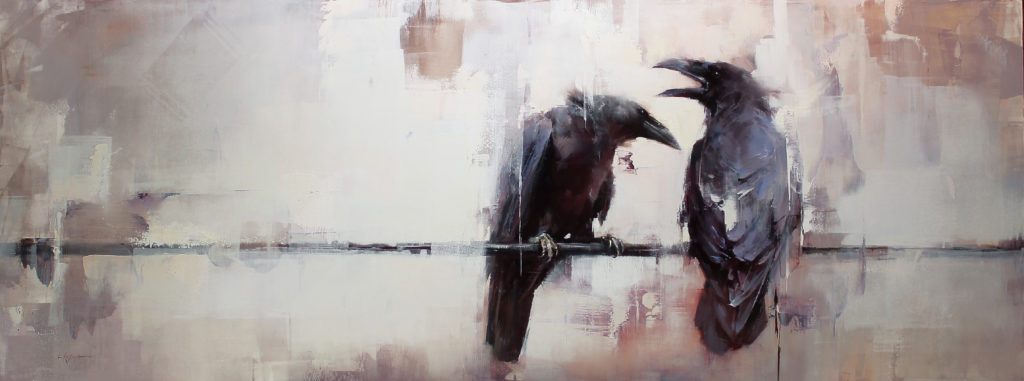
Lindsey Kustusch, “Secret Keepers,” 18 x 42, oil on panel, 2017
After I’ve successfully picked apart the reference I game-plan my layering strategy . . . Typically each piece starts with an underpainting followed by several back and forth sessions of detail and semi-transparent washes. I have a growing collection of tools I’ve found throughout the years that have become staple mark-makers in my process:
I use soft rubber printmaking blocks I’ve pre-cut into various shapes and sizes to scrape washes over detailed areas to help create atmosphere and richness.
Old brushes, destroyed from improper cleaning work as wonderful foliage makers.
An assortment of knives is useful for detail and controlled chaos, and rubber gloves work well for finger painting.
I use various surfaces, including wood panel and canvas either gessoed and sanded flat or left with texture.
The possibilities with oil paint are endless, which has been my favorite discovery of all.
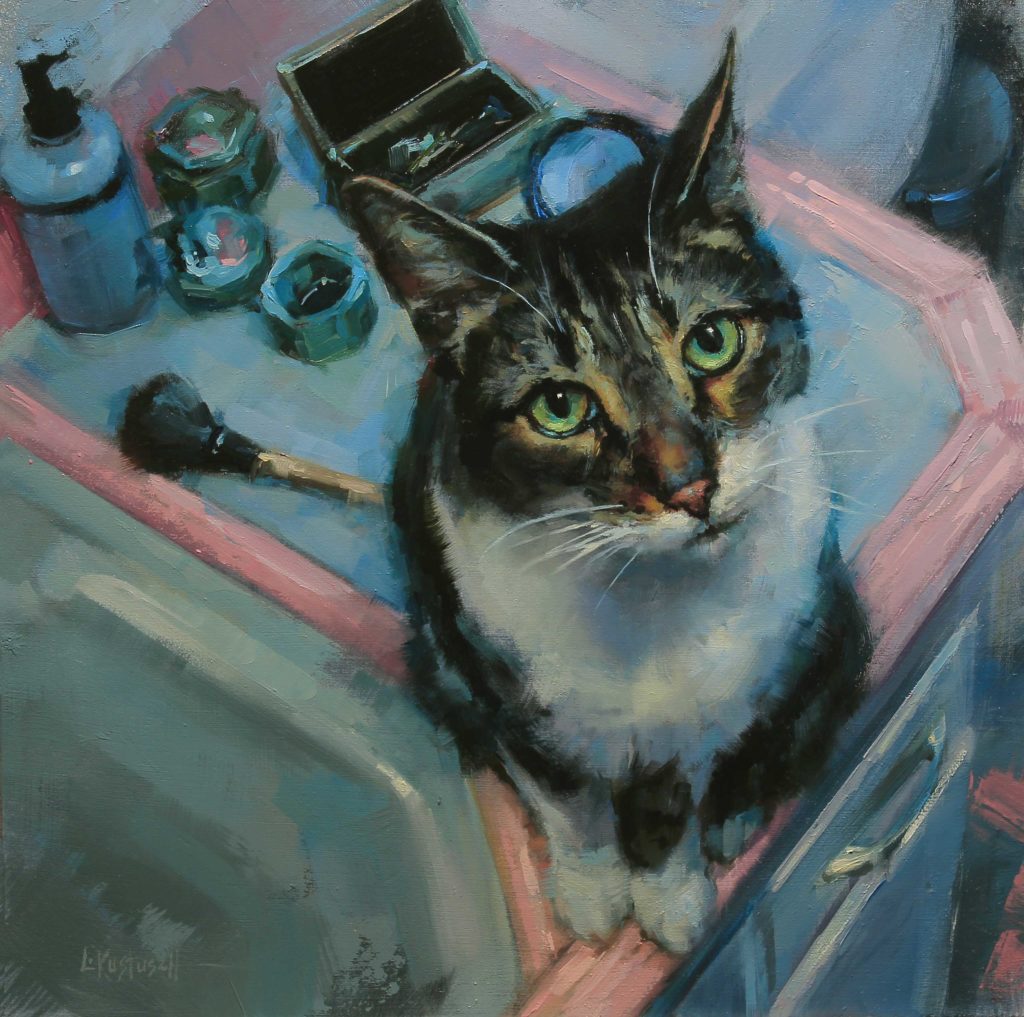
Lindsey Kustusch, “The Sink,” 12 x 12, oil on panel, 2015
Just as my subjects and use of pigment will be ever-evolving, so is the reason to create something in the first place. The further I explore, the clearer my intention has become: to remain aware, to see the things I might have missed, to immortalize the beauty of life on this planet, and to encourage others to do the same. It’s the little things that are the most important, and it’s the little things that make up our lives.
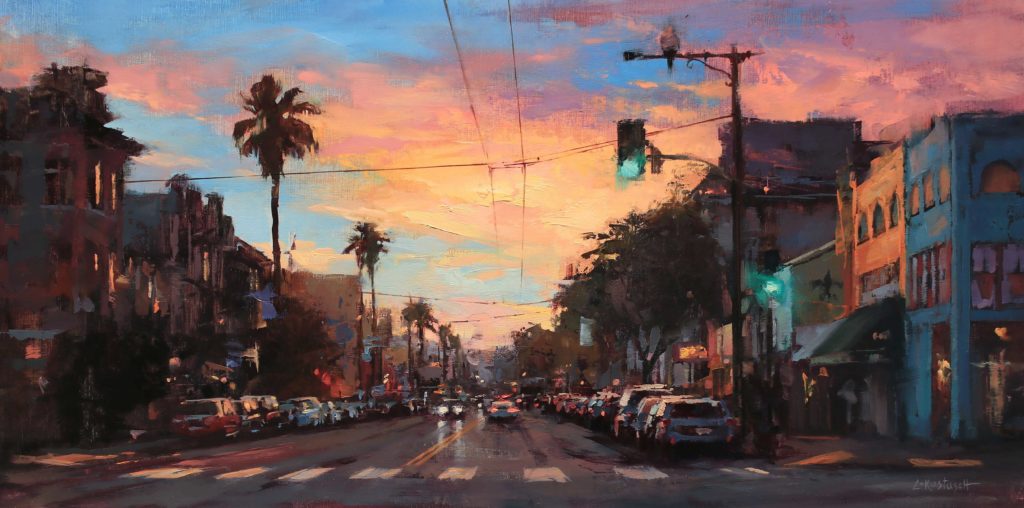
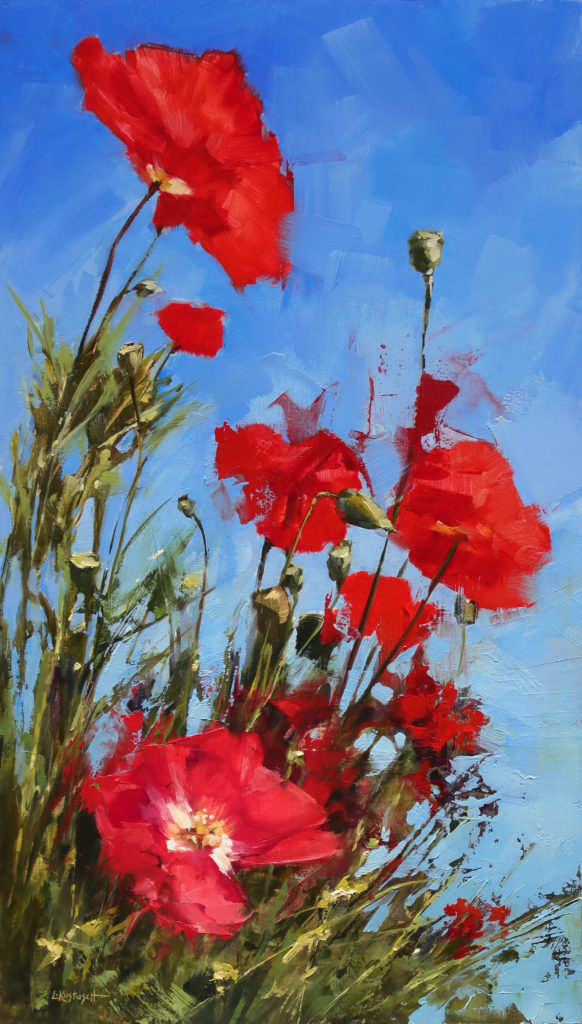
Lindsey Kustusch, “Mission & 19th,” 10 x 20, 2020Lindsey Kustusch, “Daybreak,” 20 x 30, oil on panel, 2017Lindsey Kustusch, “And Then the Skies Broke,” 30 x 40, oil on panel, 2016Lindsey Kustusch, “Sunshine on the Hill,” 21 x 30, oil on panel, 2018Lindsey Kustusch, “Momentary Stillness,” 28 x 20, oil on panel, 2015Lindsey Kustusch, “Roadside Poppies,” 21 x 12, oil on panel, 2019
> Visit EricRhoads.com to learn about more opportunities for artists and art collectors, including retreats, international art trips, art conventions, and more.
> Sign up to receive Fine Art Today, our free weekly e-newsletter
As part of our effort to continue to help artists and art galleries thrive, we’re proud to bring you this new “Virtual Gallery Walk.” Browse the paintings below and click the image itself to learn more about it, including how to contact the gallery.
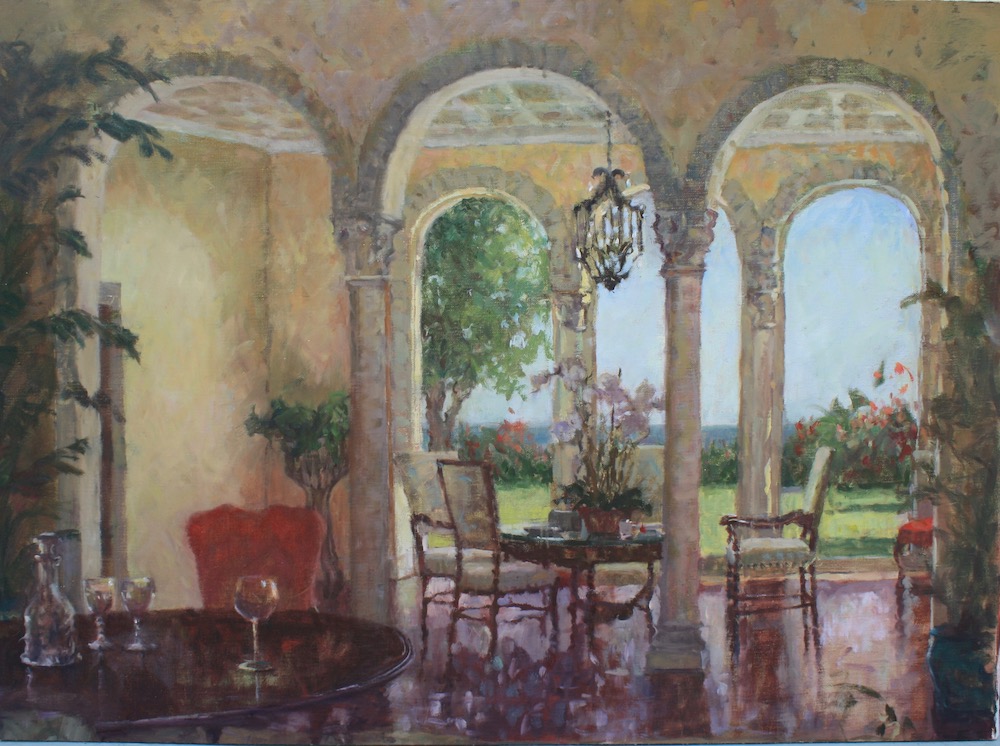
La Solana Ocean View by Hope Reis, Oil, 23.5x 32 in; Anderson Fine Art
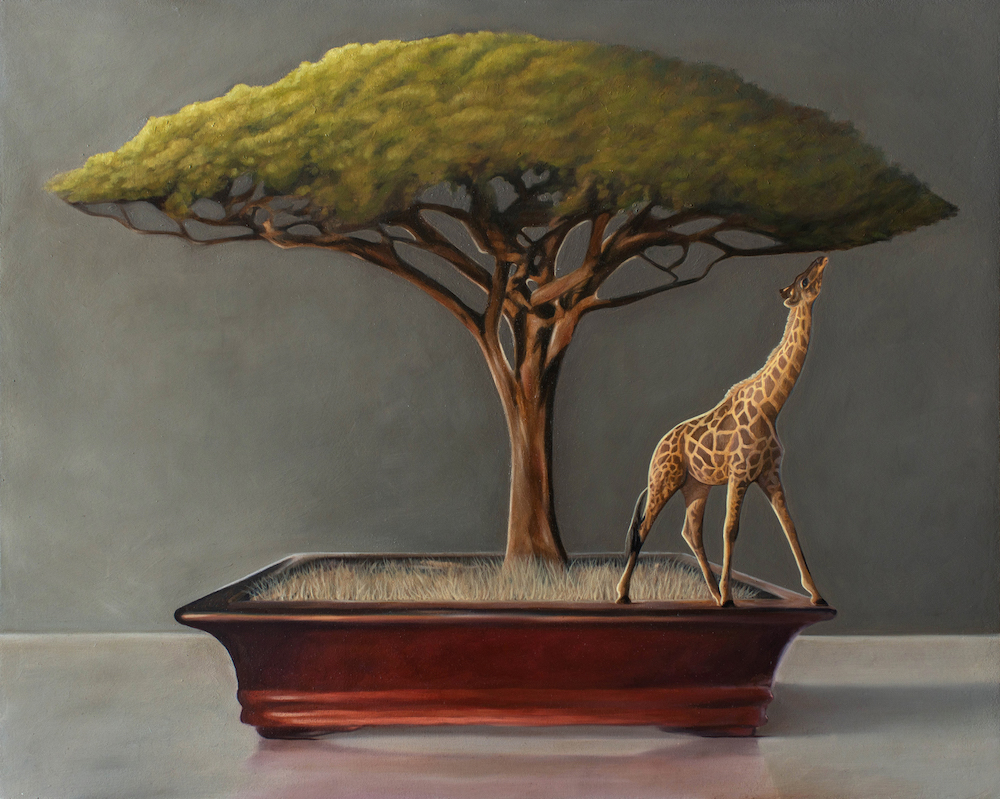
Giraffe Bonsai by Lauren Pretorius, Oil on Panel Framed, 16 x 20 in.; Bluestone Fine Art Gallery
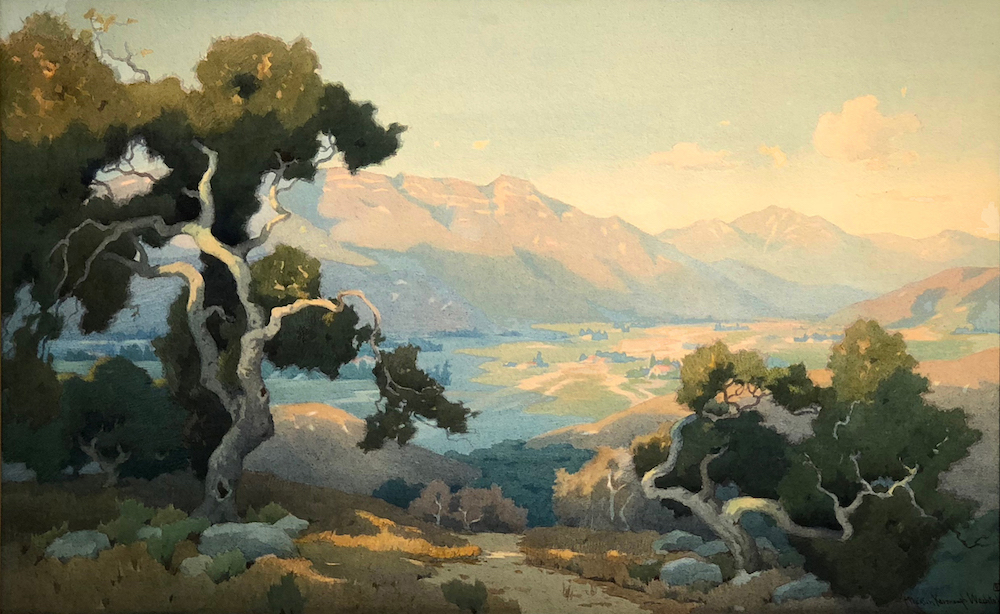
Ojai Valley by Marion Kavanaugh Wachtel (1876-1954), Watercolor, 20 x 32 in., 1912; Rieser Fine Art
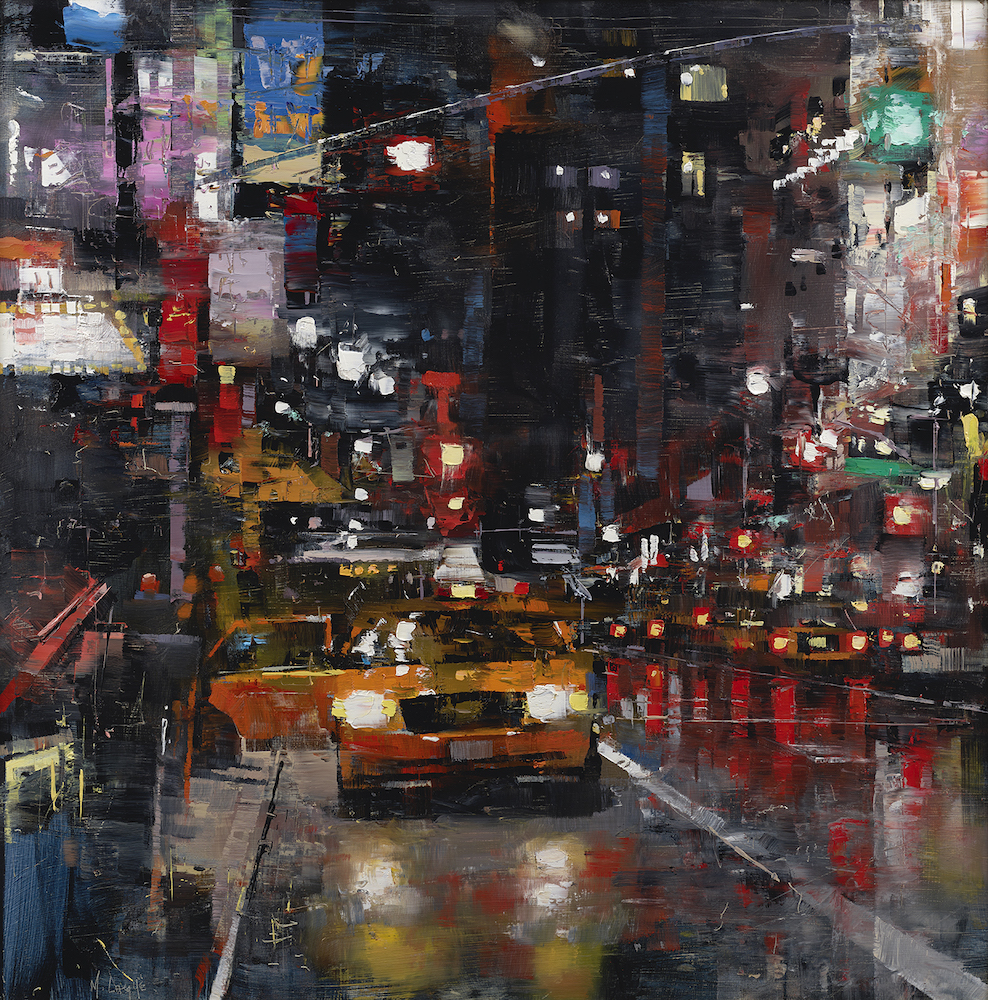
Open Door by Mark Laguë (born 1964), Oil on Panel, 30 x 30 in. Signed; Rehs Contemporary
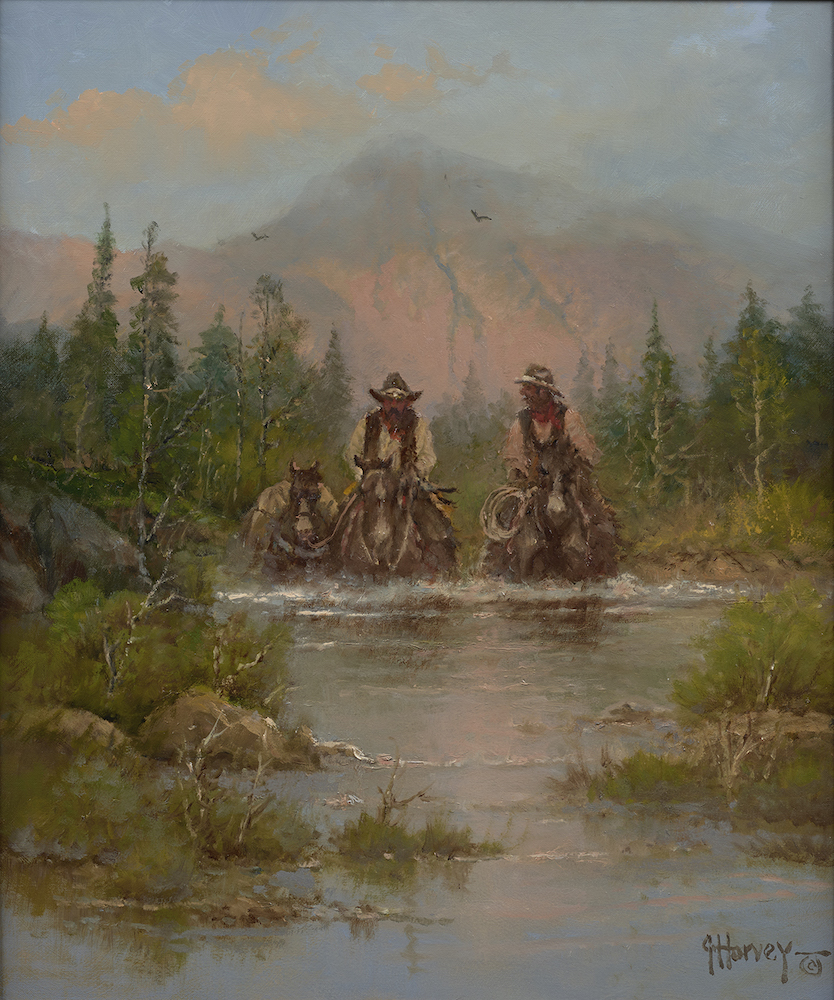
At Dawn’s Crossing by G. Harvey (1933-2017), Oil on Canvas, 24 x 20 in., Signed, also signed and titled on the reverse; Rehs Galleries, Inc.
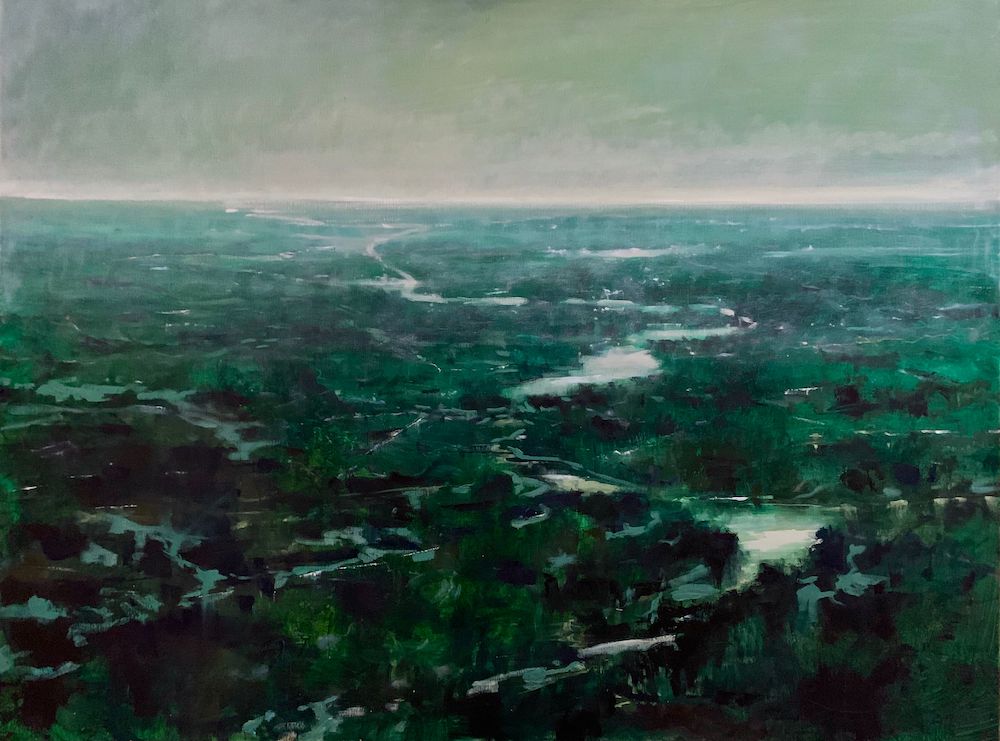
Green Velvet by Jill Basham, Oil on Panel, 36 x 48 in.; Principle Gallery
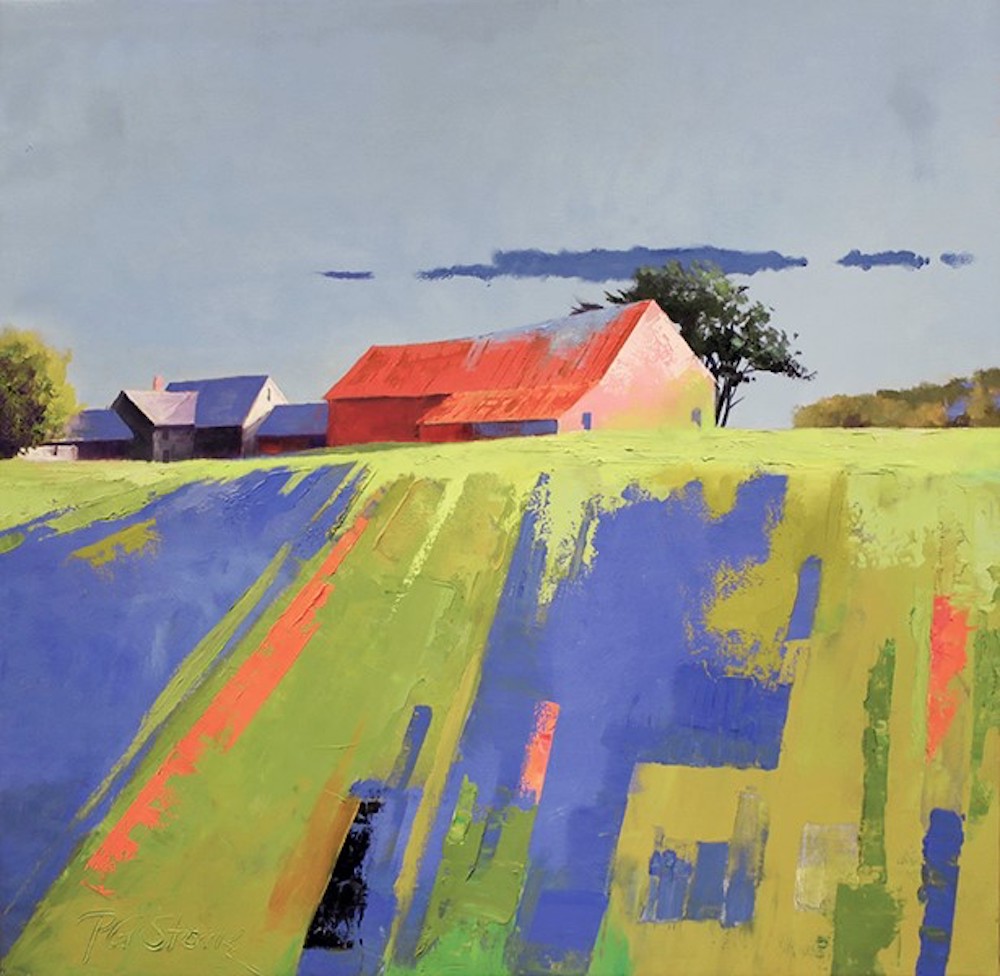
Bump Farm by Paul G. Stone, Oil on Canvas, 36 x 36 in.; Vermont Artisan Designs
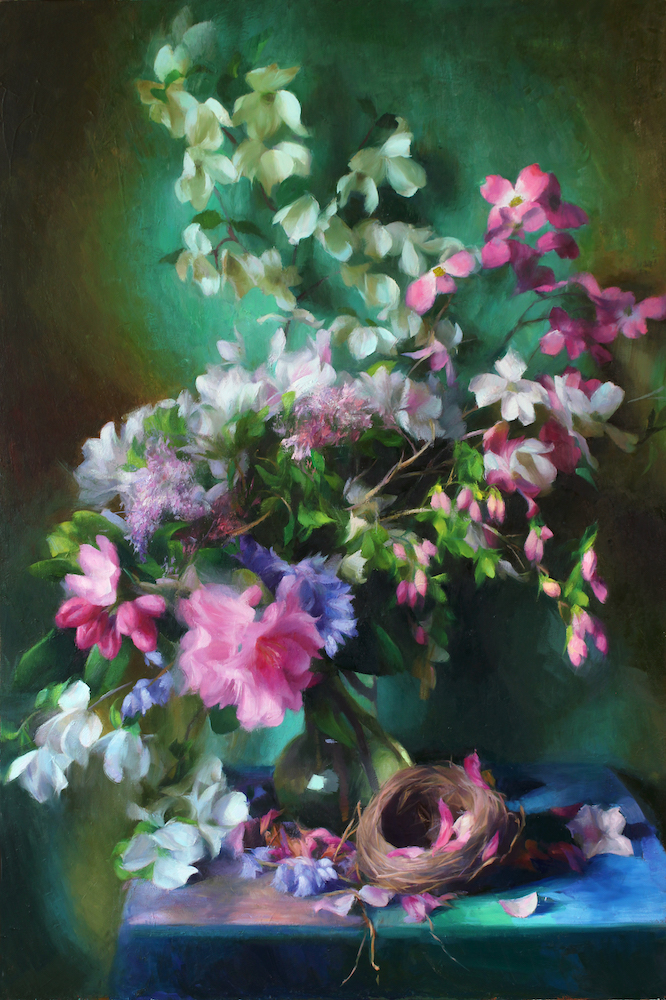
April Symphony I by Adrienne Stein, Oil on Canvas, 36 x 24 in.; Turner Fine Art
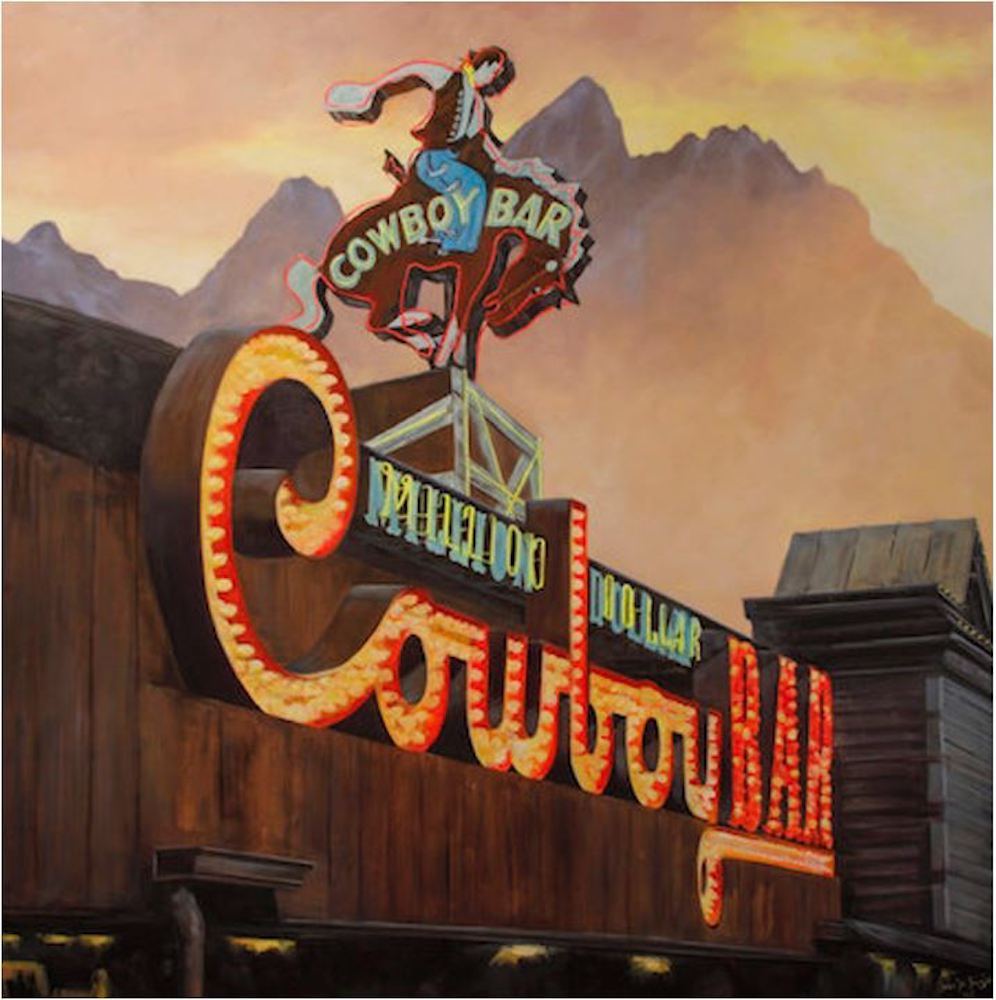
Cowboy Bar by Jennifer Johnson, Hand-Touched Oil Giclee, 24 x 24 in.; Gallery Wild during Jackson Hole Fall Arts Festival
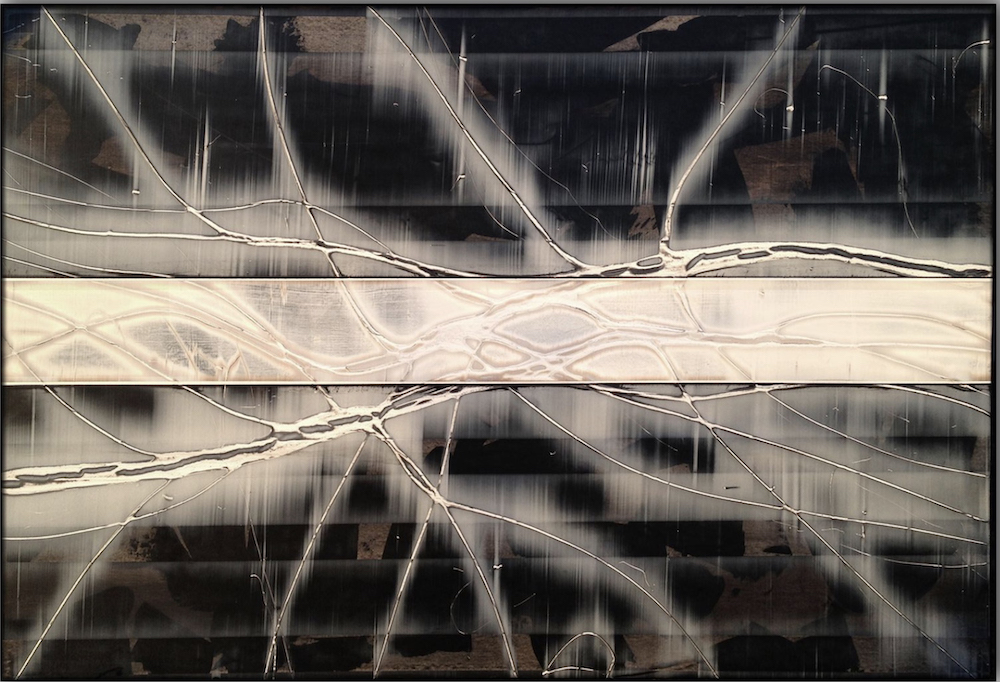
Emanation (1) by Michael Kessler, Mixed Media on Panel, 60 x 40 in., 2020; Ann Korologos Gallery
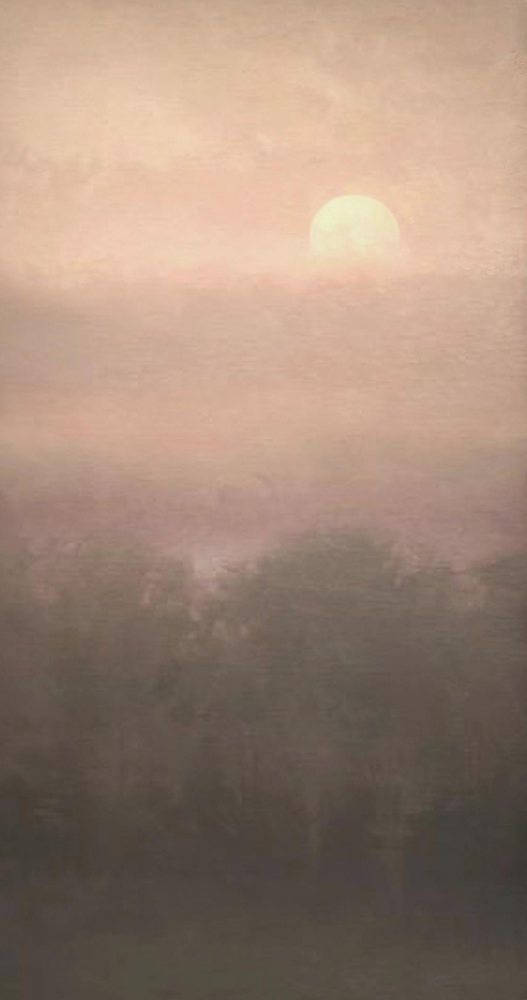
Pale Moon Rising by Rachel Warner, Oil on Linen, 23 x 17 in.; American Tonalist Society
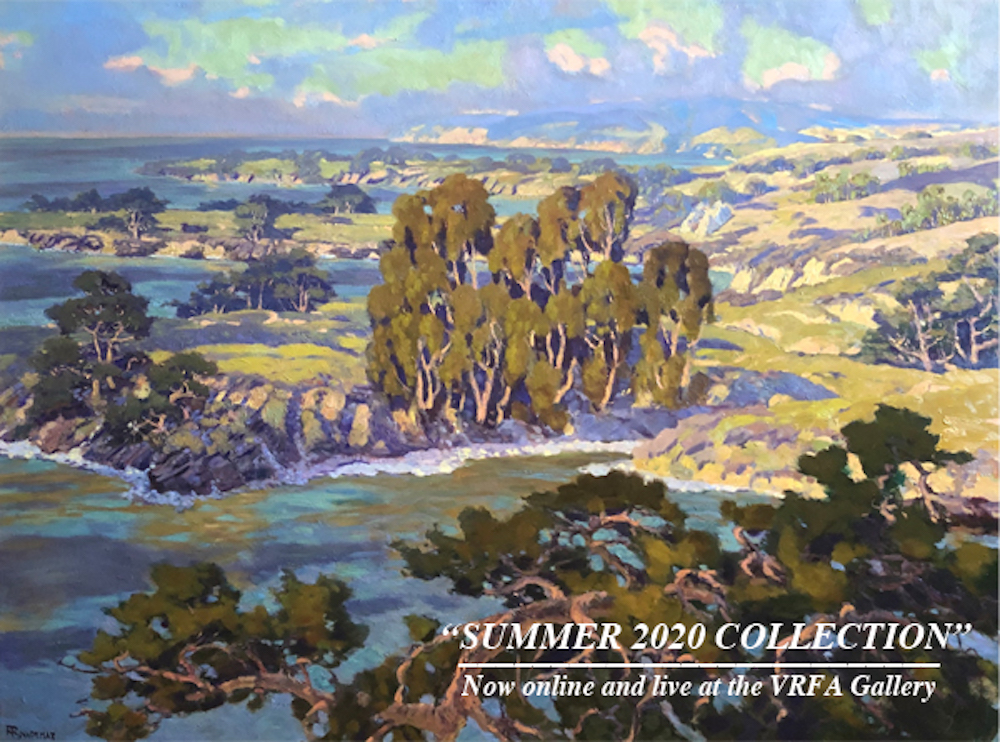
Northern California Coast by Rodolfo Rivadelmar, Oil, 30 x 40 in.; Vanessa Rothe Fine Art Gallery
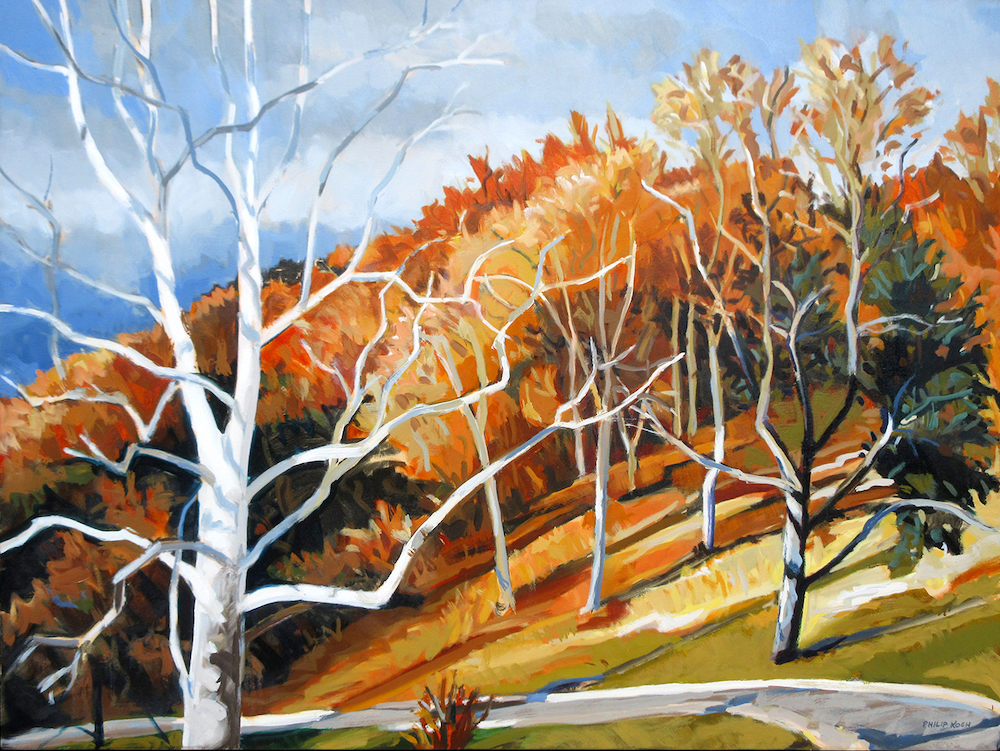
Late Autumn Sun by Philip Koch, Oil on Canvas, 36 x 48 in., 2019; Somerville Manning Gallery
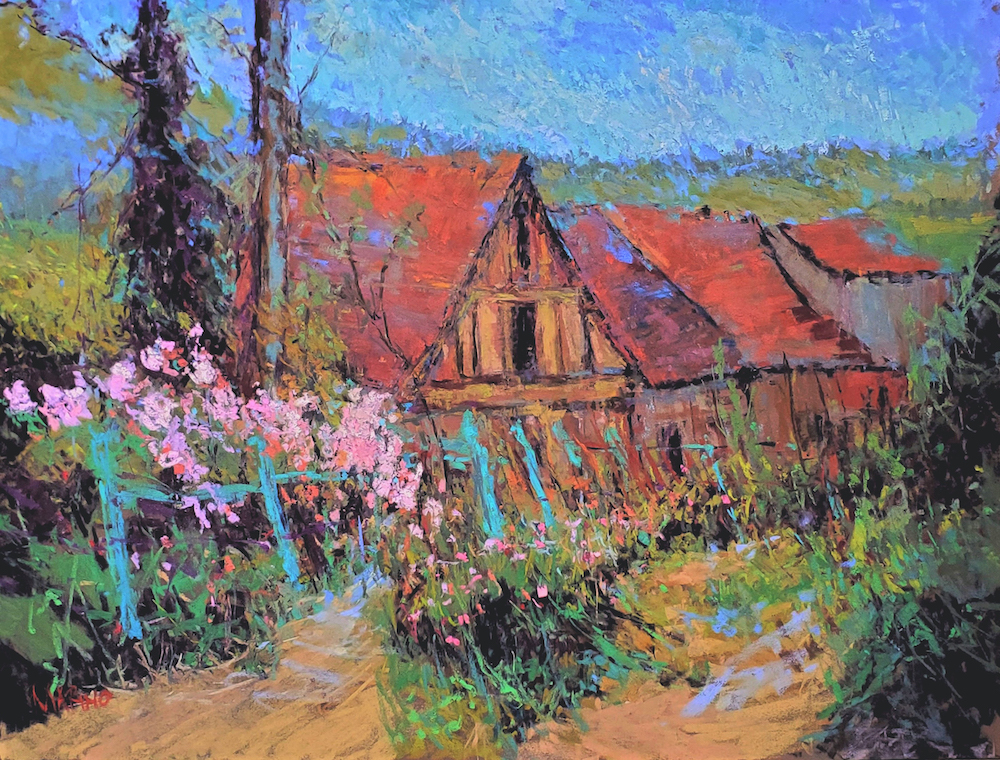
The Rue Helene in Giverny by Maria Marino, Pastel, 19 x 23 in.; The Artful Deposit
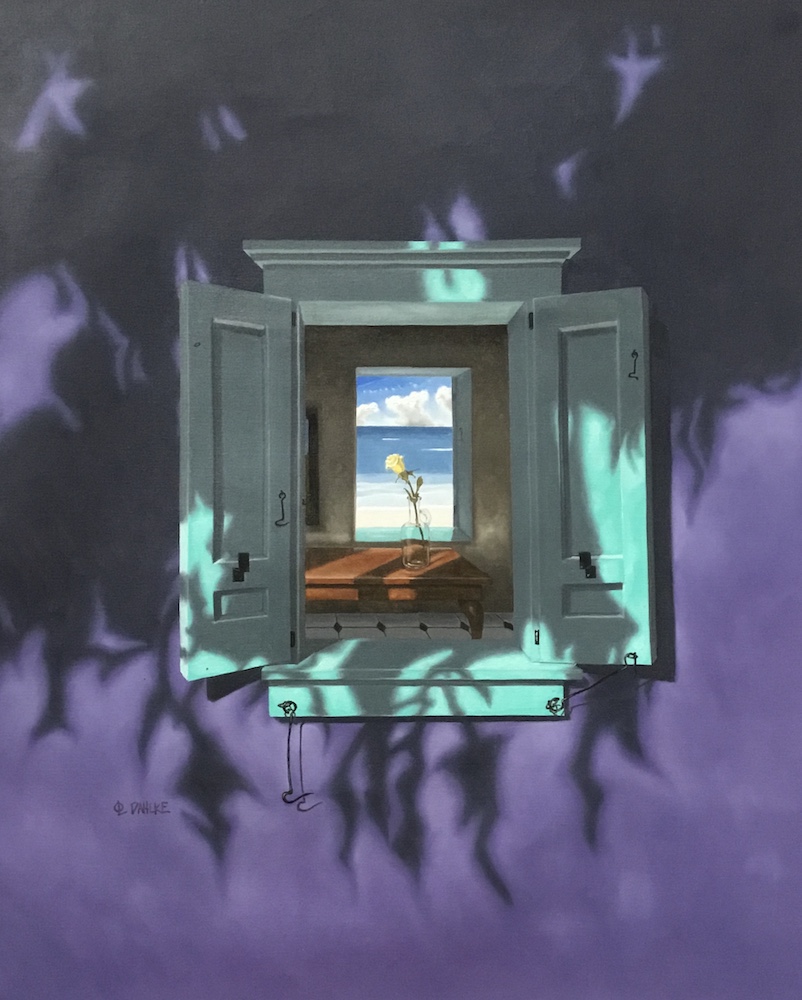
The Yellow Rose by Don Dahlke, Oil, 32 x 26 x 1.5 in.; Bronze Coast Gallery
Want to see your gallery featured in an upcoming Virtual Gallery Walk? Contact us at [email protected] to advertise today – don’t delay, as spaces are first-come first-serve and availability is limited.
“You can count on Painter Christopher W. A. Pothier’s work landing a slap to the back of your head or planting one on the forehead, oftentimes both.”
Pothier’s contemporary, representational narrative works are on view at Bowersock Gallery (Provincetown, MA) in an exhibition titled “Talk to Me,” September 4-18, 2020. “Talk to Me” will also feature the work of painter Alan Ammann and sculptor Neil Grant.
More from the gallery:
This latest body of work by Pothier is both unintentionally prophetic, and as always powerful, a perfect time to present a story focused on this outstanding, mindful painter.
Pothier’s narratives come at you fast, and unapologetically. They can also stop you short and invite you to look closer, consider the characters and intriguing scenario.
Christopher Pothier, “The New Controls of Adolescence,” 27×39, oil
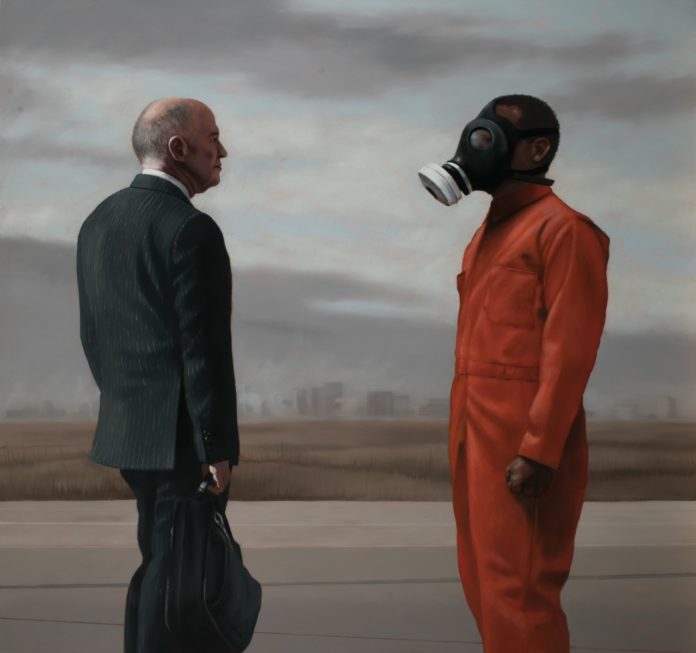
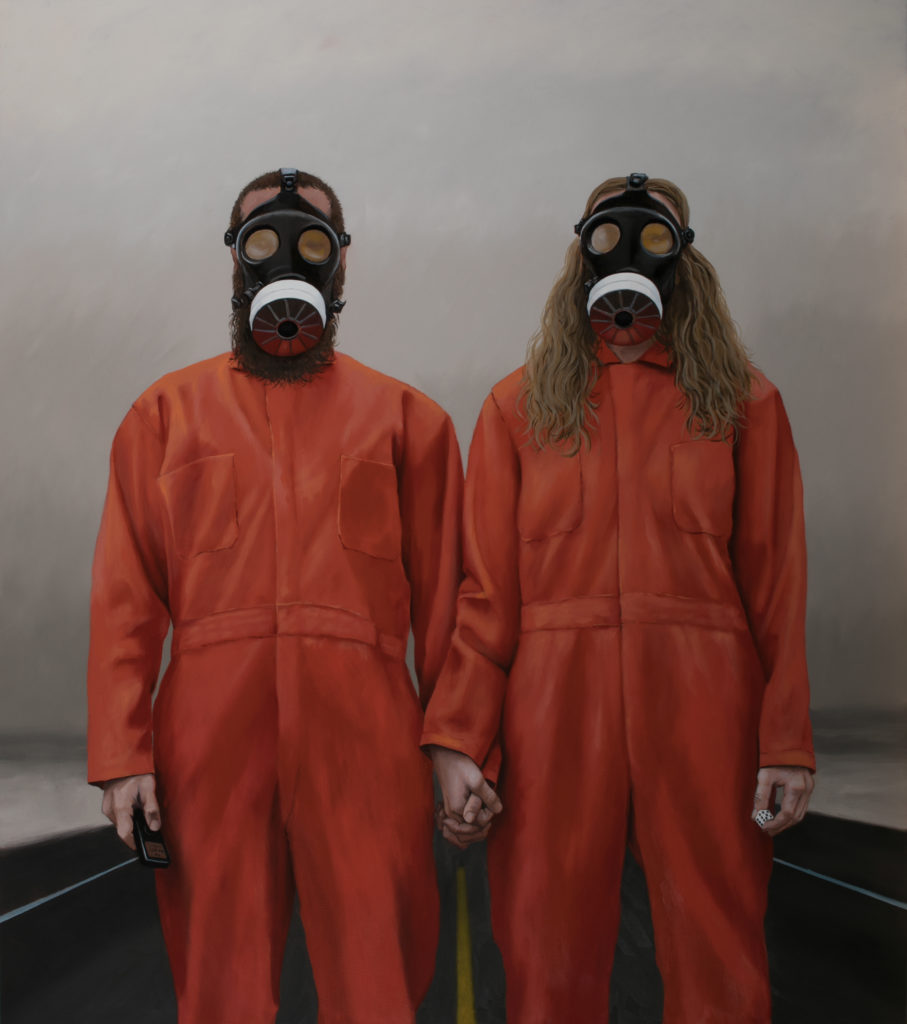
Over the years Pothier’s work has featured a returning cast of characters; business men and women (conformity), a cowboy kid (past/innocents), and orange jumpsuit clad figures (apocalypse/future). Each asks for critical deconstruction. They speak to us on all manner of topics, ourselves, our state of mind, norms, politics, culture, and society.
Pothier’s latest body of work is oddly prophetic, given most were painted or sketched in 2019 for his upcoming exhibit Bowersock Gallery.
The figures in orange overalls have returned, this time with gas masks, a prop he used in a number of canvases.
Christopher Pothier, “American Apocalyptic,” 38 x 33
“I was struck with bewilderment about the fact that my work was so descriptive of the present moment,” Pothier says. “But it’s fitting. The truth is often in my work; I’ll try and point out dichotomies and ironies. I enjoy creating scenes that are sometimes disturbing, that make people think. I feel like that is my role as an artist.”
Pothier’s images are powerful, direct, poetic, and often chilling and always beautiful for their exquisite execution.
Learn more about “Talk to Me” and the contemporary realism of Christopher W. A. Pothier at bowersockgallery.com.
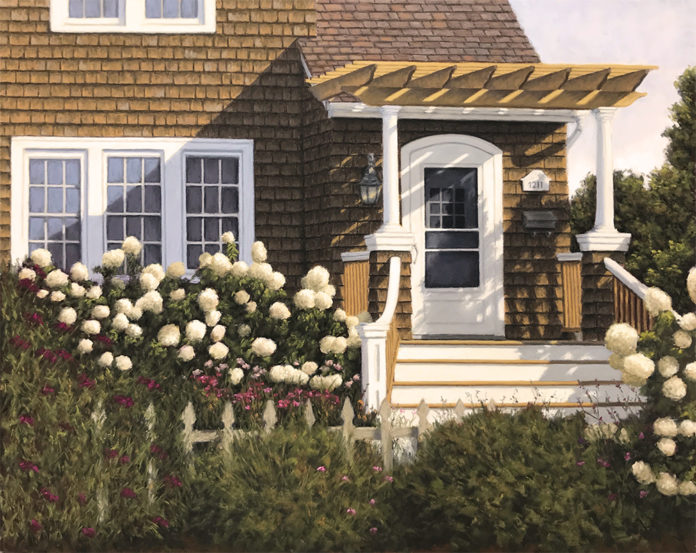
“Seaside Cottage is reminiscent of the early morning walks I enjoy while spending time at the Jersey Shore every summer. Tucked in between many of the beautiful, oversized homes are small cottages that seem to stand the test of time, and are reminders of a simpler time at the seashore.”
A classically-trained representational artist with degrees in Fine Art and Education, Lisa Cunningham finds inspiration through travel and the simple things that exist in everyday life. “Much of my current work focuses on buildings in the landscape; places we see and experience everyday. Although sometimes taken for granted, architecture in our environment, throughout our cities and rural landscapes, incorporates history, culture, and purpose for each of us.
Through an intimate and up close perspective, my paintings allow the viewer an opportunity to identify with or reflect upon a moment in time; of places familiar, or that no longer exist.”
Using soft pastels and layering techniques, Lisa’s compositions are representational yet painterly, allowing the dramatic play of light and shadow to reveal the character behind the subject matter. “Vibrant, sometimes exaggerated color is also common in my work, which lends credibility to the magic of the pastel medium, as I see it.”
Lisa is a signature member of the Pastel Society of America. Her award winning paining, Diversity, was juried into the Pastel Society of America’s 47th Annual Exhibition, and was then selected for an exhibition at the Butler Institute of American Art in Youngstown, Ohio.
She is also a Signature Member of the Pastel Society of New Jersey, a member of American Women Artists, the Salmagundi Club, the Catherine Lorillard Wolfe Art Club, and the American Artists Professional League.
Upcoming Exhibitions
The Pastel Society of America 48th Annual Exhibition: Enduring Brilliance
The Pastel Society of New Jersey Biennial Signature Members Exhibit
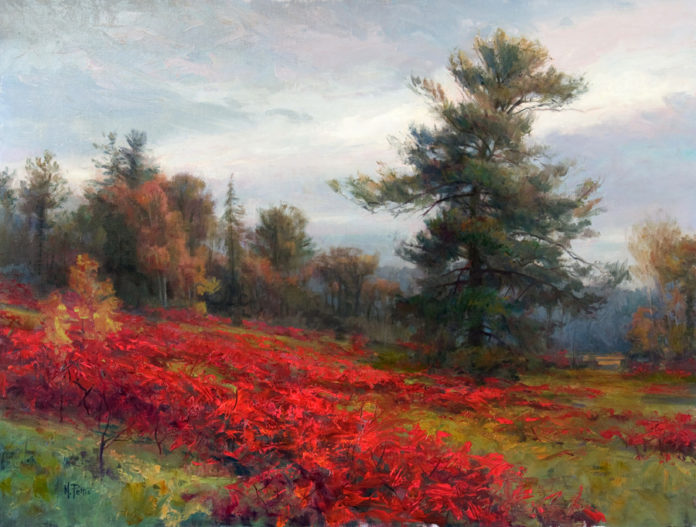
Mary Pettis, "Autumn Poetry," 30 x 40 inches, oil on linen
How can feelings be put into ground pigment and linseed oil? When a viewer finds a deeper meaning beyond the portrayed subject of a painting, what are they responding to? Mary Pettis addresses this and more in the following essay.
BY MARY PETTIS
“The aim in art is not to imitate the outward appearance of things, but their inner significance.” – Aristotle
Art collectors often wonder what it means when an artist says, “I want to show those who view my paintings not just what I SEE, but what I FEEL.” What are they talking about? How can feelings be put into ground pigment and linseed oil? When a viewer finds a deeper meaning beyond the portrayed subject of a painting, what are they responding to? Are they responding to technical brilliance or something beyond mere paint on canvas? How do artists move from representing how things look to recognizing and rendering visible an inner significance?
Great artists see deeply. I believe each sees beyond the surface appearance. Edgar Payne said, “Art is the reproduction of what the senses perceive in nature through the veil of the soul.” As an artist who also teaches, I am compelled to understand and try to explain this phenomenon. I want to know how, exactly, we transition from the facts of what we see in front of us to the wordless visual poetry inspired from our subjects. In my work I want to capture the inexplicable.
With the following considerations, I offer some pieces of the puzzle that are moving me forward on this quest.
THE TWO GREAT DIALECTS OF ART
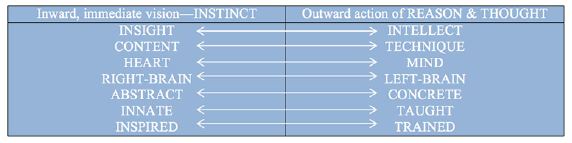
Knowledge comes to us in two ways. First, it comes to us intuitively, through an open heart and receptive senses. Second, it comes to us with disciplined study and training, through the intellect. These are the two ways of seeing. Through the years these dual modes of perception have been explained in many ways.
Through a history of discourse on the riddles of great art, writers and critics of art have called these two camps Colour and Form. They were considered the two great dialects of art, the expressive vehicles for their respective sides of the chart. These two ways of seeing were well represented by nineteenth-century contemporaries Eugène Delacroix and Jean-Auguste-Dominique Ingres. Impulse and reason, these inner and outer vital elements, form a dance, a pas de deux. It is between these two opposing forces that the Chi, the energy in a work of art, is created. We can recognize, honor, and train both sides, together and separately. Our strengths will often shift heavily to one side, then back to the other side, then back to the other, as we hunger to find balance and improve our wholeness as artists.
The question at hand is: “How do we beyond the surface appearance?” The answer is that we cannot get there through technique and reason alone; we must develop and employ our intuitive, inward vision.
Mary Pettis, “Times Stands Still,” 48 x 30 inches, oil on canvas
RECOGNIZING OUR INTUITIVE, INWARD VISION
One step in the right direction of understanding the experience of inner vision comes in the first chapter of the early twentieth-century author, L. March Phillipps’ Form and Colour. Phillipps invites us to imagine ourselves on a small ship, traveling along cliffs that descend abruptly into the sea. As we round the promontories each bay reveals a cluster of cottages, fishermen and their boats, white gulls wheeling above, and dozens of other features distinct with meaning and associations belonging to them. They have much to communicate about the life and character of the village. As we notice and think about them, their appearance naturally awakens in the mind a correspondingly observant mood. These forms stimulate the kind of reasoning and comprehension we call intellectual.
But imagine then, as our boat drifts under the shadow of the cliff, we lean over the side and gaze into the depths of water until they absorb our vision. We will immediately be aware of a change of mood or consciousness corresponding to the change in view. Forms become suffused and indistinct, and then cease to exist, and with that change the busyness of mental activity is laid to rest; another set of faculties, the passionate, meditative faculties that apprehend the connections and mysteries of the universe, are awakened and stimulated.
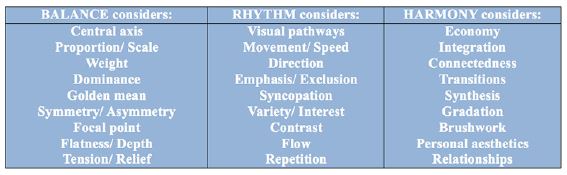
Most of us can identify with this experience. Even if we have not been at sea, perhaps we felt that shift in vision looking deeply into the forest or sky, at a perfectly cut jewel, or into the eyes of someone we love. It is in this state of enhanced emotional awareness that we become more sensitive to the abstract influence of balance, rhythm, and harmony.
Mary Pettis, “Fog Lifting Over Gooseberry Falls,” 30 x 20 inches, oil on linen
BALANCE, RHYTHM, AND HARMONY
All the arts, no matter the discipline, have in common a desire for the “unity of effect” that is achieved through balance, rhythm and harmony. These instinctive qualities are strongly felt as we form the message of our painting. The message of a painting is the concept, or idea. It is the subject of the sermon, the spark; it is Emerson’s “gleam of light that flashes across the mind from within.”
To truly capture the quality of a place or subject, artists must have a feeling about it beyond its physical appearance. If the artist feels nothing, so will the viewer. To cultivate inner vision, it is important to contemplate what fascinates and stirs us. Is what we are looking at or experiencing a metaphor for something deeper? Something larger: solitude, peace, security, love, interdependence, praise? What is the emotion? What is the inspired content? We must determine the inner significance in order to portray it. I love Emerson’s quote:
“The power in a work of art depends on the depth of the artist’s insight of that object he contemplates.”
Mary Pettis, “North Shore Mantra,” 24 x 48 inches, oil on linen
In painting, our expressive tools are Line, Shape, Value, Color, Edges, and Texture. Each of these tools can be used, separately or together, to express those things in nature and life that make our hearts skip a beat.
I will submit, as an example, abstract qualities of the first tool, LINE.
Line is here defined as a mark or stroke, real or implied, which defines the contours of a shape or mass, or indicates a visual path. Lines possess potential balance, rhythm, and harmony, according to the artistic intent. Here are seven types of lines that express various emotions:
1. Horizontal, sloping, and meandering lines are calming and bring repose.
2. Vertical lines denote strength and grandeur, nobility, rigidity, or stability.
3. Diagonal lines express movement and action or excitement.
4. Radial lines can draw attention and emphasis to the focus of the painting.
5. Jagged lines are disturbing or distressing or can impart a sense of wariness or danger.
6. Sweeping or spiral lines can direct the speed at which the viewer’s eye moves through the painting.
7. Circular or curved lines can give a womb-like sense of protection, safety, or love.
Simply put, there is an infinite variety of ways artists use the abstract qualities of each of these tools—not just line—to tell the story we want to tell (which I will save for another essay . . .) For now, it is enough to say that great artists slip into a way of seeing where individual parts become a unified whole, and they recognize the character of that whole. Instead of a single tree, they see the outstretched reach of the tree, or the relationships among a family of several trees. They see the flow of the drapery or the vines, the fragility of a child, the gesture of the clouds in the sky.
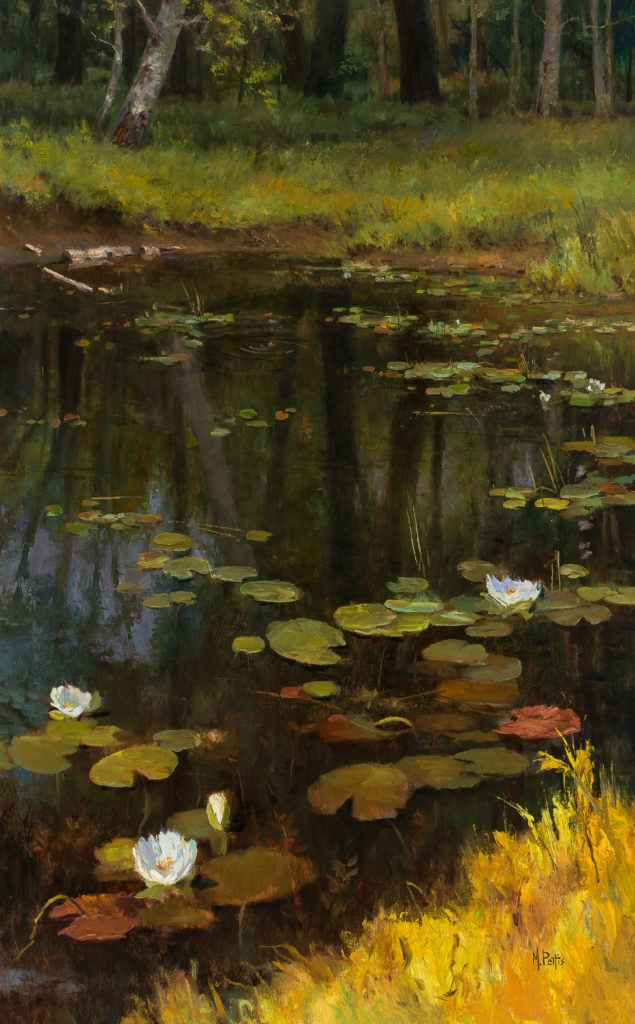
Mary Pettis, “Living Waters – Lao Valley,” 16 x 20 inches, oil on linen
Great artists identify, through contemplation, what they love, and they know the means and tools to express it. It might be the large sweep of a line or mass, the power or structural rhythms of the large shapes. Perhaps they are responding to the gentle tonality of a landscape in high key values, two vibrant colors dancing next to each other, the softness of edges of every object bathed in cool moonlight, or the sumptuous textures across a field of wheat.
Every other aspect of the painting must be sympathetic with that emotional content. What do I mean by that? Every other detail, element, or added thought must be quieted down or eliminated, to play a subordinate role to that main, inner response!
A painter must be like the choir director who knows how to sense the melody as it intertwines among the sections, while allowing the soloists to shine. The more awareness an artist brings to the orchestration of a piece, the more clearly viewers will understand the message.
As we come of age artistically, we seek to master the two great dialects of art. We learn that Nature is an inexhaustible source of both inspiration and instruction. The deeper we have penetrated the inner being of nature, the greater our desire to recreate the experience. The more methods of expression we possess, the better our ability to communicate our inward vision. We paint solely under the influence of insight and evaluate with the intellect when we set the brush down. It becomes more and more evident that the artistic tools are only the means to an end. That end is to let others into our inner poetic life, to share with them what we see beneath the surface.
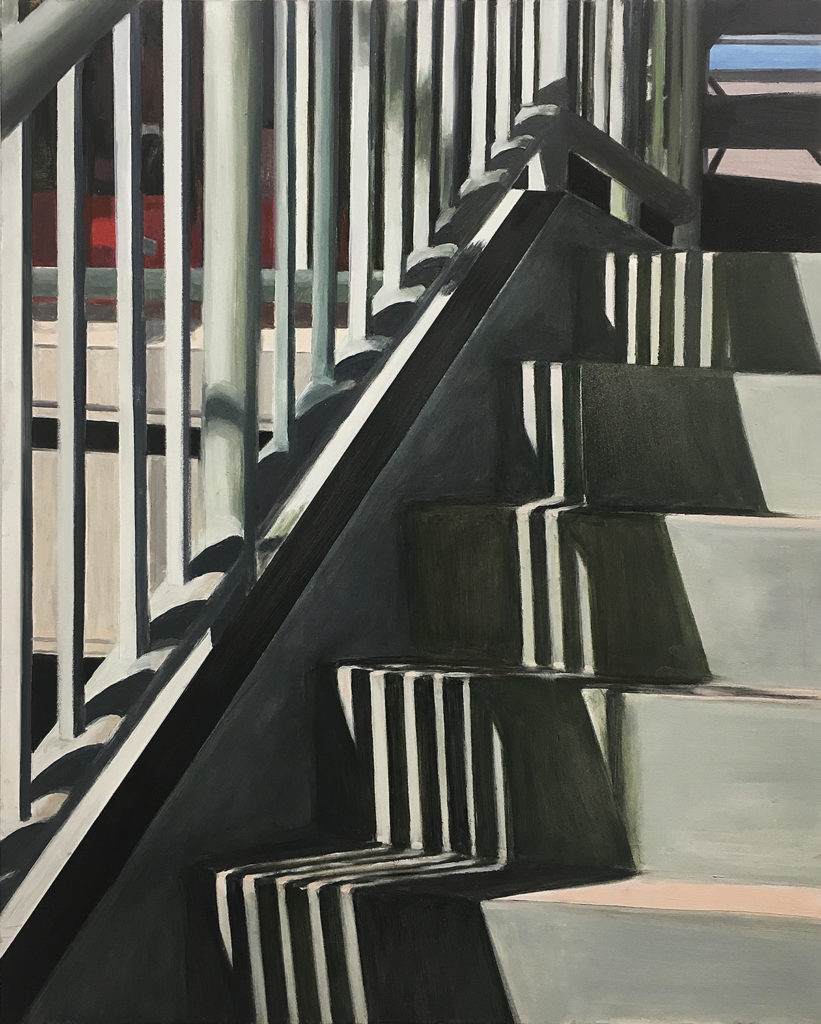
Contemporary realist oil painter Allan Gorman shares paintings – and insights – from his recent series.
BY ALLAN GORMAN
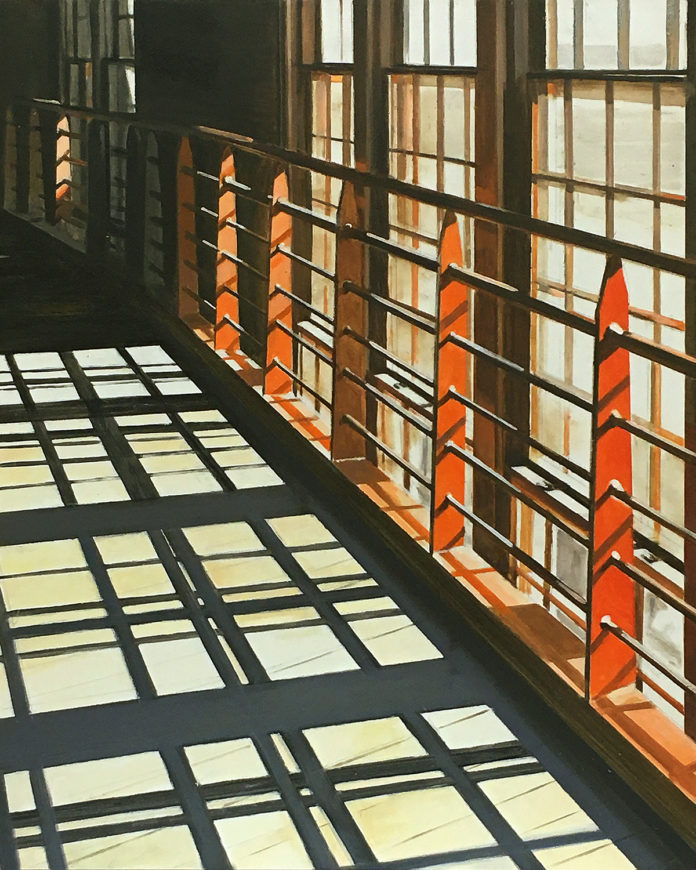
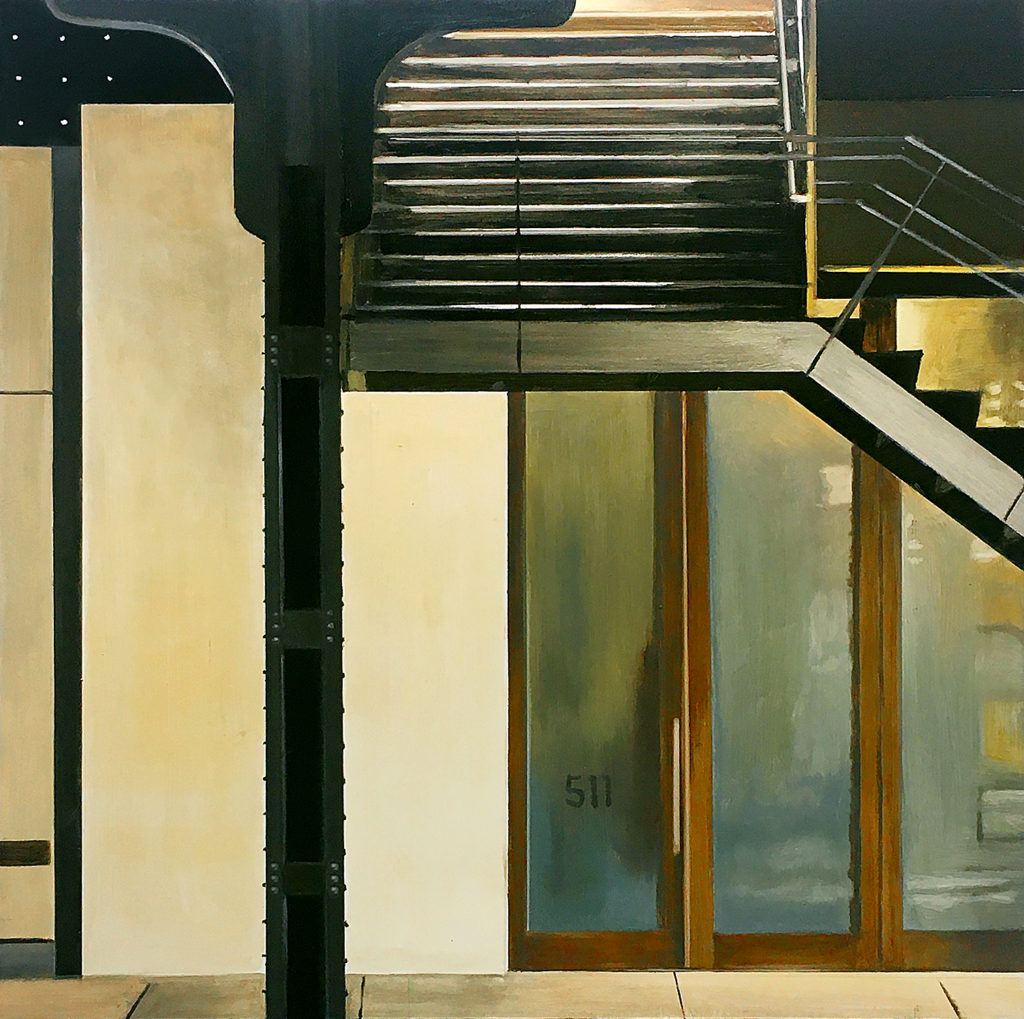
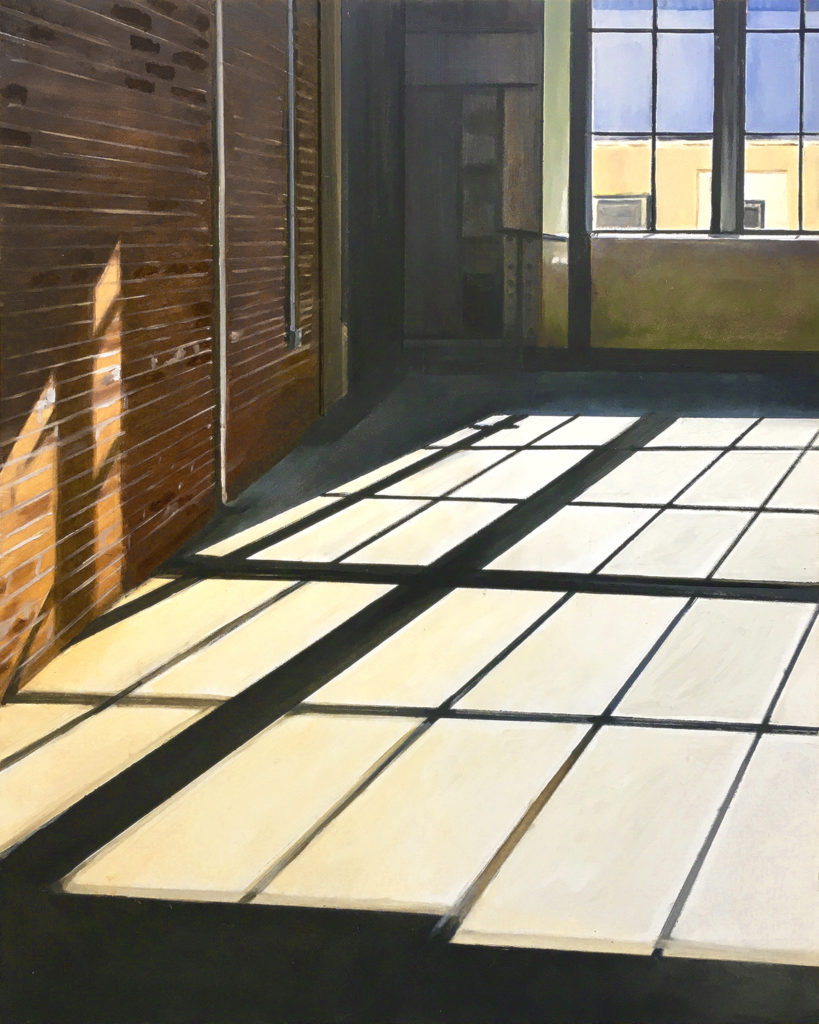
Since the beginning of the year, I have been making a series of paintings that explore plays of light and shadow in empty spaces.
Although it was completely intuitive, and a logical extension of some previous work, I feel the paintings evoke the poignancy of our forced solitary existence and the loneliness we all feel during the pandemic.
Doing these paintings keeps me focused and productive, and I believe they’re a true representation of me as an artist and a human living during these weird times.
Going to the studio and working is a lot more purposeful and rewarding than vegging out in front of the TV all day.
***
Allan Gorman’s resume includes over 120 exhibition showings in museums, galleries, and major art fairs. He was the recipient of a Fellowship for Painting from the New Jersey State Council on the Arts, and was awarded resident fellowships to Vermont Studio Center in 2011, 2014, and 2018. In 2016, he was selected for a fellowship residency by the ESKFF Foundation at Mana Contemporary. A number of the isolation paintings are in a solo show called “Summer Reflections” at the Beacon Art – Shortwave Gallery in Stone Harbor, N.J., through September 8, 2020. Gorman maintains a studio practice in Kearny, New Jersey.
For information on these paintings and more, please visit allangormanart.com.
Fill your mind with useful art stories, the latest trends, upcoming art shows, top artists, and more. Subscribe to Fine Art Today, from the publishers of Fine Art Connoisseur magazine.