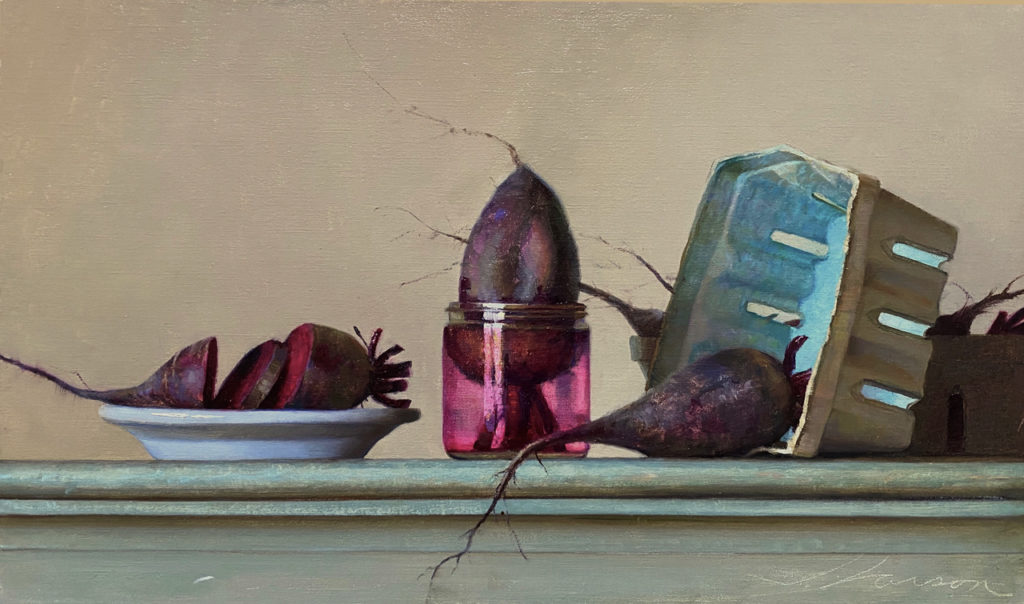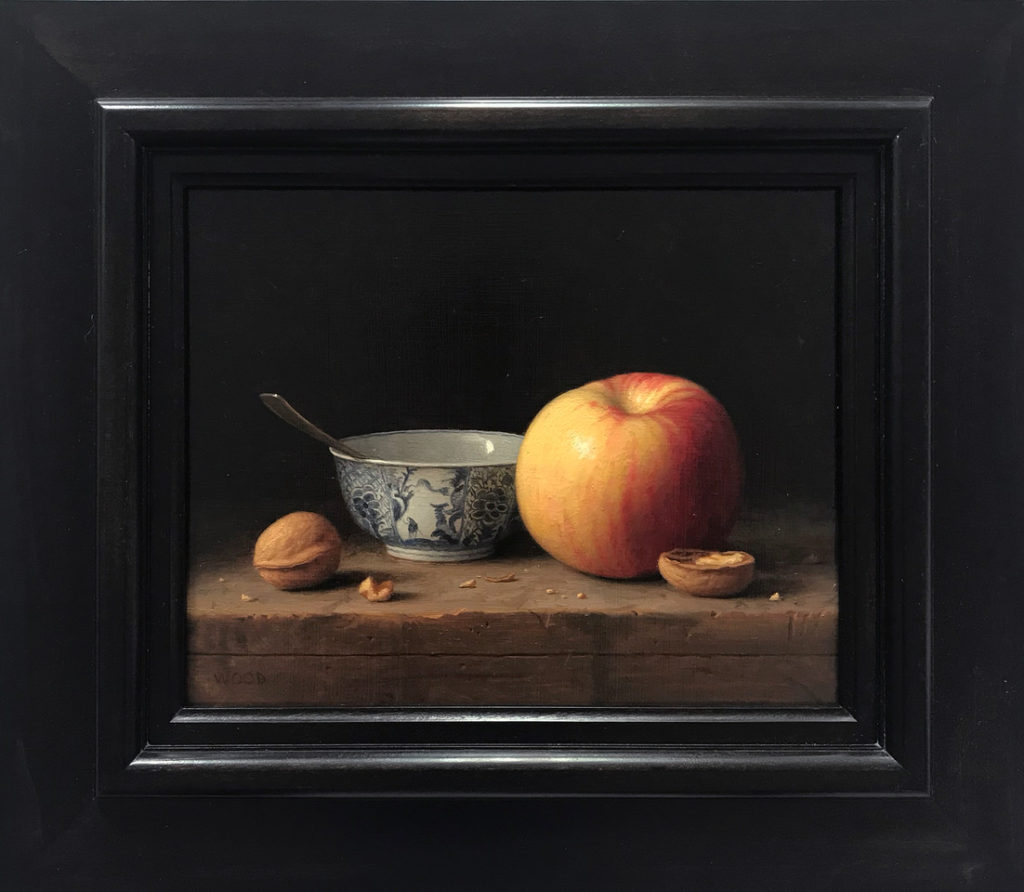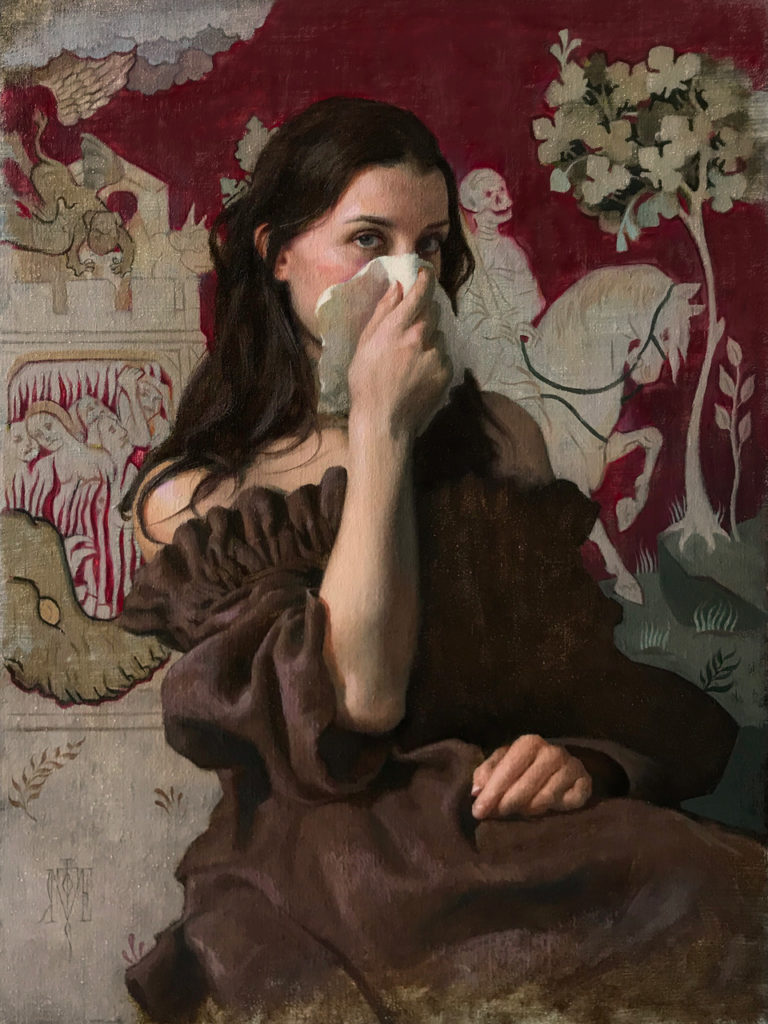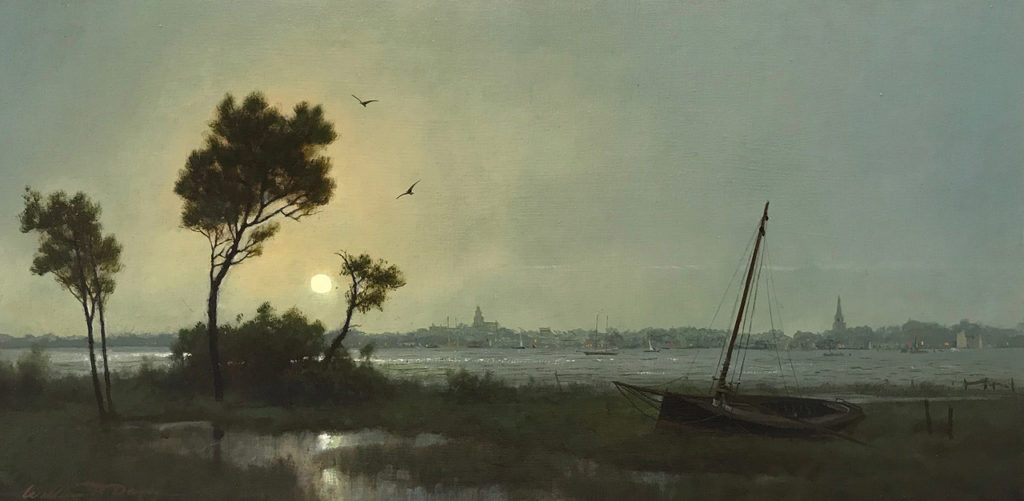

The oyster is not pretty. It is a rock from the sea. If a child is collecting sea shells, the oyster is not prized, it is discarded because it is not symmetrical, colorful or shapely.
But the oyster is delicious. And as Jonathan Swift put it, “He was a bold man that first ate an oyster.”
Tidal Harvest was born of a love for the sea and her delights, specifically the humble oyster, which is unattractive, yet prized. This bountiful collection of oysters is rendered with a precision and clarity that shows the inherent beauty in the ordinary. Even as they age, and barnacles grow, what is inside the shell is what is savored and appreciated, born out over time.
Perhaps barnacles grew on artist Matthew Bird, as he painstakingly developed the realism and nuance in this painting! Every detail was carefully studied and recorded with paint.
This “harvest” is rich with visual delights: frothy bubbles in a smooth glass, slick marble, and craggy, barnacled shells that hide the briny oyster. It whets the appetite!
Matthew Bird maintains a studio outside Baltimore, Maryland, with his wife and children, where he paints with a deep love and respect for nature and life, enjoying both portrait and still life work.
Bird is a Signature Member of numerous organizations, including the National Watercolor Society where he serves as vice president, and his award-winning watercolor paintings have been exhibited in juried shows across the United States, as well as in Canada, China, England, Greece, Hong Kong, and Italy. His work is in permanent museum collections as well as numerous private collections.
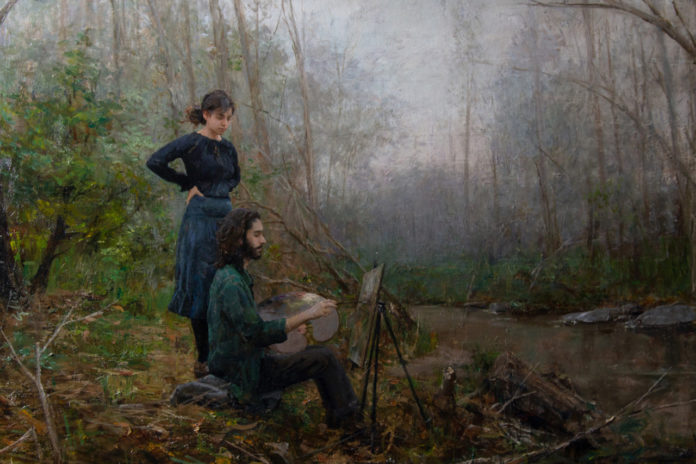
Figuring It Out
Oil on Canvas
24 x 20 in.
$2500.00
This work will be in the OPA National Exhibition at RS Hanna Gallery, Fredericksburg, Texas, from October 16 through November 28, 2020.
Figures have been one of my favorite subjects over the past 30 years. Around 1989 I was intrigued by the appearance and character of an older man at the local racetrack, named Dobbie, who fed the horses. I asked him if he would sit while I sketched him in charcoal and the result turned out great so I showed it in an exhibition and put it on my brochure. This success working from life led me to seek out life drawing groups and thus began my practice of regular figure drawing.
Once comfortable with drawing under the clock I started to paint during the longer poses. After moving to StFX University with my wife I started to teach art part-time and participate in a life drawing group. They needed someone to take over the organization and book the models, so I agreed, and nearly 20 years later we’re still having sessions, albeit with a small group of artists. Originally I drew in charcoal, conte and pastel and then started to do finished or nearly finished paintings during the sessions using watercolor, pastel or oil. Some were juried into national and regional exhibitions where they often won awards, so I was hooked. I always seemed to get a favorite model, often a student, who just had something special. It was paintings of those unique models which garnered the awards and they also had the quality of a good likeness and something of their spirit.
One such model was a Chinese student named Emily and a work of her won an Award last year in the American Watercolor Society International Exhibition. This past year or two my favorite model has been Moire, the niece of one of the art faculty. She’s just fabulous and knows how to take a great pose that looks natural. Works of her in oil and watercolor have been juried into four National and regional shows. The image of her here titled Figuring it Out has been selected for the 2020 Oil Painters of America National Exhibition, now slated for the fall of 2020.
Check out my website for my CV, Galleries and Works. Also follow me on Facebook and Instagram.
The 12th annual Grand Canyon Celebration of Art will recognize the achievements of 23 artists who have successfully interpreted the canyon, both in plein air and studio work.
Cody DeLong, when he is not off plein air painting or participating in plein air events, has a studio and gallery located in Jerome, Arizona. This will be his 12th year participating in Celebration of Art, being awarded Best of Show in 2010 and then Artists’ Choice Award in 2015. DeLong has taken numerous raft trips on the Colorado River through Grand Canyon, often with a group of fellow artists.
All of the participating Celebration of Art artists submit a Grand Canyon themed studio painting prior to the event. Of this year’s studio painting, Sunny Day at the Beach, DeLong says:
“This view is looking downriver from one of my many rafting trips. Last year we had gorgeous clear emerald water. I love the color vibrations in this piece as well as the textural qualities. There is a dynamic tension between the transitions of the water reflections, and the limestone walls. There is also movement in the water gently lapping along the beach. It’s a classic sunny day at the beach and it makes me happy every time I look at it.”
During Plein Air at Grand Canyon from September 12th through September 19th, visitors can watch the artists at work, painting along the South Rim of Grand Canyon. Beginning September 20th, 2020, and open daily through January 18th, 2021 their work will be exhibited and available for purchase at the historic Kolb Studio at the South Rim of Grand Canyon. Admission is free and open to the public. The work can also be viewed at the website below.
Bo Bartlett, "The Promised Land," 2015, oil on linen, 88 x 120 in., private collection; featured in the July/August 2020 issue of Fine Art Connoisseur magazine
A letter from Peter Trippi on communicating with artists during Covid and more, in this preview of the July/August 2020 issue of Fine Art Connoisseur Magazine.
Featured on the cover of the July/August 2020 issue: Nikolai Blokhin (b. 1968), “Old Harlequin” (detail), 2020, oil on canvas, 41.25 x 29.5 in.
Supporting Each Other
Well, 2020 has been like no other year, and it’s only half over. Here’s hoping that summer and autumn will treat us all better.
Like every field, art has been clobbered, and we at Fine Art Connoisseur have been keeping in touch with colleagues everywhere to learn how they’re doing at this extraordinary time. We have been inspired by readers’ ingenuity and determination, and we salute you for sticking to your aesthetic guns.
Our objective was to find out how nine remarkable colleagues have kept things going. The first program featured artists Alia El-Berani and Mario A. Robinson with the dealer Laura Grenning (Grenning Gallery, Long Island); the second welcomed artists Zoe Dufour and César Meza with Betty Standish (Wethersfield Academy for the Arts, Connecticut); and the third involved artists Dina Brodsky and Richie Carter with dealer Robert Simon (Robert Simon Fine Arts, New York City).
Katie and I learned a lot and send our renewed thanks to these nine professionals, who thoroughly demonstrated their ongoing commitment to making, teaching, and promoting superb contemporary realist art. Their observations ranged from detailed to big-picture, from handy tactics to the pitfalls looming ahead. Overall, it was a joy to reconnect and hear how everyone is coping.
Equally esteemed colleagues are at the Art Renewal Center (ARC); in this issue we have highlighted what’s new with them, and for our artist readers, please note that ARC is accepting entries to its 15th International ARC Salon Competition until August 14. To see its prospectus and to enter, visit arcsalon.org.
I am highlighting the Zoom conversations and the ARC Salon because it is clear that digital communications will remain essential post-COVID-19. Everyone at Fine Art Connoisseur believes in this paper magazine and will keep it moving forward, but today’s realities also make it crucial for our community to keep in touch online. Our parent, Streamline Publishing, is glad to offer an array of outlets that serve our field; just visit streamlinepublishing.com and join us.
Many thanks as ever for your collegiality, and be well until we meet again.
Morgan Weistling, "The Watering Trough, 1874," 30 x 24, oil
Since he was a child, artist Morgan Weistling has constantly seen beauty and design in the world. Intensely studying art by 12 and painting movie posters for top agencies by 19, Weistling has been chasing beauty his entire career, and he continually captures it with luminous results.
Morgan Weistling, “Silence Broken at Coyote Creek, 1879,” 34 x 40, oil
From infancy, Morgan Weistling’s mother knew he was destined for a career in art. “She loves to tell the story of when I was a baby,” he says. “She would place me on the couch that had a large painting over it. I would supposedly just get quiet and stare at it. I remember the painting, actually, and it bothered me. The perspective seemed to be off and the vanishing points didn’t all rest on the horizon line. Eventually it would make me cry that I couldn’t yet fix it. I was determined to be an artist so that someday I could fix that painting. I guess my love of art was born from frustration,” Morgan says with a tongue in cheek grin.
One toddler’s frustration is the art world’s triumph. Today, Weistling is well known throughout the country for his gorgeous figurative works and, in particular, his mastery of light. “The number one thing I use to glue everything together is lighting,” he says. “No matter what, nothing can make or break an idea more than how it’s lit. I am interested in designing light shapes. It is also how I control mood and tone.”
Morgan Weistling, “The Posse, In Pursuit of the Cook Gang, 1894,” 34 x 46, oil
Weistling’s paintings are also known for their deep, revelatory narratives, which are available only after a relationship is cultivated with the work. The artist suggests, “Ultimately, we create images that are supposed to hang on a person’s wall and it will be seen every day. I think about that. I hide sub-stories within my paintings to be discovered over time. Everything has a backstory and can be slowly digested as one lives with it. When I talk to collectors, I’m always reminded of how the painting wasn’t really finished until it was brought home and the collector added their lives to it.”
Morgan Weistlin, “The Edge of the Law, Dodge City, 1878,” 28 x 21, oil
Indeed, this “surrendering” of the painting forms a part of Weistling’s creative process. “I always tell people, I don’t finish paintings, I surrender them,” he says. “That word describes it completely. It’s rare when I don’t have a deadline waiting for a painting.” The remaining aspects of Weistling’s creative process are less predictable than deadlines.
He continues, “My process is complicated due to the fact that I create my paintings to fit a specific time period. In some ways I work backward towards inspiration. Though ultimately I am simply interpreting the form I see in relation to the light, a lot of preliminary work takes place in terms of research of my subject, costuming, model choice, and most importantly, storytelling. It’s like I have to first step into my time machine and travel to another world. Once those things are decided upon and implemented, the easy part is painting.”
“The Country Schoolhouse” by Morgan Weistling
Weistling isn’t exaggerating, either, and his description of “The Country Schoolhouse” reveals just how far the artist is willing to go to capture his artistic prize. “It started with little idea sketches as I was waiting in a car line to pick up my daughter from school,” he says. “Those idea sketches get drawn over and over again, using my old skills as an illustrator. I think about every possible angle and type of lens it would be if I were shooting it like a movie. I travelled and researched restored schoolhouses, and read a lot, too. When I had it somewhat decided, I began looking for models. In this case, I approached many parents and pleaded my case. I built a version of a schoolhouse in my studio, with desks and all, so that I could simulate the lighting and reactions while the models posed together.
“This is where I get to play director and work out the stories and see if my idea sketches had merit or whether I need to revise. Unlike a movie, though, I need to tell my story in one frame. One moment in time that sums up all I want to say. I make new sketches, I make hundreds of changes along the way, I change models, and finally I feel like the story is clear. I worked out the perspective of the desks on my canvas first and sketched over those desks with each child filling those seats.”
In addition to the lovely narratives in Weistling’s pictures, the surfaces have a vibrancy and life of their own — an element that the artist is especially attracted to. Weistling says, “Paint texture is really important to me personally as an artist. I feel bored unless the painting has that third dimension of pleasing paint variety on the canvas. If a painting is too slick or perfectly smooth, I am bored. I am excited by a contrast of thick with thin, transparent with opaque, and texture with raw canvas. There is some perfect balance I feel I am constantly chasing. Once in a blue moon I get close. But most of the time it seems elusive.”
Additional Oil Paintings by Morgan Weistling:
Morgan Weistling, “Chicken Girl,” 2016, oil, 30 x 30 in.Morgan Weistling, “The Needlepoint Artist,” 2016, oil, 24 x 20 in.Morgan Weistling, “Indian Stories,” 2016, oil, 40 x 46 in.Morgan Weistling, “First Blossoms,” 2016, oil on linen, 16 x 20 in.Morgan Weistling, “The Prairie Church,” 2016, oil, 30 x 43 in.Morgan Weistling, “Snake Oil Salesman,” 2016, oil on linen, 36 x 56 in.
This article was featured in Fine Art Today, a weekly e-newsletter from Fine Art Connoisseur magazine. To start receiving Fine Art Today for free, click here.
Robert Porter, "Will lunch ever be the same?" 12x16, Oil
“Our World Re-Imagined” is the Northern California Chapter’s first virtual exhibition with the California Art Club (CAC). This exhibition’s theme is to inspire our artists to visually interpret their perception of our changed world during Covid-19. The show is a diverse snapshot into each artist’s state of mind and visual interpretations during this time. These images range from hopeful beautiful landscapes and past times of busy urban life to desolate rural buildings, vacant urban establishments, and isolated people.
Organizers: Ellen Howard, Paul Kratter Co-chairs SF Chapter
CAC Exhibitions Manager: Addy Stupin
Judges: William Davidson & Kim Lordier
President: Peter Adams, Executive Director: Elaine Adams: California Art Club
David Casterson, “Fort,” 12×12, Oil
Carolyn Lord points out, “I reimagine our world where the use of fossil fuels is considered archaic, the environment is restored, and the infrastructure left behind become artifacts of the Anthropocene epoch. I painted “Abandoned Gas Station” in Livermore, CA, as if it were made of white marble, bathed in ethereal light. The columns are not Doric, Ionic, or Corinthian; there is neither entablature nor pediment; it is mid-20th century Googie!”
Carolyn Lord, “Abandoned Gas Station,” 11×14, Oil
Almeida Deladier’s says his painting “Meta Rembrandt” is from a series of paintings depicting museum visitors’ tendency to take a photo of famous artwork to document their visit, thereby reducing Rembrandt’s work into a tiny snapshot. People miss experiencing the beauty of the artwork as it was originally intended and created.
Deladier Almeida, “Meta Rembrandt,” 18×24, Oil
Richard Lindenberg choose to paint one of his favorite areas along the Sonoma Coast escaping the hot frustrating days indoors during sheltering in place, titled “Carmet Cliffs.”
Richard Lindenberg, “Carmet Cliff,” 9×12, Oil
Robert Porter’s painting “Will lunch ever be the same” (below) and Gil Sambrano’s painting “Station Number 5” (shown at top) contrasts two scenes. Painted just prior to the pandemic hit, a group lunch stands in stark contrast to the social distancing in Gil’s painting of the lone lifeguard station on the beach.
Gil Sambrano, “Station Number 5”, 12×16, Acrylic
Juror of Awards: Bill Davidson, Artist Member, and Kim Lordier, Signature Member
CAC “Our World Re-Imagined” Awards:
First Place: Deladier Almeida “Meta Rembrandt”, 24×18, Oil $500 cash award
Second Place: David Casterson “Fort”, 12×12, Oil $250 cash award
Third Place: Richard Lindenberg “Carmet Cliff”, 9×12, Oil $125 cash award
Honorable Mention: Ni Zhu “Caltrain 3:37”, 8×10, Oil $50 cash award
Joshua Langstaff, "Citizen of the World," Oil and gold metal leaf on linen, 26″ x 16″
Women in Art > “Exploring The Influence of Women: A Maryhill Museum and Aristides Atelier Collaborative Exhibition”
BY LOUISE PALERMO
Curator of Education
It is austere and profound studies that make great painters and sculptors. One lives all one’s life on this foundation, and if it is lacking, one will only be mediocre. ~ Jean-Léon Gérôme
Maryhill Museum of Art is full of wonder and surprise. Tucked away at the edge of the grand Columbia River, are collections that never cease to inspire. In this world of Covid-19, Maryhill presents to you “Influence of Women,” a fully online exhibition of student and graduate paintings from the Aristides Atelier, at Gage Academy of Art in Seattle, WA where Master artist Juliette Aristides offers foundational skills necessary for realist artists. We connect with this atelier through our collections of Richard Lack paintings, whose atelier was the source of her training.
The term “Classical Realism” was coined by Richard Lack and a group of atelier-trained realist artists communicating their connection to academic traditions, coupled with a modern way of seeing. It embraces classicism, realism, and an impressionist style using rigorous atelier apprenticeships, intensive mentoring, and an academic method of drawing and painting. To indulge in some name-dropping of direct lineage you will find Jaques-Louis David (1748-1825); Paul Delaroche (1797-1856); Jean-Léon Gérôme (1824-1904); William McGregor Paxton (1869-1941); R. H. Ives Gammell (1893-1981); and Richard F. Lack (1928-2009) to name a few of the many greats.
While ‘Realistic’ might, in a narrow way, define a work of art with recognizable objects, the broad stroke doesn’t do justice to the thoughtful insight of this movement. Simple objects become as beautiful as the most famous portrait, while meaning and insight resonate for those taking time to ponder.
The exhibition theme was chosen to commemorate 100th anniversary of women in America finally achieving their right to vote. Artists were asked to explore the women who have influenced their life and art.
Paintings Featured in “Exploring The Influence of Women”
The young woman who is the subject of “Citizen of the World” (shown at top) by Joshua Langstaff was born in South Africa and immigrated to the US at a young age. She is a survivor of numerous childhood traumas but has persevered to become a prominent performance artist and social justice activist. Interestingly, she has not been allowed to gain citizenship in either her natal country, or her chosen one. In this painting, Langstaff has framed her as though she were a medieval icon, holy and a most important “Citizen of the World.”
Farida Abadeen, “Self Portrait,” Pastel on Canson paper, 19″ x 25″
Self-portraits can be intimate things as artists sometimes expose the unseen. Farida Abedeen was born in Kuwait in the late fifties, a time when women worldwide were very unlikely to be encouraged toward art. In Kuwait, there was no school for studying to be an artist, but she knew that was who she is. When she moved to Seattle, she enrolled in the Aristides Atelier and her dream became a reality. She made this at the end of her first year when quarantine also requires innovation for finding models!
John Rizzotto, “Hank, I Figured It Out. Goodbye,” Oil on Canvas, 30″ x 42″
Classical Realism lifts every object into the realm of ‘beautiful.’ John Rizzotto wanted to communicate the virtuous attributes that came to him by women: compassion, mindfulness, forgiveness, gratitude, nurturing, and the knowledge that life is full of hard work to be shouldered with or without compensation.
This homage to his mother, whom he calls his closest and most profound influence, adds a note for us to ponder.
Grace Athena Flott, “Forged in the Flames (Self-portrait at 28),” Oil on panel, 28″ x 32
Artists often confront identities and prescribed ideals for beauty. Grace Athena Flott created a brilliant self-portrait in which we see this in action. As a survivor of a fire-related injury, Flott painted this image as a way to thank the countless women who supported her, showing she was not alone in her journey, and as a way to call out to anyone else who may need to hear this message. She is the reflection of all that is beautiful about her profession.
Juliette Artistides, “Yael, survivor,” Oil on panel, 36″ x 26″
The portrait of Juliette Aristides’ sister-in-law, Yael, is equally defining. Mapping her journey through aggressive breast cancer, we are given a measure of beauty that comes from struggle, determination, turbulence, and trauma.
Sally Allwardt, “Buttercup (After Rosa Bonheur/-1866- ‘A White Horse’),” Oil on linen panel, 11 3/4″ x 16″
Influence and gratitude are symbiotic. Sally Allwardt pays homage to a work of art that came to her when she was in her second year of studying painting. Rosa Bonheur was a French woman who lived in the 1800’s. The effect of this interaction was a reminder that there were countless, sometimes faceless and nameless, female artists who came before. Buttercup was created in gratitude to all women who came before and paved way for female artists yet to be.
I end with a dialogue between an artist and me. Charles Burt and I bonded over a drawing of military boots worn specifically when driving a tank. From there, my admiration for his work has grown exponentially, as has our friendship. He has rewarded me by taking a joyful moment in my life and immortalizing it in the person of “Gaia” or Mother Earth.
n see all 29 paintings created by students at the Aristides Atelier; you will also find statements by each artist, exploring their work and the inspiration for it.
The artwork, and I’ve only touched on a sample, in this exhibition represents narratives of lives touching lives. The stories are revealed by the poses, by the objects painted, and by passion that is passed from image to viewer. Take your time, look more than once, and notice details, color, lighting, technique, and choices each artist has made to share this very intimate story.
Giuseppe Antonio Pianca, “Mother and Child,” oil on canvas, 9 ¼ x 8 ¼ inches.
Robert Simon Fine Art specializes in European works of the Renaissance and Baroque periods. It’s our pleasure to share with you the following exclusive interview with Robert Simon in this Art Gallery Spotlight.
The new Robert Simon Fine Art online catalogue and exhibition is titled “New, Old, and Unexpected” and includes paintings, drawings, and sculpture from the 16th to the 20th centuries. The images featured in this interview are included in the show.
Cherie Dawn Haas: Please tell us about your gallery and the type of art in which you specialize.
Robert Simon: Robert Simon Fine Art is dedicated to introducing the great art of the past to new audiences and to exploring the continuum between that art and contemporary artists who follow in that tradition. The gallery was born out of my expertise in Italian painting, although my interests have since expanded to include the breadth of European painting and sculpture from the Renaissance to the Nineteenth Century. As broad as these interests are, connoisseurship underlies them all and has resulted in a remarkable series of discoveries of major pictures by artists as diverse as Pintoricchio, Dante Gabriel Rossetti, Vittore Carpaccio, Parmigianino, Guido Reni, Salvator Rosa, Paolo Uccello, and, notably, Leonardo da Vinci’s “Salvator Mundi.” Additionally, the gallery has led collector interest in the fields of female Old Master painters and Spanish Colonial art, having brought to light and placed important works in both areas.
Gallery exhibitions have focused on pairing contemporary paintings and sculpture with analogous works from the Renaissance, the Baroque era, and Nineteenth Century. Significant paintings, drawings, and sculpture from the gallery are to be found in major American museums, as well as in private collections across the globe.
Attributed to Giusto Le Court, “The Infant Saint John the Baptist with a Lamb,” marble, 21 ½ x 14 x 11 inches.
What adjustments have you made as a gallery since the COVID-19 outbreak?
We are working remotely, but have been able to prepare the first of a series of new online catalogues of Old Masters and works in the classical tradition. The aim here is not only to widen our audience and show some unfamiliar works of art, but also to demonstrate just how accessible such works are. The works in the catalogue, which is aimed at new and established collectors alike, are priced between $4,000 and $50,000. And since the ability to examine an item in our gallery is at present difficult, if not impossible, we are including the cost of domestic shipping in the prices that we have given for each.
What’s your biggest priority at this time? Over the next year?
1) Planning for exhibitions, whether in the gallery or online.
2) Staying in touch with collectors and museum colleagues.
3) Drinking all the wine we would normally serve at openings.
Pier Francesco Mola, “Head of a Classical Poet (Homer or Socrates),” oil on canvas, 19 ½ x 14 ⅜ inches.
What advice do you have for collectors as they navigate these times, and beyond?
While museums are closed, this is a wonderful time to expand and deepen one’s knowledge of the art of the past—through books, online resources, and contact with dealers who handle works of personal interest. Being an informed collector allows one to make better decisions about what to buy—and opportunities are forever appearing. At the same time, as we spend more time at home, it is never more important to buy only things that we will enjoy and that will sustain us over time.
Anything else you’d like to add about the current issues galleries are navigating?
Most galleries are expanding their use of virtual and video exhibitions on their websites and across digital platforms. There is a real danger of overload as every other entity—commercial, educational, governmental—seems to be doing the same thing. It is important that galleries should be judicious in what they present else it becomes lost amid all the noise.
Giovanni Antonio Sogliani, “The Marys on the Road to Calvary,” oil on panel, 20 ½ x 13 ¾ inches.
What are some of the ways you find artists to represent?
I seek out artists with a real affinity for the art of the past—ones that are more than technically accomplished; those who understand the emotional, spiritual, or intellectual components that have nourished and challenged people for centuries.
Anything else you’d like to add?
Governmental agencies do not count art as “essential.” We believe it is—both for those who make it and those who look at it. It is one of the fundamental modes of communication that humans have developed and one that many of us cannot live without. Stay with it, in whatever way you can!
Grant Wood, “Cover for ‘The Pulse’ Magazine, February 1907,” pen and ink on paper, laid down, 18 ¾ x 12 ⅜ inches.Antonio Negretti, called Antonio Palma, “Joseph and Potiphar’s Wife,” oil on canvas, 10 ½ x 35 inches.Robert Gardelle, “Portrait of Jean-Louis Buisson,” oil on canvas, 32 x 25 ¾ inches.Jean-Michel Moreau, Le Jeune, “Joseph Interpreting the Prisoners’ Dreams,” pen, ink and wash on paper, 14 ¼ x 20 ¾ inches.Jacopo Amigoni, “Portrait of a Gentleman,” pen, black ink, wash, and white heightening on blue paper, 7 ¼ x 8 ½ inches.
To learn more about Robert Simon Fine Art and the “New, Old, and Unexpected” exhibition, please visit robertsimon.com.
"Lavender," Sarah Lamb, 2020, Oil on linen, 22 x 19 inches
Grenning Gallery (Sag Harbor, NY) is now welcoming visitors to the gallery for the first time since mid-March, as New York moves to Phase 3 of re-opening the economy. “We simply require the basic precautions (mask, hand sanitizer; etc.) to keep the gallery safe for us and our other guests,” the gallery said.
Through July 12, 2020, the gallery is showing “Butko | Lamb,” with paintings by Viktor Butko (b. 1978, Moscow) and Sarah Lamb (b. 1972, Petersburg, VA).
From the gallery:
Viktor Butko, in preparation for this major, high-season show, has been painting on the East End and around New England all year. He was also quarantined in Vermont, painting en plein air with fellow Grenning Gallery artists as the pandemic hit in March.
Throughout the year, Butko has deepened his inquiry into the tonal shifts of light at twilight, especially as seen through trees.
“Over the Pond, Evening Light,” Viktor Butko, 35 x 43 inches, Oil on Linen, 2020
“Over the Pond, Evening Light” is a mid-winter examination of that theme, where Butko deftly inserts a screen of verticals in the form of light-colored birch trees to offset the horizontal landscape beyond. The trees also frame sections of his background, highlighting elements that might otherwise be lost, like the shimmering water, effectively captured by this well trained yet contemporary impressionist.
“Spring is Getting Closer” Viktor Butko, 2020, Oil on linen, 32 x 40 inches
Few may know that Viktor Butko is the third generation of highly respected painters from outside of Moscow. In fact, Butko was invited to show at the famous Moscow Union of Artists with up to 50 paintings tentatively planned on November 25, 2020. It’s an honor rarely afforded to a painter in their early 40s, and interestingly, this was the site of his grandfather’s, Victor Chulovich (b.1922 – d.1994), major exhibit in the early 1950s. (The exhibit dates may be changed due to Covid-related closures, however the invitation to show and what it confers about this fine young Russian painter stands.)
This is a theme that he has been developing for years now, starting with “Deer Park Lane” (2018, sold), and continued with several others in this show, like “Cold Winds”(2020), or “Shelter Island Summer” (2019).
“Red Door, Sag Harbor Church,” Viktor Butko, (2020), Oil on linen, 36 x 30 inches
Unbeknownst to Butko, in “Red Door, Sag Harbor Church” he is striking a bulls-eye in Sag Harbor’s contemporary art scene. Here he captures the early spring visage of The Sag Harbor Church, an exciting new arts center that Eric Fischl and April Gornik are building. Butko was drawn in by the aesthetics of the scene; the dramatic contrast of the red door against the white building, surrounded by the blue sky and green trees.
Through the lens of a global pandemic, and under quarantine on a painting sojourn with fellow painters, we are delighted to see this original and interesting composition of a Vermont valley this past March. His training en plein air in Russia has deeply influenced other Grenning Gallery painters; notably, Ben Fenske, Amy Florence, Tim McGuire, and Kelly Carmody, all of whom were on this painting trip.
“Magnolia” Sarah Lamb, 2020, Oil on linen, 14 x 22 inches
Sarah Lamb returns this year with wide ranging variety of her sought-after, poetic still-lifes. Lamb has been very busy with commissions, so if one is partial to her highly prized white floral still lifes, or perhaps a jambon and cheese set up…please let us know so we can get you on her schedule!
Fresh from her studio, painted during the pandemic lock down, we see “Magnolia,” a lovely medium sized white flower still life, in the spirit of Martin Johnson Heade. Here we see Lamb’s decisive compositional virtuosity, executed in rich tones and precise brush strokes. Masterful in every way, her still life paintings hum.
“Antique Grasshopper Weathervane” Sarah Lamb, 2018, Oil on linen, 34 x 47 inches
In “Antique Grasshopper Weathervane,” Lamb revisits an earlier subject matter, as she continues her series of weathervanes. In this larger and somewhat more mysterious painting, the brass sheen of the weathervane is so realistic you almost have to touch it.
“Glass Menagerie,” Sarah Lamb, 2019, Oil on linen, 38 x 47 inches
Lamb’s rare use of a high key palate in “Glass Menagerie” is a lovely investigation into the cool and warm palette amongst these natural and neutral tones.
“Pomegranates with Brass Bowl,” Sarah Lamb, 2020, Oil on linen, 20 x 33 inches
In “Pomegranates with Brass Bowl” Lamb’s sets the table squarely in the center of the picture, and she offers a nod to the great American painter Emil Carlson (1853-1932) with her richly observed brass bowl. We are somehow brought into the 21st century with the subtle wide set vertical lines in the background and Lamb’s quintessential overall lack of fussiness in the painting.
In “Lavender” (shown at top) we see her move forward with her more contemporary iconic composition – with almost simple color field transitions between the grey stone shelf and background, the light brown paper, and the interesting structural use of the lavender stalks.
Learn more about “Butko | Lamb” or schedule a private viewing at grenningallery.com.
As part of our effort to continue to help artists and art galleries thrive, we’re proud to bring you this new “Virtual Gallery Walk.” Browse the paintings below and click the image itself to learn more about it, including how to contact the gallery.
Apricot Sunrise by Judith Pond Kudlow, Oil, 37 x 24 in.; Anderson Fine Art Gallery
Love Park by Ekaterina Ermilkina, Oil on Canvas, 30 x 48 in.; Bluestone Fine Art Gallery
Equality. Assemblage Collection by Debra Ferrari, Paper & Acrylic on Canvas, 48 x 60 in.; Ferrari Gallery
Extinction III by Nigel Cox, Oil on Canvas, 36 x 36 in., Signed; Rehs Contemporary
Maria Gathering Flowers by Daniel Ridgway Knight (1839-1924), Oil on Canvas, 26 x 21 1/4 in., Signed and inscribed Paris; Rehs Galleries, Inc.
The Shrine by Johnnie Liliedahl AFTER J.W. Waterhouse, Oil on Canvas, 48 x 24 in.; Liliedahl Fine Art Studio-Gallery
Searching For My Mermaid Tail by Lori Mehta, Oil on Panel, 24 x 36 in.; Edgewater Gallery
After the Party by Steven J. Levin, Oil on Canvas, 9 x 14 in.; Tree’s Place
Want to see your gallery featured in an upcoming Virtual Gallery Walk? Contact us at [email protected] to advertise today – don’t delay, as spaces are first-come first-serve and availability is limited.
Fill your mind with useful art stories, the latest trends, upcoming art shows, top artists, and more. Subscribe to Fine Art Today, from the publishers of Fine Art Connoisseur magazine.