Home Blog Page 205

Featured Artwork: Sandra Corpora

0

Placido
30 x 24 in.Oil on panel
$4,600
Available through the artist

My painting Placido captures the bicyclist in the moments after a ride in the hills of Sicily. Tired in a contented way, ruffled hair from the helmet, iridescent goggles, he’s perched on some masonry in the piazza, drying off in the strong Italian sunlight. The straightforward gaze of my painting connects with the viewer. He’s ready to have a birra with you and talk about the ride. He’s one of my favorite subjects, my husband who was born in Sicily and we return there often. I go there to paint and he bicycles those same hills and dramatic coastline.

I like to think that because of the feeling expressed in this painting, it has been recognized in a number of exhibitions. Placido won an Award of Excellence in the Juried Exhibition, American Women Artists at the Haggin Museum, Stockton, California. It also was accepted in the 2019 Oil Painters of America National Exhibition at the Illume Gallery, St. George, Utah. It was also a finalist in the Art Renewal Center 2019 International Competition, and a finalist in the Portrait Society of America 14th Annual Members Competition.

I love painting portraits and figures and look for the soul behind the eyes of my subjects. It’s a special joy to capture the gesture of a figure so it feels natural and alive. Figure drawing has been an ongoing study and I recently had the honor of competing in the second Figure Drawing Competition in New York at the Historic Salmagundi Club. I was thrilled to become an artist member of Salmagundi Club.

Beside portrait and figurative work, I paint landscape and still life. I think it’s important to work in a variety of subject matter and work as much from life as possible to continue to improve my skills. And I feel it’s very important to share my knowledge with others. I teach out of my studio in Historic Bethlehem, Pennsylvania. I’m a signature member of the American Women Artists, the Portrait Society of America, The American Impressionist Society, and a signature member of Oil Painters of America. I have had over a dozen solo exhibitions and my work is collected worldwide.

View more of Sandra’s paintings at sandracorpora.com

Upcoming Exhibitions:
NOAPS Best of America Small Works 2020
4/5/20 to 5/3/20 at McBride Gallery, 215 Main Street, Annapolis, Maryland 410.267.7077

Baum School of Art Auction
5/16/20 at The Baum School of Art, 510 Linden Street, Allentown, PA 18101 610.433.0032

Making Their Mark: American Women Artists
5/23/20 – 8/23/20 at the Booth Western Art Museum, 501 N Museum Drive, Cartersville, GA 30120 770.387.1300

Facebook Sandra Corpora
Instagram sandracorpora
WWW.SANDRACORPORA.COM

Gallery Profile: Lance Rehs of Rehs Galleries

0
Rehs Galleries fine art oil paintings
The Artist (SOLD ARCHIVES) GEORGE SHERIDAN KNOWLES (1863 - 1931) The Duet Oil on canvas 36 x 28 inches Signed and dated 1915

Focus on Art Galleries > Publisher Eric Rhoads interviews Lance Rehs and Howard Rehs of Rehs Galleries (New York) in this spotlight video.

.
Connect with Rehs Galleries

> Sign up to receive Fine Art Today, our free weekly e-newsletter

> And click here to subscribe to Fine Art Connoisseur magazine, so you never miss an issue

Symbols in Art: The Traveler’s Desk

0
PleinAir Salon - Lyubena Fox - FineArtConnoisseur.com
"Traveler's Desk" (oil) by Lyubena Fox won in the Best Artist Under 30 category of the December/January 2020 PleinAir Salon.

Symbols in Art > The symbols in this contemporary still life depict man’s yearning for knowledge. See how, with these insights from the artist. “Traveler’s Desk” was a winner in the “Best Artist Under 30” category of the December/January 2020 PleinAir Salon.

BY LYUBENA FOX

Symbols in Art: About “Traveler’s Desk”
Through the symbols in “Traveler’s Desk” (above) the painting depicts man’s yearning for knowledge. The knowledge yet to be discovered (symbolized by the closed books) is obtained by travelling (indicated by the globe). This desk tells the story of a dreamer curious to learn through his travels (curiosity depicted by the squirrel that he has brought from overseas, as this type of rodent is not found in Europe). You can also find that this person is interested in foreign cultures, hence he has received a letter with a haiku, a type of traditional Japanese poetry. In this context, the scales stand for a reminder that knowledge is more valuable than material riches.

Detail, Traveler's desk by Lyubena Fox
Detail
Detail, Traveler's desk by Lyubena Fox
Detail

The Painting Techniques and Process
My paintings are painted in several layers, using both the transparent and opaque qualities of oil paint. Each layer is applied after the previous has dried, which makes the painting withstand time. It also creates a glowing, three-dimensional effect, which is due to the different layers showing through each other. These works are painted following the logic of how the eye perceives: seeing the details in the context of the form. To create a fulfilling experience, the images are composed of places, full of detail for the eye to explore and places where the eye can rest.

I arrange my still life objects into a composition, which I paint from life. My linen canvas is prepared with a layer of gesso, onto which I do a rough sketch of the main elements of the composition in oil paint. Then I roughly fill in the colors into the sketch. Once that has dried, I model the forms in a very general fashion, leaving out all details. I let the second layer dry. On the third layer I get more precise with the forms of the objects, aiming for a finished look. It is important to always keep the smaller details in context of the larger forms.

Contemporary realism self-portraits
Lyubena Fox, “Self portrait,” 2019, oil on canvas

What Inspired me to enter PleinAir Salon
After all the work I have put into my paintings, my aim is for them to reach people who would be interested and could extract something from my art for themselves. I entered the Salon in hopes of my art reaching more people.

Symbols in Art - Contemporary realism still life paintings
Lyubena Fox, “Rosella,” oil on canvas, 40 x 50 cm

Artist statement
My goal as an artist is to build up on what we’ve learned from the past, so we can create within our fullest potential, during the present. This applies to several aspects in life.

As an oil painter I stand for mastering one’s crafts, meaning to know your materials, the different ways to use them and the chemical reactions towards their surroundings. This results in producing high quality works, which will last in time.

I value the importance of good design. So as to create visually pleasing paintings, they are created following the logic of how the eye perceives: seeing the details in the context of the form. The images are composed of places, full of details for the eye to explore and places where the eye can rest.

A lot of symbolism is used, whether old (accumulated throughout history) or new (emerged more recently), to illustrate topics concerning one’s emotions towards life. By presenting my statement I strive to make the viewer better understand themselves; urging them to think about how they feel and what they stand for; discovering who they truly are.

Art is a tool to scratch beneath the surface and reach a deeper understanding of our existence.

With my art I strive to capture the transitory beauty and emotions of life.

Additional Paintings:

Symbols in Art - Contemporary realism still life paintings
Lyubena Fox, “Autumn Chipmunk,” oil
Figurative art
Lyubena Fox, “Rila Nymph,” oil on canvas
Symbols in Art - Contemporary realism still life paintings
Lyubena Fox, “Memento Roses,” 2017
Figurative art
Lyubena Fox, “Happiness is a Butterfly,” oil on canvas
Symbols in Art - Contemporary realism still life paintings
Lyubena Fox, “Bullfinch Autumn,” oil on canvas
Symbols in Art - Contemporary realism still life paintings
Lyubena Fox, “The Next,” oil on canvas

Connect with Lyubena Fox:
Website | Instagram

Learn about the PleinAir Salon, view winning paintings, and enter your best work at pleinairsalon.com.


> Visit EricRhoads.com to learn about more opportunities for artists and art collectors, including retreats, international art trips, art conventions, and more.

> Sign up to receive Fine Art Today, our free weekly e-newsletter

> Subscribe to Fine Art Connoisseur magazine, so you never miss an issue

Featured Artwork: Nanette Fluhr

1

Manu
Oil
30 x 24 in.
Available through Artsy.net

Nanette Fluhr has created paintings which have acquired collections worldwide. Her work has been featured in exhibitions at the Museu Europeu d’Art Modern (MEAM) in Barcelona, the Butler Institute of American Art, the Wausau Museum of Contemporary Art, the Eisele Gallery of Fine Art, the Hutchins Gallery at C.W. Post College, the National Arts Club, the Salmagundi Club, and the University of Connecticut Gallery, among many others.

A highlight of Nanette’s career was having three of her works selected for a historic presentation of American painting, Contemporary American Realism, which toured national museums in China including the Beijing World Art Museum, Dalain Modern Museum, Tianjin Art Museum, Hubel Provincial Museum, Zhejiang Provincial Museum and the Shanghai Art Museum.

She has received honors and awards from institutions such as the Art Renewal Center, Artist’s Magazine, the Catherine Lorilland Wolfe Art Club, the Connecticut Society of Portrait Artists, the Portrait Society of America, and the School of Visual Arts.

Nanette graduated from Rutgers University in 1987 and then went on to earn her BFA with Honors from the School of Visual Arts in New York City, where she received the Rhodes Family Award for Outstanding Achievement. There she met John Frederick Murray, who taught her drawing, painting and picture making skills gleaned from the techniques of the Old Masters. During this time Nanette became a registered copyist with the Metropolitan Museum of Art in New York, where she painted museum-quality replicas of works by Lawrence, Le Brun, Rembrandt, Rubens, Velazquez and Van Dyke.

As a faculty member of the Art League of Long Island, Nanette shares her extensive knowledge of traditional realism. She is a sought after workshop instructor for schools such as the Teaching Studios of Art, where she taught Master Copy, and is currently visiting faculty. In partnership with Craftsy.com Nanette taught a 7 episode online video class, Classic Children’s Portraits in Oil. She has also worked with Rosemary & Co. Brushes. to create two signature brush sets.

Nanette has been featured in several publications as well as in a video produced at the Metropolitan Museum of Art highlighting her Master Copies.

View more of Nanette’s work at Artsy.net.

Featured Artwork: Jill Banks

0

Le Soleil D’Or
16 x 20 in.
Oil on linen-lined panel
$2500
Available from the artist

Capturing Life in Oils

The artist says, “I paint to capture life’s magic … to transport you inside my oil paintings – to feel that breeze, hear the sounds, watch what happens, smell the beer.”

Le Soleil D’Or was painted plein air in Paris – capturing a life we appreciate now more than ever. Read about her personal painting trip to France in the Plein Air Today blog post A Paris Plein Air Adventure.

Isolation means plenty of new works are springing to life regularly. See her website, www.JillBanks.com, to sign up for her monthly newsletter to catch the latest paintings, news, and tales. She is also teaching her first set of online live painting classes that start mid-April. More info on classes here.

You can also follow Jill on Facebook and Instagram. Plus, make sure you are the first to see fresh work by signing up for New Art Alerts here.

Another of Banks’ plein air paintings Colorado Days is at Settlers West in Tucson with the Women Artists of the West 50th Jubilee National Exhibition from March 25-April 17. Banks recently became a Signature member of Women Artists of the West and American Women Artists.

Contact Jill at [email protected] or 703.403.7435.

We Say Goodbye to Daniel E. Greene

20
Daniel E. Greene, N.A., “Self-Portrait”

We are saddened to announce that Daniel E. Greene has passed away. It is no secret that he has inspired countless artists over the years.

“Daniel E. Greene was an enormous talent who inspired generations of admirers around the world,” says Peter Trippi, Editor-in-Chief of Fine Art Connoisseur magazine. “It is particularly meaningful to us at Fine Art Connoisseur that our brand-new issue (to reach newsstands and mailboxes on May 1) contains several memorable comments he generously offered for a large article about portraiture. Dan Greene remained lively and incisive until the end, and he will truly be missed by everyone who loves great painting.”

“Dan was an icon in the art world, but also a generous giving man, teaching thousands of students,” says Eric Rhoads, CEO of Streamline Publishing. “Thankfully we gave him our lifetime achievement award at the Figurative Art Convention & Expo (FACE) this past fall. He was a huge inspiration to the entire audience. He will be missed.”

From the studio of Daniel Greene:

With the recent passing of Daniel Greene on Sunday, April 5, 2020, many have inquired about how they can help; in lieu of flowers and in the event you would like to, a donation to the Artists’ Fellowship, Inc. in Daniel Greene’s name would be most appreciated. This is a non-profit organization that Daniel Greene and Wende Caporale-Greene have been closely connected with for many years (Daniel was honored in 1999, Wende is on the board and had served as president.) Right now, due to the Coronavirus, they have had an onslaught of applications for aid by artists who have suffered losses due to the virus. Normally, they help professional artists in emergency situations and the Coronavirus certainly qualifies. Sadly their endowment has been negatively impacted by the market drop which means they have less to give artists. Please check out their website: https://www.artistsfellowship.org.

Daniel E. Greene and Wende Caporale during the Lifetime Achievement Award presentation at FACE

As stated, at the most recent Figurative Art Convention & Expo, we had the pleasure of honoring both Daniel and his wife, Wende Caporale, with a Lifetime Achievement Award (watch the mini-documentary below).

.
Daniel Greene artist Wende Caporale
Eric Rhoads (left), Daniel E. Greene (seated), Peter Trippi, and Wende Caporale at the Lifetime Achievement Award Ceremony held at FACE.

Daniel E. Greene was born in Cincinnati, Ohio in 1934 to Earl and Gertrude Greene, who had settled there after immigrating from Poland, Russia, and Eastern Europe at the turn of the century.

Daniel began showing his natural talent for art quite early in life, even though his school didn’t offer art classes until the fourth grade.

At 13, he attended the children’s classes at the Art Academy of Cincinnati, his first formal training.

By 1952, Daniel was a senior in high school. In his haste to study art, he decided to quit school and move to Miami Beach. There, he discovered portrait sketch artists catering to tourists. He joined the crowds watching the pastel artists, who were primarily Cuban.

When Daniel applied for a job sketching at one of the shops, called Wendkos & Serge, he was told there were no openings. He reapplied later and, this time, was told the bitter truth; that he just wasn’t good enough.

Hearing this drove the young artist to work harder. He bought Stella Mackie’s portrait book along with an assortment of hard pastels and voraciously practiced until he was ready to reapply. He succeeded, marking the beginning of his career as an artist.

Averaging seven portraits per day, he naturally gained skills at painting a variety of people from life. To be completely equipped, he knew he needed an intensive academic course. When he received a catalog from the Art Students’ League of New York, the work of Robert Brackman sealed the academic approach that Daniel desired.

Daniel headed to New York, got a job at an art materials store, and enrolled in Brackman’s evening class at ASL. In his first class, Brackman came in, spotted Daniel’s work, and remarked to the class, “we have a lot of talent this year.”

Drafted by the Army in 1957, Daniel served two years, was honorably discharged, and moved back to Greenwich Village.

He continued sketching portraits, networking, and participating in art shows, and was proposed for membership to the Salmagundi Club. After he became a member, Daniel was asked to teach, and did so at the National Academy of Design and at the Art Students League.

Later, in 1979 and 1980, Daniel taught summer-long classes in Gloucester, Massachusetts. Finding he enjoyed being away from New York City, he closed his 67th Street studio.

Unbeknownst to Daniel, a pastel artist named Wende Caporale had gone to ASL in search of his teaching after her own professors recommended that she study with Daniel.

Although she discovered Daniel had recently left New York, she saw one of his portraits and experienced a “life-changing, prophetic moment.”

Once discovering Daniel was now in North Salem, New York, Wende enrolled in his classes at what has become the well-known and loved Studio Hill Farm. At the time, neither Wende nor Daniel realized their lives would intertwine to become more than teacher and artist.

Spending many summers painting and working together, their personal relationship blossomed and they married in 1986.

Once Wende and Daniel were married, they continued their lives in the world of art and also raising their daughter, Avignon. Daniel painted commissioned portraits, did non-commissioned work for galleries, and taught workshops all over the US and at Studio Hill Farm.

Daniel’s work has garnered many awards of achievement, including 44 prizes and a place in the Hall of Fame from the Pastel Society of America; a Gold Medal from the Portrait Society of America; a Gold Medal as a Salmagundi Club Honoree; a place in the Hall of Fame for the Oil Painters of America, and many more.

His works are in over 700 public and private collections in the United States and abroad, including the Butler Institute of American Art, the Cincinnati Art Museum, the Pentagon and House of Representatives in Washington, D.C, the Smithsonian Institution, the Metropolitan Museum of Art, as well as many others.

Daniel has painted the portraits of First Lady Eleanor Roosevelt, Commander Astronaut Walter Shirra, Jr., Ayn Rand, Natalie Portman, Bob Schieffer, Bryant Gumbel, and numerous Congressmen, Governors, Judges, Educators, and Industrialists.

Daniel’s books and instructional videos have reached people worldwide and have been translated into multiple languages. He has taught over 10,000 students during his six decades of teaching and his influence continues.

Related Article > 66 Years: A Retrospective of Daniel E. Greene Paintings

Wonderful Watercolor

0
Pat Holscher, “Geese Headed South,” watercolor on gessoed paper, (c) Pat Holscher 2015

Fine Art Today traveled to rural eastern North Carolina for a chat with accomplished watercolorist Pat Holscher, whose pictures of seagulls, pelicans, and more feel right at home next to the Pamlico River.

The character and individuality of birds have fascinated and inspired some of history’s greatest minds. John James Audubon sought to meticulously categorize all the birds of America, while Leonardo da Vinci was nearly obsessed with how birds take flight. For artist Pat Holscher, the maritime birds native to eastern North Carolina have provided endless enjoyment and, more recently, artistic inspiration.

Pat Holscher, “Harvey,” watercolor on gessoed paper, (c) Pat Holscher 2015

Immediately noticeable in Holscher’s work is the fluidity of the watercolor’s application, which displays a vibrancy and vivid saturation of blended, runny color. Holscher prefers working on gessoed paper, which allows her to achieve this desired effect. The gesso, in addition to reducing the absorbency of the paper, allows the colors to sit on the surface, resulting in stronger hues. The gesso also leaves a textured finish on the paper, a feature Holscher loves to use to enhance her subjects’ naturalism.

Pat Holscher, “Heads Up!,” watercolor on gessoed paper, 20 x 30 in. (c) Pat Holscher 2015
Pat Holscher, “Plover Playtime,” watercolor on gessoed paper, 11 x 15 in. (c) Pat Holscher 2015
Pat Holscher, “Running in Circles,” watercolor on gessoed paper, 15 x 35 in. (c) Pat Holscher 2015

For Holscher, a watercolor begins with a connection. Using photography as a means to capture a bustling flock of birds, Holscher selects one bird that displays a certain individuality of character and pose, whom she calls “the show stopper.” This bird could be used a number of times in different pictures, but typically forms a vital part of the composition, inviting the viewer into the piece. Holscher also includes a number of other birds in her paintings, creating a rhythmic play and kinetic movement that adds vitality and visual interest. One truly gets a sense of the coordinated movements birds can make as they eagerly await the next fish or piece of bread to come their way.

Pat Holscher, “Family Dynamics,” watercolor on gessoed paper, 26 x 41 in. (c) Pat Holscher 2015

Although the birds within paintings such as “Geese Headed South” and “Heads Up” haven’t always been her subjects, they have gripped the regional market and earned Holscher national and international recognition. Works by Holscher can be found up and down the North Carolina Intracoastal Waterway; The Village Gallery, The Carterate Contemporary, and The Lemonade Gallery are only a few of the establishments that carry her work. In 2008, Holscher won first place in the Watercolor Society of North Carolina’s Annual Exhibition. The American Watercolor Society awarded its Gold Medal to Holscher’s “Family Dynamics” in 2009. Works by Holscher have also been juried into the Shenzhen Watercolor Biennial in China.

Watercolor paintings by Pat Holscher
“Beach Groupies” was chosen along with one other artist’s work to be included in the National Watercolor Society’s 50th Anniversary Exhibition in July 2019. “We were chosen by the North Carolina Watercolor Society to be the two artist representatives from our state,” Pat says. This show is composed of two artists from each state for the National Watercolor Society 50 Stars Exhibition 2020: Stars of the US Watercolor Societies.

To learn more, visit Pat Holscher.

This article was originally written by Andrew Webster and featured in Fine Art Today, a weekly e-newsletter from Fine Art Connoisseur magazine. To start receiving Fine Art Today for free, click here.

Featured Artwork: Nancy Tankersley

1

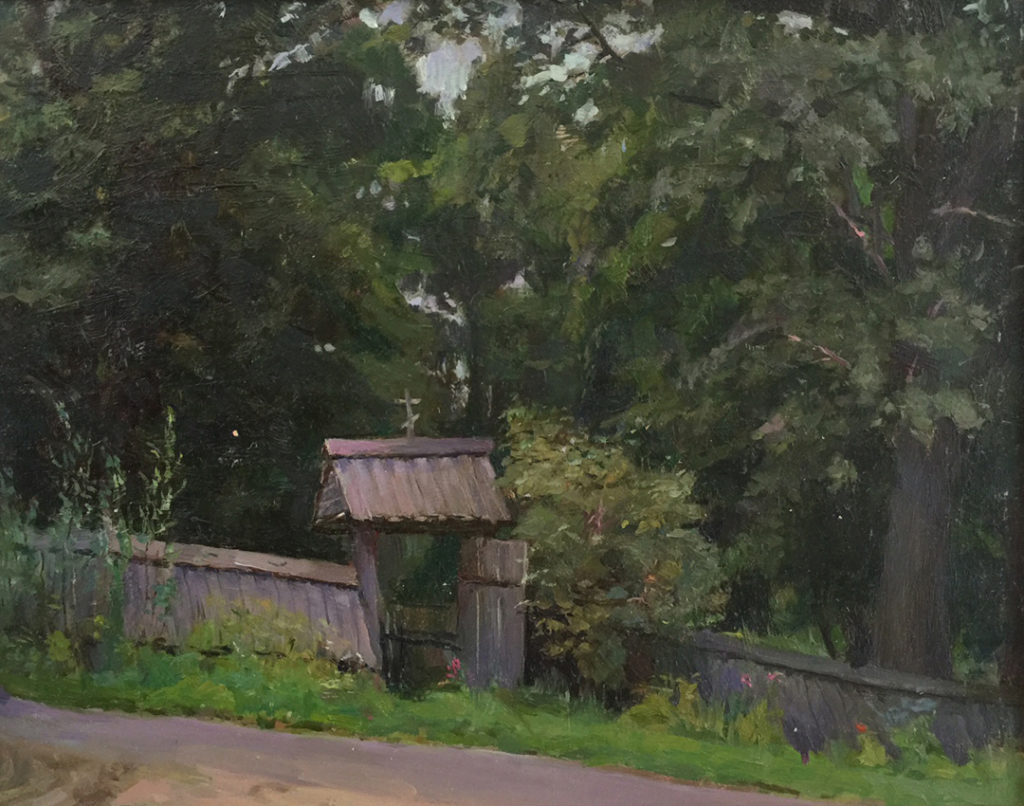
At the Edge of the Village
18 x 24 in.
Oil on canvas
$3200
Available for purchase through the artist

During her life as a painter, Nancy Tankersley has moved fluidly from portraiture to still life and figurative paintings and finally on to landscapes. “I think it is important for contemporary artists to capture the land and the people as they are today. I do not try to romanticize or invent my subjects, but I do try to show the beauty of the ordinary. People engaged in their occupations, enjoying their leisure time by eating, shopping or just strolling down a street, as well as abandoned and often overlooked landscapes … all of these are ordinary subjects, which can make extraordinary paintings. I try to paint from life as much as possible so that my work has the authenticity that comes from capturing a moment in time.”

The breadth of her themes has enabled her to draw what she has learned from each and apply that knowledge with conviction in one painting. In this recent painting, At the Edge of the Village, Tankersley draws upon her memory of time spent in a small French village where she taught for three summers. Aided by plein air sketches and photos from the same spot, Tankersley was able to combine different elements to come one up with this dynamic composition. Much of this painting was painted with palette knives and other tools in addition to traditional brushes.

Tankersley has recently published a book of her first figurative theme, figures on the beach, that contains 64 color images of paintings from the past 25 years.
 On the Beach is available through her website.

Her two instructional DVDs, Painting Figures from Photographs and Essential Painting Principles, are available here.

Mona Lisa and The Birth of Adam: The Power of Faces in Art

2
Mystery of Mona Lisa - FineArtConnoisseur.com

On the mystery of the Mona Lisa > An essay by Dr. Dan Hill, author of “First Blush: People’s Intuitive Reactions to Famous Art.”

BY DR. DAN HILL
Author of “First Blush: People’s Intuitive Reactions to Famous Art

Acclaim for Leonardo da Vinci’s Mona Lisa qualifies as a good place to start in discussing why faces matter in art. That’s true not only because of da Vinci’s celebrated genius, but also because anyone who considers the portrait to be magical mostly because of Mona Lisa’s faint “smile” is missing the point. There are several different emotions evident on Mona Lisa’s face – with happiness being merely one of them.

Look closely and in viewing the painting you’ll see a smirk at play on the right side of the woman’s face. Why might Mona Lisa be showing a sign of contempt? Could it be that as the wife of a successful Florentine merchant, she’s betraying her sense of herself as superior to da Vinci (a painter of illegitimate birth)? Or in turn, what about the woman’s taut left, lower eyebrow – a sure sign of anger. Where does that feeling come from? And the same question pertains to the raised chin that signals a mixture of anger, disgust and sadness. What’s the possible story behind those emotions?

Could it be that Mona Lisa simply felt this way often, characteristically, and da Vinci picked up on that tendency? Or is it possible that Mona Lisa had grown weary (sadness) and annoyed (angry) and finally even put off (disgust) by da Vinci’s perfectionism? After all, even before the painter carried the painting on the back of a mule to Paris, where he kept refining it until his death, da Vinci had already put in four years of work on this portrait – as long as Michelangelo took to paint the entire ceiling that crowns the Sistine Chapel.

Surely, part of the popularity and downright fascination we have with Mona Lisa is the portrait’s emotional richness. To describe Mona Lisa as having a world-weary smile is merely an appetizer in what’s actually a five-course meal.

How did da Vinci achieve this feat? It wasn’t by chance. Like his fellow artist and near-contemporary, Michelangelo, da Vinci took advantage of dissection to learn how human anatomy works. While in Michelangelo’s case, his focus was more on the body and contributed to works like David, in da Vinci’s case his interest had as much to do with the face.

Look at da Vinci’s famous notebooks for confirmation. The guy was the world’s first facial coder – the first person (and artist) to study closely how the face’s muscles move and the emotions those movements convey. Not for another 200 years would anybody rival da Vinci’s ability to discern the signals the face reveals.

Birth of Adam - FineArtConnoisseur.com

Faces will never go away in art for the simple, basic reason that emotions will never go away, either. It’s been said that there are only two currencies in life – dollars and emotions – and portraiture retains its central place because we want to know how people look, and how they feel. Case in point: let’s return to Michelangelo, namely, these eye-tracking results for The Birth of Adam. Why, not even naked skin carries the day here in terms of seizing the bulk of the visual attention. Instead, it’s God’s face that commands more attention.

From my studies I’ve discovered that 70% of the visual attention and 70% of people’s emotional interest or engagement will involve people looking at the face or faces in a painting or photograph when people are present. So it’s a matter of the face, the face, the face. But this is not an ordinary person’s face here. This is God’s face, and as best I know daring to show God’s face is another sign of Michelangelo’s daring talent. Showing the Virgin Mary or Jesus is fairly common in art, after all. As to daring to depict God’s face, however: I can’t think of a single other instance of an artist ever having done so across the history of art!

ABOUT THE AUTHOR
Dan Hill, Ph.D., is the author of “First Blush: People’s Intuitive Reactions to Famous Art,” the largest study ever conducted involving eye tracking and facial coding to capture see/feel responses to art.

Fine Art Today covers artists and products we think you’ll love. Linked products are independently selected and linked to for your convenience. If you buy something using a link on this page, Streamline Publishing may receive a small share of that sale.


> Visit EricRhoads.com to learn about more opportunities for artists and art collectors, including retreats, international art trips, art conventions, and more.

> Sign up to receive Fine Art Today, our free weekly e-newsletter

> Subscribe to Fine Art Connoisseur magazine, so you never miss an issue

American Women Artists: 2020 Winners

0
“Head Study of Matthew Innis” by Nicole Moné, Oil on panel, 18” x 36”

Congratulations to all the artists juried into the 2020 American Women Artists Spring Online Juried Show.

From the organizers:

More than 1,300 artworks were submitted, out of which 124 incredible pieces were chosen. Of those juried into the show, 15 were awarded prizes. The jurors were: Tonya Turner Carroll (NM), Ellen Woodbury (CO), and Nadine Robbins (NY).

New York artist, Nicole Moné is this year’s Grand Prize Winner.

“I’m overwhelmed, honored, and humbled to have won the Grand Prize,” wrote Nicole. “To have received this honor is all the more meaningful knowing the caliber of artists in AWA.”

Nicole’s painting, Head Study of Matthew Innis (above), is a portrait of the Editor-in-Chief of Underpaintings online magazine and one of her closest friends. They met in a painting class at School of Visual Arts in New York City. This painting is infused with random bits from 16 years of inside jokes–an homage to a friendship rooted in art and doused in twisted humor. “I’ve never laughed so much while working on a painting! I think Matthew agrees that I used tremendous restraint while depicting my perspective of his inner world. You can just take my word for that,” said Nicole.

“During this strange and uncertain time, to receive this recognition from an organization I so admire is a poignant reminder of how sweet life can be even as we press on through difficulty,” Nicole continued. “I’m honored to be a part of AWA. Thank you!”

“Heirloom Tomatoes” by Patricia Coonrod, Oil on canvas, 20” x 20"
“Heirloom Tomatoes” by Patricia Coonrod, Oil on canvas, 20” x 20″
“Dune Blooms” by Terri Ford, Pastel, 16” x 20”

View the winning paintings here.

WEEKLY NEWS FROM THE ART WORLD

Fill your mind with useful art stories, the latest trends, upcoming art shows, top artists, and more. Subscribe to Fine Art Today, from the publishers of Fine Art Connoisseur magazine.

  • This field is for validation purposes and should be left unchanged.