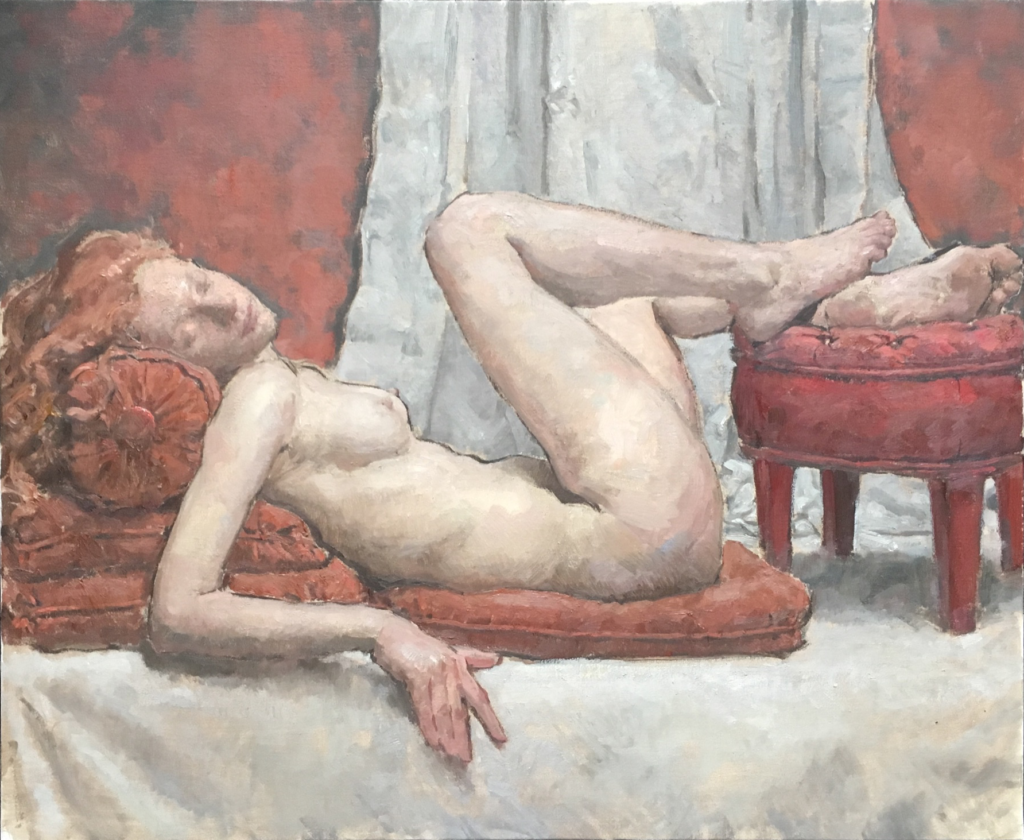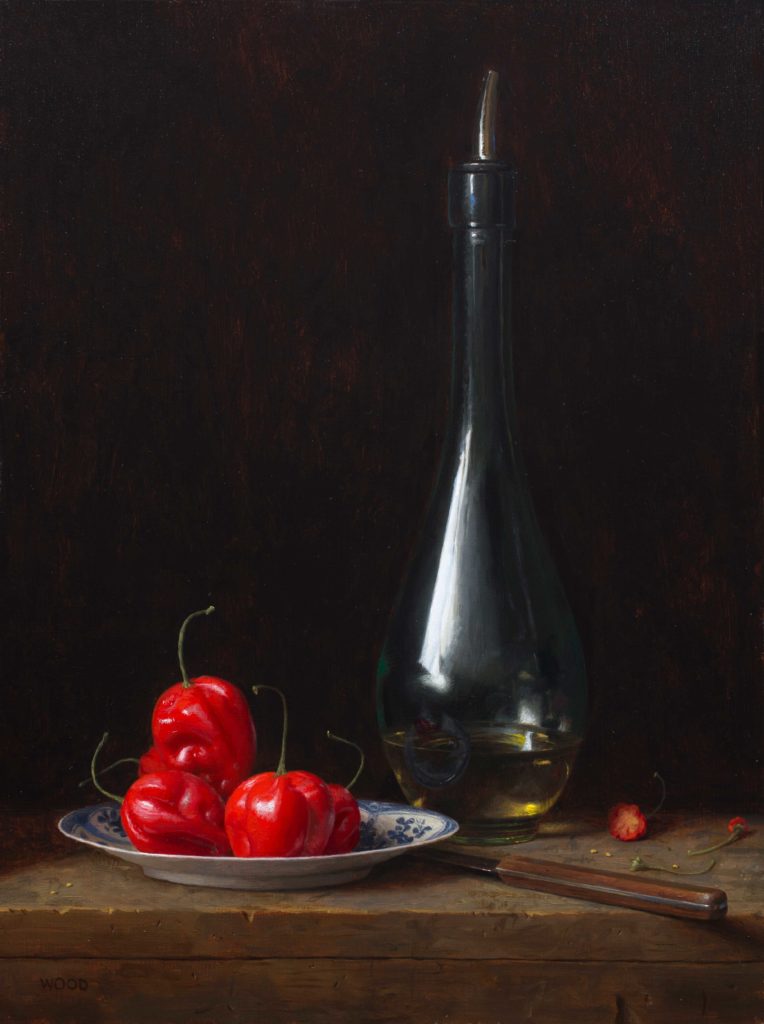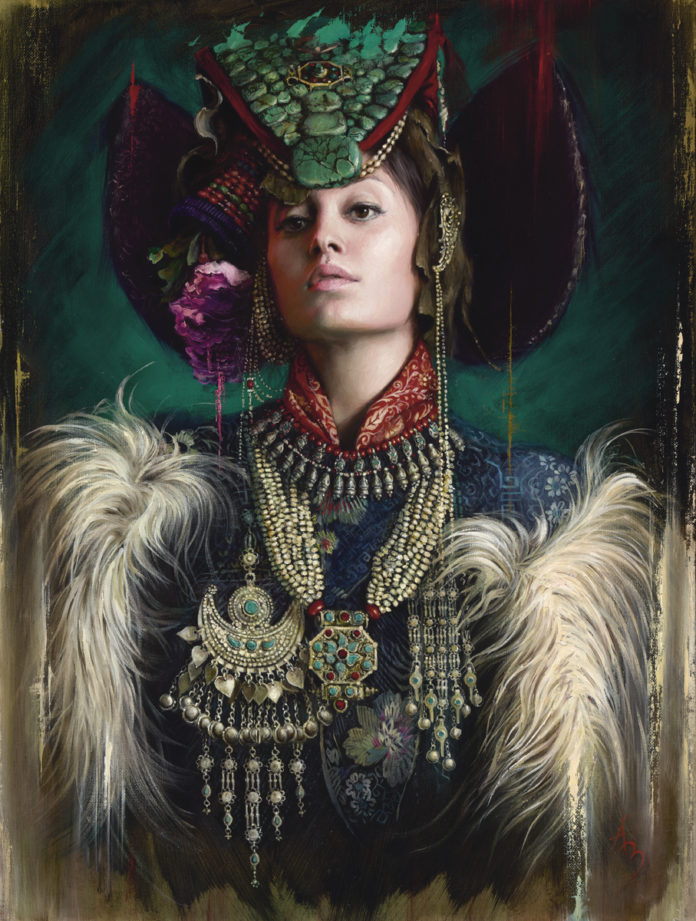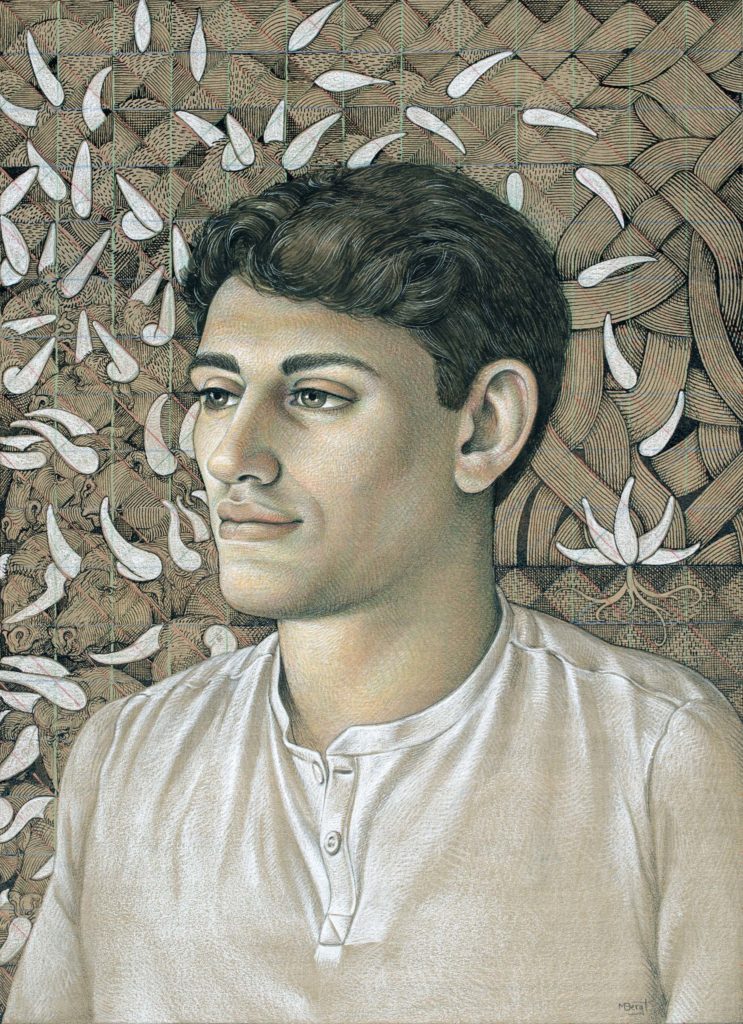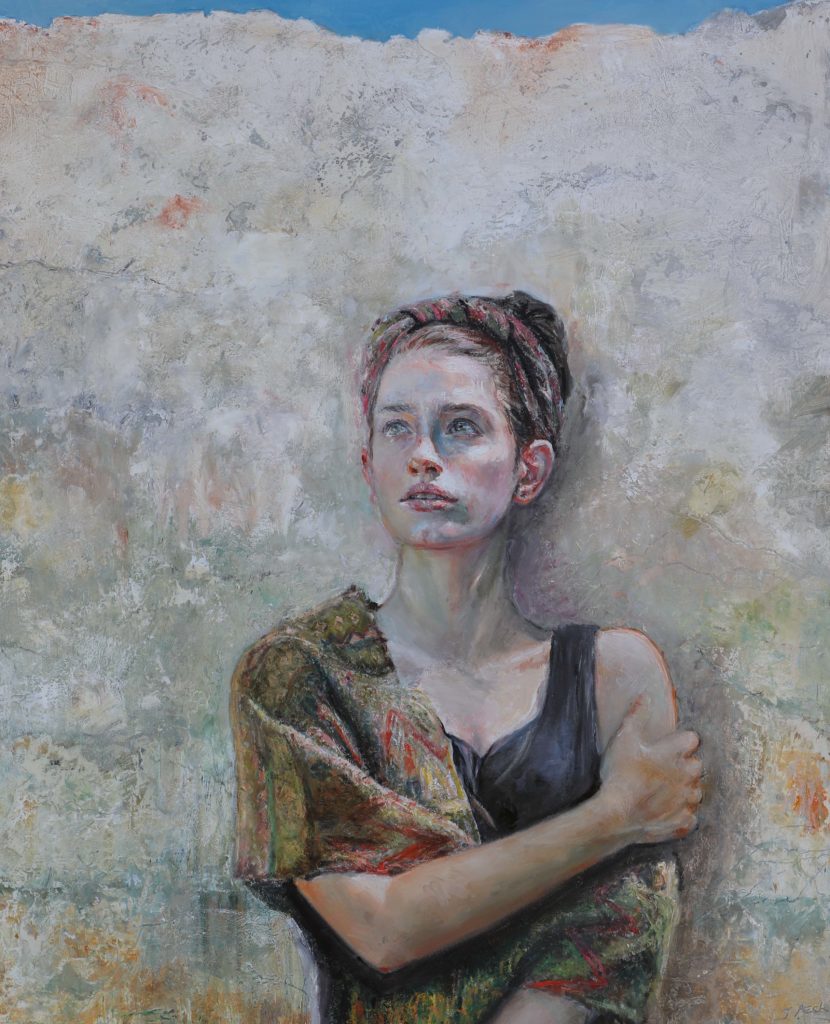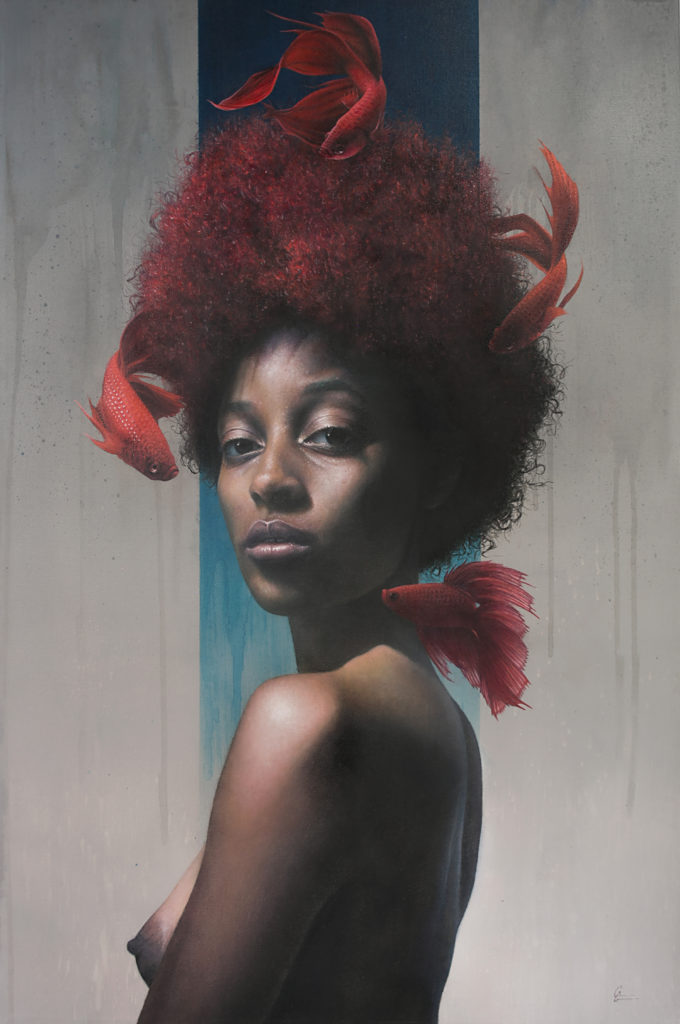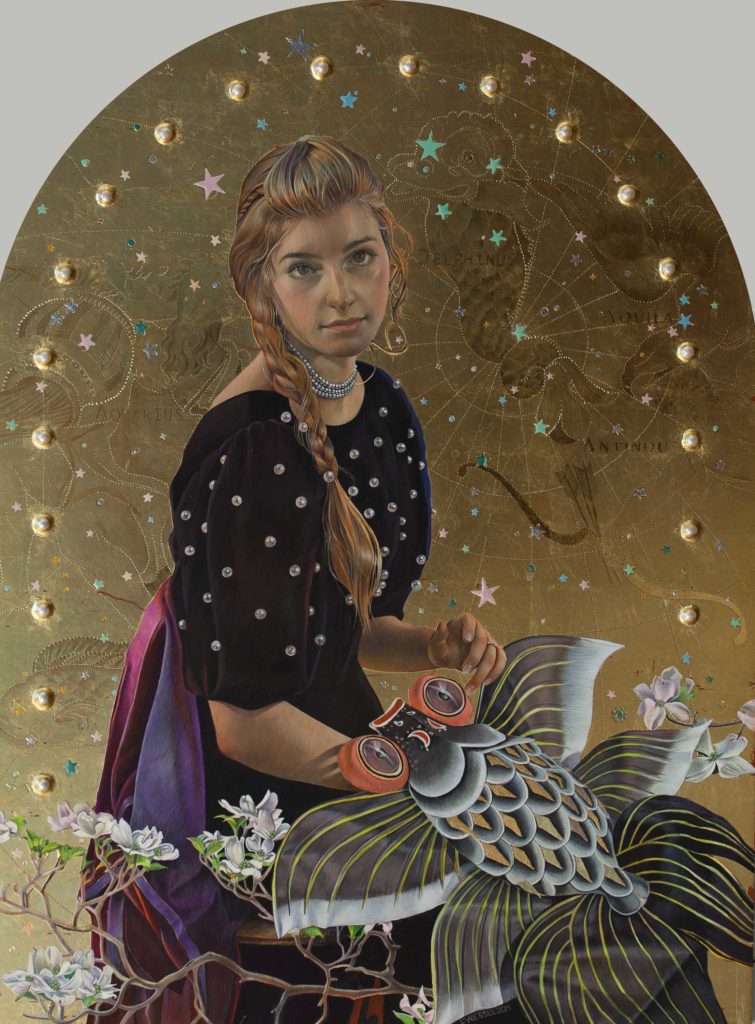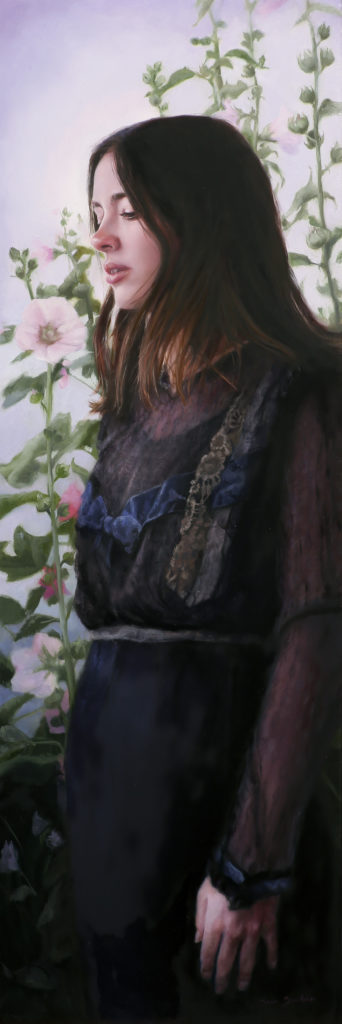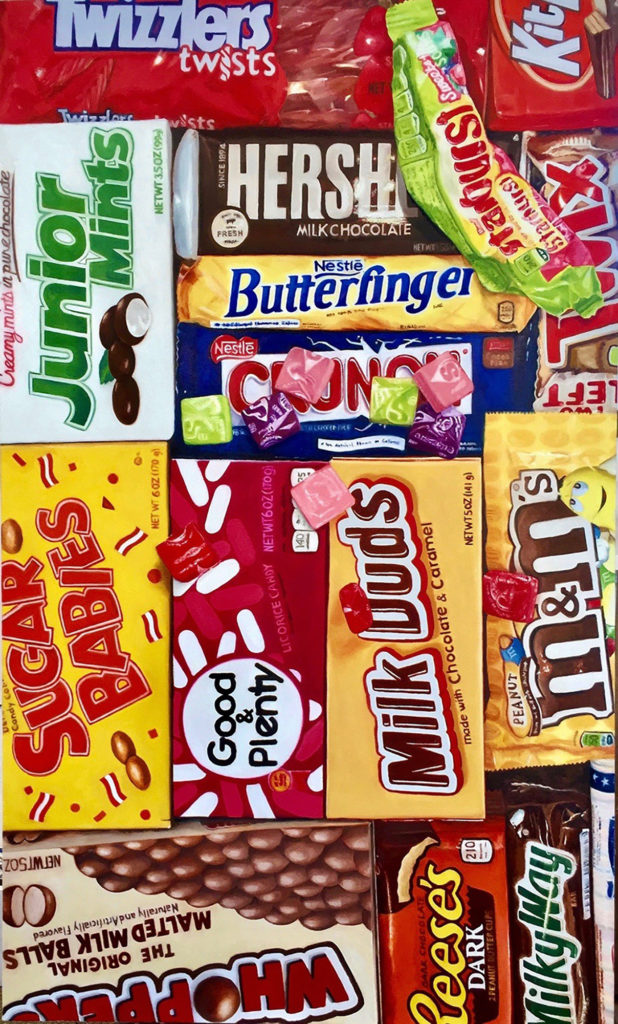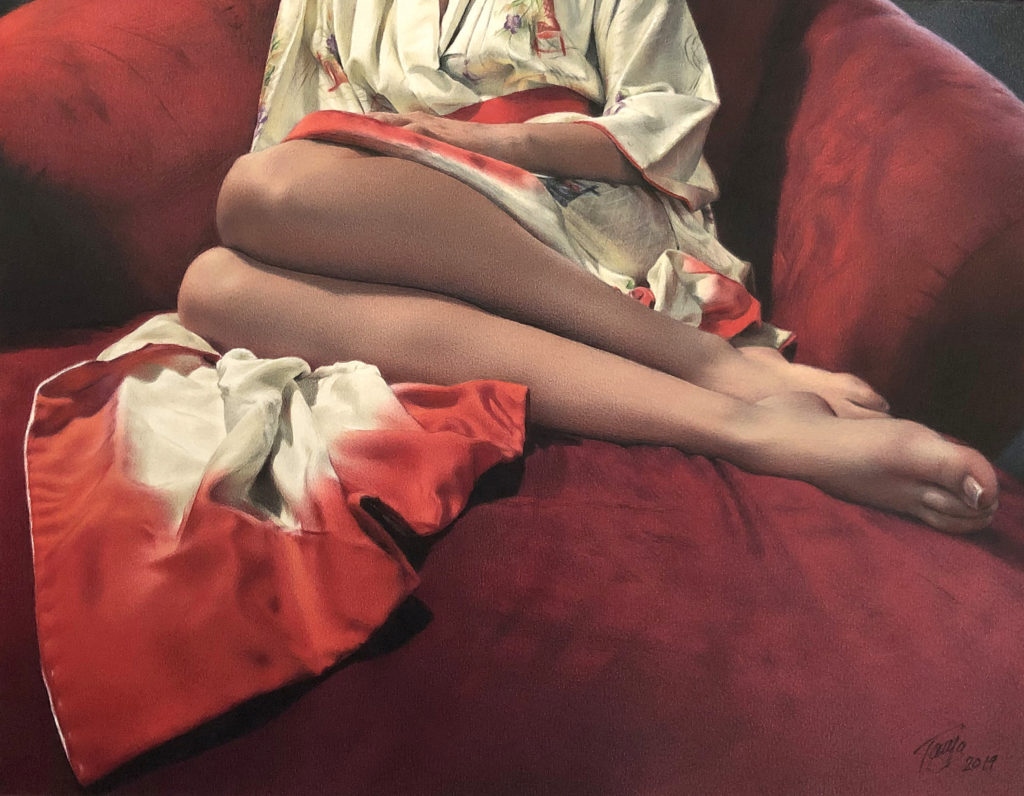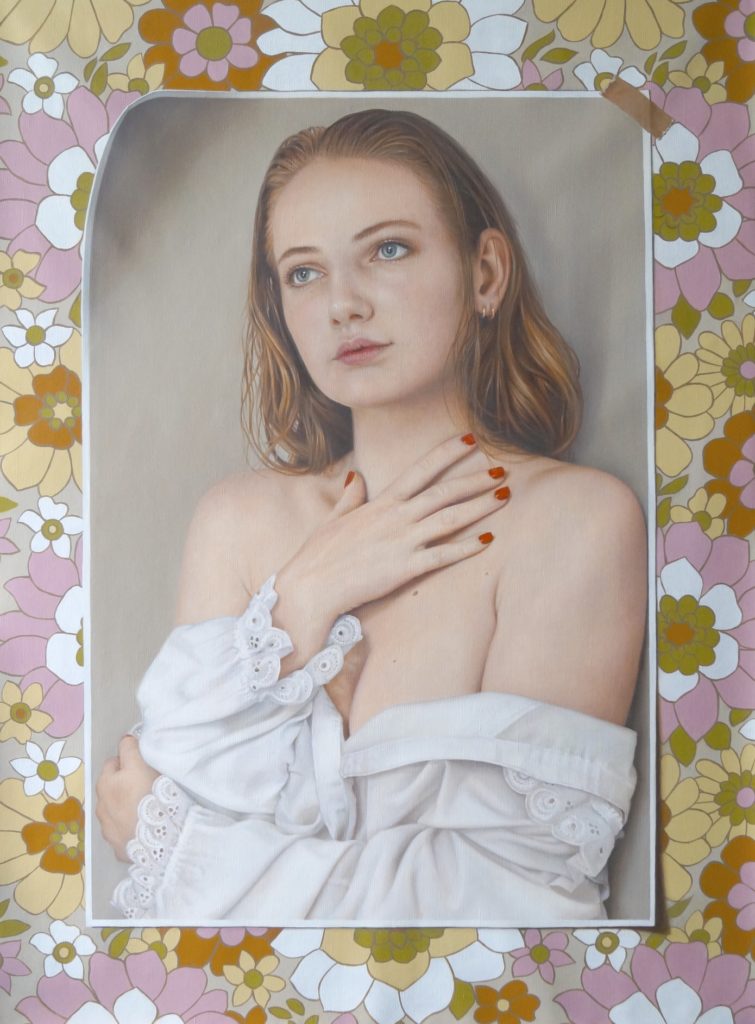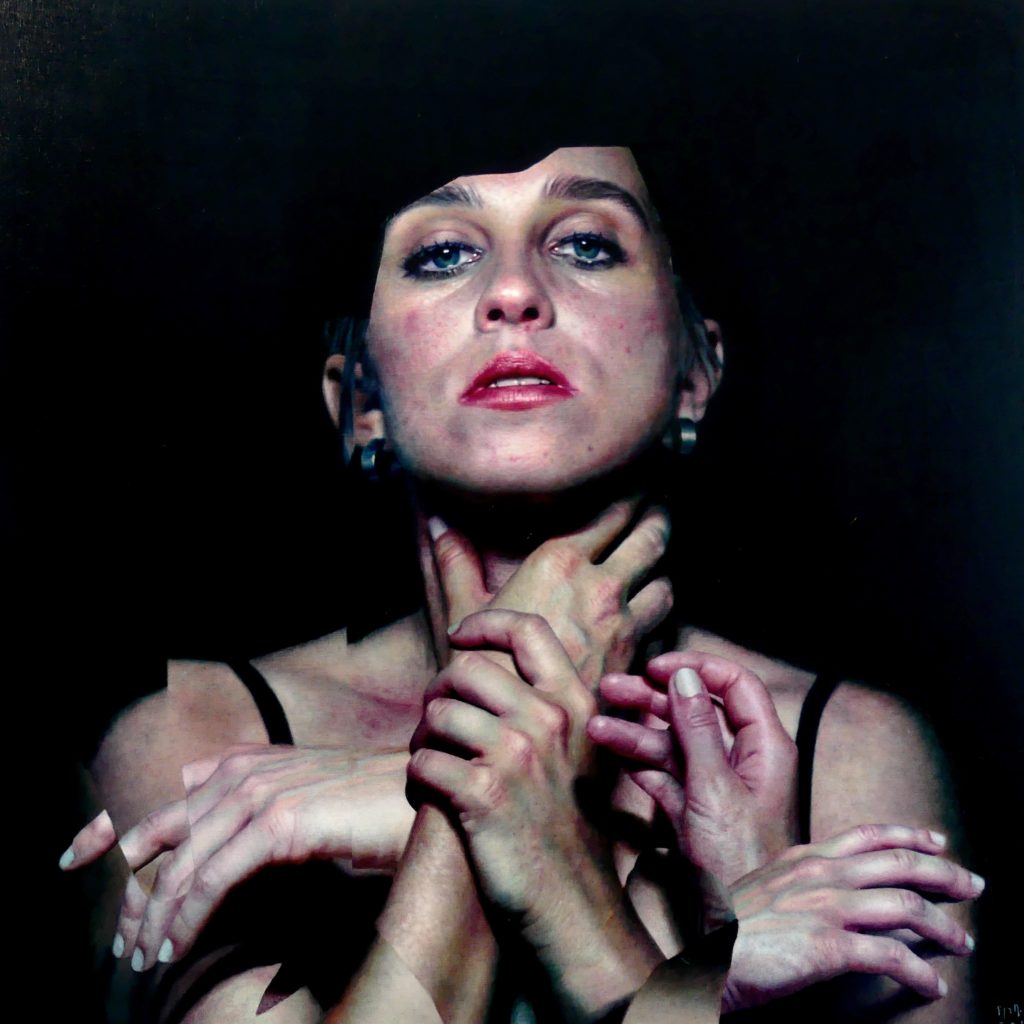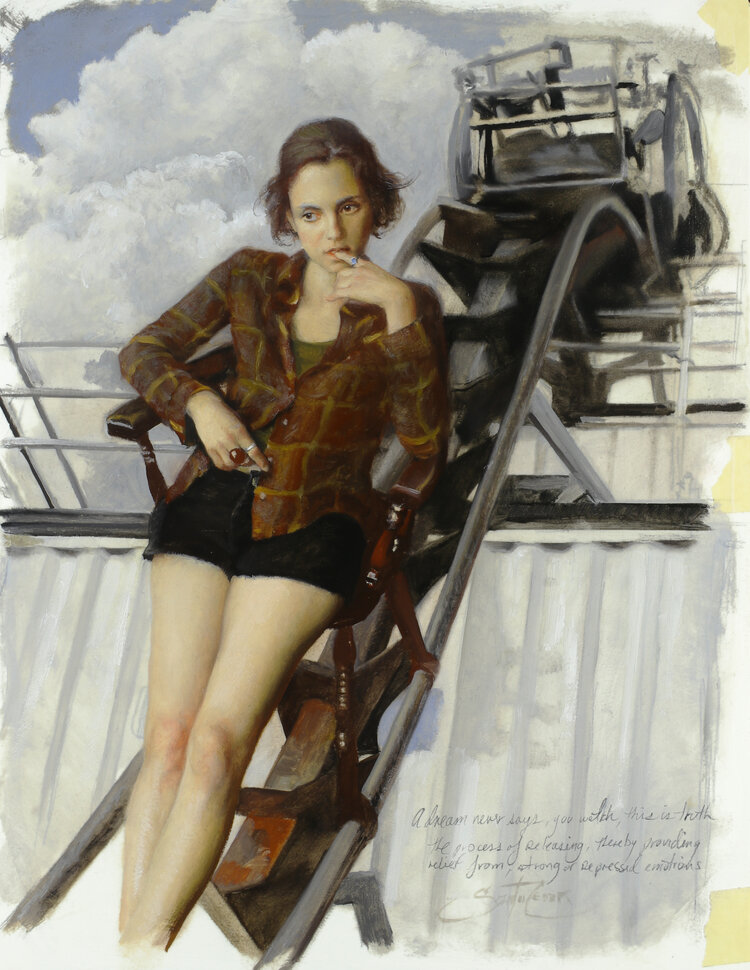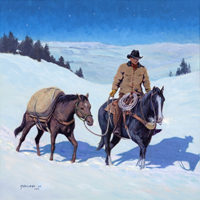

Alan Feltus, “Near Distance,” 1992, oil on linen, 39 1/2 x 55 in.
“Alan Feltus: An Air of Stillness” is on view at Winfield Gallery (Carmel, California) through December 8, 2019.
From an Essay on Alan Feltus, by Helaine Glick:
A captivating air of stillness underlies all of Alan Feltus’s figurative tableaus. His self-possessed females and their male counterparts inhabit a private realm suspended in time and space, and nothing out of context interferes to break the spell. With his rich but unobtrusive brushstrokes, precise palette of tempered Mediterranean color, and uncannily perceptive eye, Feltus gives expression to rarified and faintly voyeuristic scenarios suffused with longing, expectation, boredom, anticipation, uncertainty, and regret. Both hypnotic and mysterious, his paintings pose many questions but reveal few answers.
Alan Feltus, “And Now What?” 2013, oil on linen, 47 1/4 x 39 1/4 in.
Feltus came of age in mid-twentieth century New York City. Raised by a beautiful but troubled bohemian mother, he was often left to his own devices. He attended alternative schools and spent one high school year in Rome with her, but it was his association with her artist friends—some of whom became mentors—that inspired him and helped him to thrive. He spent hours in New York’s Metropolitan Museum of Art and the Museum of Modern Art, where he developed a keen awareness of the scope of art, and of his own tastes and preferences. Henri Rousseau’s “The Sleeping Gypsy” was a favorite, as were the haunting paintings of French-Polish artist Balthus. By the early 1960s, Feltus landed in art school, eventually earning his master of fine arts degree in painting at Yale University. While teaching at the School of the Dayton Art Institute in Ohio, he was awarded the Rome Prize Fellowship (Prix de Rome), which meant a two-year stay at the American Academy in Rome.
Living again in Rome was extremely fruitful for Feltus. He had no constraints or requirements to fulfill, and was free to experiment in a beautiful studio and roam the city’s galleries and museums. During this period he discovered a work that would become central to his artistic life—the painting “Susanna,” by Italian artist Felice Casorati, installed at the Gallery of Modern and Contemporary Art. A casually intimate scene of a nude woman seated next to to a fully clothed man in a closely defined interior space, it struck him like a bolt of lightning. The painting seemed to him to have “everything I could want my own paintings to have.” He considered it the perfect composition: two figures, select pieces of furniture, and a few scattered papers. It had the “quiet, contemplative character” that he craved. This work solidified Feltus’s commitment to narrative figure painting, and endorsed the kind of work his nature directed him towards.
Returning to the United States, Feltus took up a full-time teaching position at the American University in Washington, DC, and began to regularly exhibit his work at the Forum Gallery in New York City. He married artist Lani Irwin, and settled on a farm in Maryland, to teach and paint. But the pull of his Italian experiences and a life dedicated solely to art led him to conclude his teaching career of twelve years, and with his family, relocate to the historic town of Assisi in Italy.
Alan Feltus, “The Red Ribbon,” 2013, oil on linen, 47 1/4 x 39 1/4 in.
Arthur Haywood, “Egyptian Mathematics,” 18 x 25 in.
Based on the theme “Pure Truth, Pure Kindness, and Pure Beauty,” New Tang Dynasty Television has organized the NTD International Figure Painting Competition since 2008 to revive the traditional art of realistic oil painting.
This fifth competition entered more than 400 figure paintings by 258 artists from 46 countries, of which 104 were selected.
Apelles Zhou, “Watch the Emptiness,” 24 x 35 1/2 in.Manu Saluja, “The Dhol Player,” 30 x 38 in.
2019 NTD International Figure Painting Competition, November 24 – November 30, 2019
Location: Salmagundi Club, New York City
The auction will be on November 30, 1:00 p.m. – 3:00 p.m.
On November 29, 2019, there will be a demo and live figure painting on site.
Peter Wenzel (1745–1829), “Wild Turkey,” c. 1800, oil on canvas, 38 1/2 x 28 1/2 in., Bagshawe Fine Art
London Art Week (londonartweek.co.uk) sees galleries throughout the neighborhoods of Mayfair and St. James’s open their doors for special exhibitions. On view will be artworks dating from antiquity to the present day. On December 2, a symposium will offer participants a new platform for debate on ethical issues facing the art world. The week coincides with the Old Master sales conducted by London’s major auction houses.
London Art Week takes place December 1–6, 2019.
Eduard Fechner, “The Head of a Young Boy Wearing a Fur Hat,” pencil, Stephen Ongpin Fine ArtGallery Interior, the Weiss Gallery (copyright Marcus Peel)
Daniel Maidman, "Saint Rebecca," (2018), 18” x 24”, Oil on canvas
Equity Gallery (NYC) recently announced “It Could Be You: Portraiture in a Constructed World,” a comprehensive group exhibition of contemporary portraiture juried by Hyeseung Marriage-Song, Beverly McNeil, and Patricia Watwood. The show features more than 30 international multidisciplinary artists whose artwork explores both the purpose and limits of portraiture, identity, and the self in the modern digital age.
Hyeseung Marriage-Song, “Selfie,” (2017), 20” x 36”, oil on linenAndrew Cornell Robinson, “Lodrys,” (2019), Graphite on cotton rag paper, 27 ⅝” x 21 7/16”, 70 x 55 centimeters, (frame 28 11/16” x 22 11/16”, 73 x 63 centimeters)Trudy Borenstein-Sugiura, “Rising Son,” (2018), 14” x 17”, Found Personal Papers and Documents
More from the gallery:
Somewhere between the introduction of cheap camcorders and the proliferation of smart phones we became distrustful of our body’s ability to mediate directly with the physical world. To a large extent we have exchanged the sensual perceptions emanating from our surroundings for simulated experiences that mitigate reality through camera lenses and digitalized imagery. Once understood to be aide-mémoirs of life’s lived experiences, the media is reality—a reality comprising instantly shareable content validated or refuted by social media emojis.
That’s a risky way to construct one’s universe. How can we hope to fix an identity, let alone one informed by ethical principles, on a mutating digital stage that is subject to the whims of marketing algorithms and bots on a mission? Given present conditions, it’s no wonder that our instinct to ascertain “what’s real” has devolved into an addicting stalk for pleasure hits that never quite satiate an appetite weaned on spectacle.
Natalie Italiano, “Remembrance,” (2017), 30” x 22”, Oil on canvas
That said, can we stake out what is abiding, true, and stable about us and our fellows? In an increasingly alarming and chaotic era, art that depicts what is actually there and recognizable is defiant — and nothing could be more necessary and reassuring at the moment than simply showing what we actually look like (and mean) to each other.
Linnea Paskow, “Portrait of C,” (2019), 30” x 22”, collage of magazine and paint fragments
In “Corpo a Corpo,” 35 contemporary figurative artists from 12 countries present their works inspired by the classical tradition of the Great Masters of the past. This initiative, promoted by the Fondazione CR Firenze and the Fondazione Parchi Monumentali Bardini e Peyron, will be on view at Villa Bardini through January 12, 2020, in Florence, Italy.
More from the organizers:
The exhibition is curated by Daniela Astone and Gaia Grazioli and coordinated by professor Carlo Sisi, chairman of the Accademia delle Belle Arti of Florence and is accompanied by a catalog (Polistampa, 106 pages), which makes use of the scientific contribution of professor Giovanna Uzzani.
The expression “corpo a corpo” indicates a close-range hand-to-hand combat. Metaphorically speaking, it is an action that synthesizes man’s daily struggle with himself in confronting life in all its complexity, and in this sense it appears both violent and poetic.
“Corpo a corpo” also represents the felicitous union between a technical gesture and the representation of a form that urges the artist to embark on an endless journey of personal exploration, always aimed at achieving excellence.
By Teresa Oaxaca
The 35 protagonists of this exhibition are no exception and tell us through their drawings, paintings, and sculptures their “body to body.” They draw inspiration from the great masters of the past, dedicated to an uncompromising practice, at the service of each one’s own reflection and creative autonomy.
This anthology of personality communicates with each other and with the public through a common language that has no boundaries or barriers, being the universal one of figuration. Some of the artists present in the exhibition are self-taught, and many have attended private academies or ateliers.
By Kate Leman
Today there are several academies located all over the world entirely devoted to the practice and study from life: from the United States to Russia, from China to old Europe, all the threads seem to intertwine in Florence. For almost 30 years, Florence has been recognized as a center of excellence for figurative arts training. Indeed, the city is home to countless academies, schools, and ateliers frequented by artists from all over the globe who come to develop classical painting and sculpture technical skills.
By Ben Fenske
The 35 works on view include drawings, paintings, and sculptures by artists hailing from 12 countries: Australia, China, Greece, Ireland, Israel, Italy, Poland, Russia, Spain, Sweden, the United Kingdom, and the United States.
By Eudald de Juana
Thus, “Corpo a Corpo” promises to present visitors with a selection of high-quality works that represent the figurative arts field, a prime example of which is Italy’s acclaimed artist Pietro Annigoni, whose permanent museum can be also found within Villa Bardini’s halls.
Luigi Salvadori, president of the Fondazione CR Firenze stated, “We are thrilled to host the upcoming exhibition ‘Corpo a Corpo,’ which offers us the opportunity to spotlight Florence’s international side.” He added, “The exhibition represents the city’s openness to the world, a value that Fondazione CR Firenze believes is important to communicate.”
Jacopo Speranza, president of the Fondazione Parchi Monumentali Bardini e Peyron added, “Villa Bardini welcomes the upcoming exhibition with great satisfaction. It is only natural that the home of the Annigoni Museum pay homage to classical arts through ‘Corpo a Corpo.’ We are proud of this new initiative, which affirms Villa Bardini’s commitment to offering visitors internationally relevant experiences.”
The works in this exhibition are intended to emphasize that figuration coexists with the contemporary, that the styles and techniques of tradition relived with the experimental sensibility of our time are able to describe unconventional feelings and imaginations but share in the certainties and worries of the world in the making. On the occasion of the exhibition there will be a series of events with free admission, by reservation (tel 055 20066233 – [email protected]), organized by Daniela Astone, whose aim is to introduce the various methods of dealing with drawing and painting from life.
Please visit www.villabardini.it for more information.
Jove Wang, "Suzdal, Russia," Oil on canvas, 18" x 32"
American Legacy Fine Arts (Pasadena, CA) recently announced its “Fleeting Moments 2nd Biennale: Works en Plein Air,” a group exhibition that takes an extraordinary look at the contemporary painting movement. With more than 40 new works created by 24 artists, the exhibition focuses on continuing the evolution and growing appreciation of painting outdoors to capture the ephemeral qualities of natural light.
Jennifer Moses, “Reflections in Time, “Oil on linen panel, 8″ x 16”
More from the gallery:
By concentrating on the most active and influential as well as up-and-coming painters in this movement, the exhibition examines how skilled artists interpret spatiotemporal occurrences — events that happen in a split second of time and space — and connect those momentary experiences to universally felt emotions.
Nikita Budkov, “Towards the Light,” Oil on canvas, 18″ x 14″
With “Fleeting Moments 2nd Biennale,” American Legacy Fine Arts joins in the discourse of defining plein air (outdoor) painting to include elements of light and its momentary effects; the relationship of juxtaposed colors; and brushwork that is loose, lively, broad, or impasto. Smaller works may be completed in their entirety out-of-doors, while large-scale plein air paintings may be done in the studio with the use of on-location studies and color notes taken in nature.
Stephen Mirich, “Storm Break, San Pedro,” Oil on canvas, 9″ x 12″
“Fleeting Moments 2nd Biennale” celebrates these 24 groundbreaking artists, who are redefining the plein air experience today. The exhibition is on view November 22 through December 15, 2019 at American Legacy Fine Arts.
David Dibble, “Rainy Creek,” Oil on canvas, 10″ x 8″
Featuring:
Peter Adams, Brian Blood, Keith Bond, Nikita Budkov, Christopher Cook, Steve Curry, Karl Dempwolf, David Dibble, Kathleen Dunphy, Chuck Kovacic, Jean LeGassick, Calvin Liang, Stephen Mirich, Jennifer Moses, Michael Obermeyer, Tony Peters, Daniel W. Pinkham, Robin Purcell, Dan Schultz, Kevin Short, Amy Sidrane, W. Jason Situ, William Stout,and Jove Wang.
Betsy Ashton, “Porez Luxama: Public School Teacher from Haiti,” 2018, oil on canvas, 40 x 30 in.
Porez Luxama’s family was “exiled” from Haiti after a military coup. He had just finished high school and spoke no English but won a soccer scholarship to St. John’s University (New York City). There he majored in math and science, which he now teaches in a public junior high school. Porez also founded and runs the Life of Hope community center, which teaches English, reading, computer, leadership, and other skills to (mostly Haitian) immigrants, and which also offers family and legal counseling.
The work of Betsy Ashton was shown in Long Island City, the artistic Queens neighborhood across the East River from Manhattan, in a groundbreaking exhibition called “Portraits of Immigrants: Unknown Faces, Untold Stories.” This show featured 10 life-size oil-on-canvas paintings, all created by Betsy Ashton (b. 1944), whose journey to this milestone has been totally unique. Visit ashtonportraits.com to make arrangements for this exhibition to be on view in your area, and click here to make a contribution to the project via GoFundMe.
In 1971 Betsy Ashton was an illustrator, artist, and art teacher just three credits away from earning an M.F.A. at American University in Washington, D.C. At that moment she abandoned fine art to pursue what became an award-winning career on television. She started, in fact, by teaching art on a local channel, but soon was reporting and anchoring the news. While working for Washington’s WJLA, she became the only TV reporter ever to draw her own courtroom sketches while covering trials; they were shown on the news daily and exhibited in a prominent local gallery. Ultimately Ashton moved to New York City, where she became a well-recognized fixture at CBS News.
In 2006, Ashton resumed her career in painting at the urging of the renowned portraitist Everett Raymond Kinstler, whose workshops she attended. (She also studied with Mary Beth McKenzie and Sharon Sprung at the National Academy School of Fine Arts and the Art Students League of New York.) For the past 11 years, Ashton has made a name for herself painting commissioned oil portraits of the rich and accomplished.
Then everything changed. Ashton explains:
“The maligning of immigrants and refugees that took place during and following the 2016 presidential election, which continues to this day, has compelled me to seek out, paint, and tell the stories of the immigrants that I see, who are not a threat to America, but an asset. Immigrants from everywhere are all around me in New York City: the subway alone contains every gene pool on the planet. Using journalism skills honed in my prior career, plus my talents as a visual artist, I am interviewing and painting a variety of people who were not born here but who chose to come to this country, or were brought here as children, seeking safety, freedom, opportunity, or all of the above. The ones I meet work hard — extremely hard — to support their families here and, in some cases, abroad as well.”
Ashton approached the New York Immigration Coalition and several churches, asking them to help her find sitters willing to be painted and interviewed. There was no shortage of candidates. The 18 sitters Ashton painted are of different ages and from diverse cultures, but all have, in her words, “struggled in ways that typical Americans cannot even imagine.” Most have official immigration documents (indeed some are now citizens), but a few are hoping and praying to avoid deportation. Ashton has “agreed not to reveal the names of the undocumented; I don’t even want to know where they live.”
Few of these people would normally sit for a professional portrait because they were working too hard to slow down. Accordingly, Ashton did not take up much of their time: she interviewed, sketched, and photographed each person in one or two sittings, then returned to her Long Island City studio to paint the life-size oil portrait from her sketches and photos. Those who completed the process received a high-quality print of their portrait and copies of Ashton’s reference photos, plus photos tracing the portrait’s daily progress in the studio.
Ashton wants “the viewing public to better understand who these people are, what they have sacrificed to come here, what living here means to them, and what contributions they have made to their adopted country. I believe that the viewers of my portraits will discover ‘kindred spirits’ who are, in many ways, as ‘American’ as they are.”
This exhibition project has been designed so that the portraits can be displayed together at churches and other sympathetic venues, and also at galleries and museums. In 2018 it was on view at Long Island City and at Indianapolis’s Christ Church Cathedral; in early 2019 it was at Saint Thomas Church on Manhattan’s Fifth Avenue. (Ashton encourages readers of Fine Art Connoisseur to contact her with leads about venues that might be interested in future exhibitions.)
“The public,” Ashton says, “can look into my sitters’ eyes, examine their posture, read their stories, and sense who they are and what they are bringing to the country.” The summaries of their life stories that Ashton has written appeared beside their portraits, encompassing key points about their character, accomplishments, disappointments, fears, and dreams for the future. Running inside the exhibition was a film tracing the evolution of the 18 portraits, all of which have been placed in handsome frames donated by Diego Salazar, whose portrait and life story appear here.
Ashton herself wrote all of the biographical captions to accompany her portraits. Enjoy, and please do consider where else these paintings could be exhibited across America.
Portraits of Immigrants: Unknown Faces, Untold Stories
By Betsy Ashton
Betsy Ashton, “Diego Salazar: Business Owner from Colombia,” 2017, oil on canvas, 40 x 30 in.
Escaping poverty was the motivation for Diego Salazar to leave Colombia for the U.S. He is the youngest of 15 children in a Bogotá family, and his mother sold chickens, eggs, and home-made meals to help feed and clothe them all. Having earned a high school degree but lacking job prospects, Diego was given a plane ticket to the U.S. by his mother. In New York City a Colombian friend from school days got him a job as an apprentice in a frame shop. Diego paid back the ticket price by sending home $15 per month while he learned the business.
Five years later, with handshake loans from some “very kind Jewish customers who liked how hard I worked,” Diego opened a shop in his home, then rented more space, and later ran a factory. He bought one antique frame, then another, and soon was making superb replicas that he sold to major galleries and art collectors. Diego sold the business 15 years ago and turned the factory into loft apartments. He now owns three buildings in Long Island City, two of which contain artists’ studios. But Diego’s passion is collecting antique frames, and he also helps sponsor local art festivals and exhibitions. Now a U.S. citizen with two children who have graduated from college, he says, “I am living the American dream.”
Betsy Ashton, “Maria Salomé: Housekeeper from Guatemala,” 2017, oil on canvas, 40 x 30 in.
Maria Salomé was abandoned by her husband in Guatemala, leaving her with their five children aged 3 to 16. She became a laundress but couldn’t begin to feed them properly. She faced two choices: prostitution or finding a “coyote” to sneak her into the U.S. Unwilling to do “indecent work,” she asked relatives to look after the children and set off on the “very scary” journey through Mexico, across the Rio Grande, and walking through dry brush for two days until her group reached a road, where a bus picked them up at 2 a.m.
She eventually got to New York City, where Guatemalan laborers got her work cleaning up a house after renovations. She quickly became the homeowners’ beloved housekeeper. Four years later she had to return to Guatemala “because the children had become wild”— the oldest had sold the dining room furniture to buy clothing, and the twin boys’ feet were full of fungus. She cleaned them up, but again had no way to feed them.
Having left the children with a trusted aunt, she returned to New York with her 6-year-old son, who had begged to come with her but was difficult to keep quiet on the dangerous trek north. Naturally her employers were delighted to have her back. Having rented an apartment, Maria Salomé got her boy into public school and wired money to Guatemala to provide for her four older children.
They now work in banks and other reliable businesses. Alas, she has missed their graduations, weddings, and many family christenings and funerals, yet she is grateful for “the generosity of America” that “enabled me to support my family,” she says through an interpreter. Now a part-time lay preacher at an evangelical church, Maria Salomé is proud to have paid “a good lawyer” to get her the documentation she needs to remain in the U.S. Last October, she received her green card and flew back to Guatemala to visit the children she had not seen in 20 years and to meet her grandchildren. They want her to stay, of course, but she loves the U.S.: “I have a good life here. This is a good country. This is my home.”
Betsy Ashton, “John Lam: Businessman from Hong Kong,” 2017, oil on canvas, 40 x 30 in.
John Lam was a teenager when his parents brought him and six younger siblings here from Hong Kong. Seeing that he would have to miss high school in order to help support his family, John began washing dishes in a Chinese restaurant, but quickly realized that it had no future. He switched to laboring in a garment factory, handing all of his earnings to his mother. She gave him $15 a week to spend. John studied every job and machine in the business, became indispensable, and was soon tapped to be the supervisor. He worked nights as a waiter to save money and eventually, with family help, bought the business. When garment factories left the U.S., he learned the hotel business and now, as CEO of the Lam Group, builds and staffs major hotels. He employs several thousand people.
Betsy Ashton, “Beata Szpakowicz Kombel from Poland: Nurse Practitioner,” 2017, oil on canvas, 40 x 30 in.
Beata Szpakowicz Kombel was a young nurse in crumbling post-Communist Poland when her father, desperate to escape the chaos and support his family, managed to flee to America. Accepted as a refugee, it was four years before he could get a U.S. visa for Beata, then 24, and two more years before he could arrange entry for his wife. Speaking only Polish and learning that her professional training was not recognized here, Beata had to study English from scratch, then start over and repeat every one of her science, math, and nursing courses in order to be certified to work as a nurse. But she did it, working first in home care, then in a nursing home, then for many years in a doctor’s office, where she still works. She also studied part-time for the advanced nurse practitioner exam, passing it six months ago. Now she can see her own patients.
Aspen Dance
24 x 30 in.
Pastel on archival surface
Available through the artist
In frequent exploration of NY State’s woods, streams and riverbanks, Christine Debrosky has always found strength, solace and joy in nature’s gifts.
As her work has matured, the glowing effects of light in the landscape has taken center stage.
When she relocated to Arizona, the high desert brilliance enhanced her understanding of sunlight.
“One rainy, raw evening at dinner, I glanced outside as the sun burst through and lit up a stand of aspens with a beautiful rosy glow and dancing shadows. I excused myself and ran outside, knowing that I just had to paint this special moment.”
Gail Norfleet, “Impossible Landscape #1,” 2019, acrylic, collage, and china marker on two Lucite panels, 24 3/4 x 24 3/4 x 2 1/16 in. Photo courtesy of Valley House Gallery.
Plexiglass continues to be a foundational element in Gail Norfleet’s work. The clear material is the surface upon which she applies paint and collage, and its inherent transparency allows light to illuminate multiple layers. Working on the front and back, and on two panels, creates a real space. In this exhibition, Norfleet places familiar still life subjects (flowers, vases, birds) in front of brightly rendered landscapes and surreal interiors. The subjects originating from life are playfully manipulated into impossible yet compelling compositions.
“Bending toward the light, based on reality, a real and illusionistic space is painted on two transparent layers. Could the flower garden be a mirage?” —Gail Norfleet
Gail Norfleet, “Sunset on Tano Road,” 2019, acrylic, collage, china marker, and litho pencil on Lucite panel, 24 1/4 x 24 1/4 x 1 1/4 in. Photo courtesy of Daniel Barsotti.Gail Norfleet, “Tarot in the Garden,” 2019, acrylic, collage, and glitter on two Lucite panels, 37 x 37 x 2 in. Photo courtesy of Valley House Gallery.
Dallas artist Gail Norfleet earned her BFA at the University of Texas at Austin, and her MFA at Southern Methodist University. She has had solo exhibitions at the McKinney Avenue Contemporary and the former Delahunty and DW Galleries. Norfleet was recently appointed to the Advisory Council of the College of Fine Arts at the University of Texas at Austin. The Michelson Museum of Art in Marshall, Texas, will open a solo exhibition of her work in March 2020.
Gail Norfleet, “Anemones and Butterfly Orchids,” 2018, acrylic and litho pencil on Lucite panel, 24 1/4 x 48 1/2 x 1 1/4 in. Photo courtesy of Daniel Barsotti.Gail Norfleet, “Hummingbird Garden,” 2019, acrylic, collage, china marker, litho pencil, and glitter on two Lucite panels, 37 x 37 x 2 1/16 in. Photo courtesy of Valley House Gallery.
“Made in Layers” is Gail Norfleet’s fifth solo exhibition at Valley House Gallery (Dallas, TX). A catalogue from her 2016 exhibition, including an interview by Linda Ridgway, is available.
Gail Norfleet, “Mirage,” 2019, acrylic, collage, and china marker on two Lucite panels, 37 x 37 x 2 1/16 in. Photo courtesy of Valley House Gallery.Gail Norfleet, “Interior with Flower Vases,” 2019, acrylic, collage, china marker, and litho pencil on Lucite panel, 24 3/4 x 24 3/4 x 1 1/2 in. Photo courtesy of Daniel Barsotti.
“Gail Norfleet: Made in Layers” is on view, 10:00 a.m. to 5:00 p.m., Monday through Saturday, through December 7, 2019, at Valley House Gallery and Sculpture Garden.
Gail Norfleet will give an Artist Talk on Saturday, November 16, at 11:00 a.m.
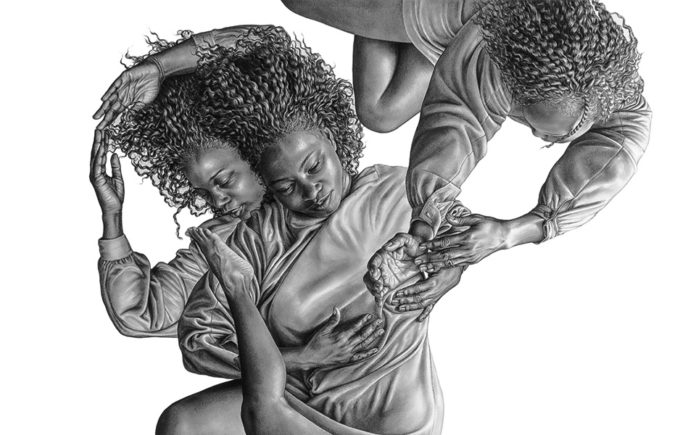
“Josephine / Rest Haven Motel,” 2017, Collection of the Fort Wayne Museum of Art
“Recently I was delighted to attend the opening gala of the Outwin 2019: American Portraiture Today at the National Portrait Gallery in Washington D.C. My drawing of Josephine, a wonderful fellow artist and even more lovely human, was one of 47 works selected from over 2,600 entries to the competition.”
“It was an honor to be represented in the triennial exhibition for a second time, and arriving for the opening felt a little bit like coming home. I had an absolute blast both meeting and reconnecting with artists from all over the U.S. who are as fascinated and obsessed with the human experience as I am. A huge thank you is due to the wonderful folks at the Fort Wayne Museum of Art for being so accommodating, generous, and supportive during the entire process.”
(L) “Josephine / Rest Haven Motel,” 2017 (R) The artist with Swoon (center) and Sedrick Huckaby (right)
The exhibition will be on view at the National Portrait Gallery through August 2020, and then will embark on a year-long national tour.
“Looking ahead, I will have brand-new work on view during Art Basel week in Miami. Details are forthcoming, but below is a sneak peak of the new works continuing my recent explorations into the history, cultural outgrowth, and human cost of nuclear testing in the United States.”
(L) “Miss Atomic,” 52 x 39 in. (R) “Operation Repo / After Michael Light, After unknown,” 52 x 39 in.
UPCOMING:
December 2019: Art Basel Miami (Context Art Fair and Scope Art Fair), Miami, FL
Spring 2020: Wignall Museum of Contemporary Art, Chaffey College, Rancho Cucamonga, CA
CURRENTLY ON VIEW:
September 2019 – January 2020: “Dorthea Lange’s America,” Gilcrease Museum of Art, Tulsa, OK
November 2019 – “The Jaunt Group Exhibition,” Legion Gallery, San Francisco, CA
Fill your mind with useful art stories, the latest trends, upcoming art shows, top artists, and more. Subscribe to Fine Art Today, from the publishers of Fine Art Connoisseur magazine.