Paul Gauguin, French, 1848–1903; “Chanteuse,” 1880; wood (mahogany), plaster, paint, and gilt; 20 7/8 × 20 7/8 × 5 1/8 inches; Ny Carlsberg Glyptotek, Copenhagen EXH36.47
Best known as a painter, Paul Gauguin was an inventive and versatile artist who also created woodcarvings, ceramics, and prints. This summer, the Saint Louis Art Museum will celebrate the range of Gauguin’s artistic output from his early Impressionist paintings to his iconic works from Brittany and Tahiti to his fascinating exploration of three-dimensional objects.
Paul Gauguin, French, 1848–1903; “Modern Thought and Catholicism,” written 1897–98, transcribed in this form 1902; manuscript with two woodcuts and two transfer drawings on the cover; 12 5/8 x 7 1/16 x 13/16 inches; Saint Louis Art Museum, Gift of Vincent L. Price Jr., in memory of his parents, Marguerite and Vincent L. Price 287:1948
Featuring 90 works of art, most from the world’s leading collection of works by the artist, “Paul Gauguin: The Art of Invention” will be the Saint Louis Art Museum’s first exhibition highlighting the exceptional range of the artist’s production. The exhibition opens July 21.
The exhibition will include more than 50 works of art from Copenhagen’s Ny Carlsberg Glyptotek, including masterworks like the Impressionist painting “Woman Sewing” and “Tahitian Woman with a Flower,” one of the first pictures Gauguin painted on the island, as well as more than 20 sculptural works that reveal Gauguin’s skill as a ceramicist and wood carver. The exhibition also will include works from the Saint Louis Art Museum’s collection, including prints by Gauguin, as well as Polynesian sculptures and Peruvian ceramics similar to those that inspired the artist. Unique to the exhibition is Gauguin’s manuscript “Modern Thought and Catholicism,” which was given to the Saint Louis Art Museum in 1948 by film star and Saint Louis native Vincent Price.
Paul Gauguin, French, 1848–1903; “Tahitian Woman with a Flower,” 1891; oil on canvas; 27 3/4 × 18 5/16 inches; Ny Carlsberg Glyptotek, Copenhagen EXH36.4
“The Ny Carlsberg Glyptotek holds one of the most comprehensive collections of works by Gauguin, and we are pleased to offer St. Louisans the opportunity to experience a wide range of the artist’s works lent by one of the world’s great museums,” said Brent R. Benjamin, the Barbara B. Taylor Director of the Saint Louis Art Museum.
Paul Gauguin, French, 1848–1903; “Portrait – Head of Martinique Woman with Kerchief,” 1887-88; unglazed stoneware decorated with slips; 8 7/8 × 5 1/8 × 6 7/8 inches; Ny Carlsberg Glyptotek, Copenhagen EXH36.40
The exhibition is organized in six themes that express Gauguin’s stylistic shifts and extensive range of materials, and allow the spectator to discover his travels within an increasingly global 19th-century world.
Paul Gauguin, French, 1848–1903; “The Queen’s Mill, Østervold,” 1885; oil on canvas; 36 7/16 × 28 7/8 inches; Ny Carlsberg Glyptotek, Copenhagen EXH36.12
“Paul Gauguin: The Art of Invention” is organized by the Saint Louis Art Museum from the collections of Ny Carlsberg Glyptotek, Copenhagen, and curated by Simon Kelly, the Saint Louis Art Museum’s curator of modern and contemporary art, with Abigail Yoder, research assistant.
The exhibition is supported by an indemnity from the Federal Council on the Arts and the Humanities. Additional support is provided by the Missouri Arts Council, a state agency; the National Endowment for the Arts; and Christie’s.
Paul Gauguin, French, 1848–1903; “Landscape from Brittany with Breton Women,” 1888; oil on canvas; 35 13/16 × 28 3/8 inches; Ny Carlsberg Glyptotek, Copenhagen EXH36.2
“Paul Gauguin: The Art of Invention” is on view at the Saint Louis Art Museum (Missouri) through September 15, 2019. For more details, visit www.slam.org.
Best in Show: Gregory Mortenson, “Standing Proud,” 2018, oil on canvas, 50 x 26 in.
The Art Renewal Center is pleased to present the winners and finalists of the 14th International ARC Salon Competition! This year the ARC received over 4,300 entries from 73 countries.
More from the ARC:
Our finalists constitute approximately 35 percent of works submitted, just over 1,500 works. ARC has acquired 16 new works for the ARC collection, valued at over $125,000.
Our highest award, Best in Show, went to Gregory Mortenson, for his figurative entry “Standing Proud” (above), where Mortenson depicts a young girl he met while working on a humanitarian project in Haiti. About the work, Mortenson said, “This young girl is growing up in an orphanage in Haiti. She has survived an earthquake and a hurricane and is still standing proud.” With her feet firmly planted on rocky soil, this contemporary depiction of human strength meets the viewer eye to eye.
William Bouguereau Award: Annie Murphy-Robinson, “Casey, Adapt,” 2018, charcoal on paper, 42 x 29 in.
Annie Murphy-Robinson’s drawing “Casey, Adapt” has won the Bouguereau Award, our second highest award in this year’s competition. Robinson also won First Place Drawing with her work “Emily and the Ram, Conjuring” as well as Third Place Drawing and an ARC Purchase Award for her work “Casey, Waiting.”
First Place Still Life: Daniel Keys, “Roses, Peonies, and Still Life,” 2017, oil on linen, 30 x 40 in.
Daniel Keys was another big award winner this year, winning First Place Still Life, Third Place Figurative, and Honorable Mentions in both Landscape and the Fully From Life categories.
ARC is now in the process of selecting approximately 100 works for the live traveling version of the ARC Salon. We are extremely pleased to announce that we will be formally exhibiting the 14th ARC Salon Exhibition at Sotheby’s New York City location.
The show is scheduled to first open at the European Museum of Modern Art (MEAM) in Barcelona, Spain, December 6, 2019, through February 2, 2020, where it will hang alongside the MEAM’s representational painting and sculpture competition, Figurativas. A joint award ceremony will be held on December 6 at the MEAM. The show will then travel to Sotheby’s New York, where it will be on exhibit July 17 through July 27, 2020, with our Grand Public Opening on Saturday, July 18, 2020.
Andrew Denman, “Camouflage 6, Union Jack,” acrylic on board, 8 x 8 in.
Contemporary artist Andrew Denman on finding a place for fine art in a digital world.
Editor’s Note: Visit a two-person exhibition featuring new paintings by Andrew Denman (“Between the Lines”) and new sculptures by Don Rambadt (“Uncut”) at Astoria Fine Art, Jackson Hole, WY, August 1-10, 2019. About the Show: Denman will focus on his ongoing “Totem Series,” whimsical and thought-provoking pieces featuring birds and animals arranged in precarious towers, and his new “String Theory Series,” which focuses on birds interacting with abstract shapes, lines, and vibrant color fields. Don’s new body of work, “Uncut,” will explore a rawer, more spontaneous approach to his work. While these sculptures will still capture the stylized, open forms we have come to expect, the artist is challenging himself to compose the works using only cut-offs and “scraps” from his other projects, with a bare minimum of manipulation and editing.
The Porcupine and The Mona Lisa
By Andrew Denman
When I get together with my artist friends, it is a rare opportunity to talk shop — and talk we do. Most of it is an endless stream of complaints and reassurances, kvetching away about the trials and tribulations of a life behind the easel, in the studio, at the foundry, or in the gallery.
Among those topics we discuss is a growing sense of dis-ease, a fear that having committed ourselves to the ancient art of applying colored goo to a substrate or pushing about wax or clay with nothing but our hands, eyes, and imaginations to guide us, we may not be able to adapt to a changing world.
Websites that sell digital wall-frames and Netflix-like subscription services with rotating images of paintings by old masters leave many of us fearing that our kind of art might not have a place in the digital age.
Young artists producing beautiful drawings on their Wacom Tablets without ever setting pencil to paper only add to the anxiety. A generation glued to their phones, flicking through images as casually as one hunts for a ripe avocado in a grocery store bin, brings into question the future of the audience we need to make a living from our respective crafts.
There are reasons to be optimistic. Even in the midst of this Brave New World, the much parodied but unquestionably relevant hipster culture seems to be very much a rejection of the digital age; yes, hipsters have their smartphones too, but in my experience, they are also attracted to hand-crafted artisanal products, retro mechanical devices, and the feel of something real in their hands.
They are not seduced by the wholly ephemeral world of the six-second Vine video or disappearing Snapchat photo. The question is whether or not buying original art will prove to be a priority for them, the digitally immersed millennials, current teenagers and tweens, or generations yet unborn but undoubtedly soon-to-be possessed by their own unique preoccupations.
As such, and despite the inclination of most of us to simply bury ourselves in the studio and do what we do best — create art — one of the most important questions for today’s working artist to consider is this: what is the role of art in an increasingly digital world that caters to increasingly short attention spans?
It is not without a sense of irony that I ask this question here, now, in an article written specifically for a digital newsletter.
“Totem #8: Stacked Crows” 48 x 24″ Oil over Acrylic on Cradled Board, 2019
Drama and Scandals
Part of the issue is the role of artists in society; with the exception of film and music, artists are rarely at the forefront of popular culture these days. In college I was fascinated by the study of art history, especially where relationships and even scandals came into play. I recall a vivid anecdote in which, at an 1883 party, Jean-Auguste-Dominique Ingres, that great neo-classicist and distorter of female anatomy, became so unhinged while lecturing his rival, the great Romantic painter Eugene Delacroix, about the value of drawing that he spilled coffee all over himself and then stormed off in a rage.
I delighted in the story of the wonderfully weird Salvador Dali opening the 1936 International Exhibition of Surrealism in London with a speech delivered in a deep-sea diving suit to symbolize the dive into the subconscious. However conceptually brilliant the stunt, it was hardly well thought out, and the artist nearly suffocated in the helmet, which had to be removed before he passed out.
I was fascinated by Picasso’s blue, rose, and other periods, which unfold like a nakedly public tour of his life’s personal traumas, triumphs, and inconstant love affairs. Painters and sculptors once occupied, and rightly so, the same space in newspapers and scandal rags now dominated by Kardashians, Wests, and Real Housewives. Going to Art Salons and looking at paintings was once the pastime that an afternoon at the movies was 10 years ago, and that binge-watching an entire season of Game of Thrones is now.
“Totem #5: Stacked Coyotes & Ravens” Coyotes & Ravens, acrylic on cradled board, 48 x 24 in. The fifth of my “Totem Series,” modern reinterpretations of the totem poles of the American Pacific Northwest. These pieces explore the precarious balance of nature and how, even today, we use animal imagery to symbolically represent our own personality traits, spiritual beliefs, and aspirations.
But if fine art is no longer at the dominant forefront of popular culture, where does it live? While there are still those rare celebrity artists like Banksy or Damien Hirst that capture media attention, frankly more for their marketing than for their messages, the true celebrity artists seem to have died out with the Picassos, Dalis, and Warhols.
There is no question that art is still culturally relevant. Certainly as a commodity it continues to sell, though making a living at it is as tough a row to hoe as it ever was. Though some of us are lucky to have a few collectors who sustain us, most of us sell a lot of work — either through galleries, art brokers, booth shows, or our own studios — to a lot of people from mainly middle and upper-class households to grace the walls of private homes.
Of course there are still great pieces of public art, but even that, in challenging economic times, is hardly enough to sustain a great many artists or to drive the kind of vast, decades-long art movements that church, state, and a few powerful taste-makers once propelled. Anyone living in this so-called “art world,” even those who only seldomly emerge from the studio, and, like post-hibernation bears, blink the sun from bleary, light-starved eyes, will notice a changed and changing landscape.
“Barn Owl,” oil over acrylic on cradled board, 48 x 48 in. This is one of the largest pieces I have attempted in years. Working at this scale, I was unable to do the kind of seamless glazing I typically do in acrylic, so this piece was actually completed in oil over an acrylic base.
For my own part, I have always tried to keep in touch with what is happening in the art world around me by thumbing through art magazines, perusing the posts of artsy Facebook friends over a zealously clutched mug of morning coffee, attending gallery openings when time permits, and visiting museums when a show of note tours nearby or when travel takes me within range of a tantalizing venue. In the case of public venues, I often spend almost as much time observing how other people interact with the art as I do observing the art myself.
A case in point: I recently attended a Rene Magritte retrospective at the San Francisco Museum of Modern Art (SFMOMA). Although I was heartened to see so many young people at the show, I was finding it difficult to enjoy the art with the constant intrusion of smartphones thrust in front of the work (and me) to snap a photo of the paintings. I observed several young women in particular who, barely even bothering to look directly at the paintings, seemed intent on capturing a cell phone photo of every piece in the show. I don’t object to the desire to try and record an experience one finds memorable, but the fact that every painting was observed through the phone and only through the phone made me wonder what kind of experience these museum visitors were after.
“Pinnacle #3″ (Broadbill Hummingbird) 24 x 6” Acrylic and 12kt White Gold Leaf on Cradled Board, 2019
It’s long been discussed that our reliance on digital technology is causing our brains to take a vacation. Our long-term memories are surrendering to search engines and “encyclopedic” websites.
Why remember the details of the Civil War, how to spell disestablishmentarianism, or how to make an empanada from scratch when all the information one needs is a click away (and can be re-visited again and again)?
I would suggest that by failing to consciously and carefully observe art (or the world around us in general), by relying on a quickly captured image to stand in for our own memories, we risk losing our ability to appreciate and absorb what we see with our own eyes.
When these museum visitors left the show, had they really seen Magritte? Would they quickly swipe through those images later, sitting with their friends at a nearby falafel restaurant or Starbucks while chatting about how bad-ass Laura Linney is in the latest season of “Ozark,” and in that context would they really appreciate the magic of Magritte’s magical realism?
Fine art is intended to force us to slow down, to appreciate both the subject and the style of the art, to form our personal interpretations, to puzzle out the artist’s intentions, and indeed to consider the relevance of something that an artist invested his or her blood, sweat, and tears to create. Can our fly-by, soundbite-driven popular culture be a vehicle for this kind of expression, or make room for the state of mind needed to experience it? Can the long and steady contemplation of a painting compete with the dopamine rush of the swipe and click? Or is it not a matter of competition at all, simply a technologically driven change in the manner in which we experience art?
These are questions worth asking, and came into particular focus for me last year when I realized a lifelong dream with a visit to Paris. My partner and I stayed at a modest hotel well-located within walking distance of both Notre Dame and the Louvre. On the afternoon of our arrival, we walked along the River Seine as the sun set, dazzling the dark water with ingots of shifting gold.
We arrived at the Cathedral just as the last light of day painted its gargoyle-festooned façade with tangerine light, throwing long, lavender shadows across the ancient stone. It was a nearly religious moment for me that brought me back to childhood fascinations long-overshadowed by life’s necessities, and I cried like a baby.
“Nike of Samothrace,” (Winged Victory) lone and triumphant at the top of the Daru staircase in the Louvre’s Denon Wing. Paris, France.
The next day I finally came face to face (so to speak) with “Nike of Samothrace,” so proud and commanding, even despite — and perhaps because of — her lack of arms or a head, at the top the Daru staircase in the Louvre’s Denon wing. A thoughtless tourist who tried to tie his shoe on her plinth was suitably excoriated by a Parisian Art lover. “This is a piece of art!” she thundered, and shooed him away like a particularly large and troublesome gnat. “Bravo,” I cheered inwardly.
Not everyone has the sensitivity to appreciate truly great art, but then even someone like myself, predisposed to the task, can find the Louvre overwhelming to the point of numbness.
A professor of mine once admonished his students never to spend too much time looking at great art, lest we become too fearful to ever paint anything ourselves. It’s a point well-taken, especially in a place where, around every bend, one is confronted by paintings and sculpture one spent weeks dissecting in an art history class.
I felt guilty spending so little time with a piece as emotionally overwhelming as Théodore Géricault’s epic “Raft of the Medusa” or Jacques-Louis David’s sprawling and vividly detailed, “The Coronation of Napoleon,” but the promise of yet more wonders drew me on.
#ParisRules
It was my experience with “The Mona Lisa” that is especially relevant to this discussion. In all honesty, I have never been a huge fan of “The Mona Lisa,” agreeing with an old college professor of mine who referred to it as “the most over-rated painting in history,” but I wasn’t about to leave without at least paying her a visit. Sadly, she was obscured by a bristling ball of selfie sticks wielded by perhaps more than a hundred tourists, shifting and seething like some enormous, half-formed sea urchin or porcupine.
Surely their enthusiasm over encountering this famous painting was understandable, but to my horror,few of them were actually looking at it. Most people were, as at the Magritte exhibit, viewing her through their phones. Others, however, were actually facing their cell phone cameras, and the painting was a mere backdrop to their duck-lips, goofy grins, and Oh-My-Gosh-Here’s-The-Mona-Lisa faces. One woman elbowed past me, her eyes bulging and mouth agape like a gasping carp out of water.
The Mona Lisa Room: The frantic activity in the Mona Lisa Room at the Louvre Museum, Paris, France.
I was not going to stand in the way of her particular homage to Leonardo, an image of herself, mugging for the camera amidst a sea of people with The Mona Lisa, ensconced behind bullet-proof glass, a velvet rope, and stern-faced security guards. The painting itself, in the background of her photo, must have seemed shrunk by distance to the size of a postage-stamp and likely unrecognizable without a caption reading something like, “Me in front of the Mona Lisa, #Louvre, #Leonardo #ParisRules.”
The painting’s long history of extreme fame was the cause of the hysteria itself, but I have to think that, prior to this age of rapid-fire digital imagery, museum visitors excited over their brush with greatness and eager to lord the experience over others would actually have had to observe the painting in order to be able to convincingly recount that they had “been there and done that.” That’s no longer necessary, not when a half-second’s pause, a click, and an Instagram post are all that is necessary to show the world “I saw the Mona Lisa!”
Getting to Know Leonardo, Right or Wrong
I fled the room to find several vastly superior DaVinci paintings in the next gallery, most without the interference of glass, and none being observed by more than a few people.
Here was my chance to commune with Leonardo as I would like to get to know him, where I could observe every graceful line and the porcelain translucence of skin, where I could feel the love he might have had for his model, and imagine the hand that might, during a break, have dropped the charcoal or brush and rested, tenderly, on a young shoulder.
I was torn. On the one hand, an artist should celebrate the fact that an institution like the Louvre was so full of people coming to see art. As an institution it couldn’t exist without that. Who am I to judge that those visitors whom I encountered were not enjoying the art as I would have them enjoy it?
I have to give them, and the young people at the SFMOMA Magritte exhibit too, some serious kudos for actually coming to a museum at all! They could far more easily have gone to see a movie, spectated a sporting event, or stayed home to “Netflix and chill” instead.
After the death of a dear friend, a Chaplain once told me “There is no right or wrong way to grieve.” Likewise, and for all of my particularly personal and subjective feelings on the subject, there is no right or wrong way to experience art.
As an artist, I am especially excited when a collector sees in my own work the same thing that I felt when I chose to paint it. More often than not, however, a viewer will see something in my work that I didn’t intend. Such interpretations are no less relevant than mine, and in some cases are cogent enough to become a part of my own narratives after the fact.
“Screech Owls,” acrylic on cradled board, 30 x 30 in. The first of my “Modern Camouflage Series,” these pieces focus on the tension between illusionistic and flat pictorial elements as well as the displacement of animals from wild to increasingly human-altered environments.
Such was the case with my “Modern Camouflage” series, modernist wildlife paintings in which owls emerge from heavily patterned, wallpaper-like backgrounds. At their core, these pieces were an exploration of the tension created between the illusionistically painted subjects and flat, decorative grounds, my visual commentary on this same over-arching conflict between differing schools of painting from the late 1800s right up until the advent of post-modernism.
A magazine writer, along with several collectors, saw them instead as commentaries on the displacement of animals from wild to urban or suburban environments as habitat destruction fuels human “advancement.” It was an idea that had not occurred to me at the time, but which, once mentioned, was so patently obvious that it has become a part of the motivation for the continuation of that series.
As a passionate conservationist, I am certain that this metaphorical interpretation of the contrast between organic and inorganic, natural and unnatural elements so integral to the “ModCam” series was, however subconsciously, a factor in its creation; it simply took a fresh pair of eyes to see what I had overlooked.
I wonder, with more than a gleam of mischief in my eye, how Leonardo DaVinci would respond to the cult status that his work, especially good old Mona, has achieved. Whether he might be bemused, amazed, heartened, disgusted, or any combination thereof really doesn’t matter.
At the very core, this is the true gift of the artist. We produce our “brain children” and send them off into the world where we want nothing more than for them to find their own way. They will always be our children, but they will, through contact with others, evolve into something other than what they were the day they left our studios. Not only is there nothing wrong with that, it is necessary.
The Internet simply provides another fertile breeding ground into which we can release our offspring to, as it were, “Go forth and multiply.” Far from being a boogie-man of ones and zeros, the digital medium is only another lens through which art will be experienced and interpreted, now and into the foreseeable future.
“String Theory #4: Vermillion Flycatchers” 11 x 14″ Acrylic on Cradled Board, 2019
Content Vs. Medium Vs. Marketing
But no matter how powerful the lens, it will never, in and of itself, replace the camera. UK-based social media strategist and founder of SociActive Yasmin Valentine notes, “The digital will only ever be supported by the physical” (and vice-versa). The two must be married, must exist inextricably hand-in-hand, because one cannot exist (for the professional working artist that is) without the other.
As artists, we should not confuse what we do, which is produce content, with the medium, in this case the Internet and an increasing panoply of digital platforms therein, that have the potential to spread that content, virus-like, around the globe in exponential fashion.
I recently had a successful two-man exhibition in England with sculptor Simon Gudgeon, founder of Sculpture by the Lakes in Dorset. Even as a social media expert, Yasmin’s multi-pronged outreach for that show included distributing printed materials to select local markets, so potential new collectors could feel something solid and beautiful in the hand, because she and Simon know the value of something real.
The goal of her entire marketing strategy, including the carefully laid out campaign of social media postings, was, in fact, to get people through the door to look at paintings on the wall, to experience the art itself, not its pale digital simulacrum via Facebook or Instagram.
Of course, in addition to Yasmin’s role, we must not leave out the massive outreach by the Sculpture Park to existing collectors and visitors, relationships which, while certainly supported by email newsletters and the like, were nonetheless based on real contact, handshakes, and personal experience with the venue, its founder, and his artwork.
Yet even those efforts must be put into context, must be considered as part of a long-term strategy, even if their original focus was the timely promotion of a single event.
Artists can often be frustrated by marketing of all kinds because results are not often entirely or immediately quantifiable. Early in my career, having one’s art showcased in a feature article in a national art magazine was the end-all-be-all, not because that article necessarily brought you a torrent of new clients, but because it contributed to an overall, cumulative increase in ones bonafides. Likewise, digital media is simply another rock face to be chipped away at over time until one has a good toe-hold and can climb confidently to the next career plateau.
It is easy, and not entirely unreasonable, for an artist to look skeptically upon the fast-paced world of social media, but how many of us honestly used to pick up a magazine and read every article in full? Was not the periodical print media’s “thumb-through-it-and-toss-it-aside” ethos the “swipe-and-click” of yesteryear?
Even if art itself goes digital, that is not necessarily something to fear. There is no question that new technology has the potential to drastically change a society, including its art, but disruption is not synonymous with destruction.
Impressionism would have been entirely impossible without the invention of tube paints in 1841. By making previously unwieldy pigments and binders portable and ready-to-use, artists were finally able to work outside and truly paint the light itself. As a result, palettes changed, the application of the paint changed, and tastes in art evolved right along with those developments. Yet here we are, nearly 200 years later, and just as many artists still prefer to paint indoors in their studios as out en plein air. The disruptive technology only expanded what is possible.
“Study #1 for ‘Playing the Field'” (Crows on Ballfield) 8 x 8″ Acrylic on Cradled Board, 2019
The Evolution of Art
Fine artists may or may not find ways to use digital media that are just as revolutionary, but I would argue that whatever revolution comes will simply add another layer to the story of art, and it will do so without smothering any of those underlying it.
I truly believe there will always be a place for handmade art in the future. It will, like all things, wax and wane in popularity, and the people who collect it will no doubt change. But like politics, ceaselessly swinging left or right, more often in the middle than not but always trending toward one pole or another, so too it is with art and how it is appreciated.
If the fashion world has taught us anything, it is that everything that was once old will become new again. One year bare midriffs are the norm, the next — modesty is the new sexy. An artist’s challenge in this day and age is not to remain relevant by changing what he or she does to meet the perceived demands of the moment (that is a maddeningly slippery eel to chase). Rather we must remain visible by taking advantage of a whole new world of media to access collectors and make our voices heard.
Our work can take on a new life in social media, video, and a host of formats. But ultimately, the value of what we artists are selling is, like all things, dictated by scarcity. Rather than being frightened by the emphasis on the fleeting, experiential world around us, we should take the opportunity to set ourselves apart, to declare that our value in this shifting landscape is dictated precisely by the painstaking manner in which our work is produced, and the simple fact that everything we do, is in fact, one-of-a-kind.
Moreover, however one may feel personally about the digital revolution and its various manifestations, it is very much an inextricable part of our zeitgeist and, as such, a perfectly valid source for our own artistic inspiration and commentary. Part of what makes art history so engaging is that one can see how creative people responded to the events and attitudes surrounding them at any number of extraordinary junctures in history.
Pablo Picasso’s “Guernica” was a direct response to the 1937 Nazi bombing of the Basque town, and it remains one of the most powerful anti-war paintings of all time. But even art that isn’t trying to be political is still a reflection of its day; certainly, the pop art movement of the fifties could not have evolved out of anything other than the post WWII prosperity that made the kind of commercial conveniences of the day so omnipresent, popular, and ultimately mundane.
“Devon Diva,” acrylic on board, 14 x 18 in. An example of my “Pattern Series,” which, in part, seeks to explore animals as they relate to popular culture, consumerism, and global commercial enterprise.
My own “Pattern Series” draws on pop art history but focuses primarily on those often taken-for-granted domestic animals, such as chickens, pigs, and sheep, that fuel multi-billion-dollar industries that feed or clothe a world full of hungry and demanding human beings.
The desire to stop and appreciate those animals that provide for us is one that would hardly have occurred to me without a lifelong immersion in an environmental movement that is very specific to my own particular moment in time. Not everyone is interested in using their art for social commentary, but whether one produces “that kind of art” or not, one cannot help but be influenced by popular culture.
Every so often I meet an artist who claims to never look at or be inspired by other artists, to be wholly original, a previously undescribed gem emerging from a vacuum of unsullied interior thought. Such artists are, without exception, facile and deluded. Artists are sponges and cannot help but be inspired by what is happening around them, and the more engaged we are in life, the richer and more relevant the art will be.
Especially today, as bombarded as all of us are by a variety of imagery and opinion, none of us can claim to be living in a bubble. Even those of us who eschew as much as possible the sensorial avalanche of digital imagery and information, are in fact, reacting to it by our very attempts to avoid it. We are living in this time, and our fears of obsolescence, however forgivable amidst the noise and haste, are not productive.
We should seize the benefits of this medium where it promises to give us a platform for our ideas, ignore it where it irrelevant to our passions and our crafts, and fight it where it threatens to overshadow that which we hold dear, most of all by subjecting it to the powerful critique of our own artists’ eyes.
As artists we have the unique privilege and burdensome task of being both the observer and the observed, of soaking up the pain and joy of the world and, hearts on sleeves, bleeding right back into that same endless river.
The great civilizations of the past left behind very little but their art and architecture. Why then, do we living artists fear that our own hard-etched mark on the world will be outpaced by transitory technologies that outpace themselves already? Technologies can and do fade, but art is eternal. When Hippocrates noted that “life is short and art long” he was writing about the long period of time required to develop a great skill, versus the very short period of time one has to employ those skills before death, but in the context of this essay, I mean to imply that, short though an artist’s life may be, fine art has the power to outlast it.
Visit any museum or gallery, look past the cell phones, and see the long and storied chain that is the art historical continuum. Imagine for a moment your own place, your own link, in that great chain. Every time you finish a new painting and share it with the world, you are making your own link thicker, stronger, and harder to ignore, and, like it or not, each “like” on Facebook and each “Share” on Instagram ever-so-slightly tempers the metal.
About the Artist
Known for his unique hallmark style combining elements of realism, stylization and abstraction, Andrew Denman is at the forefront of an artistic vanguard of the best contemporary wildlife and animal painters working today.
Born in California in 1978, Denman exhibited an early fascination for art and nature. He began teaching art at just 13 years of age, and by 16, he was exhibiting at Pacific Wildlife Galleries in Lafayette, CA, at the time one of the top commercial galleries for nature-inspired artwork in the world. A BFA from Saint Mary’s College in Moraga, CA, further fueled his love of art and art history and helped transform his passion into a career. Early exhibitions almost immediately following his college graduation quickly cemented Denman’s reputation as a noteworthy new talent and attracted feature coverage in a wealth of national and international publications.
Since then, Denman’s work has toured nationally with “Andrew Denman: The Modern Wild,” a solo retrospective show curated and directed by Dr. David J. Wagner, the highly regarded “Birds in Art” exhibition, and the Society of Animal Artists, which has thrice honored Andrew’s work with Awards of Excellence. The artist is a regular participant in the Western Visions Exhibition at the National Museum of Wildlife Art in Jackson, WY, an institution that named him the Lanford Monroe Memorial Artist in Residence for Winter of 2009. Denman’s work can be found in the collections of the National Museum of Wildlife Art, The Leigh Yawkey Woodson Art Museum, WI, the Arizona-Sonora Desert Museum, AZ, the Nature in Art Museum, Gloucester, England, and numerous private collections around the world. The artist maintains Denman Studios at his California home, which he shares with partner and fellow artist Guy Combes.
Exterior of museum at dusk, Bowdoin College Museum of Art, (c) Blind Dog Photography
America is home to terrific art museums of all kinds. In celebration of this abundance, the Fine Art Connoisseur team is now preparing our annual Museum Guide in the February 2020 issue, so we hereby invite YOU to tell us which art museums are YOUR favorites.
Any nonprofit institution in the U.S. that is devoted to collecting and/or exhibiting fine art on its own premises is eligible for your vote.
Click here to take the quick survey now. Entries are accepted through September 15, 2019, and the results will be published in a future issue of Fine Art Connoisseur, as well as on this website.
Once you take the survey, you’ll have the option to share it on social media. We encourage you to do so!
“The Great American Illustrators and World War II” is the subject of a July 13 lecture by John Howard Sanden at the National Museum of American Illustration, Newport, Rhode Island.
The years 1941–1945, when the United States entered the World War both in Europe and the Pacific, placed extraordinary demands on the nation’s illustrators, and placed great opportunities before them. The illustrators rose to the occasion and responded with an outpouring of high-quality art that inspired and challenged the nation. The six prominent artists pictured below were, as might be expected, in the forefront of this effort. The great illustrators produced posters urging increased production, enlistment in the military services, and the purchase of war bonds to help underwrite the enormous costs of the war effort.
Great illustrators Norman Rockwell, Dean Cornwell, J.C. Leyendecker, Howard Chandler Christy, Mead Schaeffer, Albert Dorne.
Much of the illustrative output was brilliant, and lecture-goers will be treated to a visual feast of outstanding examples. Artist J.C. Leyendecker created heroic portraits of the military leaders, including Generals MacArthur, Eisenhower, and Patton. Dean Cornwell and Mead Schaeffer created dramatic, detailed paintings of the military in action. Howard Chandler Christy created exquisitely beautiful posters urging the public to “Join the Red Cross” and “Fight or Buy Bonds.”
Lecturer John Howard Sanden
The illustrators’ effort climaxed in 1943 with the creation, by famed artist Norman Rockwell, of his immortal paintings depicting the Four Freedoms of President Roosevelt’s Atlantic Charter speech. It is said that no paintings in the world have ever been reproduced in such numbers as these four.
The lecture is presented by portrait artist and author John Howard Sanden, who has lectured twice at the Museum. The show begins at 1:30 p.m. on Saturday, July 13. The National Museum of American Illustration is located at Vernon Court, the magnificent “Gilded Age” mansion at 492 Bellevue Avenue, Newport, Rhode Island. Call 401-851-8949 for reservations and further information.
Related:
The National Museum of American Illustration (NMAI) in Newport, RI is pleased to welcome singer/songwriter Abigail Rockwell to the NMAI’s 2019 Summer Lecture series on Saturday, July 20th, 2019, at 1:30PM. Abigail Rockwell, one of Norman Rockwell’s grandchildren, has edited the Definitive Edition of his classic Autobiography, My Adventures as an Illustrator, published by Abbeville Press, May 2019. The book was originally written by Norman with the help of his son Tom, Abigail’s father, and published in 1960. The book is regarded as the best account of Rockwell’s personal life and artistic career, spanning from his childhood through to the height of his successful career with the Saturday Evening Post.
NMAI is also pleased to welcome framer and art restorer Geoff Gaunt to the NMAI’s third and final 2019 Summer Lecture series event on Saturday, July 27th, 2019, at 1:30PM. Geoff Gaunt will discuss the many facets of art framing, providing a general overview as well as the specific considerations involved in framing illustrations. He will also provide insight into the art conservation process, focusing on illustration art, but also discussing broad conservation principles that apply to most artworks of value.
These lectures are open to the public and there is no additional charge beyond the standard cost of Museum admission. Seating is limited; please RSVP for lectures by calling (401) 851–8949 ext. 18 or emailing [email protected].
Everett Raymond Kinstler
Credit: Ned Gerard / Hearst Connecticut Media
Remembering Everett Raymond Kinstler
Everett “Ray” Kinstler was a great friend and ally of the Art Students League of New York. He is remembered for being one of America’s greatest portrait painters, rendering portraits of more than 2,000 individuals — leaders in almost every professional field, creating a veritable Who’s Who gallery of some of the most iconic faces of American history and culture through the last seven decades.
Everett Raymond Kinstler’s portrait of Ronald Reagan
Kinstler painted more than 50 cabinet officers, more than any artist in the country’s history. Eight presidents — Richard Nixon, Gerald R. Ford, Jimmy Carter, Ronald Reagan, George H. W. Bush, Bill Clinton, George W. Bush, and Donald J. Trump (before he was president) — posed for him.
His portraits of Ford and Reagan are the official White House portraits.
Kinstler was known for his devotion to teaching. He taught painting at the League for several years (1970–74) and later continued his relationship for more than a decade, leading numerous workshops (1999–2010.) “In his mastery of the skills, traditions, and aesthetics of paintings, Ray was the epitome of the League. He also cared for and inspired generations of students,” noted Michael Rips, executive director of the Art Students League. Kinstler was also a student and member of the League along with Jon Corbino, Robert Brackman, Frank Vincent DuMond, Frank Reilly, and Sidney Dickinson.
Image he illustrated for The Shadow: “The White Skulls” (The Shadow magazine #297); Credit: Everett Ray Kinstler
A native New Yorker, Kinstler began his career at age 16, participating in the “golden age” of illustration and pulp magazines, developing important works including The Shadow and Doc Savage. But it was at the League that he ultimately made the transition to portraitist, and soon established himself as one of the nation’s foremost portrait painters.
In an interview with former executive director Ira Goldberg in LINEA (the online journal of the Art Students League) Kinstler recalled the importance of the League and the mentorship it offered: “Frank DuMond’s influence on me was profound. He encouraged me and took constant interest in my development. The most important thing he said to me was, “I am not trying to teach you to paint, but to observe . . .”
Everett Kinstler in his youth (1944). Credit: Photo courtesy of James Vadeboncoeur Jr.
Kinstler, often called the John Singer Sargent of our time, built a cult following with his skill for conveying the personality of his sitters; this sense of character developed out of intimate conversation. A typical portrait session with Kinstler did not necessarily begin with a mark — rather, with a charming invitation: “Tell me about yourself.”
Purdy Eaton (b. 1973), “Mad to Live,” 2013, oil on canvas, 12 x 12 in., private collection
By Allison Malafronte
PURDY EATON (b. 1973) does not limit her artistic production to paintings. Her photographs, videos, and installations come part and parcel with the exhibition of her fine art, creating a 360-degree traditional and digital experience for viewers. Eaton and the team at Nancy Hoffman Gallery (located in the Chelsea gallery district of New York City) work together to stage these contemporary presentations in the multi-media style becoming increasingly prevalent in project spaces.
Eaton’s work seems to show simple quotidian scenes, yet they are actually packed with probing questions, commentary on contemporary culture, and calls to action. Such exhibition and painting titles as “House-plants Make You Smarter,” “Already Against the Next War,” and “Stand Still Like the Hummingbird” (inspired by the prose of Henry Miller) reveal Eaton’s topical and poetic impulses. The seriousness of her sentiments is accented by an acerbic wit and a wide-eyed observational irony found in such works as “Farm to Mall,” “Pot of Gold,” and “American Cheese.”
One painting that lands on the poetic side of her oeuvre is “Mad to Live” (shown above) from her “Everything Is Fine” exhibition of five years ago. Like much of Eaton’s work, this show looked at humanity’s interaction with the natural world. In this painting the artist explored the rarity of unspoiled American landscapes and the re-imagined freedom of the open road.
“Mad to Live” was inspired by Jack Kerouac’s 1957 novel On the Road, specifically the quote:
“…because the only people for me are the mad ones, the ones who are mad to live, mad to talk, mad to be saved, desirous of everything at the same time, the ones who never yawn or say a commonplace thing, but burn, burn, burn like the fabulous yellow roman candles exploding like spiders across the stars and in the middle you see the blue centerlight pop and everybody goes ‘Awww!’”
Although she now lives and works in New York City, Eaton was born in Indiana and has an extensive educational résumé that includes a B.S. from Indiana University (Bloomington), an M.F.A. from Hunter College (New York City), and an M.P.H from Yale University (New Haven), as well as studies in England.
Eaton is represented by Nancy Hoffman Gallery (New York City).
Images courtesy Prix de West and the National Cowboy Museum
The National Cowboy & Western Heritage Museum sold more than $2.94 million in art during the opening week of the esteemed 47th annual Prix de West Invitational Art Exhibition & Sale, June 7–14, 2019. A portion of proceeds are allocated toward funding the National Cowboy Museum’s exhibitions and family programming.
“This is the premier Western invitational art exhibition in the world, and the quality of art this year is extraordinary,” said Natalie Shirley, president of the National Cowboy & Western Heritage Museum. “Not only is this world-class art on display through August 4 for anyone to enjoy, but there are still a number of pieces available for purchase.”
More than 2,150 people attended the seminars, artist demonstrations, sale, and exhibition over the three-day opening weekend. The top-honored Prix de West Purchase Award winner, given to the artist whose work of art is selected by the Prix de West Committee and purchased for the Museum’s permanent collection, was Oklahoman Paul Moore, for his bronze sculpture titled “The Procession.” In addition to the purchase price, Moore received the Prix de West medallion and a $5,000 award sponsored by Roberta M. Eldridge Miller.
Moore was also chosen for the honored Robert Lougheed Memorial Award. His sculptures, “The Procession,” “Navajo Country,” “The Wood Gatherers,” and “Yaqui Deer Dancer,” won best display of three or more works and a $3,000 award. The award is chosen by Prix de West exhibiting artists and is sponsored by Barbara and Roger Simons in memory of Faydra and George Simons, true Western enthusiasts. All four pieces sold during the opening weekend, although additional castings are available.
During a recognition of his awards at the closing celebration dinner in the museum’s Sam Noble Special Events Center on Saturday night, Moore spoke of a visit to a James Earle Frasier exhibit at the National Cowboy & Western Heritage Museum when he was 12 years old as inspiring his desire to become an artist. The museum is home to a number of Frasier’s works, including the iconic “The End of the Trail” sculpture.
“It really stuck with me throughout my whole life and made me want to do major monuments,” Moore said. “If it wasn’t for the (Museum) and seeing that, my whole life would be different.”
Currently, Moore and his sons are wrapping up a 20-year project, “The Oklahoma Land Run Monument,” consisting of 45 life-and-a-half elements stretching over 300 feet in length, located in Oklahoma City.
Other 2019 award winners:
The Jackie L. Coles Buyers’ Choice Award was awarded to Curt Walters’s 36 x 36 inch oil on canvas painting titled “The Chasm of the Sublime: Plateau Point.” Priced at $62,500, Walters’s painting is still available for purchase. The $3,000 award, chosen by Prix de West patrons, is given to the most popular work of art and is sponsored by the estate of the late Jackie L. Coles.
Benjamin Wu of San Francisco, California, received the Frederic Remington Painting Award for “Coming to the West,” showing a street scene of a wagon bringing in newcomers to an 1850s gold rush town. The 40 x 62 inch oil on linen painting sold for $45,000. Wu received a $3,000 award for exceptional artistic merit for a painting sponsored by Donna Holt, Jan Provine, and Terri Sadler in loving memory of their parents, Russ and Dortha Sadler, lifetime Museum members and docents.
The Major General and Mrs. Don D. Pittman Wildlife Art Award was given to Washington sculptor Ross Matteson for “Punalu’u.” The bronze, wenge, and maple piece sold for $12,500. The $3,000 award for exceptional artistic merit for a wildlife painting or sculpture is sponsored by the estate of the late Major General and Mrs. Don D. Pittman.
The James Earle Fraser Sculpture Award was presented to 26-year Prix de West artist Steve Kestrel for his granite riverstone sculpture titled “Butterfly & Bitterroots.” The sculpture is sold for $30,000. Kestrel’s $3,000 award for exceptional artistic merit for a sculpture is sponsored by the Charlie Russell Riders Foundation in honor of Steve Rose.
The Express Ranches Great American Cowboy Award, honoring the finest portrayal of cowboy subject matter, was presented to Mehl Lawson for his sculpture “Noon Break.” The 26-inch-tall bronze sold for $12,500, although additional castings are still available. The $3,000 award is sponsored by Robert A. Funk and Express Ranches.
The Donald Teague Memorial Award, honoring an exceptional artwork on paper, was presented to Wyoming artist T. Allen Lawson for “Black Angus.” The 59¾ x 97 inch mixed media on paper mounted on panel is still available for purchase for $88,500. A $3,000 award was sponsored by Scottsdale Art Auction.
The Wilson Hurley Memorial Award for landscape painting was presented to 28-year Prix de West artist Len Chmiel for his painting “Lost in Space.” An award of $3,000 was sponsored by Rod Moore, president of Moore Tax and Financial. The 34 x 40 inch oil painting is still available for purchase for $36,000.
The Rusty Parrot Lodge & Spa Gift was awarded to Randal M. Dutra as a way of recognizing his efforts throughout the year in encouraging other artists, assisting with and/or participating in seminar presentations, and offering suggestions and constructive feedback on improving different aspects of the show to both the committee and to the staff of the museum. Each year, the Prix de West committee selects one artist to receive this generous gift, which was donated by owners Ron and Sandy Harrison.
All art remains on display to the public, and unsold works are available for purchase through August 4, 2019. See available works on the online catalog: pdw.nationalcowboymuseum.org.
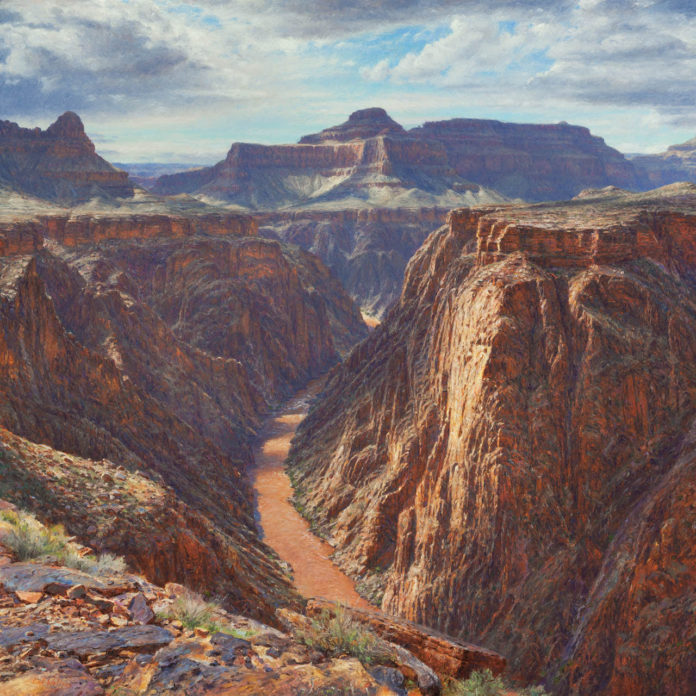
Grand Canyon Opus by Amery Bohling
20 x 30 in.
Oil
In honor of the 100 year anniversary of Grand Canyon National Park, this year’s Grand Canyon Celebration of Art will recognize the achievements of 27 artists who have successfully interpreted the canyon, both in plein air and studio work.
During Plein Air at Grand Canyon from September 7th through September 14th, visitors can watch the artists at work, painting along the South Rim of Grand Canyon. Their work will be exhibited at Kolb Studio at the South Rim September 15th, 2019-January 20th, 2020.
Following in the footsteps of the many artists that have painted the Grand Canyon over the past 160 years, this year’s Celebration of Art artists will face the challenges that capturing the Canyon presents. It’s vastness, ever-shifting light and shadows, and unique perspective of looking down has frustrated many an artist.
As a painter of the Grand Canyon, you are very aware that you are only painting nature’s artwork. Her opus. Larger than the eye can see and with a soundtrack of rain, wind, and river. Always growing and flourishing to the tune of her abstract intentions.
On Saturday September 14th from 8:00 to 10:00 am, Bohling and the CoA artists will be participating in a Quick Draw along the South Rim from Verkamp’s to Kolb Studio, with an auction of their work starting at 11:00 am at Bright Angel Trailhead.
The Celebration of Art exhibit and sale opens at 11:00 am on September 15th, 2019 and will be open daily through January 20th, 2020 at the historic Kolb Studio at the South Rim of Grand Canyon. Admission is free and open to the public.
Between
48 x 60 in.
Oil
$14,000 Available from Principle Gallery, Alexandria, VA. To purchase, please call Clint Mansell, Director, at 703.739.9326.
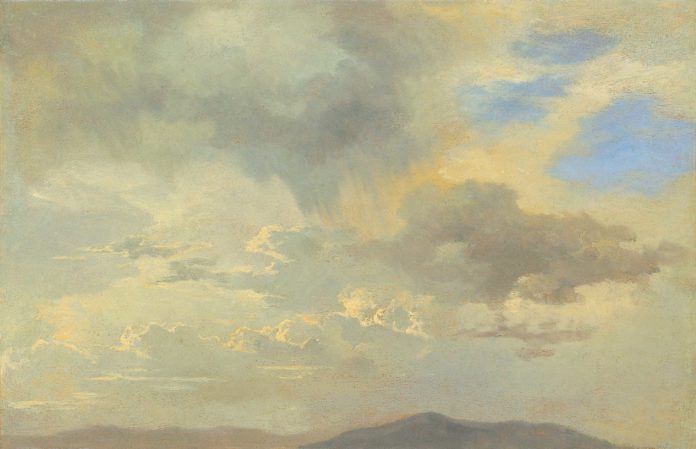
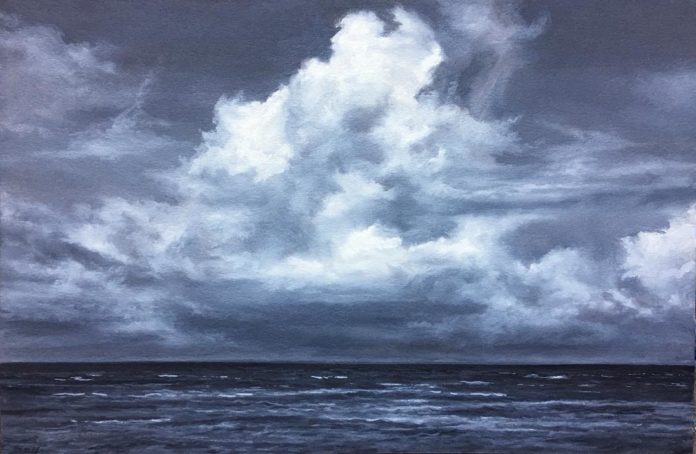
National Judge recognizes Between, 48×60. This painting is one of Jill’s larger pieces that was recently recognized as a Finalist in the master’s category of Artmuse Contest. Judge Rick Delanty writes “…this painting masterfully illustrates the three primary ingredients of a visually powerful landscape: light/space; edge-treatment, and paint application. The 2/3 sky, 1/3 land proportion in is format recalls 17th Century Dutch compositions, but the loose, varied paint application feels very modern. the fact that believable atmosphere and sense of place can be accomplished with such economy of color and means is intriguing. Painterly!”
Jill is captivated by the drama of clouds above the flat horizon of brackish marshes near her home on the Chesapeake Bay. The marsh in Between adds a perfect lead in, first to the sliver of distant Bay, then up to the building clouds and heavy atmosphere often present in a Chesapeake afternoon, and to the light filtering between the layers of clouds. The limited palette enabled Jill to focus on the drama and light of the scene, and not be distracted by major color shifts. Jill adds, “I often think that what needs to be said on an emotional level, can be said best with a limited palette”.
Jill Basham has had some major shifts in the trajectory of her work. Since 2015, she has “doubled down” on her studio time and is concentrating on larger pieces. “An immersive experience” is what Clint Mansell, the Director of Principle Gallery, Alexandria, Virginia, says of Jill Basham’s large-scale landscapes. He goes on to say that Jill “truly captures the essence of the moment, not only the beauty of a scene.” Calling her paintings “perfectly balanced and engaging compositions, using confident, loose brushwork, and brilliant highlights.”
In order to inform her large studio works, Jill uses plein air studies as well as her memory. She is painting nearly every day. By devoting a great deal of time to exploring possibilities she has made discoveries that would not have been uncovered in the field alone. She say’s “It has allowed me the flexibility to return to a piece of work time after time, putting it aside to give myself opportunity to become more objective about it.” In the studio, Jill presently has about 20+ pieces in process. “I don’t want to let a painting go until I am absolutely satisfied with it, sometimes this occurs quite quickly and seemingly easily, and other times it can take weeks, months or years.”
“The studio really is my laboratory, where I am using any means possible to uncover new processes and ways of creating. Glazing, scumbling, scratching the surface, and using whatever tools available in order to create the mark or look I am interested in achieving. Along with this comes the in depth exploration of color, texture, values and design. Sometimes, I will begin a painting not knowing at all where it will go, literally putting paint down until I “see” a path. This can include turning the canvas, exploring ideas, and moving on to other ideas if the path is not to my satisfaction. I suppose I am treating the canvas almost like a chalkboard. I know that I create paintings that I could not have imagined until after seeing “something” in the design and proceeding forward. Fun stuff, and it keeps me from getting bored.”
Jill finds that by absorbing and really truly looking at the everyday outdoor landscape whether plein air painting or not, creates emotional impressions that can be translated to the canvas in the studio.”With these paintings I am able to sift out the unnecessary information and retain the essence of the scene and my feelings for it. My plein air work has become more intuitive, with a greater focus on design and feeling.”
Simplistic and expansive landscapes have a strong appeal to Jill, but she does not want to limit her subject matter, and feels pushing boundaries, including subject choices is a good thing.
Jill will continue her explorations, and hopes to bring new surprises for her collectors. It’s when she feels “settled” that she then knows it’s time to move on.
Look for Jill Basham at these upcoming top National events in 2019: Door County Plein Air in July, 2019, where in 2018 she was awarded Best in Show by master artist C.W. Mundy. En Plein Air Texas in October, 2019, where she has won “Artists Choice” and the “Museum Purchase” award, as well as other awards. Landscape Today Exhibition in Indianapolis, Indiana. Featuring 40 of the best landscape painters in the USA. Opening September 6, 2019 at The Harrison Center.
And in September 2020, she will be sharing the walls with national artist, Kim VanDerHoek at Principle Gallery, Alexandria, VA for a unique take on the landscape…stay tuned!
Fill your mind with useful art stories, the latest trends, upcoming art shows, top artists, and more. Subscribe to Fine Art Today, from the publishers of Fine Art Connoisseur magazine.