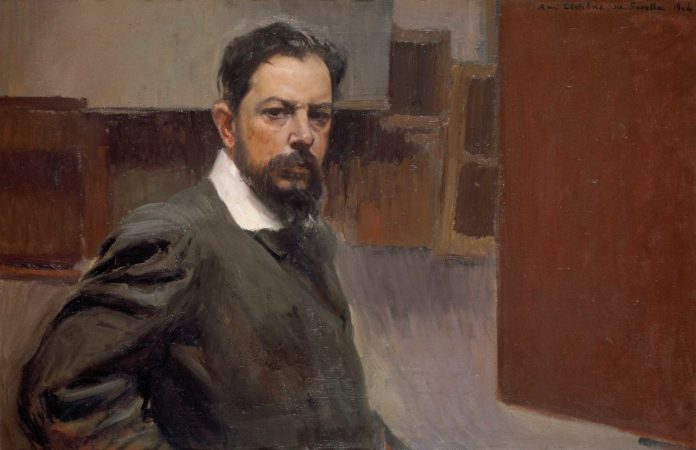
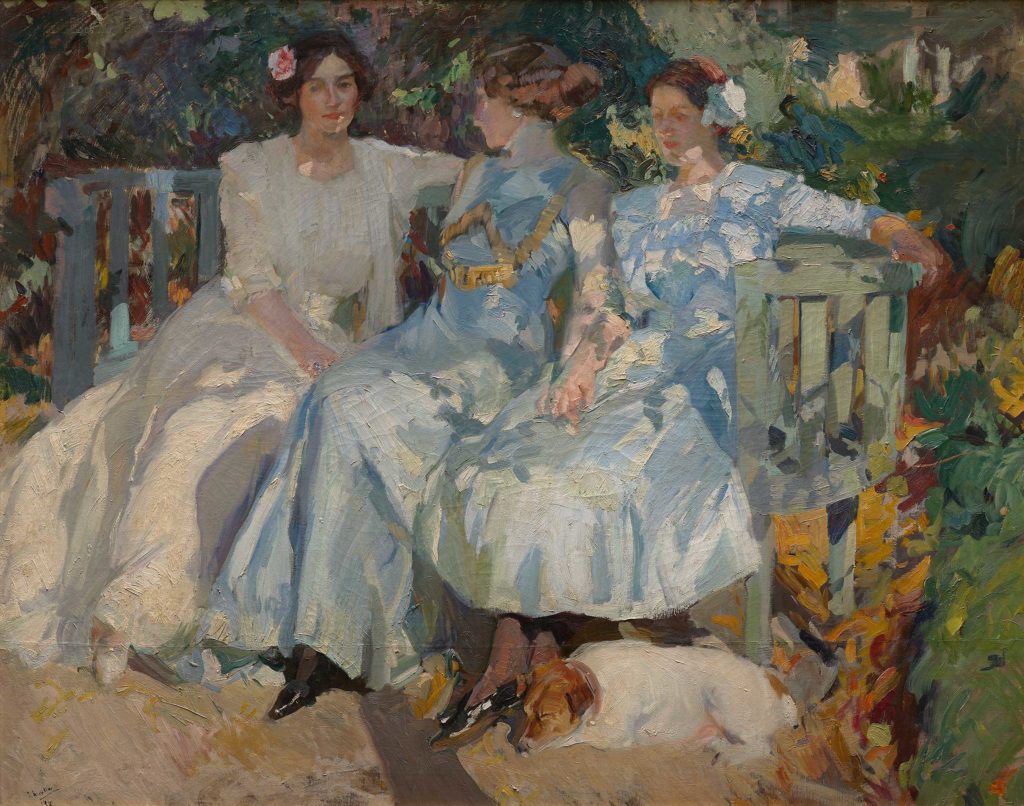
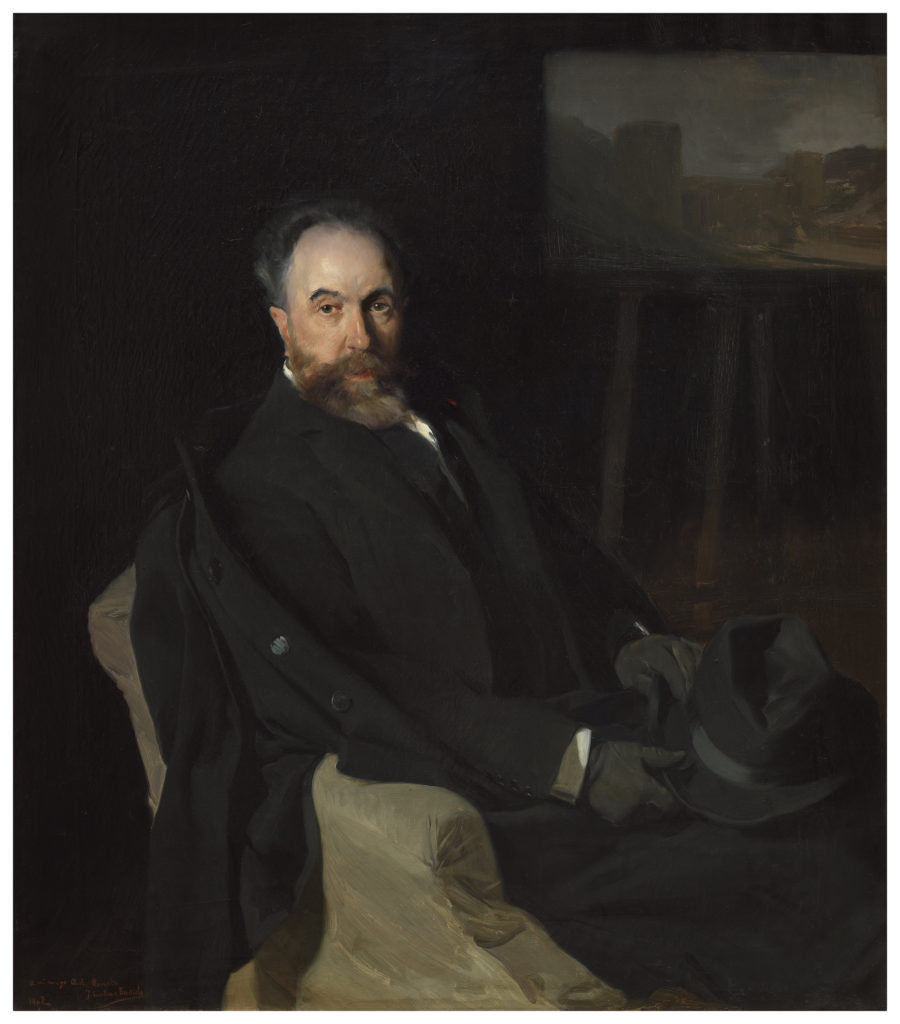
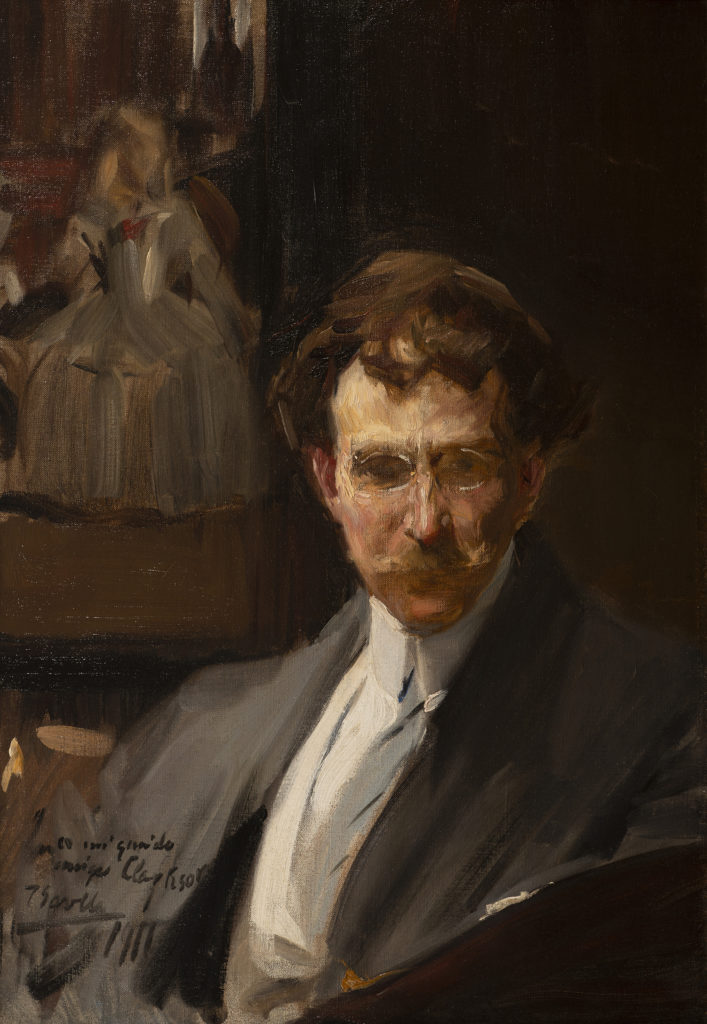
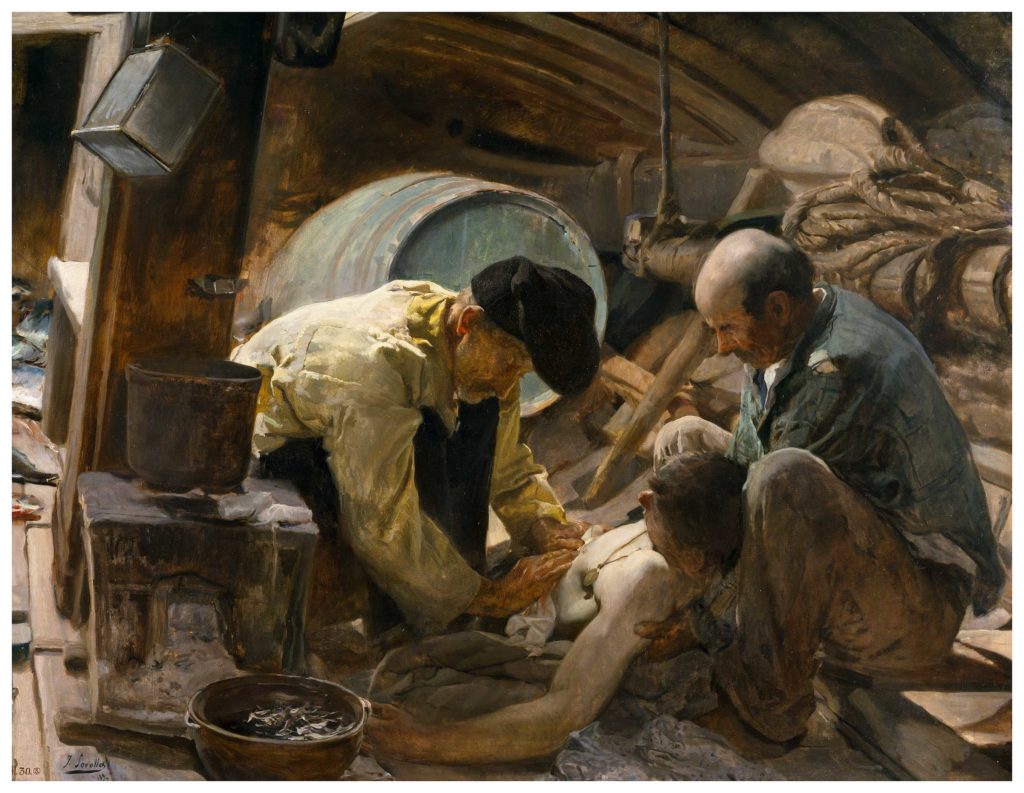
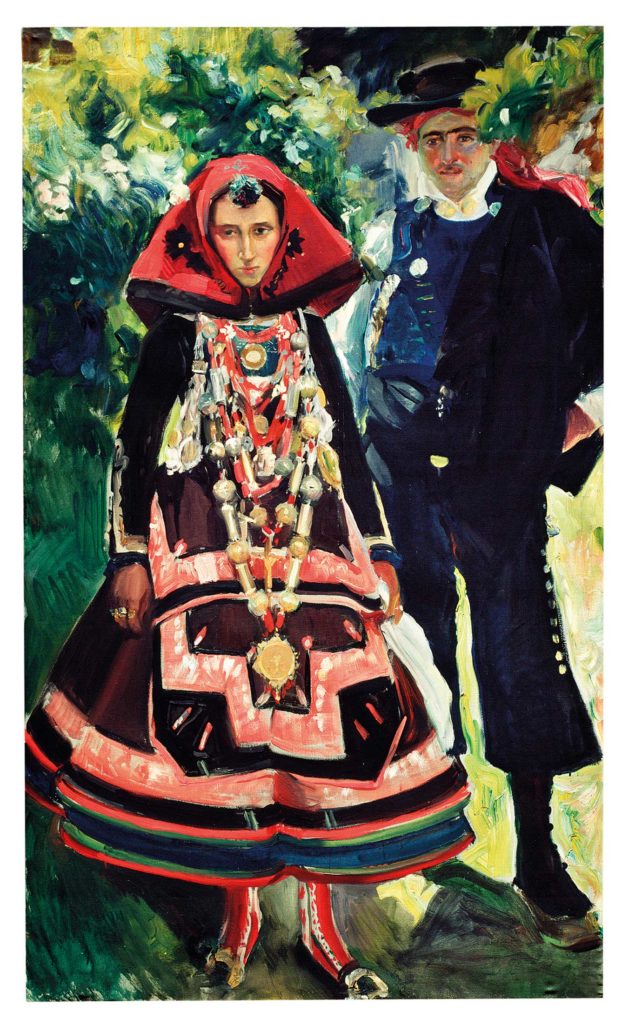
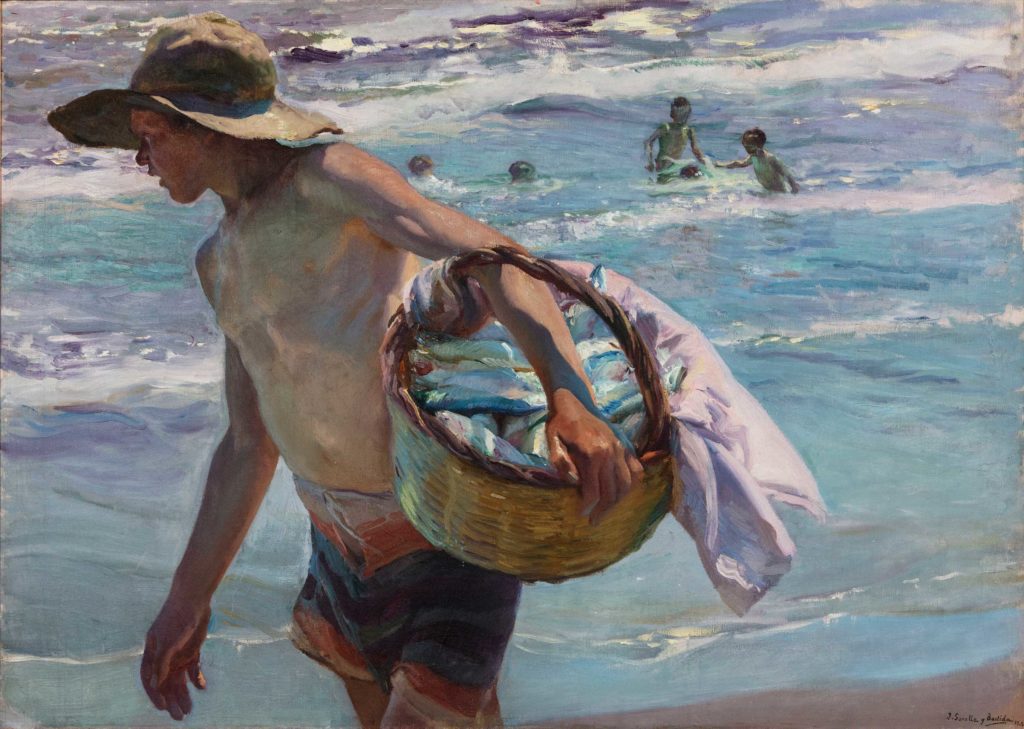
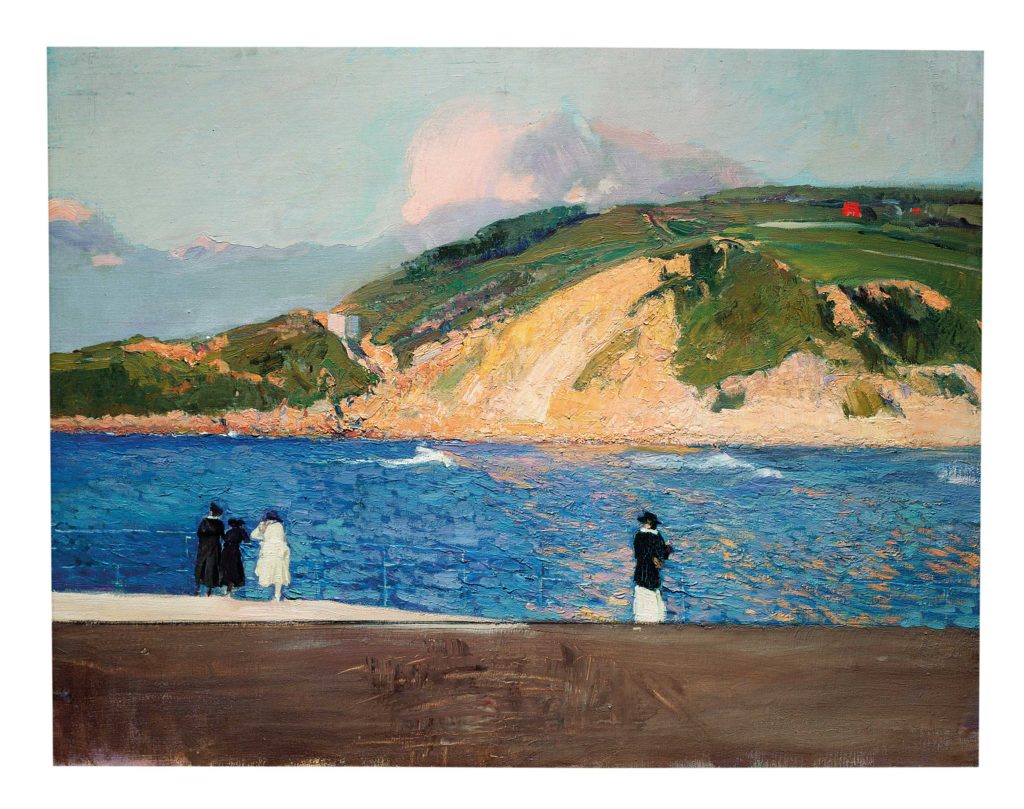
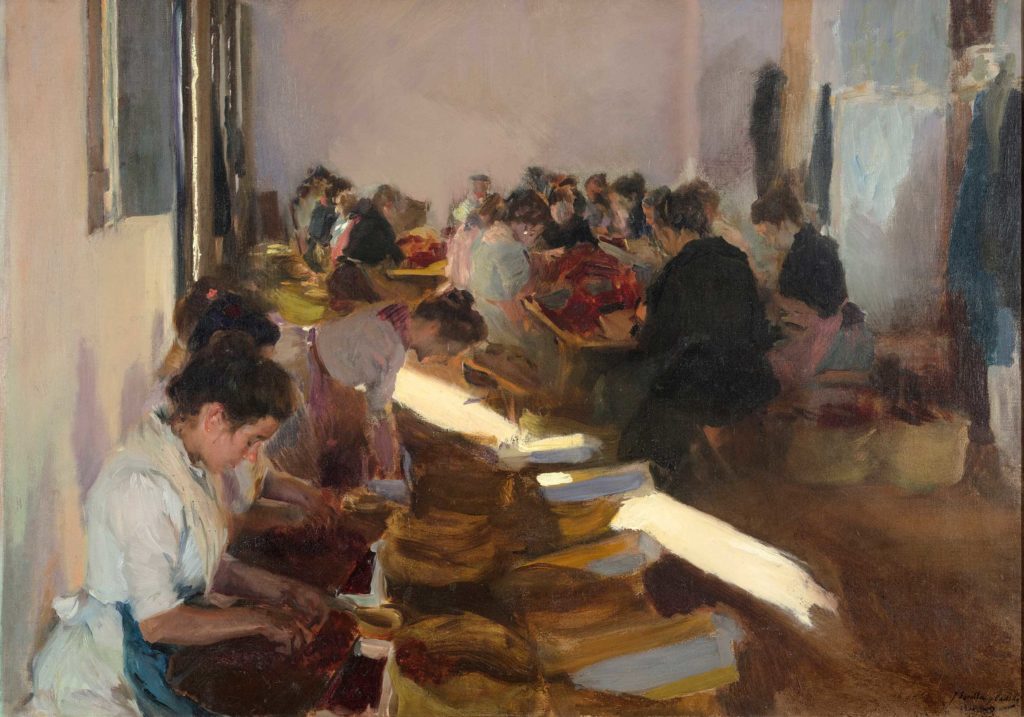
The first major exhibition in the UK for over a century of the artist known as Spain’s Impressionist, Joaquín Sorolla y Bastida (1863–1923), opened recently at the National Gallery.
“Sorolla: Spanish Master of Light” includes portraits, and genre scenes of Spanish life, as well as the landscapes, garden views, and beach scenes for which he is most renowned.
Filling the Sainsbury Wing exhibition galleries, the display features sixty works spanning the artist’s career, including important masterpieces on loan from public and private collections in Europe and the United States. This is the first UK retrospective of the artist since 1908, when Sorolla himself mounted an exhibition at London’s Grafton Galleries where he was promoted as the World’s Greatest Living Painter.
While it was his sun-drenched depictions of the life, landscapes, and traditions of Spain, as well as his gifts as a portraitist, that sealed his fame, Sorolla, who trained in Valencia and studied in Madrid and Rome, first won an international reputation for major works tackling social subjects. For the first time in the UK a series of these prized early social paintings will be brought together including his “The Return from Fishing” (1894, Paris, Musée d’Orsay), which was bought by the French government; and “Sewing the Sail” (1896, Fondazione Musei Civici di Venezia, Galleria Internazionale d’Arte Moderna di Ca’ Pesaro, Venice), which was acquired by the city of Venice.
Also displayed will be “Sad Inheritance!” (1899, Colección Fundación Bancaja, Valencia) kept in the Church of the Ascension on New York’s Fifth Avenue for over fifty years until it was returned to Spain in 1981.
One third of the paintings in “Sorolla: Spanish Master of Light” will come from private collections, and another third will be generously lent by the Museo Sorolla, one of Madrid’s most dazzling small museums, which occupies the house and garden Sorolla designed and built for his family. The Museo, now a Spanish national museum, was created following his death from bequests by the artist’s family.
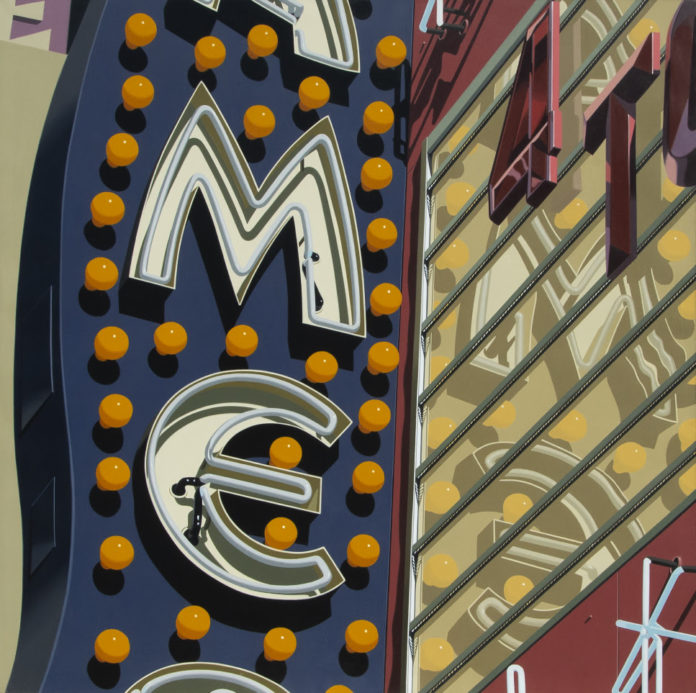
Robert Cottingham, “ME,” 1972, oil on canvas, 77 1/2 x 77 3/4 in.
Featuring the works of Davis Cone, Robert Cottingham, and Bruce Cohen, on view at Heather James Fine Art.
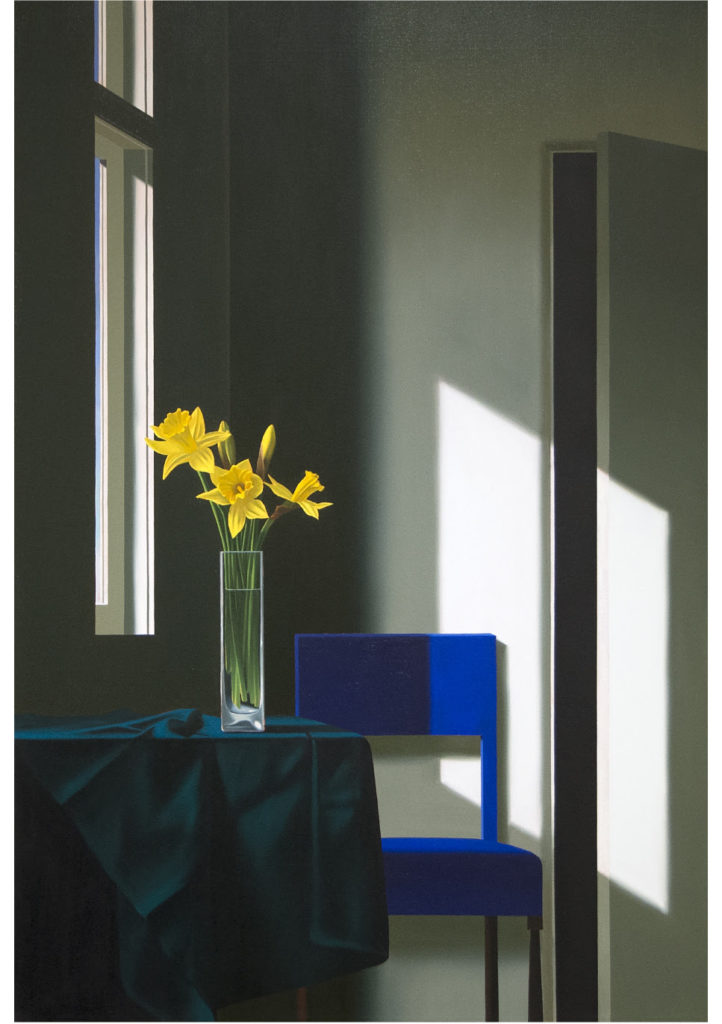
Bruce Cohen, “Untitled, Interior with Daffodils and Blue Chair,” 2018, oil on canvas, 54 x 36 in.
From the gallery:
Bruce Cohen is known for engaging his viewers with intriguing interiors in his distinctive, crisp, realist style. Influenced by Dutch still-life painting and Surrealism, he orchestrates compositions that include fruit, books, vases, and always flowers from his garden. These items are placed in geometric interiors devoid of human beings but haunted by a human presence.
Cohen graduated from the University of California, Santa Barbara. He is represented in public and private collections such as Phillip Morris, New York; Pacific Bell, Los Angeles; the San Diego Museum of Art; and the Solomon R. Guggenheim Museum, New York.
Cohen’s paintings show the technical precision for which the artist is best known. As a native Californian, Cohen embraces the light of Southern California. It is often an extension of the subject in his paintings.
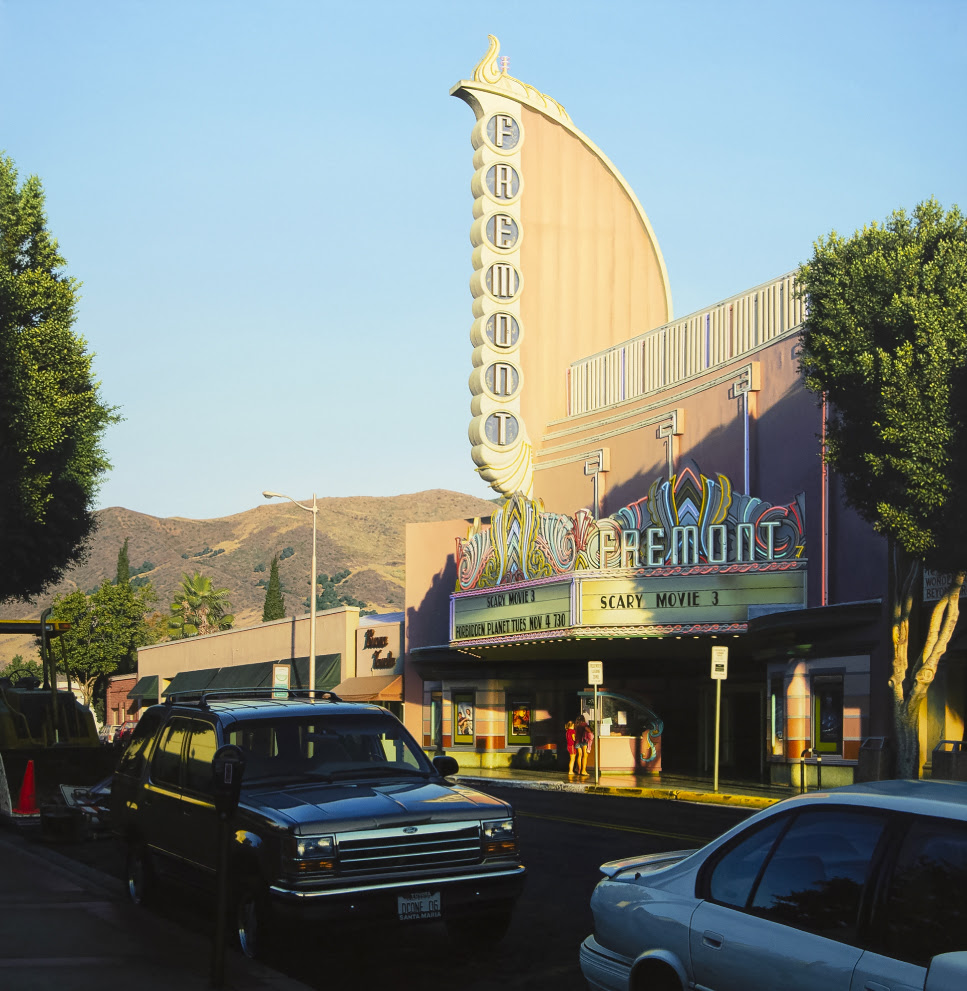
Davis Cone, “Freemont with Two Girls,” 2006, acrylic on canvas, 46 1/2 x 45 in.
Davis Cone, whose only subject is art deco movie theaters, is one of the most successful of the second generation of photorealists. As is usually the case with art that does well, it’s the combination of talent and subject that makes his work so appealing. The paintings are very romantic, but never nostalgic, as he only paints operating, vital theaters. It’s a beautiful painting of a California desert subject.
Cone’s “Fremont with Two Girls” depicts the historic Fremont Theater in San Luis Obispo, California, which opened in 1942 — just before the U.S. entered World War II. Cone presents a romanticized view, but not a nostalgic one, as the Fremont Theater remains in operation, a vital part of its community.
Robert Cottingham’s “ME” (1972, shown at top) and Davis Cone’s “Fremont with Two Girls” (2006) are wonderful examples of Realism that capture the urban American landscape, each depicting a California theater.
Cottingham created “ME” in 1972, a few years before Tom Wolfe’s famous essay, “The ‘Me’ Decade,” was published as the cover story in New York magazine on August 23, 1976. The painting is in excellent condition.
Tom Venditti, Heather James Fine Art
Related: Tom Venditti Joins Heather James Fine Art as Director for New Montecito Gallery
Heather James Fine Art is pleased to announce the appointment of Tom Venditti as director for its new gallery location in Montecito, California, opening March 21, 2019. He will oversee operations, exhibitions, and programming for Heather James Fine Art’s 2,000-square-foot gallery located in a new Spanish-Colonial Revival building at 1298 Coast Village Road, designed by Lenvik & Minor Architects.
The new gallery will feature works of art by pre-eminent artists such as Pablo Picasso, Mark Rothko, Salvador Dalí, Joan Mitchell, Richard Diebenkorn, and David Hockney, among others.
Known for its selections of blue-chip masterworks spanning a wide range of genres, movements, and periods, Heather James Fine Art’s exhibitions program focuses on presenting works by influential visionary artists and on re-examining seminal art movements. Based in Palm Desert over the last 23 years, with galleries in Jackson Hole, New York, and San Francisco, Heather James Fine Art brings a new chapter to Montecito’s thriving arts scene, which represents the perfect mix of burgeoning local cultural and creative sectors coupled with a strong visitor economy.
As an active supporter of community-based cultural initiatives, the Montecito gallery will also collaborate closely with local museums, and other cultural and nonprofit institutions. Heather James Fine Art galleries are currently showing a number of major exhibitions including a Sam Francis survey show in Palm Desert. Two noteworthy exhibitions this spring will focus on Japanese-American post-war art at the San Francisco gallery, and Female Surrealism at the New York gallery.
According to James Carona, founder of Heather James Fine Art, “We are delighted to have Tom Venditti head up our third gallery in California, and our fifth location nationwide. Having advised many prominent art collectors, including Paul Allen, on building and managing their collections, Tom’s extensive network and market knowledge will be a tremendous asset as we continue to expand.”
Prior to joining the gallery, Venditti was an independent art advisor as well as a collection design, installation, and management consultant based in New York. Before that, he served as the Senior Director of Art Collections for Vulcan Inc. in Seattle. During his 14 years at Vulcan Inc., he advised on acquisitions for the Paul Allen Family’s public and private art collections, supervised due diligence on acquisitions and deaccessions, and established strategic planning and procedural standards for collections management at multiple properties globally.
Additionally, Venditti’s prior experience working in Seattle involved advising and consulting for several prominent private collectors. His work within the public sector has included supervising the fabrication and installation of public art by the 12 commissioned artists for the Seattle Seahawks Stadium. In addition, he served as the Associate Curator of Education at Tacoma Art Museum. He is a member of the American Alliance of Museums and the Western Museum Association.
Duskwalk
10 x 12 in.
Oil on Conservation Linen Panel in Mayen~Olson 22k gold gilded handcrafted frame
$1800, also available unframed
Available through the artist
Artist Jacalyn Beam has two solo shows this spring. In March, the Station Gallery in Greenville, Delaware opens an exhibit titled A Way of Seeing. The body of work includes over 30 plein air paintings of the Brandywine Valley in Chadds Ford, Pennsylvania.
“I wanted to share local views as seen through the eyes of a plein air, impressionist painter. The historic bridges, farming conservation lands, rambling rivers, and lush landscapes make the Brandywine Valley inviting and unique,” says Jacalyn.
Throughout May, Gallery 222 will be exhibiting both plein air and studio paintings by Jacalyn. Viewers can expect to see a broader range of subject matter Jacalyn also promises some larger paintings fresh off the easel.
Meanwhile, Jacalyn is traveling, crisscrossing the county from Pennsylvania
to Florida to California to Texas and Maryland to paint in juried plein air shows which include Lighthouse Plein Air Festival, Los Gatos, Two Rivers Plein Air and Paint Annapolis. Most recently Jacalyn took part in Chadds Ford Historical Society Plein Air and throughout the year, she will be in Chadds Ford periodically as a juried artist participating in Farm to Table Plein Air.
“I paint outdoors because I find it the optimal way to see the incredibly rich beauty of three-dimensional objects, the subtleties of light and shadows, atmospheric perspective and ‘real‘ colors.”
As a representational painter, Jacalyn’s art is easily understood. One can expect to see images that are inspired by the local landscapes, discernible in content and unique in presentation.
“Her rich palette and sensitive depictions of Chester County places are a winning combination that will reward lingering to appreciate the details,” wrote John Chambless with Chester County Press.
Learn more about Jacalyn Beam on her website and stay connected by signing up for her e-newsletter. To be the first to see her current work regularly by following her on Instagram.
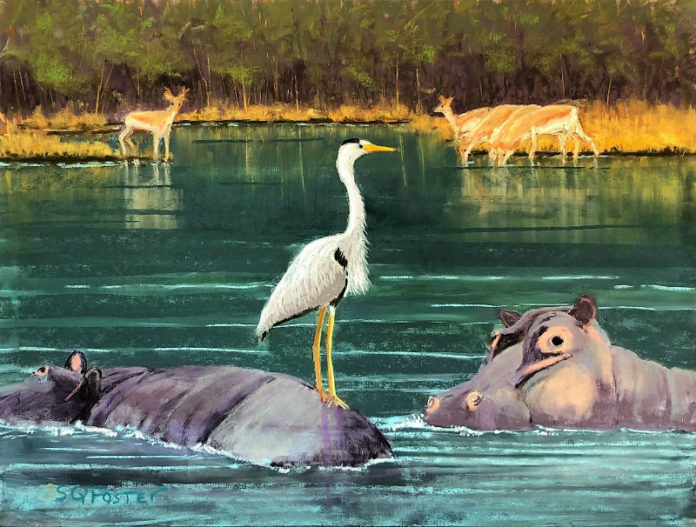
“Beauty and the Beasts” by Susan Foster. Image courtesy “Our Planet” exhibition, where oil, pastel, watercolor, acrylic, gouache, graphite, and block print works will be on display.
Our Planet – Art Exhibition on the Environment in a Changing Climate at NCAR, Boulder CO
“Our Planet” is a unique art exhibition created by 16 accomplished Colorado artists depicting how climate change is affecting our lives and environment. The objective of this art exhibition is to engage people on the subject of climate change by creating art that draws them into the subject visually and emotionally; connecting them to real life experiences and scientific understandings about what is going on today. For each painting, an artist statement describes the relationship between the art and what’s happening or can be done to address climate change. Thus, this show is not your typical art exhibition — albeit the artists’ works are beautiful on their own — but also an emotionally impactful experience and a learning opportunity. Viewers often come away with a sense of awe and wanting to do something more to change what is happening to our planet.
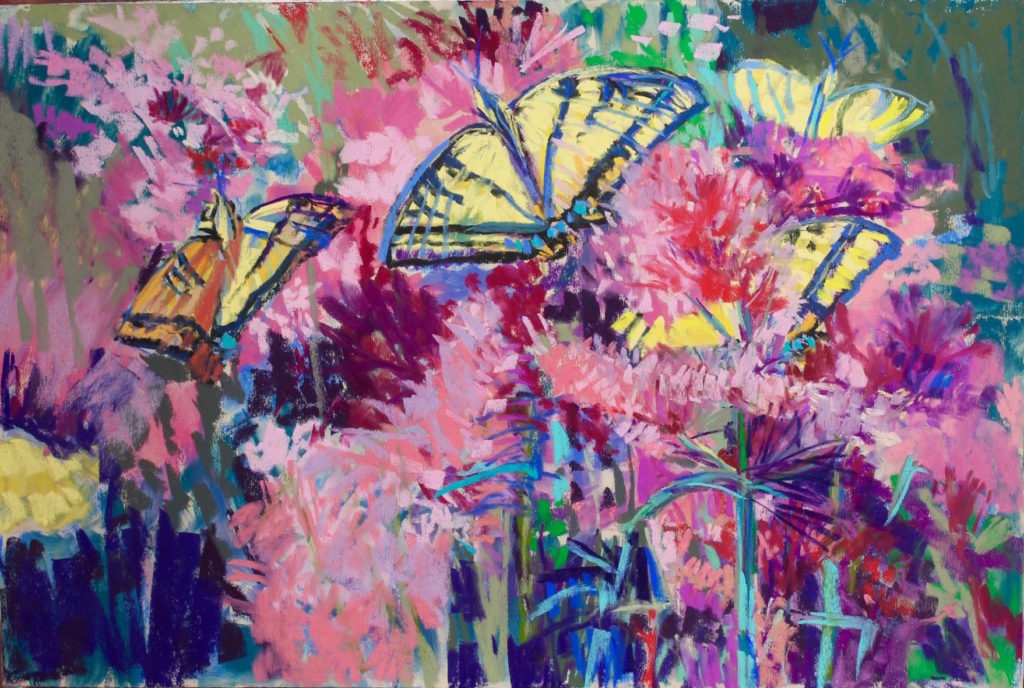
“Third Times a Charm” by Carole Buschmann
The artists exhibiting paintings in the show are:
Cliff Austin
Sina March
Rick Brogan
Susan McKelvy
Carole Buschmann
Pushpa Sunder Mehta
Marcie Cohen
Carol Peterson
Bob Doyle
Jennifer Riefenberg
Susan Foster
Elizabeth Rouland
H. Cedar Keshet
Barbara Takamine
Sarah St George
Elizabeth Van Ingen
Plus, the Growing Excitement About the ARC International Salon Competition
*Deadline extended to March 31*
A guest post by Kara Lysandra Ross, co-chairman and chief operating officer for the Art Renewal Center (ARC)
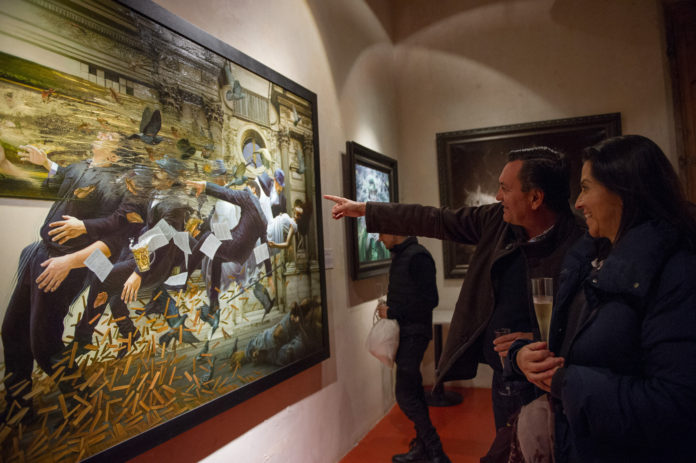
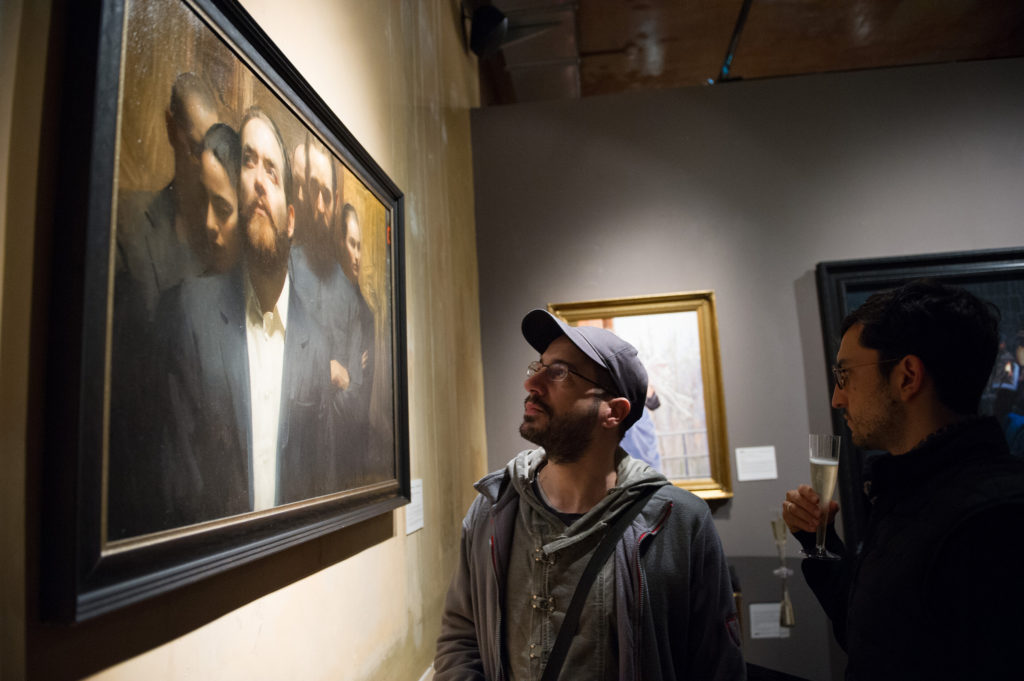
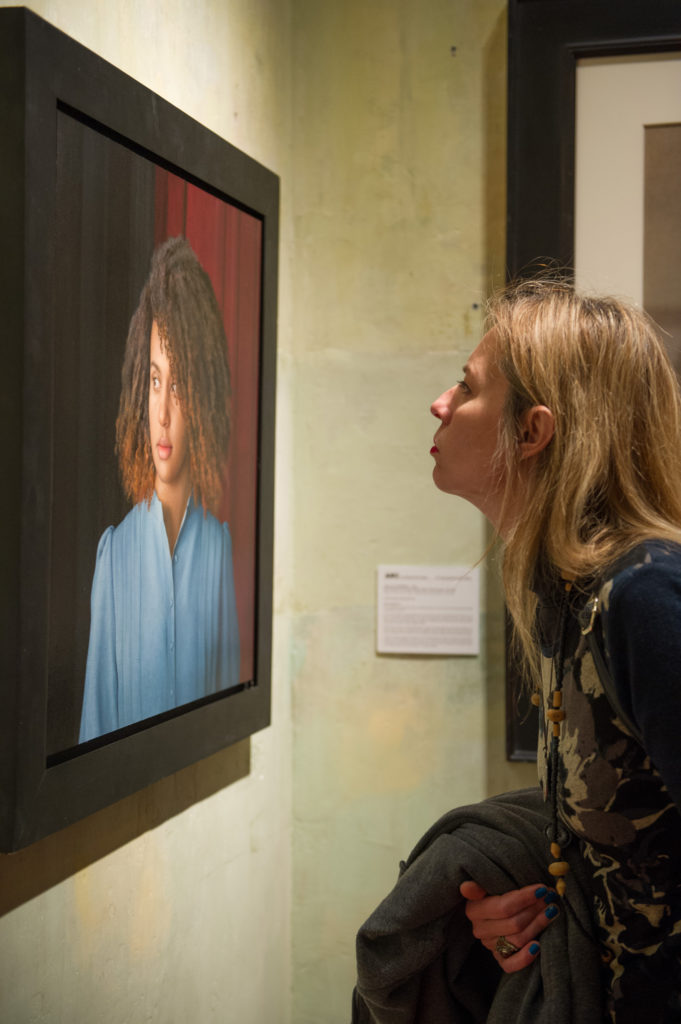
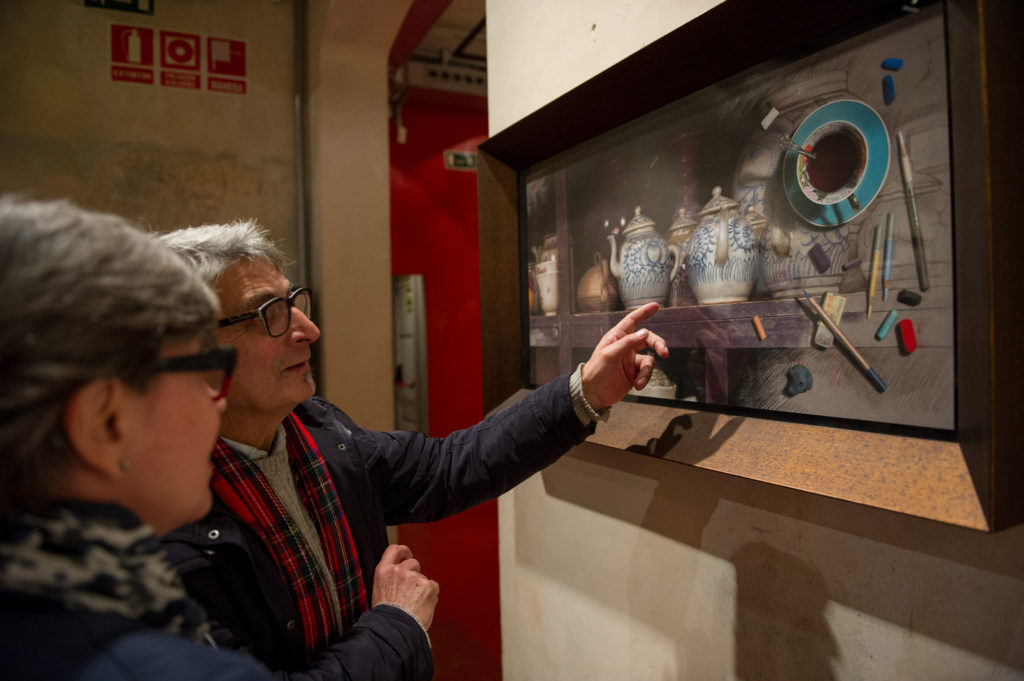
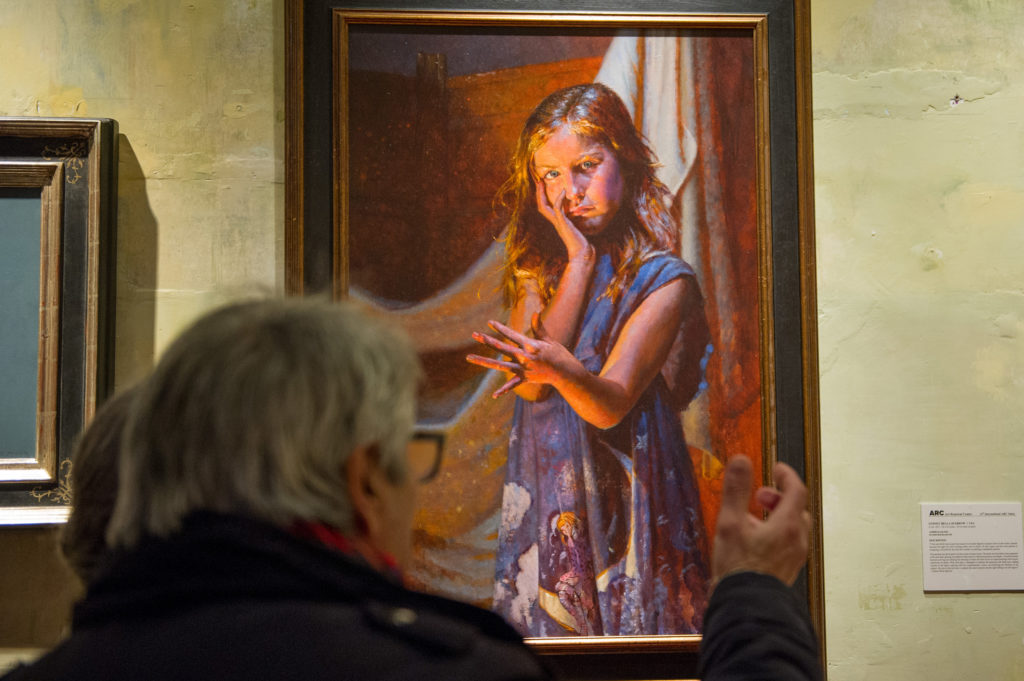
The Art Renewal’s ARC Salon Competition has been growing exponentially and expanding both with the number of entrants and awards being offered as well as in global interest and support. In addition, people are becoming more and more excited by the live traveling exhibition associated with the competition. and attendance at this past year’s show at its three venues, (Salmagundi Club, NYC, Sotheby’s LA, and MEAM museum, Barcelona) was unusually high. Throngs of individuals came to all three openings, and 1,500 came through the Salmagundi Club in the 11 days we were open. Many of the photographs taken during the events reveal an enthusiastic and passionate group of individuals.
There are a couple of qualities that I think make the International ARC Salon Competition critically important. First, it is an essential and current documentation of the best realist artists and art being created worldwide. I like to think of it as the Olympics for serious fine art and artists. The competitions are currently running once every 15 months, and works that are entered must have been created in the past three years. This past year we had over 3,750 entries from 69 countries and 49 out of 50 US states. Our nine categories cover a vast variety of styles and subject matter, including Figurative, Portraiture, Still Life, Imaginative Realism, Landscape, Drawing, Sculpture, Animal Art, Plein Air Painting, and our new Fully From Life category. Works range in style from Photo Realism and Hyper Realism, to Naturalism, Classicism, and traditional and Impressionist works. Subject matter ranges from the beautiful to the bizarre and from the comedic to the profound.
“Despite our cultural differences all people share certain core commonalities.”
Art as a Universal Language
The competition is about the importance of the universal language of realism. Even though our entrants are from many different countries and speak many different languages, they can communicate their thoughts, feelings, and beliefs to one another and to the world through their art. Using universally recognized imagery, these being the human form and gesture, human facial expressions, and the everyday objects and settings we as human beings recognize, we can hold a worldwide dialogue about the state of human existence. Despite our cultural differences all people share certain core commonalities. We all love, hurt, and fear. We all have experienced jealousy, excitement, happiness, and pain. I think this is a beautiful thing.
In the ARC Salon Competition, first and foremost, we want to see good solid technique. We look for accurate drawing (unless obviously exaggerated to give the work a specific feel). We look for good transitions from foreground to background, selective focus, modeling, lighting, and a consistent homogeneous feel so that the entirety of the work has a fluidic quality.
“It is the diversity of style, technique, and subject matter that appear in the ARC Salon which proves to the world that the movement exists.”
We then look for works that make poignant statements on human existence or capture the essence of a certain feeling or mood. Works that win often have a strong emotional thrust or capture something of what it means to be alive. Since adjudicating art is somewhat subjective, when viewing subject matter and emotional power, we find it is essential to have at least four jurors analyze each work. Jurors do not always or even usually agree, so it is the combination of four opinions in each category that produce the salon results. This year we have 18 main category jurors selecting best in show out of our top-rated works in each category. If all or most jurors agree that a work is one of the best, we feel confident that the work will hold up to the high expectations of our greater audience.
At ARC we are doing our best to show the world that Realist Art is a movement, full and thriving. We are not one style and one train of thought. It is the diversity of style, technique, and subject matter that appear in the ARC Salon which proves to the world that the movement exists, that we are not just a handful of artists who all think and feel the same way about what art should be.
The fact that we are not considered a substantial movement by mainstream press and the current art establishment is a topic of heavy discussion among realist art circles within the United States. But those of us within the movement can say with confidence that the media and establishment has just not caught up to what is actually happening. Realism is indeed a thriving and growing movement.
You can’t have a Realist Art Movement without movements, plural. One train of thought and style of painting will never and should never predominate, as such a narrow approach will never gain enough support or traction to accomplish the primary objective, which is to bring realism back as the predominant form of visual artistic expression. Modernism was not just Abstract Expressionism, or just Cubism. There were many movements, artists, and philosophies within the Modernist ideology, such as Dadaism, Fauvism, Cubism, Expressionism, Abstract Expressionism, Futurism, the list goes on and on, but we recognize them as having similar historical threads that tie them together under this heading of Modernism. The same is true with the Realist Art Movement. Because of this we are open to many styles of realism, but all must be original works of art created and conceived of by the participating artist.
“The International ARC Salon is a platform for artists to show their greatest current works to realist art fans, gallery owners, collectors, museums, magazines, realist art organizations, and the like around the world.”
Many artists who engage in realistic painting face the same problem. How do they use traditional techniques to create works that reflect both our times and a contemporary spiritual essence? I think sometimes artists overthink this. As long as their works are their own concepts and creations and they are expressing themselves through subjects that excite them, their works will reflect a contemporary spiritual character. It cannot reflect anything else, since the artists who are creating these works are living in contemporary times.
All of their experiences and the art they create with it, will be driven spiritually through their current existence. They should not listen to the criticism that their techniques are based on historical techniques of the past. This is true of every human art form that has ever grown and developed over time. It is not logical to expect each new generation to start from scratch with nothing. This would be an insult to our ancestors who struggled to acquire new knowledge. Our lives on earth are short compared to the history of human existence. It is our responsibility as a species to build on what our forebears have given us so that we can continue to advance.
The International ARC Salon is a platform for artists to show their greatest current works to realist art fans, gallery owners, collectors, museums, magazines, realist art organizations, and the like around the world. We know that many artists have launched their careers through their participation in our competition. We have a wide variety of awards and opportunities, partnering with other organizations to provide this. We have a highly successful live international traveling exhibition of between 75 and 100 works from the competition. Our awards include featured articles on artists’ works in prominent realist art magazines, museum exhibitions, gallery shows and sales, and promotion on the ARC website as well as in our ARC Salon Publication, International Realism.
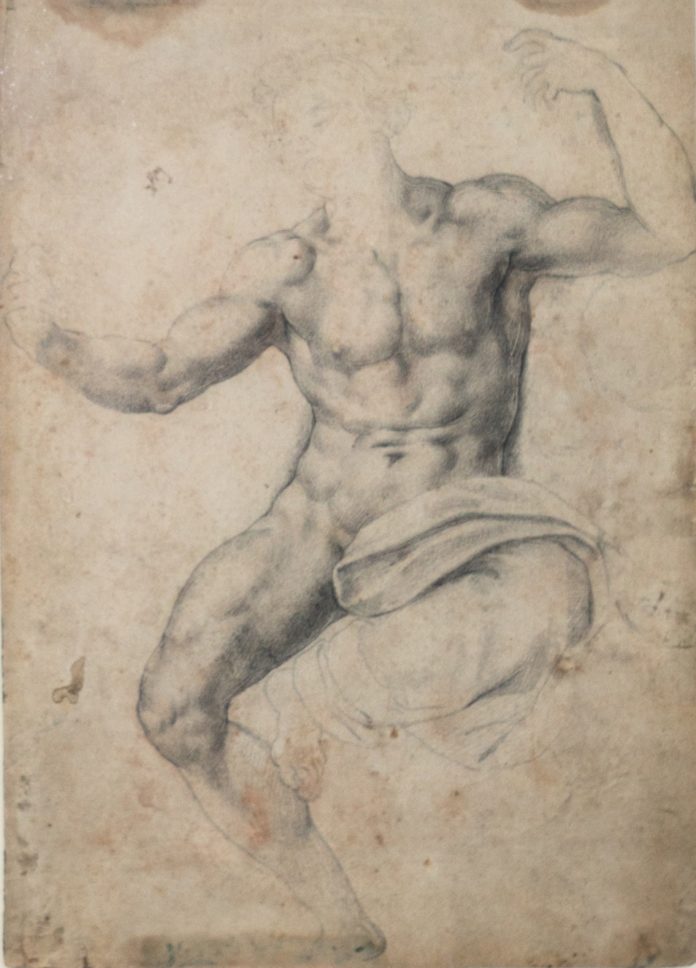
“Male Torso,” unknown Italian artist, circa mid-16th century, pencil on paper, 14.5 x 10.5 in. Collection of Jonathan Galassi
Though you look at this 16th-century drawing, can you ever see what’s really there?
By David Masello
Jonathan Galassi’s favorite work of art hangs in his New York City living room, and, though he looks at this drawing every day, he never sees what’s really there. No one can. “That’s part of the beauty of it for me, that the work never got finished,” says Galassi, who has been the president and publisher of Farrar, Straus & Giroux for more than 30 years, as well as a major poet and translator of works by Montale, Leopardi, and Primo Levi. It’s the fact that this pencil drawing on paper (by an unknown 16th-century Italian artist) remains incomplete that makes it possible for him — and any other viewer — to imagine its central figure whole.
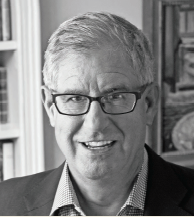
Jonathan Galassi, president and publisher, Farrar, Straus & Giroux
“The male figure is in the process of becoming, rather than realized,” Galassi emphasizes. He likens the effect to Michelangelo’s unfinished sculptures of slaves, in which the figures are seen to be emerging from the stone, but not completely so. Nonetheless, enough is seen to make them powerful. “This work suggests so much. I find it incredibly sensual and full of potential — like a sculpture coming out of the marble.”
Galassi, who admits to liking “all things Italian,” owns notable prints by Giovanni Battista Piranesi and Luigi Rossini, some 19th-century photographs of Venice and Tivoli, and a somewhat kitschy yet evocative Neapolitan tourist painting of Vesuvius, but nothing else of this caliber. “The drawing was given to me about five years ago by a friend, whose father had an extensive collection of mostly Northern European drawings; this was the sole Italian work,” he explains. “One evening, over dinner, he reached under the table and handed it to me, in its period frame. It was an incredible, wonderful, thoughtful present. I have paintings and drawings and various objects, but nothing this old, nothing this beautiful.”
Recognizing that the drawing of the muscular, well-defined male torso was decidedly Mannerist in style, Galassi showed it to a curator friend at the Metropolitan Museum of Art. “She said that it is likely a Northern Italian work. She could tell this by the rendering of the feet, or, in this case, foot, since only one is finished. I’m not sure how a foot might reveal that difference, but she loved the work, too, and recognized its merits.”
Works that are unfinished inspire conjecture. “The possibilities of this figure and why it was never completed are intensified by the fact that you don’t see a face,” says Galassi. “Who knows, maybe if the face were in place, it would be a disappointing one!” In his daily perusal of the drawing, situated now beside his fireplace, Galassi keeps seeing new details — the heavily penciled lines of the torso’s sides that make the figure stand out as if bracketed, the modest drape of the towel down to the floor, the ghosting of a head. And Galassi is always coming up with new theories as to why the artist left the drawing in this state. “Maybe there was something wrong about it in his view,” he asks rhetorically. “Is the figure dancing? Was he to be shown playing an instrument, as the position of his arms and hands seems to suggest?”
So, as in some of Galassi’s own poetry, and in the poetry he translates, a state of ambiguity characterizes this drawing. “It doesn’t frustrate me that it’s not finished,” he says. “I accept it for what it is, a beautiful figure in a constant motion of emergence.”
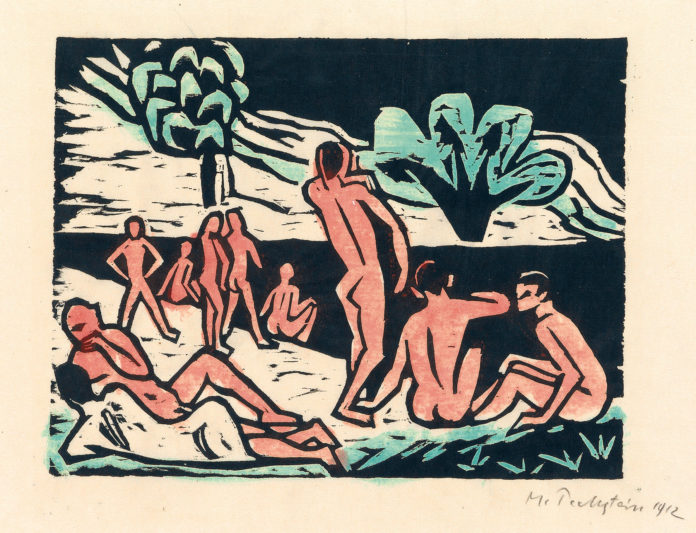
Max Pechstein, “Reisebilder: Italien–Südsee,” 1919. Sold for $25,000.
Swann Galleries’ sale of 19th- and 20th-century prints and drawings on March 5 earned $2.7M, with property from the Ismar Littmann Family Collection of German Expressionism and European Avant-Garde forming the cornerstone of the auction.
Sale total: $2,773,697
Estimates for the sale as a whole: $3,041,200 – $4,645,300
From Swann Galleries:
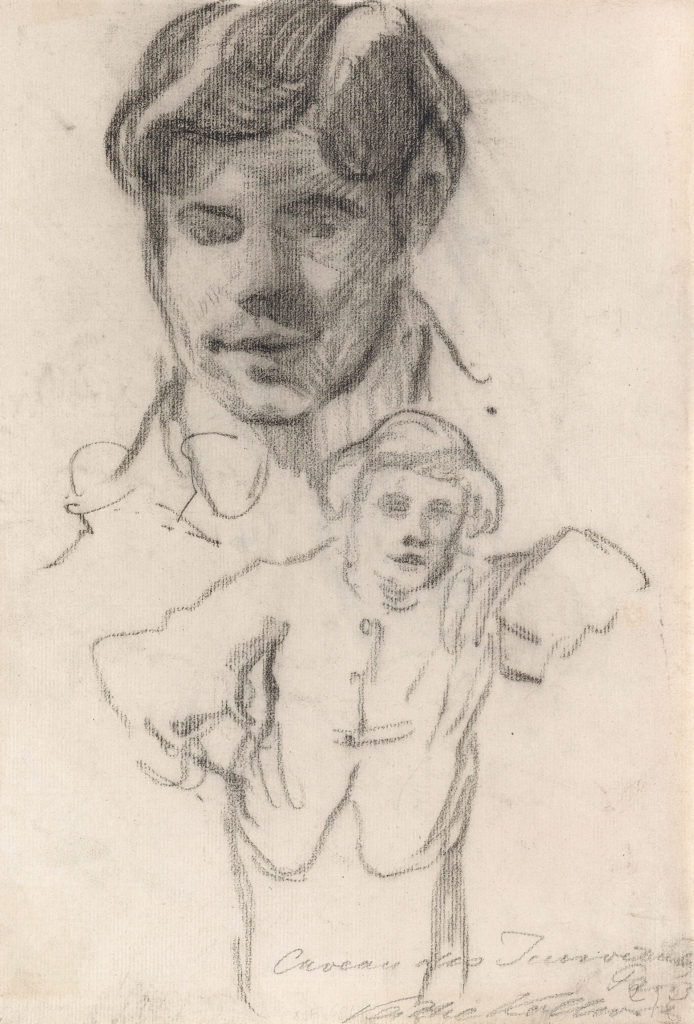
Of the Littmann Family Collection, Todd Weyman, director of prints and drawings and vice president of the house, noted, “We are very pleased with sale of property from the Littmann Family. We surpassed the total low estimate for the collection and saw active bidding for items from both American and European private collectors alike with Käthe Kollwitz, Otto Mueller, Emil Orlik, and Max Pechstein being standout artists.”
Käthe Kollwitz, “Figuren Studien,” charcoal, circa 1905. Sold for $27,500.
Top lots from the collection included “Sommer I,” 1912, by Max Pechstein, which surged past its high estimate of $15,000, bringing $81,250, a record for the work, as well as Pechstein’s “Reisebilder: Italien–Südsee,” 1919, which earned $25,000. A pair of color lithographs from 1926-27 by Otto Mueller — “Lagernde Zigeunerfamilie mit Ziege” and “Zwei Zigeunerinnen (Zigeunermutter mit Tochter)” — brought top prices at $32,500 and $25,000, respectively. Emil Orlik’s oil on board, “Still leben,” 1914, topped its low estimate at $16,250, and a 1905 charcoal figure study by Käthe Kollwitz garnered $27,500.
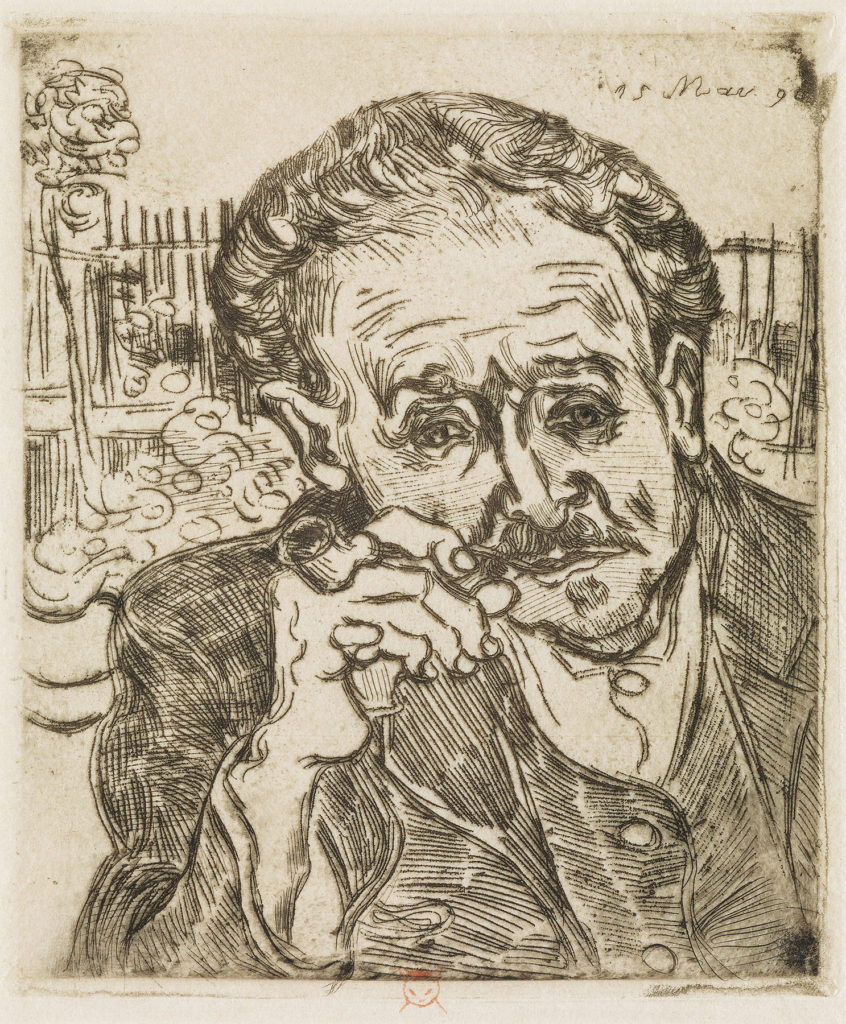
Van Gogh, “Homme à la Pipe: Portrait du Docteur Gachet,” etching, 1890. Sold for $106,250.
The afternoon portion of the sale did not slow, bringing the top lot of the auction: Van Gogh’s only etching, “Homme à la Pipe: Portrait du Docteur Gachet,” 1890, with $106,250.
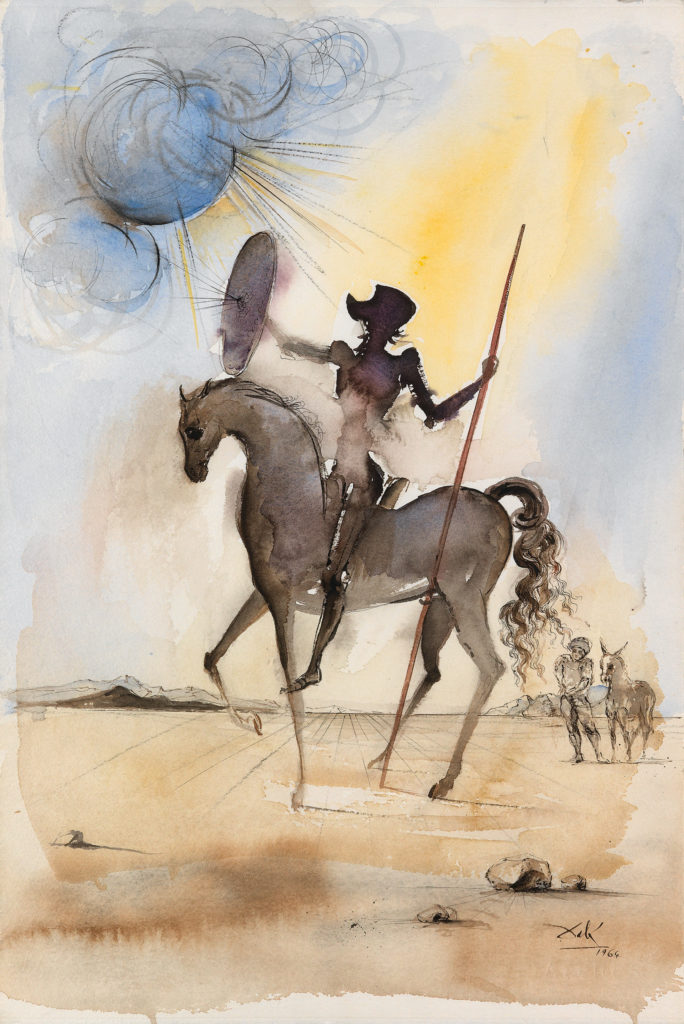
Salvador Dalí, “Don Quichotte e Sancio Panza,” watercolor with pen and ink, 1964. Sold for $100,000.
Salvador Dalí followed close behind with the watercolor “Don Quichotte e Sancio Panza,” 1964, at $100,000, while “La Conquête du Cosmos I & II,” a 1974 complete set of 12 color drypoints by the artist, brought $31,200.
Additional works by Modernist stalwarts included “Roses et Mimosa,” a color lithograph from 1975 by Marc Chagall at $27,500; Joan Miró’s color aquatint, “Le Permissionaire,” 1974, with $47,500. Picasso’s “Tête sur Fond noir,” sold for $25,000, a record for the 1953 lithograph. Also of note was Sonia Delaunay’s exuberant color pochoir and watercolor illustration of Blaise Cendrars’ poem “La Prose du Transsibérien et de la petite Jehanne de France,” 1913, which earned $87,500.
Edvard Munch was well represented in the sale with a run of lithographs: “Harpyie,” 1899, which depicts the denizen of the underworld over a skeleton, brought $30,000, and “Alfas død,” 1908-09, whose composition bears similarities to Munch’s iconic “Scream,” garnered $22,500; both were record-setting prices for the works. “August Strindberg,” an 1896 portrait of the Swedish poet, writer, and close friend of the artist was won for $30,000.
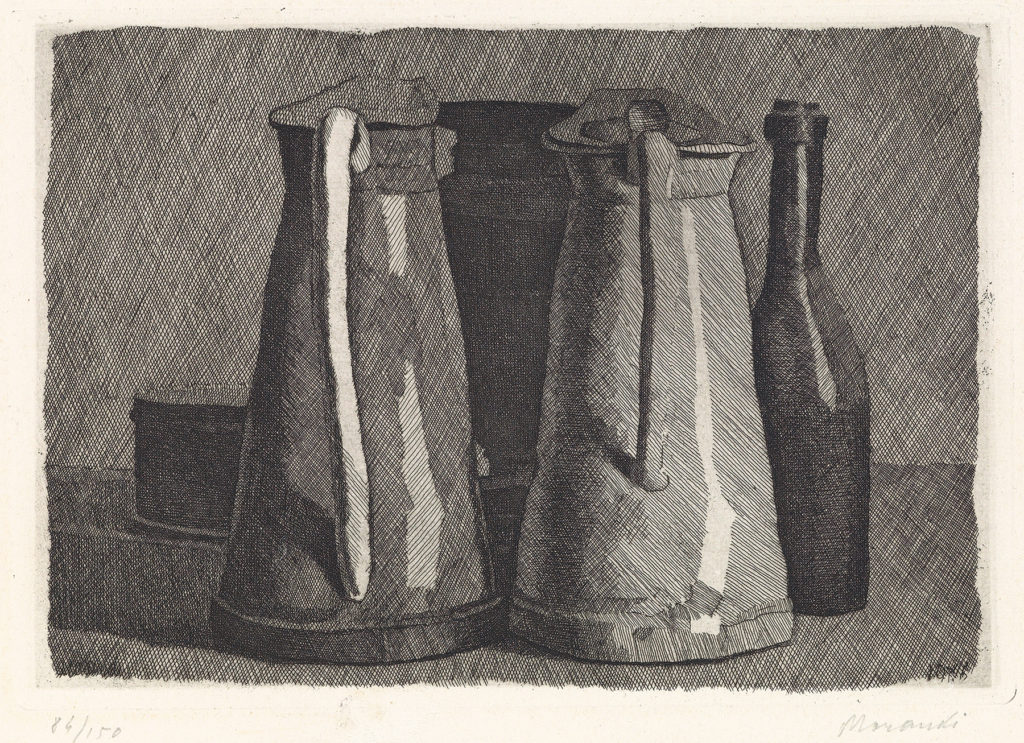
Giorgio Morandi, “Natura Morta con Cinque Oggetti,” etching, 1956. Sold for $47,500.
Italian masters were present with Giorgio Morandi’s 1956 etching, “Natura Morta con Cinque Oggetti,” which exemplified the primary focus of the artist’s oeuvre, brought $47,500, and “Femme nue,” a 1915 pencil drawing by Amedeo Modigliani earned $33,800.
Additional highlights included Winslow Homer’s line-based etching of rural women, “Mending the Tears,” 1888, which set a record with $30,000, and “Illustrations of the Book of Job,” 1826, by William Blake, a complete set of 22 engravings, saw a price of $87,500.
The next auction of prints and drawings will be held on May 2 with Old Master through Modern prints. Visit www.swanngalleries.com.
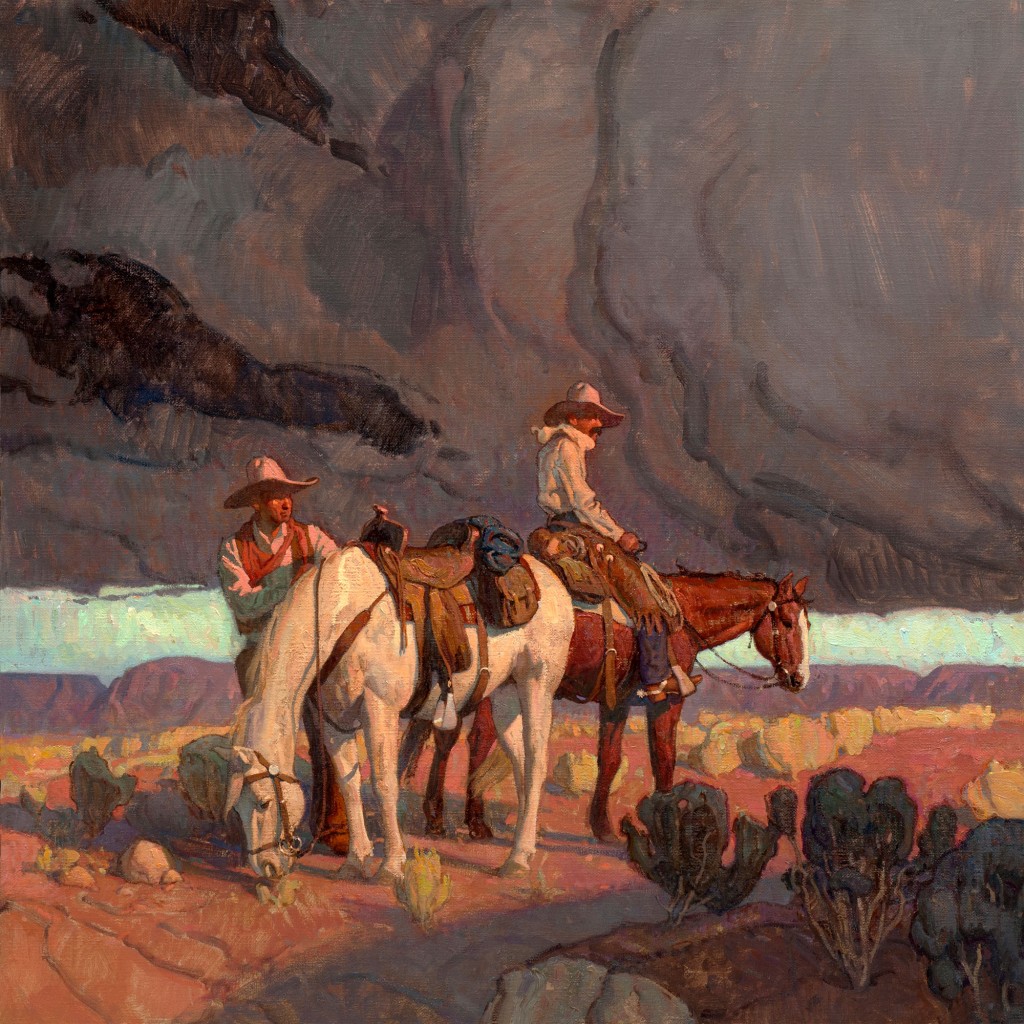
The Autry presents its 22nd Annual “Masters of the American West” Art Exhibition and Sale.
This exhibition and fundraiser celebrates premier Western art and artists. Proceeds from “Masters” support the Autry’s dynamic educational programs, ongoing collections conservation, and much more.
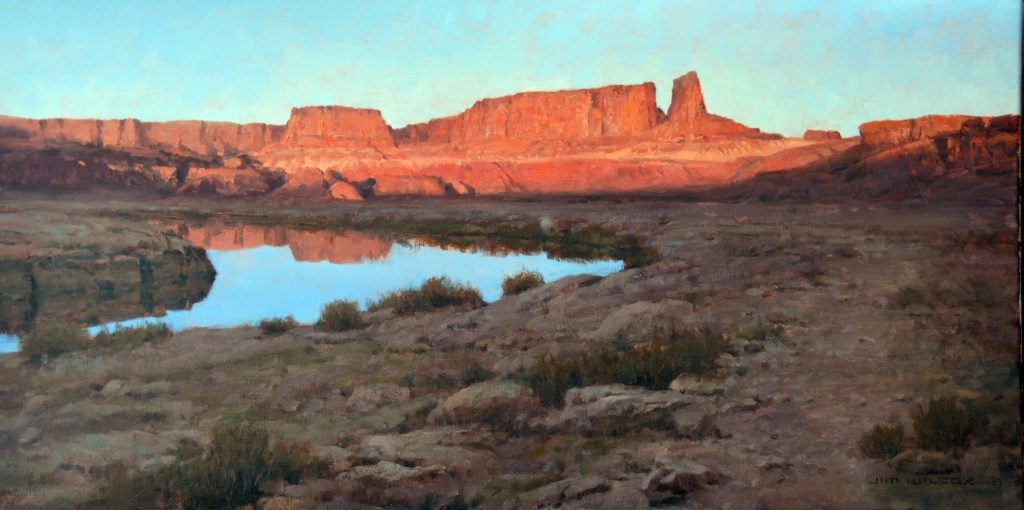
Jim Wilcox, “Desert Reflection,” 20 x 40 in.
Featuring 64 nationally recognized Western artists, including George Carlson, Dennis Doheny, Tammy Garcia, Z. S. Liang, Jeremy Lipking, Tim Solliday, Kevin Red Star, Mian Situ, Curt Walters, and Morgan Weistling.
Artists new to “Masters” in 2019 include Eric Bowman, G. Russell Case, and Howard Post. They will join fellow established artists in this annual exhibition and sale.
Brittany Weistling, “Autumn Glow,” oil on linen,” 18 x 26 in.
“‘Masters’ in 2019 continues to expand its footprint in the world of contemporary art of the American West, a place as diverse as the artistic traditions represented throughout its long history,” said Amy Scott, the Autry’s executive vice president for research and interpretation and Marilyn B. and Calvin B. Gross curator of visual arts. “‘Masters’ celebrates these histories through images and narratives that speak to the exceptional environment, cultural past, and dynamic present of the American West.”
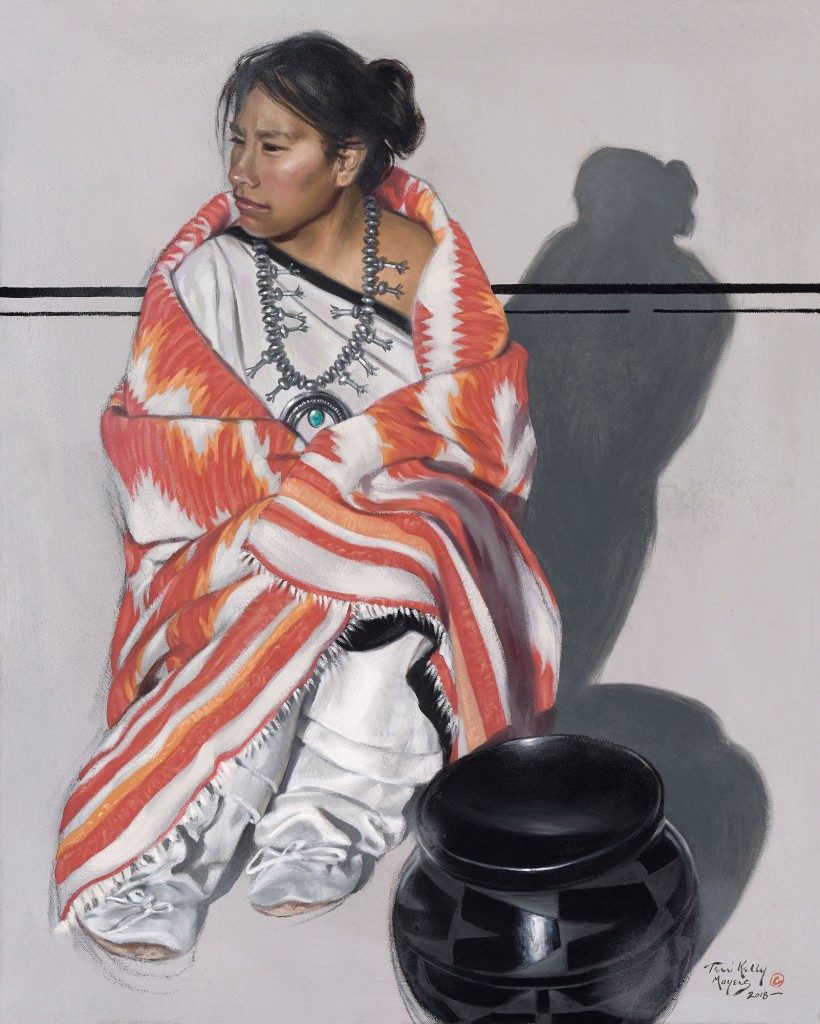
Terri Kelly Moyers, “Rio Grande Blanket,” oil on canvas, 30 x 24 in.
A ticketed opening-day program includes presentations by artists and a luncheon with an awards presentation. The lively event continues into the evening with a cocktail reception and art sale, where patrons and artists alike join in the festivities and approximately 250 fixed-price works are sold through a drawing.
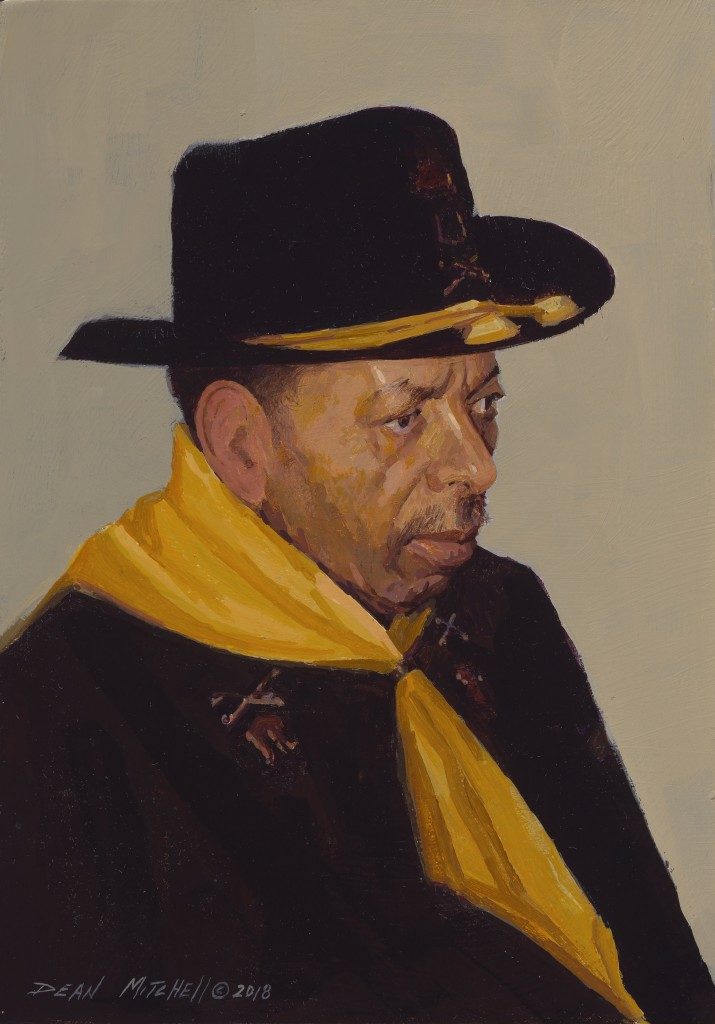
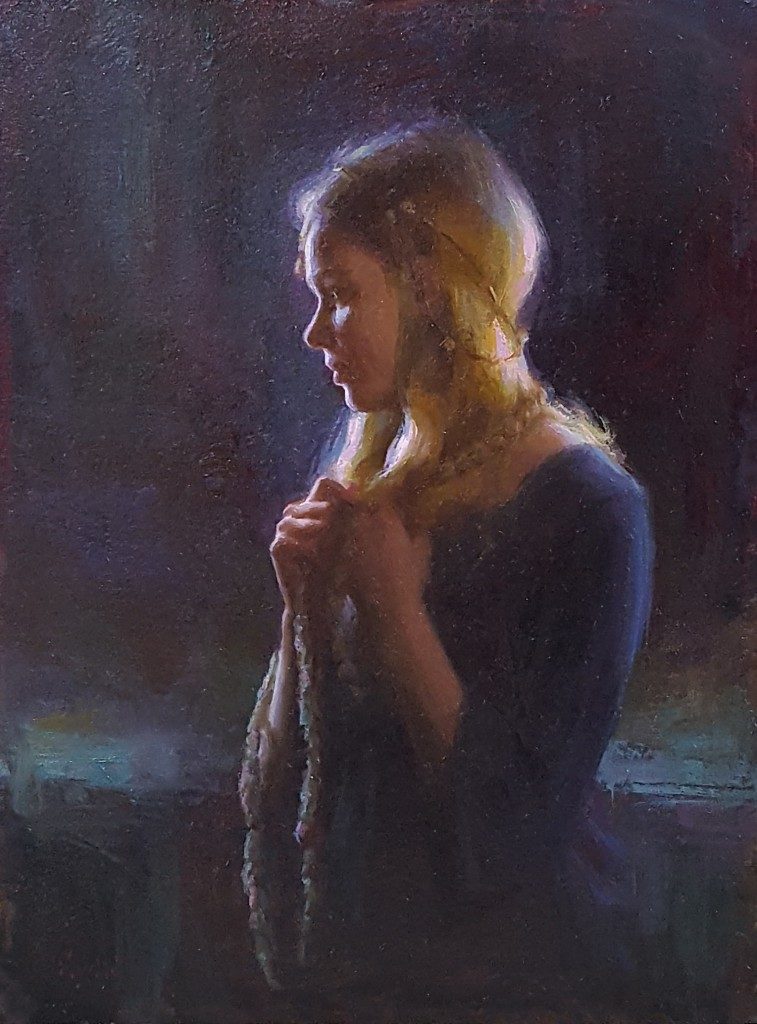
Eric Bowman, “Seen It All,” oil on linen, 30 x 30 in.Dean Mitchell, “R. Bardwell — Buffalo Soldier,” acrylic, 7.5 x 10 in.Susan Lyon, “Nostalgia,” oil 12 x 9 in.
“Masters of the American West” takes place through March 24, 2019, at the Autry Museum of the American West (Los Angeles, CA). For additional details, visit TheAutry.org/Masters.
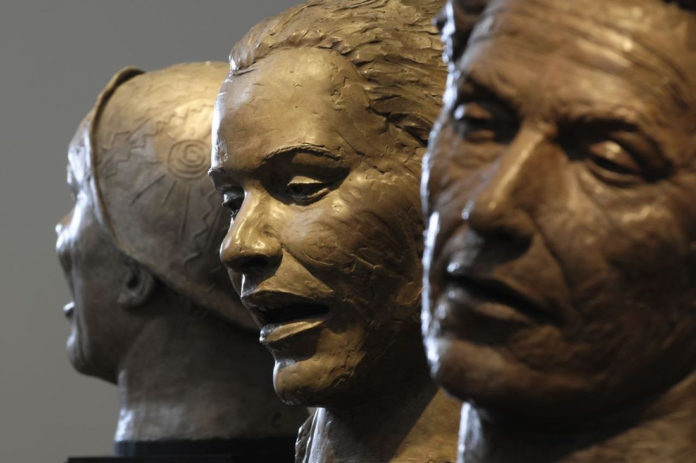
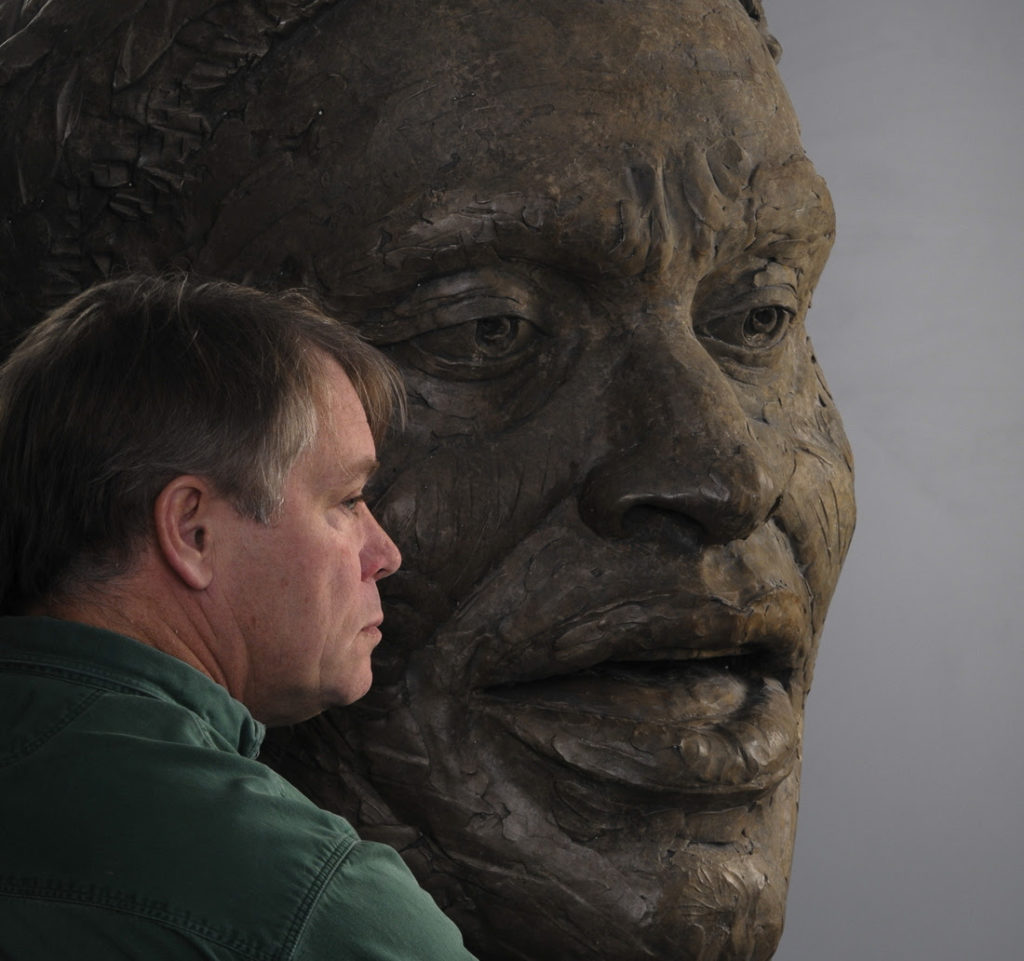
“Bessie Smith,” Billie Holiday,” and “Woody Guthrie,” 3 of 7 colossal portrait heads by Alan LeQuire, scheduled to exhibit at the Clinton Presidential Center in Little Rock, Arkansas, this spring.
The Clinton Presidential Center’s exhibit, “Cultural Heroes,” a collection of seven larger-than-life clay sculptures created by Nashville-based artist Alan LeQuire, made its debut last month as part of the Clinton Center’s Black History Month celebration. Each sculpture represents a musician who shaped the soundtrack of the Civil Rights movement: Bessie Smith, Billie Holiday, Lead Belly, Paul Robeson, Woody Guthrie, Marian Anderson, and Josh White.
The artist’s inspiration for “Cultural Heroes” is twofold. One of LeQuire’s favorite museums is the Cluny Museum in Paris. The museum displays the heads of the kings of France, which were broken off the facade of Notre Dame during the French Revolution and rediscovered during the 1970s. These larger-than-life stone heads made a lasting impact on the artist. Second, he wanted to memorialize the musicians who put their careers on the line and became the “grandparents of the Civil Rights movement.”
Sculptor Alan LeQuire with his colossal portrait of Lead Belly.
From the organizers:
LeQuire is one of the country’s foremost figurative sculptors and is best known for his colossal masterworks, “Athena Parthenos,” the largest indoor statue in the Western Hemisphere and “Musica,” one of the largest bronze figure groups in the world.
“I didn’t want to create an exact likeness; I wanted to create a living presence,” said LeQuire. “That’s also the reason behind the scale. I want people to walk in the room and feel the presence of these remarkable musicians who, when they were at the top of their game, were almost channeling the divine.”
“Cultural Heroes” was previously displayed at the National Civil Rights Museum and the Janice Mason Art Museum in 2016, the Tennessee Performing Arts Center in 2015, and the Southern Kentucky Performing Arts Center in 2012.
“Alan’s ‘Cultural Heroes’ sculptures beautifully capture the heart and soul of these amazing performers and civil rights pioneers,” said Stephanie S. Streett, executive director of the Clinton Foundation. “We are thrilled to share his work with our visitors and hope that they walk away with a greater appreciation of the artists, their music, and their contribution to civil rights.”
“Cultural Heroes” is on view at the William J. Clinton Presidential Center (Little Rock, Arkansas) through May 5, 2019. For more details, visit LeQuireGallery.com.
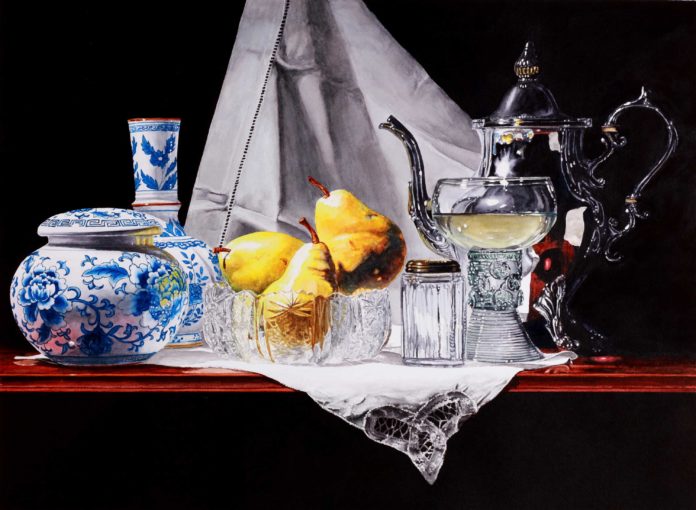
Laurin McCracken (b. 1942), “Still Life with Three Pears,” watercolor on paper, 26 x 19 in., $6,500
The work of realist painter Laurin McCracken is influenced by the Dutch and Flemish still life painters of the 16th and 17th centuries.
“Three Wooden Spoons,” watercolor on paper, 20 x 22 in., $5,000
Before a serious commitment to the medium of watercolor in 2000, McCracken was a successful architect and a part-time photographer. He attended Auburn University and earned his Bachelor of Arts and Bachelor of Architecture from Rice University. He followed that with a Masters in Architecture and Urban Planning from Princeton University. His work as a practicing architect and as a photographer allowed him to travel extensively in Europe, the Middle East, and Japan. His photographs have been widely published in architectural journals, as book covers, and as book illustrations.
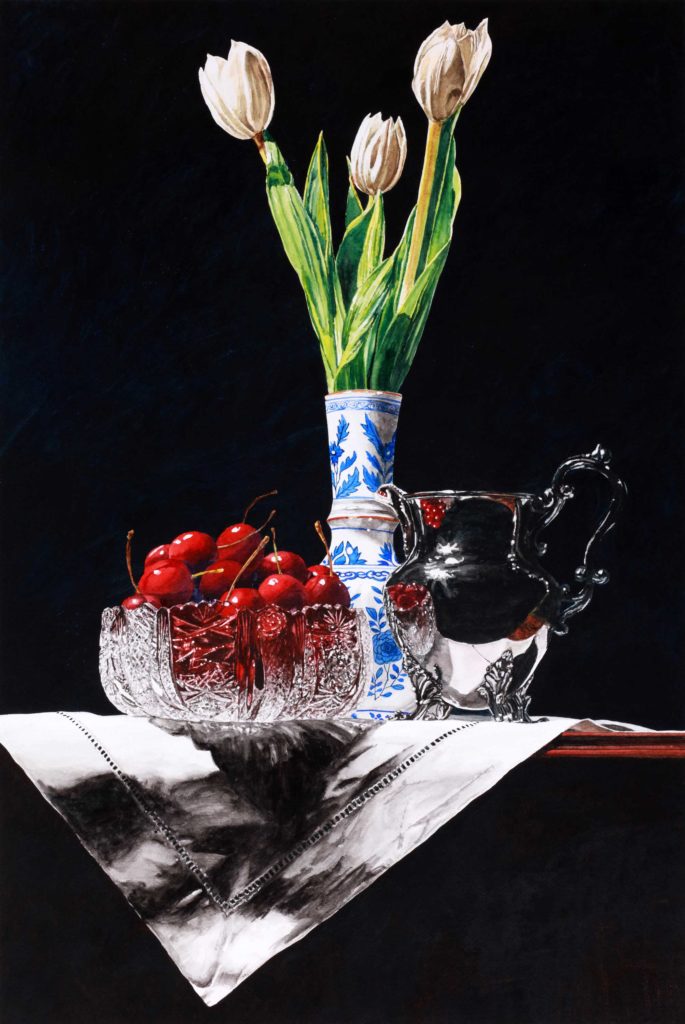
“Cherries, Tulips, Silver, Crystal and Dutch Vase,” watercolor on paper, 27 x 18 in., $5,000
Although McCracken did not take up watercolor until later in life, his existing skills in drawing, photography, and observation provided a strong foundation for his mastery of the medium. He studied with Gwenn Bragg at the Art League School in Alexandria, Virginia, and with Alain Gavin at the Art Institute of Chicago. He also carefully studied the works of still life masters who inspired his work.
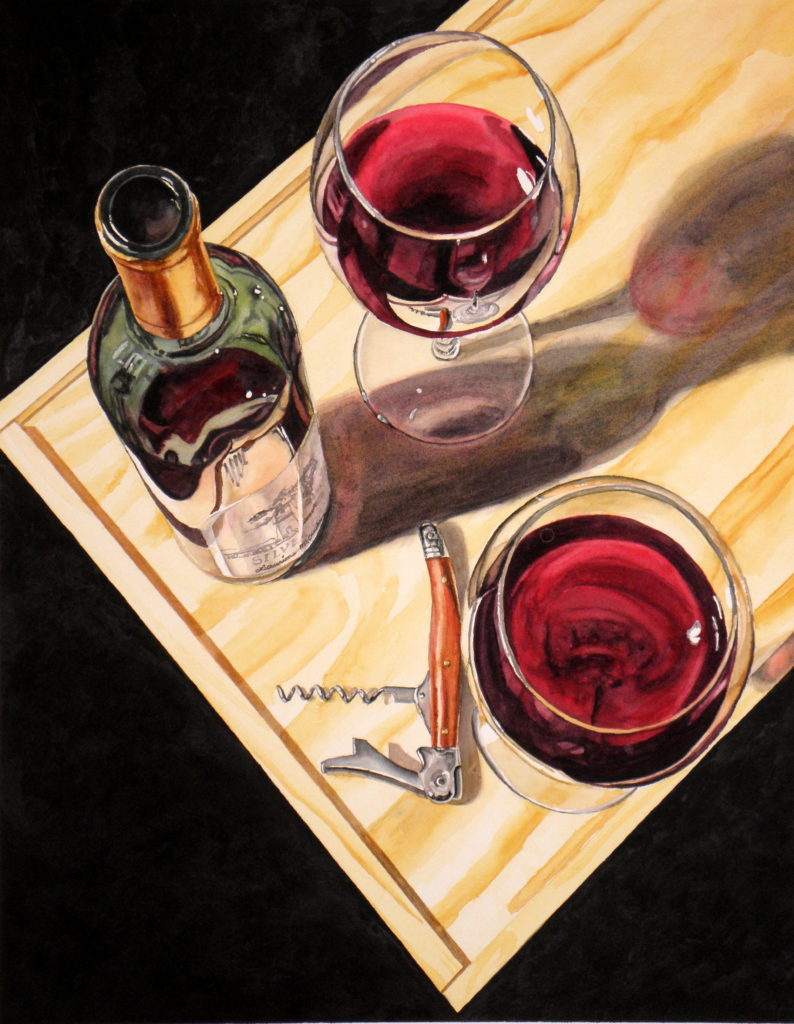
“Wine for Two,” watercolor on paper, 18 x 14 in., $3,200
McCracken’s paintings have won many awards and have been exhibited in juried shows from coast to coast and internationally. Shows include those of the American Watercolor Society, the National Watercolor Society, the Transparent Watercolor Society, the Philadelphia Watercolor Society, the Niagara Frontier Watercolor Society, the Adirondacks National Exhibition of American Watercolors, and the Southern Watercolor Society. His paintings have also been included in many competitive international shows, including the Beijing International Art Biennale 2010, 2011, 2015, 2017; the Shenzhen International Watercolor Biennial 2012, 2014; the Thailand World Watermedia Exhibition 2014; and the Masters of Watercolour 2015, St. Petersburg, Russia.
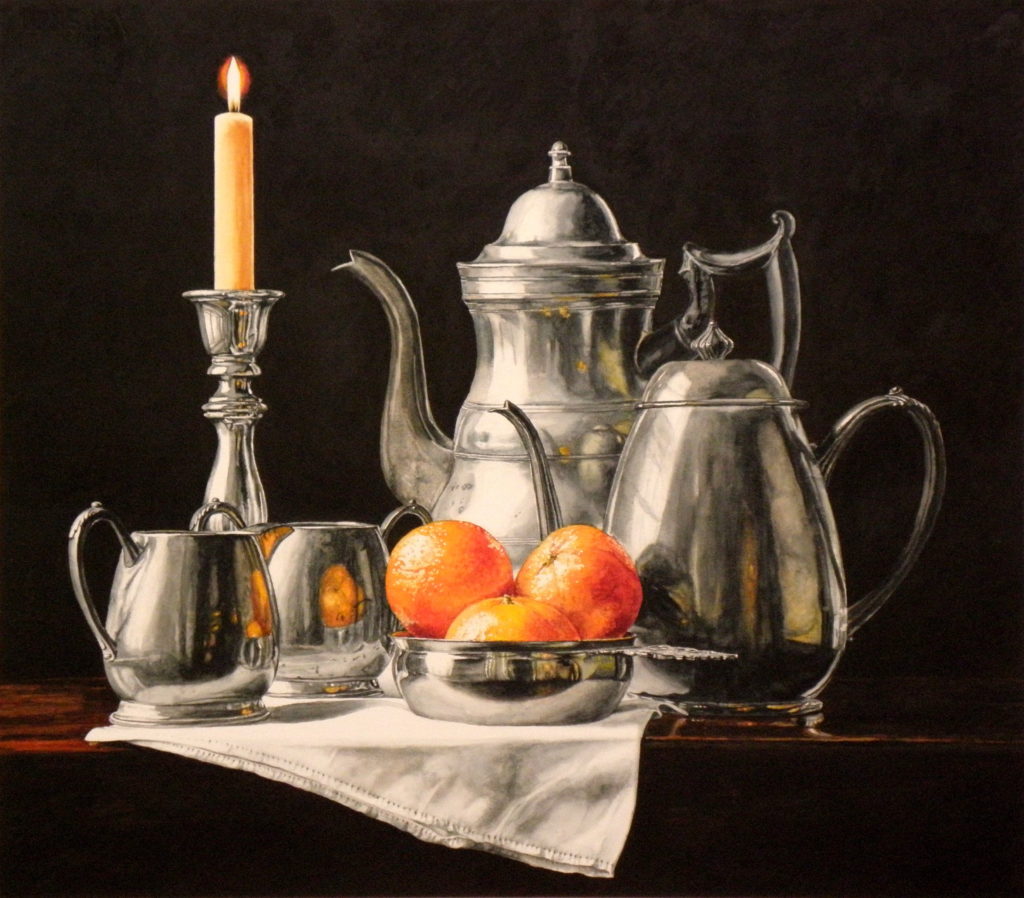
“Reflections in Pewter,” watercolor on paper, 21 x 24 in., $6,500
McCracken is the current president of the Watercolor USA Honor Society and the Country Leader for the USA for the Fabriano in Acquarello in Fabriano, Italy. He is a signature member of more than a dozen watercolor societies.
A native of Meridian, Mississippi, McCracken currently resides and paints in Fort Worth, Texas.
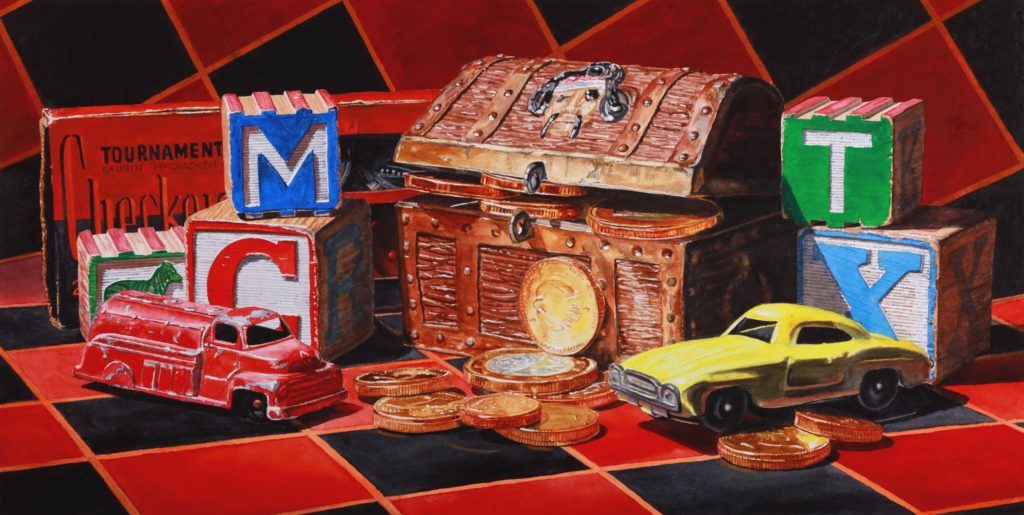
“Treasure,” watercolor on paper, 14 x 28 in.,$6,500
“Visual Abundance: Realism in Watercolor” is on view through August 3, 2019, at the University of Mississippi Museum (Oxford). Visit museum.olemiss.edu for more details.
Fill your mind with useful art stories, the latest trends, upcoming art shows, top artists, and more. Subscribe to Fine Art Today, from the publishers of Fine Art Connoisseur magazine.