
Home Blog Page 307

Surely Heaven on Earth

0
Fra Angelico, “The Dormition and Assumption of the Virgin (detail),” 1430-1434, tempera on panel, 24 5/16 x 15 1/16 inches, Isabella Stewart Gardner Museum

For the first time ever, four newly restored reliquaries that were painted by Renaissance icon Fra Angelico for the church of Santa Maria Novella in Florence between 1424 and 1434 will be reunited during a blockbuster exhibition. Where?

The Isabella Stewart Gardner Museum in Boston will be the sole venue for “Fra Angelico: Heaven on Earth,” opening February 22 and continuing through May 28. Angelico (circa 1400-1455) was celebrated in his time as the most famous painter in Italy, and any opportunity to view his masterpieces outside Europe is one worth taking.

“With remarkable ingenuity and rare technical expertise, Angelico reconceived popular compositions and infused familiar Christian stories with new meaning,” the Gardner reports. “His iconic altarpieces and frescoes — painted for two Popes, members of the Medici family of Florence, and the city’s merchant elite — transformed Western art. They secured his place in history and forged the future of painting in Italy.

“Heaven on Earth” brings together choice examples of Angelico’s narrative art, inviting visitors to experience the wonder of his breathtaking stories up close and in a new light. “Two monumental altarpieces, an intricate series of panels from his Silver Chest, a previous triptych for private devotion, and nine predella scenes join the four reliquaries in a dramatic installation evocative of their Renaissance context,” the Gardner continues. “Many of these works are visiting the United States for the first time in over 40 years at the museum.”

Dr. Nathaniel Silver, the Gardner’s associate curator of collections, added, “Although separated for over 200 years, these four precious painted reliquaries showcase Fra Angelico’s peerless creativity and unparalleled technical accomplishments. The reliquaries, carefully selected altarpieces, furniture panels, and a triptych illuminate the relationship between form and function, revealing how the artist shaped each story for its intended purpose.”

To learn more, visit the Isabella Stewart Gardner Museum.

This article was featured in Fine Art Today, a weekly e-newsletter from Fine Art Connoisseur magazine. To start receiving Fine Art Today for free, click here.

Masters of Venice and Drawing

0
Domenico Tiepolo, “Jesus in the Garden of Gesthemane: The Second Prayer,” n.d., pen and brown ink, 19 x 15 inches, Eskenazi Museum of Art

A California museum has brought together a must-see selection of master drawings by two of 18th-century Italy’s most famous father/son artists: Giambattista and Domenico Tiepolo. The show offers viewers an engaging experience of luminous compositions, as the Tiepolos’ splendid drawings — and the works of other Venetian artists — provide a unique view into the distinctive art of the lagoon city.

On view now through February 4 at the Crocker Art Museum in Sacramento, “Masters of Venice” is a tantalizing experience for any fine art lover. The show provides new insight into two of Venice’s most important artists through a fantastic selection of drawings. According to the museum, “Eighteenth-century Venice was not only home to a lively community of artists and the finest publishing and printmaking industry in Europe, but its unique architecture and traditions also made it a cultural destination for artists, aristocrats, and royalty.

Jacopo Palma il Giovane, “Study for Saint John the Baptist Preaching,” circa 1620, pen and brown ink, 14 15/16 x 13 1/2 inches, Eskenazi Museum of Art

“Giambattista Tiepolo (1696-1770) and his son Domenico (1727-1804) were the most renowned Venetian artists during this period, with patrons across Italy and Europe. In 2010, Indiana businessman and philanthropist Anthony J. Moravec donated a collection of drawings by the Tiepolos to Indiana University’s Sidney and Lois Eskenazi Museum of Art in Bloomington, expanding its Tiepolo holding to make it the third largest in the nation.

Domenico Tiepolo, “A Centaur Playing with Punchinellos,” n.d., pen and brown ink, 14 1/8 x 18 11/16 inches, Eskenazi Museum of Art
Giambattista Tiepolo, “The Flight into Egypt,” 1735-40, pen and brown ink, 16 3/16 x 11 11/16 inches, Eskenazi Museum of Art

“The centerpiece of the exhibition is a group of 12 drawings from Domenico Tiepolo’s New Testament cycle, from what is believed to be the largest such cycle produced by a single artist. These large, ink and wash drawings are not studies for other works, but rather unique designs that showcased the artist’s deep understanding of the religious subject matter and his careful observation of the world around him. While most of the events from the New Testament are familiar, others are more rarely depicted, yet even in the most iconic scenes, Domenico brings out the humanity of the story.”

To learn more, visit the Crocker Art Museum.


This article was featured in Fine Art Today, a weekly e-newsletter from Fine Art Connoisseur magazine. Click here to start receiving Fine Art Today for free.
Industrial Sights/Sites

0
Terry Miller, "Steam Fitters," 2013, graphite on board, 9 x 18 inches, private collection

by Kelly Compton

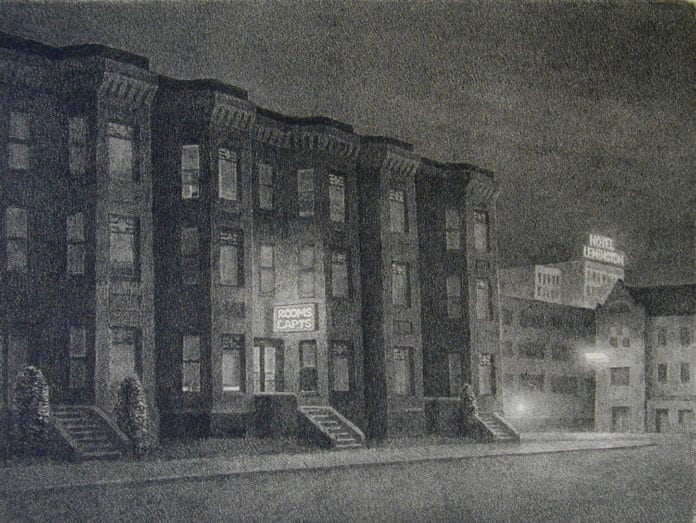
As seen in the Frontispiece of this issue (page 3), American artists have long highlighted the world of industry in their paintings, sculptures, drawings, and prints.  Unfortunately, the dynamism of such historical images—the exciting throb of big things happening—has generally morphed into faded glory, visions of once-grand structures no longer operating at full capacity, if at all.  Such scenes of melancholy and ruination possess their own charm, but industry and industriousness ain’t over yet; artists are finding ways to celebrate still-active sites, too.  This spread, therefore, sets out a range of approaches being pursued by artists around the world. . .

(This article is featured within the November-December 2017 issue of Fine Art Connoisseur.  To purchase this issue or subscribe, visit HERE.)

Ira Korman, “Serpent,” 2004, charcoal on paper, 32 x 23 inches, private collection
Robert Spooner, “The Argyle,” 2016, oil on board, 40 x 50 inches
Nancy Tankersley, “Power Play,” 2016, oil on linen panel, 20 x 20 inches
Vladislav Yeliseyev, “Easton Silos,” 2017, watercolor on paper, 11 x 15 inches
Peggy Morgan Stenmark, “Shadow Connections II,” 2012, watercolor, ink, and acrylic on paper, 26 x 22 inches
Ray Hassard, “Flying the Beam,” 2012, pastel on panel, 20 x 16 inches
Michele Usibelli, “333 Canal Street,” 2016, oil on canvas, 24 x 12 inches, private collection
Charlie Hunter, “Marble Workers, Danby, Vermont, 1963,” 2015, oil on linen, 72 x 48 inches, Artcentric.House
Shelby Keefe, “Intensity of Intention,” 2017, oil on canvas, 30 x 15 inches
Kevin Moore, “In the Shadows of Coal Country,” 2017, oil on panel, 24 x 32 inches, private collection
Bradley Schmehl, “Feeding the Beast,” 2016, oil on canvas, 30 x 40 inches, private collection
Gerald J. Fritzler, “The Master Tech,” 2015, watercolor on paper, 19 x 14 inches, private collection
Nicholas Evans-Cato, “Keyboard,” 2017, oil on canvas, 24 x 44 inches, George Billis Gallery
Francesco Fontana, “Industrial Reflections,” 2017, watercolor on paper, 15 x 20 inches
Christopher Groves, “Streamlined,” 2017, oil on board, 24 x 20 inches, Anderson Fine Art Gallery
Stewart White, “Philly Refinery, Satellite View #1,” 2016, watercolor on paper, 18 x 12 inches, private collection
Steve Stauffer, “Nelson’s Silver Cup,” 2017, oil on linen panel, 16 x 20 inches, Mission Gallery, St. George, Utah
Anne Harkness, “Whitewashed,” 2017, oil on canvas, 36 x 60 inches
Brienne M. Brown, “Wet Stop,” 2016, watercolor on paper, 14 x 10 inches
Joe Paquet, “Blue Collar,” 2014, oil on linen, 28 x 40 inches
John Cosby, ” Canojaharie Creek,” 2015, oil on linen, 18 x 24 inches
Julie Riker, “Lanaconing Silk Mill,” 2017, oil on hardboard, 16 x 12 inches
April Raber, “Diadem II,” 2017, oil on canvas, 12 x 24 inches
Joseph Lorusso, “Linemen,” 2014, oil on panel, 40 x 48 inches, Mountain Trails Gallery
Davi Boyd, “Elevated,” 2017, oil on linen, 50 x 60 inches
Jon DeMartin, “Golden Rails,” 2013, oil on wood, 9 x 24 inches, private collection

Featured Artwork: Mary Bentz Gilkerson

0
“Elm Savannah, Spring” by Mary Bentz Gilkerson

“Elm Savannah, Spring”

7 x 5 in.

oil on cradled panel

$325

Using the ever-changing color and light of a impression, the artistry of Mary Bentz Gilkerson paintings connect people to the experience of place.

“Almost daily for the last five years I’ve made a small painting inspired by the landscapes I travel through, mainly near the roads and highways around Columbia, SC, especially Lower Richland,” says Gilkerson.

Mary is drawn to the ordinary spaces we move through, especially ones that are within view from the road.

“In a roadside view I find a strange intersection of nature and culture. We move so fast that we don’t take time to observe the world around us in the way that people did before modern transportation and technology came along. In my work, I seek to focus on the shifting patterns of light and color that tell us what time of day and season it is, to note the small and subtle, as well as the large and grand.”

Gilkerson holds an MFA in drawing and painting from the University of South Carolina. A native South Carolinian, she lives and works in her Columbia studio after retiring as a professor of art at Columbia College. She has received grants from the S.C. Arts Commission and the Cultural Council of Richland and Lexington Counties in addition to having been selected as a Southern Arts Federation Fellowship Finalist. Her work is in the permanent collections of McKissick Museum, Palmetto Health, Morris Communications Company, and Seibels Bruce Group, among others.

See more of Gilkerson’s work and join her email list at https://marygilkerson.com

Also view Gilkerson’s work at if ART Gallery in Columbia, SC and online at http://ifartgallery.blogspot.com/

Mississippi Never Looked So Good

0
George Caleb Bingham, “The Jolly Flatboatmen,” 1877-78, oil on canvas, Terra Foundation for American Art

More than 175 works by 100 artists inspired by Mississippi over the last two centuries feature during a major exhibition at the Mississippi Museum of Art. There’s definitely something here for every art lover!

“Picturing Mississippi, 1817-2017: Land of Plenty, Pain, and Promise” is a significant exhibition soon to be on view at the Mississippi Museum of Art in Jackson. Opening December 9 and continuing through July 8, 2018, the exhibition commemorates the 200th anniversary of Mississippi’s statehood through more than 175 works by 100 artists.

“Illuminating the perception and depiction of Mississippi over more than 200 years, the exhibition showcases 175 works by 100 artists who either resided in the state, visited, or lived elsewhere and were compelled to respond to a multiplicity of subjects,” the museum says. “From Choctaw objects and sweeping landscapes to portraiture and contemporary work, the exhibition reveals that Mississippi has continuously resonated with artists in powerful ways as lived experience, memory, and imagination.

Louis Joseph Bahin, “Natchez Under the Hill,” 1852, oil on canvas, Morris Museum of Art

“The exhibition features individual masterpieces by artists seldom exhibited in the state, including James Audubon, Jean-Michel Basquiat, Thomas Hart Benton, George Caleb Bingham, John Steuart Curry, Robert Indiana, and Andy Warhol, alongside works by indigenous peoples, as well as by native Mississippians such as William Dunlap, Sam Gilliam, George Ohr, and Eudora Welty. Other prominent artists with works on view include Henri Cartier-Bresson, Melvin Edwards, William Eggleston, Walker Evans, Ben Shahn, and Kara Walker.”

Robert Brammer, “Mississippi Panorama,” circa 1842-1853, oil on canvas, 29 x 36 inches, Private Collection

Mississippi Museum of Art Director Betsy Bradley said, “An unprecedented event for our state, ‘Picturing Mississippi’ provides the unique opportunity to look at our history through the creative lenses of artists working across time, place, and media. We are excited to share a diversity of impressions of Mississippi’s people, places, and histories. The exhibition and related programming reaffirm the seminal quote, attributed to native son William Faulkner, ‘To understand the world, you must first understand a place like Mississippi.’ We hope the exhibition will inspire honest and wide-ranging conversation about where we’ve been, where we are, and where we hope to be.”

The robust exhibition is divided into eight different themes, including “A Contest Place: Native Americans and Europeans”; “Natchez: Culture and Slavery”; “From Statehood to Confederacy: Mississippi in Times of Peace and War”; “Art in the Age of Reconstruction”; “Land and Sea: Artists Explore Mississippi and the World”; “Mississippi, the Great Depression, and Regional Identity”; “Shaping the Future: Art of Mississippi Since 1950”; and “Art in the Age of Civil Rights.”

To learn more, visit The Mississippi Museum of Art.

This article was featured in Fine Art Today, a weekly e-newsletter from Fine Art Connoisseur magazine. To start receiving Fine Art Today for free, click here.

Realism Without Borders Returns in 2017

0
Vadim Suvorov, “Pensive in Blue,” oil, 26 x 24 inches

Vanessa Rothe Fine Art is proudly presenting again Realism Without Borders — a 60-piece fine art exhibition and sale that will be held at two esteemed locations, one on the East Coast and one of the West Coast. Featuring Soviet and historic works alongside contemporary works by Russian, Ukrainian, American, French, Swedish, Italian, and English painters, the event aims to connect two centuries and two continents through a shared commitment to realist painting traditions. Details and locations here!

Realism Without Borders started as a group of artists and art historians with a common vision for art. That partnership has grown into a prestigious collection shown through international traveling exhibitions. Curated by Vanessa Rothe with imported works by art historian Akhmed Salakhly, the Realism Without Borders collection can be found year-round at Vanessa Rothe Fine Art in California. Containing about 100 works at any given time, the collection is always changing as works are sold and new works created.

C.W. Mundy, “The Scholar,” oil, 12 x 9 inches

This year’s Realism Without Borders exhibition brings that collection to New York City and will unite an international roster of top artists working in complementary styles. The show will be hosted by the famed Salmagundi Club (New York City) from December 5-December 10, 2017, during the club’s ongoing celebration of 100 years on Fifth Avenue.

Boris Grachev, Soviet Impressionist work, circa 1955, oil, 17 x 13 inches

From Lomakin to Gladchenko, Suvorov to Kovalenko, Westerberg to Lipking, Dunaway to Krimon, the artists in this exhibition give collectors a rare opportunity to view and compare works from America, Europe, and Russia and to purchase these one-of-a-kind finds for their own fine art collections or as gifts. Paintings will range from small affordable gems to large-scale, highly finished works.

Sergey Kondratyuk, “Reflections,” oil, 15 x 32 inches

Realism Without Borders also celebrates the new opportunities that contemporary culture affords. Artists from all over the globe can now share images of their work through social media and are influencing one another across borders. This exhibition celebrates the blurring of those boundaries and borders, in both the literal sense and the stylistic execution of the works.

Jeremy Mann, “NYC 39,” oil, 18 x 18 inches

“We share an admiration of both realist and impressionist art, and many of our artists in fact combine these styles in order to make strong, visually appealing works,” says Rothe. “The viewers will see similar works and styles being created from opposite ends of the world, finding unity and likeness in both subject and stroke. Some follow the strong realist techniques of Russia’s Levitan landscapes, other styles are reminiscent of the loose and layered brushwork of California Impressionist Edgar Payne, while others are more academic in nature.”

Joshua LaRock, “Elly,” oil, 14 x 10 inches

The 2017 show and sale features newest French artist-member Nicolas Martin, as well as contemporary artists Nick Alm, Grigory Ananiev, Mia Bergeron, John Burton, Michelle Dunaway, Michael Klein, Alexander Kremer, Sergey Kovalenko, Olga Krimon, Joshua LaRock, Jeremy Mann, Nicolas Martin, Dimitri Motov, C.W. Mundy, Robert Pillsbury, Peggi Kroll-Roberts, Ray Roberts, Vanessa Rothe, Valery Shmatko, Vadim Suvorov, Daniil Volkov, and Aaron Westerberg. Historic artists include Alexi Borodin, Boris Gladchenko, Boris Grachev, Oleg Lomakin, Edgar Payne, Yuri Podlaski, Erik Rebane, and Vladimir Telegin.

Artwork on Resale From the Marano Collection include Juliette Aristides, Casey Baugh, Marc Dalessio, Daniel Graves, Jeremy Lipking, Jeremy Mann, Edward Minoff, Julio Reyes, Aaron Westerberg, and Vincent Xeus.

To learn more, visit Vanessa Rothe Fine Art.

This article was featured in Fine Art Today, a weekly e-newsletter from Fine Art Connoisseur magazine. To start receiving Fine Art Today for free, click here.

Klimas in the Meadows

0
Alexandra Klimas, “Melissa the Cow,” oil on canvas, 23 1/2 x 31 1/2 inches

Alexandra Klimas has had a lifelong fascination with cows, and follows their decline in the Netherlands with dismay — like pugs, they are now mainly kept inside, in mega farms. Her reflection of their disappearance from the fields leads her to create idealized pastoral landscapes with an ethereal quality that draws the viewer in. Where can you see those paintings now?

On view now through November 27, John Davies Gallery in England is presenting the magnetic works of Dutch painter Alexandra Klimas. Klimas paints oil portraits of farm animals created on location, with the named animals as sitters. Although animals have been painted for millennia, Klimas’ paintings are unique as the cows, sheep, farm cats, and poultry are the lead subjects in the works and given the artistic attention usually applied only to human subjects.

Alexandra Klimas, “Eliza the Sheep,” oil on canvas, 23 1/2 x 11 3/4 inches
Alexandra Klimas, “Adelia the Cow,” oil on canvas, 31 1/2 x 23 1/2 inches
Alexandra Klimas, “Lobke the Cow,” oil on canvas, 23 3/4 x 31 1/2 inches
Alexandra Klimas, “Cows in a landscape,” oil on canvas, 15 3/4 x 31 1/2 inches
Alexandra Klimas, “Mia the Cow,” oil on canvas, 31 1/2 x 39 1/4 inches
Alexandra Klimas, “Sheep in a lovely pasture,” oil on canvas, 23 1/2 x 39 1/2 inches

To learn more, visit John Davies Gallery.

This article was featured in Fine Art Today, a weekly e-newsletter from Fine Art Connoisseur magazine. To start receiving Fine Art Today for free, click here.

Pettis in Minneapolis

0
Mary Pettis, "Musique du Mouton," oil on linen, 30 x 40 inches

The Minneapolis Club is “thrilled and honored” to be hosting a solo exhibition of works by important painter Mary Pettis. Details here.

Now through November 30, Minneapolis, Minnesota, has a new attraction: a solo exhibition of gorgeous landscapes by accomplished painter Mary Pettis. Hosted by the Minneapolis Club, the exhibition consists of a handful of Pettis’ recent works, including several from her recent project with the Minnesota Orchestra in which the artist created a series of special paintings in connection with the performance of Claude Debussy’s “Images for Orchestra.”

“When I paint I truly feel, in the present moment, the great relations among all things,” remarked Pettis. “Every subject becomes a metaphor for something deeper and more intangible. I hope that those who view my work, whether briefly or for decades, will feel these sentiments. My inspiration is the hope I hold that my work will help spread peace, contemplation, tranquility, and joy.”

Recently, Pettis was designated as an ARC Living Master by the Art Renewal Center. In September 2017, Mary travelled to Barcelona, Spain to receive multiple awards in Art Renewal Center’s 12th Annual International ARC Salon. Her 3rd place winner, “Minnehaha Falls in Winter,” will be exhibited with other award winners in the live exhibition at the European Museum of Modern Art (MEAM) through the end of November.

To learn more, visit The Minneapolis Club.

This article was featured in Fine Art Today, a weekly e-newsletter from Fine Art Connoisseur magazine. To start receiving Fine Art Today for free, click here.

The Other Wright Brothers

0
Ferdinand von Wright, “View from Haminalahti,” 1853, Finnish National Gallery

Although they aren’t credited with having developed the first airplane, Magnus, Wilhelm, and Ferdinand von Wright were accomplished in their own right, each known as a great painter of portraits, landscapes, and nature subjects. A major exhibition of their creative accomplishments is currently on view here.

Growing up in North Carolina, I became very familiar with the Wright Brothers — Orville and Wilbur, that is — at a young age. After all, their famous flying machine can be seen on most NC license plates. However, I had no idea that there were other famous Wright Brothers, until now. That’s because the Ateneum Art Museum in Helsinki, Finland, is currently celebrating the career and works of three native sons —brothers — who are considered among the country’s most beloved 19th-century artists.

Ferdinand von Wright, “In the Garden of Haminalahti,” circa 1856-57, Finnish National Gallery

Magnus, Wilhelm, and Ferdinand von Wright were well known in their time as great painters of portraits, landscapes, and nature subjects, especially birds, and as creators of scientific illustrations of flora and fauna. More than 200 works from the Atheneum collection, and from Finnish and Swedish public and private collections, compose “The Von Wright Brothers,” which opened at the museum on October 27 and continues through February 25, 2018.

According to the museum, “The exhibition introduces new perspectives, as it explores the historical significance of the von Wright brothers for Finnish art, culture, and science. The exhibition, occupying the entire third floor of the museum, features oil paintings, watercolors, prints, and sketches. Exhibits also include birds stuffed by Magnus von Wright, courtesy of the Finnish Museum of Natural History.

Magnus von Wright, “Eurasian Eagle-Owl,” 1829, Finnish National Gallery

“The von Wright brothers grew up in a manor in Haminalahti, Kuopio. The brothers’ interest in nature originated in the hobby of hunting, as practiced by their father, Major Henrik Magnus von Wright. Skilled hunters, the brothers began to document the birds they caught.

“Through watching and painting birds over a long period of time, the brothers gained a wide knowledge of nature. Their works are characterized by detailed scientific accuracy. At the same time, their art conveys a special love of nature. The works reflect the aesthetic values of their time, the 19th century.

Magnus von Wright, “Suopeltovuori in Haminalahti,” 1867, Finnish National Gallery

“The eldest of the brothers, Magnus von Wright (1805–1868), known especially for his landscape paintings, was an influential cultural figure in Helsinki. He worked as a teacher at the University of Helsinki drawing school and as an expert at the Finnish Art Society, in which capacity he contributed to the establishment of the Ateneum collection. In his paintings of Helsinki, such as ‘View from Katajanokka’ (1868) and ‘Annankatu on a Cold Winter Morning’ (1868), he documented the changes taking place in the city.

“Wilhelm von Wright (1810–1887) was active especially in Stockholm and on the island of Orust on the west coast of Sweden. He worked as a scientific illustrator for the Royal Swedish Academy of Sciences. Wilhelm assisted his brother Magnus in illustrating the book Svenska foglar, presenting Swedish birdlife: the work contains 182 colored drawings, illustrating birds with scientific precision. According to today’s ornithologists, the illustrations created by the brothers are still accurate. Wilhelm suffered paralysis, which cut his career shorter than that of the other brothers.

Wilhelm von Wright, “Bohemian Waxwing,” 1829, Finnish National Gallery

“The most famous, and youngest, of the brothers is Ferdinand von Wright (1822–1906). Ferdinand is known especially for his paintings of birds, such as ‘The Fighting Capercaillies’ (1886) and ‘An Eagle-Owl Seizes a Hare’ (1860). Ferdinand was one of the first visual artists in Finland to make a living from art. He enjoyed the longest career of the brothers, and later attained the status of an old master and earned respect from young artists.”

After being on display at the Ateneum, the exhibition will, in 2018, travel to the Kuopio Art Museum and the Tikanoja Art Museum in Vaasa. To learn more, visit the Ateneum Art Museum.

This article was featured in Fine Art Today, a weekly e-newsletter from Fine Art Connoisseur magazine. To start receiving Fine Art Today for free, click here.

One to Watch: Tanya Atanasova

0
Tanya Atanasova, “Smokey Eyes, Joëlle,” 2017, oil on linen, 120 x 110 cm.

If you haven’t heard of artist Tanya Atanasova, it might be time.

I was born in Bulgaria in 1978, in a small town called Koprivshtica, right in the heart of the Balkan mountain range. With its special architecture and brightly colored houses, Koprivshtica is well known as a UNESCO heritage site. It is also a major tourist destination in Bulgaria.

I spent my early youth in a country that was still under a communist regime, though I inherited some spark of rebellion from my father, who was running a local restaurant in Koprivshtica.

Tanya Atanasova, “Lore Entangled,” 2017, oil on linen, 120 x 110 cm.

I was infected by my two older brothers’ love of drawing and painting. The three of us used to go to art classes together, but this ended abruptly when my youngest brother died in a tragic accident. My parents couldn’t cope with this great loss and got divorced. Our mother left us in the care of my father, but in practice my brother and I were raised by my grandmother.

From my early days, I felt that I was born an artist, so when my father started talking about building a hotel and started to insist that I would work there as a receptionist, I fled from the small village where I grew up, to the city of Sofia, where my mother was living. I was 14 at the time, and the changes in my life were accompanied by changes in my country, which went from a communistic dictatorship to a state run by the mafia where corruption and hyperinflation ran the game. I remember vividly that at some point my mother’s salary would be barely enough to buy us a piece of chocolate at the end of the month.

Tanya Atanasova, “Connected II,” 2017, oil on linen, 100 x 70 cm.

In my country’s darkest days, I finished high school and my mother wouldn’t provide for me anymore so I started working, taking on any job I could find, mostly bartending in a local jazz-café in Sofia. When my father died at the age of 47, I was devastated, but I was still dreaming of getting an art education, so I tried to take private lessons during the day and worked in the café at night.

Tanya Atanasova, “Michel,” 2016, oil on linen, 120 x 110 cm.

After three years, I was finally accepted as a student at the National Art Academy in Sofia. However, I wanted to take full advantage of the doors that had opened up after the fall of communism in Bulgaria. During an exchange project, I met a Belgian guy, fell in love, and decided to go to Belgium. After a year of struggling with bureaucracy, I managed to become the first Bulgarian exchange student at Sint-Lucas School for the arts in Ghent, Belgium. It’s there that I discovered and developed my interest in contemporary figurative painting. After finishing my BA in Sofia, I decided to stay in Belgium permanently.

Tanya Atanasova, “Octoman, Michel,” 2017, oil on linen, 150 x 110 cm.

These days I’m working as a full-time artist from a painting studio in Antwerp — a city rich in history and culture — where I’ve been living for 10 years now. I’ve been struggling to find my artistic voice in a society where I will always feel slightly “out of place,” but after taking a master class with the Spanish master Eloy Morales, I set out on a project of portraits that pays homage to the people that have inspired me and helped me on the bumpy road to where I am right now, even though very often I could only offer them friendship in return. It’s my way to thank life for putting them on my path and pointing me in the right direction.

Atanasova’s exhibition, titled “You My Dear,” is scheduled for 2019, so stay tuned! To learn more, visit Tanya Atanasova.

This article was featured in Fine Art Today, a weekly e-newsletter from Fine Art Connoisseur magazine. To start receiving Fine Art Today for free, click here.

WEEKLY NEWS FROM THE ART WORLD

Fill your mind with useful art stories, the latest trends, upcoming art shows, top artists, and more. Subscribe to Fine Art Today, from the publishers of Fine Art Connoisseur magazine.

  • This field is for validation purposes and should be left unchanged.