Home Blog Page 313

Was There a Relationship?

0
Johannes Vermeer, “Woman Holding a Balance,” circa 1664, oil on canvas, 16 3/4 x 14 15/16 inches, National Gallery of Art, Washington

More than 20 years after the legendary Vermeer exhibition at the National Gallery of Art in Washington, D.C., the institution has once again mounted a revealing exhibition surrounding the Dutch Golden Age master and his relationships with contemporaries.

On view now through January 21, 2018 at the National Gallery of Art is a stellar exhibition featuring some of the most iconic and prized Dutch Golden Age masterpieces. “Vermeer and the Masters of Genre Painting” had a very successful run in 2017 at the Musée du Louvre and the National Gallery of Ireland before landing in Washington, D.C., for American audiences to enjoy. The show features some 65 masterpieces by Johannes Vermeer and his contemporaries — including Gerard ter Borch, Gerrit Dou, Pieter de Hooch, Nicolas Maes, Eglon van der Neer, Caspar Netscher, and Jacob Ochtervelt.

Johannes Vermeer, “Lady Writing,” circa 1665, oil on canvas, 17 11/16 x 15 11/16 inches
Johannes Vermeer, “The Lacemaker,” circa 1670-71, oil on canvas, 9 5/8 x 8 1/4 inches, Musée du Louvre, Paris
Johannes Vermeer, “Woman with a Pearl Necklace,” circa 1662-65, oil on canvas, 21 5/8 x 17 11/16 inches, Staatliche Museen zu Berlin

The paintings are organized by theme, composition, and technique as a way of highlighting how the painters admired, challenged, and pushed each other toward greater artistic achievement. “The paintings also reflect how these masters responded to the changing artistic climate of the Dutch Republic in the third quarter of the 17th century, particularly in Amsterdam, Haarlem, Leiden, Deventer, Rotterdam, and Delft,” the museum reports.

Gerrit Dou, “Astronomer by Candlelight,” circa 1665, oil on panel, 12 5/8 x 8 3/8 inches, J. Paul Getty Museum, Los Angeles
Gabriel Metsu, “Woman Reading a Letter,” circa 1664-66, oil on panel, 20 11/16 x 15 13/16 inches, National Gallery of Ireland
Jan Steen, “Young Woman Playing a Harpsichord to a Young Man,” circa 1659, oil on panel, 16 5/8 x 13 inches, The National Gallery, London

National Gallery Director Earl A. Powell III adds, “The 1995 ‘Johannes Vermeer’ show endures as one of the most significant exhibitions in the Gallery’s history. ‘Vermeer and the Masters of Genre Painting’ will undoubtedly have the same impact while also deeply enriching our understanding of the web of influence among 17th-century Dutch artists.”

To learn more, visit the National Gallery of Art.

This article was featured in Fine Art Today, a weekly e-newsletter from Fine Art Connoisseur magazine. To start receiving Fine Art Today for free, click here.

Hint: They Weren’t White

0
Edward Dodwell, “Parthenon from the Southeast,” 1805, watercolor, The Packard Humanities Institute

If I were to ask you to describe the “classical” style, what would you say? Most would describe a stark white building with a large colonnade decorating its façade. Others might cite examples of ancient sculpture; white marble icons of figurative beauty and mathematical proportions. I often like to joke with my students that, for the most part, we’ve got it all wrong.

Regardless of the fact that white marble classical architecture, sculpture, and the artworks they inspire are incredibly beautiful, historians have proven that, originally, they were painted with vivid colors. In fact, a majority of classical Greek sculpture wasn’t even fabricated in marble at all, but rather bronze.

Reconstruction (B) of a Trojan archer, 2005, synthetic marble cast with natural pigments in egg tempera, lead, and wood. Original from Aegina, Greece, circa 480 BCE, marble
Simone Pomardi, “Western end of the Erechtheion from the Southwest,” 1805, watercolor, The Packard Humanities Institute

The Legion of Honor in San Francisco will be opening a great exhibition on October 28 that seeks to highlight this misconception. “Gods in Color: Polychromy in the Ancient World” will present ancient sculpture in their original, vibrantly colored glory. “Defying the idea of the stark white marble of antiquity,” the museum reports, “the installation is the result of over 30 years of groundbreaking research in pigmentation of ancient sculpture by international scientists and archaeologists. On view will be nearly 40 reproductions of well-known Greek and Roman artworks painted in brightly colored authentic pigments, uniquely juxtaposed with 30 statues and carved reliefs from ancient Egypt, the Near East, Greece, and Rome from the Fine Art Museums of San Francisco’s own holdings, supplemented with magnificent loans from Californian and European collections.

Reconstruction (A1) of the Chios Kore from the Akropolis in Athens, 2012, crystalline acrylic glass with natural pigments in egg tempera. Original from Athens, circa 500 BCE, marble
Reconstruction (B) of a cuirassed torso from the Akropolis in Athens, 2005, plaster cast, gilt with applied pigments in tempera. Original circa 470 BCE, marble

“When the idea of classicism took hold during the Renaissance, artists like Michelangelo and other masters hailed form and composition, instead of color, as the most prominent and venerable features of ancient sculpture. Over time, knowledge of color in ancient sculpture became all but forgotten and any evidence of polychromy was ignored. But even today, after millennia of burial and exposure to the elements, faint traces of color pigments on ancient sculptures can sometimes be detected with the naked eye. Additionally, advances in technology and research have allowed for an understanding of the evolution and extent of ancient polychromy. Techniques such as ultraviolet fluorescence photography and the examination of ancient pigments via ultra-violet-visible (UV-VIS) absorption spectroscopy have allowed an international team of archaeologists and scholars to create astonishing color reproductions.

Reconstruction (B) of Athena, 2005, plaster cast with natural pigments in egg tempera, 67 inches. Original from Aegina, Greece, circa 480 BCE, marble
Reconstruction of the Riace Warriors (A and B), 2015-2016. Originals circa 460 BCE, bronze cast, copper, colored stones, silver

“This exhibition will not only challenge the widely accepted ideal of achromatic ancient sculpture, it will also address how this misconception has influenced the history of sculpture. Works from ancient Greece and Rome will also be joined by sculptures from Egypt and the Near East to reveal a fuller range of polychromy from across the ancient Mediterranean world.”

“Gods in Color: Polychromy in the Ancient World” will continue through January 7, 2018. To learn more, visit the Legion of Honor.

This article was featured in Fine Art Today, a weekly e-newsletter from Fine Art Connoisseur magazine. To start receiving Fine Art Today for free, click here.

Thin Places, Thin Spaces

0
Maxwell Stevens, “Spring Essence 2,” 2017, oil on canvas, 23 x 23 inches

Gallery ONETWENTYEIGHT in New York is excited to soon be showcasing the engaging paintings of an ascending artist. Titled “Spring Essence,” this exhibition offers an intimate painterly probing of what some theologians refer to as “thin places” or “thin spaces.” What does this mean?

There’s certainly a lot to visually and psychologically take in during “Spring Essence,” an upcoming solo exhibition of recent works by painter Maxwell Stevens at Gallery ONETWENTYEIGHT in New York City. In the show, Stevens’ paintings brilliantly combine both abstract and representational qualities.

“Superimposed with a splashy and colorfully vivid palette of scarlet, fuchsia, and rose complimented by minty greens, the visually tactile abstractions display an increase in clarity and fluidity, blending areas between abstraction and figure, with lightly scraped passages shifting in and out of focus,” the gallery writes. “Slight progressions in time are indicated by a clock on the wall and the shifting emotional tenor of the conversation, and these changes are further mirrored by watery abstractions that fluctuate and spill across each scene in a progressive manner.”

Continuing, the press release reads, “Seeking in painterly terms what some theologians refer to as ‘thin places’ or ‘thin spaces,’ and taking the position that these divine places are more psychologically than geographically defined, the artist has turned towards private scenes in his own home during Easter weekend as his point of departure. Deepening his commitment to his multi-layered approach and to the materiality of his works, canvases have been glazed dozens of times to achieve a mirror finish, while retaining a painterly approach to rendering each delicate scene with thousands of tiny brushstrokes blended together to fuse each picture. Curvilinear gestures slide across the glassy images, culminating in vibrant, floral abstractions that seem to hover and blossom above each miniaturized scene, inviting the viewer’s gaze from both near and afar as they become both voyeur and participant in the artist’s search for a thin place through his art.

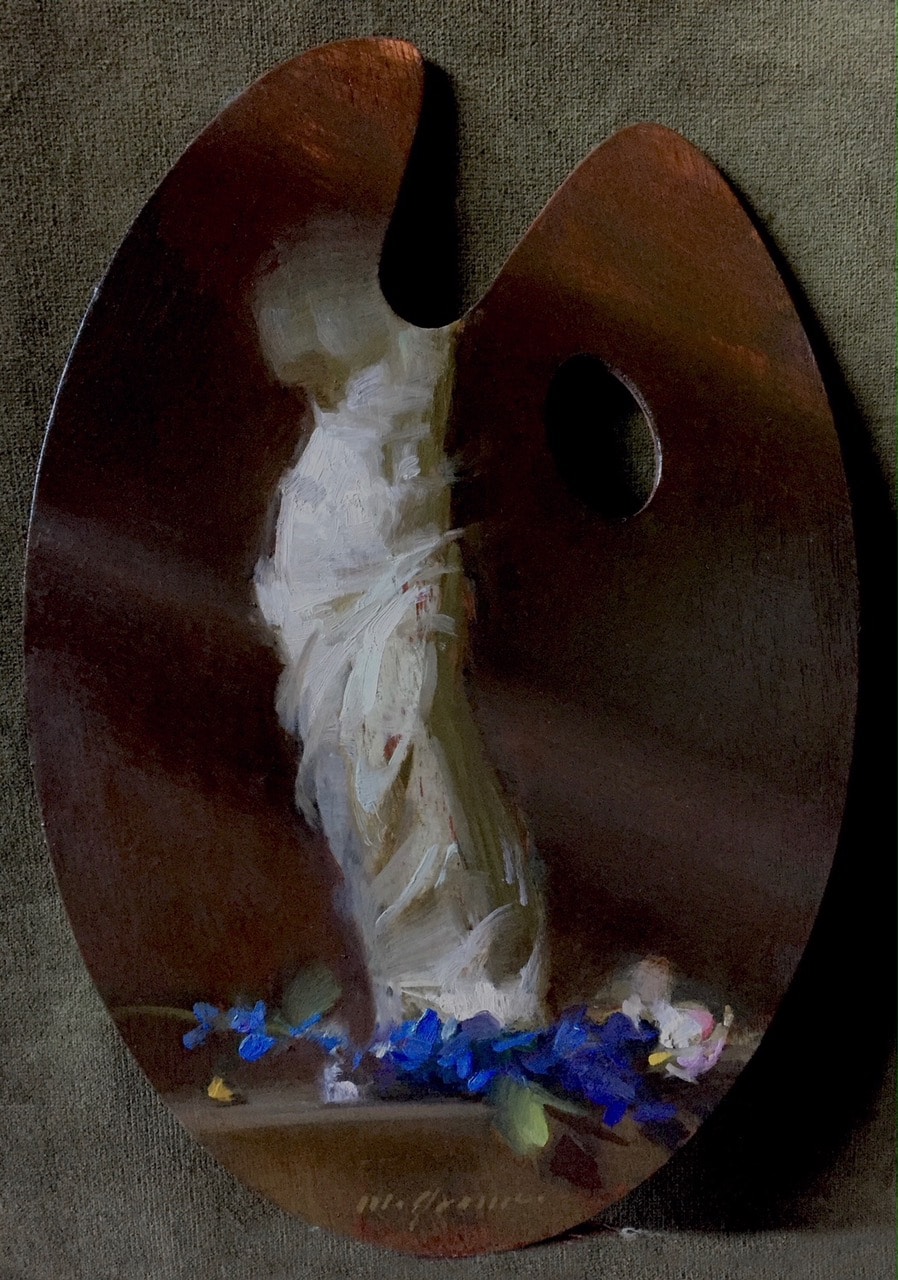
“Accompanying the ‘Spring Essence’ suite are oval panel paintings cut from heavy slabs of mahogany, their beveled edges gently curving to meet the wall, while fragments of earlier deconstructed paintings are collaged onto raw linen, standing in stark contrast to the freshly painted abstractions, creating a historical subtext within the overall presentation, allowing past and present to coalesce together.”

To learn more, visit Gallery ONETWENTYEIGHT.

This article was featured in Fine Art Today, a weekly e-newsletter from Fine Art Connoisseur magazine. To start receiving Fine Art Today for free, click here.

Legacies Worth Your Attention

1
Jeremy Lipking, “Above Timberline,” oil, 36 x 18 inches

An incredible lineup of artworks by many of the most prominent painters working in the field of realism today feature during a must-see exhibition in Denver, Colorado. Details here.

“Legacy” is perhaps one of the most star-studded exhibitions to have been mounted in 2017, making it a must-see for anyone in the Denver area in November. Opening on November 7, the exhibition headlines some of the most prominent painters working in the field of realism today.

Juliette Aristides, “Ovidieo,” oil, 36 x 26 inches

Curated by Anthony Waichulis, the exhibition aims to not only highlight the immense skill of the represented artists, but to celebrate and acknowledge their contributions in the field of art education as well. The show will be hosted at the Vida Ellison Gallery (Level 7) at the Denver Central Library and closes on December 31.

Sadie Valeri, “Venus,” oil, 20 x 16 inches

Via the exhibition press release: “For nearly 40,000 years mankind has been contributing to a vast visual record of the human condition. Weaving creativity with convention, each generation of mark-makers would pass along to the next an evolving visual vocabulary that would eventually overcome barriers of time, distance, language, and culture. Today, art educators prepare new generations of creatives to contribute new chapters to this unique, ongoing epic. Legacy is a celebration of these educators.”

Anthony Waichulis, “Storyteller,” oil, 18 x 25 inches

Participating artists in “Legacy” include Juliette Aristides, Dru Blair, Neilson Carlin, Rodney Davis, Jon deMartin, Edward Dillon, Michelle Dunaway, Kerry Dunn, Paul Foxton, Donato Giancola, David Gray, Amanda Hallenius, Russell Harris, Jeffrey Hein, Timothy Jahn, Joel Carson Jones, David Kassan, Jeremy Lipking, Deborah Lloyd, Edward Minoff, Juan Martinez, Kevin Moore, Tim Reynolds, Mario Robinson, Richard Schmid, Jordon Sokol, Dan Thompson, Sadie Valeri, Scott Waddell, Jeffrey Watts, Anthony Waichulis, Leah Waichulis, Patricia Watwood, and Elizabeth Zanzinger.

To learn more, visit Gallery 1261.

This article was featured in Fine Art Today, a weekly e-newsletter from Fine Art Connoisseur magazine. To start receiving Fine Art Today for free, click here.

Spooky Art for the Spooky Season

0
Alessandro Sicioldr, “Sogno Del Demiurgo (Creatore),” oil on wood, 60 x 70 cm.

Last Rites Gallery in New York has established a reputation for showcasing incredible representational art, but with a surreal and fantastical twist. That trend continues with “13th Hour,” a magnetic display of surrealism that fits perfectly with the Halloween season.

“Conjured by mastermind Paul Booth, the annual ‘13th Hour’ exhibition accentuates the dual nature of humanity and invites the viewers to take part in one of the most engaging and comprehensive exhibitions of contemporary surrealism,” Last Rites Gallery says. Sound like fun? I would certainly say so.

Kikyz1313, “Effigy of Coiled Tragedies,” graphite, watercolor, and pastel on paper, 30 x 39 cm.
Emil Melmoth, “Rotten Cupid,” epoxy clay and metal, 62 x 52 x 17 cm.
Grady Gordon, “Judges,” monotype on reeves paper, 11 x 15 inches

The show’s namesake describes the final minute before 1am, “in which entities that are bound to other dimensions and otherworldly realms intrude on our own reality,” the gallery continues. “Those who exist within both places during the 13th hour traverse and wreak havoc on our world, responsible for conducting the mischief onto ill-fated humans.”

Bam Maslar, “Hope Does Not Disappoint,” oil on panel, 22 x 29 inches
Miles Johnston, “Withdrawl,” graphite on paper, 10 1/2 x 10 1/2 inches
Rachel Bridge, “Nightmares Become Me,” oil on panel, 24 x 30 inches

Opening on October 28 and continuing through November 11, “13th Hour” has brought together a collection of globally renowned artists who blur the line between beautiful and grotesque, exploring themes of human existence, as well as humanity’s psychological dwelling in the “unknown” — the confusion and uncertainty of our existence that poses many questions, but reveals fewer answers.

Brian Mashburn, “Juniper,” oil on canvas, 9 x 12 inches
Paul Cristina, “Ritual Head #2,” oil on canvas, 14 x 18 inches
Caitlin McCormack, “Suffocator,” crocheted cotton string, blue, steel pins, velvet, 22 1/4 x 18 3/4 x 2 3/4 inches

“Observers are led on a visual journey through each artist’s individual interpretations of the 13th hour,” the gallery writes, “wandering through mysterious realms and conjuring stories formed by the many mediums of fine art. Illuminating from these works of art are vivid nightmares, old ones stained in our memories and new ones clawing at the surface, further revealing the darker zones of our minds that coexist with our worldly perceptions.”

Jesse Levitt, “WVRM,” oil on panel, 36 x 24 inches
Matt Mrowka, “Yolk,” oil on Masonite, 20 x 34 inches
Zofia Bogusz, “Valkyrie,” oil on wood, 18 x 18 inches

Represented artists include Logan Aguilar, Samuel Araya, Audra Auclair, Rachel Bridge, Saturno Buttò, Zofia Bogusz, Caniglia, Adrian Cherry, Nannette Cherry, Sam Wolfe Connelly, Paul Cristina, Damien Echols, Darwin Enriquez, Erik Ferguson, Grady Gordon, Gabriela Handal, Fred Harper, Stuart Holland, Ben Howe, Michael Hussar, Jeremy Hush, Stephanie Inagaki, Miles Johnston, Kikyz1313, Eric Lacombe, Darby Lahger, Jesse Levitt, Jed Leiknes, Qixuan Lim, Eli Livingston, Brian Mashburn, Bam Maslar, Caitlin McCormack, Jim McKenzie, Emil Melmoth, Harry Michalakeas, Yomico Moreno, Matt Mrowka, Billy Norby, Juan Miguel Palacios, Shane Pierce, David Richardson, Lee Harvey Roswell, Alessandro Sicioldr, Brian Smith, David Stoupakis, Henrik Uldalen, Hannah Vandermolen, N8 VanDyke, Way$hak, & Pamela Wilson.

To learn more, visit Last Rites Gallery.

This article was featured in Fine Art Today, a weekly e-newsletter from Fine Art Connoisseur magazine. To start receiving Fine Art Today for free, click here.

The Memory of John H. Moran

0
John H. Moran, photo courtesy John Moran Auctioneers

Hearts were heavy across the fine art landscape this week after it was announced that John H. Moran (1942-2017) — founder of John Moran Auctioneers — passed away on October 3. We take a moment here to honor his legacy.

Via Jeff Moran, son of John H. Moran:

Dear Friends,

It is with a heavy and saddened heart I bear the news that on October 3rd, our founder, president, and friend peacefully departed on his next voyage — which, in true fashion, was during of one of the most successful auctions in our company’s history.

The Moran Family has received such an outpouring of support from friends and clients alike, I feel compelled here to express our deepest gratitude and with that, it is important to me to reciprocate with some important insights about my father.

The beauty of the auction business is that we get to handle, research, photograph, conserve and sell an unbelievable amount of interesting property each year which requires concentrated focus all the time. You need to have a burning passion for this business, and I can assure you that we do, as he did. Working alongside him over the years, my father reminded me that we are only the temporary custodians of our most prized possessions. This idea helps put things into perspective when dealing with the acquisitive nature of the art and antiques business.

John H. Moran, photo courtesy John Moran Auctioneers

Yet for my dad, it seems the scales were tipped inversely. We ran an auction business, but the people were often more interesting than their stuff! I remember my father would come home from work and say over dinner, “I met the most interesting gentleman today,” and he would proceed to share a tale about this person’s life story. Some stories were more riveting than others but most earned dinner table merit. One fellow in particular I remember hearing about, then meeting, was Walter. This man had inherited a sizable trust but preferred the simpler life of a 21st-century hobo. We eventually sold the contents of his parent’s estate, but he could not wait to be done with the excruciating process of dismantling his childhood. My dad and I sat and listened to Walter for hours, as this tall and quiet man, who resembled a figure in a Thomas Hart Benton painting, went on to describe his adventures (and misadventures) whilst jumping on and off trains for the last 20 years across the U.S. We all laughed together and got to be friends through the business.

Walter was just one character in a cast of thousands that created the larger storybook of our company. The people truly are as interesting as their stuff, sometimes more so. I believe this is the primary reason my father gravitated towards the auction business because for him, his passion was the people first, the stuff second. This was the guiding principle that would set Moran’s apart from the competition, and that is how he built our business.

His passing comes as not as a surprise to those close to him — as does the void that his death has left in the community — like a large oak tree that has fallen in the neighborhood and people stare at in disbelief that it is no more.

As I process my father’s death, it helps me to focus on the vitality of his life and the times we shared together. Specifically, the legacy he left behind with the auction company and the friends he made along the way in 50 years of doing what he loved and all the success that comes from that. If you are reading this e-mail, it means that you have participated with our company in some way, large or small, and are part of our story. Thank you.

— Jeff Moran

This article was featured in Fine Art Today, a weekly e-newsletter from Fine Art Connoisseur magazine. To start receiving Fine Art Today for free, click here.

Featured Artwork: Olaf Schneider

0
"New York 24/7" by Olaf Schneider

‘New York 24/7’

Oil on canvas

40 in. x 60 in.

Available through the artist


Biography

 Olaf Schneider (b.1964) is a husband, father of two, and grandfather of six. He studied at the Ontario College of Art as well as Sheridan College. In 1986, while painting large scale outdoor advertising billboards for Mediacom, he acquired a strong practical foundation that would become integral to his work today.

 He is greatly inspired by mentor Ron Grieg and Norman Rockwell.

For Olaf each piece represents an intense exploration and refinement of his personal pictorial sensitivities, especially as they relate to beauty, form, light, and shade. Composition, color, and craftsmanship are all elements that become the building blocks of his work. Olaf is a prolific painter who is inspired by the power and diversity of the northern landscape, and anything that needs a “second look”. An explorer by nature, he travels across North America and Europe to gain inspiration.

 “Each dab I make is stimulated by the details that I observe. I hope to see what others miss and then make it compelling. I push and alter the colors to suit my ravenous needs and I love to improvise on the spot.”  


Olaf has a passion for a variety of subjects. Through his art, he expresses his love for life and his affinity with vibrant colour. 

“I like to use expressive and thick impasto brushstrokes or soft blended strokes to render a sense of movement and texture giving the painting a life of its own. My interpretation of colour also sets the dynamic mood. The tones often range from the darkest to the lightest in an effort to achieve maximum drama. This creative combination is spontaneous and intuitive.”

To keep his mind clear and focused he limits his exposure to all the media ‘noise’ we generally are pummelled with daily. He does not watch TV and restricts his time on the computer. He starts his day with God in prayer and meditation. Painting six to ten hours a day is common practice. Equally important to Olaf is continued growth and learning.

  
“I want to always have an open mind so that new ideas may come in. In the mind of an expert, there are few possibilities, but in the mind of an amateur they become endless. This is a God given gift and I value it greatly. If I am able to bring emotion, understanding, comfort, or joy into another’s life then I am using it wisely in His glory.”


Philosophy

Art is a celebration of life, and the making of art is an expression of the sacred spiritual discipline. If a painting could, for a moment, capture the attention and awareness of the viewer through visual harmony, carry on a dialogue, bring the viewer further than the call of the senses, beyond a momentary concern for the past or future, to a timeless state free from thought and self consciousness. Then the work has approached the realm of art, the realm of life. Art and money don’t mix.


View more of Olaf’s work at http://www.olaf.ca.


Solo Exhibitions

2016 – Tilting at Windmills Gallery, Vermont

2016 – Broadway Galleries, Virginia

2015 – Westmount Gallery, Ontario

2015 – Woodbine Raceway

2015 – International Artist Magazine June issue

2014 – Cannes France

2005–2013 – Westmount Gallery, Toronto

2011 – Royal Gallery, Rhode Island

2009 – Mercedes Benz, Ontario

2009 – Homer Watson Gallery

2008 – Gallery DeLisle

2005 – Hummingbird Centre

2004 – McMichael Gallery, Kleinburg

2003–2006 – International Artists Magazine

1998–2004 – Formula 1, Montreal & Indianapolis


Group Exhibitions

2014 – Chapel St. Bernardin, France

2014 – Le Cannet, France

2008–2013 – Westmount Gallery, Toronto

2013 – The Louvre, SNBA Salon, France

2009–2013 – Edgewood Orchard Gallery, Wisconsin

2013 – Galerie Demante, California

2012 – The Connecticut Society of Portrait Artists

2012 – Portrait Society of America

2011 – Thornwood Art Gallery, Texas

2011 – Canadian Heritage Art Gallery

2010–2013 – Toronto International Art Fair

2010 – Canadian Heritage Art Gallery, Toronto

2010 – Thornwood Art Gallery , Texas

2009 – Boston International Art Fair

2007–2011 – Miller Gallery, Ohio

2007 – Scottsdale Art Gallery, Arizona

2006 – Kipling Gallery Woodbridge, Ontario

2006 – Manitou Gallery, Santa Fe, NM

2006 – Latino America International

2004–2006 – Todmorden Mills Heritage Museum

2002–2005 – Hummingbird Centre, Toronto 

2000 – Living Arts Centre, Mississauga

1998–2002 – Molson Indy, Toronto & Vancouver


Publications

American Art Collector Magazine

Arabella Magazine

Houston Lifestyles and Homes

Ducks Unlimited 2007, 2009, 2010, 2011

Etobicoke Guardian

Scarborough Mirror

Vaughan Weekly

George Chuvalo Fight Against Drugs

International Artist

Art Fix

WPBS Television

Algonquin Park news

The Huntsville Forrester

24 Hours

Toronto Life

2004–2006 Magazin’art Biennial Guide 

Creative Source 1989, 2004


Corporate and Private Collections

Ripley’s Aquarium Canada, Toronto

PCO – Construction Ltd.

The Haven on the Queensway, Toronto

The Good Shepard, Toronto

Mackenzie Financial, Toronto

Toronto Dominion Bank, Toronto

Ducks Unlimited 2007, 2009, 2010, 2011, 2012

Make a Wish Foundation

George Chuvalo Fight Against Drugs Foundation, Canada

Paul Smith’s College, New York

Make a Wish Foundation, Toronto

Hospital for Sick Children, Toronto & Montreal

Jessie Centre for Teenagers, Toronto                              

Ontario Provincial Police, Canada

Labatt Breweries Ltd. Ontario, Canada                            

Evian Canada

Gilles Villeneuve Museum, Quebec                  

Chapters Indigo Canada

Mercedes-Benz, Toronto                                  

Ford Ontario

Ferrari North America  

Apple Canada

Governor General of Madrid, Spain

L.L.C.B.O.

Art Gallery of Ontario                                          

Centennial College

Van Moorehem Barristers, Ontario               

Block Parents Foundation,  Canada


Current Gallery Representation

Chloe Gallery, San Francisco CA  415.531.5748

Eclipse Gallery, Huntsville ON  705.783.2579

Emma Butler, St. John’s NFLD  709.739.7111

Lovetts Gallery, Tulsa OK  918.664.4732

MountainMist Gallery, Cashiers NC  407.620.2685

Palm Avenue Fine Art, Sarasota FL  941.388.7526

Rendezvous Gallery, Vancouver BC  604.687.7466

Spa Fine Art Gallery, Saratoga NY  203.226.6934

Tilting Windmills Gallery, Manchester VT  802.362.3022

Westmount Gallery, Toronto ONT  416.239.5427

Westport Gallery, Westport CT  203.226.6934

Pictures & Windows Retrospective

0
Christopher W. Benson, “Cybele and William #2,” 2001, oil on linen, 34 x 34 inches, Courtesy of Sarah Leverett

On view through 2017 at the Newport Art Museum is a great retrospective of Christopher W. Benson from 1975 to 2017, illustrating the evolution of the artist’s style over the course of his forty-year career as a painter.

Raised in Newport and Providence, Rhode Island, Christopher W. Benson emerged from a family of artists and forged his own artistic path through teachers, art historical figures, friends, and his own intuition. Along the way, he found himself in Brooklyn, Cornwall, Newport, Berkeley, Tiverton, and Santa Fe, all of which stimulated the exploration of new content, styles, and ideas.

Christopher W. Benson, “Roswell #4,” 2013, oil on linen, 48 x 72 inches, Courtesy of artist and Jessica Hagen Gallery
Christopher W. Benson, “The Wuilter’s Daughter,” 2012-14, oil on linen, 48 x 96 inches, Courtesy of artist and Jessica Hagen Gallery

Benson’s forty-year career is now in focus through December 31 at the Newport Art Museum for a retrospective titled “Pictures & Windows: The Paintings of Christopher W. Benson from 1975-2017.” “As a representational painter, Benson absorbed various influences but nevertheless created something altogether new” the museum reported. “Familiar and yet innovative, Benson’s paintings are quintessentially American, hovering in a territory somewhere between the salt-of-the-earth realism of earlier New England coastal painters like Winslow Homer and George Bellows and the vibrancy of Bay Area Figuration. His work has also been influenced by other prominent American painters, such as Martin Johnson Heade, Edward Hopper, the regionalists of the 1930s, and the American Modernists Patrick Henry Bruce and Stuart Davis. From his early paintings of New York City to San Francisco Bay Area domestic interiors and streetscapes, to New Mexican landscapes, bi-coastal seascapes, and even some Mayan-influenced paintings, Benson takes us through an artistic odyssey that charts many of the potentials of his medium, from hard-edged realism to expressionism and abstraction.

To learn more, visit the Newport Art Museum.

This article was featured in Fine Art Today, a weekly e-newsletter from Fine Art Connoisseur magazine. To start receiving Fine Art Today for free, click here.

50 Years of Trompe l’oeil

0
Gary Erbe, “Western Album,” 2015, oil on canvas, 52 x 69 inches

The Brinton Museum in Big Horn, Wyoming, is currently showcasing thirty-four mesmerizing paintings by this internationally known American painter.

For more than 50 years, artist Gary Erbe has been skillfully deceiving the eye with his photo-realistic paintings. On view now through October 29, The Brinton Museum is celebrating this storied career with “Gary Erbe: 50 Year Retrospective,” which highlights thirty-four of the artist’s best pictures.

Gary Erbe, “The Big Splash,” oil on canvas, 40 x 50 inches
Gary Erbe, “White Plus Blue Makes Red,” 2012, oil on canvas, 20 x 30 inches

According to the museum, “Erbe’s iconic images of Americana comprise a wide range of familiar subjects, including the golden age of television, sports, popular cartoons, classic Saturday morning matinees and culturally important social commentary.” The artist himself described, “I’ve always found ways of circumventing the so-called rules of trompe l-oeil in favor of originality, inventiveness and creativity.” Often, Erbe refers to his paintings as ‘levitational realism’, using flat space forms, shadow, light and color to create a visual story.

To learn more, visit the Brinton Museum.

This article was featured in Fine Art Today, a weekly e-newsletter from Fine Art Connoisseur magazine. To start receiving Fine Art Today for free, click here.

What’s ‘Spiritus Vitae’?

1
Boris Vallejo, “What You Know May Hurt You,” oil on panel, 19 x 29 inches

Legendary fantasy artist Boris Vallejo explains during his current solo exhibition at Last Rites Gallery in New York.

Only days remain before a fantastic solo exhibition dismounts in New York. “Spiritus Vitae” continues through October 21 at Last Rites Gallery and features the works of renowned artist Boris Vallejo. During the show, Vallejo “presents his own unique, personal creative vision to the public: one that features colorful, vibrant scenes of feminine mythology,” the gallery says. “The dynamic compositions created expressly for this exhibition show a wide emotional and narrative range and a soft, feminine use of color and form.

Boris Vallejo, “Soap Bubble,” oil on panel, 31 x 41 inches
Boris Vallejo, “Skywalker,” oil on panel, 29 x 39 inches
Boris Vallejo, “Shedding,” oil on illustration board, 15 x 16 inches

“In ‘Flower Touch,’ he depicts a dramatically lit female figure seated, encased in a flower, embracing herself in a manner that simultaneously suggests intimacy and defensiveness. One of her lower legs extends outward, toes pointed. The other is encased in the bed of the flower itself. Both female and flower are feminine motifs and they are unified here, fusing into one whole, as the muscular forms of her figure blend into the botanical forms of the flower.

Boris Vallejo, “Murmurs,” oil on panel, 16 x 16 inches
Boris Vallejo, “Kiss of the Temptress,” oil on panel, 24 x 30 inches
Boris Vallejo, “Flower Touch,” oil on panel, 24 x 32 inches

“Playful fantasy themes are another aspect of Vallejo’s work for this exhibition and the piece ‘Soap Bubble’ depicts exactly that. We see a muscular, butterfly-winged fairy seated on a flower, blowing aqua colored soap bubbles toward the sky. The mood is light and fun, and evocative of the Golden Age of Illustration dating back to Maxfield Parrish.”

To learn more, visit Last Rites Gallery.

This article was featured in Fine Art Today, a weekly e-newsletter from Fine Art Connoisseur magazine. To start receiving Fine Art Today for free, click here.

WEEKLY NEWS FROM THE ART WORLD

Fill your mind with useful art stories, the latest trends, upcoming art shows, top artists, and more. Subscribe to Fine Art Today, from the publishers of Fine Art Connoisseur magazine.


  • This field is for validation purposes and should be left unchanged.