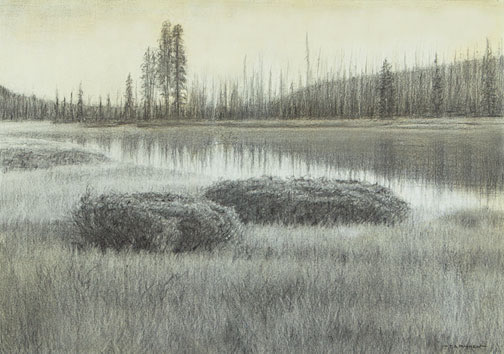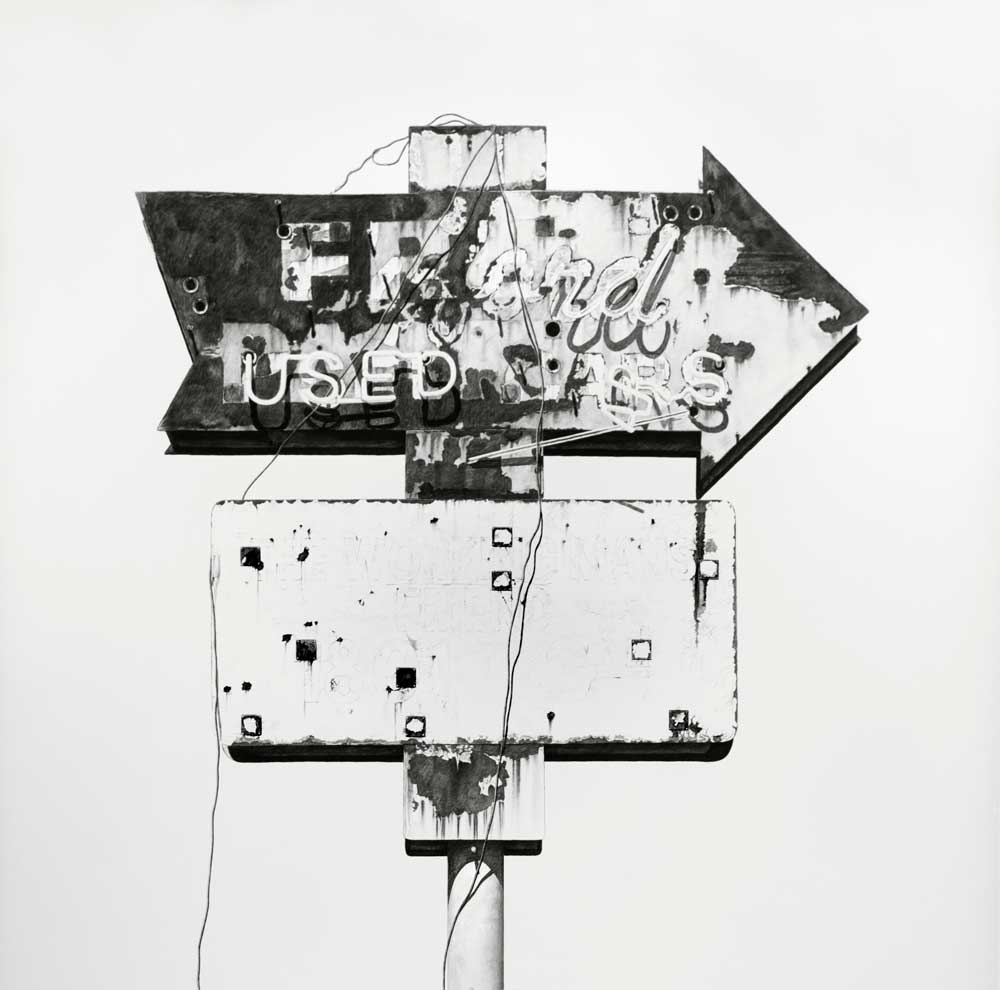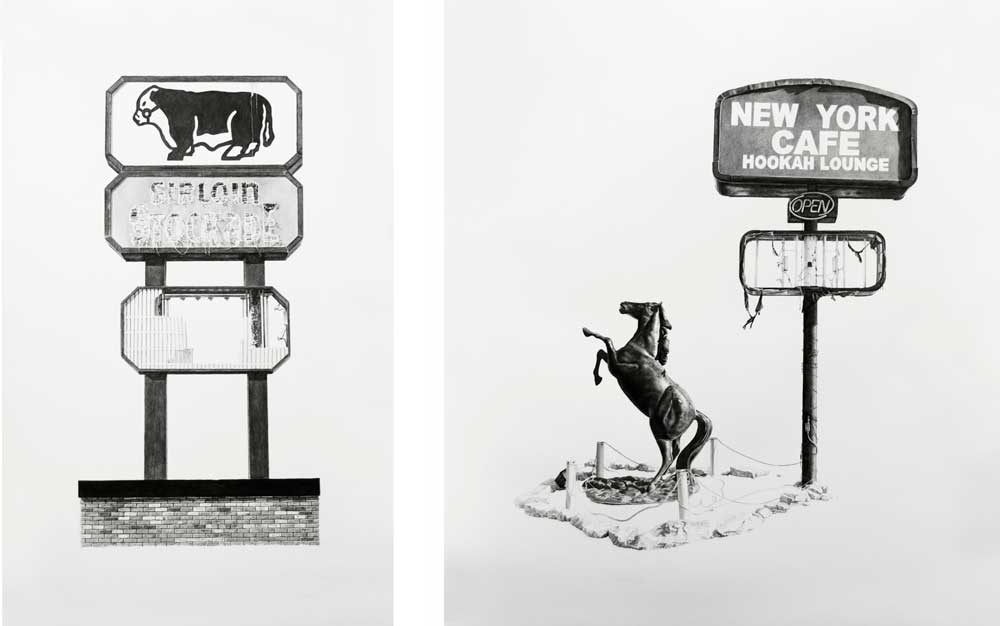

William Beckman, “Bales #2,” 2016, oil on panel, 24 x 59 inches
Forum Gallery in New York City is currently presenting a comprehensive exhibition that expands on William Beckman’s passion for rural landscape and its animals.
Through the lens of 10 significant works, Forum Gallery is currently exploring artist William Beckman’s love of landscape. On view now through November 11, “The five oil paintings and an equal number of large-scale charcoal drawings included, all completed since the artist’s last one-person exhibition in 2014, are a return to nature for the Minnesota-born Beckman, who was raised on his parents’ working farm,” the gallery reports. “The farm and its resident bulls and horses are the subjects in the current exhibition.”
William Beckman, “Paint Box,” 2016-17, oil on canvas, 114 x 138 inches
In fact, as the gallery notes, from 2008 through 2014, Beckman’s principle artistic concern was with a series titled The Bull Series — 10 large-scale charcoal drawings of bulls. The gallery continues, “The current exhibition expands on his passion for rural landscape and its animals: the principal oil painting in the exhibition, ‘Paint Box,’ is a portrait of a powerful paint horse on the family farm. Horses are also the subjects of the large-scale drawings in the exhibition, while the smaller-scale paintings depict the landscape and different breeds of bulls.
William Beckman, “Cody,” 2010, oil on panel, 20 1/2 x 18 1/2 inchesWilliam Beckman, “Cheyenne,” 2017, oil on paper, 27 1/2 x 31 1/2 inchesWilliam Beckman, “The Bull Series, #10,” 2017, charcoal on paper, 66 x 127 inches
“Power and intensity are the language of William Beckman’s work, and he achieves corresponding measures of each in works ranging from 20 by 18 inches to nearly 10 by 12 feet in size. Working and re-working each element, Beckman does not release a work of art from his studio until he is fully satisfied with the strength of the composition and image he seeks to achieve. His paintings and drawings compel the attention of the viewer through the use of bold color, dramatic, confrontational composition and dynamic eye contact. The dominance of the sky in the low-horizon landscape of hay fields and the bulls and horses seen at close range dominate the viewer with scale and strength.”
This article was featured in Fine Art Today, a weekly e-newsletter from Fine Art Connoisseur magazine. To start receiving Fine Art Today for free, click here.
Katya Held, “Alla Prima Demo (detail),” oil on canvas, 20 x 16 inches
Alla prima (Italian for “at first attempt”), in which layers of wet paint are applied to previous wet paint layers, is challenging and satisfying for the artist and the viewer. A prestigious atelier is offering a chance to learn about its glorious history and watch professional artists demonstrate its power.
Studio Incamminati in Philadelphia will soon be hosting a special event surrounding the history and practice of the alla prima technique. Admission is free for the October 19 event and will be hosted on the studio’s campus between 6-9 PM.
Christopher Nixon, “Alla Prima Portrait,” oil on canvas, 20 x 16 inchesNatalie Italiano, “Sade,” oil on canvas, 14 x 14 inches
During the event, instructors Natalie Italiano, Katya Held, Christopher Nixon, Peter Kelsey, and Rob Goodman will be demonstrating their unique approaches to the technique while Alisyn Blake lectures on the nuances of the process. “Their work brings to life a companion presentation by noted artist/scholar Patrick Connors who explains how artists from van Eyck to Monet have used the technique as a way to inform their work in an intuitive and spontaneous manner,” the studio’s website says. “In addition, visitors can discover the story behind Studio Incamminati artists’ skills with informal studio tours and conversations with alumni and students.”
Peter Kelsey, “Gabrielle Alla Prima,” 2013, oil on linen, 20 x 16 inchesRob Goodman, “Demonstration Painting of Luis Ledesma,” oil on canvas, 16 x 16 inches
The event has been co-sponsored and organized by the Italian Consulate with Ciao Philadelphia which celebrates the influence of the region’s Italian-American community. To learn more, visit Studio Incamminati.
This article was featured in Fine Art Today, a weekly e-newsletter from Fine Art Connoisseur magazine. To start receiving Fine Art Today for free, click here.
Phil Epp, “Hilltop,” acrylic on canvas board, 60 x 60 inches (Water Solubles Gold Medal)
Opening weekend for Cowboy Crossings — one of the nation’s foremost annual Western art sales and exhibitions — had gross sales nearly reaching the million mark.
Offering more than 150 pieces of world-class Western fine art representing nearly every creative medium, Cowboy Crossings on October 5-7 hosted the opening weekend for its 52nd Annual Sale & Exhibition at the National Cowboy Museum in Oklahoma City. The organizers were overjoyed to announce that their gross sales exceeded $986,310 with a portion of those proceeds benefiting the museum’s educational programs.
Martin Grelle, “Expectations,” oil on linen, 32 x 40 inches (Oil Painting Silver Medal)C. Michael Dudash, “Cowgirl,” charcoal and chalk, 24 x 20 inches (Drawing and Other Media Gold Medal)
“We are pleased by the tremendous support for Western art from across the country,” said CFO and Interim President and CEO Gary Moore. “The combination of working art such as saddles, bits and spurs, and rawhide braiding, along with the fine art of painting and sculptures, helps many individuals connect with the West in ways they might not have previously considered.”
Mikel Donahue, “The Bronc Stomper,” acrylic, 30 x 20 inches (Water Solubles Silver Medal)Paul Moore, “Young San Felipe Greek Corn Dancer,” bronze, 21 x 9 1/2 x 7 inches (Part of the Stetson CAA Award)
The top-selling work for the Cowboy Artists of America (CAA) was Martin Grelle’s magnetic painting “Expectations,” which realized $54,000. The painting also earned Grelle the Oil Painting Silver Medal Award. The CAA Stetson Award recipient, selected by active CAA members as the best compilation of individual works, was given to sculptor Paul Moore for his six works “Old Man Losing His Heron,” “When His Heart Is Down,” “Tuf of War,” “Blessing at Wuwuchim,” “Hopi Two Horned Priest,” and “Young San Felipe Green Corn Dancer.” The Anne Marion Best of Show Award was given to Grant Redden for “Feeding the Flock,” which also received the Oil Painting Gold Medal Award. “Cow Camp Studio” by artist Tyler Crow was also a two-time winner, taking the Drawing and Other Media Silver Medal Award and the Buyers’ Choice Award. C. Michael Dudash took the Drawing and Other Media Gold Medal Award for “Cowgirl.” In the Water Soluble Medal Awards, Mikel Donahue’s “The Bronc Stomper” took Silver while Phil Epp’s “Hilltop” earned the Gold.
Grant Redden, “Feeding the Flock,” oil on canvas board, 24 x 40 inches (Best of Show & Oil Painting Gold Medal)Jason Scull, “Waitin’ for Daylight,” bronze relief, 25 x 13 1/4 x 5 3/4 inches (Ray Swanson Memorial Award)Tyler Crow, “Cow Camp Studio,” charcoal, 21 x 26 inches (Buyers’ Choice)
The CAA exhibition will be on display through November 26, while works by TCAA artists will be on exhibit through January 7. To learn more, visit the National Cowboy & Western Heritage Museum.
This article was featured in Fine Art Today, a weekly e-newsletter from Fine Art Connoisseur magazine. To start receiving Fine Art Today for free, click here.
John Lintott’s love for the outdoors began as a child and has grown exponentially as a plein air painter. “Painting in the outdoors allows me to encapsulate the love I have for what I have come to take in, and translate that love into something believable, convincing and emotional. To view the beauty of the world around me and communicate my impression of the experience is the ultimate struggle.” Living in Grand Junction, Colorado, allows him to be close to the mountains, streams and red-rock canyons which he loves most, and provides endless opportunities for artistic growth and exploration.
John is one of 24 artists who will be participating in the Zion National Park Plein Air Invitational November 6-12. Artists will paint in the park, give free demonstrations, and sell their work at the end of the week to benefit youth and education programs in Zion National Park. For more information about John and this event, please visit zionpark.org.
Jane Barton, “House Boats,” oil on canvas, 20 x 20 inches
In 2017, American Women Artists is launching a 25-year initiative to bring the work of women artists into American museums. Their goal is 25 in 25 — 25 museum shows in the next 25 years. This historic undertaking begins next week. Where?
The Tucson Desert Art Museum is the proud host of what will surely be a historic initiative by American Women Artists (AWA). In January 2017, AWA announced that it would be starting “25 in 25,” a project that aims to bring the work of women artists into American museums over the next quarter-century. The exhibition will open on October 13 and continue through December 3.
Ginger Bowen, “Quiet Beauty,” oil on linen board, 16 x 20 inchesLinda Glover Gooch, “Boundless Sanctuary,” oil, 36 x 40 inches
“Over half of the working artists in this country are women,” noted AWA Board President Kathrine Lemke Waste, citing statistics from the National Museum of Women in the Arts, “yet their art is absent from the walls of our museums. Work by women artists makes up only 5 percent of the permanent holdings of art museums in America. Our vision, creativity, and imagination is virtually absent from the cultural record.”
Amanda Houston, “Brilliant Morn,” pastel, 30 x 40 inchesJudith Mackey, “Heavenly Blessing,” oil, 30 x 30 inchesRomona Youngquist, “Changing Season,” oil, 45 x 48 inches
AWA Executive Director Robin Knowlton said, “The national scope of our 25 in 25 campaign beings this fall with a juried show at the Tucson Desert Art Museum. The hope is that we can raise enough donations at each museum show to support a purchase award, guaranteeing the addition of a painting or sculpture, by a woman, in our host museum’s permanent collection.”
This article was featured in Fine Art Today, a weekly e-newsletter from Fine Art Connoisseur magazine. To start receiving Fine Art Today for free, click here.
Dean Cornwell, “Gold Hands (from Good Housekeeping magazine, March 1924),” 1924, oil on board, 37 x 53 inches, Museum of Illustration
The Florence Academy of Art U.S. is proud to be presenting significant selections from the oeuvre of Dean Cornwell as part of its ongoing educational exhibition series. Featuring a total of nine works — six paintings and three drawings — the exhibition looks to explore the artist’s legacy as one of America’s most important illustrators.
Throughout his career and during the Golden Age of Illustration, which occurred from roughly 1880 until shortly after World War I, Dean Cornwell (1892-1960) received many prestigious commissions, including work for major U.S. companies and publications, famous authors, and mural projects. The Florence Academy of Art U.S. will soon be celebrating Cornwell’s legacy during “Dean Cornwell: A Lasting Influence,” which opens in Jersey City, New Jersey, on October 15.
On view through December 15, “A Lasting Influence” explores how Cornwell became one of the most celebrated illustrators and muralists, earning him the nickname “The Dean of Illustration.” His exceptional draftsmanship and natural story-telling abilities have influenced several generations of narrative realist painters. “America’s Golden Age Illustrators, many of whom were also educators, helped preserve the foundation of picture-making during a time when Modernism was turning its back on tradition,” says Jordan Sokol, the academic director of the Florence Academy U.S. and curator of “Dean Cornwell: A Lasting Influence.” “This exhibition is a celebration of one of the Golden Age of Illustration’s most esteemed artists.”
This article was featured in Fine Art Today, a weekly e-newsletter from Fine Art Connoisseur magazine. To start receiving Fine Art Today for free, click here.
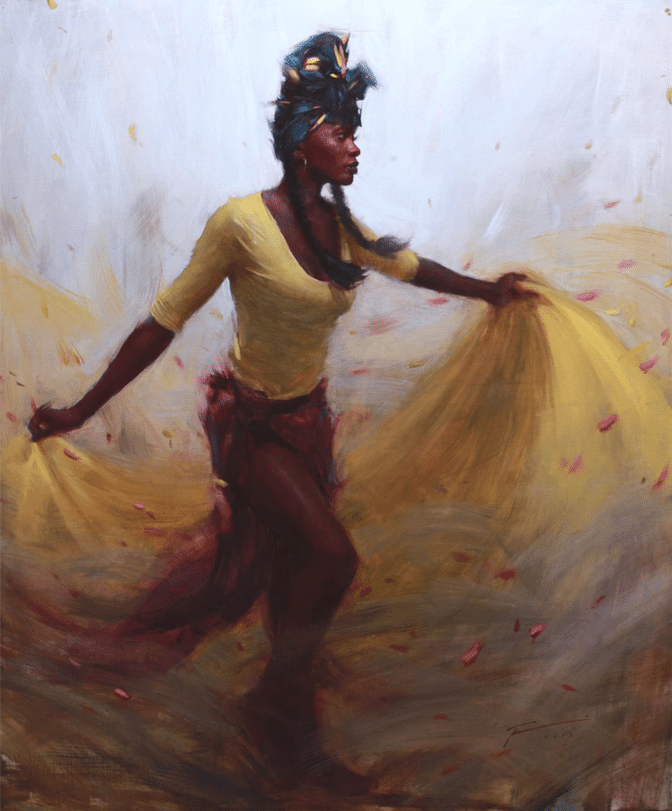
Jacob Pfeiffer, “Party Crasher,” oil, 26 1/2 x 16 1/2 inches
If you’re in Santa Fe, New Mexico, and feel the need to view some startlingly beautiful realistic paintings with a challenging, yet humorous tone, Jacob Pfeiffer and Meyer Galleries have what you’re looking for.
Opening this Friday, October 6, and continuing through October 19 at Meyer Galleries in Santa Fe is a fantastic solo display of contemporary realism from artist Jacob Pfeiffer. In his work, Pfeiffer delicately balances serious technical painting skills with lighthearted visual metaphors that engage viewers on multiple levels. “By titling each piece with clever puns or idioms, Pfeiffer reveals deeper narratives that are suggested through the painting’s ironic imagery,” the gallery writes. “For his exhibition, Pfeiffer will debut a body of work that portrays visually suspended objects that seek to simultaneously hold the viewer’s attention as we predict the outcome of each implied scenario.”
Jacob Pfeiffer, “Scales,” oil, 20 x 24 inchesJacob Pfeiffer, “Apple Sauce,” oil, 26 1/2 x 16 1/2 inches
The artist added, “Paintings in this exhibition are suspended in time and suspended on strings. And, of course, I am hoping that viewers of my work will suspend their disbelief while taking a moment to enjoy it.” The theme of suspension has its roots in 16th- and 17th-century Dutch realism, particularly the “vanitas” theme that was fashionable to Golden Age still life painters.
Jacob Pfeiffer, “Rock Candy,” oil, 9 x 12 inchesJacob Pfeiffer, “Spilling the Beans,” oil, 8 x 10 inches
“The vanitas style incorporated symbolism that pointed to the brevity of life and fleeting nature of time,” according to the gallery. “Pfeiffer incorporates this theme into paintings like ‘Apple Sauce,’ where a bowling ball is held in midair above a still life of awaiting apples. The title humorously suggests the deadly outcome of the suspended moment, while the painting prolongs the inevitable for the viewer’s anticipation. Pfeiffer’s wit is portrayed with masterful technique as he paints each object with intense detail and a saturated color palette.”
This article was featured in Fine Art Today, a weekly e-newsletter from Fine Art Connoisseur magazine. To start receiving Fine Art Today for free, click here.
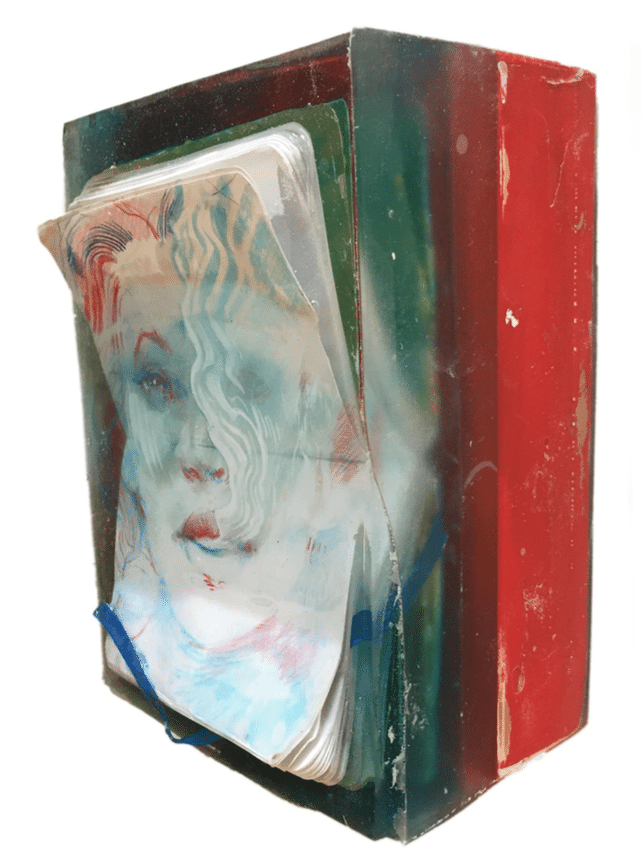
Renato Muccillo, “Back Waters in Morning Light,” oil on aluminum panel, 20 x 24 inches
Howard/Mandville Gallery in Kirkland, Washington, is currently presenting the newest oils by accomplished painter Renato Muccillo. Check out these beauties!
Tight, crisp, tranquil, luminous, and highly sought-after are all words that can be aptly applied to the paintings of Renato Muccillo, who is currently presenting his newest oils at Howard/Mandville Gallery in Washington state. “My heart lies in the natural environment,” the artist says. “I focus on the area where I live … and the experience of seeing what I see and being honest about it. I feel my best expressions are painted. I am continually driven to analyze and to try to understand the effects of light and atmosphere on color — then using my ability as an artist to decipher and record those effects.”
Renato Muccillo, “Forest Interior,” oil on canvas, 24 x 24 inchesRenato Muccillo, “Emerald Banks,” oil on aluminum panel, 24 x 20 inchesRenato Muccillo, “Tin Roofs,” oil on board, 15 x 11 inchesRenato Muccillo, “Tidal Marsh,” oil on panel, 20 x 20 inchesRenato Muccillo, “Crystalline Cove,” oil on panel, 20 x 24 inchesRenato Muccillo, “Incoming Tide at Dusk,” oil on canvas, 12 x 36 inchesRenato Muccillo, “Illuminated Grove,” oil on linen, 20 x 16 inches
“These quiet, elusive scenes are an attempt to slow everything down,” the gallery adds. “Muccillo hopes his paintings convey the message that beauty is everywhere, even in the simplest of things. Muccillo’s lush, atmospheric oil paintings are a response to his love of the natural environment. From his home near Vancouver, BC, he has access to an array of enticing subjects to paint. He skillfully paints the big moody skies that tower over our rainy West Coast. Muccillo’s artwork conveys a sense of peace and serenity. The landscapes seem timeless and traditional, flowing with washes of light and color that draw the eye into the soft mystery of the scenery. Subtle shading and muted tones let the eye rest gently in the moist, near miraculous landscapes. Like an old friend, the paintings reveal their secrets gradually, becoming more familiar and interesting with the passing of time.”
This article was featured in Fine Art Today, a weekly e-newsletter from Fine Art Connoisseur magazine. To start receiving Fine Art Today for free, click here.
Govert Flinck, “Self-Portrait,” circa 1640, oil on panel, 59 x 47 cm., Wallraf-Richartz Museum, Cologne
Many important paintings are coming together from across the world for a significant double exhibition in Amsterdam — some of which haven’t been in the Dutch capital since the 17th century. What’s the buzz in the Netherlands?
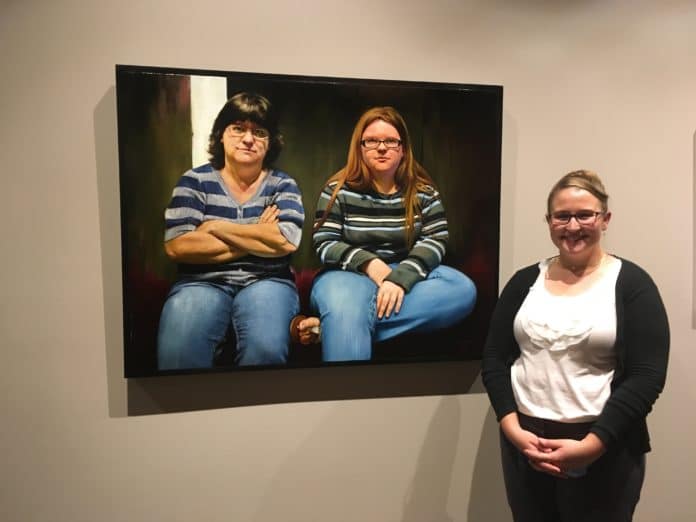
The Amsterdam Museum and Rembrandt House have teamed together to offer art lovers and museum-goers the chance to explore the mastery of Ferdinand Bol and Govert Flinck — considered to have been two of Rembrandt van Rijn’s master pupils. In the Rembrandt House, the place where Rembrandt taught Bol and Flinck, the emphasis is on their time with the master. According to the museum, “the works on view will transport visitors back in time to the painters’ early years and their training.”
Ferdinand Bol, “Self-Portrait,” circa 1647, oil on canvas, 93 x 83.5 cm., private collection
Conversely, the Amsterdam Museum will give visitors the opportunity to “discover that Bol and Flinch developed into great artists in their own right. Helped by a carefully constructed and nurtured network, the ambitious painters succeeded in reaching the pinnacle of the art market. The two men, who were of an age, became formidable competitors of their former teacher — and one another. During their lifetimes, they were even more successful than Rembrandt himself.”
“Ferdinand Bol and Govert Flinck: Rembrandt’s Master Pupils” opens on October 13 and will continue through February 18, 2018. To learn more, visit The Amsterdam Museum or the Rembrandt House.
This article was featured in Fine Art Today, a weekly e-newsletter from Fine Art Connoisseur magazine. To start receiving Fine Art Today for free, click here.
Andrew Wyeth, “Wind from the Sea,” 1947, tempera on hardboard panel, 18-1/2 x 27-1/2 inches, National Gallery of Art, Washington
The Seattle Art Museum is soon presenting a radical reimagining of one of the 20th century’s most complicated — and celebrated — artists. More information here…
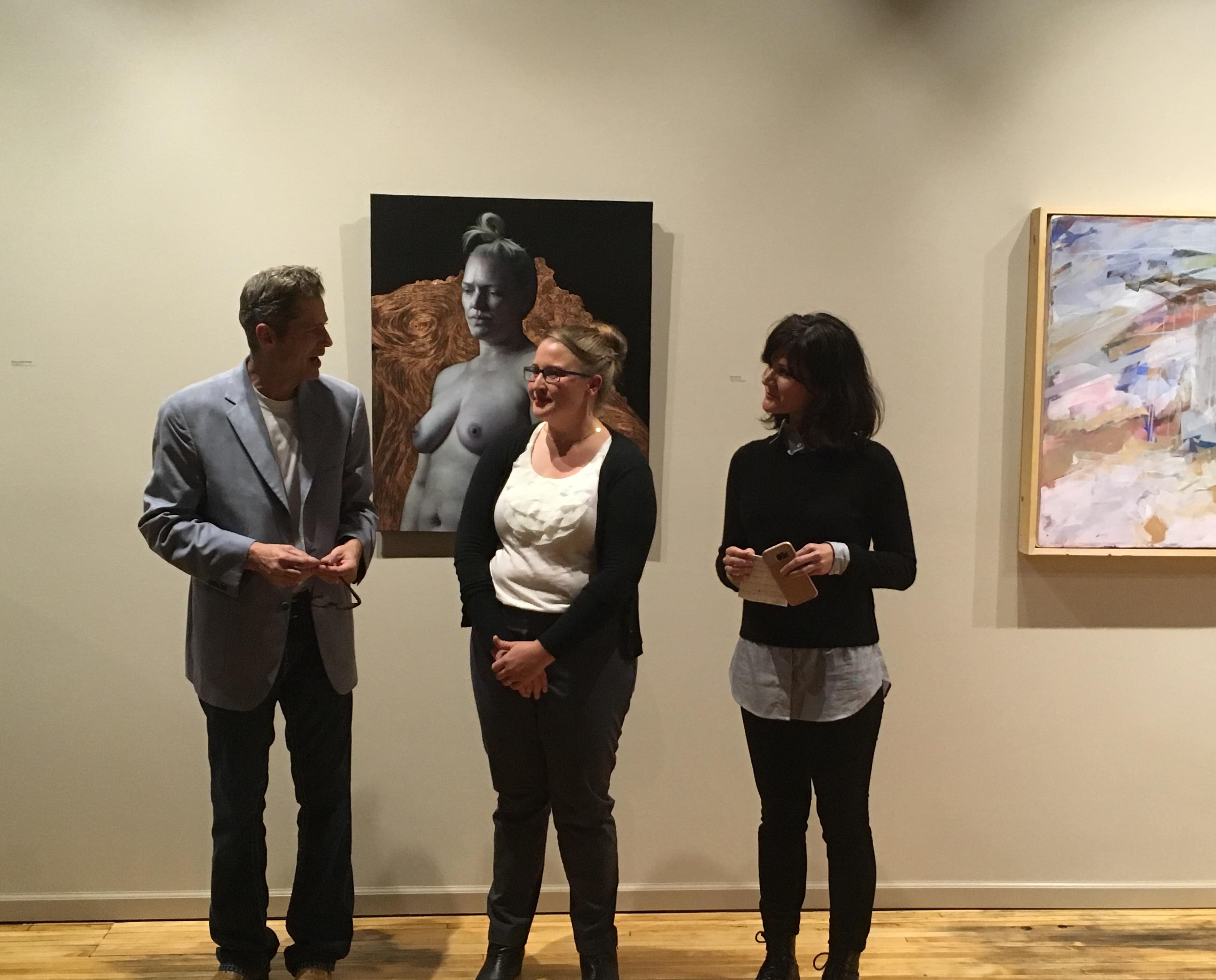
The renowned Andrew Wyeth is getting a fresh look from the Seattle Art Museum during “Andrew Wyeth: In Retrospect.” Opening October 19, the groundbreaking exhibition explores new perspectives on the art and legacy of the American painter’s 75-year career. Organized in conjunction with the Brandywine River Museum of Art for the 100th anniversary of the artist’s birth, the exhibition brings together 110 paintings and drawings ranging from the late 1930s to 2008, including rarely seen loans from the Wyeth family. According to the museum, ‘In Retrospect’ reflects on Wyeth’s work through the historical lens of a century in which he deviated from the American art mainstream but continued to figure prominently in much of the country’s artistic discourse.
Andrew Wyeth, “Lobsterman (Walt Anderson),” 1937, watercolor on paper, 21-1/4 x 27-3/4 inches, Brandywine River Museum of Art
“In Retrospect”opens with a gallery of significant works introducing the cast of characters from Wyeth’s world who feature in some of his most famous portraits, such as Christina Olson of Maine and Karl Kuerner, his neighbor in Chadds Ford, Pennsylvania. These dream-like works complicate long-held critical notions of Wyeth as an out-of-step realist, revealing how he imbued images of the places, people, and things around him with his own mysterious temperament.
Andrew Wyeth, “Black Velvet,” 1972, drybrush watercolor on paper, 21-1/4 x 39-1/2 inches, private collection
“The work of Andrew Wyeth is technically dazzling, narratively riveting, and, well — weird,” says Patricia Junker, SAM’s Ann M. Barwick Curator of American Art. “His portraits, figures, and landscapes reveal a complex mind investigating the deepest human emotions: love, death, and how we experience the passing of time. We are thrilled to offer this rare opportunity to see such an impressive array of Wyeth’s work.”
Andrew Wyeth, “The Drifter,” 1964, drybrush watercolor on paper, 22-1/2 x 28-1/2 inches. Phyllis and Jamie Wyeth Collection
The press materials report, “After the first gallery, the exhibition is organized in rough chronological order, tracing Wyeth’s development from his earliest watercolors, to more staged works of the 1940s-50s, and to deeper technical experimentation in the 1950s-60s, incorporating elements of chance. These include the artist’s little-known portraits of African Americans from the Chadds Ford community. The exhibition also offers a rare view into Wyeth’s artistic and technical process, presenting studies in a variety of media in an intimate tabletop display.
Andrew Wyeth, “Snow Hill,” 1989, tempera on hardboard panel, 48 x 72 inches, Andrew and Betsy Wyeth Collection
“A subsequent gallery presents the transitional moment in the late 1960s when Wyeth created portraits of two favored subjects, Christina Olson and Siri Erickson. Enigmatic, unsettling paintings of Wyeth’s neighbors Anna and Karl Kuerner investigate a marriage; poignantly, these are adjacent to Wyeth’s nude portraits of the Kuerners’ nurse Helga Testorf, created in secret at the same time and kept hidden for decades. Also from this era are complex, more abstract paintings that stand out against the rest of Wyeth’s oeuvre, including ‘Thin Ice’(1969), an early work on loan from a private collection in Japan being shown for the first time on the West Coast.
Andrew Wyeth, “Winter,” 1946, tempera on hardboard panel, 31-1/2 x 48 inches, North Carolina Museum of Art
“‘In Retrospect’explores less-understood influences on Wyeth, such as popular film and images of war. On view are clips from ‘Metaphor’ (1975), a filmed conversation between director King Vidor and Wyeth, including scenes from Vidor’s silent masterpiece about World War I, ‘The Big Parade’(1925), which Wyeth first saw as a child and re-watched hundreds of times. Also playing in the exhibition are clips from Ingmar Bergman’s ‘The Seventh Seal’(1957), another film that deeply influenced Wyeth. While his contemporaries were expressing the modern age through abstraction, these clips reveal how Wyeth found his own way to a powerful symbolism through the experimental, modern art form of film.
Andrew Wyeth, “The Kuerners,” 1971, drybrush watercolor on paper, 26-1/2 x 40-1/2 inches, Andrew and Betsy Wyeth Collection
“The exhibition closes with increasingly surreal late works and reflections on mortality, ending with Wyeth’s last painting, ‘Goodbye’ (2008), seen in this exhibition for the first time since it was briefly shown to those who attended the artist’s memorial service in 2009.”
“In Retrospect” will continue through January 15, 2018. To learn more, visit the Seattle Art Museum.
This article was featured in Fine Art Today, a weekly e-newsletter from Fine Art Connoisseur magazine. To start receiving Fine Art Today for free, click here.
Fill your mind with useful art stories, the latest trends, upcoming art shows, top artists, and more. Subscribe to Fine Art Today, from the publishers of Fine Art Connoisseur magazine.