
Home Blog Page 346

His Day Has Come

0
Philippe Smit, “The Church at Thoury-Ferrottes,” 1927, pastel, Private collection

Some say Dutch-born artist Philippe Smit might be the most accomplished unknown artist of the 20th century. Aren’t familiar with the name? That could drastically change in just a few weeks. Why?

Strongly influenced by Jean-François Millet, the French Barbizon School, and the mysticism of Vincent van Gogh, artist Philippe Smit would eventually pioneer a unique style in the 20th century called mystical symbolism. Although he is still relatively unknown in the pantheon of great 20th-century painters, a new exhibition and catalogue raisonné are aiming to change that narrative this spring.

On May 21, the Glencairn Museum in Bryn Athyn, Pennsylvania, will open a much-anticipated exhibition and catalogue-release surrounding the life and career of Smit. According to the museum, “Mysticism grew out of the enlightenment period and became prevalent among artists and philosophers of the late 19th and early 20th centuries. While Smit often painted with oils, he preferred pastels. Rich and intense color illustrates the expression of his works, which were inspired by the great French poets and musicians, and by the writings of 18th-century Swedish scientist and spiritual philosopher Emanuel Swedenborg.

Philippe Smit, “Vase of Sunflowers,” 1914, oil on canvas, 22 x 18 inches

“The spiritual sentimentality and expression in his work is considered unique and distant from the contemporary aesthetic revolution of his time. A more intimate style can be observed in his portraits of family members and close friends and in his still lifes of flowers.”

Andreas Narzt, director and developer of the catalogue raisonné, suggests, “Smit, like many artists of his time, explored the transcendence and struggle between man and the divine. As he grew in his art, he sought a deeper connection to the divine and often explored the connection between man, nature, and God.”

To learn more, visit the Glencairn Museum. You can also learn more about Philippe Smit by visiting here.

This article was featured in Fine Art Today, a weekly e-newsletter from Fine Art Connoisseur magazine. To start receiving Fine Art Today for free, click here.
Catch that Subliminal Message

0
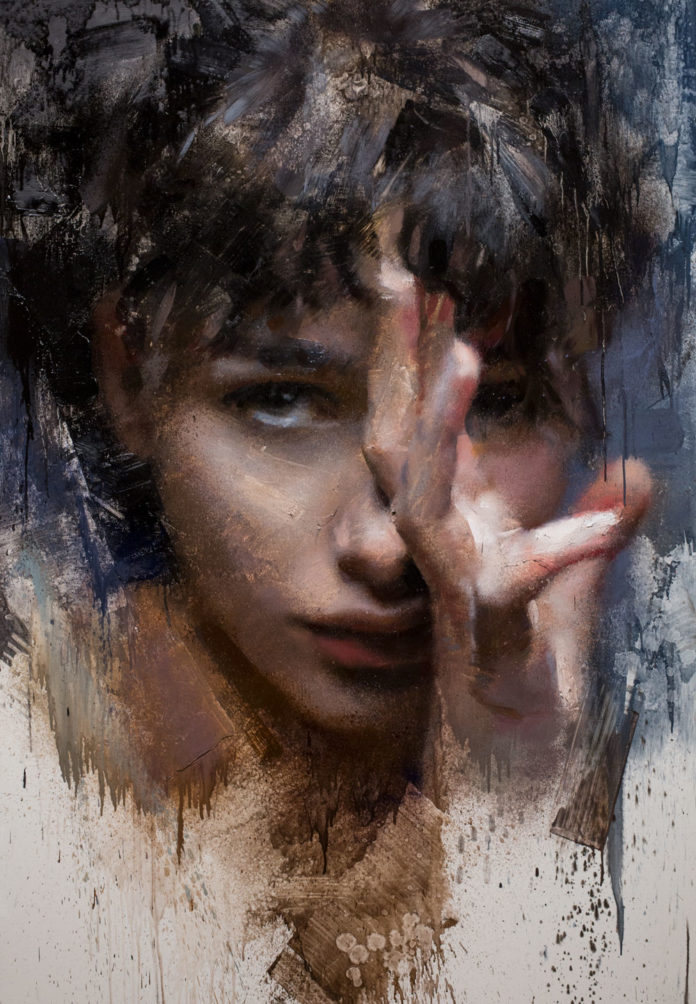
Jason Shawn Alexander, “Threesome,” mixed media on canvas, 72 x 60 inches

Two Los Angeles-based artists are currently presenting evocative new bodies of work that are full of emotion, subliminal communication, and so much more. Don’t miss it!

Their styles may be different, but the impact is the same. Opened on May 6 and on view through May 27 at Booth Gallery in New York City, “Subliminal” presents the recent works of Los Angeles-based painters Jason Shawn Alexander and Stephanie Inagaki.

Jason Shawn Alexander, “Body,” mixed media on canvas, 54 x 29 inches
Stephanie Inagaki, “(in)resolve,” charcoal and washi on paper, 24 x 46 1/2 inches
Stephanie Inagaki, “(within) constraint,” charcoal and washi on paper, 24 x 46 1/2 inches

Both artists are self-described figurative painters, but that’s only where their works begin. Alexander creates life-sized to over-life-sized, towering pictures of exposed bodies. Through expressive body language and degrees of abstraction, Alexander’s paintings offer stories to their viewers. Speaking about his current work and Inagaki’s, Alexander suggests, “You cannot simply hang either of our works ‘safely’ on the wall. The work for this show is challenging, both in interpretation of the lives being portrayed, and directly due to the images ‘seeing’ the viewer or the imposing scale. These works have much more going on than simply figurative art. These are works that tell stories. Our stories, told through figurative work. Some of it is right there, splashed in front of you, but most of it is in the subtitles, almost subliminal.”

Jason Shawn Alexander, “Judith,” mixed media on canvas, 70 x 50 inches
Stephanie Inagaki, “Equanimity,” charcoal and washi on paper, 23-1/2 x 45-1/2 inches
Stephanie Inagaki, “The Reluctant Passing,” charcoal and washi on paper, 29 1/2 x 33 1/2 inches
Jason Shawn Alexander, “The Great Egress,” mixed media on canvas, 72 x 60 inches

Inagaki works in mixed media to construct her figurative stories and “portray characters that hold direct eye contact with the viewer,” the gallery writes, “daring them to seek meaning within her mythological-based narratives. Both Inagaki’s and Alexander’s figures are vessels for stories, purposed to transfer emotion and human experience.”

To learn more, visit Booth Gallery.

This article was featured in Fine Art Today, a weekly e-newsletter from Fine Art Connoisseur magazine. To start receiving Fine Art Today for free, click here.
Beauty Awakened

0
Eyvind Earle, “Paradise,” 1973, oil on canvas on wood, © Walt Disney Family Foundation

Twentieth-century artists who worked on classic Walt Disney feature animations rarely get the attention they deserve. One of them, who was the lead stylist for Sleeping Beauty (1959), is getting his time in the spotlight at this museum.

I’ve come across exhibitions like this before — whether in person or digitally — and they always make an impression, leading to the question: Why aren’t there more institutions celebrating these fantastic artworks? I’m talking about original artworks from the animation studios of our childhood, such as Walt Disney, Warner Brothers, MGM, and more.

Eyvind Earle, Concept painting (Sleeping Beauty), circa 1950, gouache on paperboard, © Walt Disney Family Foundation

The Walt Disney Family Museum in San Francisco, California, is an institution made for these types of displays, and its current exhibition “Awaking Beauty: The Art of Eyvind Earle” surely deserves your attention. On view from May 18 through January 2018, “Awaking Beauty” is a gorgeous retrospective that showcases the life and work of Eyvind Earle (1916-2000), who is best known as the lead stylist for Sleeping Beauty (1959). Earle was also a lead stylist for concept art that intimately shaped such films as Lady and the Tramp (1955) and Peter Pan (1953).

Eyvind Earle, Concept painting (Sleeping Beauty), circa 1950, gouache on paperboard, © Walt Disney Family Foundation
Eyvind Earle, “Ancient Forest,” 1989, oil on Masonite, © Courtesy of Eyvind Earle Publishing, LLC

Via the museum, “Co-curated by Ioan Szasz, CEO of Eyvind Earle Publishing, and Michael Labrie, Director of Collections and Exhibitions for the Walt Disney Family Foundation and The Walt Disney Family Museum, the artist’s first-ever comprehensive museum retrospective will feature more than 250 works, including intricate thumbnail concept paintings for Lady and the Tramp and evocative large-scale concept artworks for Sleeping Beauty. Alongside Earle’s work for The Walt Disney Studios is an extensive showcase of his fine art, including elaborate and lush landscapes, unique scratchboards, rare examples of sculpture, companion poetry, and commercial illustrations. In addition to signature landscapes and enchanting illustrations that are characteristic of Earle’s style, the exhibition will feature his limited-edition serigraphs and lesser-known pieces, including cartoon drawings from his time in the U.S. Navy and commercial advertisements for American brands.

Eyvind Earle, Concept painting (Lady and the Tramp), circa 1955, gouache on paperboard, © Walt Disney Family Foundation
Eyvind Earle, “Green Forest,” 1989, oil on Masonite, © Walt Disney Family Foundation

“This retrospective offers unique insight into Earle’s colorful life story, his inspiration, and his creative approach to the art-making process. Combined, these elements fueled an extraordinarily diverse career across a spectrum of traditional fine art, commercial design, and filmmaking.”

To learn more, visit The Walt Disney Family Museum.

This article was featured in Fine Art Today, a weekly e-newsletter from Fine Art Connoisseur magazine. To start receiving Fine Art Today for free, click here.

Damian Lechoszest in the U.S.

0
Damian Lechoszest, “Daily Bread,” oil, 18 x 20 inches

He’s exhibited in countries across Europe, including the Czech Republic, Germany, Russia, Great Britain, Ireland, France, and his native Poland, but never in the United States, until now.

The first one-man show for Polish artist Damian Lechoszest in the United States has landed at a fitting venue: InSight Gallery in Fredericksburg, Texas, this spring. On view through May 5 through the end of the month, “Traditions” features a range of outstanding works by the artist that undoubtedly highlight his uncanny ability to harness subtle effects and phenomena of light.

Damian Lechoszest, “Love Letter,” oil, 24 x 36 inches
Damian Lechoszest, “Corn Shucking,” oil, 22 x 28 inches

Using feathery, expressive strokes of the brush, Lechoszest “portrays his subjects with unusual insight and analytical attitude,” the gallery writes. “He strives to record and immortalize the disappearing Polish folk traditions of his native land. An aspiring artist at a very early age, teachers and mentors from throughout his life have recognized a special quality in Lechoszest, with their tutelage and encouragement contributing to the artist’s passion for his profession. Lechoszest is the consummate student, devouring books about the human form and theoretical fundamentals of art then pouring what he has learned into his artwork. His brushwork is fitting and in perfect harmony with the old-world subjects and figurative works he so masterfully delivers.”

To learn more, visit InSight Gallery.

This article was featured in Fine Art Today, a weekly e-newsletter from Fine Art Connoisseur magazine. To start receiving Fine Art Today for free, click here.
AAM Awards Prestigious Honor

0
Public study room, Paul Mellon Centre for Studies in British Art, photo: Martine La Roche 2017

It was recently announced that the American Alliance of Museums has honored Yale University and another renowned institution with a prestigious award. What was it?

The Yale Center for British Art and the Paul Mellon Centre for Studies in British Art are among the best in the country, and they both possess a new award to demonstrates as much. The American Alliance of Museums recently announced that the two won a gold-level MUSE Award for their jointly published, open-access digital journal titled British Art Studies. “Part of the MUSE Open Culture category, the award recognizes British Art Studies for its high standards of excellence in the use of media and technology for Gallery, Library, Archive, and Museum (GLAM) programs,” Artfix Daily reports.

The two institutions were chosen among an international pool of more than 200 applications. This year’s entries included videos and films, interactive kiosks and installations, VR experiences, applications and APIs, digital communities, websites, audio tours, and more.

To learn more, visit Artfix Daily.

This article was featured in Fine Art Today, a weekly e-newsletter from Fine Art Connoisseur magazine. To start receiving Fine Art Today for free, click here.
Kunkle’s Next Step

0
Image still from the Main Title of Anne with an E, Imaginary Forces Studios

Nationally known representational painter Brad Kunkle recently announced some big news involving his directing of an imaginative film set to premier on Netflix. In what capacity? Find out here.

Brad Kunkle is in high demand these days. The representational painter, known for his stunning use of gold and silver gilding with sensuous female figures, recently announced the release of Anne with an “E” — a television series on Netflix for which Kunkle was art director. The series is a reimagining of the classic book and musical Anne of Green Gables by Lucy Maud Montgomery; the book was first published in 1908.The story is a coming-of-age tale surrounding a young orphan (Anne) who is seeking love, acceptance, and her place in the world. Kunkle produced a series of original paintings that were used in the main title/opening for the series.

This article was featured in Fine Art Today, a weekly e-newsletter from Fine Art Connoisseur magazine. To start receiving Fine Art Today for free, click here.
Modern Identity Through Traditional Means

0
Colleen Barry, “Self Portrait with St. Jerome,” 2015, oil on panel, 9 x 12 in. © Eleventh Street Arts

Twenty-seven leading artists of the contemporary realist revival investigate modern character and identity through their own visages during this outstanding group exhibition in New York. Who are they, and where? Details here!

Located in Long Island City, New York, Eleventh Street Arts has a reputation for mounting must-see exhibitions. Representing the top realist painters every year, that exhibition trend certainly continues through “Self-Portrait,” opening April 20 and continuing through June 20.

Travis Schlaht, “In Between, Self Portrait Age 40,” 2016, oil on linen, 12 x 16 in. © Eleventh Street Arts

“Self-Portrait” showcases paintings of this genre by 27 of the top contemporary representational painters, including Daniela Astone, Colleen Barry, Stephen Bauman, Benjamin Bjorklund, Patrick Byrnes, Jacob Collins, Kamille Corry, Hollis Dunlap, Louise Fenne, Richard Greathouse, Amaya Gurpide, Daniel Graves, Cornelia Hernes, Brendan Johnston, Joshua LaRock, Rodrigo Mateo, Edward Minoff, Gregory Mortenson, Carolyn Pyfrom, Edmond Rochat, Irvin Rodriguez, Travis Schlaht, Jordan Sokol, Will St. John, Nicolas Uribe, Charles Weed and Justin Wood.

Daniela Astone, “Self Portrait,” 2016, oil on copper, 8.4 x 6.4 in. © Eleventh Street Arts

As one of the most complex and vibrant genres, self-portraiture has allowed each of these artists to probe their identities in a world of “shifting artistic values,” the gallery writes. “Exhibited works display a cross-section of styles, many representative of the pedagogies of the world’s foremost art academies: The Lyme Academy, The Florence Academy of Art, Grand Central Atelier, The School of Visual Arts and The Art Students League. Celebrating an artistic practice that reaches back to the Renaissance, the works of ‘Self-Portrait’ offer compelling evidence that the legacy of great western art continues to live on through the practice of artists alive today. With the self-portrait as the shard origin of inspiration, these works present a dazzling synthesis of technical skill and personal vision.”

To learn more, visit Eleventh Street Arts.

This article was featured in Fine Art Today, a weekly e-newsletter from Fine Art Connoisseur magazine. To start receiving Fine Art Today for free, click here.

Portrait of the Week: X Marks the Spot

0

In this occasional series, Fine Art Today delves into the world of portraiture, highlighting historical and contemporary examples of superb quality and skill. This week we consider a famous portrait of an infamous seductress.

Traditional three-quarter and full-length portraits of the elite highlight the career of 19th-century American painter John Singer Sargent (1856-1925). However, when the artist was not creating his lifelike visions of paying patrons, he often found himself crafting exploratory portraits of his closest friends and confrères.

“Portrait of Madame X” is as notorious a portrait as the subject was in person. Unveiled at the Paris Salon in 1884, the painting was greeted with immediate scandal and controversy over the sitter’s identity and suggestive clothing (the upper strap of the dress was originally shown having fallen off her shoulder — giving the work erotic undertones). A young Parisian socialite, Virginie Amélie Avegno was a model and American expatriate who became notorious among the bourgeois for her beauty and rumored infidelities. Scholars have suggested that the poor reception of the painting in Paris solidified Sargent’s departure from France; he had been struggling to find audience there.

After the Paris Salon of 1884, Sargent reworked the dress strap and renamed the painting “Madame X,” which undoubtedly imbues the work with a sense of mystery, drama, and seduction. In 1916, Sargent sold the painting to the Metropolitan Museum of Art, where it remains on display today. After the sale, Sargent remarked to the museum’s director, “I suppose it is the best thing I have ever done.”

This article was featured in Fine Art Today, a weekly e-newsletter from Fine Art Connoisseur magazine. To start receiving Fine Art Today for free, click here.

Featured Artwork: Jude Tolar, PSA

0
“Sweet Irises” by Jude Tolar, PSA

“Sweet Irises”

Pastels on sanded paper

14 x 11 in.


About the Artist:

My pastel paintings are lyrical views of the beauty and joy I see in the world. My wonder and awe lead me first to light, then line and color.

I love to work from life, preferably en plein air. My favorites are tree and floral portraits outdoors and glass still lifes indoors.

Seasonal florals provide me with nearly endless plein air possibilities. Here in Oklahoma we have blooms from late January to late November.

Currently it’s iris season here. It’s an ‘iris-fest’, as I’m wooed each week by a succession of colors and varieties. Some are frilly, making me smile and call them “fancypants.” Other intrigue me with color, whiskers or other traits.

This featured iris has a beautiful lavender edge on the falls and a very sweet scent. I painted its portrait with backlighting, for drama and glow. I included young buds and an old, dried-up flower, to show the iris’ life cycle. “Sweet Irises” is available through my website, www.judetolar.com.

I began painting with pastels 11 years ago, after a long career in graphic design and illustration in OKC and Stillwater (OK). I have a psychology degree from Oklahoma State University and two post-baccalaureate years of fine arts and illustration classes at University of Oklahoma.

After retirement, a desire to work from life en plein air led me to pastels and studies with master pastelists, most extensively with Clive Tyler.

Soft pastels and sanded papers changed my art world. This forgiving medium lets me paint freely and in layers. I’m fearless with strong colors and values. This adds impact to the stories and portraits I paint.

My pastel paintings have generated strong responses. I’ve juried into many national and international shows, including Pastel Society of America and International Association of Pastel Societies. I’ve won awards on various levels, including two PleinAir Salon awards from PleinAir magazine, two Pastel 100 awards from Pastel Journal, and five Best of Shows.

My work has been featured in PleinAir magazine, PleinAir Today, and Pastel Journal. It’s also shown in The Cyber Art Show online, and in an article I wrote for Pastel Journal (April/May 2016). I’m in the current Pastel Journal issue (April/May 2017) as a Pastel 100 winner.

I’ve shown in numerous solo, invitational and members shows at galleries and elsewhere. My pastels are in collections across the US.

I’m a Signature Member of Pastel Society of America and Oklahoma Art Guild, and a member of American Impressionist Society, Oklahoma Pastel Society, Pastel Society of New Mexico, and Stillwater (OK) Art Guild.

I give pastel demonstrations and teach pastel workshops on various subjects. When not painting, I can be found gardening, reading, hiking or mowing. I live in Stillwater, Oklahoma, with my husband and a studio full of soft pastels.

Jude Tolar, PSA

Eyewitness Views

0
Luca Carlevarijs, “The Regatta on the Grand Canal in Honor of King Frederick IV, King of Denmark,” 1711, oil on canvas, J. Paul Getty Museum

We live in a time where images — especially of a documentary nature — abound. At every turn of the head, click of a mouse, or swipe across a screen, we can see spectacular events from around the globe in near real time. What did they do in the 18th century? This.

For millennia, Europe’s most iconic cities have been the scene of events ranging from magnificent coronations, to festivals, and sometimes to disasters, all of which presented artists with ample opportunity to showcase their skills and document important events. During the 18th century, a number of princes, popes, and ambassadors took this a little further, specifically commissioning master painters such as Canaletto and Panini to record memorable happenings.

Michele Marieschi, “The Rialto Bridge with the Festive Entry of the Patriarch Antonio Correr,” 1735, oil on canvas, The Palmer-Morewood Collection

This 18th-century trend is explored through more than 40 works in Los Angeles at the J. Paul Getty Museum. Opened on May 9 and continuing through July 30, “Eyewitness Views: Making History in Eighteenth-Century Europe” is the first exhibition to focus on view paintings as documentary depictions of contemporary events.

Antonio Joli, “Departure of Charles III from Naples to Become King of Spain,” 1759, oil on canvas, Museo Nacional del Prado

“‘Eyewitness Views’ brings together an incredible array of international loans to tell the fascinating story of how artists captured, and in many ways created, history in 18th-century Europe,” says Timothy Potts, director of the J. Paul Getty Museum. “Both in their subject matter of spectacular public occasions, such as papal visits, and in the brilliance of their execution, these colorful panoramic views provide a window into history as well as a testament to the achievements of some of the era’s greatest painters. Ambitious exhibitions of this kind increasingly require the commitment of partner institutions, and we are particularly grateful to our colleagues in Minneapolis and Cleveland for their support in helping us realize this exhibition.”

Giovanni Paolo Panini, “The Musical Performance in the Teatro Argentina in Honor of the Marriage of the Dauphin,” 1747, oil on canvas, Musée du Louvre
Canaletto, “The Procession on the Feast Day of Saint Roch,” circa 1735, oil on canvas, The National Gallery, London

To learn more, visit the J. Paul Getty Museum.

This article was featured in Fine Art Today, a weekly e-newsletter from Fine Art Connoisseur magazine. To start receiving Fine Art Today for free, click here.
WEEKLY NEWS FROM THE ART WORLD

Fill your mind with useful art stories, the latest trends, upcoming art shows, top artists, and more. Subscribe to Fine Art Today, from the publishers of Fine Art Connoisseur magazine.

  • This field is for validation purposes and should be left unchanged.