Home Blog Page 436

Blockbuster Names, Powerful Prints

0

A century ago, the Metropolitan Museum of Art established its Department of Prints under the stewardship of William M. Ivins (1881-1961). In commemoration, the museum will soon launch an exhibition aimed at telling the story of how this world-renowned collection evolved.
 
From its very beginnings, the Metropolitan Museum of Art’s Department of Prints has been cleverly, if not masterfully, composed and organized. Much like a library, the department holds a vast number of prints that display the full range and history of the medium. Opening January 25 and on view through May 22, “The Power of Prints” will feature some of the biggest names in art history, including James McNeill Whistler, Henri de ToulouseLautrec, Mary Cassatt, Rembrandt van Rijn, Francisco de Goya y Lucientes, Albrecht Dürer, Andrea Mantegna, and Edward Hopper — to name just a few.


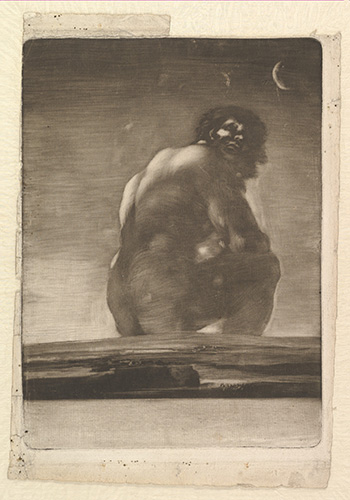
Francisco de Goya y Lucientes, “A Giant Seated in a Landscape,” 1818, print, (c) MET 2016

 
The museum writes, “Brilliantly mixing the exceptional and everyday, Ivins and [Ivins associate A. Hyatt] Mayor amassed a collection of hundreds of thousands of prints that is both encyclopedic in its scope and studied in its many areas of focus. Ivins’ and Mayor’s prescient understanding of the value of printed works across a wide spectrum, and the intellectual framework from which their collecting practice arose, transformed the field of prints by broadening its purview beyond aesthetic, formal, and technical aspects and by asking new questions about the function of works of art, their historical and cultural context, and their active role as both containers and purveyors of information.”


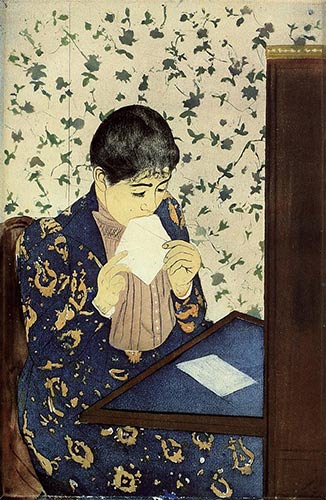
Mary Cassatt, “The Letter,” ca. 1890-1891, print, (c) MET 2016

 
In addition to the exhibition, a fully illustrated catalogue will be available along with a host of educational programs. Events include “a Friday Focus lecture on January 29; a MetFridays Gallery Event on February 19 during which visitors can enjoy interactive gallery chats, art making, and a Drop-in Drawing class; a three-session Studio Workshop focusing on drypoint and lithography; a Met Escapes for visitors with dementia and their care partners on February 24; a Sunday at the Met program on April 3; and a Seeing Through Drawing for adults who are blind or partially sighted on May 14.”
 
“The Power of Prints” opens on January 26 and will be on view through May 22.
 
To learn more, visit the Metropolitan Museum of Art.
 
This article was featured in Fine Art Today, a weekly e-newsletter from Fine Art Connoisseur magazine. To start receiving Fine Art Today for free, click here.
 

Russell Skull Welcomes Three in 2016

0

Formed in 2013, the Russell Skull Society of Artists has recognized and honored a number of painters and sculptors for their dedication to the traditions of Charles M. Russell. Joining 19 current members are three 2016 inductees. They are?
 
The C.M. Russell Museum of Great Falls, Montana, is widely known as one of the preeminent American Western art institutions in the United States. Since 2013, in connection with the museum, the Russell Skull Society of Artists has been annually welcoming new members who display a notable degree of commitment to C.M. Russell’s tradition.
 
This year, three deserving artists have been inducted into the group: Jim Carson, Josh Elliott, and C. Michael Dudash. Senior Art Coordinator Duane Braaten says, “Russell Skull Society artists are important ambassadors for both Western art and the C.M. Russell Museum. We are so excited to have incredible artists like Jim, Josh, and Michael join an already impressive group.”


Josh Elliott, “Lake Creek Lost and Found,” oil, 42 x 32 in. (c) Josh Elliott 2016

 
The museum states, “All three artists have participated in the C.M. Russell Museum’s premiere fund-raising event, ‘The Russell: An Exhibition and Sale to Benefit the C.M. Russell Museum,’ selling pieces in both the First Strike Auction and Live Auction. In 2016, all three will participate in the crowd-favorite ‘Art in Action’ event. Each artist will also have pieces on display at the Russell Skull Society of Artists Suites, a free event during Western Art Week that is open to the public. BNSF Railway is the 2016 Presenting Sponsor of ‘The Russell Exhibition and Sale.’


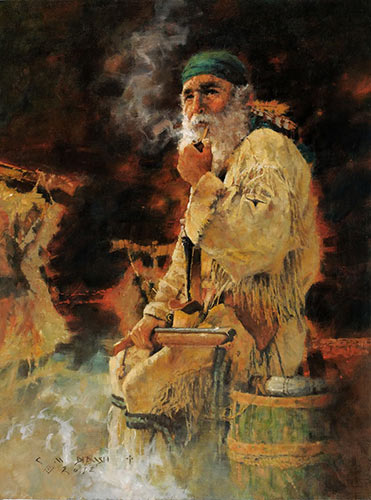
C. Michael Dudash, “The Tales He Could Tell,” oil on linen, 24 x 18 in. (c) C. Michael Dudash 2016

 
“Returning members of the Russell Skull Society include Nancy Dunlop Cawdrey, Michael Coleman, Todd Connor, Brent Cotton, Charles Fritz, John C. Gawne, R. Tom Gilleon, Carol Hagan, Greg Kelsey, Lee Kromschroeder, Jerry McKellar, Chris Owen, Chad Poppleton, Gary Lynn Roberts, W. Steve Seltzer, Brett James Smith, Oleg Stavrowsky, Andy Thomas, and Randy Van Beek.”
 
For more information about the Russell Skull Society of Artists and the Russell, please visit www.cmrussell.org./
 
This article was featured in Fine Art Today, a weekly e-newsletter from Fine Art Connoisseur magazine. To start receiving Fine Art Today for free, click here.

Awards from PSA

0

The Portrait Society of America recently honored many with merit and honorable mention awards during its “2015 Members Only Competition.” Who were the winners selected?
 
The Portrait Society of America’s “2015 Members Only Competition” was another event hosted by the organization replete with outstanding artistry. With over 1,000 entries from hundreds of acclaimed and supremely talented members, competition was steep, but many left as deserving recipients.


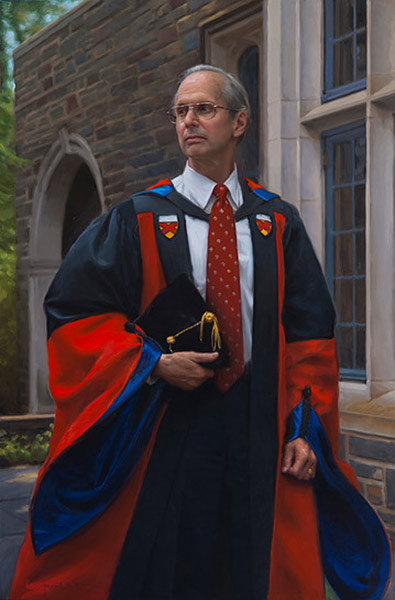
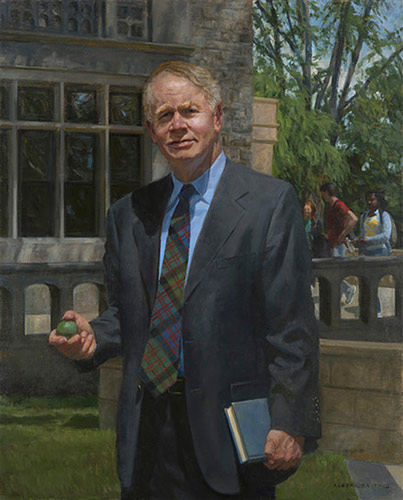
Alexandra Tyng, “David M. Felson,” oil, 42 x 34 in. (c) PSA 2016

 
First through 10th place awards were given in the category of commissioned portraits, while 1o merit and 10 honorable mention awards were also given under the category of commissioned pieces. Other categories included non-commissioned, outside the box, landscape, and still life. Paul Newton received first place for his portrait of Dean Bill Russel of Princeton University while Alexandra Tyng took second for her picture of David M. Felsen. Raelene Sharp and Anna Rose Bain took home first merit and first honorable mention, respectively, for their delightful oils as well.


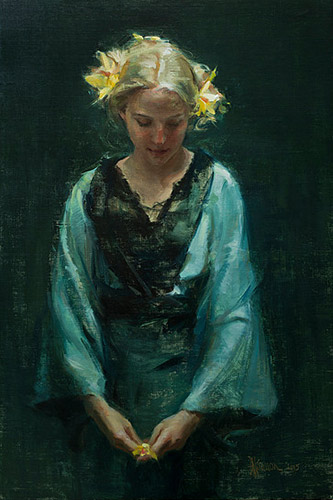
Johanna Harmon, “Golden Orchids,” oil, 24 x 16 in. (c) PSA 2016

 
Under the category of non-commissioned portraits, artist Johanna Harmon was honored with first place for “Golden Orchids,” a stunning picture of a blond female subject in three-quarter view. The subject wears what appears to be a traditional Japanese kimono, and her golden hair with bright yellow flower adornments contrasts sharply with the deep aquamarine setting. In second place was Karen Offutt for her work titled “Listen.”


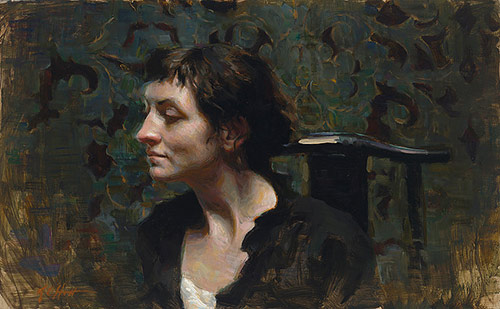
Karen Offutt, “Listen,” oil, 12 x 20 in. (c) PSA 2016

 
To view the entire list of recipients and to learn more about the Portrait Society of America, visit their webpage here.
 
This article was featured in Fine Art Today, a weekly e-newsletter from Fine Art Connoisseur magazine. To start receiving Fine Art Today for free, click here.

In Light of Venice

0

The outstanding contributions to the field of art history and Old Master paintings by Dr. David Rosand (1938-2014) cannot be understated. In his honor, the Otto Naumann Gallery will be filled once more with a breathtaking array of Renaissance, Baroque, and Rococo paintings, many of which have never been exhibited publicly.
 
Dr. David Rosand’s name will surely live among the pantheon of Renaissance art historians. The accomplishments of this graduate and distinguished professor at Columbia University range from his establishment of Casa Muraro —Columbia’s residence and study center in Venice — to numerous formative publications and awards.
 
In honor of the late scholar, Otto Naumann and Robert Simon (also Columbia alumni in art history) are delighted to announce the opening of “In Light of Venice” on January 11 at Naumann’s New York City Gallery. The exhibition will feature more than 30 important works from the Renaissance, Baroque, and Rococo periods. In addition to showcasing gorgeous Old Master paintings — many of which will be available for purchase — a portion of the sales will benefit the David Rosand Tribute Fund at Columbia, which was formed to help sustain professorship in Italian Renaissance art history. The fund also supports other programs in Venetian studies and art historical scholarship at Columbia.
 
Via the event press release, Simon noted that “with the establishment of the Rosand Professorship in the Italian Renaissance, the subject is insured to be taught in perpetuity by distinguished scholars.” Naumann adds, “The exhibition demonstrates that important works by some of the greatest masters of the period are still on the market and many are certain to find homes in private collections, as well as in museums.”
 
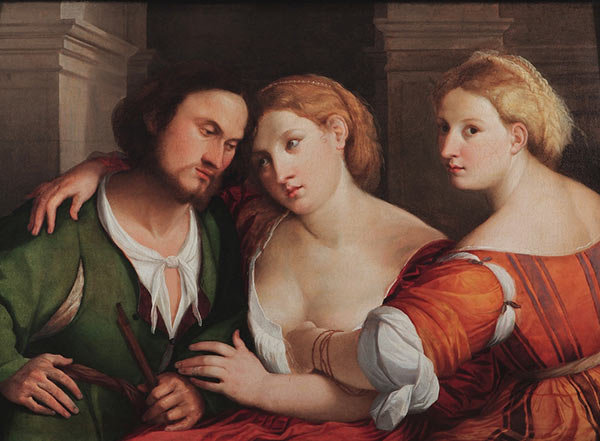
Featured artists include Carpaccio, Giovanni Bellini, Palma il Vecchio, Titian, Tintoretto, Paolo Veronese, and Jacopo Bassano.
 
“In Light of Venice” opens on January 11 and will hang through February 12. To learn more, visit Otto Naumann, Ltd.
 
This article was featured in Fine Art Today, a weekly e-newsletter from Fine Art Connoisseur magazine. To start receiving Fine Art Today for free, click here.
 

Scrupulous Silhouettes

0

It never ceases to amaze how descriptive the silhouette can be — how it can communicate detail and minute information through such simplicity. Coming soon is an engaging exhibition that examines, among other types of portraiture, the silhouette portrait in profile. Where and when?
 
There often seems to be something outstanding happening at Portraits, INC. in New York City, and in the new year, it’s more of the same. Opening January 14, “The Art of the Face” will probe portraiture in “a multitude of styles and media choices not readily apparent to the novice client, and in some instances, the seasoned patron,” according to the gallery. Indeed, the exhibition offers an interesting perspective, one centered around side views of the face, silhouettes, and tonal portraits that “employ drawing media such as charcoal or a limited paint palette in shades of grey or soft earth colors.”
 
“The Art of the Face: Side Views, Silhouettes, and Shades of Grey” opens January 14 and will be on view through February 29.
 
To learn more, visit Portraits, INC.
 
This article was featured in Fine Art Today, a weekly e-newsletter from Fine Art Connoisseur magazine. To start receiving Fine Art Today for free, click here.
 

Featured Lot: Alfred Seifert, “Picking Flowers”

0

In this ongoing series for Fine Art Today, we take a longer look at the history and features of a soon-to-be-available artwork of note. This week: Alfred Seifert, “Picking Flowers.”
 
Personal misfortune ultimately helped steer Czech-German painter Alfred Seifert (1850-1901) toward art, and the world is better off for it. Born in Praskolesy, present-day Czech Republic, in 1805, Seifert experienced a serious illness as a child that left him unable to walk for four years. Spending most of his time in bed, Seifert took up drawing to entertain himself, and he — and his caretakers — quickly noticed that he had considerable artistic talent. After high school, Seifert was accepted into the Academy of Fine Arts in Munich, Germany, in 1869, and there the young painter developed an affinity for female portraiture.
 
Catering to the German market, Seifert achieved success for his “Seifert types” — often gorgeous female sitters with romantic expressions in lush outdoor settings. Although his connection to the Pre-Raphaelite Brotherhood is vague at best, Seifert’s penchant for female portraiture and pure traditional style situates him well within the range of popular tastes of his generation. In Germany, critics greatly appreciated the painter’s acute observational skill, well-thought-out compositional strategies, harmony of color, and pastoral atmosphere.
 
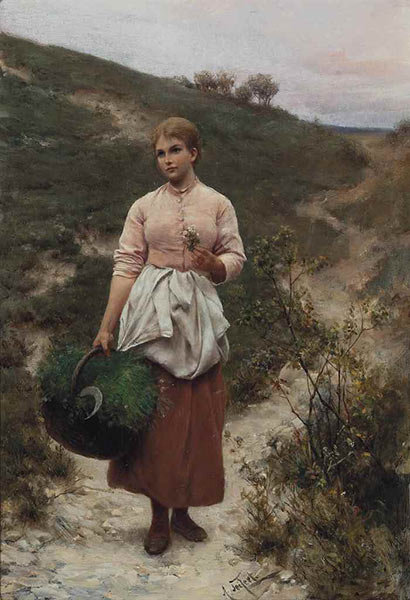
Leading all lots during Christie’s January 20 “19th Century European Art” sale is a beautiful Seifert oil, titled “Picking Flowers.” Of course, the work is unmistakably a “Seifert type,” with a single female subject who faces toward the viewer. Dressed in contemporary rural clothing of the era, the subject holds a woven basket that bursts with a large bundle of wildflowers. Although her gaze does not meet ours, she presents the viewer with a small bouquet, held in her left hand. The simple gesture is a warm and welcoming one, beckoning the viewer into the piece. Further, she stands in the foreground along a well-trodden path, which winds its way into the background. The palette of the piece is muted in tone, but beautifully arranged and balanced. The red in the subject’s dress is made more intense through complementary use of green in the bundle of flowers.
 
The market for Seifert’s work appears relatively pedestrian today, with this piece expected to realize around $3,000. However, works by Seifert have commanded five-figure numbers as recently as 2008, with his “Flora” selling for $10,258.
 
To view the full catalogue, visit Christie’s.
 
This article was featured in Fine Art Today, a weekly e-newsletter from Fine Art Connoisseur magazine. To start receiving Fine Art Today for free, click here.

VIDEO: An Art Museum…Underwater?

0

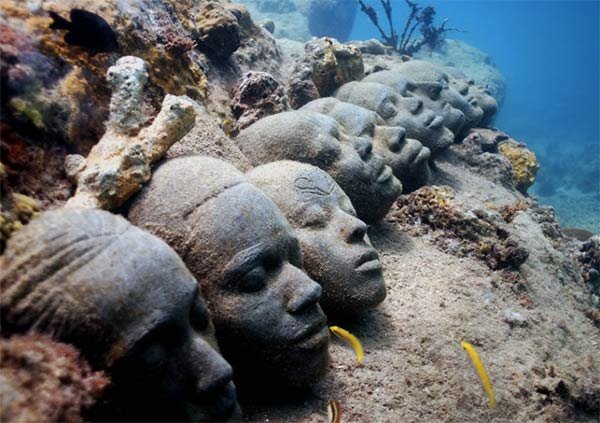
Nature has a way of creating beauty in multifarious ways. One sculptor is using the sea to his advantage. How? Jason deCaires Taylor explains during this captivating TED talk.
 
Via TED: “For sculptor Jason deCaires Taylor, the ocean is more than a muse — it’s an exhibition space and museum. Taylor creates sculptures of human forms and mundane life on land and sinks them to the ocean floor, where they are subsumed by the sea and transformed from lifeless stone into vibrant habitats for corals, crustaceans and other creatures. The result: Enigmatic, haunting and colorful commentaries about our transient existence, the sacredness of the ocean and its breathtaking power of regeneration.”
 

To learn more, visit Jason deCaires Taylor.

This article was featured in Fine Art Today, a weekly e-newsletter from Fine Art Connoisseur magazine. To start receiving Fine Art Today for free, click here.


Artistic Odyssey

0

From the West Coast to the East Coast and back, accomplished artist John Rowe has done just about everything to establish a successful career. Supporting a family through major commissions as an illustrator, Rowe continues his epic journey by exploring more deeply how fine art can communicate what words cannot.
 
The story of artist John Rowe’s career reads like Homer’s Odyssey — filled with triumph, love, deception, failure, and so much more. Like many before him, Rowe’s odyssey began when he was a child. The artist recalls how he had trouble putting down the pencil — how he was constantly observing the world and musing on how to represent it on paper. As a budding artist, Rowe’s formal training began at Cal State LA, where Al Fiori encouraged him to go to Art Center. Rowe recalls, “My first attempt at a student loan fell through, so I worked two full-time jobs to raise tuition and work my way through school. After school, I sold my belongings and took a Greyhound bus to New York City with $600 to my name.”



John Rowe, “Make-up,” 2015, oil on canvas, 30 x 40 in. (c) John Rowe 2016

 
In the “City That Never Sleeps,” Rowe found himself being pushed into roles that didn’t provide the creative outlet he desired, so he took the plunge and resigned his role at an ad agency and began painting full-time. The move proved pivotal for Rowe, who relocated to Los Angeles and was quickly noticed by Disney for his illustrative talent. He writes, “Over the years I have been lucky enough to be able to support my family through commissions from Disney, the United Nations, and National Geographic. I was the president of the Society of Illustrators in Los Angeles for a few years as well. I’ve had lots of fun as a guest artist on cruise ships and learned a lot from many talented people. I feel like I am finally learning how to paint decently and my current work just might have something to offer. Mostly I am very grateful to be able to do what I love and have so much fun making art.”
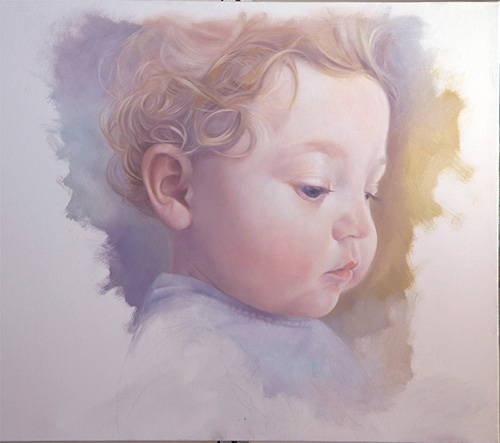


John Rowe, “Baby Study,” oil on canvas, 18 x 24 in. (c) John Rowe 2016

The range of Rowe’s work is stunning — and inspirational. While many artists hone their skills on portraiture, landscape, still life, and figurative subjects, Rowe has done it all, from book illustration to movie posters, traditional subjects, and beyond. “I never set out to create artworks in such a wide range,” he says, “but I was very determined to earn my living creating art and accepted almost any project that would accomplish that at the beginning. The wide variety of work I was offered defined its own path. Besides, everything in life is so interesting. To me, everywhere you turn, there is wonder and amazement worth studying, worth painting, worth thinking about. Over time I have been letting the subjects that hold my interest the least go and used personal works to evolve in directions that are meaningful to me.”

Rowe’s recently completed “Her Gift” is a terrific — and gorgeous — example of his new direction. Amidst a soothing solid background, the viewer is presented with two subjects: a brown and dark-haired mother tenderly grasping a pale-skinned infant. Albeit simple in subject, the piece bursts with emotional and interpretive potential. The piece has a very special meaning to the artist, made palpable through his description. The artist writes, “The painting of my wife and our foster child — who has since been returned to his family — is still very close to me. I watched my wife over months give her love and strength and protection to this child. Tears, joy, fierce protection, devotion, sleepless nights — all while knowing she might never see him again but that he would carry the sense of being loved unconditionally into his future life and it would become a foundation for him. We had taken classes to learn about how those first relationships can lay a groundwork for the core of who you become. I wanted the differences in hair, skin, and ethnicity to be apparent and for the emotional connection between her and the baby to be strong enough to make that completely irrelevant. I wanted to leave the viewer with the feeling of profound love that only a mother can have for her child.
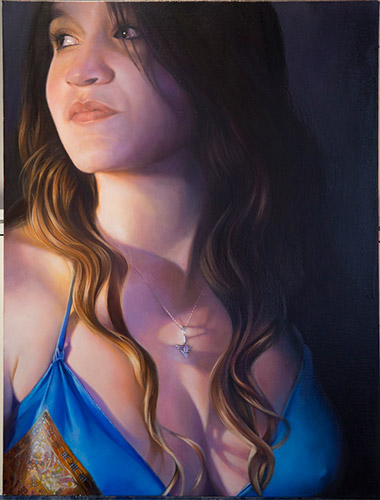


John Rowe, “Stephanie,” 2015, oil on canvas, 18 x 24 in. (c) John Rowe 2016

“We did a photo shoot at my studio, and I combined several different shots together. I closed her eyes to give the composition a feeling of peace and began painting. To me one of the most important parts was her hand. Each finger held the baby differently: from the talon-like security of her thumb and forefinger griping him, to the gentle touch of her ring finger and pinky left floating in space half touching and half letting go, as she would eventually have to do. I painted my wife’s face out of focus so other mothers could relate to her and not become too specific. The child’s fine hair was represented as real as possible so the viewer could relate to the fragile nature and delicate features of a baby.”

Rowe hopes to continue producing paintings such as “Her Gift” for gallery spaces into the future. After spending a long career creating illustrations for major publishers, Rowe endeavors to create artworks that are meaningful to his viewers and collectors. He concludes, “I think if I am able to do that from time to time during the rest of my career that is what would make me happy.”

To learn more, visit John Rowe.

This article was featured in Fine Art Today, a weekly e-newsletter from Fine Art Connoisseur magazine. To start receiving Fine Art Today for free, click here.

 

Discoveries and Rarities

0

Although New York City will be flooded with master drawing exhibitions and sales this month, collectors will have an opportunity to acquire important European bronze sculptures as well. Who’s offering them?
 
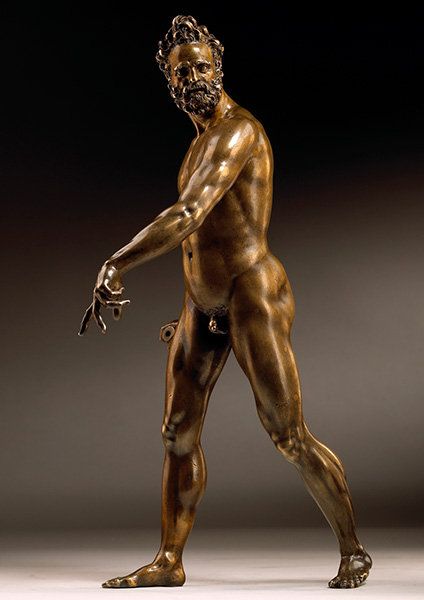
Timed to coincide with Master Drawings New York 2016, leading international sculpture dealers Tomasso Brothers Fine Art will make available a number of outstanding European bronze sculptures at Carlton Hobbs LLC. On view and offered from January 21-30, Antonio di Pietro Averlino’s (ca. 1400-1469) relief of Julius Caesar takes center stage among a considerable collection of works. Via the event press release, “Averlino’s work dates circa 1433, around the time he began designing the monumental bronze doors of St. Peter’s Basilica, Rome and is considered to have had a crucial influence over the entire genre of all’antica bronze relief work that emerged during the second half of the 15th century. Autographed works by Averlino are astonishingly rare and along with his tutor, Lorenzo Ghiberti (1378-1455), he is considered one of the earliest masters of bronze relief sculpture.”


Antonio di Pietro Averlino, Julius Caesar and King Juba, bronze, 6 1/4 x 10 3/4 in. (c) Tomasso Brothers Fine Art 2016

 
Dino Tomasso said, “We will present serious collectors and connoisseurs with an outstanding opportunity to view and acquire some of the best European bronze sculpture available today.” Raffaello Tomasso added, “This follows up a successful New York event we staged at Carlton Hobbs a year ago. Our forthcoming show, and the works we have selected to bring, is in part a response to the well-received exhibitions of the Quentin and Hill bronzes, held at the Frick Collection in recent years.”
 
“Important European Bronzes” will open on January 21 at Carlton Hobbs LLC, New York, and will be on view through January 30.
 
To learn more, visit Tomasso Brothers Fine Art.
 
This article was featured in Fine Art Today, a weekly e-newsletter from Fine Art Connoisseur magazine. To start receiving Fine Art Today for free, click here.

 

Simple Pleasures

0

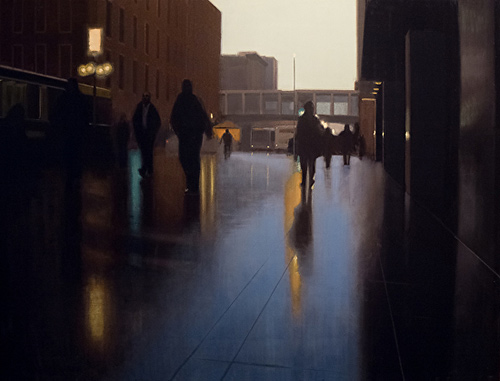
Preferring subjects that depict ordinary people in quiet public settings, painter David Cunningham will feature his latest oils during an upcoming solo exhibition. Where can you find them?
 
“Every painting must be about something,” writes artist David Cunningham. And for him, strangers sitting in cafés, walking along city streets, or waiting for trains connect him to his blue-collar upbringing.
 
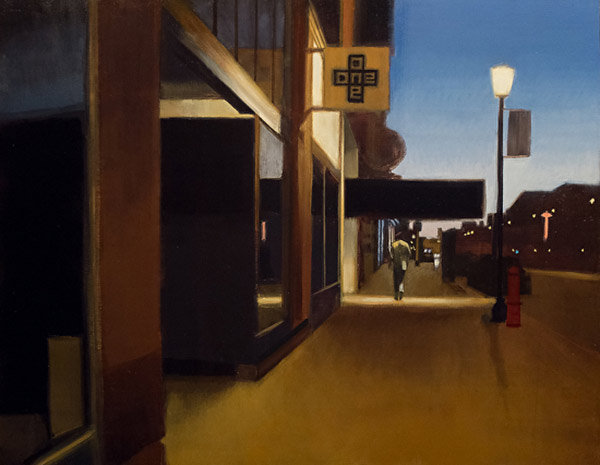
Opening January 9 at Minneapolis’s Gallery 360, Cunningham will showcase his latest works during a solo exhibition entitled “Sidewalks of the City.” As its title indicates, the exhibition will feature works by Cunningham that focus on people in urban settings, often standing or walking along sparsely populated sidewalks and streets.


David J. Cunningham, “Rain,” oil on panel, 36 x 48 in. (c) David J. Cunningham 2016

 
Classically trained and particularly drawn to French Academic art, Cunningham has pushed himself to bring traditional techniques into more contemporary subject matter. The resulting works, such as “Rain” and “Washington Ave,” have a captivating simplicity and isolation that often recall Edward Hopper’s masterpiece “Nighthawks”— an iconic painting of 20th-century modern nightlife.
 
During time spent living abroad in southern Argentina, Cunningham developed an affinity for 19th-century tonalists George Inness and James McNeill Whistler. The influence of these painters can be seen in Cunningham’s soft, atmospheric brushwork, which lends itself well to the subjects and emotional tone of his works.
 
“Sidewalks of the City” opens on January 9 and will hang through February 18 at Gallery 360 in Minneapolis, Minnesota.
 
To learn more, visit David J. Cunningham.  
 
This article was featured in Fine Art Today, a weekly e-newsletter from Fine Art Connoisseur magazine. To start receiving Fine Art Today for free, click here.
 

WEEKLY NEWS FROM THE ART WORLD

Fill your mind with useful art stories, the latest trends, upcoming art shows, top artists, and more. Subscribe to Fine Art Today, from the publishers of Fine Art Connoisseur magazine.

  • This field is for validation purposes and should be left unchanged.