
Home Blog Page 452

Jewel City

0

2015 marks the centennial of the Panama-Pacific International Exposition (PPIE) in San Francisco, California. The De Young Museum is celebrating the anniversary with an outstanding exhibition that features more than 200 works, many of which were on display in 1915.
 
To celebrate the grand opening of the Panama Canal and to commemorate the reconstruction of San Francisco after the great earthquake of 1906, the Panama-Pacific International Exposition (PPIE) was a vital moment in the city’s history and signaled to the world that San Francisco had — and would continue to be — an epicenter for Western culture and artistic production. Spanning some 76 city blocks and showcasing national and international innovation, industry, and arts, the PPIE encompassed more than 20,000 works of art in all types of mediums and styles from major American and European artists.
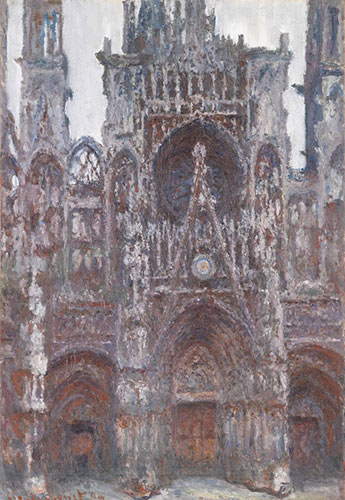


Claude Monet, “Rouen Cathedral Façade,” 1892, oil on canvas, 42 1/4 x 29 1/4 in.
(c) Musee d’Orsay, Paris 2015

 
A century later, the effects of the PPIE are still being felt across the city of San Francisco, and throughout California. In celebration, the De Young Museum has brought together more than 200 paintings, sculptures, prints, and photographs from the PPIE that have not been seen together since that first exhibition, and may never be together again. James Ganz, lead curator of “Jewel City,” says, “The curatorial team has spent more than three years assembling this ambitious exhibition that re-creates highlights of the original Exposition of 1915. Our efforts to identify and locate actual works of art shown in the PPIE have led from our own storerooms to holdings as far away as Budapest, Hungary. In a way, we are following in the footsteps of the original organizers as we bring back to San Francisco a compelling array of significant works by American and European artists last seen together here a century ago.”
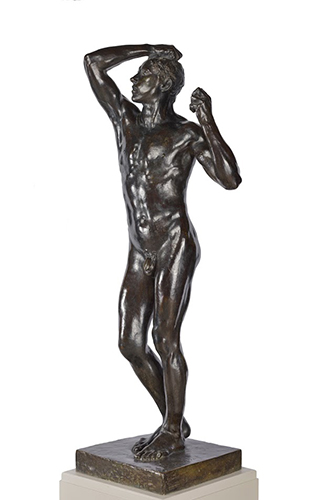

Auguste Rodin, “The Age of Bronze,” ca. 1875-1877, bronze, 71 1/2 x 21 1/4 x 25 1/2 in.
(c) Fine Arts Museum of San Francisco 2015

 
Among the featured blockbuster names are Claude Monet, John Singer Sargent, James McNeill Whistler, Ansel Adams, Umberto Boccioni, and Winslow Homer. “Jewel City: Art from the Panama-Pacific International Exposition” opened on October 17 and will be on view through January 10.
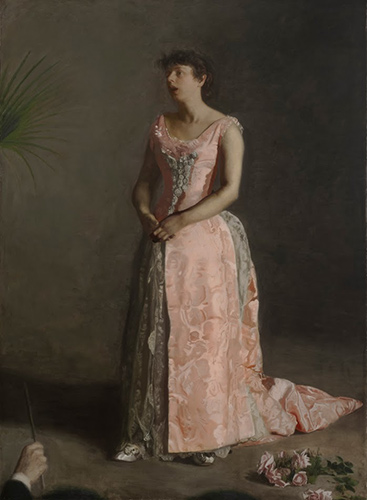


Thomas Eakins, “The Concert Singer,” ca. 1890-1892, oil on canvas, 75 1/8 x 54 1/4 in.
(c) Philadelphia Museum of Art 2015

 
To learn more, visit the De Young Museum.
 
This article was featured in Fine Art Today, a weekly e-newsletter from Fine Art Connoisseur magazine. To start receiving Fine Art Today for free, click here.

Tamara de Lempicka

0

A major retrospective of the renowned Polish Art Deco painter is on view in Verona.
 
Featuring over 200 works including oils, drawings, photographs, watercolors, videos, and more, “Tamara de Lempicka” is an extraordinary exhibition dedicated to the life and career of Polish painter Tamara de Lempicka (1898-1980). Exploring the relationship between Lempicka’s work, fashion, photography, modern life and culture, and femininity, “Tamara de Lempicka” is sure to send ripples through the art world.


Tamara de Lempicka, “The Blue Scarf,” 1930, oil on panel, 56 ½ x 48 cm. (c) Tamara Art Heritage 2015

 
The show is divided into eight sections: Tamara de Lempicka’s World, Madame la Baroness, Modern Medievalist, The Artist’s Daughter, Sacred Visions, Amorous Visions, Dandy Deco, and Scandalous Tamara. “La bella Rafaëla” from 1927 is a stunning highlight of the exhibition. Lempicka’s outstanding use of tenebrism, dramatic lighting, and bold, simplified forms imbue the painting with drama, sensuality, and seductiveness. The picture displays a reclining nude female subject wearing vibrant red lipstick. The chiaroscuro found within the subject’s form is absolutely masterful and contrasts with the bold shapes of the body.


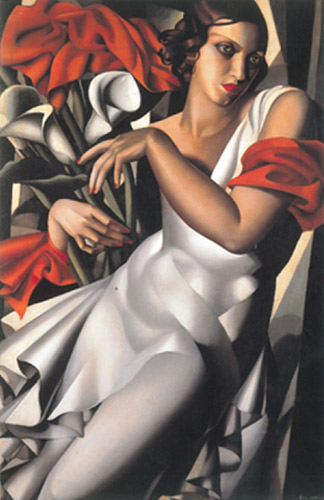
Tamara de Lempicka, “Ritratto di Madame Perrot,” 1931-1932, oil on panel, 99 x 65 cm.
(c) Palazzo Forti 2015, Private Collection

 
“The Blue Scarf” is another tantalizing example from the exhibition. Although it is unclear whether the image is a self-portrait, the sitter bears remarkable similarities to photos of Lempicka. In a bust view, the blond female gazes out of the frame towards the left. In an image characterized by, again, bold shapes and sharp edges, the saturated blues in the woman’s twisting, dancing scarf immediately harness our attention. A sailboat appears to dart and bob to the upper left of the panel.
 
“Tamara de Lempicka” is on view at the Palazzo Forti in Verona, Italy, through January 31.
 
To learn more, visit Blouin ARTINFO.
 
This article was featured in Fine Art Today, a weekly e-newsletter from Fine Art Connoisseur magazine. To start receiving Fine Art Today for free, click here.
 

MC at DPG

0

Dulwich Picture Gallery in London is offering a rare glimpse into the life and career of one of the 20th century’s most acclaimed graphic artists and masters of illusion.
 
Known for his imaginative tessellations of birds, frogs, and lizards, and his impossible never-ending staircases and waterfalls, Dutch artist M.C. Escher (1898-1972) created some of the most popular images in modern art. The fascinating worlds Escher created in his drawings, lithographs, and woodcuts have proven to be timeless, appearing on the covers of albums and on the walls of countless teenagers’ bedrooms and college dormitories.


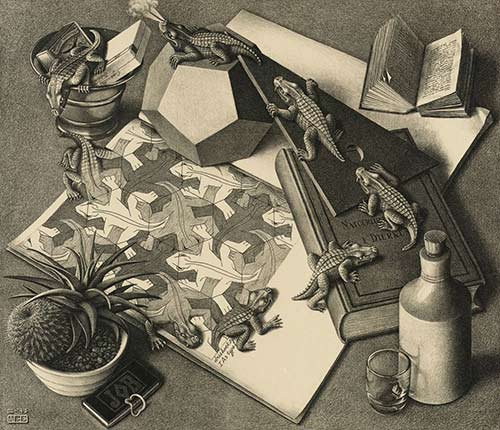
M.C. Escher, “Reptiles,” 1943, lithograph, 13 x 15 in. (c) Cordon Art-Baarn-the Netherlands 2015


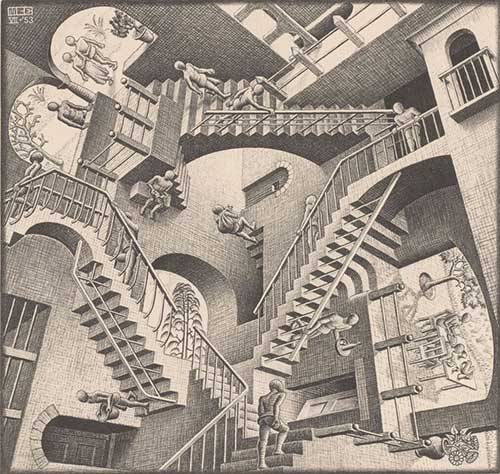
M.C. Escher, “Relativity,” 1953, lithograph, 15 3/8 x 16 in. (c) Cordon Art-Baarn-the Netherlands 2015

 
Following its run at the Scottish National Gallery of Modern Art, “The Amazing World of M.C. Escher” has come to London’s Dulwich Picture Gallery, where it will remain through January 17. The exhibition is a rare opportunity to view the full range of Escher’s genius, complete with original drawings, iconic prints, lithographs, woodcuts, and “archive material that highlights his supreme skill as a master draughtsman with unparalleled technical ability,” as the gallery states.


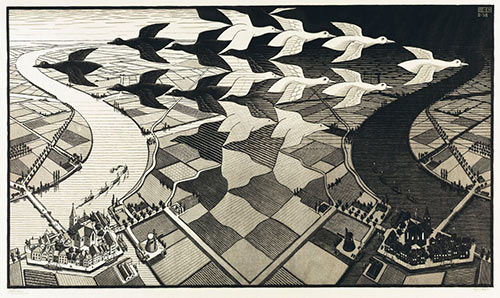
M.C. Escher, “Day and Night,” 1938, woodcut, 15 7/16 x 26 5/8 in. (c) Cordon Art-Baarn-the Netherlands 2015

 
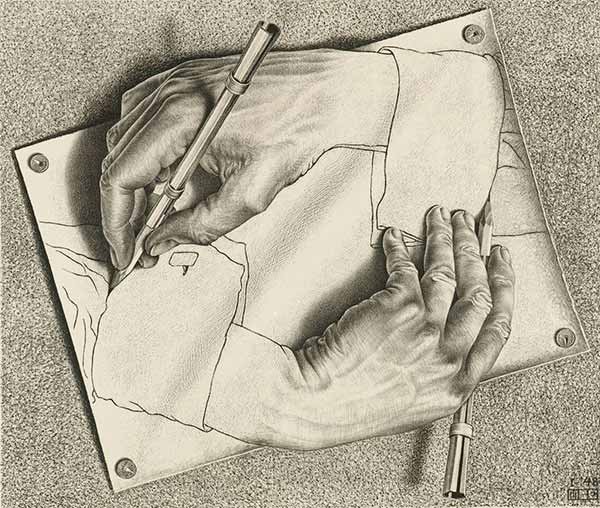
Over 100 works will feature in the exhibition and are arranged chronologically, spanning Escher’s career. The gallery continues, “Travel was hugely influential in the development of Escher’s work. He lived in Rome for 10 years, taking annual trips through various parts of Italy where, inspired by the mountainous scenery and picturesque towns and buildings, he created irregular perspectives, impossible in natural form. In ‘Still Life with Mirror’ (1934), for example, we see Escher using surreal illusion perhaps for the first time. When he moved to Switzerland in 1935 and then Belgium in 1938 he worked from images in his mind, rather than directly from observations. Escher focused on the concept of eternity in art — the subject of the well-known lithograph ‘Drawing Hands’ (1948).”


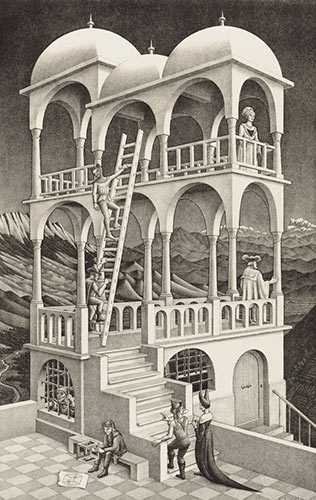
M.C. Escher, “Belvedere,” 1958, lithograph, 18 x 11 in. (c) Cordon Art-Baarn-the Netherlands 2015

 
To learn more, visit the Dulwich Picture Gallery.
 
This article was featured in Fine Art Today, a weekly e-newsletter from Fine Art Connoisseur magazine. To start receiving Fine Art Today for free, click here.
 

Major Acquisition at NGA

0

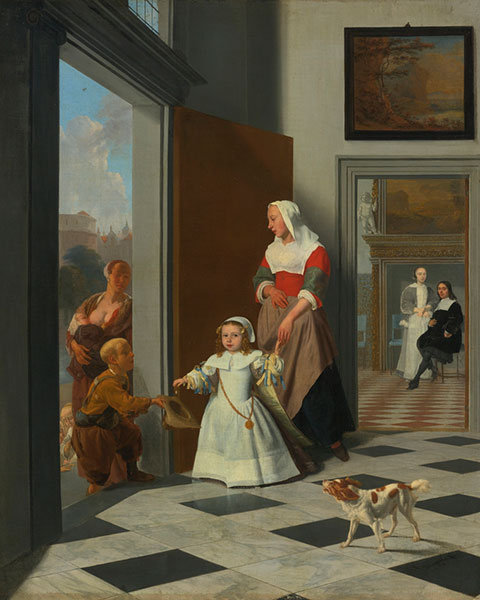
The National Gallery of Art, Washington, recently announced its acquisition of an exquisite 17th-century Dutch genre painting.
 
Everything one would expect from the finest of Dutch genre painting is present within Jacob Ochtervelt’s “A Nurse and Child in the Foyer of an Elegant Townhouse.” In what is arguably one of the artist’s finest works, at center we find a beautifully dressed and well-to-do boy engaging the viewer with his innocent gaze. He gracefully holds the hand of his nurse, whose brilliant red top presents a visual focus. To their left, another boy of similar age, accompanied by his mother, holds out his hat as the other child drops in some coins.
 
Masterfully executed, no detail has been left untouched, from the marbling in the quintessential checkered floor to the Italianate landscapes that can be seen over the doorways as our view recedes into the home. Ochtervelt has also clearly distinguished the differences in class, seen in the rendering of clothing, complexion, and body language. Quiet and still, the image’s only sense of movement and drama is indicated by the tiny but aggressive spaniel that yaps at the beggars.
 
Signed and dated 1663, the painting represents the most recent acquisition by the National Gallery of Art in Washington, D.C., and is a marvelous addition to an already world-renowned permanent collection. Director Earl A. Powell III offers, “This wonderful painting complements one of the great strengths of the gallery’s collection: the Dutch painters of high-life genre scenes in the 1650s and 1660s, among them Johannes Vermeer, Pieter de Hooch, Gerard ter Borch, and Gabriel Metsu. Each of these artists capture quiet moments of daily life that entrance and engage viewers, not only because of the sensitivity of their depictions of the human figure, but also because of the way they capture the effects of light and color, and the sheen of fabrics.”
 
Although he is not quite the household name that, say, Vermeer or de Hooch are, Ochtervelt was a preeminent genre painter during the mid-17th century. After studying in Haarlem from 1645-1650, he established a career in Rotterdam, then relocated to the bustling metropolis of Amsterdam. The gallery reports that in Amsterdam, “Ochtervelt focused on the pleasures of patrician life and leisure-men and -women reading and writing letters, eating and drinking, making music, and playing games. However, his most innovative scenes are those that depict the interactions between the upper and lower classes, often placed at the threshold of an elegant townhouse. Characterized by clarity of light and of color, his paintings display a sympathetic rendering of people from all social classes.”
 
To learn more, visit the National Gallery of Art.
 
This article was featured in Fine Art Today, a weekly e-newsletter from Fine Art Connoisseur magazine. To start receiving Fine Art Today for free, click here.
Fighting Forgery

0

Fakes and fraud in the art market might be a thing of the past, as recent technological advancements could give each work a unique tag.
 
Throughout history, there has always existed a black market for forged works of art, and it has been estimated that some 40 percent of works sold aren’t what they seem. Fortunately, The Global Center of Innovation at the University of Albany may have developed a microscopic tag that could make forgery virtually impossible. In a program launched in London on October 12, researchers have begun to tag original works of art with a synthetic DNA label that can be scanned and verified via a protected database. Sound expensive? In fact, the tag would cost around $150 for each work, an insignificant sum given the level of protection.
 
Lawrence Shindell, chairman of ARIS Title Insurance Corporation, points out, “There is no universal standard that governs how a work should be identified, no solution that can authenticate a previously unidentified work with any degree of certainty, and therefore no mechanism to prevent the reintroduction of faked and forged objects back onto the market. The i2M Standards represent an international, cross-industry solution designed to solve art’s great challenges caused by fakery and fraud.”
 
While the DNA tag and database aren’t 100 percent fail-proof, the project represents a major advance in the fight to keep the art market free of fraudulent works. Researchers and investors hope the tags become commonplace and part of a universal standard that — if achieved — will make forged works of art extremely rare, if not virtually nonexistent. Moreover, developers hope to extend the project beyond the art world and into various other industries.
 
To learn more, visit the University of Albany.
 
This article was featured in Fine Art Today, a weekly e-newsletter from Fine Art Connoisseur magazine. To start receiving Fine Art Today for free, click here.
 

Southern Light

0

From Abruzzo, Molise, Campania, and Apulia to Basilicata, Calabria, and Sicily; 19th-century Italian masters from throughout Southern Italy highlight a beautiful and carefully selected exhibition in New York.
 
Curated by the renowned expert and art dealer Marco Bertoli, 34 beautiful paintings rarely exhibited in the United States are on view at New York City’s Italian Cultural Institute. Although temperatures are cooling, viewers can bask in the mastery of Mediterranean light and exquisite chromatic skills of painters from gorgeous regions of Southern Italy. The Institute suggests, “While art enthusiasts may be more familiar with the artistic production from the North of Italy – such as work from Florence, Venice, Milan, etc. – the exhibition serves to highlight the Southern regions.”


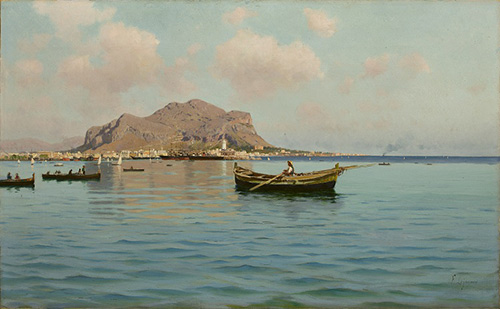
Francesco Lojacono, “Gulf of Palermo,” oil, (c) The Italian Cultural Institute 2015

 
In works that beautifully render diverse subject matter of everyday life, light and color were clearly the primary focus for artists of the 19th-century Neapolitan school. Viewers can expect a range of landscape, seascape, genre, and portraiture that captures the aura of this breathtaking region of the Mediterranean.
 
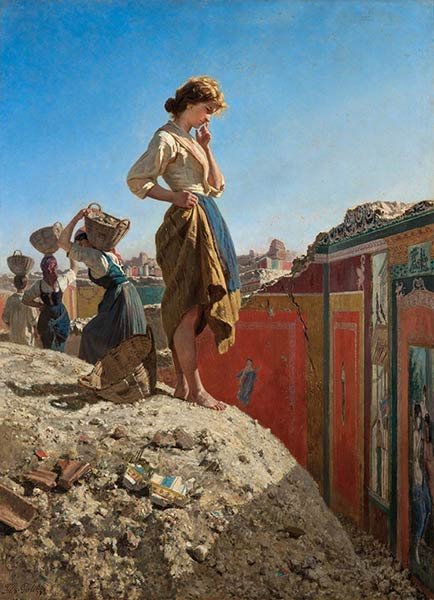
Filippo Palizzi’s “The Ruins of Pompeii” is a stunning highlight of the exhibition, displaying one of the artist’s favorite models, Filomena. Independent of the subject, the clarity, luminescence, detail, and color of the painting are truly extraordinary. Standing at center is a pensive, contemplative female subject, one hand resting on her waist and the other touching her face. She gazes at a frescoed wall amidst the ruins of Pompeii as three other women recede into the background, carrying baskets of rubble. Bright reds, yellows, and blues from the frescoes dance across the canvas, their outstanding state of preservation represented masterfully. The subject was a popular one among painters of the late 19th century, as the 1864 unification of Italy initiated an active period of archaeological discovery and excavation. New technologies and methods gave rise to discoveries at Pompeii and Paestum, including new architectural complexes, some of which may be represented here.  
 
Francesco Lojacono’s “Gulf of Palermo” is another highlight of the exhibition. At center we find a single figure rowing his boat across the bay as the light of a fading day illuminates the picture. Other vessels, powered by both wind and man, are seen scattered throughout the picture. In the distance we find a faint cityscape underneath the dominating peaks of a short mountain. The light and color of the piece is mesmerizing, with an arrangement of blues, purples, and greens composing the water, while pinks, greens, and pastel blues detail the land and sky.
 
“The Light of Southern Italy” opened on October 8 and will be on view through November 5.
 
To learn more, visit the Italian Cultural Institute.
 
This article was featured in Fine Art Today, a weekly e-newsletter from Fine Art Connoisseur magazine. To start receiving Fine Art Today for free, click here.
October 29: AFA Annual Gala

0

The American Federation of Arts will host its annual Gala to honor artists and recognize supporters of the arts.
 
On October 29 at the Metropolitan Club in New York City, the American Federation of Arts will kick off the 2015 Gala & Cultural Leadership Awards.  Via the event website, “The AFA is delighted to announced that the recipients of the AFA’s prestigious Cultural Leadership Awards are renowned art patrons and collectors Rosa and Carlos de la Cruz, contemporary American artist Wade Guyton, and retiring longtime director of the Brooklyn Museum Arnold Lehman. “
 
To learn more, visit the American Federation of Arts. Tickets for the Gala may be found here.
 

Featured Artwork: D.K. Richardson

0

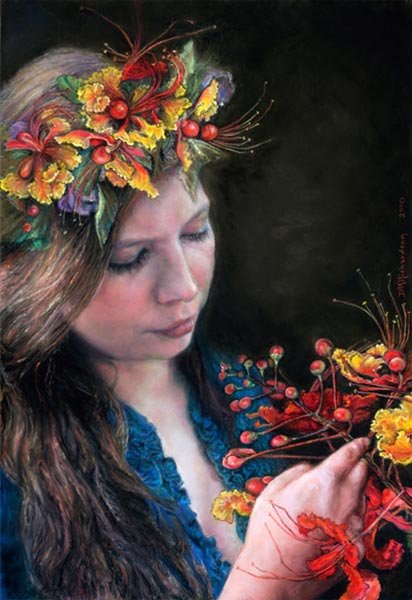
“Blossoms for the Bride”
Pastel on Panel
16 x 11 in.
$22,000
 
Description: Summer In my garden brings the most delightful experiences and Pride of Barbados is one the most spectacular flowering plants that can be viewed from my solarium. Its flowers are vibrant yellow, orange, and fiery red. I knew there must be an enchanting way to combine this most spectacular flora and my beloved niece and model, Shasta Chez’, who had just recently renewed her vows. These two exquisite subjects intertwined into the painting, “Blossoms for the Bride”.
 
About the Artist:
Influenced by Masters of their craft: Da Vinci, Moroni, Rembrandt, Vermeer, and Rubens; D.K. Richardson endeavors to breathe a feeling of “Life” into her subjects regardless of the medium. She is known for her unique and detailed pastel work. Strong composition, color, and expression hold viewers fascinated with the painting’s life-like appearance.
 
Recent Achievements:
IN3 Group Exhibition, Jadite Gallery, New York, NY which opened September 16. Paintings exhibited were “A Quiet Moment”, “Adoration”, and “Blossoms for the Bride”. “The Shaman”, a pastel painting, recently exhibited in Madrid, Spain. “The Babylonian Woman”, worked with a verdaccio oil underpainting and glazing technique, has exhibited in Texas, Sweden, Lithuania, Romania, Italy, Spain, and France.  “Once a Queen – Twice Exiled”, verdaccio underpainting with color glazes exhibits in Paris in March of 2015. Finalist in the 2013/2014, 2012/2013, and 2011/2012 ARC International Salons; Richardson has been honored with two Best of Show winners in the Austin Pastel Society competitions; Certificate of Excellence 2013 Portrait Society of America International Portrait Competition.

Richardson is an active member of the Portrait Society of America, and IN3 International Artists Incentive. Native to Texas, she resides in Austin.
 
D.K. Richardson   |   830-928-3393   |   [email protected]   |   www.dkrichardson-artist.com  
 

Academia

0

The Laguna College of Art and Design is currently showing selected works from the Russian Academy of Arts alongside works by its talented roster of students. Even better, Fine Art Connoisseur’s very own Vanessa Rothe was one of the exhibition’s curators.
 
On view through November 19, “Academia” features a number of outstanding figure and portrait drawings from the Russian Academy of Arts in an exhibition at the Laguna College of Art and Design (LCAD). Curated by Hope Railey, Russian Akhmed Salakhly, and Fine Art Connoisseur’s West Coast editor, Vanessa Rothe, the exhibition also includes selected works by LCAD students.


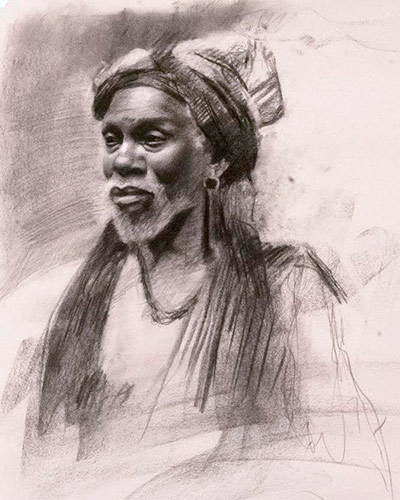
Charlie Antolin, “JJ,” charcoal, 16 x 20 in. (c) LCAD 2015

 
Charlie Antolin’s “JJ” is an outstanding portrait study. Shown in near half length, the confident and experienced sitter peers out of the left edge of the page. A beautiful juxtaposition exists between the refined and naturalistic details of the man’s visage and his surroundings, which are indicated through quick and gestural strokes of charcoal.


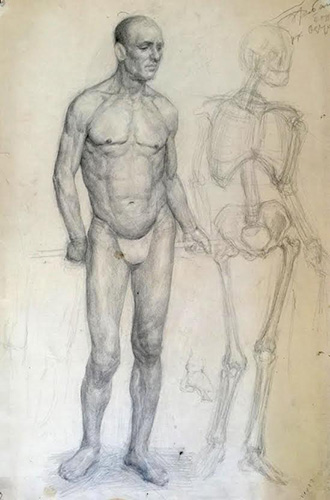
Eric Rebane, “Structure,” pencil on paper, (c) LCAD 2015

 
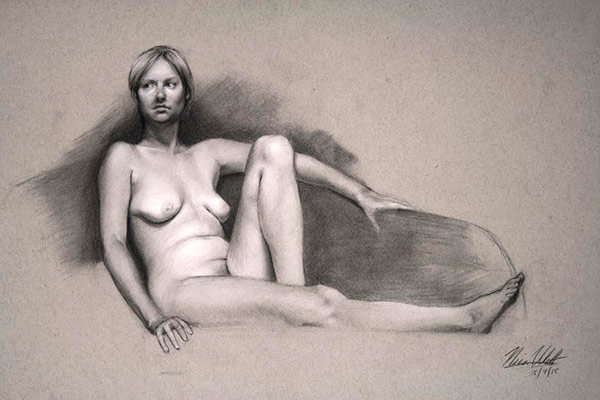
Also worthy of mention is the full nude study by Nina Ulett titled “Page.” In this drawing, executed on gray paper, Ulett has achieved an outstanding range of depth and form through her employment of both white chalk and black charcoal. The full range of value tones has created superb naturalism. At center, a female nude reclines in a classical, timeless pose. With one leg straight and extended, the other has been brought close to the torso, bent at the knee. Relaxed and poised, the subject rests one arm on the back of her couch while the other supports her body.
 
“Academia” opened on October 8 and will be on view through November 19. A reception is scheduled for October 20 from 4-6 p.m.

To learn more, visit the Laguna College of Art and Design.
 
This article was featured in Fine Art Today, a weekly e-newsletter from Fine Art Connoisseur magazine. To start receiving Fine Art Today for free, click here.
Sea Breeze

0

Scenes from the coast of Cape Cod feature in a beautiful group exhibition in Massachusetts.
 
Viewers will nearly be able to smell the salt in the air, wiggle their toes in the sand, and catch the golden rays of a Cape Cod sun at Tree’s Place Gallery in Orleans, Massachusetts. From October 10 through October 23, “Salt Air: Scenes from the Cape” will surely ignite nostalgia in some, while others may be booking their next vacation to the coast. A group show, the exhibition will feature some 47 outstanding works with subjects ranging from beach scenes to seascapes to sailboats and beyond. What is more, the range of styles will be sure to keep patrons moving and entertained.
 
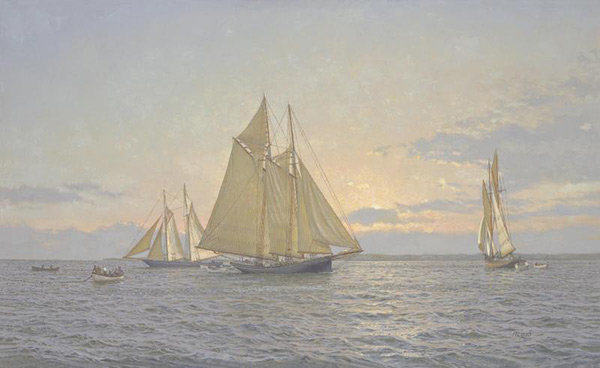
“Working a School” by Richard Loud is a lovely example from the show. The viewers find themselves deep into a bay as the sun begins to slowly dip behind the clouds at the end of the day. Three large sailboats hover a short distance away as groups of smaller rowboats man the fishing nets. The luminance of the piece is outstanding and displays an overall softness through the predominate use of light pastel tones.
 
“Salt Air: Scenes from the Cape” opened on October 10 and will be on view through October 23.
 
To learn more, visit Tree’s Place Gallery.
 
This article was featured in Fine Art Today, a weekly e-newsletter from Fine Art Connoisseur magazine. To start receiving Fine Art Today for free, click here.
WEEKLY NEWS FROM THE ART WORLD

Fill your mind with useful art stories, the latest trends, upcoming art shows, top artists, and more. Subscribe to Fine Art Today, from the publishers of Fine Art Connoisseur magazine.

  • This field is for validation purposes and should be left unchanged.