

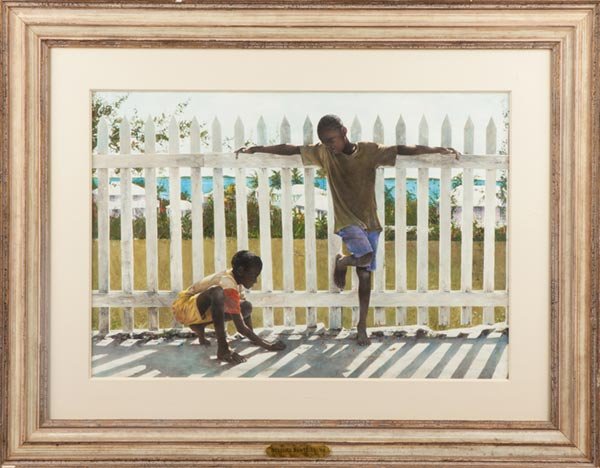
In this ongoing series for Fine Art Today, we take a longer look at the history and features of a soon-to-be-available artwork of note. This week: Stephen Scott Young, “Shadow Games.”
Widely considered a living master in the American realist tradition, painter Stephen Scott Young has established a successful artistic career by exploring themes of family, coming of age, and everyday life in his watercolor paintings and etchings. Born in Hawaii in 1957, Young established a love for art flipping through picture books of traditional masters such as Johannes Vermeer, Michelangelo Caravaggio, and Rembrandt van Rijn, artists who have undoubtedly exercised considerable influence on his preference for naturalism and attention to detail. His first academic exposure in the arts came during his tenure at Ringling College of Art and Design in Sarasota, Florida. Around 1985, shortly after Young won first prize in a national art competition held by American Artist Magazine, the artist travelled to the Bahamas, where he began painting and etching genre scenes of quotidian life. The eloquent simplicity of life on the islands entranced Young, which has continued to draw his artistic attention ever since. In addition to the Bahamas, Young has turned his eyes towards similar subjects along the Eastern Coast of the United States, detailing everyday life in Vermount, Florida, Georgia, and the Carolinas.
A quintessential example of both Young’s mastery of watercolor and his profound love for Bahamian subjects is “Shadow Games,” a gorgeous painting of 1995. Immediately noticeable is the rhythmic dance of the white-picket fence that forms a major part of the composition, its play of light and shadow cast on the sidewalk below. Contrasting sharply are the dark bodies of two Bahamian boys, themselves accented with vividly saturated blue and yellow shorts. Basking in the unyielding glow of a midday sun, one youth stands, leisurely stretching and resting his arms along the fence. A second youth to the left kneels and intently concentrates on the game by his feet, unaware of the audience gaze beyond the picture plane. Beyond the fence we find an unpopulated field followed by beautiful white homes along a beach – their location indicated by hints of brilliant blue waters in the distance. Like so many traditional realists, there is a timelessness and nostalgic appeal to this – and indeed all – of Young’s pictures, an element that has continually drawn collectors to his work.
“Shadow Games” could be the next piece hanging in your collection as the work features in a September 26 sale at Cottone Auctions in Geneseo, New York, day 2 of a “Fine Art & Antique Auction.” Residing currently in a private collection and in outstanding condition, the piece has auction estimates of between $80,000 and $120,000.
To view the full catalogue, visit Cottone Auctions.
This article was featured in Fine Art Today, a weekly e-newsletter from Fine Art Connoisseur magazine. To start receiving Fine Art Today for free, click here.
Featured Lot: Stephen Scott Young, “Shadow Games”
More than an Idol
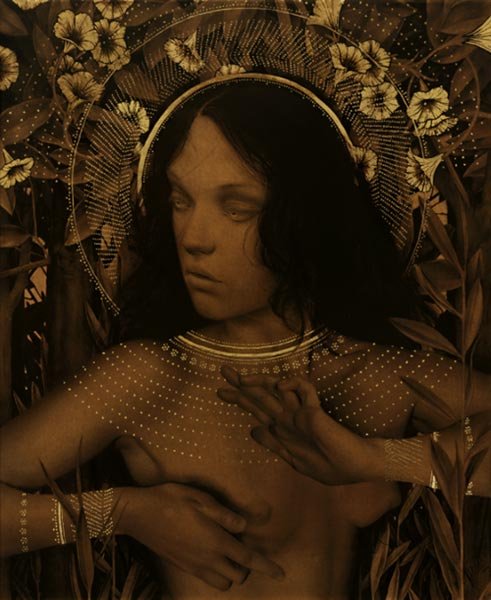
Stemming from her interests in Christian iconography, artist Alessandra Peters’ modern visions of female idols comment on the double standards of moral femininity.
For nearly 2,000 years, the Virgin Mary has represented for billions of people especially women – the ideal of virtue, modesty, and motherhood. Indeed, a major part of her divinity stems from her purity, embodied by her miraculous conception. However, while the Virgin provides an exceptional moral and sexual ideal, popular culture often glorifies and encourages the opposite, creating a conflicting message for millions of young, Christian women. Artist Alessandra Peters, who was raised Catholic, took note of this double standard during her formative years in an all-girls high school, which has evolved into a powerful artistic voice. “It was enormously difficult to try and develop a self-identity as a teen because there were so few examples of powerful, sexless femininity,” Peters recounts, “Most young women grow up with the idea that their power is based on whether – and how – they choose to express their sexuality. Everyone is telling you to stay a virgin and everywhere the media is trying to convince you of the power of your sex.”
Alessandra Peters, coffee-stained paper with graphite/carbon pencil, gold leaf and black ink,
(c) Alessandra Peters 2015
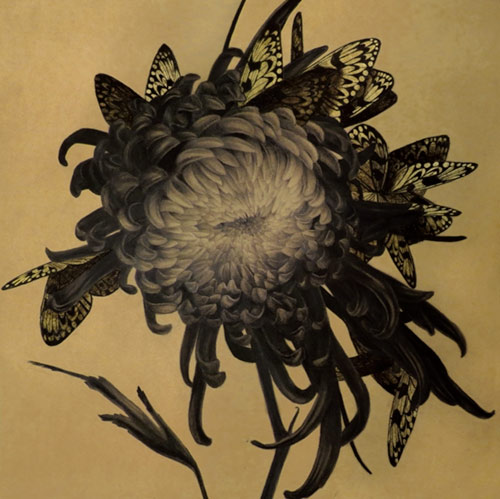
“I believe we all need idols,” Peters continued, “and if we don’t have them we eventually create our own.” Creating new, modern idols specifically for women is the core of Peters’s artistic goals. Stripped of her sex appeal, disjointed, powerful, and dark is the stunning “Cleis Rising.” Executed with graphite and ink on stained paper, a half-length female figure stands at center. Her quiet, confident pose and expression are stoic and captivating as she peers outside of the picture. “Her nudity is irrelevant,” writes Peters, “I try to use typical feminine motifs – flowers and butterflies, to give her strength, darkness, and edge.” Adding an extra sensory dimension is the artist’s use of gold leaf, which is beautifully arranged to form a sparkling halo around the subject’s head. What is more, many of the flowers have been embellished with gold leafing as well. The resulting effect on the viewer is entrancing as our eyes vacillate between the three-dimensional and two-dimensional. Although the leafing begs the brain to perceive it as flat, its brilliant illumination leaps from the darkened page while simultaneously disappearing behind the idol and objects surrounding her.
Alessandra Peters, coffee-stained paper with graphite/carbon pencil, gold leaf and black ink,
(c) Alessandra Peters 2015
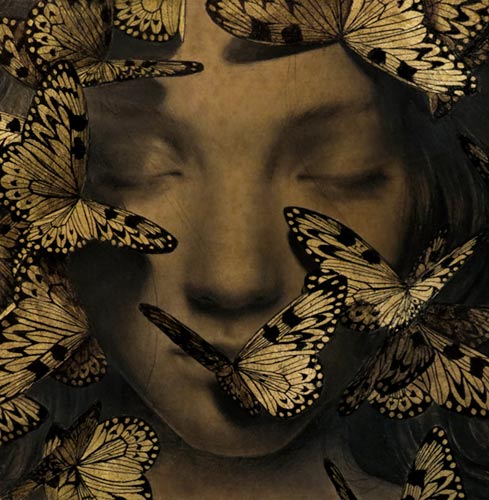
Alessandra Peters, coffee-stained paper with graphite/carbon pencil, gold leaf and black ink,
(c) Alessandra Peters 2015
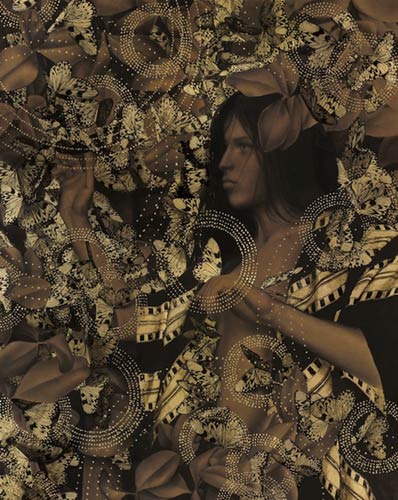
Another marvelous example again displays a half-length female figure. Particularly noteworthy from this picture is the liberal use of gold, which composes nearly half of image. In lieu of flowers, the viewer finds a swarm of golden butterflies, their various angles and views activating the artwork with kinetic energy. Adding to the visual texture is an array of dotted, concentric gold circles, which appear to form miniature halos around each butterfly. Were it not for the figure’s outstanding modeling, dark hair and robe, she could be entirely lost in the composition.
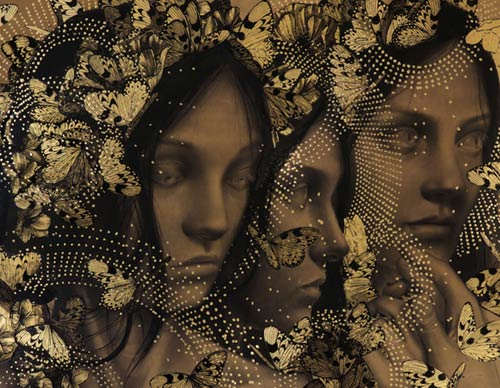
Alessandra Peters, coffee-stained paper with graphite/carbon pencil, gold leaf and black ink,
(c) Alessandra Peters 2015
Don’t expect Peters to stop anytime soon. At 26 years-old, Peters has a long career ahead, the prospects of which seem promising. “I have so many ideas, and love pondering that thought,” she writes, “Always improving, always growing, that’s the goal.”
Peters is represented by Arcadia Contemporary in New York and was recently featured in their “Works on Paper” exhibition, which was detailed in an earlier Fine Art Today article here.
To learn more, visit Alessandra Peters.
This article was featured in Fine Art Today, a weekly e-newsletter from Fine Art Connoisseur magazine. To start receiving Fine Art Today for free, click here.
Featured Artwork: D.K. Richardson

D.K. Richardson
“The Babylonian Woman”
Oil on Linen
14 x 11 in.
$22,000
Named for an exotic culture of the past, “The Babylonian Woman” is a fantasy of how such a woman might have adorned herself. She would have been confident, poised, and strong. Her headdress would have been woven by hand, multi-colored, having texture and beautiful fringe.
This work of art is painted with a verdaccio underpainting. The entire painting is done in greens, and then glazed with thin layers of color. This allows the skin to have a transparent and more life-like appearance.
Pause . . . be of present mind, all is well, just stop and take a moment to ponder the beauty before us and share it with those around you.
Exhibitions for “The Babylonian Woman”:
IN3 Art Worldwide European Tour:
Stockholm, Sweden – Galleri Bellman, opening July 2014
Kaunas, Lithuania, Museum of Music, opening August 2014
Bucharest, Romania, Museum of Art, opening August 2014
Italy, Castello Chiaramontano di Racalmuto September 2014
Spain, Galeria CREARIUM, October 2014
About the Artist:
Influenced by Masters of their craft: Da Vinci, Moroni, Rembrandt, Vermeer, and Rubens; D.K. Richardson endeavors to breathe a feeling of “Life” into her subjects regardless of the medium. She is known for her unique and detailed pastel work. Strong composition, color, and expression hold viewers fascinated with the painting’s life-like appearance.
Recent Achievements:
“Once a Queen – Twice Exiled”, verdaccio underpainting with color glazes, exhibited at the IN3 Members show at the Galerie Artes July 26 – August 4, 2015. “The Shaman”, a pastel painting, recently exhibited in Madrid, Spain. “The Babylonian Woman”, worked with a verdaccio oil underpainting and glazing technique, has exhibited in Texas, Sweden, Lithuania, Romania, Italy, Spain, and France. Finalist in the 2013/2014, 2012/2013, and 2011/2012 ARC International Salons; Richardson has been honored with two Best of Show winners in the Austin Pastel Society competitions; Certificate of Excellence 2013 Portrait Society of America International Portrait Competition.
Richardson is an active member of the Portrait Society of America, and IN3 International Artists Incentive. Native to Texas, she resides in Austin.
Contact:
[email protected]
www.dkrichardson-artist.com
830-928-3393
Invisible Made Visible
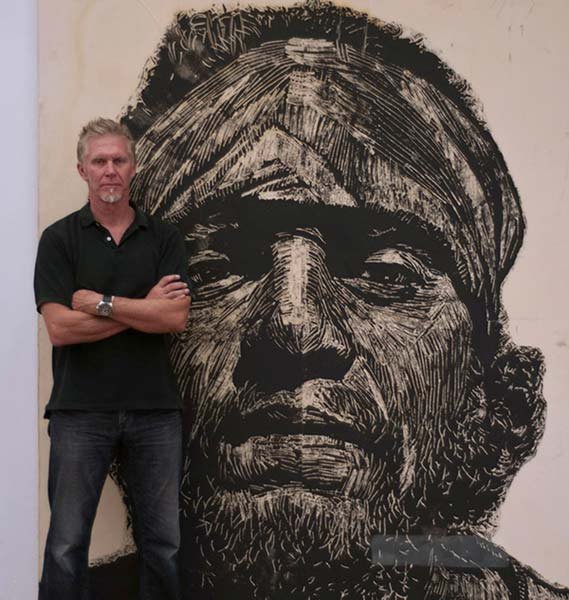
Part of what makes portraiture so magnetic is the skillful artist’s ability to capture the essence of an individual’s character, their personality traits as conveyed via subtle variations in physiognomy.
Artists, and especially photographers, have become increasingly interested in telling the tale of homeless populations, whose often worn and frightened appearance communicates so much about their day-to-day experiences. Artist Neil Shigley is one such creative mind using his own methods to document San Diego’s homeless population — “many of whom are from the streets in his neighborhood near downtown,” the Bread & Salt Gallery suggests. In what could come as a shock to some viewers, many of Shigley’s works are completed on a massive scale, their immediacy and detail confronting audiences immediately.
Shigley’s recent works will be on display at Bread & Salt Gallery in San Diego beginning September 12. The gallery reports, “The incredible character that life on the streets has given these individuals is captured through large-scale block prints and graphite drawings. These portraits from Shigley’s ongoing series ‘Invisible People’ show great nobility, beauty, strength, and vulnerability — characteristics that are there if we only look. Shigley’s ability to capture the essence of each individual reminds viewers that this was most likely not the life any of these individuals dreamed of as children. Each of his subjects has a family, friends, and a story of why they are where they are.”
“Neil Shigley: Invisible Drawings and Prints” opens on September 12 and will be on view through October 31.
To learn more, visit Bread & Salt Gallery.
This article was featured in Fine Art Today, a weekly e-newsletter from Fine Art Connoisseur magazine. To start receiving Fine Art Today for free, click here.
Royal Acquisition
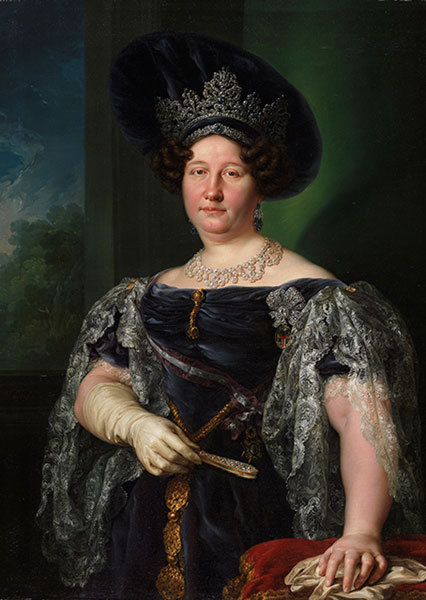
A beautiful portrait finds its new permanent home.
The Fitzwilliam Museum in Cambridge, England, has added a unique portrait to its already outstanding permanent collection. Dated circa 1829-1830, “Maria Isabel de Borbón, Queen of the Two Sicilies,” is a gorgeous three-quarter portrait by Vicente López (1772-1850), a court painter relatively unknown outside Spain. Importantly, the portrait is the first painting by López to enter a public collection in the UK.
Despite the artist’s limited notoriety, his immense talent and skill are on full display in the picture. A robust Maria is shown exquisitely dressed in blue velvet and lace. She delicately holds a fan while resting her hand on a pillow. López has masterfully rendered the subject’s visage, her flushed cheeks radiating warmth and vitality. Behind Maria is the slender view of a landscape beyond. Particularly noteworthy is López’s attention to texture, especially that of the velvet in Maria’s hat and gown, as well as the lace that embellishes her shoulders and arms.
Fitzwilliam Museum Director Tim Knox suggests, “Our collections have constantly been growing over the past 200 years and we are committed to displaying works that have a strong research and learning focus, and offer something new and fascinating to our visitors. We are absolutely delighted to announce this acquisition on the eve of our bicentenary in 2016.”
“Maria Isabel de Borbón, Queen of the Two Sicilies,” is now on view in the Fitzwilliam’s permanent collection.
To learn more, visit the Fitzwilliam Museum.
This article was featured in Fine Art Today, a weekly e-newsletter from Fine Art Connoisseur magazine. To start receiving Fine Art Today for free, click here.
Annual Exhibition Takes Flight Once Again
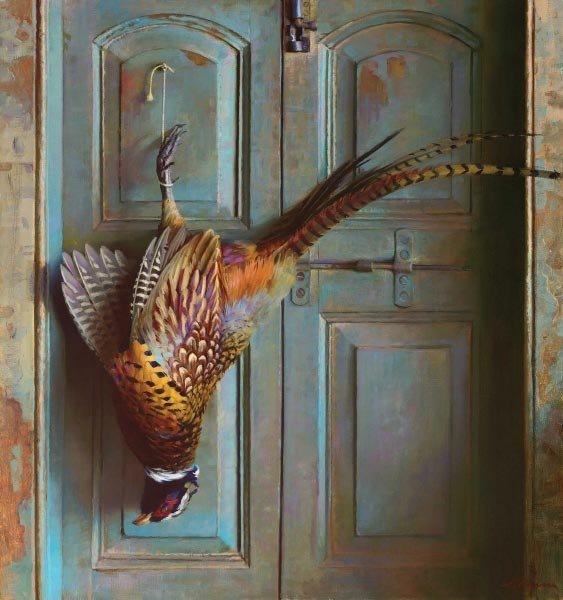
Time and again birds have found themselves the subjects of artists’ work in all types of mediums and styles. Since 1976, one museum has annually exhibited a juried collection of nearly 100 works with our feathered friends as the focus. Who’s featured in this year’s show?
On view beginning September 12 is the 40th annual “Birds in Art” exhibition at the Leigh Yawkey Woodson Art Museum in Wausau, Wisconsin. The show, which features artworks by 123 of the world’s most talented artists, has earned international recognition over its tenure. Among the artists juried into the show, 21 have been named “master wildlife artists” in earlier exhibitions; they include Owen J. Gromme (1976), Peter Scott (1980), Maynard Reece (1989), Richard Sloan (1994), John T. Sharp (1996), Nancy Howe (2005), Terry Miller (2013), Anne Senechal Faust (1999), and Andrea Rich (2013).
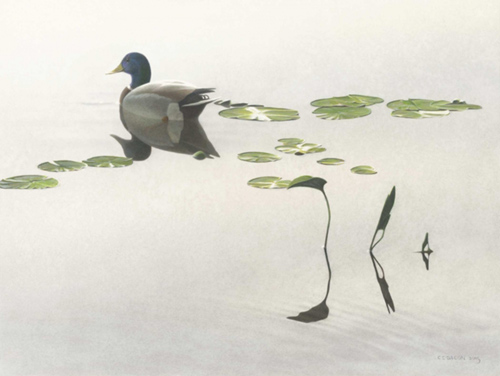
Chris Bacon, “A New Day,” 2015, watercolor, (c) Woodson Art Museum 2015
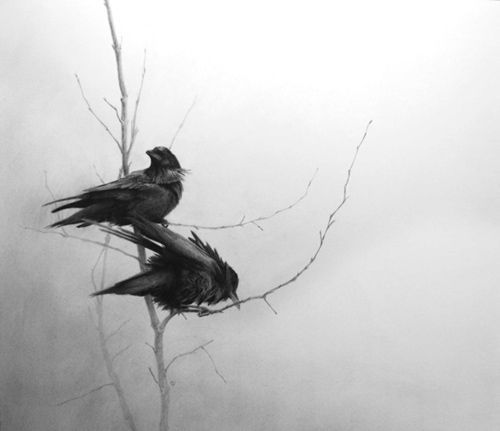
Ray Brown, “Huginn and Muninn,” 2015, charcoal, (c) Woodson Art Museum 2015
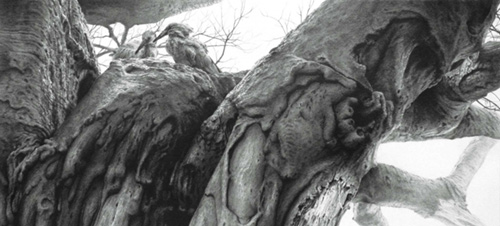
Terry Miller, “The Visitation,” 2015, graphite, (c) Woodson Art Museum 2015
Jurors Danny Bills, Virginia Eichhorn, and Terry Pitts scoured through submissions from more than 607 artists from across the world. Via the museum’s announcement: “This year’s edition includes 12 Wisconsin artists, 28 international artists, and 11 first-time ‘Birds in Art’ artists. The Wisconsin artists are Clarence P. Cameron, Gary Eigenberger, Janet D. Flynn, Cary Hunkel, David Kapszukiewicz, Jeffrey T. Larson, S.V. Medaris, John S. Miller, Don Rambadt, Gene Reineking, Jan McAllaster Stommes, and Todd Wohlt.”
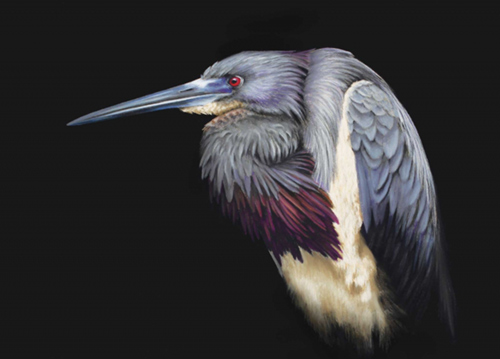
James Offeman, “Tricolored Heron,” 2015, pastel, (c) Woodson Art Museum 2015
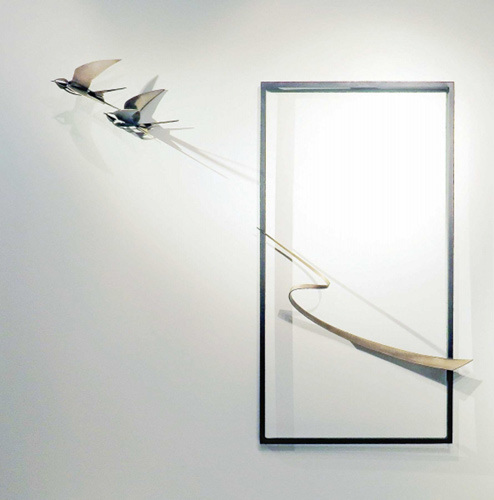
Don Rambadt, “Wings When You Fall,” 2014, welded bronze, (c) Woodson Art Museum 2015
“Birds in Art” opens on September 12 and will be on view through November 29.
To learn more, visit the Woodson Art Museum.
This article was featured in Fine Art Today, a weekly e-newsletter from Fine Art Connoisseur magazine. To start receiving Fine Art Today for free, click here.
Collecting History
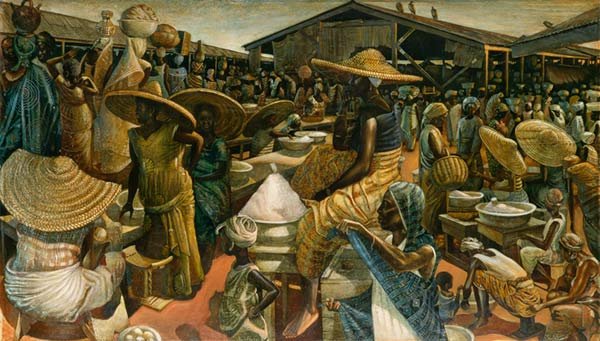
Works from the private collection of one of the 20th century’s most celebrated individuals head to auction September 15.
“I’ve learned that people will forget what you said, people will forget what you did, but people will never forget how you made them feel,” is one of the countless profound statements of the late Dr. Maya Angelou (1928-2014). Her words resonate today perhaps more than ever because it was how she made people feel that has been her most lasting legacy. A poet, dancer, actress, singer, and author, Angelou first moved the world with I Know Why the Caged Bird Sings (1969), a telling autobiography that recollects her life journey to age 17, overcoming brutal racism while blossoming into a capable, intelligent activist. She would go on to publish six more autobiographies, three books of essays, and several books of poetry that have consistently found their way on the list of New York Times Best Sellers.

Faith Ringgold, “Maya’s Quilt of Life,” 1989, acrylic on canvas with pieced fabric border,
(c) Swann Auction Galleries 2015
Angelou is hailed as one of America’s greatest cultural heroes, one who set the stage for African Americans to write and talk about the black experience without apology or reservation. In truth, some critics have suggested that she helped pave the way for feminist writings of the 1970s and ’80s. Her reach has even extended into popular culture, with hip hop artists such as Common, Kanye West, and Tupac Shakur paying tribute and quoting her works in their songs.
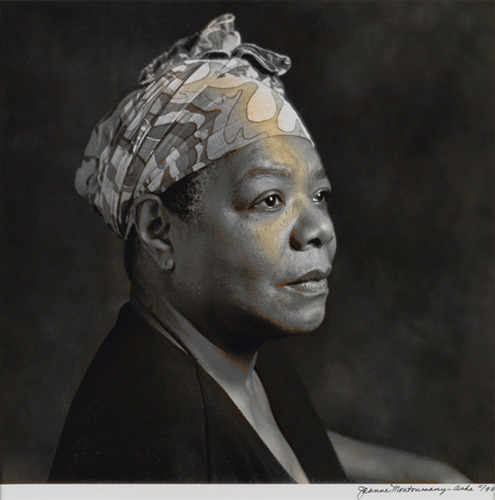
Jean Moutoussamy-Ashe, “Maya Angelou,” 1993, silver print, (c) Swann Auction Galleries 2015
Collectors and admirers will now have a chance to see — and own — works from Dr. Angelou’s private collection, much of which has never been publicly exhibited. More than 50 works have been chosen to feature in a September 15 auction through Swann Auction Galleries in New York. For those who wish to view the collection, an exhibition is on view through September 11.
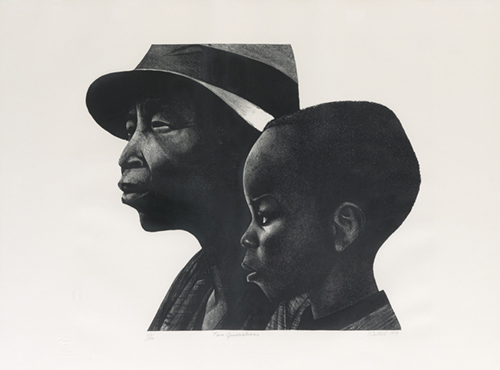
Elizabeth Catlett, “Two Generations,” 1979, lithograph, (c) Swann Auction Galleries 2015
A stunning highlight of the sale is a beautiful quilt by Faith Ringgold, who was commissioned by Oprah Winfrey to produce the piece for Angelou’s birthday in 1989. Titled “Maya’s Quilt of Life,” the piece consists of a central acrylic painting on canvas of Angelou as she strolls down a garden pathway. Two columns of text frame the central image as a gorgeous arrangement of triangular and diamond-shaped cuts of patterned fabric complete the quilt. Another feature is John Biggers’s “Kumasi Market” of 1962. As the work’s title indicates, the viewer finds the crowded scene of an African market. A hypnotizing rhythm of large reed hats dances across the center of the composition, taking the viewer on a journey from the left to the right side of the Masonite board. Graphic and illustrative in style, each figure is rendered individually, with masterful attention paid to the large and small. Further, the arrangement of yellow, brown, and red hues imparts a warm luminescence to the piece.
To learn more, visit Swann Auction Galleries.
This article was featured in Fine Art Today, a weekly e-newsletter from Fine Art Connoisseur magazine. To start receiving Fine Art Today for free, click here.
Featured Lot: Giulio Cesare Procaccini, “Sacrifice of Isaac”
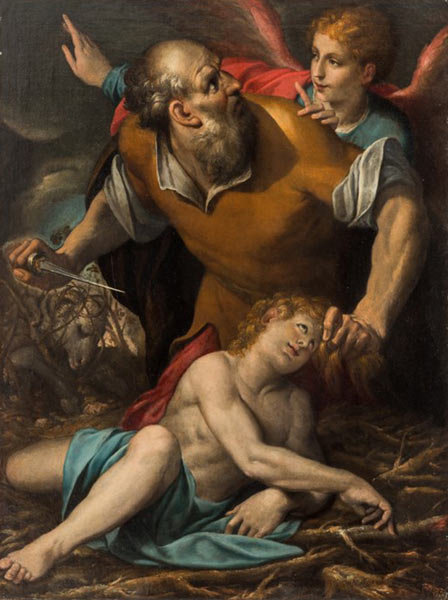
In this ongoing series for Fine Art Today, we take a longer look at the history and features of a soon-to-be-available artwork of note. This week: Giulio Cesare Procaccini, “Sacrifice of Isaac.”
Like so many artists of the Renaissance and beyond, Giulio Cesare Procaccini (1574-1625) was born into an artistic family. His father, Ercole the Elder, was a former student of Annibale Carracci and founded the Academy of the Procaccini, which trained many Milanese painters after about 1590. Even so, Giulio began his artistic career as a sculptor before turning to painting.
Between 1613 and 1616, Procaccini worked in Modena, where the influence of his father — and thus Carracci — gave way to the extreme sfumato championed by Correggio and his pupils. The artist’s style continued to vacillate in the last years of his life as he began to take note of Peter Paul Rubens’s palette and expressiveness of figure. Some scholars have suggested that Procaccini’s fluctuations in style may have contributed toward his lack of notoriety. The Getty reports, “[Procaccini] employed the acid colors and tense, sophisticated draftsmanship typical of Mannerism as well as the theatrical effects, movement, and deep feeling that anticipate the Baroque.”
Featuring in the September 23 sale of Old Master and 19th-century paintings at Auctionata, Berlin, is one of Procaccini’s late oils, dated to 1620-1625. A popular subject, “The Sacrifice of Isaac” recounts the biblical story of God testing Abraham’s faith. Procaccini’s version of the scene is unique, spiraling from lower left through Isaac’s and Abraham’s shoulders and down through the dagger-bearing arm of Abraham, which points back toward the center. The fascinating composition seems typical of the Baroque, but the fully saturated oranges, reds, and blues of the characters’ clothing adheres to the older Mannerist tradition. Abraham himself is skillfully rendered, his tense arms, hands, and well-observed visage all indications of Procaccini’s skill.
“The Sacrifice of Isaac” will feature at noon ET on September 23, during Auctionata’s “Old Masters and 19th Century Paintings” sale. The painting has an auction estimate of €60,000 (~$67,000 USD).
To view the full catalogue, visit Auctionata.
This article was featured in Fine Art Today, a weekly e-newsletter from Fine Art Connoisseur magazine. To start receiving Fine Art Today for free, click here.
Ace-High

Cowboys, cattle, weary travelers, and Indians are some of the subjects encountered in a solo exhibition of Gary Lynn Roberts’s Western paintings.
Gary Lynn Roberts was born into a family with the artistic gene: His father, Joe Roberts, was the owner of a successful sign-painting business. “For as long as I can remember, all I ever wanted to do was be a painter,” Roberts recounts on his website. “My dad had been bitten by the same bug in his youth, but in the 1950s and ’60s, you couldn’t make enough money to support a family as a fine artist, so he built a sign-painting business while establishing his reputation as a Western painter.”
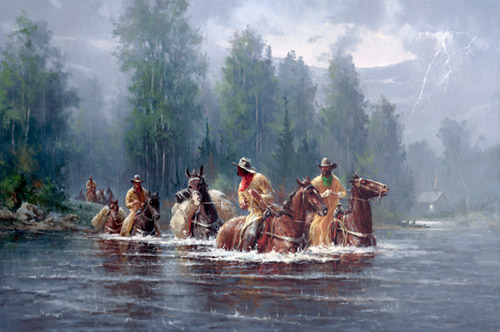
Gary Lynn Roberts, “Spooked,” oil, 24 x 36 in. (c) The Legacy Gallery 2015
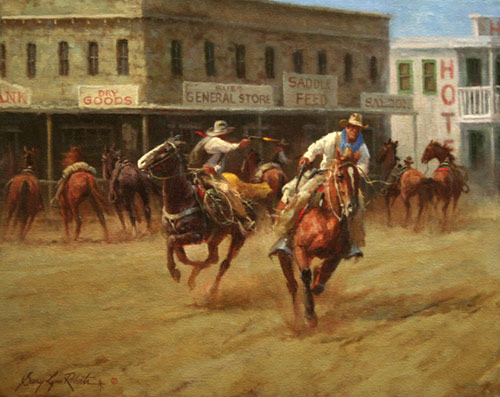
Gary Lynn Roberts, “Afternoon Gone Bad,” oil, 16 x 20 in. (c) The Legacy Gallery 2015
Growing up in the rural town of Channelview, Texas, and following in his father’s footsteps have proven to be all Roberts needed to launch a successful painting career — well, that and immense talent. Today Roberts is represented by a number of prominent galleries across the country, including The Legacy Gallery in Bozeman, Montana, which is hosting a solo exhibition of Roberts’s work beginning tomorrow, September 11.
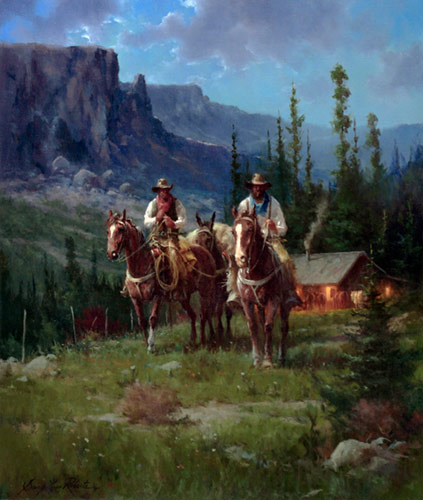
Gary Lynn Roberts, “Taking the Lead,” oil, 24 x 20 in. (c) The Legacy Gallery 2015
Featuring 10 paintings, the body of work is a virtuoso display of Roberts’s acute sense of composition, color, and narrative. Each painting seems to tell a silent story that has neither a beginning nor an end, existing in a timeless bygone space ripe with nostalgia. “A Cold Night Coming” is one such outstanding piece, representing a traveling group of three Native Americans on horseback in the final minutes of a winter sunset. With the aid of the title but more tangibly through the cool tones, one can nearly get chilled to the core viewing the piece. However, the waning glow of the sun burns like a fiery beacon in the picture, its intensity balancing the entire composition. The subjects bask in the warm light, soaking in the dying rays.
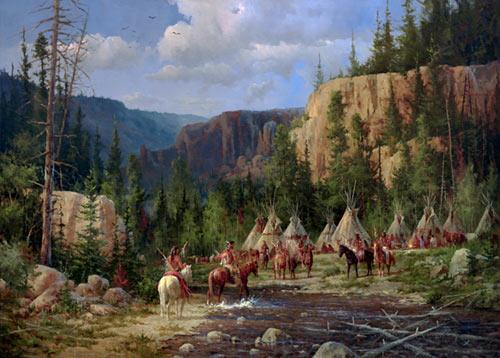
Gary Lynn Roberts, “The Return,” oil, 36 x 50 in. (c) The Legacy Gallery 2015
Another captivating tale is told in “Spooked.” Approaching the viewer from the center left of the canvas is a line of cowboys on horseback. Three men and five horses have begun their weary trek across a mountain river. A violent storm rages all around the travelers, the pouring rain captured in vivid clarity. The tension in the animals is palpable, with one of the lead horses struggling to keep its composure as a crack of lightning strikes in the upper right. Down river one can faintly discern the outlines of a cabin, the smoke rising from its chimney and a low glow emitted from a small window.
“Gary Lynn Roberts: One Man Show” opens on September 11 and will be on view through September 20. An artist reception and art walk will take place on the 11th between 6 and 8 p.m. at The Legacy Gallery.
To learn more, visit The Legacy Gallery.
This article was featured in Fine Art Today, a weekly e-newsletter from Fine Art Connoisseur magazine. To start receiving Fine Art Today for free, click here.
Fine Art Fair
One of the nation’s largest fine art fairs is taking place right now!
The Houston Fine Art Fair (HFAF) has grown so large that this year’s events will be based in the largest entertainment center in Texas: the NRG Center, a 350-acre complex that includes the NRG Center, NRG Arena, NRG Stadium, and NRG Astrodome. Collectors and art enthusiasts can expect to encounter all types of fine artworks from both national and international artists. This will be the fifth annual HFAF event, and the last four years have witnessed considerable growth. 2014 saw nearly 12,000 attendees combing through offerings from more than 80 highly respected galleries from around the country. In addition, HFAF 2014 generated millions of dollars in art sales from a number of international art deals.
HFAF 2015, which began yesterday, September 9, is expected to be even larger. A comprehensive list of the exhibitors can be found here, while a detailed list of all times and scheduled events can be found here.
This article was featured in Fine Art Today, a weekly e-newsletter from Fine Art Connoisseur magazine. To start receiving Fine Art Today for free, click here.