Home Blog Page 464

Issue: September-October 2015

1

Table of Contents


Subscribe to Fine Art Connoisseur magazine


Three to Watch


Discover the talents of Iliya Mirochnik, Kyle Sims, and Lori White.


Dean Mitchell: Realer than Real


By Nicholas Mancusi

Focusing on Fabrics

By Max Gillies

The Art Renewal Center Salon

By Kelly Compton

Great Art Nationwide

By Kelly Compton

Crossing the Hudson, & Eras

By Jason Rosenfeld

Southern Italy Comes to Park Avenue

By Marco Bertoli

Experiencing Georgia O’Keeffe’s New Mexico

By Peter Trippi

Art Thrives in South Central Texas

By Max Gillies

Malaga’s Thyssen: In Spain, A Different Thyssen Collection

By Micah Christensen

Odd Nerdrum Goes Global

By Peter Trippi
Frontispiece: Edouard Manet
Publisher’s Letter
Editor’s Note
Auction: James Whistler, by David Masello
Favorite: Anna Sui, by David Masello
Off the Walls
Classic Moment: Cody Erickson
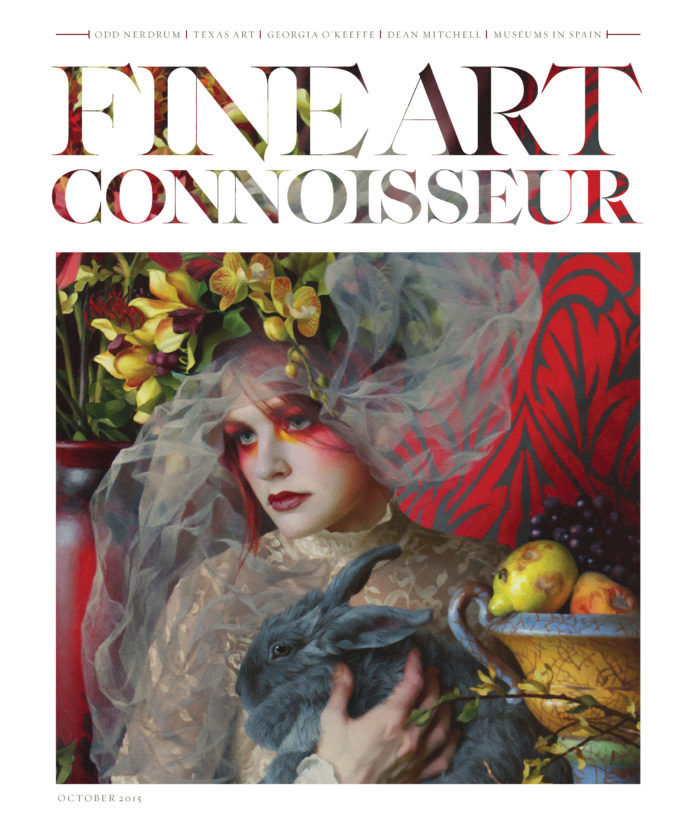
On the cover


Adrienne Stein (b. 1986)
La Fête Sauvage  (detail)
2014, acrylic on canvas, 48 x 24 in.
Recipient of the Art Renewal Center Purchase Award

August 31: Maritime Masters

0

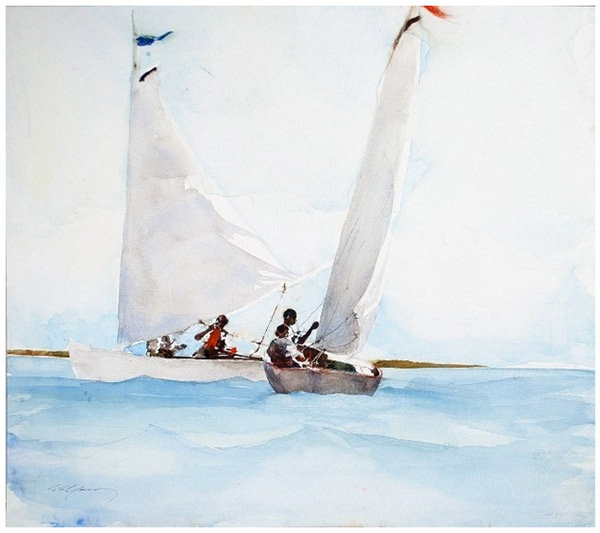
Cavalier Galleries has assembled a fine exhibition of Maritime and Nautical themed art that will interest both art appreciators and Maritime history buffs.  

Press Release: “A wonderful selection of fine art paintings, photographs, and sculpture have been brought together to create a compelling online exhibition that celebrates the beauty and nostalgia of Maritime history, classic ships and other things nautical.  The exhibition is on view for the months of July and August and all works are for sale.
 

“Cavalier Gallery is well known for its fine and extensive collection of contemporary Maritime art and this exhibition does not disappoint.  The show features over 50 works of art by some of the world’s best known Maritime modern masters, as well as some historic works.  Featured painters include Nicholas Berger, Anthony Blake, Donald Demers, Maarten Platje, Robert Stark, William Storck, John Terelak, Stephen Scott Young, Louis Guarnaccia, William Storck, Don Stone, and Li Xiao. 
 

“Additional work by sculptor Kent Ullberg, and photographer Michael Kahn compliment the show beautifully – and historical works by artists Elisha Taylor Baker (1827-1890), John Eastman (1824-1906), William John Huggins (1781-1845),  Hayley Lever (1876-1958), and Frederick Waugh (1861-1940) truly transport you to another time.  
 

““Maritime Masters” can be viewed online at www.cavaliergalleries.com between July 4th and August 31st.    Many of the works included in this online exhibition are also currently on view in our galleries. Please contact your preferred location for additional details or to schedule an appointment to view the work.”

To learn more, visit Cavalier Galleries.

Painted Faces and Tradition Reborn

0

Although Teresa Oaxaca is largely focused on perfecting her techniques and aesthetic, her body of work already demonstrates her immense talent, eclectic taste, and unreal potential.
 
Drawing heavily from past traditions and costume, the paintings of Teresa Oaxaca have both a modern flavor and a timeless aura that is truly captivating. “I am as ever concerned with capturing emotions and feelings and communicating those through my subjects,” writes Oaxaca. “I am interested in showing the beauty of the world around me and evoking a sense of joy, wonder, and seriousness.”
 
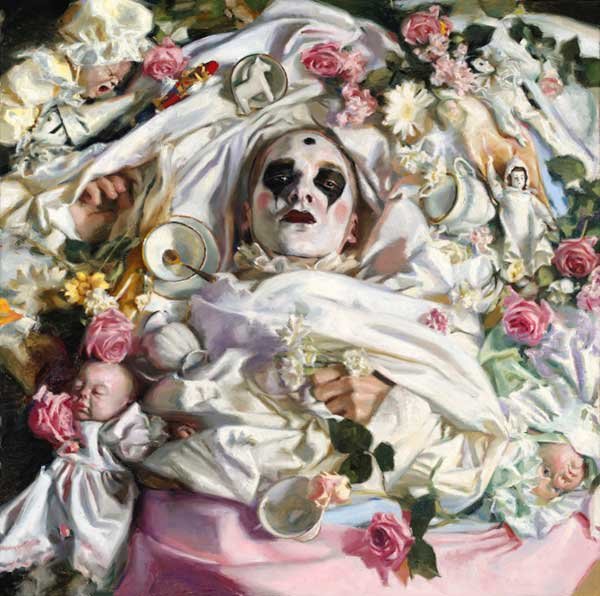
Joy, seriousness, and wonder are indeed apropos when considering “The Black Pierrot.” Among a sea of dolls, teacups, and flowers lies a pensive figure with face painted in white, with black around the eyes. The stoic figure looks out at the viewer with an intensity and power that nearly feels intrusive, as if they are peering into our deepest emotions. The rest of the figure is surrounded by an arrangement of colorful objects that appear to grow or exist organically.
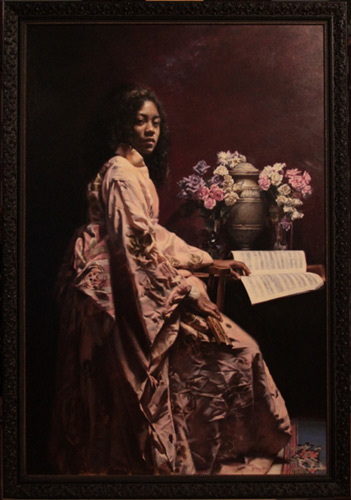


Teresa Oaxaca, “Kazumi,” oil on canvas, 45 x 66 in. (c) Teresa Oaxaca 2015

 
Oaxaca suggests, “Frequently my compositions are spontaneous. When a person comes to me, they occupy a space in my mind. Arrangements form from there until — with excitement — I see the idea I have. The design is both planned and subconscious. For this reason I surround myself with Victorian and Baroque costume, bones, and other things which I find fascinating — I want subject matter to always be at hand.”
 
While some might find Oaxaca’s use of Victorian and Baroque costume, along with clown-like facial paint, unusual, Oaxaca sees it as part of an established tradition. She suggests, “I was mentored in the 19th-century tradition of art, a period which looked back and leaned heavily upon the past. The artistic ideal then was not to reinvent the wheel every day or to deconstruct, but to add to the culture. The dead, as it were, had a very real impact on the present. I like to think that my interest in wigs and costuming of other eras is part of that tradition.”
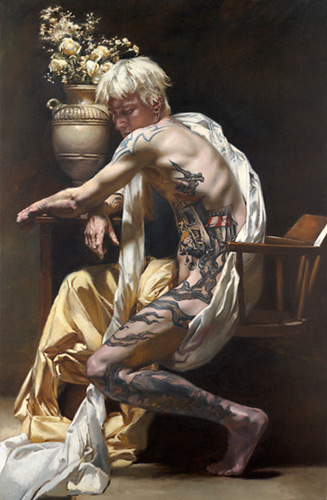


Teresa Oaxaca, “Patrick,” oil on canvas, (c) Teresa Oaxaca 2015

 
Recently, Oaxaca has pushed herself to “stay fit” with her drawing skills. “The drawings stand on their own and serve to loosen my hand and give my eye a rest from a long painting project,” she says. “I draw and paint to make finished works. I like to alternate between the two.” In fact, so skilled is Oaxaca with her drawing that the artist has established regular workshops around the country focused on improving techniques with charcoal and portraiture.
 
Oaxaca’s prowess in portraiture extends into paint as well. “Kazumi” is an exceptional example of the artist’s outstanding talent in this time-honored genre. Presented in seated full length is a stoic African-American sitter. Lit from directly above, the picture is dominated by the lavish kimono robe adorning the subject. Oaxaca’s ability to capture the light as it falls on the silky texture is absolutely stunning. Every fold, wrinkle, and stitch is captured with acute observation. While the robe occupies a large portion of the picture, the face of the sitter is magnetic as well — her confidence and naturalistic visage radiate from the surface. Next to the subject sits a table with vase and floral arrangement, which also serves as evidence that Oaxaca is well versed in still life.
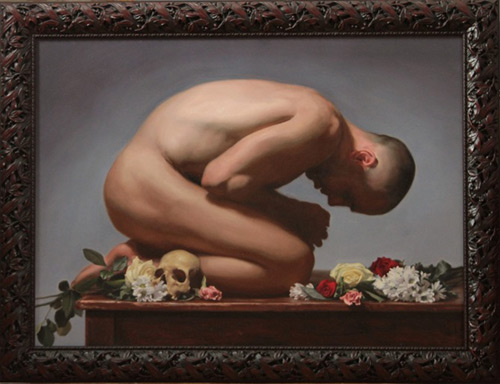


Teresa Oaxaca, “Remembrance,” oil on canvas, 32 x 44 in. (c) Teresa Oaxaca 2015

 
Opportunities to meet and learn from Oaxaca are numerous and feature all across the country, with room still available in many. To learn more about Oaxaca’s workshops, visit here.
 
To learn more, visit Teresa Oaxaca.
 
This article was featured in Fine Art Today, a weekly e-newsletter from Fine Art Connoisseur magazine. To start receiving Fine Art Today for free, click here.

 

Covered with Love

0

Michael Pearce probes our deepest emotional connections with one another through his magnificent figural paintings.
 
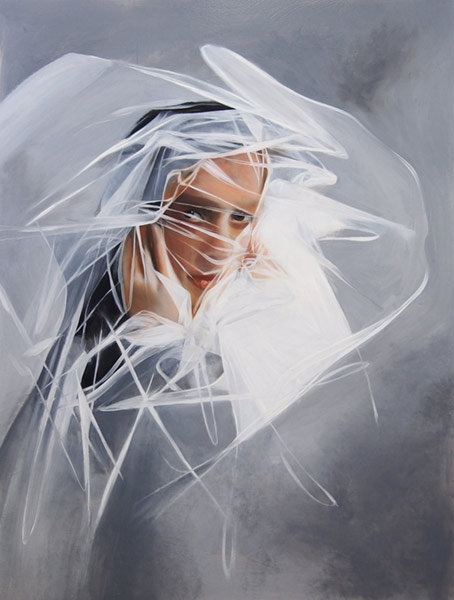
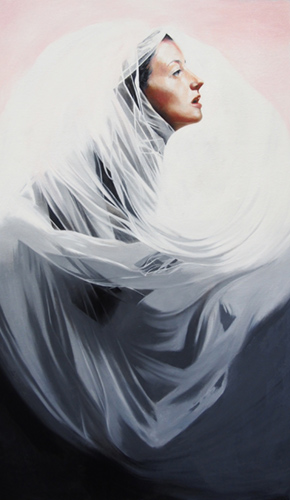
Renowned painter and chair of The Representational Art Conference Michael Pearce has put together an outstanding solo exhibition at Blackboard Gallery in Camarillo, California. Titled “Love,” the show will feature a number of Pearce’s paintings that give a visual language to “the feeling you get when you love,” as he writes. “They [the paintings] emphasize the fragile unity of mind meeting mind.”


Michael Pearce, “Half a Kiss,” oil on canvas, (c) Blackboard Gallery 2015

 
“Cloud Nine” is a beautifully entrancing image of a female subject engulfed in a patterned arrangement of white lines and shades that recall fabric. With only her head in view, the sitter’s gaze — which meets ours — and subtle expression seem pregnant with a compelling, yet unknown, narrative. Pearce has also created a fascinating dichotomy between the naturalistic and masterfully colored figure and the unfurnished, abstracted space she inhabits.
 
“Half a Kiss” displays similar characteristics. Imaged in three-quarter view is a female subject in profile, wrapped tightly in a luminous white-and-gray fabric. Her mouth slightly ajar, she appears to call out and long for someone or something outside of the frame. Blackboard Gallery reports that, “Much of Pearce’s art is figurative and allegorical. He uses oil paint to transform canvases into stories that embrace the magic and romance of an earlier era. He uses conceptual themes that capture his audience by encouraging their individual imaginative interpretation of the events he has painted. There’s meaning here — a reconstruction of ideas bigger than self — that makes these paintings feel greater than their already large size.”
 
“Love” opens on September 3 and will be on view through September 25. An opening reception will take place on September 5 at 4 p.m. Pacific.
 
To learn more, visit Blackboard Gallery.
 
This article was featured in Fine Art Today, a weekly e-newsletter from Fine Art Connoisseur magazine. To start receiving Fine Art Today for free, click here.

 

Born from Fire

0

Built largely around the treasured tea ceremony, pottery is a long-established tradition in Japan. The Indianapolis Museum of Art is showing a profound exhibition that explores the interface between historical tradition and modern innovation in ceramics produced by living masters.
 
With some potters self-taught and others part of an established pottery-making family spanning 11 generations, the Indianapolis Museum of Art has much to offer during “Tradition Reborn: Contemporary Japanese Ceramics.” Seven potters, many of whom are categorized as “Living National Treasures,” are featured in the show. Their designation is in recognition of their mastery of skills that are deemed to be of significant historic and cultural value.
 
Of particular focus in the exhibition are functional wares rather than abstracted or sculptural work. Their utility does not detract from their aesthetic beauty, as each object in the exhibition is an exquisite work of fine art. The focus on function is curator John Teramoto’s way of “emphasizing the historical roots” of the ceramic tradition in Japan. Teramoto also suggested, “Although it is wonderful to exhibit the work of potters designated as Living National Treasures, all the ceramics in this exhibition will continue to stand on their own merits as masterworks even if their makers’ names were to be lost. Just as historical works regarded as masterpieces today were ‘contemporary’ at the time of their creation, I firmly believe these works will also stand the test of time.”


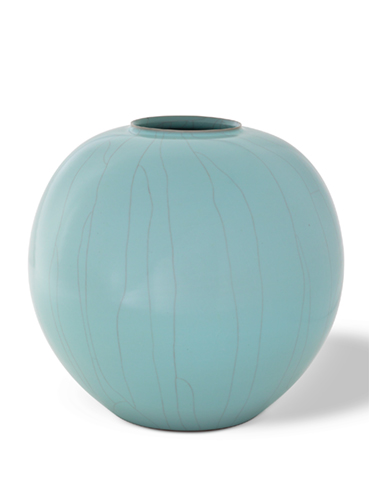
Suzuki Sansei, “Celadon Globular Jar,” ca. 1990–1995, stoneware with crackled powder blue celadon glaze,
14.5 x 15 in. (c) Indianapolis Museum of Art 2015

 
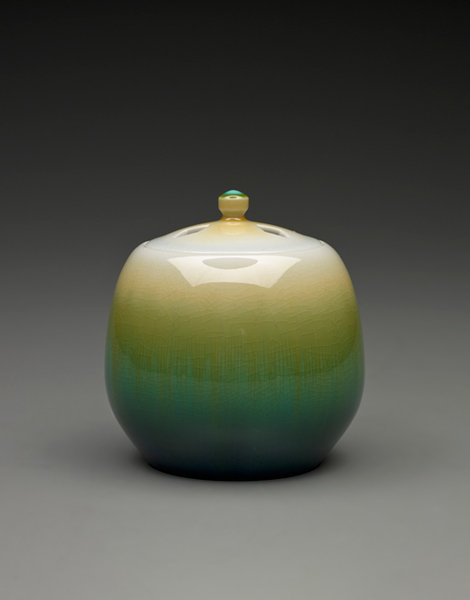
A stunning highlight from the exhibition of 25 objects is Tokuda Yasokichi IV’s “Saiyu Censer” from 2002. This beautiful jar displays a fullness of form that is elegant in its simplicity. Yasokichi has given the vessel, slightly plump toward the bottom, just enough lift on the foot, allowing the piece to hover softly. Upon close inspection, one can appreciate the translucent polychrome glaze, which is illuminated by the brilliant white porcelain clay body beneath. The glaze itself begins at the top of the body as a soft white before graduating to yellow at the shoulder then transitioning to an exquisite green and deep royal blue at the bottom. This graduation of color is reversed on the lid of the vessel, which also displays cut holes.
 
“Tradition Reborn: Contemporary Japanese Ceramics” opened on July 31 and will show through July 17, 2016.
 
To learn more, visit the Indianapolis Museum of Art.  
 
This article was featured in Fine Art Today, a weekly e-newsletter from Fine Art Connoisseur magazine. To start receiving Fine Art Today for free, click here.
 

Midday Theft

0

Danish police are still searching for two men who walked out of a Copenhagen museum in broad daylight with a bronze bust worth $300,000.
 
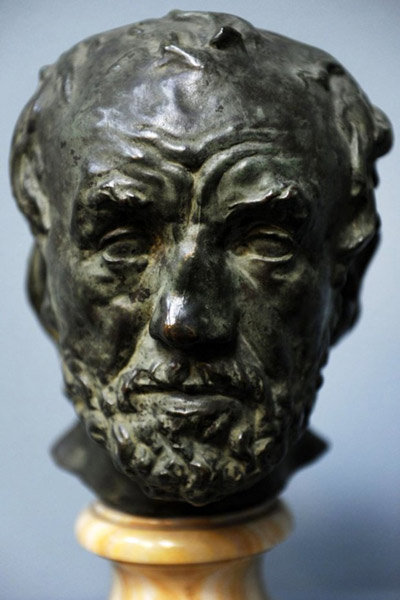
With modern technology and security advances, it’s hard to believe that anyone could get away with stealing valuable art from a museum, let alone during the middle of the day. Unfortunately, that’s what Danish police are dealing with after two men disguised as tourists walked off with a bronze bust by famed 19th-century sculptor Auguste Rodin worth an estimated $300,000. Police believe the heist — which took 12 minutes to pull off — was a carefully orchestrated scheme that began several days before, when the two men somehow disabled security features on the sculpture. Returning, the men slipped the bust into a bag and calmly walked out of the Ny Carlsberg Glyptotek Museum’s front doors. The brazen act, along with the relative ease with which it was executed, seems unthinkable and will no doubt force this museum and others to rethink how their holdings are secured.
 
The bust, dating from 1863 and titled “The Man with the Broken Nose,” is relatively small at 10 inches tall and portrays the head of an elderly Parisian workman. A marble version exists in the Musée Rodin in Paris.
 
To learn more, visit artnet.
 
This article was featured in Fine Art Today, a weekly e-newsletter from Fine Art Connoisseur magazine. To start receiving Fine Art Today for free, click here.
 

Guest of Honor

0

A previously unknown self-portrait by Rembrandt has been welcomed with open arms for a temporary exhibition.
 
Although Rembrandt painted and etched hundreds of self-portraits over his career, every one is held in the highest regard. Apparently, Rembrandt painted so many self-portraits that his pupils recycled at least one of them for their own uses. That is the story experts uncovered in 1995, when X-rays revealed that a lovely self-portrait by the master had lain undetected for nearly three centuries underneath a painting by his students.
 
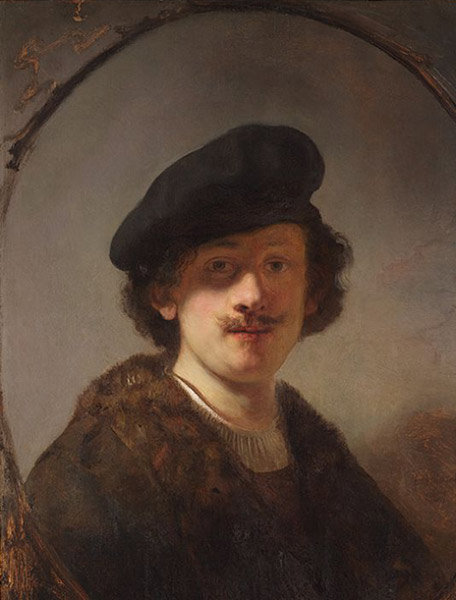
After its discovery, “Self-Portrait with Shaded Eyes” was quickly restored and has established its place among the many other records of the artist’s visage. In the painting, we find a 28-year-old Rembrandt, complete with a stylish mustache and fur coat, and boasting a beret. His cap shields most of his face from the light source in the upper left, leaving him in shadow.
 
Visitors to Detroit have only a few more months to view the self-portrait along with three other Rembrandt originals — “The Weeping Woman,” “The Visitation,” and “Titus” —at the Detroit Institute of Arts. The museum reports that, “Rembrandt started painting self-portraits in the late 1620s and tended to portray himself wearing berets, fanciful costumes and accessories. His self-portraits stand out from those of other artists because of his endless variety and creativity. Although he painted the same subject 40 times, no two self-portraits look quite alike.”
 
“Rembrandt: Guest of Honor” will be on view through December 13.
 
To learn more, visit the Detroit Institute of Arts.
 
This article was featured in Fine Art Today, a weekly e-newsletter from Fine Art Connoisseur magazine. To start receiving Fine Art Today for free, click here.
 

Landing Legends

0

Two major donations highlight an exciting August for the New-York Historical Society.
 
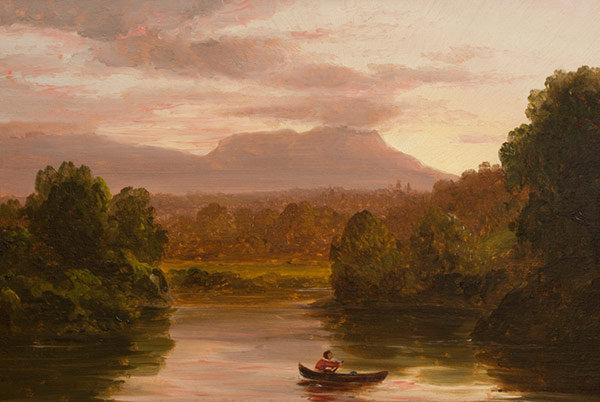
Adding to its already stellar collection of Hudson River School paintings, the New-York Historical Society announced that it has received 15 paintings from the late Arthur and Eileen Newman. The gift includes works by Thomas Cole, Frederic Edwin Church, and Martin Johnson Heade.
 
Senior art historian and museum director emerita Dr. Linda S. Ferber remarked, “My first visit to see these wonderful Hudson River School paintings at the Newmans’ apartment brought the thrilling realization that the ‘fit’ of their collection and New-York Historical Society’s holdings was truly uncanny. The core of N-YHS’ Hudson River School collection came from the landmark holdings of two great 19th-century New York collectors: Luman Reed and Robert L. Stuart. The 21st-century gift of the Newman Family Collection, formed in recent decades with such dedication and thoughtfulness, brings our historic collections to a new breadth and strength, offering fresh opportunities to foster scholarship and to mount exhibitions that will share the enduring legacy of the Hudson River School’s vision of America with visitors.”


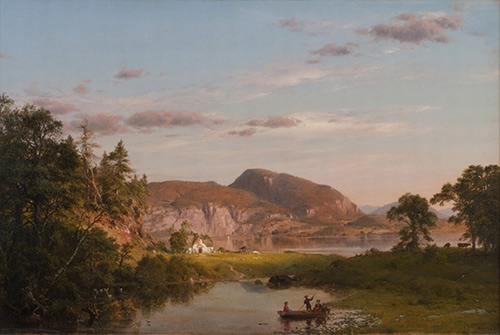
Frederic Edwin Church, “Home by the Lake,” ca. 1852, oil on canvas, (c) New-York Historical Society 2015

 
The organization won’t wait long, as a preview of selected paintings from the Newman collection begins on August 28. Thomas Cole’s “On Catskill Creek, Sunset” from 1845 is a delightful picture of one of the artist’s favorite places to paint. “Home by the Lake” by Frederic Edwin Church is a similar scene, displaying a soft golden light as it fades and blankets a quintessential Hudson River School pastoral scene.
 
To learn more, visit the New-York Historical Society.
 
This article was featured in Fine Art Today, a weekly e-newsletter from Fine Art Connoisseur magazine. To start receiving Fine Art Today for free, click here.
 

“Traveling Exhibition” Gets New Meaning

0

Every summer, millions of Americans pack their bags, unplug, and hit the road to enjoy the country’s most coveted parks and landscapes. California is a frequent destination, with everything from towering mountains to sun-bathed beaches.
 
Giant Sequoias, Yosemite National Park, and the Pacific Coast Highway are only a few of the gorgeous locations and things that keep individuals coming back time and again to California. Many of those who travel California are skilled artists, who record in their own ways the sights, sounds, and moods they experience. “A Toast to California: Regional and Seasonal” is an outstanding exhibition that seeks to celebrate the works of artists who have traveled behind the wheel to record California’s coveted views.


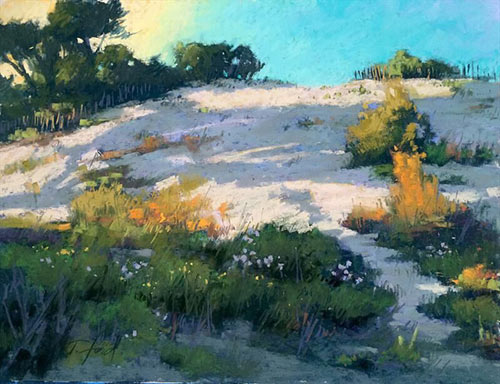
Terri Ford, “Dune Shadows,” soft pastel, 12 x 16 in. (c) California Art Club 2015


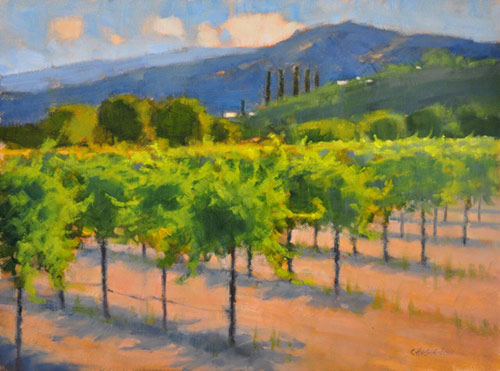
Carolyn Hesse-Low, “California Vineyard,” oil, 9 x 12 in. (c) California Art Club 2015

 
The exhibition will feature nearly 40 works with subjects ranging from vineyards and fruit stands to panoramic landscapes with flowers and foliage that document the shifting seasons. “Agriculture is central to life in California, as the state supplies many healthy and desirable foods to not only the nation, but the world, and with ‘A Toast to California’ we pay tribute to this important aspect of California living,” says Madeleine Aguilar, exhibitions coordinator for the California Art Club.


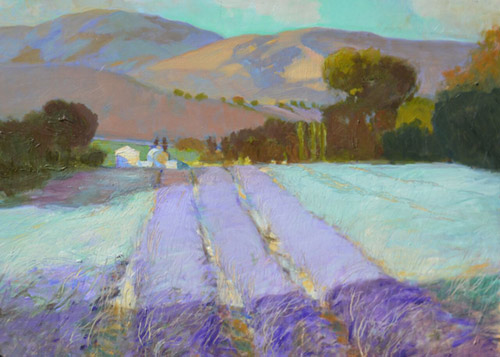
Chuck Kovacic, “Lavender Fields at Beaumont,” oil, 18 x 12 in. (c) California Art Club 2015
 

All of the exhibiting artists, who include — among others — Esther Engelman and Chuck Kovacic, are members of the California Art Club, which has been in existence for nearly a century and is one of the nation’s oldest, largest, and most active fine arts organizations.


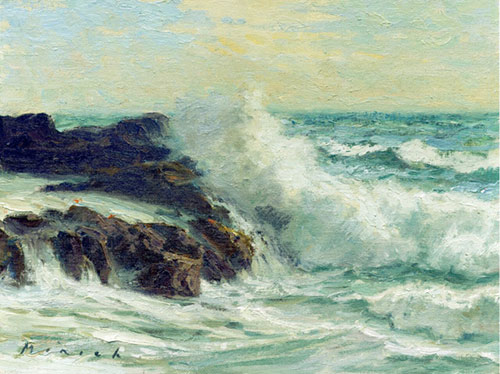
Stephen Mirich, “Golden Coast Splendor,” oil, 9 x 12 in. (c) California Art Club 2015

 
“A Toast to California: Regional and Seasonal” opens on September 1 and will hang through January 10.
 
To learn more, visit the California Art Club.  
 
This article was featured in Fine Art Today, a weekly e-newsletter from Fine Art Connoisseur magazine. To start receiving Fine Art Today for free, click here.
 

In Awe of Adornment

0

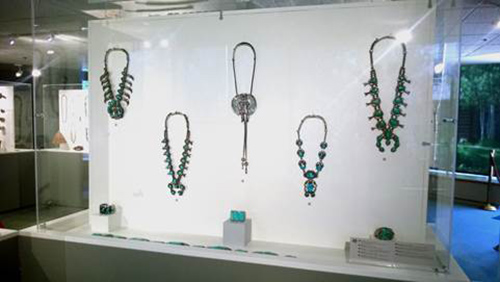
Expose yourself to the wonders of Native American artistry with an exhibition that features exquisite jewelry.
 
We all love to place art on our walls, shelves, and tables to beautify and embellish spaces we frequent. However, art that can be used to beautify us seldom receives the attention it deserves, leaving few to appreciate the subtle designs, attention to detail, and artistry involved in its fabrication. The Buffalo Bill Center of the West in Wyoming is looking to expose the amazing efforts of Native American jewelers through a current exhibition that features hundreds of objects, ranging from bracelets and necklaces to rings and pins.


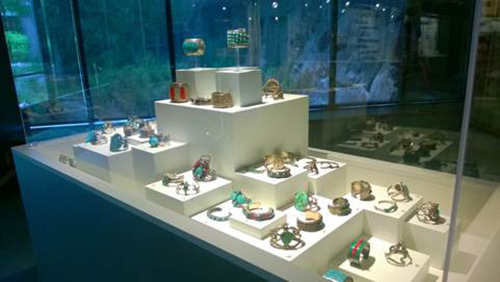
A case featuring numerous bracelets

 
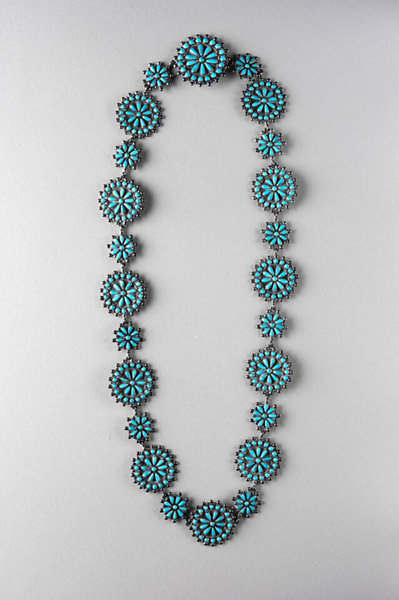
Curated by Donna Poulton, the exhibition — in addition to placing the work on public view — is displayed masterfully, with some objects expertly hung to allow full 360-degree views. All the works, but particularly a silver and turquoise belt from the 1940s, are absolutely stunning. The belt has a mesmerizing rhythm to its design, which alternates between large and small floral motifs. The exhibition also serves as evidence of the growing appreciation of Native American jewelry. In fact, major designers such as Ralph Lauren and Donna Karan, and the stylists for Vogue magazine, have borrowed from or been inspired by the style.


A few of the beautiful necklaces on display

 
“Adornment in the West: The American Indian as Artist” is currently on view and will be on view through October 16.
 
To learn more, visit the Buffalo Bill Center of the West.
 
This article was featured in Fine Art Today, a weekly e-newsletter from Fine Art Connoisseur magazine. To start receiving Fine Art Today for free, click here.
 

WEEKLY NEWS FROM THE ART WORLD

Fill your mind with useful art stories, the latest trends, upcoming art shows, top artists, and more. Subscribe to Fine Art Today, from the publishers of Fine Art Connoisseur magazine.

  • This field is for validation purposes and should be left unchanged.