As part of our effort to continue to help artists and art galleries thrive, we’re proud to bring you this week’s “Virtual Gallery Walk.” Browse the artwork below and click the image itself to learn more about it, including how to contact the gallery.
Want to see your gallery featured in an upcoming Virtual Gallery Walk? Contact us at [email protected] to advertise today. Don’t delay, as spaces are first come, first served, and availability is limited.
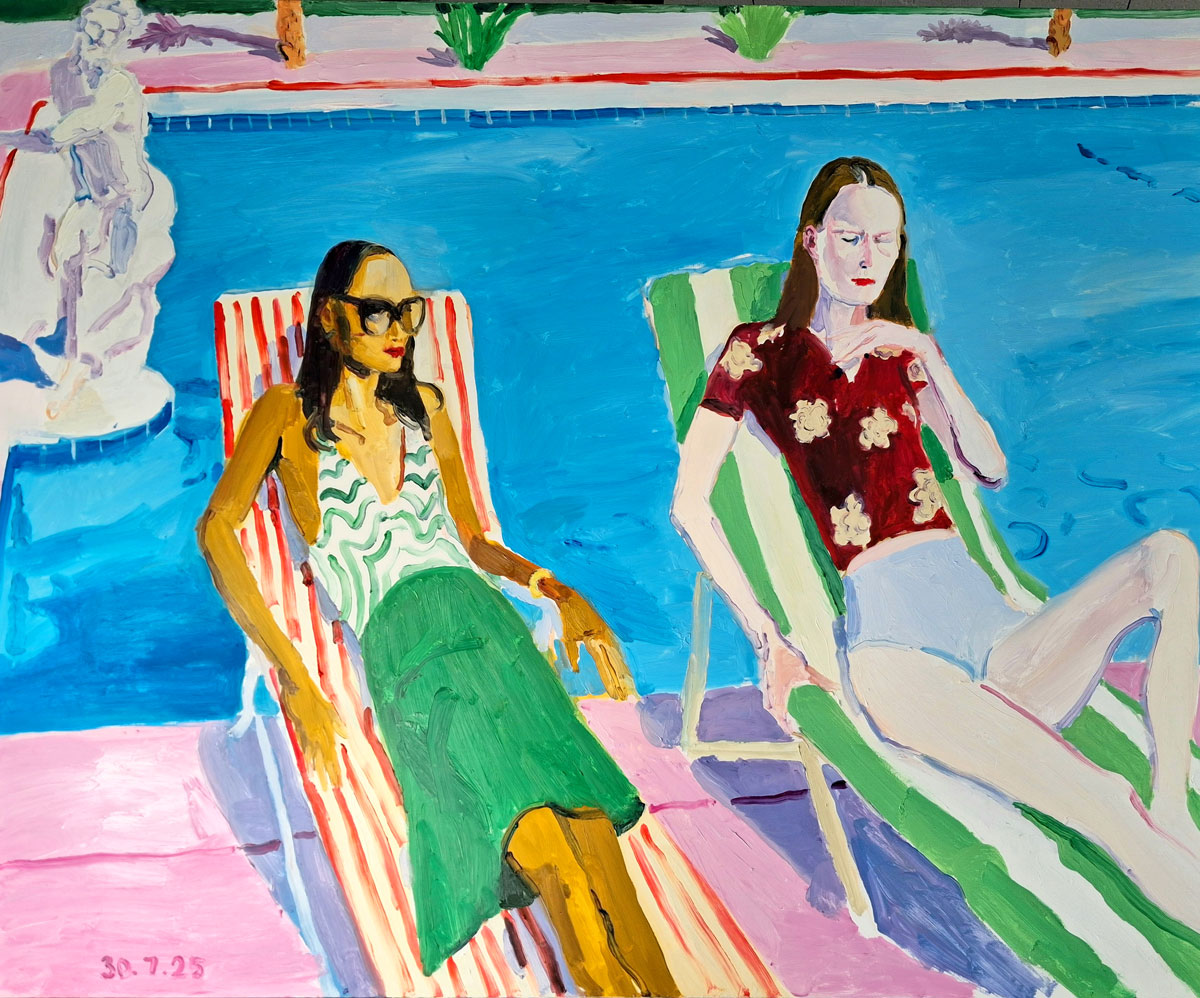
Xevi Solà, "Dimanche 2," 2025, oil on canvas, 51.2 x 63.8 in | 130 x 162 cm
Contemporary figurative art / narrative paintings on view >>>
“If I had to define this series, I would say it’s a kind of collective psychological portrait,” said Xevi Solà. “These figures are trying to relax in a bright and colorful environment, but gray clouds lurk behind their sunglasses.”
Exhibition Detail at a Glance:
“Xevi Solà: Endless Sun-Days”
Opera Gallery
New York, New York
February 12 – March 7, 2026 operagallery.com
Xevi Solà, “Dimanche 4,” 2025, oil on canvas, 51.2 x 63.8 in | 130 x 162 cm
From the gallery:
Influenced by fashion photography, film stills, and mugshots, Solà creates portraits with a cinematic dimension and suggestive storytelling. “As a child,” he says, “I was very much a homebody, and my source of inspiration for landscapes was cinema.”
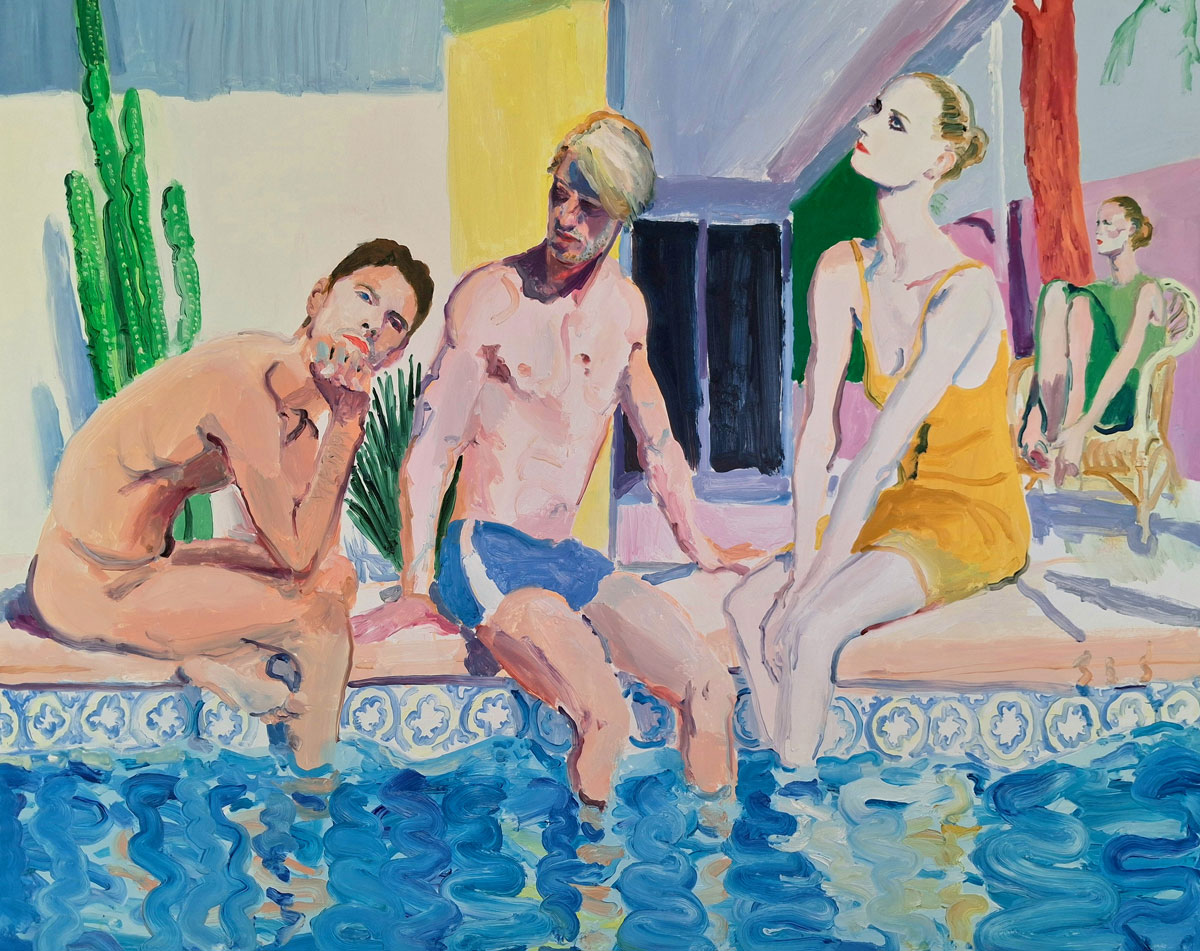
Xevi Solà, “Dimanche 1,” 2025, oil on canvas, 51.2 x 63.8 in | 130 x 162 cm
In “Dimanche 1,” four figures sit by a pool, lost in silent contemplation, time seemingly suspended. While echoes of David Hockney’s iconic pool scenes can be perceived, Solà’s incisive, contemporary, and psychologically charged approach lends this moment a unique authenticity.
One can cite, for example, the glamour and tension of Mid-century French Riviera cinema, which Solà’s paintings evoke, particularly the psychological atmosphere of the 1969 film La Piscine (The Swimming Pool), in which Alain Delon, Romy Schneider, Maurice Ronet, and Jane Birkin grapple with latent desire and jealousy during a summer in the South of France. The leisurely ideal and mid-20th-century elegance of Slim Aarons’s Poolside Gossip series find a similar resonance in Solà’s compositions, which are both familiar and dreamlike.
Xevi Solà, “Dimanche 3,” 2025, oil on canvas, 51.2 x 63.8 in | 130 x 162 cm
Working from spontaneous, single-stroke sketches, Solà paints quickly to preserve the immediacy and spontaneity of his creative process, thus placing his practice in the lineage of contemporary figurative painters such as Alice Neel, Lucian Freud, Alex Katz, Chantal Joffe, and Elizabeth Peyton.
Presented together, the works in ‘Endless Sun-days’ read like an intimate, colorful, and cinematic visual diary. Viewers are invited to enter Solà’s suspended summer world and imagine the stories unfolding just beyond the frame.
Xevi Solà (b. 1969) is a Spanish painter who lives and works in Girona, Spain. He was born in Santa Coloma de Farners in Catalonia and he graduated from the Faculty of Fine Arts at the University of Barcelona in 2007. He has exhibited widely in galleries and museums across Europe, the United States, and Asia, including solo exhibitions at Voltz Clarke Gallery in New York, Alzueta Gallery in Barcelona, the Cuperior Collection and YIRI ARTS in Taipei. In 2024, he had his first solo exhibition with Opera Gallery at their Geneva, Switzerland location.
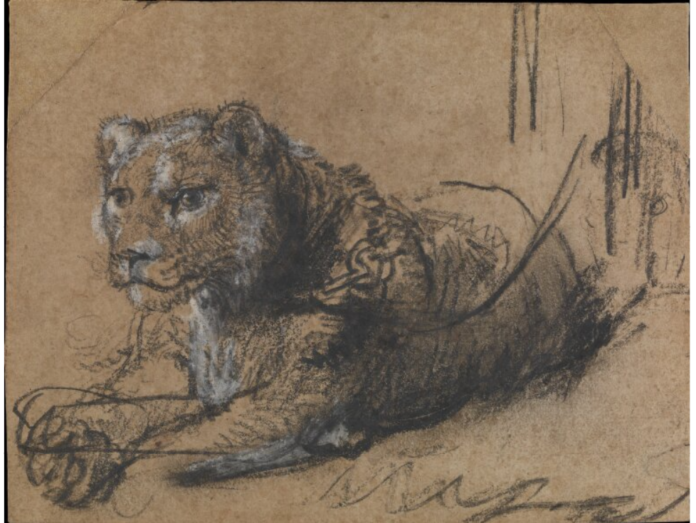
Rembrandt van Rijn, "Young Lion Resting," ca. 1638-42, black chalk, white chalk heightening, and gray wash, on brown laid paper, 11.5 x 15 cm; Image courtesy The Leiden Collection
The Leiden Collection and Panthera today are celebrating the landmark sale of Rembrandt van Rijn’s “Young Lion Resting” for $17,860,000 at Sotheby’s “Master Works on Paper from Five Centuries” auction in New York.
More from Sotheby’s:
This historic event represents a “full-circle” moment for the masterpiece — originally the first work of art by Rembrandt acquired by Dr. Thomas S. Kaplan and his wife Daphne Recanati Kaplan, all proceeds from its sale will be donated to Panthera and employed to secure the future of the very species the drawing so vividly depicts.
Panthera was co-founded in 2006 by the Kaplans and the late renowned wildlife biologist Dr. Alan Rabinowitz. Now chaired by the drawing’s co-owner, philanthropist and wild cat conservationist Jon Ayers, it is the only organization of its kind exclusively devoted to the protection of the world’s 40 species of wild cats and their ecosystems.
Celebrating its 20th Anniversary this year, Panthera will use the funds generated to support science-directed initiatives fostering human-wild cat coexistence and critical landscapes protection in some 40 countries across four continents. The organization’s proven conservation models and award-winning programs will be scaled globally, rooted in local partnerships and traditional knowledge, and implemented to combat wild cats’ greatest threats — from poaching for the illegal wildlife trade and conflict with communities to habitat loss.
Dr. Thomas S. Kaplan, co-founder of both The Leiden Collection and Panthera, said: “To see this masterpiece, which began our journey with collecting Rembrandt some twenty years ago, now provide the resources to protect big cats around the world is a deeply moving moment of symmetry for us. Uniting art and wildlife, this sale marking the 20th Anniversary of Panthera was meant to transform cultural heritage into conservation action. Its incredibly successful outcome evinces both the enduring power of the Master and the crucial importance of safeguarding biodiversity for future generations.”
“The pulse of life that Rembrandt captured in this lion’s gaze continues to beat today through our conservation field programs,” said Jon Ayers, Board Chair of Panthera and co-owner of the work. “This sale provides Panthera with critical resources to combat poaching and habitat loss globally, ensuring that the majesty Rembrandt admired in the 17th century survives well into the 21st and beyond.”
Prior to auction, Panthera, The Leiden Collection, and Sotheby’s unveiled “Young Lion Vanished” as a visual warning and a statement in conservation — replacing Rembrandt’s lion with empty space to reflect the accelerating loss of lions across Africa. While lions have undergone a catastrophic range reduction of 95 percent over the last century, with only about 24,000 lions remaining, down from an estimated 200,000, Panthera’s recent, replicable success stories have demonstrated that the recovery of lion populations is possible.
“Young Lion Resting” encapsulates Rembrandt’s preternatural skill as a draftsman. To convey the animal’s languid power, he juxtaposed loose, confident strokes, seen in the modeling of the lion’s paws, with the controlled shading that brings its gaze to life. The sheet is also an incredible rarity. Only six drawings of lions by Rembrandt are currently known, with two being held at the British Museum and one in each of the collections of the Louvre in Paris, the Rijksmuseum in Amsterdam and the Museum Boijmans Van Beuningen in Rotterdam. “Young Lion Resting” is also the first to come to the market in a century. The $17.9 million result places this exquisite work among the most significant Old Master drawings ever sold at auction and sets a new record for a drawing by Rembrandt, surpassing the artist’s previous auction record for a work on paper of $3.7 million in 2000.
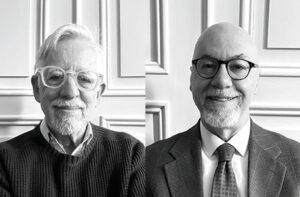
Jack Esterson AIA and Hon. Richard Montelione of Brooklyn have collected art throughout their 40 years together. Now the co-founder and principal of Think! Architecture & Design, Esterson declares that “Art has always been in my DNA.” As a young artist from Syracuse, he was lured by the irresistible pull of New York City, and while studying architecture at Brooklyn’s Pratt Institute found himself surrounded by artists, designers, and art historians. “I had no money to collect,” he recalls, “so I made art and bartered with my artist friends.”
Art collectors Jack Esterson and Richard Montelione
Esterson continues, “What I had learned rubbed off on Rich, who is a brilliant legal intellect [in fact, the native New Yorker is now a State Supreme Court judge] but once lacked self-confidence in assessing art. Today, after four decades of visiting galleries, museums, and fairs — not to mention deep immersion in a creative community — Rich has definitely found a wide frame of references for experiencing art in all its modalities.”
As time went on, the couple started collecting from the many artists working in the lively Brooklyn neighborhoods of Fort Greene and Clinton Hill, as well as ones associated with Pratt Institute. “Sadly,” Esterson notes, “most of them have passed away, left the area, or been priced out, and that has dramatically affected how and what we acquire now.”
Esterson still has the bug, though: “When asked what I want for Christmas or a birthday, I always reply ‘Art, please.’ Rich says there is no more wall space, but this does not deter me. We rearrange.”
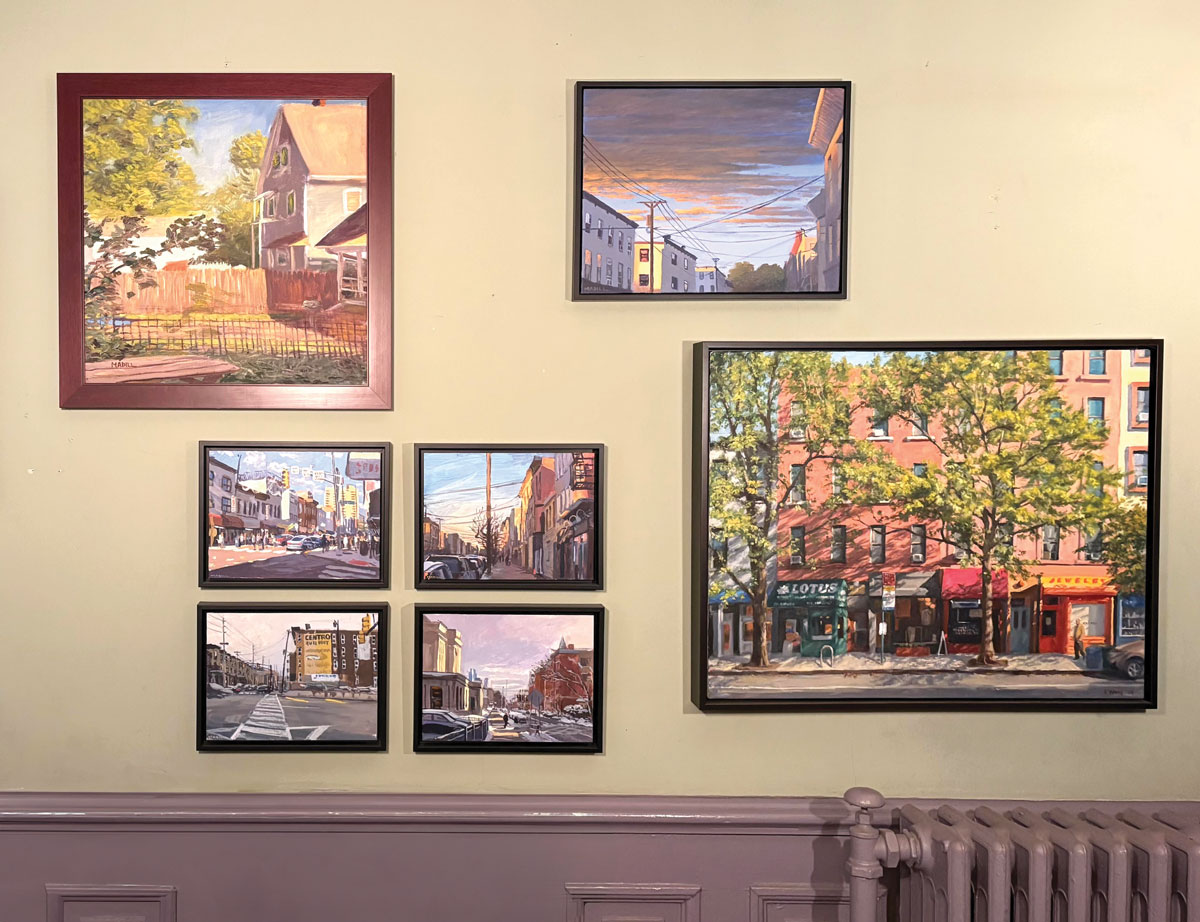
The large painting at right was painted by Ella Yang, and the others by Doug Madill.
Hundreds of artworks adorn the couple’s three locations — a 19th-century Brooklyn brownstone, a 200-year-old farmhouse in Columbia County (three hours north of New York City), and Montelione’s three-room judicial chambers. The collection ranges widely in date and media. The oldest pieces are 19th-century American and British landscapes, which look at home in the historic rooms of the renovated farmhouse upstate. Displayed throughout the Brooklyn house are WPA-era prints and an array of abstract paintings and collages dating from the 1950s through the Hip Hop era. Esterson’s own drawings and paintings also adorn these walls. He has designed some of the homes’ furniture, and at one point he caught what he laughingly calls GPS (Gay Pottery Syndrome), which has resulted in a plethora of studio ceramics, mostly American and European, plus the occasional piece of Arts & Crafts metalwork.
Confident that the contrast of great modernism and great classicism creates a compelling visual experience, Esterson has arranged most of the figurative work on the brownstone’s garden level, which contains Arts & Crafts furniture brought to Brooklyn from a now-sold summer cabin in Woodstock. The modernist pieces are concentrated on the parlor floor, with its grand scale and classical detailing.
Robert Goldstrom (b. 1952), “7:25 a.m.,” 2017, oil on linen, 33 x 22 in.
Esterson and Montelione are proud to own paintings by Audrey Frank Anastasi, Sandra Jones Campbell, Sarah Hall, Susan Rowland, J.D. Siazon, and Lois Silver; collages by Keith Maddy; and sculpture by Woody Pantilla. Pride of place, however, is given to a triumvirate of gifted painters who offer what Esterson calls “an intimate take on urban documentation”: Robert Goldstrom and Ella Yang of Brooklyn, and Doug Madill of Jersey City. The couple own at least 30 Goldstrom views of the distinctively shaped tower of downtown Brooklyn’s Williamsburgh Savings Bank, which many locals still use as a landmark while moving around the borough. Esterson is particularly fond of Goldstrom’s studies and drawings, admitting “they are like an addiction for me; I just cannot resist them.” Also here is a variety of Goldstrom’s male nudes, usually shown as portions of the body rather than in full.
Another star in the collection is Esterson and Montelione’s close friend Harvey Wilson, who arrived at Pratt in 1957 and has remained in Brooklyn ever since, still admired for his joyful abstract paintings. Now living in a nursing home nearby, Wilson has closed his studio and loaned all 450 of its works to Esterson, who recently designed a low-income residential complex in Brooklyn’s Brownsville neighborhood. Stretching between its two buildings is a long, climate-controlled passageway that the architect has always called “The Gallery.” This season its inaugural show is a large Wilson retrospective that Esterson curated for the visual delight of the hundreds of people living there.
“Our collection is sprawling; it’s everywhere, but looking back,” Esterson concludes, “Rich and I see a through-line in it — an emotional connection to audacious color and dynamic movement. There’s also a virtuosity that resonates deeply for both of us” — and surely for anyone lucky enough to visit their art-filled spaces.
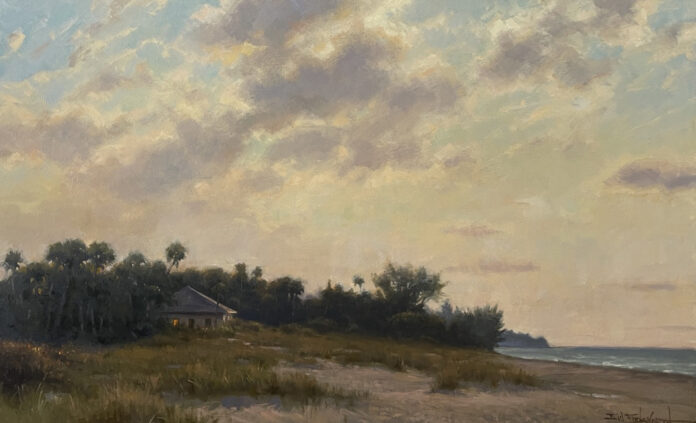
Enchantment, Bill Farnsworth,oil, 30 in. x 48 in., oil, $12,500. Tonal morning painting, available at Thomsen Fine Art
Bill Farnsworth: The goal with my work is to start the story and invite the viewer to finish it with their own personal experience. I believe this is part what art should do. Through intense observation we begin to feel empathy for our subject and from that comes understanding.
My Solo show at Thomsen Fine Art in Sarasota, FL will be my largest show to date featuring over 28 paintings; opening date: March 6, 2026.
Another Era, Bill Farnsworth, oil, 24 in. x 36 in., $6800; opulent beach estate from the 1920s. Available at Thomsen Fine Art.Afternoon Walk, Bill Farnsworth, oil, 40 in. x 30 in., $10,500, old Florida with dappled light; available at Thomsen Fine Art.
Fernando Micheli, “Lovrijenac Fortress Overlook, Dubrovnik,” oil, 18 x 14 in.
Please help us congratulate Fernando Micheli for winning Overall First Place in the December 2025 PleinAir Salon, judged by Master Artist Debra Joy Groesser.
“As I was reviewing the entries, this piece grabbed my attention immediately,” Debra said. “It reminded me of some of Claude Monet’s impressionist paintings of the cliffs at Etretat. The composition is simple and powerful. The texture of the rocks, the reflected light and the atmospheric perspective are spot on. The execution of the water is simply stunning – the sparkle and patterns of the brilliant sunlight, the beautiful transparency and layering of color in the foreground water. You can almost feel the sunshine, smell the sea air, and hear the gentle lapping of the water. This painting is an impressionistic delight for the senses – absolutely stunning!”
Fernando Micheli is a long time resident of Laguna Beach, California and a member of LPAPA Laguna Plein Air Painter’s Association. He was born in Fiano, near Lucca, Italy and immigrated to the United States with family in 1955. After High School in Watsonville, California, he decided to pursue schooling in Pinerolo (Piedmont), Pietrasanta, Florence and Lucca (Tuscany) for two years, which not only improved his fluency in Italian, but allowed him the time to travel and attain the proficiency needed to apply to the University of Florence in Art and Architecture.
After much thought, he eventually longed to return to San Francisco and family and pursue a design oriented profession graduating from the University of California at Berkeley’s College of Environmental Design in Landscape Architecture. After graduating with a BA in Environmental Design, he began a successful career as a Landscape Architect in Costa Mesa and Laguna Beach, which lasted over 36 years.
Desiring a change and anticipating his retirement, he decided to try oil painting in 2013 on a whin. It was a life changing decision; one that he believes brought him back to his longing to be an artist. What attracts Fernando to painting is the immediacy of plein air painting.
“One not only needs to capture the feeling of the subject, but also the essence of light and color as it bounces, reflects and scatters on the physical world,” he says. “Painting is truly seeing more intensely than you can possibly hope to see. Painting is a lifelong pursuit, one that requires always honing and learning new skills in order to build a vocabulary that just doesn’t reproduce reality, but can capture the emotional essence of nature. I focus on the immediacy of plein air painting and representational art, capturing the beauty of Southern California as well as traveling to destinations nationally and abroad.”
Fernando maintains a Gallery/Studio in Laguna Beach, California. Learn more about his work at fernandomicheli.com.
About the PleinAir Salon:
In the spirit of the French Salon created by the Academie des Beaux-Arts in Paris, this annual online art competition, with 11 monthly cycles, leading to the annual Salon Grand Prize winners, is designed to stimulate artistic growth through competition. The PleinAir® Salon rewards artists with $50,000 in cash prizes and exposure of their work, with the winning painting featured on the cover of PleinAir® Magazine.
Winners in each monthly competition may receive recognition and exposure through PleinAir Magazine’s print magazine, e-newsletters, websites, and social media. Winners of each competition will also be entered into the annual competition. The Annual Awards will be presented live at the next Plein Air Convention & Expo.
The next round of the PleinAir Salon has begun so hurry, as this competition ends on the last day of the month. Enter your best art in the PleinAir Salon here.
As part of our effort to continue to help artists and art galleries thrive, we’re proud to bring you this week’s “Virtual Gallery Walk.” Browse the artwork below and click the image itself to learn more about it, including how to contact the gallery.
Antelope Valley- A Tapestry Of Royal Yellow and Ming Grey, Marian Fortunati, oil on linen panel, 14 x 18 in; Marian Fortunati Fine Art
Want to see your gallery featured in an upcoming Virtual Gallery Walk? Contact us at [email protected] to advertise today. Don’t delay, as spaces are first come, first served, and availability is limited.
Kyle Ma, "Yorkshire Dahlia Garden," oil, 17 x 22 in.
“Light, Land & Legacy: The Art of Kyle Ma” is a showcase of new works by one of the most celebrated young talents in Western Art, February 12-13, 2026, at Legacy Gallery in Scottsdale, Arizona, during the Scottsdale Art Walk.
This current exhibition will include landscapes from Ma’s travels throughout the West as well as several new paintings depicting European scenes.
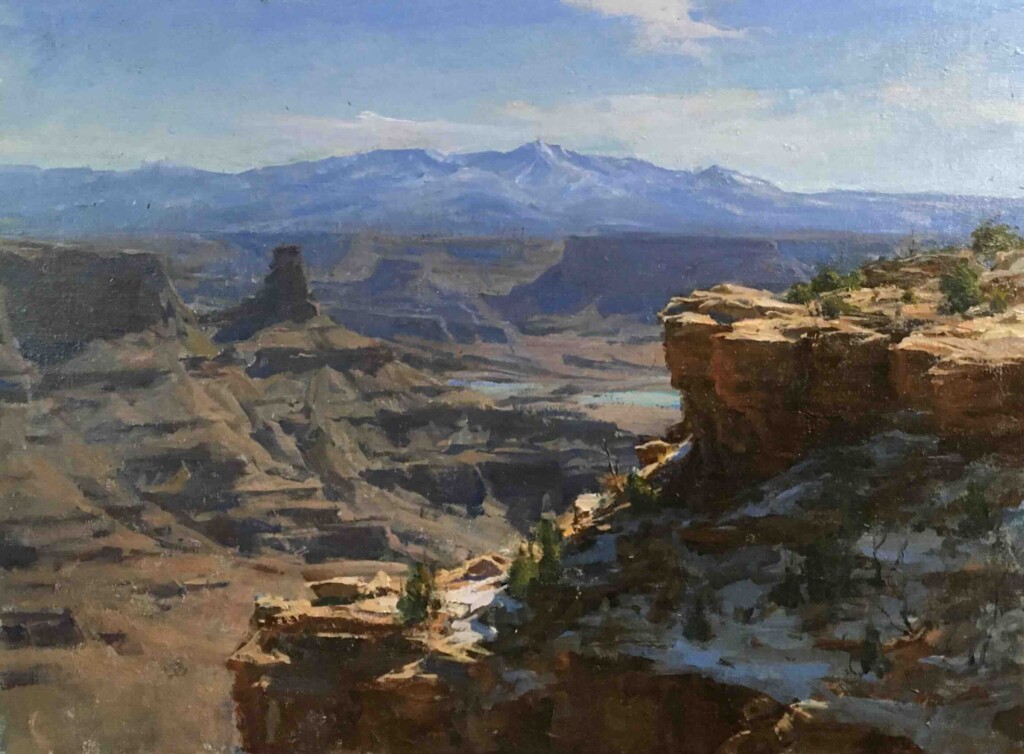
One of the Western paintings is titled “Deadhorse Point, Winter” and exhibits Ma’s keen ability to render subtle moments of beauty in the sky and land.
Kyle Ma, “Deadhorse Point Winter,” oil, 18 x 24 in.
“This piece was inspired by a visit to Deadhorse Point in Southern Utah,” says Ma. “There were still patches of snow on the cliffs reflecting blue light from the sky. This was contrasted against the reds of the vast desert landscape.”
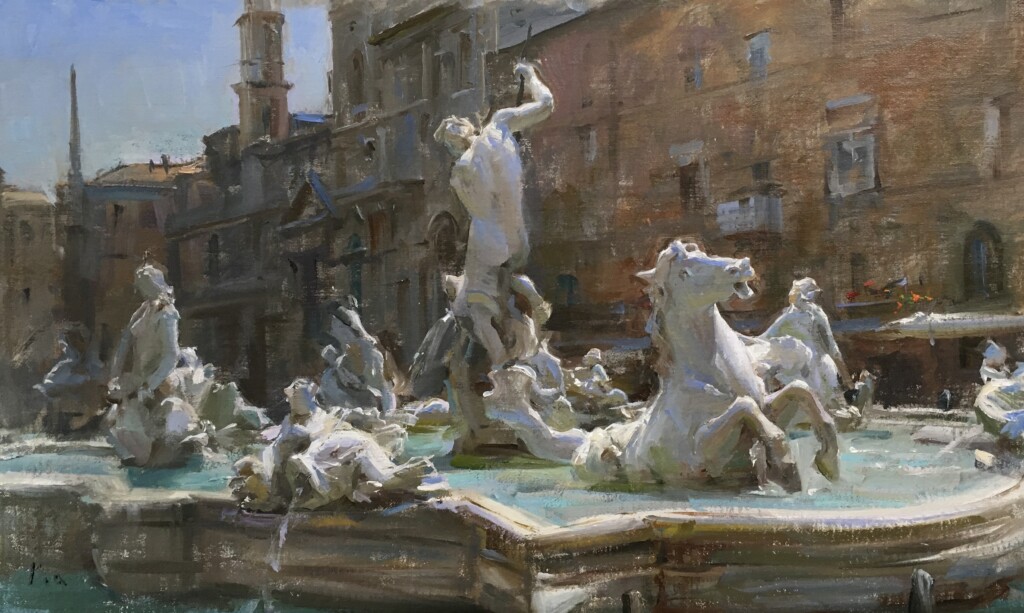
Ma’s European scenes were inspired by a recent trip to Italy where he fell under the spell of the light, architecture and landscapes of the country. “Piazza Navona Fountain” is one from this series.
Kyle Ma, “Piazza Navona Fountain,” oil, 12 x 20 in.
“I came to this fountain during a hot day in Rome and did some sketching on location,” says Ma. “While I was there, I kept noticing all the beautiful colors coming from reflected light in the sculptures, making a white sculpture appear very colorful. In the studio, this was one of several paintings exploring that idea.”
At the age of 25, Ma has already won many important awards and distinctions from events and exhibitions across the country, including the 2025 PleinAir Salon Grand Prize.
Ma was born in 2000 and developed early on a love for fine art after being exposed to the works of the old masters through museums and art history books. Ma is also already a Master Signature Member of the Oil Painters of America.
Additional Paintings by Kyle Ma
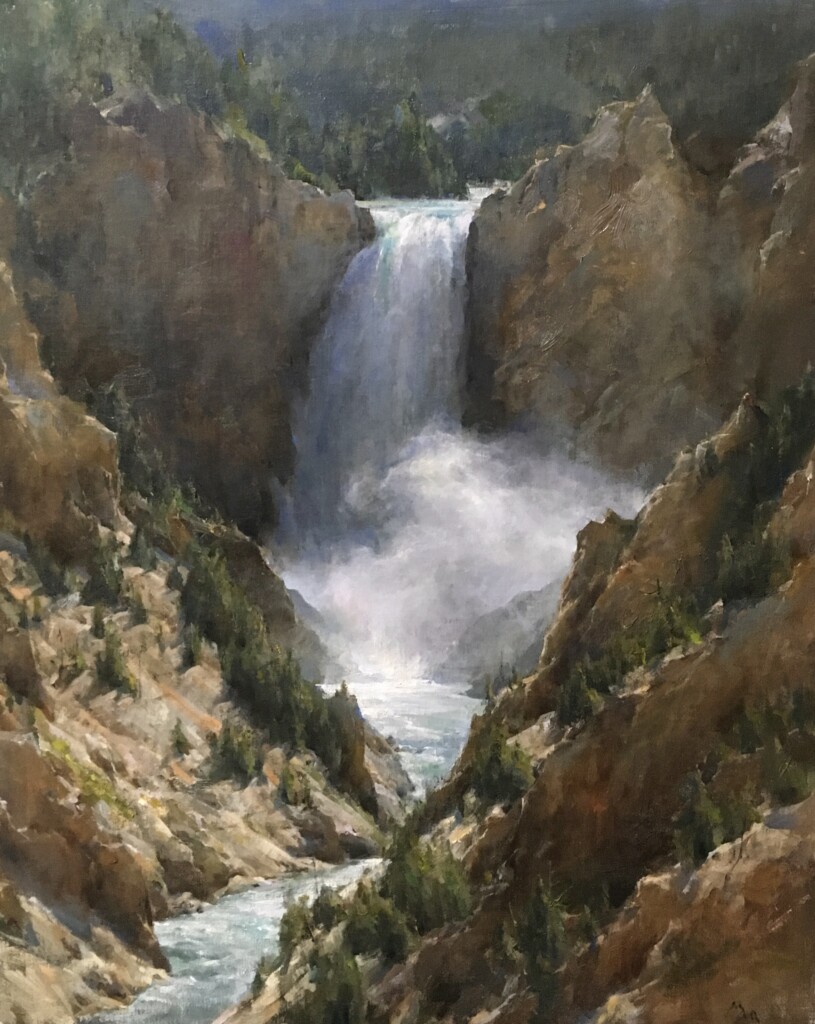
Kyle Ma, “Morning at the Salute,” 2025, oil on panel, 16 x 20 in.Kyle Ma, “Yellowstone Falls,” oil, 30 x 24 in.
Light, Land & Legacy: The Art of Kyle Ma
Legacy Gallery
Scottsdale, Arizona legacygallery.com
February 12–13, 2026
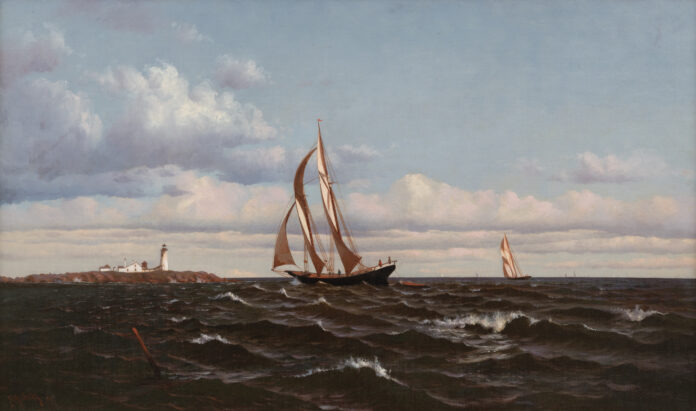
FRANCIS A. SILVA (1835–1886), "Off Eastern Point Light, Gloucester," 1874, oil on canvas, 18 x 30 1/4 in., available through Debra Force Fine Arts (New York)
What to do with fine art collection objects that are outsized in value relative to everything else one owns? Find out in this article from Fine Art Connoisseur magazine.
By Daniel Grant
On an episode of PBS’s long-running television series Antiques Roadshow, a man brought in a marine painting he had inherited from his father several years before. He didn’t know anything about its creator, Francis A. Silva (1835–1886), and so was interested to learn about him, the artwork, and — of course — its value from regular Roadshow expert Debra Force. If she were to handle the painting, the New York art dealer declared, she “would probably sell it for around $250,000.” The owner’s first response was “Holy smokes” and then, “That’s worth more than my house!”
This owner soon realized that he didn’t want something quite this valuable at home, so he loaned the Silva to the Seattle Art Museum for almost a decade. Ultimately, he consigned it to Debra Force.
One can understand this owner’s desire to be free of the painting. He did not have a fine art provision, or even a fine art rider, on his homeowner’s insurance policy. A theft or, more likely, a disaster such as a fire, hurricane, earthquake, or tornado, would greatly diminish the Silva’s value. He might even have wondered, “What if the wire holding the frame on the wall snaps and the painting falls to the floor?”
Varied Challenges of a Fine Art Collection
Indeed, art collectors have a lot to fret about. For example, “It is difficult, almost impossible, to find an insurance policy for just one painting,” says Dorit Straus, a fine art insurance adviser at Wondeur AI, which evaluates financial risks for the insurance industry. The “imbalance” in value between one masterwork and your home’s other assets “would lead most insurers to decline to provide coverage.”
Even if an insurer agreed to write a policy for one artwork, she notes, there would likely be other expenses to address, such as installing a central station alarm that automatically notifies the police and fire departments that a break-in or fire is occurring. There might also need to be cameras and sensors to track problems, and more secure doors and windows to prevent intruders. Alternatively, the owner might need to rent a space in a fine art storage facility. Getting insured is “not a panacea to having something very valuable,” Straus concludes.
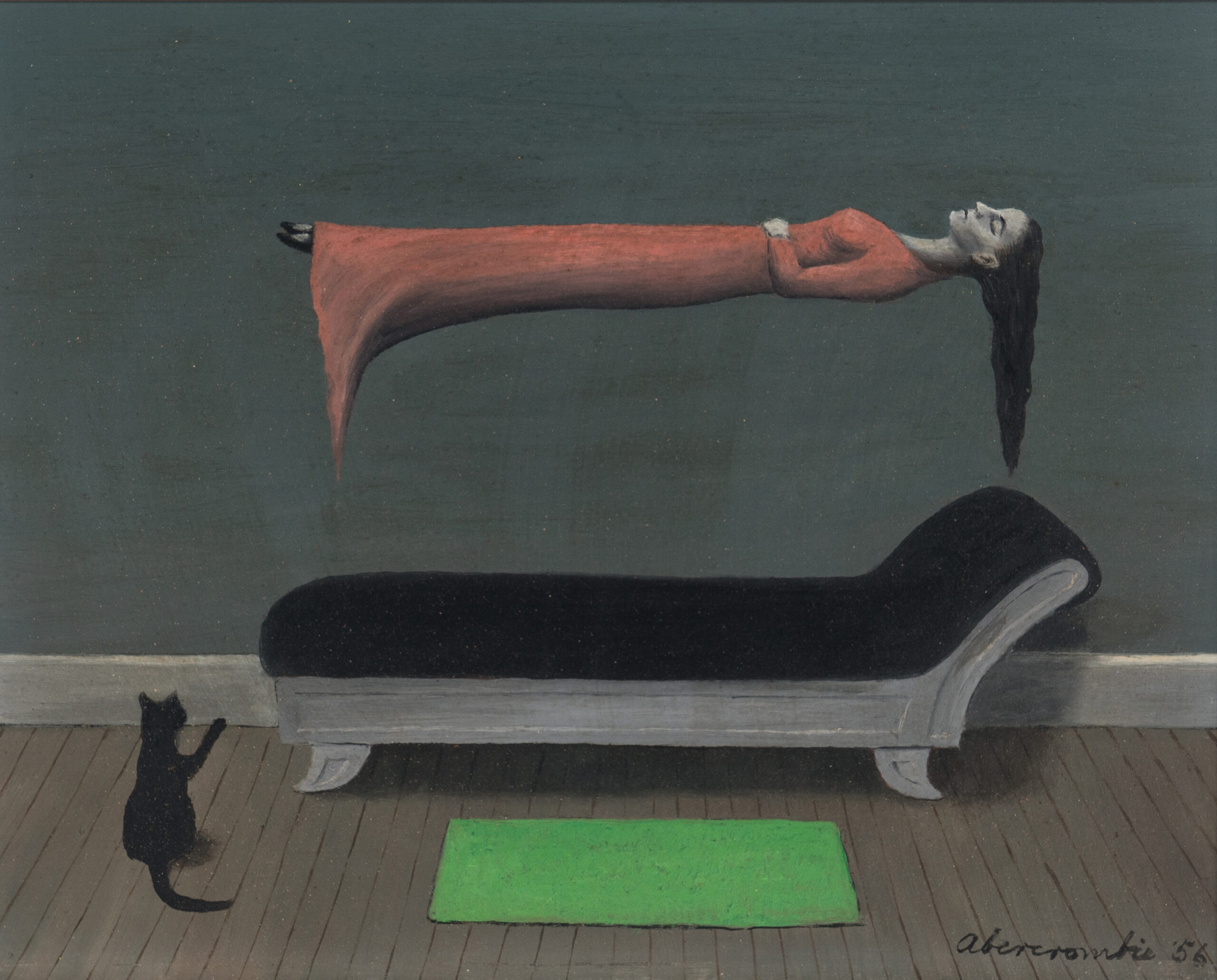
GERTRUDE ABERCROMBIE (1909–1977), “The Magician,” 1956, oil on Masonite, 7 3/4 x 10 in.
Though it is generally assumed to enrich viewers’ lives, art can also inspire anxiety. Zack Wirsum, senior vice-president and head of postwar and contemporary art at Freeman’s | Hindman, recalls an instance when a “consignor was losing sleep, quite literally, over how valuable a work he inherited had become. He did not think he could afford to insure it.” He owned a tiny painting by Gertrude Abercrombie (1909–1977) that his father had purchased for $90 directly from the artist at a Chicago street fair back in 1956. The consignor had seen online that “works by Abercrombie had been sold for as much as a quarter of a million dollars, and he was worried about having something so valuable on his walls.” He brought the work to Freeman’s | Hindman, which sold it for $469,900, a record-setting price for the artist.
Rags-to-riches sounds good, but worry-to-relief sounds good, too. Betty Krulik, a dealer in Irvington, New York, who has also offered appraisals on Antiques Roadshow, recalls a couple she informed that their pair of Winslow Homer watercolors were worth up to $200,000. They immediately placed them in a bank vault. “These were people from a small town. They didn’t even have a lock on their door,” she says. Sure enough, the pair sold at Christie’s New York in January 2025 for a total of $189,000, including fees.
The owners of highly valuable artworks are often quite unlikely. The Washington, D.C.-based National Press Club possessed a 1946 painting by Norman Rockwell titled “Norman Rockwell Visits a Country Editor” that had appeared on a cover of The Saturday Evening Post. The artist had given it to the club in the early 1960s, an era when his paintings were not perceived as valuable after they had been published. Through most of the intervening years, this piece had hung unguarded on a wall, but Rockwell’s market was skyrocketing.
The club eventually took out a fine art insurance policy, the premiums of which rose with the market. By 2015 the appraised value had reached $10 million–$15 million, resulting in annual premiums of more than $10,000. “The National Press Club isn’t a museum like the Smithsonian,” said John Hughes, then the club’s president and an editor at Bloomberg Business. “We’re not set up to handle works of art that are valuable, and the costs of insurance and keeping this painting safe, since we don’t have guards here, would drain resources from our core mission.”
So the National Press Club decided to sell the Rockwell at Christie’s, where it fetched $11.5 million, filling the organization’s coffers and easing a variety of worries. Many private owners probably know, and like, that feeling.
Rockwell gave a 1959 oil on paper study, “The Jury — The Jury Holdout,” to Richard Hamilton, who had originally called the artist seeking to buy something as a gift for his father. The work returned to Hamilton with his father’s estate. According to the New York-based illustration dealer Judith Cutler, it “had appreciated in value to the point that he felt he couldn’t keep it anymore,” so Hamilton consigned it to her and she sold it for “more than $500,000.”
Things to Consider
It’s impossible to control whether your art rises or falls in value. Ironically, the upside is where the worries may begin. An owner’s responsibilities rise with the price, and insurance premiums — which run 8–12 cents per $100 of appraised value (roughly $1,000 per $1,000,000) — are only the beginning.
Let’s start with the more expensive security technology: motion sensors in rooms where artworks are displayed; intrusion-detection systems for points of entry and exit (doors, windows, chimneys, air-conditioning units); alarms attached to artworks to alert a security company if they are moved; motion-activated camera surveillance of the house’s grounds; thicker locks and striker plates on the house’s doors; and the establishment of protocols for inventorying, activating systems, and identifying everyone who enters the house. Some owners even buy DNA threads that are woven onto the back of a canvas to help with identification if the work is stolen. These costs can easily reach $25,000–$50,000, according to Robert Wittman, an art security and recovery consultant in Chester Heights, Pennsylvania, who headed the FBI’s National Art Crime Team until his retirement in 2008. “For a large house with a lot of acreage, you could spend considerably more.”
All of this may not worry seasoned collectors who are “out in the market and keeping track of things,” says David Weiss, senior vice-president for fine art at the Philadelphia office of Freeman’s | Hindman. They already have insurance, and for them the only problem may be the insurer’s requirement for updated appraisals following a rise in prices for similar items. The decision to sell is based less on fear than “a sense that this is the time to cash in.”
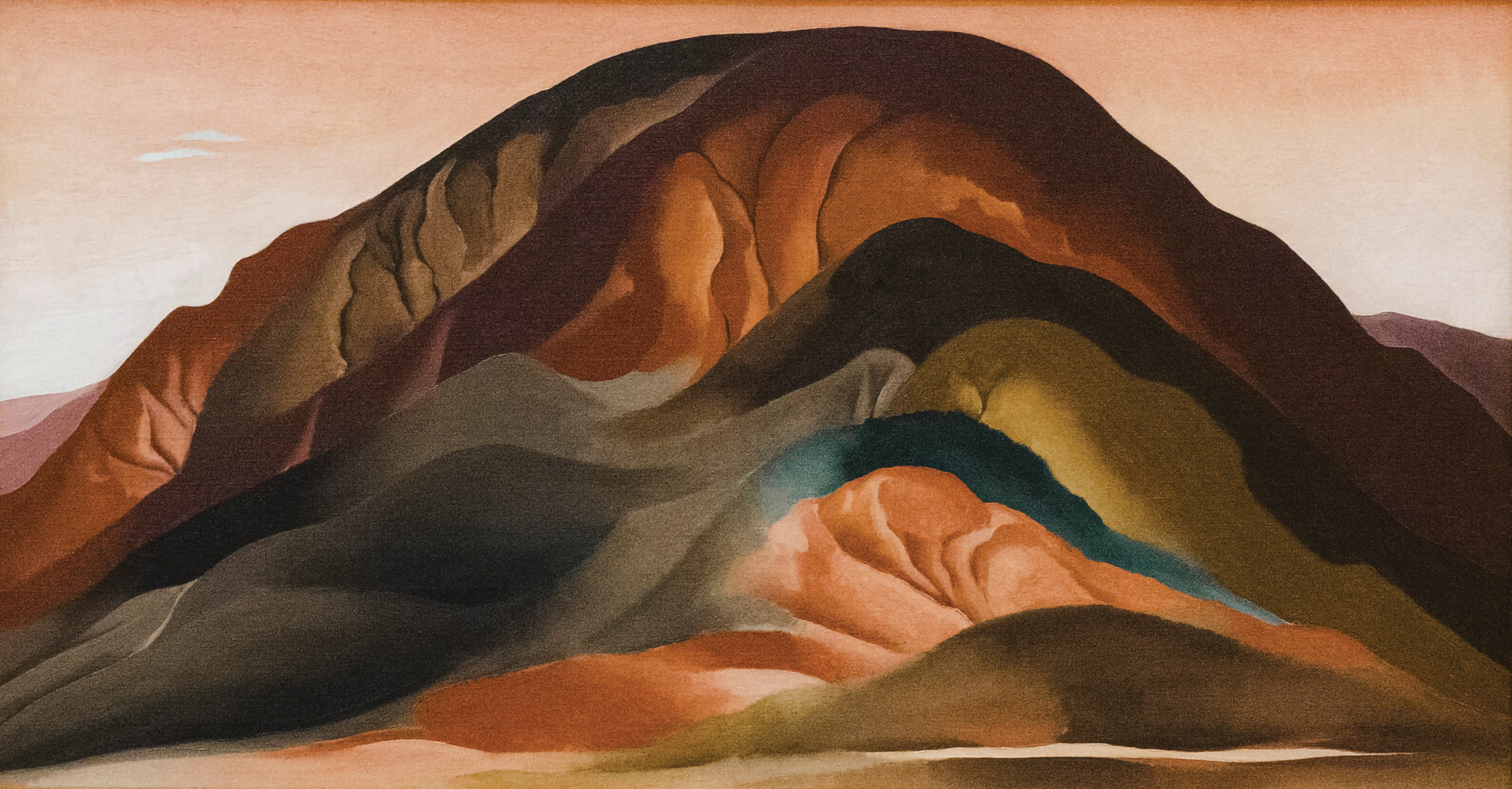
GEORGIA O’KEEFFE (1887–1986), “Rust Red Hills,” 1930, oil on canvas, 16 x 30 in., Valparaiso University (Indiana)
It is the non-collector who is more likely to be taken aback by the costs and responsibilities of ownership. The National Press Club is an example, and there are colleges and universities nationwide that find themselves art-rich and endowment-poor, seeking to sell in order to become more financially stable. A telling example arose in 2023 at Indiana’s Valparaiso University when administrators decided to sell three paintings from its Brauer Museum of Art — Georgia O’Keeffe’s “Rust Red Hills” (1930), Frederic E. Church’s “Mountain Landscape” (1865), and Childe Hassam’s “The Silver Veil and the Golden Gate” (1914) — estimated to be worth $10 million–$15 million in total. The objective was to use the proceeds to improve freshman dormitories with “amenities and features that prospective students value and expect,” according to the university’s president, José D. Padilla.
An additional reason for the sale, the university claimed in its petition to the County Superior Court, was their heightened value. “The three paintings… have become very valuable making it impractical for Valparaiso University to display them and making it wasteful for Valparaiso to retain them in storage indefinitely.” The petition noted that the Brauer Museum lacks state-of-the-art security systems, particularly at a time when “‘activists,’ in recent years, have taken to hurling soup and other harmful objects at classic art.” Keeping the artworks would mean that the university would have to spend money, whereas its priorities were elsewhere. Today the paintings are awaiting sale, stored in an undisclosed location.
Next Steps
What to do with objects that are outsized in value relative to everything else one owns? Joanna Ostrem, head of Christie’s trusts & estates department in New York City, says, “We are always happy to provide estimates and auction recommendations, and if a sale is not wanted, we can help find an alternative such as giving or loaning the work to an institution.” Donating is a good option assuming that the museum wants the piece and the donor can claim a charitable deduction. Still, if the appraised value is so great that the taxpayer can’t make full use of the deduction — even carried over five years — then the option of selling re-emerges.
One further option is to place pieces in fine art storage facilities, which are distinct from self-storage units because of their environmental controls (temperature, humidity, ventilation), increased security, and greater cost. In Manhattan, they generally charge over $200 per month for the first five square feet, and some negotiable amount for every square foot after that.
Picasso stated that a work of art washes “the dust of daily life off our souls,” but sometimes it can inadvertently complicate that daily life, becoming the gift that keeps getting paid for.
DANIEL GRANT is the author of several books, including The Business of Being an Artist (Skyhorse Press). He also is a contributing writer to Fine Art Connoisseur.
Fine Art Today covers artists and products we think you’ll love. Linked products are independently selected and linked to for your convenience. If you buy something using a link on this page, Streamline Publishing may receive a small share of that sale.
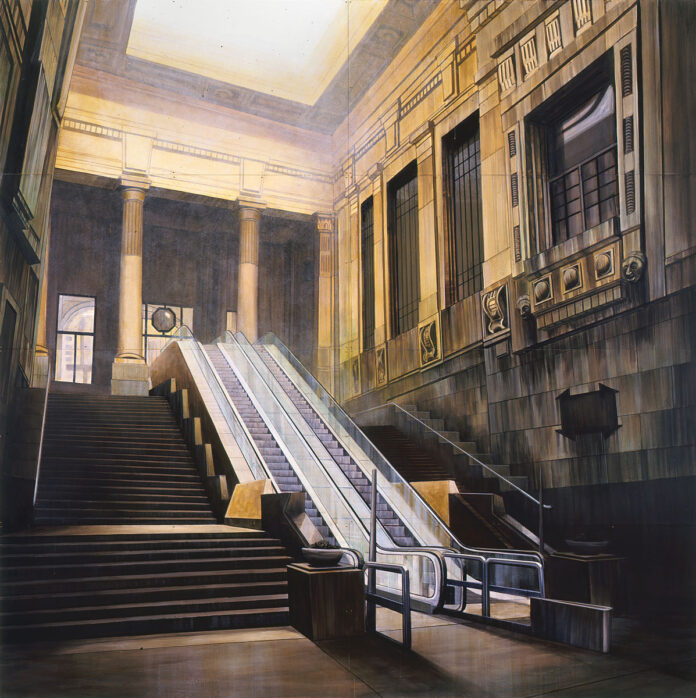
Peter Waite, "Station/Milan," 1992, acrylic on PVC panels, 96 x 96 in., collection of Cynthia and Charles Peabody
On View:
PETER WAITE: SOCIAL MEMORY, PAINTINGS 1987–2023
The Wadsworth
Hartford, Connecticut thewadsworth.org
through March 15, 2026
The Wadsworth (until recently called the Wadsworth Atheneum Museum of Art) is celebrating the Connecticut-based artist Peter Waite (b. 1950) with his first solo exhibition at a museum.
On view are 70 paintings spanning nearly four decades, selected and organized by curator Laura Leonard and accompanied by a handsome catalogue.
Painting in acrylics on large PVC panels, Waite creates scenes that explore public spaces in New England and Europe where history, memory, and perception meet. These are places we pass through daily but rarely stop to examine — such as bridges, train stations, and passageways — which he shows emptied of their usual crowds, conjuring a sense of absence. To make these scenes, Waite consults his own photographs, sketches from the field, and personal memory.
Fill your mind with useful art stories, the latest trends, upcoming art shows, top artists, and more. Subscribe to Fine Art Today, from the publishers of Fine Art Connoisseur magazine.