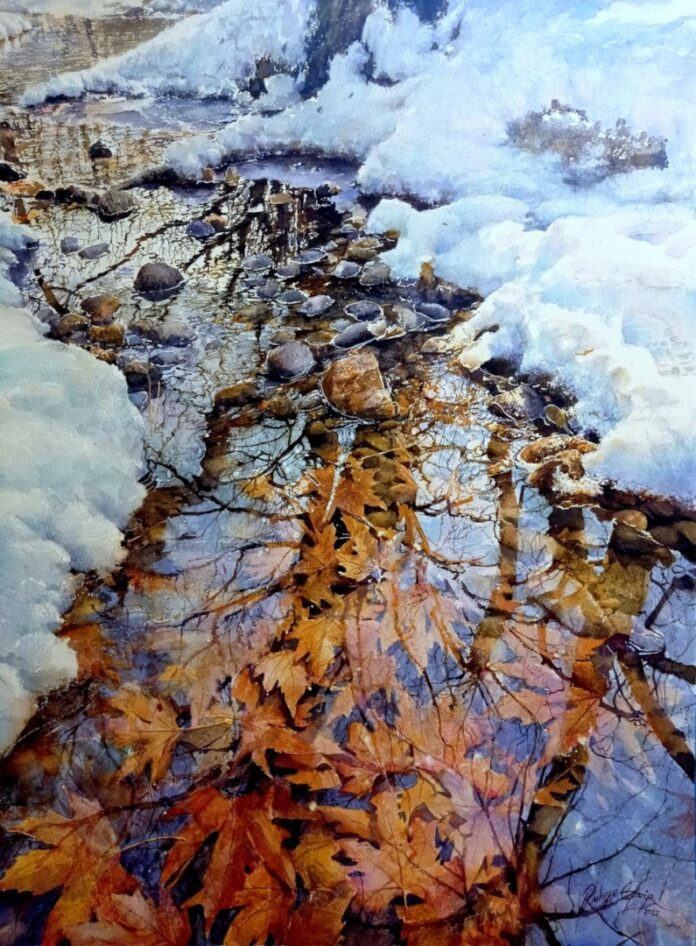
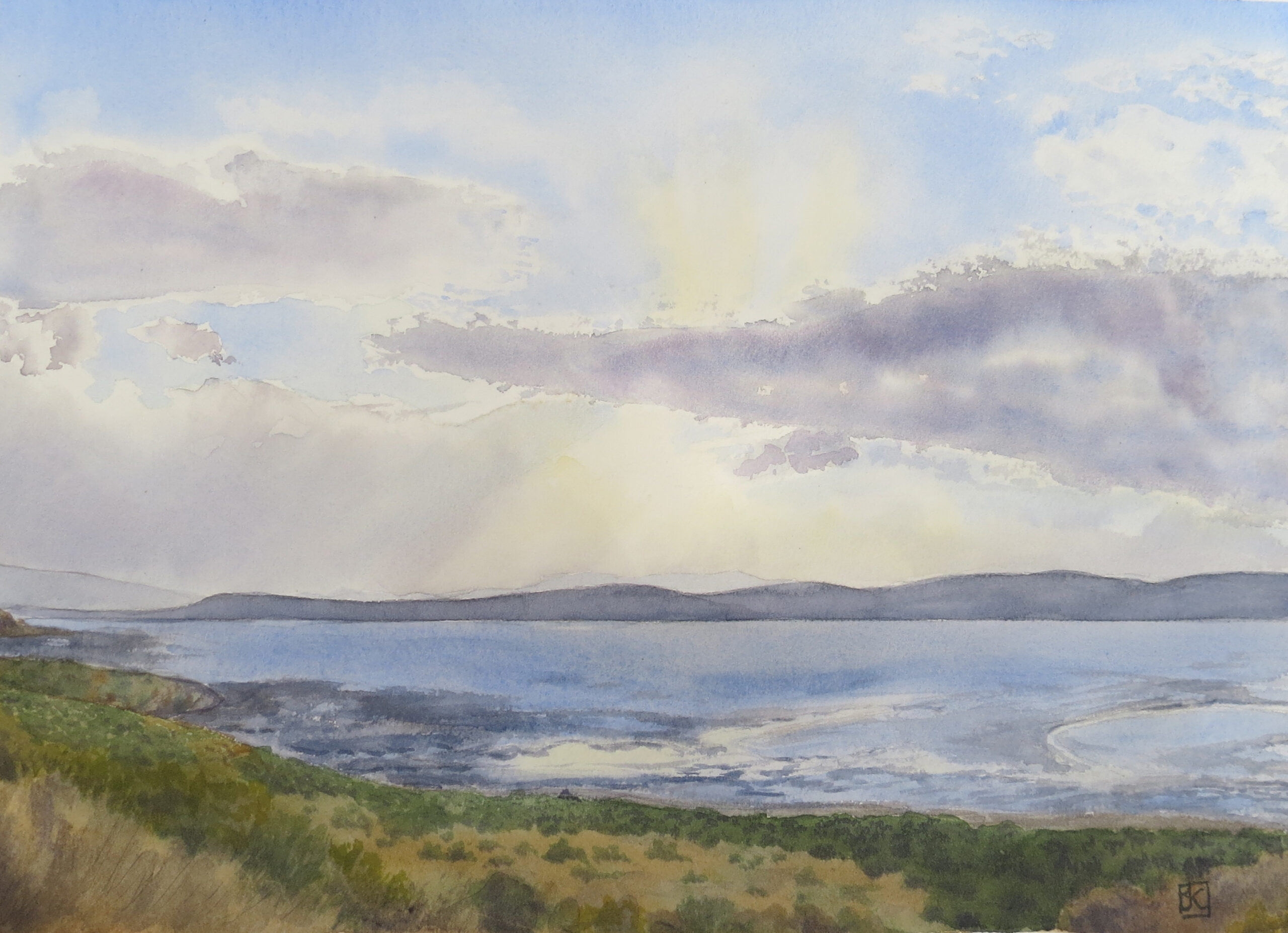
Rukiye Garip, “Winter Reflection,” watercolor, 30 x 22 in.
We’d like to congratulate Rukiye Garip for winning Overall First Place in the December 2022 PleinAir Salon, judged by Kathleen Dunphy. (Watch the live announcement on Facebook here.)
About the PleinAir Salon Winner, “Winter’s Reflection”
By Rukiye Garip
My inspiration for this painting is the woodland area near my home, where I am fascinated by its enchanting beauty in every season and at different times of the day – melting snow during a walk in snowy weather, leaves in the water, reflected tree branches, and light.
Since the reference photos I took did not fully meet my dreams, I created a new composition using a few photos. I discarded the details that would create confusion and added leaves and branches. I had to decide where to start for this seemingly multi-layered work. In this process, where I had to plan from the beginning, I experimented with drawing and color for three days.
In order not to drown in the details, it was best to act in accordance with the order and layers in nature. First of all, I worked on the snowy areas, then the lightest tonal transitions in the reflections, and finally all the details layer by layer.
I used a salt effect for leaf, stone, and snow textures. I used maskıng fluıd to protect the small glittery areas on the water surface. I completed the painting phase in five days, working an average of four hours a day.
The biggest challenge in works with reflections is maintaining transparency in the water. Therefore, wet and fast work is required in the first layer. The hardest part for me in this picture was to mix the colors of the leaves visible under the water and the color of the water, without creating any pollution in the first layer. It was both challenging and exciting to be able to give the magical effect I wanted by thinking about the next layers and preserving the light.
Art competitions are areas of choice that require bold steps for almost everyone because in the end, there are only two possibilities: winning and losing. For me, it is important to experience both.
It is very natural for a person who participates in a prize art competition to dream and expect the grand prize, but at the same time, it is necessary to accept the negative consequences as normal. An artist who wants to participate in the competition must first make sure that the conditions and concept of the art competition are suitable for him/her. It is important to be aware of your own level, to know the general participant profiles, and therefore not to be disappointed with the possible results. Instead of expecting good results with a mediocre work, I recommend that they participate with their best work.
Not getting a reward once should not reduce the next motivation. The experience you gain will guide you in the new steps you will take. Whatever the result, it is necessary to meet with maturity and write it as a plus to our experience section.
While learning the result of [this round of the PleinAir Salon], I experienced the excitement of waiting for the result, the happiness of knowing that my effort was appreciated, and the feeling of peace at the same time; the announcement of my name also sounded very nice. My motivation to make new and many paintings was renewed.
In the spirit of the French Salon created by the Academie des Beaux-Arts in Paris, this annual online art competition, with 11 monthly cycles, leading to the annual Salon Grand Prize winners, is designed to stimulate artistic growth through competition. The competition rewards artists with over $33,000 in cash prizes and exposure of their work, with the winning painting featured on the cover of PleinAir Magazine.
Winners in each monthly competition may receive recognition and exposure through PleinAir Magazine’s print magazine, e-newsletters, websites, and social media. Winners of each competition will also be entered into the annual competition. The 12th Annual Awards will be presented live at the Plein Air Convention & Expo in May 2023.
The next round of the PleinAir Salon has begun so hurry, as this competition ends on the last day of the month. Enter your best art in the PleinAir Salon here.
As part of our effort to continue to help artists and art galleries thrive, we’re proud to bring you this week’s “Virtual Gallery Walk.” Browse the artwork below and click the image itself to learn more about it, including how to contact the gallery.
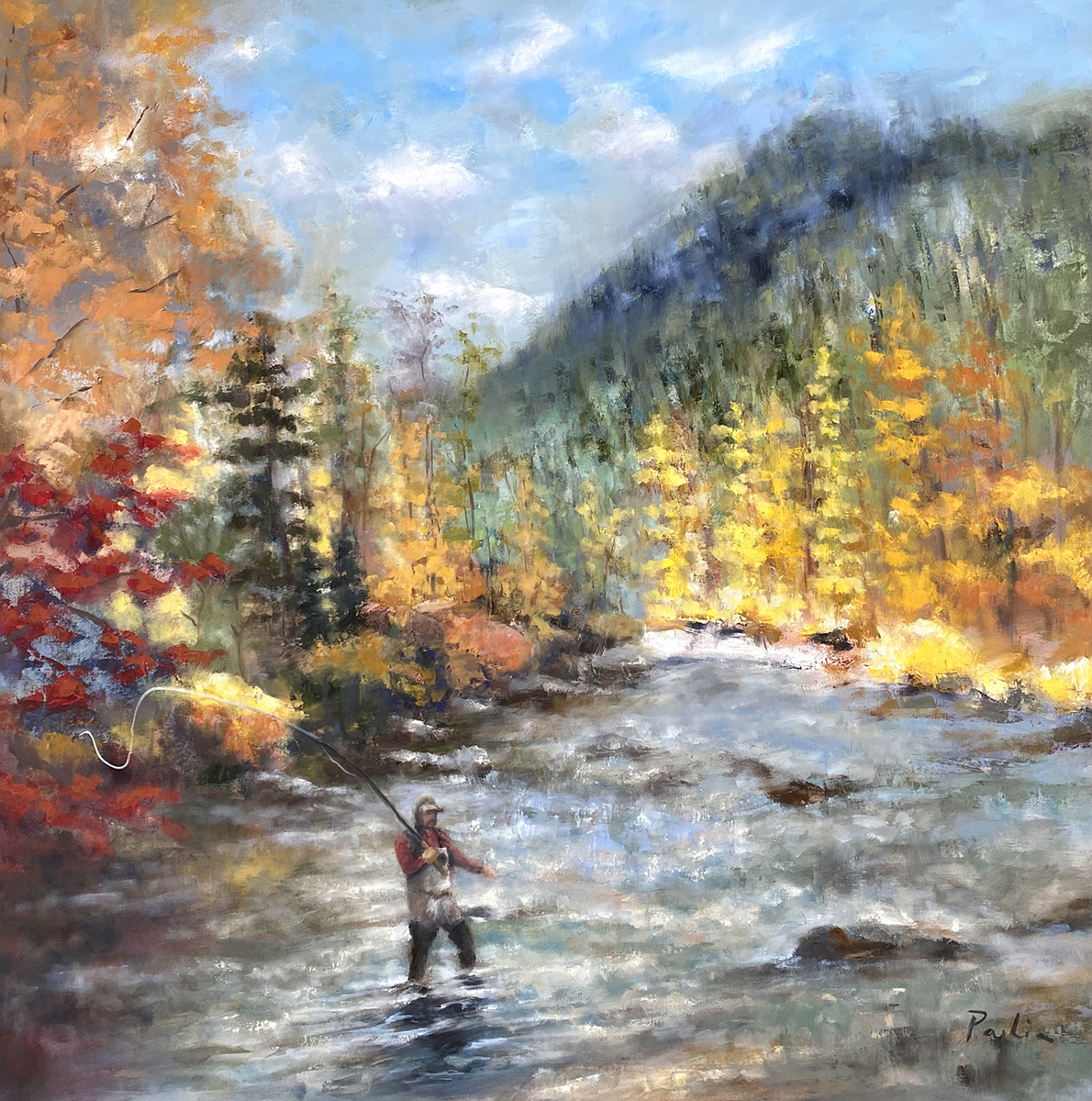
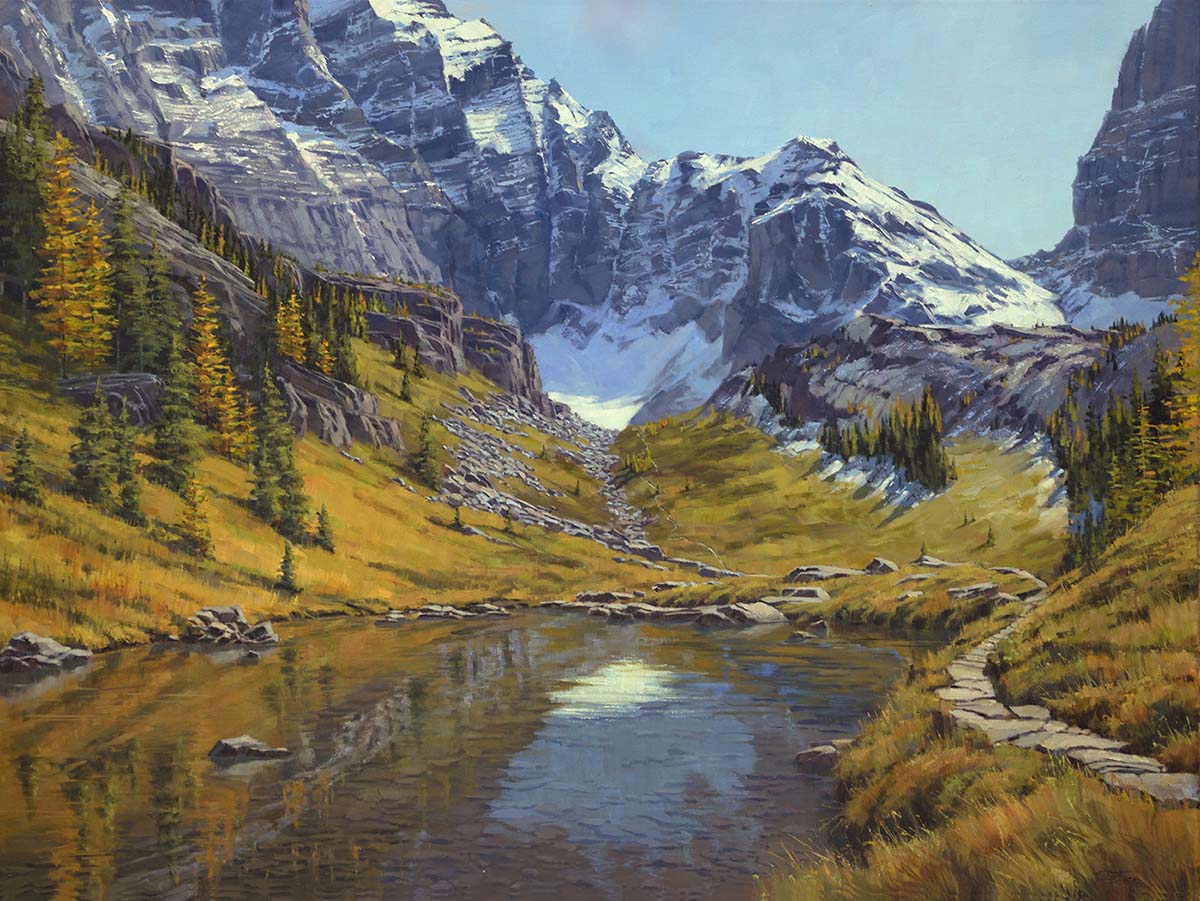
Solitude, Becky Pashia, oil, 36 x 36 in; Celebration of Fine ArtTrail Of Tamarack Gold, Darcie Peet, oil, 30 x 40 in., Solo Show; ArtzLine
Want to see your gallery featured in an upcoming Virtual Gallery Walk? Contact us at [email protected] to advertise today. Don’t delay, as spaces are first come, first served, and availability is limited.
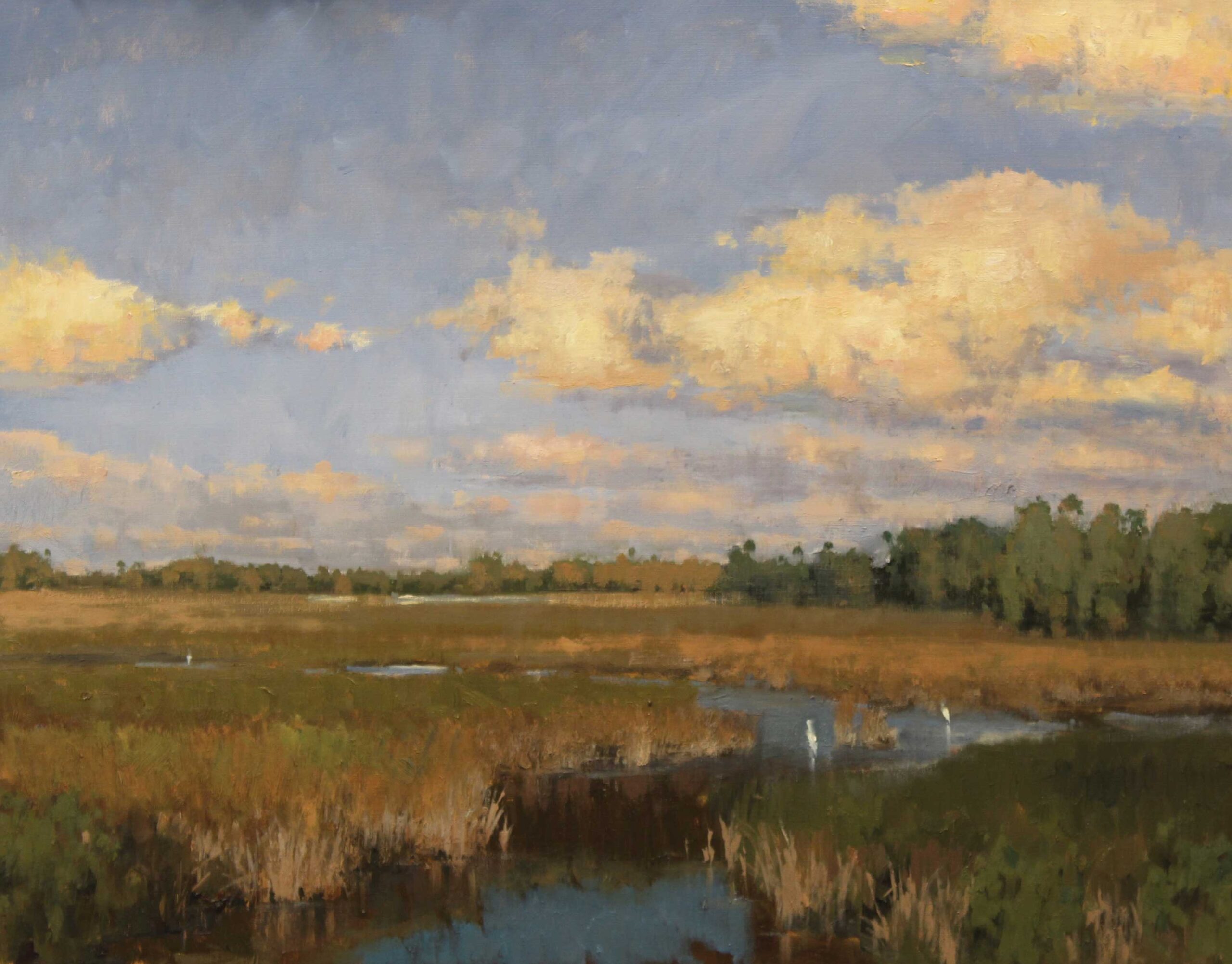
Roger Dale Brown, "Maroon Sunset," 2020, oil on linen, 30 x 40 in., collection of the artist
The unlikely story of how a largely self-taught artist nurtured his passion for art, and of how his creativity, spirituality, and ultimately his “artistic voice” evolved.
Plein Air Painter Roger Dale Brown: Pursuing His Passion for Art
by Charles Raskob Robinson
This is the unlikely story of how a largely self-taught artist and plein air painter, Roger Dale Brown (b. 1963), nurtured his passion for art, and of how his creativity, spirituality, and ultimately his “artistic voice” evolved. Renowned for his teaching skills, Brown is a leading member of the American Society of Marine Artists, Oil Painters of America, American Impressionist Society, Salmagundi Club, Cumberland Society of Painters, and Chestnut Group. He is also past president of the Plein Air Painters of the Southeast.
Born in Birmingham, Alabama, and raised in Tennessee, Brown traces his passion for art to age 4: that’s when his mother introduced him to crayons and watercolors so successfully that he was soon using them on larger surfaces — namely, his mother’s walls. By high school, he was fairly accomplished, but after a stint at college, various jobs, and a whole lot of boxing, art was no longer Brown’s focus.
He got a job selling eyeglasses and became a licensed optician; it was in this capacity that the passion for art resurfaced through an unusual twist of fate. A customer came in to get some glasses and soon revealed he was a muralist seeking an assistant. Brown expressed interest and, after presenting his high school art portfolio, landed the job. One day, when his muralist boss failed to show up for a meeting with a new client, Brown announced that he himself could produce the Monet-like work requested. The client liked his oil sketch and proceeded to commission the larger work. Today Brown recalls it as “the most horrifying experience of my life,” but he also remembers thinking to himself, “Now I am an artist!”
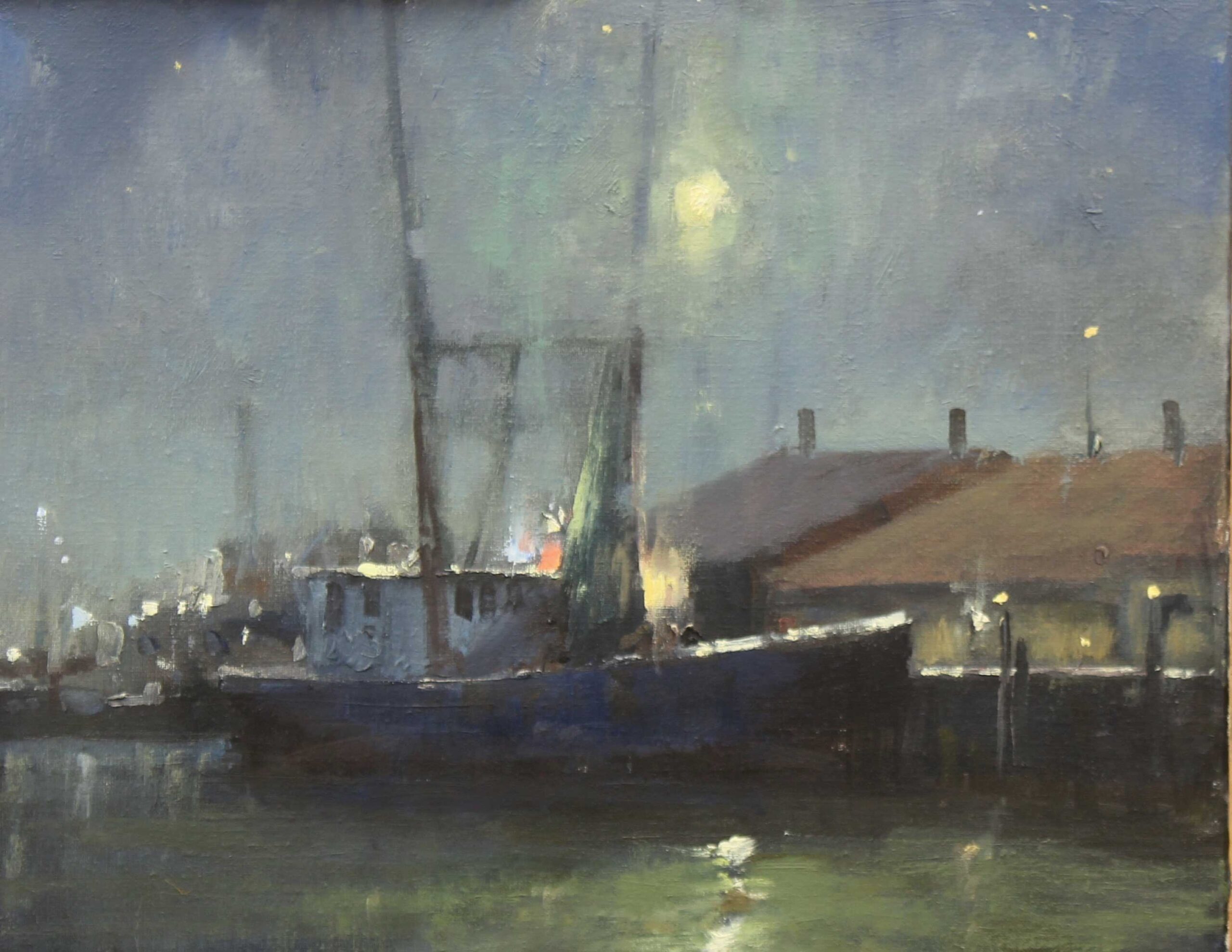
Roger Dale Brown, “Maritime Night,” 2020, oil on linen, 16 x 20 in., private collection
Onward
In 1999 Brown got his first introduction to painting on canvas through lessons from Hazel Mae Crye King (1917–2017). 2002 was a pivotal year as he began taking lessons from Dawn E. Whitelaw (b. 1945), a former student of Everett Raymond Kinstler (1926–2019), with whom Brown also studied later.
“Dawn Whitelaw taught me the mentality of an artist in every aspect,” Brown says. “There were others who became great mentors, but Dawn holds a special place for me.” That same year brought Brown into contact with another fine teacher, Jason Allen Saunders (b. 1972), who suggested a workshop with Scott L. Christensen (b. 1962). This became a turning point because “Scott became my mentor, set me on the right path, and planted certain basics in me, one of which was setting goals for myself.”
Brown’s first such goal was to paint one plein air work every day for a year. Although he came up a bit short — completing 350 out of 365 — this project was a success because Brown “spent a lot of time learning — going to my own school with my own curriculum and schedule. I became disciplined and truthful with myself about my progress and how much more I had to learn.”
In 2004 Brown put himself to the test: “I held my first workshop and made myself practice what I preach.” This proved more consequential than he could have imagined: he realized how much he loves to teach and he fell in love with a student, Beverly Ford Evans, another Tennessean and a graduate of the O’More School of Design in Franklin. She became his constant painting companion and, in 2014, his wife.
Roger Dale Brown, “Across the Ford II,” 2020, oil on linen, 40 x 30 in., private collection
Different Ways of Seeing
Brown reflects, “The successes that have come my way have been mostly through persistence, hard work, studying art and art history, experimenting, and practicing the art of observation. At the beginning of every year, I set new goals to improve my career.” His first goal sounds rather basic: to improve his artistic skills. How?
“First, I always paint for myself — never for the market. Second, I study both the Old Masters and contemporaries who inspire me, especially those who push the limits, and I continue to build a library of art books. In short, I seek to develop a critical eye to learn how to see — basically to know how a good painting should be created.” And for colleagues who tend to focus on one genre (such as marine subjects), Brown stresses the importance of becoming well-rounded: artists always grow when they move back and forth between still lifes, landscapes, figures, and portraits.
Brown estimates he spends 40 percent of his time painting outdoors and 60 percent in the studio, yet he stresses the significance of the former in contributing to success in the latter. One is not subservient to the other. “Good painting is good painting,” he declares, “but plein air painting permits a one-on-one relationship with nature you can’t get indoors. There is an immediacy to being outdoors that evokes so many emotions.”
Moreover, “Outdoors you learn the relationship of shapes and values and nuances and how to use important elements and eliminate others. In short, you manipulate what you are seeing into a good composition. In the studio, it is just God, my canvas, and me. Painting on location is my school, but indoors is where I really can create. I try to use information gathered outside to create something inside. These are two different experiences, but I would not be successful in the studio without my plein air experience, which, in turn, is furthered by studio time.”
A key step in the development of Brown’s approach came when Gary Young, one of his former students and now a close friend, introduced him to a Fellow of the American Society of Marine Artists (ASMA), Charles Warren Mundy (b. 1945). Brown admired C.W. Mundy’s desire to “build up and tear down a painting, then bring back the key elements in order to reiterate the work’s visual intent.” Underlying this creative/destructive/recreative philosophy is the artist’s willingness to accept failure; there is a risk that he or she might not bring the painting back successfully. “In trying this approach,” Brown recalls, “I learned more when I had the guts to fail — to step out of the box and try things that are against the rules. I found this invaluable.”
Having settled on a subject, Brown begins the first stage of his process — to “Un-Define” the scene, to eliminate all preconceived notions about it in order to freely appreciate how and why it attracts him, “to see as an artist sees it.” This means observing the subject “as mere shapes, colors, and values.”
Next, Brown “Prepares to Rebuild” the scene he has just mentally deconstructed. Here he finds it helpful to view the subject’s elements on an abstract basis by looking at the color and value within each, to start forming an idea using visual language. In the final stage, the “Rebuilding Continues.” Here the abstract becomes more representational, but Brown cautions, “Become the creator, not the follower. Do not become tied to a scene; be inspired by it. Your ultimate aim should be to evoke the mood of a strand of time.”
Although Brown acknowledges that his approach is not for every artist, his “vital stages of the painting process give me a uniqueness that has become my voice as an artist.” He regards the various “isms” — realism, abstractionism, modernism, impressionism, etc. — as “philosophies” and does not adhere to any one of them. Rather, he draws upon them all according to the needs of the scene and the circumstances he seeks to capture. “I do not want to develop a specific look or style,” Brown says, “but a fusion of styles that has the mark of my voice.” He warns, “Wanting to paint in a particular style limits your creative possibilities.”
Most basically, Brown notes, “An artist should be attracted to the subject she or he seeks to memorialize on canvas. I always start my paintings by visualizing the finished painting. I have better success when I have an idea in my mind’s eye of what I want it to look like. A boxer once told me that in the ring he visualizes — actually foresees — scenarios of attack and defense. The same should happen in art. I visualize the end of my painting and all that must occur from the opening bell to the finished product, including that knockout punch.”
Roger Dale Brown, “Color of Summer,” 2020, oil on linen, 24 x 30 in., collection of the artist
Spirituality and Travel
Brown notes, “The older I get and the more I experience, the more contemplative I become. And the more I realize that spirituality is an important part of my painting, and that painting is a passion. Painting brings in the spirit; it creates a meditative state wherein one loses track of time. We are made in the image of God, the Creator, so creativity is ingrained in us. Painting what He has created is emulating — showing respect for — what He has done.”
He continues, “It is in this context that — when a subject intrigues me, especially outdoors — I not only attempt to paint it visually, but also spiritually. This is what separates an artist from a painter. The artist strives for the viewer to understand how the subject made him feel. Knowledge gives us the tools to paint and our spirit makes us artists. When a viewer senses my emotions in a painting, then I have succeeded.” A corollary to this is that Brown uses a scene as a platform to create from, rather being literal to it. “If we do not interpret with our own voices, we deprive ourselves of fully using the talent given to us.”
Travel has also played an important role in the development of Brown’s voice. He and Beverly Ford Evans travel widely every year and are particularly attracted to such beautiful places as the Rocky Mountains and Maine, which Brown thinks “has an old soul” to which he relates easily. Inside his second book, A Passion for Painting (2015), are chapters that read like adventure stories — hiking to great heights and deep into swamps, close encounters with alligators, snakes, grizzlies, and wolves, and much more. The couple have also traveled to China, South America, and Europe; most recently they spent six weeks on a Scottish loch preparing for their first joint exhibition, Inspirations from the Highlands, seen at the Berkley Gallery in Virginia last winter.
Brown and Evans always remain long enough to truly understand the locale — the basis for any successful painting. He notes, “Long stays help me become familiar with the scene, culture, and feel of the area and moment. This is crucial to my creative process. Most of my studio paintings are created from memory, so the field studies are my preparation for that.”
Brown’s passion for art began at age 4 and has grown steadily; now he uses his artistic voice to convey full-throated enthusiasm for all creation. This is best expressed in a passage from the Book of Psalms that he quotes on the opening page of A Passion for Painting:
Let the heavens Be Glad, and let all the earth Rejoice;
Let the sea roar and all that fills it;
Let the field Exult and everything in it!
Then shall all the trees of the forest Sing for Joy for your glory.
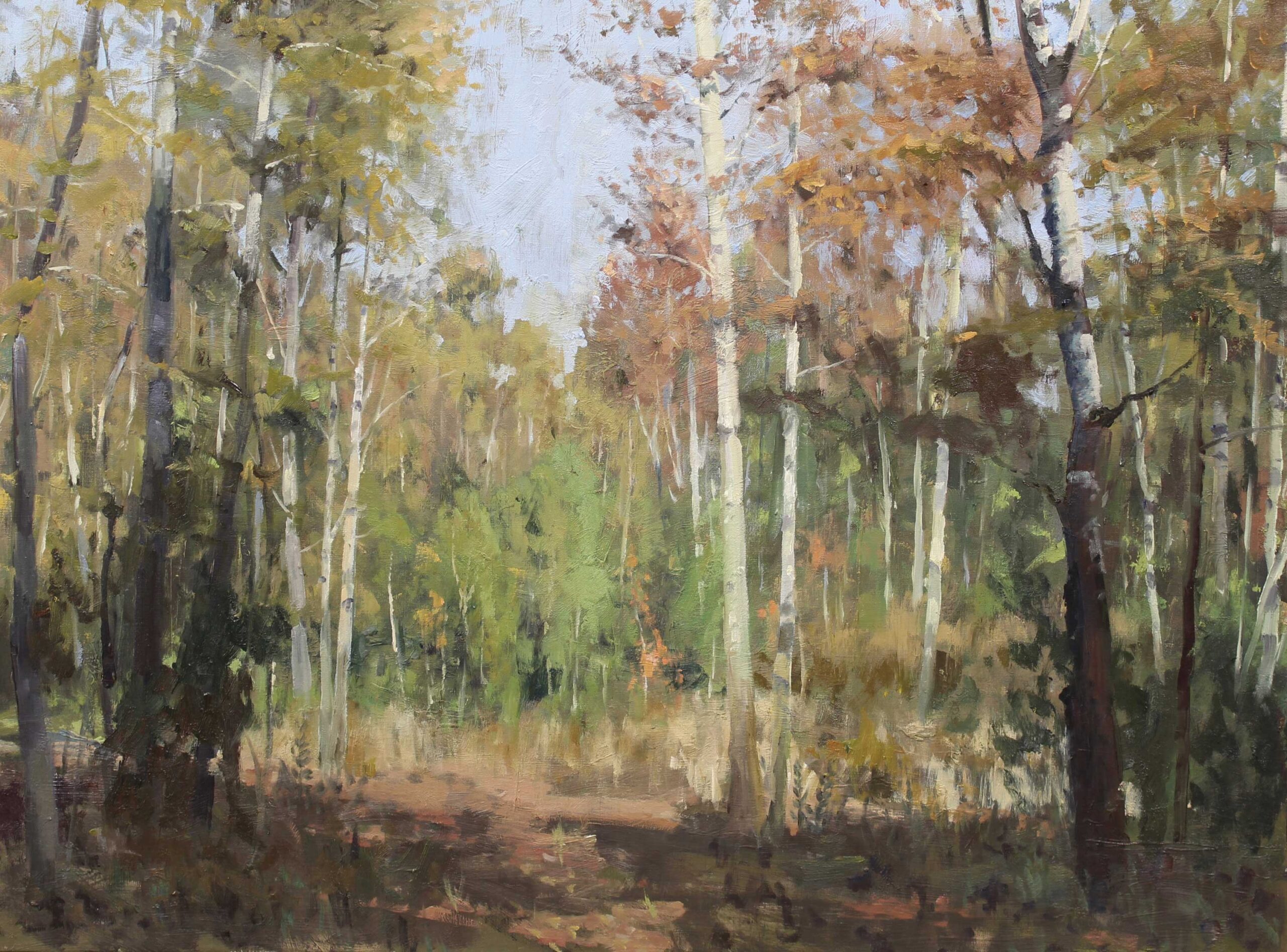
Roger Dale Brown, “A Walk through the Woods,” 2020, oil on linen, 30 x 40 in, collection of the artist
Robert David Jinkins: Horizontal Line
Miller Art Museum
Sturgeon Bay, Wisconsin millerartmuseum.org
Through April 10, 2023
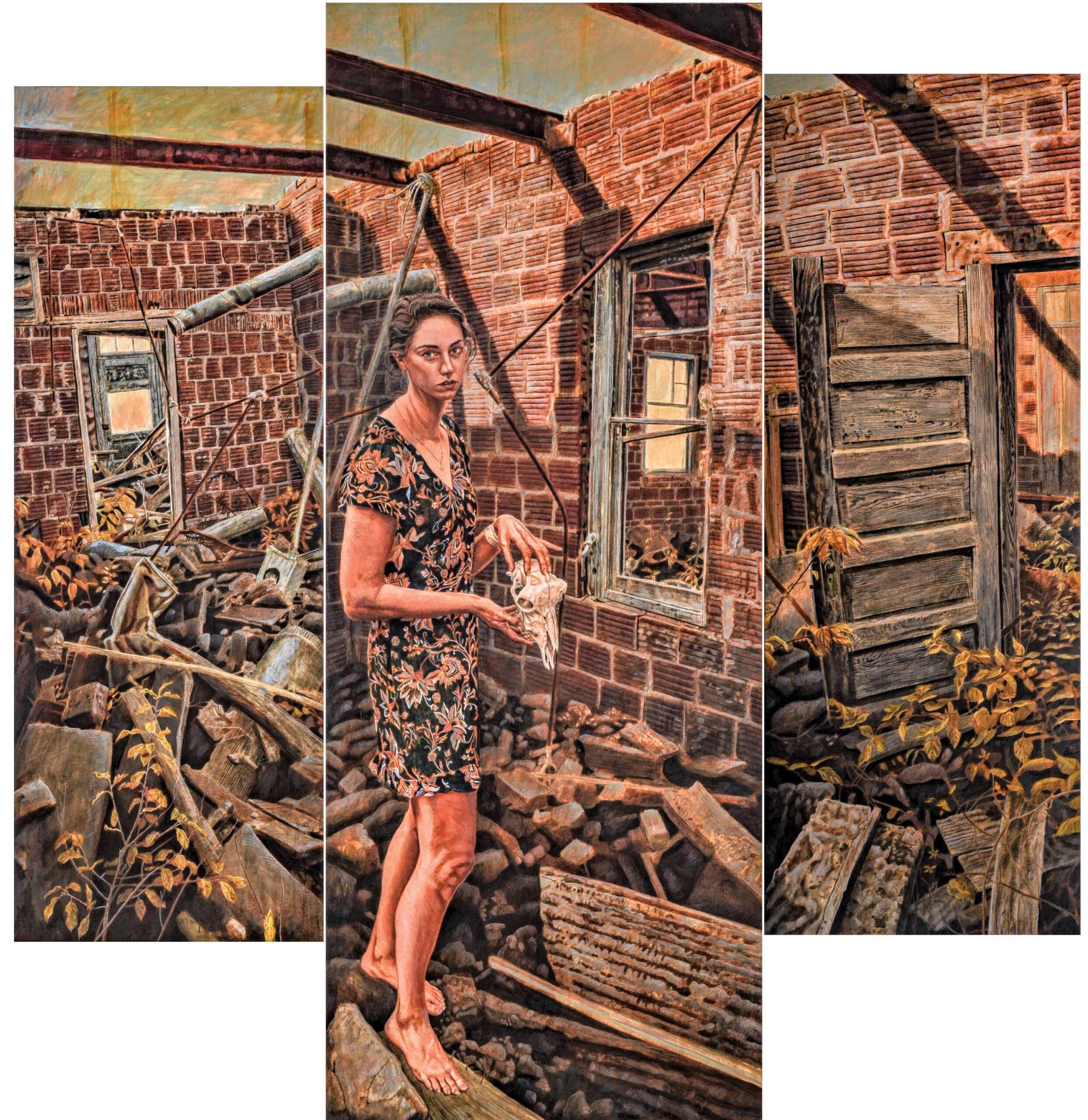
Robert David Jinkins (b. 1994), “Ovis Aries,” 2022, mixed acrylic media and graphite on panel, 72 x 60 in.
The Miller Art Museum is presenting large recent paintings created by Robert David Jinkins, most depicting life on the Wisconsin farm his family has owned since the 1840s. He explains, “Growing up on a farm, I gained an admiration and reverence for the land that so many of my family members have worked. I enjoy painting every blade of grass while allowing a disconcerting ambiguity to lurk below the surface in order to encourage viewers into a deeper dialogue with the painting.”
The exhibition’s curator, Helen del Guidice, adds, “These paintings are less idyllic and more forthright about the rural environment and its proximity to life and death. Jinkins connects the perimeters of the paintings as an object to the panoramic storytelling, through long panels, diptychs, and triptychs, which provides the viewer a visceral sense of place.”
Having earned an M.F.A. from Iowa State University, Jinkins is now a full-time lecturer in drawing at the University of Wisconsin – Stout. His scenes are complicated, sometimes slightly disturbing, reflecting his effort to, in his own words, “find the sublime in the mundane.”
Several works in this show were produced during a period funded by a grant from the Elizabeth Greenshields Foundation, a major force for good in the field of contemporary realism.
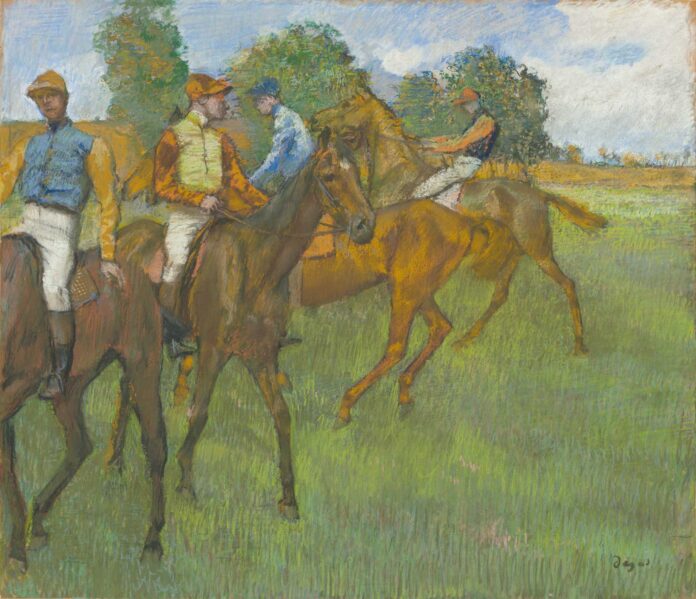
Edgar Degas (1834–1917), "Before the Race," c. 1887–89, pastel with charcoal underdrawing on tracing paper mounted on cardboard, 22 5/8 x 25 3/4 in., bequest of Leonard C. Hanna, Jr., 1958.27
On View: “Nineteenth-Century French Drawings from the Cleveland Museum of Art”
Cleveland Museum of Art Cleveland clevelandart.org, gilesltd.com
Through June 11, 2023
Since its opening in 1916, one of the Cleveland Museum of Art’s key collections has been its trove of French drawings from the 19th century. Made by almost 50 different artists, they range from preparatory graphite sketches to pastels finished for public display.
On view this season is a temporary exhibition of highlights, new research on which has just been published in a 200-page catalogue produced by D Giles Limited, London.
In 19th-century France, drawing evolved from a means of artistic training into an independent medium with rich potential for exploration and experimentation. A variety of materials became available to artists — such as commercially fabricated chalks, pastels, and specialty papers — encouraging talents ranging from Jean-Auguste-Dominique Ingres to Paul Cezanne to reconsider the place of drawing within their practices.
A growing number of public and private exhibition venues began to feature their creations, building an audience who were attracted by the intimacy of drawings and their unique techniques. In France and abroad, museums and individuals alike started to actively acquire these works while they were still contemporary.
Thanks to its deep pockets and insightful curators, the Cleveland Museum of Art has obtained outstanding examples right from its outset. Now everyone is invited to take a closer look.
As part of our effort to continue to help artists and art galleries thrive, we’re proud to bring you this week’s “Virtual Gallery Walk.” Browse the artwork below and click the image itself to learn more about it, including how to contact the gallery.
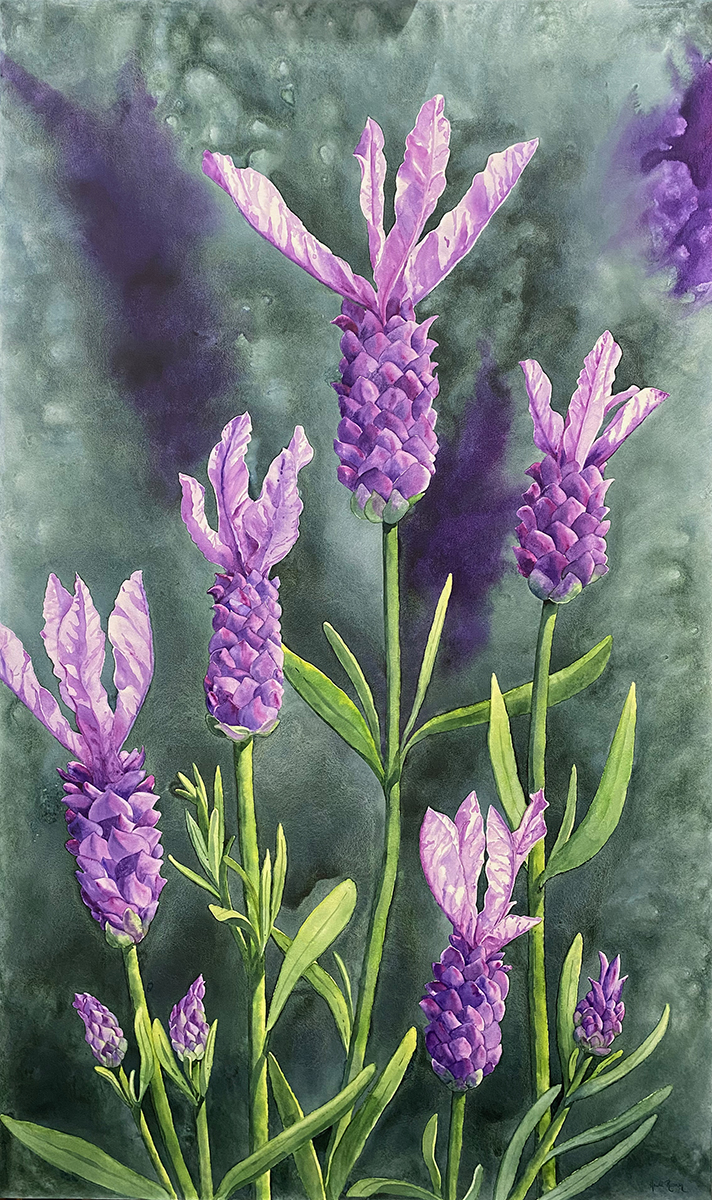
Lavender Serenity, Heidi Rosner, Watercolor on Canvas, 60 x 36 in;A Summer For Scarlet Paintbrush, Darcie Peet, oil, 20 x 16 in., Solo Show; ArtzLineRolling In, Chris Kling, oil, 36 x 48 in; Chris Kling
Want to see your gallery featured in an upcoming Virtual Gallery Walk? Contact us at [email protected] to advertise today. Don’t delay, as spaces are first come, first served, and availability is limited.
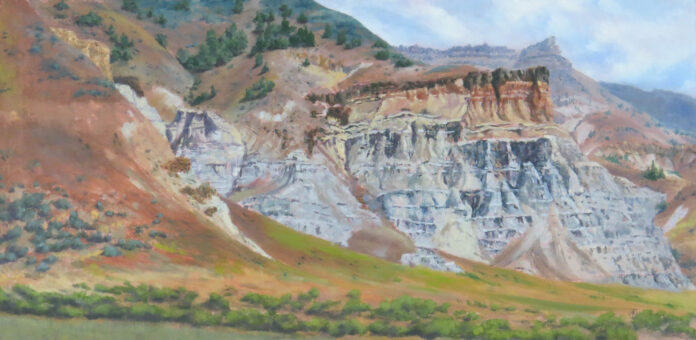
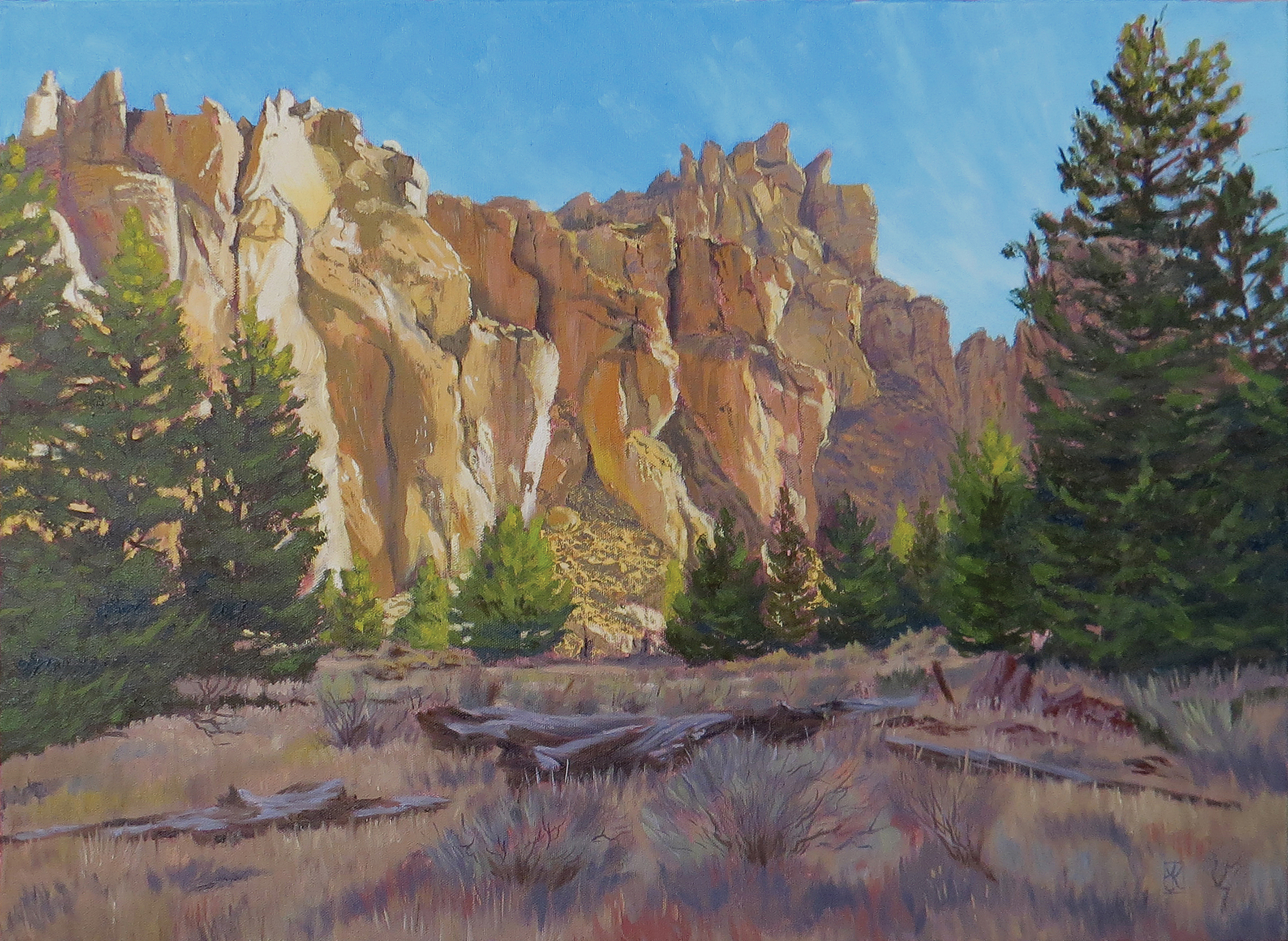
Krystal Allen, "Emerging Cathedrals," 12 x 24 in., 2023
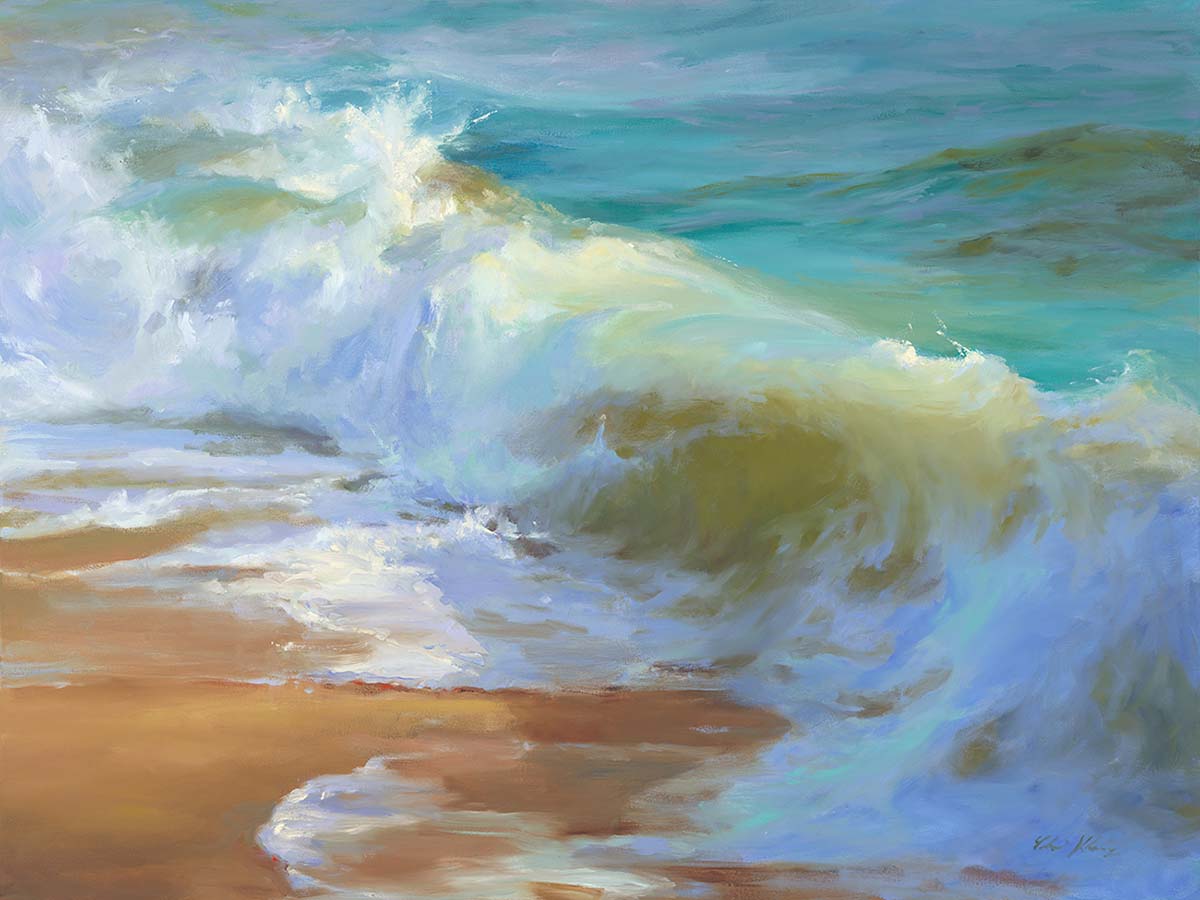
Landscapes and Seascapes On View: “Krystal Allen: Love of Nature” Original oil and watercolor landscape and seascape paintings of the American west.
Clymer Museum of Art
Ellensburg, Washington clymermuseum.org
Through March 25, 2023
“In the process of creativity, I find that the ends are a reward for the means,” says artist Krystal Allen. “The joy of creating an imagery of a moment or an emotion, and being able to share it with others, is the essence of my art. My intense love for both natural beauty and creating art makes for a wonderful combination. There are so many beautiful things to be painted and shared with the world, I feel it is an honor to have been given the talent to do so.”
“Krystal Allen’s paintings reveal a flawless demonstration of how light and shadow embrace the landscape,” said the curator. “This emphasizes the rugged energy of the terrain. Her technique works whether painting mountains, valleys, or rivers. Her refined attention to detail allows her to consistently create coherent compositions while presenting nature without exaggerated gestures or romanticism. This lends itself to giving the work a raw power, and an opportunity for the viewer to share this sensation through the honest beauty in her work.”
Krystal Allen, “Morning Glory,” 18 x 24 in., oil on canvas, 2022
About Krystal Allen:
Krystal was born and raised in the northeast, and she has lived in the west since 1974, residing in California and Colorado before moving to central Oregon. Her love of art began as a small child when she would spend countless hours drawing and dreaming of being an artist. Having been raised in a large, supportive, creative family, she was encouraged to follow her dream from the beginning. Her parents and grandparents were major influences on her creativity; they were cabinet makers, draftsmen, artists, seamstresses, and gardeners.
Most of her formal training took place when she was young and fortunate enough to have the same art teacher throughout her primary and secondary education. His guidance helped her to explore the many mediums that were available to the visual artist, to refine her abilities, and to focus on what she wanted to do creatively. Later in college, she concentrated on design and graphics while studying commercial art and marketing, as well as painting.
Influenced early on by the Hudson River School, the Surrealists, and the Impressionists, her work is constantly growing to encompass craftsmanship, sensitivity, and a sense of space and time. Finding inspiration in the natural world and light, she translates emotions into a visual image of a moment in time. Her goal is to create a body of work that will convey her perception of our beautiful world through a legacy of paintings.
Krystal is a current member of the Plein Air Paints of Oregon. She worked for 9 years as the West Coast Marketing Manager for PleinAir and Fine Art Connoisseur magazines and retired at the onset of the pandemic. She now spends the bulk of her time painting landscapes and seascapes and gardening.
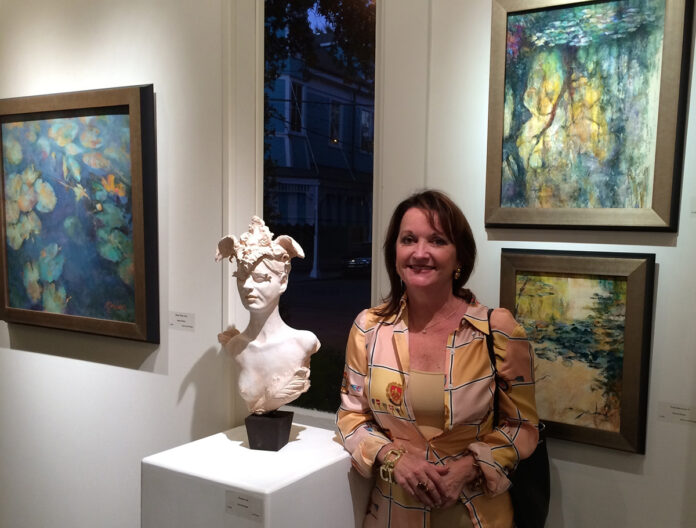
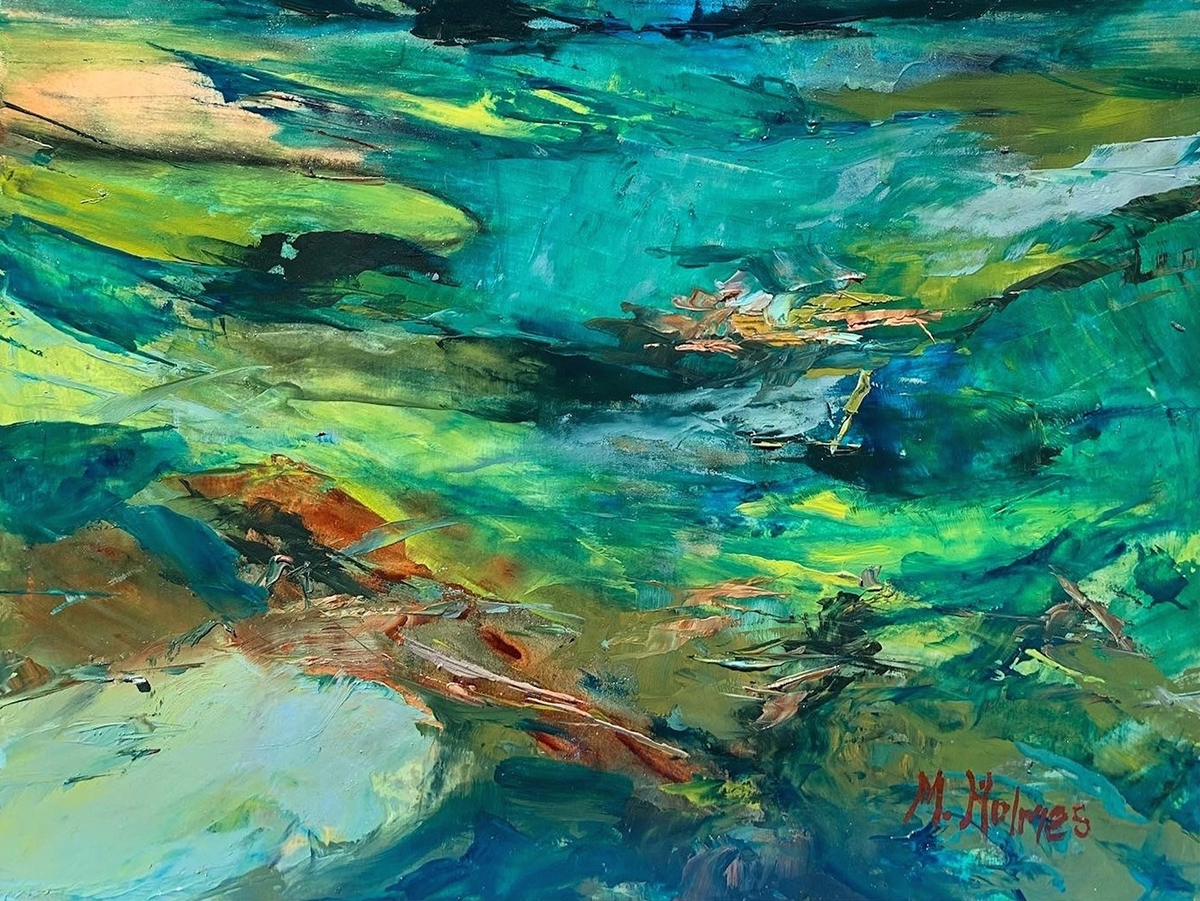
Artist Photo- Marcia Holmes. Celebrating 10 years- FAC first feature, Art Abounds in New Orleans, Marcia’s Garden District Exhibition
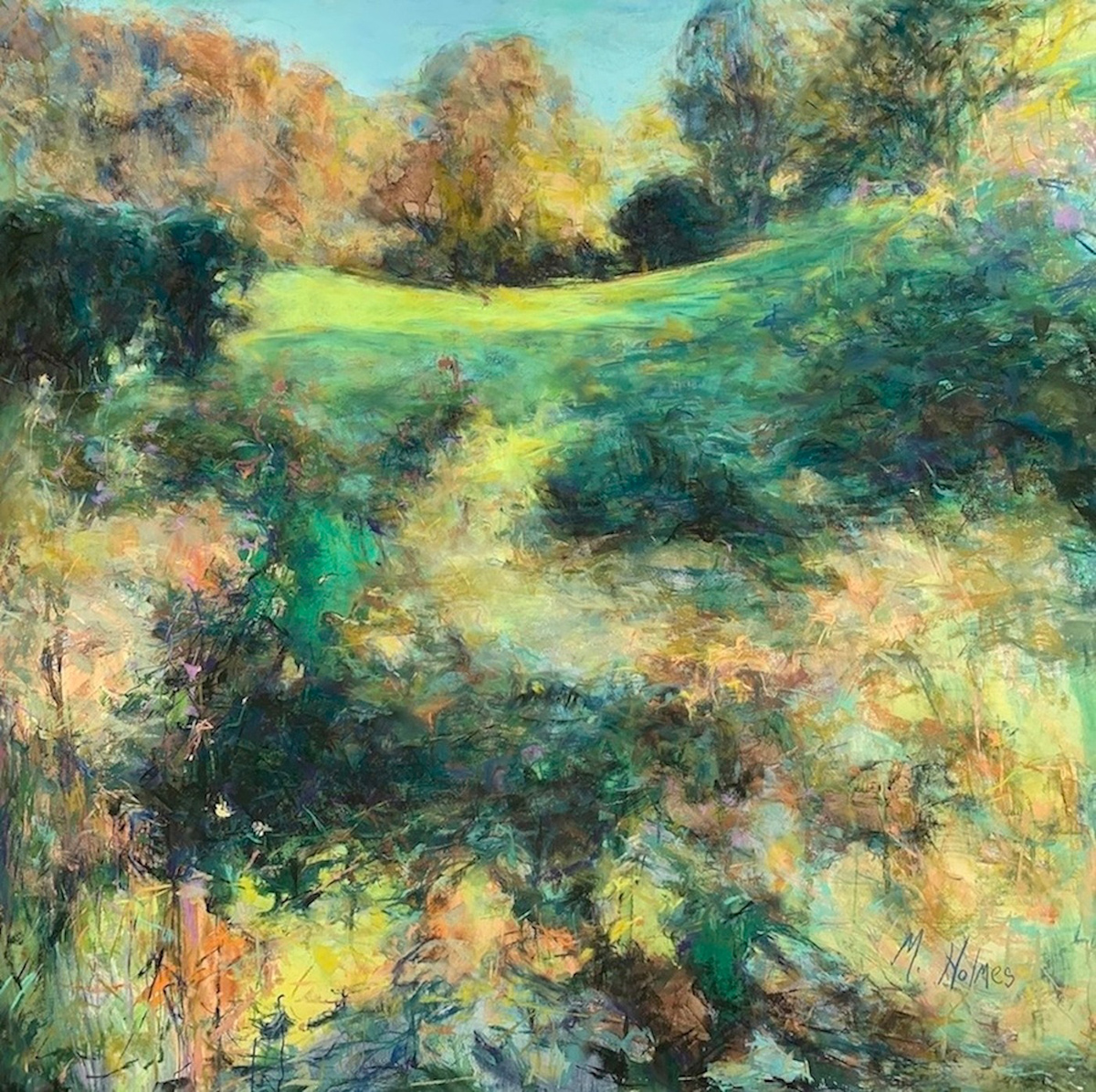
What’s the best thing about being an artist? Marcia Holmes: Living the artist’s life encompasses the best of an enormous range of emotion; the wonder and gift of creativity alone, dreaming art and pursuing the visions I’m compelled to paint, the boundless freedom of artistic expression; fulfillment, exhilaration, surprise revelations of self-discovery and beauty of unexpected finishes accomplished!!
Being a wanderlust, I’ve added a personal joy of being an artist, which is “I paint to travel and travel to paint. I’ll share an excerpt from my catalogue Anecdotes from Water’s Edge, 2017/2018-Degas Gallery, New Orleans Solo Exhibition, post a France painting excursion: “I am grateful for the experiences enjoyed, and further to be able to reveal the open heart of an artist, a voyager, a woman of conscience and faith. There is no comparison to being alone in nature. For me it is the closest thing to God and ultimate freedom.”
The Lagniappe, bonus of being an artist, is the personal relationships formed meeting collectors, working with art professionals, students, and just talking art with friends! This connectivity is the best part of living an artist’s life!
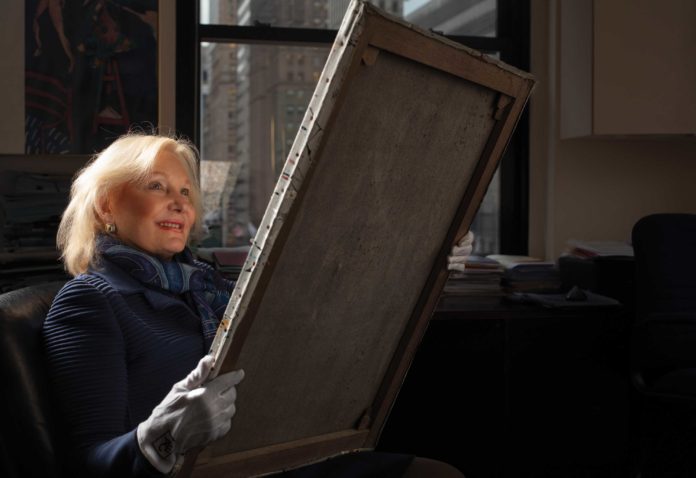
IFAR’s executive director, Dr. Sharon Flescher, looks at a painting submitted to IFAR’s Authentication Research Service; photo: Pascal Perich
On an art authentication foundation that helps root out fakes and frauds — a growing problem in the 1960s.
by Leslie Gilbert Elman
The International Foundation for Art Research (IFAR) was established in 1969 at the suggestion of New York state’s attorney general to fill the void for an “authoritative, impartial, not-for-profit body to research works of art with uncertain authorship and also educate the public about art world issues.” For individual collectors, IFAR would help determine whether an heirloom that someone’s great-grandfather considered a Rubens was indeed that master’s work. For institutions, it could help to root out fakes and frauds — a growing problem in the 1960s.
Around this time, for instance, art forger David Stein was making and selling false Picassos, Modiglianis, Klees, and more at an alarming rate. He was arrested in New York in 1967, when Marc Chagall spotted a fake of his own work, painted by Stein, hanging in an exhibition. Stein pled guilty to six counts of counterfeiting and grand larceny, served time in prison, went to France after his release, and was arrested and convicted there as well. Nevertheless, Stein’s paintings in the styles of modernist masters — this time signed with his own name — were shown in a 1970 gallery exhibition titled “Forgeries by Stein,” and he was even enlisted to make the fakes featured in director Alan Rudolph’s 1988 film, “The Moderns.”
To be sure, stories of exploits such as Stein’s are tantalizing, and it’s understandable when they become the subject of articles, books, and even films. Yet, sadly, cases of misattribution, fakery, and fraud happen more often than art world professionals might care to admit. They inflict serious damage and have long-lasting ramifications. In 1969 there was an undeniable public need for IFAR, an independent, objective source that could conduct unbiased research to determine an artwork’s authenticity.
Over time, IFAR’s mission broadened to include investigations into provenance, particularly related to the restitution of artworks looted by the Nazis in the 1930s and ’40s. It created and maintained the Art Theft Database (precursor to today’s Art Loss Register) and has provided expert guidance and scholarship to Interpol, the FBI, and other law enforcement agencies.
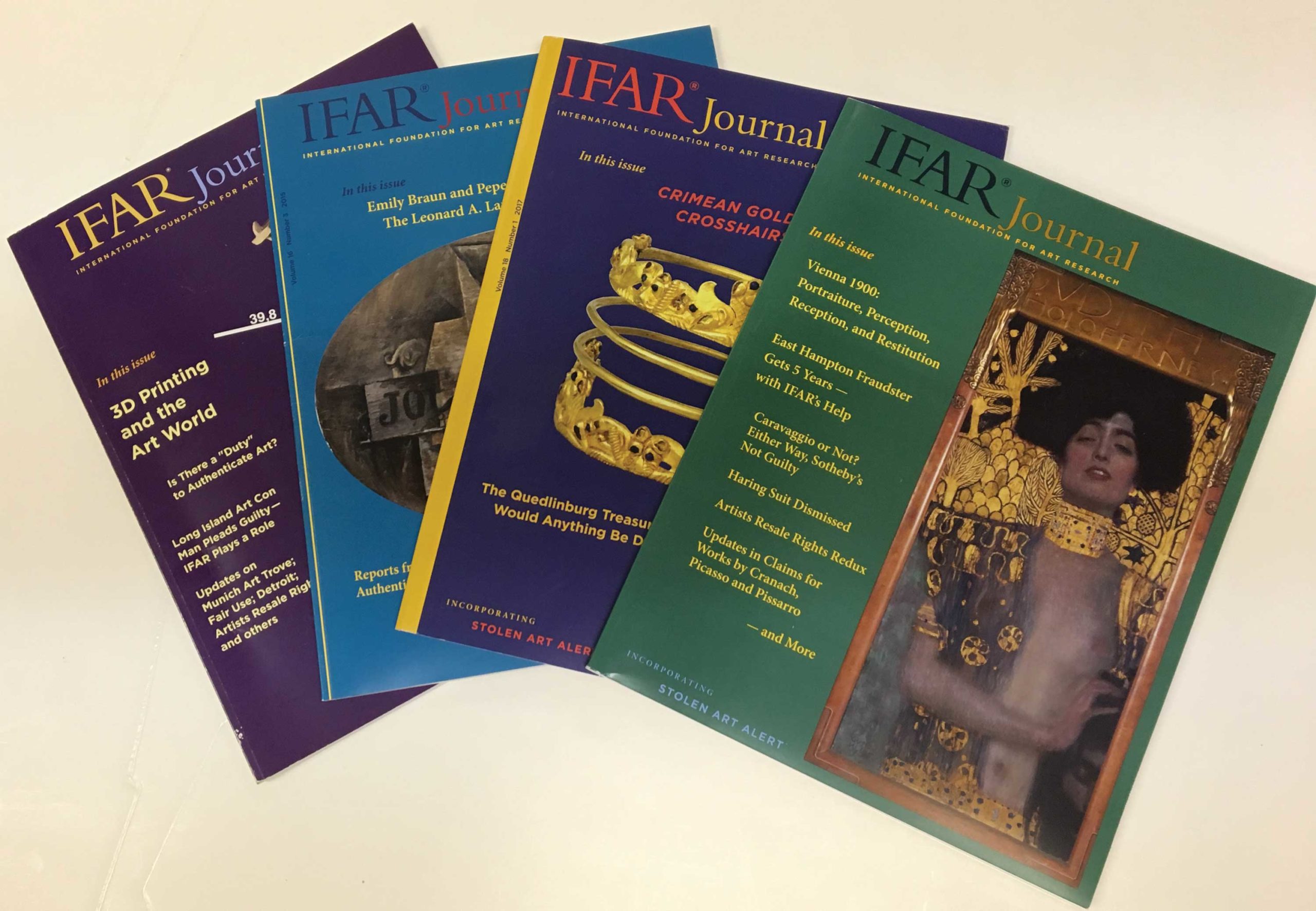
Four issues of IFAR Journal
This is the work for which IFAR is best known. But over the course of its 50 years, IFAR’s resource offerings have expanded to include a comprehensive Catalogues Raisonnés Database with more than 4,500 entries for over 3,000 artists — from Hans von Aachen (1552–1615) to Francisco de Zurbarán (1598–1664). IFAR also created the Art Law & Cultural Property Database of legislation and case law from the United States and abroad related to cultural property ownership and loss, authenticity, and restitution. This is an invaluable resource for attorneys, scholars, collectors, and anyone else interested in this continually expanding legal area.
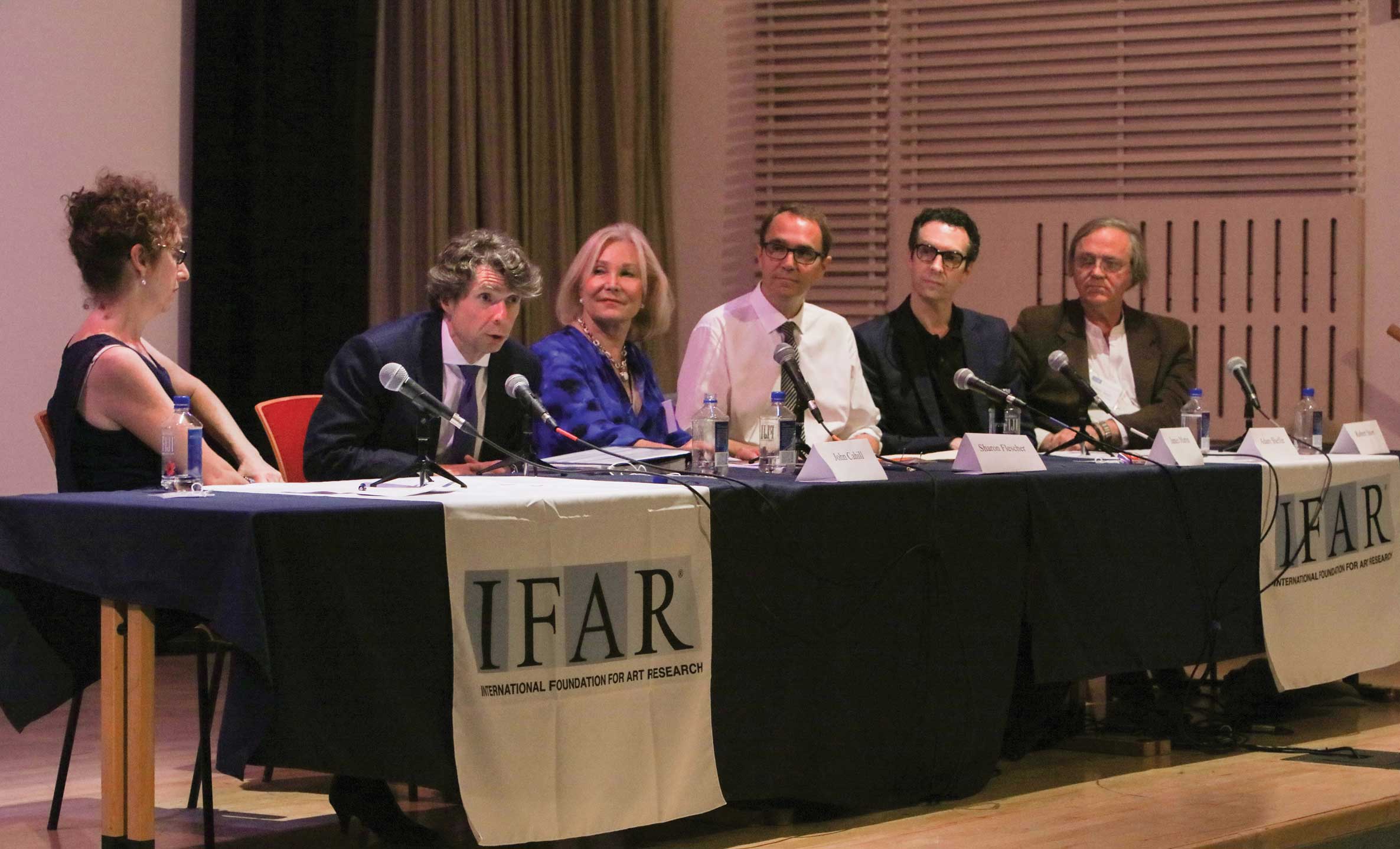
Participants in “20/20 Hindsight: Lessons from the Knoedler/Rosales Affair,” an IFAR Evening panel held in July 2016. Left to right: Patricia Cohen (who broke the story of this affair in The New York Times), John Cahill, Sharon Flescher, James Martin, Adam Sheffer, Robert Storr. Photo: Steven Tucker
IFAR’s members include museum professionals, dealers, scholars, collectors, students, and “a lot of attorneys,” executive director Dr. Sharon Flescher says with a smile. “They look to us for our research services, online resources, the quarterly IFAR Journal, and our events.” In fact, the organization’s public programs addressing top-of-mind subjects are almost always sold out. (Just for example, “What Is It about Modigliani?” and “Notre Dame: Iconic Cathedral; Disastrous Fire; Uncertain Future” took place in 2018 and 2019, respectively.) Today all of IFAR’s work is funded by contributions and dues, subscription and submission fees, sponsorships, and grants. It is not an endowed foundation.
“We guard our reputation for integrity jealously,” Flescher notes, adding that any owner of an artwork who engages IFAR’s Authentication Research Service must sign an agreement stating that she or he understands that IFAR’s determination about its authorship may not necessarily be what the owner was expecting or hoping for. “We have no vested interest in the outcome of the research,” she explains. “We don’t buy, sell, or even appraise art for monetary value.”
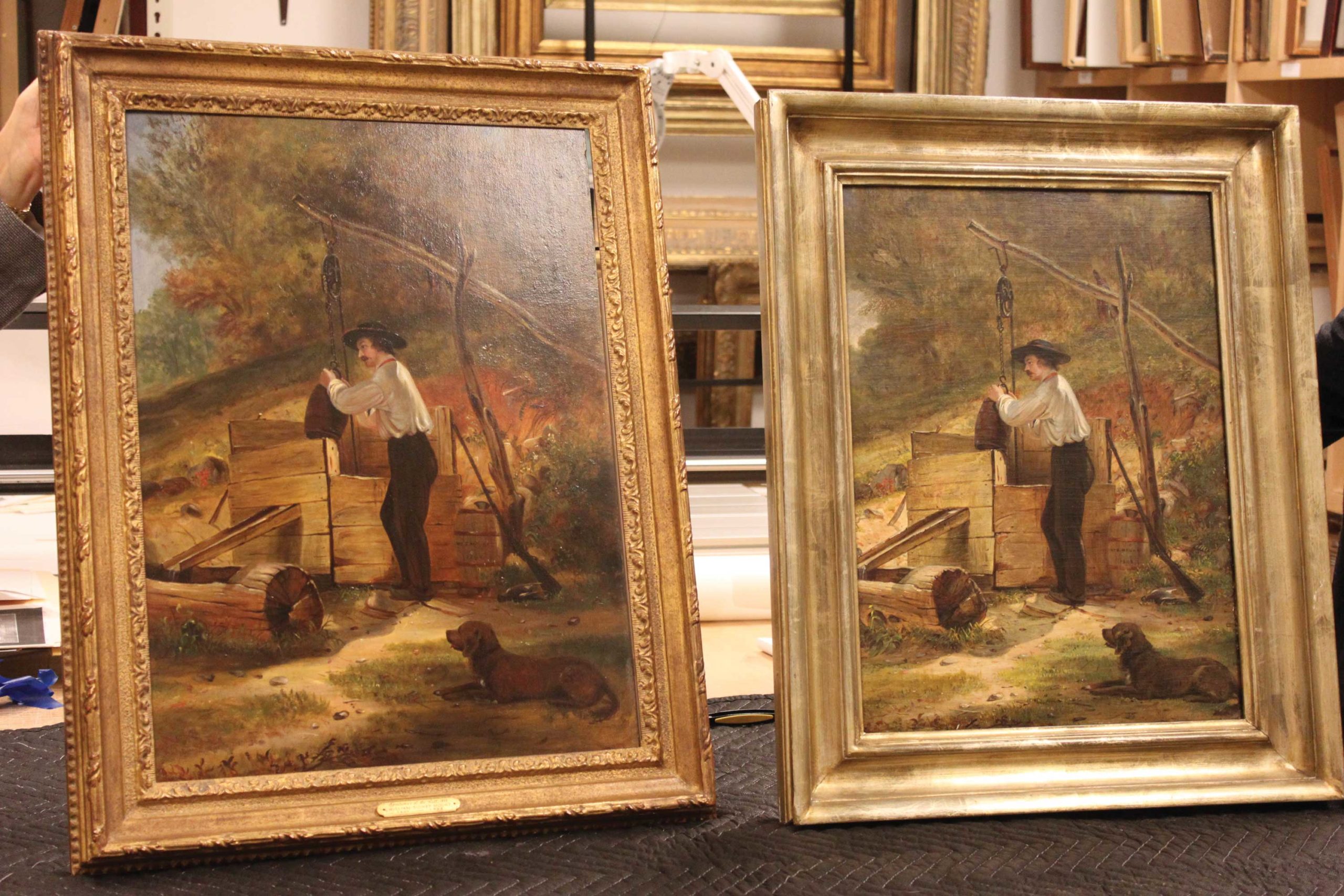
Right: WILLIAM SIDNEY MOUNT (1807–1868), At the Well (1848, oil on cardboard mounted on panel) in the collection of Connecticut’s New Britain Museum of American Art. To its left is Sportsman at the Well, an oil on panel that was submitted to IFAR for review.
It Might Be a Mount, But Not William Sidney
On rare occasions, the results of IFAR’s research may raise unexpected questions without answers. Such was the case when it was asked to say whether a painting known as “Sportsman at the Well” was the work of American genre painter William Sidney Mount (1807–1868). It was nearly identical to “At the Well,” an 1848 painting known to be by Mount and now in the collection of Connecticut’s New Britain Museum of American Art.
An example of the idealized rustic scenes for which Mount is known, the painting in question was also signed and dated 1848. The fact that it had been owned by Mount’s descendants as recently as 1941 would indicate it was not a forgery, and Mount was generally known to have painted several versions of the same scenes. Nevertheless, the quality of handling and treatment of details in this example were inferior to what we see in Mount’s known works — a fact made clear when it was placed side by side with New Britain’s version.
So, if Mount didn’t paint “Sportsman at the Well,” who did?
IFAR’s investigation turned up a couple of candidates, most likely of which was Mount’s niece, Evelina. Like her uncle William and her father Henry, Evelina Mount was a skilled artist. She frequently copied William’s work and he advised her on techniques and materials. They lived in the same house on Long Island for several years, and Evelina took over his studio after his death. Similarities between Evelina’s work and William’s — right down to the materials they used — are thus easily explained. Yet because no evidence was found to confirm Evelina’s copying of this specific painting, her hand in its creation can still only be assumed.
Art Authentication: Of Rembrandts and Restitution
Of the many cases in which IFAR has been asked to provide expertise, one that began in 2002 and took more than two years to complete stands out for Flescher because of its rare resolution.
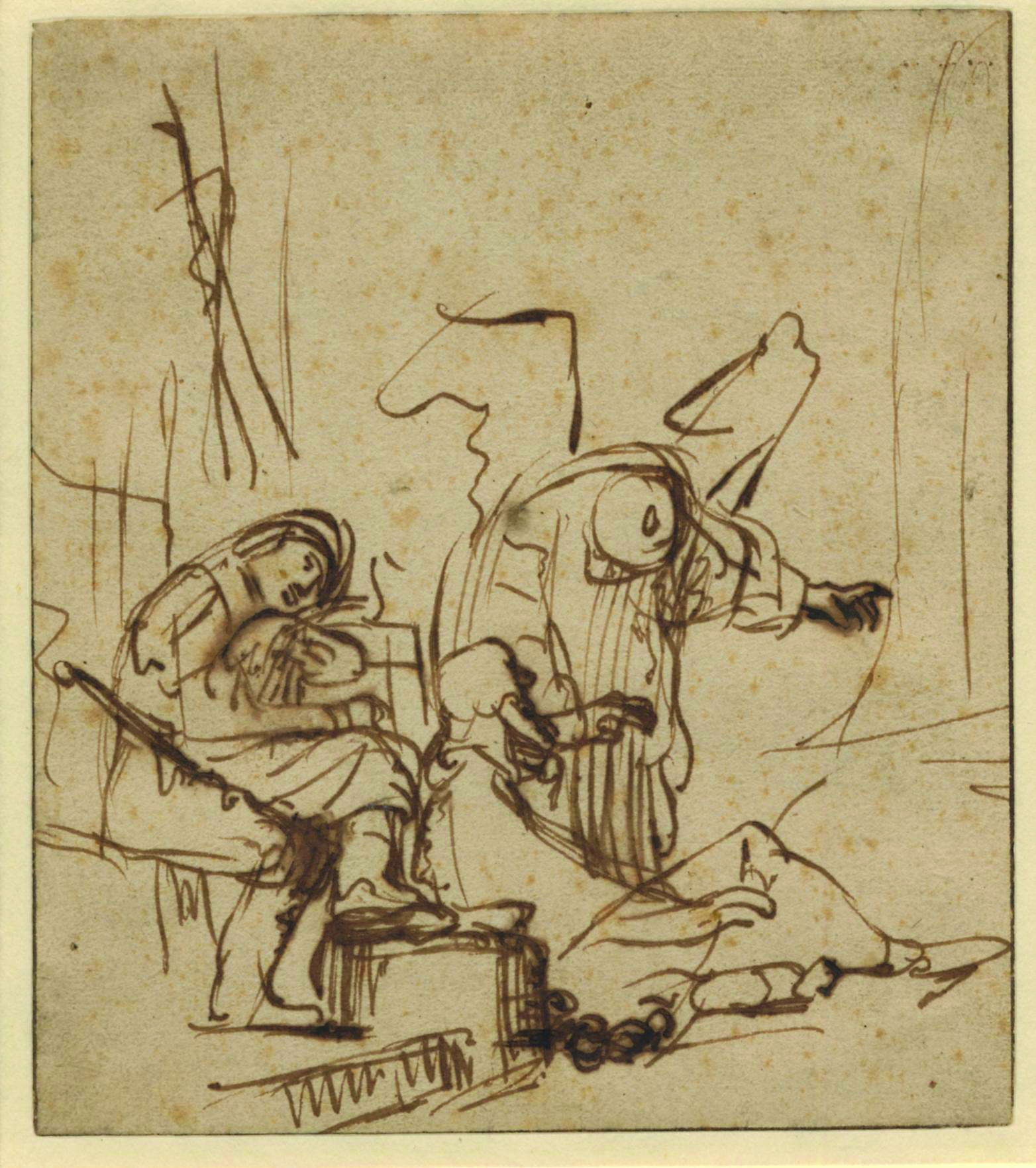
It began with an American professor who inherited a Rembrandt drawing she had reason to believe had once belonged to Arthur Feldmann, a lawyer in Brno, Czechoslovakia (now the Czech Republic). On March 15, 1939, the day the Nazis invaded Czechoslovakia, Feldmann’s collection of some 700 Old Master drawings was confiscated by the Gestapo. He and his wife died at the hands of the Nazis, and their art collection was eventually dispersed. Much of it remains unaccounted for. Some works were sold at auction by Sotheby’s London in 1946; four works made their way into the collection of the British Museum.
In 2002, after reading that Feldmann’s heirs were searching for objects from his looted collection, the professor (who prefers to remain anonymous) sought to confirm the provenance of her drawing. If it had indeed been looted, she wanted to return it to Feldmann’s family without recompense. She consulted a museum director on how to proceed with confirming the provenance and finding Feldmann’s family. The director referred her to IFAR.
As Sharon Flescher recalls, putting the professor in touch with Feldmann’s family, although initially difficult, turned out to be fortuitously simple: his grandson, Uri Peled, who had initiated the search, was a new subscriber to the IFAR Journal. The connection was facilitated and the research began.
Records reviewed by IFAR and the Commission for Looted Art in Europe (CLAE), which was representing the Feldmann family, showed that the drawing — “The Liberation of St. Peter from Prison” — had appeared at the Sotheby’s sale in 1946. The professor knew that her family acquired the drawing in good faith from an Amsterdam dealer in the 1970s. Now it seemed clear that the drawing was part of the looted collection and would be returned to the Feldmann family, but there was a surprise in store.
“Although our task was to determine whether the work had been looted, we also examined the drawing itself,” Flescher recalls. The late Egbert Havercamp-Begemann, a professor at New York University’s Institute of Fine Arts, member of the Rembrandt Research Project in Amsterdam, and longtime member of IFAR’s Art Advisory Council, lent his expertise. “It was his opinion that the drawing was not by Rembrandt, but by a follower, probably Govert Flinck,” Flescher says. That had also been the opinion of another great Rembrandt scholar as far back as 1956. In 2004 the drawing was returned to the family, who two years later presented it to the British Museum, where curator Martin Royalton-Kisch affirmed the work was by Flinck.
GOVERT FLINCK (1615–1660), The Liberation of St. Peter, c. 1639, pen and bistre on paper, 5 2/3 x 5 in., British Museum, London, 2006,0930.1
This reattribution might have made the drawing less “important,” but its significance in cultural history remains undiminished: this case marked a rare instance that a Nazi-looted artwork was returned to its rightful owners unprompted and without compensation of any kind. “The professor was, in my mind, a true heroine, as no one would have known she had the drawing,” Flescher notes. “From the start, it was her intention to err on the side of generosity.”
It’s safe to say that every IFAR investigation, even if it ends with a question mark, adds something to art-historical scholarship. Each study is exhaustive and may require many months to complete, yet it is work that needs doing. “We have dealt with issues of theft, looting, fakes, and so on, for 50 years, long before they became ‘sexy,’” Flescher explains. “Now they are more in the news than ever, making our work more significant than ever. But I think our supporters fund us because they realize how important — and sorely needed — integrity in the visual arts is.”
Fine Art Today would like to congratulate William Suys for being elected Master Signature Member in the Oil Painters of America, a non-profit organization dedicated to the preservation of representational art.
The recognition, he says, “is a heartwarming and humbling confirmation of where I stand as an artist. It is also a huge opportunity and challenge, as it lays a foundation for a new level in my exploration of Art and what I am able to develop and offer. I really look forward to doubling down on my existential effort toward realizing Artistic mastery.”
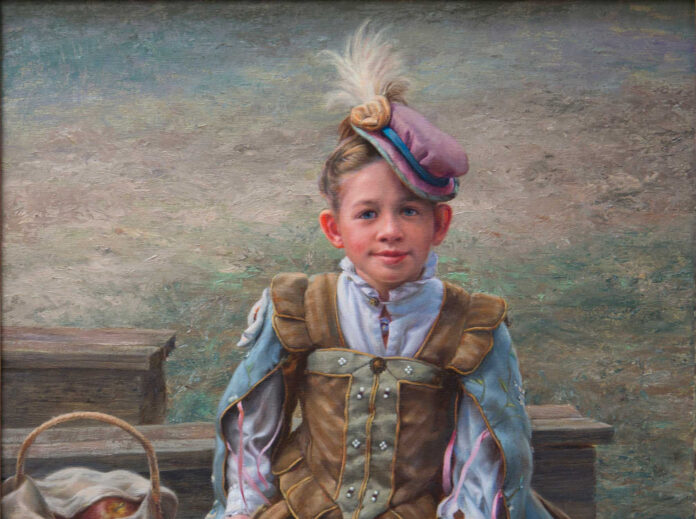
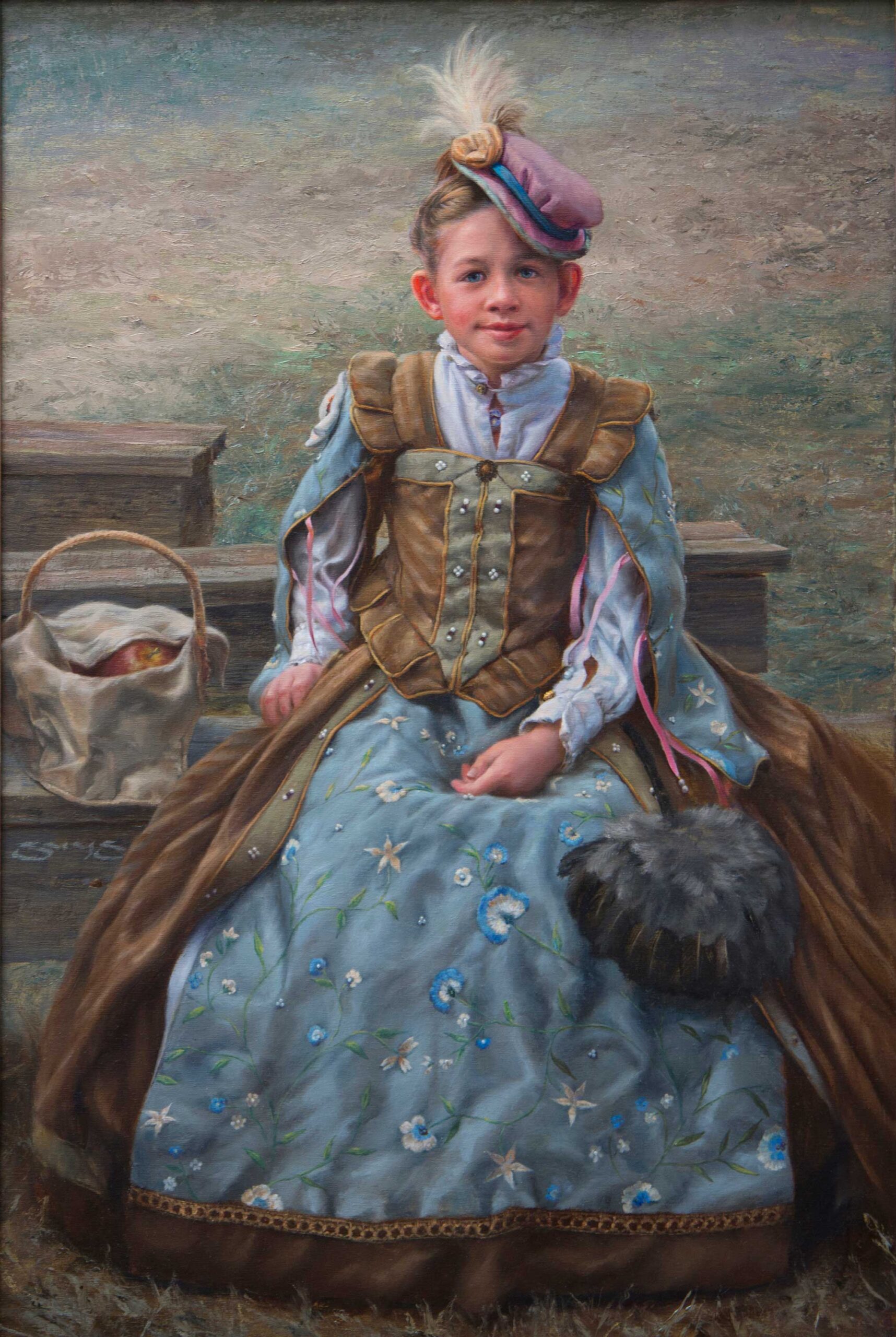
Representational art by William Suys, “Awaiting the Faire,” 36 x 24 in. “I love when I come across a person and personality that just grabs me,” William said. “This girl’s mother was putting the final touches on a beautiful dress I believe she made for the Renaissance Faire. I loved painting the design, the beauty of the material, and the embroidery, along with the engaging quirkiness of this young lady.”
William’s announcement is wonderful, and our team is happy for him and his many achievements. As he and I continued to converse via email, however, I realized that this “story” is much bigger. His is a story that is representative of why so many of us are drawn to art and from so many different angles. He helps us understand with a fresh perspective why it’s so important. Why it’s so much more than what we end up viewing in a frame.
For example, he shares how his artistic path might have veered toward music, specifically playing the trumpet. “Both of my parents were deaf, and so much of their world came to them through visual stimulus,” William said. “Still, I always found music incredibly interesting and stimulating.
“When I was in high school, I was learning to play the trumpet; I was in my basement bedroom practicing and my sister was at the door listening. My dad also came to the door, and after a while, he asked her, ‘Is he good, does he sound good?’ (all in sign language, of course).
“At that moment, I decided working on any musical talent wasn’t really fair to them, and I should really focus on areas that they could appreciate, too.”
Without further ado, enjoy the following exclusive and incredibly moving interview with William on his path in representational art, and in life.
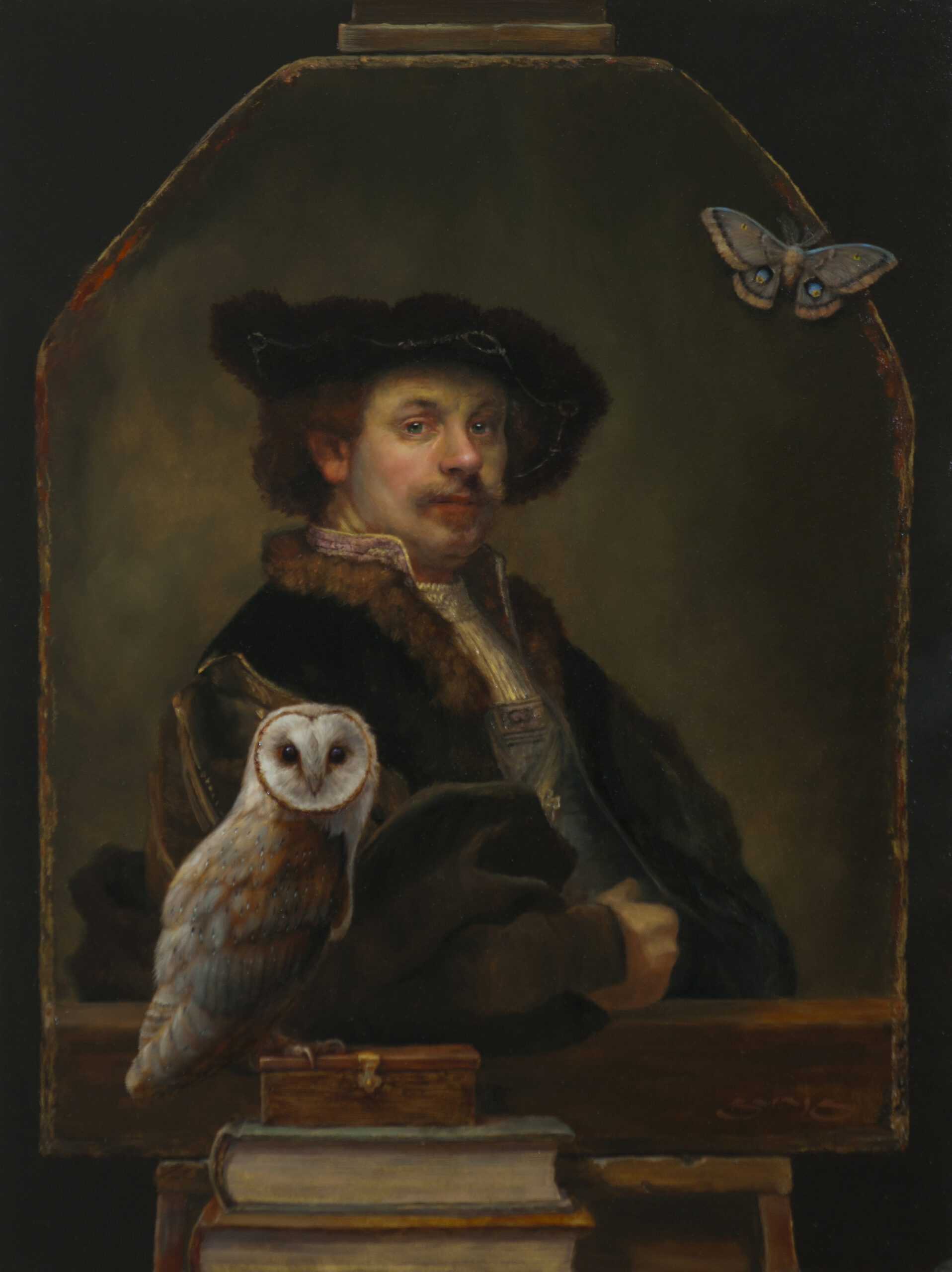
William Suys, “Perceptions,” 24 x 18 in. “This early painting is a favorite, and it won Best of Show in the Salon International. It started with a dying moth we found when visiting my wife Kristin’s dad in Sarasota. I found the appearance and texture of this moth so interesting, so I carefully brought it home to paint. As I spent time with it, its camouflage and faux ‘eyes’ called me to explore a range of visual symbols, whether natural or man-made.”
Cherie Dawn Haas: Tell us a little about your path in art, and how your work has evolved since the beginning.
William Suys: To be honest, answering this question would require a long, wildly diverse discussion of ‘Life’ and ‘Art.’ As my work evolves, I believe the two are completely intertwined. In this format, I’ll share a few quick notes about both:
I have been drawing in some shape or form since my earliest memories. For some reason, I’ve always been compelled to create things, whether in two dimensions or three. There has always been an urge to produce something that wasn’t there before. It did not start out as a pursuit, it was simply what I did — it is still what I do. I do recall a pivotal moment in my young drawing life: We had a class trip to see an exhibit of drawings by Andrew Wyeth at the Art Institute of Chicago. I was blown away by what I saw. The thought that kept running through my head was, “So …THAT’S what I’m trying to do!”
I enrolled in a commercial art program and moved on to Fine Art in college. Abstract expressionism was in vogue and I realized some artists were more successful simply due to their ability to ‘wax eloquent’ about the schlock they created. I intuitively felt I should hone my craft and my vision would evolve. I also realized the key to being a successful artist isn’t whether you’re trained or self-taught; it is being a self-driven artist … seeking and developing the visual and emotional building blocks that feed one’s growth.
While in school I experienced a great range of “creation,” from the potter’s wheel and sculpting (which may have been my forte) to creating the exploded-view Assembly Manual for Excalibur Motor Cars and having a one-man show. I received tremendously positive feedback and support from my instructors, including requests that I apprentice with a professor who had works in the Smithsonian.
But, because the Fine Art world was a strange and dicey proposition during this time, I morphed from an Art Major to graduating as a Business Major so I could feel secure in my ability to raise a family. As it turned out, I loved that life and the company I worked for, and I learned so much that also strengthened my work and my artistic career. I still drew and painted in watercolor every day.
When I left the company, I switched from watercolor to oils and found rapid success. I was working toward building a major series of paintings while traveling the world to curate an international art collection, but my wife became severely alcoholic and I was prompted to focus solely on the kids and life at home. This caused me to shift toward work that was more basic and could be marketable in local galleries; a safer solution, but also something I feel stymied my larger creative potential. Still, my kids were more important than my art ‘mistress’ and I just did my best.
Curating and purchasing an international collection of art reinforced for me how important it was to deliver a story, message, or emotion in the art I responded to. I also saw the importance of maturity in one’s work; there are often new artists who are very capable craftspeople, but years of work and understanding seem to infuse an artist’s work with depth and gravitas that will stand the test of time.
Fortunately, after a few difficult years, I met and married Kristin. She was a former Designer/Art Director and lifelong “art person” — maybe even more than I was! She understood what I was about and was completely supportive of me and my work. Her desire to see my work develop and my career grow has been a wonderful catalyst. Though she’s an uncompromising critic, I can never thank her enough.
Even with this healthy new life, the past few years have been consumed by the illness and death of my son. He died a Major in the Air Force of cancer from burn pit exposure. This has been so heartbreaking that for the first time in my life, I have not created art on a daily basis. I do, however, feel deeply that the aftermath of this experience is driving me to truly dive into my core principles and I will begin to create work that reflects my soul. Though it’s been difficult, I believe it may result in the true “evolution” of my mature work.
In short, the evolution begins with understanding and developing one’s craft; transitioning from learning how to see to building upon that foundation to eventually express life and feeling in a visual manner. I am really looking forward to what will come in the years ahead.
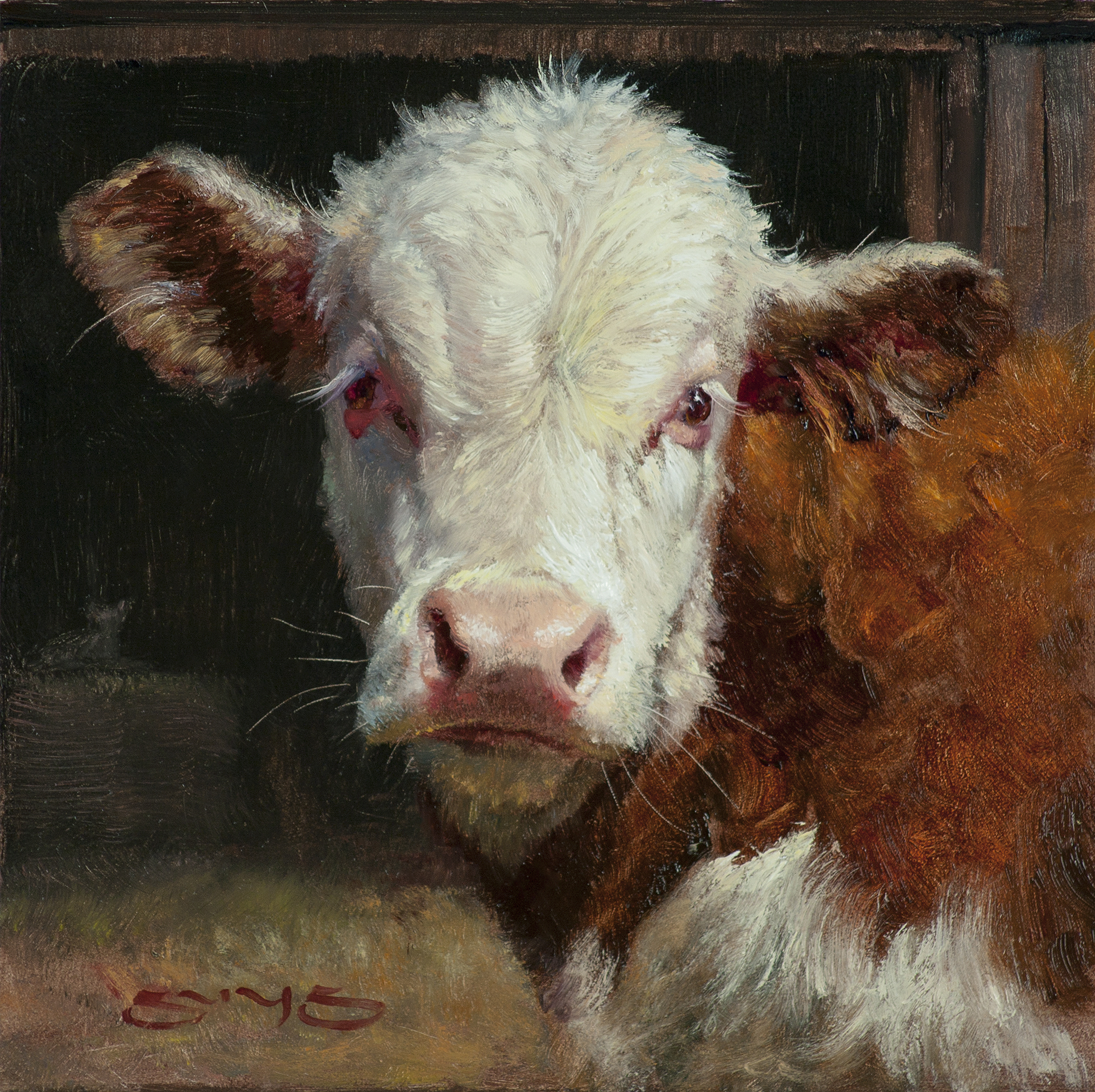
William Suys, “Curious Calf,” 6 x 6 in. “Some paintings just dance themselves onto a surface. This one appeared in a wonderful hour or two and has had a magical presence ever since.”
You’re known for your incredible figurative works, among other subjects in representational art. What are some of the things you consider when painting one’s portrait?
Thank you for that.
When I’m painting someone’s portrait, a simple likeness is only a beginning. I want to bring that specific person and personality to life. I work to fully understand the structure, gesture, and form, and I like to imagine my brush laying both transparent and opaque paint over and around the actual surface of my subject.
I also find it is very helpful to “fall in love” with one’s subject … to fall in love with the beauty of that particular human form and its presence. Once you really become intimate with your subject, celebrating that individual seems to flow naturally and the end result will breathe forever.
What is one of your favorite paintings (by you), and can you tell us about it?
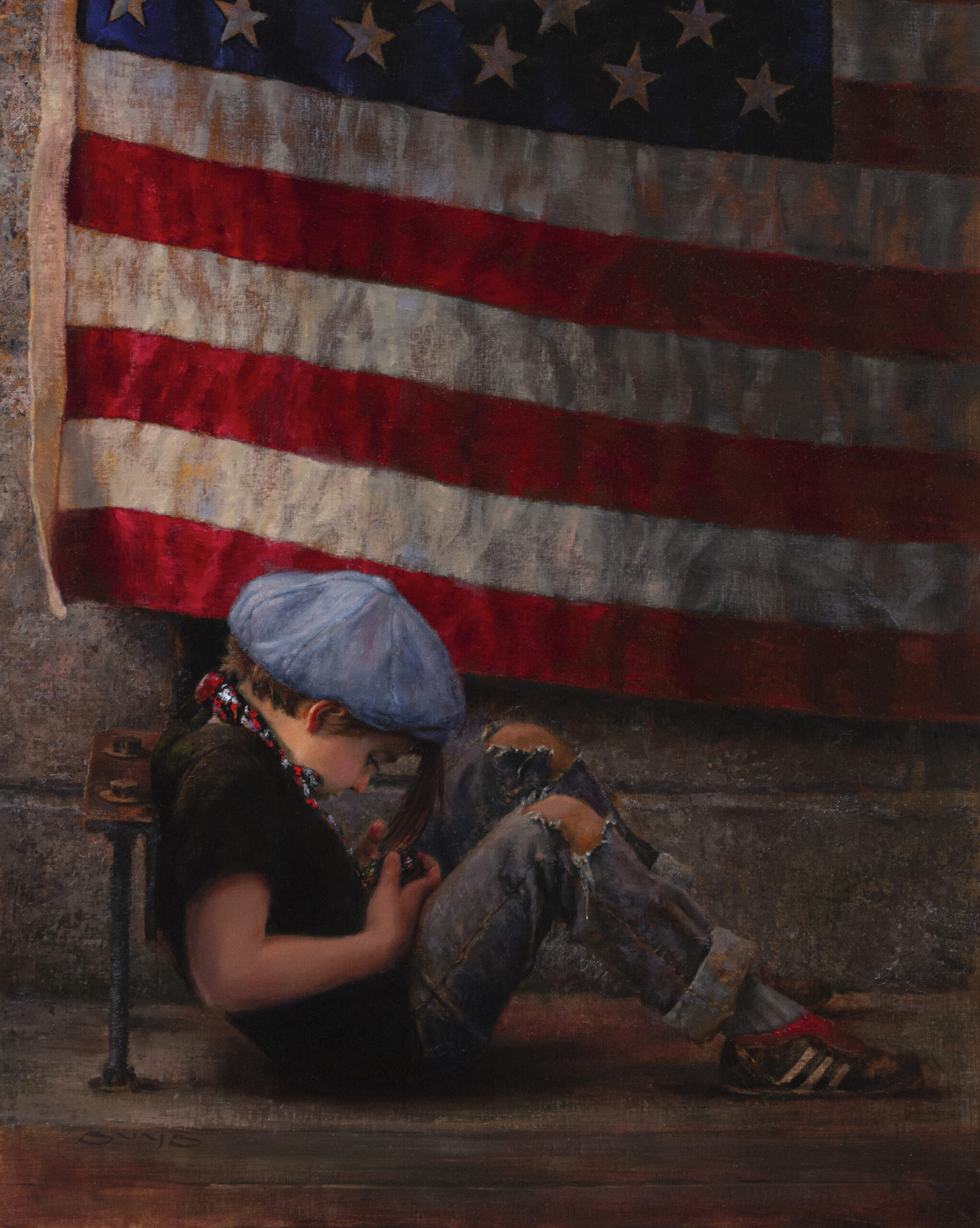
A current favorite is “The Immigrant.” I feel I’m expressing a life … the young subject is engaged within themself, and we are not sure exactly what they are doing or where they are going, but I sense wonderful potential within the world of this piece. I’m happy it expresses a story in beautiful, interesting paint.
William Suys, “The Immigrant,” 30 x 24 in. “As I mentioned in the text, I love this painting; both the process of its creation and its lasting presence. It’s an intimate moment that speaks to a lifetime of discovery and promise.”
How does plein air painting fit into your process?
I always say I do plein air because it informs my work, and I mean it! When plein air painting, we’re being presented all the questions, and they take all forms; the solidity of a building, the transparency of atmosphere, the transition of light, and the translucency of a tree. With each painting, we learn a little bit about how to understand the complexity and beauty of interpreting what is presented to us in the natural world.
As I go forward with my plein air work, I’ll want to build a two-dimensional personal celebration of the environment presented to me — while working toward a genuine emotional response. Because of the immediacy and idiosyncratic nature of each plein air experience, success is not guaranteed, but sometimes serendipity pulls everything together with very satisfying results.
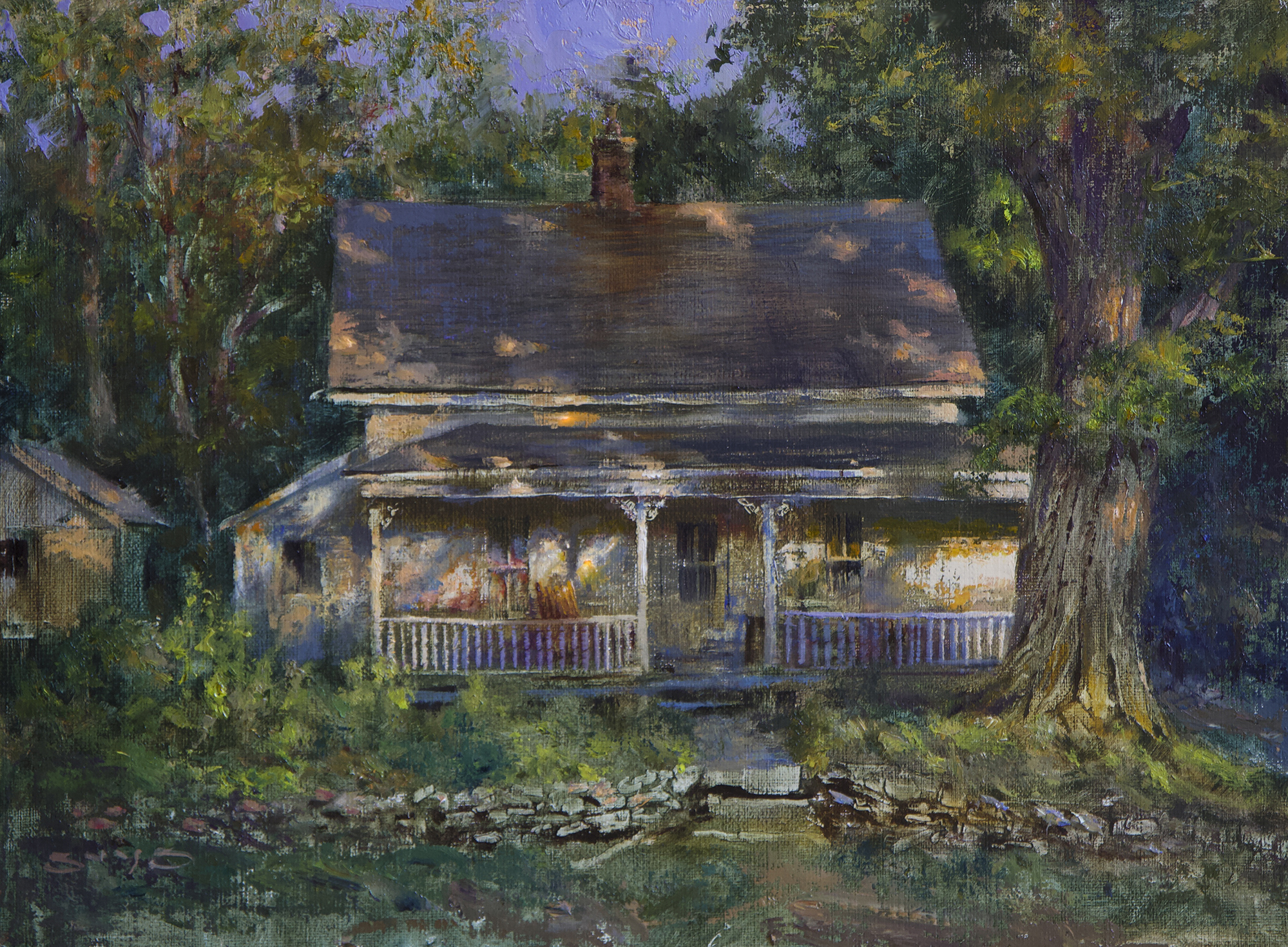
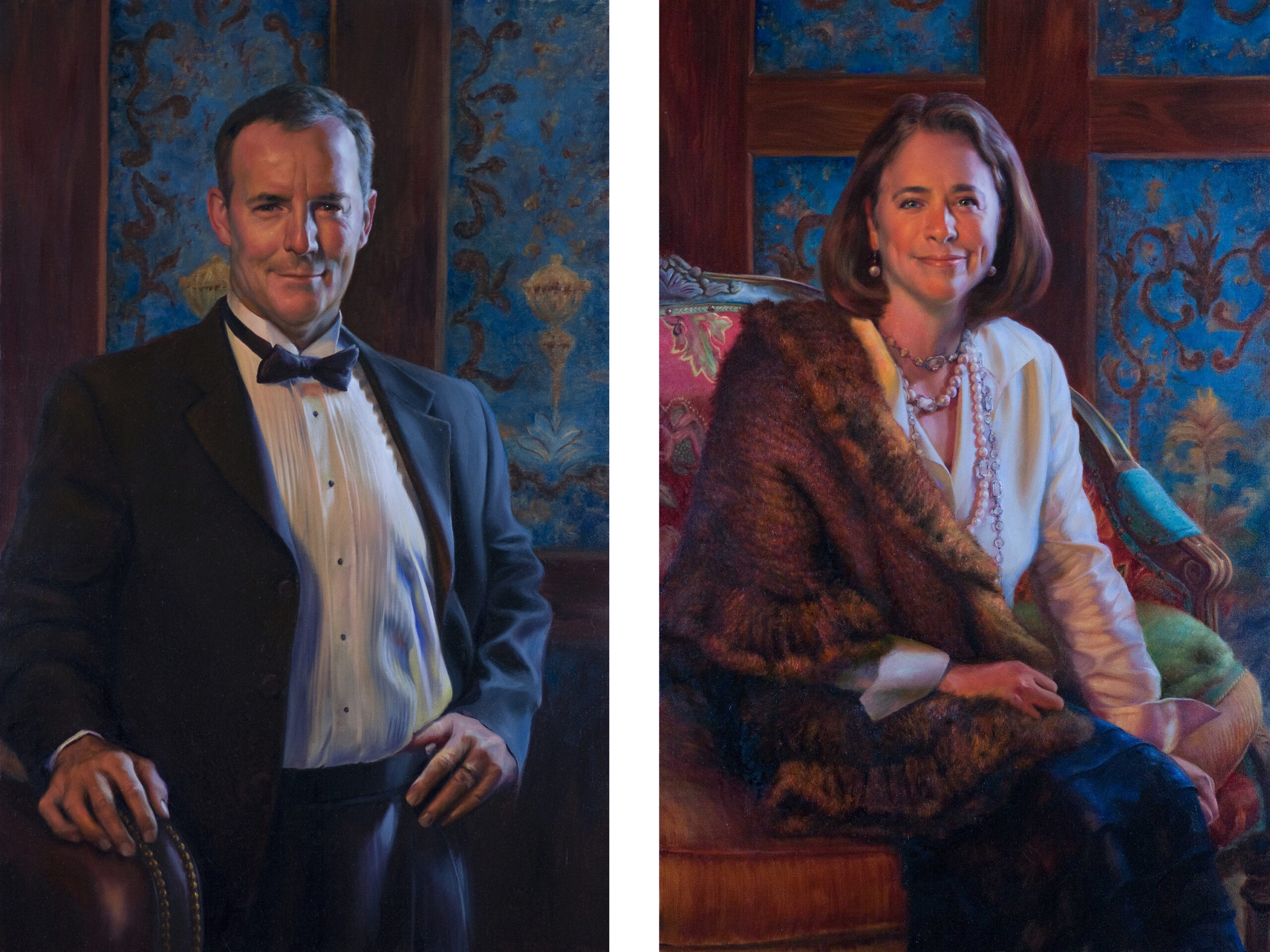
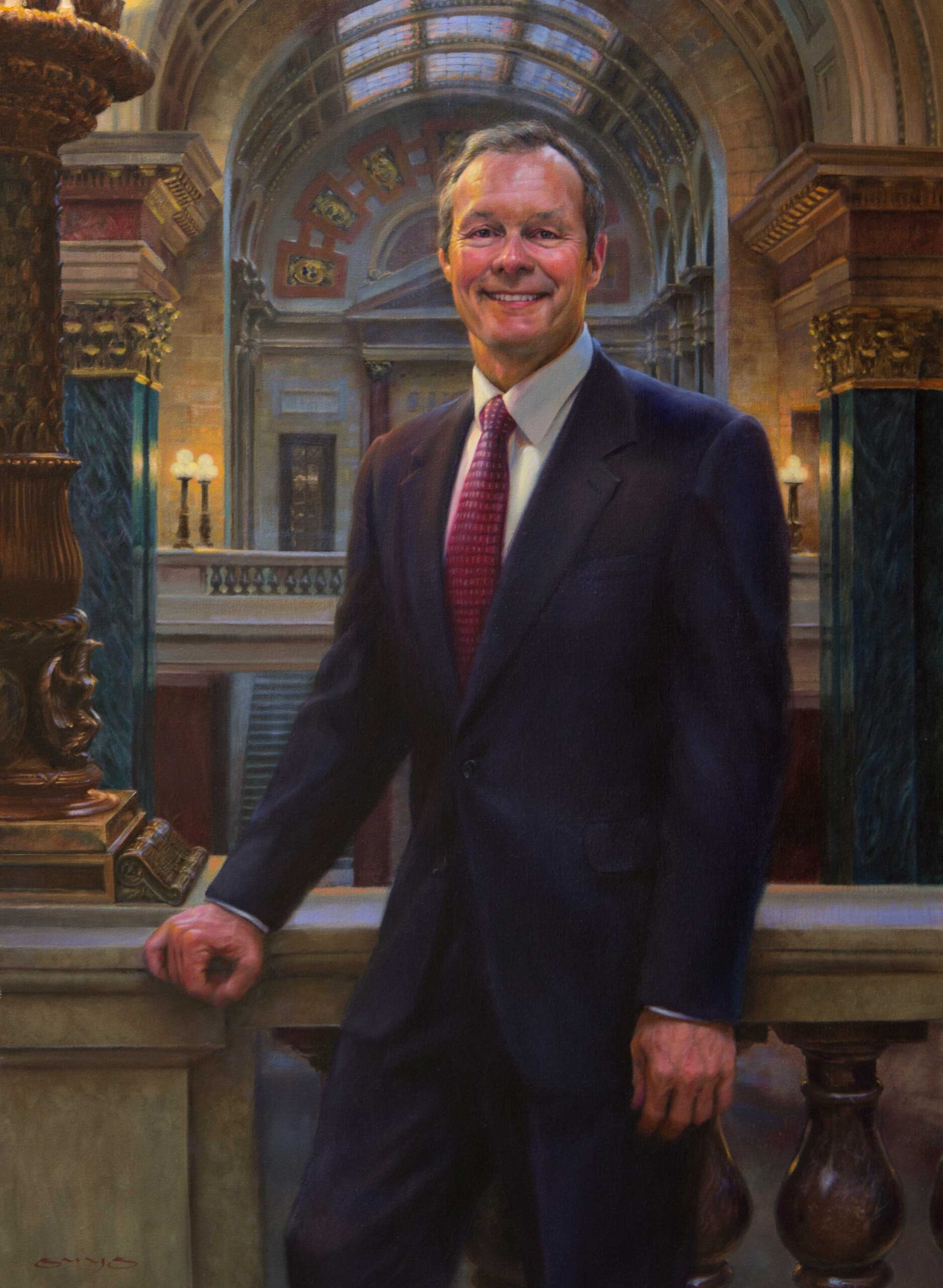
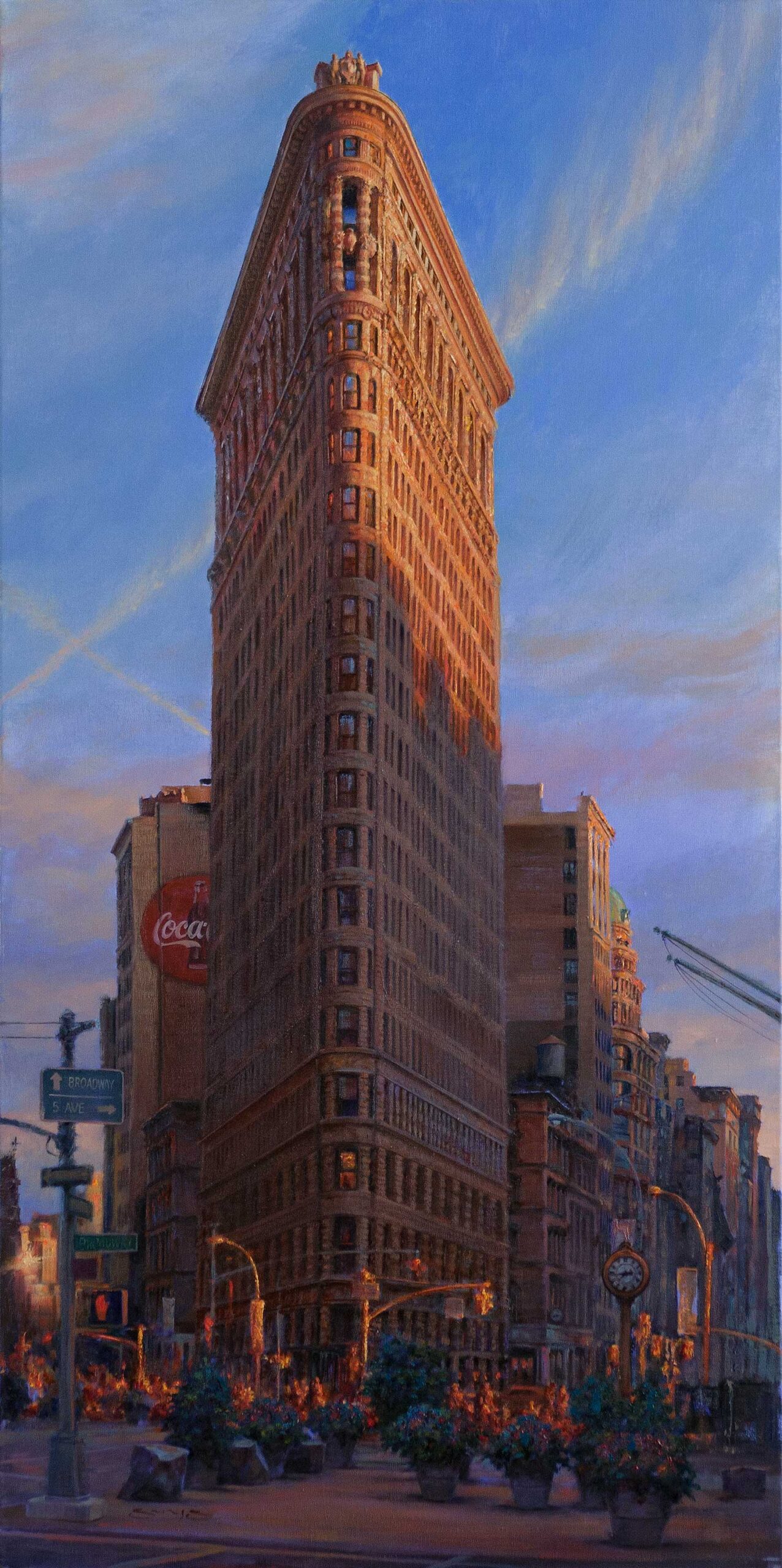
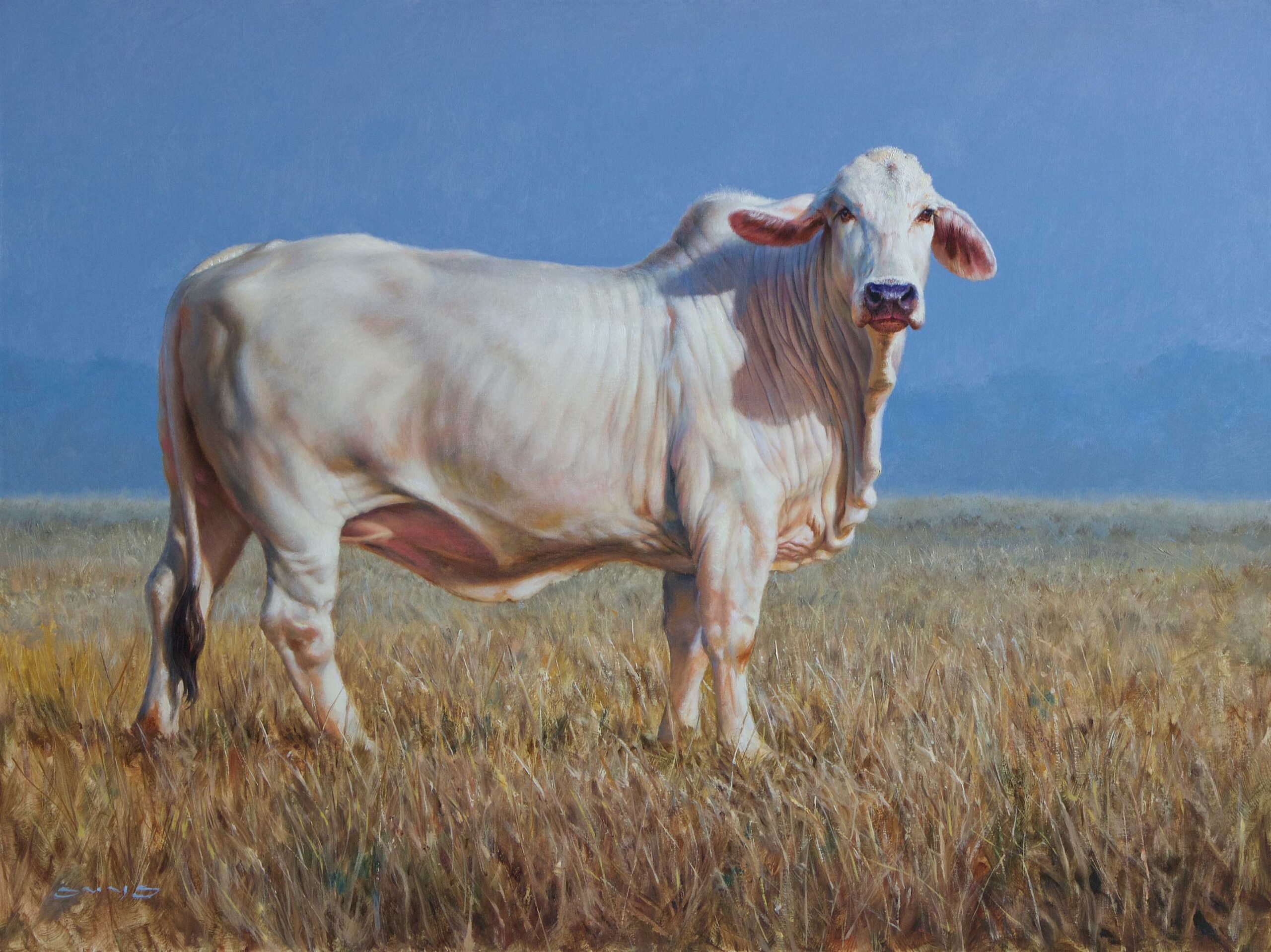
William Suys, “Evening Return,” 9 x 12 in. “Coming off the ferry on Washington Island, WI, this old charmer is one of the first landmarks that says ‘home’. I painted this plein air one evening on a visit to our cabin last summer and it hangs in our personal gallery.”William Suys, “Brian” and “Sandy,” 44 x 28 in. each “A matching pair of portraits: I thought it was a beautiful solution to have them hang in the same special area, where both subjects command an equal presence and importance.”William Suys, “Senate Background: Governor Scott McCallum,” 44 x 32 in. “This was an official state portrait that spoke to the love this governor had for his time in the State Senate while also celebrating the large, amazing space within our beautiful Wisconsin State Capitol.”William Suys, “Sunset Crossing Broadway,” 48 x 24 in. “Traveling often brings inspiration for a painting. Visiting New York and staying near the Flatiron Building prompted me to create what felt like a plein air piece … celebrating the light, space, and magnificence of this building and the City. Happy to have this painting hanging in the Italian headquarters of the company that owns the building.”William Suys, “Morning Mist,” 36 x 48 in. “I loved the singular majesty of this Brahman cow on a misty, peaceful West Texas Morning. I was very moved by the particular atmosphere of her setting and I created a few paintings from this day.”
See More Representational Art
Connect with William Suys and see more of his representational art: williamasuys.com
Learn more about the OPA and its involvement with representational art: oilpaintersofamerica.com
Fill your mind with useful art stories, the latest trends, upcoming art shows, top artists, and more. Subscribe to Fine Art Today, from the publishers of Fine Art Connoisseur magazine.