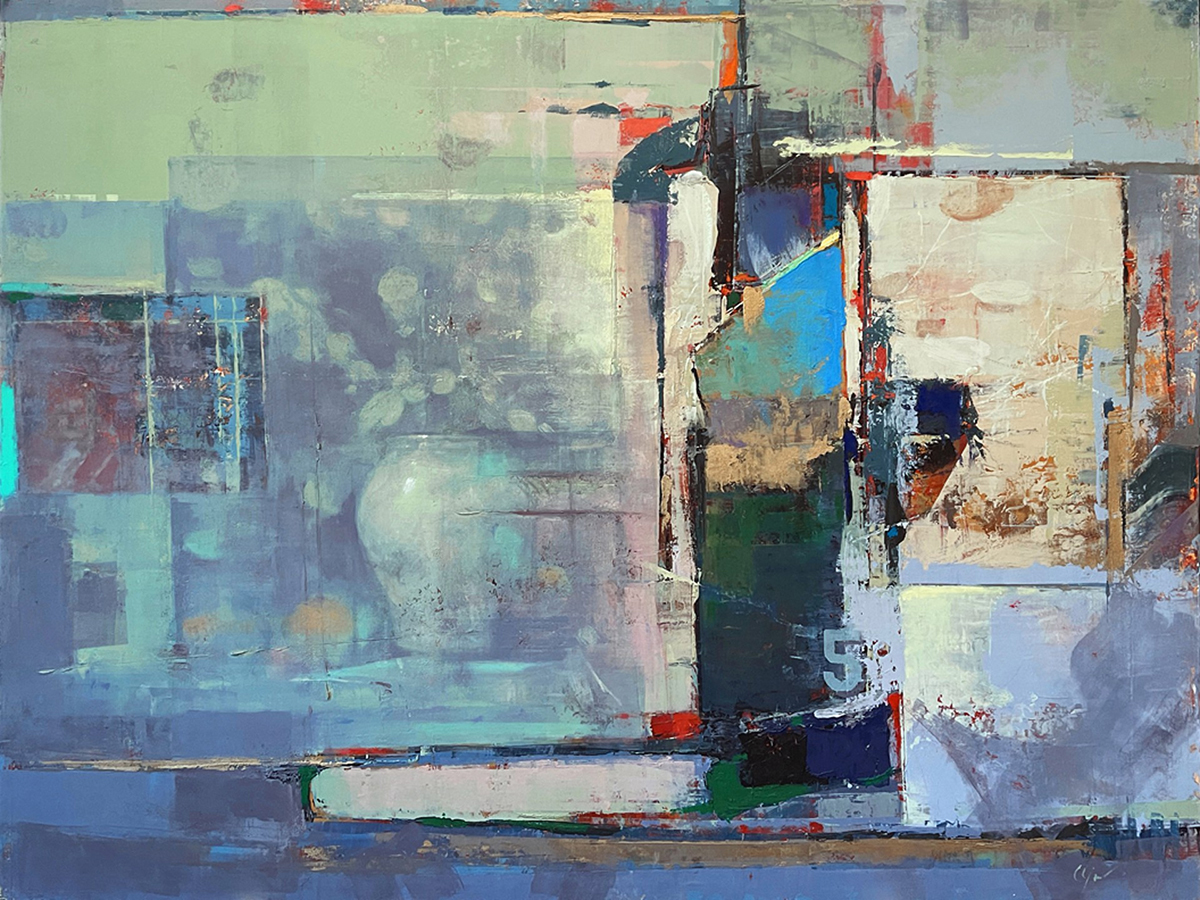
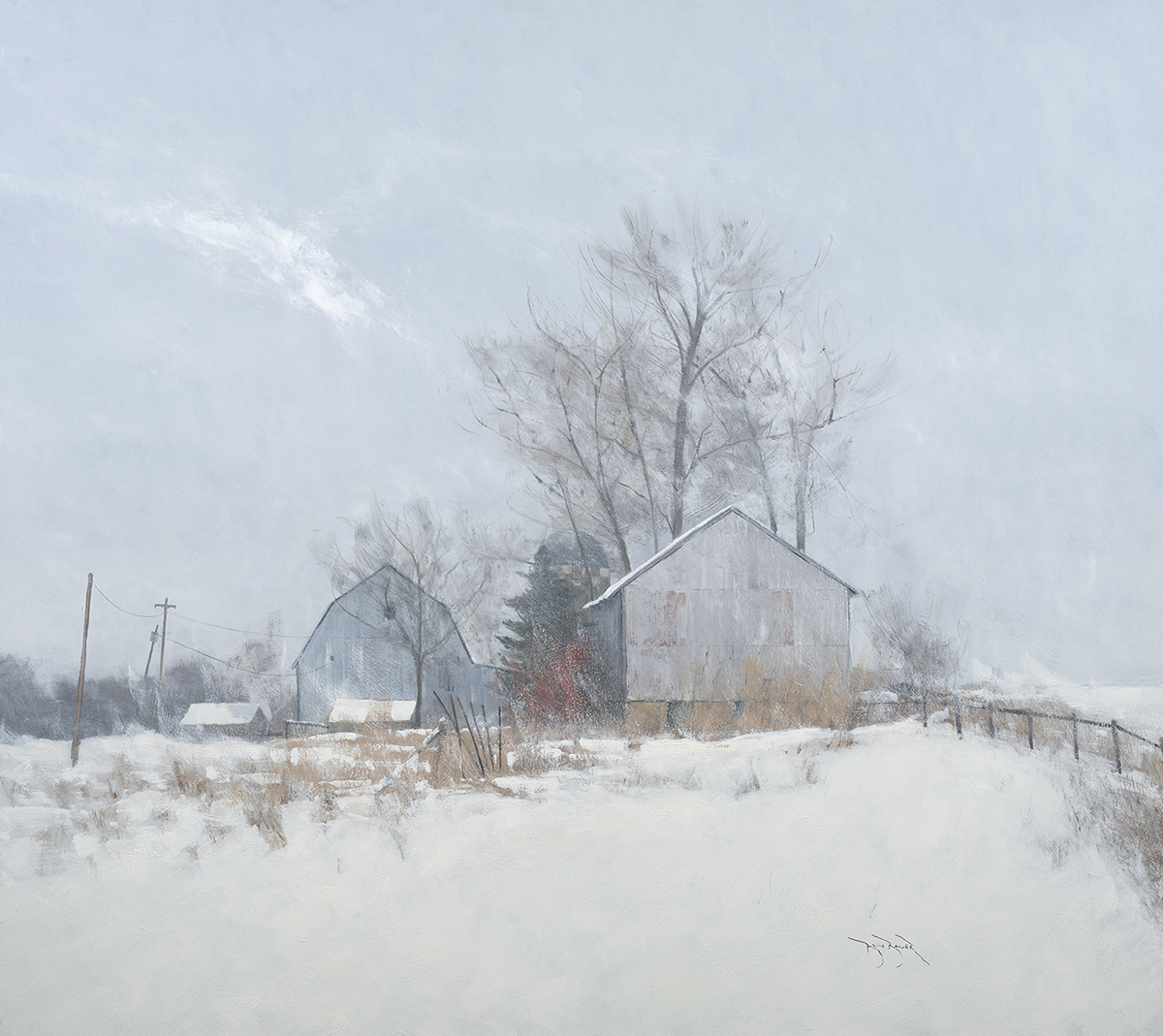
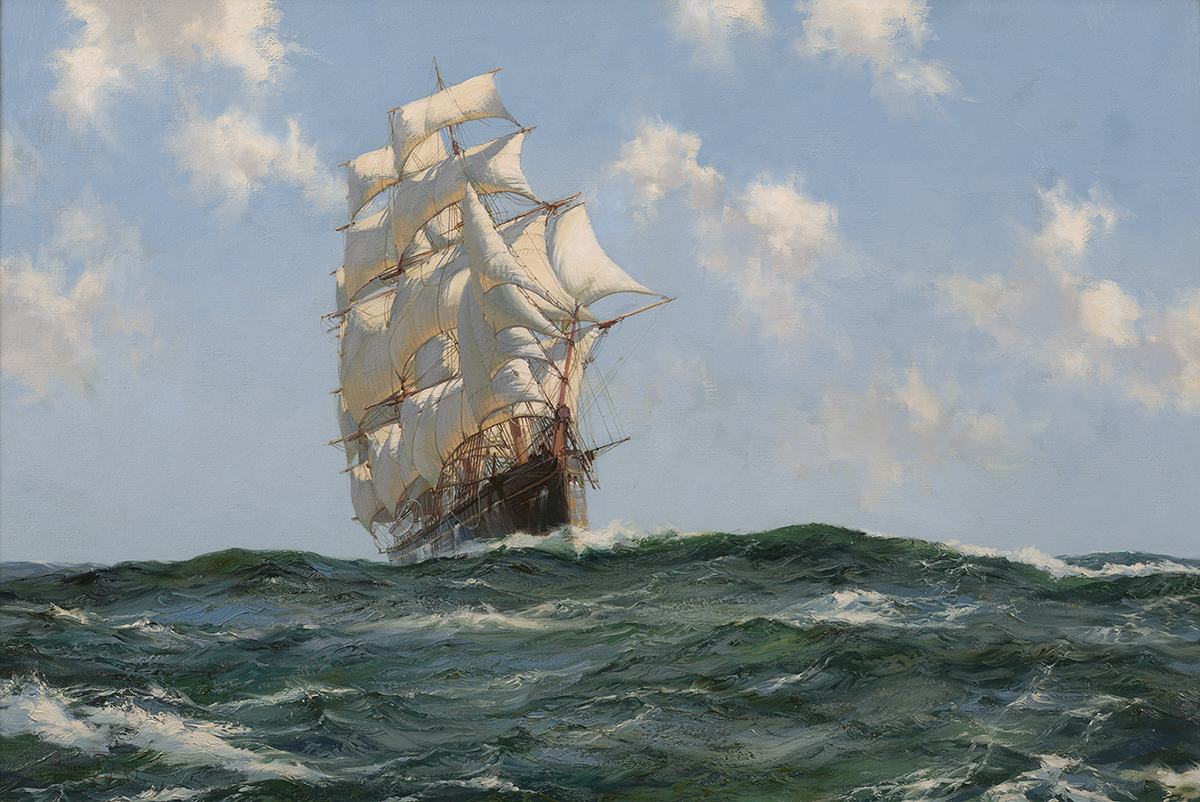
As part of our effort to continue to help artists and art galleries thrive, we’re proud to bring you this week’s “Virtual Gallery Walk.” Browse the artwork below and click the image itself to learn more about it, including how to contact the gallery.
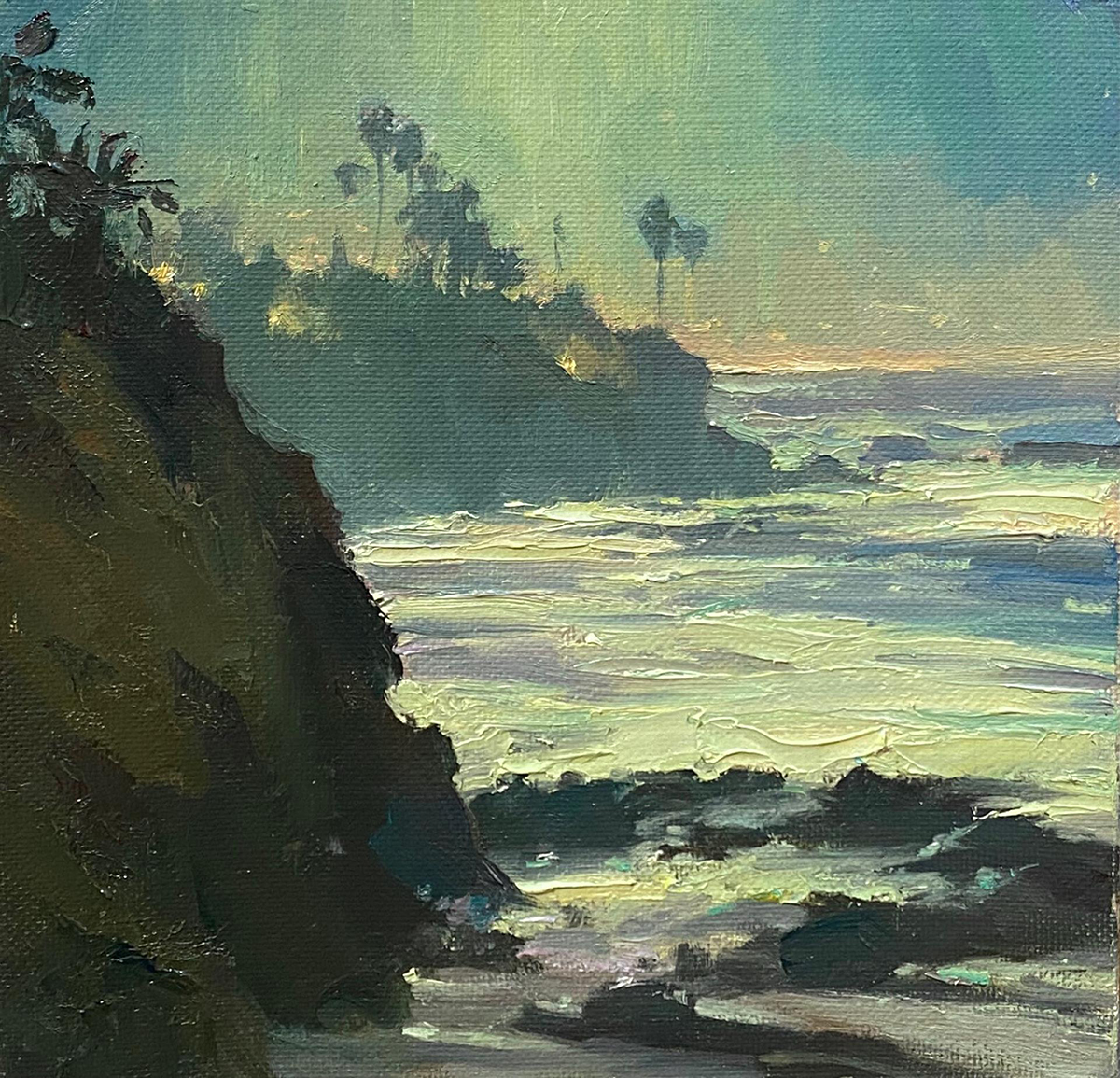
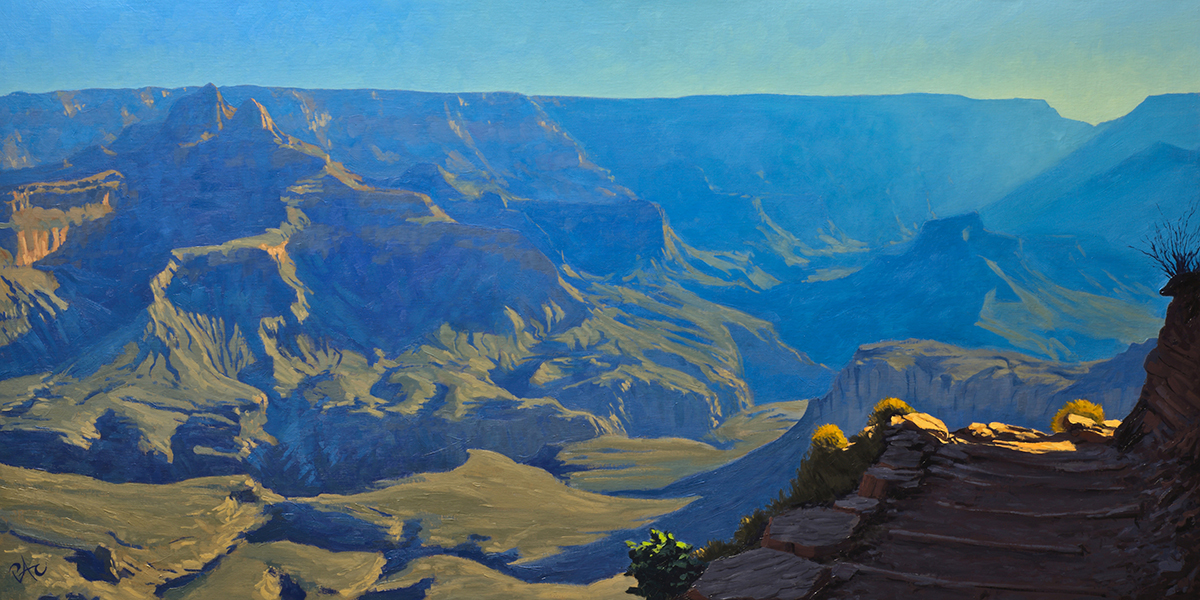
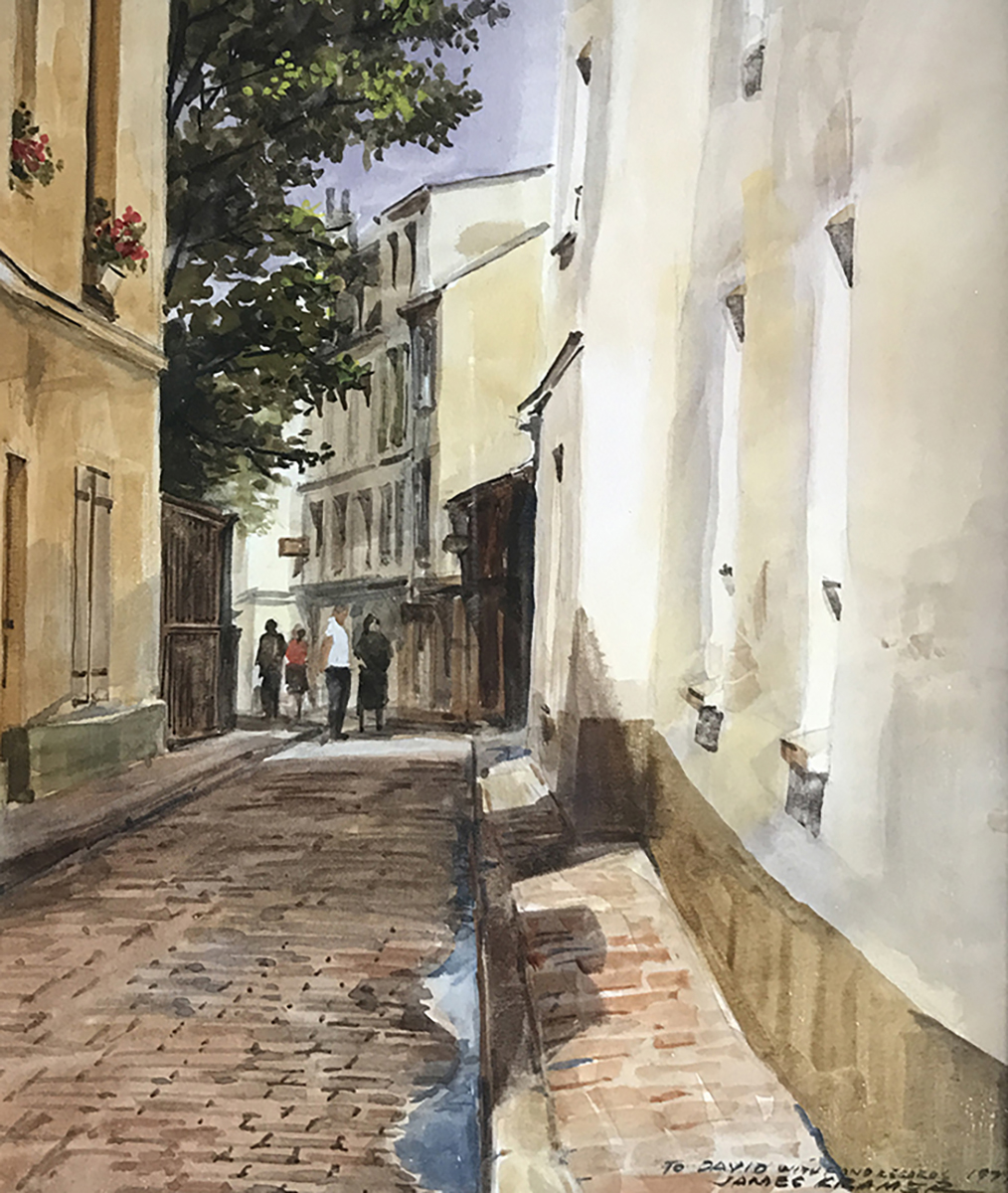
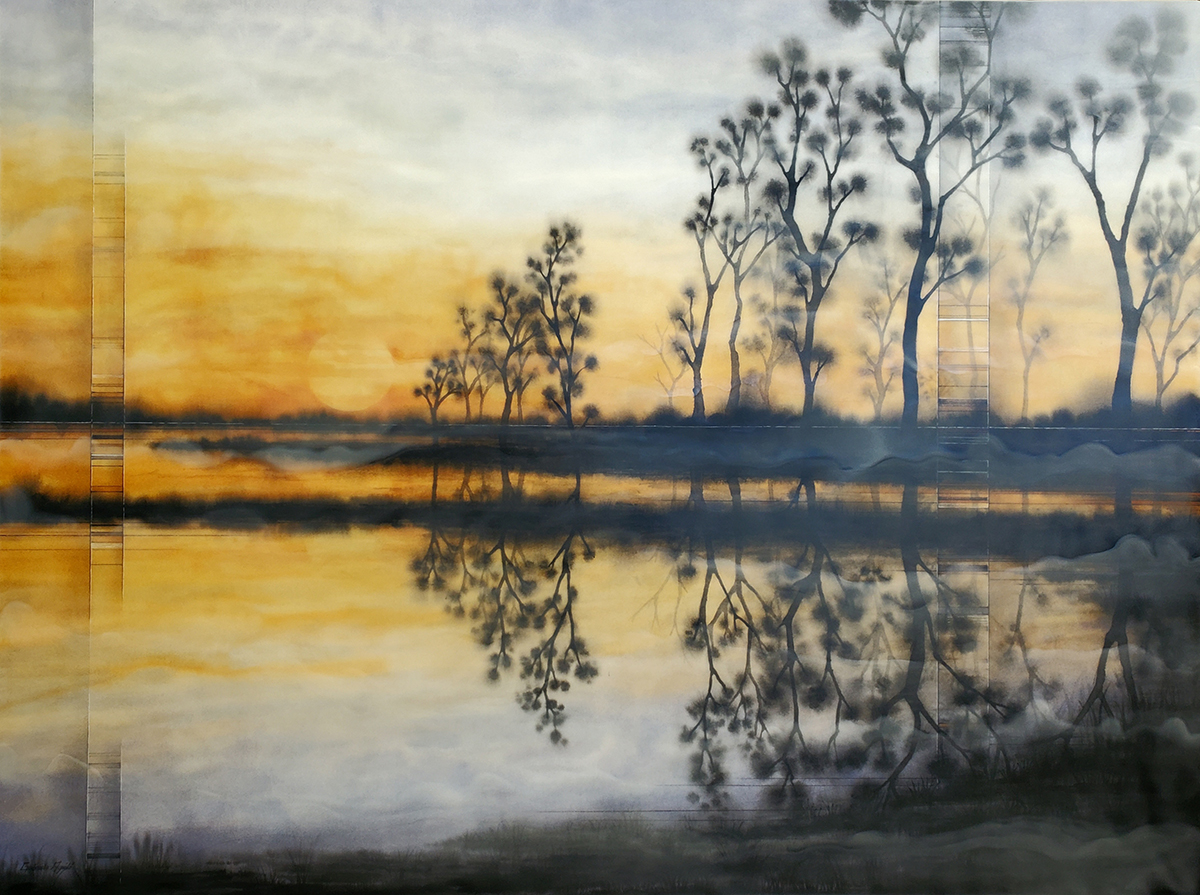
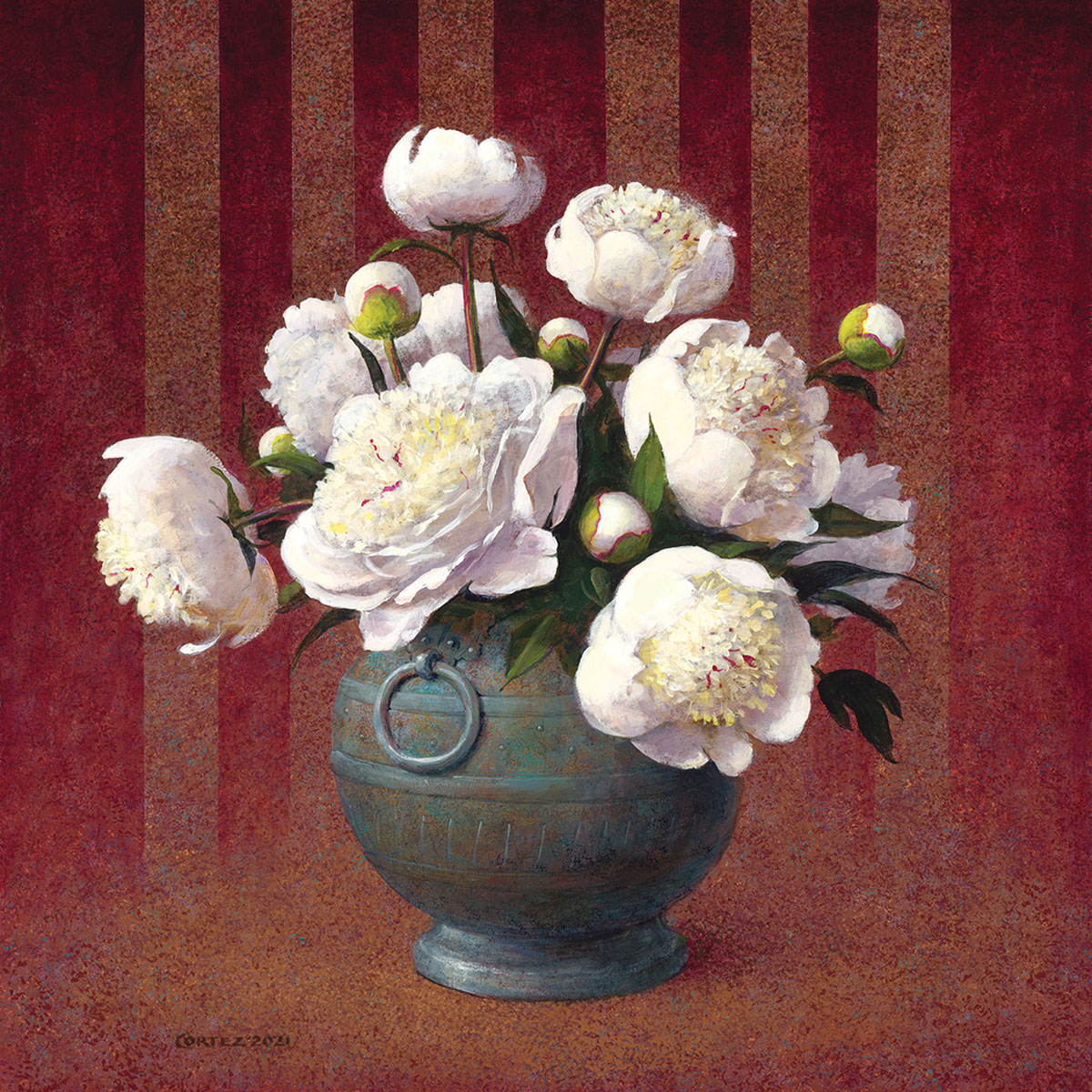
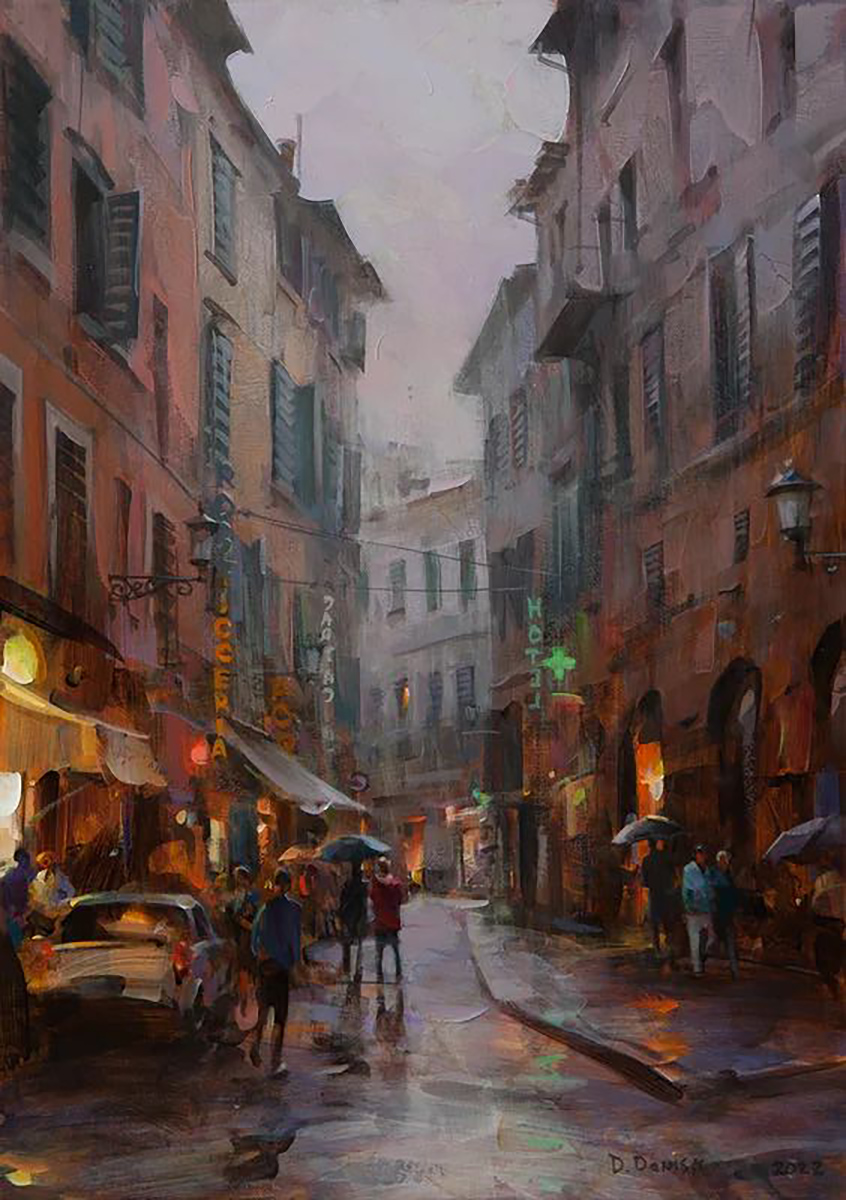
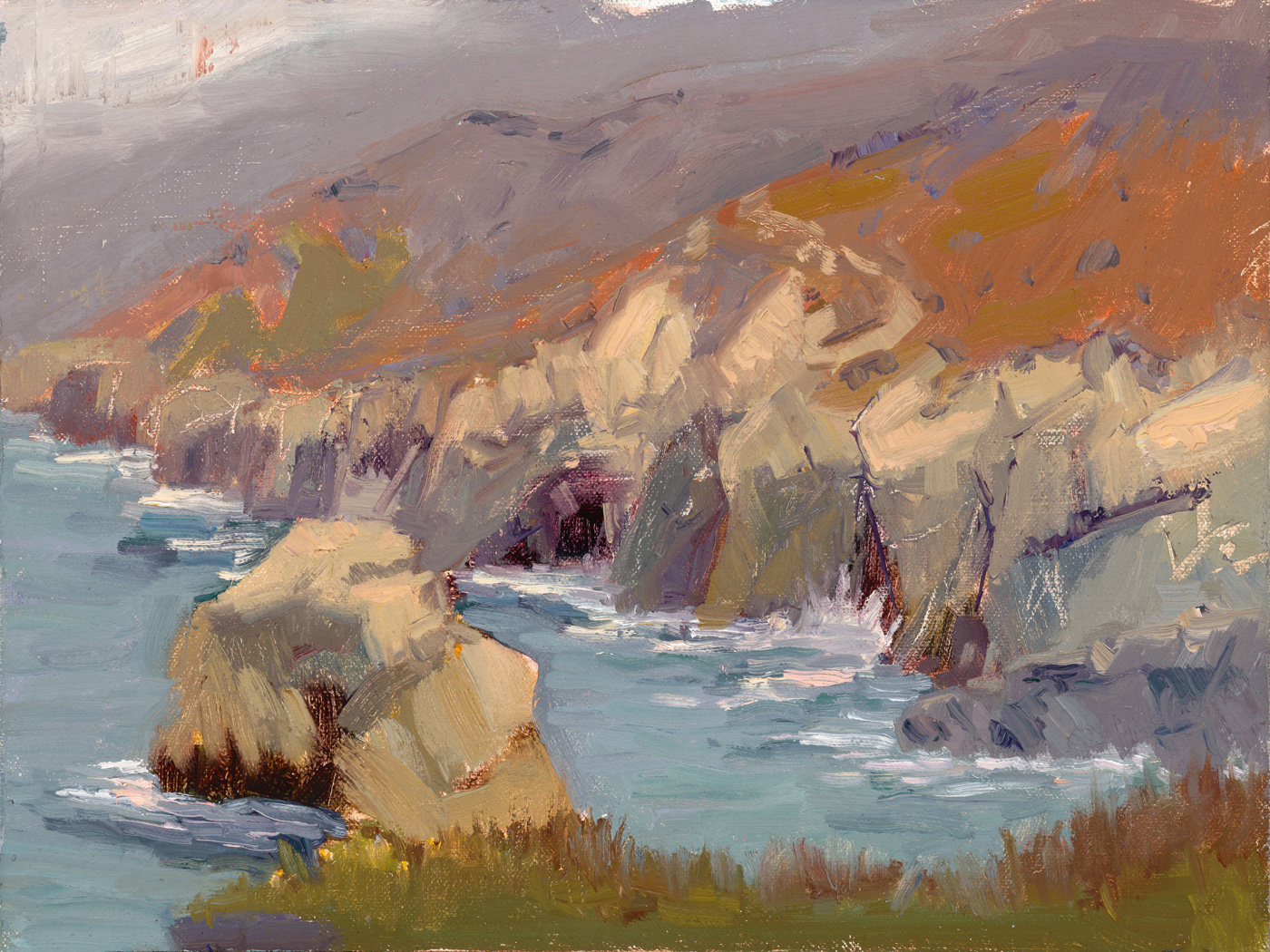
Still in Structure, Chris Groves, oil, 30 x 40 in; Anderson Fine Art GalleryBlowing Snow in Buffalo County, WI, Ben Bauer, oil on panel, 36 x 40 in., Signed; Rehs ContemporaryRed Jacket on Open Seas, Montague Dawson (1895 – 1973), oil on canvas, 24 x 36 in., Signed; Rehs Galleries, Inc.Coastal Moonlight, Michael Obermeyer, 8 in. x 8 in., oil, 2022. Juried work in the 3rd Annual ‘LPAPA Squared’ Juried All Member Art Show at LPAPA Art Gallery.A Journey That Begins Where Everything End, Philip A. Carlton, oil, 22 x 44 in; Grand Canyon Conservancy’s Celebration of ArtRue De La Bonne, James Kramer, watercolor, 9 x 7.25 in; ArtzLineThe Sweet Unknown, Gabriella Aguilo, Encaustic, 36 x 48; Celebration of Fine ArtPeonies In A Chinese Vessel, Jenness Cortez, acrylic on birch panel, 40 x 40 in; Trailside GalleriesLight Drizzle, Dmitri Danish, oil on canvas, 20 x 14 in; Reinert Fine Art & Sculpture Garden Gallery
Want to see your gallery featured in an upcoming Virtual Gallery Walk? Contact us at [email protected] to advertise today. Don’t delay, as spaces are first come, first served, and availability is limited.
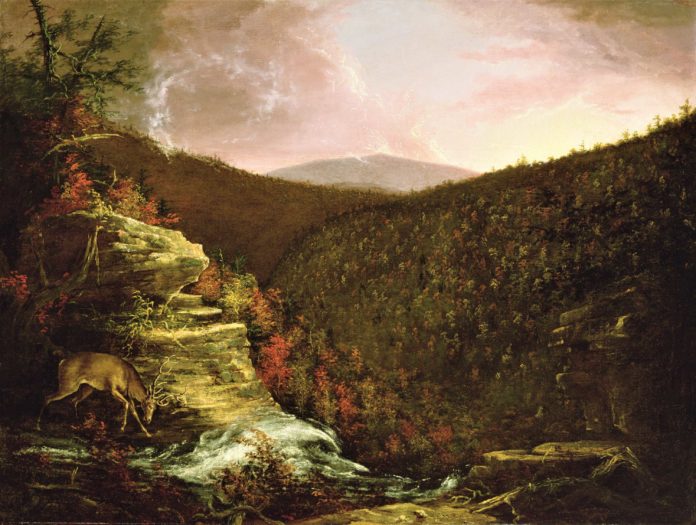
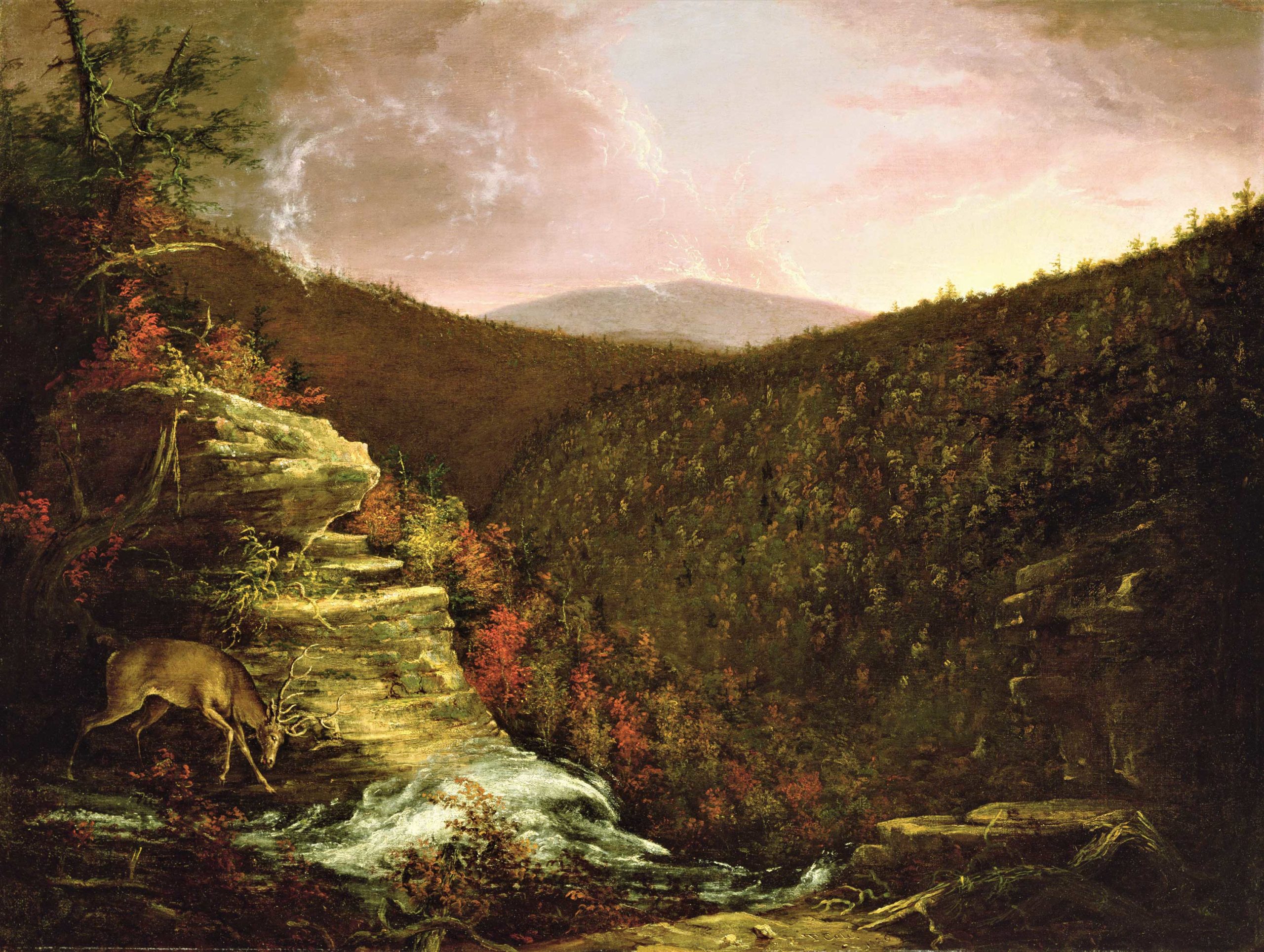
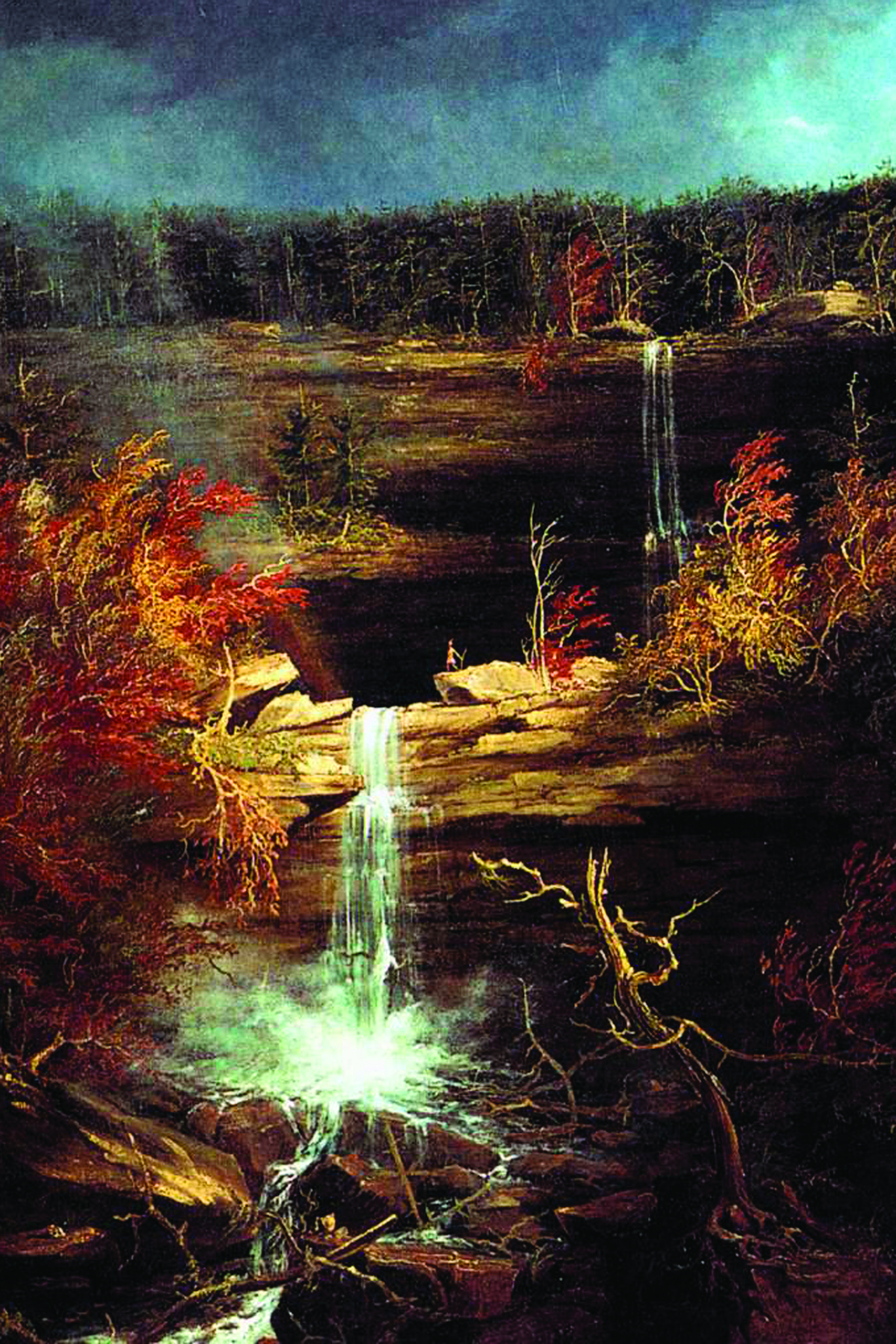
Fig. 5: THOMAS COLE (1801–1848), "From the Top of Kaaterskill Falls," 1826, oil on canvas, 31 1/8 x 41 1/8 in., Detroit Institute of Arts
How two scientists and art lovers came face to face with the Ice Age when they undertook a tour of the Hudson River School Art Trail to follow in the footsteps of Thomas Cole.
Redefining the “Sublime” in the Footsteps of Thomas Cole
By Robert Titus and Johanna Titus
We are scientists: Robert is a geologist and Johanna a biologist. Ours are the two leading sciences of the landscape. We are also residents of New York State’s Catskill Mountains, so it should not surprise anyone that we harbor a passion for the Hudson River School of painters. Fortunately, scientists like us are well-positioned to offer insights on some of the leading themes of that talented group.
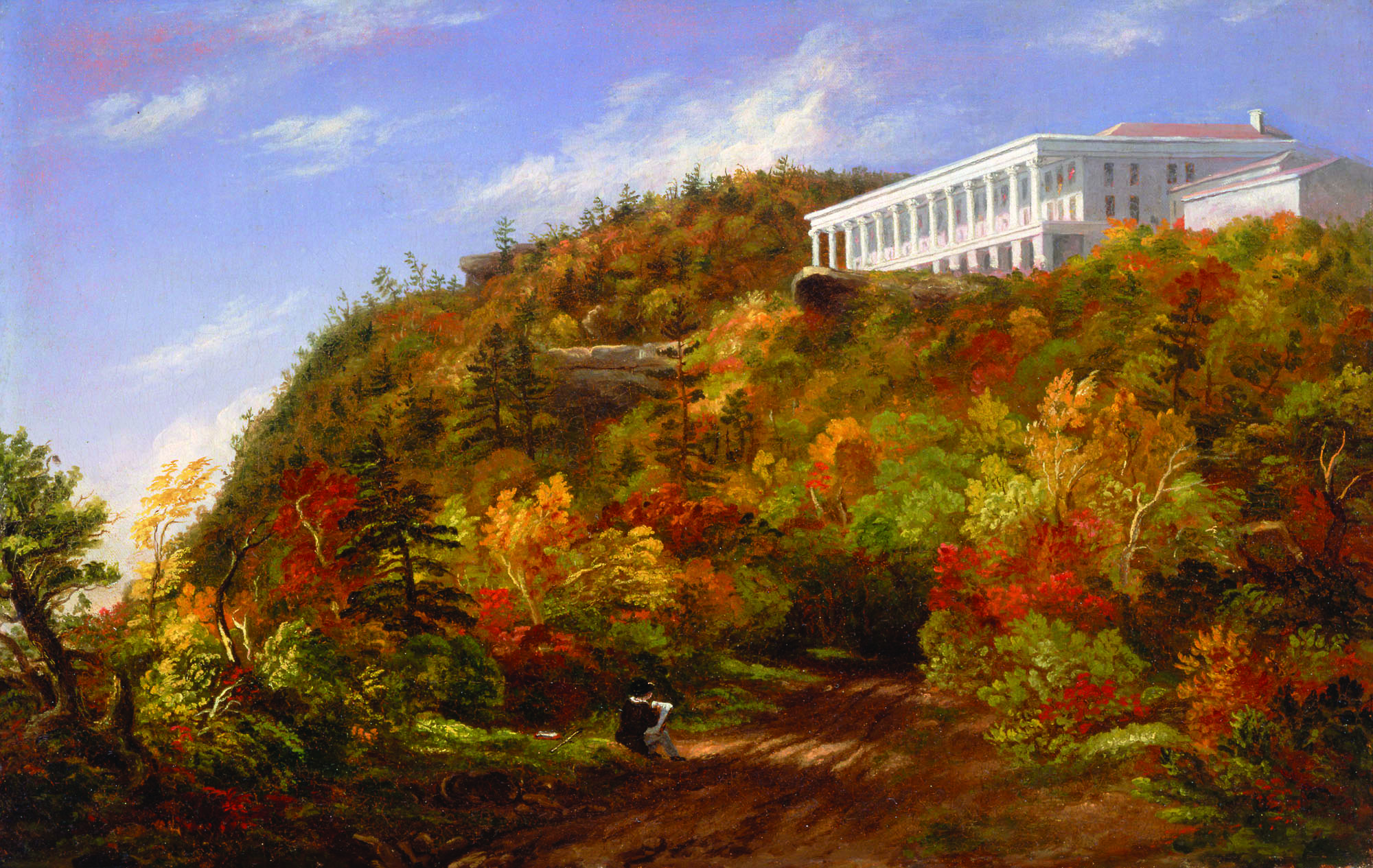
The Hudson River School was America’s first formally recognized art movement. It thrived in the mid-19th century, starting when the English émigré Thomas Cole (1801–1848) began painting landscapes around the Catskill Mountain House Hotel (Fig. 1) at the summit of the “Wall of Manitou,” a towering escarpment along the Catskills’ eastern edge.
Fig. 1: SARAH COLE (1805–1857) after the original painted by her brother Thomas Cole (1801–1848), “A View of the Catskill Mountain House,” 1848, oil on canvas, 15 1/3 x 23 3/8 in., Albany Institute of History and Art
Cole first visited this region in 1825, early in his career, when it was still largely wilderness. The landscapes he painted that year contrasted dramatically with the park-like views that had long been featured in European landscape art. Little true wilderness still existed in Europe, but the Catskills offered it in abundance. The atmosphere and effect his canvases evoked soon came to be called “the Sublime.”
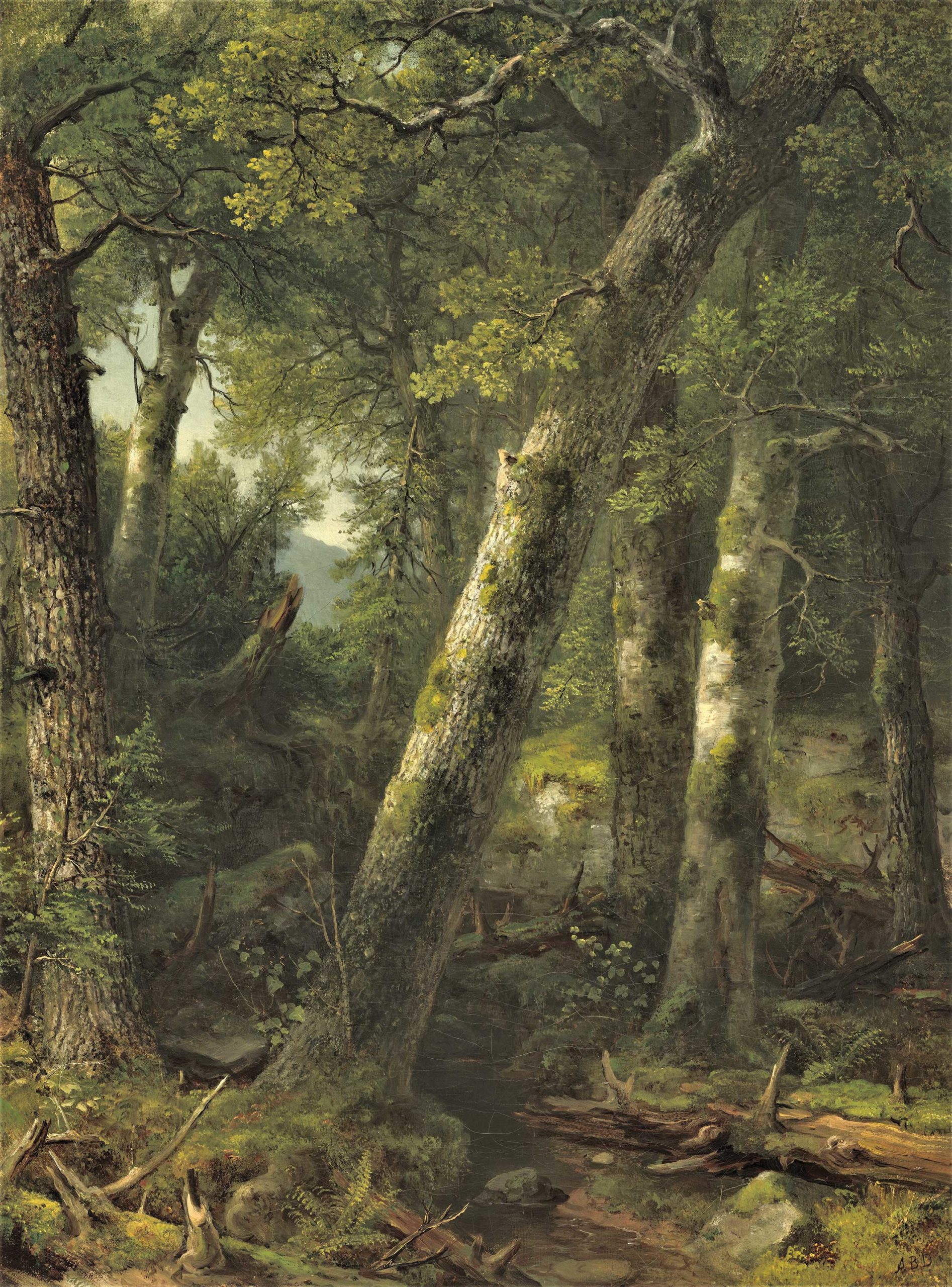
Understanding the Sublime is central to understanding the Hudson River School, yet as a word, it has always been difficult to define precisely. To be Sublime, Nature is imagined not just as wilderness, but as wilderness with something vaguely dangerous, even ungodly, about it. Look at any forest scene (Fig. 2) painted by the Hudson River School’s Asher B. Durand (1796–1886). It is easy to imagine entering his dense, wild woodlands, but then you must ask yourself, “Can I be certain I will ever get out of them again?” The answer is no, you cannot, and that, we think, constitutes the scary part of the Sublime.
Fig. 2: ASHER B. DURAND (1796–1886), “Forest in the Morning Light,” c. 1855, oil on canvas, 24 3/16 x 18 3/16 in., National Gallery of Art, Washington, D.C.
The two of us have spent much time exploring the Catskills, in and around where Cole worked, and we think there is more to the Sublime than “wild and scary.” Please visit the area and see for yourself: many of Cole’s early landscapes can be seen in what is now the North Lake Campground, which is open to the public. Located in the village of Catskill is Cole’s studio house, Cedar Grove. It was designated a National Historic Site in 1999 in order to enhance understanding of the Hudson River School through architectural preservation, exhibitions, and scholarly study. Having been members of this nonprofit organization right from the start, we have watched with pleasure as it has earned a sterling reputation in all of these pursuits.
Cedar Grove has always reached out to the general public. One example is its publication online of the Hudson River School Art Trail guide. This major endeavor points visitors to many of the exact spots where Cole and his colleagues made their sketches. When we first undertook this tour following in their footsteps, we discovered another, more scientific understanding of the Sublime; we came face to face with the Ice Age. This article presents our icy version of the Sublime.
On the Hudson River School Art Trail
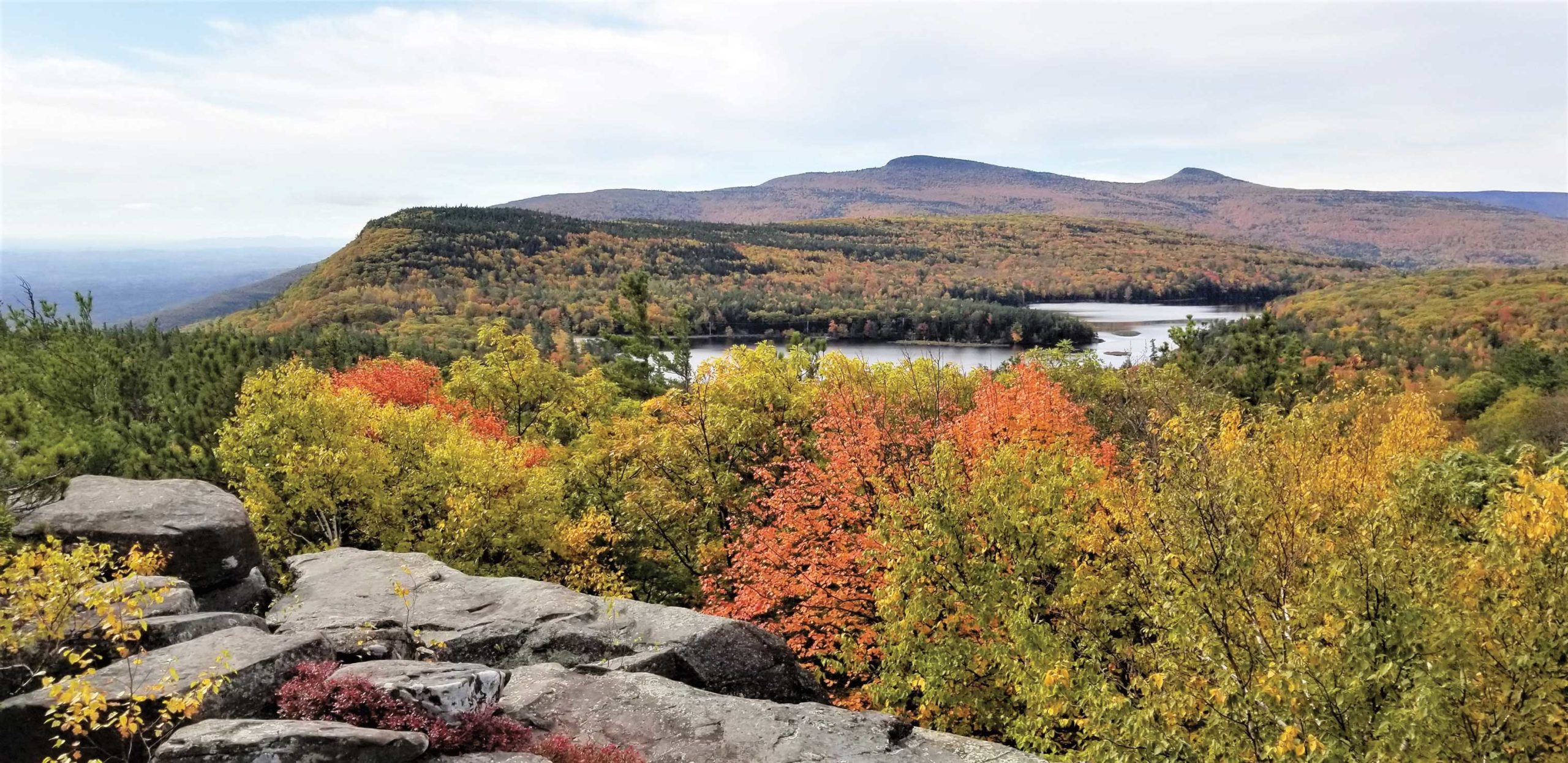
We began at Site 7 on the Art Trail, a location called Sunset Rock (Fig. 3). It’s a rocky promontory that affords hikers a view we consider one of the finest east of the Rockies. Cole painted it several times.
Fig. 3: View of North and South Lakes from Sunset Rock today
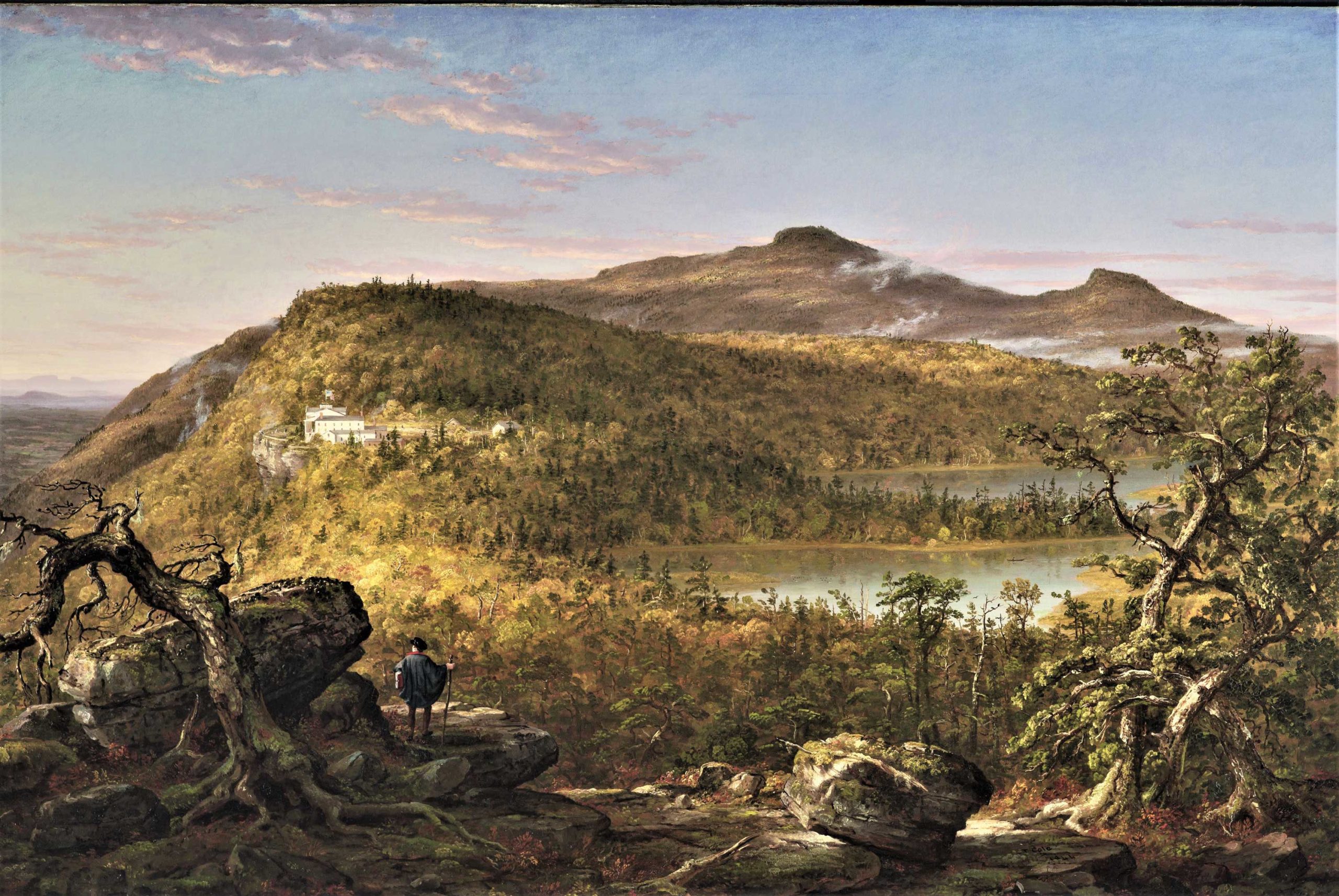
Spread out across the Brooklyn Museum’s version (Fig. 4) are the Catskills that first captivated Cole in 1825. In the distance is the Catskill Mountain House Hotel, which became 19th-century America’s finest resort and the birthplace of all Catskills culture, including the Hudson River School. Above it is South Mountain, and beyond, mostly out of sight, is Kaaterskill Clove — a scenic wonder and key site for the movement. (The word “clove” bewilders some people today; in this context it is not an herb, but rather a chasm that has been cleaved by Nature.)
Fig. 4: THOMAS COLE (1801–1848), “A View of the Two Lakes and Mountain House,” Catskill Mountains, Morning, 1844, oil on canvas, 35 13/16 x 53 7/8 in., Brooklyn Museum, New York
There is something else happening here. When we, as geologists, stand on Sunset Rock, it becomes 25,000 years ago. We look left into the Hudson River Valley and see it filling with a great glacier, moving south very slowly. The ice rubs up against the Wall of Manitou, which Cole portrayed just to the left of the hotel. The glacier’s grinding motions are carving this centerpiece of Catskills scenery, including the ledge on which the hotel would someday stand. As we watch, the ice swells up below us, crosses the ledge, and spreads to the right and toward the west. Its abrasive motions carve the basin of North Lake that Cole painted. From Sunset Rock, we have “witnessed” glaciers creating a famous Catskills landscape.
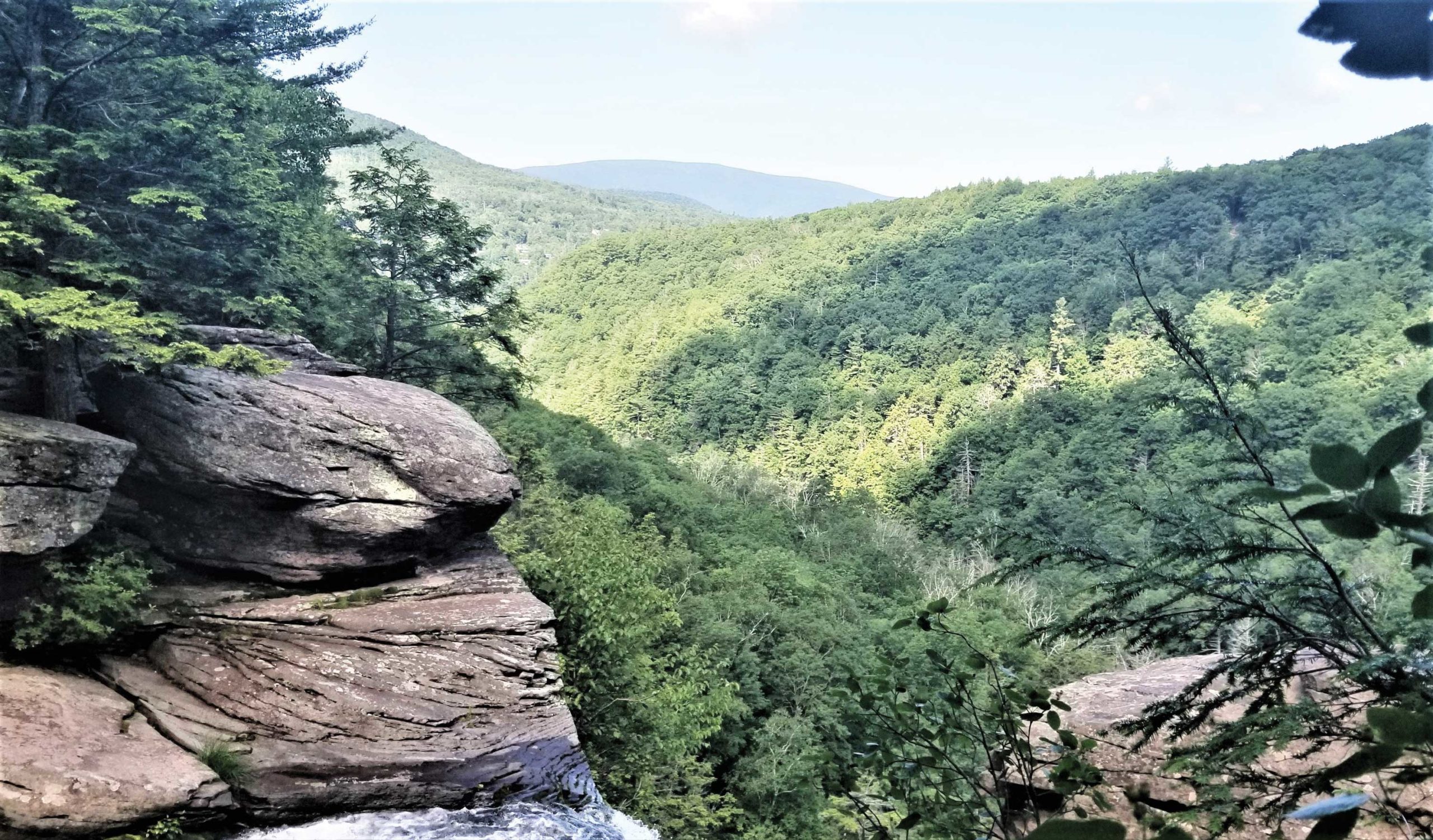
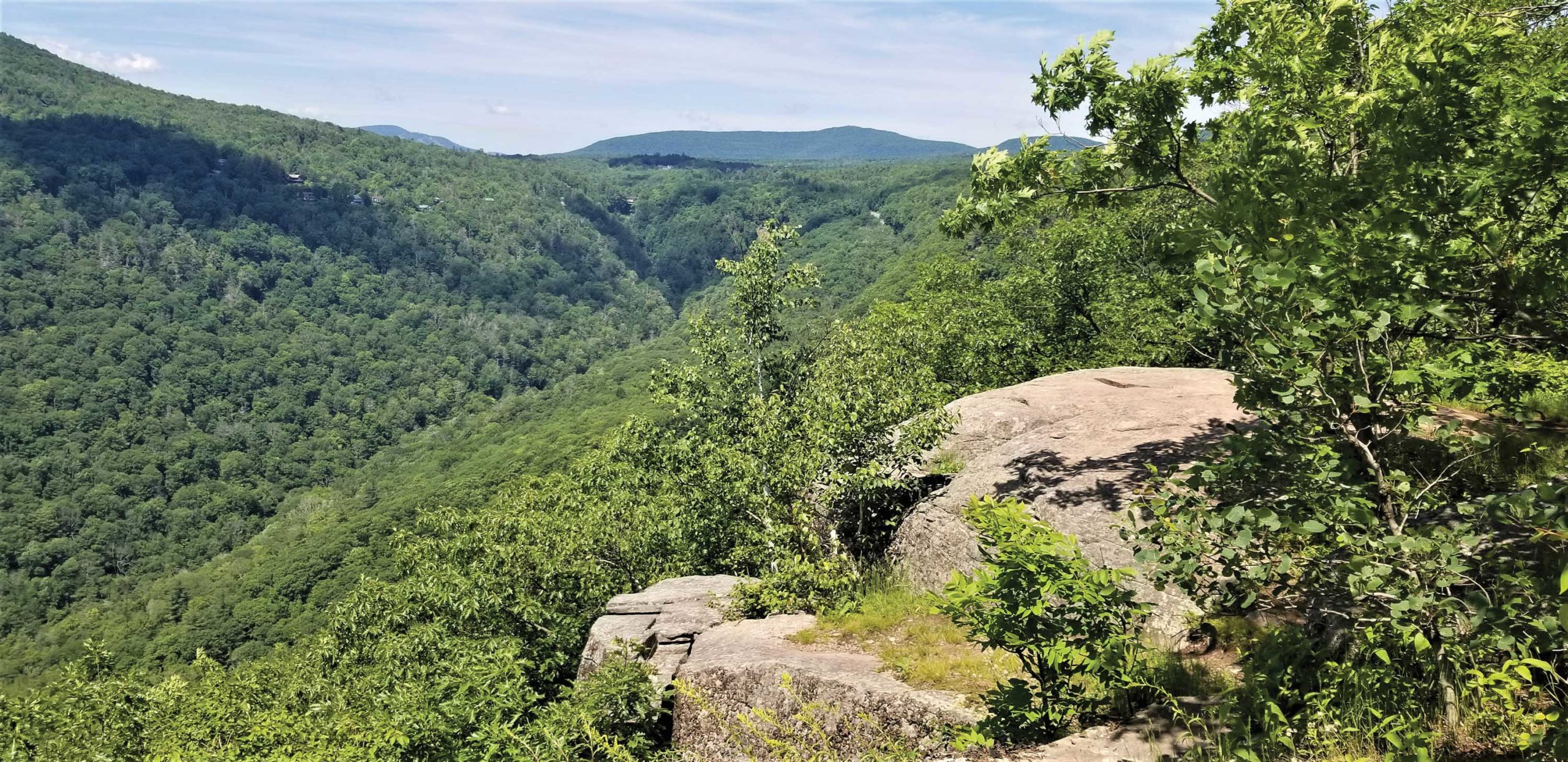
Next, the Art Trail guide pointed us to Site 5, the top of Kaaterskill Falls. Cole came here in 1825 and produced one of the first Hudson River School paintings (Fig. 5). We explored a bit and found the very ledge where he must have sat as he sketched. A bit awed, we took turns sitting there and took our own photograph (Fig. 6). But there was more: we stepped forward a few feet and gazed beyond the lip of the falls. Again, we had entered the Ice Age. A glacier was advancing up the clove below us. The same ice we had just seen from Sunset Rock was now rising up Kaaterskill Clove, pushed from behind. It was sculpting the very landscape that Cole would later paint. We watched with fascination, beginning to understand that it was ice that created so much of this scenery.
Fig. 5: THOMAS COLE, “From the Top of Kaaterskill Falls,” 1826, oil on canvas, 31 1/8 x 41 1/8 in., Detroit Institute of ArtsFig. 6: Looking down from the top of Kaaterskill Falls today
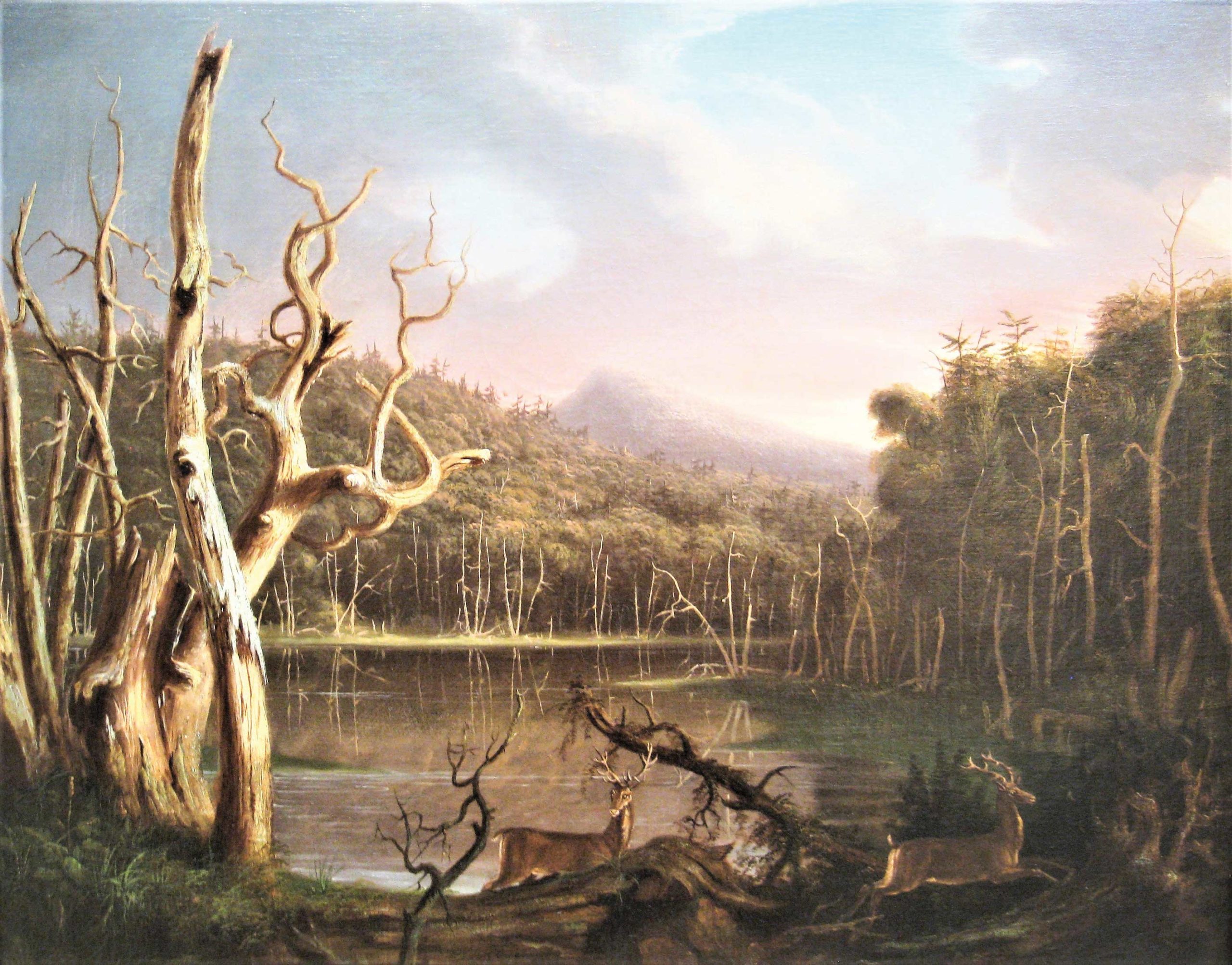
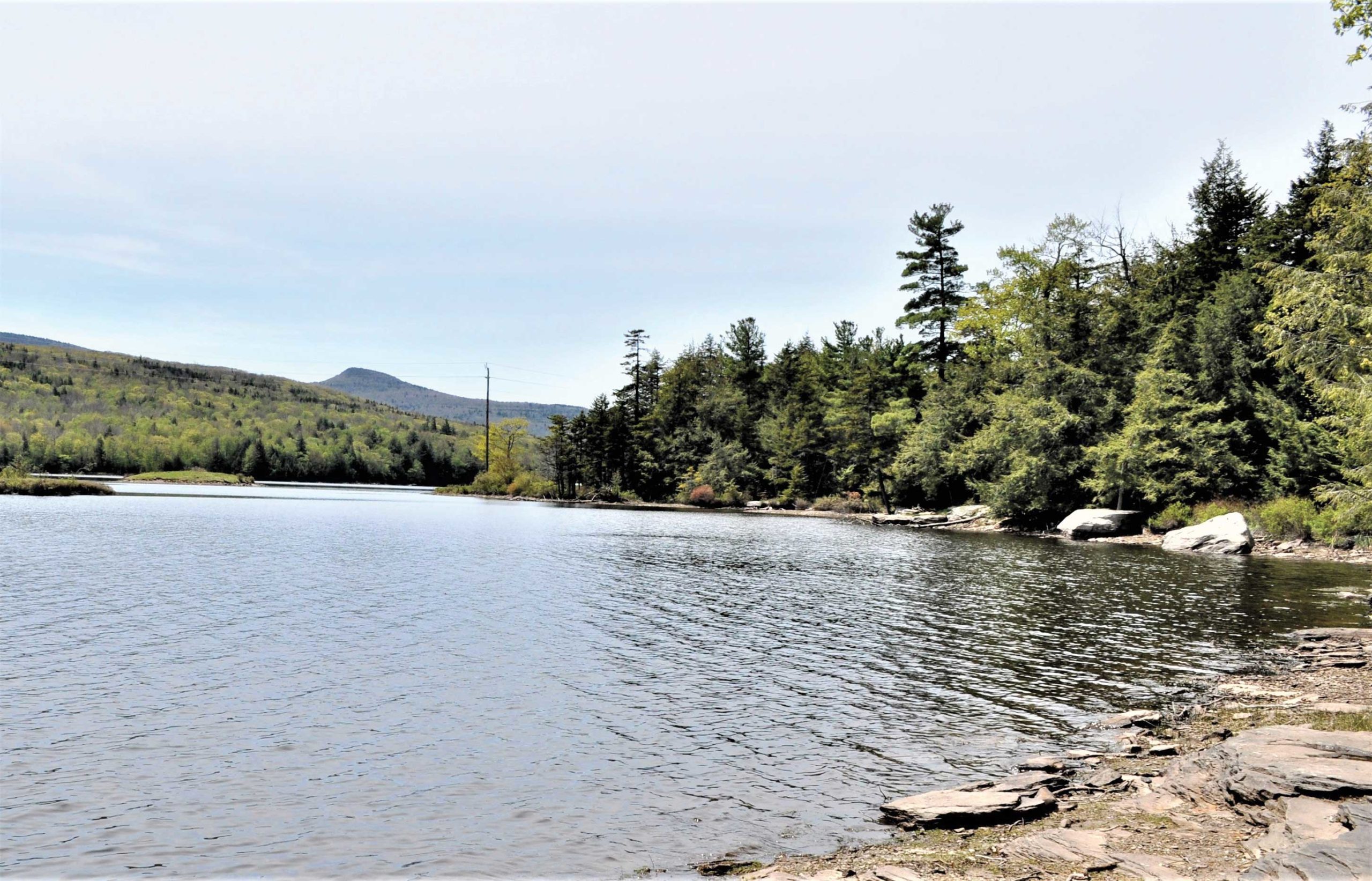
We then found our way to Site 6 and beheld the modern-day view of Cole’s “Lake with Dead Trees” (Fig. 7). Cole had also sketched this place in 1825, but, once again, “we were there” during the Ice Age. Advancing toward us, that same Kaaterskill Falls glacier was grinding its way into the local bedrock. This powerful force was scouring out the South Lake basin (Fig. 8) that Cole would paint.
THOMAS COLE, “Lake with Dead Trees (Catskill),” 1825, oil on canvas, 27 x 33 3/4 in., Allen Memorial Art Museum, Oberlin, OhioFig. 8: South Lake today
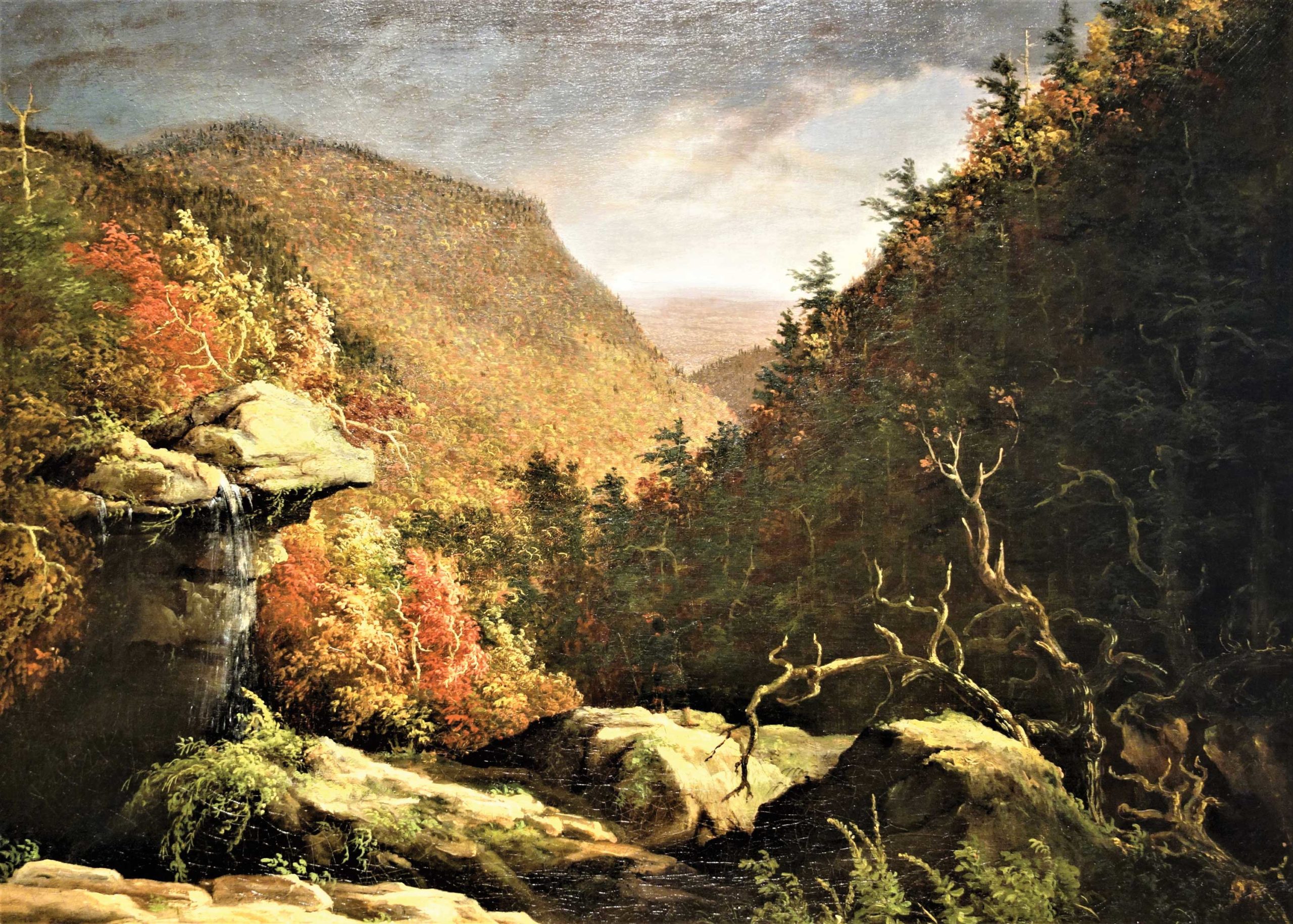
A visit to Site 4 would reveal more. There Cole made another of his early views, this one looking down Kaaterskill Clove (Fig. 9). Five miles long, a mile across, and a thousand feet deep, this chasm would lure future generations of landscapists, but Cole got there first. Kaaterskill Clove truly merits the adjective “awesome” — too grand to be compressed into one artistic view. Perhaps that’s why Cole chose to paint only its narrow upstream end.
Fig. 9: THOMAS COLE, “The Clove, Catskills,” 1827, 25 1/4 x 35 in., New Britain Museum of American Art, Connecticut
We took a hiking trail out along the clove’s north rim, unexpectedly journeying 15,000 years back in time. Standing on Inspiration Point (Fig. 10), below us we could see the clove filled with ice, a lower part of that same Kaaterskill Falls glacier. But now the climate had warmed; this ice was melting. We could hear the powerful subglacial flow of meltwater, muffled far beneath its icy surface. Down there, that torrent was cutting through the glacier and into the clove’s bedrock bottom. It was carving the deep, narrow canyon that has beckoned generations of painters.
Fig. 10: Inspiration Point, looking west in Kaaterskill Clove
Site 5 relates to what is perhaps Cole’s most famous painting, which depicts Kaaterskill Falls from below (Fig. 11). This is another of the early scenes that launched his career. He eliminated all evidence of the modern tourist industry, painting it instead as his prehistoric Sublime. A single Native American stands atop the lower falls surveying the scene.
Fig. 11: THOMAS COLE, “Kaaterskill Falls,” 1825, oil on canvas, 49 x 36 in., private collection
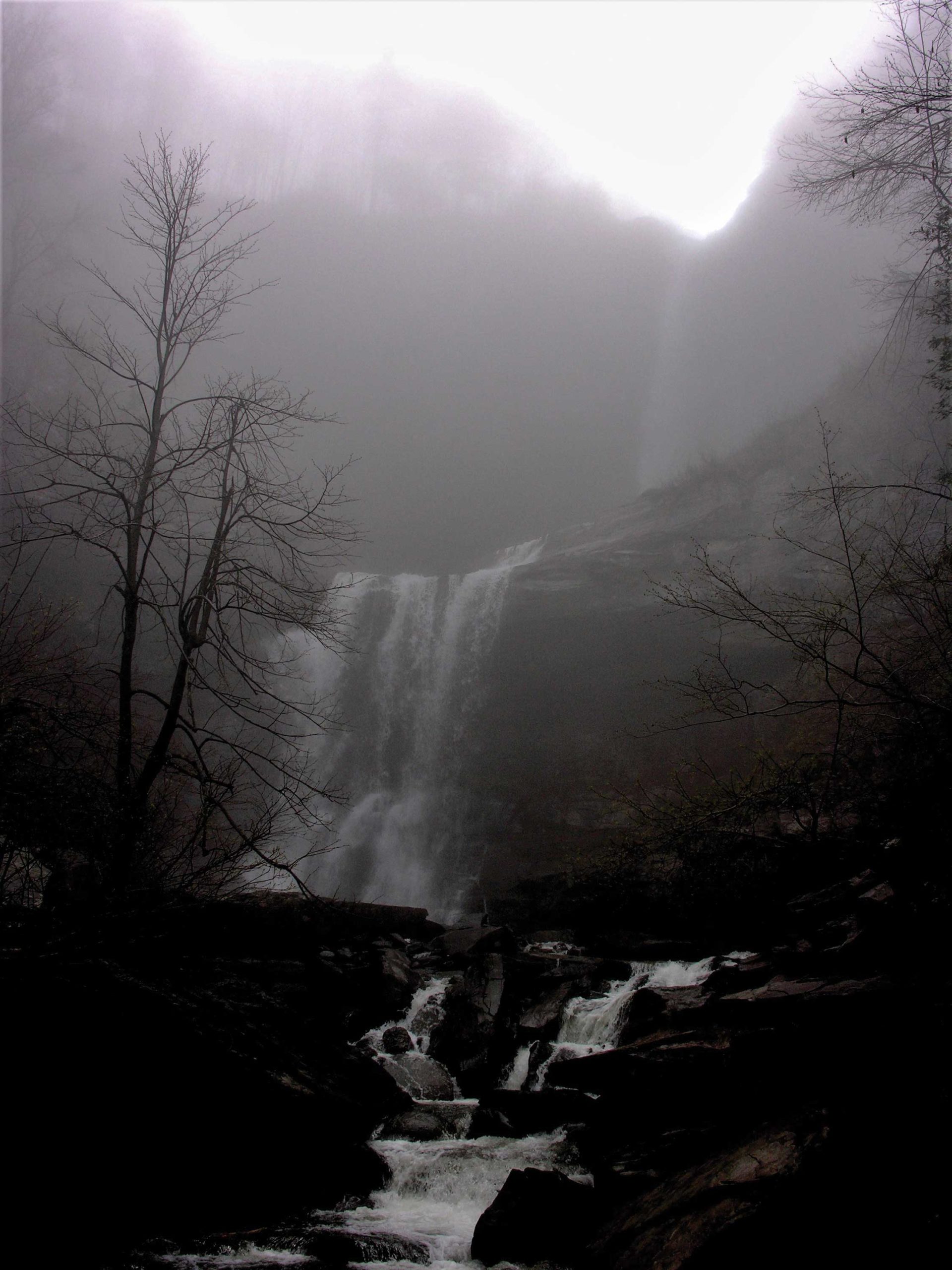
We found our way to the bottom of the falls on a foggy day and looked into the past (Fig. 12). For us the Ice Age was just ending. Down the canyon, there was still a glacier, but above us enormous amounts of the remaining ice were quickly melting. Raging, foaming, pounding, thundering torrents were cascading over the top of Kaaterskill Falls. The sound was unbelievable and made worse by its echoing off the cliffs all around. It seems we had picked the most violent day in the history of the falls. Never before had so much water passed across it; never again would there be this much. We were watching the Sublime origins of Kaaterskill Falls.
Fig. 12: Kaaterskill Falls today
New Perspectives
How much did Thomas Cole know of all this? Perhaps more than one might assume. Cole made the acquaintance of several accomplished geologists, the most notable being the Yale professor Benjamin Silliman. The theory of the Ice Age had just been born in the 1820s, so surely Cole was familiar with it. He could not have known the full extent to which glaciers had created his beloved landscapes, but he almost certainly knew they had been there.
For us, it had been quite the adventure. We had explored Thomas Cole’s Catskills realm and discovered something fundamental about the Sublime. We had always known that our beautiful Catskills had inspired much great art in the 19th century, but now we had looked deeper back in time. The Hudson River School artists painted these landscapes, but first the glaciers had sculpted them. Ultimately, both the landscapes and the paintings are gifts of the Ice Age.
***
ROBERT TITUS, PHD and JOHANNA TITUS are popular science writers, focusing on the geological history of the Catskills. They have authored The Catskills in the Ice Age (3rd edition, 2019, Purple Mountain Press and Black Dome Press). They can be contacted at [email protected]. Robert Titus took all of the modern photographs illustrated here, and the authors have sourced several of the historical images through Wikimedia Commons.
Ronald Sherr (1952-2022) studied at the DuCret School of Art in New Jersey and at the National Academy of Design with Daniel E. Greene, Harvey Dinnerstein, and privately with Burton Silverman. He passed away Wednesday, December 7.
From his family:
Our beloved Ron, who filled our lives with art, love and laughter has passed away.
His rich legacy will live on for generations. We shall treasure the memories and images he has left us with, for the rest of our lives.
~May he Rest in Peace~ Love to all, Lois & Alex
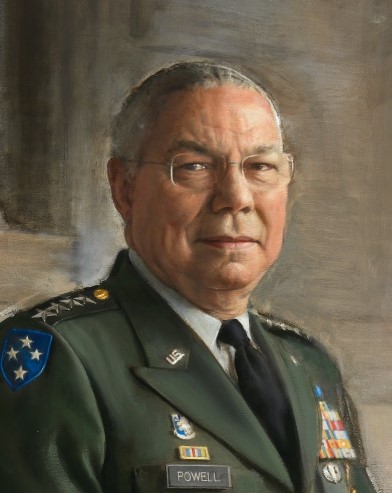
His portraits of notable Americans include former presidents, Supreme Court justices, senators, and governors as well as leaders in business, medicine, academia, and the arts. Sherr is one of the few artists to receive the Hubbard Art Award ($250,000) from the Hubbard Art Museum in Ruidoso, New Mexico.
A detail from Robert Sherr’s portrait of Colin Powell painted for the National Portrait Gallery
His teaching career spanned twenty-five years, with long tenures at the National Academy of Design and the Art Students League (ASL) of New York. The ASL published an interview with Ronald Sherr and Stephanie Cassidy in 2020. When asked what quality he admires most in other artists, Sherr said, “While there are those who seem gifted with an inherent, inexplicable talent (in any of the arts for that matter), it is usually hard work and a driving, serious commitment that brings out the best in any artist.”
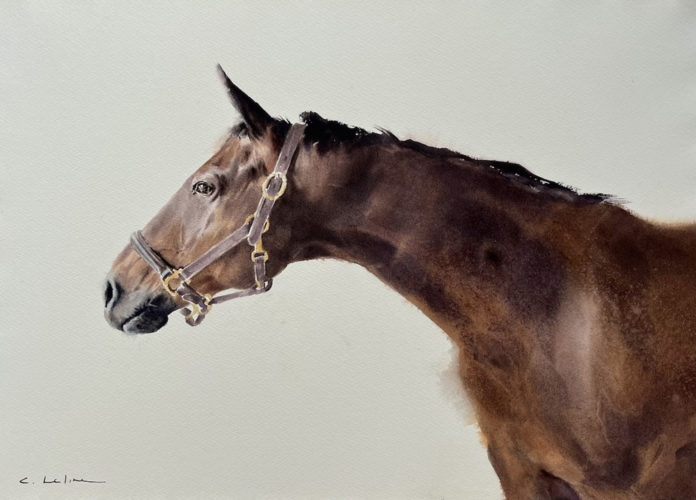
1st Place Winner: "Waiting Patiently" (watercolor, 16 x 20 in.) by Caitlin Leline Hatch
A watercolor painting of a horse, titled “Waiting Patiently,” took first place. The artist turned out to be …
One of juror Andy Evansen’s goals in picking 75 watermedia paintings from the 664 submitted to the Northwest Watercolor Society’s (NWWS) 82nd International Open Exhibition was to pick different styles to show the medium’s versatility and possibilities. At the Awards Reception, he explained why he chose each painting. The recorded event is available for public viewing as is the free online exhibition through January 6, 2023, at www.nwws.org.
On the First Place Winner:
The first place of $2,000 cash went to Caitlin Leline Hatch for her watercolor painting ‘Waiting Patiently’ (shown at top). “The small important subtle light shapes in the face to indicate tendons, sinews, and veins and the strong rich colors in the neck” impressed Evansen with the artist’s remarkable skill. “It’s painted realistically but expressively enough that it still embraces what makes watercolor such a beautiful and unique medium.”
On the Second Place Winner:
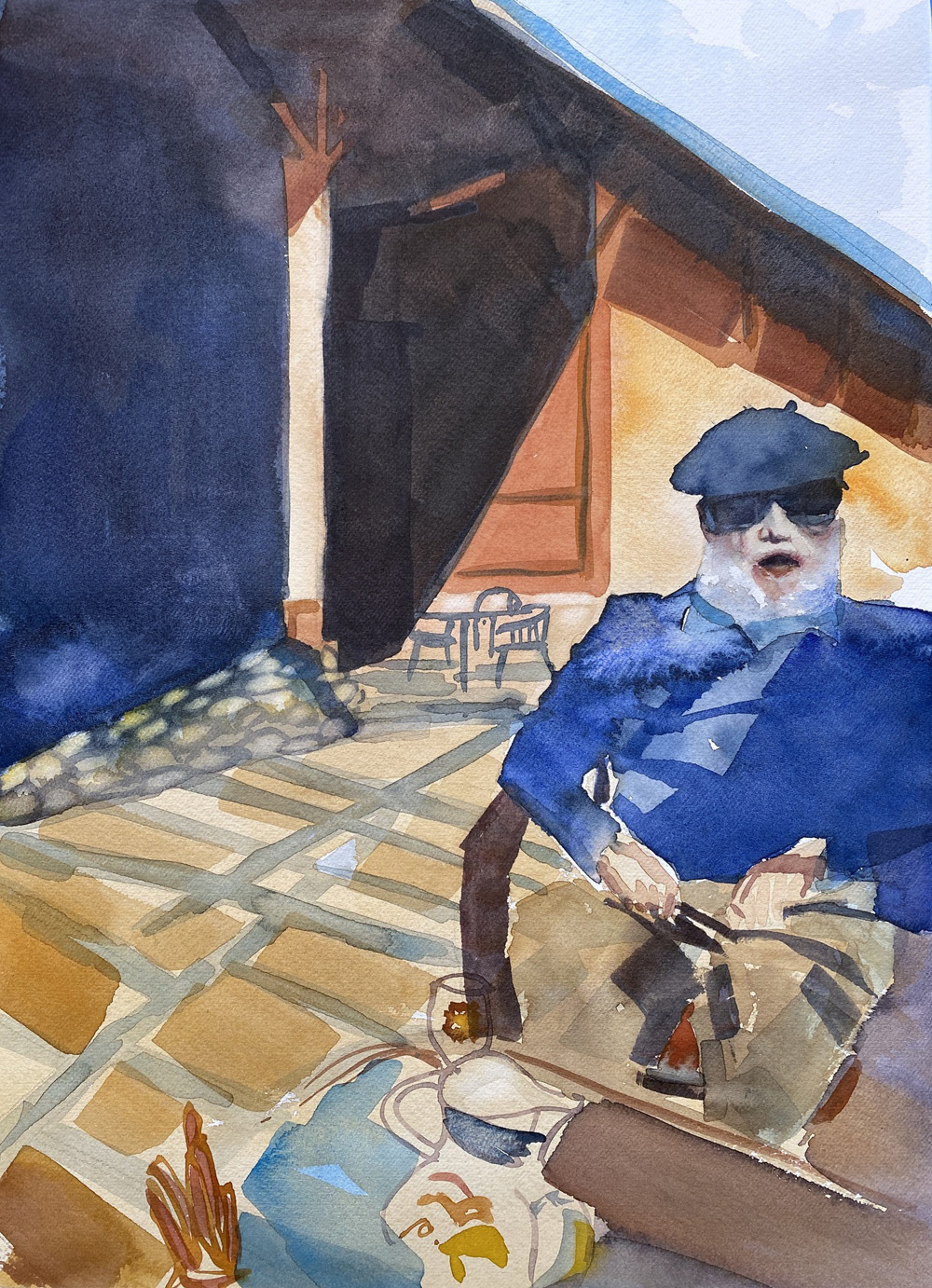
“Every time I looked at this painting, it brought a smile to my face,” Evansen said of Amalia Fisch’s ‘Guillermo’ awarded second place of $1300 cash. “A cubist break up of the space…reduced to large simple shapes works so well. A unique vision and charming painting.”
2nd Place Winner: “Guillermo” (watercolor, 14.5 x 10.5 in., watercolor) by Amalia Fisch
On the Third Place Winner:
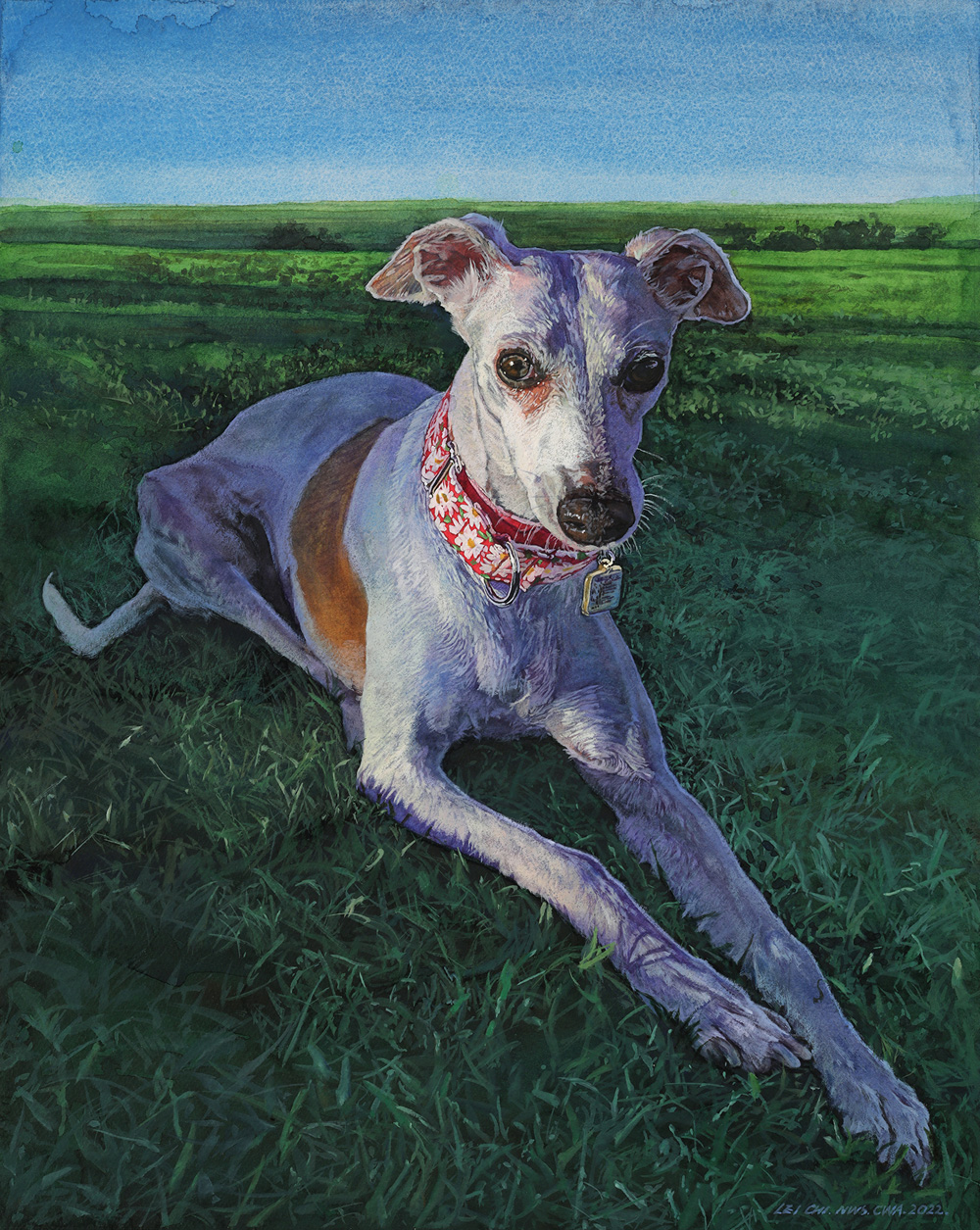
“The textures and variety of shapes in the eyes make a difference in the elegance and design of this painting. We’re looking directly at the dog and that makes another level of majesty. It has as much emotion and feeling as any of the portraits of people,” Evansen explained about Lei Chi’s ‘Olive,’ awarded $800 for third place.
3rd Place Winner: “Olive” (19.25 x 15.25 in., watercolor) by Lei Chi
A Purchase Award of $1,000 was given to John Ebner for ‘China Mist.’ Eleven other merchandise and cash awards were also handed out.
At the end of the event, Evansen congratulated everybody and in an almost apologetic voice said, “If you didn’t win an award, try again next time – like we all do.”
A variety of watermedia paintings are accepted into NWWS exhibitions. All artwork is for sale by contacting the NWWS treasurer, Shirley at [email protected]. Artists receive 75% of the sales price.
About NWWS
The Northwest Watercolor Society (NWWS) was founded in 1939 in Seattle, Washington when a group of eight artists came together to form an organization dedicated to the celebration of watercolor. With a goal to inspire both a lasting interest in the art of watercolor painting and an appreciation for watercolor as an artful, imaginative medium, the history of NWWS began. From these modest beginnings, NWWS has grown into the internationally recognized, historically rich organization of today with a membership over a thousand Signature, Lifetime, and Associate Members across the USA, Canada & internationally.
Browse more watercolor art here at fineartconnoisseur.com, and save years of struggle and frustration by discovering techniques revealed by the world’s top watercolor artists in just three days at Watercolor Live, the world’s largest online art training event January 26-28, 2023 with Beginner’s Day on January 25: watercolorlive.com.
KANŌ TSUNENOBU (Japanese, 1636–1713), Page from Studies of Ancient Masters (Gakko-jō), c. 1695, ink and color on silk and paper, 11 1/4 x 9 7/8 in., Fralin Museum of Art, University of Virginia, anonymous gift, 1975.11.40
As different traditions of Buddhism spread across Asia between the 17th and 19th centuries, art of Buddhist luminaries played a pivotal role.
The Fralin Museum of Art’s exhibition “Earthly Exemplars: The Art of Buddhist Disciples and Teachers in Asia” highlights images that facilitated this faith’s transmission from one teacher to the next.
The works on view were made in Tibet, China, and Japan and are drawn primarily from the Fralin’s permanent collection.
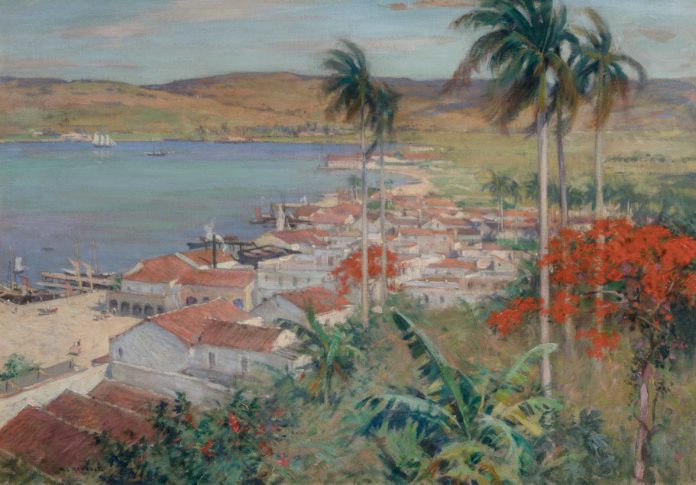
Willard L. Metcalf (1858–1925), "Havana Harbor," 1902, oil on canvas, 18 5/16 x 26 1/8 in., Terra Foundation for American Art, 1992.49
Patricia & Phillip Frost Art Museum
Miami, Florida frost.fiu.edu
through January 15, 2023
Surely there is no better setting than Florida International University’s Patricia & Phillip Frost Art Museum for “In the Mind’s Eye: Landscapes of Cuba,” an exhibition that shows how this famous island has been imagined by American and Cuban artists.
Well into the 20th century, U.S. artists such as Winslow Homer, William Glackens, and Childe Hassam projected an Edenic image of escapism, overlooking Cuba’s harsh realities of servitude, racial strife, and environmental degradation.
Since 1959, Cuban artists like Juan Carlos Alom and Juana Valdés have presented a different story.
The project is accompanied by a handsome 136-page publication produced by D Giles Limited (London). It features essays in English and Spanish by editor Amy Galpin and contributing scholars Jorge Duany and Katherine Manthorne.
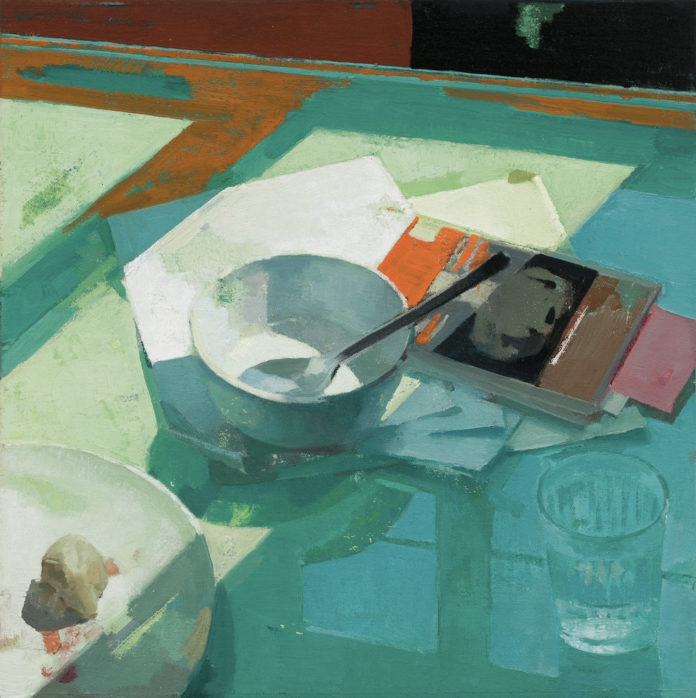
Zoey Frank, "Still Life in Rome," 2022, oil on canvas on panel, 13.5 x 13.5 in.
Sugarlift has announced “Zoey Frank: Recent Paintings,” the artist’s second solo show with the gallery, open through January 7, 2023.
From the gallery:
Boundless in her command of narrative and perspective, Zoey Frank creates paintings which defy classification, imploring the viewer to consider them outside of the art historical tradition which they so aptly reference. Elegantly executed, each piece arrests the viewer in time, unfurling in rivulets, through continued engagement with the artwork surface. Drawing from a deep well of knowledge and with quotations ranging from the Old Masters, to the Post-Impressionists, and all the way through to the Abstract Expressionists, Frank’s layered technique and refusal of pictorial limitations is unparalleled.
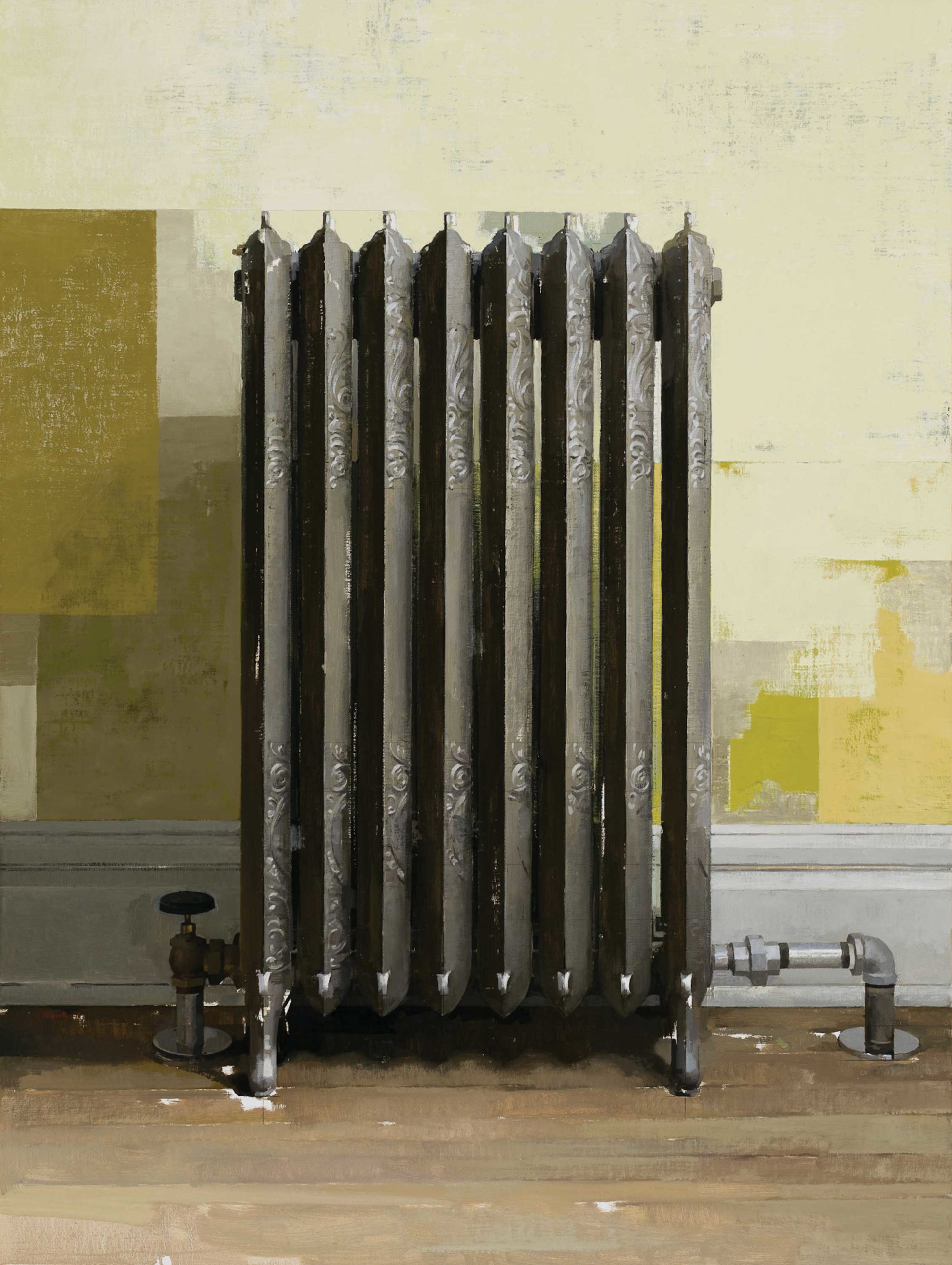
Zoey Frank, “Radiator #2,” 2021, oil on linen on panel, 48 x 36 in.
Porch Musicians, the centerpiece of the exhibition, is a monumental diptych measuring 74 x 132 inches. As is typical of Frank’s work, it is only in the prolonged exploration of the canvas that one can begin to absorb its most subversive aspects. There are differences in the left and right sides which are not immediately perceptible – children, and a violinist, appear on the left, while on the right a blue sky lends a more naturalistic bent. Upon further reflection, it becomes clear that the perspective has shifted, the mood and the level of abstraction interweaving, slightly to the left and slightly less in focus. In the amount of time it takes the viewer to recognize these differences, both sequential and instantaneous, they have immersed themselves in a painting that they perhaps meant only to glimpse. And herein lies Frank’s unique skill as a storyteller. The suspension of motion – made necessary by the medium of paint – leaves open interpretation and involvement by the viewer in the story. An abstracted blur carries the eyeline across the canvas and back again, unveiling new information with every pass.
Trained academically in an atelier setting, in the intervening years Frank has turned to color as another way to break the boundaries of formality. In 5her three-piece Breakfast Table series, the artist reduces her palette, deftly applying a vaguely monochromatic lens as she captures different scenes at the same table. Green, with orange highlights, as a couple sits down for breakfast. Pink, this time with green highlights, as they read the paper together. Orange, now with pops of blue, the viewer encounters the woman alone. Once again, it is in the exploration of these color and subject matter shifts, the bouncing of the eye around and between each work, that one can begin to comprehend the depth of influences from which the artist is drawing.
“The complexity of compositional structure comes through, along with the exquisite visual meanderings and slippage, the conflating of abstraction and figuration…[Frank] is mining and exploring the everyday – the kitchen, the dishwasher, the take-out deli sandwich, – and, not simply invested in depiction for its own sake, Frank permutates the motif – experimenting to reveal spatial and aesthetic possibilities.” – Jordan Wolfson
Frank’s practice is multilayered, sweeping; and her subject matter is at times deceptively simple: a window, or a radiator, each carrying more meaning than first meets the eye. In a way, these less complex compositions deny the apparent requirement in painting of having a subject at all. Rather, by paring down her thesis, Frank makes a subject of the artwork itself, the moment and moments in time which she has chosen to depict.
About Zoey Frank:
Zoey Frank (b. 1987) is a Colorado-based painter who received her MFA in painting from Laguna College of Art and Design after studying for four years with Juliette Aristides at Gage Academy of Art. She has received numerous honors and awards, including three Elizabeth Greenshields grants and the Artist’s Magazine All Media Competition Grand Prize. Her work has been featured in publications such as Fine Art Connoisseur and American Art Collector, and she has exhibited in galleries across the United States, England, and the Netherlands.
For more details about the show, please visit sugarlift.com.
As part of our effort to continue to help artists and art galleries thrive, we’re proud to bring you this week’s “Virtual Gallery Walk.” Browse the artwork below and click the image itself to learn more about it, including how to contact the gallery.
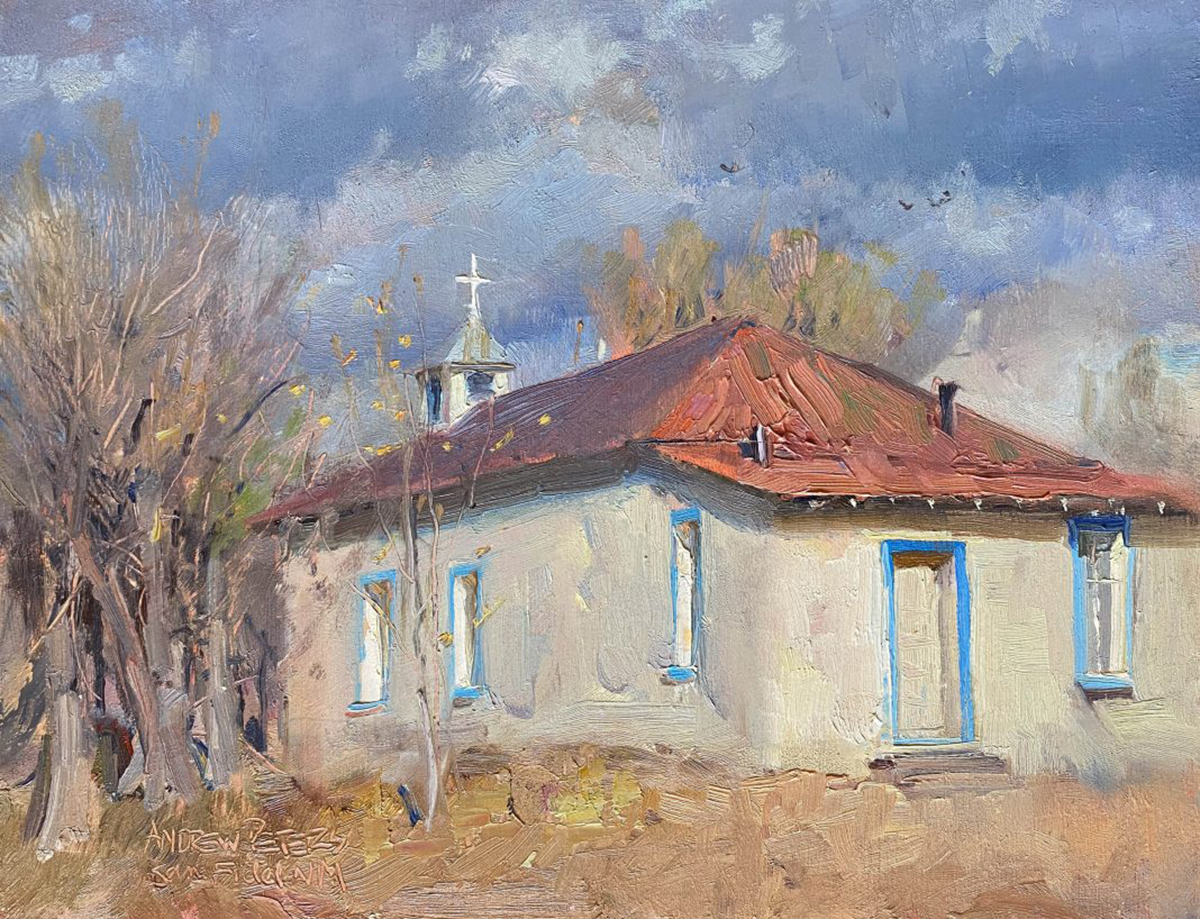
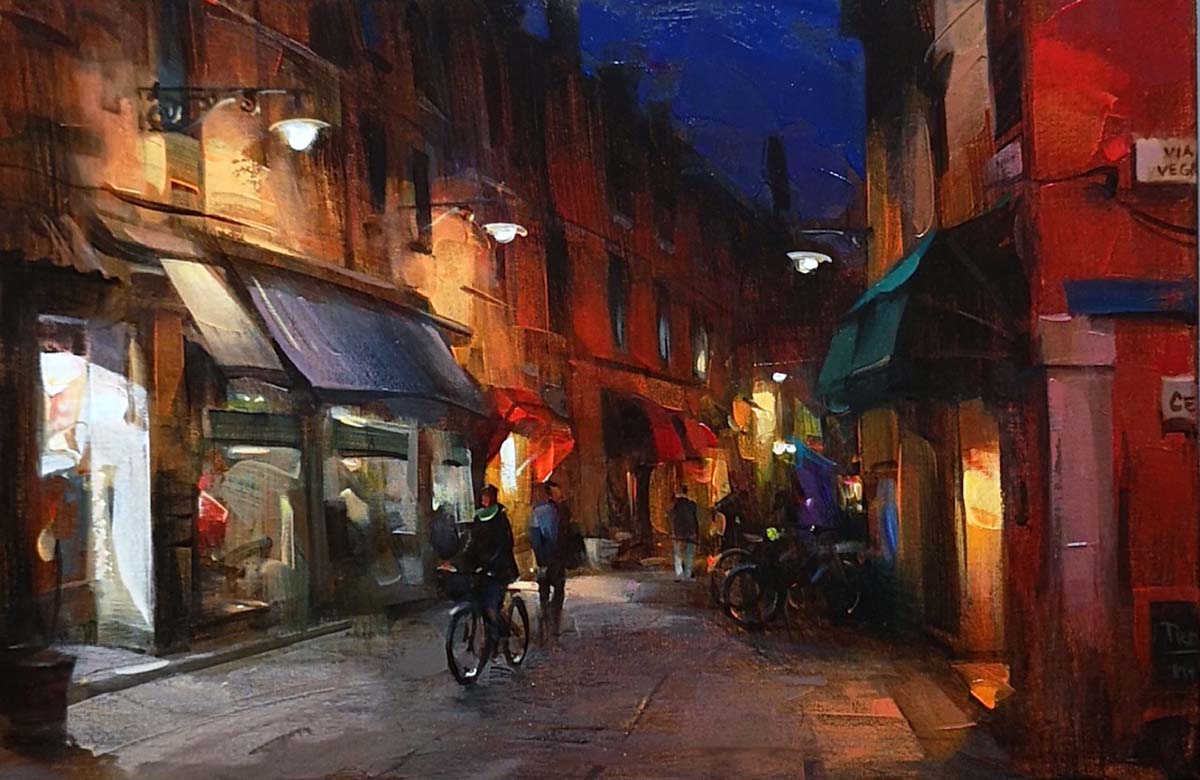
First Light, Paul Batch, oil, 18 x 24 in; Anderson Fine Art GalleryBlowing Snow in Buffalo County, WI, Ben Bauer, oil on panel, 36 x 40 in., Signed; Rehs ContemporaryRed Jacket on Open Seas, Montague Dawson (1895 – 1973), oil on canvas, 24 x 36 in., Signed; Rehs Galleries, Inc.Garaputa Beach Morning (Carmel), Laurie Hendricks, oil on canvas board, 9 x 12 in; Laurie Hendricks GallerySan Fidel, NM, Andrew Peters, oil, 9 x 12 in; ArtzLineFresh Powder, Cathy Sheeter, Scratchboard & Archival Ink, 24 x 36 in; Celebration of Fine ArtBeachcombers, Kathleen Dunphy, oil on linen, 20 x 60 in; Trailside GalleriesInspiration from the Museum, Jhenna Quinn Lewis, oil, 14 x 11 in; Meyer GalleryFerrara At Late Evening, Dmitri Danish, oil on canvas, 12 x 18 in; Reinert Fine Art
Want to see your gallery featured in an upcoming Virtual Gallery Walk? Contact us at [email protected] to advertise today. Don’t delay, as spaces are first come, first served, and availability is limited.
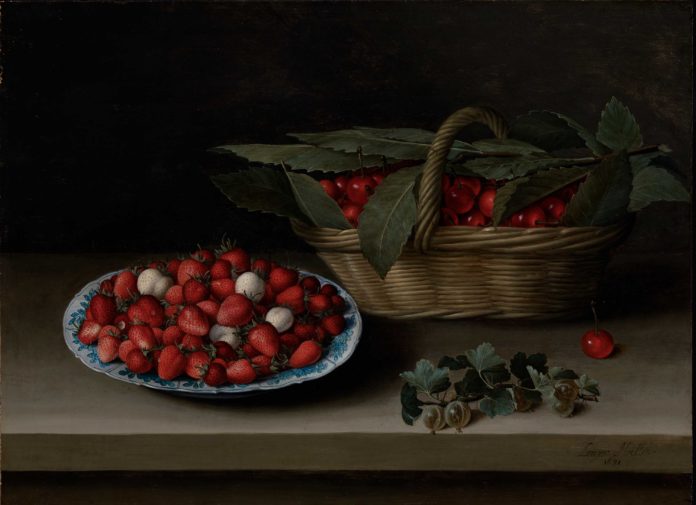
"Still Life with a Bowl of Strawberries, Basket of Cherries, and Branch of Gooseberries" by Louise Moillon
“Still Life with a Bowl of Strawberries, Basket of Cherries, and Branch of Gooseberries” by French artist Louise Moillon is on public view for the first time in its history.
The Kimbell Art Museum (Fort Worth, Texas) has announced the acquisition of “Still Life with a Bowl of Strawberries, Basket of Cherries, and Branch of Gooseberries,” signed and dated 1631 by French artist Louise Moillon (1609/10–1696).
More from the museum:
“The Kimbell Art Museum is delighted to add to its renowned collection what is unquestionably a masterpiece by Louise Moillon,” said Eric Lee, director of the Kimbell. “The painting is an exceptionally well-preserved composition, a mysterious image of simple fruits painted in jewel tones on a wooden panel. It came to light for the first time just this year and is a prime example of Moillon’s keen observational skills and poetic approach to still life.”
The painting, which had long been in a family’s collection in central France, was unknown to scholars until its appearance at auction in March. The Kimbell purchased the painting from an American collector through the New York dealer Adam Williams. It joins another striking and innovative still life by a woman, “Still Life with Mackerel” (1787) by Anne Vallayer-Coster, acquired by the Kimbell in 2019.
Louise Moillon, who has been called the “unexpected genius of the period,” was among the greatest French still-life painters of the 17th century. Moillon’s paintings are remarkable for their elegance and restraint, the equilibrium of their compositions, and a delicate technique that reveals the qualities of fresh, ripe fruits and vegetables, provoking a sense of serenity.
Although the work of many painters of the period — especially female artists — remains unattributed, Louise Moillon signed and dated many of her pictures, enabling about 60 still lifes to be assigned to her hand. (She signed the Kimbell canvas with the archaic spelling of her name, Louyse.) Much remains unknown about her career, but archival documents show that Moillon earned renown in her own time. Five of her paintings of fruits are listed in the inventory of King Charles I of England (1600–1649).
Meticulously painted on oak panel, the Kimbell still life shows Moillon’s characteristic restraint, highlighting the appeal of the delectable fruit at its prime — ripe, firm, and succulent. The fruit containers are placed on a closely framed wooden tabletop that tilts slightly forward and whose edge is brought near the foreground. A strong light from the upper left illuminates the glistening red objects against a dark, shadowy background.
The wild strawberries — fraises des bois — in a blue and white Wanli bowl range in shape, size, and color, from deep garnet to white. Their soft, seeded texture suggests the delicacy of this fruit, whose spiky green calyxes remain intact to preserve their freshness, sweetness, and aroma. Bright, glossy cherries — perhaps the prized tart cherries from Montmorency, north of Paris — are heaped in a rustic wicker basket under a protective shield of deep green chestnut leaves; their sawtooth edges, outlined in a lighter tone, discourage the temptation to pluck one of the polished spheres by its rugged stem.
The little branch of gooseberries placed in the lower right foreground balances the basket and bowl; two of the gooseberries, jade-green globes, are strategically placed at the very edge of the table to create a tactile spatial illusion. Just above, a single ruby cherry invites admiration. Throughout the composition, Moillon creates a simple yet sophisticated balance of color and tone.
Moillon’s sincere approach to still life — excluding anecdote and symbolism — reflects 17th-century French agricultural reforms and the keen market in Paris for fresh fruit and vegetables. The nobility and bourgeoisie took pride in the fresh produce cultivated in their country estates and gardens. In the fields and orchards that abounded in the countryside outside the capital, women and children would pick the fruit late in the day so that it could be transported to the city by morning and sold at market.
The peaches, plums, apricots, grapes, cherries, and wild strawberries, along with vegetables such as artichokes and asparagus, that we see in Louise Moillon’s still lifes and market scenes represent the produce that would have been scrupulously selected for freshness and flavor by ladies, their cooks, and their maidservants and proudly served at the table.
The Moillon painting is the most recent of several acquisitions by the Kimbell, timed to the 50th anniversary of the museum’s founding, including a bronze vessel from the Shang dynasty (c. 1600–1050 BC); a larger-than-life-sized sculpture, “The Mountain (La Montagne),” designed by Aristide Maillol in 1937 and posthumously cast; a 16th-century alabaster statue of the Virgin and Child, from the Atelier of Saint-Léger in Troyes, France; “Dog Guarding a Basket of Grapes” (1836), an impressive still life by Ferdinand Georg Waldmüller; and three pastels by Kimbell architect Louis I. Kahn.
ABOUT LOUISE MOILLON
Louise Moillon was born in Paris in 1609 or 1610 to Nicolas Moillon (c. 1580–1619), a Protestant painter and picture dealer, and Marie Gilbert (d. 1630), the daughter of a wealthy goldsmith. Nicolas Moillon was among the earliest French artists to prosper as an art merchant; he leased a house on the Pont Notre-Dame and purchased several stalls near Saint-Germain-des-Prés abbey, the site of an important fair near which a community of northerners and Protestant artists had settled.
After Louise’s father died in 1619, her mother married François Garnier (c. 1600–1658), likewise a Protestant master painter and art dealer. An inventory taken after her mother’s death in 1630 — when Louise was 20 — listed 13 paintings and testifies to her precocity and productivity. As a young artist in the heart of the Parisian art trade, Louise was ideally situated to study exuberant still-life paintings by Flemish and Dutch artists and paintings in a more sober and less decorative manner by their contemporary French counterparts. The superior quality and elegant yet unpretentious style of Louise Moillon’s work speak clearly: at an early age, she had forged an original and singular idea of still life, distinctly French in character.
In 1640, when she was 30 years old, Louise married a prosperous Protestant lumber merchant, Étienne Girardot de Chancourt. The inventory following her husband’s death in 1680 details their material wealth — a sizable residence with luxury furnishings, a large library, and costly jewelry, as well as paintings, including a few still lifes of fruits that may have been painted by Louise — but nothing to give evidence to her continued activity as an artist. Moillon’s last known signed painting dates to 1641; she apparently stopped painting soon after her marriage in 1640 at age 30. This ending is so far unexplained. Perhaps the wealth and social status of her husband and her extensive family circle discouraged her from continuing her profession.
With the Revocation of the Edict of Nantes in 1685, the French Protestant population was forced to convert publicly to Catholicism. Members of Louise Mollion’s extended family suffered persecution or imprisonment and some relocated outside France. Moillon herself remained in Paris, where she died in 1696. Her will indicates that she had no children (or if so, they predeceased her) and details generous bequests to her numerous relatives and heirs.
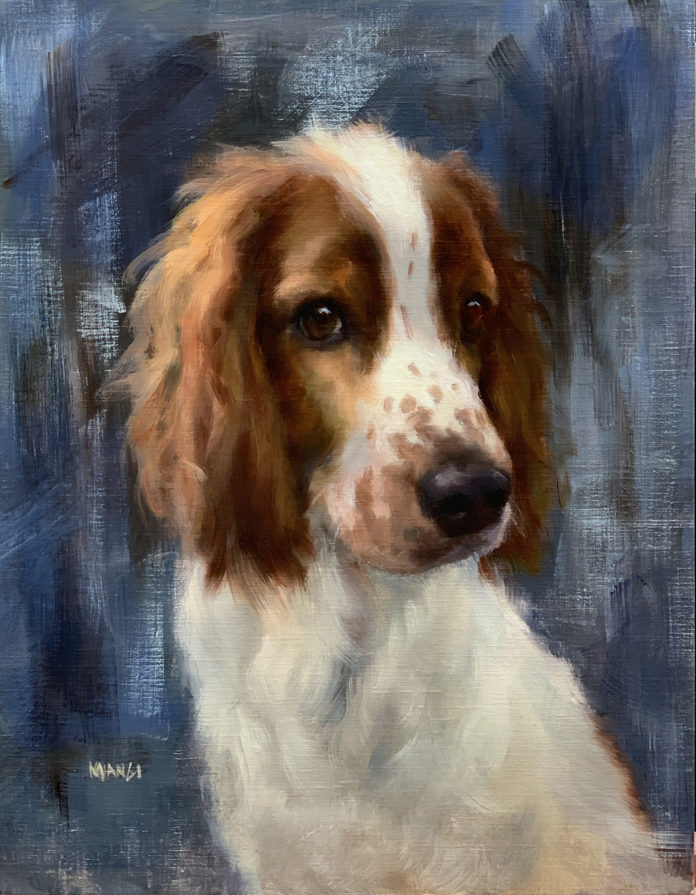
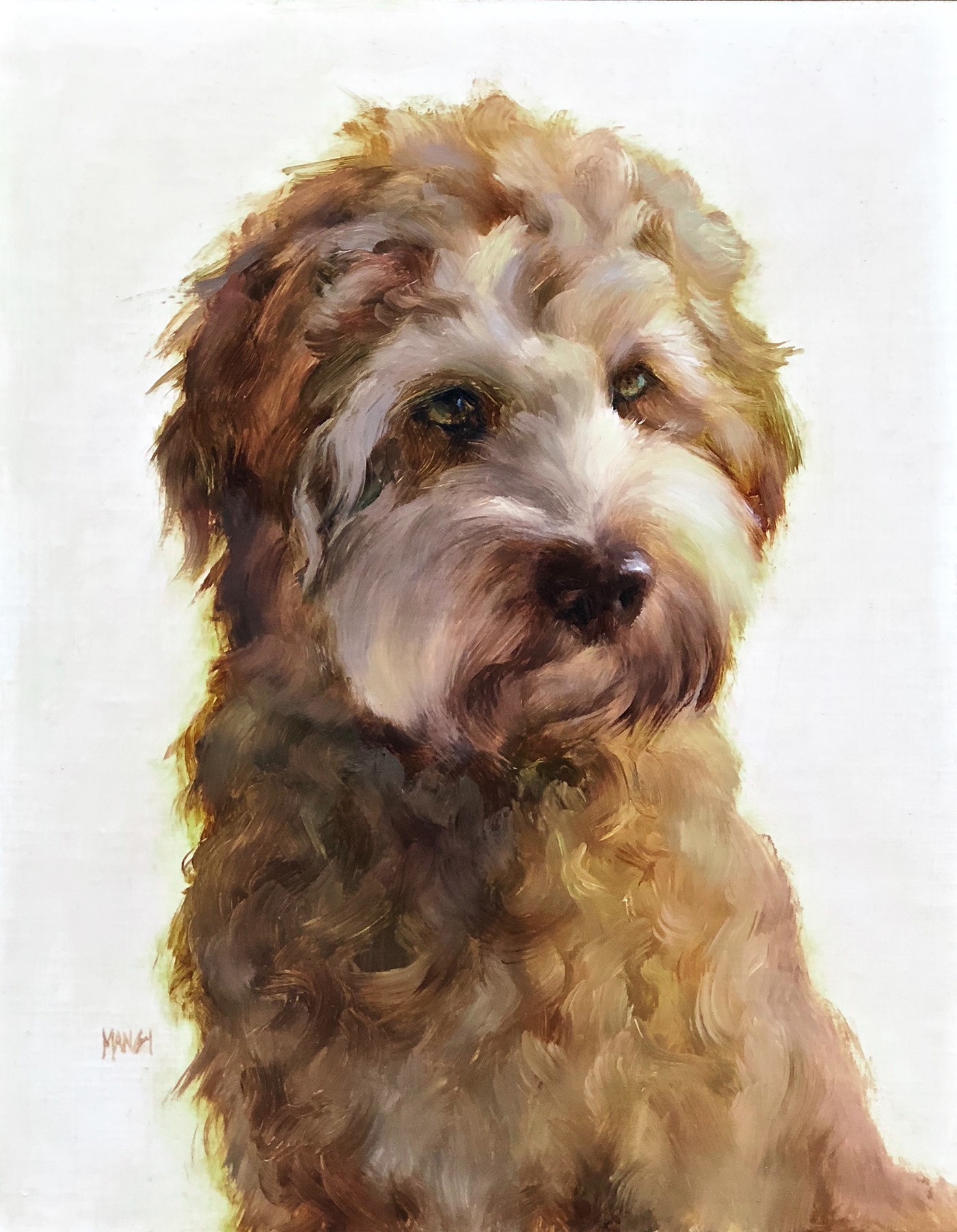
Johanne Mangi: Johanne Mangi’s former career in marketing has enhanced her full time art efforts. Her CT Third Floor Studio group is on a COVID hiatus but Johanne still manages a full time schedule. Although her workshops are shifting to online, she continues to mentor students. An Art Ambassador for Royal Talens/Rembrandt Oil Paints and an Advisory Board Member for Bright Light Fine Art she is a strong advocate for continued learning.
Fill your mind with useful art stories, the latest trends, upcoming art shows, top artists, and more. Subscribe to Fine Art Today, from the publishers of Fine Art Connoisseur magazine.