
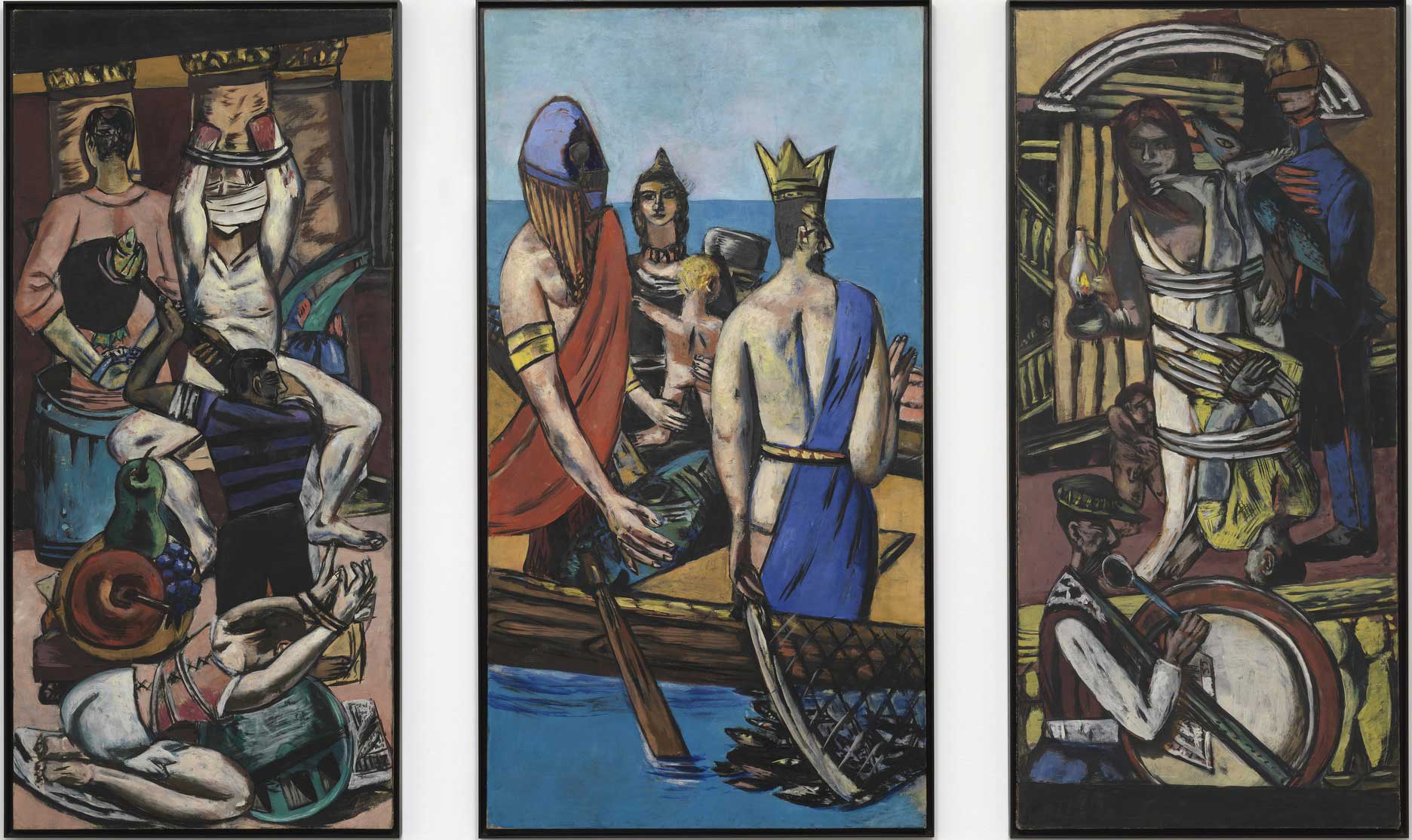
It’s not the typical backdrop for a family-friendly photo op: Max Beckmann’s triptych “Departure” shows prisoners being tortured, some blindfolded, others squeezing their eyes shut in the face of impending doom. But Alasdair Nichol, deputy chairman of the newly merged Freeman’s and Hindman auction houses, and one of the most engaging figures on PBS’s Antiques Roadshow (particularly while using his lilting Scottish brogue to full effect), so admires this Beckmann masterwork that he can’t help but find it whenever he visits New York’s Museum of Modern Art. “Once, I had my son and daughter-in-law stand in front of it so I could take their photo.” Though no one in its three panels is smiling, Nichol feels a certain glee when he’s in front of the triptych.

Nichol is hardly an advocate of violence, and like many art historians he questions the very notion that what we see here is, indeed, an overt depiction of torture. “Beckmann was very influenced by theater, and there’s a theatricality to what’s being shown,” he explains. He points out the symbolism of the images depicted, with references, perhaps, to T.S. Eliot’s “The Wasteland” and even King Arthur’s “Fisher King,” whose task was to guard the Holy Grail. The very scale of some elements, such as the oversized fruit in the central panel, indicates, for Nichol, a softened view of what might be seen as violence. Yet the work is indisputably charged with a profound commentary on fascism, censorship, and the lead-up to war.
Beckmann began painting “Departure” in Frankfurt in 1932, just as the Nazis were coming to power. When they deemed him and his fellow German Expressionists “degenerates,” Beckmann began his own departure — living in, among other locales, Berlin and Amsterdam. He eventually came to America, residing and teaching in St. Louis and, later, New York (where he died on Central Park West while walking to the Metropolitan Museum of Art to view his own work).
Many of Beckmann’s works were decidedly ambiguous, including “Departure,” the first of his nine triptychs. This form is typically associated with Christian altarpieces, and Nichol feels the format “literally gave Beckmann a bigger canvas, able to relate a narrative with panels that talk to each other. He was constantly drawing, and this work is particularly rich with imagery. It’s impossible to interpret. He didn’t want people to interpret it.”
Nichol recalls the moment he first encountered Beckmann, at the suggestion of his teacher in Aberdeen. “Frankly, when I was in art school, I couldn’t tell if I should be an English major or an artist,” he says. “I was an angst-ridden young man, and the moment I saw this work in a catalogue, it became meat and potatoes for me,” meaning that its saturation of symbolism and ambiguous multiple meanings affected young Nichol in a fundamental way.
Moreover, abstraction prevailed at that time, so Nichol found Beckmann’s embrace of figures refreshing: “There was a new figurative movement emerging, and I looked to Beckmann for some inspiration. I’m still so taken with this work that I’m a bit embarrassed I find it so important to me after all these years.”
The above article was written by David Masello for Fine Art Connoisseur
View more artist and collector profiles here at FineArtConnoisseur.com.