
As part of our effort to continue to help artists and art galleries thrive, we’re proud to bring you this week’s “Virtual Gallery Walk.” Browse the artwork below and click the image itself to learn more about it, including how to contact the gallery.
Zinnias in Basket by Elizabeth Floyd, Oil, 24 x 30 in.; Anderson Fine Art Gallery
Mara Masters (1/10) by Bart Walter, Bronze, 10.75 x 15.5 in., Signed; Rehs Contemporary
Café de la Paix by Edouard Leon Cortes (1882 – 1969), Oil on canvas, 13 x 18 in., Signed; Rehs Galleries, Inc.
Sam by Mary Qian, Oil, 14 x 11 in.; ArtzLine.com
Want to see your gallery featured in an upcoming Virtual Gallery Walk? Contact us at [email protected] to advertise today. Don’t delay, as spaces are first come, first served, and availability is limited.
Catherine Hillis has worked as a professional artist for several decades.
Catherine Hillis paints daily in her studio or en plein air.
How did you get started and then develop your career?
Catherine Hillis: I’ve always been involved in the arts. I began my career in theatre working as an actress and costume designer, but I always enjoyed painting and drawing. Once I discovered watercolors, it became my primary medium, and it wasn’t long before I focused entirely on painting. Within a few years, I was entering competitions in the Washington, DC metro area and winning awards, and that led me to enter national competitions. I’ve worked as a professional artist for several decades, writing articles, teaching, selling original artwork, and competing in plein air events. My theatrical background is helpful in developing the narratives I so love in painting and in my colorful approach to teaching. And yes, I paint every day.
How do you describe success?
To me, success is knowing I’ve put forth every effort to become the best I can be while working towards realizing my goals. Every year I set artistic and business goals for myself, and while I don’t expect to meet all those objectives, it provides me with aspirations to work towards.
How do you find inspiration?
I don’t look for inspiration — it finds me! I love those corners of the world that most people pass by without realizing how beautiful or interesting they are. When I find a scene to paint, an overwhelming compulsion forces me to stop, put up my easel and get to work or point my camera and shoot. The scene informs me when it must be painted.
I enjoy working both in the studio and in the field, and I can encounter that compulsion to paint in either location.
What is the best thing about being an artist?
I love my job and I enjoy hard work. Even though working as a self-employed artist is difficult and time consuming, I love what I do. I have the freedom and autonomy to select my own subjects, my own goals, the hours I prefer and my own workspace, whether I select to work outdoors or in the studio. Of course, there are things that accompany the job that aren’t as likeable, such as accounting, shipping, packing, traveling and marketing, but I’m grateful to work at something that I love so much.
Who do you collect?
I collect mostly the work of contemporary watercolor painters I admire such as John Salminen, Jean Grastorf and Joseph Zbukvic, along with Russian, Ukrainian and Canadian painters.
Catherine Hillis, “Thanks for the Memories,” 22 x 18 in., watercolor, 2021. I love painting reflections. This scene provided plenty of opportunity to recreate reflective surfaces while relaying a story about an individual who was just enjoying the moment.Catherine Hillis, “Color Blocking,” 28 x 27 in., watercolor, 2021. Courtesy Anderson Fine Arts Gallery, St. Simons Island, GA. A group of colorful chairs is one of those everyday scenes that people pass every day without realizing how beautiful it is.Catherine Hillis, “Plenty of Pelicans,” 28 x 22 in., watercolor, 2021. Many artists have painted this familiar scene in Apalachicola, Florida, but I wanted to illustrate some of the joy and humor the pelicans provide.Catherine Hillis, “Reservations Required,” 26 x 22 in., watercolor, 2021. There’s a popular restaurant near my home that’s always booked. I’ve never been able to get a reservation there, so I painted it instead.
Although she created oil paintings, watercolors, lithographs, and collages, the artist and educator Luise Clayborn Kaish (1925–2013) was best known for her monumental sculptures in bronze. Critic Robert M. Coates once described her bronze reliefs as possessing a “sweeping energy that parallels the turbulence of Turner in painting,” and indeed her important commissions for Jewish and Christian sanctuaries — such as “The Ark of Revelation” illustrated below — infuse traditional forms with her emotional power and fresh understandings of religious meaning.
LUISE KAISH at work on “The Ark of Revelation” in her MacDougal Street studio, New York City, c. 1962; photo: Morton Kaish, courtesy of Kaish Family Art Project and the Luise and Morton Kaish Foundation
In an era when women were discouraged from pursuing careers in art, and especially sculpture, Kaish studied with leading figures including Ivan Meštrović and Diego Rivera. Traveling widely to research and see art in situ, she was among the first women to be awarded the American Academy of Rome Prize and ultimately became professor and chair of Columbia University’s painting and sculpture division. Beyond the big commissions, her works can be found in major museum collections nationwide.
LUISE KAISH (1925–2013), “The Ark of Revelation,” 1960–64, bronze, 14 x 15 ft., Temple B’rith Kodesh, Rochester, New York, photo: Paul Rocheleau
Out now is “Luise Kaish: An American Art Legacy,” a richly illustrated 256-page monograph surveying Kaish’s life and career, published by D Giles Limited (London) in association with the Kaish Family Art Project. Edited by feminist art historian Maura Reilly, it contains essays by six scholars and many previously unpublished photographs. A portion of each sale made through the Project’s website will go to the Artists’ Fellowship, which assists professional artists and their families in times of need.
The book’s publication coincides with a major gift from the Kaish family to Syracuse University, where Luise and her artist husband Morton Kaish met as students (they married in 1948). The gift will name a gallery at the Syracuse University Art Museum where the couple’s art will be displayed, and also endow a fellowship program that provides students with opportunities to use the Kaishes’ artworks as a basis for original scholarship.
All of these exciting developments epitomize how artists’ legacies can be secured for the future, an urgent matter explored in detail by James Lancel McElhinney in the November/December issue of Fine Art Connoisseur magazine (page 101).
> Visit EricRhoads.com to learn about more opportunities for artists and art collectors, including retreats, international art trips, art conventions, and more.
> Sign up to receive Fine Art Today, our free weekly e-newsletter
As part of our effort to continue to help artists and art galleries thrive, we’re proud to bring you this week’s “Virtual Gallery Walk.” Browse the artwork below and click the image itself to learn more about it, including how to contact the gallery.
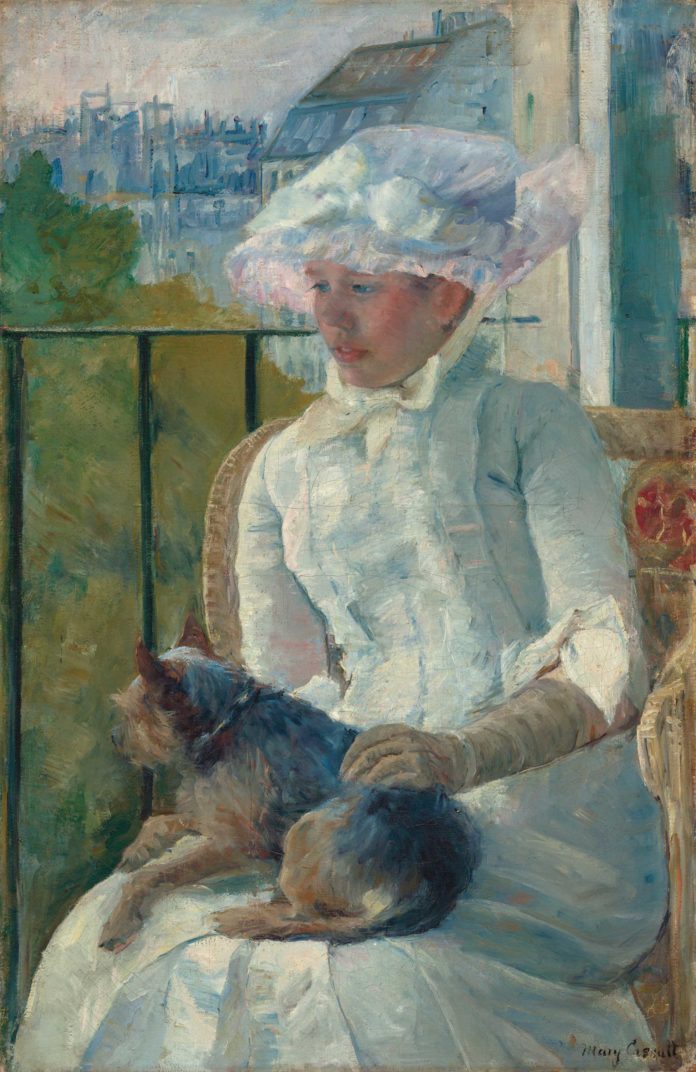
She Wore a Ribbon by Melissa Hefferlin, Oil, 16 x 13 in.; Anderson Fine Art Gallery
Red Velvet Cake by Beth Sistrunk, Acrylic and oil on panel, 6 x 6 in., Signed; Rehs Contemporary
Fontaine-Chaalis, Oise by Constantin Kluge (1912 – 2003), Oil on canvas, 21 x 25 in., Signed; also titled on the stretcher; Rehs Galleries, Inc.
Petite Souris 479 by Marina Dieul, Oil, 4 in. diameter; ArtzLine.com
Want to see your gallery featured in an upcoming Virtual Gallery Walk? Contact us at [email protected] to advertise today. Don’t delay, as spaces are first come, first served, and availability is limited.
ALYSSA MONKS, "No Going Back," 2021, oil on linen, 41 x 41 inches
Alyssa Monks, whose psychologically-charged, figurative paintings have been exhibited in New York since 2006, is known for her bold, expressionistic portrayals of women as they experience the natural, contemporary world. Alyssa Monks’ TED talk (watch below) has been viewed more than a million times, her paintings have been presented throughout the United States and in Europe, and her work was featured in the television series, The Americans (FX) throughout its sixth and final season.
Her works are now on view through January 8, 2022 at Forum Gallery in the exhibition titled “It’s All Under Control.”
ALYSSA MONKS, “The Shadow Self,” 2021, oil on linen, 50 x 34 inches
In the sixteen paintings on view, Alyssa Monks draws the viewer into the shifting, powerful emotions experienced during the past eighteen months when the wider world has suffered physical, emotional, and political disturbances unlike at any time in history. Compounding the complexity of the new works in the exhibition, from the smallest (12 x 18 inches) to the largest (62 x 90 inches), have been the acutely emotional, personal circumstances Monks has faced during this time, events that have combined to propel her to turn to herself as the subject of a body of work that endeavors to make sense of troubled times.
ALYSSA MONKS, “Watch The Only Way Out Disappear,” 2021, oil on linen, 54 x 54 inches
“At times, the recent global and national devastation, division, and so many disappointments felt like a surreal projection of my own mental states in the isolation of the last 18 months,” Monks said. “I began to explore the human reliance on control and predictability, and how our deepest suffering comes from our attachment to security, virtue, identity, and the logic of cause and effect. The glass barrier in these paintings between subject and viewer is clouded with vapor that obscures and abstracts the subject. This barrier underlines the personal and community-wide preoccupation with virus-laden respiratory droplets and the isolation it creates. Some works are more ambiguous than others, amplifying the state of disorientation in the face of terrifying unfamiliarity. Each piece has its own, often-layered, strategy, voice and urgent plea.
“One of the most painful truths in life is that there are difficult events and circumstances that we cannot control or influence. Perhaps in accepting our limitations, and the often life-altering grief that goes along with them, we can find a greater authenticity of being, a sense of empathy, and an understanding that we are not quite so isolated after all. The paintings in this series paradoxically reveal our shared human experience as they describe private moments of distress.”
ALYSSA MONKS, “It’s All Under Control,” 2021, oil on linen, 62 x 90 inches
Since receiving her MFA from the New York Academy of Art in 2001, Monks’ paintings have been the subject of numerous solo and group presentations including exhibitions at the Kunst Museum in Ahlen, Germany, The Bo Bartlett Center in Columbus, GA, and the National Academy Museum of Fine Arts, New York. Her work is represented in public and private collections, including the Savannah College of Art and Design Museum of Art, The Center for Contemporary Art, and the collections of Howard Tullman, Danielle Steele and Eric Fischl. Monks has been awarded the Elizabeth Greenshields Foundation Grant for Painting three times.
ALYSSA MONKS, “Dissociated,” 2021, oil on linen, 30 x 30 inches
“It’s All Under Control” is Alyssa Monks’ third one-person exhibition at Forum Gallery.
> Visit EricRhoads.com to learn about more opportunities for artists and art collectors, including retreats, international art trips, art conventions, and more.
> Sign up to receive Fine Art Today, our free weekly e-newsletter
Winter Visitors
By Heidi Rosner
12 x 24 in.
Watercolor
$1,000
A self-taught artist, Heidi Rosner was an engineer in the aerospace industry before pursuing fine art. She paints in the studio as well as en plein air and is fulfilled by the spontaneous nature and flexibility of watercolor. “My love of the outdoors helps me to see and capture the vibrancy of native plants in the scenes that I paint.” With every painting, her goal is for people to feel as if they can walk into her landscapes and enjoy the experience, or to feel the sun that illuminates her florals. When Rosner’s viewers share in these experiences, she knows she has succeeded.
“My inspiration comes from scenes in and around the Southwest, the West Coast, as well as on location all over the world. Because I travel extensively, I have made my painting set up extremely portable to enable me to take it with me everywhere I go.”
Come watch Heidi and 100 other artists create at the Celebration of Fine Art, where art lovers and artists connect, in Scottsdale, AZ January 15 – March 27, 2022. Contact us at 480-443-7695 or [email protected].
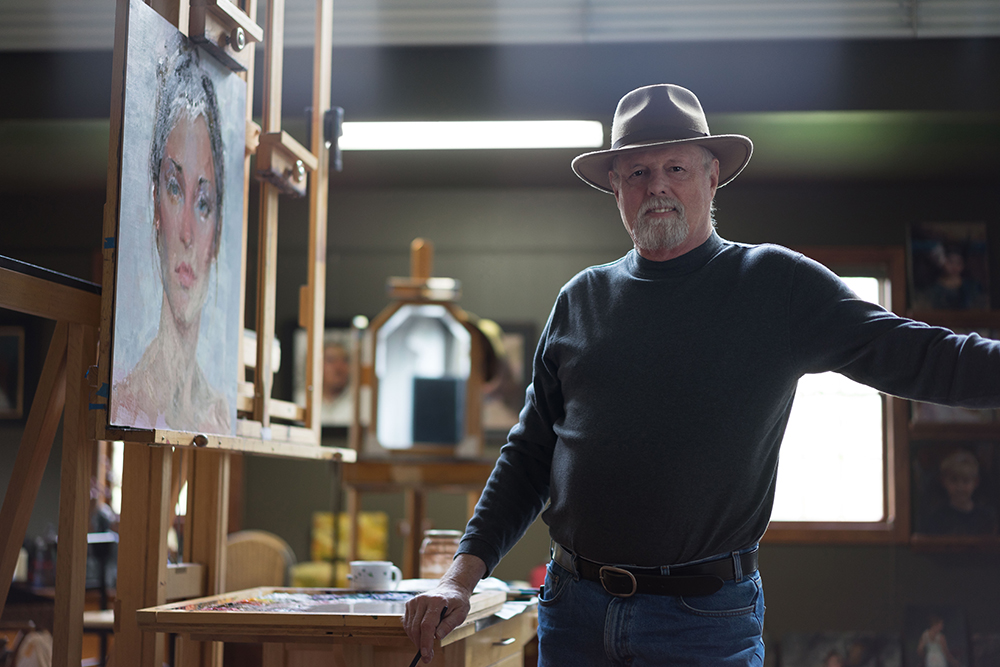
Featured Artist Ray Hassard with some of his plein air pastels at a recent gallery opening.
Painting on site was important during the worst days of the pandemic. Here Ray is painting in a local nursery, Spring 2020, which led to several studio pieces.
How did you get started and then develop your career?
Ray Hassard: An artist friend of mine asks, “Can you ever remember a time when you didn’t draw?” The answer from me and most artists I know is, “no.” From my earliest days, I have always loved drawing, coloring, painting — anything to do with image making — always with the idea of being as “real” as possible.
My first professional paintings were photorealist in style and urban in subject. I was happy painting that way for years. But eventually I tired of the painstaking nature of it and searched for something more immediate. I turned to plein air painting, and a new world opened for me. I guess only Abstract Expressionism would have been further from photorealism. I think now that to be “objective” is probably best left to the camera, but the opposite danger is becoming so “subjective” that the painting communicates only to the artist. Adam Clague recently wrote about walking the tightrope between “the Abyss of Unbridled Creativity on one side and the Chasm of Static Rendering on the other.” I know that balancing act only too well!
Plein air painting at first was extremely difficult, and I learned a huge amount by watching experienced painters in local groups. I found out about equipment needed, how to approach this very different way of working, how frustrating and yet satisfying it can be. Eventually, I started entering plein air competitions, finding that the additional tight focus of those events helped my work and that I enjoyed the intensity and camaraderie of them. Several First-Place awards and sales added to the incentive as did the opportunity to paint around the country in the past decade.
How do you describe success?
I might say supreme mastery of an art, making the difficult seem effortless, repeatedly. I might also say being able to support oneself (and others if need be) through one’s art. And I might also say being able to spend a large part of one’s life producing art one is proud of, while continuously striving to do better.
How do you find inspiration?
I used to really recharge the batteries by travel. Some of my best times painting were in India and Cuba. A month as Artist in Residence in Dinan, France, will always be a highlight of my life. Of course, that all changed in 2020. So, now looking at other people’s art, online and in magazines and artbooks gives me thoughts and ideas about new directions. I have continued to go out and paint with a few friends — every week if possible — since the pandemic started. And not being on the road as much has allowed me to explore different media such as gouache, acrylic and casein.
What is the best thing about being an artist?
Freedom! We can do whatever we dream of, really, if we can get out of our own way. (See the tightrope analogy again). Of course, there is a lot of responsibility with that freedom — a huge amount of self-discipline and tons of hard work. And there is that emotional rollercoaster we all know about and perhaps ride too often. But never doubt, it is a great life!
Who do you collect?
I collect mostly by trading with my painting friends: the late Larry Rudolech, Roy Boswell, Marilee Klosterman, Nathaniel Flanagan, Debra Joyce Dawson, David Mueller, and a very special trade with Patrick Lee: one of his sketchbooks. If I could afford it I would love something by Marc Dalessio, Carl Bretzke, Marc Hanson, or Joaquin Sorolla! Well, while I’m dreaming, let’s throw in Sargent and Zorn and Levitan! At least I can collect them in good quality books.
Ray Hassard, “Behind the Greenhouse,” oil on canvas, 24 x 48 in., 2020. A larger studio version of a plein air pastel done at the same local nursery.Ray Hassard, “Winter on the Ohio,” casein on panel, 12 x 24 in., 2021. My first larger scale casein painting. This was based on a plein air pastel done just before my fingers froze solid.Ray Hassard, “Watching the Boys Swim, pastel on panel,” 18 x 18 in., 2013. South India, near Rameswaram, a blinding hot day on the beach. The local dogs were squeezed into the little bit of shade under my easel! Based on photos, sketches and vivid memories.Ray Hassard, “Sunday in Havana,” gouache, 12 x 9 in., 2020. Photos and sketches were the basis for this studio gouache of a beautiful Sunday afternoon in the park.
Brian Keeler (b. 1953), “Interiority Rhythm,” 2017, oil on linen on panel, 30 x 26 in., collection of Scott Nissenson and Laura Taylor, Ithaca, NY
Contemporary Art > Capturing the Spirit of Music and Dance
Because the arts have always been interconnected, it makes perfect sense that painters and sculptors continue to depict musicians and dancers at work. Among the best-known chroniclers of these sister arts is Edgar Degas (1834–1917), who haunted the stages and rehearsal rooms of Belle-Epoque Paris, drawing what he witnessed.
Hailing from across North America, most of the artists highlighted here work in modes quite different from that of Degas, yet their overall objectives are similar: to underscore the intense effort necessary to pursue these disciplines, and also to convey the exhilaration performers and audiences feel when everything comes together.
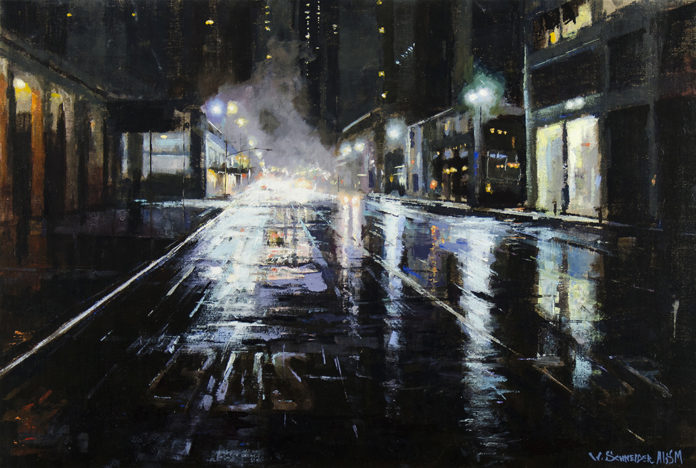
Jorge Alberto (b. 1949), “Allegory of the Arts,” 2016, oil on panel, 16 x 25 in., Troika Gallery, Easton, MDAndrew S. Conklin (b. 1961), “Spanish Still Life,” 1994, oil on linen, 24 x 19 in., private collectionWilliam Schneider (b. 1945), “Practice Makes Perfect,” 2013, oil on linen, 24 x 30 in., private collectionTina Garrett (b. 1974), “Tango Nights,” 2016, oil on canvas, 50 x 60 in., private collectionAndre Lucero (b. 1967), “Floating,” 2017, oil on canvas, 36 x 24 in., J.M. Stringer Gallery, Vero Beach, FLNancy Oppenheimer (b. 1948), “In Key,” 2008, pastel on board, 30 x 23 in., available from the artistMichael Malm (b. 1972), “The Dancer,” 2010, oil on canvas, 40 x 15 in., Meyer Gallery, Santa FeMatthew Bird (b. 1977), “Jazz by Brennan’s,” 2016, watercolor on paper, 29 x 31 in., available from the artistDavid Tanner (b. 1969), “Boy with Mandolin,” 2013, oil on canvas, 30 x 15 in., collection of Alexandra McGrath
Gladys Roldan-De-Moras (1963), “Flamenco Lady,” 2014, oil on linen, 36 x 24 in., private collection, courtesy InSight Gallery, Fredericksburg, TXDavid William Terry (b. 1958), “Like a Lover at First Touching,” 2016, oil on linen, 36 x 24 in., private collection
5 Contemporary Art Sculptures Celebrating Music and Dance
Jane Dedecker (b. 1961), “Can Can,” 2004, bronze, 79 x 83 x 49 in., Brookgreen Gardens (SC) and also available from the artistPaige Bradley (b. 1974), “Ballet Femme,” 2015, bronze (edition of 25), 32 x 24 x 44 1/2 in., Thornwood Gallery, Houston, and Gallery D’May, Cape May, NJOlga Nielsen (b. 1953), Dancer, 2015, bronze (edition of 3), 26 x 7 x 13 in., available from the artistMarc Mellon (b. 1951), “Marcelo Gomes as Apollo,” 2017, bronze (edition of 12), 26 1/2 x 10 in., available from the artistRichard Macdonald (b. 1946), “Joie de Vivre,” 2007, bronze, 82 x 68 x 55 in., private collection
This contemporary art roundup originally appeared in Fine Art Connoisseur, January/February 2018
"Social Distancing" watercolor by Charles McVicker
For 100 years the National Watercolor Society (NWS) has hosted a watermedia exhibition that showcases watercolor and watermedia by artists from around the world. This year’s 101st exhibition continues the celebration of this elusive and magical medium.
2021 101st NWS International Open Exhibition:
“The artwork chosen by NWS Jurors Ken Goldman, Donna Zagotta, and Bev Jozwiak is original, masterful, and evocative,” said NWS President Denise Willing Booher. “Each painting weaves its own unique story, leaving the viewer yearning for more. The 95 spectacular works present 14 countries and 28 states. The combined Jurors’ votes produced a cumulative exhibition that speaks of our time, artistic excellence, and innovation. Judge of Awards Ali Cavanaugh skillfully chose masterful inspirational artwork painted with artistic merit that touched the soul.
“The past year has seen political and social unrest, a pandemic, and a shift in our lives, creating uncertainty. Yet, through it, all NWS membership and prominence have flourished and grown, spreading our outreach worldwide. The 101st NWS International Open Exhibition is the pinnacle of the freshest cutting-edge watermedia artwork today.”
“Museum of Us,” watercolor by Geoffrey Allen“A Feminine Touch,” watercolor by Alisa Shea“Life is Looking for Crayfish,” watercolor by Kathleen Giles
The NWS International Open Exhibition is recognized for its diversity of watermedia styles, masters of the medium, and up and coming artists from around the world. This exhibition will take place online through December 11, 2021, at nwsexhibition.com.
> Visit EricRhoads.com to learn about more opportunities for artists and art collectors, including retreats, international art trips, art conventions, and more.
> Sign up to receive Fine Art Today, our free weekly e-newsletter
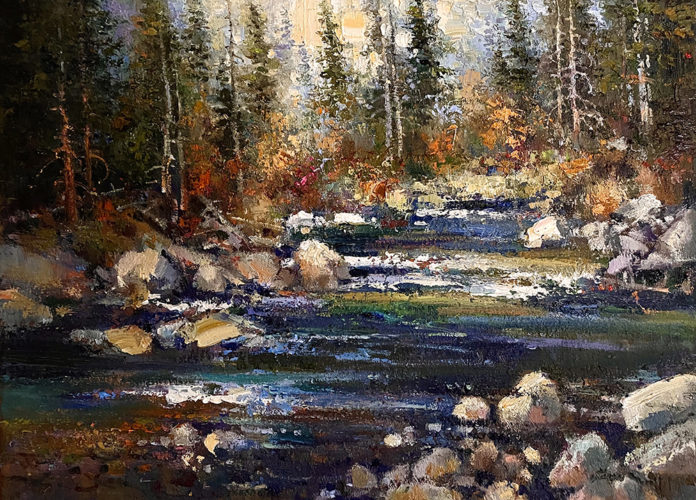
Barbara Jaenicke (b. 1964), "Twilight’s Radiant Descent," 2017, oil on panel, 12 x 16 in., Authentique Gallery of Art and Design (St. George, UT)
Landscape Painting Spotlight > There is a lot of superb contemporary realism being made these days; this article by Allison Malafronte shines light on a gifted individual.
Capturing moments in nature that move swiftly out of sight but leave a brilliant memory is the specialty of Bend, Oregon, artist BARBARA JAENICKE (b. 1964). Working in both oils and pastels, the artist imbues her landscapes with delicate and sensitively observed light, often representing sunset, dusk, and twilight hours. Recreating the shifting light and shadows of these particular times of day requires a sharp eye and plenty of plein air painting experience. Jaenicke has been developing her landscape skills with near-obsessive devotion since she decided to pursue painting full-time in 2002.
Although Jaenicke was always artistic, she admits she was never applauded for her youthful talent and therefore had to work twice as hard to get to where she is today. After graduating with a B.A. in art from Trenton State College (New Jersey), she spent nearly a decade working in advertising as an art director, followed by corporate marketing positions.
At the time this may have seemed like a detour from her fine-art path, but it proved to inform her future painting career immensely. She now produces prolifically for several galleries, is a popular instructor who teaches up to 12 workshops per year, and manages her own marketing, business, and advertising.
Jaenicke paints a variety of outdoor scenes, but those of the wintry variety are her signature. Growing up in New Jersey, she weathered many northeastern winters, and has always found the sight of snow delightful. The artist continues to find it an ideal subject for creating contrast, capturing light and shadow, and using a luscious palette.
In her painting “Twilight’s Radiant Descent,” (above) those aspects are visible in the shimmering metallic reflections in the water, the chords of cool color notes in the thick application of white paint, and the compositional juxtapositions. “I spotted this glowing little nook just after I finished painting nearby,” Jaenicke recalls. “The light was gone from the ground and vegetation, but still illuminated in the water. It was a dazzling array of visual contrasts that I immediately brought back to the studio.”
Ruminating about her process, and her ongoing battle to be the best painter she can be, Jaenicke says, “A painting never comes easily for me. I am constantly challenged to create something that goes beyond just painting a ‘thing.’ That magic doesn’t always happen in every attempt, but when a painting ‘hits,’ it makes all of the painful misses well worth it.”
Barbara Jaenicke has been on the faculty for the virtual art conference Pastel Live.
Fill your mind with useful art stories, the latest trends, upcoming art shows, top artists, and more. Subscribe to Fine Art Today, from the publishers of Fine Art Connoisseur magazine.