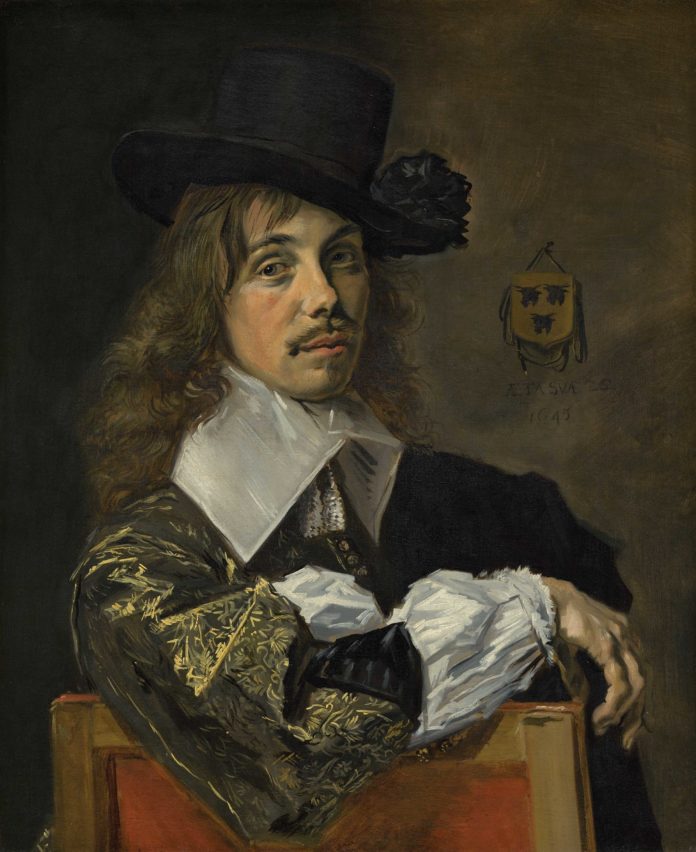
Frans Hals (1582/3–1666), "Willem Coymans," 1645, oil on canvas, 30 5/16 x 25 3/16 in., National Gallery of Art, Washington, Andrew W. Mellon Collection, 1937.1.69
Frans Hals: The Male Portrait
The Wallace Collection, London wallacecollection.org
Through January 30, 2022
The Dutch painter Frans Hals (c. 1582/3–1666) was praised by contemporaries for portraits that seem “to live and breathe.” Through his lively compositions and dynamic brushwork, he revolutionized the field, and now the Wallace Collection’s exhibition, “Frans Hals: The Male Portrait,” will celebrate its own Hals portrait by juxtaposing it with more than a dozen examples borrowed from collections around the world.
“The Laughing Cavalier” (1624) was purchased in 1865 by the 4th Marquess of Hertford, the Wallace Collection’s principal founder, who paid the then astronomical sum of 51,000 francs, more than six times its estimate. The resulting publicity brought Hals back into the spotlight after centuries of neglect.
> Visit EricRhoads.com to learn about more opportunities for artists and art collectors, including retreats, international art trips, art conventions, and more.
> Sign up to receive Fine Art Today, our free weekly e-newsletter
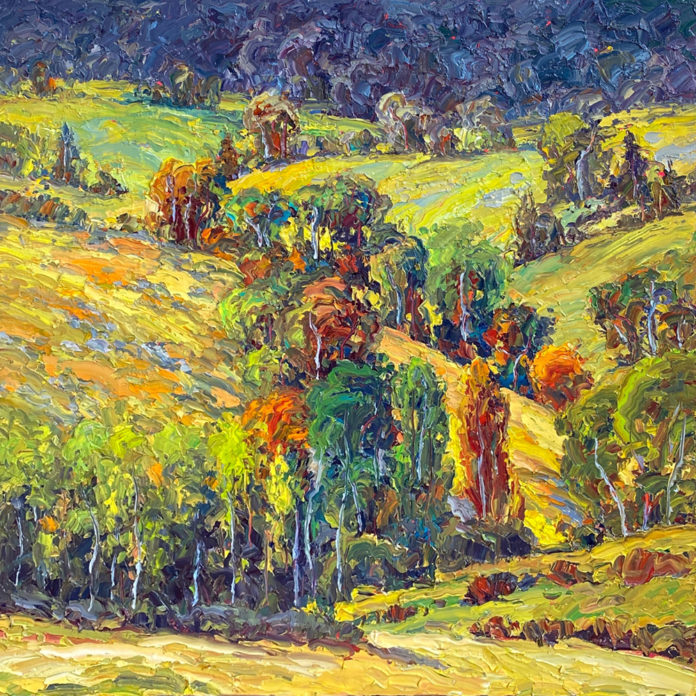
Canyon Grove
By Brad Teare
30 x 30 in.
Oil on panel
$5,800
Available from Manitou Galleries, Santa Fe, New Mexico
Inspired by a field sketch, this richly textured painting was completed in the studio during the Fall of 2021. Teare uses plein air paintings to record accurate value and color while transferring the sketch’s original energy to his studio work.
BRAD TEARE – THE POETRY OF THICK PAINT
Although initially a woodcut artist, seeing an exhibit of Van Gogh paintings at the Metropolitan museum reignited Teare’s love of thick paint. He was surprised at how much more impact Van Gogh’s paintings had in person. Some of Van Gogh’s paintings that he knew from reproductions were hardly recognizable. Intrigued, Teare began landscape painting with thick texture. Starting with brushes, he later switched to palette knives to achieve even thicker strokes of color. Other influences include Birger Sandzén, Edgar Payne, and William Wendt.
Raised in Kansas, at age 18, Teare traveled to Northern Idaho, built a log cabin in the foothills of Moscow Mountain, and began studying wood engraving. He later studied fine art at the University of Idaho. After college, Teare moved to New York to pursue an illustration career featuring the art of woodcut. He worked for The New York Times and Random House, where he did book covers for authors such as James Michener, Anne Tyler, and Alice Walker.
Teare eventually left New York to pursue a full-time career as a landscape painter. He settled in a picturesque valley in Utah. Teare travels the West, recording its beauty in field sketches and painting larger versions back in his studio.
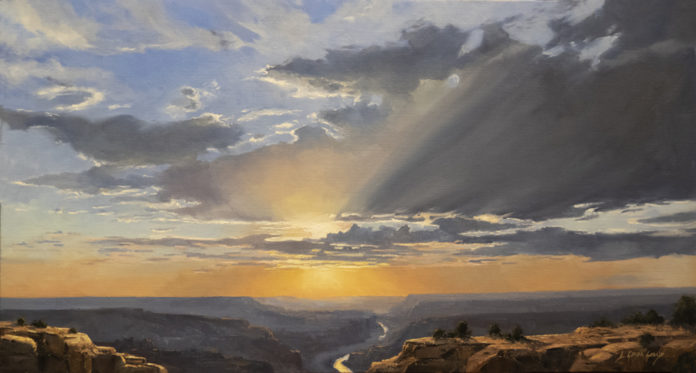
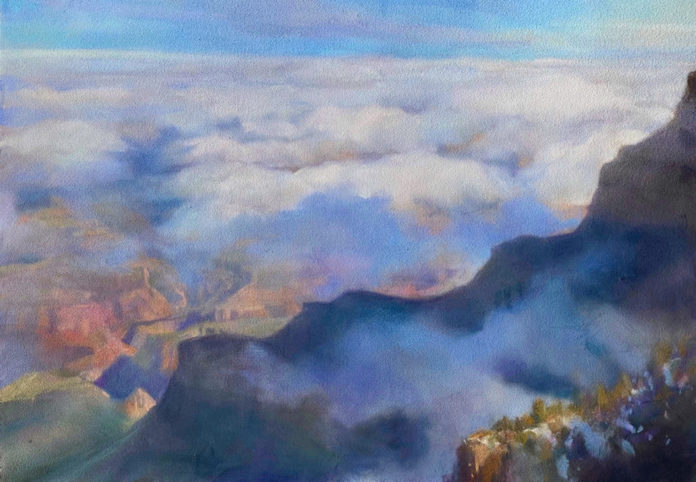
Age to Age
By Linda Glover Gooch
15 x 28 in.
Oil on linen
Linda Glover Gooch was one of the 23 plein air artists participating in the 13th Annual Grand Canyon Celebration of Art. During a week in September the artists from around the country visited Grand Canyon National Park, painting plein air along the South Rim of the canyon. The artists faced the challenges the canyon presents to those who attempt to capture its beauty, its vastness, its depth, and its ever-changing light and weather patterns on canvas or on paper.
Glover Gooch, an artist from Mesa, Arizona, has participated in 12 of the Celebration of Art events. Known for her glorious rendering of clouds, Glover Gooch captures the beauty and the majesty of Grand Canyon sunsets against the depth and glory of the canyon.
All of the participating Celebration of Art artists submit a Grand Canyon themed studio painting prior to the event. Regarding her studio painting “Age to Age” Glover Gooch says:
“Sunsets at the canyon can be hypnotizing as the glow in the sky influence the majestic walls. The mesas and buttes edges catch the golden glow that spreads across the canyon creating a beautiful display. This display of clouds created sunrays blasting upward while blanketing the canyon with beauty.”
The work of these accomplished artists (both studio and plein air work) will be exhibited and available for purchase at Kolb Studio on the South Rim of Grand Canyon National Park through January 17, 2022 or online at:
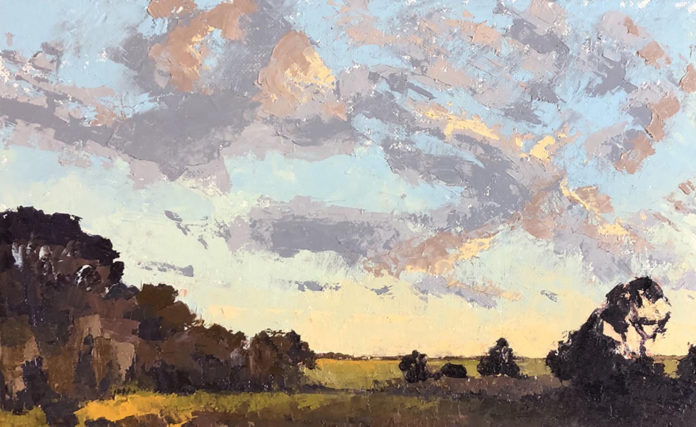
Using the changing color and light of an impression, the artistry of Mary Bentz Gilkerson’s paintings connects people to the experience of place.
“Almost daily for the last ten years I’ve made a small painting inspired by the landscapes I travel through, mainly near the roads and highways around Columbia, SC, especially Lower Richland, and the marshes can creeks of Edisto Island and Savannah, GA” says Gilkerson.
Mary is drawn to the ordinary spaces we move through, especially ones that are within view from the road.
“In a roadside view I find a strange intersection of nature and culture. We move so fast that we don’t take time to observe the world around us in the way that people did before modern transportation and technology came along. In my work, I seek to focus on the shifting patterns of light and color that tell us what time of day and season it is, to note the small and subtle, as well as the large and grand.”
Gilkerson holds an MFA in drawing and painting from the University of South Carolina. A native South Carolinian, she lives and works in her Columbia studio after retiring as a professor of art at Columbia College. She has received grants from the South Carolina Arts Commission and the Cultural Council of Richland and Lexington Counties in addition to having been selected as a Southern Arts Federation Fellowship Finalist. Her work is in the permanent collections of McKissick Museum, Palmetto Health, Morris Communications Company, and Seibels Bruce Group, among others.
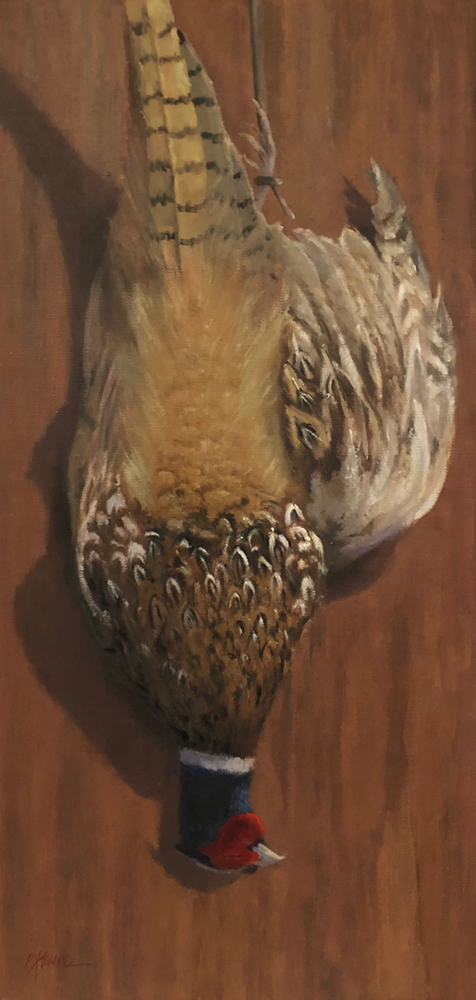
The Day’s Bounty
24 x 12 in.
Oil on Linen
Available through Berkley Gallery in Warrenton, VA
Beverly Ford Evans:“I love to paint birds, as well as hunting scenes and wildlife. This scene fulfilled two of the genres I enjoy. It is important to me to try to capture the soft delicate feathers and the beautiful color shifts in the more prominent feathers. The male pheasant is a captivating species with his intricate feather markings and bold head colors.”
To keep up with my newest work I hope you will follow me on IG – bfevans and FB – Beverly Ford Evans
Beverly was raised in Nashville, Tennessee and now resides in Franklin, Tennessee. As a child she was drawn to the beauty that surrounded her. Encouraged by her parents, she began drawing and painting.
Her talent and a strong desire to create, led her to a successful career in interior design. She continued to have a yearning to create beautiful paintings. In 2003 she took her first workshop to help her achieve this goal.
Beverly has become a prolific artist. She has studied with the accomplished artists of The Cumberland Society of Painters, which includes Roger Dale Brown, Dawn Whitelaw, and Paula Frizbe; the Plein Air Painters of the Southeast; Quang Ho and Kenn Backhaus. She also spends time analyzing and studying many of the old masters, to draw from their techniques, which she uses in her work.
With her deliberate brushwork and attention to the scene, Beverly captures the essence of the landscape beautifully and artfully. She loves to pack her paints and travel to other parts of our beautiful country, where she is inspired by the diversity and beauty at every turn in the road.
Coupled with her love of the landscape is her love for animals. Beverly is sought after to paint commissions for loving pet owners, and participates in the South Eastern Wildlife Expo in Charleston, SC, the Waterfowl Festival in Easton, MD, and Plantation Wildlife Arts Festival in Thomasville, GA.
Beverly assists her husband, Roger Dale Brown in teaching plein air, still life and studio workshops across the country. Visit www.rogerdalebrown.com for their workshop schedule.
“I am very excited about the opportunity to share the talent born in me. There is a constant drive to continue to learn and study to grow as an artist. I was surprised how vulnerable I felt the first time I had a show, but that was quickly overshadowed by excitement and humility when I saw my work evoke emotional reactions in people.
I sincerely thank God for this incredible blessing; I celebrate the connections that I make with people and I am constantly left standing in awe at the magnificent world around me.”
A Canyon of February Storm
By Bruce Gomez
29 x 39 in.
Pastel
During the 13th annual Grand Canyon Celebration of Art, 23 plein air artists from around the country gathered at Grand Canyon National Park, painting plein air along the South Rim of the canyon for a week in September. The artists faced the challenges the canyon presents to those who attempt to capture its beauty, its vastness, its depth, and its ever-changing light and weather patterns on canvas or on paper.
Bruce Gomez, a pastel artist from Denver, Colorado, has participated in Grand Canyon Celebration of Art for the past 7 years, often as the only pastel artist. During the 2017 Celebration of Art his fellow artists presented him with the Artist’s Choice Award. He considers himself fortunate to travel and paint in wonderful places like Telluride, Paris, Rome, and Moab. “I go out and look to capture that one unique and spectacular moment of life,” he says.
All of the participating Celebration of Art artists submit a Grand Canyon themed studio painting prior to the event. Regarding his studio painting “A Canyon of February Storm” Gomez says:
“Imagine the stunning silence of snow and clouds filling the most vast space. I saw this slow dance of a storm breaking below me two decades ago and I’ve forever been wanting to capture this on paper.”
The work of these accomplished artists (both studio and plein air work) will be exhibited and available for purchase at Kolb Studio on the South Rim of Grand Canyon National Park through January 17, 2022 or online at:
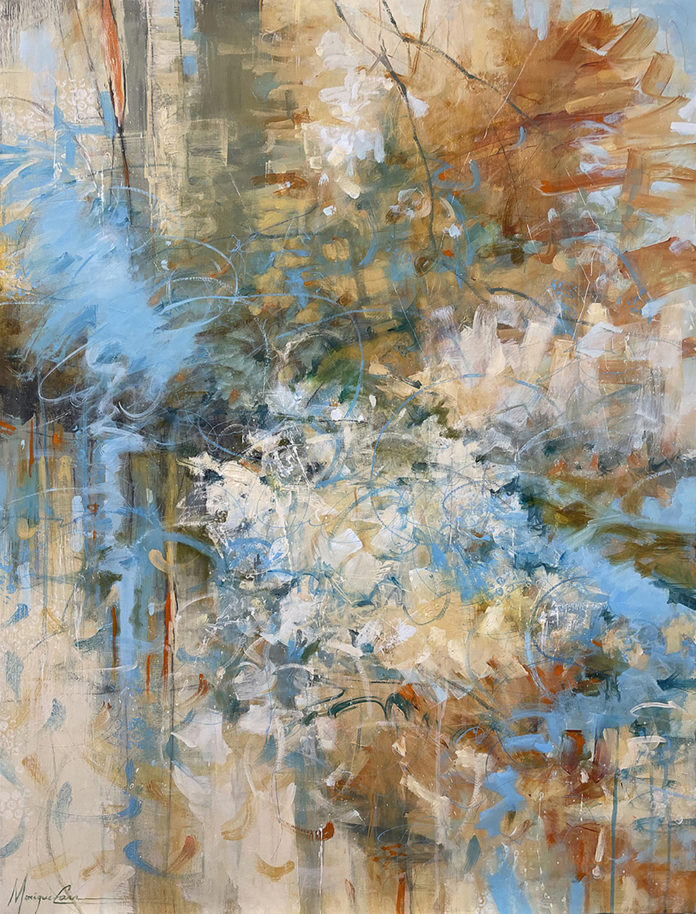
Always and Forever
Acrylic on Canvas
40 x 30 in.
$3,700
Available through Carlton Gallery
Monique Carr is well known for her imaginative and abstract landscapes and florals. The style that emerges in Monique’s work bursts with energy as she combines expressive colors and intriguing textures.
Monique is proudly showing here the painting titled ‘Always and Forever’, which won the prestigious BoldBrush Award for Abstract in July 2022.
From her beginnings in Montreal, Canada, to many years in the tropics of the Cayman Islands, Monique Carr has settled in the mountainous region of east Tennessee. Each chapter of her life has inspired her abstracted landscapes and seascapes, including her recent collections of work displayed at Carlton Gallery and at Dare Gallery.
Monique says, ”I want to leave the viewers of my work with feelings of surprise and joy, allowing them to interpret each work in a soulful way that is uniquely their visual experience.”
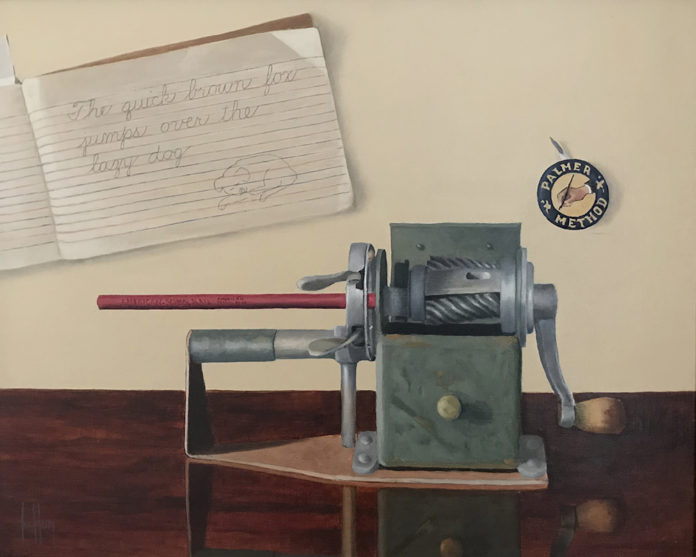
Cursive Writing: A Lost Art is a reminder of times gone by when students in the primary grades transitioned from writing in print to cursive writing. Kellum was an elementary school teacher in Virginia and taught cursive writing to her third graders who were eager to learn to write like the ‘grownups.’ Many curriculums do not include the instruction of cursive writing in today’s schools.
This artist works in both oil and pastel, primarily concentrating in still life and animals. Often her still life work depicts a theme or story as it does in this piece. Most works begin as an idea and then require a mission to find all items needed for the setup. Antique stores, Ebay, things from around the house or borrowed from friends are often her source. A large collection of marionettes has provided a series of paintings.
Adding to National and International awards previously earned, the artist recently received the “Best Narrative Award” for Cursive Writing: A Lost Art, from the NOAPS ‘Best of America Small Works Exhibit 2021’ at The Principle Gallery in Charleston, South Carolina. The judges recognized the creativity of the idea and the interesting choice of the subject.
Betsy Kellum’s work is represented by Crossroads Art Center in Richmond, Virginia. Gallery inquiries are welcome.
Contemporary Oil Paintings > “Ilya Gefter’s suite of misty, achingly delicate paintings are a quiet respite,” said R.M. Vaughan of The Globe and Mail*. “Gefter’s crafty focus pulling/focus releasing causes the viewer to first seek out the solid, fully materialized objects being studied, and then to drift toward the liminal spaces, the backgrounds and sunsets, all underpainted veils of muted colour. Absence and presence, negative and positive space, are neatly, even obsessively, balanced, but Gefter’s works are not overly painterly or forced. Sleight of hand rarely feels so honest.”
Ilya was kind enough to respond to questions we had about his work, and about the ways a viewer may gain insight into an artist by looking at his or her work.
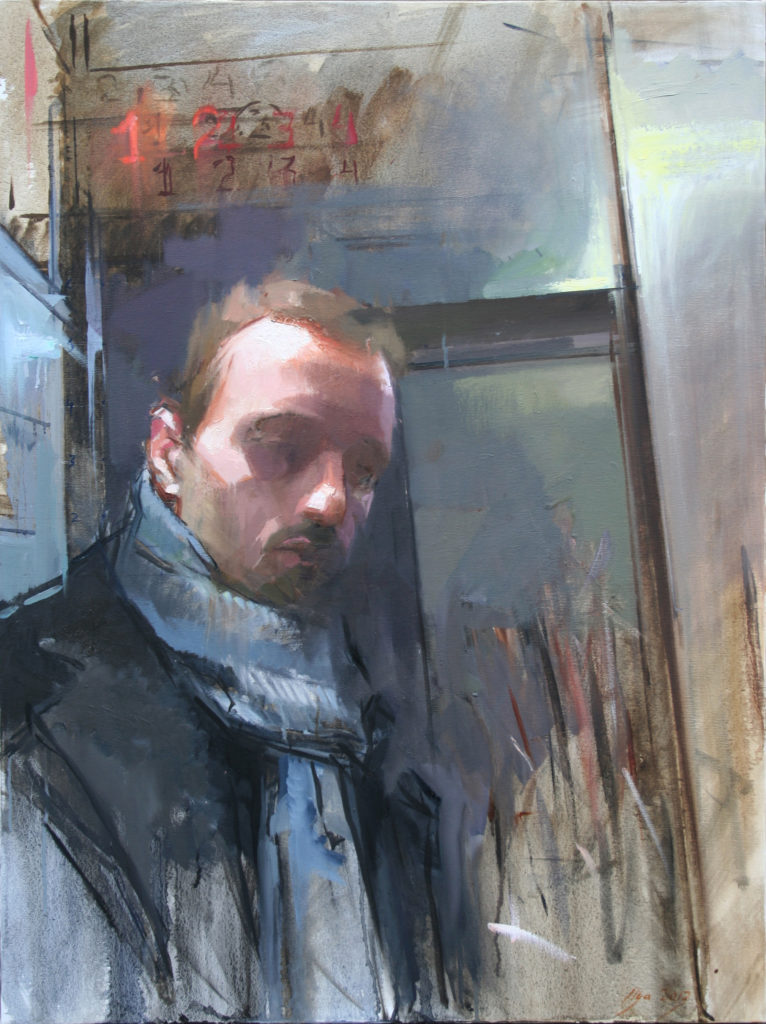
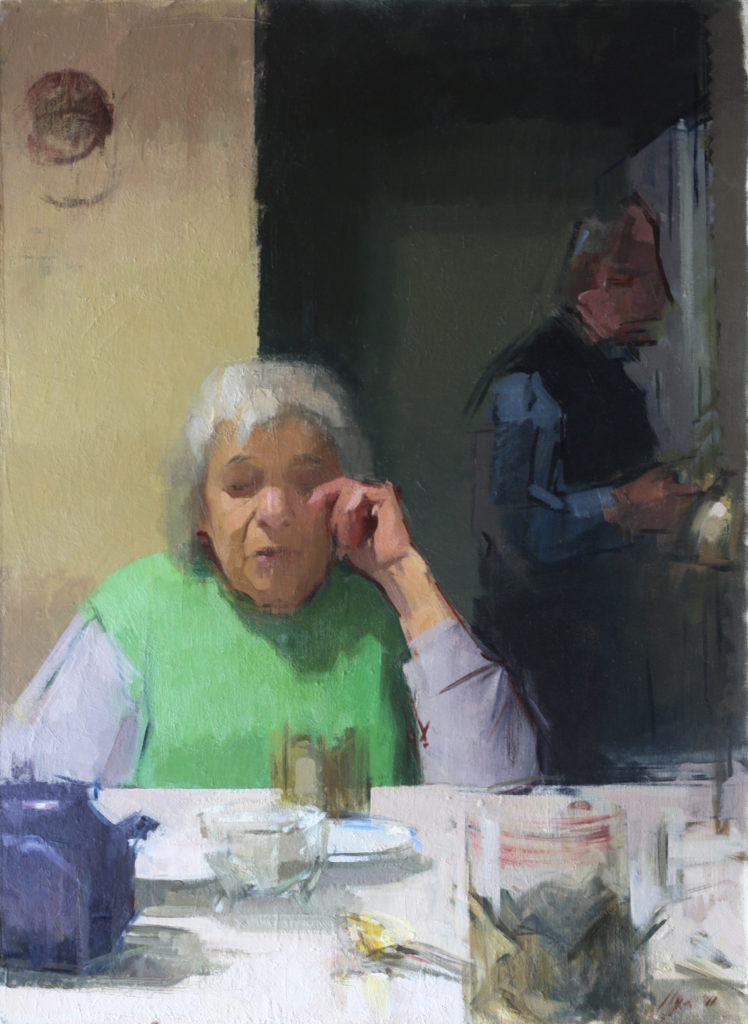
Ilya Gefter, “Elevator Portrait,” 100 x 76 cm, Oil on canvas
In what ways and to what extent do your temperament and view of the world reveal themselves in your work?
I believe that these things are beyond conscious control. Whether I want it or not, my temperament manifests itself in every brushstroke. In what ways the work mirrors my emotional make-up and my views, I cannot tell, as I am too engaged in the process. I would assume that the paintings inevitably reflect my passing inner states that change from month to month, and from year to year. And perhaps, somehow, also reflect a deeper core that does not change a lot over the years.
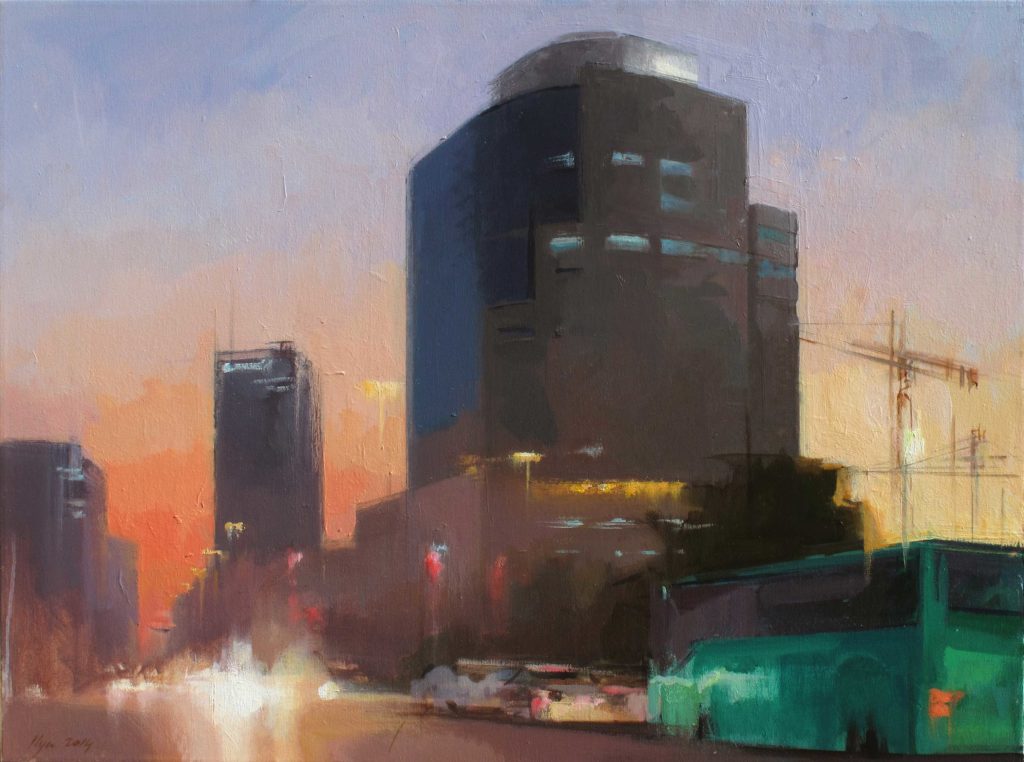
Ilya Gefter, “Masger,” 60 x 80 cm, Oil on canvas
Was there a point in your own life—or perhaps a period in your life—where you looked at a work on the easel, and had an Ah-ha moment, recognizing that work as a unique expression of your voice on canvas?
As a youngster I thought about discovering some style or a personal voice. I do not know whether I ever found it, but I do know that at a certain point I stopped searching for one. Instead of looking for a personal voice, I wish to constantly clarify to myself what my values are. The clearer my vision is of quality and seriousness in art, the more streamlined my efforts are.
I ask myself what I value in art . . . what I value as a human being . . . and what makes a painting meaningful to me. If I do have a personal voice, it is just a byproduct of my reflection on these issues that are, in fact, broad and impersonal: What makes art meaningful? What makes a painting work well visually? What makes a painting significant or profound?
In other words, I am more preoccupied with the content of the pictorial conversations and less concerned with the voice. The content, in turn, determines the particular qualities of the voice, which remain secondary.
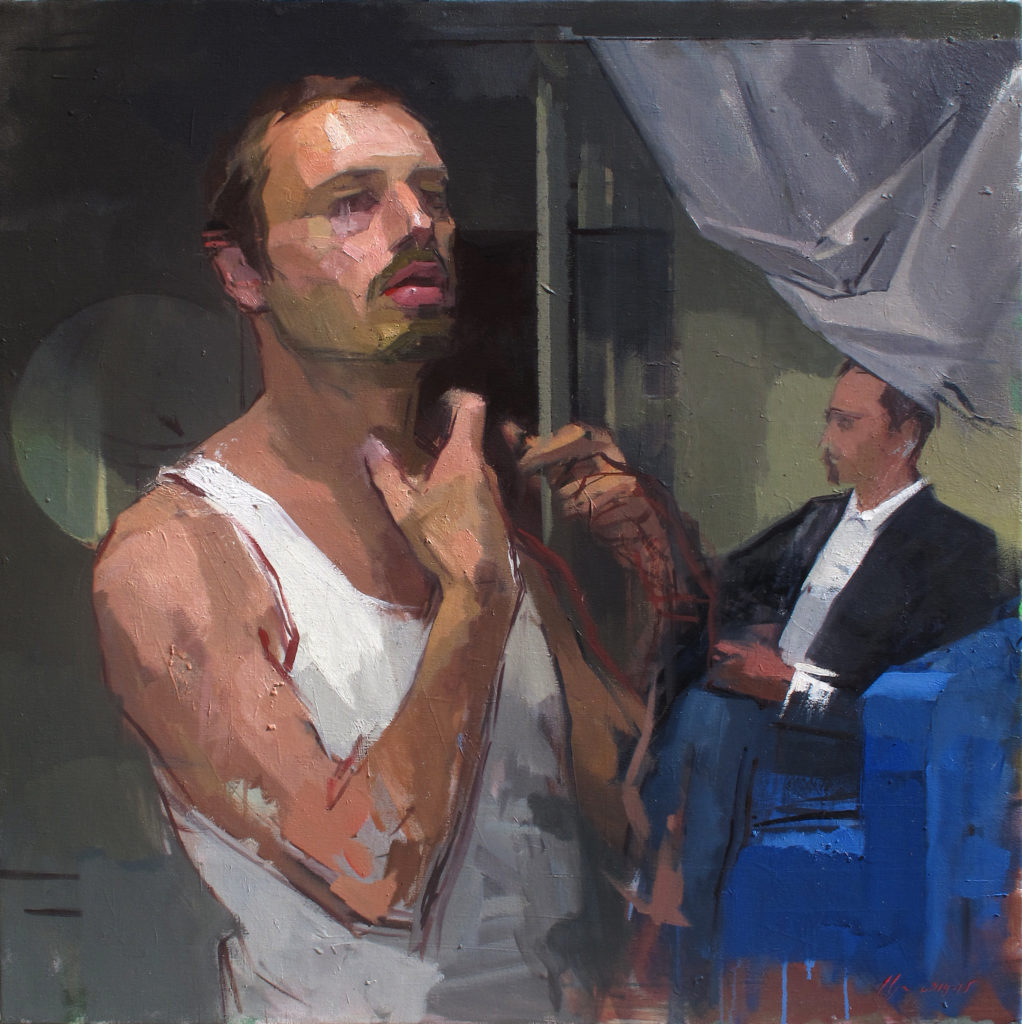
Ilya Gefter, “Self Portrait,” 100 x 100 cm, Oil on canvas
Is it fair to say that every piece an artist paints is in a way an amalgam not just of the scene in front of them and the paints on their palette, but an entire life experience, synthesized to a greater or lesser extent on the canvas? If this is true, do you have a sense of obligation—or anxiety—about speaking your life experience clearly through your oil paintings?
I do not believe there is such a thing as “obligation.” There are urges, desires and decisions. But fulfilling certain desires takes a tremendous amount of courage. It definitely takes some courage to fulfill the urge of expressing personal experiences on a canvas. I feel like I constantly have to dismantle limitations and safety nets that we build for ourselves through education and training.
Like all of us, I’ve invested my efforts in figuring out the craft. Artifice is necessary to unveil the human experience—but it may also conceal it, when it becomes self-referential. It does take a fair bit of honesty and courage to have the craft speak of personal experience.
Your oil paintings seemed to move progressively into the evening and night hours and grew in intensity and interest as it did. What are some of the challenges and advantages of low-light settings?
Since my last year in college, I was interested in the issue of light. Light is both a revealing and a concealing principle. Sometimes the light mainly reveals, like crisp, sunny weather does at mid-day. Evening light, on the other hand, conceals things. Being less interested in the landscape of facts, and more concerned with atmosphere, the qualities of concealment are essential to me. There’s more mystery in evening and twilight hours.
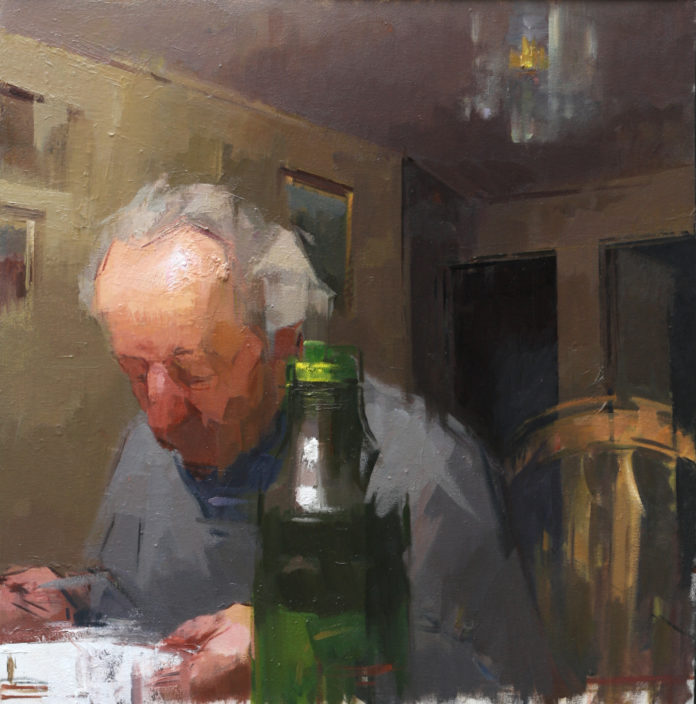
Ilya Gefter, “Table,” 89 x 66 cm, Oil on canvas
How heavily do you rely on photography to guide your painting?
The camera has multiple functions for me. First and foremost the lens of the camera is a seeing aid—a tool that unifies the visual flux into a manageable scale and a rectangular format. The camera is also an efficient tool to select motifs. When I started using the camera extensively about nine years ago, I took multiple photos before starting to paint, but in the end, the work was done entirely from observation without ever looking at the snapshots.
As the work was becoming more layered, more complex, or simply larger, it necessitated a certain distance from the motif. Gradually, I started using the photographs beyond the initial stages of selection. Now, the photos stay with me throughout much of the process. Direct experience of the motif, however, remains indispensable. And a painting is always measured and weighed against itself, not in relation to the photography.
In what ways is your current work a logical next step in your development or vision?
That I may only know when my current work becomes my past work. Seeing such things requires some distance.
> Visit EricRhoads.com to learn about more opportunities for artists and art collectors, including retreats, international art trips, art conventions, and more.
> Sign up to receive Fine Art Today, our free weekly e-newsletter featuring a variety of oil paintings, pastels, watercolors, and more
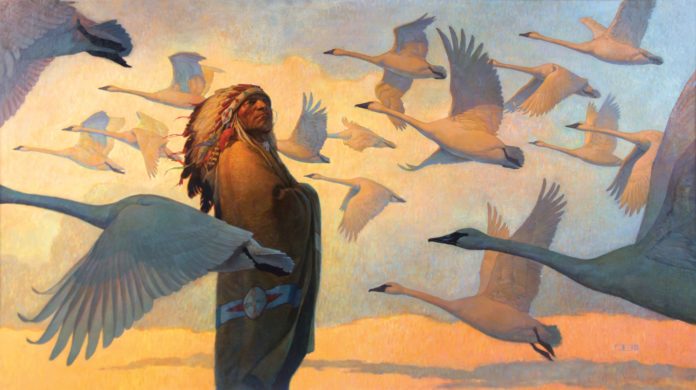
Thomas Blackshear, "Swan Song," 1993, oil on board, 28 x 50 in., private collection
An excerpt from a Fine Art Connoisseur feature on the Western Art of Thomas Blackshear (who is on the faculty of the upcoming 2nd Annual Realism Live virtual art conference), written by Michael J. Pearce
Western Art, Western Nouveau
Learn from Thomas Blackshear in person at the 2nd Annual Realism Live, November 11-13, 2021 (Beginner’s Day on November 10)
The golden glow of success has gathered around Thomas Blackshear II (b. 1955). In September 2020 his painting “Swan Song” (above) was a smashing success at the 14th annual Jackson Hole Art Auction, where it sold for $77,350 — more than double its high estimate. That same week, Blackshear’s painting “Hunter’s Watch” appeared on the commemorative poster of the Jackson Hall Fall Arts Festival and then sold for $37,000.
The following month, he was inducted into the Society of Illustrators’ Hall of Fame, an honor previously accorded to such legends as Maxfield Parrish, Norman Rockwell, and Dean Cornwell. This past March, three new Blackshear paintings — “The Wait,” “American Nobility,” and “Native American with Feather” — appeared in the Masters of the American West sale at Los Angeles’s Autry Museum of the American West, where “The Wait” won the Artists’ Choice award.
It is easy to see why. Blackshear’s “Western Nouveau” paintings are light, decorative, and elegant, a romantic and fresh kind of imagery that has captured the imagination of Western art connoisseurs, who always have a sharp eye for a rising star.
Divine Inspiration
Blackshear has found divine support. He has a deep Christian faith, and has long enjoyed success selling religious paintings and prints to evangelical churches throughout the U.S. Prayer and painting are closely tied, which makes this body of work a spiritual journey for Blackshear.
Gold is the most material of substances, but it also symbolizes God. So, does the gold he paints with have a spiritual component? Blackshear is ambivalent about whether the gilding itself might be spiritual, in the way that monks illuminating their manuscripts once considered their craftsmanship as prayer.
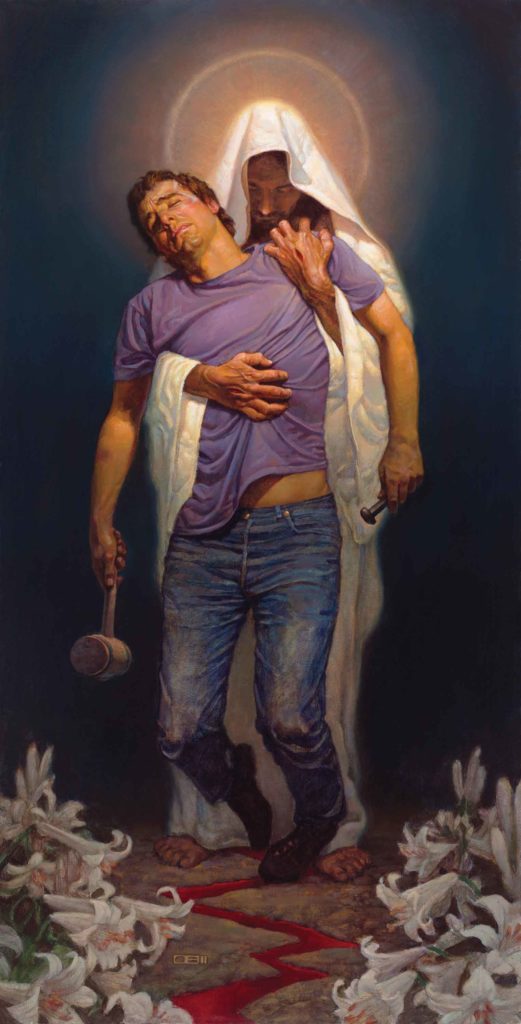
Thomas Blackshear, “Forgiven,” 1991, oil on canvas, 33 x 16 1/4 in., Museum of Biblical Art, Dallas
His religious imagery transcends denominations. When a friend set off on a missionary trip to India, Blackshear gave him a selection of his own prints. In Calcutta that friend visited Mother Teresa (1910–1997) and offered her two of them — “Forgiven” and “Coat of Many Colors, Lord of All.”
She asked him, “May I put them in the room of the dying?” Of course, the friend agreed, assuming she would hang them in a hospice ward. A year later, the friend met a nun from Mother Teresa’s facility who invited him to visit the hospice. Not seeing the Blackshear prints anywhere, he asked what had become of them. His guide replied, “You misunderstood. When Mother Teresa asked, ‘Do you mind if I put it in the room of the dying?’ she meant herself.” In her last days, St. Teresa had kept Blackshear’s prints in her bedroom, which is now a shrine to her memory. In 2010, he was commissioned to design a U.S. Postal Service stamp commemorating her.
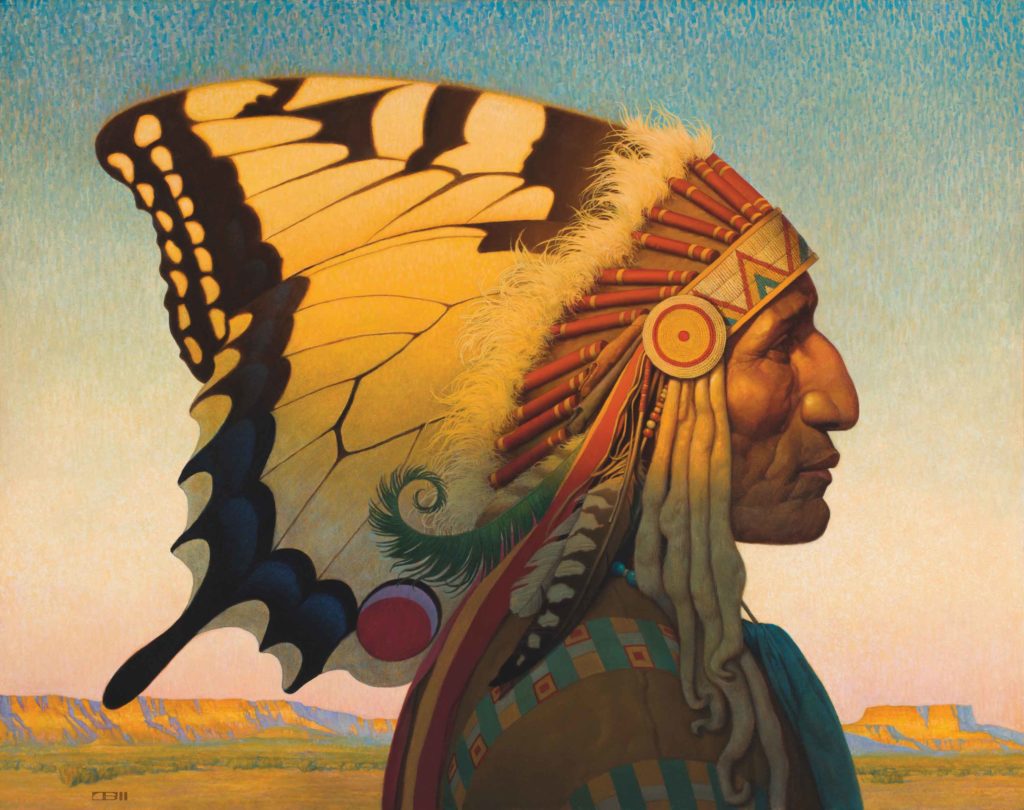
A lay spirituality is manifest in Blackshear’s paintings of Native Americans, who are elemental guides. Here he follows the conventions of Western art, painting indigenous people as “noble savages” and flavoring their images with romanticism. The men bear smoking incense that curls around them in decorative flourishes that are also seen in Mucha’s gorgeous embellished posters. Blackshear’s “Native American Nouveau” features a warrior wearing a headdress fashioned as a butterfly’s wing, suggesting the transience and fragility of the tribes.
Thomas Blackshear, “Native American Nouveau,” 2018, oil on canvas, 38 x 48 in., private collection
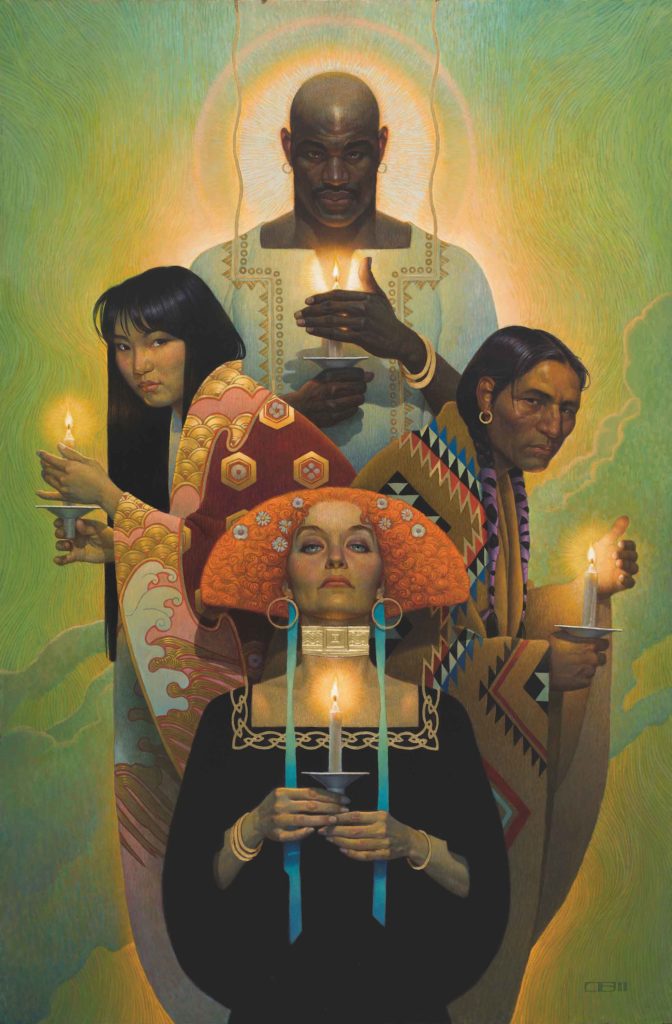
Blackshear’s “A Common Thread” echoes the heartfelt plea for racial tolerance that Rockwell conveyed in his famous “Golden Rule (Do unto Others)” in 1961. Figures representing the four races bear lit candles; they are unified as a community, as light-bearers, as keepers of the flame of decency and truth, which they hold up against the threatening darkness of intolerance.
Thomas Blackshear, “A Common Thread,” 2015, oil on board with gold leaf, 38 x 25 in., collection of the artist
Though decorative, Blackshear’s Western paintings avoid much of the sentimental excess that afflicts the genre. His images of black cowboys are a necessary reminder that the Old West wasn’t actually as white as Hollywood has suggested. Wrapped in rawhide, his rugged black buckaroos chew tobacco and smoke with the same machismo as their white colleagues.
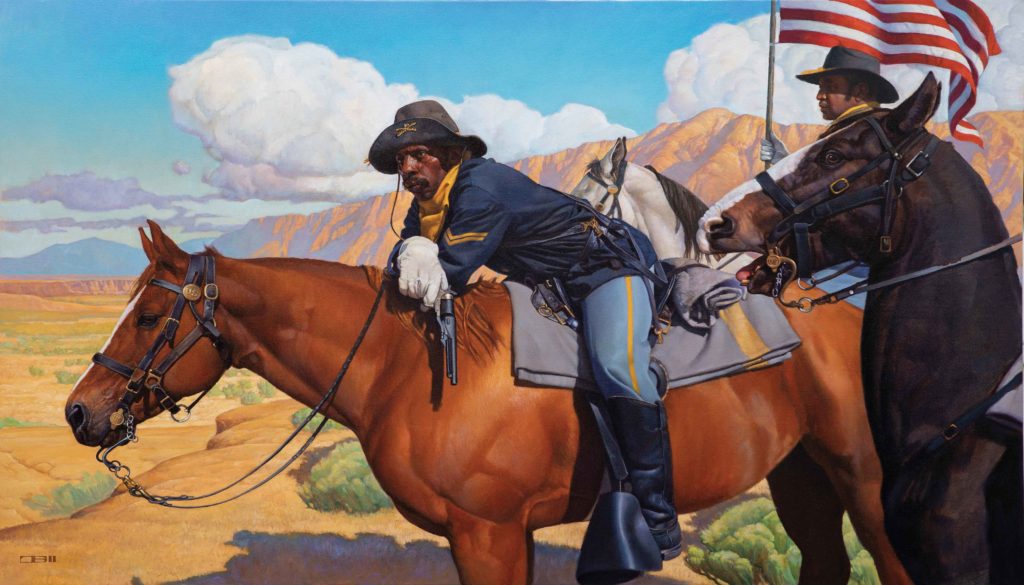
Thomas Blackshear, “The Wait,” 2021, oil on canvas, 40 x 61 1/2 in., private collection
“The Wait,” Blackshear’s latest addition to a series examining African-Americans’ role in shaping the U.S., is a powerful reminder that black Union soldiers also paid the ultimate price in the Civil War: 180,000 black men served in that fight for justice, and thousands died in battle or hospital.
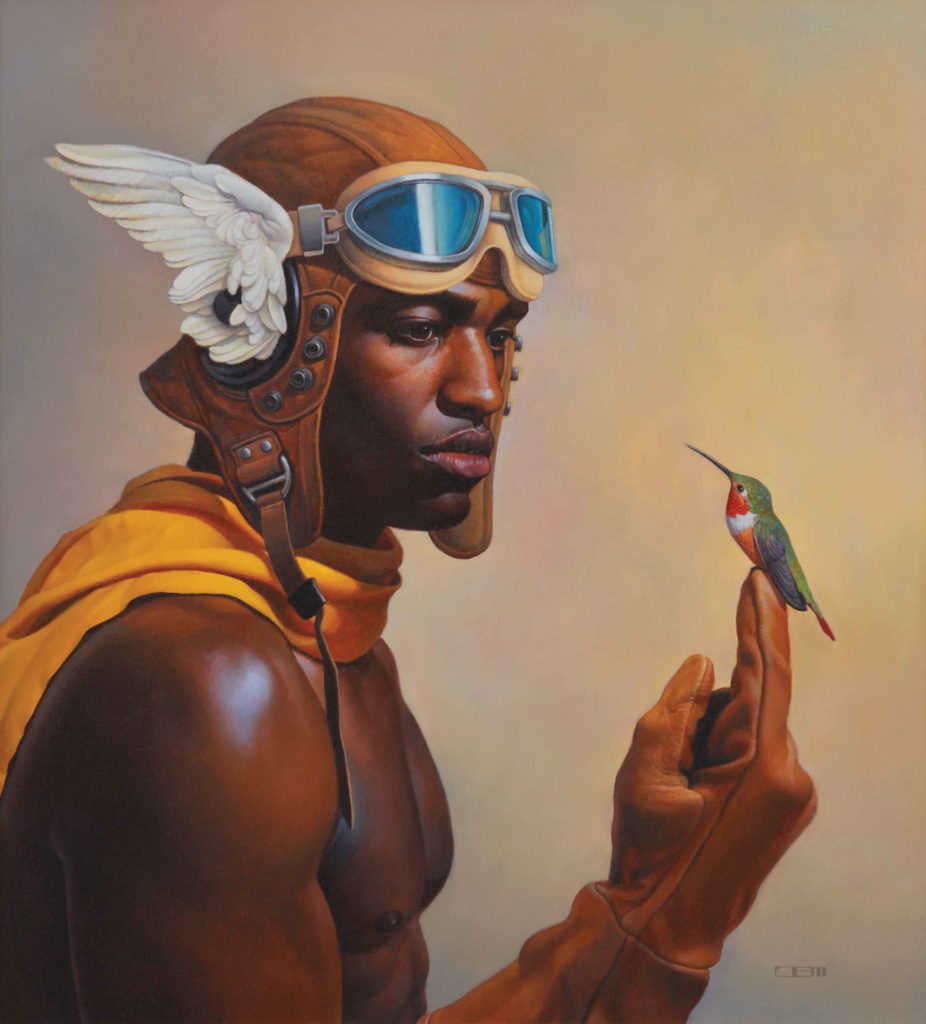
Thomas Blackshear, “Airman’s Inspiration,” 2020, oil on canvas, 33 x 29 in., private collection
Blackshear’s soldier waits for a better world. Moving forward in time, “Airman’s Inspiration” is a sensitive portrait of a Tuskegee pilot with the wings of Perseus, caught in a quiet, beautiful moment with a hummingbird balanced on the finger of his leather gauntlet. Yes, there is nostalgia and romance in Blackshear’s work, but it is aimed at a broad and inclusive audience, an audience of all Americans.
> Visit EricRhoads.com to learn about more opportunities for artists and art collectors, including retreats, international art trips, art conventions, and more.
> Sign up to receive Fine Art Today, our free weekly e-newsletter
Fill your mind with useful art stories, the latest trends, upcoming art shows, top artists, and more. Subscribe to Fine Art Today, from the publishers of Fine Art Connoisseur magazine.