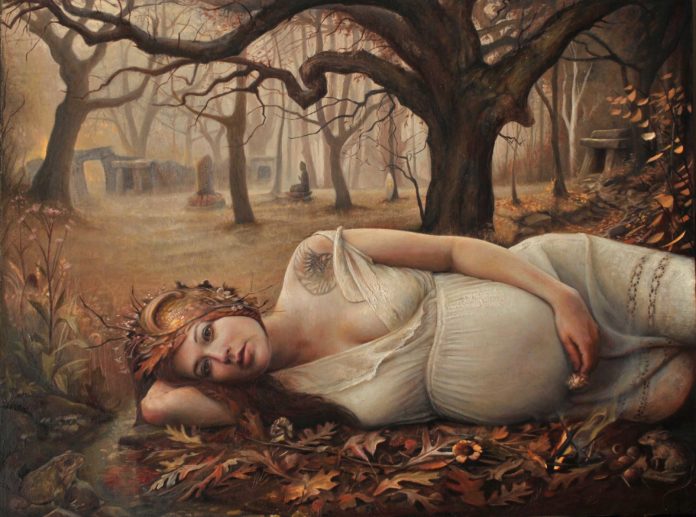
Luke Hillestad draws heavily upon some of history’s greatest painters to create figurative art that vibrates with life and gives voice to the primal beauty of humankind.
Figurative Art: Staying in Touch with Tradition
Often considered one of the most malevolent painters in history, Caravaggio (1571-1610) established a career on fashioning intensely dark and dramatic pictures with fresh compositions. His artistic ancestor, Titian (1485/90-1576), created ripples across post-Tridentine Europe with a precise but expressive brushstroke that animated the surfaces of his paintings. Minneapolis-born painter Luke Hillestad often wonders what could’ve been, had Caravaggio lived past the age of 40 and adopted Titian’s expressiveness. And that is one of many ideas Hillestad seeks to explore in his own oeuvre.
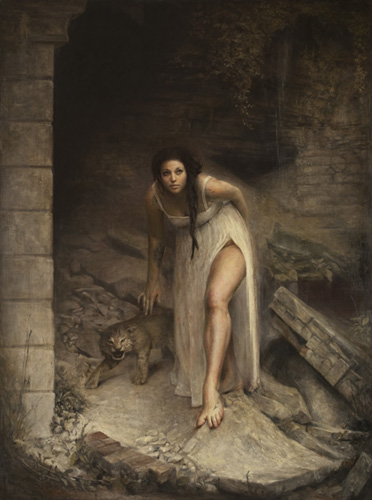
Luke Hillestad, “Grotto,” oil on canvas, 68 x 51 in. (c) Luke Hillestad 2016
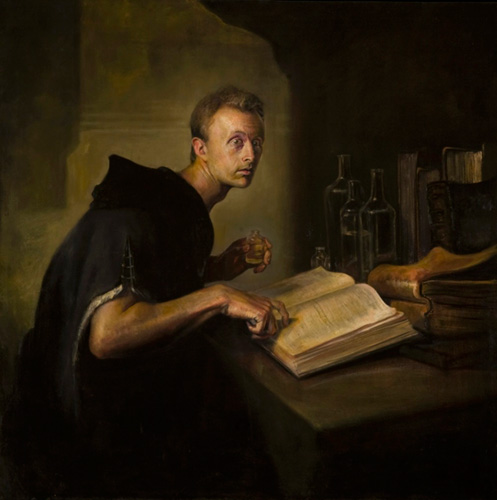
During a period when abstraction is — and has been — in vogue, the classical Greco-Roman tradition of the Renaissance and Baroque prevails in Hillestad’s paintings. Under the tutelage of the renowned Odd Nerdrum, Hillestad has amassed an impressive body of work with an eclectic range of themes over his brief nine-year career. Undeniably born from the rhythmic surfaces of Titian and Rembrandt, and from Caravaggio’s penchant for the theatrical, works such as “Wishbone and Suicide Note” and “The Alchemist” have a timeless aura that could very well be mistaken for a 16th-century hand. “I am a kitsch painter,” Hillestad declares, an identification he embraces. In a recent interview with Nashville Arts Magazine, Hillestad suggested, “I am quite serious when I say that if my work is distinct from Nerdrum, Rembrandt, or Titian, it is accidental and likely for my lack of skill.”
Luke Hillestad, “The Alchemist,” oil on canvas, 42 x 42 in. (c) Luke Hillestad 2016
Hillestad employs the palette of renowned 4th-century BCE master Apelles of Kos — a popular practice throughout history. “Martyr’s Lover,” for example, displays a balance and cohesion of color that results from a foundation of red, yellow, white, and black.
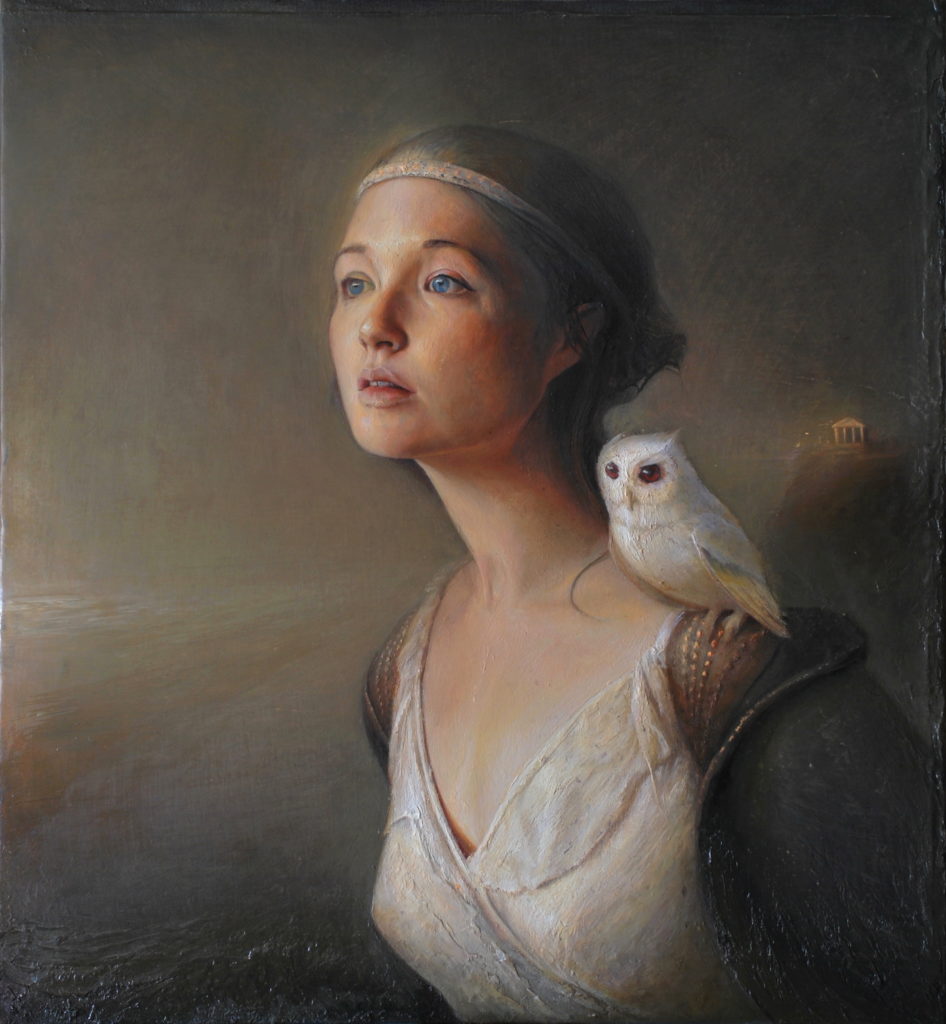
Luke Hillestad, “Athena at Dusk,” oil on linen, 24 x 22 in.
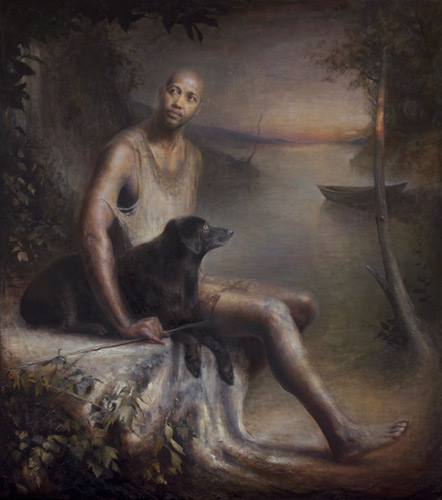
Themes centering on kinship, ritual, and wilderness come to the fore in paintings such as “Grotto” and “Victor,” highlighting an original and tightly knit bond between animal and human. Works like these reveal Hillestad’s skilled use of chiaroscuro to construct mysterious settings for his narratives. What is more, his figures have vitality, as they breathe and lift from the picture plane — the result of Hillestad’s intense illumination with high contrasts. For Hillestad, unexpected experiences often lead to a painting’s inspiration, “when there is a combination of sensuality and drama that grips me.”
Luke Hillestad, “Victor,” oil on canvas, 54 x 48 in. (c) Luke Hillestad 2016
This article was written by Andrew Webster and featured in Fine Art Today, a weekly e-newsletter from Fine Art Connoisseur magazine. To start receiving Fine Art Today for free, click here.
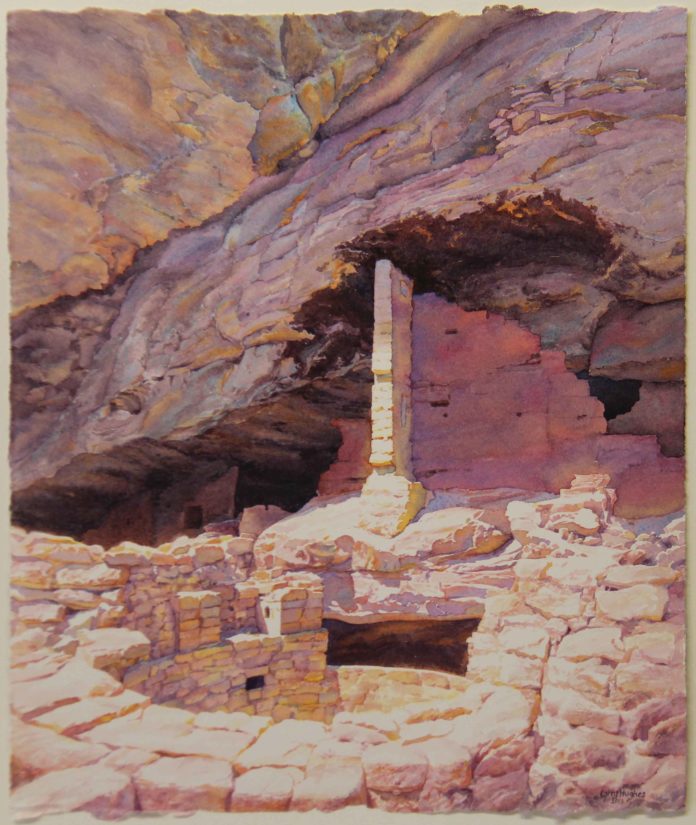
Larry Hughes (b. 1953), "Kiva, Oak Tree House," 2017, watercolor on paper, 14 1/4 x 12 in.
“Larry Hughes: A Walk in the Parks”
Customs House Museum & Cultural Center Clarksville, Tennessee customshousemuseum.org
through July 18, 2021
The Customs House is highlighting the impressive watercolors, drawings, and oil paintings created by Memphis artist Larry Hughes during residencies at six National Parks and Monuments. He recalls his experiences there as “magical,” and that sensibility pervades these luminous visions of the desert’s pinkish tones, the green and gold grasses flanking riverbeds, and more.
Having spent much of his life in Arizona and California, Hughes has always gravitated toward the grandeur of Western wilderness, particularly the Grand Canyon, Sonoran Desert, Guadalupe Mountains of West Texas, and Northern New Mexico.
Thanks to his earlier career in exploration geophysics, he fully understands what he sees in nature — not only the appearance, but also its essence. After developing studies outdoors, he returns to the studio to make finished works. The Customs House exhibition will guide visitors through that entire process.
> Visit EricRhoads.com to learn about more opportunities for artists and art collectors, including retreats, international art trips, art conventions, and more.
> Sign up to receive Fine Art Today, our free weekly e-newsletter
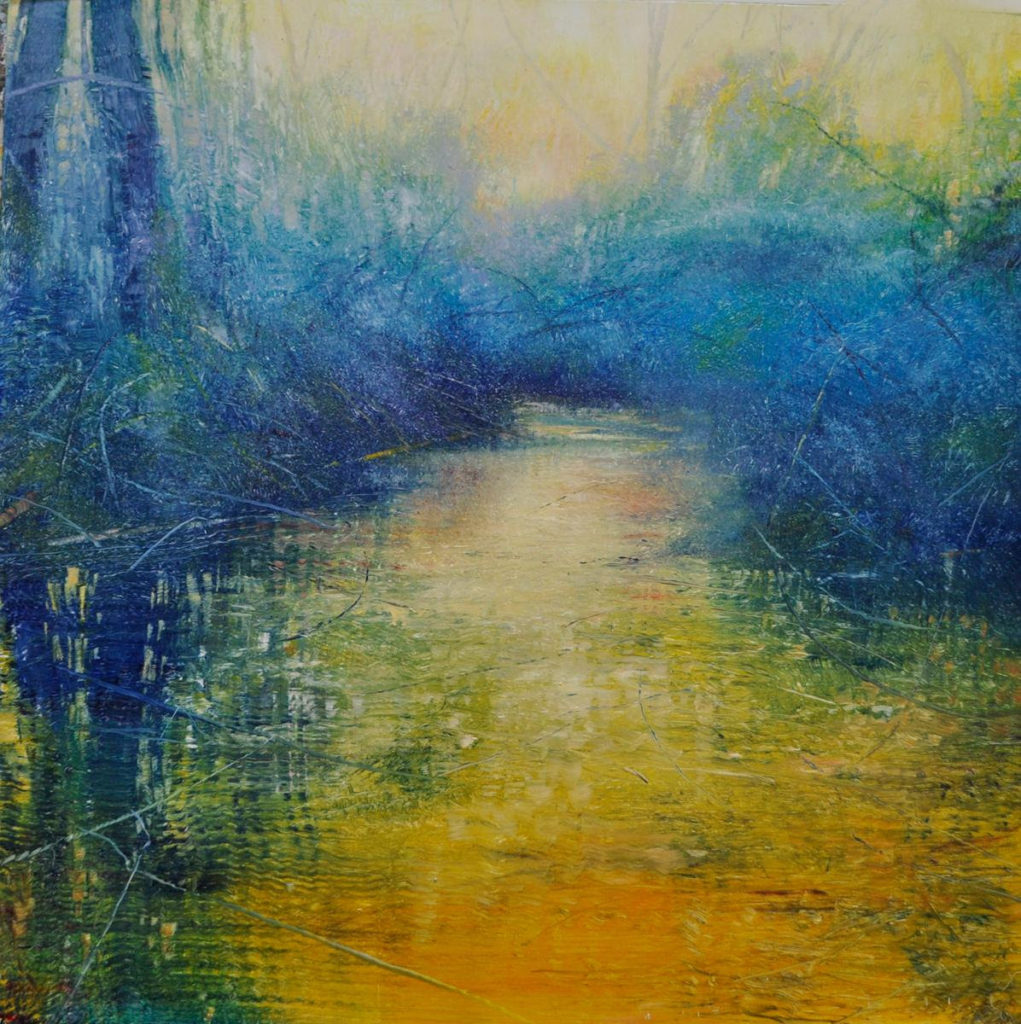
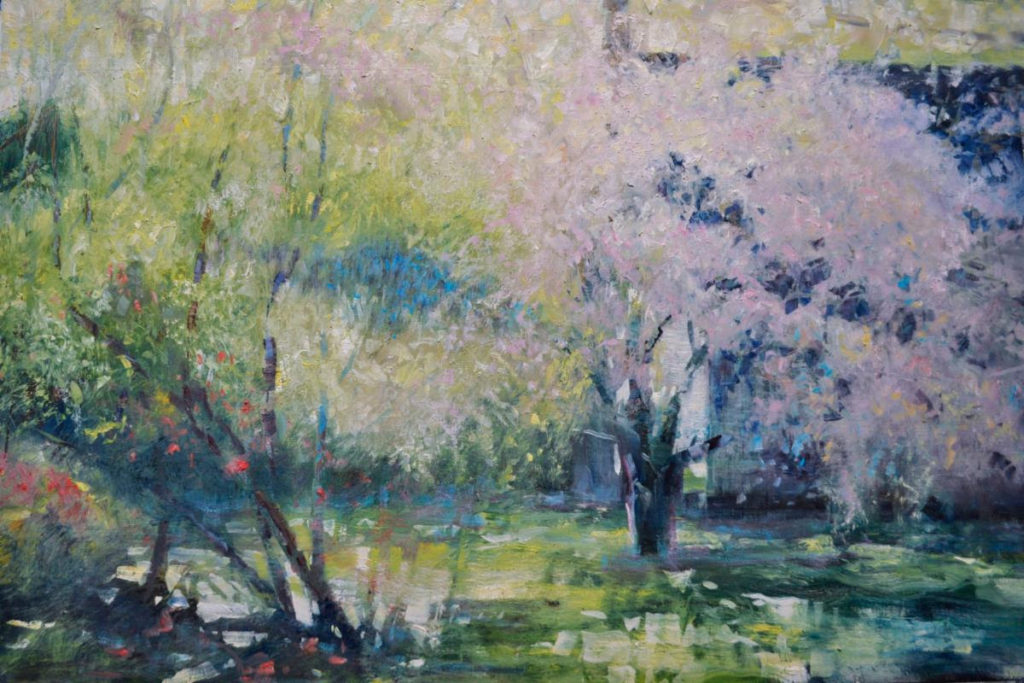
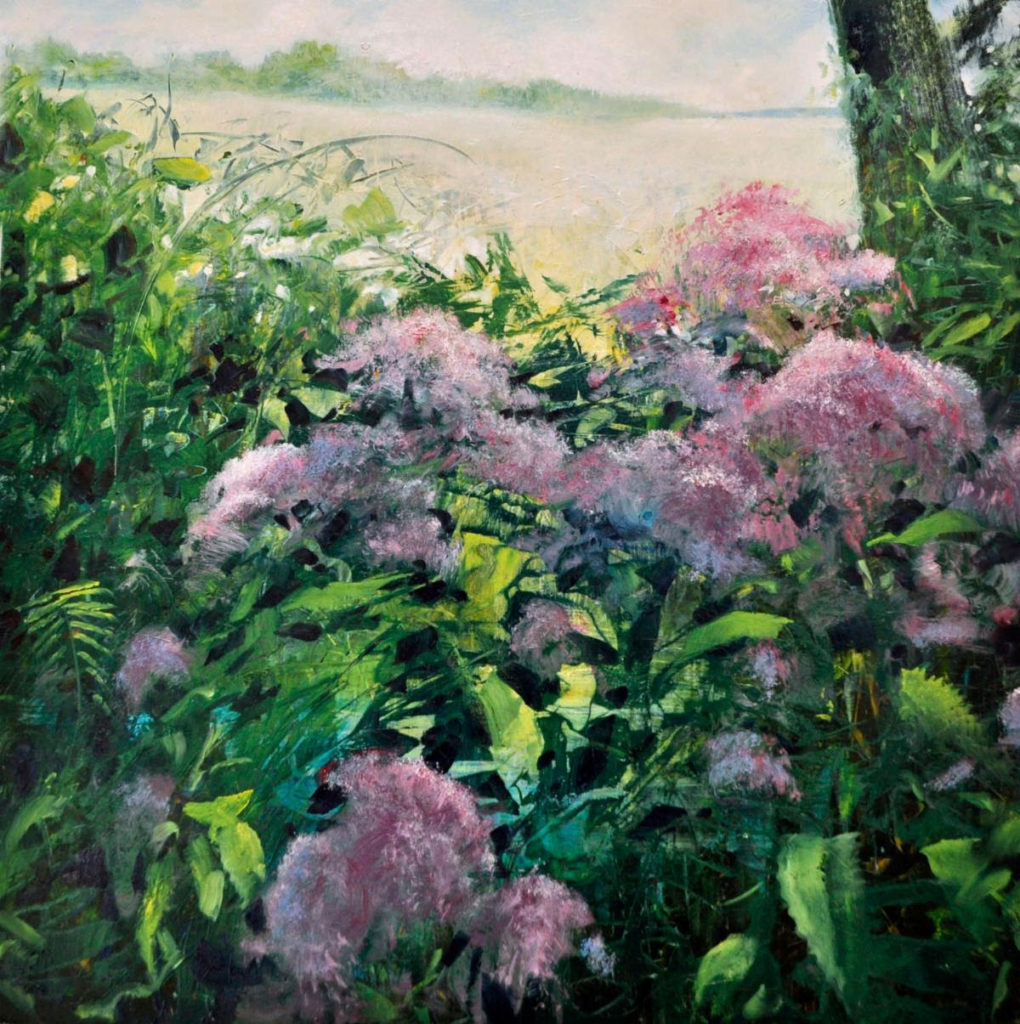
The theme of this new show embraces reflection, translucency, luminosity, and our perceptual experience of nature’s patterns in motion. Subject range from vibrant, meditative Connecticut landscapes to oils exploring the abstract patterns, kinetic energy and motion of New York City.
When viewing his paintings, David elaborates, “I’m hopeful when people look at my work it gives them another way of experiencing nature, the sense of motion becomes as important as the atmosphere and luminosity.”
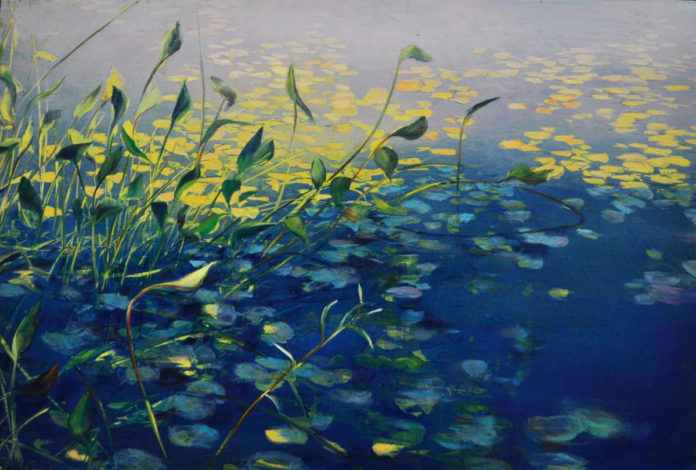
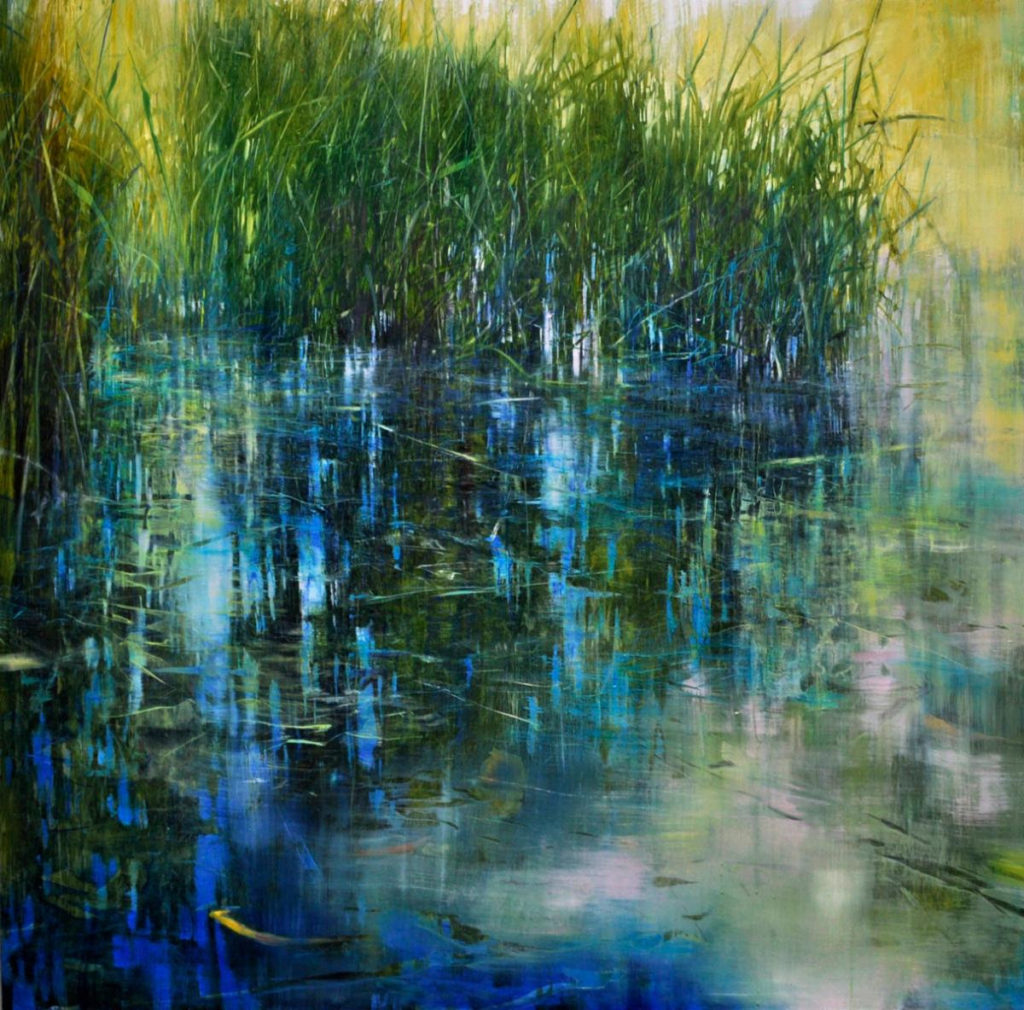
David Dunlop Summer Pond in Tall Grass Oil on aluminum, 48 x 48 inchesDavid Dunlop Hint of Spring Oil on aluminum, 24 x 24 inchesDavid Dunlop Expressionist Spring Oil on aluminum, 24 x 36 inchesDavid Dunlop Violet in Green Oil on aluminum, 24 x 24 inches
David achieves his luminous effects with the original technique of translucent glazes on brushed silver, gold and white laminated aluminum, allowing the light to pass through, which further amplifies the color and vividness of the painting.
> Visit EricRhoads.com to learn about more opportunities for artists and art collectors, including retreats, international art trips, art conventions, and more.
> Sign up to receive Fine Art Today, our free weekly e-newsletter
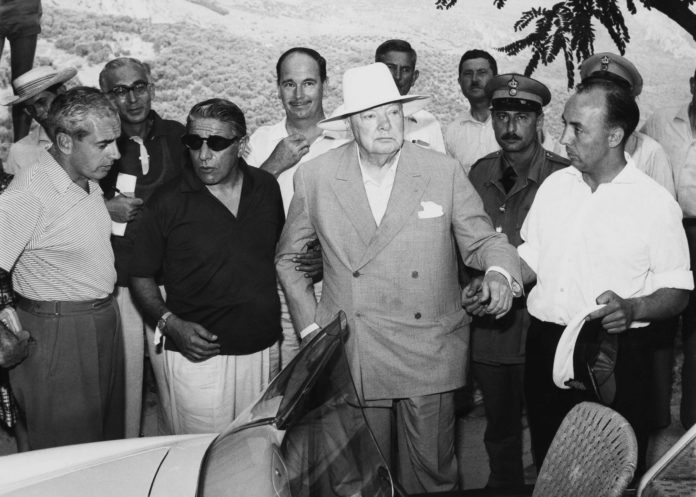
Winston Churchill And Aristotle Onassis, July 29, 1959 Photo by Keystone-FranceGamma-Keystone via Getty Images
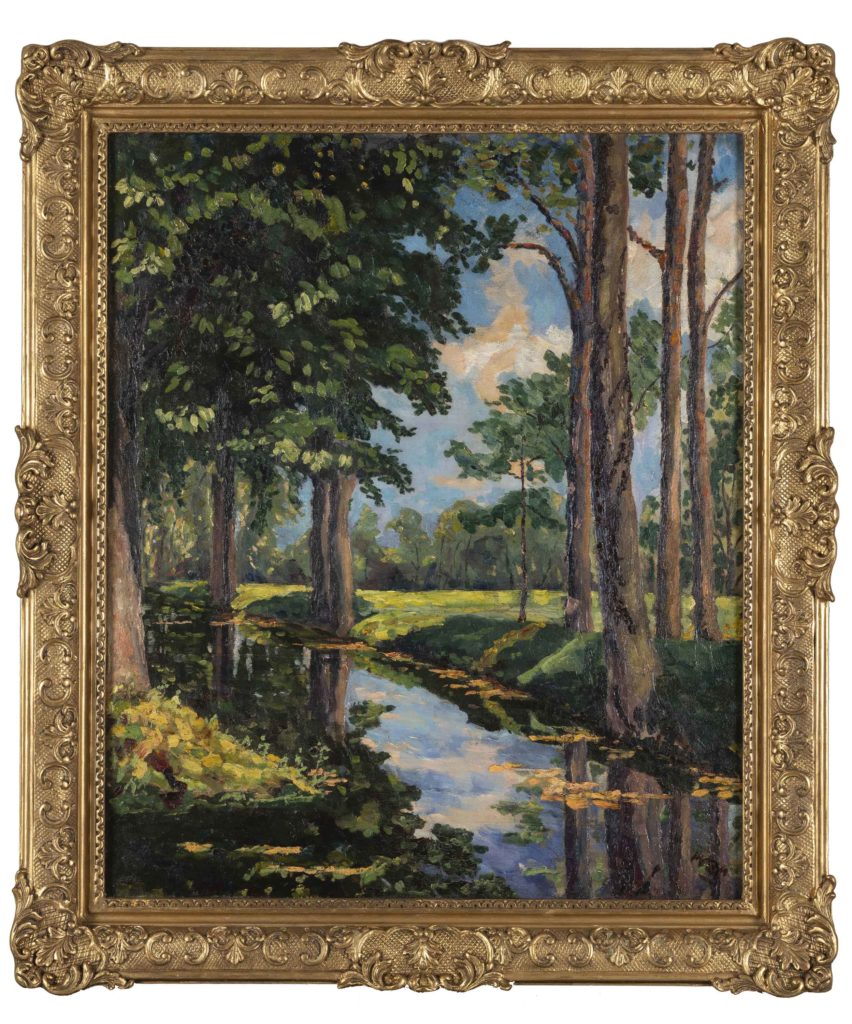
An extraordinary emblem of the celebrated friendship between British Prime Minister Sir Winston Churchill and Greek shipping magnate Aristotle Onassis, “The Moat, Breccles” will be offered in Phillips’ 20th Century and Contemporary Art Evening Sale on June 23, 2021, estimated at $1.5-2 million.
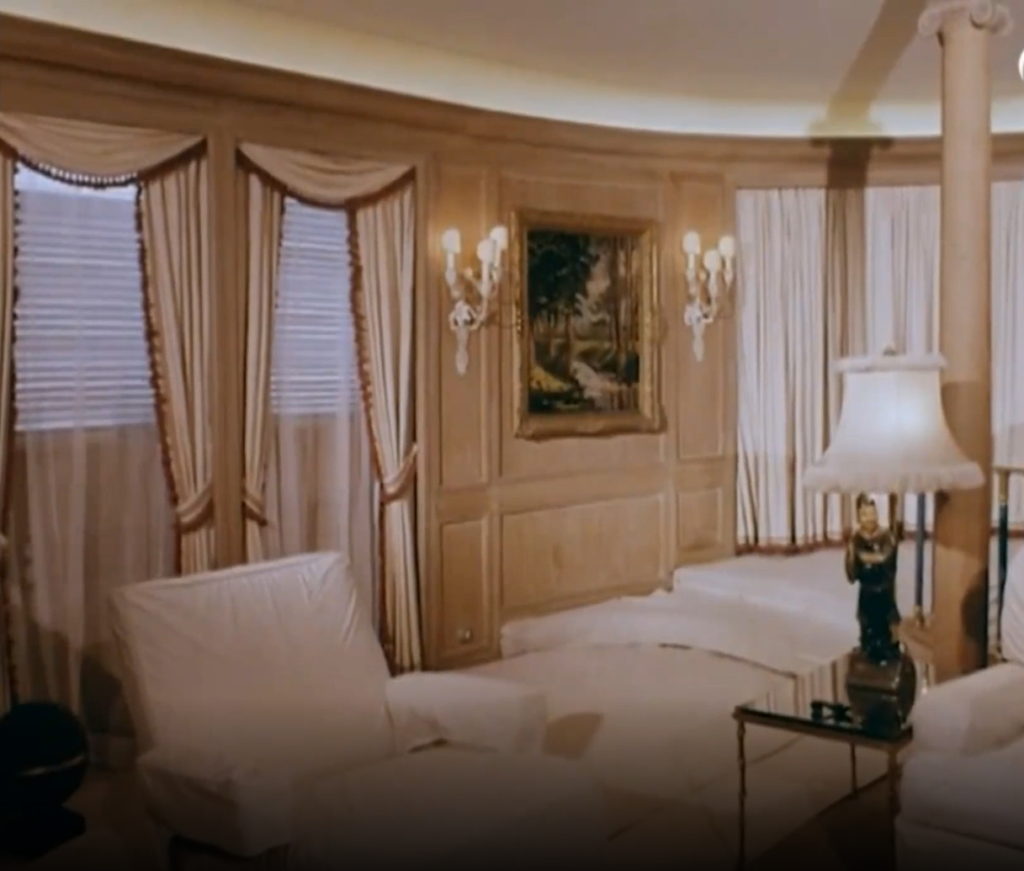
Painted in August 1921, the painting by Churchill was gifted to Aristotle Onassis in 1961, and hung in the saloon of the Onassis yacht, the Christina.
“The Moat, Breccles,” credit: Phillips
More from Phillips:
Jean-Paul Engelen, Deputy Chairman and Worldwide Co-Head of 20th Century & Contemporary Art, said, “Two of the most influential figures of the 20th century, Churchill and Onassis formed a remarkable friendship, which Churchill sought to honor by gifting a work that he treasured in his own private collection for forty years. Long thought to have been lost, ‘The Moat, Breccles’ was in fact aboard the Christina and is now being sold by the Onassis Family a century after its creation and fifty years after it was generously gifted by the statesman to the family.”
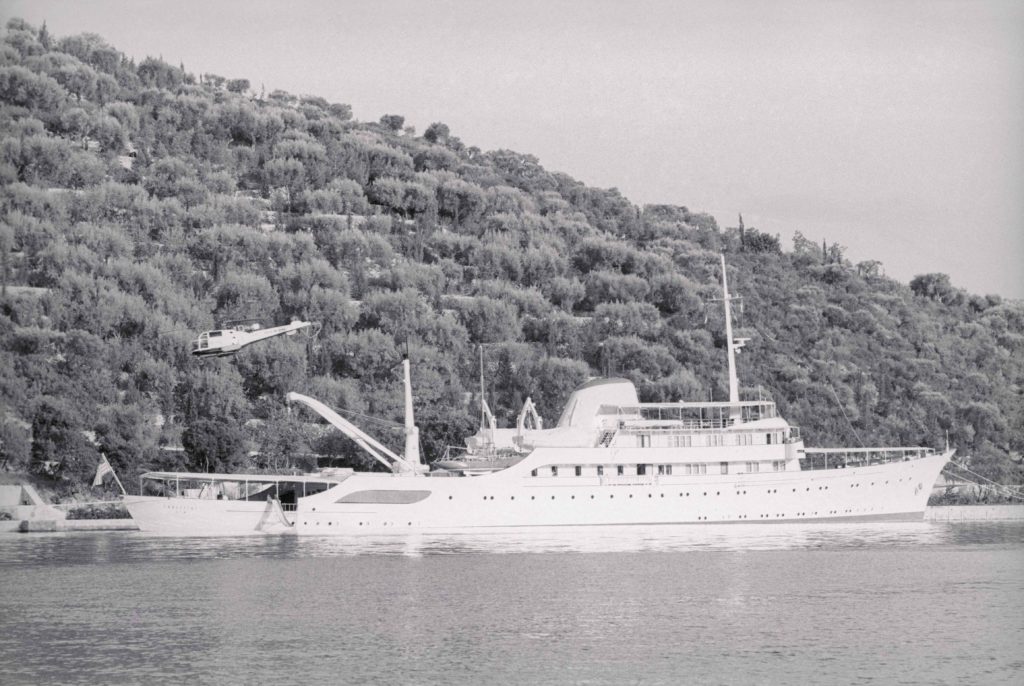
Aristotle Onassis’ yacht, Christina, off the coast of his private island of Skorpios, 1968 – Photo credit Bettmann Getty Images.
A Story of Friendship
Churchill’s son, Randolph, introduced Churchill to Onassis at a dinner in La Pausa, France, on January 16, 1956. The introduction sparked a friendship that would prompt Onassis to invite Churchill and his wife, Clementine, to a dinner party on his yacht the Christina. Churchill was not only impressed by Onassis’ hospitality, but also the yacht which he described once in a letter to his wife, Clementine, of February 8, 1956, as: “the most beautiful structure I have seen afloat.”
A close friendship between the two men developed. During the period 1958-1963 Churchill, often accompanied by his wife, made eight cruises in the Mediterranean and the Atlantic on the Christina. Onassis went to great lengths to make each cruise as easy and comfortable for the elder statesman.
Celia, Sir Winston’s granddaughter, observed that her grandfather had aged considerably after his retirement and was wonderfully happy on the yacht and those pleasurable holidays appeared to give him renewed life. Onassis, apart from being one of Churchill’s great admirers, enjoyed his company and could often be found in deep conversation with Churchill, listening to his views.
In Situ on The Christina: “The Other World of Winston Churchill”
While onboard the Christina, Churchill visited many locations, and it was on the yacht that he made his final visit to the United States in 1961. Onassis and his celebrated guest crossed the Atlantic from Gibraltar and cruised the West Indies before proceeding to New York City.
The Christina’s fame and allure as the original “superyacht” owes itself to such illustrious and glamorous guests as Maria Callas, The Begum of Aga Kahn, John Paul Getty, John D Rockefeller, Eva Peron, Richard Burton, Elizabeth Taylor, Marilyn Monroe, Frank Sinatra, Rudolf Nureyev, John Wayne, Greta Garbo, Dame Margot Fonteyn, Prince Rainier and Princess Grace, and John F Kennedy and Jacqueline Kennedy, later Jackie Onassis, whom first met Churchill on the Christina.
About the Artwork
“The Moat, Breccles” was first mentioned in “Painting as a Pastime,” an essay written by Sir Winston Churchill, which was first published in The Strand Magazine, December 1921. Painting became his lifelong hobby and he freely admitted that it revived his spirits and, as with writing, became an antidote to his frequent bouts of depression.
Churchill explained painting “as a means to relieve his mind from the demands of leadership.” He began with watercolor but soon applied himself to oils. “The Moat, Breccles” was one of several paintings personally selected by Churchill to be included in the essay and in 1964, was prominently featured in a film documentary, “The Other World of Winston Churchill” on the Christina.
Opening on June 15, leading up to the auction, Phillips will recreate Aristotle Onassis’ iconic bar on the Christina, affectionately known to its many guests as Ari’s Bar, in the auction house’s new headquarters at 432 Park Avenue, with “The Moat, Breccles” taking center stage.
> Visit EricRhoads.com to learn about more opportunities for artists and art collectors, including retreats, international art trips, art conventions, and more.
> Sign up to receive Fine Art Today, our free weekly e-newsletter
As part of our effort to continue to help artists and art galleries thrive, we’re proud to bring you this week’s “Virtual Gallery Walk.” Browse the artwork below and click the image itself to learn more about it, including how to contact the gallery.
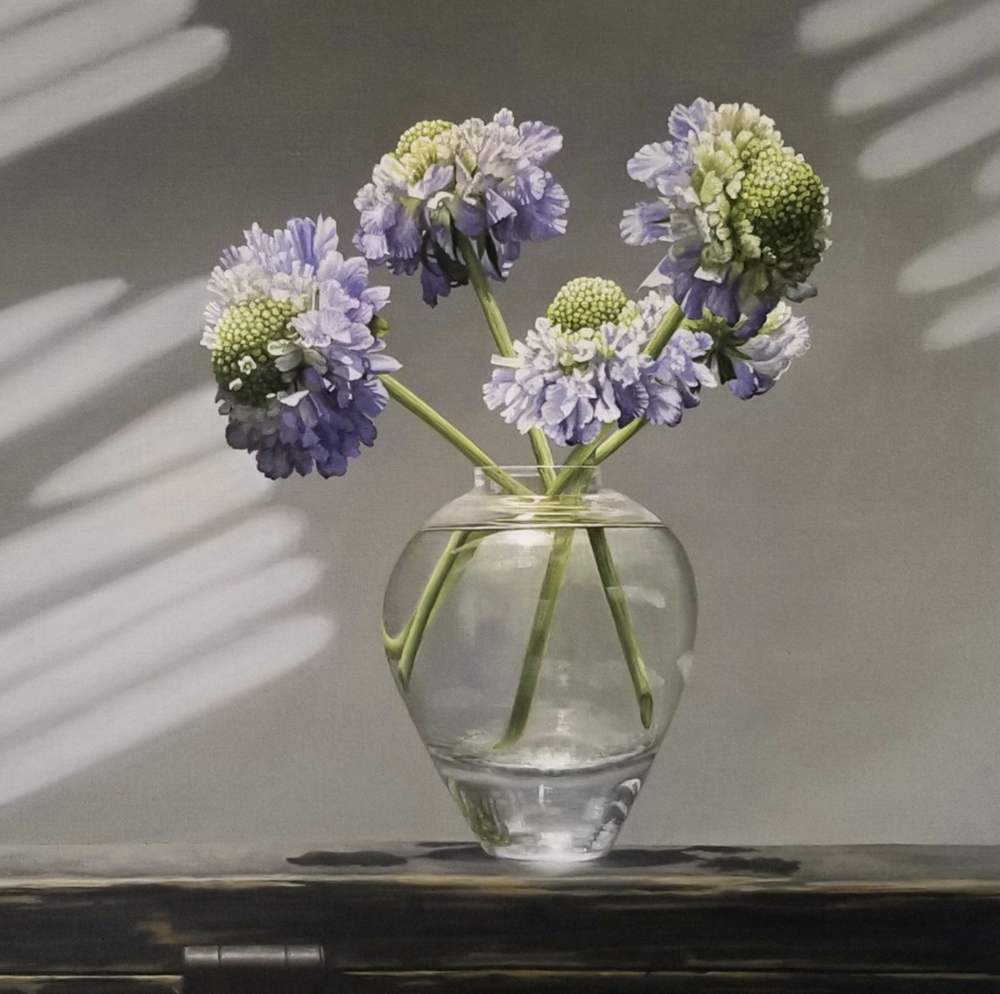
Scabiosa in Vase by Loren DiBenedetto, Oil, 24 x 24 in.; Anderson Fine Art Gallery
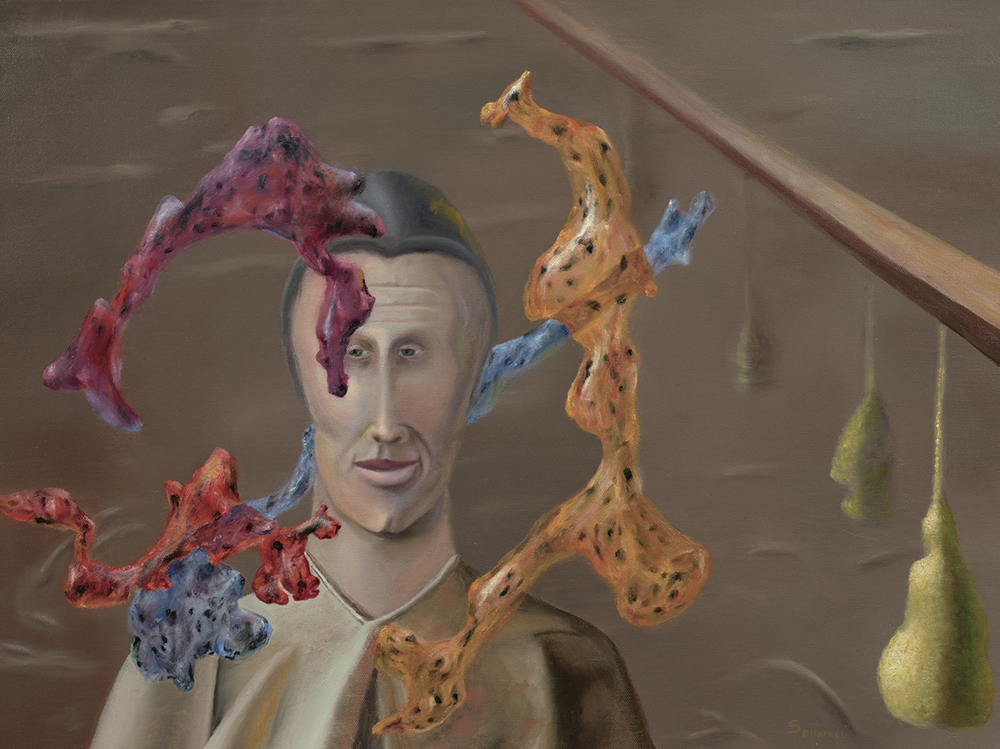
Obsessive Thoughts (1993) by Stuart Dunkel, Oil on canvas, 18 x 24 in., Signed; Rehs Contemporary
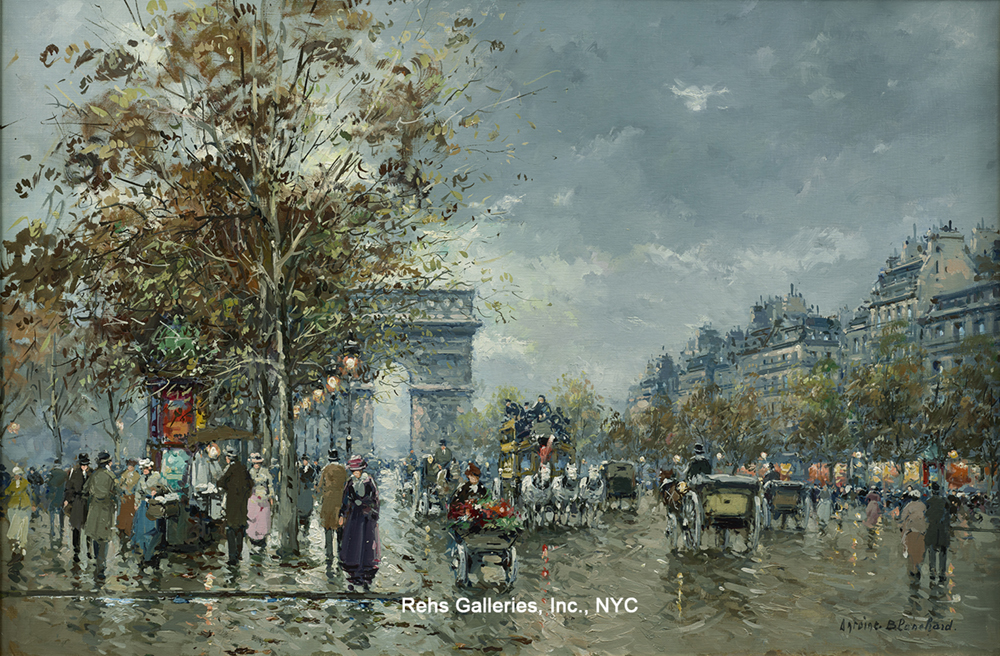
Arc de Triomphe by Antoine Blanchard, Oil on canvas, 24 x 36 in. (framed 30 3/4 x 42 3/4 in.), Signed; Rehs Galleries, Inc.
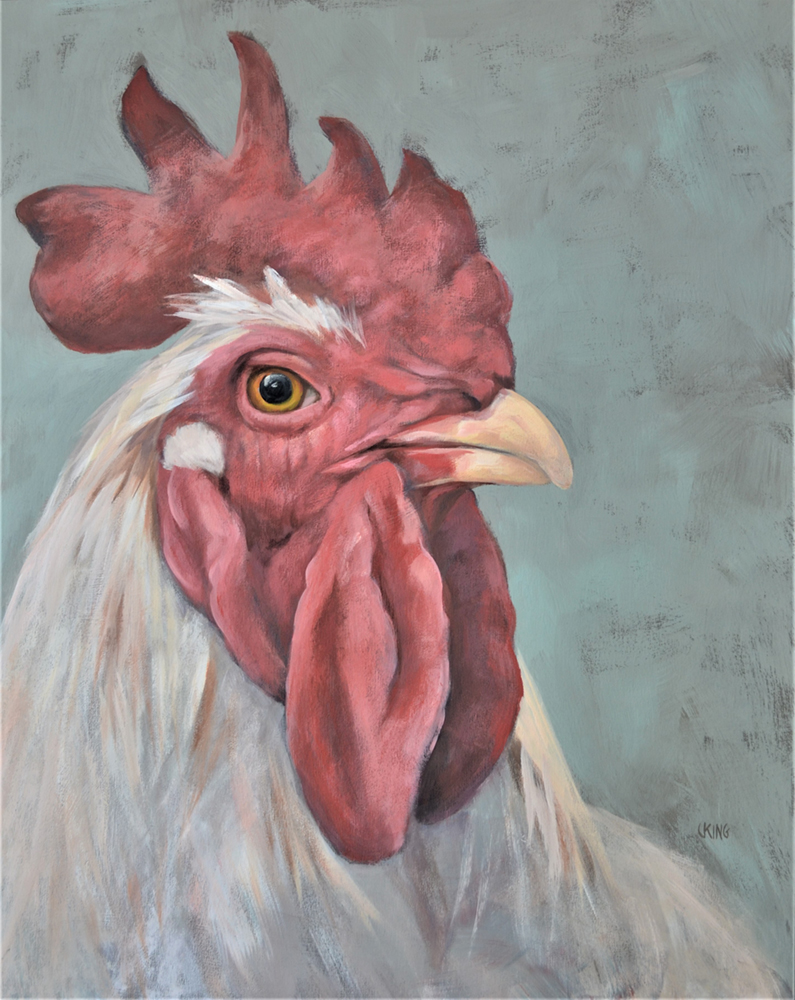
Hermes by Caryn King, Oil on panel, 30 x 24 in.; Vermont Artisan Designs
Made in the Shade by Mick McAndrews, Watercolor, 11 x 15 in. (Featured in Back to Nature – A Landscape Painter’s Invitational Exhibition); Wayne Art Center
May Melt And Tumble by Darcie Peet, Oil, 30 x 20 in.; ArtzLine.com
Want to see your gallery featured in an upcoming Virtual Gallery Walk? Contact us at [email protected] to advertise today. Don’t delay, as spaces are first come, first served, and availability is limited.
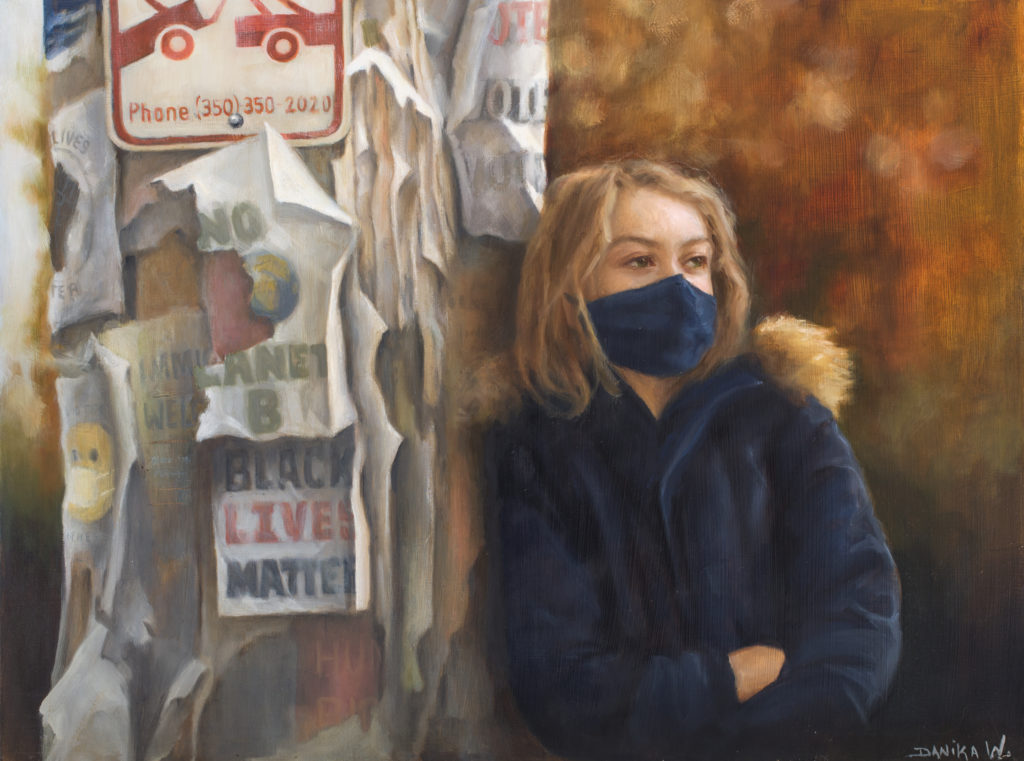
"Reflections of 2020" (oil on board, 18 x 24 in.) by Danika Wright
A partnership with the Aristides Atelier at Gage Academy of Art in Seattle, Washington, will bring realist paintings to Maryhill Museum of Art through July 18, 2021. The works will be on view in the museum’s M.J. Murdock Charitable Trust Education Center.
“Searching for Beauty: Artist Views through the Lens of 2020/2021” features work reflecting each artist’s personal experiences during the pandemic. While the 40 paintings on view are realist works, on close inspection, viewers will find layers of meaning and mood as expressed through subject matter, brushwork, and color.
Artist’s Statements
Shown at top: “Reflections of 2020” (oil on board, 18 x 24 in.) by Danika Wright
To say 2020 has been a challenging year would be an understatement. It has been a year filled with mixed emotions, new and unresolved challenges. I’m sure like most people, my thoughts have been occupied by the pandemic, concern for family and friends, the much needed BLM movement, sparked by the deaths of George Floyd and Breonna Taylor, and the effects and ever pressing deadline of global warming.
My heart breaks when I hear how these issues have and continue to turn peoples lives upside down. The pandemic has touched all of us, either through the death of a loved one or friend, illness or loneliness. In my neighborhood, more and more tent cities appear, revealing how the pandemic has left so many homeless. The boarded up windows of downtown Seattle echo the fight against an injustice that has been going on for decades.
And amid all of this, the abundant wildfires, dying coral reefs, and increasing extinction rate reminds us of the urgent actions needed to avoid more climate catastrophes. With these things at the forefront of my mind, it’s easy to feel overwhelmed and disheartened. However, this feeling is eased when I see the individuals and communities coming together to stand up and give a powerful voice to these issues. People taking action to remind us all how precious life and our planet is. It’s these people who inspire me and give me hope for our future.
***
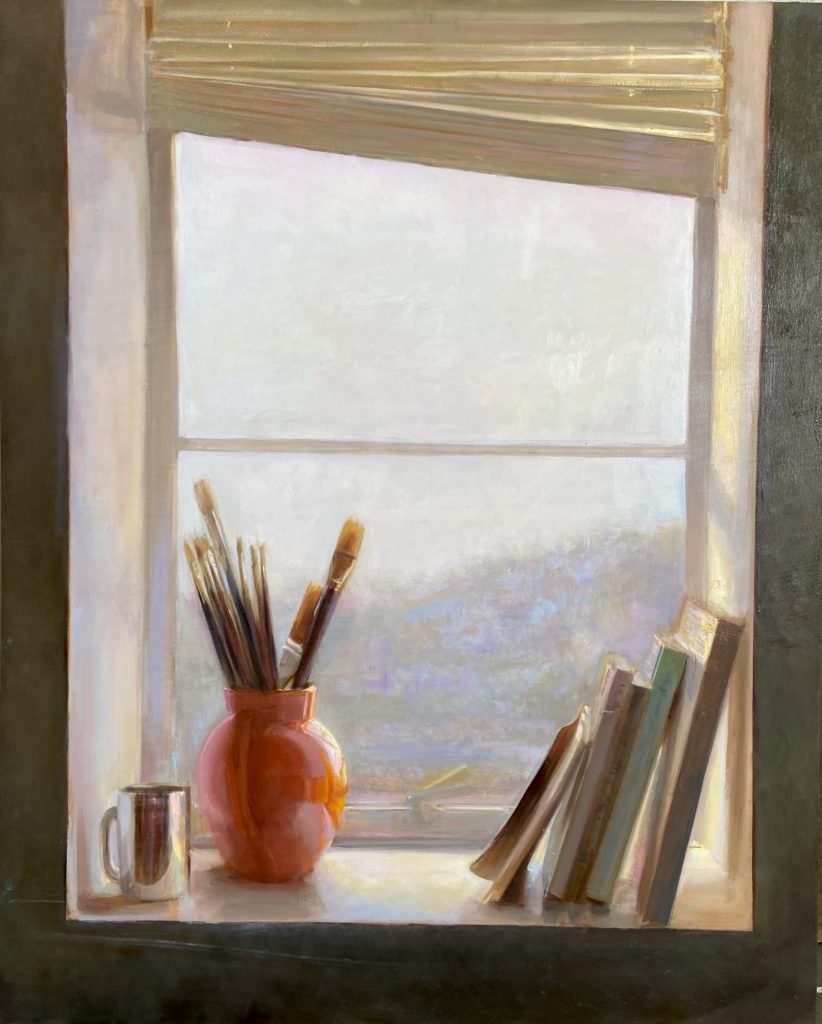
“Split Screen” (oil on panel, 26 x 32 in.) by Juliette Aristides
“Split Screen” (oil on panel, 26 x 32 in.) by Juliette Aristides
This is a painting of my studio window at Gage Academy of Art, where I have spent so many hours and years of my life. At the start of the pandemic we sheltered in place while schools, churches, and museums sat empty. Eventually I went back to school to paint in the building – alone.
At first it was eerie and disturbing but I was grateful to leave my house and have somewhere to go. I was disciplined about painting and the routine helped me through the summer. This studio is about one mile from the location of the CHAZ, the Capitol Hill Autonomous Zone. It felt like being in the eye of a storm.
***
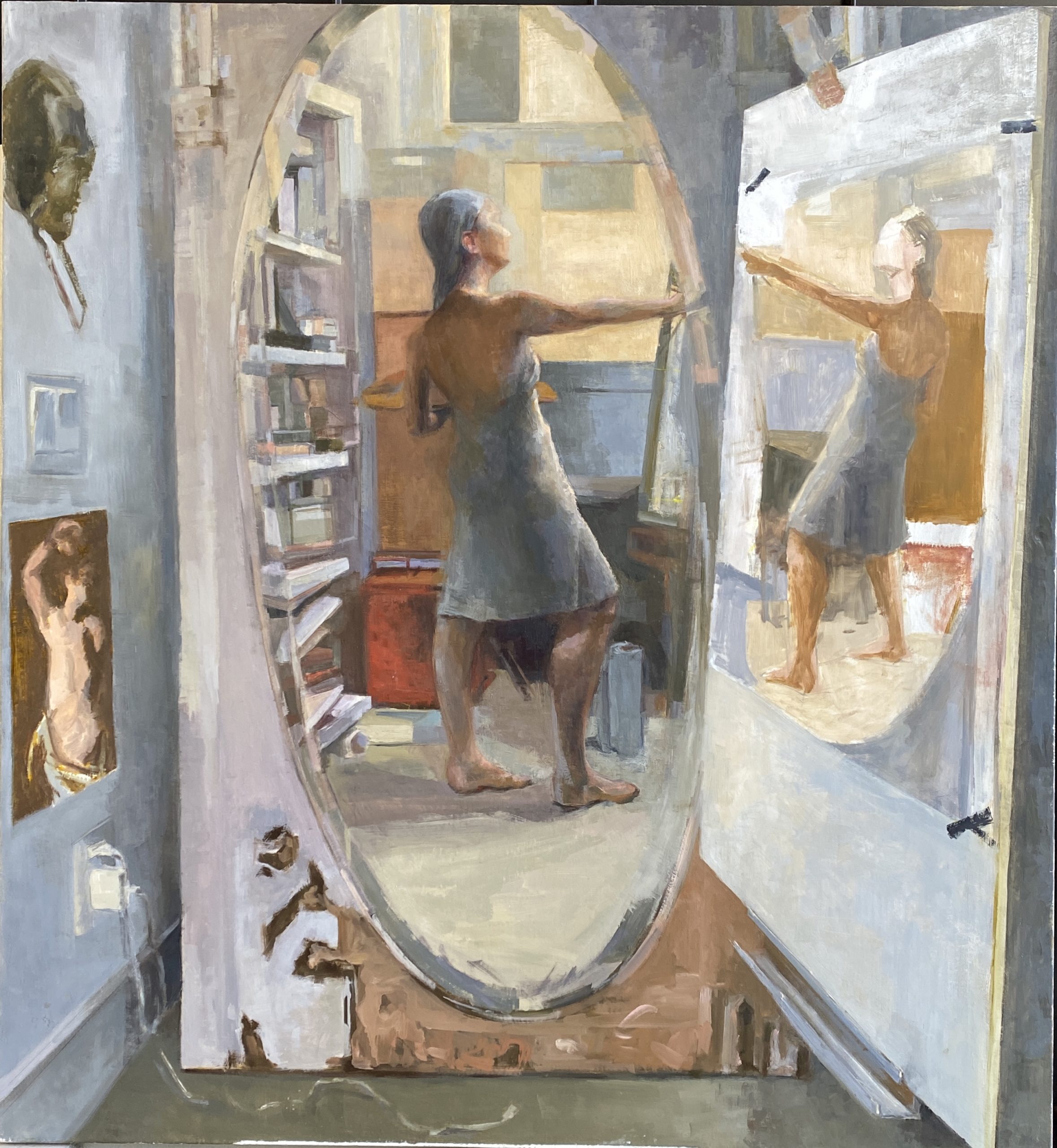
Best in Show “Self-Portrait” (oil on linen, 48 x 53 in.) by Maria Huang
Best in Show “Self-Portrait” (oil on linen, 48 x 53 in.) by Maria Huang
Working during the pandemic took on a claustrophobic feel for me. I felt as though all day, everyday, all I did was read news, look, listen to the news on the radio, draw, watch my children, be a mother, partner…and think. Think of hope, think of doom, think of a world spinning fast out of control, and into great and amazing change…I hope, I hope.
Yet, I am in my head all day long trying to capture this moment in paint, learning, seeing, hoping. My studio space is tight and I felt like all my books, implements, paint, brushes were calling to me with their information, ideas, and potential. All the things do, while time stands seemingly still, yet moving faster than light. I felt like I couldn’t move fast enough as the atmosphere was/is so thick. I am hoping I can catch all these feelings in this portrait: in the paint, the real and the unreal, the light and shadow, the thoughts of looking…at me …looking at me and seeing me.
***
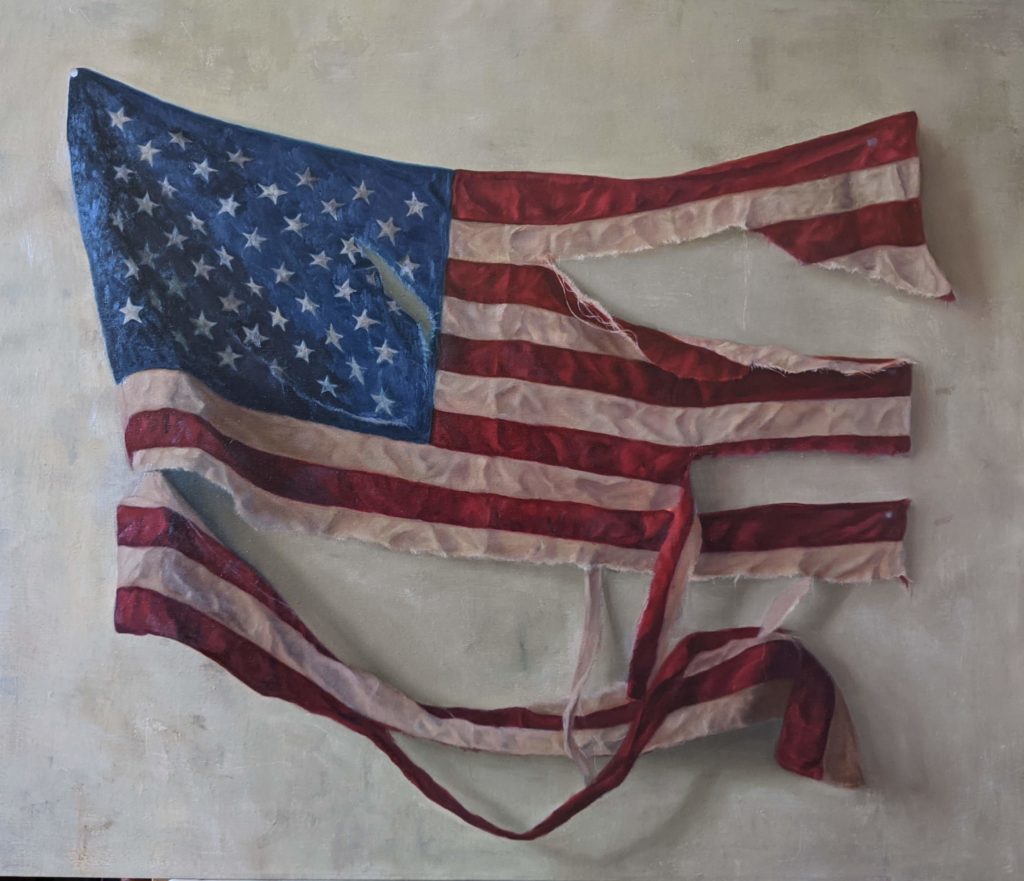
“United We Stand” (oil on linen, 24 x 36 in.) by Leslie Kiesler
First Place “United We Stand” (oil on linen, 24 x 36 in.) by Leslie Kiesler
The last year tore through the world like a monster leaving devastation and upheaval in its wake. Being asked to meditate on the year 2020 and create something that represents my own experience was challenging to say the least.
It was a year that felt as though I was sitting on the sidelines in lockdown watching the world wail through a collective trauma. Yet at home, in America, we fought more than just a virus. 2020 was a year marred by sickness and death, racism, gun violence, white supremacy, obstructive political division, nationalistic terrorism, and more. Lives are changed forever, many are gone.
The flag represents more than freedom to so many Americans. It is such a beloved symbol that some are reviled at its defacement. Our family waved it proudly outside our home as I was growing up. This was a symbol of freedom and opportunity and unity and so the past year decided in me to challenge that image.
The famous phrase, “United we stand, divided we fall”, also drove me to this controversial picture. We are a nation divided and we are failing each other more each day, to the point of death. Our flag is a symbol, a representation of the United States of America, yet we are not united. The very fabric of what makes us call ourselves Americans is unraveling and continues to do so.
My intention for this image is to serve as a reminder that unless we stop sowing division and come together, the stained, unraveling threads will soon be pulled to pieces. I want this symbol to become whole and bright again, but that can only be done together. The hope of a greater future exists as long as we stand united. The flag still holds together and can be mended as can our hearts and relationships.
***
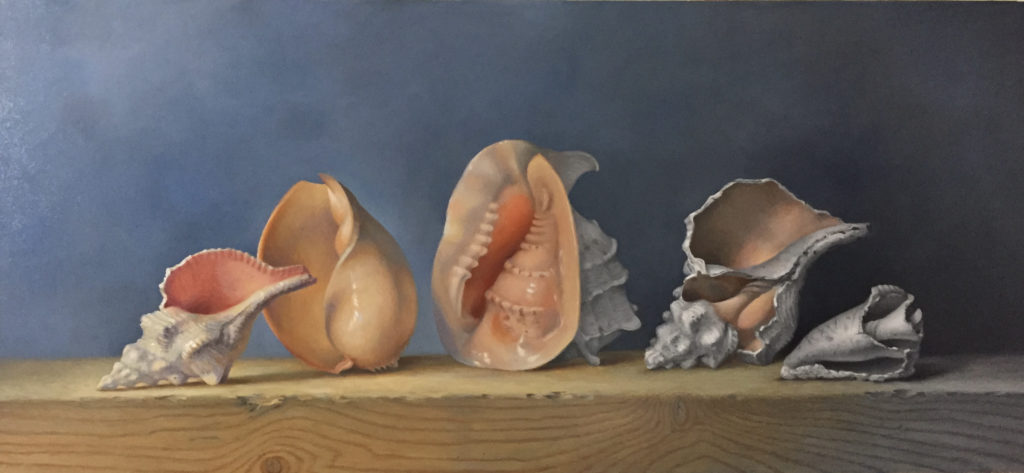
“Fade to Black” (oil on linen, 24 x 36 in.) by John Rizzoto
Second Place “Fade to Black” (oil on linen, 24 x 36 in.) by John Rizzoto
The year 2020 tipped the scales of endurance for everyone I know. Brazen displays of sanctioned hate, unfathomably corrupt and deceitful politics, profound racial injustice, and a global pandemic all bearing down on us at once put a dent in the spirits of even my most optimistic friends.
Underlying this and making all other concerns inconsequential by comparison, is climate change and our planet’s now irreversible spiral downward. Daily we add species, grand and small, to the extinction list.
“Fade To Black” gives visual voice to one aspect of the climate change crisis, ocean acidification. Well underway now, acidification is causing a net decrease in the amount of carbonate ions available in ocean waters, making it more difficult for marine calcifying organisms to form biogenic calcium carbonate, or CaCO3.
These marine organisms include anything that builds a shell; all mollusk (seashells), shrimps, corals, crabs, lobsters and perhaps most important, krill, the basis of the oceanic food chain. I have spent my entire life in close proximity to the ocean, walking the line between the sea and shore. The thought of future generations beach combing for beautiful bits of wave-washed plastic and urban waste seems like an unsatisfying comparison to the world of wonder contained in a pocket full of shells.
***
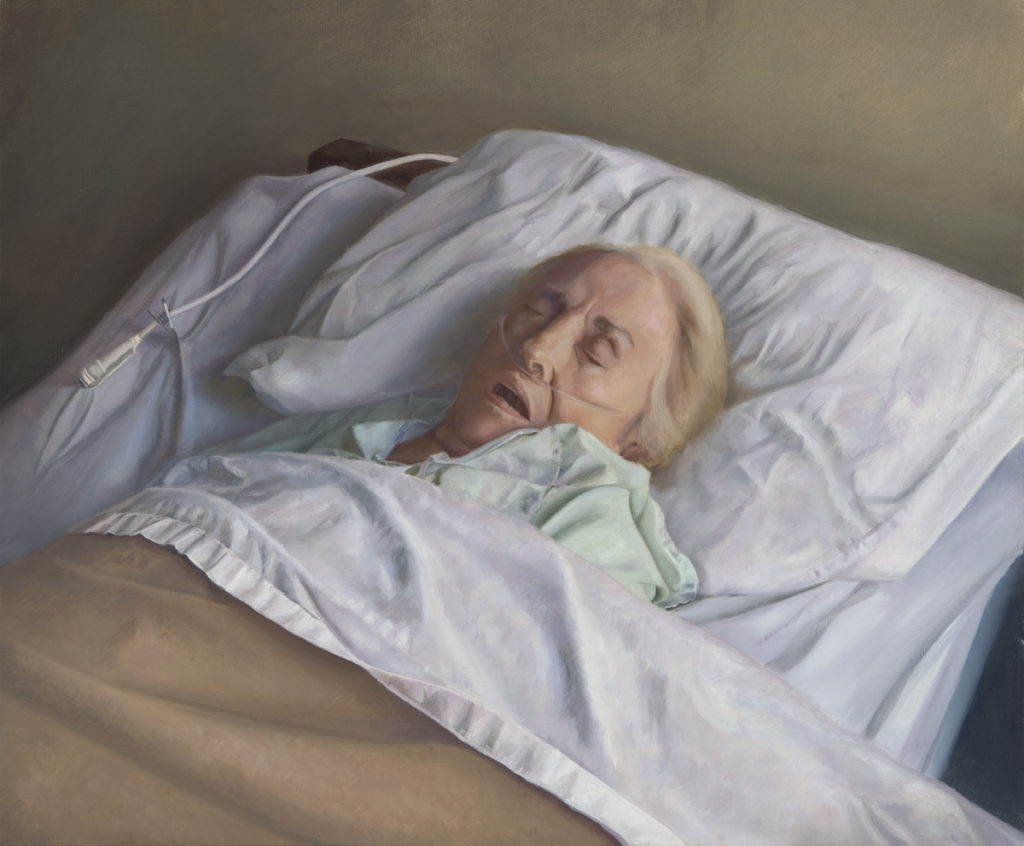
“Alison” (oil on linen, 19 x 23 in.) by Will Dargie
Third Place “Alison” (oil on linen, 19 x 23 in.) by Will Dargie
Alison, my mother, died on September 7, 2020. She did not die of Covid, but Covid was nevertheless responsible. When the pandemic came, it took from my mother her friends and community and her joy of life. She was alone and isolated. She would not eat. She was afraid to go out, to get food, to go to the doctor.
Determined to fight, she went into denial. She ignored the symptoms of oncoming cancer because she could not separate her physical pain from her emotional one. By the time she finally agreed to go to the doctor it was too late and she died, in hospice, soon thereafter. Other than myself, visitors were not permitted. It’s customary to say she was at peace, but she wasn’t.
***
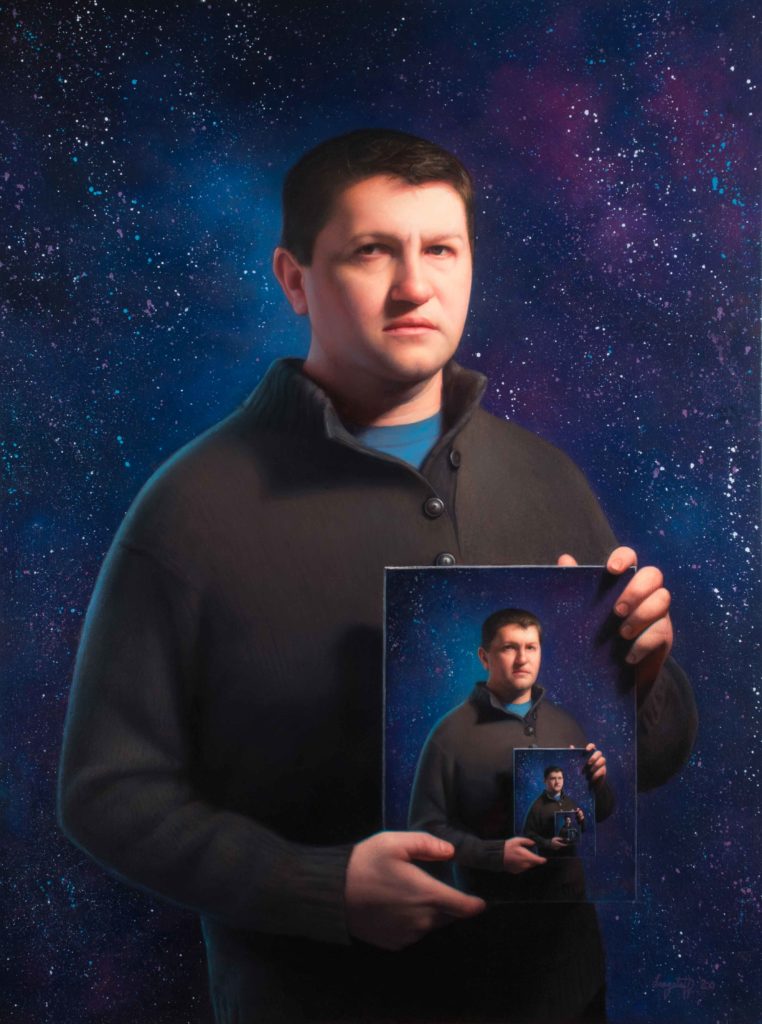
“Self-Portrait Contemplating Infinity” (oil on linen, 24 x 32 in.) by Josh Langstaff
Curator of Education’s Choice “Self-Portrait Contemplating Infinity” (oil on linen, 24 x 32 in.) by Josh Langstaff
The pandemic forced me into a lot of introspection. My mind turned to thoughts of mortality and the cycle of life and death. One thought I kept coming back to was the concept of infinity. Since the only model I could work with was myself, I decided to do a self-portrait on the theme. In the portrait I hold a painting of myself that is the same image as the overall portrait. Theoretically, it repeats itself infinitely within the portrait. The background further explores the concept with the infinite expanse of the cosmos. Though the pandemic seems interminable, in the grand scheme it is but a blip on the infinite cosmic scale.
***
“Reflections of 2020” (oil on board, 18 x 24 in.) by Danika Wright
Terri Jordan, Curator of the Customs House Museum in Clarksville, Tennessee, juried the exhibition and selected several works for special recognition.
“With each of these pieces I could see what the artist was portraying even before reading their statements,” says Jordan. “While different, these works all had a strong sense of composition and form.”
Visitors to the museum will be invited to select their own favorite painting for the People’s Choice Award.
At a Glance:
“Searching for Beauty: Artist Views through the Lens of 2020/2021”
Maryhill Museum of Art
Through July 18, 2021 marhillmuseum.org
> Visit EricRhoads.com to learn about more opportunities for artists and art collectors, including retreats, international art trips, art conventions, and more.
> Sign up to receive Fine Art Today, our free weekly e-newsletter
Lindsay, as I Remember Her
By Lavely Miller
Acrylic on paper on panel, 2020
40 x 30 in.
$5,000
Available through the Muskegon Museum of Art
Lavely Miller paints portraits that narrate the effects of trauma, exploring visual cues that speak to loss, suffering, recovery, and salvation. Physically still, her figures exist in moments of emotional action, their frequently direct gazes challenging the viewer’s attention. This sense of movement is translated through transparent layers of glazes, sometimes upward of 100 separate applications of color combining to create the final surface. The quality of layering is heightened by the use of paper, as it moves and crinkles during its application to create physical depth. Classical Flemish glazing techniques — unusually applied almost exclusively with the artist’s right index finger — and the aged appearance of the painted surface give these figures a timeless quality, a frozen moment of physical time filled with universal human emotion.
A practicing artist with a BFA in painting and drawing from James Madison University, Miller also holds an Ed.D. and M.Ed. in clinical mental health. She exhibits throughout the Washington, D.C. and Virginia area in addition group and juried shows across the U.S. Her paintings can be found in the collections of the University of Virginia, the New Salem Museum, the National Center for Transgender Equality in Washington, D.C., and the Twenty-First Century Fox and News Corporation Building in New York City, amongst other public and private collections. Her work recently received a top prize award at Art Basel (2013) and a judge’s choice award from Camy Clough, Director of the Smithsonian’s National Museum of American History (2020). Miller is represented by Arcadia Contemporary in Los Angeles, California and Artist’s Proof in Washington, D.C.
Phoebe Hicks, "Holly," 2019, charcoal and chalk, 17 x 25 in.
On View: “Letting Us In” celebrates 150 drawings, paintings, and sculptures by women of the Florence Academy of Art.
From the organizers:
A room, a garden, a gaze. The women of the Florence Academy lay a path to somewhere deep, gorgeous, intensely personal. 80 graduates of the FAA’s 30 years of fine arts training, their diverse and highly personal visions are formed from an arts education that is meant to be foundational, a tradition these painters and sculptors have expanded upon or returned to in the 150 works assembled in this exhibition.
80 women who share with us their experiences and visions in this breadth of media and styles, from oil and bronze to mixed media and digital art, from classical representation to imaginative and abstracted figuration. We are delighted to give them this stage.
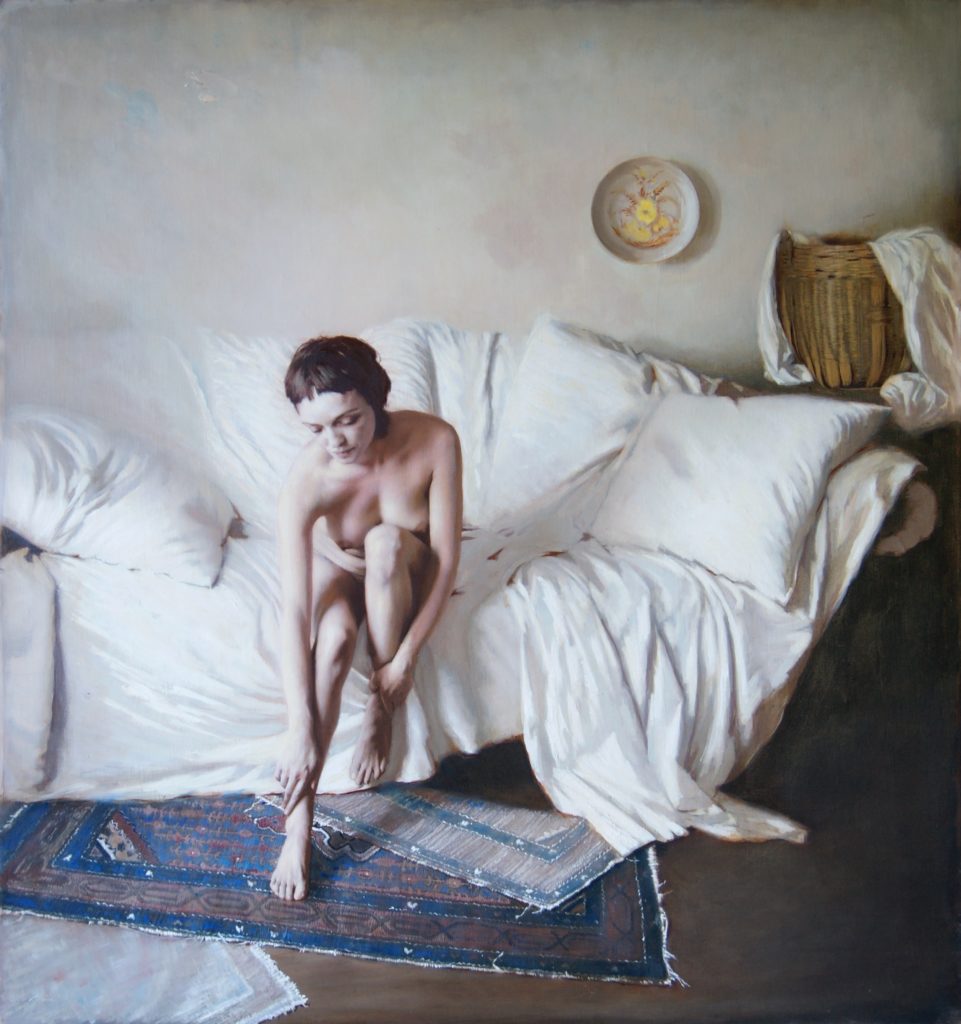
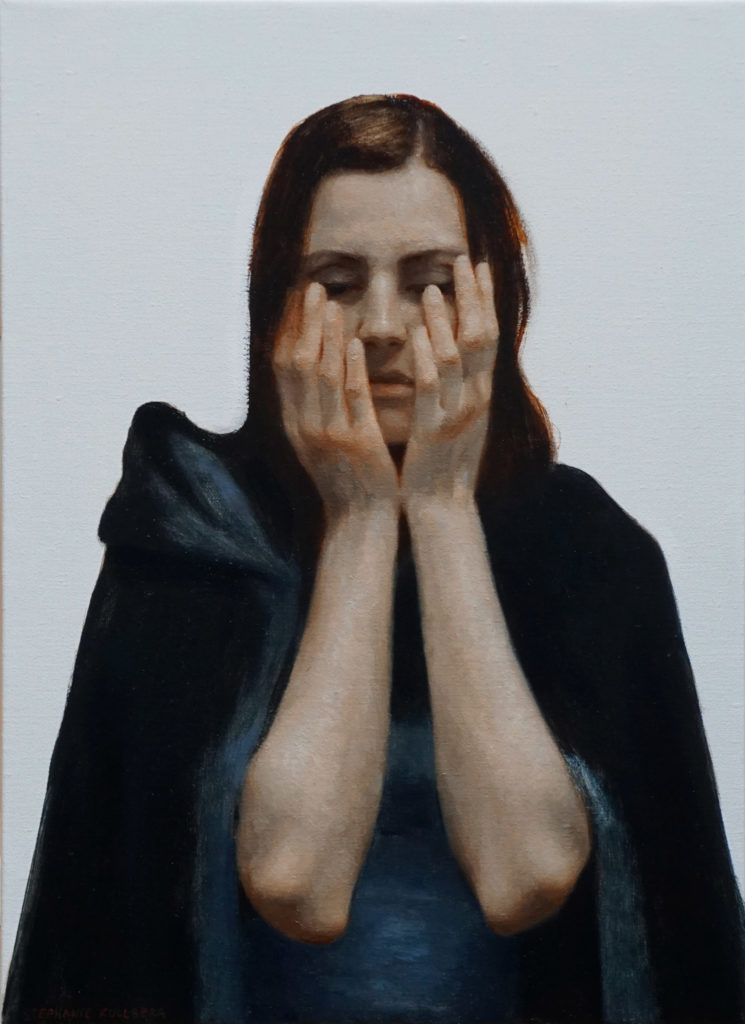
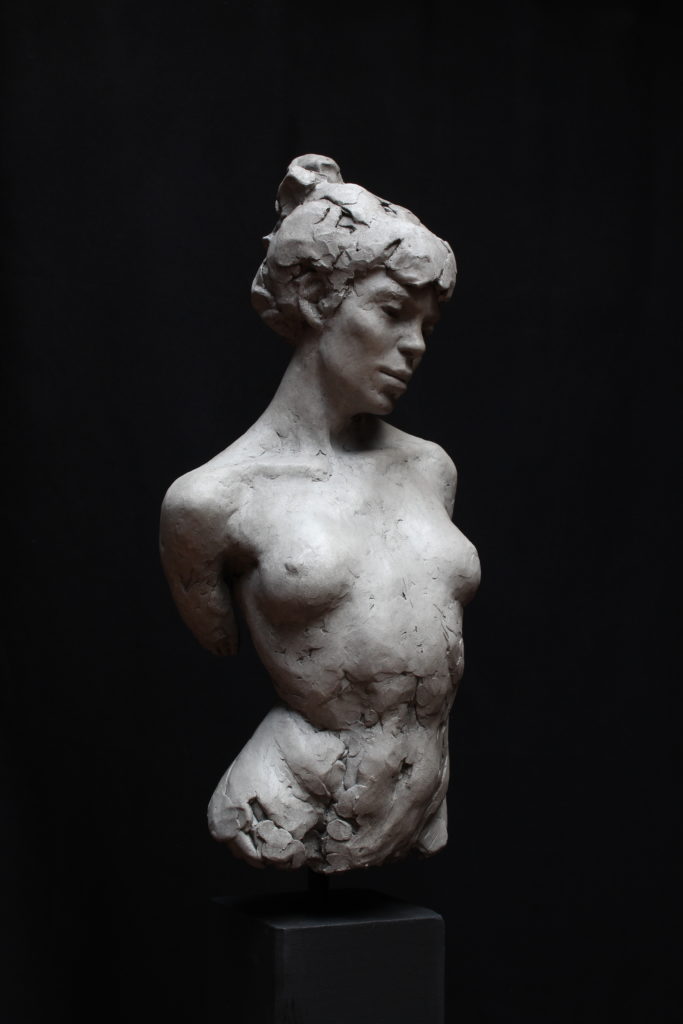
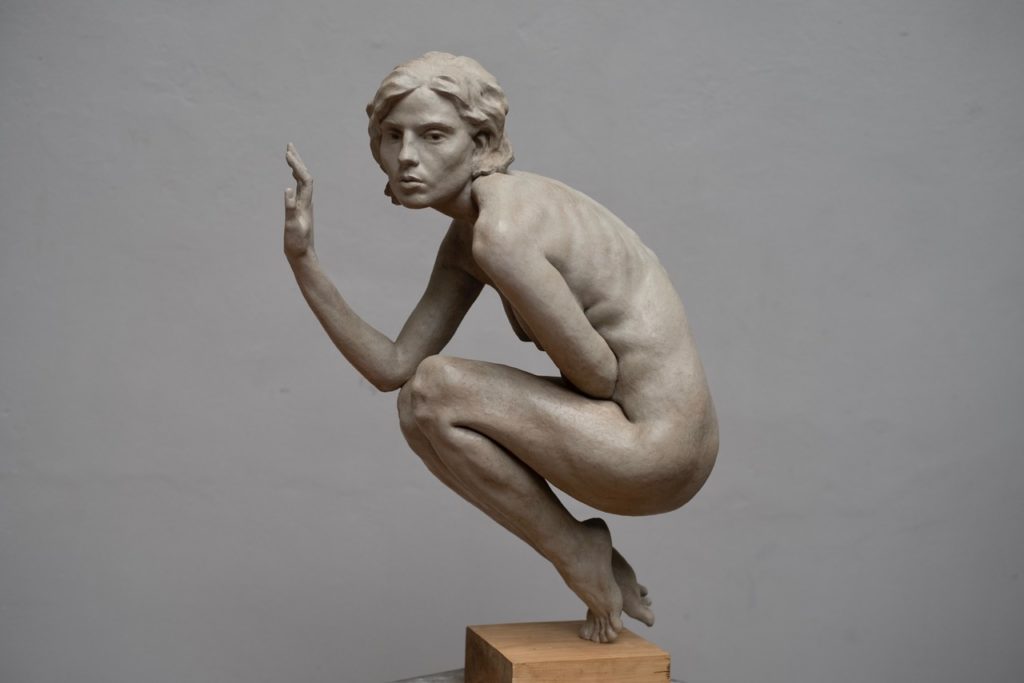
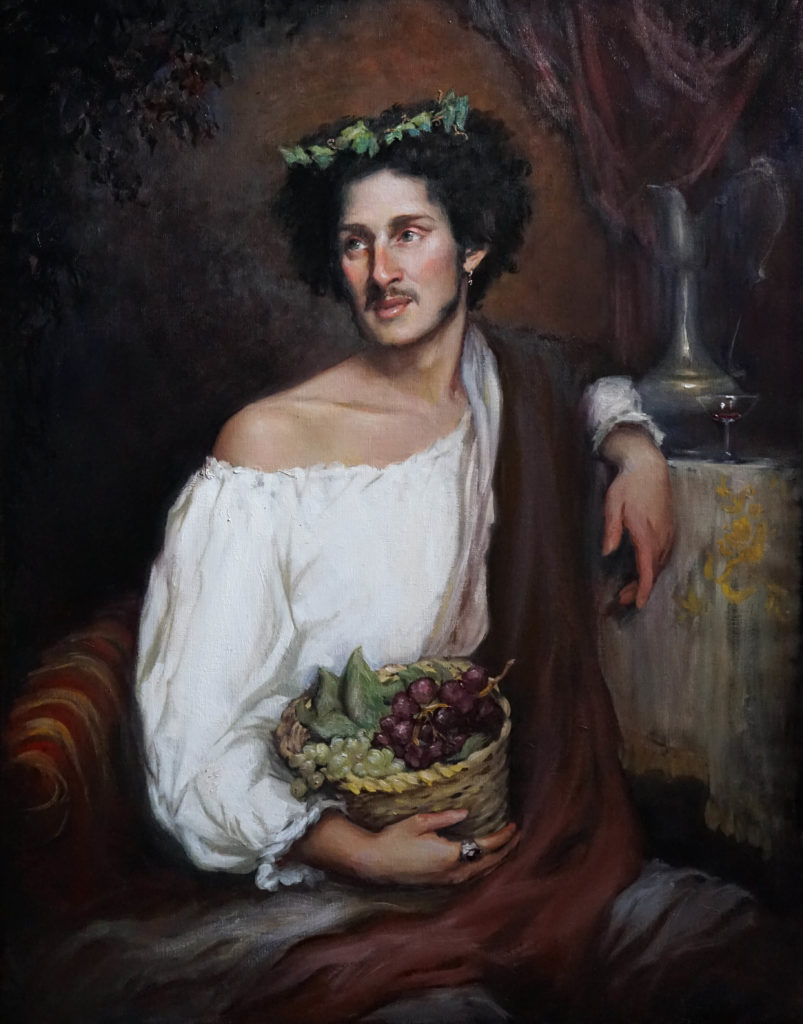
Tina Orsolic, “Spring Flowers,” 2020, oil on canvas, 55 x 35 cmCarla Paine, “Before the Bath,” 2021, oil on linen, 30 x 32 in.Stephanie Kullberg, “In My Eyes,” 2021, oil on linen, 54 x 40 cmMaudie Brady, “Marie,” 2021, hydroresin, 60 cm (height)Jana Büttner, “Trapped,” 2021, clay cast in resin, 75 x 50 x 31 cmIreland Wisdom, “Young Bacchus,” 2019, oil on linen, 110 x 84 cmJane Manco, “Morning Dress,” 2020, oil on canvas, 23 x 28 in.
> Visit EricRhoads.com to learn about more opportunities for artists and art collectors, including retreats, international art trips, art conventions, and more.
> Sign up to receive Fine Art Today, our free weekly e-newsletter
Elaine Lisle, "Colors in the River," 2018, oil on canvas, 24 x 48 in.
How painting on location has changed for one artist, in multiple ways.
BY NANCY BEA MILLER
For many years, the urban landscape paintings of Elaine Moynihan Lisle (b. 1954) have gloried unabashedly in bright summer days. Using bold colors and lively brushwork, the artist has infused energy into her world of flowerbeds and leafy trees contrasting with red bricks, colorful awnings, and the pure blue skies soaring above them. “It has been hard for me to paint a rainy or cloudy day,” Lisle explains. “When there is no sun, I have always sought the silver lining, or the bright spot hidden in a bank of clouds.”
Lately, however, Lisle has been focusing on other seasons and times of day. Her family weathered two tragedies in 2019: her mother lost a difficult battle with ALS, and then a beloved sister-in law died at a relatively young age. These experiences inevitably influenced Lisle and her art: “I’m still an aesthetic optimist, which I equate with saturated colors and light,” she says, “but perhaps that optimism is being tempered. I’ve developed more of an appreciation for all seasons, from dawn to dusk. A sunny summer day is not necessarily the only beautiful moment.”
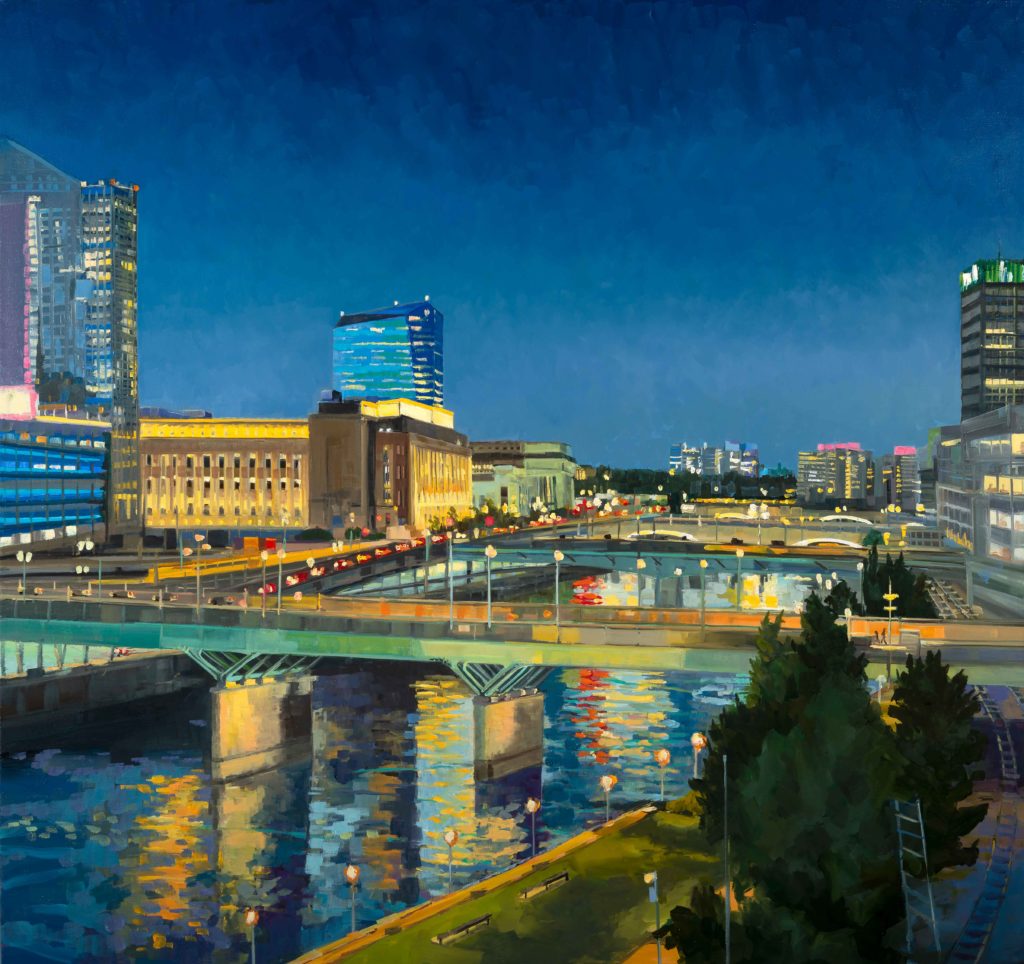
Elaine Lisle, “City at Night,” 2018, oil on canvas, 36 x 38 in.
Lisle says this realization is due in part to her growing participation in the national plein air movement. “Plein air competitions have pushed me to paint more quickly, even when I’m not in the mood. Whether it’s rainy, chilly, or hot, you must be out there when you’re competing. You rise to the occasion and it stretches you in a good way. These experiences have also made me push harder once I get back to the studio.” Just for example, Lisle cites a nighttime event during Maryland’s Plein Air Easton as having opened her eyes to the aesthetic possibilities of darkness.
Painting from nature is hardly new for Lisle. Her maternal grandfather, Russell Barnes, was a landscape architect who loved to sketch. “I visited my grandparents’ place in New Hampshire in the summer; my grandfather and I would paint together and he’d give me tips about things like aerial perspective. He would say, ‘Put more blue and white in the distance to push those mountains back, Elaine!’ Being with someone like that encouraged me by example. He was always observing, trying new things.”
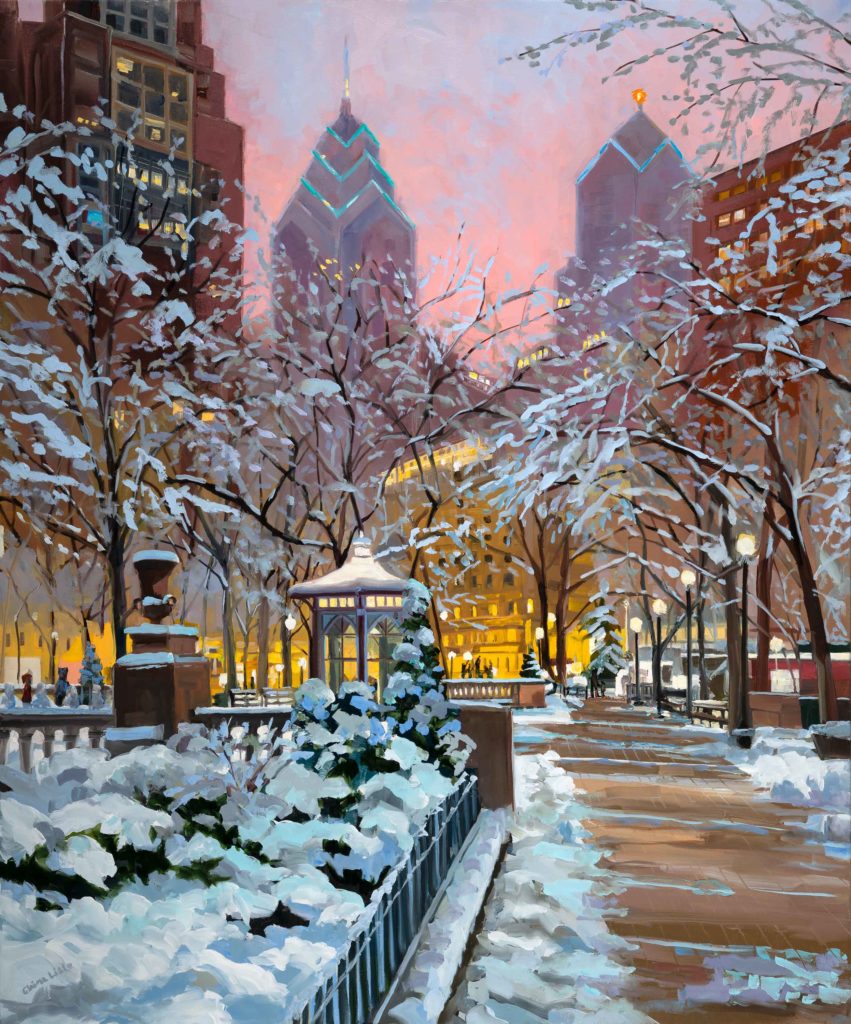
One of Lisle’s own new things is a 36-by-30-inch painting titled “Rittenhouse Snow.” It depicts Philadelphia’s most prestigious square glowing at sunset and twinkling with street lights, all covered by fresh snow. The subtlety of its colors and the interaction of its various light sources offer a visual feast.
Elaine Lisle, “Rittenhouse Snow,” 2018, oil on canvas, 36 x 30 in.
Lisle recalls, “When my husband and I turned the corner and walked into Rittenhouse Square, I was absolutely knocked out by the colors. The snow had transformed a familiar landscape into something softer, different.” She snapped as many photos as possible with her smartphone, regretting that she “couldn’t start painting the scene right at that moment.”
Back in her studio the next day, Lisle painted a small study from memory, augmented by her photos. “I was trying to remember the feel of the color rather than going strictly by the photos. Photographs never exactly capture the color anyway. In my memory, the sky was brilliant coral and the lights were like glowing coals in the blue shadows of the snow.” Lisle realized then that she could indeed recreate what had struck her so viscerally.
“Broad Street Banter” is another painting that offers a slightly oblique view down Broad Street toward Philadelphia’s City Hall. In the foreground people converse under the red banners of the University of the Arts. Though this painting depicts a sunny day, there is a captivating tension in how the figures interact.
Elaine Lisle, “Broad Street Banter,” 2018, oil on canvas, 40 x 30 in.
“I just loved those guys,” Lisle laughs. “Sometimes I put in people, sometimes I don’t. Often I will take someone from one scene and insert them into another. I am not slavish to a photographic moment, and figures must add something to the ‘story’ in a real way.” This lively painting is the by-product of a commission Lisle received for a more typical view of City Hall. “I finished the commission, and then I got to paint this for myself,” she explains with evident satisfaction.
THE WINDING PATH HERE
Lisle grew up in rural Storrs, Connecticut, and now lives in a Philadelphia suburb. Why, one might well ask, does she feel so drawn to urban scenes? The answer stretches back to her youth. Lisle was helping her father clean out his house and found one of her sketchbooks from high school. It was filled with perspective studies of streets and buildings, apparently drawn for the fun of it.
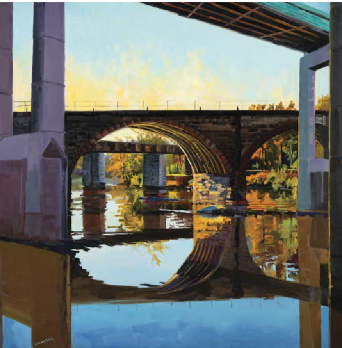
Elaine Lisle, “Fall Light, Three Bridges,” 2018, oil on canvas, 30 x 30 in.
“Understanding perspective was such a light bulb moment for me,” Lisle recalls. “Drawing a city street with buildings marching away into the distance was so much fun!” Unlike many artists, Lisle has always had a mathematical side: “I considered studying architecture,” she says, “but painting won out. Still, whenever I look at anything, I am studying the interactions of planes. I break things up into pieces, shapes of colors. It’s the way I perceive things.”
One of Lisle’s favorite professors during her two years of post-graduate study at Philadelphia’s Pennsylvania Academy of the Fine Arts was the late Murray Dessner. “As an abstract painter, Murray was always talking about edges, how paint edges meet and where different colors touch each other. Until then I was not so focused on how these pieces make a pattern.”
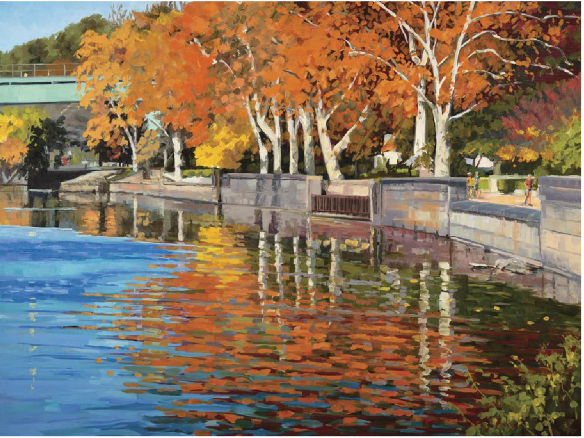
Elaine Lisle, “Schuylkill Sycamores,” 2018, oil on canvas, 36 x 48 in.
Lisle had previously earned a B.F.A. at the University of Pennsylvania, including some independent study with the late Neil Welliver, who was renowned for his large landscapes, often made en plein air. Lisle remembers, “Under his influence I was taking my large canvases outside. I had been trying to be more abstract up to that point, interpreting the urban landscape in terms of shapes and color; it was the ’70s and abstraction was typically the goal for young artists. But then, when I saw what Neil was doing, I realized that it was okay to be a realist. What a relief.”
Like so many landscapists before her, Lisle prepares for her larger works by painting “a small oil sketch on site. Based on its information, as well as on additional photos I take on site, I then create the larger piece in the studio. Sometimes I go back and take more photos, or do another color sketch. I might decide that I now want to see what was behind a parked truck, or if a slightly different angle might work better. The larger painting never just replicates the on-site sketch. It must have its own spirit.”
> Visit EricRhoads.com to learn about more opportunities for artists and art collectors, including retreats, international art trips, art conventions, and more.
> Sign up to receive Fine Art Today, our free weekly e-newsletter
Meyer Gallery (Santa Fe, NM) Presents its First Solo Exhibition for Painter Kim English
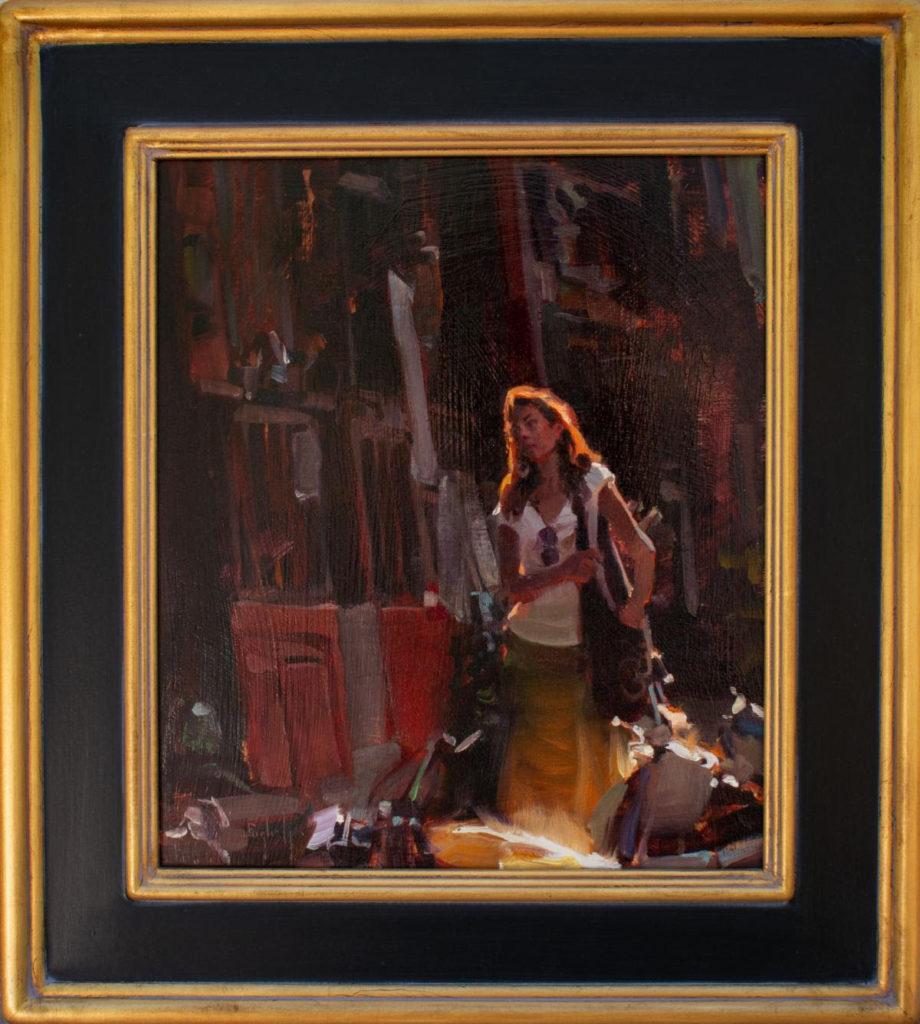
An accomplished artist who spent much of his life and career in Colorado, English presents a collection of more than ten new paintings that express the artist’s signature use of light and shadow, alla prima painting technique, and gestural representational style. Artwork is available in the gallery and online at meyergalleries.com.
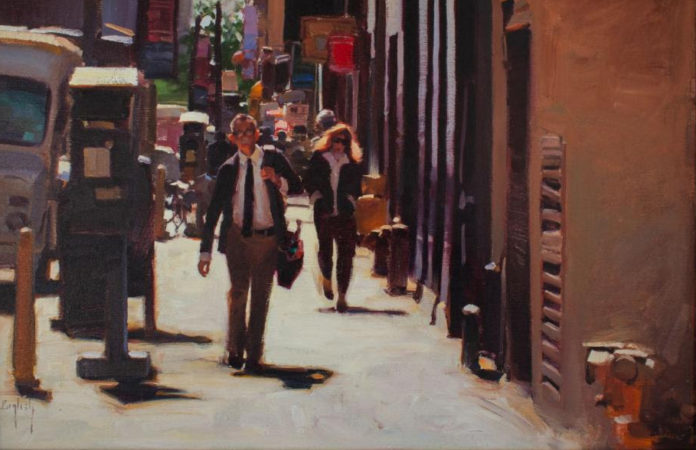
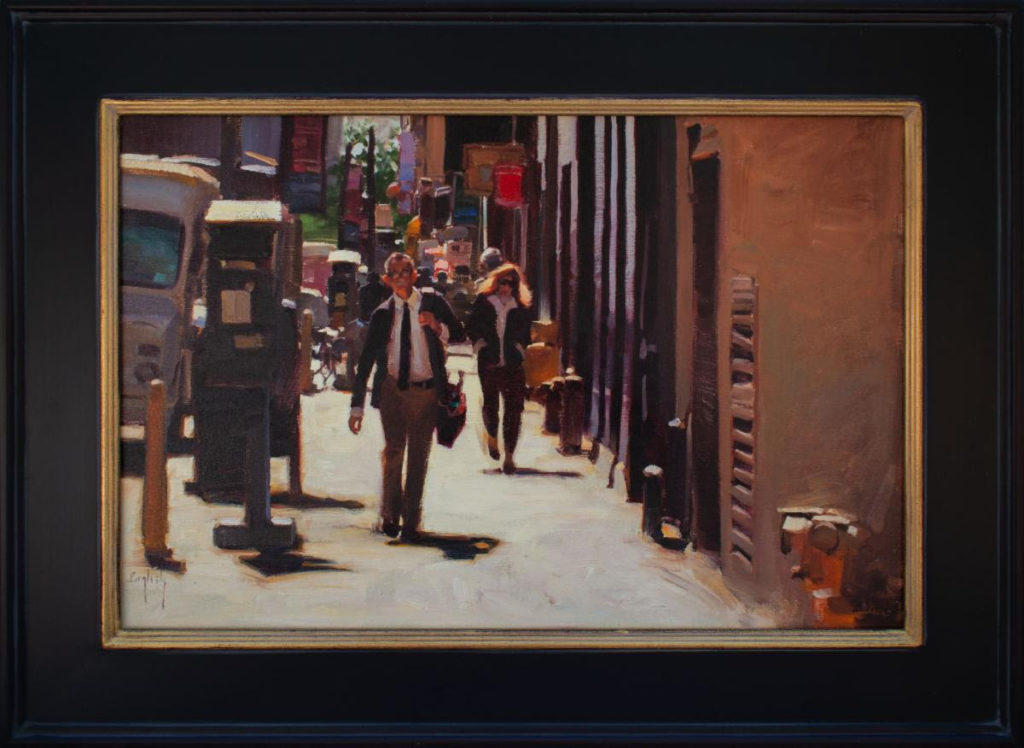
Kim English, “New York Hustle,” Oil, 18″ x 27″
English’s work highlights the beauty found within rituals of everyday life around the world – from the busy streets of New York City to cultural celebrations in San Miguel, Mexico. His work is inspired by his travels to Europe, South America and the American West, as well as his local environment.
As an alla prima painter, English typically completes each piece in a single sitting in order to capture the light, color, and mood of a fleeting moment. This “wet on wet” painting technique allows the artist to achieve rich texture and depth, while creating a sense of immediacy that brings the viewer directly into each painted moment.
Kim English, “Leisure Visit,” Oil, 14″ x 12″
With his trips limited over the past year, English dove into his photography archives from previous travels as reference for new paintings. The resulting work has a sense of nostalgia as it depicts busy street scenes, shopping tourists and celebratory gatherings between people. “I’m remembering how things were,” says the artist, whose work also emits feelings of hope and excitement as we look toward the future.
English currently lives and works near Louisville, Kentucky, where he moved with his wife nearly four years ago. He was born in Omaha, Nebraska and grew up in rural Colorado. He attended the Rocky Mountain School of the Arts in Denver, and taught at the Art Students League of Denver and the Scottsdale Artists School.
His work has been exhibited at the National Academy of Design, the NAWA 21st Annual Exhibition, Arts for the Parks, the Colorado Governor’s Invitational at the Loveland Museum, the A.R. Mitchell Memorial Museum of Western Art, The Knickerbocker 42nd Annual Exhibition, and with the Oil Painters of America. He has shown with the Allied Artists of America and was awarded their Gold Medal of Honor. He has also won both the Certificate of Merit and the Joseph Hartley Memorial Award from the Salmagundi Club in New York.
> Visit EricRhoads.com to learn about more opportunities for artists and art collectors, including retreats, international art trips, art conventions, and more.
> Sign up to receive Fine Art Today, our free weekly e-newsletter
Fill your mind with useful art stories, the latest trends, upcoming art shows, top artists, and more. Subscribe to Fine Art Today, from the publishers of Fine Art Connoisseur magazine.