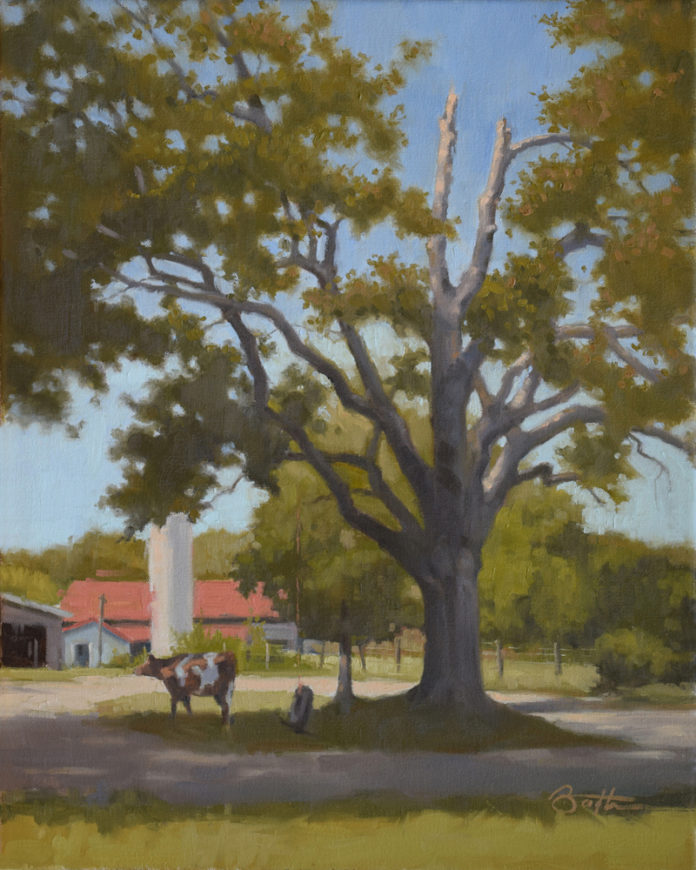
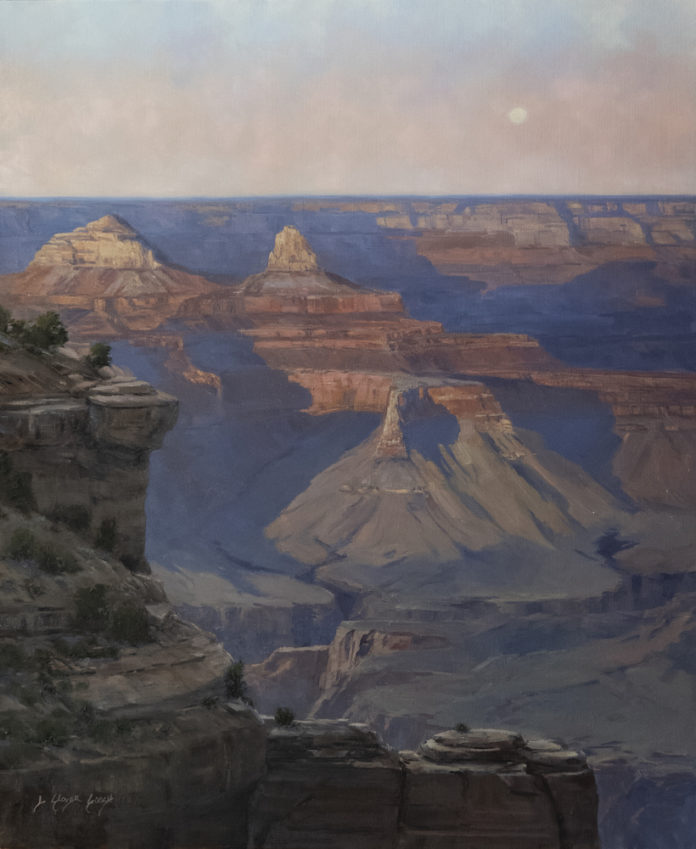
As part of our effort to continue to help artists and art galleries thrive, we’re proud to bring you this new “Virtual Gallery Walk.” Browse the paintings below and click the image itself to learn more about it, including how to contact the gallery.
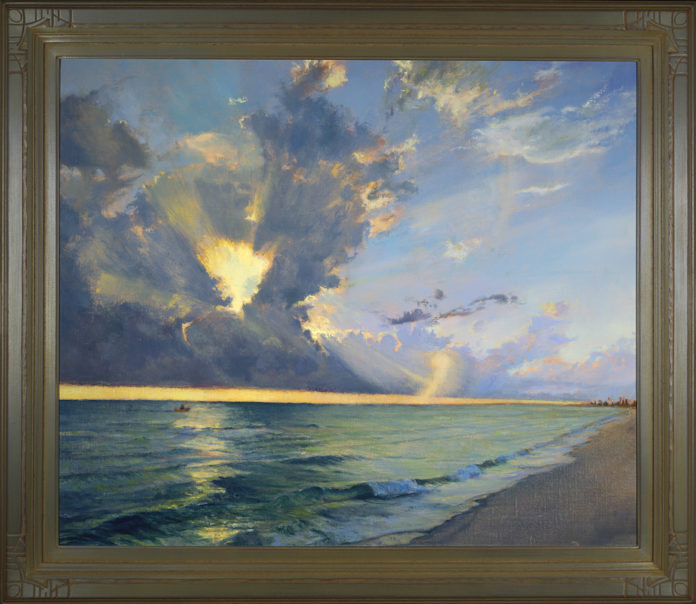
La Solana Ocean View by Hope Reis, Oil, 23.5x 32 in; Anderson Fine Art
Giraffe Bonsai by Lauren Pretorius, Oil on Panel Framed, 16 x 20 in.; Bluestone Fine Art Gallery
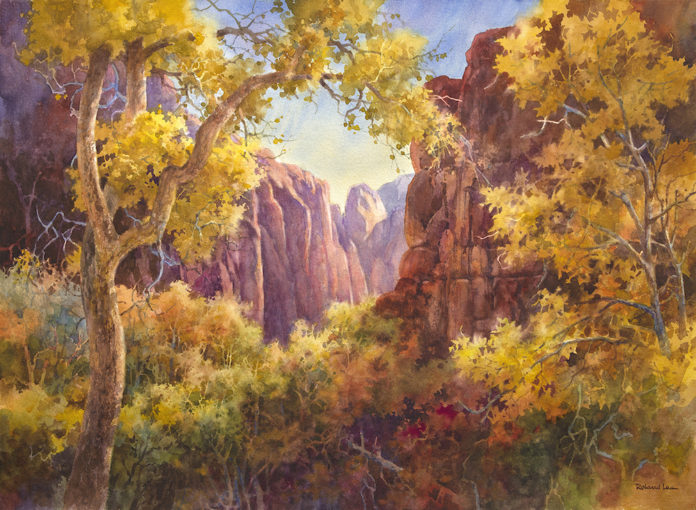
Ojai Valley by Marion Kavanaugh Wachtel (1876-1954), Watercolor, 20 x 32 in., 1912; Rieser Fine Art
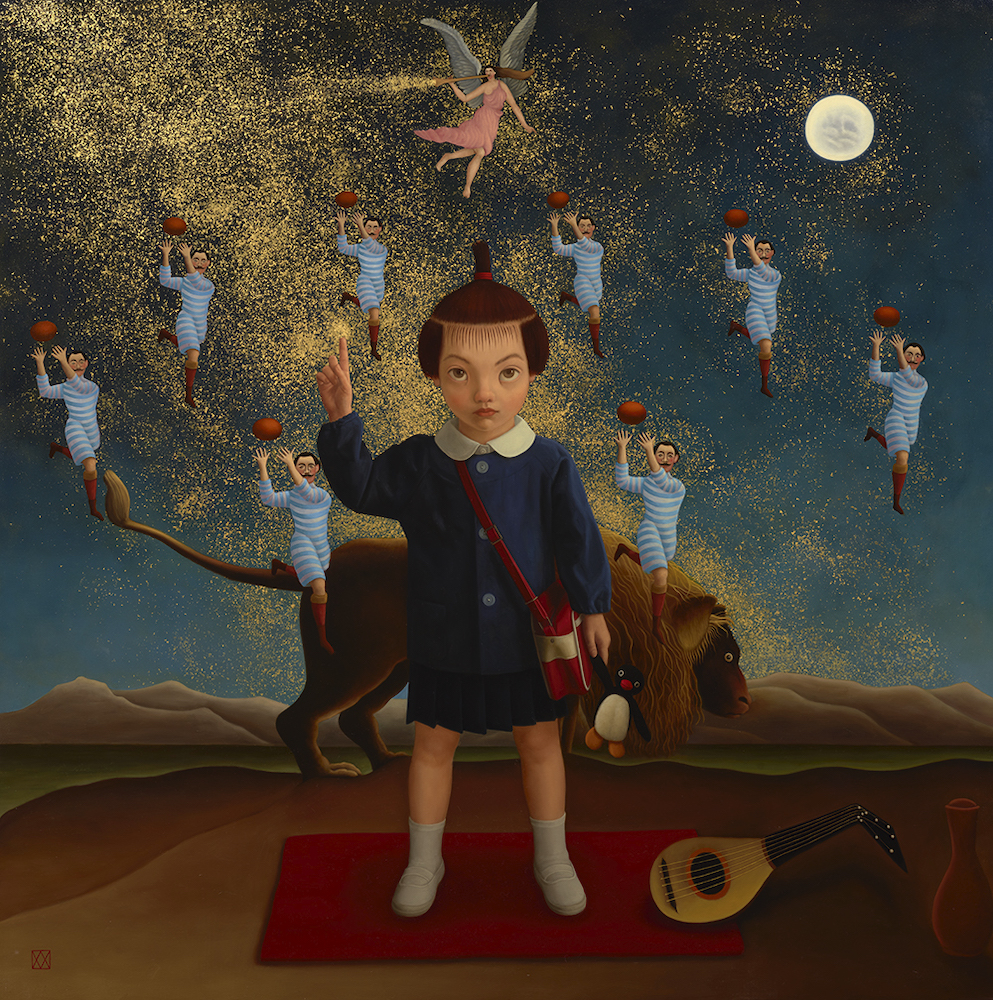
Open Door by Mark Laguë (born 1964), Oil on Panel, 30 x 30 in. Signed; Rehs Contemporary
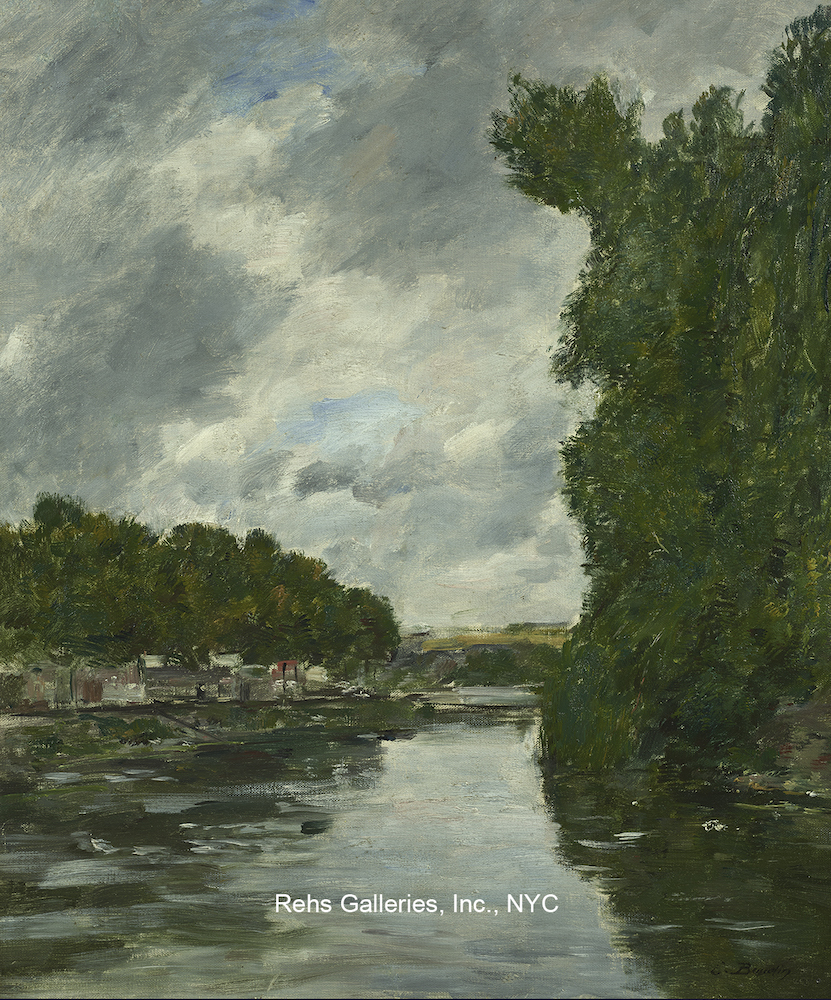
At Dawn’s Crossing by G. Harvey (1933-2017), Oil on Canvas, 24 x 20 in., Signed, also signed and titled on the reverse; Rehs Galleries, Inc.
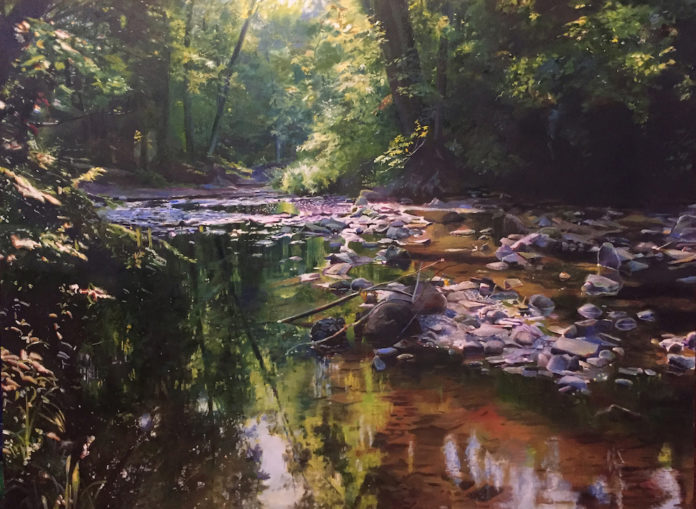
Green Velvet by Jill Basham, Oil on Panel, 36 x 48 in.; Principle Gallery
Bump Farm by Paul G. Stone, Oil on Canvas, 36 x 36 in.; Vermont Artisan Designs
April Symphony I by Adrienne Stein, Oil on Canvas, 36 x 24 in.; Turner Fine Art
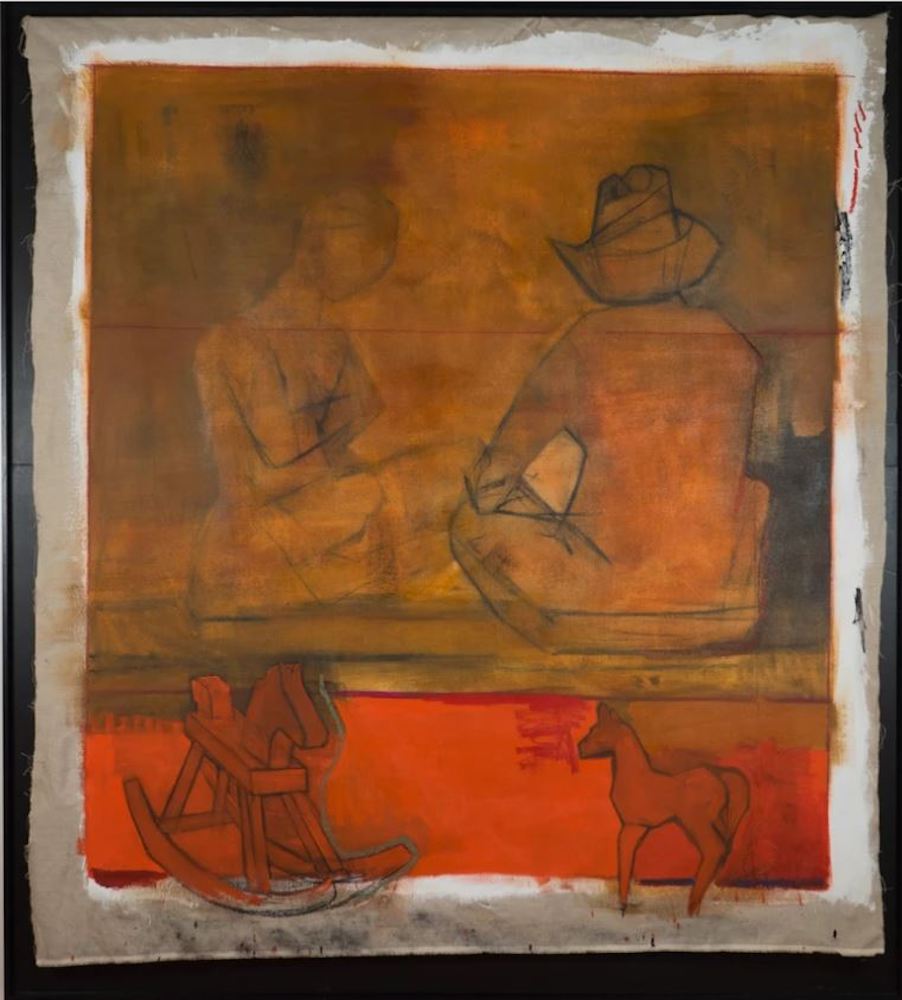
Cowboy Bar by Jennifer Johnson, Hand-Touched Oil Giclee, 24 x 24 in.; Gallery Wild during Jackson Hole Fall Arts Festival
Emanation (1) by Michael Kessler, Mixed Media on Panel, 60 x 40 in., 2020; Ann Korologos Gallery
Pale Moon Rising by Rachel Warner, Oil on Linen, 23 x 17 in.; American Tonalist Society
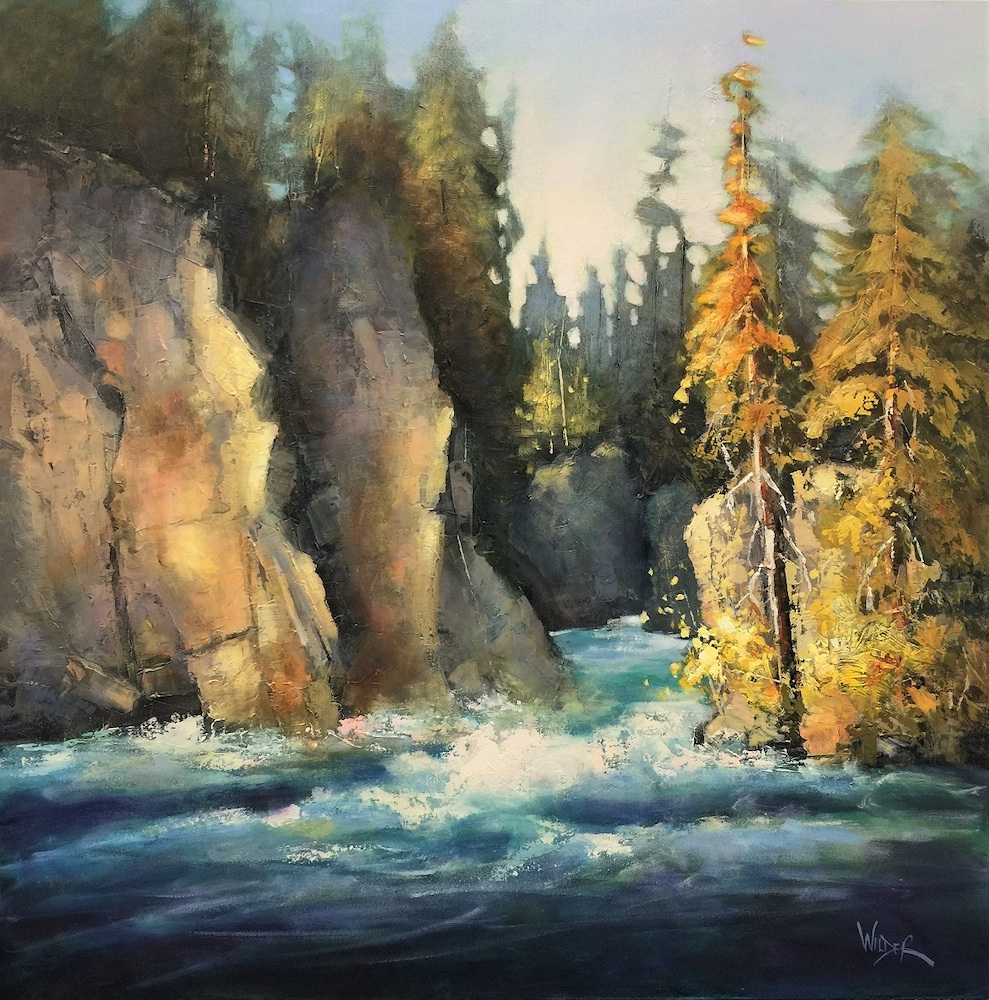
Northern California Coast by Rodolfo Rivadelmar, Oil, 30 x 40 in.; Vanessa Rothe Fine Art Gallery
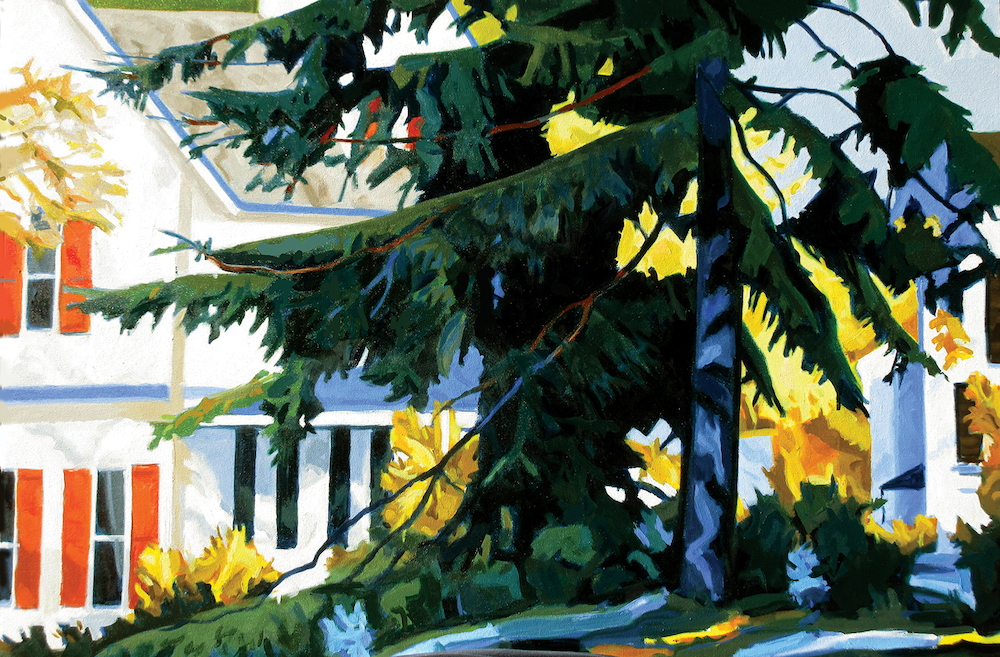
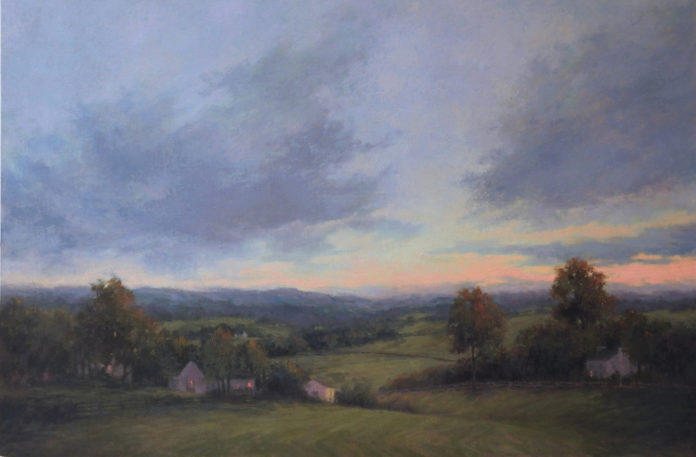
Late Autumn Sun by Philip Koch, Oil on Canvas, 36 x 48 in., 2019; Somerville Manning Gallery
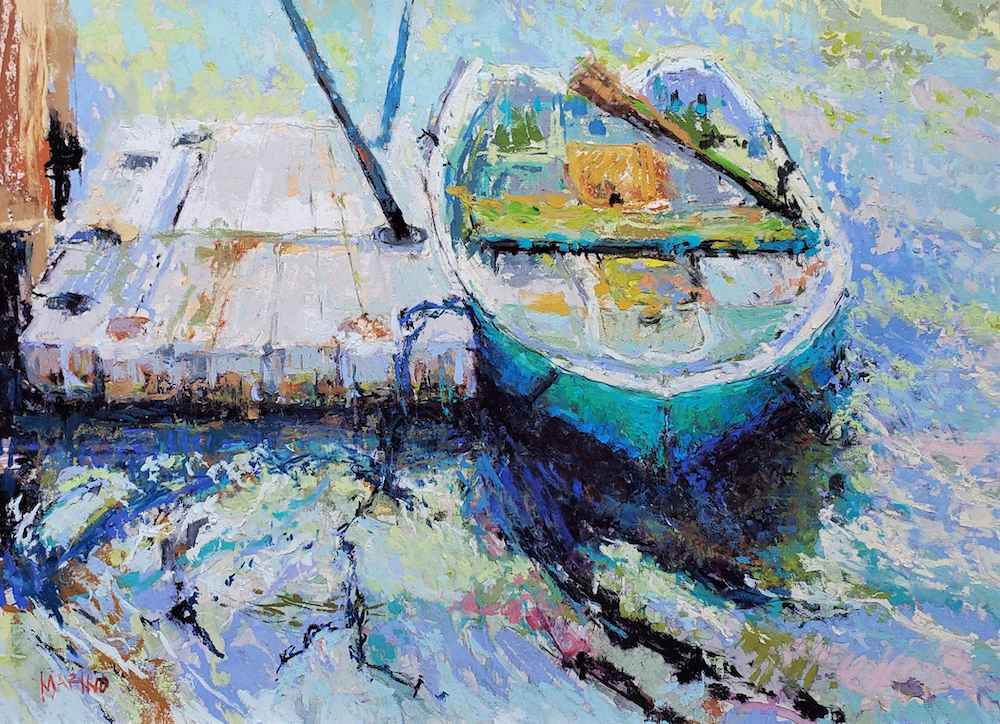
The Rue Helene in Giverny by Maria Marino, Pastel, 19 x 23 in.; The Artful Deposit
The Yellow Rose by Don Dahlke, Oil, 32 x 26 x 1.5 in.; Bronze Coast Gallery
Want to see your gallery featured in an upcoming Virtual Gallery Walk? Contact us at [email protected] to advertise today – don’t delay, as spaces are first-come first-serve and availability is limited.
“You can count on Painter Christopher W. A. Pothier’s work landing a slap to the back of your head or planting one on the forehead, oftentimes both.”
Pothier’s contemporary, representational narrative works are on view at Bowersock Gallery (Provincetown, MA) in an exhibition titled “Talk to Me,” September 4-18, 2020. “Talk to Me” will also feature the work of painter Alan Ammann and sculptor Neil Grant.
More from the gallery:
This latest body of work by Pothier is both unintentionally prophetic, and as always powerful, a perfect time to present a story focused on this outstanding, mindful painter.
Pothier’s narratives come at you fast, and unapologetically. They can also stop you short and invite you to look closer, consider the characters and intriguing scenario.
Christopher Pothier, “The New Controls of Adolescence,” 27×39, oil
Over the years Pothier’s work has featured a returning cast of characters; business men and women (conformity), a cowboy kid (past/innocents), and orange jumpsuit clad figures (apocalypse/future). Each asks for critical deconstruction. They speak to us on all manner of topics, ourselves, our state of mind, norms, politics, culture, and society.
Pothier’s latest body of work is oddly prophetic, given most were painted or sketched in 2019 for his upcoming exhibit Bowersock Gallery.
The figures in orange overalls have returned, this time with gas masks, a prop he used in a number of canvases.
Christopher Pothier, “American Apocalyptic,” 38 x 33
“I was struck with bewilderment about the fact that my work was so descriptive of the present moment,” Pothier says. “But it’s fitting. The truth is often in my work; I’ll try and point out dichotomies and ironies. I enjoy creating scenes that are sometimes disturbing, that make people think. I feel like that is my role as an artist.”
Pothier’s images are powerful, direct, poetic, and often chilling and always beautiful for their exquisite execution.
Learn more about “Talk to Me” and the contemporary realism of Christopher W. A. Pothier at bowersockgallery.com.
“Seaside Cottage is reminiscent of the early morning walks I enjoy while spending time at the Jersey Shore every summer. Tucked in between many of the beautiful, oversized homes are small cottages that seem to stand the test of time, and are reminders of a simpler time at the seashore.”
A classically-trained representational artist with degrees in Fine Art and Education, Lisa Cunningham finds inspiration through travel and the simple things that exist in everyday life. “Much of my current work focuses on buildings in the landscape; places we see and experience everyday. Although sometimes taken for granted, architecture in our environment, throughout our cities and rural landscapes, incorporates history, culture, and purpose for each of us.
Through an intimate and up close perspective, my paintings allow the viewer an opportunity to identify with or reflect upon a moment in time; of places familiar, or that no longer exist.”
Using soft pastels and layering techniques, Lisa’s compositions are representational yet painterly, allowing the dramatic play of light and shadow to reveal the character behind the subject matter. “Vibrant, sometimes exaggerated color is also common in my work, which lends credibility to the magic of the pastel medium, as I see it.”
Lisa is a signature member of the Pastel Society of America. Her award winning paining, Diversity, was juried into the Pastel Society of America’s 47th Annual Exhibition, and was then selected for an exhibition at the Butler Institute of American Art in Youngstown, Ohio.
She is also a Signature Member of the Pastel Society of New Jersey, a member of American Women Artists, the Salmagundi Club, the Catherine Lorillard Wolfe Art Club, and the American Artists Professional League.
Upcoming Exhibitions
The Pastel Society of America 48th Annual Exhibition: Enduring Brilliance
The Pastel Society of New Jersey Biennial Signature Members Exhibit
Mary Pettis, "Autumn Poetry," 30 x 40 inches, oil on linen
How can feelings be put into ground pigment and linseed oil? When a viewer finds a deeper meaning beyond the portrayed subject of a painting, what are they responding to? Mary Pettis addresses this and more in the following essay.
BY MARY PETTIS
“The aim in art is not to imitate the outward appearance of things, but their inner significance.” – Aristotle
Art collectors often wonder what it means when an artist says, “I want to show those who view my paintings not just what I SEE, but what I FEEL.” What are they talking about? How can feelings be put into ground pigment and linseed oil? When a viewer finds a deeper meaning beyond the portrayed subject of a painting, what are they responding to? Are they responding to technical brilliance or something beyond mere paint on canvas? How do artists move from representing how things look to recognizing and rendering visible an inner significance?
Great artists see deeply. I believe each sees beyond the surface appearance. Edgar Payne said, “Art is the reproduction of what the senses perceive in nature through the veil of the soul.” As an artist who also teaches, I am compelled to understand and try to explain this phenomenon. I want to know how, exactly, we transition from the facts of what we see in front of us to the wordless visual poetry inspired from our subjects. In my work I want to capture the inexplicable.
With the following considerations, I offer some pieces of the puzzle that are moving me forward on this quest.
THE TWO GREAT DIALECTS OF ART
Knowledge comes to us in two ways. First, it comes to us intuitively, through an open heart and receptive senses. Second, it comes to us with disciplined study and training, through the intellect. These are the two ways of seeing. Through the years these dual modes of perception have been explained in many ways.
Through a history of discourse on the riddles of great art, writers and critics of art have called these two camps Colour and Form. They were considered the two great dialects of art, the expressive vehicles for their respective sides of the chart. These two ways of seeing were well represented by nineteenth-century contemporaries Eugène Delacroix and Jean-Auguste-Dominique Ingres. Impulse and reason, these inner and outer vital elements, form a dance, a pas de deux. It is between these two opposing forces that the Chi, the energy in a work of art, is created. We can recognize, honor, and train both sides, together and separately. Our strengths will often shift heavily to one side, then back to the other side, then back to the other, as we hunger to find balance and improve our wholeness as artists.
The question at hand is: “How do we beyond the surface appearance?” The answer is that we cannot get there through technique and reason alone; we must develop and employ our intuitive, inward vision.
Mary Pettis, “Times Stands Still,” 48 x 30 inches, oil on canvas
RECOGNIZING OUR INTUITIVE, INWARD VISION
One step in the right direction of understanding the experience of inner vision comes in the first chapter of the early twentieth-century author, L. March Phillipps’ Form and Colour. Phillipps invites us to imagine ourselves on a small ship, traveling along cliffs that descend abruptly into the sea. As we round the promontories each bay reveals a cluster of cottages, fishermen and their boats, white gulls wheeling above, and dozens of other features distinct with meaning and associations belonging to them. They have much to communicate about the life and character of the village. As we notice and think about them, their appearance naturally awakens in the mind a correspondingly observant mood. These forms stimulate the kind of reasoning and comprehension we call intellectual.
But imagine then, as our boat drifts under the shadow of the cliff, we lean over the side and gaze into the depths of water until they absorb our vision. We will immediately be aware of a change of mood or consciousness corresponding to the change in view. Forms become suffused and indistinct, and then cease to exist, and with that change the busyness of mental activity is laid to rest; another set of faculties, the passionate, meditative faculties that apprehend the connections and mysteries of the universe, are awakened and stimulated.
Most of us can identify with this experience. Even if we have not been at sea, perhaps we felt that shift in vision looking deeply into the forest or sky, at a perfectly cut jewel, or into the eyes of someone we love. It is in this state of enhanced emotional awareness that we become more sensitive to the abstract influence of balance, rhythm, and harmony.
Mary Pettis, “Fog Lifting Over Gooseberry Falls,” 30 x 20 inches, oil on linen
BALANCE, RHYTHM, AND HARMONY
All the arts, no matter the discipline, have in common a desire for the “unity of effect” that is achieved through balance, rhythm and harmony. These instinctive qualities are strongly felt as we form the message of our painting. The message of a painting is the concept, or idea. It is the subject of the sermon, the spark; it is Emerson’s “gleam of light that flashes across the mind from within.”
To truly capture the quality of a place or subject, artists must have a feeling about it beyond its physical appearance. If the artist feels nothing, so will the viewer. To cultivate inner vision, it is important to contemplate what fascinates and stirs us. Is what we are looking at or experiencing a metaphor for something deeper? Something larger: solitude, peace, security, love, interdependence, praise? What is the emotion? What is the inspired content? We must determine the inner significance in order to portray it. I love Emerson’s quote:
“The power in a work of art depends on the depth of the artist’s insight of that object he contemplates.”
Mary Pettis, “North Shore Mantra,” 24 x 48 inches, oil on linen
In painting, our expressive tools are Line, Shape, Value, Color, Edges, and Texture. Each of these tools can be used, separately or together, to express those things in nature and life that make our hearts skip a beat.
I will submit, as an example, abstract qualities of the first tool, LINE.
Line is here defined as a mark or stroke, real or implied, which defines the contours of a shape or mass, or indicates a visual path. Lines possess potential balance, rhythm, and harmony, according to the artistic intent. Here are seven types of lines that express various emotions:
1. Horizontal, sloping, and meandering lines are calming and bring repose.
2. Vertical lines denote strength and grandeur, nobility, rigidity, or stability.
3. Diagonal lines express movement and action or excitement.
4. Radial lines can draw attention and emphasis to the focus of the painting.
5. Jagged lines are disturbing or distressing or can impart a sense of wariness or danger.
6. Sweeping or spiral lines can direct the speed at which the viewer’s eye moves through the painting.
7. Circular or curved lines can give a womb-like sense of protection, safety, or love.
Simply put, there is an infinite variety of ways artists use the abstract qualities of each of these tools—not just line—to tell the story we want to tell (which I will save for another essay . . .) For now, it is enough to say that great artists slip into a way of seeing where individual parts become a unified whole, and they recognize the character of that whole. Instead of a single tree, they see the outstretched reach of the tree, or the relationships among a family of several trees. They see the flow of the drapery or the vines, the fragility of a child, the gesture of the clouds in the sky.
Mary Pettis, “Living Waters – Lao Valley,” 16 x 20 inches, oil on linen
Great artists identify, through contemplation, what they love, and they know the means and tools to express it. It might be the large sweep of a line or mass, the power or structural rhythms of the large shapes. Perhaps they are responding to the gentle tonality of a landscape in high key values, two vibrant colors dancing next to each other, the softness of edges of every object bathed in cool moonlight, or the sumptuous textures across a field of wheat.
Every other aspect of the painting must be sympathetic with that emotional content. What do I mean by that? Every other detail, element, or added thought must be quieted down or eliminated, to play a subordinate role to that main, inner response!
A painter must be like the choir director who knows how to sense the melody as it intertwines among the sections, while allowing the soloists to shine. The more awareness an artist brings to the orchestration of a piece, the more clearly viewers will understand the message.
As we come of age artistically, we seek to master the two great dialects of art. We learn that Nature is an inexhaustible source of both inspiration and instruction. The deeper we have penetrated the inner being of nature, the greater our desire to recreate the experience. The more methods of expression we possess, the better our ability to communicate our inward vision. We paint solely under the influence of insight and evaluate with the intellect when we set the brush down. It becomes more and more evident that the artistic tools are only the means to an end. That end is to let others into our inner poetic life, to share with them what we see beneath the surface.
Contemporary realist oil painter Allan Gorman shares paintings – and insights – from his recent series.
BY ALLAN GORMAN
Since the beginning of the year, I have been making a series of paintings that explore plays of light and shadow in empty spaces.
Although it was completely intuitive, and a logical extension of some previous work, I feel the paintings evoke the poignancy of our forced solitary existence and the loneliness we all feel during the pandemic.
Doing these paintings keeps me focused and productive, and I believe they’re a true representation of me as an artist and a human living during these weird times.
Going to the studio and working is a lot more purposeful and rewarding than vegging out in front of the TV all day.
***
Allan Gorman’s resume includes over 120 exhibition showings in museums, galleries, and major art fairs. He was the recipient of a Fellowship for Painting from the New Jersey State Council on the Arts, and was awarded resident fellowships to Vermont Studio Center in 2011, 2014, and 2018. In 2016, he was selected for a fellowship residency by the ESKFF Foundation at Mana Contemporary. A number of the isolation paintings are in a solo show called “Summer Reflections” at the Beacon Art – Shortwave Gallery in Stone Harbor, N.J., through September 8, 2020. Gorman maintains a studio practice in Kearny, New Jersey.
For information on these paintings and more, please visit allangormanart.com.
Robert Goldstrom, "Red Tang," 30x24, oil on linen, $3200
ROBERT GOLDSTROM (b. 1953) is a painter who thinks in series, revisiting a compelling motif again and again until it plays itself out.
Born in Detroit, Goldstrom paid his way through the University of Michigan by designing posters around campus. On his last day job-hunting in Chicago, he landed an assignment at Playboy, which led to an award-winning career making posters for the New York City Opera, shopping bags for Bloomingdales, and covers for Time and The New York Times Magazine. Between assignments, Goldstrom started painting for enjoyment, and has since gone full time in that direction.
Robert Goldstrom, “Sunfish (study),” 10×8, oil on linen panel, $950Robert Goldstrom, “Gold #10,” 24×30, oil on linen, $3200Robert Goldstrom, “White Discus (study),” 10×8, oil on linen panel, $950
“I have yet to run out of inspiration. When I stop looking, the ideas will stop coming.”
.
Goldstrom’s next show is at Rice Polak Gallery in Provincetown, MA. The exhibition runs through September 3, 2020 and features works by Robert Goldstrom, Michael Snodgrass, Blair Bradshaw, and Jennifer Goldfinger.
CINDY RIZZA (b. 1984), "Stockpile II," 2018, oil on linen, 30 x 24 in., private collection
There is a lot of superb contemporary realism being made these days; this article by Allison Malafronte shines light on a gifted individual.
CINDY RIZZA (b. 1984) makes paintings of familiar and comforting heirloom objects — such as handmade quilts and blankets — that explore the concepts of safety and security, while also questioning how much control we have over these elements. “In examining the unique identities of heirloom textiles, my work summons conflicting feelings of comfort and loneliness, hope and foreboding, love and loss,” the artist shares. “I aim to expose the contradictions within the subjects — to honor the comfort they bore, but question their capacity to keep us truly secure from what we cannot control.”
Currently living in New Hampshire, Rizza grew up in Maine and earned her B.F.A. at the New Hampshire Institute of Art. Continuing education classes at the New York Academy of Art helped her learn to combine classical techniques with contemporary thought and conceptualization. With an eclectic mix of influences — Andrew Wyeth, Andy Warhol, and Robert Bechtle among them — Rizza has taken a cue from artists of the past whose works carry a tension between how things appear and what lies beneath the surface.
We see this impulse in Rizza’s series of stacked crocheted blankets, in which she questions not only the object but also the maker and meaning behind it. “As women, and as mothers especially, we work to create nests and protected worlds for our families and the people we love, almost to a fault,” the artist explains.
“Although these blankets are comforting, I also think of them as somewhat frightening because of the questions they provoke. Do they actually provide security? Are their makers still here? What happened to the people they were made for? Are we safe? Are we secure? While these blankets provide shelter and warmth, do they weigh on us and tie us down?”
In “Stockpile II” (shown at top), for example, Rizza explores these concerns through careful attention to contrasts of sunlight and shadow and the ambiguities found between them. Her multi-step approach — beginning with a compositional sketch, creating an underdrawing, laying down an imprimatura wash as an underpainting, and building up layers with increasingly thick paint — allows Rizza to create a detailed representation carrying all of the multi-layered dimension and symbolism she seeks.
Cindy Rizza, “Armory,” oil on linen, 30″ x 36″, 2019Cindy Rizza, “Serpentine,” oil on panel: 18″ diameter, 2020Cindy Rizza, “Resistance,” oil on panel, 24″ x 24″, 2020Cindy Rizza, “Arsenal,” oil on linen 30″ x 36″, 2020
Rizza’s upcoming fall solo exhibition will be at the George Billis Gallery, New York City. Visit her website at cindyrizza.com for more information.
Francisco de Herrera the Elder (Spanish, c. 1590–1654), “Bearded Head in Half‐Profile,” c. 1642. Reed pen with gray‐brown ink on laid paper, 3 7/8 x 2 7/8 in. (10 x 7 cm). Meadows Museum, SMU, Dallas. Museum purchase with funds from The Meadows Foundation with additional support provided by the ExxonMobil Foundation, MM.2020.03. Photo by Kevin Todora.
The Meadows Museum, SMU (Dallas, Texas), announced recently that it has acquired six new works for its collection: five Spanish drawings from the seventeenth and eighteenth centuries, including one by Alonso Cano (1601–1667), and one terracotta sculpture by the Catalan Modernist Agustín Querol y Subirats (1864–1909).
From the museum:
Purchased together from De la Mano Gallery in Madrid, Spain, the five sheets reflect the strong tradition of Spanish draftsmanship in the early modern period, and significantly enhance the museum’s collection of drawings.
Works by Francisco de Herrera the Elder (c. 1590–1654) and Pedro Duque Cornejo (1678–1757) are the first by these artists to enter the Meadows’ collection, while other drawings offer new insight into the creative processes of artists already represented, including Alonso Cano, Mariano Salvador Maella (1739–1819), and José Camarón Bonanat (1731–1803).
The sculpture by Agustín Querol y Subirats adds to the Meadows’ growing collection of Catalan art and joins two important paintings, one by Catalan artist Josep de Togores i Llach (1893–1970) and the other by Santiago Rusiñol i Prats (1861–1931), both acquired by the museum earlier this year.
“We are looking forward to the scholarship that will result from studying these newly acquired works alongside those already in our collection,” said Mark Roglán, the Linda P. and William A. Custard Director of the Meadows Museum. “It is important to have a drawing by Alonso Cano, one of the Golden Age’s masters of the Spanish School and a colleague of Velázquez, in addition to the Cano painting already in the collection. The significant addition of the other four sheets to our Spanish drawings collection—including a beautifully rendered head by Francisco de Herrera the Elder—is likely to spur new research and perhaps even result in publications and exhibitions that further deepen our understanding of Spanish draftsmanship and its influence on the built environment and culture of seventeenth and eighteenth-century Spain. Meanwhile, the acquisition of the Querol work is a milestone in the growth of holdings that represent both modernist and Catalan art, areas of the collection that the Meadows is committed to developing further.”
About the Works
“The Death of Mary Magdalene” is the first work on paper by Alonso Cano to enter the Meadows Museum’s collection, joining a small panel painting by the artist titled “Christ Child” (c. 1628–29).
Cano was a master draftsman, painter, architect, sculptor and designer who is best known for his work at Granada Cathedral, where he became clergy in 1652. His oeuvre includes a series of paintings on the life of the Virgin Mary as well as the design for the cathedral’s façade, which was built posthumously.
Cano studied painting alongside Diego Velázquez and under Francisco Pacheco and studied sculpture under Juan Martínez Montañes while in Seville. Scholars have identified only about 120 of the artist’s drawings, most of which are now in Spanish museums, making this acquisition quite rare, especially for a U.S. institution.
Like many of Cano’s drawings, “The Death of Mary Magdalene” is small in scale and created with dynamic marks that are informal in appearance. “The Death of Mary Magdalene” is likely a preparatory sketch for which there is no known finished work. The drawing, which features a female figure recumbent on a mat or bed with two small angels above her, demonstrates the artist’s skillful draftsmanship and mark-making. This sheet is part of a lot of five drawings purchased together from De la Mano Gallery, Madrid, Spain.
Alonso Cano (Spanish, 1601–1667), “The Death of Mary Magdalene,” c. 1645–50. Pen and gray‐brown ink on laid paper, 3 ½ x 7 ½ in. (9 x 19 cm). Meadows Museum, SMU, Dallas. Museum purchase with funds from The Meadows Foundation, MM.2020.05. Photo by Kevin Todora.
***
Francisco de Herrera the Elder was an esteemed artist who was central to the cultural life of early seventeenth-century Seville. Drawings by the artist appear in the collections of major museums worldwide, including the Metropolitan Museum of Art, New York; the Museo Nacional del Prado, Madrid; and the Hamburger Kunsthalle.
His work serves as a representative example of the shift that many artists made during the period, moving away from the elongated forms of Mannerism toward the more naturalistic tendencies characteristic of the high Baroque. “Bearded Head in Half‐Profile” is a later work by the artist that demonstrates his embrace of naturalism. In this drawing, Herrera the Elder portrayed an older man in half profile, capturing his subject’s facial features with marks that are economical but effective.
Herrera the Elder frequently studied heads, observing and documenting the details of human faces and facial expressions as in this drawing. “Bearded Head in Half‐Profile” is the first work by Herrera the Elder to enter the Meadows collection, and is part of a lot of five drawings purchased together from De la Mano Gallery, Madrid, Spain.
Francisco de Herrera the Elder (Spanish, c. 1590–1654), “Bearded Head in Half‐Profile,” c. 1642. Reed pen with gray‐brown ink on laid paper, 3 7/8 x 2 7/8 in. (10 x 7 cm). Meadows Museum, SMU, Dallas. Museum purchase with funds from The Meadows Foundation with additional support provided by the ExxonMobil Foundation, MM.2020.03. Photo by Kevin Todora.
***
Pedro Duque Cornejo was a Baroque artist known for his sculptural and architectural works. A disciple of his grandfather, the sculptor Pedro Roldán, Duque Cornejo was born in Seville and primarily worked in his home city as well as in Granada and Córdoba.
Among others, Duque Cornejo is known for his work as a master architect and sculptor for the altarpiece of the Church of San Lorenzo in Seville, two altarpieces for the Monastery of Santa María de las Cuevas in Seville, sculptures for the Cartuja Monastery of Granada and the Monastery of Santa María de El Paular in Madrid, and the choir of the Cathedral of Córdoba.
Duque Cornejo used drawings, such as this “The Immaculate Conception, Saint Ferdinand, and a Seated Angel,” to aid his sculptural practice. In this work, three unrelated sketches appear on the same sheet along with corresponding notes, suggesting the artist may have used one sheet for planning various projects.
These preliminary sketches have not yet been definitively assigned to final works created by the artist, allowing for the possibility of further research and study of his artistic process.
This sketch, the first example of the artist’s work to enter the Meadows collection, joins a terracotta sculpture by Pedro’s aunt, Luisa Roldán, titled “Infant Saint John the Baptist.” This work is part of a lot of five drawings purchased together from De la Mano Gallery, Madrid, Spain.
Pedro Duque Cornejo (Spanish, 1678–1757), “The Immaculate Conception, Saint Ferdinand, and a Seated Angel,” c. 1720–30. Pencil, gray‐brown ink, and grayish wash on laid paper, 12 5/8 x 7 5/8 in. (32 x 19 cm). Meadows Museum, SMU, Dallas. Museum purchase with funds from The Meadows Foundation with additional support provided by The Joe M. and Doris R. Dealey Family Foundation, MM.2020.04. Photo by Kevin Todora.
***
José Camarón Bonanat (or Boronat) was a Spanish draftsman, painter, and printmaker who was one of the most esteemed artists in Valencia during the second half of the eighteenth century. Camarón was one of the founding members of the Real Academia de Bellas Artes de San Carlos in Valencia; he served as that academy’s director of painting in 1790 and its general director from 1796 until 1801.
Among others, he is well known for his religious commissions, including those for Valencia Cathedral and San Francisco el Grande in Madrid.
Many of Camarón’s drawings, such as this work, were reproduced by engravers as book illustrations. The front side of this sheet features three highly finished drawings of cartouches.
Reproduced in prints by Hipòlit Ricarte, these cartouches were used to illustrate the texts on a 1761 map of the Archbishopric of Valencia created by cartographer Tomás Vilanova. The sheet is likely a final version of Camarón’s designs as the drawing and the printed map—copies of which are housed at the Universidad Politécnica in Valencia, the Universidad de Lleida, and the Biblioteca Nacional de España in Madrid—are very similar.
The other side of the sheet features small sketches that seem to have been completed more quickly than those on the front, which have not yet been matched with finished works by the artist, thus presenting an opportunity for further study.
This acquisition is the second work by Camarón to enter the Meadows Museum collection; it joins another drawing, “The Madonna and Child in Glory Surrounded by Saints and Putti.” This work is part of a lot of five drawings purchased together from De la Mano Gallery, Madrid, Spain.
José Camarón Bonanat (or Boronat) (Spanish, 1731–1803), “Cartouches for the Map of the Archbishopric of Valencia [recto]/Models for various bookplates and a small sketch for a scene with a sword shop [verso],” 1761. Black chalk and ink on laid paper [recto]/pen with gray‐brown and black ink on laid paper [verso], 10 x 16 3/8 in. (25 x 42 cm). Meadows Museum, SMU, Dallas. Museum purchase with funds from The Meadows Foundation, MM.2020.06.A-B. Photo by Kevin Todora.***
Mariano Salvador Maella was a master of eighteenth-century Spanish art. Maella was employed at the Spanish court of the Bourbon kings Charles III (r. 1759–1788) and Charles IV (r. 1788–1808), and was greatly admired as a draftsman. During his lifetime, his work was acquired by the Real Academia de Bellas Artes de San Fernando in Madrid and used to teach students at the academy.
“Portrait of Christopher Columbus” was commissioned by the historian and philosopher Juan Bautista Muñoz, who was tasked with writing a comprehensive history of the Spanish conquest and colonization of the Americas and asked Maella to create a drawing of Christopher Columbus to serve as the design for the cover.
This drawing was the third created by Maella for Muñoz, who selected it for his volume Historia del Nuevo Mundo (1793) because of its unadorned and direct nature.
Maella used black chalk to meticulously highlight various textures in the drawing, from Columbus’ skin and hair to his armor and clothing. “Portrait of Christopher Columbus” is the third work by Maella to enter the Meadows Museum collection; it joins the oil sketch Spain and the “Four Parts of the World” (1798) and the drawing “Gaius Mucius Scaevola before Lars Porsena” (c. 1790–1800).
Each of these works is an example of Maella’s preparatory process, revealing different components of the artist’s practice. Portrait of Christopher Columbus is part of a lot of five drawings purchased together from De la Mano Gallery, Madrid, Spain.
Mariano Salvador Maella (Spanish, 1739–1819), “Portrait of Christopher Columbus,” 1793. Black chalk and gray and sepia ink washes on laid paper, 5 3⁄4 x 4 3/8 in. (14.5 x 11 cm). Meadows Museum, SMU, Dallas. Museum purchase with funds from The Meadows Foundation, with additional support provided by Linda Gardner and Fred Alsup with additional donations from Cathryn Withrow; MM.2020.07. Photo by Kevin Todora.
***
“A Baby Rolling Over” is not only the first work by Agustín Querol y Subirats to enter the Meadows Museum’s collection, it’s also the first example of nineteenth-century sculpture to be acquired by the Meadows.
Querol’s work is rarely of a scale that is practical for a public institution to own and exhibit; he is best known for monumental works such as the dramatic figures that top the Spanish Ministry of Agriculture in downtown Madrid and his “Allegory of Spain” on the façade of the Biblioteca Nacional de España.
In “A Baby Rolling Over,” Querol depicts a milestone event in the life of the young child, the moment when they learned how to roll over. It’s an intimate and sensitive work, created with the artist’s own hands as opposed to a workshop of assistants, as would be the case with his larger, commissioned works.
The sculpture was donated to the Meadows by Dr. Michael P. Mezzatesta, a noted art historian and the Mary D.B.T. and James H. Semans Director Emeritus of the Nasher Museum of Art at Duke University in honor of Dr. William B. Jordan, founding director of the Meadows Museum, who died in 2018. It is a fitting tribute to Jordan, whose own appreciation of Spanish terracotta sculpture was well known and evidenced by his 1999 donation of Luisa Roldán’s sculpture of Saint John the Baptist.
Agustín Querol y Subirats (Spanish, 1864–1909), “A Baby Rolling Over,” 1884–87. Terracotta, 15 ¾ x 25 ¼ x 8 ¾ in. (40 x 64 x 22 cm). Meadows Museum, SMU, Dallas. Given by Michael P. Mezzatesta in honor of William B. Jordan, MM.2020.02. Photo by Kevin Todora.
As part of our effort to continue to help artists and art galleries thrive, we’re proud to bring you this new “Virtual Gallery Walk.” Browse the paintings below and click the image itself to learn more about it, including how to contact the gallery.
Fireflies by Paul Batch, Oil, 24 x 30 in.; Anderson Fine Art
Blueberry Joy by Kim Smith, Oil on Canvas, 36 x 36 in.; Bluestone Fine Art Gallery
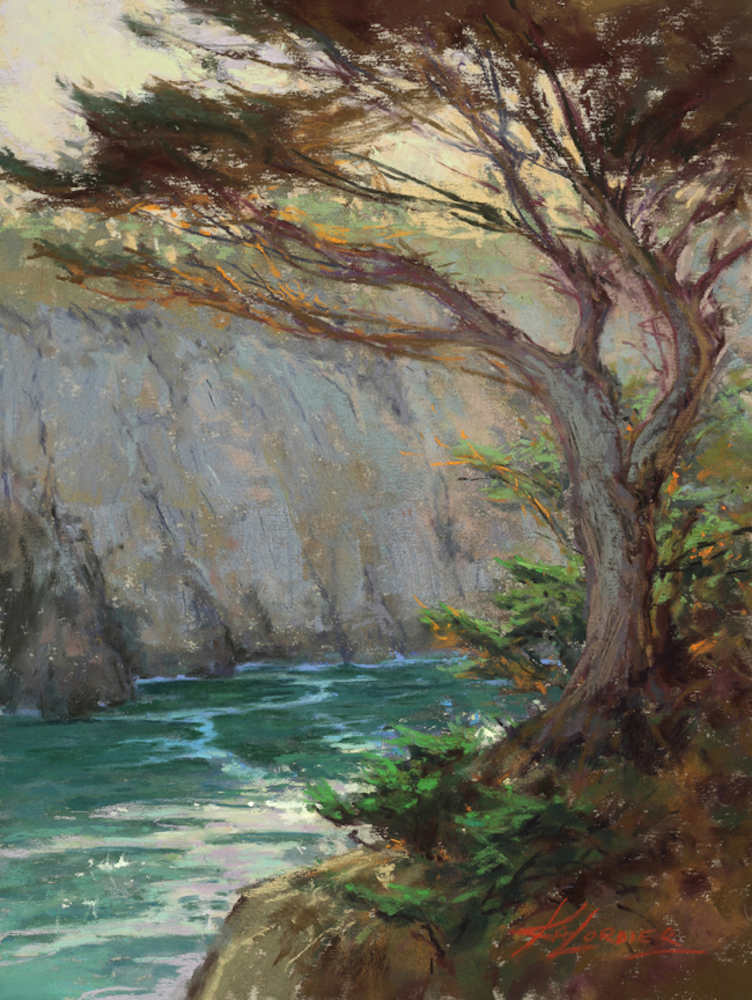
Cypress Grove Fringe by Kim Lordier, Pastel on Archival Board, 27 x 40 in.; Rieser Fine Art
Metamorphose by Randalf Dilla (born 1986), Oil on Canvas, 24 x 30 in., Signed; Rehs Contemporary
Scuola Grande di San Marco and the Ponte Cavallo on the Rio dei Mendicanti, Venice by Rubens Santoro (1859-1942), Oil on Canvas, 33 1/2 x 26 in., Signed; Rehs Galleries, Inc.
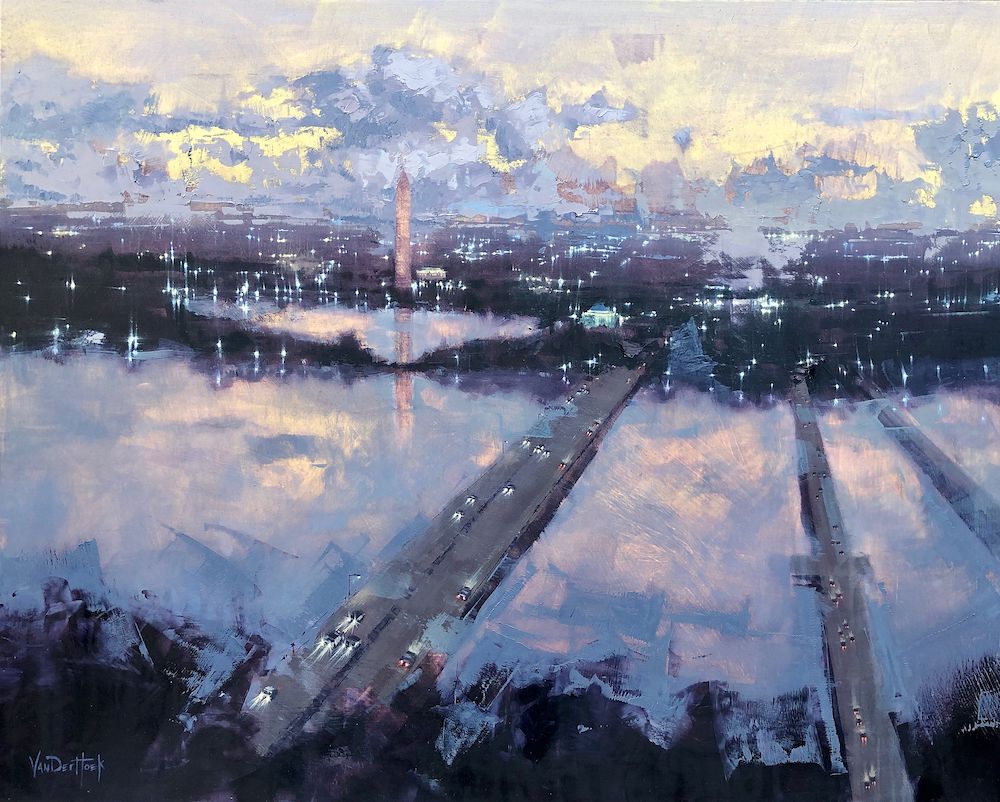
To Fly Toward A Secret Sky by Kim VanDerHoek, Oil on Panel, 40 x 30 in.; Principle Gallery
Sunrise, Sunset II by Appel Bronstein, Oil on Paper, 22.5 x 30 in., 27 x 34.5 in. framed; Vermont Artisan Designs
Narcissus and Daffodils by Kathleen Speranza, Oil on Panel, 14.5 x 10.5 in.; Turner Fine Art
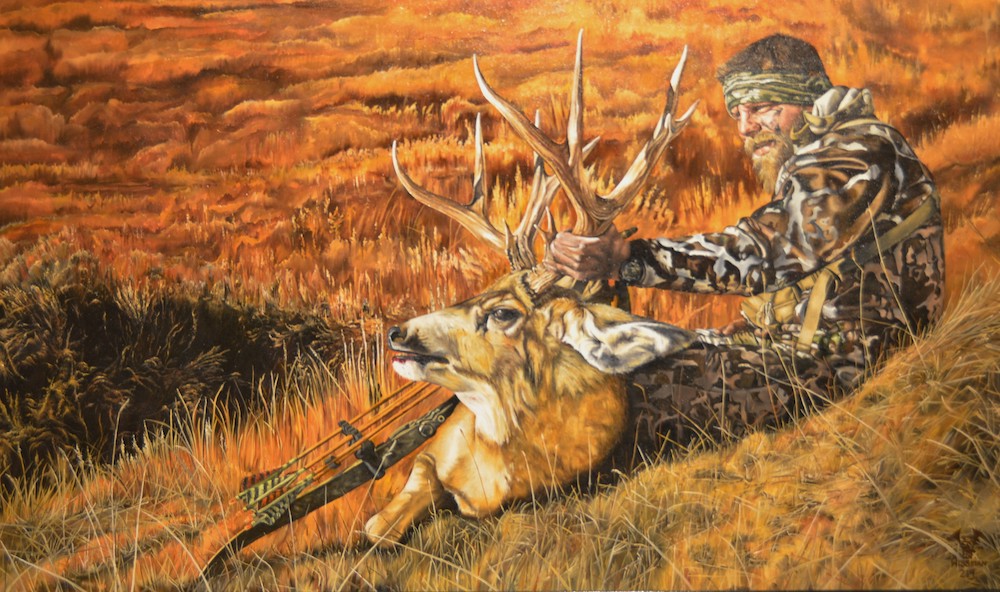
Hunter’s Watch by Thomas Blackshear, Oil on Canvas with Gold Leaf, 30 x 38 in.; Trailside Galleries during Jackson Hole Fall Arts Festival
Terry Gardner, Beyond the Range by Terry Gardner, Oil on Canvas, 36 x 48 in., 2020; Ann Korologos Gallery
Hunting the Marsh – Northern Harrier by Mary Erickson, Oil on Linen, 20 x 24 in.; American Tonalist Society
In the Summer Garden by Trent Gudmundsen, Oil, 32 x 24 in.; Vanessa Rothe Fine Art Gallery
The Great Dune by Philip Koch, Oil on Canvas, 28 x 42 in., 2020; Somerville Manning Gallery
Want to see your gallery featured in an upcoming Virtual Gallery Walk? Contact us at [email protected] to advertise today – don’t delay, as spaces are first-come first-serve and availability is limited.
In Michele Ann Murtaugh’s figurative narrative paintings, her subjects address the current condition of human intimacy, the desire of it and the lack of it. She combines realist human form with surrealistic atmospheric nuances to give the viewer the feeling of being in the subconscious. Her large scale oil paintings combine delicate, refined and crude brush work to intensify the psychological contradiction of surrender with immediacy and impatience. Her subjects are often nude or costumed in inorganic fantastic materials. They can be found masked or uncomfortably gazing back at the viewer. The paintings mirror our beautiful and imperfect attempt to connect and be accepted.
Fill your mind with useful art stories, the latest trends, upcoming art shows, top artists, and more. Subscribe to Fine Art Today, from the publishers of Fine Art Connoisseur magazine.