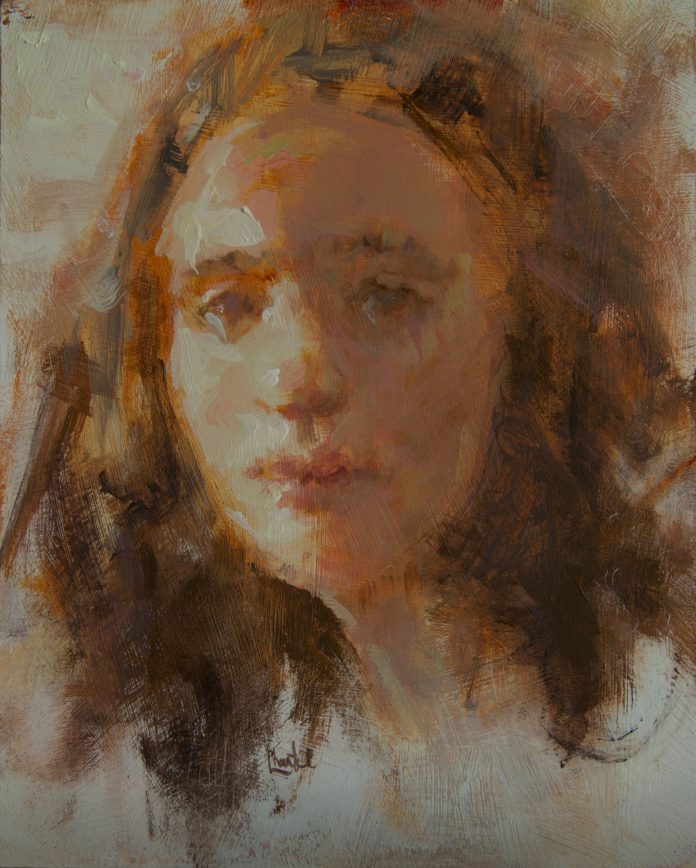
I Am Female
10 x 8 in., acrylic on panel
Available from the artist
Chantel’s passion for art began flourishing at age 12 when she was mentored under local San Diego artists. She continued to study art, largely self-taught, while living in Newport, Rhode Island and Keflavik, Iceland. While enrolled in a college art course, a fellow student introduced her to acrylic paints, and she soon found it to be a medium dominated by abstract art. But her first love was portraiture for which she found little advice. As she dreamed of perfecting her skills as an acrylic portrait artist, Chantel continued to learn from professional oil painters and translated their teachings into acrylic techniques. All the while, she remained active in local art communities, including serving as President of Artists’ Link in Memphis, Tennessee.
In 2006, Chantel opened her own art business called Chantel’s Originals near Memphis Tennessee. Chantel soon benefited from workshops and demonstrations with outstanding artists including Dawn Whitelaw, Michael Shane Neil, Suzie Baker, and Marc Hanson. Chantel is currently the National Coordinator of the State Ambassador program for the Portrait Society of America, and is also a member of The Chestnut Group and the National Oil & Acrylic Painters’ Society.
Chantel has been featured in solo art shows and juried exhibitions. Her award winning paintings are in private and public collections throughout the United States and overseas. Her work is published in Acrylic Artist magazine, American Art Collector, Southwest Art, The Artist’s Magazine, Fine Art Connoisseur, International Artist and several books. She regularly blogs at chantellynnbarber.com. Chantel resides in Bartlett, Tennessee, where she teaches online and in workshops throughout the United States and Canada.
Oil and pastel artist, Tracy Wilson, radiates a genuine love for her craft which informs all her work. The intuitive grace of her compositions, the elegance of lighting, the finesse with which she handles texture—these are the hallmarks of her work. As such, each painting is imbued with her intentional energy, sincerity, and an ethereal quality that cannot be missed.
Tracy’s style has evolved into a masterful expression that can be appreciated by the aficionado, as well as the layman. Sentiments such as, ‘Romantic, Classical, Engaging’ and ‘No one paints like this anymore’ are common accolades. In addition to studying the techniques of the old Dutch masters, she has also trained under various contemporary artists.
Prior to her artistic career, Tracy worked for twenty years in computer education, both as an instructor and a curriculum designer. There she honed many skills that inform her as an art instructor. She has delivered numerous demonstrations and workshops to art organizations.
Wilson has exhibited and received awards locally, nationally, and internationally. In addition to membership in numerous local art organizations, Wilson is a signature member of the Pastel Society of Colorado, an associate member of the Oil Painters of America, and a member of the Miniature Art Society of Florida. Her work can be viewed at TracyWilsonArt.com.
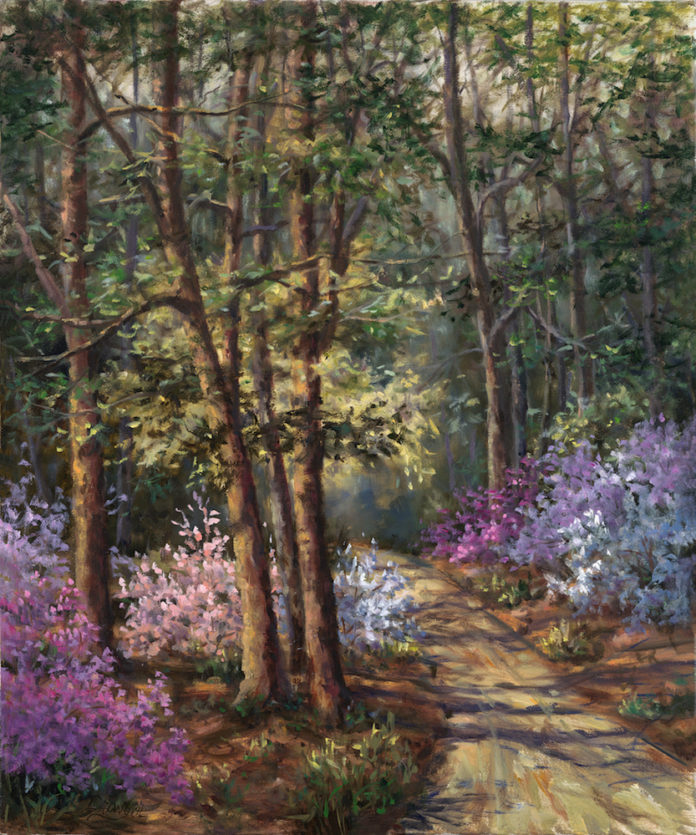
Backlit Blooms
24 x 20in., oil on linen
$3,800
Available through Main St. Gallery, Annapolis, Maryland 410.216.7166
Artist Christine Drewyer says, “Being born on the first of May, the ancient day of Beltane, it is no surprise to me that I am inspired to have the landscape as my primary focus. Perhaps being born in that time when new life is emerging in the springtime has infused my art with a desire to co-create a world where wild chaos as well as order, meld and produce beauty as a result.”
Spring holds a particular sense of urgency and attraction for Christine. Maryland and the surrounding environs offer a plethora of gardens and arboretums overflowing with a bounty of flowering gardens. Drewyer finds it impossible to resist the temptation to fully immerse it all of that beauty and to show up in person and paint in plein air!
Many mornings, for about 3 weeks, she travels to these locations of immense beauty to capture them for the short duration of the blooming season. Backlit Blooms was painted in the National Arboretum as a plein air study and later translated into this larger more complex version of the original inspiration.
Christine claims, “I go a little crazy during this time of year because I just can’t ever capture all of it, but feel I must try and during the process it feels like I’ve gone to Heaven while they last.”
“With my landscapes, I hope to convey a sense of timelessness, this feeling of solidity and endurance and natural beauty. Beauty is a rare and multifaceted thing. It can be a shadow, or a sunbeam, a mother doe with her fawn, the grandeur of a sunset, or the promise of a new day. I find it in the turn of a wave ready to spill onto the shore in a never-ending progression of tides that we are all anchored to in this brilliant Universe that we share. The sacredness of the trees and the natural world and the gift we are offered each day to behold—I want to make work that reminds us that, there by the grace of God, go we.”
Upcoming Exhibitions
Main St. Gallery Invitational Small Group Show 6/13 – 7/8. Opening reception 6/16. Call 410.216.7166 for more information.
American Women Artists Illuminate the Haggin Museum 8/2 – 9/16 Stockton, CA
Washington Society of Landscape Painters at Principle Gallery 9/2 – 10/2 Alexandria, VA
Women Artists of the West, 48th National Invitational Annual Exhibition 9/2 – 11/4 Bartlesville, OK, Price Tower
Christine Drewyer has been featured in these National Art Publications: Art of the West, 2016 “Mother Nature’s Magic” by Vicki Stavig What’s Up, 2015 “Inside the Artist’s Studio” by Kathi Ferguson magazine cover & feature American Art Collector, 2014 “Love of the land” Artist Focus American Art Collector, 2013 OPA Editorial American Art Collector, 2013 Rich Timmons Gallery Artists Focus American Art Collector, 2011 “A Visual Experience” by Michelle Borgwardt American Art Collector, 2010 “Revering Nature” by Josh Rose
Christine Drewyer has found beauty all over the world to paint. She works exclusively in oil paint and paints most months with the oldest landscape painting group in the country, The Washington Society of Landscape Painters. Although most of her paintings begin as a plein air sketch or study, she does translate many of these into more developed paintings in her studio.
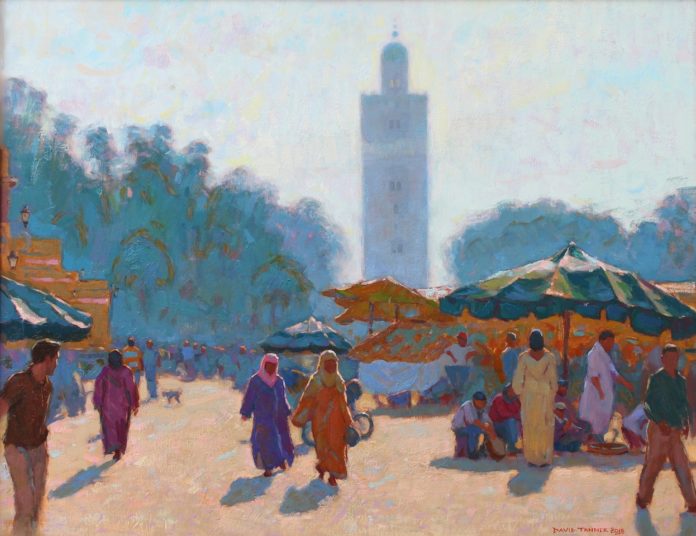
“Morocco: The Marketplace in Marrakech,” oil on canvas, 22 x 28 in., 2018
When an upcoming exhibition of David Tanner’s work caught my eye, I reached out to him for a quick Q&A on this annual show of his recent works. Here, he takes us behind the scenes of his year-long project.
Cherie Dawn Haas: First, thank you for taking the time for this. Can you give us an overview of your show? David Tanner: Each May I have a show of new work, all done in the previous 11 months. So all of the work in this current show started coming to fruition last June. Having a show each year keeps me accountable. It gives me enforced deadlines to plan projects and get things finished on time. I tend to work on several things at once.
Paintings that require a lot of planning and pre-design, like my narrative figure compositions, I may work on for several days, or weeks even. I then put them away for a while to see them with fresh eyes before finishing.
Each year I generally end up with about 22 paintings to display that I feel are strong and presentable. My anchor pieces are usually narrative figure paintings that take a great deal of planning, and often dozens of hours of painting time.
On the other hand, many of the pieces that are included in my shows are non-commissioned alla prima portrait sketches, simple head studies usually painted in a single session with a model.
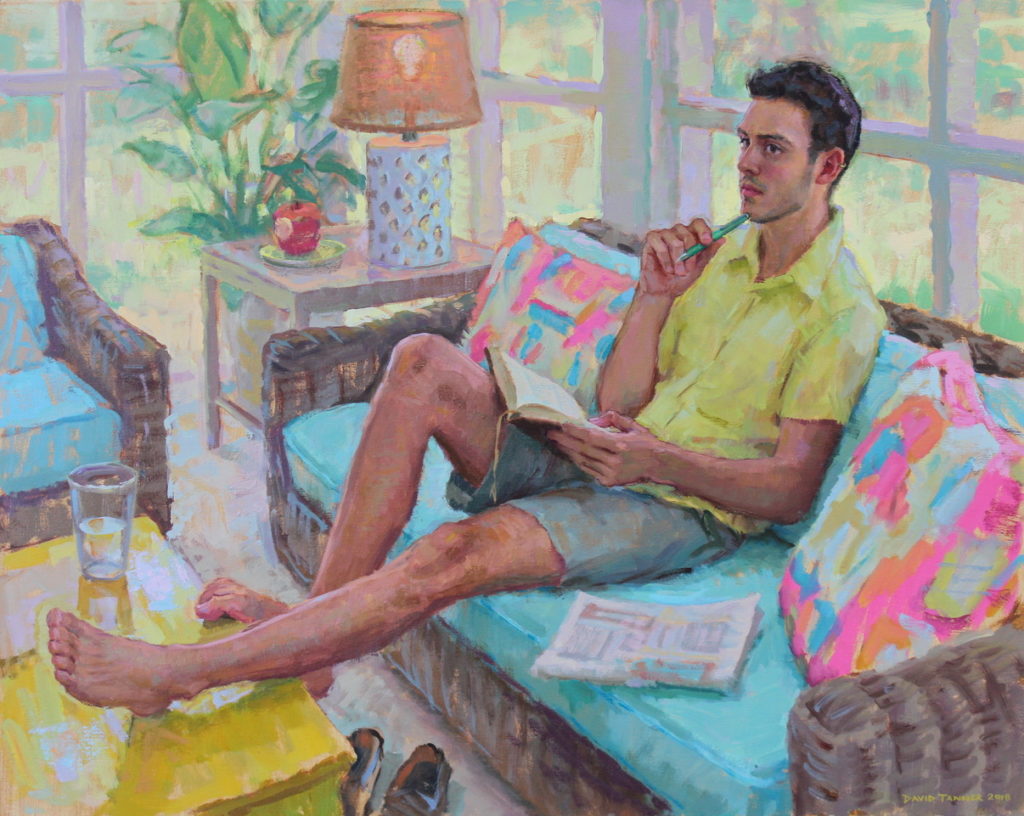
“Waiting for the Light to Go On,” oil on canvas, 24 x 30 in., 2018
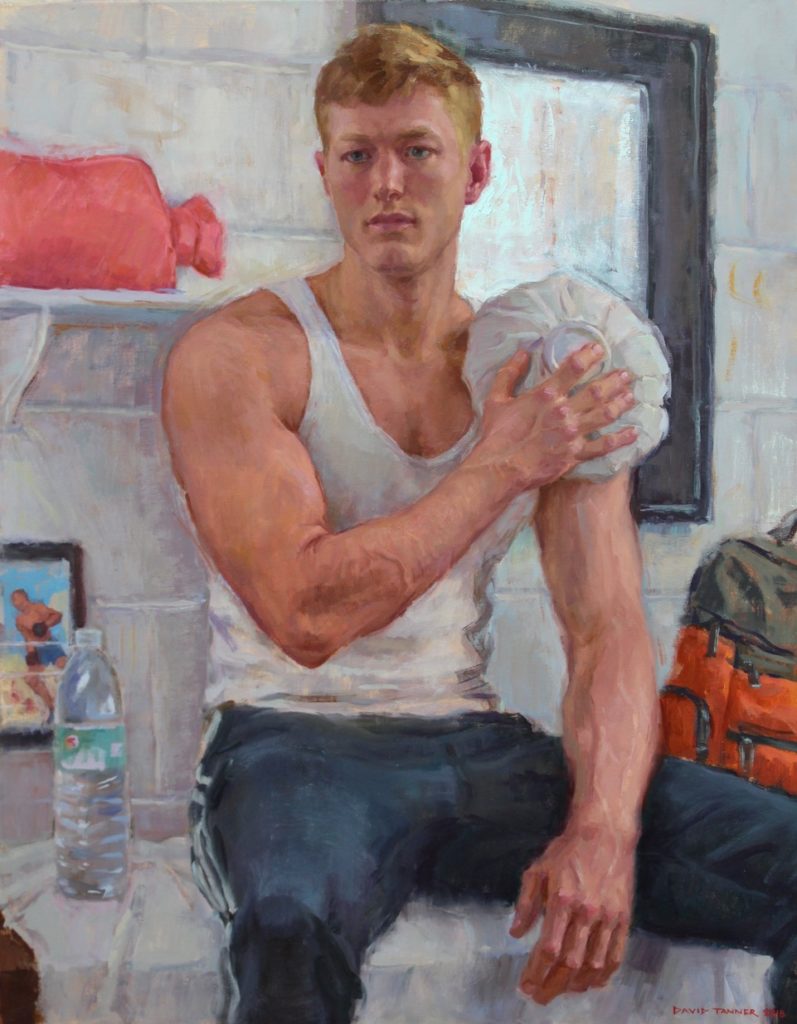
CDH: What’s the most common question (and your answer) that you hear about your work? DT: I’m often asked about the genesis of my narrative figure paintings. It begins with choosing a model to fit the type of character I envision for the painting. As an example, the contemplative young man I chose for “Waiting for the Light to Go On” was perfect for portraying a character in the midst of writing. An 8 x 10 sketch was painted on location, and then referred to in my studio (along with photo references) to create the 24 x 30 inch painting.
“After the Match,” oil on canvas, 28 x 22 in., 2018
The same type for thinking was used in choosing a model to bring to life the concept of an athlete nursing an injury, an idea that evolved into the painting “After the Match.” Once I have the right model to “play” the character, we try different gestures, clothing, lighting, etc. until I begin to see something interesting.
CDH: What do you love about oil, and why is this your chosen medium? DT: I love oil painting. It’s such a forgiving medium. I try to take advantage of the paint while it’s wet so I can push color masses into each other and find what feels like the correct borders, as opposed to creating lines and filling them in with color. The feeling of pushing those colors around and being able to manipulate them is just heaven to me.
CDH: Please tell us a little about Morocco. Did you actually visit? What was it like? DT: My partner and I travel as much as possible, and spent ten days in Morocco in 2009. We visited Tangier and Marrakech. The narrow streets and crowded markets were beehives of activity, and of course visually compelling for a painter.
“Morocco: The Marketplace in Marrakech” [shown at top] was based upon paintings I did on location back in 2009, as well as photo references taken on the trip. The square is called Jemaa el-Fna. The smoke hanging over the square (from the grilled meat stalls) lent an enigmatic quality to the Koutoubia Mosque, looming over the scene.
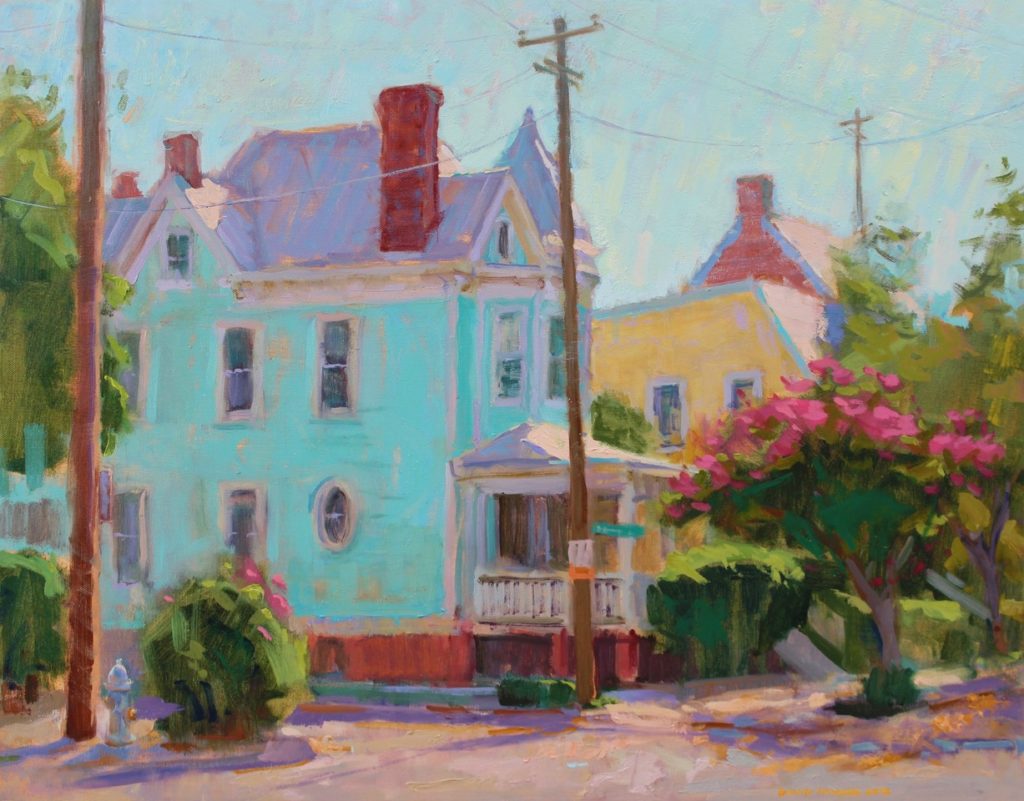
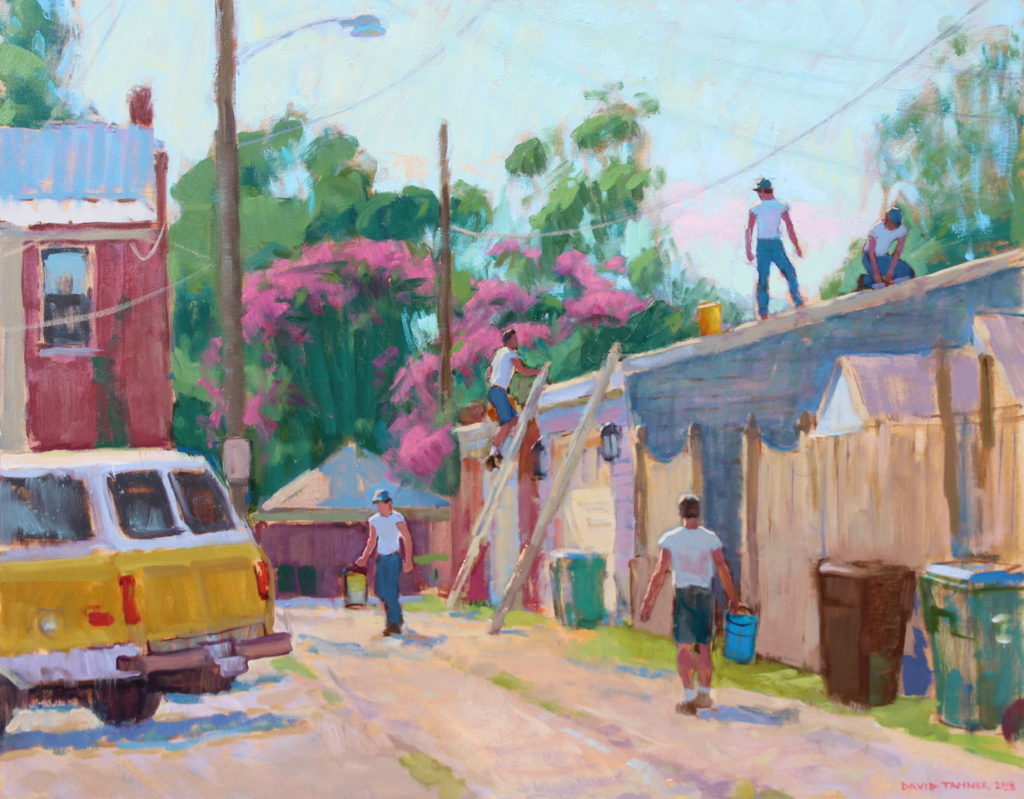
“Morning Sunlight in Church Hill,” oil on canvas, 22 x 28 in., 2018“Construction in the Alley, Mid-Summer,” oil on canvas, 22 x 28 in., 2018
***
“David Tanner: Recent Oil Paintings” runs through July 7, 2018, at the Crossroads Art Center (The Caboose Gallery) in Richmond, Virginia. For more information, please visit davidtannerfineart.com.
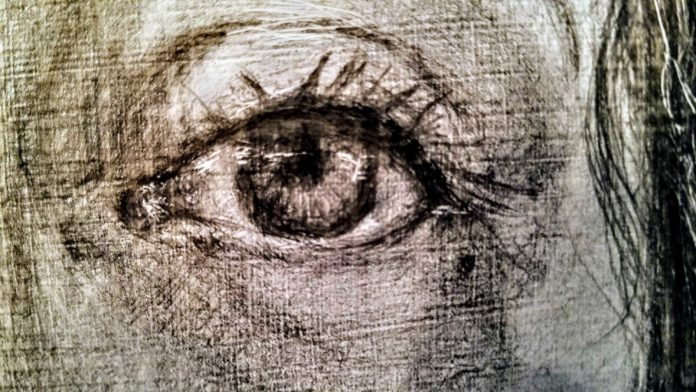
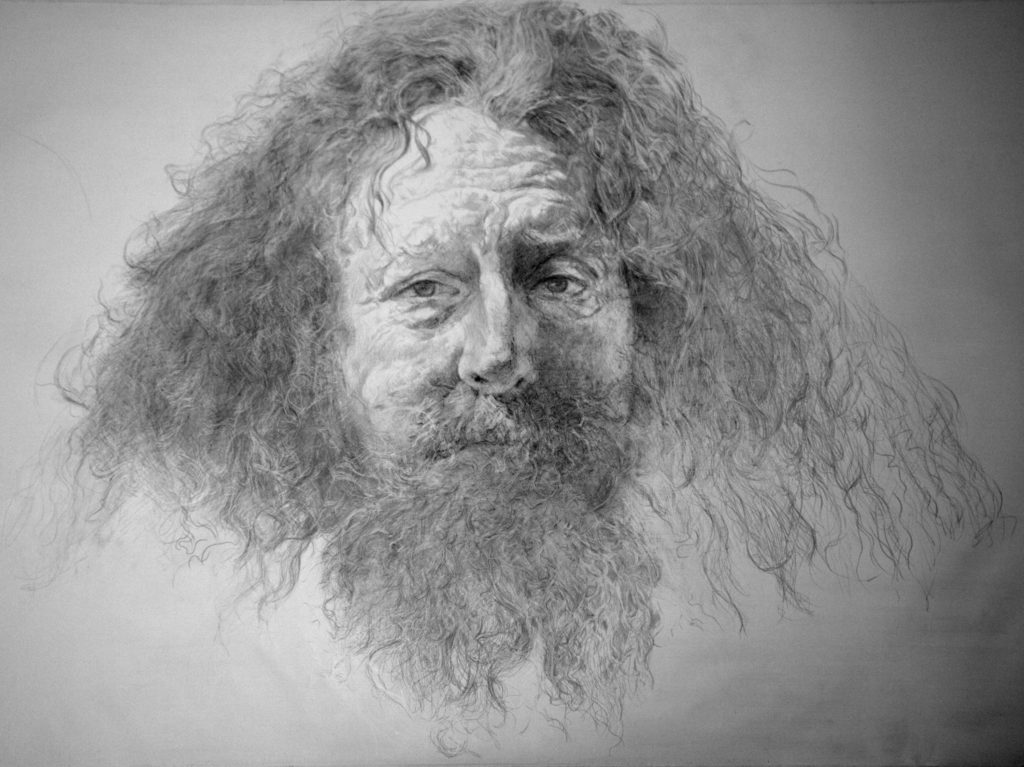
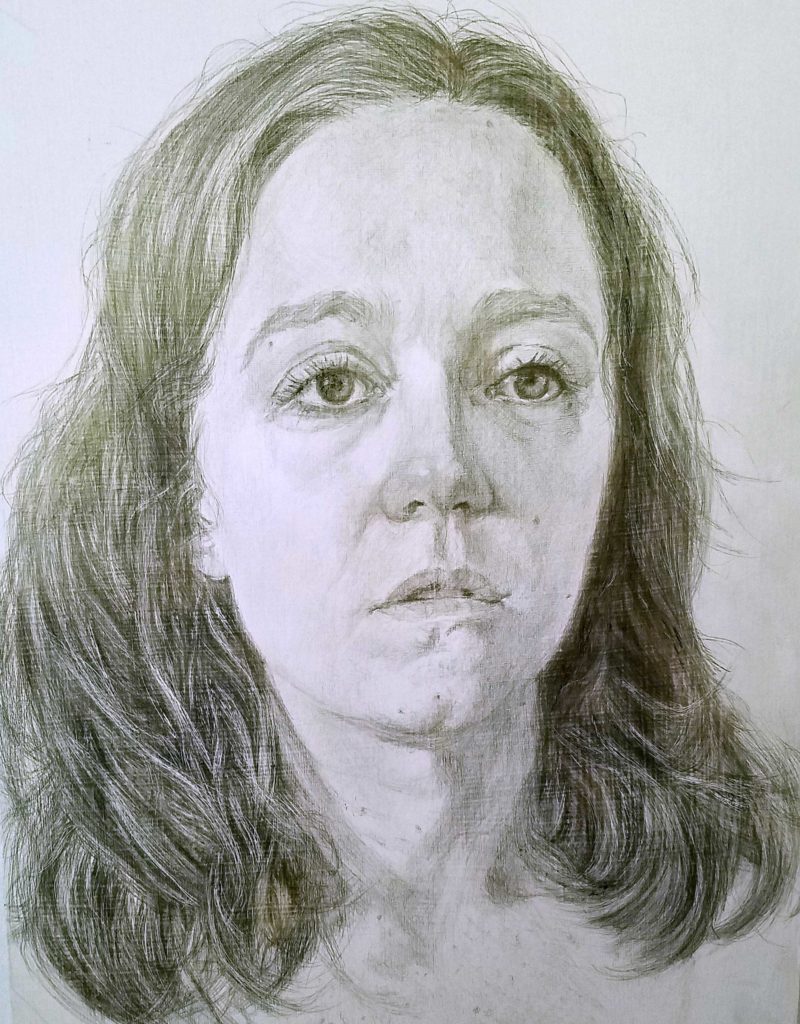
Sherry Camhy, “Eye,” detail, silverpoint on prepared wood panel, 2018, Collection of the artist
by Sherry Camhy
If you have never heard of metalpoint, you are not alone. A surprising number of art-smart people have not either. Until recently, few schools taught this technique, and fewer art supply stores sold the necessary materials. Only a handful of American museums own examples of it, and those that do rarely put them on view. Major exhibitions devoted to metalpoint are few and far between.
In a National Gallery catalogue essay for an earlier exhibition titled “Drawing in Silver and Gold: Leonardo to Jasper Johns,” paper conservator Kimberly Schenck helpfully clarifies the terminology: “metalpoint” refers to “drawings created by a tool made of a metal or combination of metals of any type, whereas ‘silverpoint’ designates that the tool was made primarily of silver.” Indeed, artists over the centuries have used not only silver, but also gold, copper, lead, iron, zinc, platinum, aluminum, and brass. It is often difficult to be sure which metal was actually used in a drawing unless that information was passed down from trustworthy sources.
Sherry Camhy, “Moses,” silver and gold on parchment, 14 x 20 in., 2000
Because silver was traditionally the most commonly used material, most metalpoint images have generally been lumped together as “silverpoints,” but today, investigators can use microscopes, technical imaging, and non-invasive chemical analysis to be more precise.
Silver remains the material of choice because its warm glowing color tarnishes with age to become even more radiant.
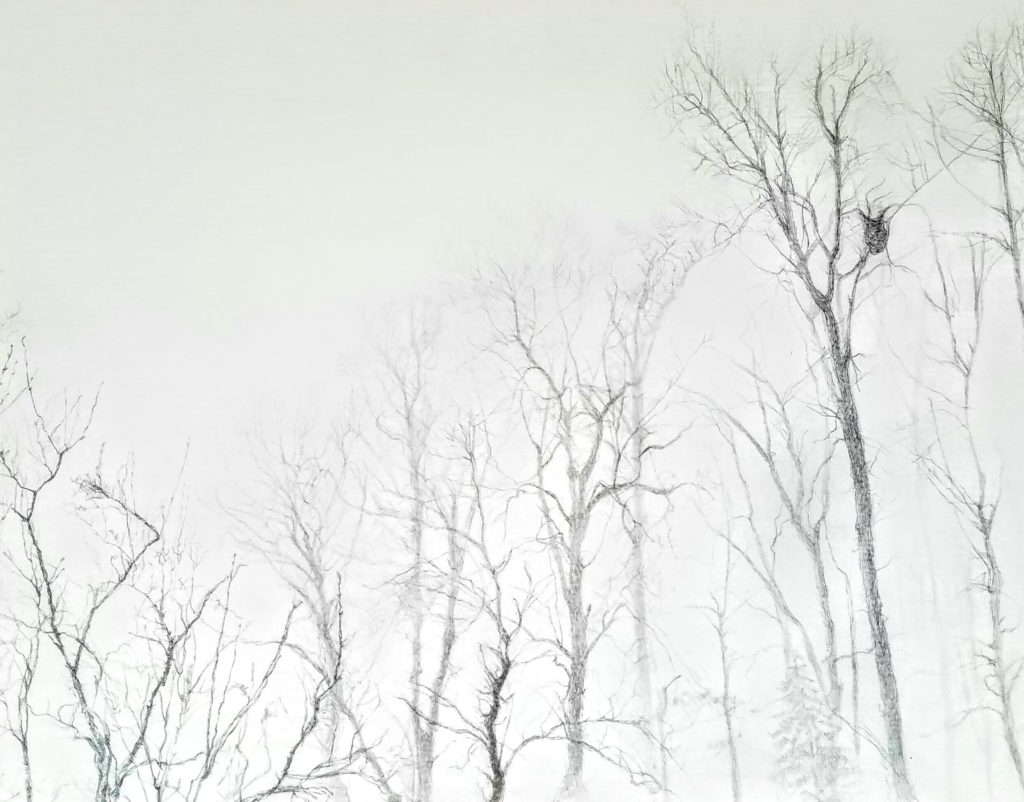
Sherry Camhy, “Becoming,” silver, gold, copper on white prepared wooden board, 15.75 x 19.75 in., 2017, Collection of the artist
Although copper tarnishes too, its coloring varies unpredictably among green, orange, brown, or red hues. Gold does not tarnish, of course; its marks do not look shiny yellow as you might expect, but instead cool gray. Since silver becomes tawny over time, it is sometimes confused with gold, as noted in several of the catalogue entries. Made by the artist Susan Schwalb (b. 1944), the abstract image Strata #295 in this exhibition is a striking demonstration of how silver, gold, copper, aluminum, brass, and platinum can be used together to stirring effect.
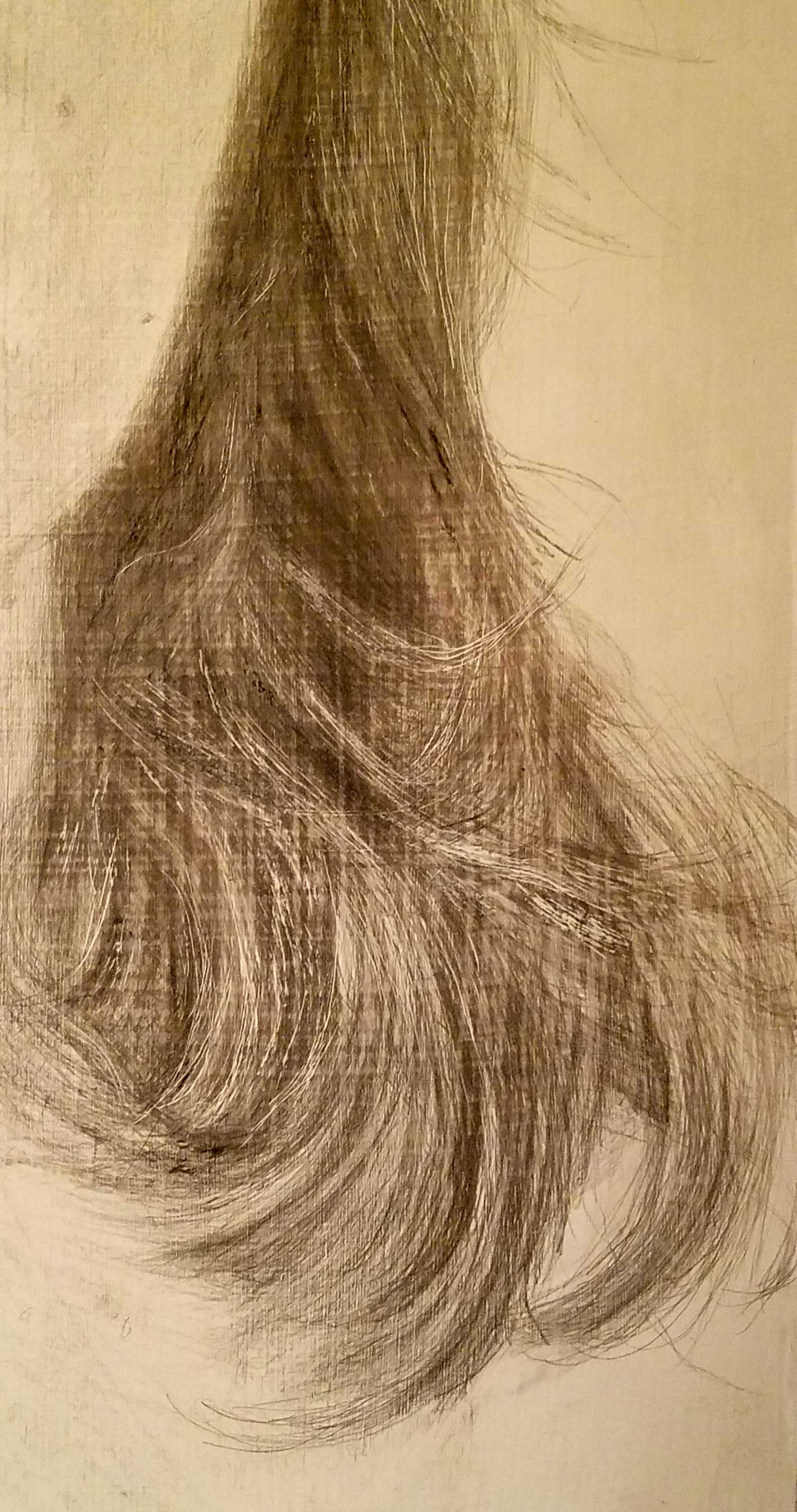
Sherry Camhy, “Hair,” detail, silverpoint on prepared wood panel, 2018, Collection of the artist
In the past, artists placed a short piece of metal into a stylus, a holder made of wood or ivory. Now, artists usually place the metal into something that resembles a mechanical pencil. In fact, metalpoint was the Old Masters’ pencil, because graphite did not become widely available until the early 19th century. Metalpoints are hard, and the lines they make are consistently even; they do not smudge easily, but they are also very difficult to erase, so each line must be considered carefully in advance. Darker areas must be developed patiently with repeated strokes.
Early on, metalpoint artists began to experiment with mixed media to add a greater range of darks and lights, as well as colors. They did this by toning their surfaces, highlighting with white, applying water media, chalks, and inks, and using blind drawing (cutting through the surface with a sharp tool into the primer tone below). As new materials appear, artists eagerly use them to extend the possibilities.
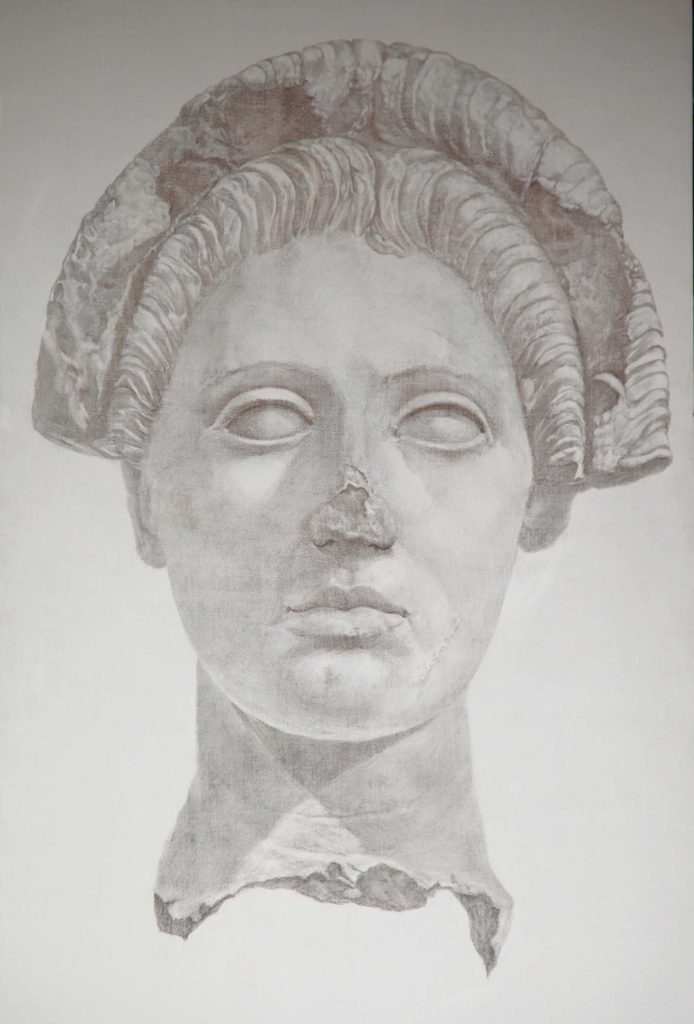
Sherry Camhy, “Young Woman, Antique Sculpture Series,” silver and gold on prepared gray wood panel, 24 x 40 in., 2011, Collection of the artist
Today we are free to work on almost any size of two- or three-dimensional surface, prepared with ingredients that make erasing easy, the use of color, texture, and mixed media tempting, and even installation art feasible.
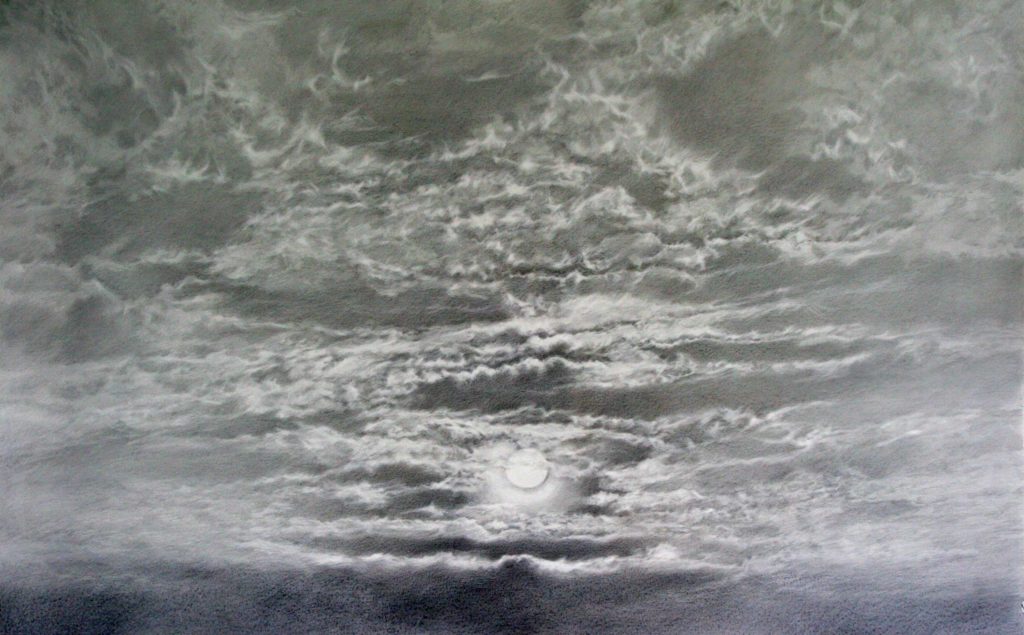
Sherry Camhy, “Olivia,” sterling and Austrian silver on prepared wood panel, 12 x 16 in., 2018, Collection of the artistSherry Camhy, “Silver Sky,” sterling silver on clay coated paper, 30 x 40 in, 2006, Collection of Evansville Museum of Arts, History & Science.
About the author: Sherry Camhy is an artist, writer, and teacher. She curated a silverpoint exhibition at New York City’s National Arts Club in 2013 and at the Art Students League in 2015. Camhy will be giving a silverpoint workshop at the Art Students League, October 22-26, 2018. For more information, please visit www.sherrycamhy.com.
Many people are naturally curious to know if the artworks they own — or even ones they encounter at shops or fairs — are of historical importance, who created them, if they have any financial value, etc.
While the editors and writers of Fine Art Connoisseur are not qualified to provide feedback on these matters, we certainly share your curiosity and warmly encourage you to approach experts in the field who can be of help.
Most communities are served by an auction firm that employs individuals who can quickly assess an artwork. (These are the types of people seen on PBS’s successful television series, Antiques Roadshow.) Most often, they will find that the artwork is of sentimental value, but not of historical importance or great financial value. Sometimes, however, the item is rare, possibly unique, and thus worthy of closer study or even sale to an owner who can take better care of it.
Find an Art Auctioneer
Auctioneers are ideally placed to survey a wide array of materials. Finding a suitable auctioneer is usually as easy as searching the internet with the name of your community or region and the phrase “art auction.” Most auctioneers will gladly receive an email from you, as long as you also attach clear color photographs of the artwork from every possible angle, up close, and from a distance. Auctioneers are not mind-readers and cannot guess at what you are trying to show them . . . they require good-quality photographs to make an informed assessment.
Ask an Appropriate Art Dealer or Art Gallery
Art dealers and gallery owners are also talented at assessing artworks, but they are more often focused on a single kind of art — for example, contemporary paintings, antique furniture, or silver. Therefore finding the right dealer to assess your artwork requires more research on your part. The easiest way to proceed is to visit that dealer or gallery’s website to see what kinds of art are illustrated there; if they resemble your object, then an approach via email or letter may be worthwhile. We recommend against showing up at a gallery with an artwork for the owner to assess; you will probably be interrupting a negotiation underway, and that will not endear you to the gallery staff. Another warning: Some dealers may not have time to reply at all if they are not interested in reselling what you own. In contrast, most auctioneers do reply, even if it is to say “no thank you” or “we don’t know what this object is.”
Contact the Appraisers Association of America
Finally, you can approach an accredited appraiser who is a member of the Appraisers Association of America. This group’s members live nationwide and are trained to assess artworks of many kinds. However, they are independent businesspeople who may automatically charge a service fee if you want them to research or tell you more about the item. Clarity about your expectations, and about any charges to be incurred, is essential during all of your communications with an appraiser. Quite rightly, their “meter” usually begins running the moment you begin to correspond with them.
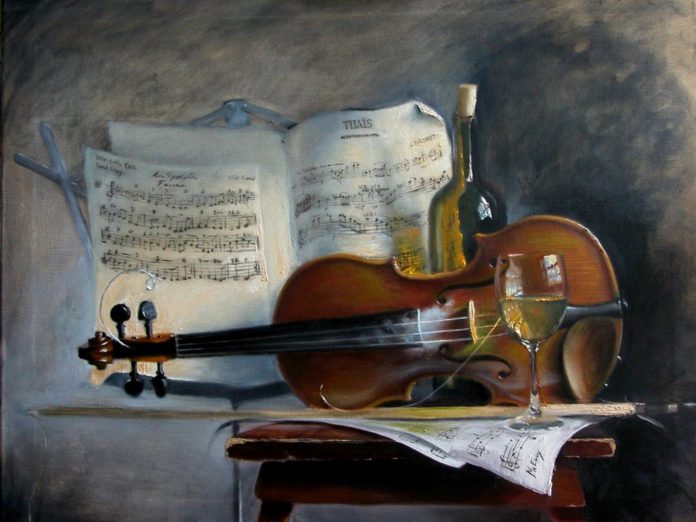
Kevin McEvoy, “The Fiddle and the Violin,” 2010, oil on linen, 36 x 30 in.
The Atelier at Flowerfield proudly presents Atelier Masterworks 2018, an annual group show held at Atelier Hall, the school’s exhibition space designed to complement their traditional fine-art training. This exhibition features work from nine local and visiting instructors, with a focus on introducing upcoming Atelier at Flowerfield workshop teachers and nationally recognized painters Leo Mancini-Hresko, David Shevlino, and John C. Traynor to the greater St. James and Stony Brook communities. The exhibition also features the work of Atelier at Flowerfield’s year-round professional instructors Kevin McEvoy (director), Lana Ballot, Leeanna Chipana, Bill Graf, Tyler Hughes, and Wendy Jensen.
Atelier Masterworks 2018 comprises 34 works: still lifes, landscapes, interiors, figures, and portraits painted predominantly in oil (works in graphite and pastel are also included) and ranging in size from 9 x 11 inches to 48 x 60 inches. The paintings as a whole embody the educational focus of the atelier and McEvoy’s mission to teach classical fundamentals of drawing and painting from life as a foundation for individual expression in a contemporary context.
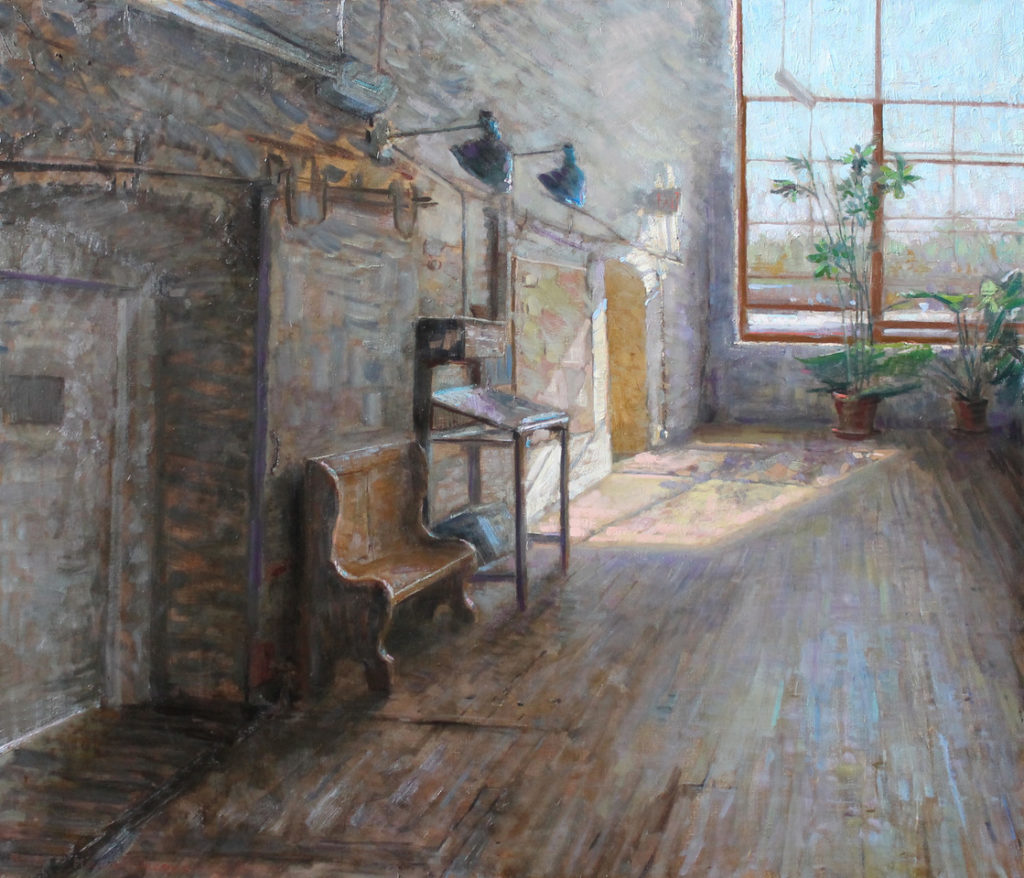
Leo Mancini-Hresko, “Summer Light, Studio Hallway,” 2013, oil on linen, 24 x 30 in.
Leo Mancini-Hresko — a graduate and former principal instructor of the Florence Academy of Art — has ten works in this exhibition. Known for his knowledge of Old Master methods and materials, Mancini-Hresko applies those principles to impressionistic and expressionistic portrayals of his surrounding world: predominantly on-site landscapes from New England and his travels abroad (a large-scale view of the Ponte Vecchio in Florence is featured in this exhibition, as are the artist’s paintings from Greece and Maine), but also sensitively observed interiors, light-filled still lifes, and the occasional figure or portrait.
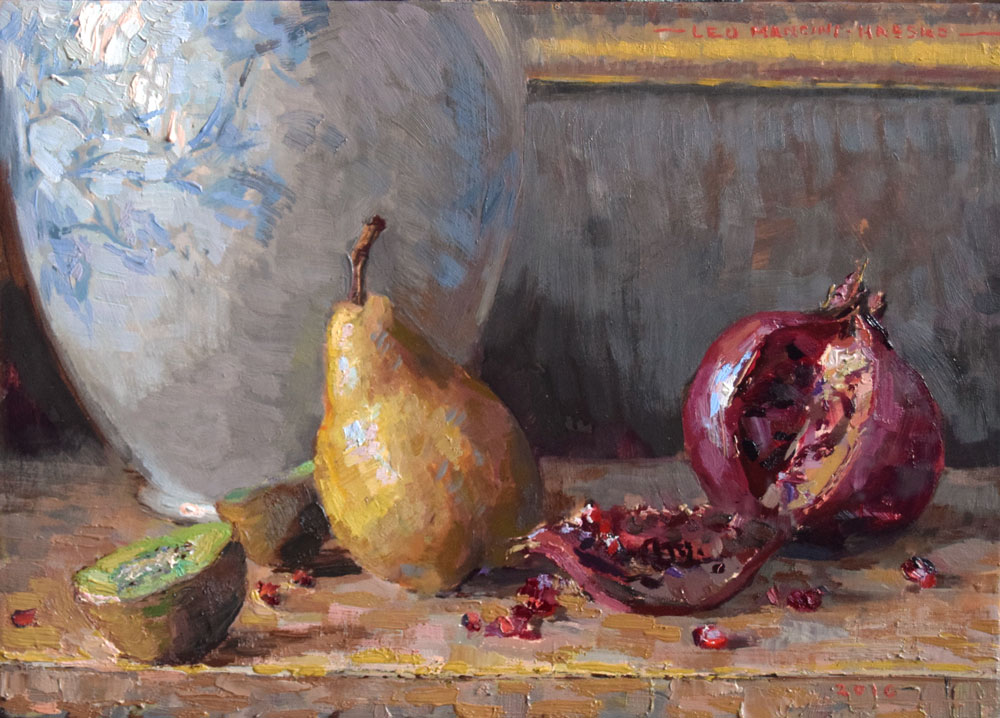
Leo Mancini-Hresko, “Pear and Pomegranate,” 2016, oil on board, 25 x 35 in.
Mancini-Hresko has been included in group exhibitions throughout the world, including in Italy, Greece, Ireland, England, and Russia. He has taught his approach to hand-crafting his own oils, canvases, and mediums at various schools and institutions, including at the Museum of Fine Arts Boston, and he continues to be a part of an ongoing cultural exchange between Russian and American painters.
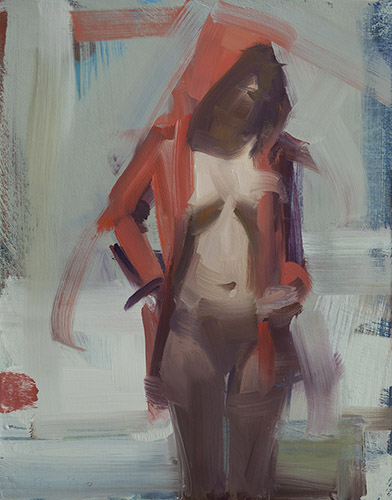
David Shevlino, “Red Jacket,” 2016, oil on panel, 12 x 15 in.
David Shevlino received his training at the historic Pennsylvania Academy of the Fine Arts, and also studied at the University of Pennsylvania and the Art Students League of New York. A firm believer in a traditional fine-art foundation, Shevlino has also developed an appreciation for more expressive styles and experimentation. His artwork lives in that energetic tension between representation and abstraction, a place where the artist feels most comfortable and confident.
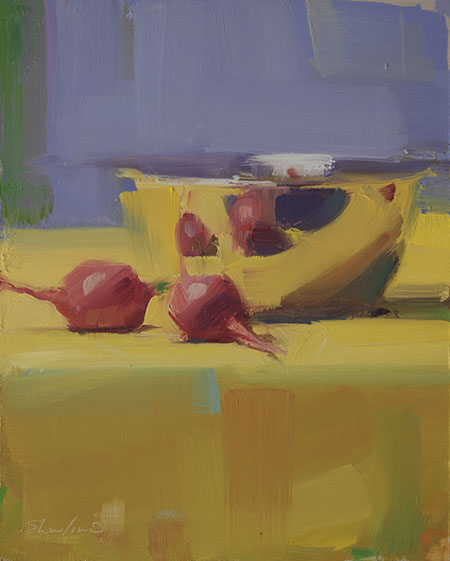
David Shevlino, “Two Radishes,” 2013, oil on panel, 9 x 12 in.
Shevlino has six works in this exhibition, showcasing the various sides of his stylistic personality. These include a large-scale American Impressionist-esque outdoor portrait of a young boy; a semi-nude figure demonstrating his signature hybrid style; and a simple still life, painted with a limited palette a la the Hawthorne/Hensche school of color. Shevlino has been exhibiting his paintings nationally and internationally for more than two decades, and his work has been featured in several national and online publications.
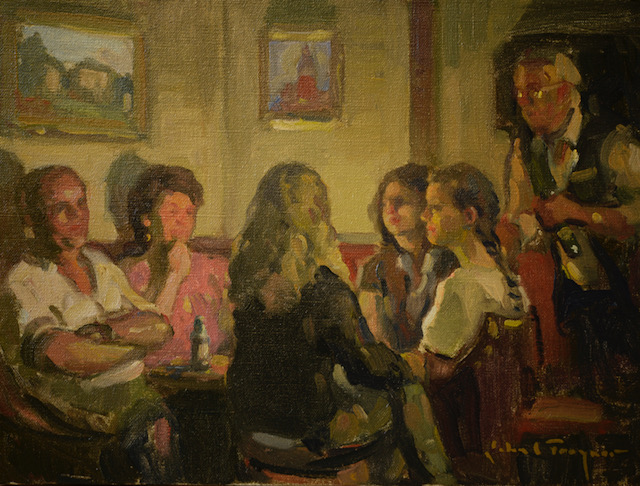
John C. Traynor, “Sunday Evening Stories,” oil on linen, 22 x 18 in.
John C. Traynor has been painting and traveling the world in search of beauty for more than 40 years and is known for his landscapes and still lifes that combine traditional realism with atmospheric impressionism. Having trained with such teachers as Deanne Keller and Frank Mason in his youth, Traynor is part of several lineages, including those associated with the Copley Society of Boston, of which he is a honorary member.
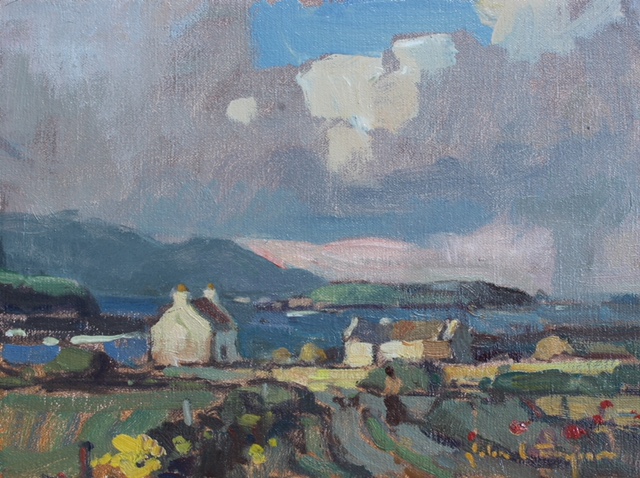
John C. Traynor, “Passing Shower, County Clare, Ireland,” oil on linen, 18 x 14 in.
The artist has five works in this exhibition, including his highly collected outdoor landscape scenes, as well as a rare multi-figure interior titled “Sunday Evening Stories.” Traynor is the official fine artist of the upcoming 2018 U.S. Open Men’s Golf Championship, held this June at the Shinnecock Hills Golf Club, in Eastern Long Island. Traynor has been making several trips to the area over the last several months to paint on-site and has been particularly inspired by the legacy of William Merritt Chase, who summered and painted in Shinnecock and ran the Shinnecock Hills Summer School of Art from 1891 to 1902.
“Atelier Masterworks” runs through August 30, 2018. For more information, please visit www.atelierflowerfield.org.
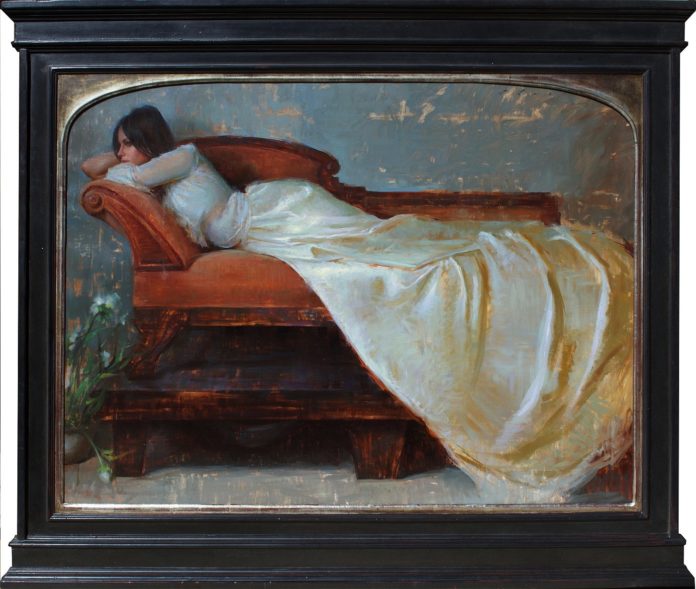
Suchitra Bhosle, “Trailing Silk,” oil, 44 x 60 in., $10,000
An overview of the fine art exhibition “Suchitra Bhosle: Sacred Spaces”
by Kelly Skeen, Arts Writer for Meyer Gallery
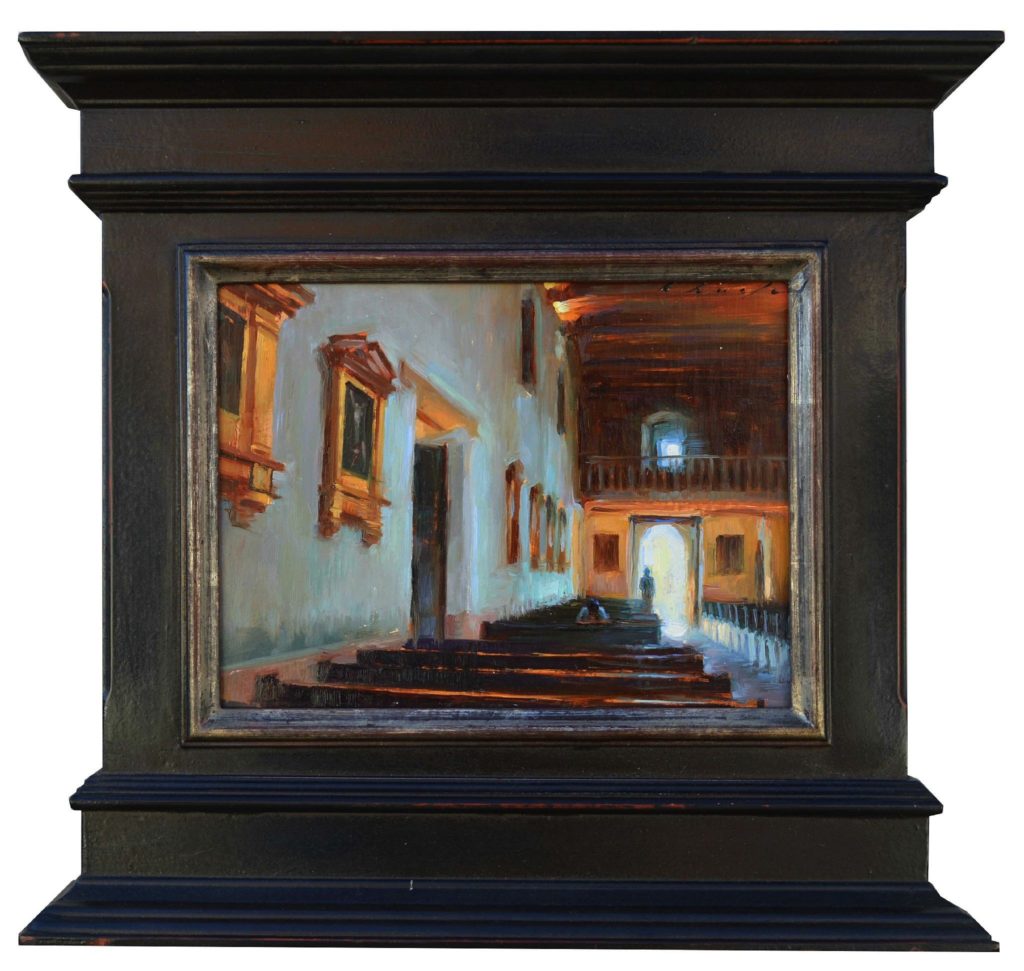
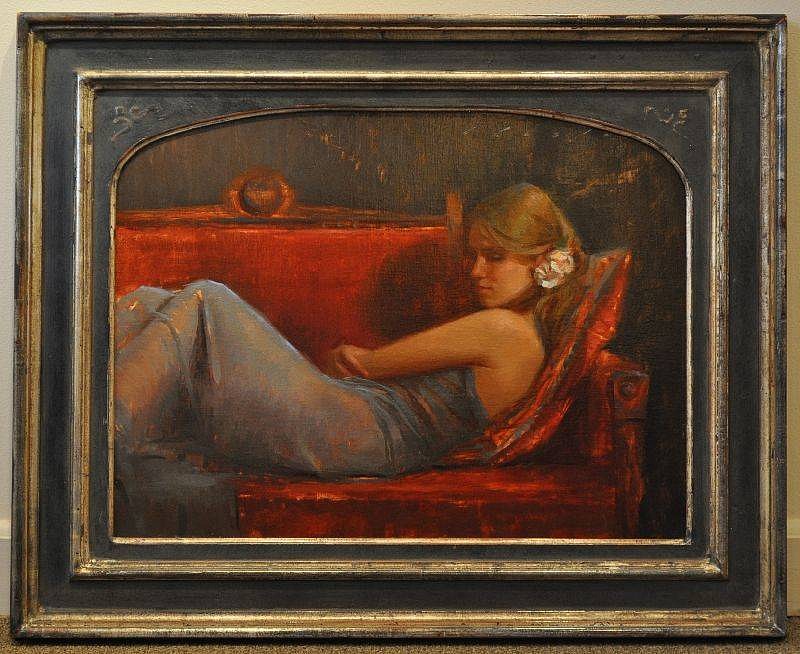
Suchitra Bhosle’s representational painting style embraces impressionist techniques through loose brushwork and accurate depictions of ever-changing light. The defining factor of Bhosle’s work, however, is the mood she invokes through oil paintings that are inspired by personal moments or lingering experiences. While much of Bhosle’s painting career has focused on the figure, her latest work emphasizes architectural subjects that stem from an intimate sense of place.
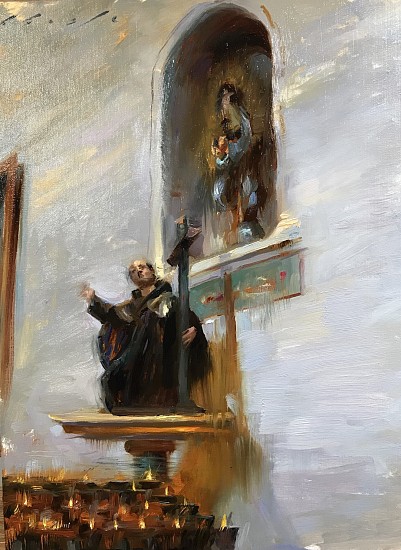
Suchitra Bhosle, “Apostle and Alcove,” oil, 16 x 12 in., $4,000
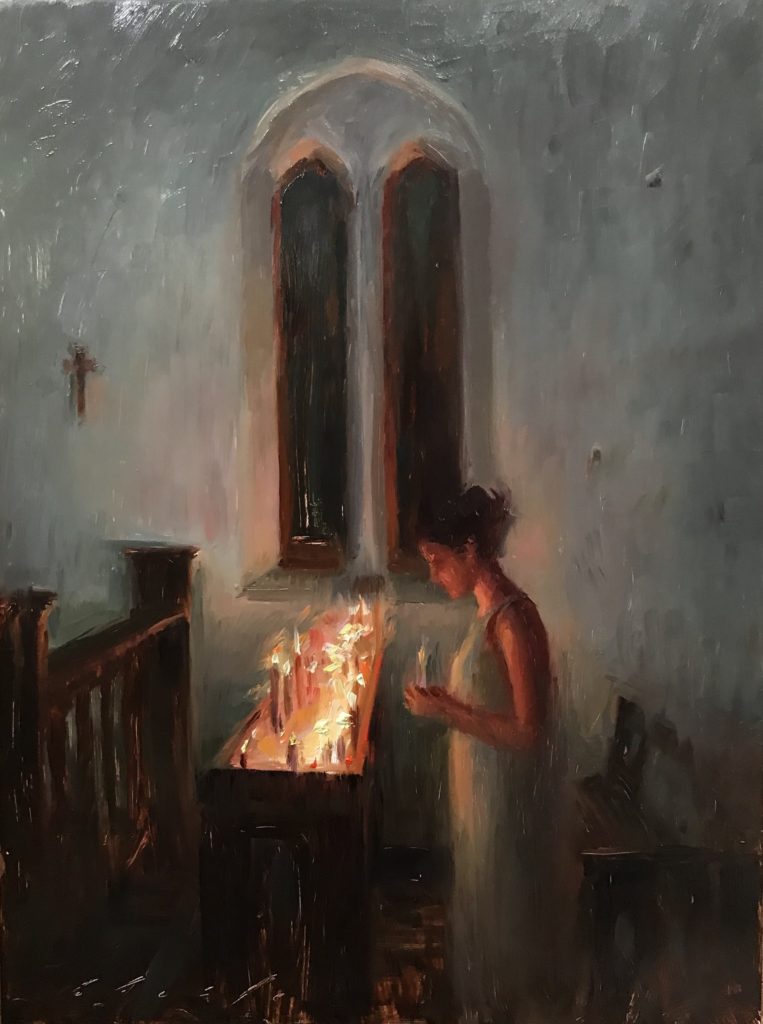
“Apart from lighting and mood, what draws me to paint these spaces is the dynamic dialogue between shape and color,” says Bhosle of her architectural imagery. While the dominating subjects for Bhosle’s exhibition are church naves or facades, the sacred feel of her paintings is not necessarily reliant on spiritual subject matter. The distinct mood of each piece is conjured instead through intimate lighting, soft brushwork, and subtle color harmonies. These techniques are also evident in Bhosle’s figurative style, which will have a presence within the exhibition. “A sacred space could be a mosque, temple, or any place of worship,” she says. “But it’s not limited to that. It could also be a personal moment that was close to me.”
Suchitra Bhosle, “Devotee,” oil, 9 x 12 in., Sold
Bhosle was born in India, where she lived for 25 years before moving to the United States. She and her husband lived in California and took regular trips to New Mexico before recently moving to the East Coast. Her latest architectural paintings reflect blended imagery of Indian temples, California Spanish missions, and Southwest adobe churches. Bhosle often juxtaposes various elements from each culture into a single image, imagining a place that encompasses the beauty she has experienced in various sacred spaces.
Suchitra Bhosle, “Candle Lit Prayer,” oil, 16 x 12 in., $4,000Suchitra Bhosle, “Blue Lace,” oil, 18 x 24 in., $6,000
“Suchitra Bhosle: Sacred Spaces” will be on view through June 14, 2018. For more information, please visit www.meyergalleries.com.
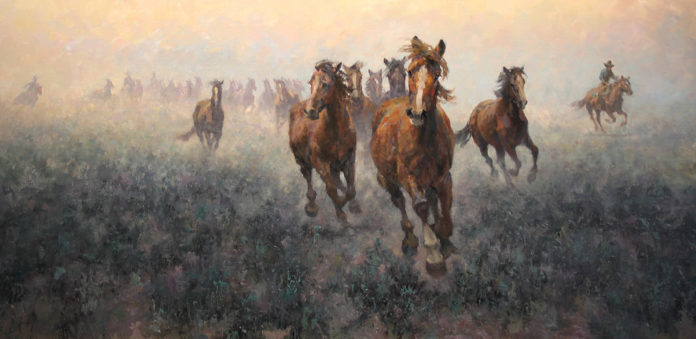
Jim Rey, “Sage Runners,” oil on canvas, 24 x 48 in.
See the West through the eyes of Maura Allen and Jim Rey, two distinct artists featured in the fine art exhibition, “This is the West.” Allen portrays the American West with a contemporary, cinematic quality, while Rey captures a bygone era, preserving a way of life. Read more about the artists below.
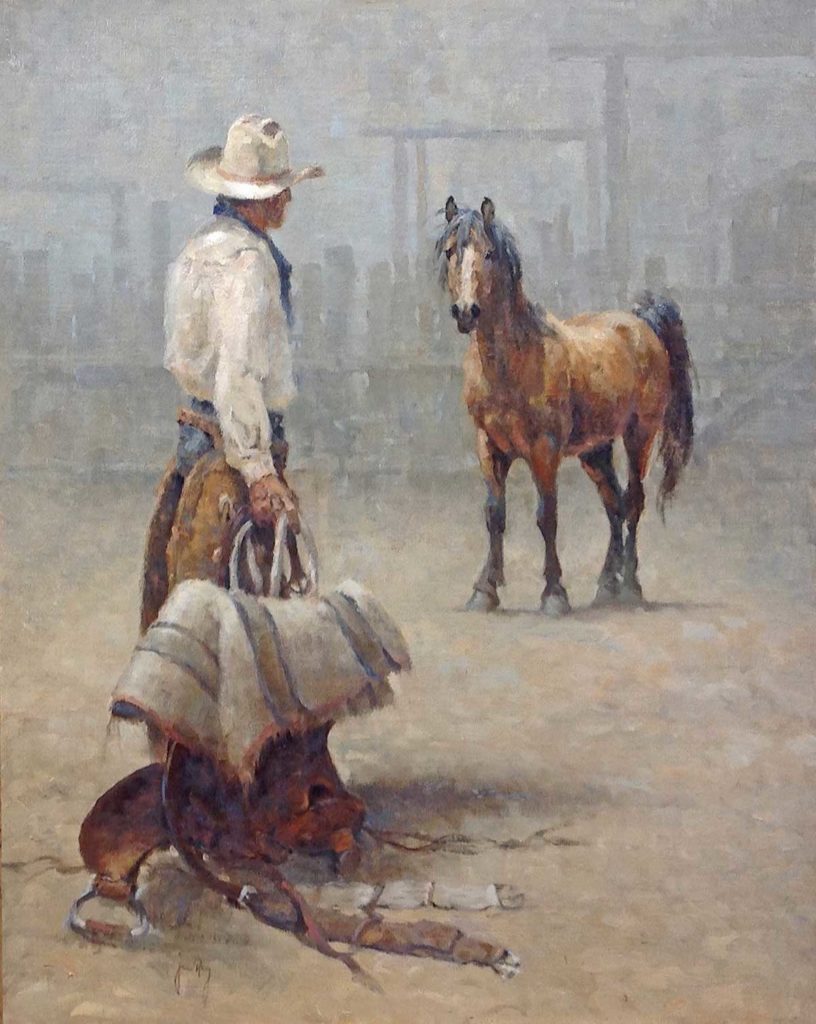
Jim Rey, “Introduction to the Saddle,” oil on linen, 30 x 24 in.
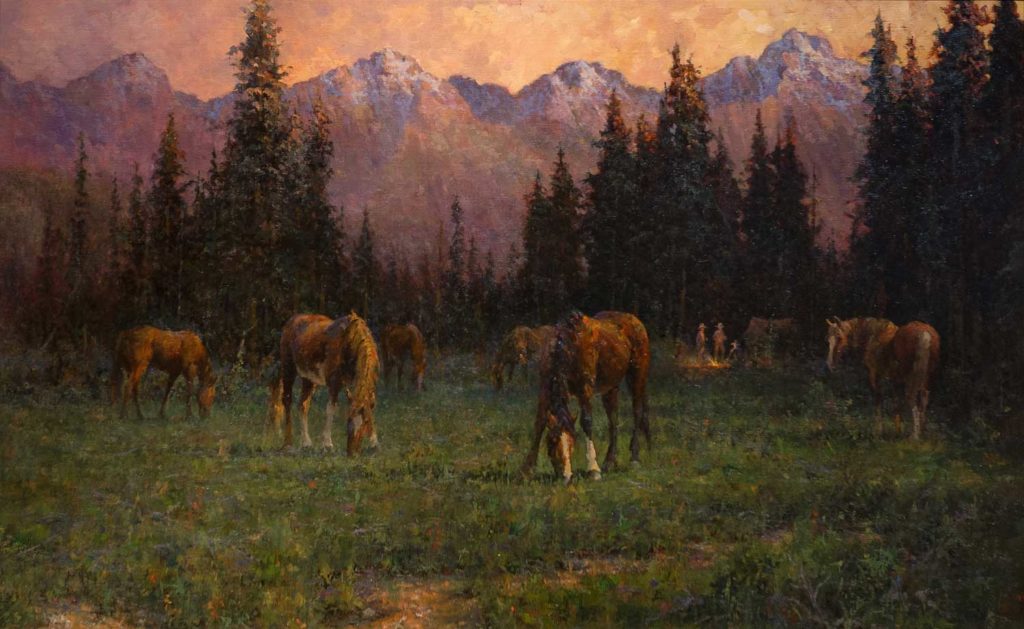
Jim Rey has spent a lifetime living the ranching experience, and close to five decades depicting those experiences with his paintbrush. Turning to his own memories and continually exploring new ranches and landscape locations infuses Rey’s work with a tangible authenticity. He strives to visually demonstrate what he cares about, sharing a thought and his own way of looking at things in the final image.
“I’ve seen what hard work and diligence does,” Rey says, “both in art and on the range.”
Jim Rey, “Camp at Sunset,” oil, 30 x 48 in.
The pieces presented at this show will focus on the “haptic” approach in his work, as he uses his fingers to create a natural line of movement, energy, and flow, all coming from the touch. “Using the touch of my fingers in addition to brush strokes allows me to be empathetic to the subject and results in a painting that is created based on feeling.”
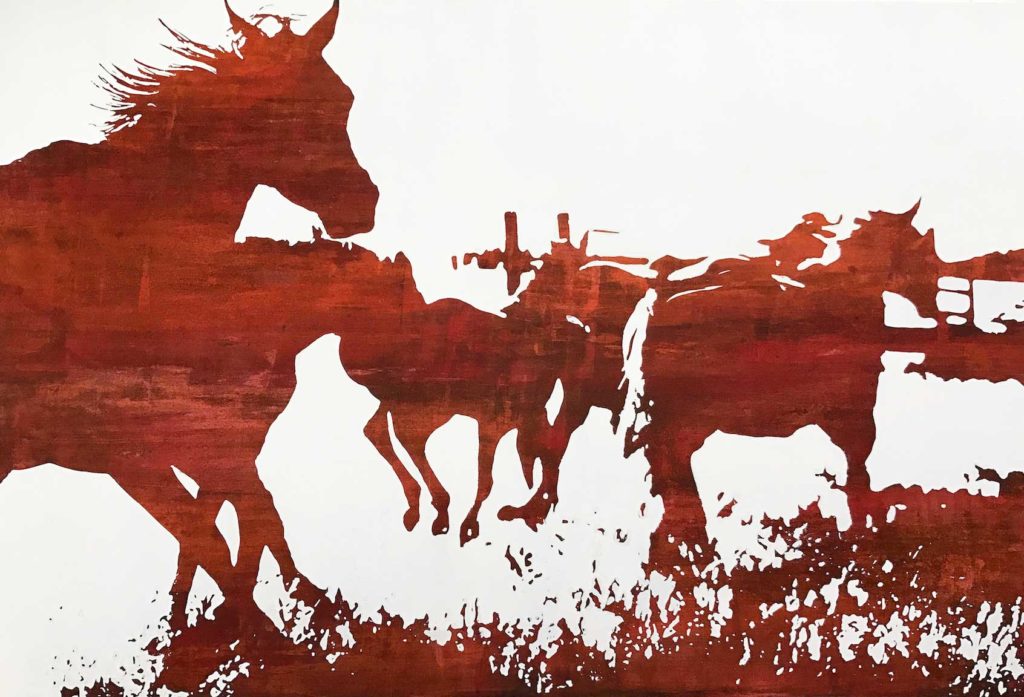
Maura Allen, “Gallup,” acrylic, 40 x 60 in.
Maura Allen devotes time each year to travel, visiting various locations, reestablishing her personal connection with the American West. Recently, she spent time in Wyoming and at a private ranch in northern Denver, discovering and collecting visual lessons for future contemplation. Upon returning to her studio, she transforms these journeys into stunning paintings that embody her beloved West. “For centuries, the West has represented beginnings, not endings,” she says. It’s a “place where experimentation and the pioneering spirit — no matter your passion — has enough sky to thrive.”
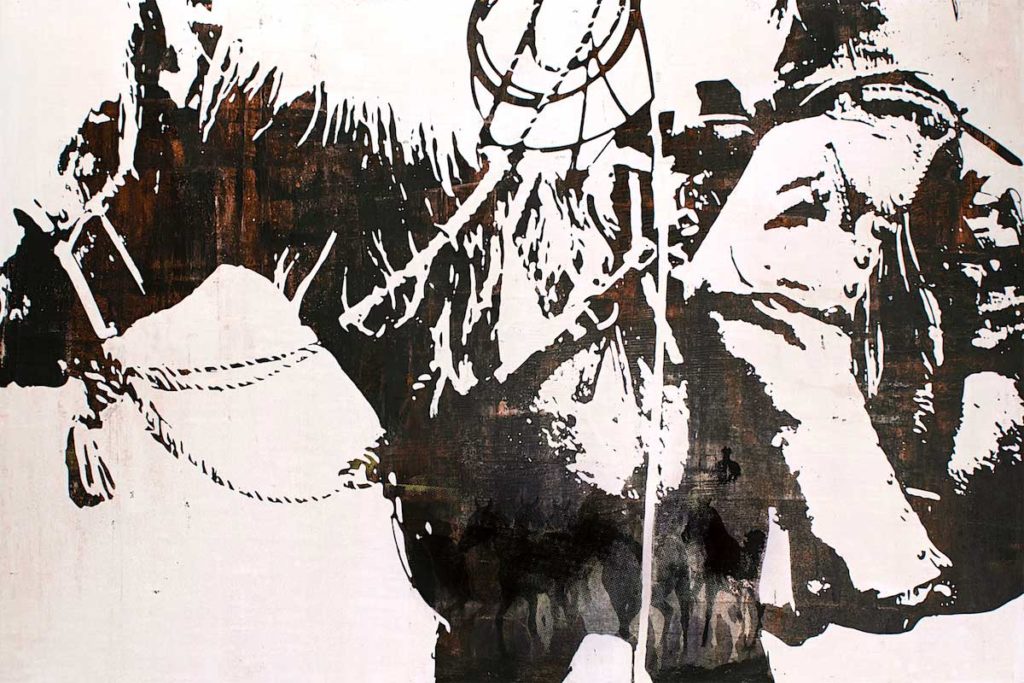
Maura Allen, “Cortez,” acrylic on canvas, 32 x 48 in.
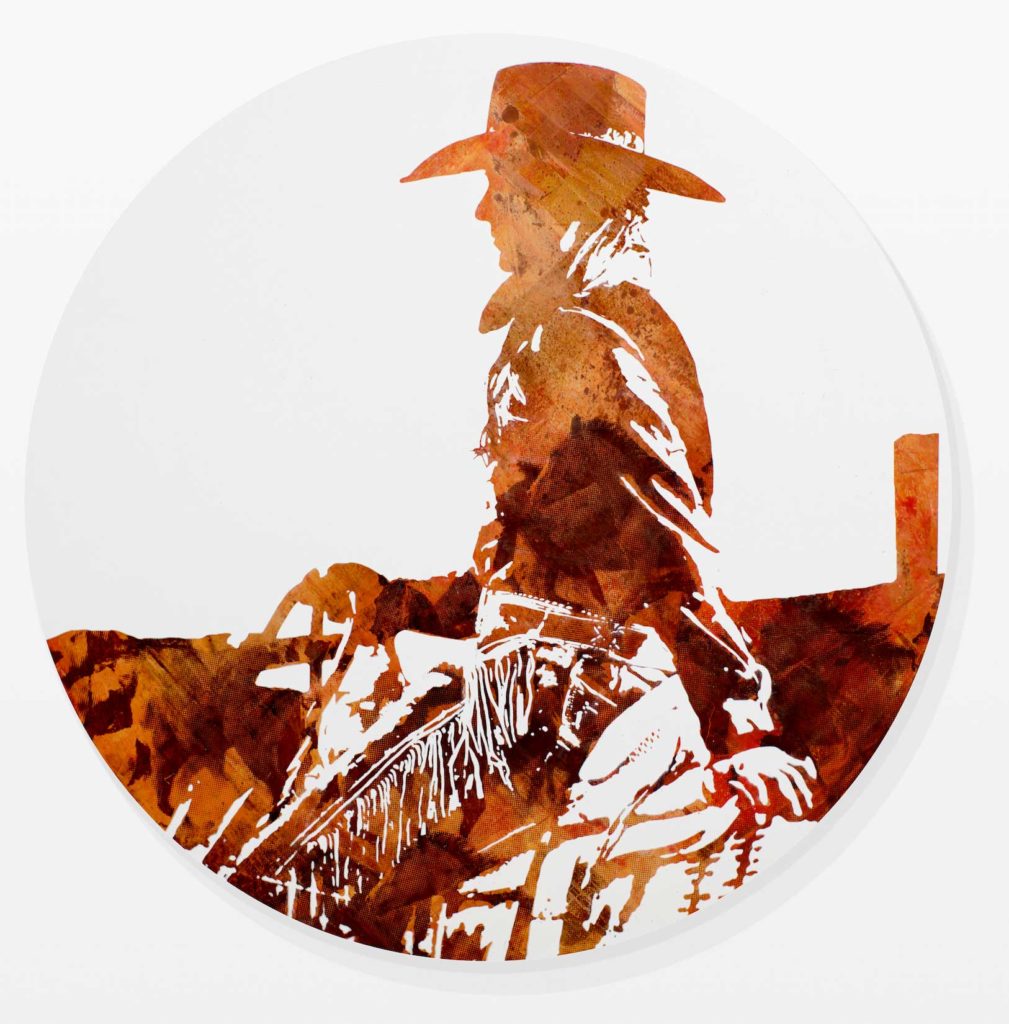
At this show, Allen introduces several new works of varying sizes and shapes, including a pinwheel circle series with a bold, recurring Western element. Other imagery includes barrel racing cowgirls and Native American themes. “The West we live — and the West of our imagination — is what I paint. Like the great tales of the West, my work is part rugged, part romanticized.”
Maura Allen, “Oh My Darling, Clementine,” acrylic on panel, 24 in. diameter
Shanan Campbell Wells, owner of Sorrel Sky Gallery, looks forward to this show with much anticipation. “Maura and Jim are both so devoted to expressing what they see individually as ‘the West.’ Each approaches their creative processes so differently, with a distinctive style and method. Yet each conveys their deep love and appreciation for their surroundings, what its future and history mean to them, with imagery that clearly states ‘This is the West.’”
“This is the West” runs through June 30, 2018. For more information, please visit sorrelsky.com.
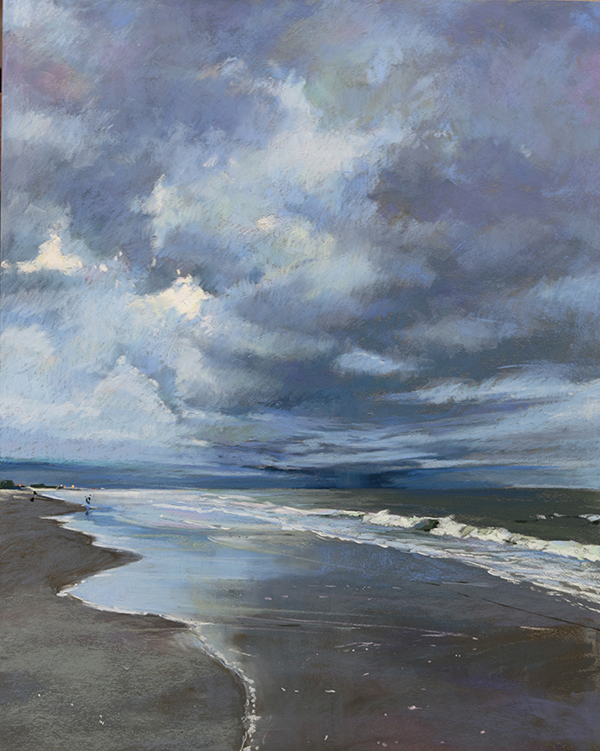
Storm Clouds in Blue
16 x 20 in., pastel
$2,000
Available from the artist
Atlanta artist Lisa Gleim is a branch of a family tree of artists with deeply rooted Southern connections. A graduate of the Pennsylvania Academy of the Fine Arts, Lisa is strongly influenced by the great American Impressionists. A love of pastels took off when a family friend gave her a set of French pastels; Lisa was immediately hooked.
“The medium,” she says, “allows me the ability to capture the effect of light with extreme vividness. Pastels have the unmatched richness of painting with pure pigment. The beauty of light and how it affects subjects, whether it be an animal or a coastal landscape is what one will see in my paintings.”
Lisa is always looking at her daily encounters as possible paintings. She never leaves home without her camera or phone so she always has the option to capture a perfect moment. Although her work is primarily created in studio, she does paint in plein air whenever possible. Each year she takes a week-long painting trip, usually near water.
Both her portraits and landscapes can be found in many private collections across the United States including the Children’s Hospital of Philadelphia, AstraZeneca Pharmaceutical, the Court of Chancery in Wilmington, DE, and has been included in numerous publications, including several issues of the book Strokes of Genius: The Best of Drawing series by Northlight Books. She is a signature member of the American Society of Marine Artists, a Master Circle Member of the International Association of Pastel Societies, and a juried associate member of the Society of Animal Artists, to name a few.
After living and working in Philadelphia for eight years, Lisa returned to her native home of Atlanta in 2000 where she maintains her studio and residence with her husband and 12 year old daughter.
Select honors:
2012 & 2016 Audubon Artists Gold Medal of Honor for Pastel recipient
2013 Audubon Artists Art Spirit Foundation’s Gold Medal Award for Pastel
2016 Atlanta Branch of the National League of Pen Women’s Artist of the Year
Fill your mind with useful art stories, the latest trends, upcoming art shows, top artists, and more. Subscribe to Fine Art Today, from the publishers of Fine Art Connoisseur magazine.