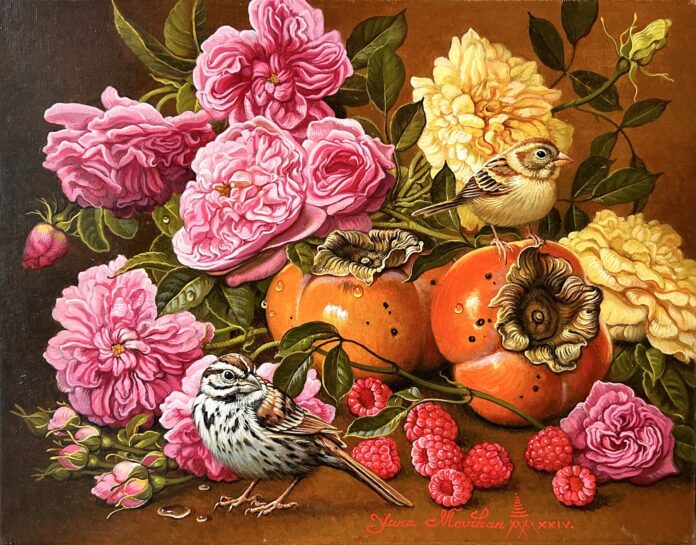
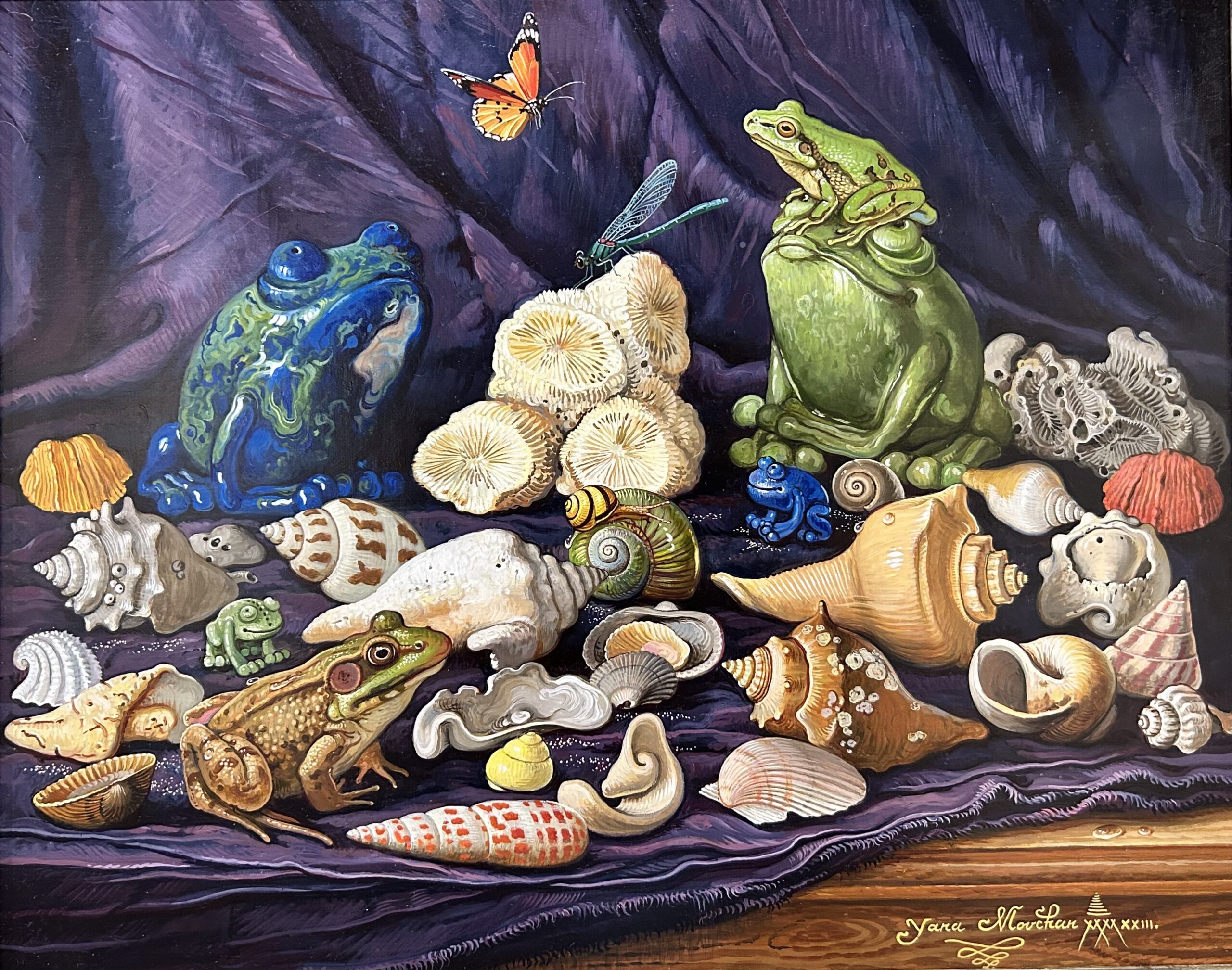
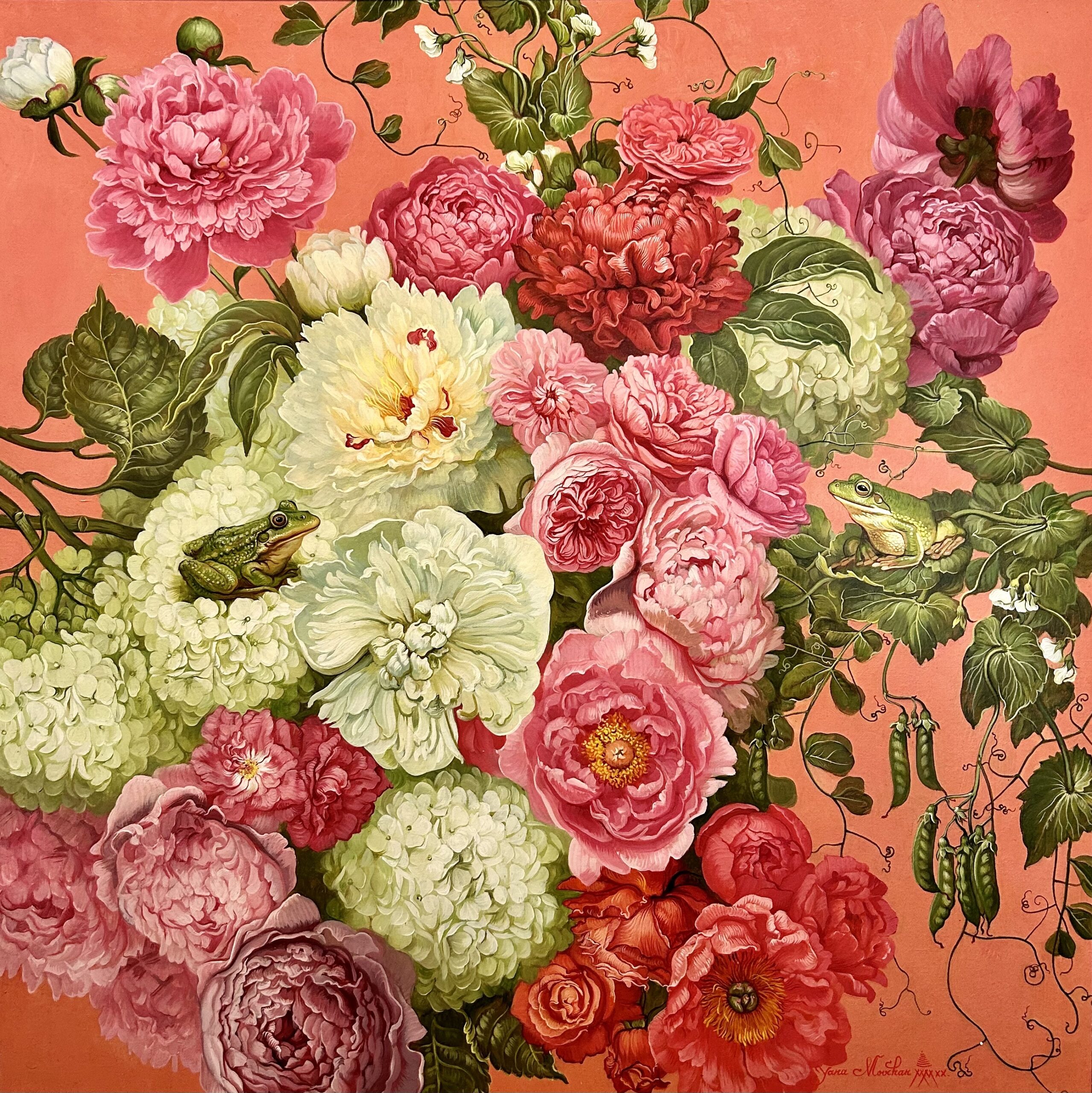
Yana Movchan, "Roses and Persimmons," 12" x 14", oil on canvas, 2025
Contemporary Fine Art on View
Expression & Enchantment: The Artwork of Yana Movchan
Lily Pad | West
Milwaukee, Wisconsin www.lilypadgallery.com
Through June 1, 2025
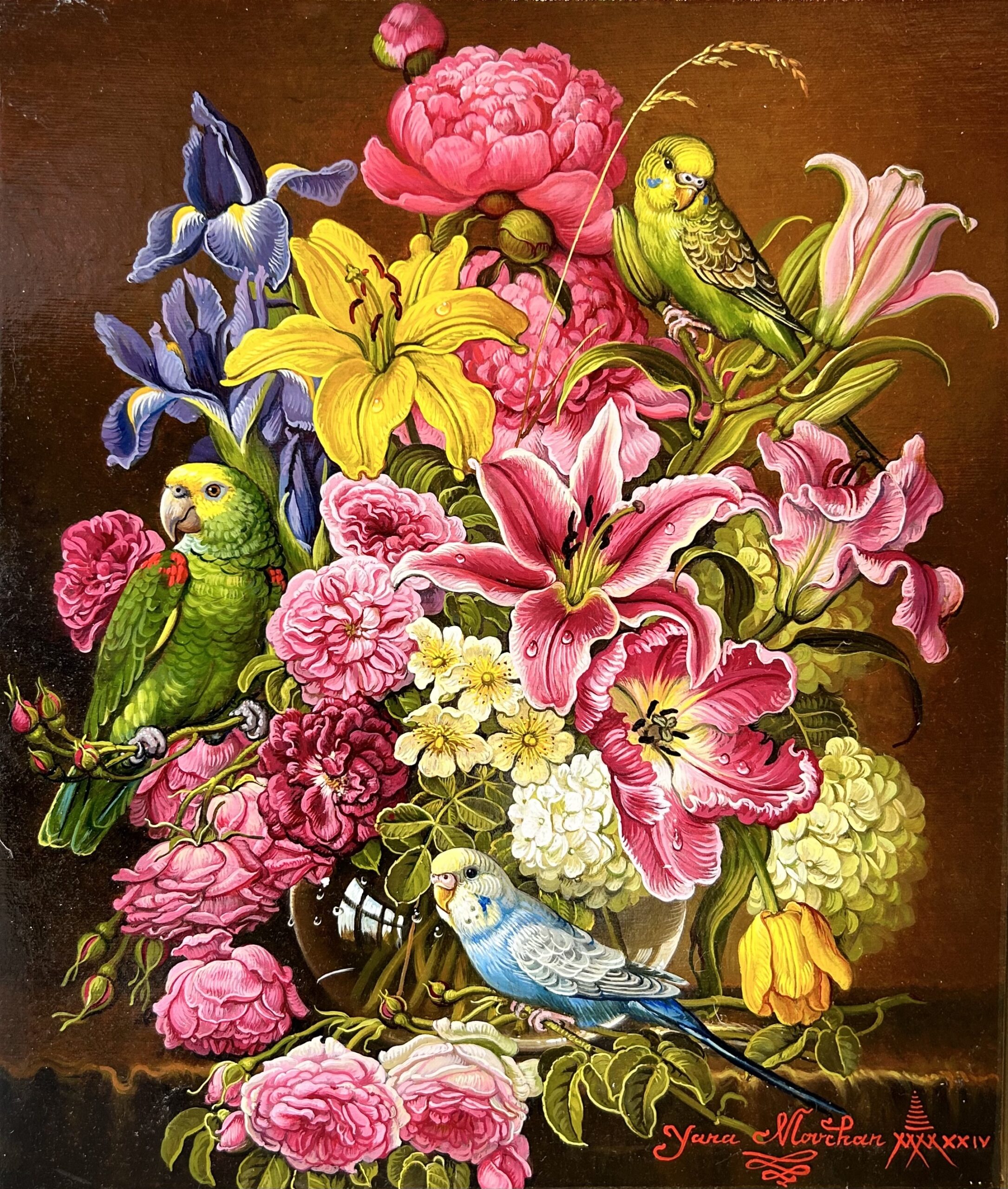
Yana Movchan, “Bouquet with Parrots,” 12″ x 14″, oil on canvas, 2024
From the Gallery:
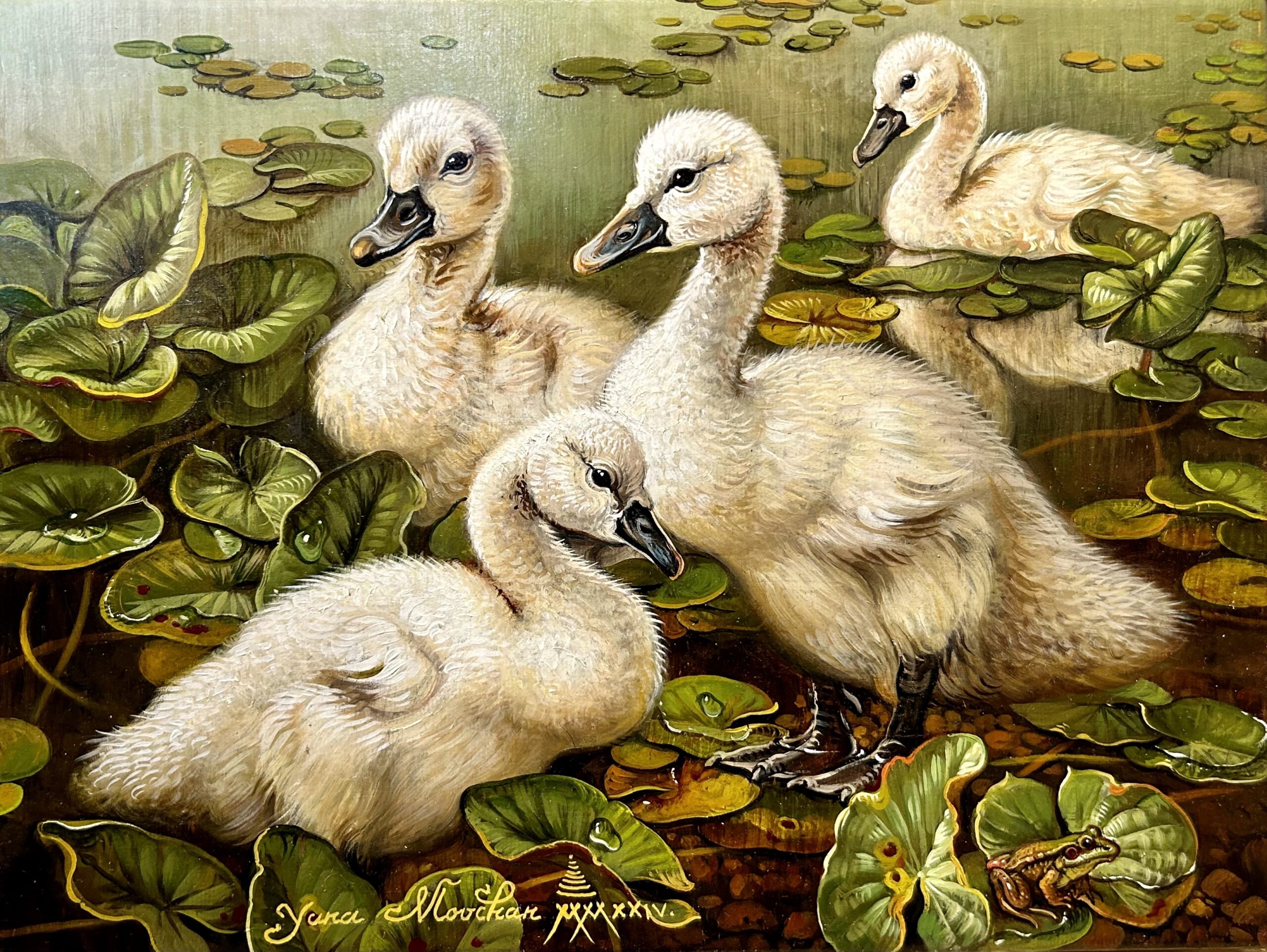
“Expression & Enchantment: The Artwork of Yana Movchan” explores the captivating interplay between memory, nature, and imagination. In contrast, Yana transports us to a realm where hyper-realistic figures intertwine with nature, creating powerful symbolic narratives. Her meticulously crafted works combine classical techniques with surrealistic elements, inviting reflection on themes of innocence and transformation.
Yana Movchan, “Cygnets,” 9″ x 12″, oil on canvas, 2024
A graduate of the Ukrainian Art Academy, Yana has exhibited her award-winning art across Europe and Canada, now residing in Halifax. Yana will be present for Gallery Night (April 11) and Gallery Day (April 12).
Yana Movchan, “Light Conversation,” 24″ x 30″, oil on canvas, 2021Yana Movchan, “Nature Made and Man Made,” 16″ x 20″, oil on canvas, 2023Yana Movchan, “Opposite Attraction,” 30″ x 30″, oil on canvas, 2023
Yana presents a striking mix of expressionism and magical realism. “Expression & Enchantment: The Artwork Yana Movchan,” showcases her unique artistic vision, offering an inspiring journey through nature and imagination.
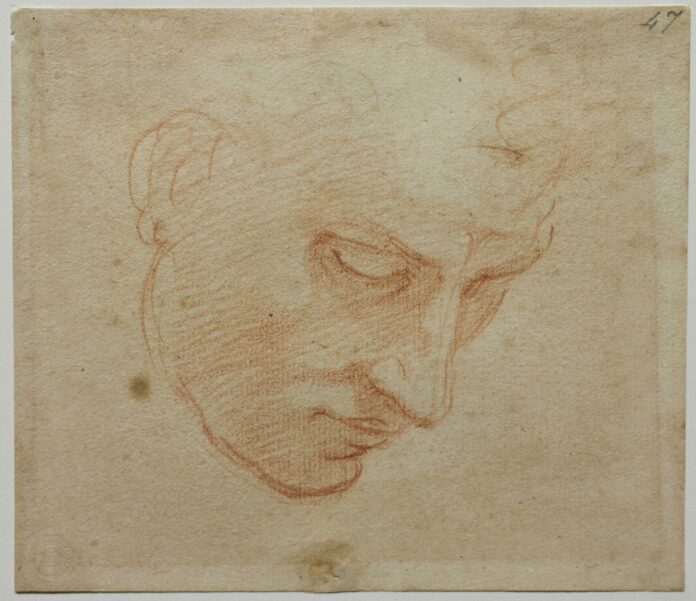
MICHELANGELO BUONARROTI (1475–1564), Study for a Male Face for The Flood, c. 1508–09, red chalk on paper, 5 x 6 in., Casa Buonarroti, Florence, inv. 47 F
Michelangelo drawings on view > Located on the campus of the College of William & Mary, the Muscarelle Museum of Art is the only U.S. venue for “Michelangelo: The Genesis of the Sistine,” an exhibition marking 550 years since the Italian Renaissance master was born. On view will be 38 objects offering a glimpse into the thoughts, ideas, struggles, and breakthroughs that shaped one of history’s greatest masterpieces — the frescoes of the Sistine Chapel ceiling inside the Pope’s Vatican palace in Rome.
At a Glance:
MICHELANGELO: THE GENESIS OF THE SISTINE
Muscarelle Museum of Art
Williamsburg, Virginia muscarelle.wm.edu
Through May 28, 2025
Of the hundreds of drawings Michelangelo created for that ceiling, less than 50 survive, and nearly half will be on view at the Muscarelle. This show marks the global debut of a long-overlooked drawing hypothesized to be the artist’s first sketch in preparation for the ceiling, plus the U.S. debut of seven drawings. After 15 years of research, organizing curator Adriano Marinazzo has gathered these key loans, as well as engravings, lithographs, and other unique items. The latter include a portrait of Michelangelo by Giuliano Bugiardini, two self-portraits Michelangelo sketched while he was painting the ceiling, and a letter to Michelangelo from his friend Francesco Granacci.
The exhibition’s design and installation will be innovative, with low lighting and life-size reproductions of such iconic frescoes as “The Creation of Adam” to help visitors appreciate the ceiling’s huge scale. Marinazzo has created an immersive video, “This Is Not My Art,” which brings Michelangelo’s illusionistic painted architecture to life, transforming his two-dimensional designs into a three-dimensional digital experience.
The Muscarelle’s original building, opened in 1983, was recently expanded by more than 42,000 square feet, designed by Pelli Clarke & Partners as part of the college’s new Martha Wren Briggs Center for the Visual Arts. “Michelangelo” is the first major exhibition gracing this space, and it makes special sense because the Muscarelle has an impressive track record of Renaissance exhibitions, including Michelangelo in 2013, Leonardo in 2015, and Botticelli in 2017. Lending once again are several leading Italian museums, including the Uffizi, Casa Buonarroti, and the Musei Reali Torino.
Adriano Marinazzo will deliver public lectures on April 28.
As part of our effort to continue to help artists and art galleries thrive, we’re proud to bring you this week’s “Virtual Gallery Walk.” Browse the artwork below and click the image itself to learn more about it, including how to contact the gallery.
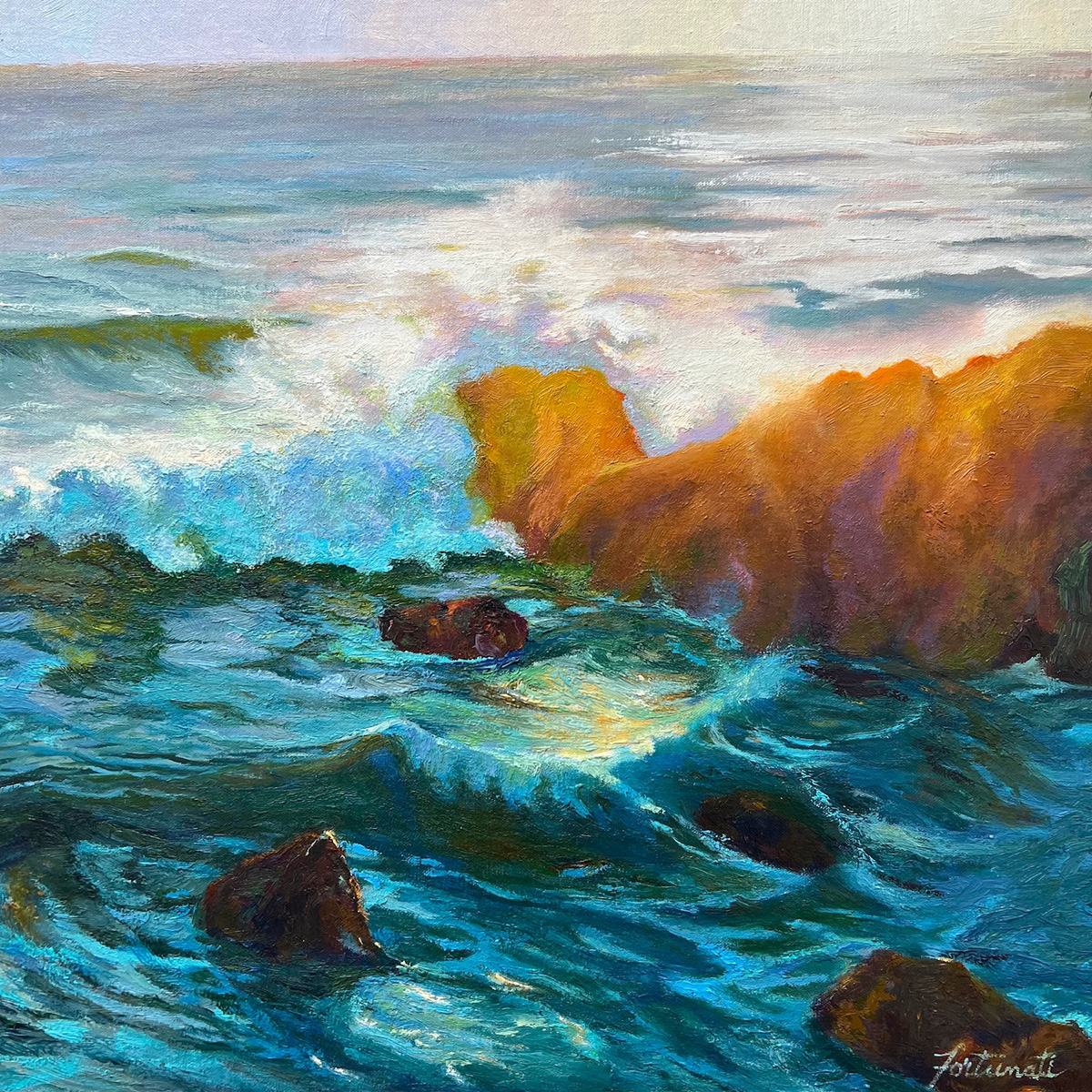
Kissed by the Sun, Marian Fortunati, framed oil on linen panel, 20 x 20 in; Marian Fortunati
Want to see your gallery featured in an upcoming Virtual Gallery Walk? Contact us at [email protected] to advertise today. Don’t delay, as spaces are first come, first served, and availability is limited.
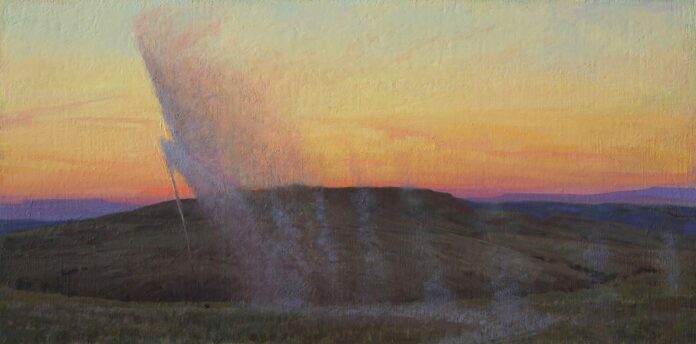
First Place Overall: Seth Tummins, “Do Not Go Gentle,” Oil, 18×36 in.
Please help us congratulate Seth Tummins for winning Overall First Place in the February 2025 PleinAir Salon, judged by Jill Carver.
First Place Overall: Seth Tummins, “Do Not Go Gentle,” Oil, 18×36 in.
“Artists have the power to make us see the world differently, to pay attention,” Jill said. “I would never have imagined that an irrigator could provide such a poetic motif. Sometimes it is the idea that elevates a winner from a portfolio of very accomplished and pleasing paintings.
“This beautifully nuanced and harmonious piece stopped me in my tracks – the idea and the execution. There is so much to see here: the sunset colors depicted not just once, but again in refracted form in the spray of water; the ghosts of receding water sprays creating vertical rhythms as they drift left to right. It does what a great painting should do, which is to conjure up real emotions – I held my breath, exhaled, and then stayed for a very long time.”
In the spirit of the French Salon created by the Academie des Beaux-Arts in Paris, this annual online art competition, with 11 monthly cycles, leading to the annual Salon Grand Prize winners, is designed to stimulate artistic growth through competition. The PleinAir® Salon rewards artists with $50,000 in cash prizes and exposure of their work, with the winning painting featured on the cover of PleinAir® Magazine.
Winners in each monthly competition may receive recognition and exposure through PleinAir Magazine’s print magazine, e-newsletters, websites, and social media. Winners of each competition will also be entered into the annual competition. The Annual Awards will be presented live at the next Plein Air Convention & Expo.
The next round of the PleinAir Salon has begun so hurry, as this competition ends on the last day of the month. Enter your best art in the PleinAir Salon here.
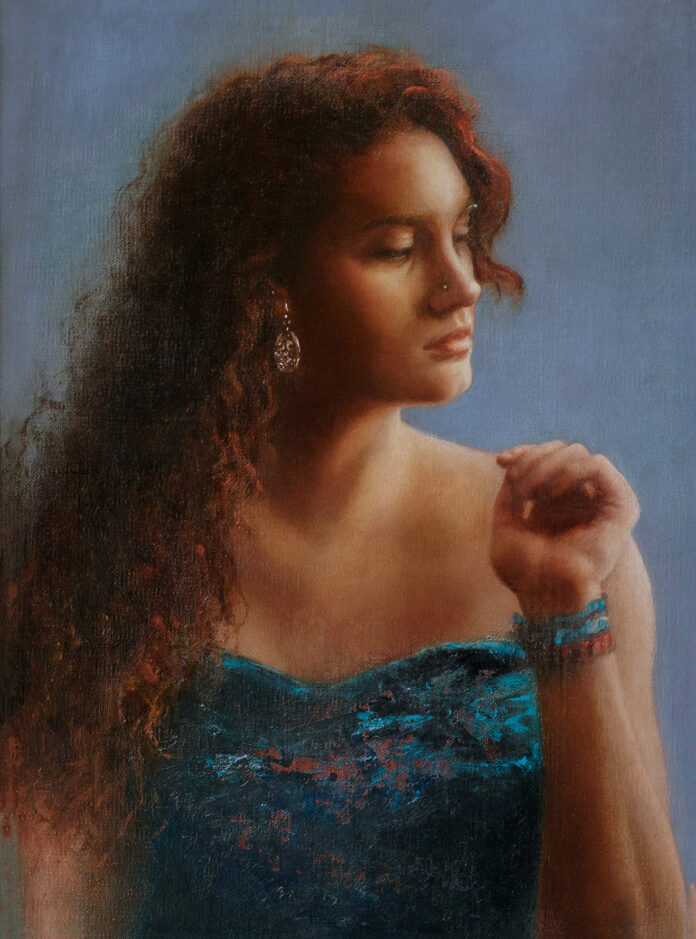
“Voodoo Child,” JuliAnne Jonker, oil and wax, 9 x 12 in., $2,400
JuliAnne Jonker: JuliAnne Jonker’s encaustic and cold wax oil paintings combine a semi-abstract textural atmosphere with realism. Her portraits have an ethereal quality, where the play of light and delicate brushwork creates a dreamlike atmosphere, drawing the viewer into a world of subtle beauty. JuliAnne’s timeless work is available through Chelsie Nicole Contemporary.
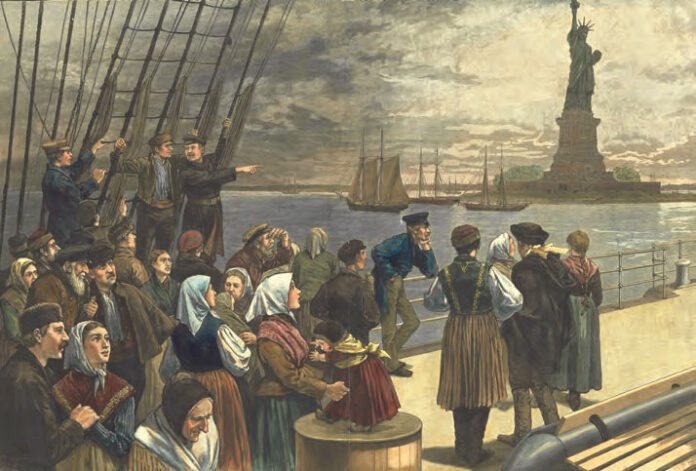
"New York—Welcome to the Land of Freedom…" Anonymous, Published July 2, 1887
South Street Seaport Museum, gift of Fritz Gold, 1994.017.005
Ellis Island Art > A Collection Spotlight
By David Masello
Peter Boyer, Composer (Photo: Danika Singfield)
Peter Boyer has struck actual notes that resonate not only with American immigrants, but also with his own ancestors. He has composed 35 concert works that have earned him a Grammy nomination and many other accolades. Among his compositions is “Ellis Island: The Dream of America” (2002), which brings together a full orchestra with actors and projected images to acknowledge the millions of immigrants who passed through Ellis Island between 1910 and 1940. The piece includes verbatim remembrances that Boyer obtained through the Ellis Island Oral History Project — words written long ago by seven immigrants hailing from Russia, Hungary, Italy, Greece, Ireland, Poland, and Belgium.
After visiting the island numerous times and reading immigrants’ letters recounting their impressions of sailing into New York Harbor, Boyer delved into his own family’s past and learned something new. “Although my grandfather had told me about his father having come to America from Naples, little else about that trip was known,” recalls the composer from his home and studio in Altadena, California.
“So many who started life anew in America didn’t dwell on the journey itself; my great-grandfather Francesco, who died when I was 12, never mentioned anything to me. He sailed from Europe in May 1912, and I’m struck by the fact that this was the month after the Titanic had sunk. I wonder how his knowing this might have affected his impressions of the voyage.”
Complementing Boyer’s personal experience of Ellis Island were historical images of it he carried in his head. One was an engraving published in the July 2, 1887 edition of Frank Leslie’s Illustrated Newspaper, the original of which is owned by New York’s South Street Seaport Museum. Its caption reads New York—Welcome to the Land of Freedom—An Ocean Steamer Passing the Statue of Liberty: Scene on the Steerage Deck. This colorful and detailed scene shows a group of immigrants reacting to the vista into which they are sailing. As the exact ethnicities of the figures are not immediately discernible, the group can be thought of as representing the whole of the European continent from which most immigrants in that era came.
Boyer’s epic composition, which has been performed 286 times by 125 different orchestras, directly echoes much of what we see in this image, which was drawn by one of the newspaper’s unnamed staff artists. He notes, “I look at this and feel an actual chill down my back seeing their different expressions and thinking about what they all had to go through on this voyage.”
“The Statue of Liberty is clearly a symbol here,” Boyer continues, emphasizing that it was dedicated in 1886, the year before the illustration. “This image is both reportage and commentary that captures the emotions of these people. It pulls you in.” Indeed, the figures, after enduring many days in cramped quarters, collectively demonstrate excitement at seeing the looming statue, the harbor full of ships, and, though it is not visible, the city skyline, at which some appear to be gazing in awe.
“The illustration conveys the communal sense of arrival,” Boyer observes. “Everyone depicted is about to begin their new chapter.” His composition is an audible articulation of the emotions such people likely felt, and their voices live on through it.
Browse art video workshops available now at PaintTube.tv, including how to paint landscapes, sunsets, waterfalls, and much more!
As part of our effort to continue to help artists and art galleries thrive, we’re proud to bring you this week’s “Virtual Gallery Walk.” Browse the artwork below and click the image itself to learn more about it, including how to contact the gallery.
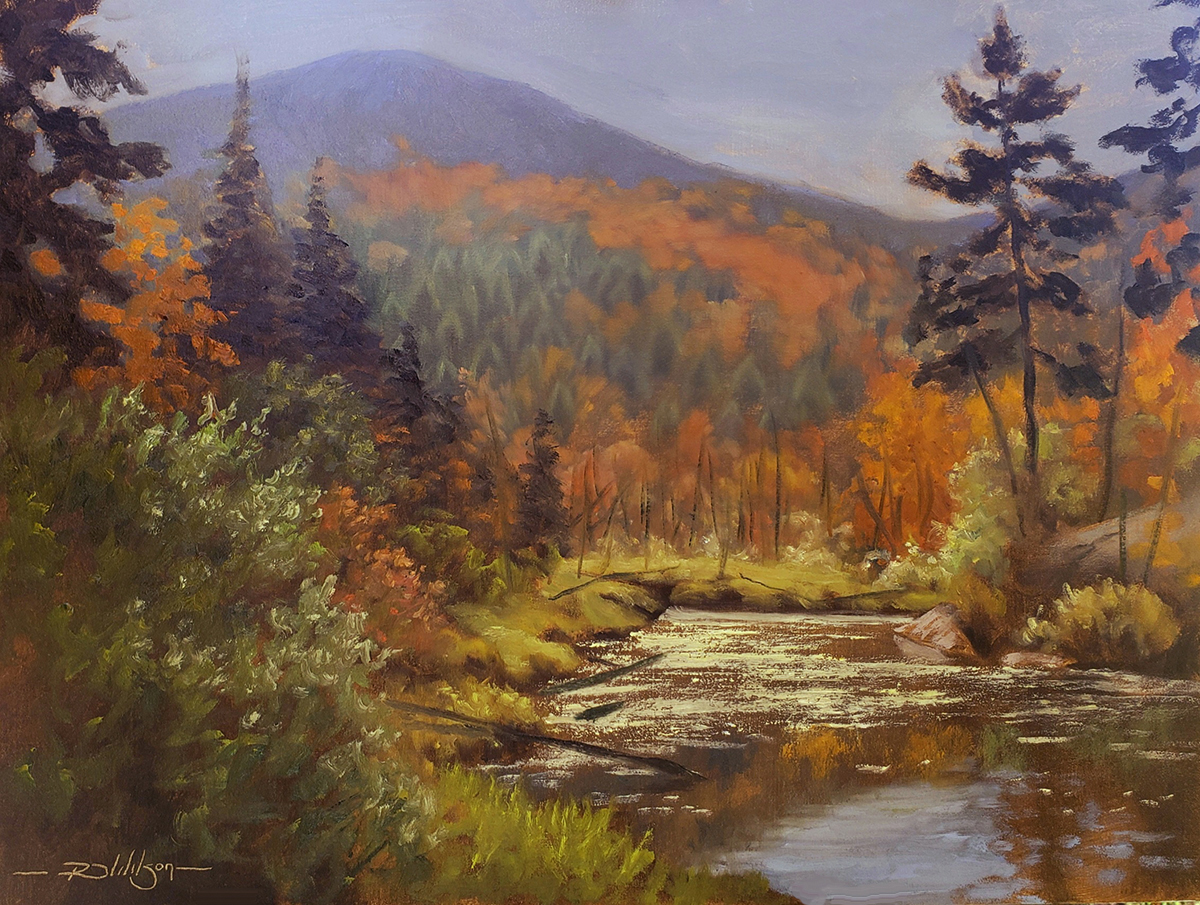
Adirondack Autumn, Rick D Wilson, 12 x 16 in, oil plein airCalifornia Wildflowers, Tamara Smith, oil on linen canvas, 20 x 30 in; California Art Club
Want to see your gallery featured in an upcoming Virtual Gallery Walk? Contact us at [email protected] to advertise today. Don’t delay, as spaces are first come, first served, and availability is limited.
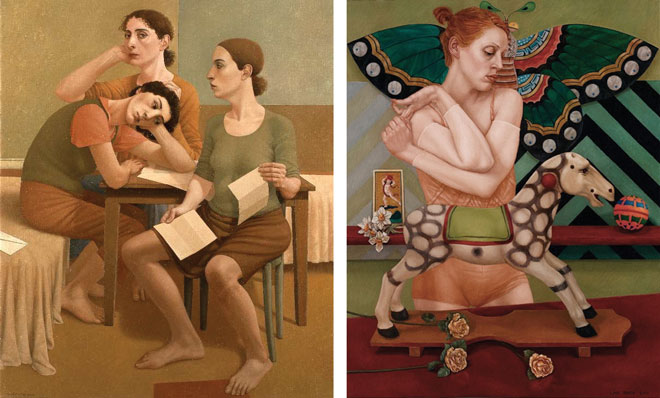
(left) Alan Feltus, "Le Sorelle," 2005, oil on linen; (right) Lani Irwin, "La Farfalla (or the Counterfeit Chambermaid)," 2005, oil on linen
Both Lani Irwin and Alan Feltus paint stunning figurative paintings that compel the viewer to stop and contemplate. They are quiet paintings that are both formally impeccable and psychologically intriguing. Feltus’ figures are ambiguously gendered and strangely simultaneously aware and unaware of each other. Irwin’s female figures are powerful magicians that confront the viewer head on.
This exhibition presents the works of these two artists – who are married to each other – together in the same space, allowing the viewer to consider their paintings in conversation.
“Lani Irwin & Alan Feltus: Selected Works”
Bannister Gallery
Rhode Island College
Providence, Rhode Island ric.edu
April 3-25, 2025
Alan Feltus, born in 1943 in Washington, D.C., has been represented by Forum Gallery in New York City since 1976. Lani Irwin, born in 1947 in Annapolis, MD, has exhibited widely in both the US and in Italy. Both artists’ work can be found in many public collections, including the Smithsonian American Art Museum and the Hirshhorn Museum and Sculpture Garden. They have lived and worked near Assisi, Italy, since 1987 and have two sons.
John Frederick Lewis (1804–1876), "A Reception in the Harem," 1873, watercolor and bodycolor on paper, 29 x 41 in.
A rediscovered masterpiece in watercolour, “A Reception in the Harem” by John Frederick Lewis (1804-1876), unseen in public for over 60 years, was the top lot at Bonhams 19th Century & Orientalist Paintings sale March 26 at Bonhams New Bond Street, London. The work, which had been in the same private collection since 1961, sold for £1,137,400.
The 69-lot sale made a total of £2,693,754.
More from Bonhams:
Charles O’Brien, Head of 19th Century Paintings at Bonhams, commented: “An extraordinary watercolour by John Frederick Lewis, ‘A Reception in the Harem’, was an exciting discovery, having not been exhibited publicly for over 60 years. Rich in the intricate detail and the jewel-like colours that made Lewis’ reputation, it is no wonder this work caught the eye of collectors eager to acquire a work by one of the greatest British Orientalist painters.”
John Frederick Lewis (1804-1876) was one of England’s most prominent 19th-century painters. He excelled in both oil and watercolour, was elected President of London’s Old Watercolour Society in 1855 and was made an Associate of the Royal Academy in 1859 and a full member in 1865. Lewis’s ten-year period of residency in Egypt in the 1840s led to the widespread belief that his incredibly popular scenes of the Middle East and North Africa, which he produced after 1850, were the work of a cultural insider.
By mixing watercolour pigments with Chinese white he discovered they could rival the look of oils. By the early 1860s, Lewis began to systematically produce two nearly identical versions of a work, one in oil, destined for exhibition at the Royal Academy, and one more elaborate version in watercolour for collectors.
“A Reception in the Harem” is a larger version of the celebrated oil painting by Lewis at the Yale Center for British Art in New Haven, Connecticut.
Other highlights of the sale included:
John Frederick Lewis, RA, POWS (British, 1804-1876), Interior of the Hagia Sophia. Sold for £190,900.
Marie Spartali Stillman (British, 1844-1927), Mia suora Rachel. Sold for £140,100.
Jean-Baptiste-Camille Corot (French, 1796-1875), Souvenir de la Rotte, près Rotterdam. Sold for £140,100.
Sir Alfred James Munnings, PRA, RWS (British, 1878-1959), George Schicht on John Peel III. Sold for £127,400.
Rudolf Ernst (Austrian, 1854-1932), The farrier. Sold for £108,350.
For a full list of forthcoming auctions, plus details of Bonhams specialist departments, please visit bonhams.com.
Attention Art Collectors! May 20-22, 2025: Visit the Plein Air Convention & Expo’s robust pop-up art gallery at the Nugget Casino Resort in Reno, Nevada, where hundreds of artists, including our master faculty, will have studio and plein air works on display and ready to purchase. Register for the full event at PleinAirConvention.com now.
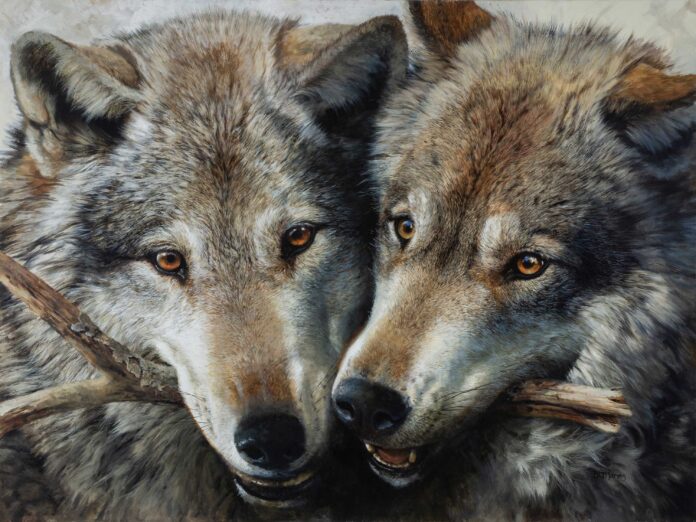
Bonnie Marris, “The Best Stick Ever,” Oil on canvas, 34” x 48”
The Briscoe Western Art Museum proudly presents the 2025 Night of Artists Exhibition and Sale, a premier celebration of the American West and one of the nation’s leading Western art events. Taking place March 28-29, 2025, this year’s event showcases over 270 exceptional works by more than 85 of today’s top contemporary Western artists, drawing collectors, enthusiasts, and artists from across the country.
The two-day celebration includes exclusive collector experiences, artist demonstrations, a live auction and the highly anticipated Luck of the Draw sale. A public exhibition of the works follows, running March 30 – May 11.
“Night of Artists is always our most anticipated event of the year. But the overwhelming interest in this year’s event is a testament to the deep love of the American West – and the appreciation of the fantastic art that highlights the stories and traditions of our Western heritage and culture,” said Liz Jackson, President and CEO of the Briscoe Western Art Museum. “We can’t wait to welcome everyone and showcase the body of work presented by this year’s artists. The exhibition is stunning, and we have no doubt that art enthusiasts will find works that compliment, or even kick off, their collections.”
Jeremy Winborg, “My Sister and Me,” 2024, Oil, 30” x 45”
New This Year: The Small Works Sale
For the first time, the Briscoe is featuring a Small Works Sale, offering collectors and art enthusiasts the chance to acquire smaller-scale pieces from renowned contemporary Western artists. These intimate, high-quality works will be available during the evening celebration on Friday, March 28, and buyers will be able to take their purchases home immediately. Whether you’re a seasoned collector or just beginning your journey, this sale provides a rare opportunity to own an original piece of Western art in an accessible format.
Featured Artists
The 2025 Night of Artists welcomes an extraordinary lineup of returning favorites and exciting new voices in Western art. New artists include Thomas Blackshear II, Sean Michael Chavez, Scott Christensen, Quang Ho, Josh Elliott, Dean Mitchell, T. Allen Lawson, Sally Maxwell, Kyle Ma, Matt Smith, Daniel Sprick, Dustin Payne, and Vic Payne.
Artists returning to the celebrated exhibition and sale include Martin Grelle, John Coleman, Greg Beecham, Eric Bowman, G. Russell Case, Bonnie Marris, Teresa Elliott, William Haskell, Jeremy Lipking, Ed Natiya, Don Oelze, Howard Post, Grant Redden, Gladys Roldán-de-Moras, Billy Schenck, Jim Vogel, Morgan Weistling, and Jeremy Winborg.
“The incredible talent at Night of Artists is what makes this event one of the most anticipated in the Western art world,” said Jackson. “This year’s lineup showcases the breadth and vibrancy of Western art today. We’re honored to host such remarkable artists and share their work with our community.”
Xiang Zhang, “From Texas,” Oil on linen, 20” x 16”
Exhibition on Display through May 11
Following the opening weekend, the Night of Artists public exhibition and sale will remain on view through May 11, allowing visitors to experience and appreciate the breathtaking collection of contemporary Western art. This extended exhibition offers an opportunity for those unable to attend the sale events to see the remarkable talent shaping today’s Western art scene and purchase any remaining works. The exhibition is included in museum admission. Works not sold during opening weekend will be available for purchase both in-person and online. For tickets, absentee bidding and art sale information, visit briscoemuseum.org/noa or call 210.299.4499.
Attention Art Collectors! May 20-22, 2025: Visit the Plein Air Convention & Expo’s robust pop-up art gallery at the Nugget Casino Resort in Reno, Nevada, where hundreds of artists, including our master faculty, will have studio and plein air works on display and ready to purchase. Register for the full event at PleinAirConvention.com now.
Fill your mind with useful art stories, the latest trends, upcoming art shows, top artists, and more. Subscribe to Fine Art Today, from the publishers of Fine Art Connoisseur magazine.