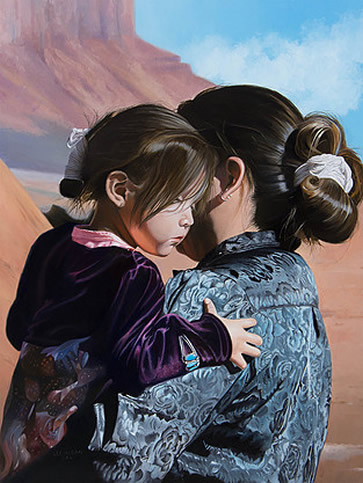
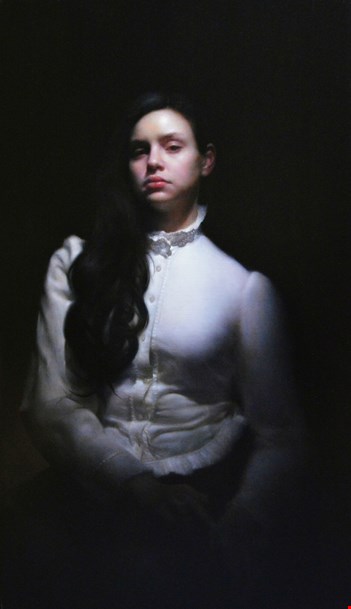
Fatima Ronquillo, “Allegory of Spring,” oil, 24 x 20 inches
Young love is ephemeral, spellbinding, enchanting, and maddening, and that is what painter Fatima Ronquillo finds inspirational in her latest body of work, on view here.
Drawing upon the tradition of classical portraiture, idyllic Rococo-style settings, classicism, and mythology, there’s no shortage of stimulating content during Fatima Ronquillo’s upcoming solo exhibition, “Mad Enchantment,” at Meyer Gallery in Santa Fe, New Mexico. Opening on September 15 and continuing through September 29, “Mad Enchantment” is a “continuation of the flora and fauna and blind love themes that I’ve been working on the past couple of years,” the artist suggests. “But this time there is a bit more magic. There is a mad enchantment that possesses the heart and mind when confronted by the possibilities glimpsed through visions of beauty and love.”
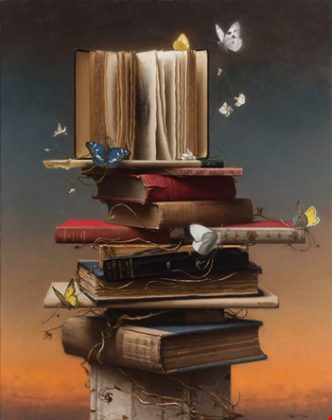
Fatima Ronquillo, “Feast with Cupid and Velvet Monkey,” oil, 32 x 30 inchesFatima Ronquillo, “Mad Enchantment,” oil, 40 x 30 inchesFatima Ronquillo, “Cupbearer with Ornate Hawk Eagle,” oil, 30 x 24 inchesFatima Ronquillo, “Masked Eros,” oil, 12 x 9 inches
The gallery adds, “The seducing beauty of springtime sets the scene for Ronquillo’s dramas, while her imagined characters’ blind desires and innocent infatuations weave stories of forsaken love in idyllic Rococo-style settings. The artist’s classical references extend to mythological subjects, such as Diana, Cupid, or Bacchus, adding to the magical realism of her work. Symbolism including animals, sheer blindfolds, and physical wounds of love contribute to each composition’s underlying narrative while retaining enough mystery to intrigue the viewer. Spring’s transient blooms fill Ronquillo’s paintings as symbols of natural beauty, the object of our fleeting desires.”
This article was featured in Fine Art Today, a weekly e-newsletter from Fine Art Connoisseur magazine. To start receiving Fine Art Today for free, click here.

The North Shore Arts Association will soon be hosting an important selling retrospective exhibition surrounding Charles Movalli, featuring over 95 pieces of his work.
On September 17, the North Shore Arts Association in Gloucester, Massachusetts, will open a selling retrospective exhibition on artist Charles Movalli. Curated by his wife and artist Dale Ratcliff Movalli, the exhibition tells a brilliant story of how Movalli relished his reputation as an avant-garde painter and man of letters.
In an article titled “Charles Movalli — A Versatile Brush,” author Judith A. Curtis suggests, “Others viewed him as a bridge between traditionalism and the modernists, not only on Cape Ann and the North Shore, but across the country, and as far afield as Europe. Charles Movalli touched the lives of everyone who knew him; through his art, his vision, his writing — he authored numerous how to art books and eighty plus articles for American Artist — not to mention his dry wit and skill as a raconteur.
“From Renaissance man to Frank Lloyd Wright aficionado, the genius that was Charles Movalli pulled inspiration seemingly from the ether, inspiring and guiding countless students through his teaching, writing, and unflagging enthusiasm. He was quick to espouse the virtues of traditional art, championed by many of the Cape Ann painters, but was quick to step outside the box — eschewing the obvious to explore the esoteric— holding as his own mentor one whom he called America’s greatest artist — architect Frank Lloyd Wright!”
The exhibition will continue through October 28 with a preview reception on September 15. To learn more, visit the North Shore Arts Association.
This article was featured in Fine Art Today, a weekly e-newsletter from Fine Art Connoisseur magazine. To start receiving Fine Art Today for free, click here.

Leave it to Fine Art Connoisseur publisher Eric Rhoads to offer his readers once-in-a-lifetime opportunities to travel the world to incredible locations, learning about distant times and cultures through magnificent works of art. One of the most ambitious and amazing trips he’s planned yet kicks off tomorrow!
The recent political turmoil between the United States and Russia is of no concern to an amazing group of 50 collectors and artists who will gather in Moscow tomorrow for a once-in-a-lifetime opportunity. The trip has stemmed from numerous requests to return since a similar tour in 2010.
“It was one of our most memorable trips ever because of our ability to go places tourists and even art connoisseurs would ordinarily never have access to,” says Rhoads. “For the first time, our annual cruise is not a cruise at all. There is so much deep and rich culture in both Moscow and St. Petersburg that we decided to do a land-based trip, with five days in each city and a high-speed train between.
“Peter Trippi, editor of Fine Art Connoisseur magazine, and I have deep art connections and friendships in this magical place, home to some of the most important art in the world. Friends and acquaintances include the heads of the top art academies in Moscow and St. Petersburg, the director of the Hermitage Museum, and many prominent artists, some of whom are world famous.
“Of course, one cannot go to Russia without seeing its amazing palaces, churches, and other tourist locations, so we’re incorporating those into our art-heavy itinerary; that is why we’re spending five days in each city.”
Of course, Fine Art Today will keep you updated on their travels in Russia between September 10 and 20, so stay tuned! To learn more about this trip and how you can become part of a future trip, visit Russian Art Trip or Fine Art Cruise.
This article was featured in Fine Art Today, a weekly e-newsletter from Fine Art Connoisseur magazine. To start receiving Fine Art Today for free, click here.
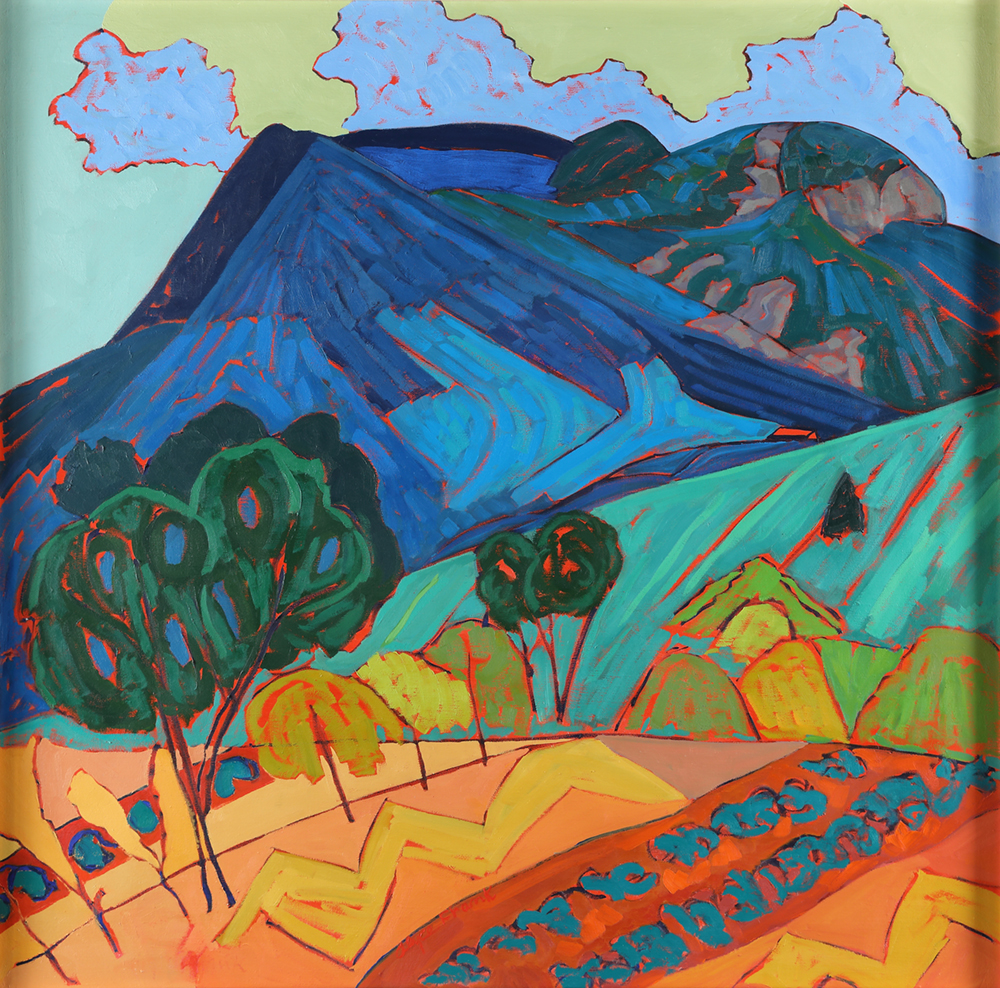
Breehan James, “August Moon,” 2016, oil on canvas, 60 x 48 inches
Seeing the wilderness of Northern Wisconsin and the Boundary Waters of Minnesota is an unforgettable experience, captured through the magical paintings of Breehan James during this tantalizing solo show. Where?
Breehan James, “Red Rock Lake Night,” 2017, gouache on paper, 22 x 30 inches
Tory Folliard Gallery in Milwaukee will soon unleash a fantastic solo exhibition on the world. Opening September 15 and on view through October 14, “A Hunter’s Heart, A Fisherman’s View” is a vibrant showcase of new works by artist Breehan James, who delights in capturing the mystical forests found in Northern Wisconsin and Minnesota. Through her use of bold lines and saturated color, James’ paintings have a crispness that echoes the untouched subjects she depicts.
This article was featured in Fine Art Today, a weekly e-newsletter from Fine Art Connoisseur magazine. To start receiving Fine Art Today for free, click here.
Robert Griffing, “On the Banks of the Alleghenies,” 2017, oil on linen, 24 x 40 inches
Collectors and connoisseurs alike are enthusiastic about this weekend’s events in Indianapolis. Are you in the know?
This weekend the Eiteljorg Museum of American Indians and Western Art in Indianapolis, Indiana, will host the widely anticipated Quest for the West Art Show and Sale, featuring some 50 artists showcasing more than 200 recent works not exhibited previously. 2017 is the event’s 12th year, and the exhibition of works will continue through October 8.
John Moyers, “Dakota Badlands Study,” 2017, oil, 12 x 12 inchesP.A. Nisbet, “Beneath the Blue Moon Bench,” 2012, oil on linen, 30 x 42 inches
“We’re thrilled by the popularity of the Quest show among artists, collectors, and museum visitors who come to the Eiteljorg specifically to see the best contemporary Western art,” Eiteljorg President and CEO John Vanausdall said. “Our museum’s Western Art Society was visionary in advocating for creating Quest in 2006 to bring compelling new works to the Eiteljorg each year. To see what Quest has become on a national scale and what it means to our museum is something special.”
Deborah Copenhaver Fellows, “Where the Sun Goes,” 2016, bronze, 26 x 18 1/2 x 11 inches
New in 2017 is a miniature art sale to be hosted on Friday, September 8. The Eiteljorg developed the first-ever Quest Miniature Art Sale to serve beginning art collectors who seek affordably priced works and experienced collectors who no longer have room for large paintings or sculptures and want pieces that take up less space. To be entered into the Quest Miniature Art Sale, paintings must be no larger than 12-by-12 inches and sculptures no taller than 8 inches. Buyers purchasing miniatures at that sale can pick them up that night. At last year’s event, nearly $1 million in art was sold. The museum keeps a percentage of art sales to support its operations and to acquire the Harrison Eiteljorg Purchase Award artwork.
This article was featured in Fine Art Today, a weekly e-newsletter from Fine Art Connoisseur magazine. To start receiving Fine Art Today for free, click here.

Most of us would agree that PBS offers some fantastic programming for our viewing pleasure. They’ve certainly done it again with an upcoming documentary that delves into the life, times, and career of one of America’s greatest Western painters.
On September 9, Great Falls, Montana, will host the world premiere of the Montana PBS documentary titled “C.M. Russell and the American West.” In conjunction with the release, and to welcome a film that underscores Russell’s place among great American artists, the museum has also planned three days of community-sponsored events titled “Raise the Roof for the Russells.”
“A young Charlie Russell fell in love with Montana and called Great Falls home. His legacy is an immeasurable inspiration to and influence on the people here,” said Tom Petrie, chairman of the C.M. Russell Museum board. “Our community support and dedication to launching a film that brings Charlie’s fascinating story and timeless message to the world is both exciting and humbling. The spirit of the American West remains impressive in Great Falls.”
Great Falls Mayor Bob Kelley added, “The community of Great Falls is excited to share the story of her favorite son with all his followers throughout the state and the nation. Charlie’s story is just one of the many things we are proud of. I hope visitors and residents take advantage of such a wonderful celebration.”
The schedule for “Raise the Roof for the Russells” includes the following events. All will be held at the C.M. Russell Museum unless otherwise noted.
The public opening ceremony for the Frederic G. and Ginger K. Renner Research Center on September 8 at 11 a.m.
A member opening of the Josephine Trigg Collection Gallery Exhibition and the Strand Collection Exhibition on September 8 at 4 p.m.
An auction to benefit the Russell House and Studio presented by Petrie Partners on September 8 at 6 p.m.
A Russell Riders Outdoor Sculpture Garden ceremony on September 9 at 2 p.m.
A chuck wagon barbecue on September 9 at 3 p.m. presented by Benefis Health System
VIP meet-and-greet event at the Mansfield Convention Center on September 9 at 5 p.m.
The world premiere screening of “C.M. Russell and the American West” at the Mansfield Theater on September 9 from 6-9 p.m. presented by Benefis Health System
A short description of the film:
“C.M. Russell and the American West” examines the life and art of Charles Marion Russell (1864-1926). The film explores his arrival in Montana as a youth, his apprenticeship and work as a cowboy on the open range, and his self-taught, almost explosive growth into an iconic American artist who affected generations. Russell’s body of work was panoramic and modern in his sensitivity to subject matter, from a reverence for the land and wildlife to his positive depictions of American Indians. The film was created by Producer/Director Gus Chambers and Producer/Writer Paul Zalis. William Marcus and Aaron Pruitt of MontanaPBS are Executive Producers.”
This article was featured in Fine Art Today, a weekly e-newsletter from Fine Art Connoisseur magazine. To start receiving Fine Art Today for free, click here.
John Singer Sargent, “The Daughters of Edward Darley Boit,” 1882, oil on canvas, 87 x 87 inches, Museum of Fine Arts Boston
In this occasional series, Fine Art Today delves into the world of portraiture, highlighting historical and contemporary examples of superb quality and skill. This week we look at one of John Singer Sargent’s most well-known paintings.
The grand foyer of Edward and Mary Boit’s luxurious home on the avenue de Friedland in Paris was the setting for a magnificent group portrait by the American expatriate John Singer Sargent in the autumn of 1882. In a shadowy setting, Sargent has delicately placed the couple’s four daughters — Mary Louisa, Florence, Jane, and Julia — in a rather odd arrangement. “While Ned and Isa may have initially approached Sargent to make a traditional portrait, they supported his ambition to create something more unusual, a painting that is half a portrait and half an interior scene,” Erica Hirshler of the Museum of Fine Arts Boston writes.
“Each of the girls is presented individually, but the features of two are obscured, an attribute antithetical to conventional portraiture and one that, combined with the lack of connection between the girls, stymied critics when the painting was first displayed. Its unusual format was inspired by the art of both the past and the present, a characteristic approach that Sargent employed to make paintings that seemed simultaneously traditional and modern. The historical precedent for the Boit portrait can be found in the work of the seventeenth-century Spanish master Diego Velázquez, an artist greatly admired in nineteenth-century France. Sargent had traveled to Madrid in 1879 to make copies after Velázquez at the Museo Nacional del Prado; among the paintings he studied was ‘Las Meninas’ (about 1656), a large and famous portrait of the young Spanish infanta with her maids in a great shadowed room. Sargent adapted Velázquez’s mysterious space, his dark subdued palette, and the manner in which his self-possessed princess directly confronts the viewer. At the same time, Sargent must have been thinking of the unusual portraits and oddly centrifugal compositions of his French contemporary Edgar Degas. ‘The Daughters of Edward Darley Boit’ shares some of Degas’s strategies: the asymmetrical composition with an almost empty center, the sense of disconnection between family members, and a feeling of modern life interrupted.
“Sargent placed the Boit girls in an indeterminate space — the entrance hall, neither entirely public nor entirely private — that is brightly lit in the foreground but recedes into a vaguely defined drawing room half-lit with mirrors and reflections. The two tall Japanese vases, made in Arita in the late nineteenth century specifically for export to the West, were prized family possessions; their unusual size in relation to the girls makes the interior seem strange and magical. The sisters are dressed almost alike, in the sort of casual clothes they would have worn in the schoolroom or at play. Their white pinafores gave Sargent an opportunity to demonstrate his mastery at painting white in different conditions of light. Only the youngest girl, Julia, engages the viewer, while the older girls recede progressively into the shadows, becoming increasingly indistinct.
“Sargent titled the painting ‘Portraits of Children’ and displayed it in December 1882 in an exhibition at the gallery of the French dealer Georges Petit, who specialized in works by an international group of artists who were more modern than many of the painters who showed at the Salon, but less innovative than the Impressionists. The picture received generally good reviews, and Sargent decided to display it again the following spring, this time at the Salon, the annual state-run exhibition in Paris that was an important venue for artists seeking to build their reputations. While some critics praised Sargent’s technical abilities, most found the composition troubling for its unconventional approach to portraiture. One unidentified writer even described it as ‘four corners and a void.’ While some have interpreted Sargent’s strategy as a poignant comment on the fickle nature of childhood and adolescence, writer Henry James, a friend of both the Boits and Sargent, described the picture as a ‘happy play-world of a family of charming children.’ With this painting, Sargent masterfully transcended portraiture, providing a continuously evocative meditation on openness and enigma, public and private, light and shadow.”
This article was featured in Fine Art Today, a weekly e-newsletter from Fine Art Connoisseur magazine. To start receiving Fine Art Today for free, click here.
Albert Bierstadt, “Passing Clouds Over the Mountains,” oil on canvas, 42 1/4 x 32 1/2 inches
In this ongoing series for Fine Art Today, we take a longer look at the history and features of a soon-to-be-available artwork of note. This week we highlight a Hudson River School landscape that’s sure to intrigue collectors.
Although he was born in Germany and would eventually study his craft there for several years, Albert Bierstadt (1830-1902) is widely recognized as one of America’s greatest artists and was a founding member of the famed Hudson River School. Bierstadt’s parents moved to Massachusetts when Albert was just a year old, in 1831. From childhood, Bierstadt displayed a keen interest in and notable talent for art.
Bierstadt’s artistic career was officially launched around 1858, when a landscape exhibited at the National Academy of Design found instant appeal to critics. It was around this time that the artist met other like-minded artists who adored landscape painting with romantic, almost glowing light. Among them were Thomas Moran, Thomas Cole, Frederic Edwin Church, John Frederick Kensett, and Asher Durand. This group of painters would eventually be categorized as members of the Hudson River School.
Along with several other artists, Bierstadt began to travel with various companies and journeymen of the Westward Expansion. Bierstadt’s lavish views of the American West — including many areas that became national parks — enlivened the imaginations of his viewers and helped cultivate a desire to preserve these lands among the public.
Bierstadt’s financial success is noteworthy as well. In 1865, the artist’s magnificent work “The Rocky Mountains, Lander’s Peak” sold for an astronomical $25,000, the equivalent of around $350,000 in today’s market.
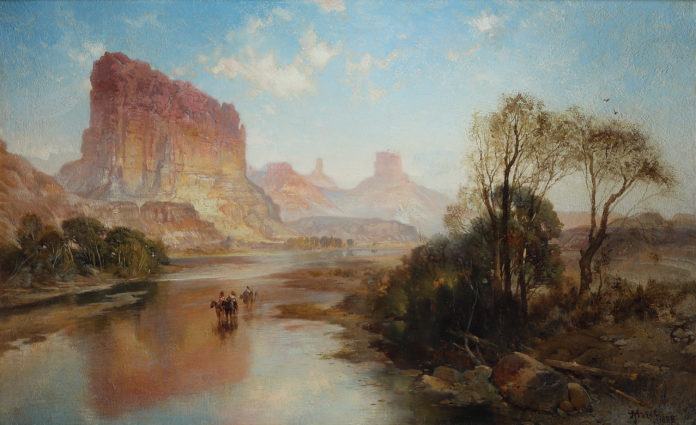
It seems collectors have eagerly bought up Bierstadt’s original works since their production, and the trend continues to this day. Opportunities to purchase an original work from this iconic figure are few and far between, which makes the September 17 sale at Clars Auction Gallery in Oakland, California, significant. Heading to auction, among other works by Thomas Moran and Edgar Payne, is a fantastic original by Bierstadt titled “Passing Clouds Over the Mountains.” The painting is set at the base of a rushing mountain river, and the viewer gazes up toward the cloud-covered peaks of several mountains. In the foreground are several large evergreen trees and a brightly lit path towards the viewer’s right. Auction estimates are between $70,000 and $100,000.
This article was featured in Fine Art Today, a weekly e-newsletter from Fine Art Connoisseur magazine. To start receiving Fine Art Today for free, click here.
Patricia Watwood, "Flowers," 2016, oil on linen, 22 x 20 inches
Masterful figurative artists such as Patricia Watwood are in such a unique position because — perhaps better than any other subject — the human body can communicate a multitude of deeply moving and fundamental themes. How and why does she do it? Find out here.
The list of world-class faculty members who will be included in the first ever Figurative Art Convention & Expo, to be held November 8-11, 2017 in Miami, continues to grow. Organizers couldn’t be more excited that one of them is New York-based painter Patricia Watwood. In addition to having developed mastery with her technique, Watwood explores transformative narratives, mythological archetypes, and the human condition in her paintings, which have continued to intrigue collectors, connoisseurs, and galleries for years.
Patricia Watwood, “Femen Flora (Sarah),” 2015, pencil and chalk on blue paper, 16-3/4 x 13-1/2 inches
Although Watwood’s most common subject matter includes female nudes, each painting begins with a theme or narrative that interests or inspires the artist. That theme is then developed through small sketches. “A pictorial theme sticks with me when I find ways in which it has connections with my own preoccupations or societal issues — the painting has multiple levels of operation,” Watwood says. “Certain images just pop into my head as a composition. I have developed a practice of making small thumbnails of these ideas (or even just a written description if I can’t sketch), so that I can get them down when I catch them.
Patricia Watwood, “Femen Flora (Larissa),” 2015, pencil and chalk on blue paper, 18-1/4 x 14 inches
“Lately these are small pencil and watercolor sketches that record the inspiration. I don’t allow myself to judge — it’s just a tiny little piece of paper with some color. There’s nothing at stake, and, in this way, I can allow myself to at least explore any pictorial idea that comes and try to catch inspiration before it drifts away.”
Patricia Watwood, “Femen Flora,” 2015, oil on linen, 28 x 26 inchesPatricia Watwood, “Lunette I (Anna),” 2015, pencil, pastel and watercolor on paper, 15 x 15 inches
One of the artist’s current projects — a painting of Suzannah and the Elders — typifies her incredible process. Watwood writes, “This painting actually started with a figure drawing that I made and loved the pose. I added a little composition to the drawing that became an idea firmly lodged in my head. The theme is about ‘forbidden images’ — the two elders spy on the beautiful Suzannah while she’s bathing in the moonlight. Lust, voyeurism, permission, desire, beauty, power — all these thoughts circle around this image for me — which I find very interesting from a feminist point of view as a female artist who paints beautiful women.
“So, with a drawing and a theme that intrigued me, it seemed destined to become a painting. However, then the drawing sat around for a long while waiting for me to get back to it while I finished other things. Finally, I started the painting a year ago, and worked for a while on the main figure. After another long pause, I’ve finally resolved the background, which is a dark nocturnal moonlit scene. It was completely unfamiliar territory, so it was slow pulling it out of the murk. I find I can proceed with quick confidence in areas that I’m familiar with — but whenever I work on some new challenge, it can be slow going.”
Patricia Watwood, “Study for The Sixth Extinction,” 2015, sanguine, charcoal and watercolor on paper, 44 x 30 inches
Narratives such as “forbidden images” or feminism and mythology are extremely important elements in Watwood’s painting. “In fact,” she adds, “if there isn’t some narrative in the painting, then I’m usually not interested in developing it. Occasionally, I make a painting ‘just because it’s pretty’ or for other formal painterly reasons, but I usually want my paintings to work on several levels — the first being aesthetic and pictorial, and the second being narrative and philosophic. I think narratives communicate in a very interesting way with viewers — like a novel or poem that can be read and unraveled. I’m interested in this level of communication, in addition to the visual aesthetic language.”
All told, Watwood seeks to spark connection between people and places in her paintings, “giving my audience a sense of the soul — in themselves and in the art,” she continues. “I hope they see a sense of the power and sacredness of the body and understand it to be in themselves as well.”
Patricia Watwood, “The Sixth Extinction (detail),” 2015, oil on linen, 67-1/2 x 51-1/2 inches
Naturally, and as alluded to above, the human figure is perfectly suited to Watwood’s conceptual and aesthetic goals. “At heart, my interest in the figure is all about my search for meaning in life in general,” she says. “My worldview tells me that we are spiritual beings having a human experience — a beautiful, terrible, wonderful human experience. The poignancy of our human condition seems to be the most interesting thing in the world to me. You could say that I’m trying to create documentary proof of the soul.”
Patricia Watwood, “The Sixth Extinction,” 2015, oil on linen, 67-1/2 x 51-1/2 inches
Can’t you see why we’re so excited to have her as faculty at FACE2017? In November, Watwood will be teaching as a studio mentor, guiding attendees through making figurative paintings from a model. Through these sessions, Watwood will be painting as well, sharing her techniques and approach. She will also be taking part in a panel discussion on figurative art in which she will share her passion for how artists develop creativity and complexity in figurative painting. “I’ll share my perspective and insights from my 20 years in the field in New York City,” she says. “I think folks should attend because the conference is uniquely focused on the development of excellence in figurative art. If you are interested in participating in and having a career in this field, there’s nothing like FACE.”
This article was featured in Fine Art Today, a weekly e-newsletter from Fine Art Connoisseur magazine. To start receiving Fine Art Today for free, click here.
Andrea Kowch, "Courtiers," 2016, acrylic on canvas, 36 x 60 inches, RJD Gallery
by Kelly Compton
Look up toward the sky, or out of your window. Chances are good you will spy a bird soon enough. Though some humans share their homes with birds, all people are surrounded by these feathered creatures, and, though we may not regularly acknowledge it, out world would be a quieter, duller place without them. In this section, we highlight the broad array of birds depicted by a flock of artists in recent years. Many of these images transcend description or charm to underscore the more profound, even symbolist, meanings that we humans has assigned to birds over the centuries.
Michael Dicker, “Babel,” 2016, oil on canvas, 60 x 40 inchesWill Hemsley, “Descent (edition of 15),” 2009, bronze, 7 x 4 x 4 ft.Kat Houseman, “Red Sun Wren,” 2016, oil and copper leaf on canvas, 12 x 12 inchesAnni Crouter, “Spooked,” 2015, watercolor on paper, 19 x 24 inchesMichael Dumas, “High Summer (Yellow Warbler),” 2015, oil on birch, 7 x 5 inchesRob Rey, “Bioluminescence IV,” 2016, oil on board, 18 x 24 inchesPaul Rhymer, “Rant and Skeptic (edition of 25),” 2013, bronze, wood and steel, 72 x 40 x 24 inchesShawn Gould, “Aspen Embrace,” 2017, acrylic on panel, 24 x 24 inchesKent Ullberg, “Mind and Passion,” 2016, bronze and stainless steel,” 26-1/2 x 17-1/2 x 6 inchesEzra Tucker, “American Kestrel,” 2016, acrylic on board, 11 x 15 inchesTerry Miller, “Preserve and Protect,” 2013, graphite on board, 7-3/4 x 18 inchesCarol Guzman, “Crabapple Pie,” 2016, oil on linen on board, 11 x 14 inchesThomas Broadbent, “Feeding Birds 2,” 2012, watercolor on papJacob A. Pfeiffer, “Full Spectrum,” 2015, oil on panel, 8 x 22 inchesMary Alayne Thomas, “The Reader,” 2016, encaustic on board, 10 x 10 inchesKathryn Mapes Turner, “Lady,” 2012, oil on canvas, 30 x 24 inchesRyan D. Jacque, “End of Summer,” 2005, pencil on paper, 15 x 18 inchesJan Stommes, “Moving On,” 2017, oil on canvas, 3 x 4 ft.Sarah Lamb, “A Brace of Quail,” 2012, oil on linen, 22 x 20 inchesBrad Woodfin, “Frédéric,” 2016, oil on panel, 16 x 12 inchesAnn Moeller Stevenson, “Above the Storm,” 2017, oil on aluminum panel, 14 x 11 inchesHelena van Emmerik-finn, “3 Geese,” 2017, pastel on paper, 20 x 12 inchesBen Steele, “Poe’s Crows,” 2014, oil on canvas, 44 x 34 inchesStanka Kordic, “Truth and Knowledge,” 2015, oil on aluminum, 12 x 12 inchesMark Eberhard, “Red Tail Hawk,” 2017, oil on canvas, 40 x 40 inchesBart Walter, “The Critics,” 2007, bronze, 41 x 61 x 34 inchesEllen Fuller, “Sandhill Cranes,” 2015, acrylic on canvas, 24 x 72 inches
This is an excerpt from “Avian Art Takes Flight”. Find the full article in the September / October 2017 Edition of Fine Art Connoisseur Magazine.
Fill your mind with useful art stories, the latest trends, upcoming art shows, top artists, and more. Subscribe to Fine Art Today, from the publishers of Fine Art Connoisseur magazine.