
Home Blog Page 362

All Roads Lead to. . .

0
Giovanni Paolo Panini, “Capriccio View of Ancient Roman Monuments,” circa 1755, oil on canvas, 31 x 43 in.

San Francisco? Two San Francisco institutions have coordinated to offer a delightful event on March 11 for those interested in the art of the “Eternal City.”

The San Francisco Airport Commission Aviation Library and Louis A. Turpen Aviation Museum have joined to offer a great opportunity to view works from the Collection of Piraneseum. Opening March 11 with a reception from 2 to 3 p.m., the exhibition features a number of carefully selected Grand Tour objects, including paintings, drawings, etchings, sculptures, and more.

Viviano Codazzi, “Colosseum and Arch of Constantine,” circa 1650, oil on canvas, 56 x 77 in.

Via the press release: “Please join the ICAA to explore the fascinating world of Piraneseum, as member Lucia Howard guides us through her extensive collection of Grand Tour objects that convey the essence of Rome’s splendid architecture, and the timeless grandeur of its ruins. Among the more than seventy antique souvenirs are 17th and 18th century paintings, drawings, and etchings of ruins, both realistic and fully imaginary, as well as lavish, gold-finished bronze models of the Eternal City’s signal landmarks — the Columns of Trajan and Marcus Aurelius, the Arch of Constantine, Lateran Obelisk, and others.”

The exhibition, titled “All Roads Lead to Rome” will continue through August 13 and is located in the International Terminal at the San Francisco Airport. To learn more, visit here.

This article was featured in Fine Art Today, a weekly e-newsletter from Fine Art Connoisseur magazine. To start receiving Fine Art Today for free, click here.
Don’t Miss This

0
Bidding is always spirited during The Russell Live Auction, seen here in 2016. © Image courtesy C.M. Russell Museum

Mid-March is always an exciting time of year, especially when the C.M. Russell Museum hosts its annual exhibition and sale — one of the world’s premier events and destinations for collectors and enthusiasts of Western art. How’s 2017 shaping up?

Mark your calendars! From March 16 through March 18, Great Falls, Montana, will once again host the C.M. Russell Museum’s annual exhibition and sale — surely one of the most anticipated fine art events of 2017. Exhibition of available works opened on February 17 at the C.M. Russell Museum.

Members of the Russell Skull Society of Artists exhibit their works in 2016. © Image courtesy C.M. Russell Museum

The week kicks off with an Art Preview Party on March 16 from 5-7 p.m. at the museum. This will be a fantastic opportunity for the public to mingle with the artists and have one last look at the available lots. On Friday, March 17, Art in Action begins at 10 a.m. This event is “an exciting variation of a traditional ‘quick draw’” organizers write. The event culminates in a live auction of the completed works of art with 100 percent of the proceeds donated to the museum.

Friday night will witness the First Strike Auction at the Mansfield Convention Center. Focused solely on contemporary artists, this auction is the perfect opportunity to get one’s feet wet in anticipation of The Russell Live Auction on Saturday. The First Strike Auction commences at 6 p.m.

Attendees watch and interact with working artists during Art in Action 2016. © Image courtesy C.M. Russell Museum

Finally, the main event — The Russell Live Auction — begins at 4:30 p.m. on Saturday, March 18, at the Mansfield Convention Center. The evening includes a gourmet dinner and beverage service.

Not to be forgotten are the Russell Skull Society of Artists Suites, which will be on view the entire week at the Mansfield Convention Center. The C.M. Russell Museum writes, “In addition to artworks for sale by this distinguished group of Western artists, enjoy live music, delectable food, and premium beverages.”

To learn more and purchase your tickets, visit the C.M. Russell Museum.

This article was featured in Fine Art Today, a weekly e-newsletter from Fine Art Connoisseur magazine. To start receiving Fine Art Today for free, click here.
Little Red Riding Hood Was a Liar

0
Ester Curini, “My Eyes, My Soul,” 2016, acrylic on linen, 72 x 48 in. © Bernarducci Meisel Gallery 2017

At least that’s what incredible painter Ester Curini suggests during her stunning solo exhibition of wolves in New York City.

There are certainly no big bad wolves found within “Endangered,” a brilliant solo exhibition of works by Ester Curini at Bernarducci Meisel Gallery in New York City. Rather, the show is about celebrating wolves, their majestic beauty, and their importance in our ecosystem.

Ester Curini, “I Am the Lobo,” 2016, acrylic on linen, 72 x 48 in. © Bernarducci Meisel Gallery 2017

Wolves are amazingly complex and social creatures of the wild, and Curini captures each animal’s individuality and character with amazing intimacy and vision. The portraits are set against stark white backgrounds, and the viewer is forced to confront the animals directly, considering their physiognomy, unique colors, and elegant gestures.

“My aim is to raise awareness about their importance in our ecosystem,” Curini says. “They have been hunted, trapped, and poisoned. Specifically, the Mexican Gray and the Red wolves. They are the most endangered species in North America.

Ester Curini, “Zephyr,” 2014, acrylic on linen, 72 x 48 in. © Bernarducci Meisel Gallery 2017

“The subject of my portraits featured in my exhibition are living at the Wolf Conservation Center in South Salem, New York. It is just a few miles away from Manhattan.”

“Endangered” opens today, March 2, and will continue through April 1. To learn more, visit Bernarducci Meisel Gallery.

This article was featured in Fine Art Today, a weekly e-newsletter from Fine Art Connoisseur magazine. To start receiving Fine Art Today for free, click here.

Spring Is in Cleveland’s Air

0
George Mauersberger, “Flowerama 1,” 2014, watercolor, 24 x 58 in. © George Mauersberger 2017

A colorful bouquet of floral watercolors awaits lucky visitors to a Cleveland, Ohio, gallery. Who’s the masterful artist, and where can you catch a view?

Cleveland native and accomplished artist George Mauersberger will present a number of lively watercolors during an exhibition at the city’s Bonfoey Gallery. Titled “Modern Botanicals,” the exhibition opens on March 3 and will be on view through April 1. Concurrently, Mauersberger will have a retrospective of his pastel work in the Guffuni Gallery at the Butler Institute for American Art in Youngstown, Ohio. The retrospective, “George Mauersberger — Pastel Drawings — 1991-2016,” will be shown from March 5 through May 14. The Butler opening with the artist is Sunday, March 5, from 1 to 3 p.m.

To learn more, visit the Butler or the Bonfoey.

This article was featured in Fine Art Today, a weekly e-newsletter from Fine Art Connoisseur magazine. To start receiving Fine Art Today for free, click here.
The Ephemeral Nature of Experience

0

Probing the technical difficulties of painting while exploring his own fleeting experiences in life, artist Thomas Reis has produced a wealth of images during his career that are moving, radiant, and timeless.
 
For much of his career, artist Thomas Reis worked as an illustrator for nationally recognized publications, including Time, Rolling Stone, Sports Illustrated, and many more. Today, Reis finds himself producing magnetic paintings that have earned the artist numerous honors, including his “Amelie” gracing the cover of Fine Art Connoisseur’s December 2012 issue.


Thomas Reis, “Amelie,” oil, 12 x 19 in. (c) Thomas Reis 2016

 
Digging to the core of Reis’s creative imagination, one finds a tantalizing story in which the technical challenges of painting and the interests and influences of the artist are given equal significance. “The actual painting process generally progresses the same way each time,” he writes. “I add a quick imprimatura wash to kill the white of the canvas. I then sketch the big masses with vine charcoal — working hard to simplify the shapes, yet maintain accuracy. Next, I use a small filbert with raw umber and medium to repaint and further refine the drawing. Once completed, I often give a light color/medium wash to each major shape, which provides a rough colorized roadmap for the painting. I paint in the darks, which helps me to establish the key of the painting. I work through the middle tones to the lights, redrawing as I go. Once an area has been blocked in, it is often further refined via the addition of transition passages.”


Thomas Reis, “Hanok,” oil, 26 x 36 in. (c) Thomas Reis 2016

 
The final picture is realized when the artist has exhausted this refinement process and, he writes, “when I run out of ideas as to how to improve it. Color, shape, line, wale, and composition are the primary areas of concern, all of which present endless challenges.”


Thomas Reis, “Ina,” oil, 9 x 12 in. (c) Thomas Reis 2016

 
For Reis, although many of his works have figurative subjects, that isn’t necessarily indicative of a bias. While he acknowledges, “we are social creatures” and “we are interested in people,” the artist’s ultimate results are “regardless of subject, always abstract — massed shapes, values, and color organized on a flat surface.” He says, “To me, that’s what makes figurative, landscapes, and still life subject matter equally valid. What makes those things beautiful, in the end, is the result of individual artistic interpretation. Painting is a summation of the interests and influences of the artist. I believe that this personal interpretation, not the actual subject, is the essence of art.”


Thomas Reis, “Marietta,” oil, 19 x 22 in. (c) Thomas Reis 2016

 
For himself, Reis finds complete joy in the creative process. Combine this with his love for “wrestling with all of the technical aspects of painting,” and he is ultimately interested in “conveying the ephemeral nature of experience and a sense of atmosphere and narrative content,” he says. “The fleeting elements in life seem to bring me the most joy. If a sunset were to last all day, I’m sure I’d lose interest in it! I try my best to use all my tools to communicate this sense of the ephemeral.”


Thomas Reis, “Peonies,” oil, 12 x 16 in. (c) Thomas Reis 2016

 
The future is sure to bring a number of outstanding works from his studio as Reis continues to push himself technically and artistically. He writes, “I hope to grow as an artist. The amazing work of the past and present continue to inspire me and provide a roadmap of the mountains left to climb.”


Thomas Reis, “Scribe,” oil, 28 x 42 in. (c) Thomas Reis 2016

Reis is also represented by two galleries: Palm Ave Fine Art in Sarasota, Florida, and Principle Gallery in Charleston, South Carolina.

To learn more, visit Thomas Reis.
 
This article was featured in Fine Art Today, a weekly e-newsletter from Fine Art Connoisseur magazine. To start receiving Fine Art Today for free, click here.
 

Da Vinci Denied

1
Leonardo da Vinci, “Saint Sebastian Bound to a Tree,” circa 1481, ink on paper, 7 1/2 x 5 in. (c) Ed Alcock, The New York Times 2017

It was just a few weeks ago that Fine Art Today reported on the magnificent discovery of an authenticated drawing of Saint Sebastian by Renaissance icon Leonardo da Vinci. News surrounding the discovery keeps coming with this shocking denial.

On December 12, major Paris-based auction house Tajan announced that a retired doctor recently brought them a drawing that depicts Saint Sebastian bound to a tree that was definitively authenticated as by Renaissance master Leonardo da Vinci (1478-1519). The value of the work was estimated around $16 million, and it was the first discovery of its kind in nearly two decades. However, sale of the prized drawing was awaiting approval from the French government, which has since blocked its sale.

Deeming the drawing a “French National Treasure,” France now has 30 months to raise the $16 million price tag. According to ArtDaily, the French government had a “right of pre-emption,” under which it has 30 months to purchase items that officials believe should remain in the country.

Excerpt from Fine Art Today’s December 15 article:

“It is a familiar subject for both Da Vinci and his connoisseurs, and there survive several works by the Renaissance master depicting Saint Sebastian. The drawing also includes, on its back, optical studies in light and shadow and text written in Leonardo’s famed cryptic mirror style. Via The Art Newspaper, ‘The artist referred to eight drawings of the saint in his tome of drawings, texts and scientific studies, the Codex Atlanticus, and this sheet is believed to be among them — and is the one of only three that have been located to date.’

“Tajan has reported that the anonymous owner brought the drawings to them in March 2016 along with a group of about 13 other unframed drawings that had been collected by his father. The auction house’s director of Old Master paintings, Thaddée Prate, was struck by the image of Saint Sebastian and sought further counsel from drawings expert Patrick de Bayser and, later, Carmen C. Bambach, a curator of Spanish and Italian drawings at the Metropolitan Museum in New York City. As Bambach told the New York Times, the drawing was ‘quite incontestable’ and ‘an open-and-shut case.’ She added, ‘My heart will always pound when I think about this drawing.’”

To learn more, visit The New York Times.

This article was featured in Fine Art Today, a weekly e-newsletter from Fine Art Connoisseur magazine. To start receiving Fine Art Today for free, click here.
Featured Artwork: Patricia Hynes

0
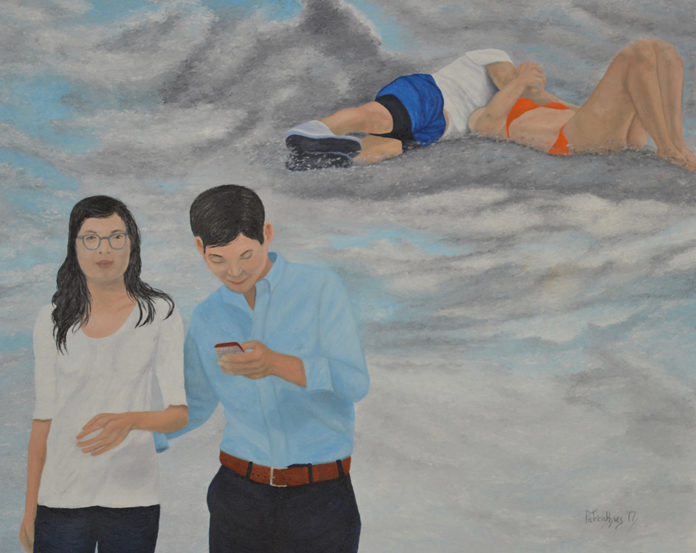
"Dreams" by Patricia Hynes

“Dreams”

oil on canvas

24 in. x 36 in.


ART IS A REFLECTION OF HUMAN EXISTENCE

In my early twenties for some unknown reason and with no significant financial resources, I purchased a canvas board, student brushes, and a few tubes of oil paint. The instant I started to copy a magazine image onto the canvas, I knew my calling was to be a painter with all of its challenges and demands. After I earned undergraduate and Master of Fine Arts degrees in studio art, life with its responsibilities took hold. Yet, I always found time to paint, though not with the energy that was required to develop my craft as I wished. I then structured my life so that eventually I would be able to paint full time time.

As a student of people I was able to interact with many individuals during a long non-painting career in museums and educational institutions working in teaching and administration. These experiences helped me develop a deeper understanding of human nature. This understanding, as well as my overall life experiences, have become profound influences in determining my mature painter’s voice.

I have come to understand that my work has always been directed by the paths I chose. The paintings I create are about how people choose to, or not to, live their lives. My intent is not to replicate past historical visual images, but rather to study the reaction of people in various life situations and then create contemporary visual stories depicting significant moments that reveal an inner presence. They study the fleeting instant when emotional reactions and the pathos of a situation is often unconsciously revealed. Through my paintings viewers are prompted to think and reflect upon the relation of these enigmatic references to their own lives.

I strive for accurate visual representation, however, I consciously do not paint for photographic accuracy. My work is about the fusion of concept and pigment to produce a painting. Photography has always been a mainstay of my visual approach. In structuring a composition, I select images from a number of my photographs. These images are then used to draw what I call a road map on the canvas. Then my focus shifts to pigment for its harmonious and expressive application onto the canvas. I paint so the pigment can speak as an indication of a passage’s significance, as well as to express the intrinsic concept of the scene. My paintings are large, yet they are painted in great detail with small brushes. The brushwork I employ emphasizes passages throughout the canvas, creating a visual tempo about the story that that is being told. Thus, the finished painting is a fusion of concept and the process of painting.

The direction I have been advancing towards is to paint backgrounds that are increasingly more indicative of the painting’s narrative rather than the placement of people into a traditional environment. This is to promote greater interest and reflection on the part of the viewer, for further grounding people within an evocative narrative creates a scene apart from the commonplace of daily existence. While questions are raised in viewing these scenes, there is no “right” interpretation of them. I leave all interpretations to the viewers who dialogue with my paintings.

I am a member of the Salmagundi Club, New York; Oil Painters of America; American Impressionist Society; and American Women Artists.

I received a Master of Fine Arts degree from Rutgers University and a Bachelor of Arts degree from Douglas College. After a period of teaching Studio Art and Art History I pursued a career in nonprofit institutions holding positions in development and institutional advancement. Positions held include Deputy Director, Cincinnati Art Museum; Vice President, Pratt Institute; Vice President, American Craft Museum, now the Museum of Arts and Design; as well as Director of Alumni Relations, Associate Director University Development, and Director of Development, Tisch School of the Arts, all for New York University University; and development posts at the Whitney Museum and the Brooklyn Museum.

Featured Lot: Stitching A Collection Together

0
Eugene von Blaas (1843-1931), “The Italian Seamstress,” oil on panel, 15 15/16 x 12 5/8 in. © Bonhams 2017

In this ongoing series for Fine Art Today, we take a longer look at the history and features of a soon-to-be-available artwork of note. This week’s painting will make a lovely addition to your academic collection.

Works by Eugene von Blaas (1843-1931), an accomplished Academic painter of the 19th and early 20th centuries, are prized possessions any collector would want as their own. Born near Rome, Italy, to Austrian parents, Blaas’ father was also a skilled painter who later became professor at the Academy of Venice.

Typical of Blaas’ works are figurative subjects, often showing Venetian women in period clothing. Further, critics often recognize Blaas’ use of vivid color, which helps distinguish his works from other period artists.

Heading to auction via Bonham’s on March 1 in London is a beautiful portrait of an Italian seamstress by Blaas. In what is undoubtedly one of his mature works, a dark-haired girl with flushed cheeks sits in half length. Set against a gray background, the subject carefully threads a needle. Blaas’ attention to texture, especially the embroidery around the sitter’s blouse, is noteworthy.

With a solid provenance and in great condition, auction estimates are between $50,000 and $75,000. To learn more, visit Bonhams.

This article was featured in Fine Art Today, a weekly e-newsletter from Fine Art Connoisseur magazine. To start receiving Fine Art Today for free, click here.
Portrait of the Week: The Most Famous Visage in History

1
Leonardo da Vinci, “Portrait of Lisa Gherardini,” circa 1503-1517, oil on panel, 30 x 21 in. © Musée du Louvre 2017

In this ongoing series, Fine Art Today delves into the world of portraiture, highlighting historical and contemporary examples of superb quality and skill. This week we discuss the most famous portrait ever painted.

Perhaps it was the painting’s theft in 1911, or the fact that its creator carried it with him during the final years of his life and never delivered it to its patron. Maybe it was the Dadaists and Marcel Duchamp toying with her image in the early 20th century, or that the identity of the sitter was unknown for nearly 500 years. Whatever reason you ascribe, there can be no doubt that Leonardo da Vinci’s “Mona Lisa” is the most famous, researched, and debated portrait ever made.

Some of you may agree, others not, but I find the legend of “Mona Lisa” nauseating, especially after an underwhelming viewing of the painting in the Louvre Museum in 2001. Surrounded by hundreds of tourists eagerly snapping photos, I climbed my way through the hordes to catch a glimpse. My first reaction: “That’s IT?” Lisa stared at me with that ambiguous smile through her three-inch-thick, bulletproof glass case as if the joke were on me — and everyone else; and it was. As I stood in her presence for the first time, I had an epiphany (even at 14 years old) that has stuck to this day: She’s just a splendid portrait by one of history’s greatest artists, nothing more, nothing less.

Lisa’s tale is one of caution. Caution to recognize that sometimes we dig too far and stretch the limits of art historical interpretation to the point that a painting becomes something else — something entirely different and far removed from what it really is. It happens all the time, but the case of “Mona Lisa” has been boiling over for at least two centuries.

This isn’t to say that the painting isn’t exquisite — a stunning visualization of a beautiful woman in Da Vinci’s famed sfumato (Italian for “smoky”) technique. Nor is it to deny the canonical triangular composition, nuanced and enigmatic expression, or provoking uneven landscape beyond. Rather, recognize the painting for what it actually is: a fantastic Renaissance portrait of Lisa Gherardini, wife of Florentine merchant Francesco del Giocondo, produced by one of the greatest artistic geniuses of the Western world. In this way, Da Vinci’s “Mona Lisa” still achieves adoration and acclaim as a brilliant source of Renaissance fashion, identity, and technical mastery. However, the life Lisa has taken over the last two centuries has bordered on the comical.

To learn more, visit the Louvre Museum.

This article was featured in Fine Art Today, a weekly e-newsletter from Fine Art Connoisseur magazine. To start receiving Fine Art Today for free, click here.
Budapest Masterworks on the Move

0
Raphael, “Virgin and Child with the Young Saint John the Baptist,” circa 1508, tempera and oil on panel, 28.5 x 21.5 cm. © Museum of Fine Arts, Budapest 2017

The Museum of Fine Arts in Budapest and the Hungarian National Gallery have graciously loaned a number of artworks for an exhibition you’ll be disappointed to miss. Details here.

Although it’s still pretty far away, Madrid is closer to the United States than Budapest. Opened on February 18 and on view through May 28, “From the Renaissance to the Avant-Garde” is a brilliant display of masterworks from the Museum of Fine Arts in Budapest and the Hungarian National Gallery at Madrid’s Museo Thyssen-Bornemisza.

The exhibition presents about 90 masterworks, including rarely seen works by Albrecht Dürer, Raphael, Annibale Caracci, Leonardo da Vinci, Diego Velázquez, and Peter Paul Rubens.

To learn more, visit the Museo Thyssen-Bornemisza.

This article was featured in Fine Art Today, a weekly e-newsletter from Fine Art Connoisseur magazine. To start receiving Fine Art Today for free, click here.
WEEKLY NEWS FROM THE ART WORLD

Fill your mind with useful art stories, the latest trends, upcoming art shows, top artists, and more. Subscribe to Fine Art Today, from the publishers of Fine Art Connoisseur magazine.

  • This field is for validation purposes and should be left unchanged.