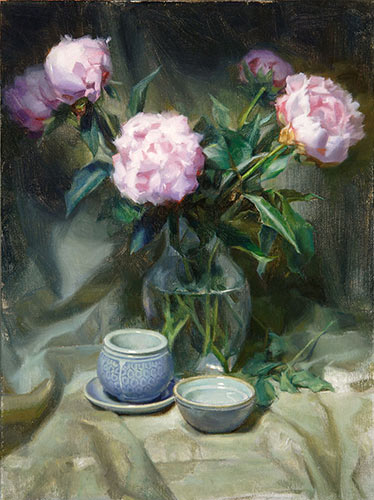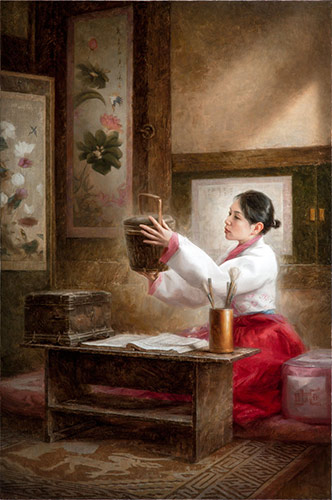

Located in Oshkosh, Wisconsin, the Paine Art Center and Gardens are in celebration after recently opening a stunning exhibition of paintings by an accomplished painter who’s no stranger to Fine Art Connoisseur magazine. Will you recognize this Midwestern talent?
On view now through May 28 at the Paine Art Center and Gardens is a brilliant showcase of recent paintings by Craig Blietz. A Door County native, Blietz has established national renown for his lovely paintings of farm animals and rural landscapes, “which celebrate the dignity and quiet beauty of agrarian life,” the Paine says. “This exhibition features a selection of new works by Blietz, reflecting the inspiration he gleans from the serene landscapes and noble depictions of animals created by nineteenth-century French Barbizon School artists, many of whom are represented in the Paine’s permanent collection.”
This article was featured in Fine Art Today, a weekly e-newsletter from Fine Art Connoisseur magazine. To start receiving Fine Art Today for free, click here.
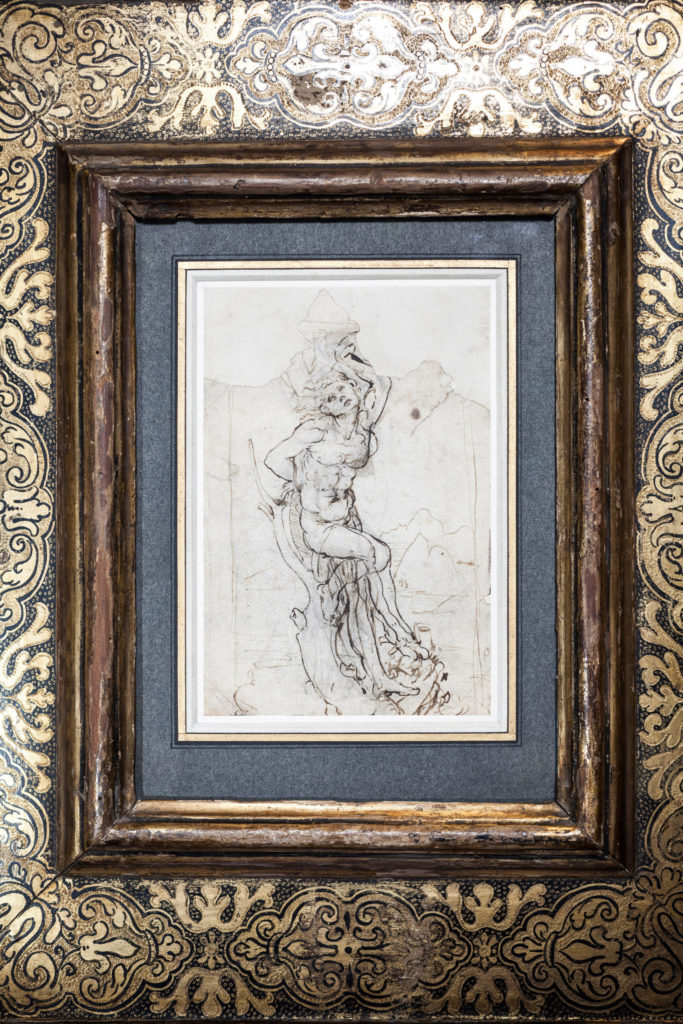
A colorful array of floral paintings will bring warmth and a hint of spring to your winter this month at R. Michelson Galleries. Who’s the well-known painter? Much more is just one click away!
Do you miss the ribbons of color that characterize the sudden burst of life at the beginning of the spring season? If so, we’ve got an exhibition worth your time. On view through February 28 at R. Michelson Galleries in Northampton, Massachusetts, “Flowers in February” is a great showcase of recent plein air works by painter Lewis Bryden.
While the prototypical plein air painting features vast landscapes and a deeper sense of space, Bryden focuses his artistic lens close to his subjects. Featuring some 16 colorful works, “Flowers in February” will bring a hint of spring to your winter months!
Speaking about his recent artistic journeys, Bryden says, “I began thinking in a new way about painting outdoors: Why not have a very close focus of interest in a plein air painting? Also, what could be better than being outdoors and getting the colors of flowers in their always changing natural light?
“So, about three years ago I started this series of plein air flower paintings. There are some precedents, such as Monet’s ‘Poppy Field’ and some Impressionists’ garden studies. However, most flower painting I’ve seen is of cut flowers, in a vase in an artists’ studio, under north light. This struck me as a chance to try a new approach.
“Of course, I can’t paint flowers outside during the winter months — but that’s when we miss them the most. Hence, ‘Flowers in February.’”
This article was featured in Fine Art Today, a weekly e-newsletter from Fine Art Connoisseur magazine. To start receiving Fine Art Today for free, click here.
New York City is poised to open a fun exhibition this weekend featuring works by Georges Seurat (1859-1891). Details here!
Visitors to New York’s Metropolitan Museum of Art this spring will be treated to a colorful and fun circus-themed exhibition featuring more than 100 paintings, drawings, prints, period posters, instruments, and illustrated journals. “Seurat’s Circus Sideshow” opens on February 17 and continues through May 29 and — as its title suggests — centers around a stunning pointillist masterwork by Georges Seurat (1859-1891) called “Circus Sideshow (Parade de cirque).”
Via the museum, “‘Circus Sideshow’ is one of only a half-dozen major figure compositions that date to Seurat’s short career. More compact in scale and more evocative in expression than his other scenes of modern life — which he regarded as ‘toiles de lutte’ (canvases of combat) — the painting effectively announced the Neo-Impressionist’s next line of attack on old guard turf, signaling a shift in focus away from the sunlit banks of the Seine to the heart of urban Paris. ‘Circus Sideshow’ initiated a final trio of works devoted to popular entertainment and led the fray as the first to tackle a nighttime setting with the benefit of his innovative technique, alternatively called pointillism or divisionism (the former term emphasizing the dotted brushwork, the latter, the theory behind separating, or dividing, color into discrete touches that would retain their integrity and brilliance). It was his singular experiment in painting outdoor, artificial illumination. The result is disarming. In relying on his finely tuned approach to evoke the effects of ethereal, penumbral light in this evening fairground scene of the Corvi Circus troupe and their public at the Gingerbread Fair in Paris, Seurat produced his most mysterious painting. From the time it debuted at the Salon des Indépendants in Paris in 1888, it has unfailingly intrigued, perplexed, and mesmerized its viewers. Seurat’s closest associates, seemingly dumbstruck, largely confined their spare remarks to its novelty as a ‘nocturnal effect.’ The laconic artist never mentioned the picture.”
Also included in the show are works by Pablo Picasso, Fernand Pelez, and the great caricaturist Honoré Daumier. To learn more, visit the MET.
This article was featured in Fine Art Today, a weekly e-newsletter from Fine Art Connoisseur magazine. To start receiving Fine Art Today for free, click here.
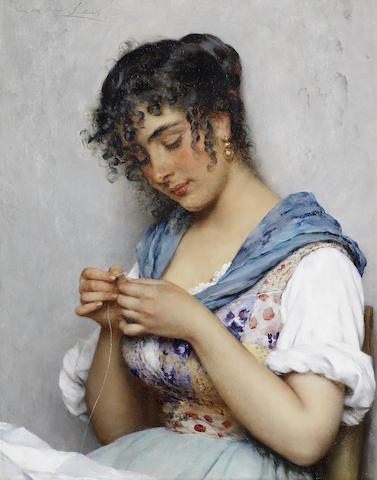
Although the official auction has passed, there’s still time to see a magnetic show of American miniatures in Tucson, Arizona — and dozens of brilliant paintings to be had.
Well over 200 artists participated in this year’s American Miniatures exhibition and sale at Tucson’s Settlers West Galleries. Although the official auction was held on February 11, many of the works are still available at tantalizing prices.
To view a full list of available works and find out how to acquire them, visit Settlers West Galleries.
This article was featured in Fine Art Today, a weekly e-newsletter from Fine Art Connoisseur magazine. To start receiving Fine Art Today for free, click here.
A staple among the top fine art collectors today, “Masters of the American West” is looking to blow audiences away once more in 2017. Was that goal met? You decide.
Arguably the country’s premier Western art exhibition and sale, Masters of the American West — hosted by the delightful Autry Museum of the American West in Los Angeles — is in its 20th year in 2017.
Seventy-six nationally and internationally recognized artists are included in this year’s showcase, which features a diverse range of styles and genres, including landscape, seascape, wildlife, historical, and much more. Among the masters represented in 2017 are George Carlson, Robert Griffing, Z.S. Liang, Bonnie Marris, Kyle Polzin, Thomas Quinn, Mian Situ, Tucker Smith, Curt Walters, and Morgan Weistling.
This article was featured in Fine Art Today, a weekly e-newsletter from Fine Art Connoisseur magazine. To start receiving Fine Art Today for free, click here.
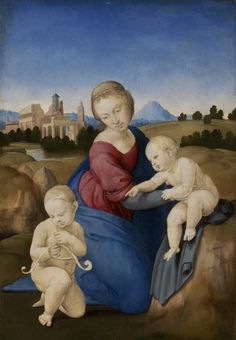
Sometimes movement involves feelings rather than objects. Discover how one man has been using still life for nearly 60 years to inspire generations of accomplished creators.
Opened February 16 and on view through April 30, “Ken Davies: Realism in the 20th Century” is an important exhibition that any fine art connoisseur needs to see. For more than 60 years, Ken Davies (b.1925) has been producing brilliant works that have earned him the designation of one of the preeminent still life painters alive today. As importantly, from Davies have come a number of accomplished students, including Joseph Reboli, Jo-Anne Scavetta, Daniel Patrick Buckley, Richard Newman, Dennis Coburn, and George (Gig) Thompson — all of whom have work in the show.
Among a number of remarkable still lifes are several of Davies’ landscape paintings as well. In addition to exploring the influential career of Davies, the exhibition is meant to delve into the master’s influence on Joseph Reboli (1945-2004). Reboli was a graduate of Paier School of Art in Hamden, Connecticut, during Davies’ tenure as dean. “Joe Reboli was one of the best students in the history of the Paier School,” Davies once said.
“Ken Davies: Realism in the 20th Century” is on view through April 30 at the Reboli Center in Stony Brook, New York. To learn more, visit the Reboli Center.
This article was featured in Fine Art Today, a weekly e-newsletter from Fine Art Connoisseur magazine. To start receiving Fine Art Today for free, click here.
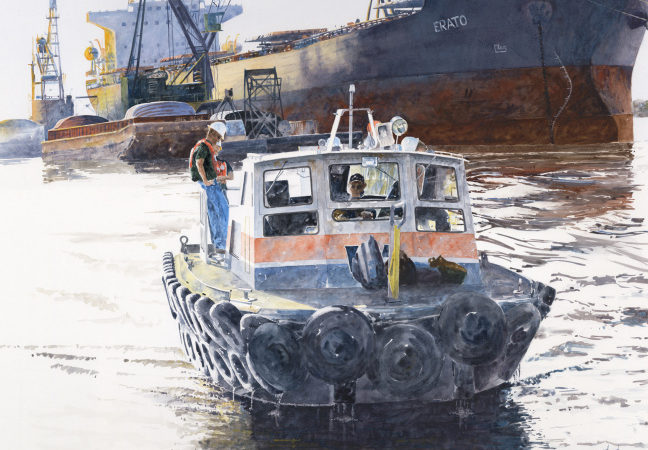
Opening this week is an important group exhibition featuring many of the world’s most accomplished marine painters. Get the list of participating artists and a preview here.
On view now through March 20 at Quidley & Company in Naples, Florida, is a fantastic group exhibition of “Marine Masters.” A popular subject among historical and contemporary artists, there seems no end to the sea’s majesty, serene beauty, and terrific chaos.
Among others, participating artists include Montague Dawson, John Stobart, Tim Thompson, Michael Keane, Shane Michael Couch, Terry Bailey, William Davis, and James Buttersworth.
This article was featured in Fine Art Today, a weekly e-newsletter from Fine Art Connoisseur magazine. To start receiving Fine Art Today for free, click here.
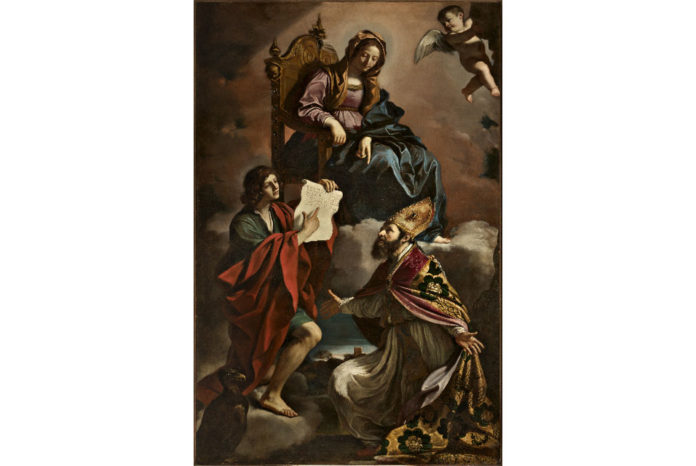
In this ongoing series for Fine Art Today, we take a longer look at the history and features of a soon-to-be-available artwork of note. This week’s painting is one of this artist’s greatest masterpieces ever to come to auction.
This week’s featured lot is perhaps one of the most anticipated in quite some time. Heading to auction on March 1 via Sotheby’s, London, is a masterpiece of Viennese fin-de-siècle art by the monumental Gustav Klimt (1862-1918). “This remarkable landscape is rooted in the natural world yet simultaneously reaches towards the symbolic, decorative avant-garde,” the auction house reports. “During the summer months, from 1900 onwards, Klimt traveled out of Vienna to Litzlberg on the Attersee with his friends and family to relax and paint. In the rustic garden of the Mayr-Hof Klimt found inspiration for ‘Bauerngarten,’ with its informal profusion of poppies, daisies, zinnia, and roses, and transformed it into a shimmering array of color.”
Produced during the “golden period” of Klimt’s career, “Bauerngarten” was immediately met with celebration and adoration. In fact, the painting is regarded as one of the artist’s finest landscapes. “Bauerngarten” headlines Sotheby’s March 1 “Impressionist & Modern Art Sale” in London; estimate is in excess of $45 million.
This article was featured in Fine Art Today, a weekly e-newsletter from Fine Art Connoisseur magazine. To start receiving Fine Art Today for free, click here.
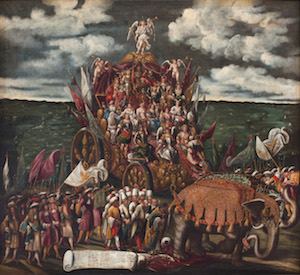
Lee Price, “Lemon Slices II,” 2012, oil on linen, 34 x 76 in. (c) Lee Price 2017
An incredible group of female representational painters has taken over Bernarducci Meisel Gallery in New York City — and it’s absolutely stunning. Who are they, and when do the doors open?
Opening January 12 at New York City’s Bernarducci Meisel Gallery, “Formation” is an amazing display of contemporary female artistic talent. Visitors to the gallery can expect to find a wide range of styles as well — from unique oil-on-copper figures by Erin Anderson (whose “Felix Looking Backward, Looking Forward” graced the cover of Fine Art Connoisseur’s November/December 2016 Issue) to the loose, painterly figures of Heidi Elbers.
“Formation” is presented in conjunction with a special issue of PoetsArtistsMagazine. It is curated by Didi Menendez, publisher of PoetsArtists, who says, “‘Formation’ will showcase a distinct selection of figure paintings, ranging from stirring portraits to thought-provoking life studies. There are no prescriptive formulas for what makes a figure painting successful — it is an elusive, intangible property that somehow the best artists know how to unite into a powerful expression that draws the viewer in.”
Erin Anderson, “Practice,” 2013, oil on copper, 36 x 30 in. (c) Erin Anderson 2017Heidi Elbers, “Raven Darlings,” 2016, oil on panel, 16 x 16 in. (c) Heidi Elbers 2017
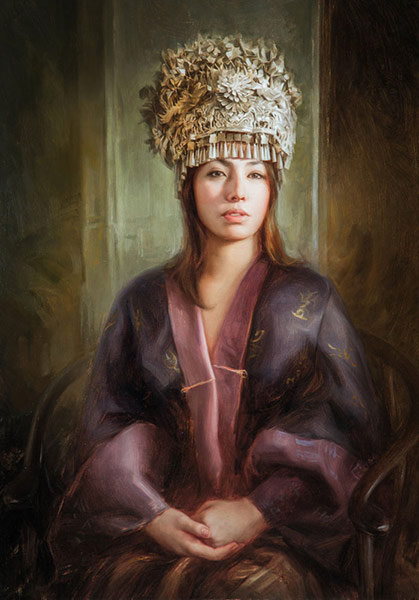
In addition to the aforementioned, artists included in the group show are Erica Elan Ciganek, Michelle Doll, Shana Levenson, Sylvia Maier, Jenny Morgan, Sarah Muirhead, Omalix, Lee Price, Nadine Robbins, and Victoria Selbach. With a lineup with this, how can you possibly pass up any opportunity to catch a viewing?
Omalix, “The Headdress,” oil on linen, 24 x 24 in. (c) Omalix 2017
Continuing, Menendez says, “These artists’ distinctive styles of capturing the human figure offer a wonderful anthology illustrating tangible and intangible aspects of life — some solemn, poignant, or introspective, others joyful, beguiling, or confrontational.”
This article was featured in Fine Art Today, a weekly e-newsletter from Fine Art Connoisseur magazine. To start receiving Fine Art Today for free, click here.
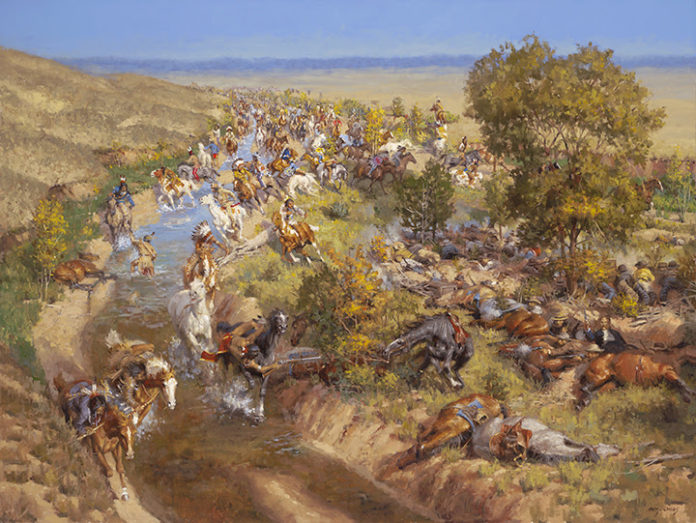
Olaf Schneider acquired a strong hands-on education in art while working full-time at age 21 with Canada’s leading outdoor advertising company and painting very large scale pictorials with some of the world’s seasoned fine artists. His art education has continued with independent and occasional formal studies in oil painting. The resulting works display his affinity for the classical tradition.
Olaf is a prolific Canadian painter inspired by the power and diversity of the northern landscape, and anything that needs a “second look”. An explorer by nature, the artist travels across North America and Europe, gaining inspiration and discovering new color combinations by painting on location. His large-scale canvases are necessarily created in the studio. For Olaf, each piece represents an intense exploration and refinement of his personal pictorial sensitivities, especially as they relate to beauty, form, light, and shade. Composition, color, and craftsmanship are all elements that become the building blocks of his work.
“Each dab I make is stimulated by the details that I observe. I hope to see what others miss and then make it compelling. I push and alter the colors to suit my ravenous needs and I love to improvise on the spot.”
Olaf has a passion for a variety of subjects. Through his art, he expresses his love for life and his affinity for vibrant color.
“I like to use expressive and thick impasto brushstrokes or soft blended strokes to render a sense of movement and texture giving the painting a life of its own. My interpretation of color also sets the dynamic mood. The tones often range from the darkest to the lightest in an effort to achieve maximum drama. This creative combination is spontaneous and intuitive.”
To keep his mind clear and focused he limits his exposure to all the media ‘noise’ we generally are pummeled with daily. He does not watch TV and restricts his time on the computer. He starts his day with God in prayer and meditation. Painting 6 to 10 hours a day is common practice. Equally important to Olaf is continued growth and learning.
“I want to always have an open mind so that new ideas may come in. In the mind of an expert, there are few possibilities, but in the mind of an amateur they become endless. This is a God-given gift and I value it greatly. If I am able to bring emotion, understanding, comfort, or joy into another person’s life then I am using it wisely in His glory.”
Fill your mind with useful art stories, the latest trends, upcoming art shows, top artists, and more. Subscribe to Fine Art Today, from the publishers of Fine Art Connoisseur magazine.