As part of our effort to continue to help artists and art galleries thrive, we’re proud to bring you this week’s “Virtual Gallery Walk.” Browse the artwork below and click the image itself to learn more about it, including how to contact the gallery.
The Four Spirits (4 girls murdered by the KKK), Kelly Ingram national Park, Birmingham, Alabama, 2013, Elizabeth MacQueen, 12 x 10 x 4 with one independent 5 in figure, Bronze and Engraved Metal; Elizabeth MacQueen
***
Home to Roost, 2019, Scott G. Brooks, Oil on canvas, 20 × 16 in; 33 Contemporary
Want to see your gallery featured in an upcoming Virtual Gallery Walk? Contact us at [email protected] to advertise today. Don’t delay, as spaces are first come, first served, and availability is limited.
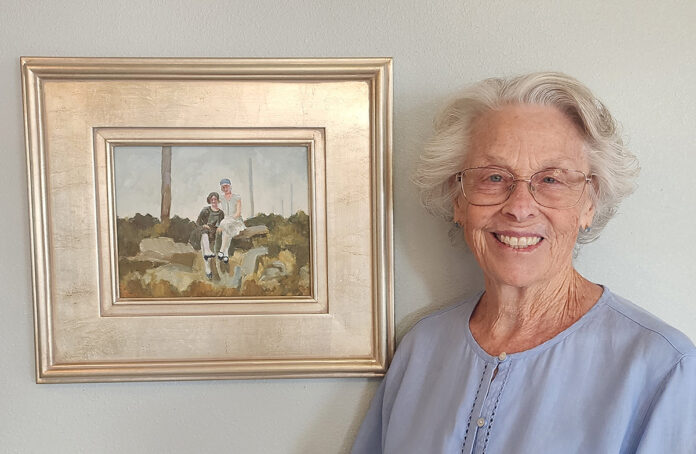
Nina Cobb Walker, “Sunday Afternoon,” 8 x 10, oil on linen panel, 2018. My mother with her sister posing together on what I would imagine as a family outing.
How do you find inspiration? Nina Cobb Walker: Inspiration comes to me in unlikely places. I try to paint what I know and to create a body of work that will be memorable and touch the viewer and spark a sense of joy. These paintings are from a body of work titled “Tapestry”. The idea came to me as I was looking at some old photographs of my family. I am privileged to be the keeper of family photos. I wanted to create a story of my family from a different era using some of the familiar faces to me which inspired me to use a limited pallet to paint in to give the feeling of the times. This is an ongoing project which I will continue to paint and bring the generations forward.
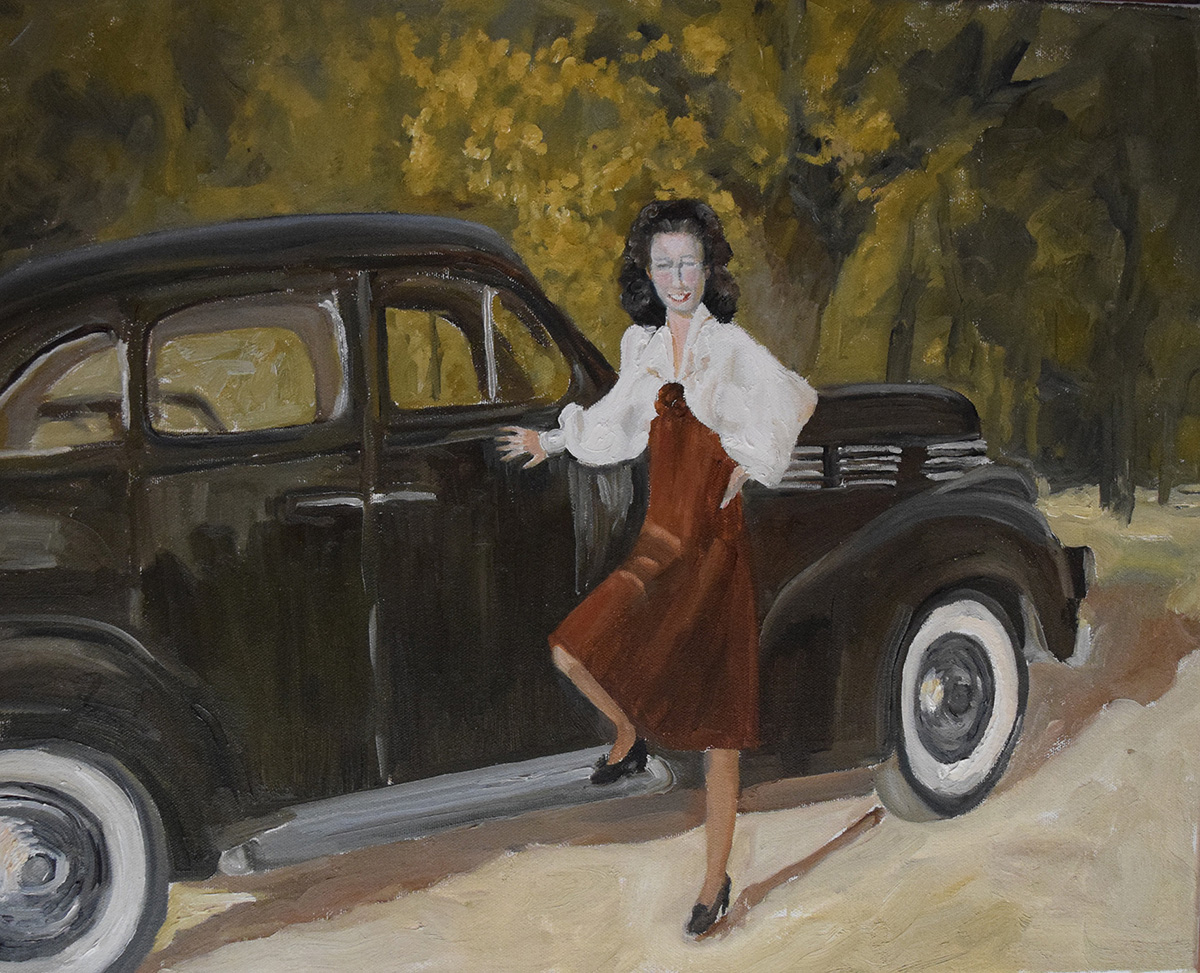
Nina Cobb Walker, “The Red Trike,” 16 x 20 in., oil on canvas, 2018. My uncle and son together, the suits and hats of both tell a story of the timesNina Cobb Walker, “Maxine” 16 x 20 in., oil on canvas, 2019. My aunt posing on a delightful outing next to the family car
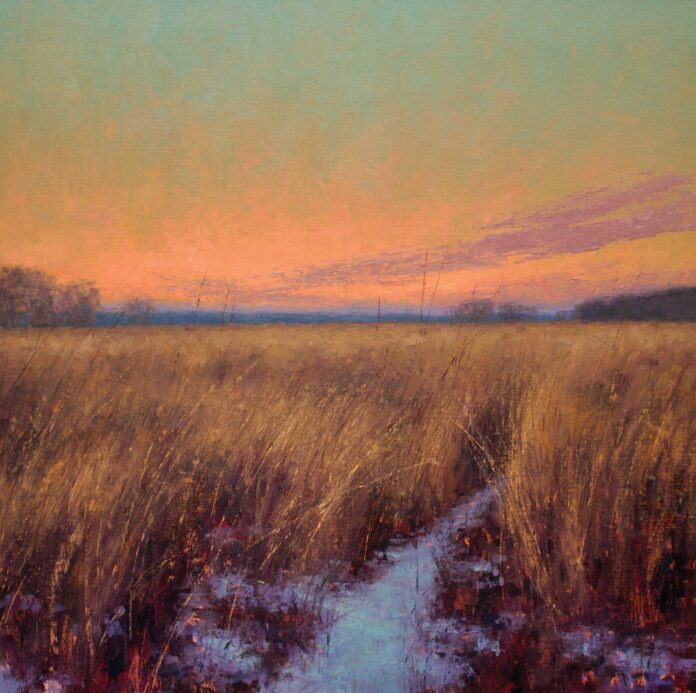
Kami Mendlik (b. 1973), "The Silver Lining Again," 2022, oil on linen, 30 x 30 in., private collection
Minnesota Marine Art Museum
Winona, Minnesota mmam.org
through September 30, 2023
The Minnesota Marine Art Museum is presenting two simultaneous exhibitions that complement one another perfectly. First, this is the latest stop on the national tour of “The Poetry of Nature: Hudson River School Paintings from the New-York Historical Society.”
As the project’s title suggests, one of Manhattan’s leading museums has assembled some 40 of its own paintings, created by 25 artists between 1818 and 1886, to introduce viewers to this loosely knit group of artists.
Together with like-minded poets and writers, these men forged a self-consciously American aesthetic that saw nature as a resource for spiritual renewal and an expression of national identity.
The Hudson River and the varied scenery along its banks, including the Catskills, Adirondacks, and White Mountains, provided the subjects for their luminous scenes.
As if to remind visitors that great landscape painting is by no means extinct, the museum is also presenting “Creating the Illusion of Light: Contemporary Landscape Painters.”
It features two well-known Minnesota landscapists who have spent their careers teaching others to paint.
Exhibiting together for the first time, Fred Somers approaches painting like a spiritual quest, while Kami Mendlik transforms the illusion of light into something concrete.
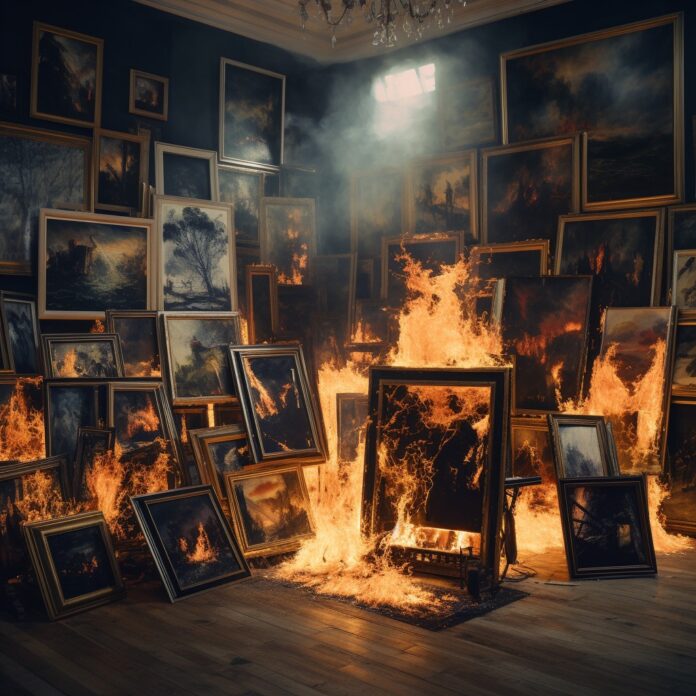
Paintings Destroyed in Fire? What to do before it’s too late.
I rarely comment on current events, but like you, I’m devastated to hear of the tragedy in Maui, one of the biggest tragedies in our country’s history. And like you, I’m feeling helpless, wishing there was more I could do to help. We’re working with a few art initiatives to help raise money, but somehow it does not seem sufficient.
The Maui fires, in addition to all the damage we know of so far, have resulted in hundreds of lost paintings at artist studios, collector homes, and galleries.
My dad trained us to understand that if you have to think under pressure and don’t already have a plan, things won’t go as well in the heat of an emergency, or even drama and emotion. But if you try to anticipate situations, perhaps you can recover, or reduce the negative impact. That said, no one in Maui could have anticipated what happened last week.
For many of us who are not in the midst of tragedy, now is the time to take action to make sure you have the best possible plan in case something does happen.
Art Studio Considerations
If you had a five-minute notice, what would you grab? Look around and decide what’s absolutely irreplaceable, whether because it’s valuable or sentimental.
The first thing crossing my mind isn’t the stuff we can replace, it’s the stuff we can’t. Things with emotional meaning — in my case, an extensive art collection, a collection of portraits other artists have done of me, and piles of paintings that are my life’s work. What would I do if it was all lost?
I created a list of everything that had meaning, then prioritized that list, and handed out instructions. If there is a fire, if there is time, get these items out to safety first. If there is still more time, add these things that are on the list.
What do you need to do to prepare to leave on a moment’s notice?
What will you regret not having, or not having created a digital copy of?
Most important, of course, is your life and your family. Don’t go into a burning fire and risk your life to save an old photo. It’s not worth the risk. But having a plan in advance is a great idea.
Art Insurance and Documentation
Contact your insurance agency and ask what you need for proper coverage. They may require specific documentation of your collection or your body of work.
My friends in the Malibu fire had five minutes’ notice. They lost everything. That’s the most likely scenario. In that case, you would at least want records and proof such as digital photos and things stored online or on a server off-site. I have most of my paintings and collection documented, but the list has not been updated in five years. I would at least want to be able to remember those things or have evidence for insurance. (Artwork Archive is a great resource for helping you keep track of your art inventory.)
In your art inventory, include high-resolution photos of all of your paintings and document the size along with any other details you have available.
What if your paintings are lost in a gallery fire?
When you agree to sell your paintings through a gallery, you should have a written agreement that includes things like liability issues and insurance. Keep a digital copy of this online in case it’s ever needed.
Your agreement should also include answers to the following questions:
Will your insurance cover the loss of your art if the gallery has a fire or theft, or is that the responsibility of the gallery?
Do you need an insurance rider on your work that is hanging in a gallery?
What if the gallery is unable to pay you for the paintings they’ve sold?
One More Note
The horrors of Maui are beyond awful. Families need help, and if you have something extra, this is the time to step up and find a charity that will help.
Leon Loughridge (b. 1952), "Spirits of Abo Mission," 2023, woodblock print on paper [edition of 12], 18 x 12 in.
Gerald Peters Gallery is exhibiting recent works by the master printmaker Leon Loughridge. Based in Colorado, he employs the Japanese technique of moku hanga; the woodblock prints are created by hand, and although his hand-printing process is simple, it is also labor-intensive. To underscore this point and to answer visitors’ questions, Loughridge demonstrated the process at the gallery in July.
Titled “Sacred Ground,” his show features woodblock prints, watercolors, and serigraphs of the places in New Mexico that represent Loughridge’s spiritual roots and personal story.
Leon Loughridge, “Sacred Ground”
Gerald Peters Gallery
Santa Fe, New Mexico gpgallery.com
through September 2, 2023
The artist is characteristically eloquent about how these recent works came to be: “Sacred Ground is a personal issue for me. Having grown up in open spaces, wandering freely, I have come to depend on moments of isolation in an environment where the rules are clear, if not stark. The constancy of that stark reality allows me to trust my environment, to explore my emotional reactions to what is in front of me, and to observe the subtle nuances of color and light in a landscape.”
He continues, “These familiar locations are a never-ending display of beauty. They are sites where I am continually inspired, where I am familiar with the folds and creases of the land, so much so that I can mentally step into the landscape and walk those folds while standing at my easel. As light and shadow dance across those folds and creases, the landscape becomes a living stage, offering glimpses of artistic renderings.”
Loughridge asks, “At what point does the land become a living entity in one’s mind? My constant return to these sites develops a symbiotic nurturing of spirit between myself and the land, where concern for the ground enlightens my own being. As one becomes more and more devout in caring for the landscape and observing its beauty, the ground begins to take on a sacred aspect, becoming a portal or apparition of a state of mind. My artworks from these sites are devotional statements of my encounters with the reality and beauty they offer.”
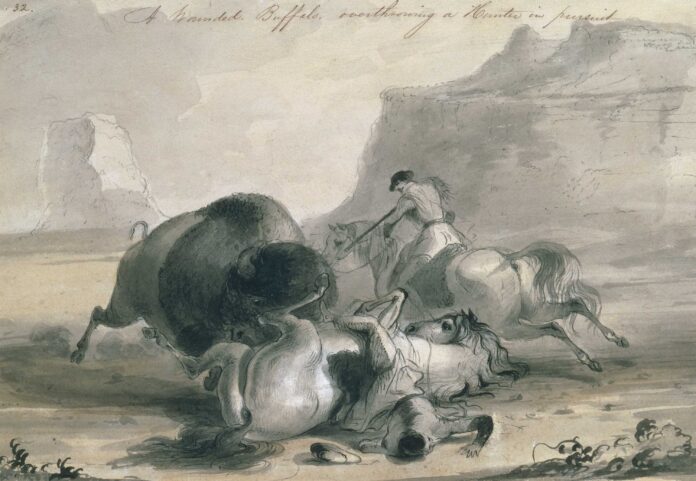
Alfred Jacob Miller (1810–1874), "A Wounded Buffalo Overthrowing a Hunter in Pursuit," c. 1837, watercolor on paper, 7 1/4 x 10 3/8 in., National Museum of Wildlife Art (Jackson, Wyoming), JKM Collection
On view now through October 22, 2023, at the Buffalo Bill Center of the West in Cody, Wyoming is the groundbreaking western art exhibition “Alfred Jacob Miller: Revisiting the Rendezvous — in Scotland and Today.”
In 1837 the American artist Alfred Jacob Miller (1810–1874) attended the fur traders’ summer rendezvous held in the Green River Valley in what is now Wyoming. Invited along by the wealthy Scottish adventurer William Drummond Stewart (1795–1871), Miller became one of the first artists of European descent to venture into the Rocky Mountains.
Though this would be his only trip west, he spent the rest of his career revisiting and romanticizing the experience through his art. Miller’s subjects were primarily the Native people he had met, as well as memorable geological formations, landscapes, hunting scenes, and animal encounters.
More immediately, Miller produced over 100 paintings for Stewart, ranging from intimately scaled watercolors to large oil paintings (one measured eight feet wide). The patron displayed them proudly at his Murthly Castle in Scotland, but upon his death they were auctioned and dispersed throughout the world.
Now a large number of them have been reunited to be considered afresh. As if by magic, many of Miller’s works have found their way to Wyoming over the years, so the Center has focused its attention on collections there.
Lenders to this year’s project include Naoma Tate, J. Joe Ricketts in association with the Ricketts Art Foundation, the National Museum of Wildlife Art in Jackson, and the American Heritage Center (AHC) at the University of Wyoming in Laramie, which has loaned eight paintings from its Graff family collections. The Buffalo Bill Center itself has provided 21 paintings and one chromolithograph, though it actually owns a whopping 33 Miller works.
Artifacts related to the fur trade era have been juxtaposed with Miller’s paintings to complement and complicate the stories his fanciful art relays. Eight of the paintings are accompanied by historian/playwright Gregory Hinton’s recorded narration of Miller’s own descriptions, and two theatrical stage sets based on his art have been built. One evokes Stewart’s campsite at the 1837 rendezvous, while the other is a fictitious room at his Scottish estate.
This innovative project was catalyzed by a digital research project called “Fur Traders and Rendezvous: The Alfred Jacob Miller Online Catalogue.” Launched in 2015 as a joint effort among the Ricketts Art Foundation, Center of the West, and Museum of the Mountain Man, it spurred the curatorial team to develop this in-person exhibition as a logical next step.
Next year, a version of the show will be presented at Indianapolis’s Eiteljorg Museum of American Indians and Western Art, which has partnered with the Center of the West all along the way.
As part of our effort to continue to help artists and art galleries thrive, we’re proud to bring you this week’s “Virtual Gallery Walk.” Browse the artwork below and click the image itself to learn more about it, including how to contact the gallery.
Good Catch, David Marty, oil, 20 x 20 in; David Marty
***
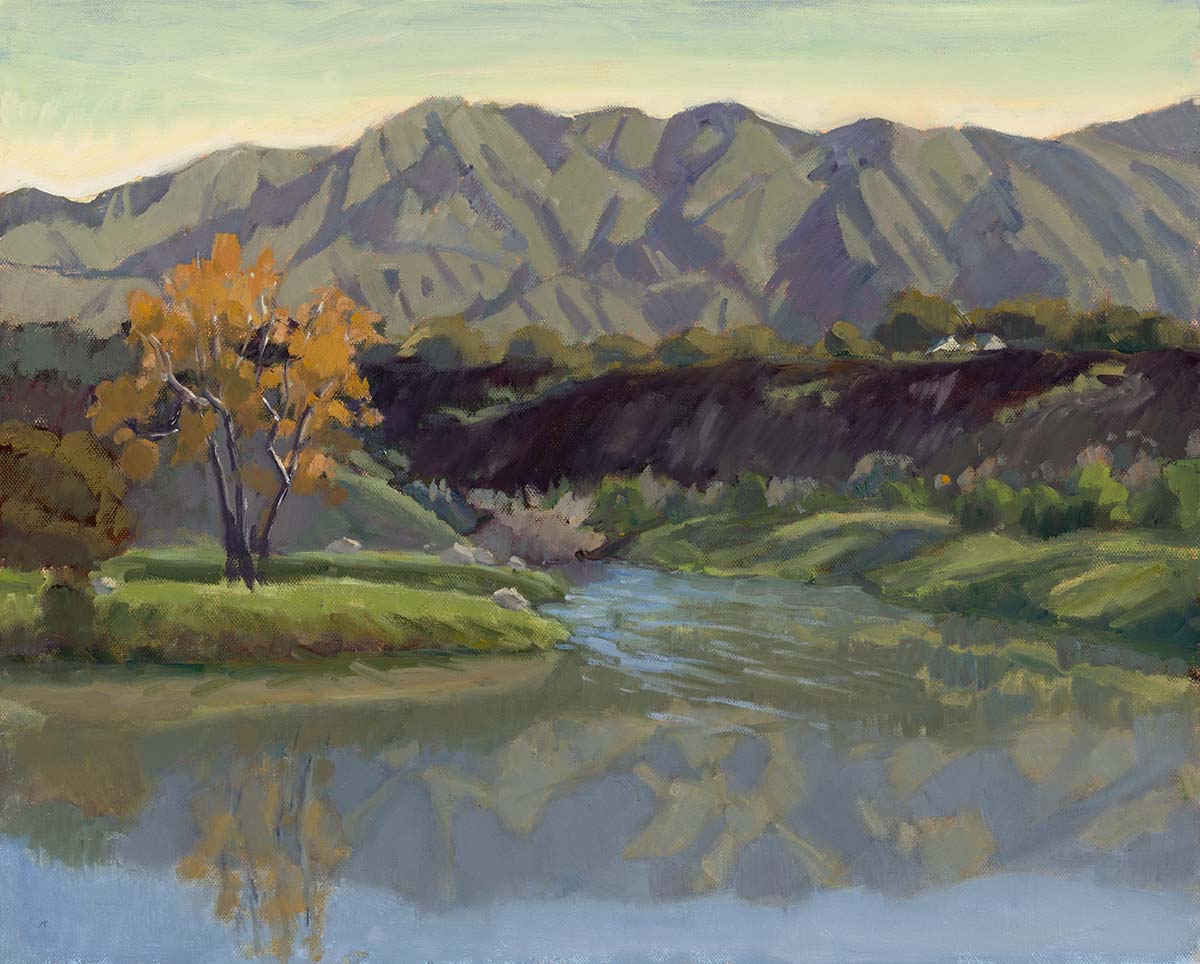
The Beauty of the Arroyo Seco, Laurie Hendricks, oil on canvas, 10 x 20 in; Laurie Hendricks
***
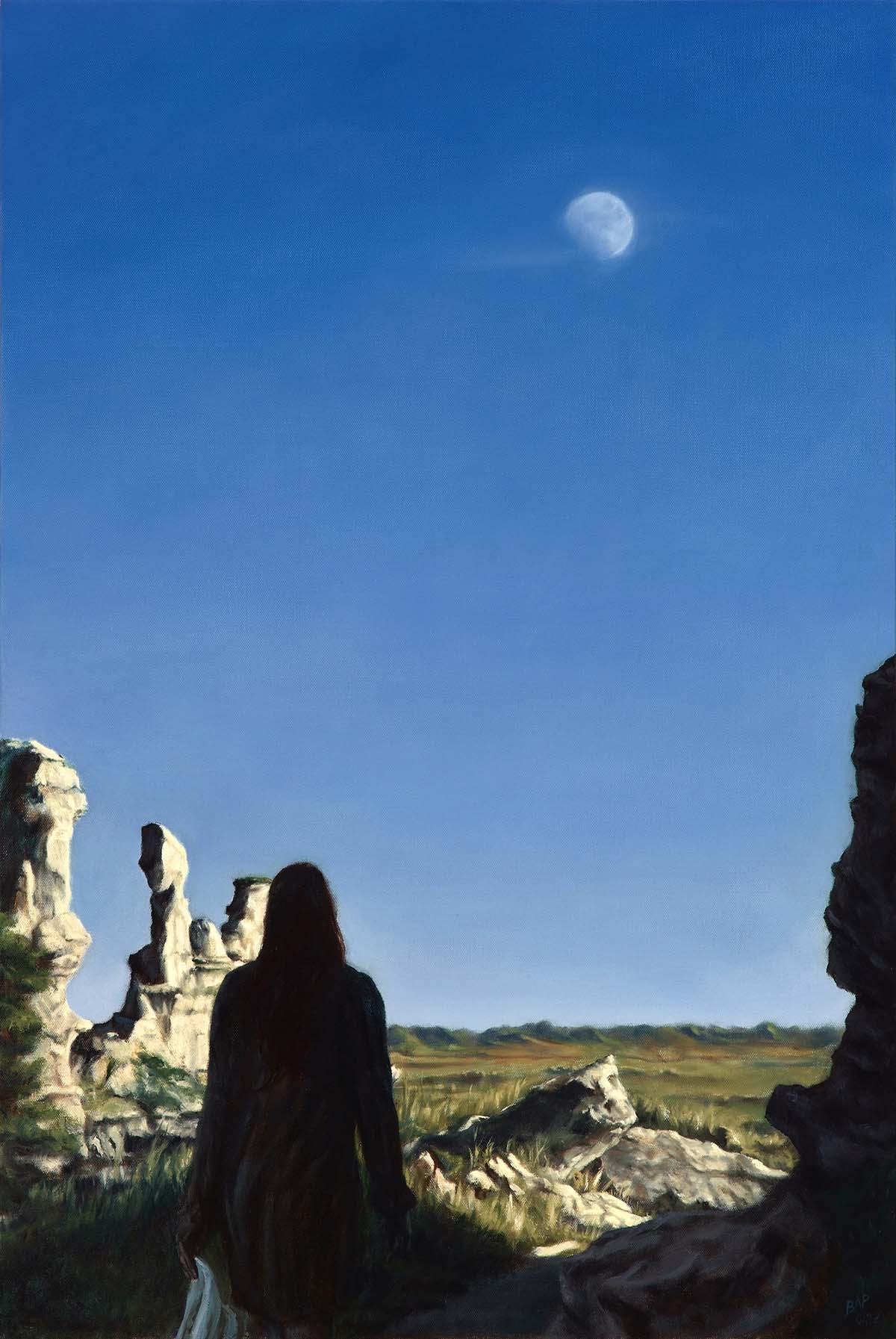
Lunar Dusk, 2022, Benji Alexander Palus, Oil on canvas, 36 × 24 in; 33 Contemporary
Want to see your gallery featured in an upcoming Virtual Gallery Walk? Contact us at [email protected] to advertise today. Don’t delay, as spaces are first come, first served, and availability is limited.
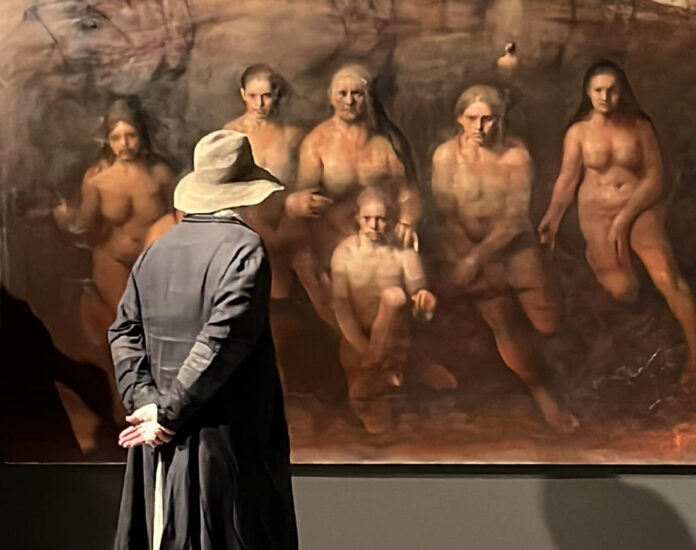
Image credit: Ujazdowski Castle Centre for Contemporary Art
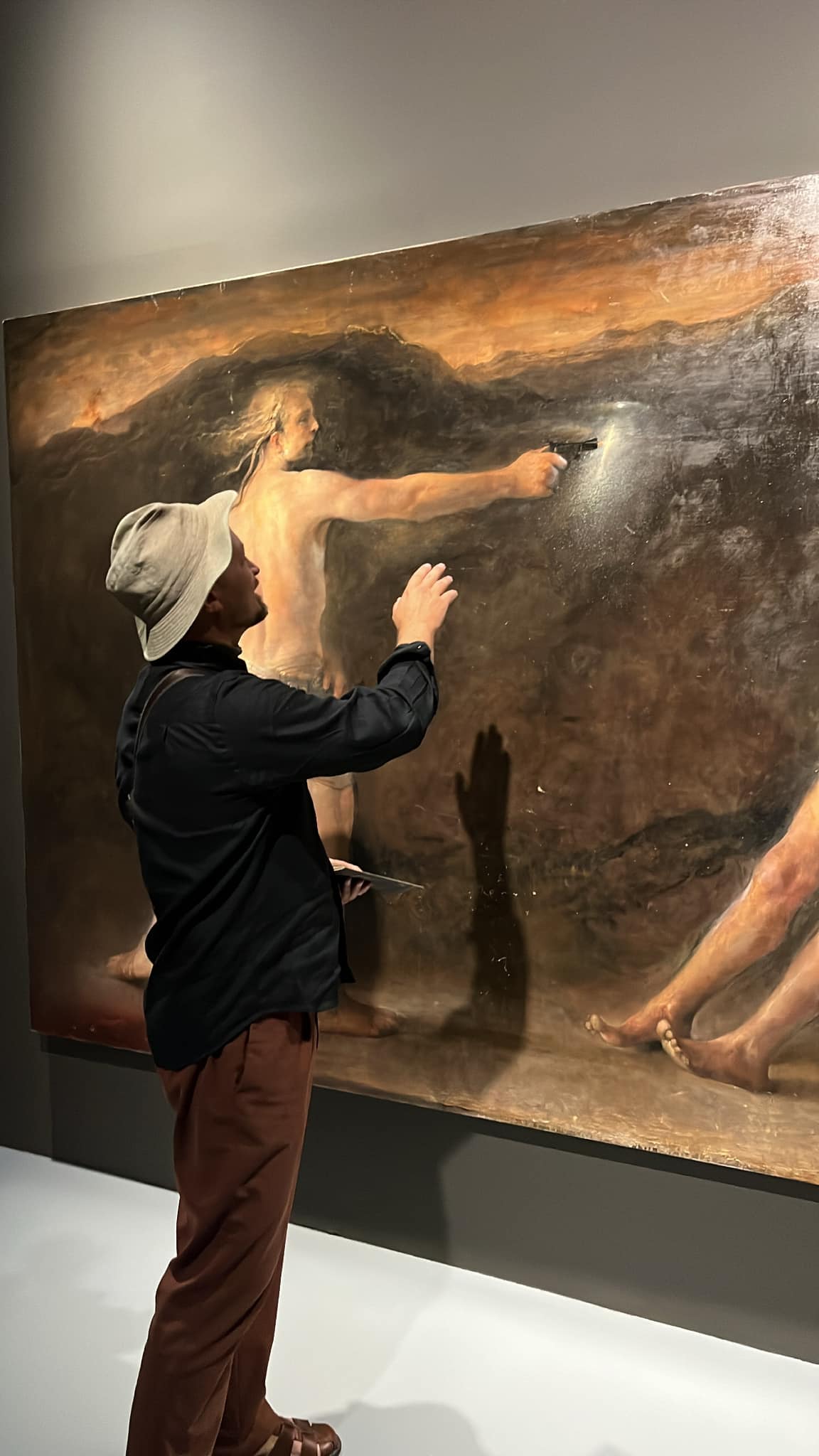
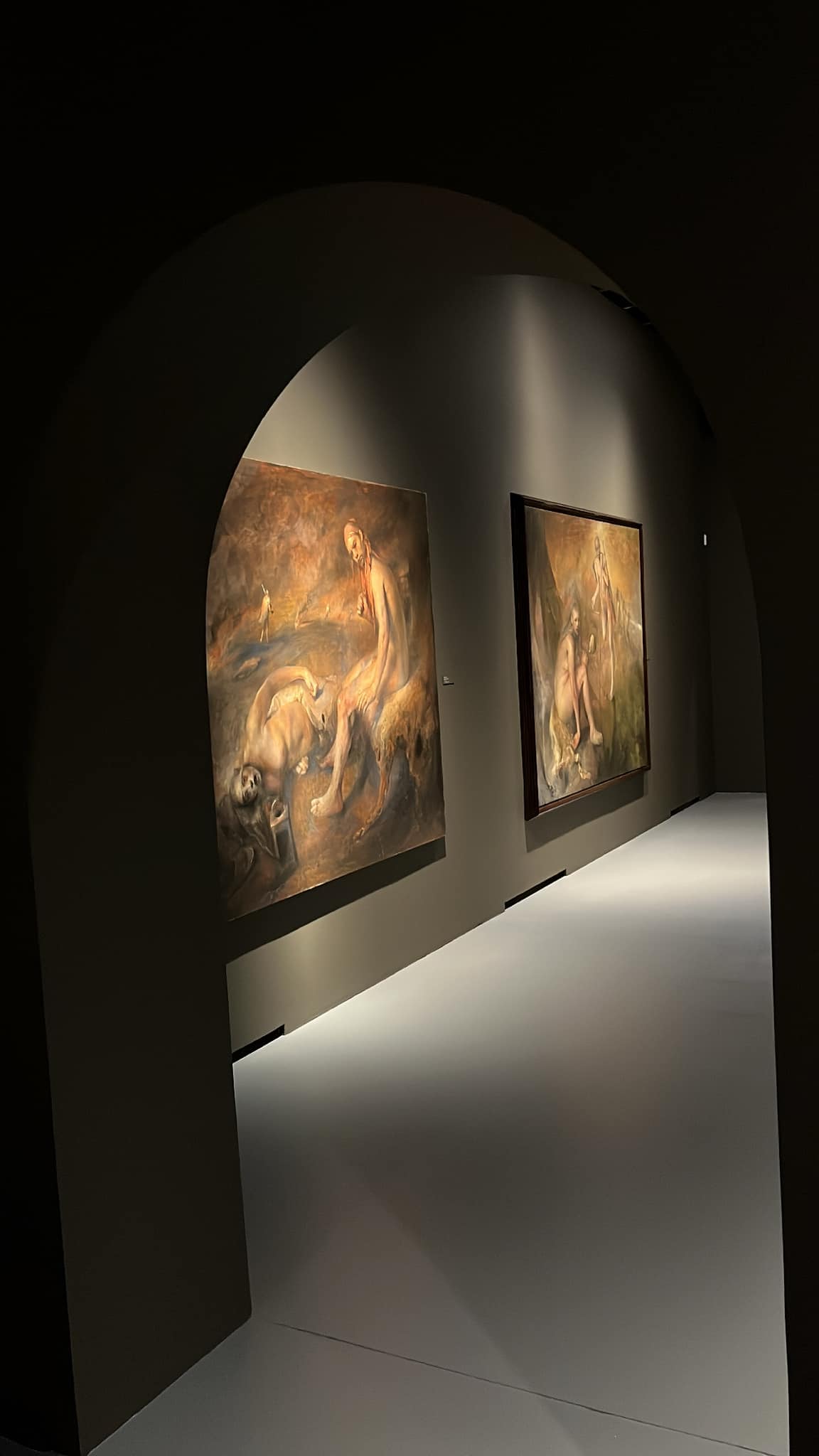
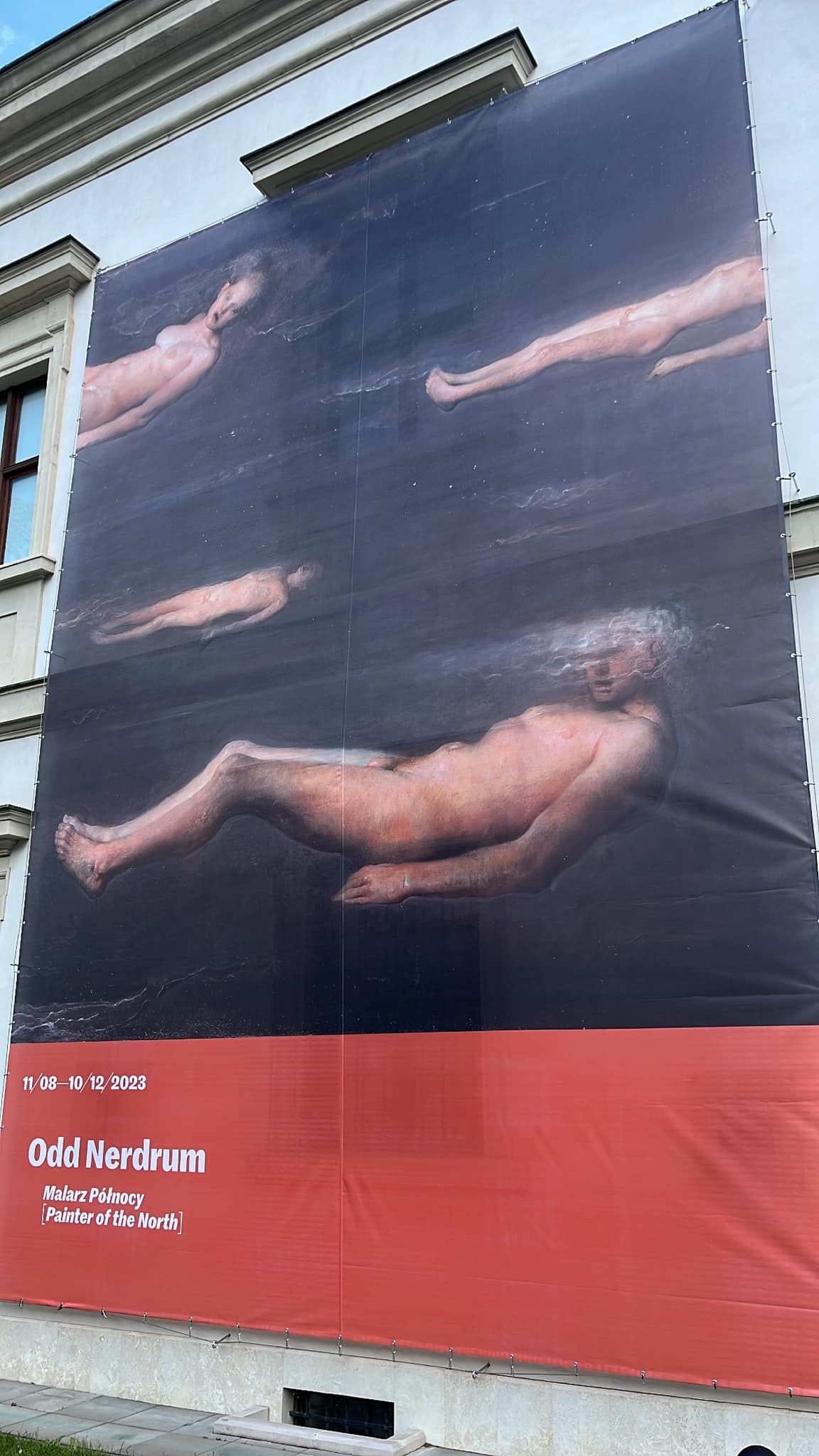
Odd Nerdrum, Painter of the North
Ujazdowski Castle Centre for Contemporary Art
Warsaw, Poland https://u-jazdowski.pl/en
On view through December 10, 2023
From the Museum:
The Ujazdowski Castle Centre for Contemporary Art invites you to the exhibition “Odd Nerdrum, Painter of the North.” Heavily influenced by classical painters like Rembrandt and Caravaggio, Odd Nerdrum (b. 1944) has become one of the most accomplished Norwegian painters since Edvard Munch (1864–1944).
A defining moment in his early years was seeing Rembrandt’s painting “The Conspiracy of Claudius Civilis” in the National Museum of Fine Arts in Stockholm. This consolidated his artistic route, bringing him into opposition with the understanding of art among his contemporaries. “to make a long story short, I would paint myself into isolation,” he later acknowledged. But isolation from contemporaries was swapped for the company of classical masters. Other influences on his work are Masaccio, Titian, Pieter Bruegel, Millet, as well as the less apparent Henry Fuseli and Lars Hertervig.
Image credit: Ujazdowski Castle Centre for Contemporary Art
Odd Nerdrum is now represented in some of the most important collections in the world. Among them, the National Gallery in Oslo, the Astrup Fearnley Museum of Modern Art in Oslo, the Hirshhorn Museum and Sculpture Garden in Washington, D.C., the Metropolitan Museum of Art in New York, the New Orleans Museum of Art in New Orleans, the Museum of Contemporary Art San Diego in San Diego, and the Walker Art Center in Minneapolis.
Nerdrum’s painting is an attempt to rebuild the relationship with the tradition of old painting, broken in the second half of the 19th century when the term modernity began to be used in its contemporary sense as praising novelty and the feverish search for the new. By breaking with the avant-garde, Nerdrum opposes such thinking and, as it were, repairs the avant-garde rupture.
In 1998, Nerdrum established the “Kitsch Movement” while referring to Hans Reimann’s concept that the term “kitsch” originated in the mid-19th century in Munich studios, and that the purpose of its use was to attack past culture in order to open up space for a completely new art. By identifying with the concept of kitsch, Nerdrum is not so much deprecating his painting, but rather rejecting the oppositional categories of kitsch and modernity/avant-garde as a false tension constitutive of today’s art world.
Image credit: Ujazdowski Castle Centre for Contemporary Art
Curatorial Statement:
In Nerdrum’s paintings, Mankind is situated in an abysmal, mythological world beyond what we usually associate with ‘history’, time, and space. We are apparently presented to a completely new world and a language of signs and symbols, somehow imitating that of myths and tales.
People are dressed in hides or ancient fabric, often almost naked. They are equipped with simple instruments and tools. They seem to live in a predatory stage, with violence, and danger apparently never far away. They are seen being transported, together in closeness, caring, or consoling each other. But this is not some earlier version of mankind; these people are us, Nerdrum’s contemporaries, only stripped of our modern outfits. Time is absent. They are inhibiting ‘an eternal present’. Not post-apocalyptical, not after some global destruction, but rather as we live today in our essence.
No adherence to progressive ideas can be found in the works and life of Odd Nerdrum. The nature of Man, in his view, is unchanging. In some circles, this will be considered rebellious and nonconformist. The undefinable landscapes and dressing underscore this term, ‘nature of man’; the scenery invokes questions of transcendence. What is it that constitutes us, that shapes who and what we are.
These humans are dislocated in time and space, and so are we.
In a retrospective line from The Cloud (1985) to the haunting No Witness (2012), eternity and destruction is blended in metaphorical comments on a world observed from the beyond.
Image credit: Ujazdowski Castle Centre for Contemporary Art
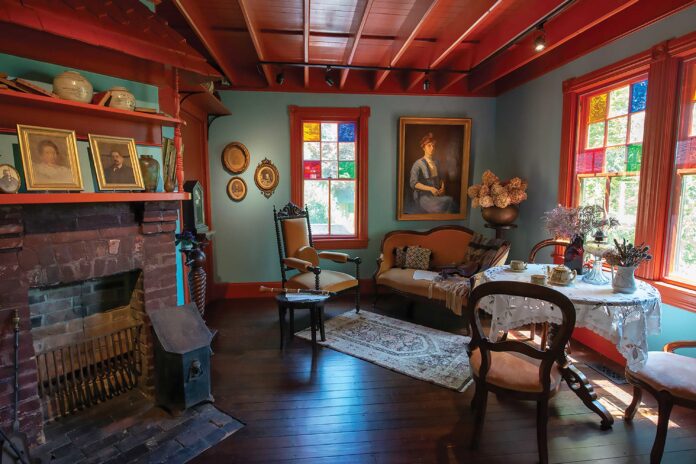
The parlor’s furniture, rug, stained-glass windows, and artifacts are all original to the house. On the mantle, the portraits of Peto and his wife, Christine, were painted by Emily Perkins in 1903. The larger portrait of Christine hanging on the far wall was painted by Fred Wagner in 1913.
Spotlight on the John F. Peto Studio Museum > Experts have come to acknowledge this artist as one of the leaders of late 19th-century America’s trompe l’oeil movement.
By Allison Malafronte
John F. Peto’s legacy has been enhanced by the preservation efforts of a team formed by Peter and Cynthia Kellogg, who used to own his Island Heights home. In 2010, after a five-year, $2 million renovation, this group opened the home to the public as the John F. Peto Studio Museum. And in September 2020, the Kelloggs donated the building to the museum’s board, which is now growing the permanent collection while planning exhibitions, events, and projects that highlight Peto’s significance.
Although his trompe l’oeil (“trick the eye”) still life paintings are owned by major museums nationwide, and although famous talents like Jasper Johns and Roy Lichtenstein have paid homage to him in their own work, John F Peto (1854–1907) has remained relatively obscure in accounts of American art history. Perhaps that’s due, at least in part, to the fact that he avoided both the spotlight and chasing commercial trends, preferring instead the family time, artistic reflection, and spiritual replenishment he enjoyed at his year-round cottage home in Island Heights, New Jersey.
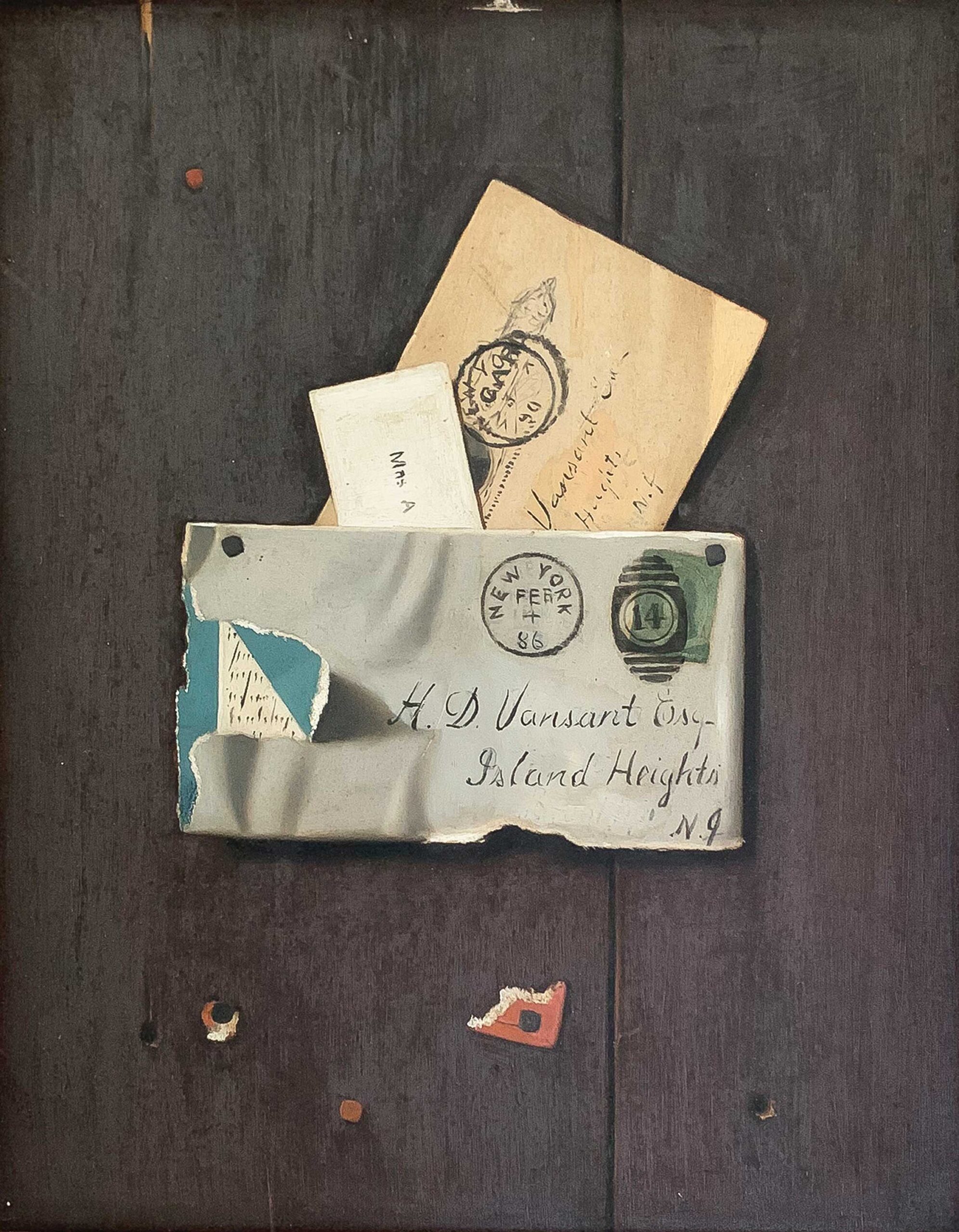
Peto’s painting “The Letters,” n.d., oil on canvas, 12 x 9 3/4 in.
Another factor contributing to Peto’s posthumous obscurity was the wrongful attribution of many of his paintings to William M. Harnett (1848–1892), whom Peto befriended while they were studying at the Pennsylvania Academy of the Fine Arts. Peto admired Harnett’s style and emulated it for a short time, which accounts for some of the confusion. But from 1949 onward, thanks to careful research by the art critic Alfred V. Frankenstein (1906–1981) and the perseverance of Peto’s only child, Helen, Peto’s name was eventually reassigned to dozens of his paintings. Since then, experts have come to acknowledge him as one of the leaders of late 19th-century America’s trompe l’oeil movement.
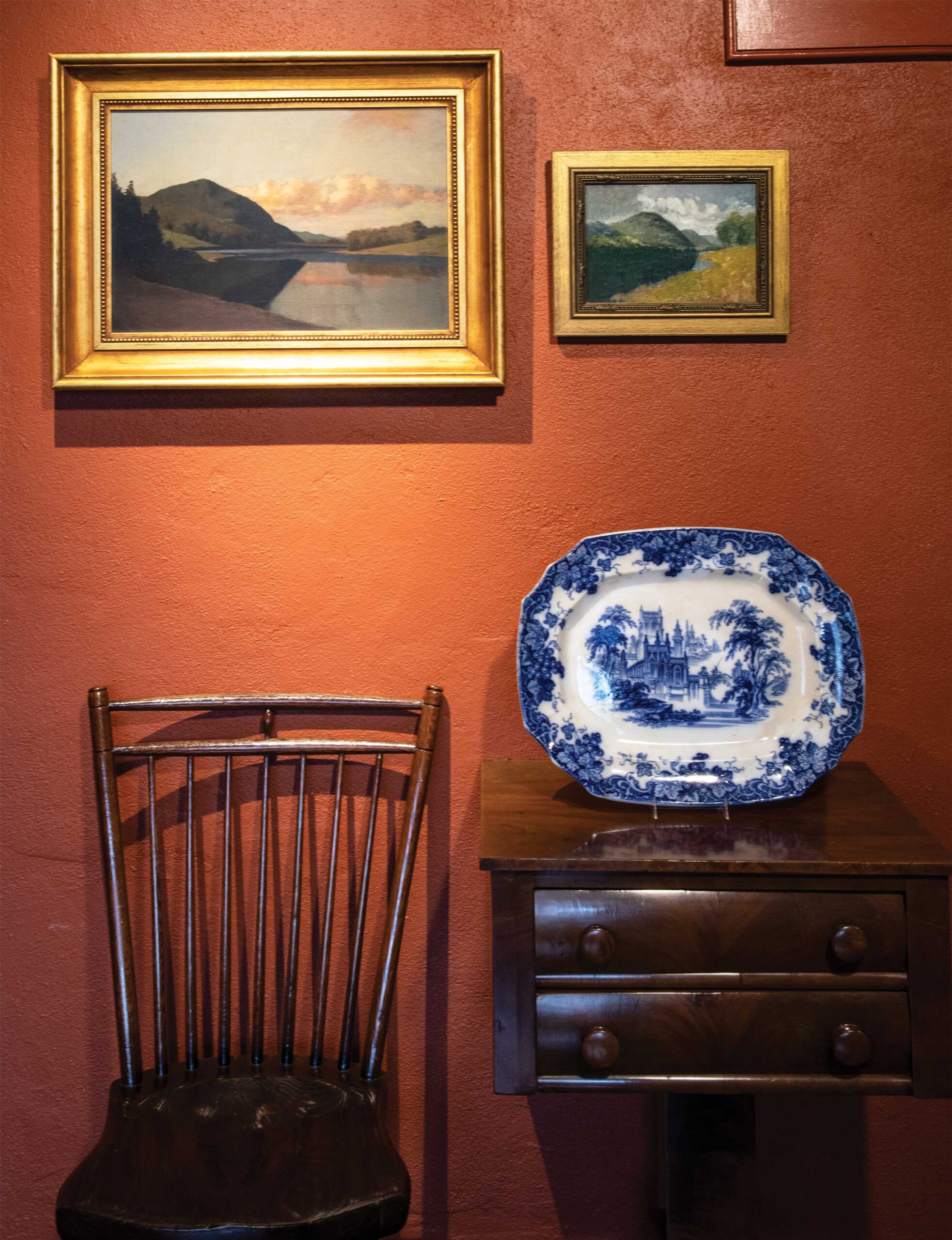
John F. Peto’s “Harper’s Ferry, West Virginia” (left) and “Study for Harper’s Ferry, West Virginia” hang above a vintage chair, heirloom blue-and-white platter, and antique side table.
Beginnings
John Frederick Peto was born in Philadelphia, the first of five children in a tight-knit family with whom he always remained close. By the age of 22, he had a studio on Chestnut Street near various friends and family members involved in the arts. Peto was also a musician and played the cornet in the Philadelphia Fire Department Band and at church meetings. At 23 he enrolled at the prestigious Pennsylvania Academy of the Fine Arts, just a year after Thomas Eakins was (controversially) forced to leave his post as director. Though Peto stayed only a year, he continued submitting his paintings to the academy’s high-profile annual exhibitions.
In 1889, when he was 35, Peto and his new wife, Christine, moved to Island Heights, a summer resort town on the Jersey coast he had gotten to know while visiting two aunts there regularly. Records reveal that Peto originally moved to “The Heights” in order to open a photography studio — following in the highly regarded footsteps of an uncle — before turning his full attention to painting. He designed and built a house at the corner of Cedar and Westray Avenues, then constructed a studio addition a few years later. This is where Peto spent most of the rest of his life, painting and taking photographs surrounded by the artworks and objects that inspired him, as well as his beloved wife, daughter, and two aunts.
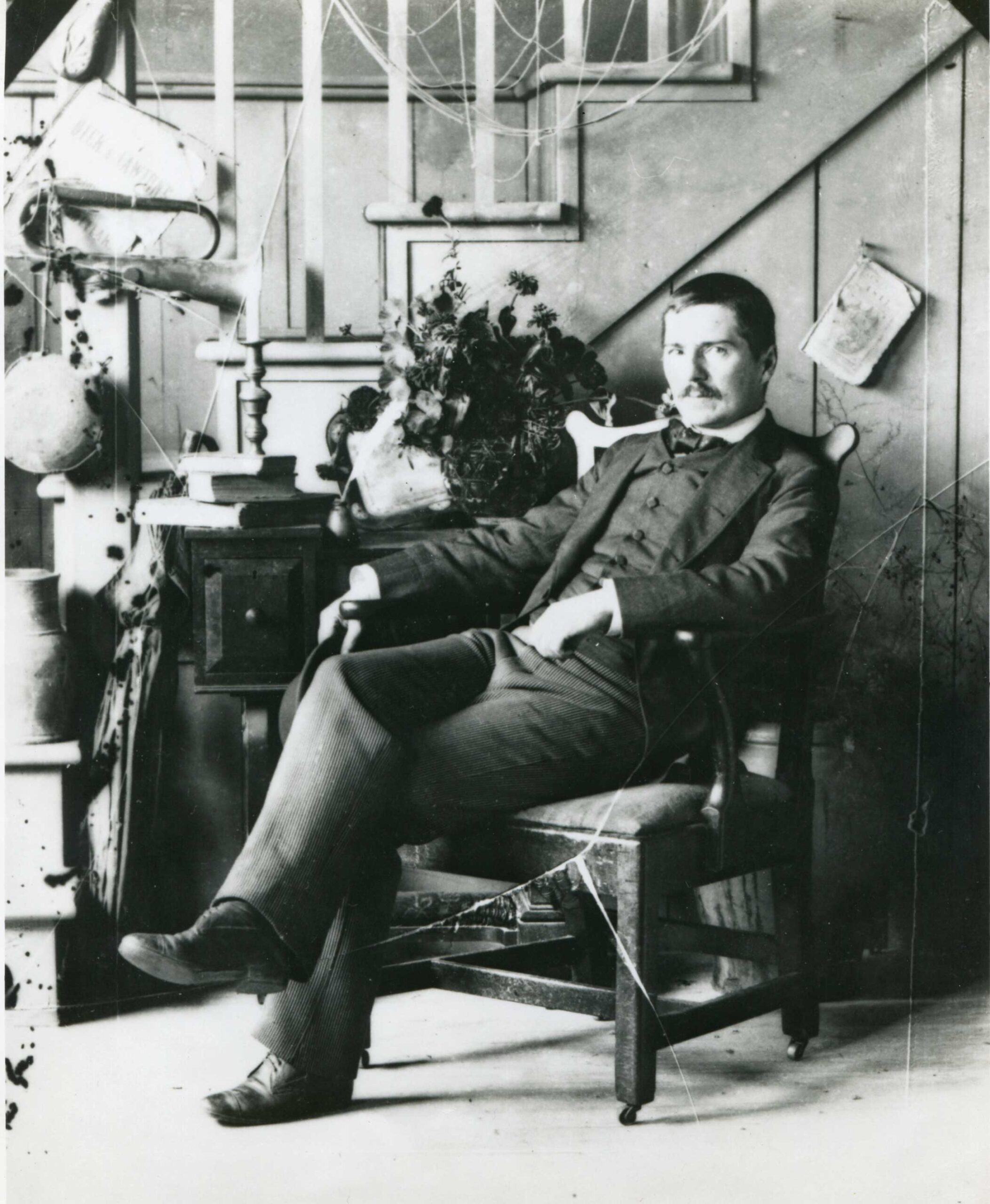
The museum owns this photograph of Peto seated in his studio, c. 1890.
While Peto basked in his sanctuary, friends and colleagues such as Harnett — who often tried, and failed, to persuade Peto to travel with him — were enjoying commercial success in Philadelphia, New York City, and other major markets. Peto earned a modest income by selling his paintings to tourists or bartering them with local businesses, sometimes supplementing it by playing his cornet for the Island Heights Methodist Camp Meeting or taking in summer boarders. After his premature death from a kidney condition at 53, Christine remained in their home, taking in boarders. Later Helen — followed by her daughter Joy Peto Smiley — ran the house as a bed and breakfast. Ultimately, three generations of Petos lived there for more than a century until Joy’s passing in 2002.
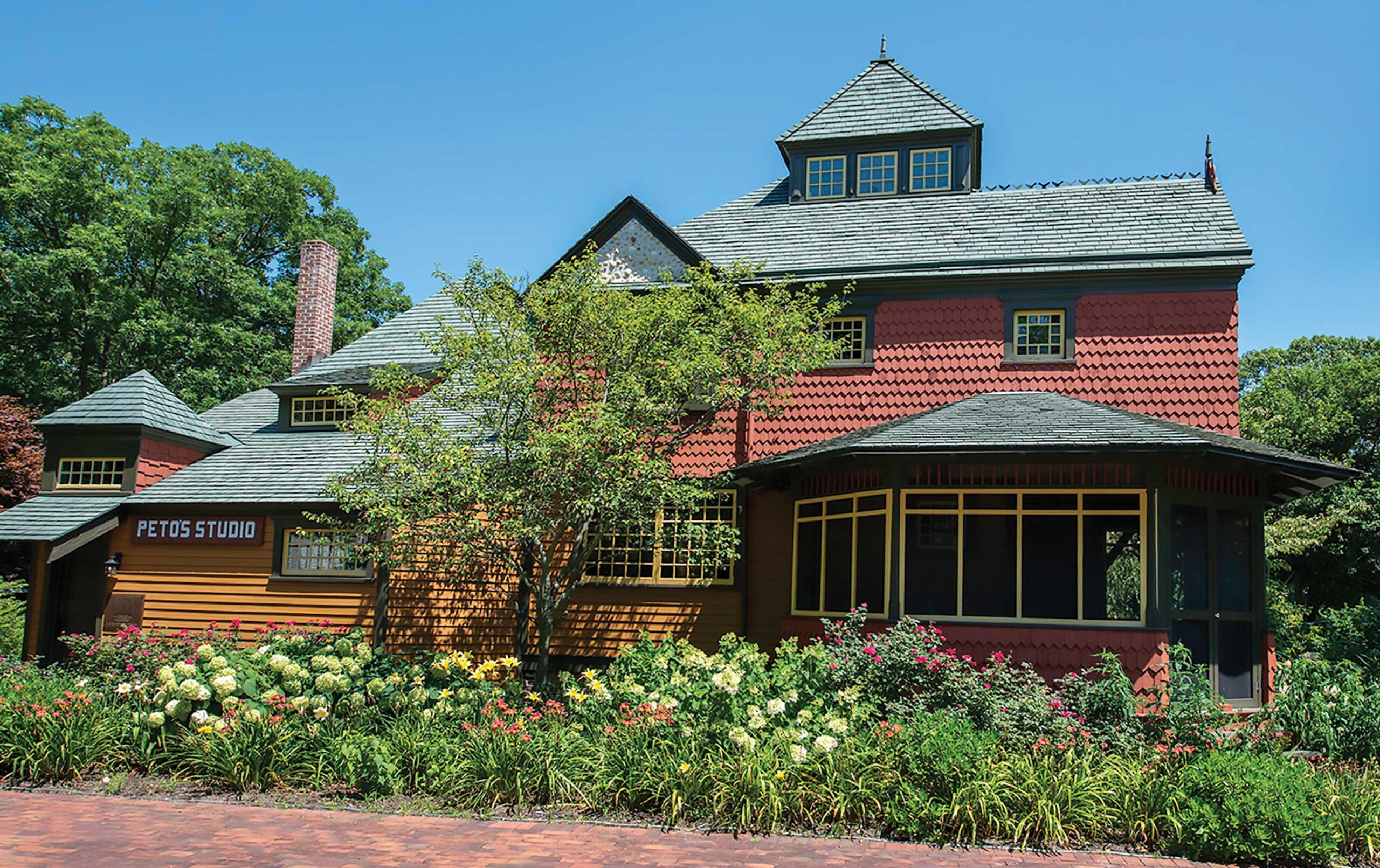
The Queen Anne-style structure was built in 1889–91 and underwent an extensive renovation in 2005–10. More than 60 paint samples (interior and exterior) were collected to determine its original colors.
Stepping Back in Time
Today, when visitors arrive at Peto’s two-and-a-half-story Victorian house — located just north of the Toms River where it flows into Barnegat Bay — its rusty red and ochre façade offers few hints of the rich artistic heritage inside. During its extensive renovation (2005–10), every effort was made to return both the exterior and interior to their appearance in 1907, the year Peto died. Using family photographs, archeology, and materials analysis techniques such as paint microscopy, the team replaced older shingles with cedar shakes, demolished several add-ons, restored the original rooflines and shutters, and reconstructed the front porch.
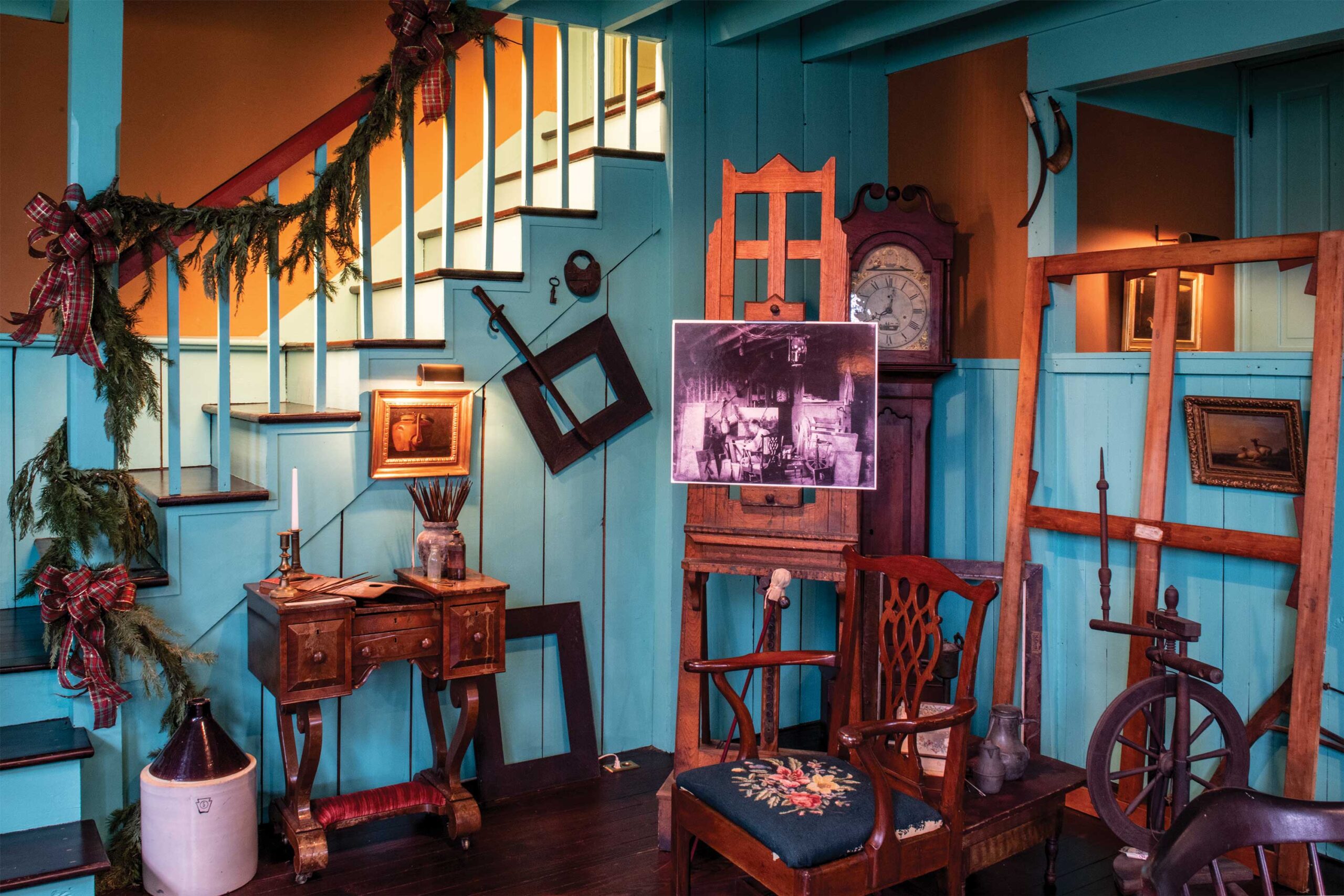
Walking through the front door is like stepping back in time. Throughout the 12 rooms on public view are pieces of period furniture, many original to this house; some of the actual books, candlesticks, vases, and ephemera that appear in various Peto paintings; his palette, brushes, and jars of medium; and examples from his collection of artworks and artifacts. Even the bright aqua wall color Peto selected has been replicated by analyzing a paint sample retrieved from the ceiling and then searching through more than 60 paint mixtures to find an exact match.
Peto’s studio was re-created based on the black-and-white photo above. Visitors can inspect his original easel, palette, jar of brushes, and bottles of medium.
Then there’s the art itself, displayed throughout the first floor, which encompasses the studio, parlor, office, and kitchen. The museum’s growing collection contains 22 original Peto paintings obtained through purchase, loan, or gift. Among them are seven recent acquisitions from a board member and from a local whose ancestors knew Peto. Various stages of the artist’s career are represented, with most emphasis on his trompe l’oeils and less on the landscapes. Rounding out the collection are several paintings by his Philadelphia-based contemporaries — such as Franklin D. Briscoe, Fred Wagner, and Emily Perkins — as well as black-and-white family photographs.
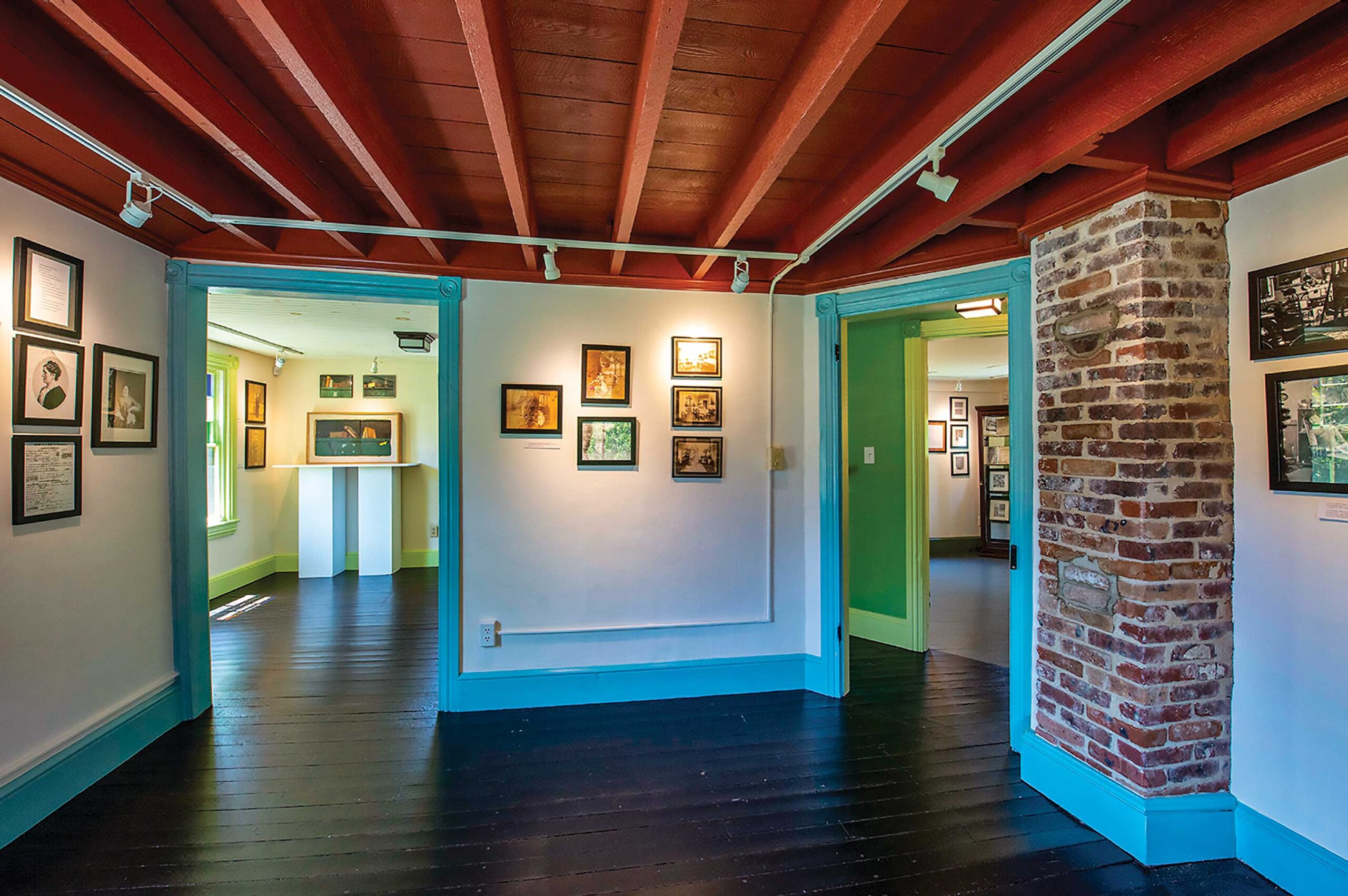
Five former bedrooms were converted into gallery space for the museum’s year-round schedule of exhibitions that showcase artists past and present.
Because no photographs of the five upstairs bedrooms survive, the restoration team felt free to convert them into gallery space, where visitors now enjoy rotating exhibitions throughout the year. When asked how he selects these projects’ themes and participating artists, the museum’s “Arts & Artifacts Curator,” Harry Bower, explains that he is not limited strictly to trompe l’oeil or New Jersey. “We show both regionally and nationally known artists working in genres that complement Peto’s lifelong interests, subject matter, and style,” he says. “Recent exhibitions have included Thomas Eakins in New Jersey, The Women of Peto, and Trompe l’oeil Meets Photo Realism.”
A retired art educator as well as a fiber artist, Bower has lived in Island Heights for more than 40 years and knew Joy Peto Smiley when she ran the bed and breakfast during the 1970s. He became further interested in 1983 while exploring the National Gallery of Art’s ground-breaking exhibition Important Information Inside: The Art of John F. Peto and the Idea of Still-Life Painting in Nineteenth-Century America.
After Joy’s passing in 2002, Bower was invited to join the house’s steering committee. Two decades later he remains enthralled with Peto’s art. “He was inspired by the everyday,” Bower notes. “When you look around his home and at the paintings themselves, you see many common objects: a good book, a good pipe, and a good beer quite often show up. Sometimes I look at the bold, bright colors in his paintings and think, ‘Was he influenced by those colors because he surrounded himself with them in his home, or was it the other way around?’”
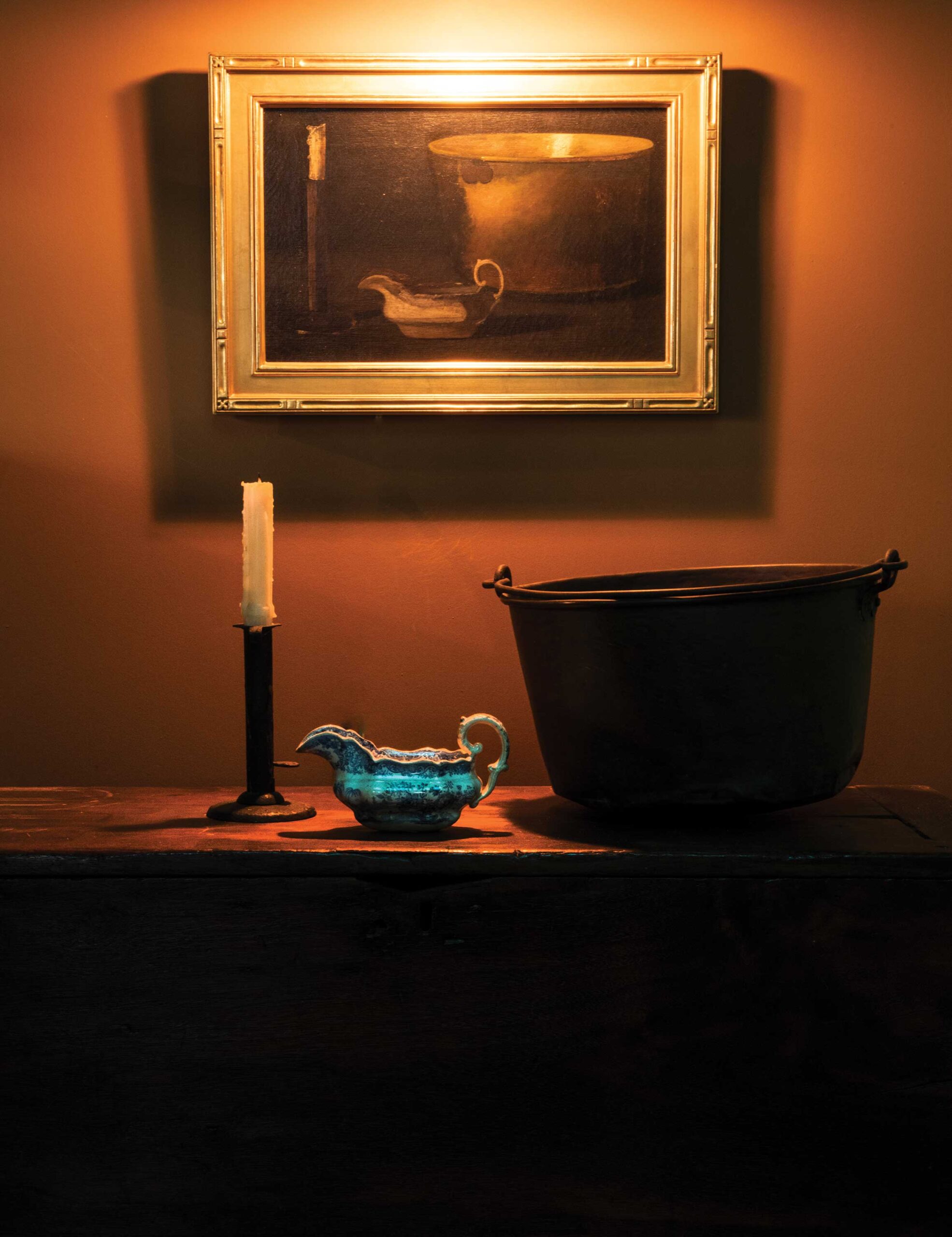
Peto’s painting “Brass Stewing Kettle, Candlestick, and Gravy Boat” (c. 1890) hangs above the original candlestick, gravy boat, and kettle that appear in it.
Where An Artist Creates Reveals Why
Perhaps it was both. Peto may have been drawn to commonplace objects, but his penchant for vibrant, uncommon colors is evident in both the objects he chose to depict and in the palette in which he decorated his home. “Walking through its rooms offers an opportunity to experience the inspiration that Peto found every day in the profusion of lush yellows, blues, reds, and greens,” writes Valerie A. Balint in her Guide to Historic Artists’ Homes & Studios (2020). She continues, “His paintings on display reveal that the same colors often appear in his work. The combination of original furnishings, objects, and artwork against this vibrant backdrop offers unique insight into Peto’s creative process and means of expression.”
Much of Peto’s later work was marked by expressive color, along with his usual attention to light, texture, and precise technique. It also became increasingly introspective and somber: ruminations on objects with history, meaning, and a story to tell, be they weathered books, newspaper clippings, rusty violins, or official documents that once belonged to his father. (A picture-frame gilder and dealer of fire-department supplies, Peto’s father was an enduring influence throughout the artist’s life.)
Viewing artists’ work in the context of where they created it is always enlightening. The John F. Peto Studio Museum is one of 48 sites currently in the National Trust for Historic Preservation’s network of Historic Artists’ Homes and Studios (HAHS), and it’s well worth the journey to coastal New Jersey — or any other location cited in Balint’s useful HAHS guide — to experience them in person.
“Art is the result of both a physical and mental practice, but what is displayed in a museum represents only the results,” Balint observes. “Artists’ homes and studios help us imagine the form of this rigorous process by allowing us to see where art was actually made…. [T]hey reveal not only an artist’s process, but what in the environment inspired it. The working spaces, the objects the artists chose to surround themselves with, the books they read, and the views they regarded beyond their studio walls all inform what they created.”
Plan your visit to the John F. Peto Studio Museum at petomuseum.org.
Indefinitely Wild (installation view), 2023, UCI Jack and Shanaz Langson Institute and Museum of California Art, photo by Jeff McLane
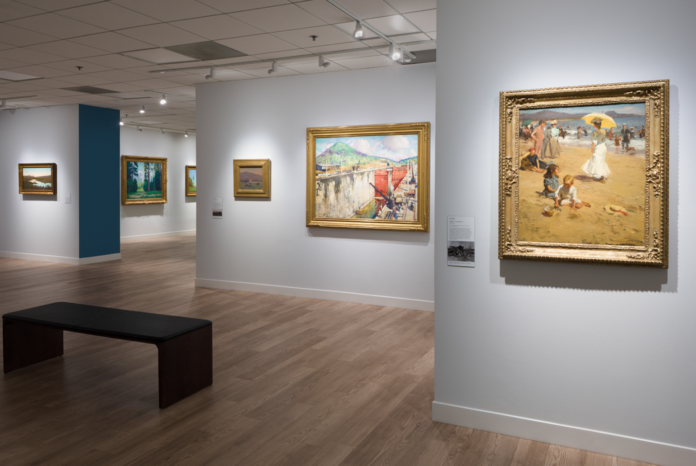
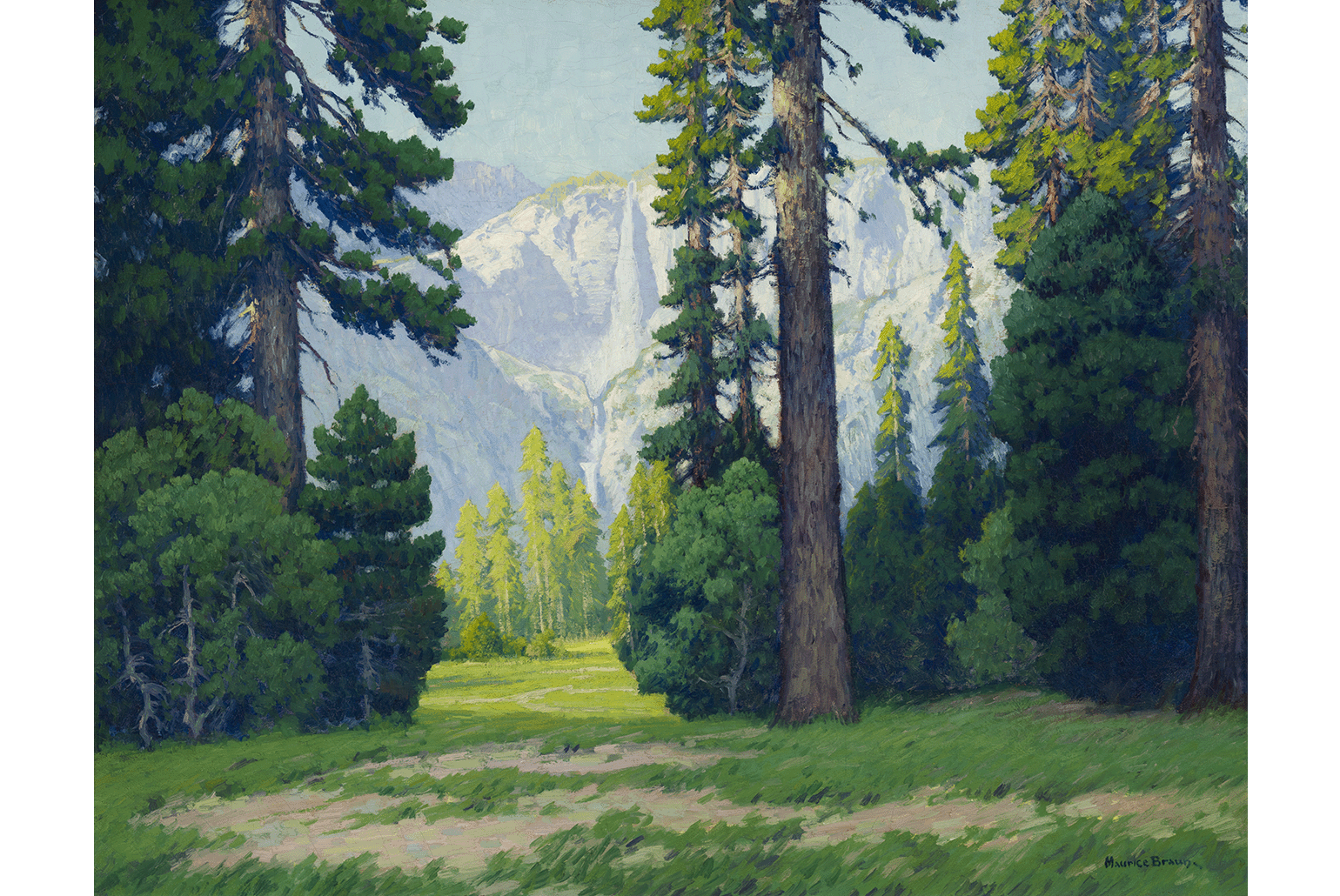
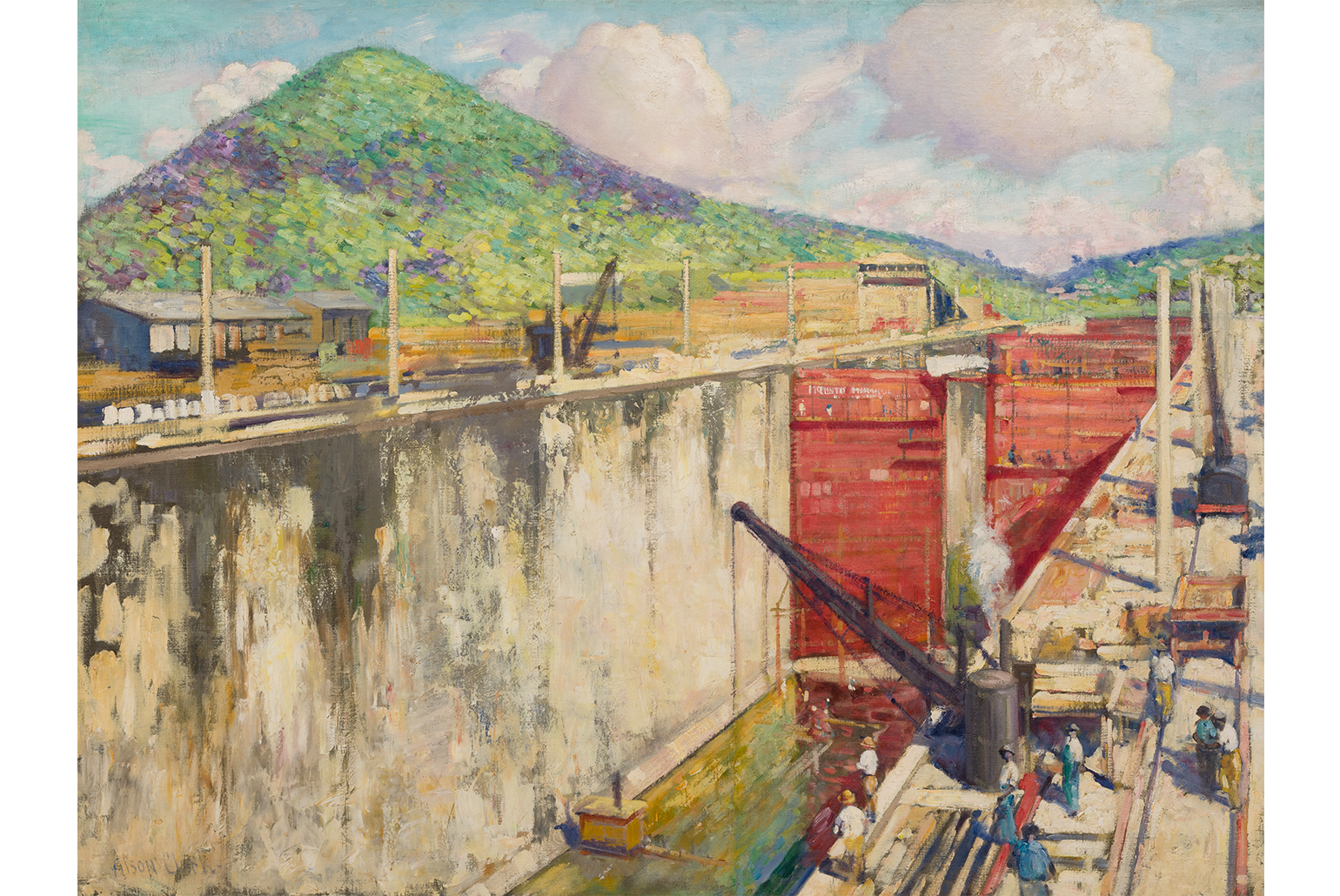
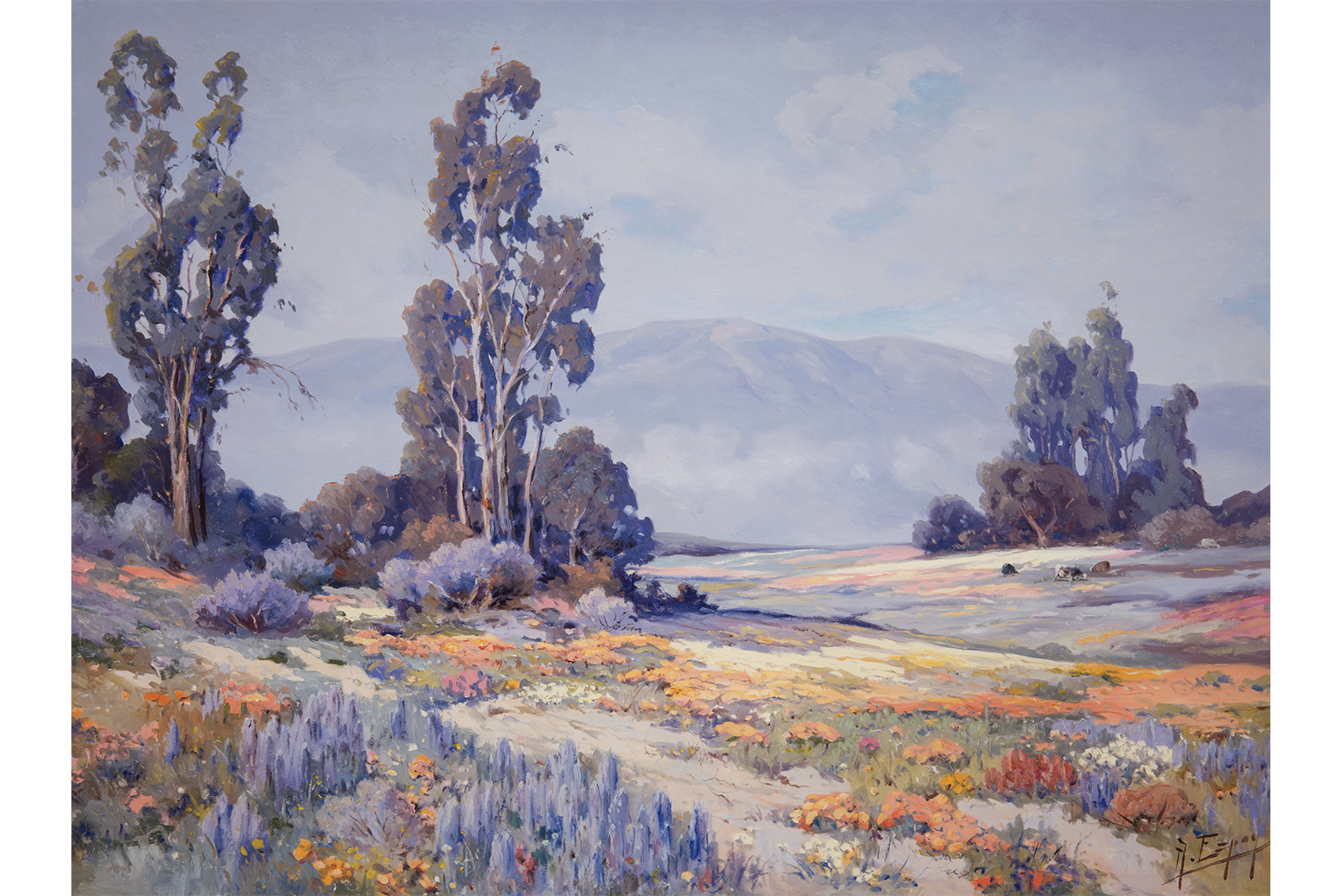
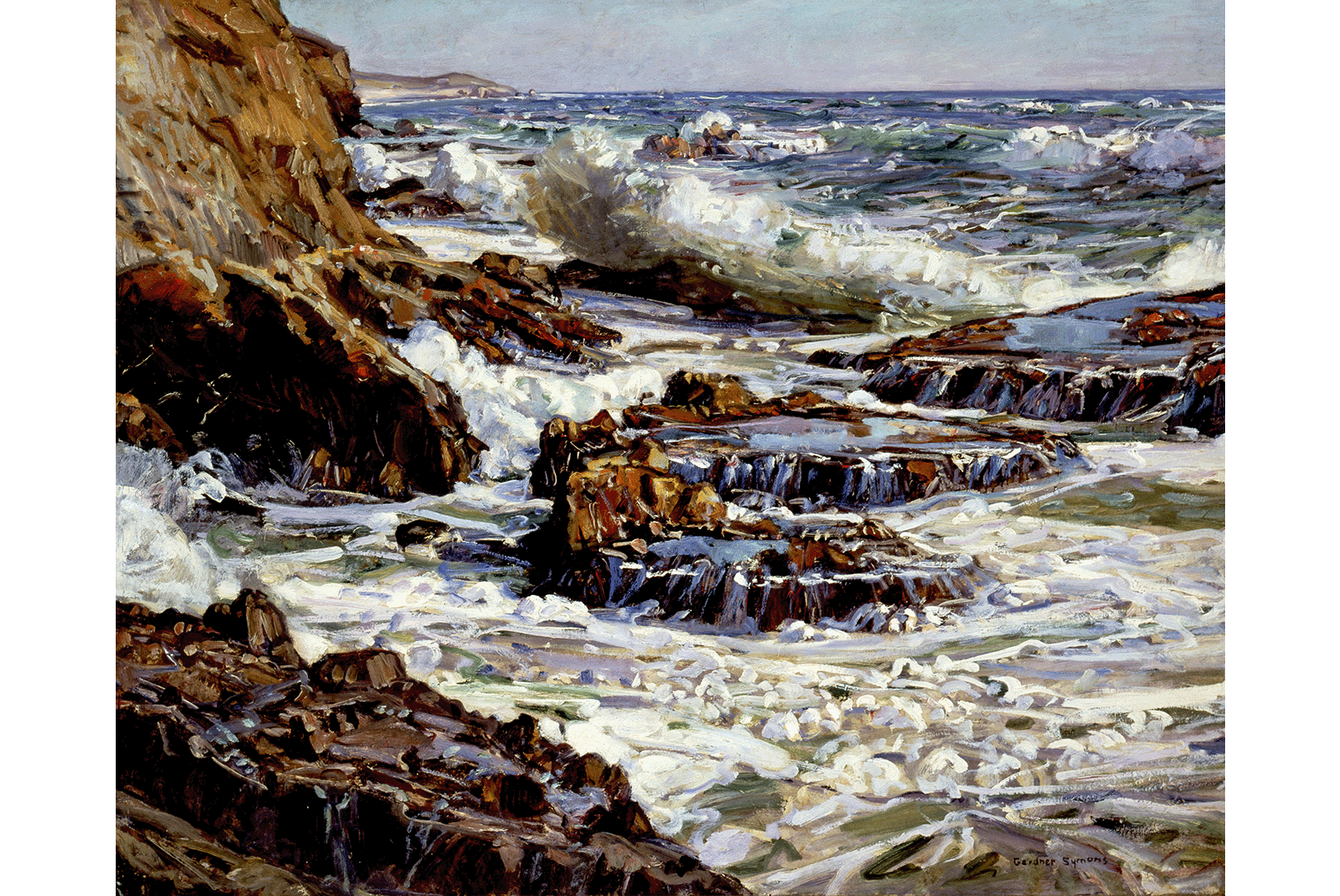
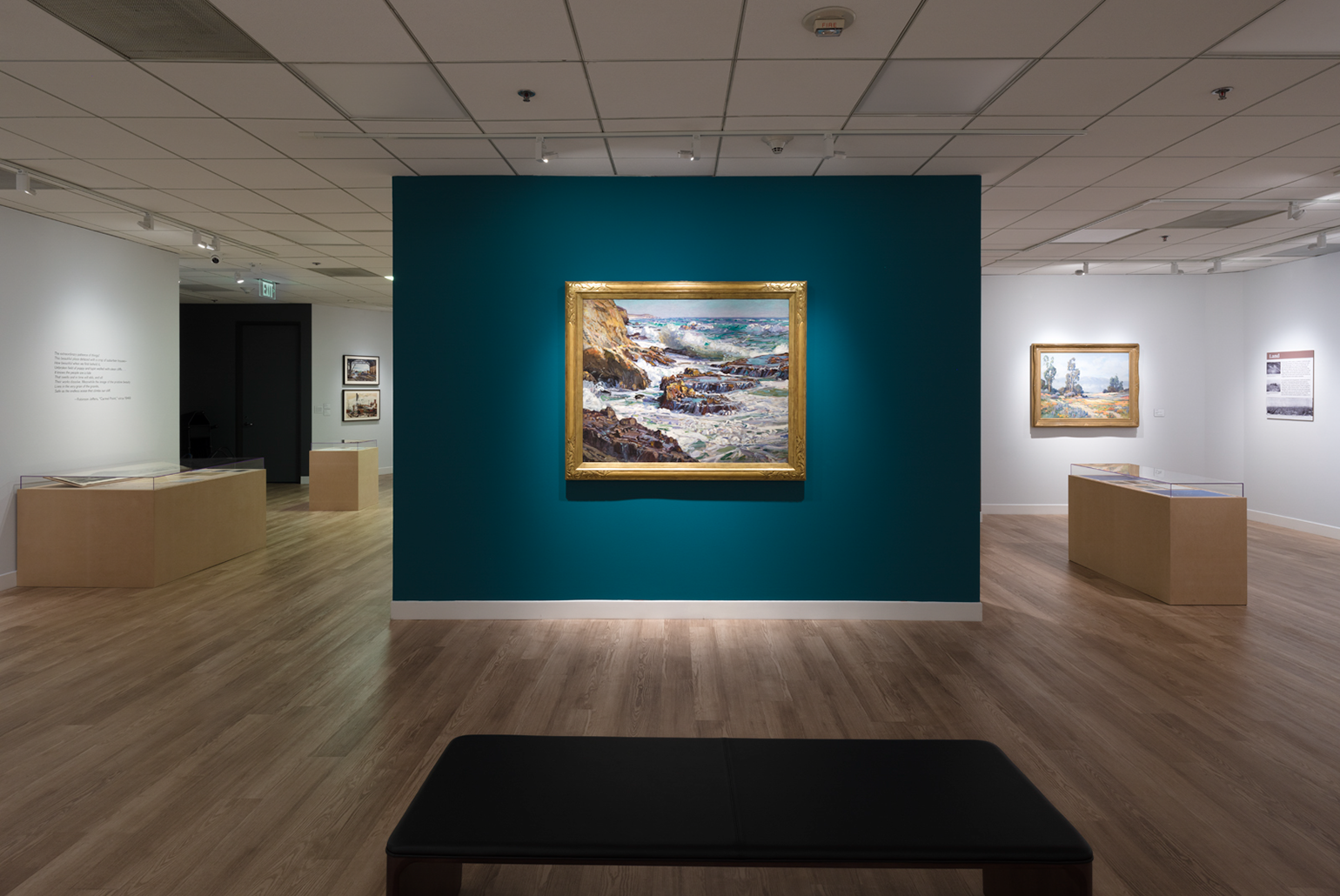
UCI Jack and Shanaz Langson Institute and Museum of California Art (Langson IMCA in Irvine) is presenting “Indefinitely Wild: Preserving California’s Natural Resources,” an exhibition exploring how the early history of environmental preservation and conservation of the state’s natural resources can be considered relative to the work of artists of the same period.
Maurice Braun, “Yosemite Falls from the Valley,” 1918, Oil on canvas, 36 x 46 in. UCI Jack and Shanaz Langson Institute and Museum of California Art, Gift of The Irvine Museum
In the exhibition, guest curator Cassandra Coblentz juxtaposes turn-of-the-century landscape paintings of the state’s natural resources with historical materials and photographs of human activities that depleted or commodified California’s natural bounty.
Alson Skinner Clark, “Pedro Miguel Locks,” 1913, Oil on canvas, 38 x 50 in. The Buck Collection at UCI Jack and Shanaz Institute and Museum of California Art
The selected works demonstrate how the featured artists considered humans’ relationships to nature alongside the impacts of industrialization and California’s population boom in the late 19th and early 20th centuries.
Angel Espoy, Untitled (Poppies, Lupines and Cows), after 1914, Oil on canvas, 30 x 40 in. UCI Jack and Shanaz Langson Institute and Museum of California Art, Gift of The Irvine Museum
Coblentz said, “The exhibition’s title ‘Indefinitely Wild’ draws on a quote by Henry David Thoreau, who writes of the ‘tonic’ of ‘unfathomable’ wild spaces, such as those depicted in the exhibited works. As presented here, they offer viewers an opportunity to consider landscape paintings in Langson IMCA‘s collection from a fresh perspective. My hope is that by reflecting on these works in the context of the history of conservation and preservation as well as the industrial development of our state, viewers will have a more nuanced understanding of the persistent need for protection and care of California’s natural environment and its wild spaces.”
George Gardner Symons, “Southern California Coast,” before 1913, Oil on canvas, 40 x 50 in. UCI Jack and Shanaz Langson Institute and Museum of California Art, Gift of The Irvine Museum
A range of ephemera complements the paintings and documents the state’s early industrialization alongside the development of environmental preservation and conservation practices. This ephemera includes both original and reproduced archival photography, newspaper clippings, advertisements, and other materials sourced from the Special Collections and Archives of UCI Libraries, among other institutions.
Indefinitely Wild (installation view), 2023, UCI Jack and Shanaz Langson Institute and Museum of California Art, photo by Jeff McLane
The exhibition is organized into five sections that explore specific natural resources that inspired these artists.
Fill your mind with useful art stories, the latest trends, upcoming art shows, top artists, and more. Subscribe to Fine Art Today, from the publishers of Fine Art Connoisseur magazine.





![moku hanga - Leon Loughridge (b. 1952), "Spirits of Abo Mission," 2023, woodblock print on paper [edition of 12], 18 x 12 in.](https://fineartconnoisseur.com/wp-content/uploads/2023/08/Loughridge-Spirits-of-Abo-Mission-696x1019.jpg "Loughridge-Spirits-of-Abo-Mission")