


What to do with fine art collection objects that are outsized in value relative to everything else one owns? Find out in this article from Fine Art Connoisseur magazine.
By Daniel Grant
On an episode of PBS’s long-running television series Antiques Roadshow, a man brought in a marine painting he had inherited from his father several years before. He didn’t know anything about its creator, Francis A. Silva (1835–1886), and so was interested to learn about him, the artwork, and — of course — its value from regular Roadshow expert Debra Force. If she were to handle the painting, the New York art dealer declared, she “would probably sell it for around $250,000.” The owner’s first response was “Holy smokes” and then, “That’s worth more than my house!”
This owner soon realized that he didn’t want something quite this valuable at home, so he loaned the Silva to the Seattle Art Museum for almost a decade. Ultimately, he consigned it to Debra Force.
One can understand this owner’s desire to be free of the painting. He did not have a fine art provision, or even a fine art rider, on his homeowner’s insurance policy. A theft or, more likely, a disaster such as a fire, hurricane, earthquake, or tornado, would greatly diminish the Silva’s value. He might even have wondered, “What if the wire holding the frame on the wall snaps and the painting falls to the floor?”
Varied Challenges of a Fine Art Collection
Indeed, art collectors have a lot to fret about. For example, “It is difficult, almost impossible, to find an insurance policy for just one painting,” says Dorit Straus, a fine art insurance adviser at Wondeur AI, which evaluates financial risks for the insurance industry. The “imbalance” in value between one masterwork and your home’s other assets “would lead most insurers to decline to provide coverage.”
Even if an insurer agreed to write a policy for one artwork, she notes, there would likely be other expenses to address, such as installing a central station alarm that automatically notifies the police and fire departments that a break-in or fire is occurring. There might also need to be cameras and sensors to track problems, and more secure doors and windows to prevent intruders. Alternatively, the owner might need to rent a space in a fine art storage facility. Getting insured is “not a panacea to having something very valuable,” Straus concludes.
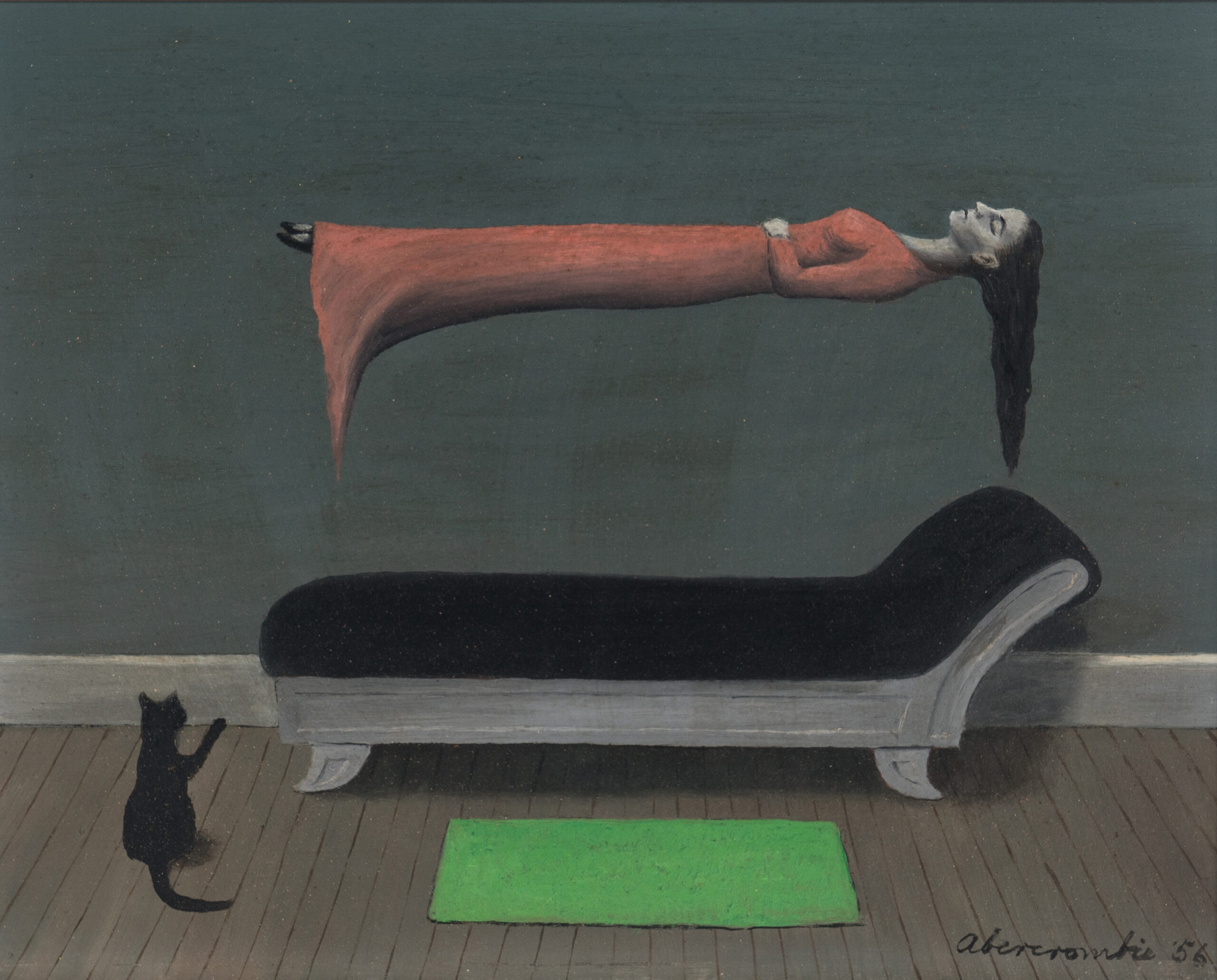
Though it is generally assumed to enrich viewers’ lives, art can also inspire anxiety. Zack Wirsum, senior vice-president and head of postwar and contemporary art at Freeman’s | Hindman, recalls an instance when a “consignor was losing sleep, quite literally, over how valuable a work he inherited had become. He did not think he could afford to insure it.” He owned a tiny painting by Gertrude Abercrombie (1909–1977) that his father had purchased for $90 directly from the artist at a Chicago street fair back in 1956. The consignor had seen online that “works by Abercrombie had been sold for as much as a quarter of a million dollars, and he was worried about having something so valuable on his walls.” He brought the work to Freeman’s | Hindman, which sold it for $469,900, a record-setting price for the artist.
Rags-to-riches sounds good, but worry-to-relief sounds good, too. Betty Krulik, a dealer in Irvington, New York, who has also offered appraisals on Antiques Roadshow, recalls a couple she informed that their pair of Winslow Homer watercolors were worth up to $200,000. They immediately placed them in a bank vault. “These were people from a small town. They didn’t even have a lock on their door,” she says. Sure enough, the pair sold at Christie’s New York in January 2025 for a total of $189,000, including fees.
The owners of highly valuable artworks are often quite unlikely. The Washington, D.C.-based National Press Club possessed a 1946 painting by Norman Rockwell titled “Norman Rockwell Visits a Country Editor” that had appeared on a cover of The Saturday Evening Post. The artist had given it to the club in the early 1960s, an era when his paintings were not perceived as valuable after they had been published. Through most of the intervening years, this piece had hung unguarded on a wall, but Rockwell’s market was skyrocketing.
The club eventually took out a fine art insurance policy, the premiums of which rose with the market. By 2015 the appraised value had reached $10 million–$15 million, resulting in annual premiums of more than $10,000. “The National Press Club isn’t a museum like the Smithsonian,” said John Hughes, then the club’s president and an editor at Bloomberg Business. “We’re not set up to handle works of art that are valuable, and the costs of insurance and keeping this painting safe, since we don’t have guards here, would drain resources from our core mission.”
So the National Press Club decided to sell the Rockwell at Christie’s, where it fetched $11.5 million, filling the organization’s coffers and easing a variety of worries. Many private owners probably know, and like, that feeling.
Rockwell gave a 1959 oil on paper study, “The Jury — The Jury Holdout,” to Richard Hamilton, who had originally called the artist seeking to buy something as a gift for his father. The work returned to Hamilton with his father’s estate. According to the New York-based illustration dealer Judith Cutler, it “had appreciated in value to the point that he felt he couldn’t keep it anymore,” so Hamilton consigned it to her and she sold it for “more than $500,000.”
Things to Consider
It’s impossible to control whether your art rises or falls in value. Ironically, the upside is where the worries may begin. An owner’s responsibilities rise with the price, and insurance premiums — which run 8–12 cents per $100 of appraised value (roughly $1,000 per $1,000,000) — are only the beginning.
Let’s start with the more expensive security technology: motion sensors in rooms where artworks are displayed; intrusion-detection systems for points of entry and exit (doors, windows, chimneys, air-conditioning units); alarms attached to artworks to alert a security company if they are moved; motion-activated camera surveillance of the house’s grounds; thicker locks and striker plates on the house’s doors; and the establishment of protocols for inventorying, activating systems, and identifying everyone who enters the house. Some owners even buy DNA threads that are woven onto the back of a canvas to help with identification if the work is stolen. These costs can easily reach $25,000–$50,000, according to Robert Wittman, an art security and recovery consultant in Chester Heights, Pennsylvania, who headed the FBI’s National Art Crime Team until his retirement in 2008. “For a large house with a lot of acreage, you could spend considerably more.”
All of this may not worry seasoned collectors who are “out in the market and keeping track of things,” says David Weiss, senior vice-president for fine art at the Philadelphia office of Freeman’s | Hindman. They already have insurance, and for them the only problem may be the insurer’s requirement for updated appraisals following a rise in prices for similar items. The decision to sell is based less on fear than “a sense that this is the time to cash in.”

It is the non-collector who is more likely to be taken aback by the costs and responsibilities of ownership. The National Press Club is an example, and there are colleges and universities nationwide that find themselves art-rich and endowment-poor, seeking to sell in order to become more financially stable. A telling example arose in 2023 at Indiana’s Valparaiso University when administrators decided to sell three paintings from its Brauer Museum of Art — Georgia O’Keeffe’s “Rust Red Hills” (1930), Frederic E. Church’s “Mountain Landscape” (1865), and Childe Hassam’s “The Silver Veil and the Golden Gate” (1914) — estimated to be worth $10 million–$15 million in total. The objective was to use the proceeds to improve freshman dormitories with “amenities and features that prospective students value and expect,” according to the university’s president, José D. Padilla.
An additional reason for the sale, the university claimed in its petition to the County Superior Court, was their heightened value. “The three paintings… have become very valuable making it impractical for Valparaiso University to display them and making it wasteful for Valparaiso to retain them in storage indefinitely.” The petition noted that the Brauer Museum lacks state-of-the-art security systems, particularly at a time when “‘activists,’ in recent years, have taken to hurling soup and other harmful objects at classic art.” Keeping the artworks would mean that the university would have to spend money, whereas its priorities were elsewhere. Today the paintings are awaiting sale, stored in an undisclosed location.
Next Steps
What to do with objects that are outsized in value relative to everything else one owns? Joanna Ostrem, head of Christie’s trusts & estates department in New York City, says, “We are always happy to provide estimates and auction recommendations, and if a sale is not wanted, we can help find an alternative such as giving or loaning the work to an institution.” Donating is a good option assuming that the museum wants the piece and the donor can claim a charitable deduction. Still, if the appraised value is so great that the taxpayer can’t make full use of the deduction — even carried over five years — then the option of selling re-emerges.
One further option is to place pieces in fine art storage facilities, which are distinct from self-storage units because of their environmental controls (temperature, humidity, ventilation), increased security, and greater cost. In Manhattan, they generally charge over $200 per month for the first five square feet, and some negotiable amount for every square foot after that.
Picasso stated that a work of art washes “the dust of daily life off our souls,” but sometimes it can inadvertently complicate that daily life, becoming the gift that keeps getting paid for.
DANIEL GRANT is the author of several books, including The Business of Being an Artist (Skyhorse Press). He also is a contributing writer to Fine Art Connoisseur.
Fine Art Today covers artists and products we think you’ll love. Linked products are independently selected and linked to for your convenience. If you buy something using a link on this page, Streamline Publishing may receive a small share of that sale.
View more artist and collector profiles here at FineArtConnoisseur.com.