
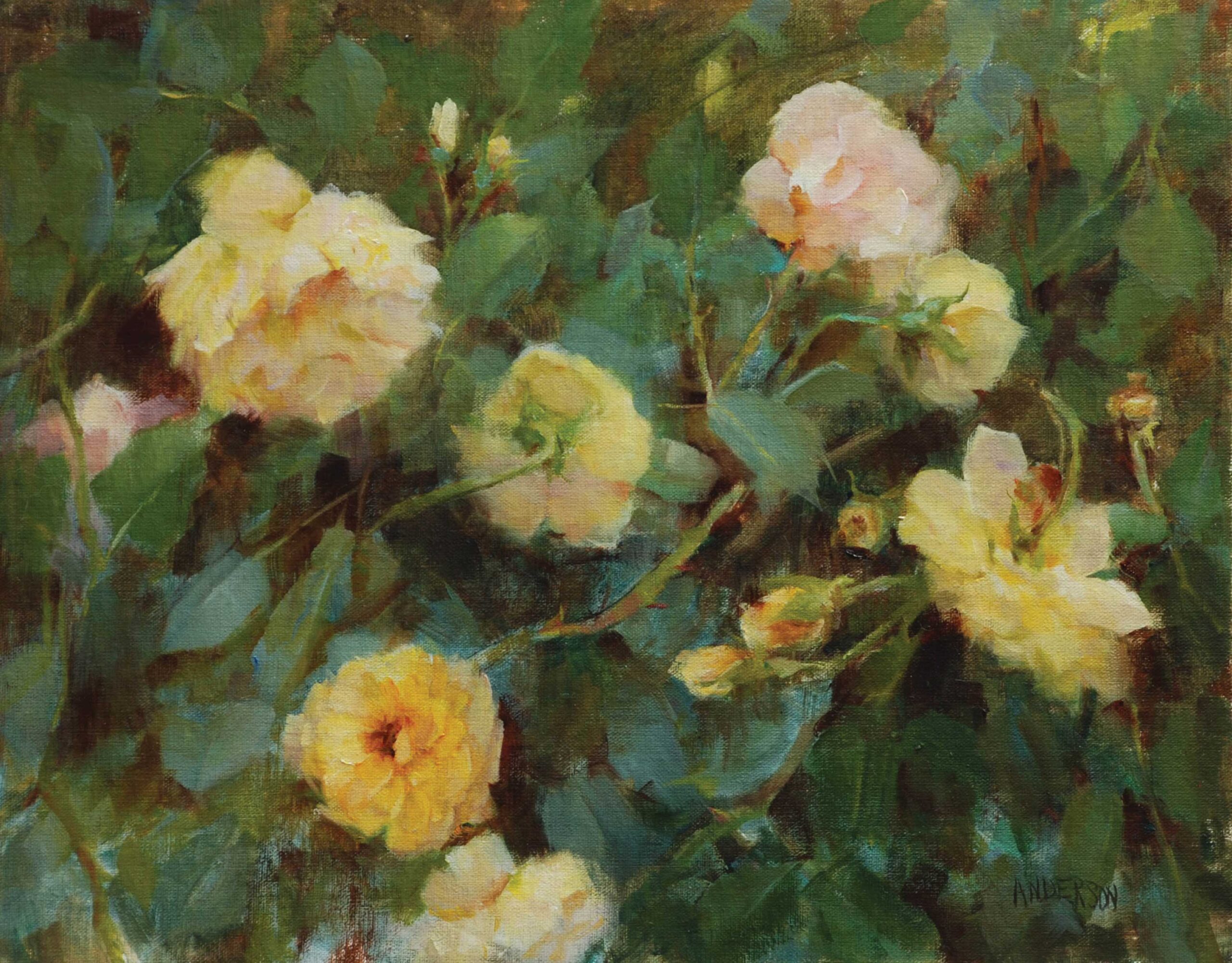
Discover Kathy Anderson’s artful paintings of flowers in this feature article.
By Daniel Grant
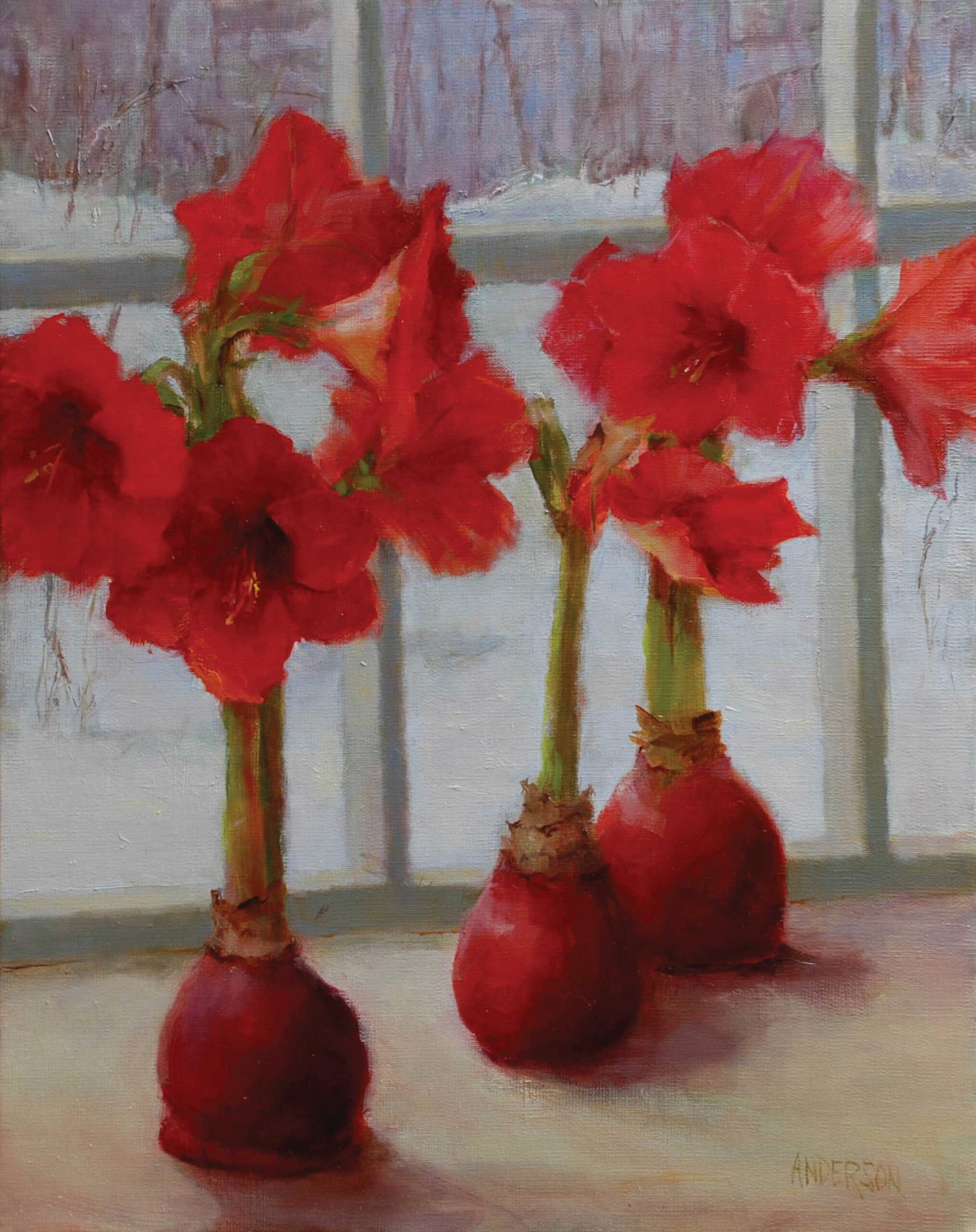
Based in Redding, Connecticut, Kathy Anderson (b. 1945) is a leading painter of floral still lifes and gardens, especially blooms gathered into groupings that provide contrasting colors and shapes. “I look for strong value patterns,” she says, “and for color combinations that excite me. A few weeks ago, I started a painting of white peonies, and now I have some pinks thrown in, even just spots of pink. That garden also had yellow lilies, which I wasn’t going to put in. But then I got home and thought, ‘You know what? I’m putting those in,’ and now they look so beautiful.”
A florist, Anderson notes, is usually focused on creating symmetry, balancing colors and flowers in equal measure, with everything at its peak. Her paintings, on the other hand, “look like a garden.” She says, “They have some dead flowers, pieces of flowers; occasionally you see a weed or grass or something like that. I have a more natural way of setting something up, as opposed to a formal bouquet, though sometimes I do that, too.” That peony painting, for instance, has some flowers in full bloom, but others are past their peak or just buds. It’s a still image that evokes the past, the present, and the future.
One might assume that someone growing up in the heyday of abstract expressionism and reaching maturity in the time of Pop, minimalism, and conceptualism would make art reflecting some of those influences. “My God, no,” Anderson laughs. “Experimenting in this, dabbling at that, trying one style after another. I’ve always gone to what I’m drawn to, which is nature and flowers.” She did study art, specifically illustration, at Farmingdale State College on Long Island. At the time it was the State University of New York’s largest college of applied science and technology, and its illustration program trained artists to work in the advertising industry. Anderson lasted a year and a half. The instruction was based on “very tight concepts,” and she hated it. “I just didn’t do the work and thought, ‘Oh, they’re not really going to flunk me,’” but they did.
Anderson spent 11 years working as a ticket agent for United Airlines at New York’s JFK airport, getting married in 1970 and eventually having children, all of which moved any aspirations to paint full-time to the back burner. But, as every parent knows, children do grow up and parents contemplate what they want to do next. Suddenly there was time to attend workshops and plein air paint-outs. “During my early career, I was pretty much self-taught,” Anderson explains, but if you work at something long enough, you generally will become more proficient.
She began with watercolors, painting birds, flowers, and wildlife, and showing in one or two local galleries. Anderson says she “transitioned to oils because I never painted as most watercolorists do, prioritizing the medium’s transparency. Instead I preferred to add gouache or even pastels. So I said to myself, ‘Why don’t I just work in oil?’”
In addition to selling through small galleries, Anderson bought a tent and began selling directly at outdoor shows for several years, which she now looks back on as “a nightmare.” She says, “It’s always weather-dependent. It’s too hot, it rains, it’s too cold.” Eventually, she put away the tent and began working with a few friends as a muralist, painting images on interior walls and ceilings in private homes.
The Turning Point
It was at an arts and crafts festival in Sherman, Connecticut, that one of her paintings was purchased by the award-winning artist Richard Schmid (1934–2021), who had lived in the town before and returned annually to help promote the festival. The two artists did not actually meet at the time of the sale, but the next year Anderson participated in the same show “and introduced myself,” she says. “Richard then invited me to join the Putney Painters.” (Schmid, who died in 2021 at the age of 86, was the focal point of painting groups he formed in the various places he lived; this particular group met periodically in Putney, Vermont. Many of his valuable tips appear in the book Alla Prima: Everything I Know about Painting, which has been updated often by Stove Prairie Press since its first appearance in 1998.)
“What appealed to me about Richard mostly was his unbelievable joy in painting,” Anderson recalls. “And the standards of excellence I learned from him: don’t put out work that isn’t your best; don’t settle; always keep learning and sharing. That was the main thing: to share and pass it on.”
Schmid’s widow, the artist Nancy Guzik, says that his “influence on Kathy was profound. As members of the Putney Painters, they worked together regularly, providing Kathy with invaluable opportunities to observe Richard’s process up close. She learned how he approached and resolved artistic challenges and utilized his tools and materials. She observed his entire painting process from start to finish. Richard generously shared his knowledge, eagerly answering her questions and offering guidance. Over more than 19 years, their collaboration deepened into a close working relationship and a cherished friendship full of fun.”
Perhaps the most crucial lesson Schmid imparted to Anderson was to simplify her goals and paint what excites her. She recalls him saying: “Are you excited about that color? About the light on those particular flowers? Will what you see become a great composition?” Anderson also credits her long friendship with her Connecticut neighbor Everett Raymond Kinstler (1926–2019), whose influence and critiques added to her dedication to high standards in all aspects of an artistic career.
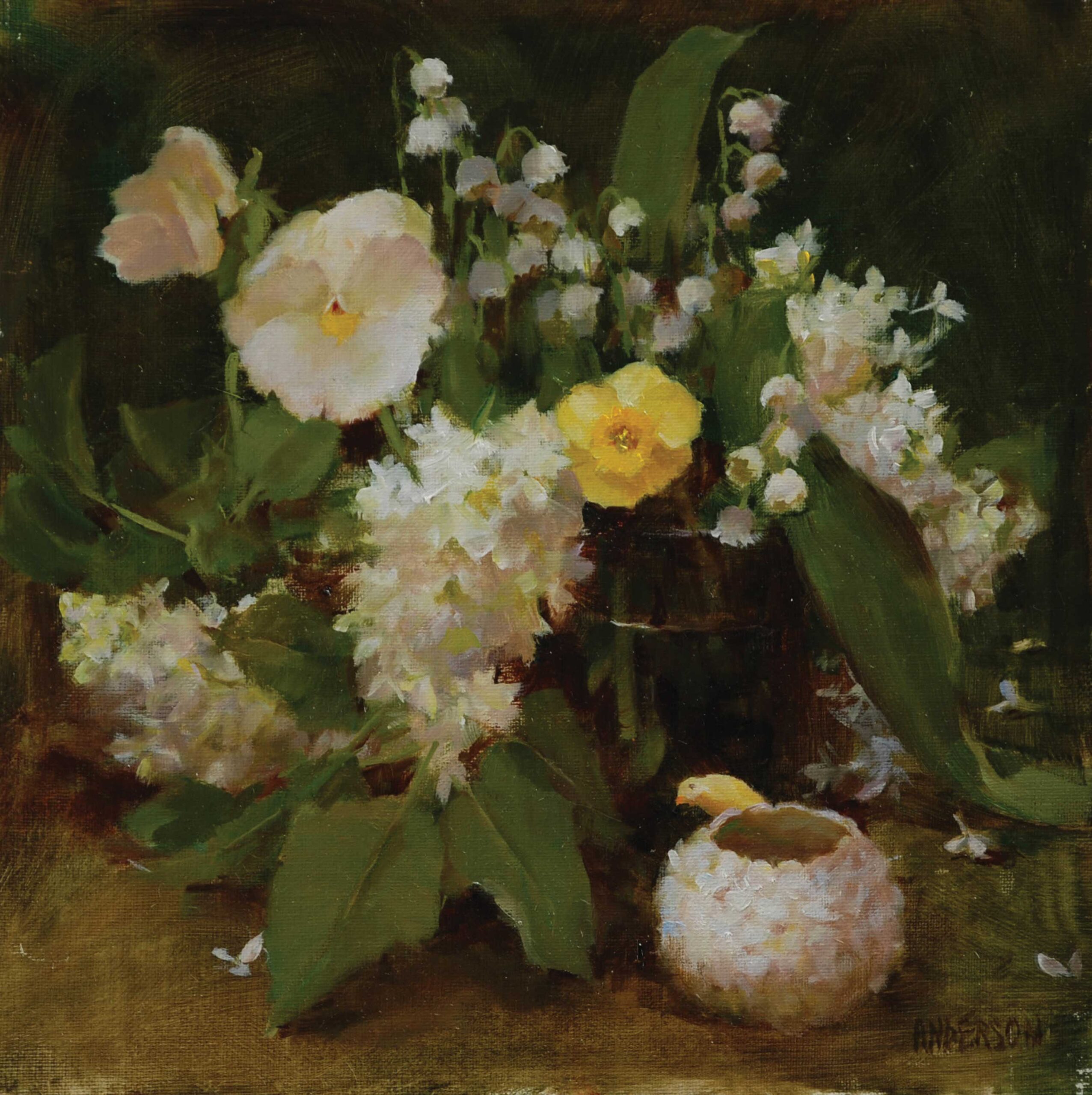
Today Anderson keeps busy producing 30 to 40 paintings per year that range in size from 6 x 8 up to 34 x 50 inches. And she keeps her husband, John, equally busy as her expert in-house framer. That’s enough output to keep her seven galleries stocked with inventory that generally sells between $2,000 and $12,000 per piece. Anderson also teaches workshops around the country and abroad.
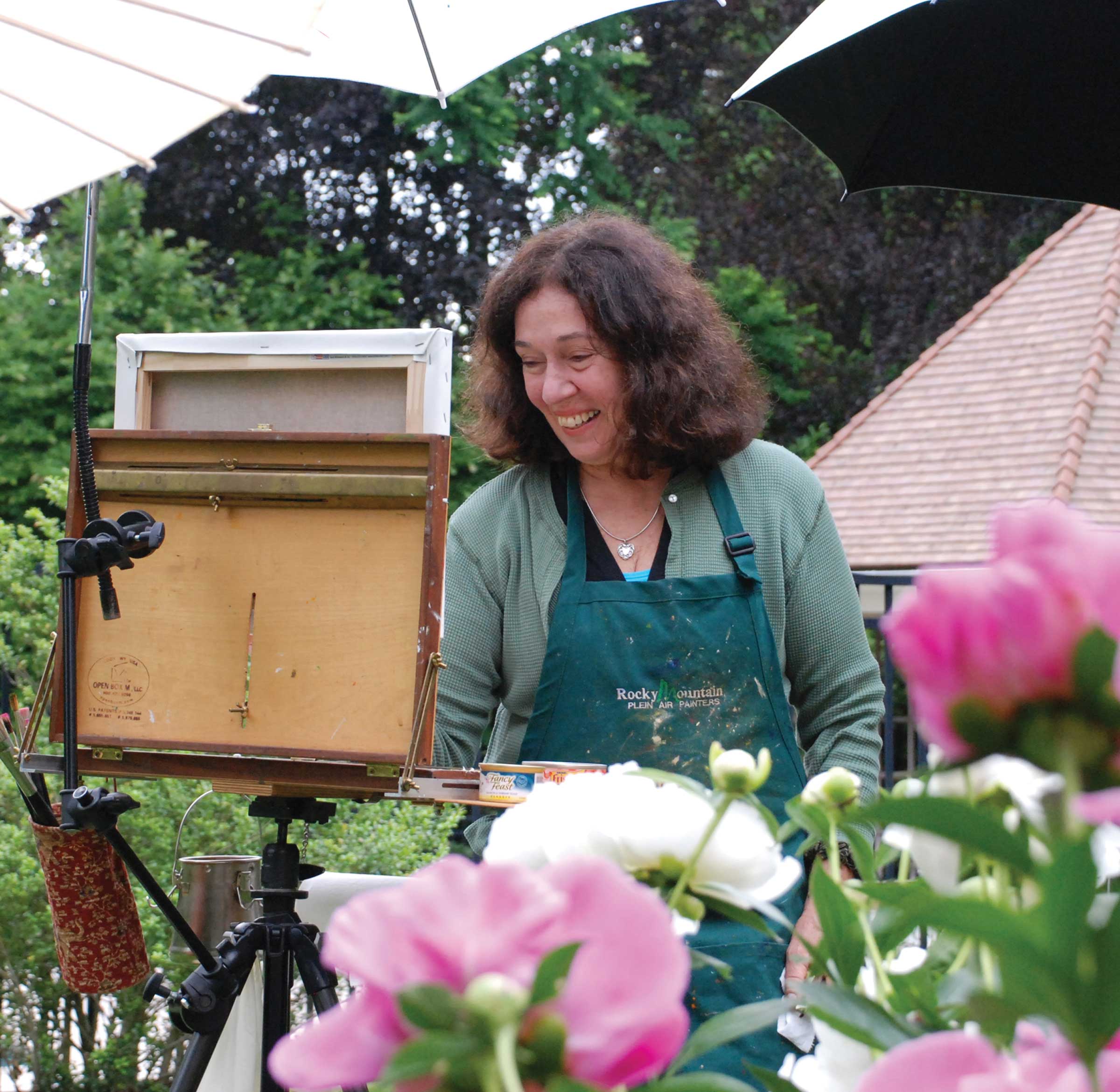
Anderson also enjoys painting landscapes and has participated in many plein air shows and paint-outs. On location, she looks not so much at “the big vista, the mountains, and clouds in the distance. I prefer intimate landscapes.” The world is her garden, and the garden is her world.
Paintings of Flowers & A Paradox
From time to time, I had occasion to speak with the late critic and author Dore Ashton. If I mentioned “the art world,” she would interrupt me to say, “There is no art world.” She meant that nothing holds together all of us artists, critics, curators, buyers, sellers, and viewers other than the word “art.” Instead, there are numerous niches where people maintain their own language in a certain fiefdom and look down on — or at least have little to do with — other fiefdoms. Just for example, artists highlighted in Fine Art Connoisseur almost never appear in ARTnews and Art in America, and vice versa.
Today I dare you to visit the “leading” galleries of New York City, Los Angeles, Chicago, or Miami and find plein air paintings of flowers. Yet all of us like flowers; many of us visit botanical gardens wherever we go, from Brooklyn to Giverny to Marrakesh, but somehow there is a disconnect between what we like to see in life and what we see in contemporary art.
Flowers in bloom (embodying life at its fullest) or in decay (signifying the shortness of life) were a long-standing artistic subject from the 17th century (e.g., Chardin, Bosschaert) right through the 19th century (Manet, Van Gogh). The modernists sustained this interest — just think of Klimt, Matisse, and O’Keeffe. But something changed in the mid-20th century: Warhol’s 1964 “Flowers” are just blocks of color with little to signify that they are hibiscus, while the floral backgrounds in Kehinde Wiley’s current portraits of Black rappers seem less to do with a love of flowers than with making a point about how Baroque artists depicted famous white men.

Not everything has to be ironic. One of Anderson’s dealers, Susan Powell of Susan Powell Fine Art in Madison, Connecticut, notes that “many of my clients like realism, and many respond to how lifelike Kathy’s floral and garden subjects are. Gardens will always be appreciated in the modern world because most people respond to the beauty of flowers and their surroundings.”
About the Author: Daniel Grant is the author of several books, including The Business of Being an Artist (Skyhorse Press). He also is a contributing writer to Fine Art Connoisseur.

Kathy Anderson’s easy-to-follow and detailed painting demeanor will have you painting fresh beautiful florals with new knowledge of floral structure. Her passion is easily conveyed so you’ll soon share her true love for the flowers, weeds, dirt and detritus of a natural, healthy garden. Learn more about how to paint flowers with Kathy’s three art video workshops.
View more artist and collector profiles here at FineArtConnoisseur.com.